
You already know Zoho CRM exists. What you need is a clear picture of what it does, feature by feature, so you can decide whether the platform covers your workflow or leaves gaps you will need to fill elsewhere.
Zoho CRM is a cloud-based sales platform used by 300,000+ businesses worldwide, offering sales force automation, AI intelligence, omnichannel communication, process automation, and analytics from a single subscription starting at $14/user/month. This breakdown covers every feature area, how each capability works, who it serves, and which plan unlocks it.
Zoho CRM's feature set has you covered if:
You manage leads, contacts, and deals across multiple pipelines and need stage-gated process enforcement without writing code
You want AI that scores leads, predicts churn, drafts emails, and suggests workflows from inside the CRM rather than through a bolt-on tool
You communicate with prospects across email, phone, WhatsApp, SMS, live chat, and social media and need every interaction logged to one record
You run distinct sales processes by product line, geography, or team and need territory management with automated account assignment
You want a single vendor covering CRM, marketing automation, finance, support, and HR without stitching together third-party integrations
You need deep customization (Canvas Design Studio, Blueprint, custom modules, REST and GraphQL APIs) at mid-market pricing
You'll reach the edges of its capabilities if:
You need a B2B contact and company database with verified direct dials, org charts, and technographics to fuel your outreach
You want buyer intent signals showing which companies are researching your category across the web before you contact them
You need conversation intelligence that records, transcribes, and coaches from sales calls with deal risk detection
You want to identify anonymous website visitors at the contact level and trigger personalized outreach instantly
For those needs, the reference point is ZoomInfo: a GTM platform built on 500M contacts, 100M companies, 135M+ verified phone numbers, and 200M+ verified business email addresses, with a GTM Context Graph that combines B2B data with CRM records, conversation intelligence, and behavioral signals into a single intelligence layer, accessible through APIs, MCP, GTM Workspace, and GTM Studio.
After the feature breakdown, this article covers where Zoho CRM stops and how ZoomInfo fills those gaps.
Zoho CRM Platform Overview
Zoho CRM is the flagship product of Zoho Corporation, a private, bootstrapped company with 130M+ users globally and 55+ applications spanning CRM, finance, HR, marketing, customer support, and analytics.
The CRM launched in 2005 and targets businesses that want sales automation without enterprise pricing: its Enterprise tier costs $40/user/month compared to Salesforce Sales Cloud at $165 and Microsoft Dynamics 365 at $95. Named customers include L'Oreal, Amazon, Daimler Truck, and Zomato.
Zoho earned a Visionary position in the 2025 Gartner MQ for Sales Force Automation Platforms for the fourth time, and a Nucleus Research Technology Leader designation in 2024, 2025, and 2026.
The platform is organized around five capability areas:
Capability Area | What It Covers | Plan Availability |
|---|---|---|
Leads, contacts, deals, pipelines, CPQ, territory management, forecasting, workflows | Free (basic); Standard and up (full) | |
Predictive scoring, generative AI, agentic AI agents, email/call intelligence | Standard (AI agents); Professional (email intelligence); Enterprise (full Zia) | |
Cadences, SalesSignals, Social CRM, journey orchestration, lead nurturing | Standard (Cadences); Enterprise (CommandCenter) | |
Reports, dashboards, KPIs, forecasting, Zia anomaly detection, Zoho Analytics integration | Standard (custom reports); Enterprise (anomaly detection) | |
Workflow rules, Blueprint, Kiosk Studio, CommandCenter, approval processes, Wizards | Standard (workflows); Professional (Blueprint); Enterprise (Kiosk, CommandCenter) |
Feature access maps to five pricing tiers: a permanent free plan for up to 3 users, then Standard ($14/user/month), Professional ($23), Enterprise ($40), and Ultimate ($52), all on annual billing. A 15-day free trial of the Enterprise plan requires no credit card. With that structure in place, here is the full tour.
Zoho CRM Sales Force Automation
Sales Force Automation is the feature area most buyers evaluate first. It covers the full arc from lead capture through deal close: leads, contacts, accounts, deals, pipelines, quoting, territory assignment, forecasting, and the workflow rules that connect them.
Zoho positions this as the layer that frees reps from manual data entry and follow-up so they can focus on selling.
Leads, contacts, and accounts flow into the CRM from web forms, imports, social media, email, and live chat. Once a lead qualifies, it converts into a Contact, Account, and Deal, each showing a 360-degree view of associated activities, emails, calls, and transactions.
Parent-child account structures handle enterprise clients with multiple subsidiaries, and the system supports up to 1.5 billion records in a single org through Zoho's Module360 infrastructure.
Multiple pipelines let teams run distinct deal processes for different product lines, geographies, or sales motions within one CRM instance. Each pipeline has its own stages, rules, and views. On the Enterprise plan, you can run up to 20 pipelines (50 on Ultimate). Zia's AI predictions highlight which deals deserve attention, and pipeline analytics surface conversion rates, idle deals, and stage-by-stage performance.
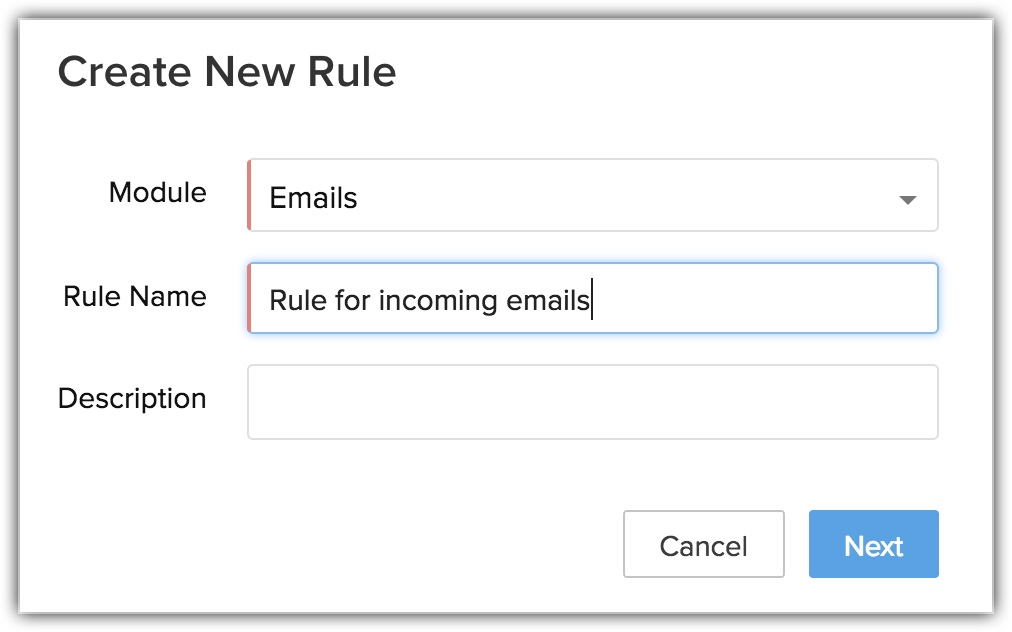
Workflow rules form the automation backbone. Each rule defines a trigger (record creation, field update, or scheduled time), filter conditions, and actions: sending emails, assigning tasks, updating fields, firing webhooks, or running custom Deluge functions. The Standard plan includes 30 rules per module (15 active); Enterprise raises that to 125 (75 active).
Source: Zoho CRM
Workflow insight reports track execution rates and surface failures with affected records, and Zia monitors audit logs to suggest new workflow opportunities based on repetitive manual actions.
CPQ (Configure, Price, Quote) arrives at the Professional tier. Reps configure product bundles, apply pricing rules and discount calculations, and generate quotes directly from a deal record. A guided selling layer surfaces buyer sentiment, competitor mentions, and upsell recommendations as the quote is built. A quotes dashboard tracks approval status and revenue impact.
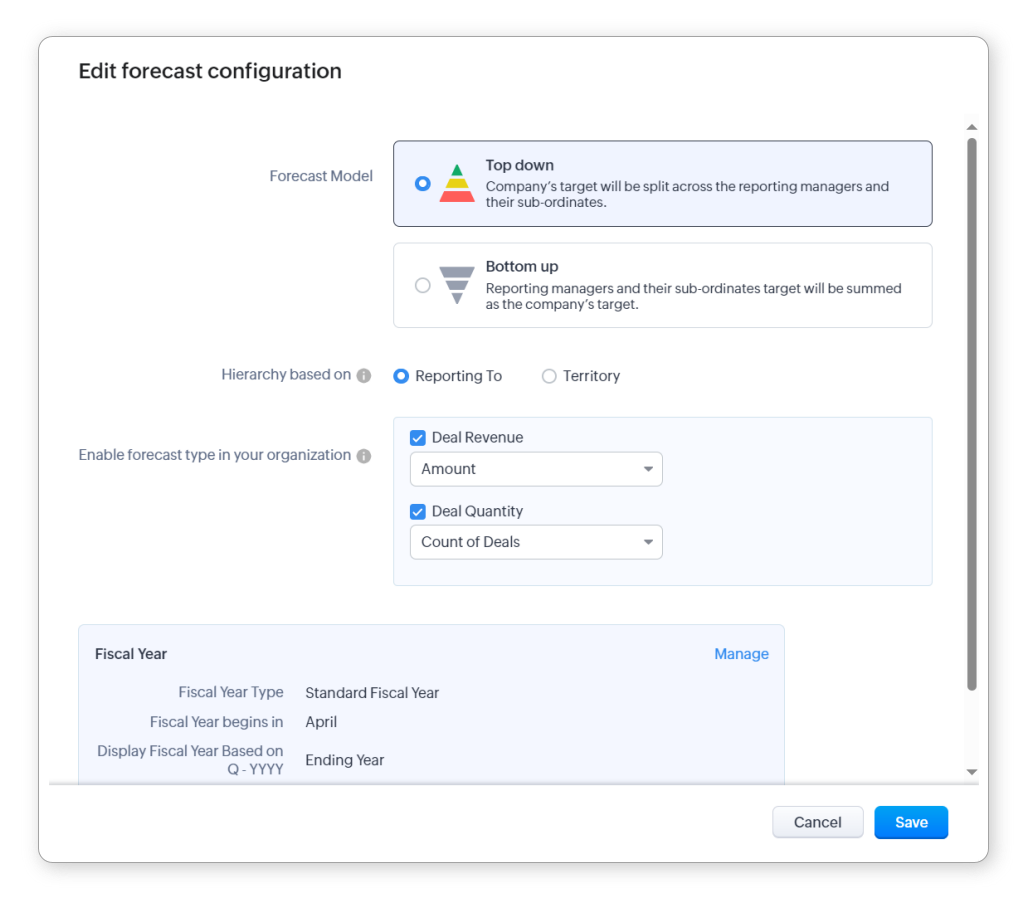
Territory management (Enterprise plan) defines hierarchies by region, product, or team. Automation handles account-to-territory assignment based on rules, and analytics dashboards break down performance at the regional, team, or individual level. Targets cascade from territory to team to rep, with both top-down and bottom-up perspectives.
Sales forecasting pulls from real-time pipeline data, historical results, and Zia's AI layer. Deals are segmented into Committed, Best Case, and Open Deals buckets. Forecasts support non-standard fiscal periods, multiple forecast types (deal revenue, product quantities, licenses sold), and simultaneously accommodate top-down manager views and bottom-up rep views.
Source: Zoho CRM
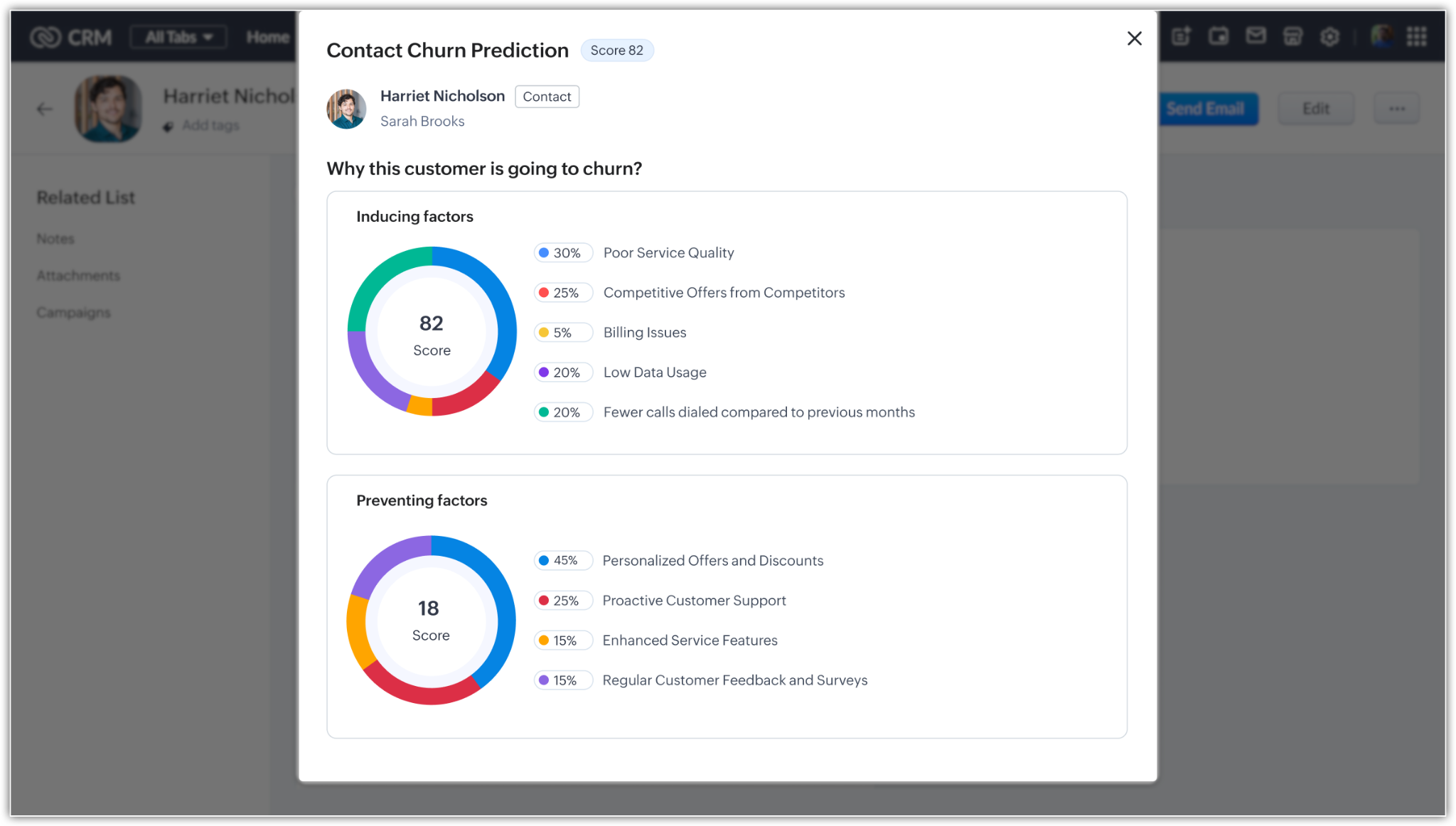
The module also includes a document library for centralized sales collateral, Motivator for gamified leaderboards and goals, SDR Agents for AI lead qualification and meeting scheduling, inventory management for invoices and sales orders (Professional plan), and churn prediction that flags at-risk contacts using transaction history and engagement data.
Zoho CRM Zia AI and Automation Intelligence
Zia is Zoho CRM's built-in AI engine, operating across three tiers: predictive intelligence, generative AI, and agentic AI.
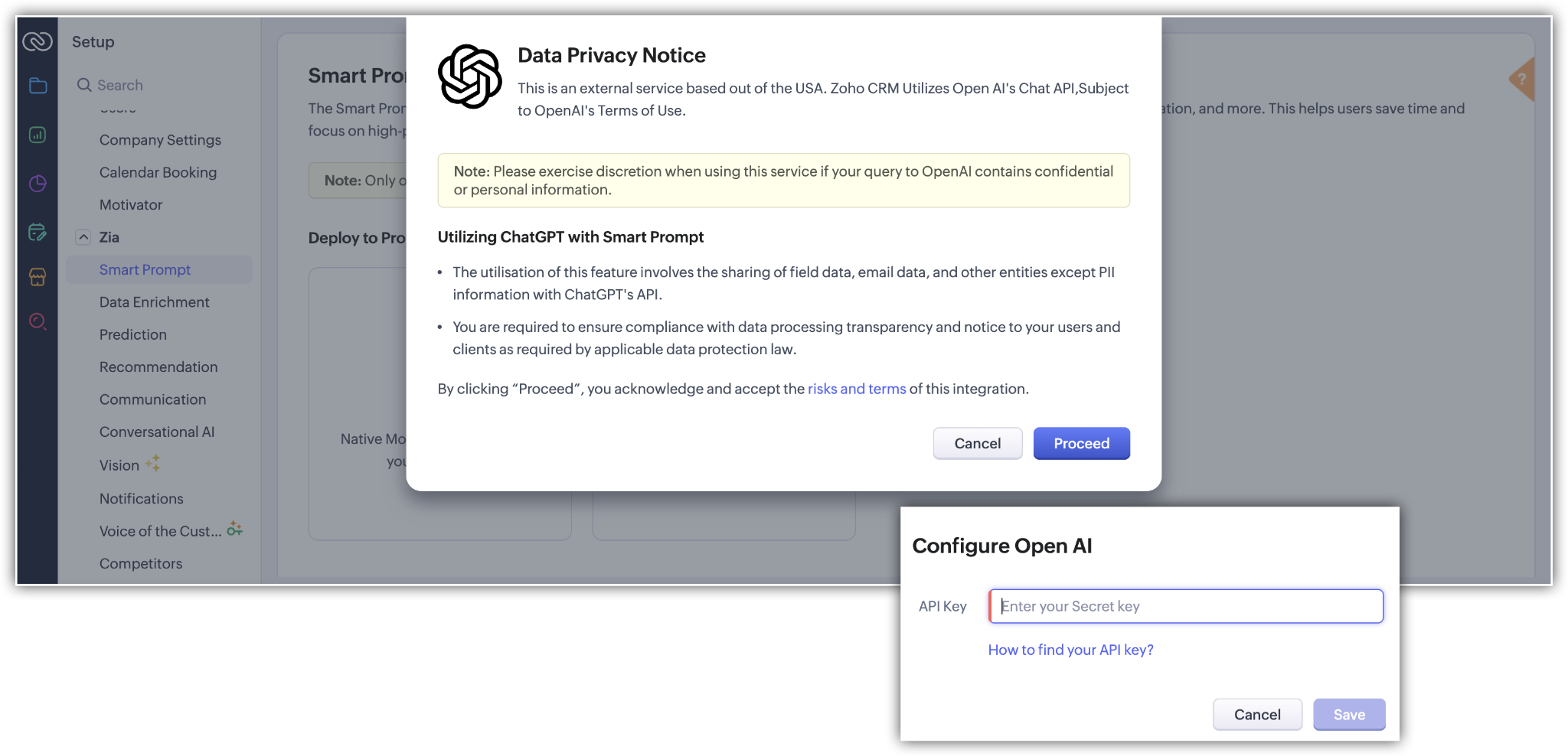
Rather than a single feature, Zia is a layer embedded throughout the CRM that handles the data-intensive parts of sales operations. Zoho runs language models built for business use cases with defined privacy controls, and also supports third-party LLMs (including ChatGPT) through its Smart Prompt feature.
The predictive layer starts with Zia scores, which rank prospects by conversion likelihood based on deal histories, email threads, call recordings, and activity logs. Predictions update continuously as new data flows in.
Churn prediction assigns churn scores to existing accounts and, for subscription businesses, identifies which specific product a customer is at risk of churning from.
Source: Zoho CRM
Field prediction builds custom predictions on any selected record field (deal win/loss probability, expected revenue), and AI forecasting combines user-generated forecasts with anomaly detection and suggests specific actions to close gaps.
Where predictions identify risk and opportunity, recommendations tell reps what to do about them.
The Recommendation Builder identifies which product or service a prospect is most likely to purchase.
Next Best Experience surfaces the ideal next step for each open deal or lead.
Best Time and Mode to Contact analyzes historical engagement patterns to recommend when and how to reach each customer, down to the specific channel and time window.
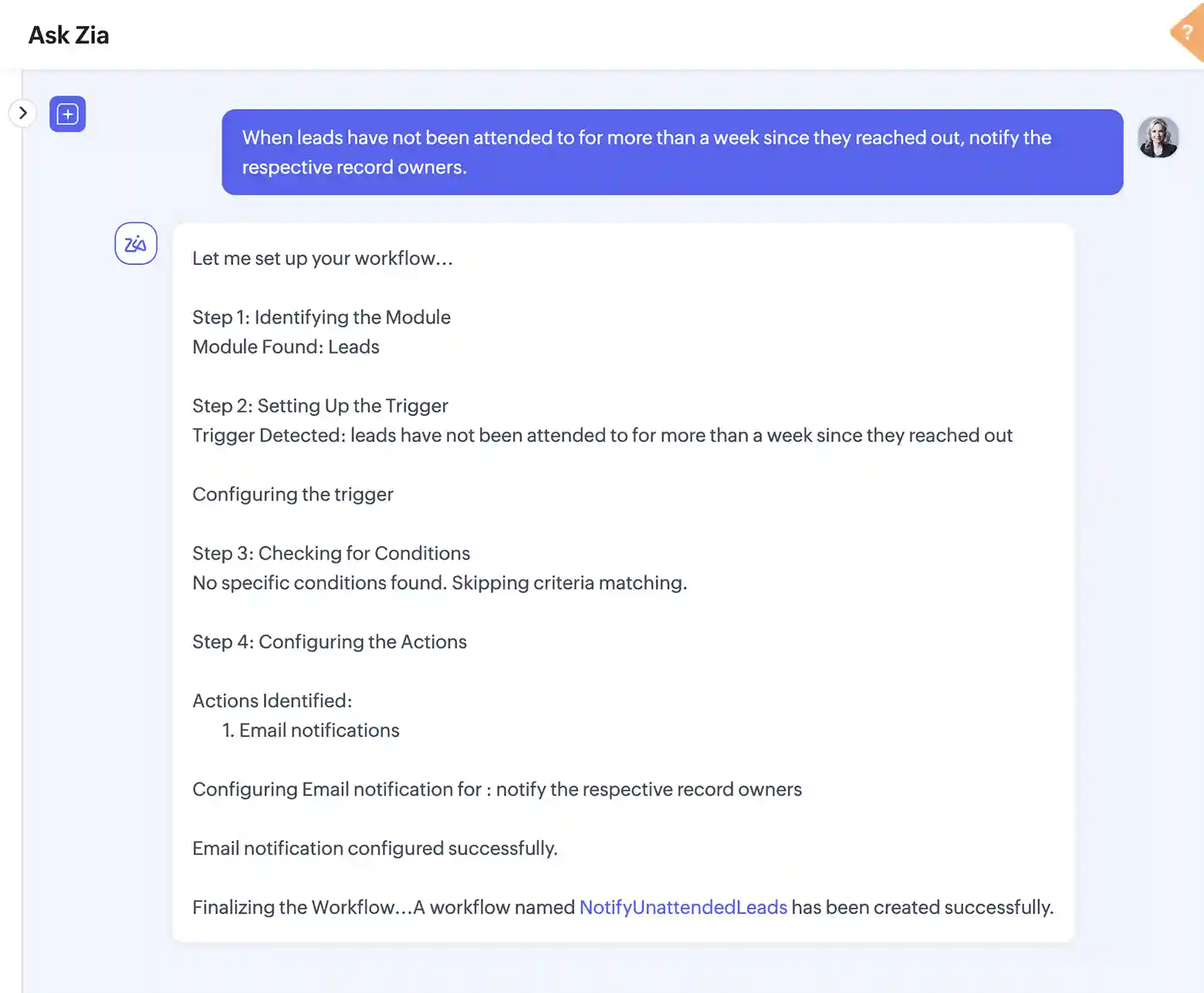
Zia's generative capabilities eliminate manual CRM configuration work. Describe a module in plain language, and Zia builds it with associated fields. Tell Zia to create a workflow rule in natural language, and it generates the trigger, conditions, and actions. Ask for a report, and Zia selects the modules, fields, filters, and chart type automatically.
For content, the Smart Prompt feature generates or revises email drafts, modifies templates, and summarizes notes using either Zia's own LLM or a connected third-party model. Image to Canvas converts a design image into a CRM layout template.
Source: Zoho CRM
Email intelligence (Professional plan and up) processes inbound and outbound emails through Zia's NLP engine. Sentiment analysis categorizes each email as positive, negative, or neutral and triggers alerts for consecutive negative emails.
Intent classification identifies whether an email is a query, request, complaint, or purchase signal, with custom intents trainable from keywords or sample data. Emotion analysis tags emails across eight categories (happy, enthusiastic, frustrated, confused, grateful, discontented, trusting, neutral).
Competitor alerts notify reps when leads or contacts mention a competitor in email, with sentiment context. Zia also provides email subject line suggestions, autocomplete, translation, and a writing assistant.
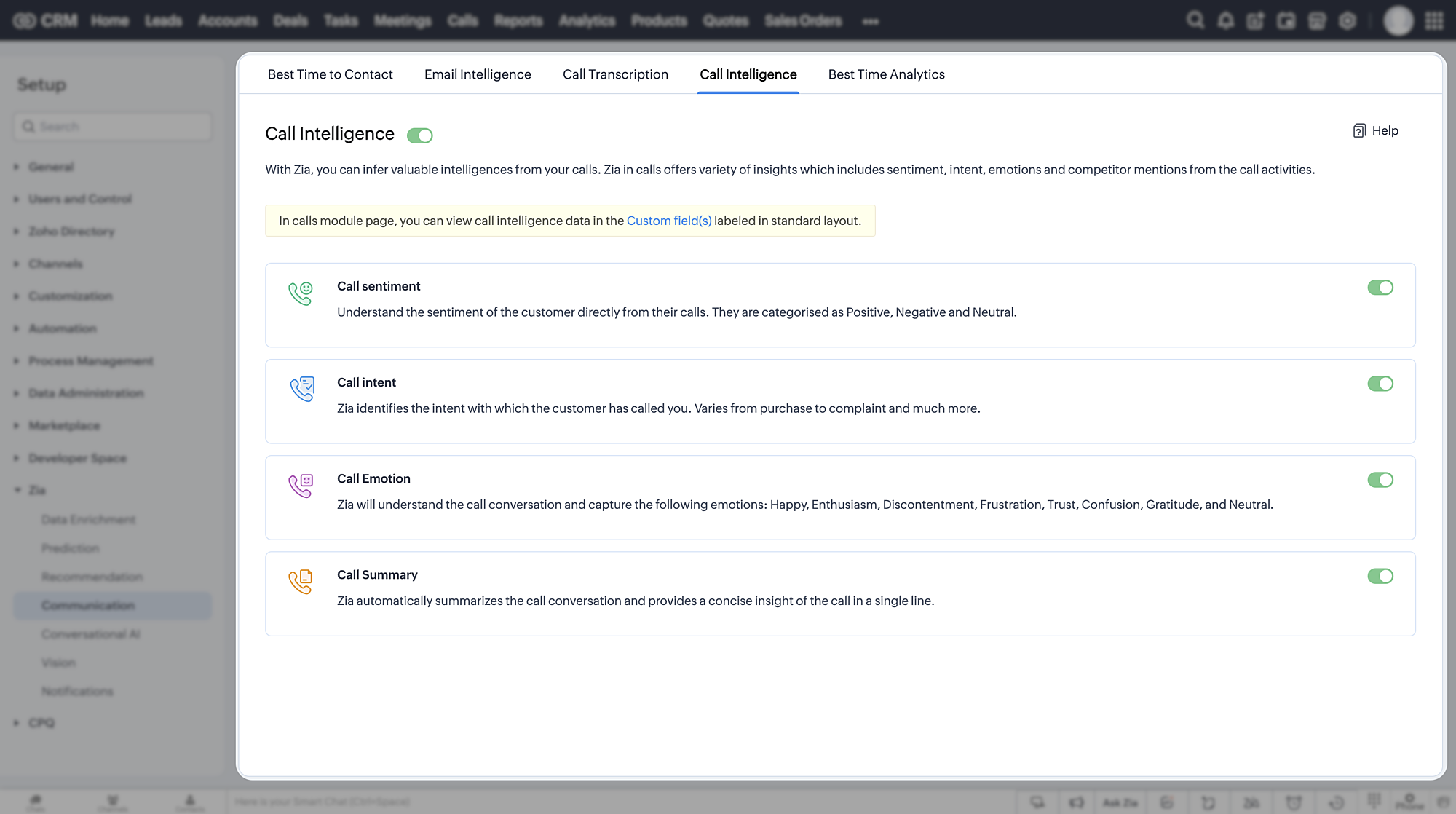
Call intelligence transcribes call audio to text automatically, then extracts sentiment, intent, emotion, and a one-line summary. A dashboard tracks monthly transcription usage. Vision AI rounds out the intelligence layer with Intelligent Character Recognition (extracting information from images and mapping fields to CRM records) and image validation with duplicate detection.
Source: Zoho CRM
Zia Agents represent the newest tier: autonomous AI entities that plan and execute multi-step sales tasks without human intervention at each step. Agents deploy into Zoho CRM as either "Connections" (using a user's identity and permissions) or "Digital Employees" (independent entities with their own identities).
The Zia Agent Studio provides a low-code environment for building custom agents, and the Zia Agents Store offers 100+ pre-built agents integrated with 60+ applications.
Pre-built agents include an SDR Agent (lead nurturing and meeting scheduling), Sales Coach (personalized rep feedback), Follow-up Scheduler (autonomous prospect outreach), Deal Analyzer (win probability and next-step recommendations), Quote Generator, and Revenue Growth Specialist (upsell and cross-sell identification).
For organizations needing AI beyond Zia's native capabilities, QuickML (Ultimate tier) lets teams build and deploy custom ML models that integrate directly with CRM data, with daily free API calls included.
Zoho CRM Marketing Automation and Omnichannel Communication
Zoho CRM packages its marketing and communication capabilities natively inside the CRM rather than requiring a separate product.
The system spans three layers: Cadences for automated multichannel follow-up, omnichannel communication for unified channel management, and CommandCenter for end-to-end journey orchestration. Every conversation, across every channel, logs to the same record the sales team uses.
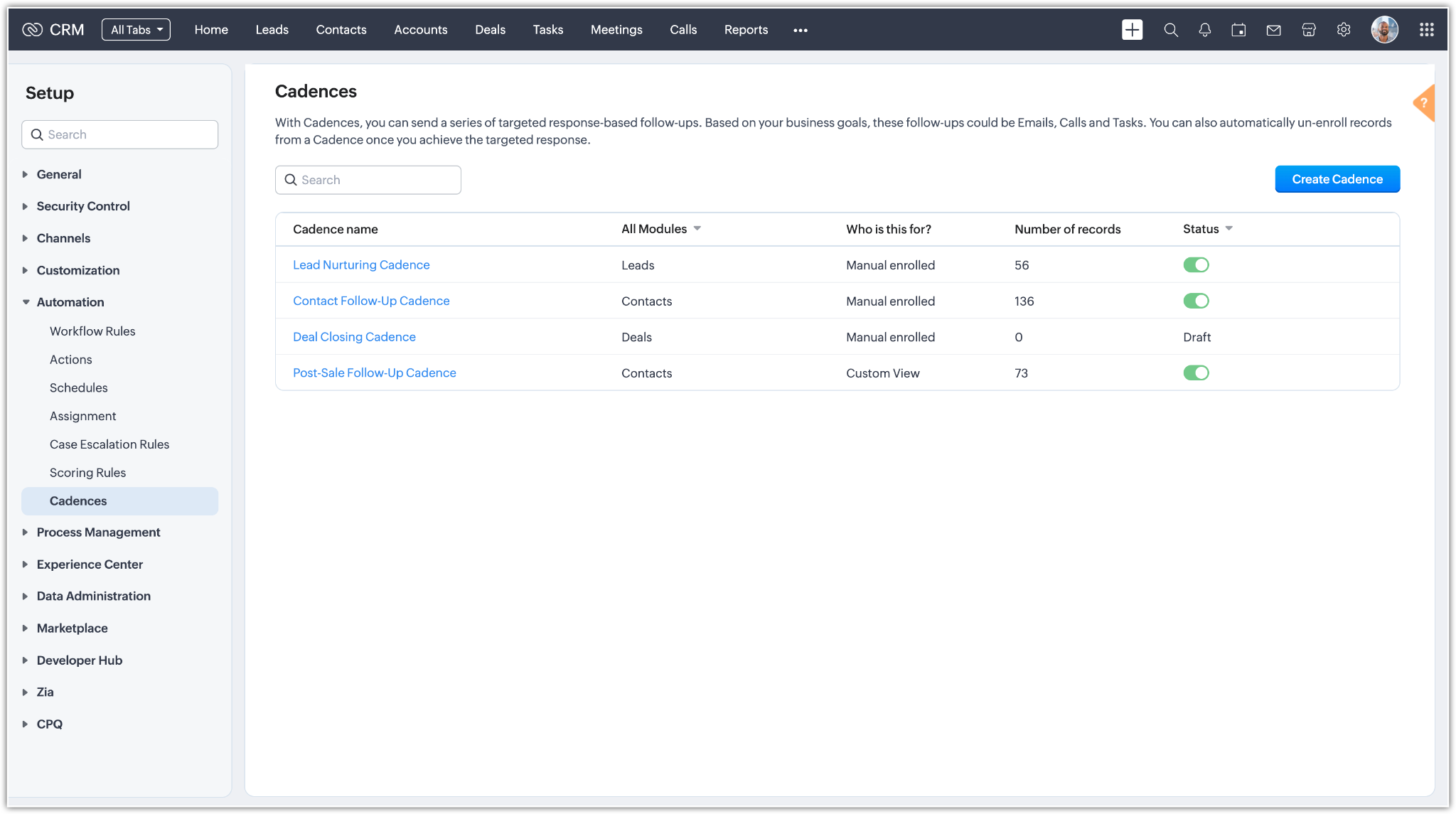
Cadences (Standard plan and up) let reps build branching, multichannel follow-up sequences that react to each prospect's behavior. A Cadence coordinates tasks, phone calls, and emails so that when a prospect ignores one channel, the next touchpoint shifts to another automatically.
Source: Zoho CRM
If a prospect ignores your email, a follow-up task fires. If they click a link, a call gets scheduled. Audience enrollment supports both dynamic mode (auto-updates as lead criteria change) and manual entry. The Standard plan includes 20 Cadences per module (10 active).
From inside any prospect record, reps can work across every supported channel without leaving the CRM.
Omnichannel communication covers email, click-to-dial phone calls with automatic transcription logging, WhatsApp and Line messages, SMS using pre-approved templates, online meetings, and live chat through Zoho SalesIQ integration.
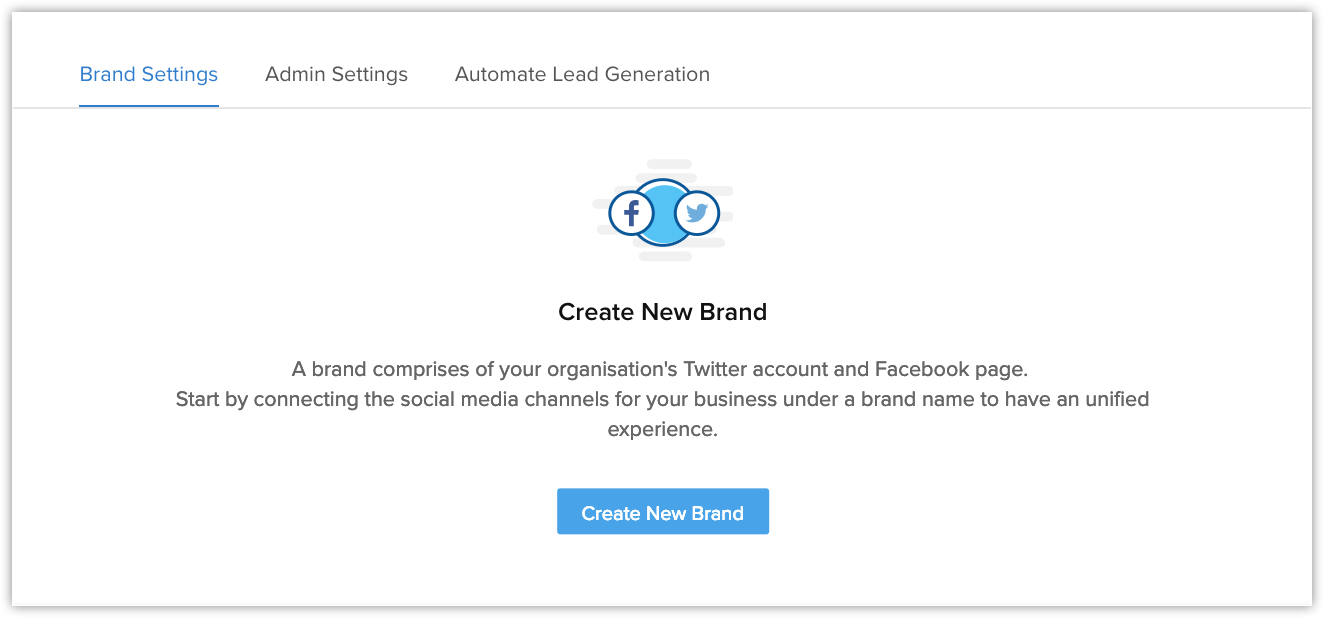
Social CRM monitors brand mentions and engagement on Facebook, Twitter/X, and LinkedIn, and auto-converts social interactions into CRM leads or contacts. Zia recommends the channel most likely to convert and the best outreach time per prospect based on historical engagement patterns.
Source: Zoho CRM
SalesSignals fires real-time notifications whenever a prospect opens an email, responds on any channel, initiates a chat, or engages on social media. Each alert appears directly within the prospect record alongside full interaction history, so a rep never has to check multiple tools to see what just happened.
Lead management relies on a combination of Zia AI scoring and manual scoring models. The system assigns leads automatically by criteria or round-robin, with workload caps per rep preventing overallocation. Double opt-in and consent management handle GDPR and HIPAA compliance. Google Ads integration (Professional plan) enables click-to-cash attribution.
CommandCenter / Journey Orchestration (Enterprise plan) adds the strategic layer.
PathFinder discovers how customers actually move across channels and touchpoints, surfacing paths the team may not have designed.
Journey Builder provides a visual drag-and-drop editor for defining multi-department journeys, with analytics showing popular paths, bottlenecks, and drop-off points. CommandCenter handles journeys spanning marketing, sales, and service departments, resolving coordination delays that occur when teams operate in separate tools.
Zoho CRM Workflow and Process Automation
Zoho CRM stacks five distinct automation tools, each targeting a different level of complexity, all within the same product.
This layered approach means an admin building simple email alerts uses the same platform as one enforcing a 12-stage compliance workflow across three departments.
Workflow rules (Standard and up) are the foundational layer.
Each rule follows a trigger, condition, action chain: a record is created, a field updates, or a scheduled time arrives; conditions filter which records qualify; and actions fire instantly or on a delay (email alerts, task creation, field updates, webhooks, custom Deluge functions that reach third-party apps). Insight reports track execution rates and diagnose failures.
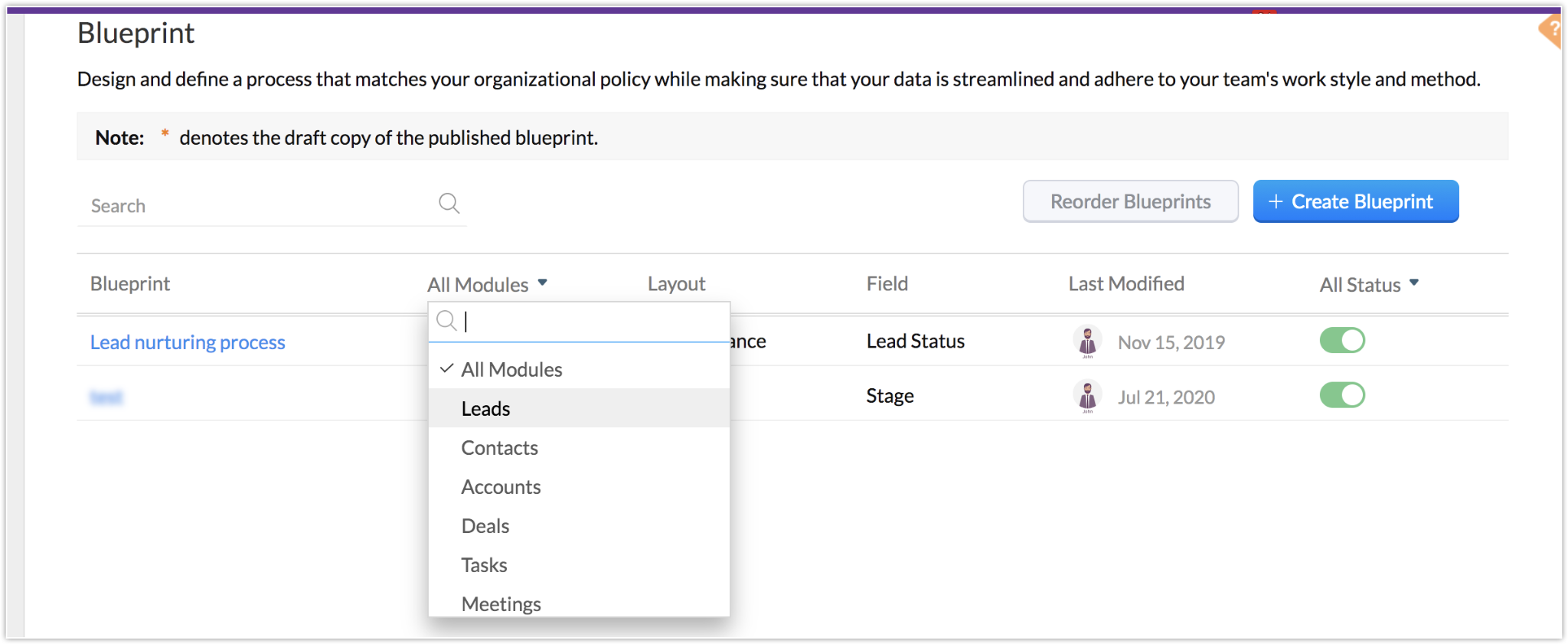
Blueprint (Professional and up) models an entire sales process as a visual state machine. An admin creates stages and transitions in a drag-and-drop editor, specifying what conditions must be true before a rep can advance a record.
Source: Zoho CRM
At each transition, Blueprint enforces required actions: filling specific fields, logging a call, completing a task. Stale records trigger alerts and escalations if they sit too long at any stage. Unlike pipeline-stage views in many CRMs (which are cosmetic), Blueprint is a compliance tool: it "inserts checks and balances to ensure your team follows the process just as designed."
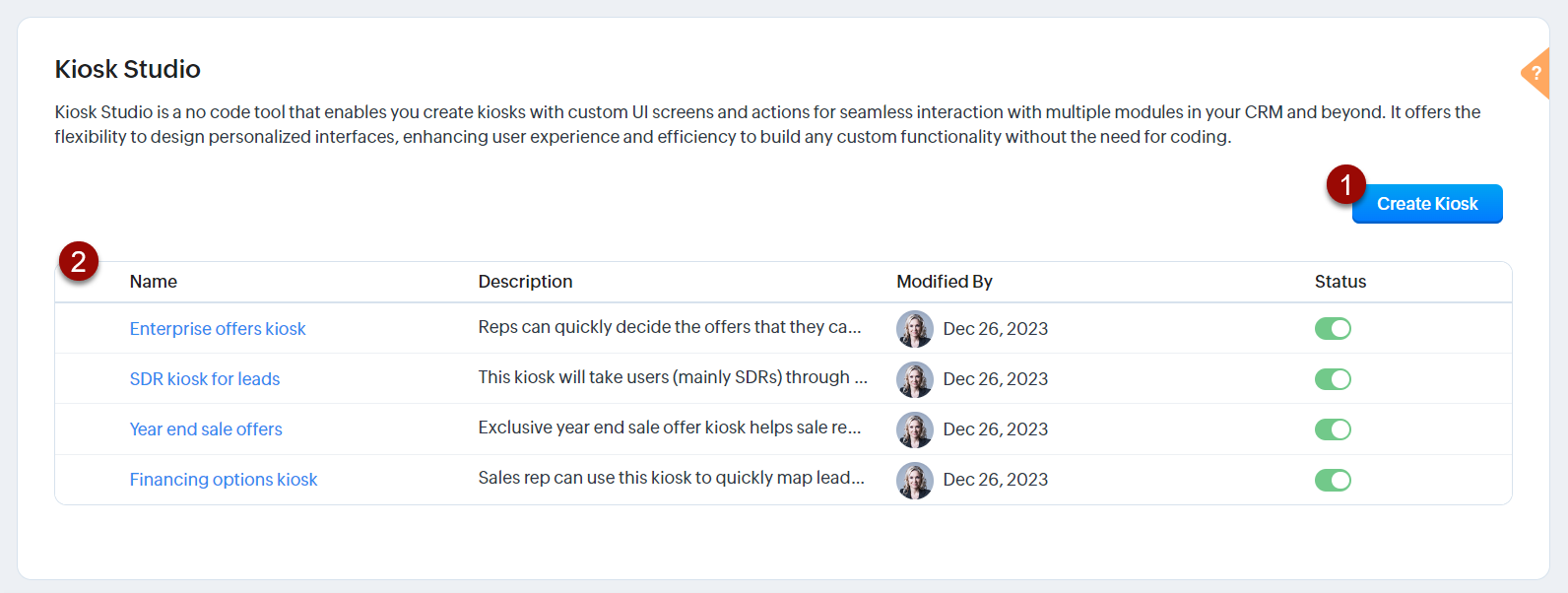
Kiosk Studio (Enterprise) is a no-code visual builder for custom interactive screens. Admins drag and drop UI components (fields, buttons, display screens) to create guided, step-by-step flows embeddable anywhere in the CRM. An onboarding checklist, a return authorization process, or a compliance questionnaire can be built without developer involvement.
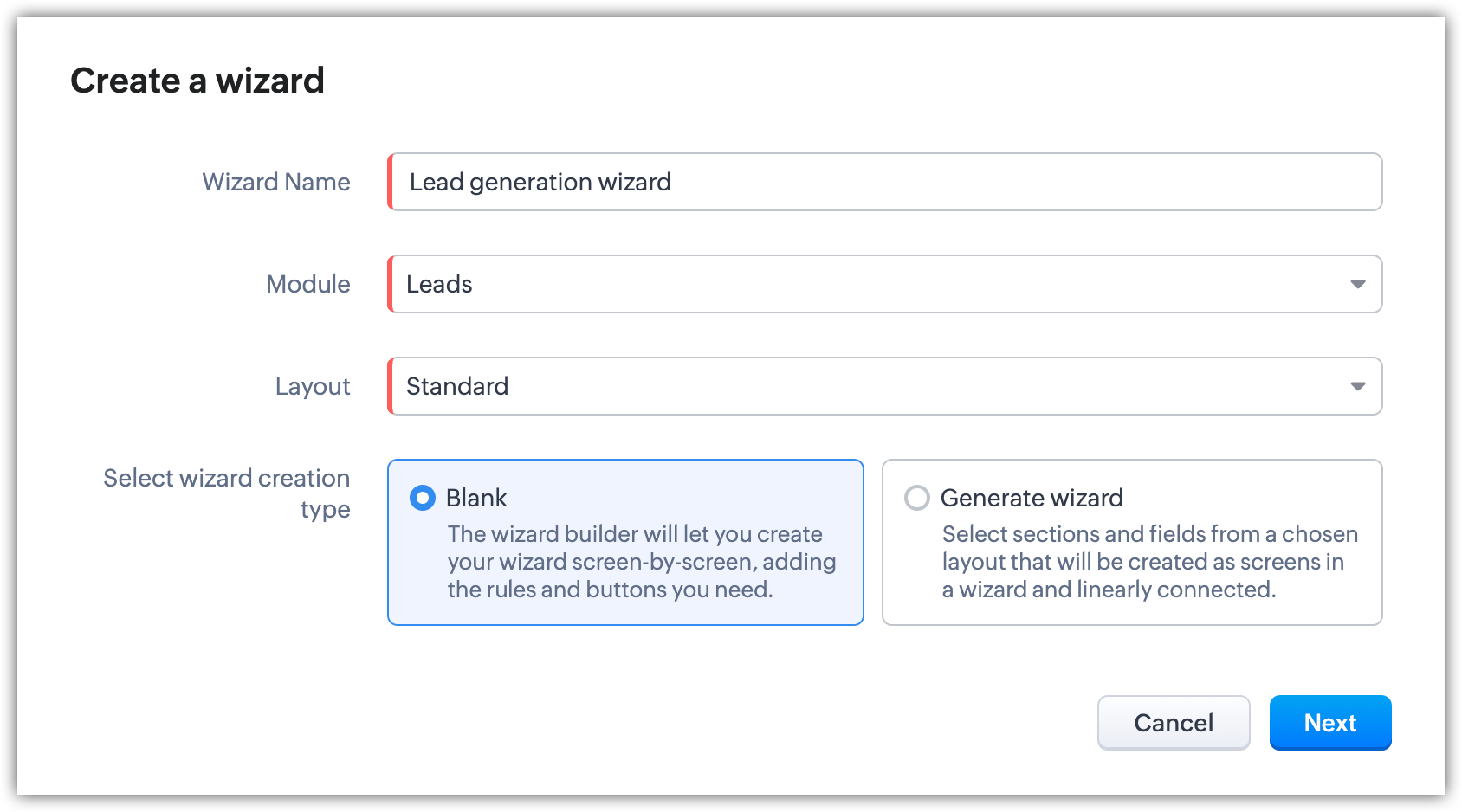
Wizards (Enterprise) replace long CRM forms with sequential, context-aware screens that collect data in logical stages. A 30-field lead form becomes four focused screens, each showing only the fields relevant to what the user selected on the previous screen.
Source: Zoho CRM
Approval processes route records through structured sign-off chains: a discount exceeding 20% goes to the regional VP, a deal above $100K triggers legal review, an expense report routes to the department head. Validation rules enforce data quality before records can be saved.
Custom functions (Enterprise) extend workflow actions beyond what webhooks alone can accomplish, using Deluge scripting to call third-party APIs, manipulate data, or trigger business logic.
Zoho CRM Analytics and Business Intelligence
Zoho CRM's analytics suite serves three audiences from one platform: individual reps tracking progress, managers assessing team performance, and leaders needing an organizational health view.
The system surfaces insights from CRM data without exporting to spreadsheets or configuring a separate BI tool.
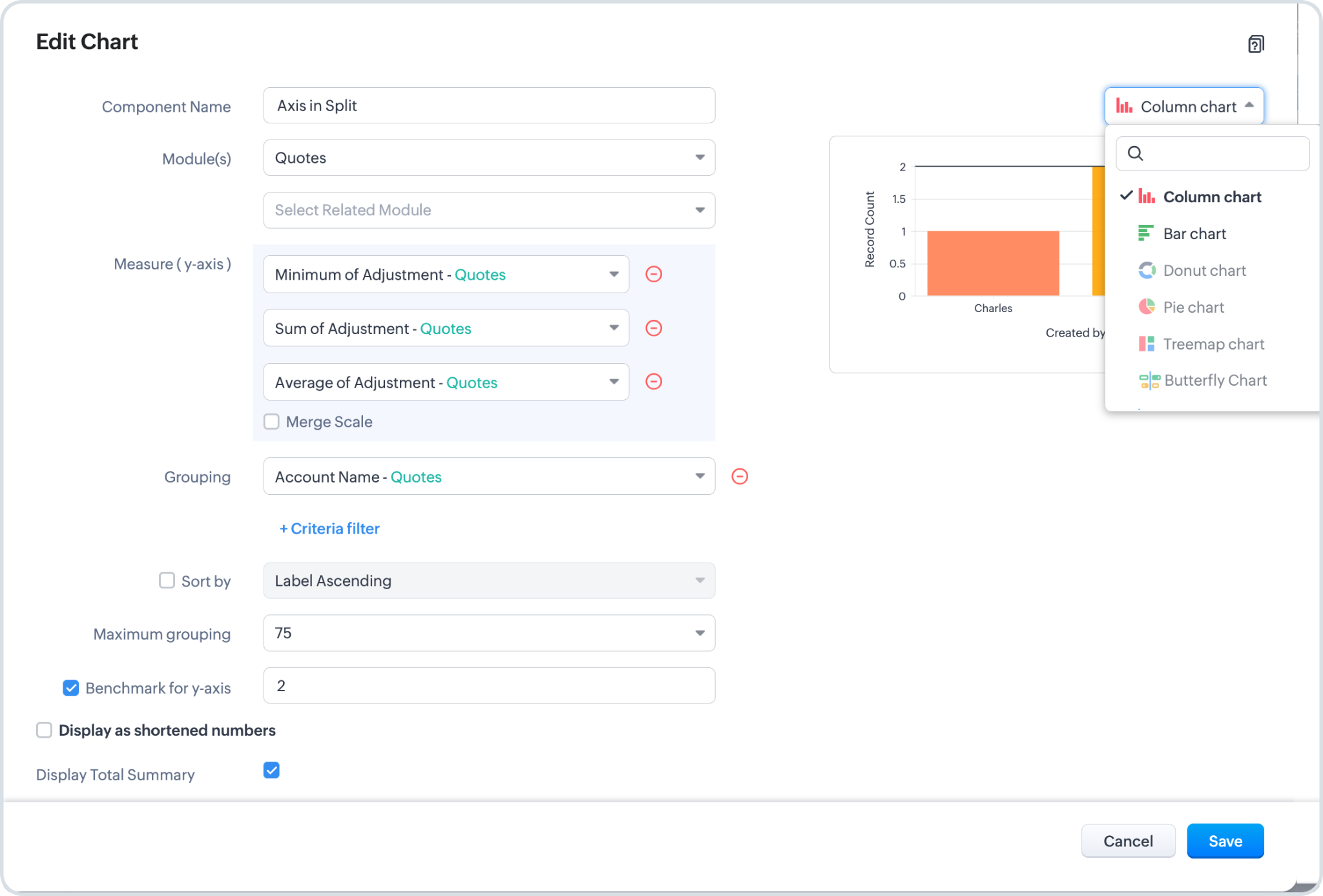
Reports and charts are the starting point. Users build reports directly from CRM data (leads, deals, contacts, accounts, activities, campaigns) and generate charts in a single click from any report. Nine chart types are available: Bar, Line, Funnel, Table, Column, Donut, Pie, Area maps, and Heat maps.
Source: Zoho CRM
Clicking into any entry drills down to the full record-level detail behind it. Custom reports and dashboards are available from the Standard tier.
Dashboards aggregate multiple components into a single view: charts, KPI monitors in five formats (Standard, Growth Index, Basic, Scorecard, and Rankings), funnels, comparators, and target meters. Sales managers configure executive dashboards that consolidate performance metrics across all departments.
The forecasting engine pulls from pipeline data, historical performance, and Zia's AI suggestions. Forecasts can be monthly, quarterly, or annual, tracking deal revenue, product quantities, or licenses. The pipeline splits into Committed, Best Case, Open, and Closed categories with adjustable targets, and both top-down and bottom-up views work simultaneously.
Zia's analytics layer adds a proactive dimension. Zia monitors trends across all tracked sales parameters and detects anomalies automatically, notifying stakeholders about unusual events (a sudden dip in lead volume, an unexpected spike in churn). Once it has accumulated enough data, it prescribes corrective actions.
Zia can also compile the most meaningful reports into a presentation-ready narrative that tells the story of organizational performance, removing the manual step of slide preparation.
For organizations that need analytics beyond CRM data, Zoho CRM connects natively to Zoho Analytics, a dedicated BI platform recognized in the 2025 Gartner Magic Quadrant for Analytics and Business Intelligence Platforms.
This integration lets teams blend CRM data with 250+ additional sources and use Ask Zia conversational AI to query business data in natural language. The Ultimate tier adds data preparation (merging and segregating similar datasets into single tables for cleaner analysis).
Marketing ROI analytics track campaigns from click-to-cash, and post-sales analytics identify frequent purchasers and top spenders for cross-sell and upsell targeting. Motivator layers gamified performance analytics (leaderboards and quota progress) on top of the reporting engine.
Zoho CRM Customization and Developer Platform
Zoho CRM supports no-code, low-code, and pro-code paths from a single platform, so both non-technical admins and developers can reshape the CRM to match their processes.
Canvas Design Studio is the no-code interface builder. Admins drag and drop components to redesign record views, layouts, and detail pages without writing code. A support team's contact view can look entirely different from a sales rep's, each tailored to the information that role needs.
Source: Zoho CRM
CRM for Everyone / Teamspaces extends this concept organization-wide, creating dedicated workspaces for non-sales teams (legal, HR, finance, marketing, development, onboarding) connected to core CRM data. This scopes the UI to job context, reducing cognitive overhead for occasional users.
On the developer side, the platform exposes REST APIs with full CRUD access to CRM data, GraphQL APIs for selective field querying, and a Widget SDK for embedding custom UI components built with any open-source web technology.
Serverless Deluge functions execute in response to CRM events without separate hosting, and client scripts run event-driven UI actions client-side in real time. The current API is V8, with a credit-based rate limit system ranging from 5,000 credits/day on the Free plan to unlimited on Ultimate/CRM Plus.
Source: Zoho CRM
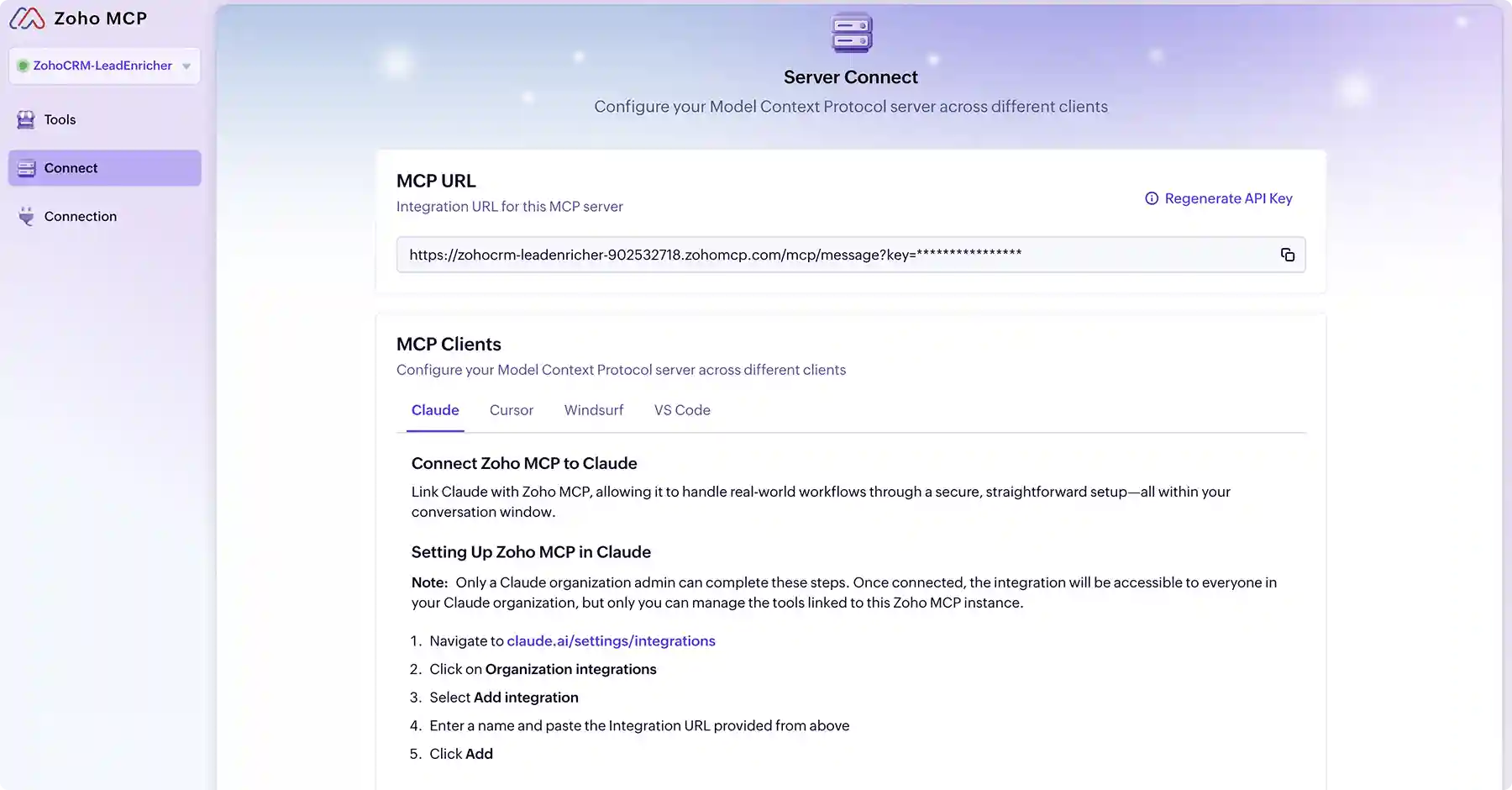
Zoho MCP connects external LLMs like ChatGPT or Claude to Zoho's APIs and data models, enabling AI agents to translate natural language into business actions inside the CRM. A Sandbox environment (Enterprise and up) lets teams validate integrations, APIs, and customizations before deploying to production. A free Developer Edition provides a fully featured CRM instance for safe testing.
Zoho CRM Integrations, Security, and Infrastructure
Integrations span three tiers. Natively, Zoho CRM integrates with 40+ first-party applications: Zoho Books, Campaigns, Desk, Sign, Analytics, SalesIQ, Projects, and more, all sharing the same data layer with no third-party sync required.
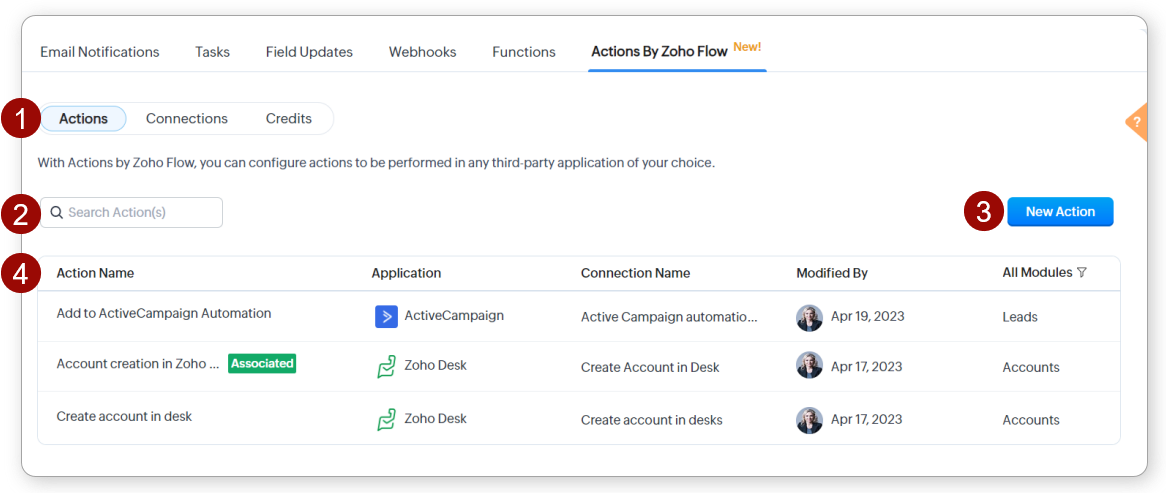
The Zoho Marketplace lists 1,100+ app integrations covering marketing, sales, finance, booking, telephony, communications, and document management. Named native integrations include Google Workspace, Microsoft 365, Google Ads, and WhatsApp Business. Zoho Flow serves as the iPaaS layer, enabling multi-app workflows that trigger across connected applications.
Source: Zoho CRM
Security and compliance rest on a broad certification stack: ISO 27001, ISO 27701, ISO 27017, ISO 27018, ISO 9001, ISO 22301, SOC 2 Type 2, SOC 1, and HIPAA. Zoho operates its own data centers globally (18 data centers across India, UAE, UK, US, Australia, Japan, China, Canada, and Saudi Arabia) with biometric access, AES-256 backup encryption, and redundant architecture.
Enterprise features include field-level encryption (Enterprise plan), audit logs, IP restrictions, role-based permissions, SSO with Active Directory, and MFA via Zoho OneAuth (biometric, push notification, QR code, TOTP, and hardware Yubikey). A published bug bounty program covers ongoing vulnerability management.
Zoho operates a no-advertising-based business model and does not sell customer data, with no third-party trackers on its websites. GDPR controls serve as the baseline standard for all global operations, not just EU customers.
Where Zoho CRM Stops: The Gaps
Zoho CRM centers on the sales team's internal workflow: managing leads, automating processes, analyzing pipeline, and communicating with prospects across channels.
That focus shapes the product's strengths, but it also means the platform depends on external sources for several capabilities a revenue team needs.
No native B2B contact or company database.
Zoho CRM manages the contacts and companies you put into it, but it does not include its own database of verified contacts, direct dials, org charts, or technographics. A team using Zoho CRM without a data provider has to source prospects manually, import from spreadsheets, or connect third-party lead generation tools. The CRM stores and organizes the data; it does not supply it.
No native buyer intent signals.
Zoho CRM tracks engagement with your own outreach (email opens, website visits via SalesIQ, social interactions), but it does not include intent data showing which companies are researching your category across the web before you ever contact them. Engagement signals tell you who is responding to your activity; intent signals tell you who is in-market before any outreach begins.
Conversation intelligence is limited to call transcription.
Zoho CRM's Zia transcribes calls and extracts sentiment, intent, and emotion, but the platform does not include the conversation intelligence that dedicated tools provide: deal risk detection based on conversation patterns across thousands of deals, coaching scorecards with rep-to-rep comparison, competitive mention tracking across the full call library, or buying committee sentiment mapping from meeting transcripts.
Source: Zoho CRM
The transcription covers what was said; it does not reason about why deals move or stall based on conversation patterns.
No contact-level website visitor identification.
Zoho SalesIQ (the live chat integration) identifies website visitors, but the identification is session-based and depends on the visitor engaging with chat or forms. There is no passive, contact-level resolution of anonymous website traffic comparable to what specialized visitor identification tools provide.
Third-party marketplace depth versus larger ecosystems.
Zoho's marketplace offers 1,100+ extensions, but organizations requiring deep integrations with niche enterprise systems may find fewer pre-built connectors compared to ecosystems like Salesforce AppExchange with 7,000+ apps.
How ZoomInfo Covers the Gaps
The gaps above share a common thread: Zoho CRM manages the contacts you already have, but depends on external sources for the data, signals, and intelligence that tell you who to contact and why.
ZoomInfo supplies those layers.
ZoomInfo's B2B Data Platform: The contact and company database Zoho CRM does not include
ZoomInfo operates one of the largest B2B data platforms available: 500M contacts, 100M companies, 135M+ verified phone numbers, 120M direct-dial phone numbers, and 200M+ verified business email addresses.
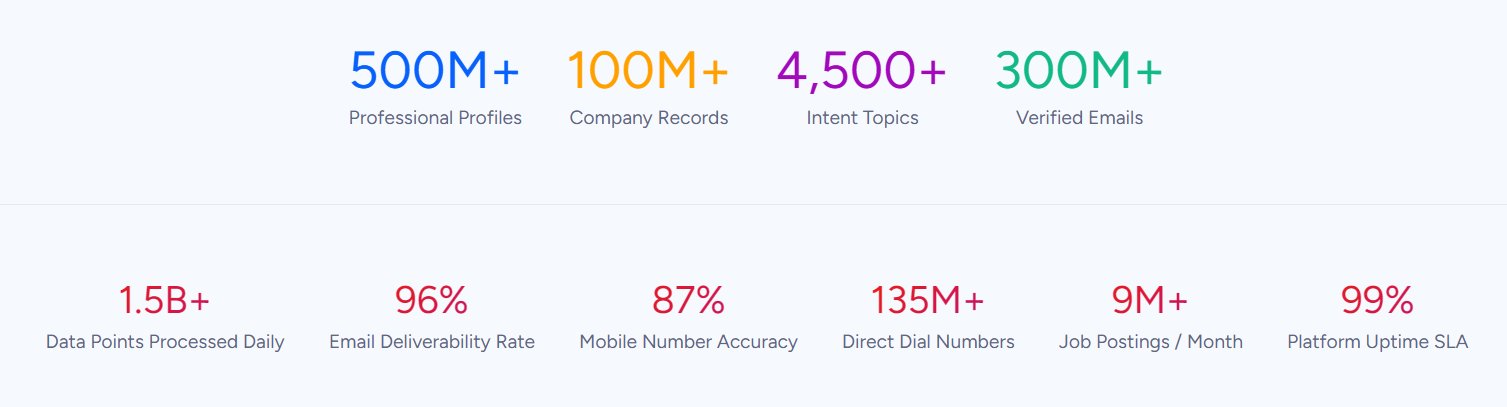
The data flows through a verification pipeline backed by 300+ human researchers and automated ML scanning 28 million site domains daily, reaching up to 95% accuracy on first-party data.
For a team using Zoho CRM, this fills the prospecting gap directly. Zoho CRM manages leads and deals inside the pipeline; ZoomInfo supplies the verified contacts those pipelines run on.
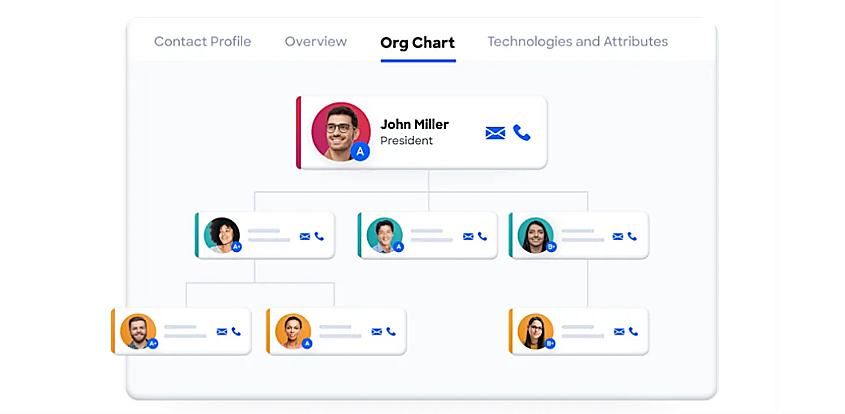
ZoomInfo provides department org charts with decision-makers' direct dials and emails, 300+ company attributes for segmentation, technographic profiles covering 30,000+ technologies across 200+ categories for 30+ million companies, and contact tracking with job-change alerts.
Global coverage extends to 34M+ company profiles outside North America, 200M+ professional profiles outside NA, and 45M+ mobile numbers outside NA.
In a Fortune 500 competitive RFP analyzing 25 million contacts across vendors, an independent consultant concluded that "no other competitor came even close."
The data quality is externally validated: Leader in the Forrester Wave for Intent Data Providers, Q1 2025, Leader in the Gartner Magic Quadrant for ABM Platforms for the second consecutive year, and the only vendor positioned in the Gartner Voice of the Customer Customers' Choice quadrant with a 4.7/5.0 rating.
ZoomInfo Intent and WebSights: Signals that show who is in-market before outreach begins
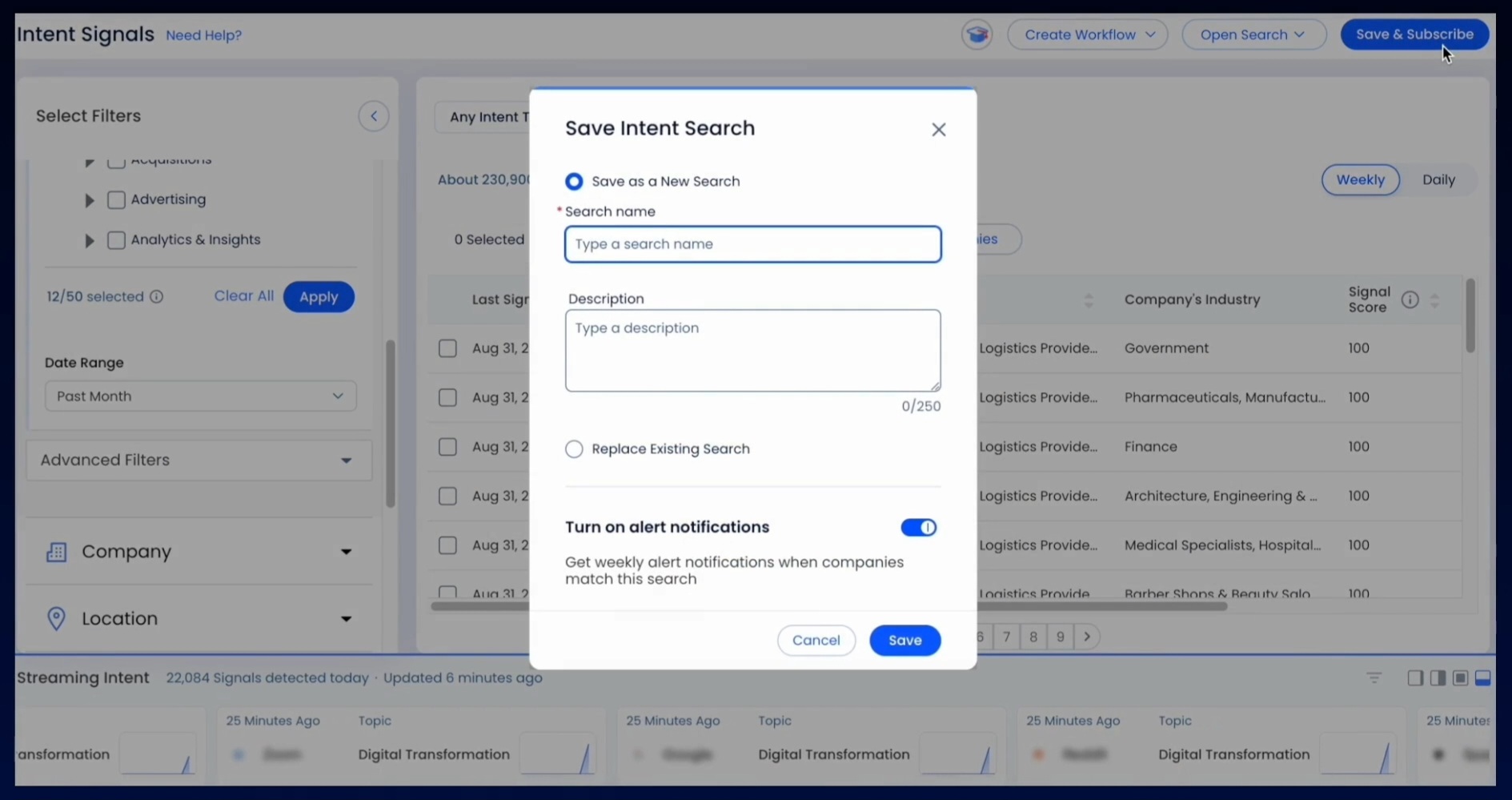
ZoomInfo Intent tracks signals from 210 million IP-to-Organization pairings and 6 trillion+ new keyword-to-device pairings sourced monthly.
Where Zoho CRM's SalesSignals track engagement with your own channels, ZoomInfo's intent data reveals which companies are researching topics related to your product across the web, before you have ever contacted them. Guided Intent, exclusive to ZoomInfo, identifies the topics historically correlated with deal success rather than requiring manual topic selection.
Source: ZoomInfo
On the website side, WebSights resolves anonymous website traffic to companies with Automatic Traffic Filtering that distinguishes real visitors from bots. ZoomInfo Marketing goes further with contact-level site visitor identification, identifying who specifically visited (not just which company) and triggering personalized outreach instantly.
ZoomInfo's GTM Context Graph and Chorus: Intelligence that captures why deals move, not just that they moved
Zoho CRM's Zia transcribes calls and extracts sentiment at the individual conversation level.
ZoomInfo's GTM Context Graph operates at a different level: it processes 1.5B+ data points daily, combining ZoomInfo's B2B data with a customer's CRM records, conversation intelligence from Chorus (backed by 14 technology patents), email interactions, and behavioral signals into one intelligence layer.
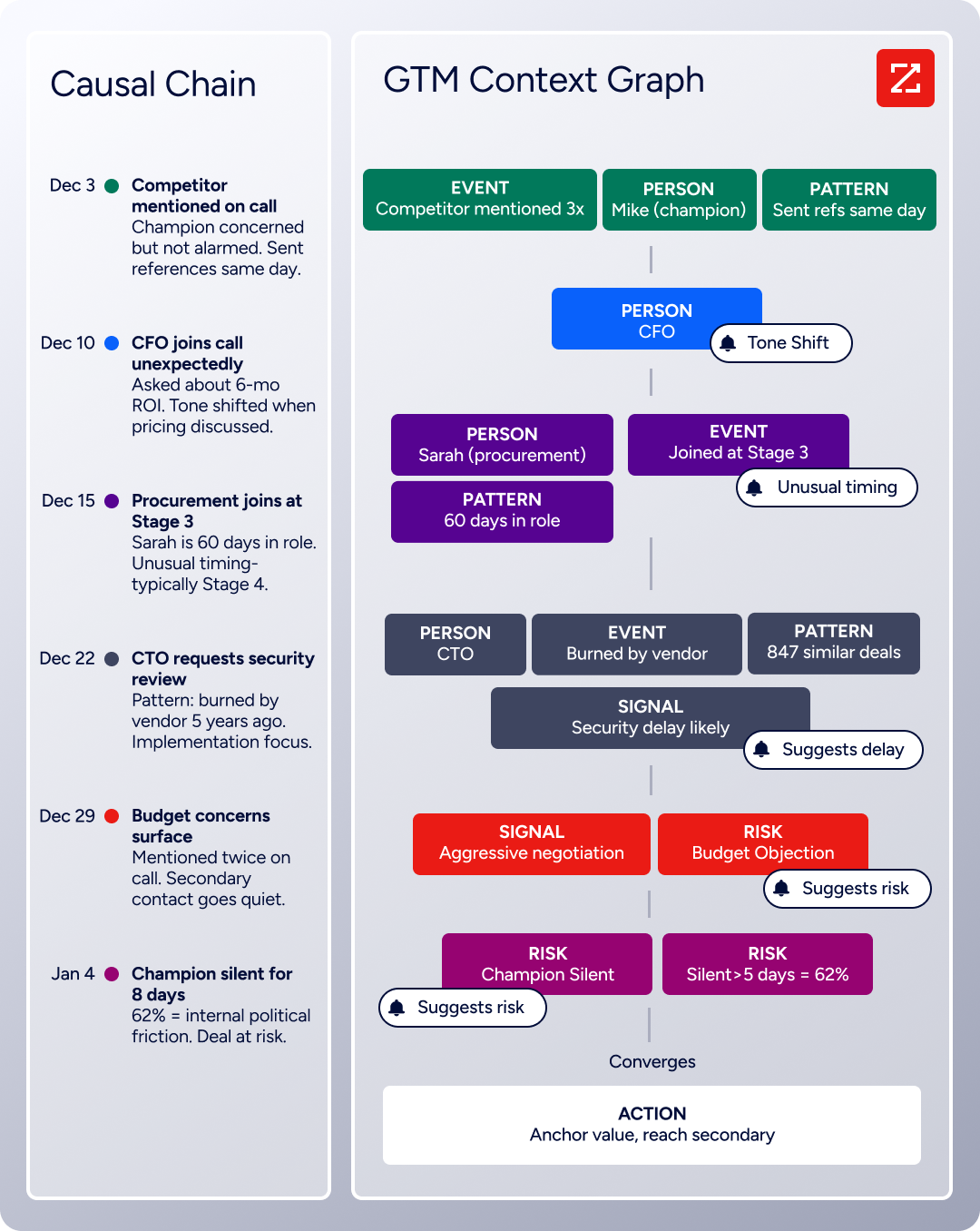
A CRM records that a deal moved stages. Chorus captures what the CFO said on the last call.
The GTM Context Graph combines both to surface why the deal moved: connecting executive sponsorship entering at this stage with ROI-focused questions to the pattern behind closed-won deals in the same segment, then linking that to third-party signals showing the company is hiring and researching a competitor. That intelligence flows into outreach, forecasting, and deal execution.
ZoomInfo GTM Workspace and GTM Studio: Execution and orchestration surfaces
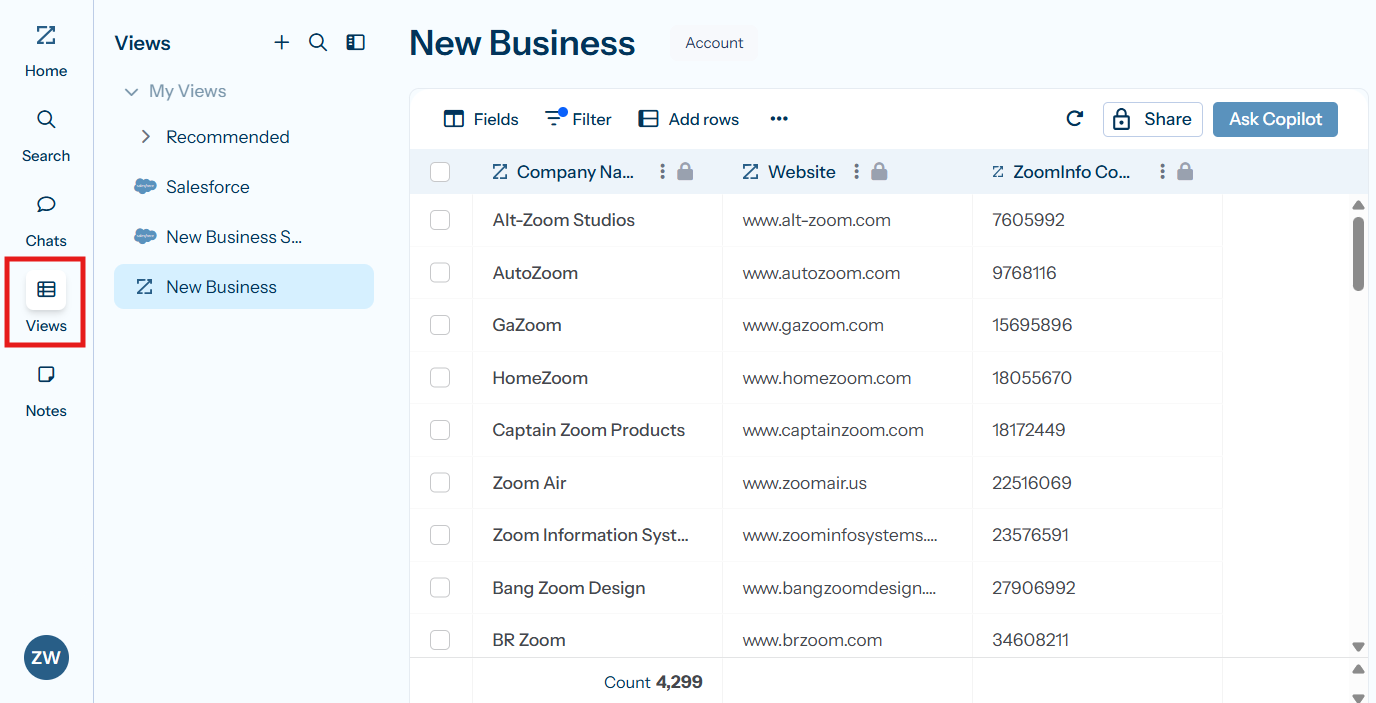
GTM Workspace is ZoomInfo's seller front-end, built on the GTM Context Graph.
Source: ZoomInfo
It provides a complete Book of Business view across CRM, ZoomInfo data, conversation history, and market intelligence, with AI agents automating account research, outreach, CRM updates, and signal monitoring. An Action Feed streams in-market buyers matched to target criteria with pre-drafted actions on every signal.
GTM Studio addresses the marketing orchestration and ABM gap. Marketers, RevOps teams, and GTM engineers can build audiences using natural language, enrich with first- and third-party data, define triggers, and activate plays across channels without engineering support.
Pre-built GTM plays cover inbound acceleration, champion tracking, competitive displacement, and ICP targeting. Expansion plays that used to take 3 weeks now launch in 30 minutes.
ZoomInfo APIs and MCP: Data access for any tool or AI agent
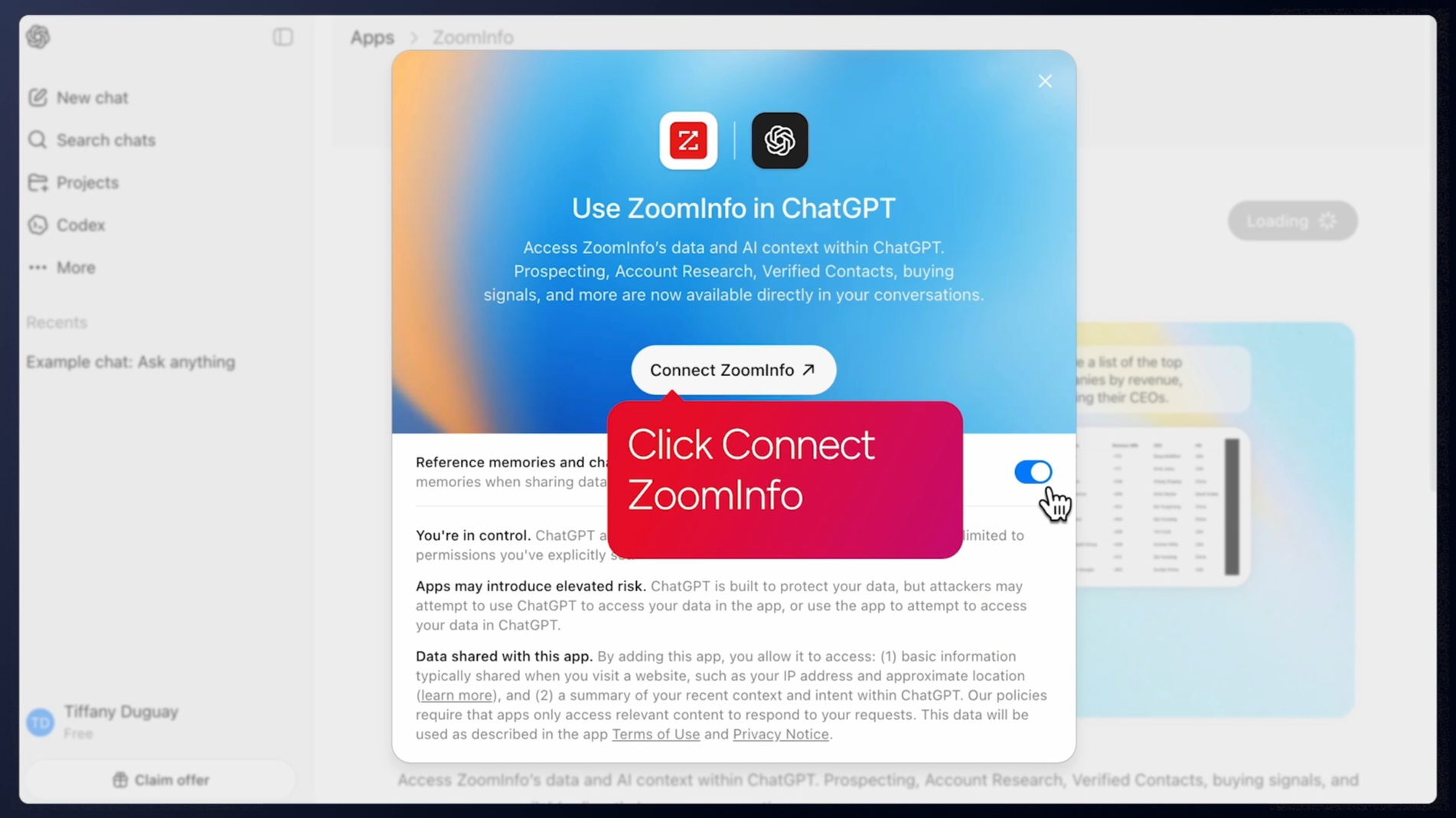
ZoomInfo delivers its intelligence through APIs and MCP (Model Context Protocol), so the same data and GTM Context Graph powering ZoomInfo's own products is accessible inside any third-party tool or custom AI agent, including Zoho CRM itself.
The MCP server connects AI models directly to ZoomInfo's B2B data as a native tool, currently supporting Claude and ChatGPT. API access is included in all relevant plans.
Source: ZoomInfo
ZoomInfo's Free Entry Points: A way to evaluate the platform without commitment
ZoomInfo Lite is a permanent free tier with access to ZoomInfo's B2B database, 10 monthly export credits, individual and company searches, a Chrome extension, and WebSights Lite with up to 10 website visitor reveals per day.
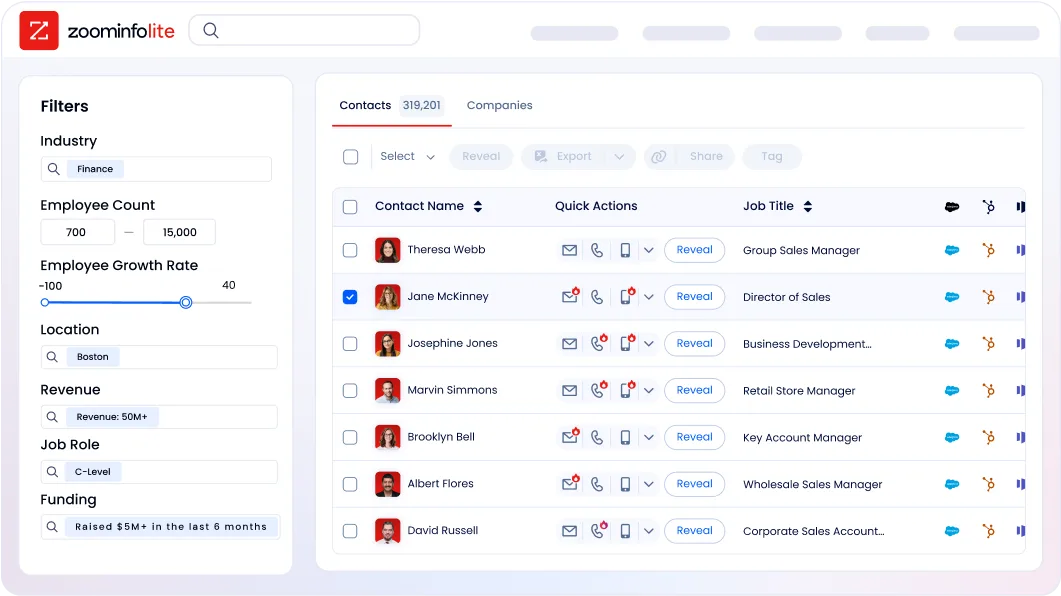
A separate 7-day free trial provides broader access with no credit card required.
Seismic's sales team attributed 39% of active pipeline to opportunities identified or influenced by ZoomInfo signals, boosted productivity by 54%, and saved 11.5 hours per week per seller. (Seismic Case Study)
Final Summary
Zoho CRM is a configurable sales platform: five automation layers (workflow rules, Blueprint, Cadences, Kiosk Studio, CommandCenter), Zia AI covering predictive scoring through autonomous agents, omnichannel communication across eight channels, and analytics from custom dashboards through Zia-generated presentations.
It covers the internal sales workflow from lead capture through forecasting at pricing that undercuts enterprise competitors by 38-76%, and the Zoho ecosystem extends the same vendor to finance, support, marketing, and HR.
It is lighter on the layer upstream of execution: no native B2B contact database, no intent signals, call transcription without cross-deal conversation intelligence, and no passive contact-level website visitor identification.
If your bottleneck is knowing who to contact and why they are ready to buy, that is the ground ZoomInfo covers. Its 500M-contact, 100M-company database supplies the verified emails, direct dials, and org charts that Zoho CRM's pipelines need to run on.
ZoomInfo Intent surfaces accounts researching your category from 6 trillion+ keyword-to-device pairings sourced monthly, before any outreach begins. Chorus captures and analyzes every sales conversation, connecting what was said to why deals move.
And the GTM Context Graph combines all of it into one intelligence layer that Zoho CRM's automation and process tools can act on, accessible through APIs and MCP that connect directly to any CRM.
See what that intelligence layer adds to your CRM: start with ZoomInfo Lite for free, or request a demo to see verified contacts and intent signals flow into your pipeline.
FAQ
Does Zoho CRM include a B2B contact database for prospecting?
No. Zoho CRM manages the contacts and companies you add to it, but it does not include its own database of verified B2B contacts, phone numbers, or email addresses. Prospecting requires importing leads from external sources, web forms, or connecting a third-party data provider.
ZoomInfo's database of 500M contacts with 120M direct-dial phone numbers and 200M+ verified business emails is one source that can feed Zoho CRM's pipelines.
Which Zoho CRM plan includes Zia AI?
Zia's capabilities are distributed across tiers. The Standard plan includes AI agents for sales activity automation. Professional adds email intelligence (sentiment, intent, and emotion analysis).
Enterprise unlocks the full Zia suite: predictive scoring, churn prediction, anomaly detection, recommendations, journey orchestration, and the Next Best Experience engine. Ultimate adds QuickML for custom ML model building on CRM data.
Can Zoho CRM automate multi-channel follow-up sequences?
Yes. Cadences, available from the Standard plan, build branching follow-up sequences across email, phone, and tasks that adapt based on prospect behavior.
If a prospect ignores an email, the system can trigger a call task; if they click a link, it can schedule a meeting. CommandCenter (Enterprise plan) extends this to full customer journey orchestration spanning multiple departments and external touchpoints.
How does Zoho CRM's pricing compare to Salesforce?
Zoho CRM Enterprise costs $40/user/month on annual billing, compared to Salesforce Sales Cloud at $165/user/month and Microsoft Dynamics 365 at $95/user/month. That is a 38-76% savings. Zoho also offers month-to-month billing with no annual lock-in, a permanent free plan for up to 3 users, and a 15-day free trial with no credit card required.
Does Zoho CRM support Blueprint process enforcement?
Yes. Blueprint (Professional plan and up) models sales processes as visual state machines with enforced transition conditions. Unlike cosmetic pipeline views, Blueprint prevents reps from advancing a record until defined criteria are met: required fields filled, calls logged, tasks completed. Stale records trigger automatic alerts and escalations. It functions as a compliance tool, not just a visualization.
What integrations does Zoho CRM support?
Zoho CRM offers 1,100+ integrations through the Zoho Marketplace, plus native integration with 40+ first-party Zoho applications (Books, Desk, Campaigns, Analytics, SalesIQ, and more).
Named third-party integrations include Google Workspace, Microsoft 365, Google Ads, WhatsApp Business, Slack, and QuickBooks. REST APIs, GraphQL APIs, webhooks, and the Widget SDK support custom integrations, and Zoho Flow provides iPaaS-level multi-app workflow automation.
Does Zoho CRM offer buyer intent data?
Zoho CRM tracks engagement signals from your own outreach through SalesSignals (email opens, chat initiations, social interactions), but it does not include third-party intent data showing which companies are researching topics across the web. Intent signals enter only through what prospects do in response to your activity, not from broader web behavior.
ZoomInfo Intent tracks signals from 210 million IP-to-Organization pairings and 6 trillion+ keyword-to-device pairings sourced monthly, identifying in-market accounts before any outreach begins.
Does Zoho CRM include conversation intelligence for sales calls?
Zoho CRM's Zia transcribes call audio and extracts sentiment, intent, and emotion from individual conversations. It does not include cross-deal conversation intelligence: coaching scorecards, competitive mention tracking across the full call library, deal risk detection based on conversation patterns, or buying committee sentiment mapping.
ZoomInfo's Chorus, backed by 14 technology patents, records and analyzes calls at that deeper level, feeding insights into the GTM Context Graph to explain why deals move or stall.
