
Choosing between ZoomInfo and Salesgenie for your B2B prospecting often comes down to five questions:
Do you need a North American lead database or a global intelligence platform?
Is your priority finding and downloading contact lists, or prioritizing accounts with AI-driven signals?
Are you a small team looking for affordable data with built-in marketing services, or an enterprise building a full go-to-market operation?
Do you want AI agents that research accounts, draft outreach, and update your CRM automatically?
Is transparent, fixed pricing more important than access to the largest verified B2B dataset available?
Here's how they compare at a high level:
Salesgenie is a lead database and marketing services platform backed by Data Axle's 50 years of data collection, offering unlimited access to over 19.5 million businesses and 255 million consumers across the U.S. and Canada. With plans starting at $99/month, built-in direct mail and email campaign tools, and a credit-based export system, it's built for small and mid-sized businesses that want straightforward prospecting and campaign execution without enterprise complexity. The platform's 300+ full-time researchers making over 24 million verification calls annually maintain data quality, and a satisfaction guarantee refunds customers for bad records. However, Salesgenie lacks AI-powered lead scoring, has limited direct dial coverage, and focuses exclusively on North American data.
ZoomInfo is an AI GTM Platform built on a large data foundation: 500M contacts, 100M companies, 135M+ verified phone numbers, and 200M+ verified business emails. Its GTM Context Graph (an intelligence layer that processes 1.5B+ data points daily) unifies this data with your CRM records, conversation transcripts, and behavioral signals to reveal the full context of your accounts. That context gives AI the material to show not just what happened, but why it happened, and which actions to take next. With that intelligence, your team can run sales from the GTM Workspace, build go-to-market plays in GTM Studio, or power their own tools through the API and MCP in any front-end. Pricing is custom-quoted for enterprise buyers, but a permanent free tier (ZoomInfo Lite) lets smaller teams start without commitment.
Both platforms provide B2B contact data, but they serve different needs. Your choice depends on whether you need an affordable regional lead database with marketing services, or an enterprise intelligence platform that turns data into action.
ZoomInfo vs. Salesgenie at a glance
Salesgenie | ZoomInfo | |
|---|---|---|
Core Focus | Lead database + marketing services | AI GTM Platform |
Database Size | 19.5M businesses, 255M consumers (U.S./Canada) | 500M contacts, 100M companies (global) |
Direct Dials | Limited availability | |
Verified Emails | Available via credits | 200M+ verified business email addresses |
Geographic Coverage | U.S. and Canada | Global (34M+ company profiles outside NA) |
Intent Data | Optional add-on ($50/month) | Native, with Guided Intent |
AI Capabilities | Limited | GTM Context Graph, AI agents, AI-drafted outreach |
Marketing Services | Built-in (email, direct mail, display, social, SEO) | Not included (focused on data and intelligence) |
Starting Price | $99/month (Basic) | Custom-quoted (Lite tier is free) |
Contract | 12-month initial term | Annual contracts standard |
Best For | SMBs needing U.S./Canada leads + campaign execution | Enterprise teams needing global intelligence and AI-driven GTM |
The core difference: Lead database vs. intelligence platform
The distinction between these platforms is what they do with data after you find it.
Salesgenie operates as a searchable lead database with marketing services attached.
You search for contacts using filters, download records via credits, and either work those leads yourself or have Salesgenie's team execute campaigns on your behalf. The platform's value lies in the data itself and the convenience of bundled marketing execution.
Data Axle, Salesgenie's parent company, has compiled business and consumer data since 1972, and the platform reflects that history: a large, verified database that you query, export, and act on through familiar channels like direct mail, email, and paid search.

ZoomInfo starts with a larger dataset but builds an intelligence layer on top of it.
The GTM Context Graph processes 1.5B+ data points daily, combining ZoomInfo's third-party data with a customer's CRM records, conversation intelligence, and behavioral signals. The result isn't just a bigger contact list; it's a system that identifies which accounts are worth pursuing now, why a deal is moving or stalling, and what action to take next.
As ZoomInfo's CPO Dominik Facher wrote: "The CRM recorded the state change. It has no record of why it happened." The GTM Context Graph exists to fill that gap.
This difference shapes everything downstream: pricing, complexity, who benefits most, and what you should expect from each platform.
Salesgenie provides affordable data with hands-on marketing support
Salesgenie targets sales professionals and small business owners who need to find prospects and reach them without building a complex tech stack.
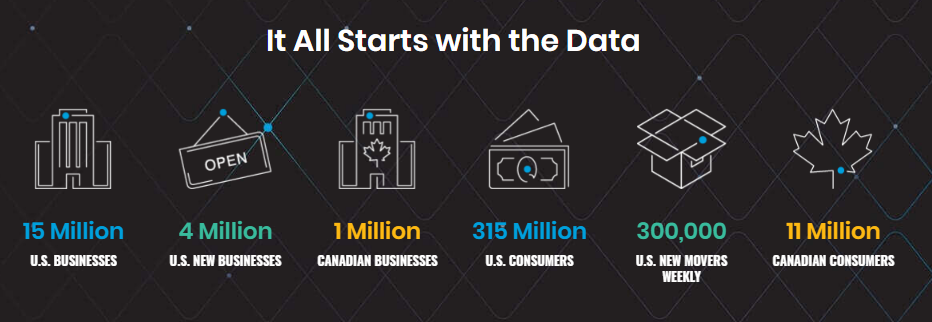
The platform's core offering is unlimited access to six databases covering U.S. Businesses (15 million records), U.S. New Businesses (4 million), Canadian Businesses (1 million), U.S. Consumers (315 million), U.S. New Movers (300,000 weekly), and Canadian Consumers (11 million). Users search these databases using over 100 search parameters spanning firmographics, demographics, geography, and industry classifications. Records can be viewed for free within the platform; downloading or exporting costs credits.
Source: Salesgenie
What sets Salesgenie apart from pure data providers is its integrated marketing services.
The platform includes email marketing with a drag-and-drop builder, direct mail with next-day print and mailing, online display advertising, search engine marketing, SEO, and social media advertising. For businesses that lack marketing departments, Salesgenie's copywriters and designers create campaign materials, and marketing experts handle execution.
A small business owner can go from finding a prospect list to launching a direct mail campaign without leaving one platform or hiring an agency.
The data quality process relies on human verification. Over 300 full-time researchers make more than 24 million verification calls annually, and business data is compiled from U.S. and Canadian Yellow Page directories, new business filings, daily utility connections, press releases, corporate websites, annual reports, and user-generated feedback. A satisfaction guarantee refunds money for undeliverable, out-of-date, or disconnected records, and if bad data exceeds 8%, refunds increase to $0.40 per record.
Data Axle was named a Leader in The Forrester Wave: Marketing and Sales Data Providers for B2B, Q1 2026, earning the highest possible scores in Vision, Innovation, and Roadmap criteria.
However, the platform has gaps.
Users report that data accuracy can be inconsistent, with outdated contact information, undelivered emails, wrong phone numbers, and non-existent companies. The platform has few direct phone numbers, limiting cold calling effectiveness. And critically, there is no AI-powered lead scoring, no workflow automation, and no intelligent routing, which means every lead gets the same weight regardless of purchase likelihood.
Source: TrustRadius
ZoomInfo combines data scale with AI-powered intelligence
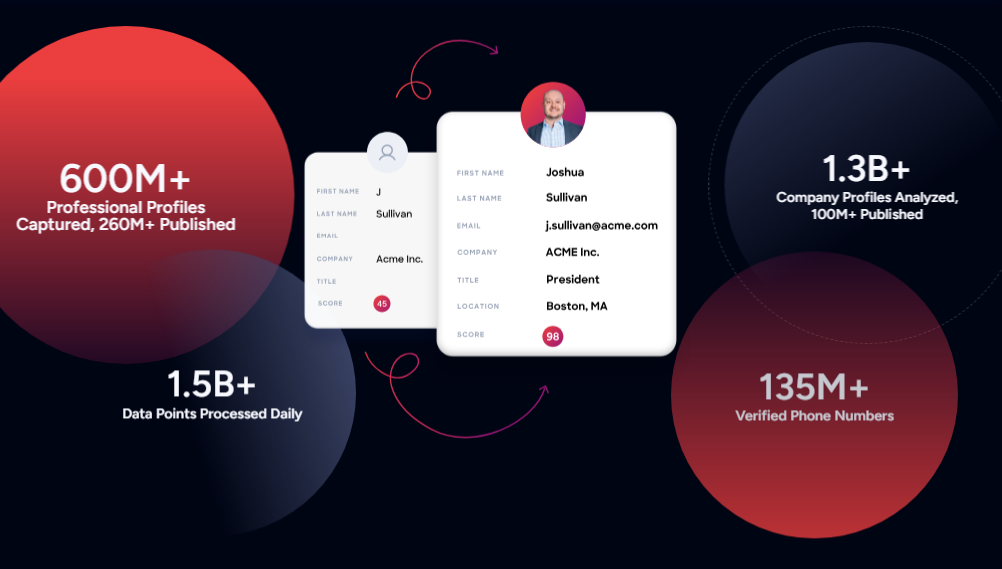
ZoomInfo operates at a different scale and with a different goal. The platform covers 500M+ contacts, 100M+ companies, 135M+ verified phone numbers, 120M+ direct-dial phone numbers, and 200M+ verified business email addresses globally, with 34M+ company profiles and 200M+ professional profiles outside North America.
The data is verified through multiple sources: automated ML scanning of 28 million site domains daily, third-party partner data covering 95 million businesses, a community of 200,000+ ZoomInfo Lite users who share data back, and an in-house Data Training Lab of 300+ human researchers. First-party data reaches up to 95% accuracy.
In a Fortune 500 competitive RFP analyzing 25 million contacts across vendors, the independent consultant concluded that "no other competitor came even close."
Source: ZoomInfo
But ZoomInfo's differentiation isn't just database size.
The GTM Context Graph fuses ZoomInfo's B2B data with a customer's CRM records, conversation intelligence (captured via Chorus), email interactions, and behavioral signals into a single intelligence layer. This graph captures the connections between signals and outcomes across deals: why executive sponsorship entering at a particular stage correlates with closed-won outcomes, why a champion going quiet for eight days signals an internal budget battle, what a competitive mention means for deal risk.
That intelligence surfaces through three access points.
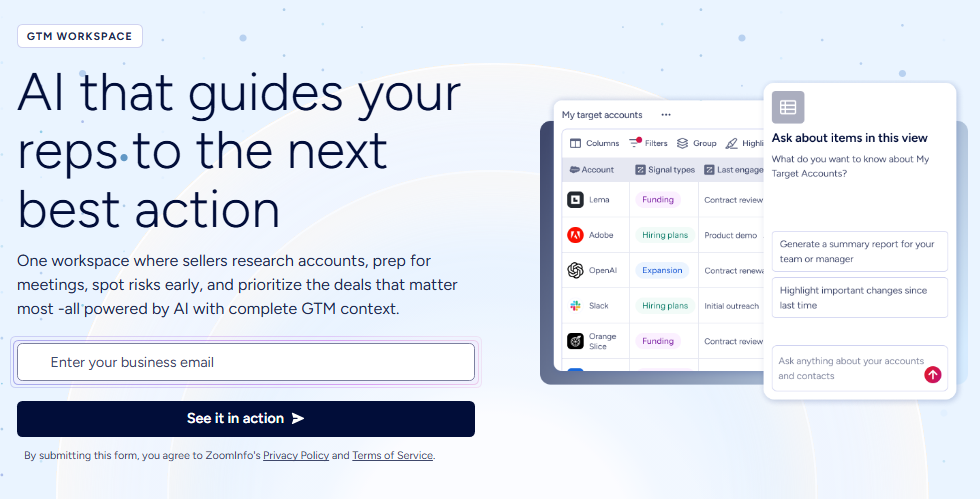
GTM Workspace gives sellers a single screen with prioritized accounts, AI-drafted outreach, and deal execution. GTM Studio lets marketers and RevOps teams describe audiences in natural language, launch multi-channel plays, and track pipeline impact without engineering support. And APIs and MCP expose the same intelligence to any custom tool or AI agent.
Source: ZoomInfo
Enterprise customer results show the impact. Seismic attributed 39% of active pipeline to ZoomInfo signals, reported 54% productivity gains, and saved 11.5 hours per week per seller. Snowflake achieved 90% higher opportunity open rates and 2x higher customer conversion rates using ZoomInfo-powered account scoring.
ZoomInfo's complexity matches its capability. The platform requires real onboarding investment, and ZoomInfo redesigned its onboarding program from 30 to 90 days to address this. Custom-quoted pricing and annual contracts mean no instant signup for paid tiers, though ZoomInfo Lite offers a permanent free tier with 10 monthly export credits and access to the B2B database.
Data coverage and quality compared
The raw numbers tell part of the story. Salesgenie covers 19.5 million businesses and 255 million consumers in the U.S. and Canada. ZoomInfo covers 500M+ contacts and 100M+ companies globally.
But the more useful comparison is what data each platform provides per record and how it stays current.
Salesgenie focuses on basic business and consumer attributes: company name, address, phone, SIC/NAICS codes, employee count, revenue, and executive names. Consumer records include demographics like income, homeownership, and age.
The platform compiles data from Yellow Page directories, new business filings, utility connections, press releases, and annual reports, then verifies it with 24 million phone calls per year. A competitive audit by the University of Nebraska-Omaha found 96.1% accuracy for company name, address, and phone number.
However, users report a gap between verified business listings and actionable sales contacts. The platform reportedly has few direct phone numbers and limited emails, and email deliverability for campaigns has fallen below expectations. For B2B sales teams that depend on reaching specific decision-makers by phone or email, this is a real limitation.
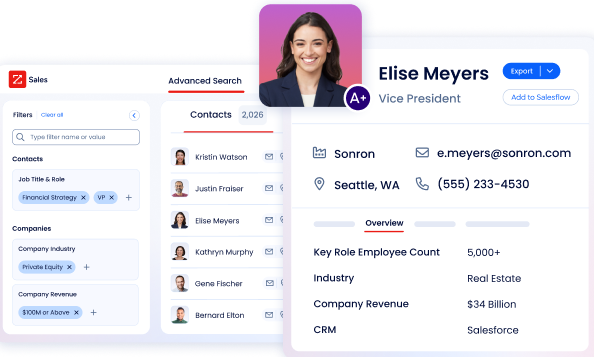
ZoomInfo provides deeper per-record data: 120M direct-dial phone numbers, 200M+ verified business email addresses, department org charts, job titles, seniority levels, and employment history.
Beyond identity data, ZoomInfo adds company context (industry, revenue, employee count, technographics tracking 30,000+ technologies across 30M+ companies, parent-child hierarchies) and dynamic signals (buyer intent from 210 million IP-to-Organization pairings, website visitor identification, job-change alerts).
The direct dial difference matters for sales teams. Cold calling a general business line means navigating gatekeepers. Cold calling a direct dial means reaching the decision-maker's desk. ZoomInfo's 120M direct-dial phone numbers represent a category of data that Salesgenie reportedly struggles to provide at scale.
Source: ZoomInfo
For international teams, ZoomInfo covers 34M+ company profiles outside North America and 45M+ mobile numbers outside NA. Salesgenie's coverage is limited to U.S. and Canadian data.
Intent data and signal intelligence
Salesgenie offers buyer intent data as an optional add-on for $50/month, measuring interest across 12,000+ intent topics with scores from 60-100. This lets users identify companies actively researching relevant solutions.
However, the intent data operates independently from the lead database; no automated workflow connects a high-intent signal to a specific action like triggering an outreach sequence.
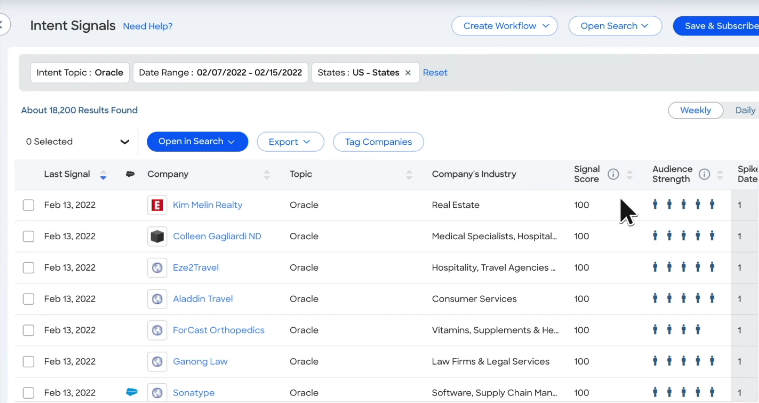
ZoomInfo integrates intent data natively. ZoomInfo Intent tracks signals from 210 million IP-to-Organization pairings and 6 trillion+ new keyword-to-device pairings sourced monthly.
More importantly, Guided Intent (exclusive to ZoomInfo) identifies topics historically correlated with deal success rather than requiring users to manually select which topics to monitor.
This is where the GTM Context Graph creates a structural advantage.
Intent signals feed into the same intelligence layer as CRM data, conversation transcripts, and company attributes. A spike in intent research from a company where you also see hiring in your target department and recent funding creates a compound signal that a simple intent score can't replicate.
Source: ZoomInfo
ZoomInfo's AI surfaces these compound signals automatically; Salesgenie requires users to interpret intent scores manually alongside their prospecting work.
Marketing services and campaign execution
This is where Salesgenie has a capability that ZoomInfo doesn't offer.
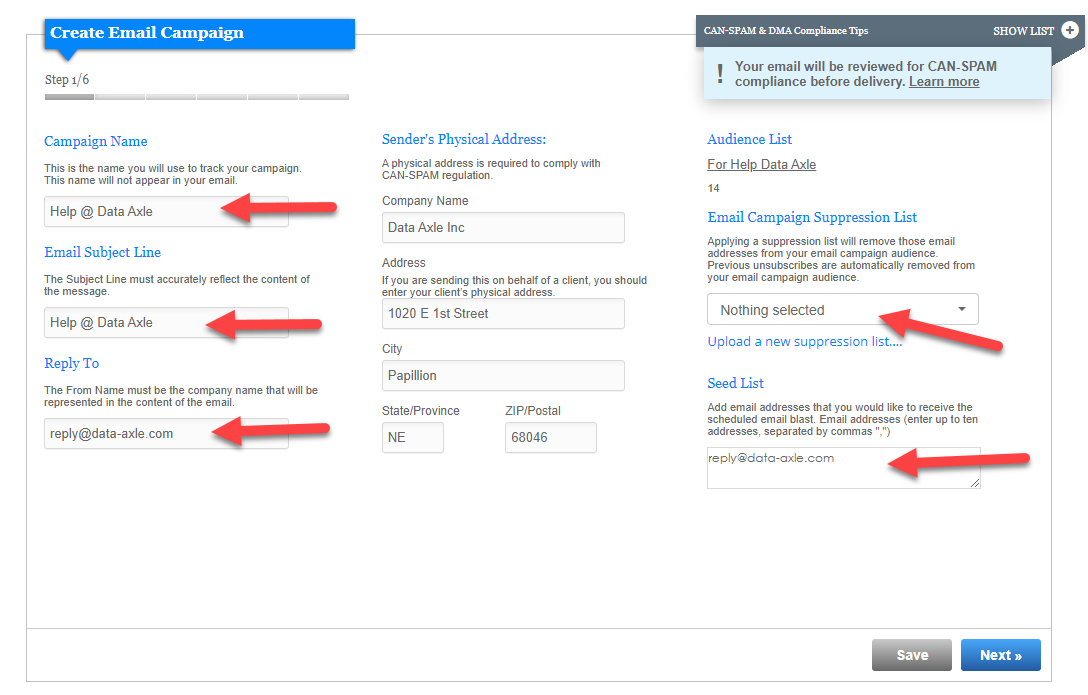
Salesgenie provides full-service marketing execution including email campaigns, direct mail with next-day print and mailing, online display advertising, search engine marketing, SEO, and social media advertising. The platform's copywriters and designers create campaign materials, and marketing experts handle deployment and optimization.
For small businesses without marketing teams, this means going from a prospect list to a running campaign with little effort.
The email campaign builder offers drag-and-drop templates and access to over 14 million verified business email addresses. Direct mail includes USPS delivery tracking and targeting options for both consumers and businesses. Social media advertising covers Facebook, Instagram, and LinkedIn with the team handling design, execution, and optimization.
Source: Salesgenie
ZoomInfo does not provide marketing execution services.
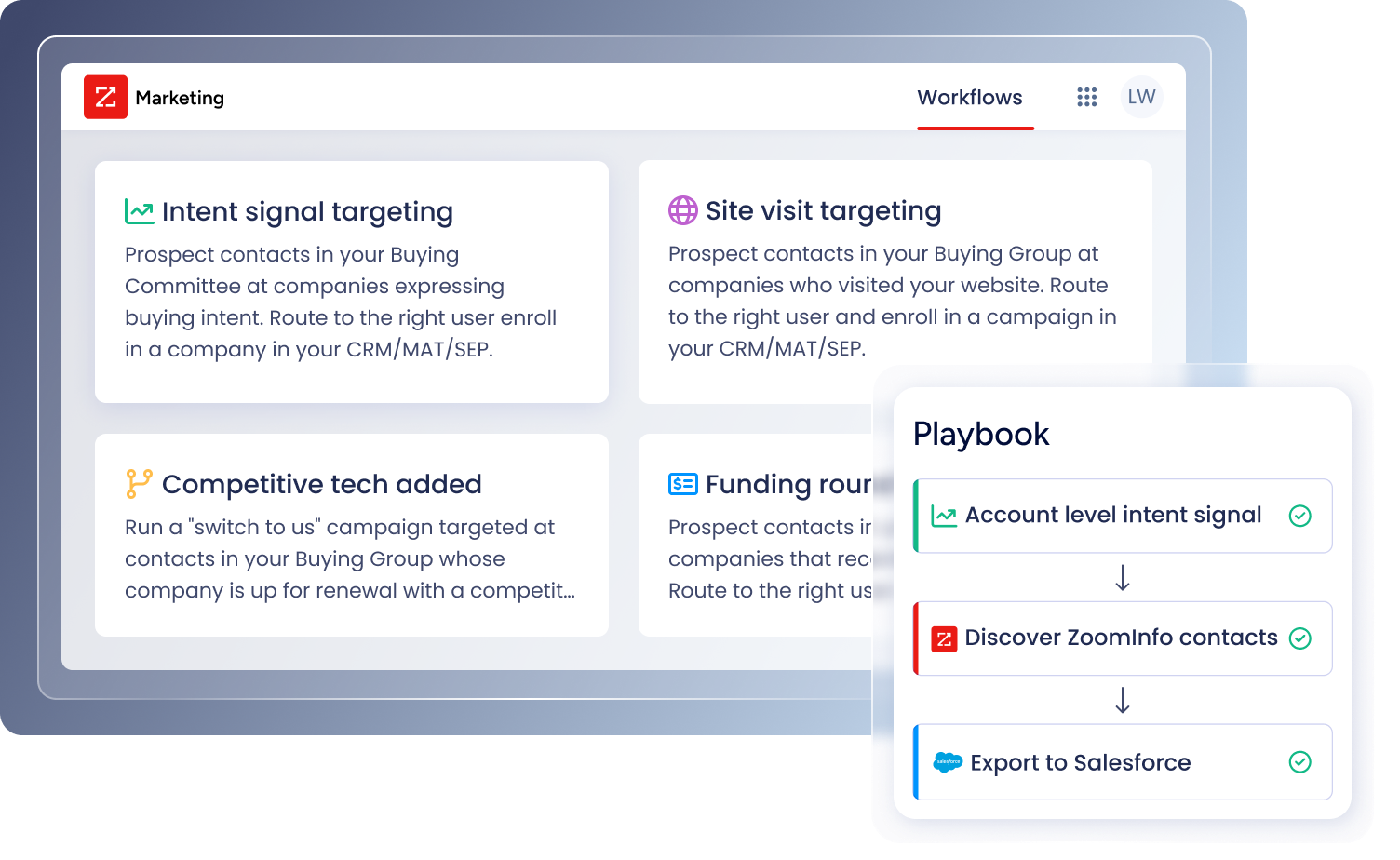
Its marketing capabilities focus on ABM and audience orchestration through GTM Studio and ZoomInfo Marketing. These tools help identify and prioritize accounts, build targeted audiences, and coordinate multi-channel plays, but actual campaign execution happens through your existing marketing stack (Marketo, HubSpot, Eloqua, Salesforce, etc.). ZoomInfo's native DSP enables display advertising, and FormComplete reduces web forms to a single field, but there's no copywriting team, no direct mail fulfillment, and no done-for-you campaign management.
Source: ZoomInfo
For businesses that need someone to run their campaigns, Salesgenie fills a real need. For businesses that already have a marketing team and tech stack, ZoomInfo's orchestration and intelligence add more value than execution services would.
Pricing and total cost of ownership
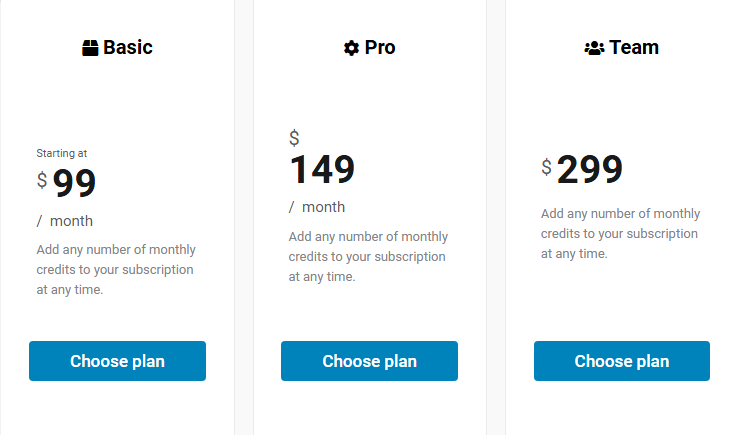
Salesgenie offers transparent, tiered pricing:
Basic ($99/month): 1 user, unlimited views, lead management, exports (uses credits), email marketing (uses credits)
Pro ($149/month): everything in Basic, plus performance tracking, customer profile analysis, and direct mail marketing (uses credits)
Team ($299/month): 5 user licenses, everything in Pro
All plans require a 12-month initial subscription that renews month-to-month afterward. Buyer intent data adds $50/month. Credits for downloading, exporting, or emailing records cost extra, though specific per-credit pricing requires contacting sales. A free trial is available without a credit card.
Source: Salesgenie
ZoomInfo uses custom-quoted, seat-and-credit-based pricing with no published dollar amounts for paid tiers. Costs depend on user count, monthly credit volume, features, company size, and contract length. Annual contracts are standard, with multi-year commitments offering lower rates.
ZoomInfo's three product lines (Sales, Marketing, and Operations) each have their own tier structure (Professional, Advanced, Enterprise) with progressively more capabilities. Credits work differently from Salesgenie: 1 credit = 1 export of a professional or company profile, and searching or viewing data within the platform doesn't consume credits.
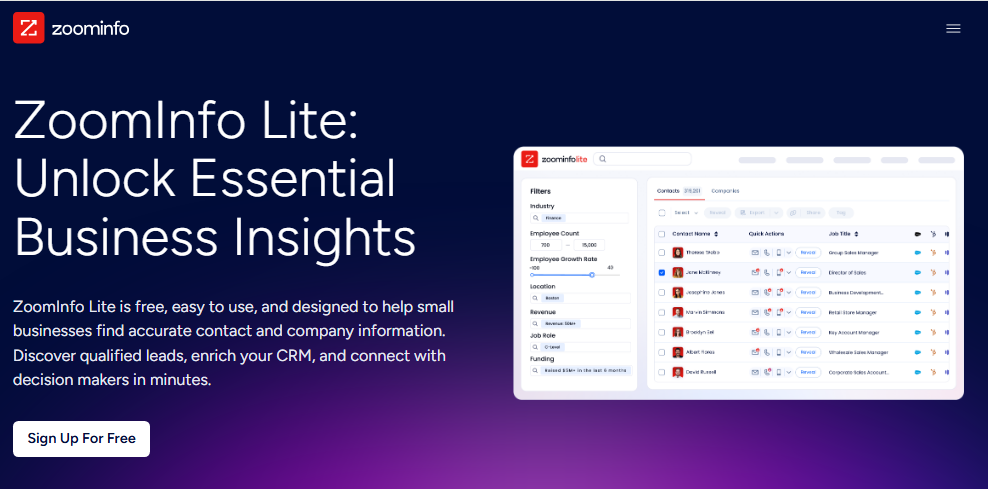
For teams that want to explore before committing, ZoomInfo Lite is a permanent free tier with 10 monthly export credits, access to the B2B database, advanced filters, a Chrome extension, and HubSpot integration. A 7-day free trial provides access to broader features.
Source: ZoomInfo
The total cost comparison depends on what you need. A five-person sales team at a small business would pay $299/month on Salesgenie's Team plan and get data, lead management, and marketing services in one package. The same team on ZoomInfo would likely pay considerably more, but would gain access to 25x more contacts, 120M direct dials, intent signals, AI-powered prospecting, and global coverage.
The question is whether your team will use those additional capabilities enough to justify the investment.
CRM integration and technical capabilities
Salesgenie offers native integrations with Salesforce, HubSpot, Zoho CRM, Microsoft Dynamics, SAP, and Oracle.
The HubSpot integration enables one-click export with admin-defined field mapping. The Salesgenie Connect API suite allows developers to find and deliver prospecting data, validate customer data, and send data to endpoints via webhook. For Salesforce and Dynamics users, Salesgenie provides a CRM tab for pushing data into accounts, contacts, and leads.
ZoomInfo's integration ecosystem is broader and deeper.
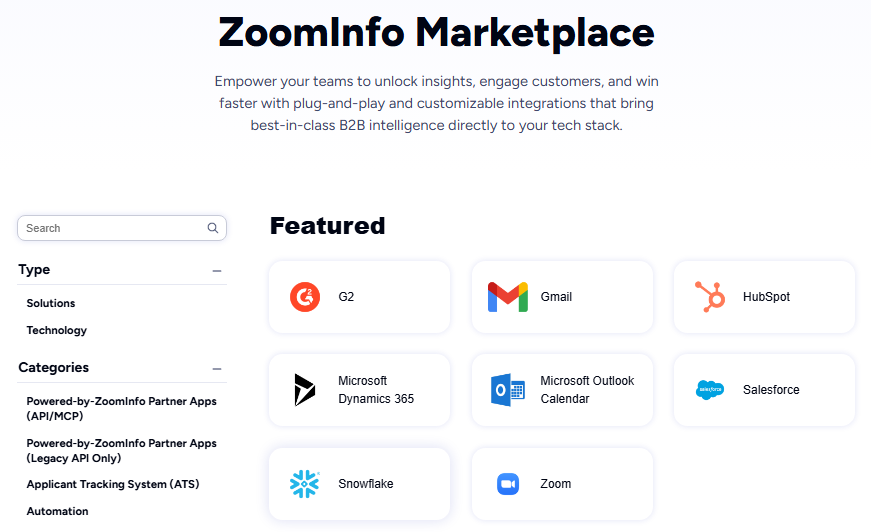
The App Marketplace lists 120+ partner integrations across CRM, marketing automation, sales engagement, revenue intelligence, data warehouse, and communications categories. The Enterprise API provides programmatic access organized into four areas: Data API (search and enrich), Copilot API (AI intelligence), Marketing API (audience management), and Platform API (engagement data).
The MCP server connects AI models directly to ZoomInfo's data through natural language. Cloud Partners enables direct data ingestion into AWS, Google Cloud, Snowflake, and Databricks. API access is included in all relevant plans.
Source: ZoomInfo
The technical depth difference reflects the audience difference. Salesgenie's integrations handle straightforward data export to a CRM. ZoomInfo's are built for teams creating automated workflows, custom AI agents, and data pipelines that power enterprise go-to-market operations.
Security and compliance
Salesgenie complies with the EU-U.S. Data Privacy Framework, the Swiss-U.S. Data Privacy Framework, and the UK Extension for data transferred from the EU, UK, and Switzerland to the U.S.
The company is registered as a data broker under Texas law and uses physical and electronic security, firewall protections, encryption and hashing, and access controls. However, third-party assessments have noted a lack of SOC 2, ISO 27001, GDPR compliance frameworks, and HIPAA certifications.
ZoomInfo holds a full certification stack, all renewed annually: ISO 27001, SOC 2 Type II, ISO 27701, TRUSTe GDPR Practices Validation, and TRUSTe CCPA Practices Validation. The company is a registered data broker in California and Vermont and maintains a dedicated Trust Center.
For enterprise buyers in regulated industries (financial services, healthcare), ZoomInfo's certifications are likely a procurement requirement. Salesgenie's compliance posture may suffice for small businesses with less stringent security requirements.
ZoomInfo vs. Salesgenie: Which should you choose?
The choice depends on your team's size, budget, geographic focus, and what you need beyond raw contact data.
Choose Salesgenie if:
You're a small or mid-sized business focused on U.S. and Canadian markets
You want transparent pricing starting at $99/month with no custom-quote process
You need built-in marketing services (direct mail, email campaigns, display ads, SEO) without hiring an agency
Your prospecting process is straightforward: search, download lists, make calls, send campaigns
Consumer data (new movers, demographics, purchase signals) matters as much as B2B data for your business
You don't need AI-powered lead scoring, workflow automation, or intent-driven prioritization
Your team size is five or fewer users
Choose ZoomInfo if:
You need global B2B coverage beyond North America
Direct-dial phone numbers and verified business emails at scale are essential for your outreach
You want AI to prioritize accounts, draft outreach, and surface buying signals automatically
Your team already uses a CRM and marketing automation stack that would benefit from data enrichment
Intent data, technographics, and org chart intelligence matter for your sales process
You need enterprise-grade security certifications (ISO 27001, SOC 2 Type II, ISO 27701)
You're building or planning to build AI-powered workflows using APIs or MCP
Your organization has the budget and onboarding capacity for a platform investment
Get a ZoomInfo free trial here!
The difference between these platforms is not just features and pricing; it's what kind of sales operation you're running.
Salesgenie helps you find prospects and reach them through familiar channels. ZoomInfo helps you understand which prospects to prioritize, why they're worth pursuing now, and what to say when you reach them. Both are valid approaches, but they serve different stages of sales maturity and different scales of operation.
A five-person sales team at a regional services company will get more from Salesgenie's affordable data and done-for-you marketing than from ZoomInfo's AI agents and intent signals. A 50-person enterprise sales org targeting global accounts will find Salesgenie's North American database and lack of automation a bottleneck, while ZoomInfo's intelligence layer compounds in value as the team and deal complexity grow.
Choose the platform that matches where your sales operation is today and where you need it to be in the next two years.
