
Most B2B marketing budgets are built by carrying last year's line items forward and then arguing about the edges. That approach worked when the channel mix was stable. It works much less well now that buyers start research in AI assistants and the returns on paid search keep shifting.
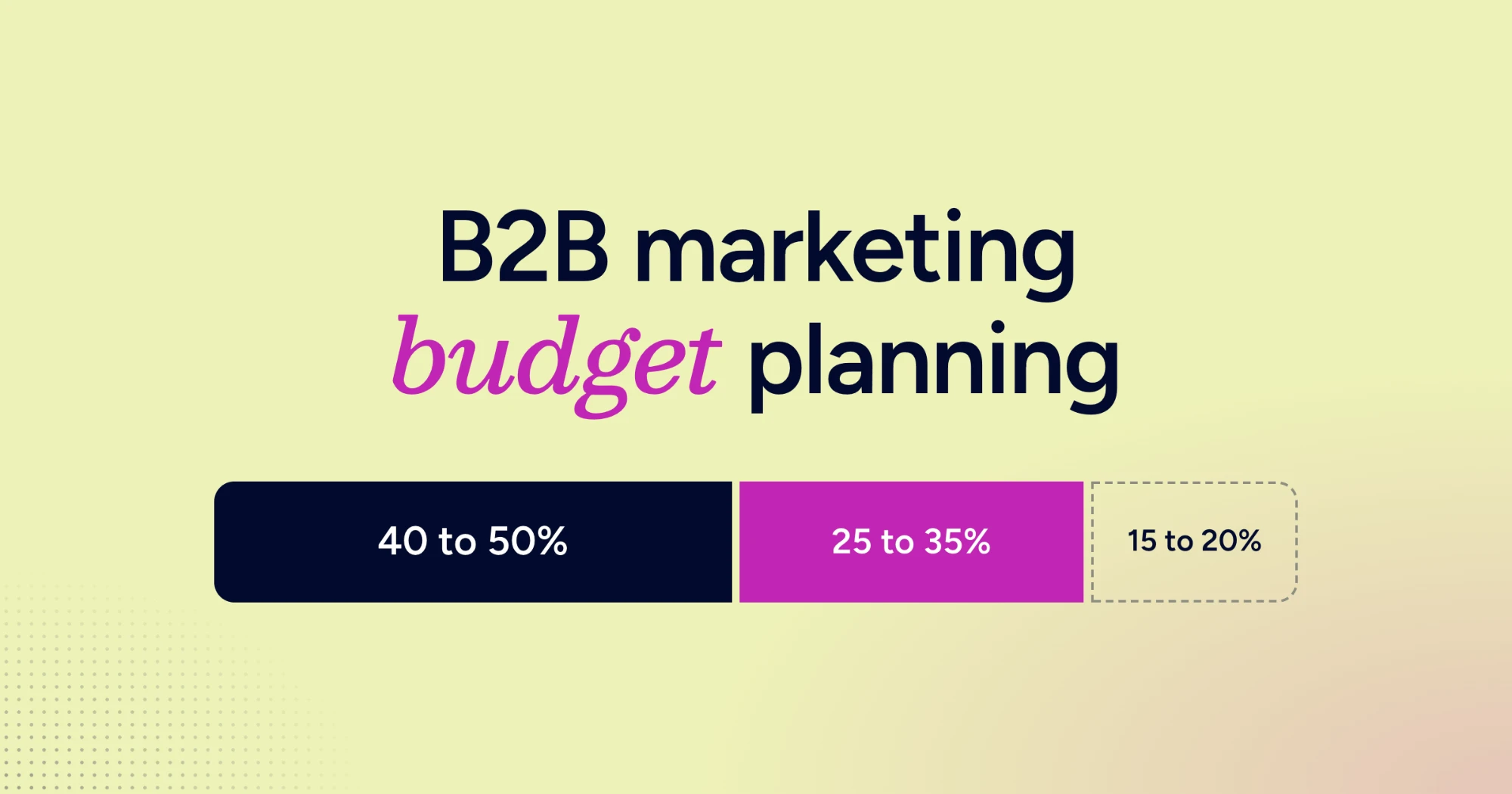
A workable B2B marketing budget has three parts:
A primary motion that has proven itself
A set of supporting activities that have earned more money
And, a small testing budget that keeps next year's options open.
This post walks through how to size each part and how to defend the plan to finance. It's based on my GTM Roundtable with Steffen Hedebrandt, CMO & Co-founder at Dreamdata.
Why is B2B marketing budget planning harder this year?
Budget season comes around every year, but the inputs have changed. Many buyers now start their research in tools like ChatGPT and Claude instead of a search engine, and they arrive at vendor websites with a shortlist already formed. Teams that rely on non-branded search to create demand are seeing less return from the same spend, and many are paying more per click to get it. You might also like a previous post of mine: A practical view of AI for marketing operations.
That is the case I'd make for rethinking the plan rather than rolling it forward. Legacy spend is hard to unwind because it has owners, relationships, and habits behind it. The strongest argument for changing it is a clear view of where performance has eroded.
How do you build a B2B marketing budget from the revenue target?
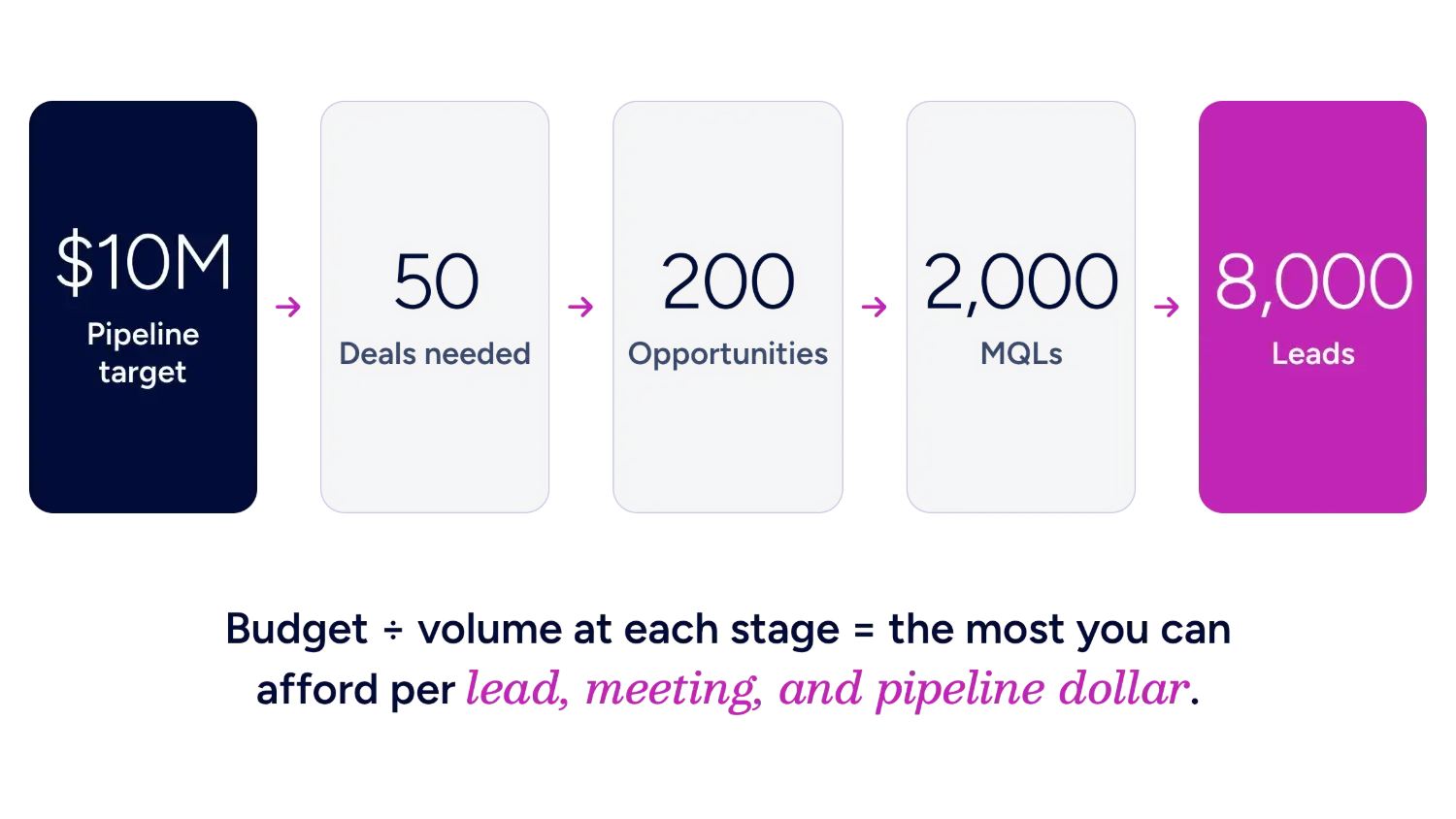
Start with the number finance cares about, then work down the funnel:
Set the pipeline or revenue target for the year.
Divide by average deal size to get the number of deals you need.
Work back through your conversion rates to get the opportunities, MQLs, and leads you need.
Divide your total budget by those volumes to get the cost you can afford per lead, per meeting, and per pipeline dollar.
Once you have that math, you can compare marketing against other options. Sales already compares SDR cost per meeting, and the CFO will ask whether the next dollar belongs in marketing, in a hire, or in a tool. A budget that shows what each dollar should produce answers that question before it's asked. For the stages behind this math, see B2B marketing funnels.
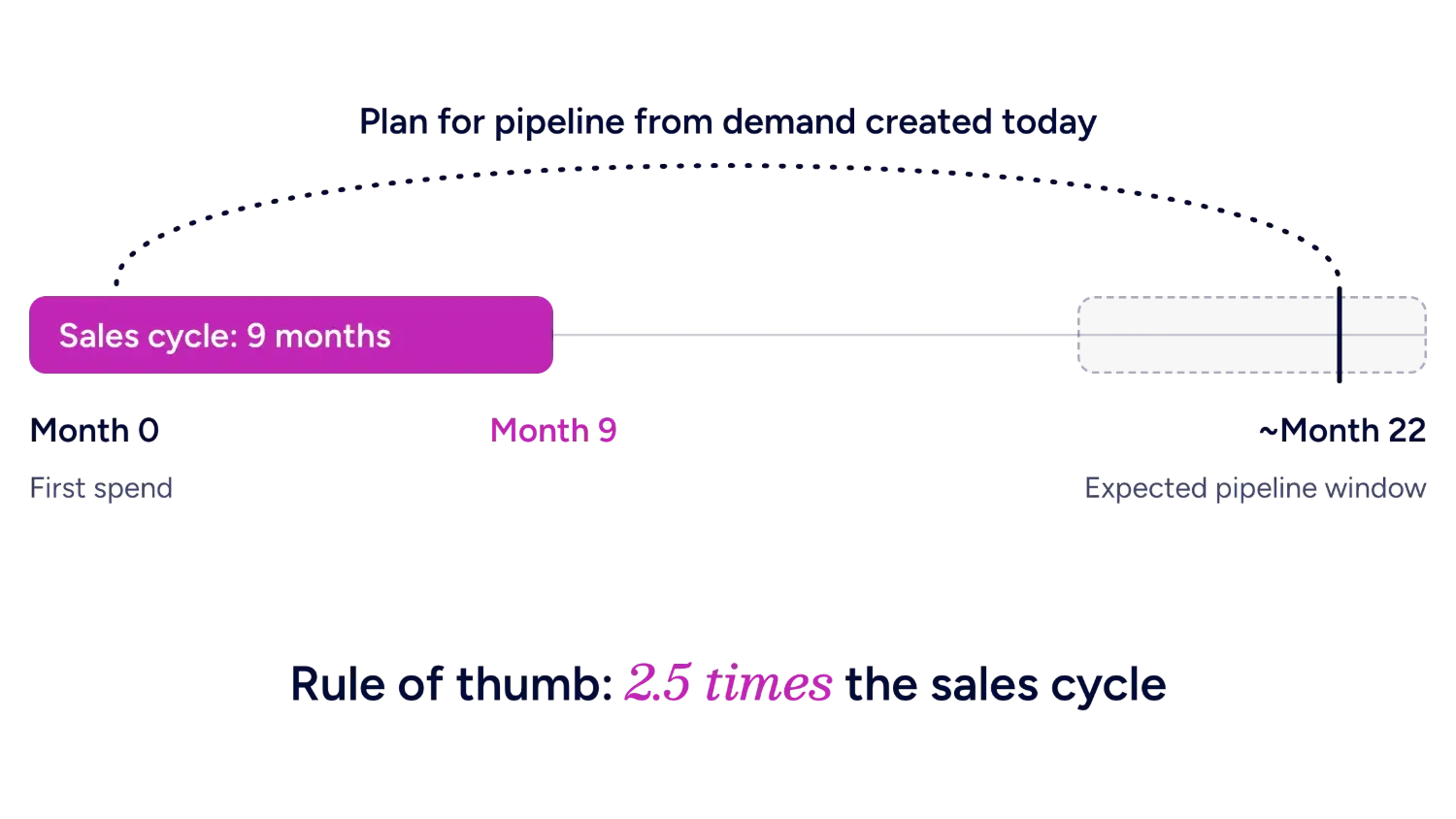
Account for lag. As a rule of thumb, plan for about two and a half times your sales cycle between when you create demand and when it shows up as pipeline. If your sales cycle is nine months, the program you fund in January may not show results until the following autumn. Validate that rule against your own data before you rely on it.
How should you split a B2B marketing budget?
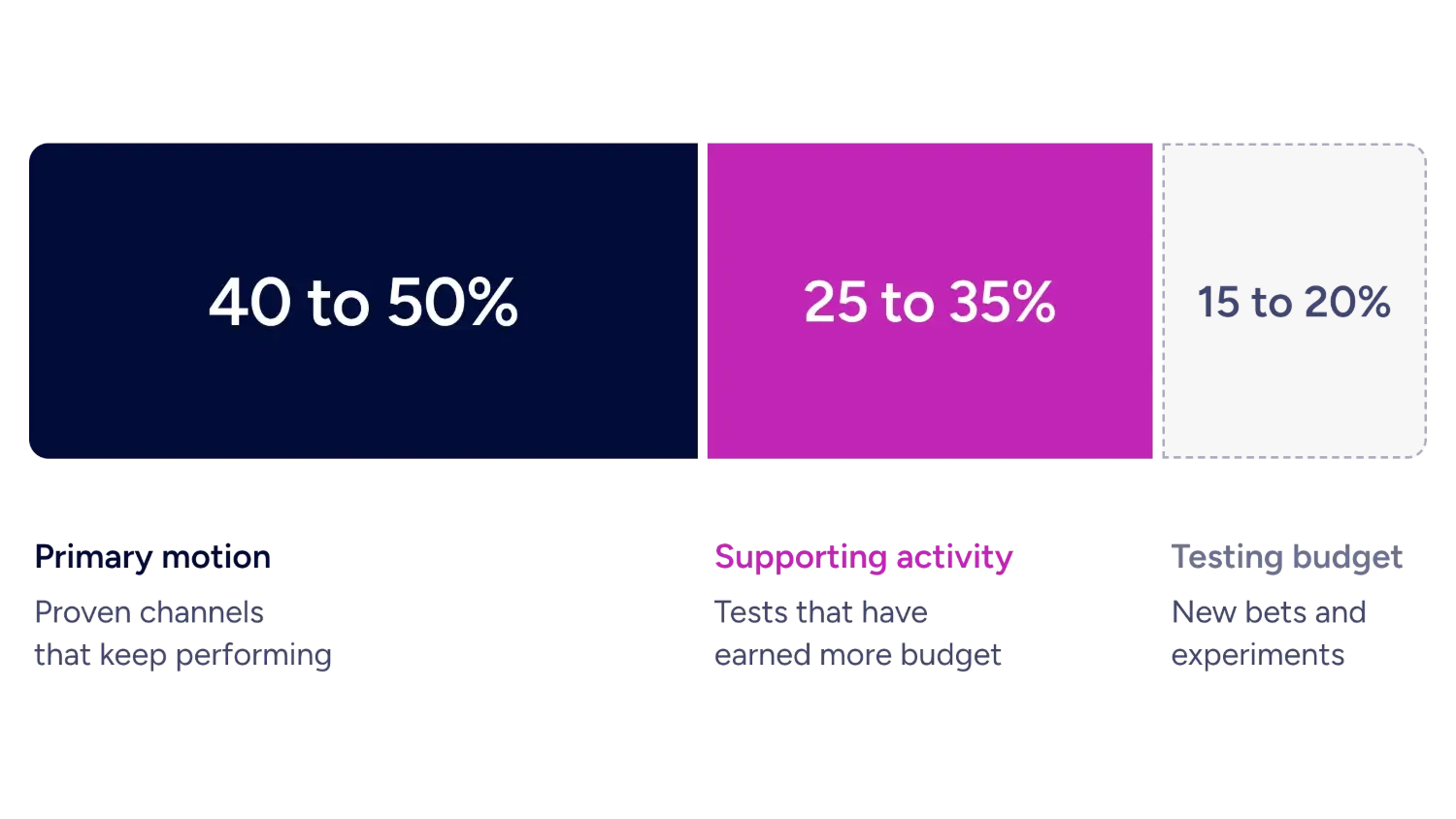
A simple three-bucket structure works for most teams:
Primary motion: The channels that have a consistent record and keep performing near their historical rate. Most of the budget belongs here. For many B2B teams, that is paid social or LinkedIn aimed at a fixed list of target accounts, because it keeps the right companies in view even when they aren't in market yet.
Supporting activity: Tests from the past year that produced consistent output, with enough confidence to put more money behind them. These move up from the testing bucket once the evidence holds.
Testing budget: Roughly 15%-20% of total spend for new bets. You won't know what scale looks like yet, and that is the point. Without this bucket, nothing new gets funded, and the plan drifts into legacy.
These percentages are a starting point, not a rule. If your primary channels are still strong, lean toward them. If your primary channels are eroding, the testing budget should grow, because marketplace saturation eventually kills any program that everyone copies. Keep a bench of tested alternatives ready to scale when the current winner fades.
Should you fund create demand or capture demand first?
Create demand covers the work that builds awareness and intent before a buyer is ready to talk: brand, content, events, and targeted engagement with accounts that fit your ideal customer profile. Capture demand covers the channels that harvest intent that already exists, such as paid search and organic search for high-intent terms.
A rule of thumb many teams use is roughly 60% create and 40% capture. Treat it as a starting point and adjust it to your pipeline mix. Keep in mind that the two are linked. Capture only works on demand that exists, so if create spend drops to zero, capture eventually shrinks too. Brand and demand spend also overlap in practice. Most activity that creates demand builds brand at the same time, so it helps to evaluate the two together.
How do you audit legacy spend without losing the team?
Every channel should earn its renewal. Ask each team to show three things: current performance against the target, where performance has eroded over the last six to twelve months, and where the same money could work harder. Teams that come back with a proposal to move budget to a better use, even if it means shrinking their own remit, should be rewarded for it.
Top tip: If your Martech stack is part of that review, see how to justify the Martech budget.
Some legacy items are easy to recognize: defensive brand search spend, event sponsorships that sales enjoys but that don't show up in pipeline, and partner commitments made for reasons unrelated to results. For each one, look at cost per pipeline dollar, not clicks or impressions.
You don't have to cut in one move. Stepping down brand search coverage in small, measured increments is one way to test whether the spend is still needed. Track the MQLs you lose against your trailing average each week, and compare the cost of getting them back with the cost of your typical branded MQL. Repeat the test over the year, because a single result can change as the market does.
Set a kill date for every program. A date agreed in advance removes the emotion from the decision. When the date arrives, you either have the evidence to renew the program or you don't.
How do you build an experiment pipeline that can scale?
Start with a long list of ideas. Then score each one on two to five criteria your team agrees on in advance, such as expected impact, cost, and how easy it is to run. Sort by impact for the effort required, and start with the top of the list.
Start small. Set a minimum viable budget for each test and let the results build the case for more. The most expensive mistake in budget planning is committing large sums to an idea that has never been tested at small scale.
Before launch, write down the success metrics. Use leading indicators you can read early, such as click-through rate, site visits, and demo bookings, alongside the lagging metric that matters most, such as pipeline. Set the kill criteria at the same time.
When a test works, scale it in steps and expect the returns to drop. A channel that produces ten pipeline dollars for every dollar at baseline will not produce ten at 1.5 times the spend. Build that decline into the forecast. A plan that assumes efficiency rises with spend is the fastest way to disappoint leadership.
How do you measure what works before you move money?
Attribution models tell different stories, and you need to know which story you're reading. Last-touch or original-source fields credit the final session before a conversion and miss the many sessions that came before it. First-touch reports show different channels doing the early work. Platform metrics only show what happened inside each ad platform. None of these is wrong on its own, but none is the full picture. Our guide to B2B marketing attribution goes deeper on choosing a model.
Pick one measurement framework as the source of truth before you compare channels. Then look at the same channels through more than one lens so you can see where the stories diverge. Connect each channel to campaign KPIs that map to revenue. Showing executives both views is often the fastest way to explain why a channel looks weak in one report and strong in another.
Clean data matters here. If CRM records are duplicated or incomplete, campaign-to-revenue attribution breaks, and the budget conversation becomes a debate about data instead of a decision about money.
How should sales and marketing timing fit into the budget?
Your budget calendar has to match your sales calendar. If sales has a large fourth quarter, marketing needs to be building pipeline in the second quarter, because large-account journeys take months to mature. Funding a big spend push in the fourth quarter and expecting it to close that year is a common way to miss the number.
Measure marketing on the accounts that matter, not on raw lead counts. Teams running account-based marketing already work this way. Lead volume is easy to inflate with low-quality contacts. An account-level score that ranks the companies most likely to convert, handed to SDRs as a priority list, connects marketing spend to pipeline in a way lead counts cannot.
Plan the handoff too. High-intent leads that are exported to sales but never reach a conversation are a budget problem, not only a sales problem. Agree on what a qualified handoff looks like and how fast sales will follow up before you fund the program.
What should you plan for when leadership asks "what if"?
Two questions come up in almost every budget review.
The first: if you had to cut 30 percent tomorrow, where would it come from? Start with the channels showing erosion and the testing spend that hasn't yet earned its place.
The second: if you were given twice the budget, where would it go? Have a specific answer and the evidence behind it.
Keep both answers filed away somewhere. When leadership asks, you can respond quickly with a reasoned view instead of a guess. Stay skeptical about the second answer, though. A promising result at small scale is not proof that the same program will work at double the budget.
How do you take the budget to finance?
Finance wants a rational conversation. Before you ask for money, explain what the spend should produce: how much pipeline you expect and at what cost per dollar. If results come in differently, go back and explain why. That habit builds trust faster than any single forecast.
Bake in expected decline. Even if channel performance holds steady, it will probably get a little worse as the market shifts. Under-promise and over-deliver. Use last year's actual results as the baseline, not the best quarter you can find.
Frequently asked questions
What percentage of a B2B marketing budget should go to testing?
A common starting point is 15-20% for new experiments. Adjust the number based on how fast your primary channels are eroding, and give every test a kill date and success metrics before you start.
How long does B2B marketing spend take to show up in pipeline?
Plan for about two and a half times your sales cycle as a rule of thumb, then check that against your own data. Track leading metrics such as clicks, site visits, and demo bookings so you can see early signs of whether the program is working.
How do you decide which channels to cut first?
Look at cost per pipeline dollar and at how performance has changed over the last six to twelve months. Channels with rising costs and falling returns are the first candidates, especially if the same results could come from a channel that is still performing.
How do you justify a marketing budget to finance?
Start from the revenue target and work backward to the spend required. State the pipeline you expect and the cost per dollar, explain what would cause you to deviate, and use last year's actual results as the baseline.
Should B2B marketing budgets include spend on AI search?
Yes, as a testing allocation to start. Measure the results, pair paid tests with the organic work that improves how often your brand shows up in AI answers, and scale what proves out.
What is the difference between create demand and capture demand?
Create demand builds awareness and intent over time, reaching accounts before they are ready to buy. Capture demand harvests intent that already exists, such as searches for your category or your brand. You need both, and the capture budget depends on the create work that came before it.