
Most B2B marketing teams have an AI line item in the budget this year. Very few can tell you what it returned. Every vendor has an AI success story, and almost none of them tells you where to start.
Here's what usually happens: a few AI pilots go live, the results are modest, and the tools quietly get shelved. I don't think that's because of bad strategy or a weak model. It's because of where the team started with AI for marketing operations: on the flashiest use case, not the one every other use case depends on.
Adoption itself is not the gap. In ZoomInfo's State of AI 2025 survey of more than 1,000 GTM professionals, 63% of marketers said they use AI at least once a week, and marketing teams were most likely to use content creation tools. More specialized tools, such as data enrichment tools and predictive analytics systems, were used far less.
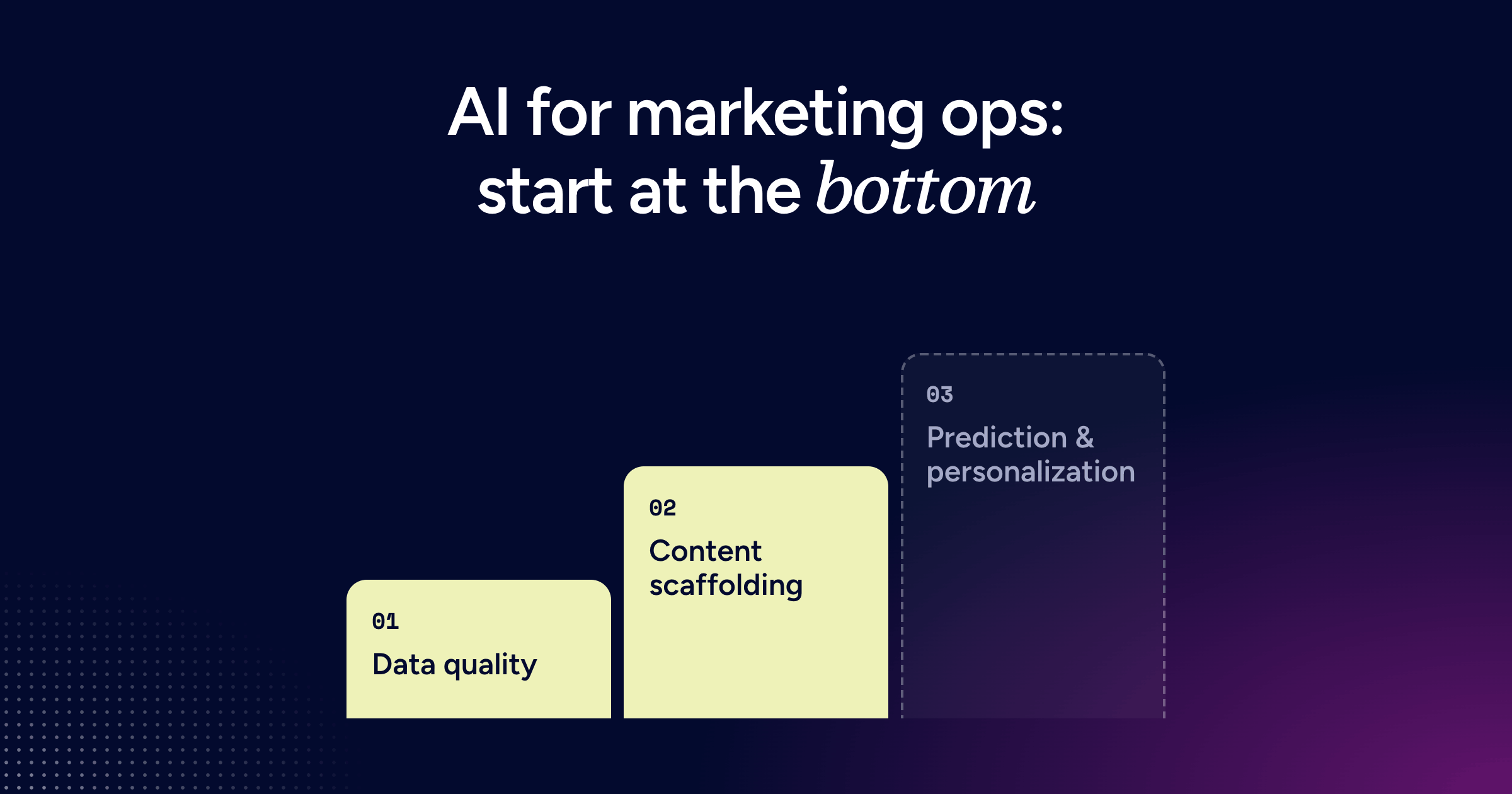
That pattern tells you where to start: a minimum viable use case that moves the needle without turning into another pilot project. Begin with data quality and content scaffolding, where setup is light and feedback is fast, and hold personalization engines and predictive scoring until your data can support them. Below you'll find a ranked table of AI tools for marketing operations by use case, a four-step adoption framework, and a way to measure ROI that finance will accept.
Why most AI pilots in marketing ops stall
For Revenue Architects, ZoomInfo's GTM.AI podcast, hosts Florin Tatulea and John Lloyd interviewed 50 senior GTM leaders at US enterprises with 1,000 or more employees. About half said their data was too fragmented across systems. Half said they could not trust AI outputs without heavy human review. And 40% said their AI tools work with incomplete or inaccurate data.
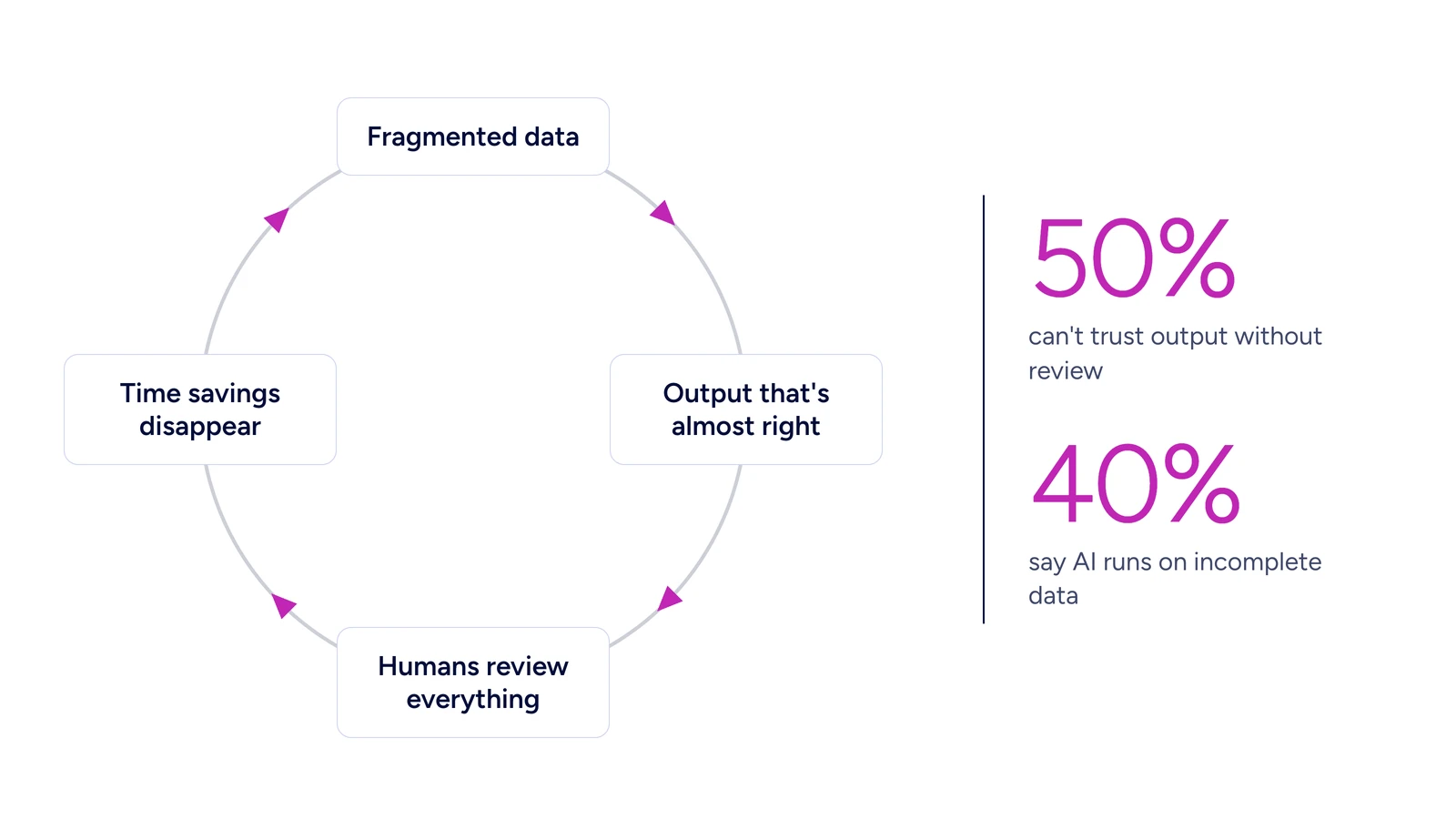
Why AI pilots stall: fragmented data produces output that's almost right, so humans review everything and the time savings disappear. Source: ZoomInfo's research with 50 senior GTM leaders, Revenue Architects podcast.
Florin, GTM Engineer in Residence at ZoomInfo, read those results as one problem showing up three times. When the data underneath is fragmented, AI produces output that is nearly right. Humans then review everything, and the promised time savings disappear. John Lloyd, Manager of Go-to-Market Consulting at ZoomInfo, put the mood plainly on the podcast: "They're exhausted by AI that's almost right."
That is how an AI pilot program dies. Nobody declares it a failure. The review queue just grows until the pilot costs more time than it saves.
Redwood Logistics lived a version of this. A competing intent data tool's 90-day pilot failed: the tool was time-consuming, required an upgrade for CRM integration, and had a grinding onboarding. When the team moved to ZoomInfo for ad targeting, enrichment, normalization, and lead routing, it got back 20 to 25 hours a week that had gone to manually researching, verifying, and updating CRM records.
The second reason pilots stall is ownership after launch. Mollie Bodensteiner, VP of Revenue Operations at ZoomInfo, speaking on Revenue Architects, warns against treating "we built it and it works" as the finish line. Her words: "Like that's honestly just where you're starting."
Areas of AI impact in marketing operations, ranked by where to start
Most guides list marketing AI use cases as if they were interchangeable. They aren't, and treating them that way is how pilots stall. Each one depends on a different amount of clean, connected data, and that dependency decides whether a pilot shows value quickly or stalls. If you need the basics first, start with this overview of AI marketing automation.
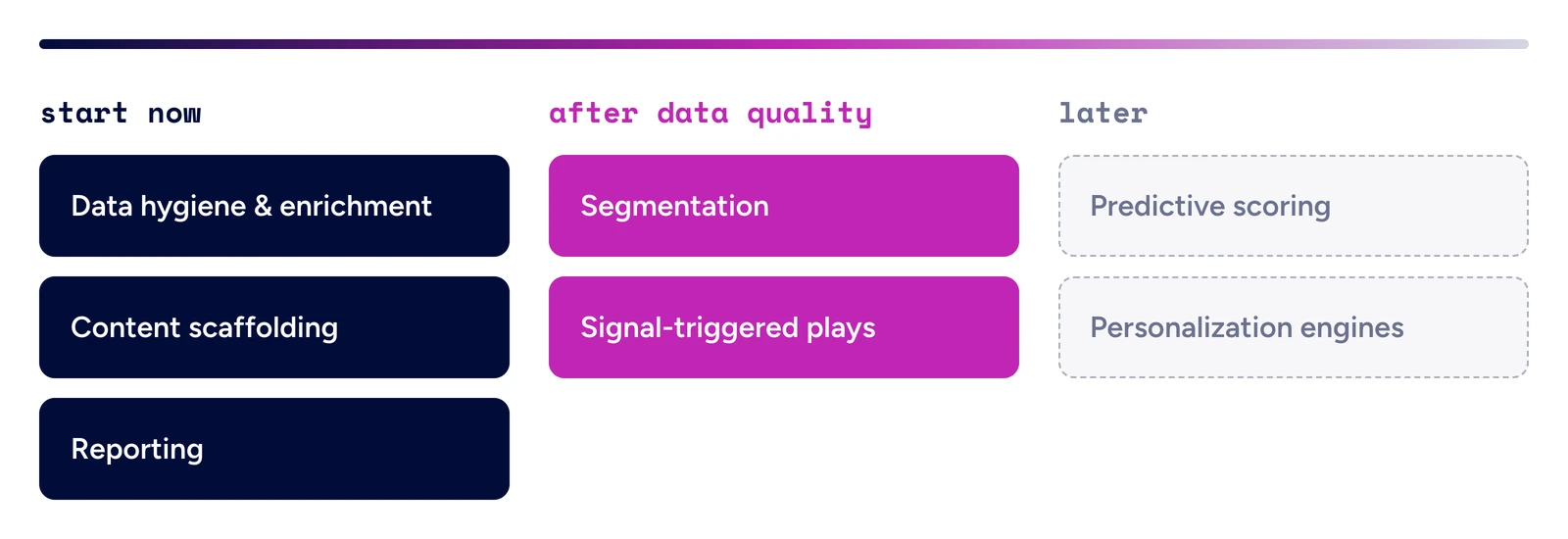
Where to start with AI in marketing ops: use cases grouped by how much clean, connected data they need.
Use case | What AI does | Data it depends on | Start now or later |
|---|---|---|---|
Data hygiene and enrichment | Dedupes, normalizes, and fills missing fields on records | Your CRM and MAP records plus a verified external source | Start now |
Content scaffolding and repurposing | Drafts outlines, briefs, and derivative assets for a human to finish | Your existing content and brand guidelines | Start now |
Campaign and pipeline reporting | Summarizes performance and flags anomalies | Consistent campaign and opportunity fields | Start now, alongside data hygiene |
Audience building and segmentation | Builds target lists from plain-language criteria | Complete firmographics, contacts, and intent signals | After data quality |
Signal-triggered plays | Kicks off a workflow when an account shows a buying signal | Fresh signals tied to the right account and owner | After data quality |
Predictive lead scoring | Ranks leads by likelihood to convert | Clean conversion history at volume | Later |
Personalization engines | Tailors messaging per account or person | All of the above, kept current | Later |
The middle rows depend on data you may not have yet: audience segmentation needs complete firmographics, and buying signals are only useful when they're tied to the right account and owner. The bottom two rows wait for a reason. Improvado's marketing AI use-case guide puts the floor for a stable scoring model at 500 to 1,000 historical conversions and 10,000+ leads, and notes that predictive models need weeks to months of data preparation and validation, while reporting automation can deploy in days to weeks. If your conversion history is thin or scattered across duplicate records, predictive lead scoring will score noise.
Once the data holds up, the middle rows pay off quickly. Safety Services built custom intent topics, used website visitor ID to trigger Workflows that pull persona-matched contacts into nurture, and saw 200% more MQLs in its first month.

"With intent, we're identifying the companies and contacts most ready to buy, warming those leads, qualifying them and then routing them to sales."
Start with data quality, because every AI use case inherits it
On Revenue Architects, Florin and John also asked the same 50 leaders what they would build with no budget limit. 62% chose a unified data layer connecting their GTM tools. Continuous data enrichment came second at 48%. Plugging AI agents into the stack ranked last, at 16%. Florin summed it up: "Given a blank check, GTM leaders don't actually buy more AI, they build a foundation underneath it." That data foundation for agentic AI is what every later use case runs on.
Brendan Powers, Principal GTM Operations and Engineering Manager at ZoomInfo, who joined John on Revenue Architects, builds the agents that run across ZoomInfo's own go-to-market teams. His agents draw on a data layer of CRM records, product usage data in the company's Snowflake warehouse, and signal and enrichment data, and most of them are triggered by a Salesforce event such as an inbound lead, a completed demo, or a renewal 90 days out. When an agent depends on a field that is often empty, no model upgrade saves it. As Brendan puts it, if "you only have industry on like 50% of your accounts, well, your agent is not gonna be too effective."
Three data problems break AI data quality most often:
Duplicate records: An AI agent asked to find the latest note on a contact may pick one of three records for the same person and miss the context in the other two.
Empty or inconsistent fields: Missing industries, free-text job titles, and unmapped fields break segmentation and routing rules before AI ever sees them. Regular CRM hygiene catches most of them.
Decay: B2B data decay runs between 22.5% and 70% of accuracy per year, depending on data type and industry.
Mollie's advice is to set the bar per use case before you pilot: "understand what is the required cleanliness and like confidence in data to support the use case that you're trying to pilot?" That question is your AI readiness test, and a data quality checklist is a good way to answer it. A content assistant needs very little. A scoring model needs a lot.
Data work also moves faster than most teams expect. This is the unglamorous part, and it's the part that pays. After a series of mergers, Watermark Insights removed 100,000 duplicates across Salesforce and Marketo in a few weeks using ZoomInfo Operations, then automated enrichment, normalization, and lead-to-account matching, and added $2 million to pipeline. For the recurring routine, follow these data hygiene best practices.
Where your verified data comes from matters too. Verification quality varies widely across the market, and some specialists do it well. Cognism's Diamond Verified Data, for example, uses a manual process to phone-verify mobile numbers, with a focus on EU coverage. The difference that matters for AI is scope and continuity. ZoomInfo pairs global verified coverage (135M+ verified phone numbers and 120M+ direct dials, backed by multi-source verification with 300+ human researchers) with continuous enrichment, deduplication, and normalization in Operations, so AI works from records that stay clean, not a list that was verified once.
Use AI as scaffolding for content before you let it predict
Scaffolding means AI builds the structure and a person finishes the work. It covers outlining, research, briefs, and repurposing one asset into several. This is where marketers already get value, from AI that works like scaffolding rather than black-box prediction: the marketing AI survey found content creation tools dominate marketing AI use, while predictive analytics and data enrichment platforms remain underused.
For marketing ops, AI for content marketing and AI content repurposing look like this:
Campaign briefs: Turn a request intake form into a first-draft brief with audience, offer, channels, and success metrics.
Repurposing: Turn a webinar or podcast transcript into a blog outline, social posts, and a follow-up email.
Nurture drafts: Produce first-draft copy for each stage of a nurture track, written against your messaging guide.
Account research: Summarize public information on a target account list before an ABM planning session.
Build QA: Generate a pre-launch checklist for a campaign build covering UTMs, suppression lists, and field mapping.
Each of these is fast to set up and easy to judge, because a human reviews the output before it ships. Keep that rule. Mallory Lee, VP of Revenue Operations at Zipline, holds her team to it, as she told John on Revenue Architects: "never send something that you haven't read." For a wider set of ideas, see these generative AI use cases.
It's the same principle behind the context package we hand ZoomInfo SDRs every morning: the data gets pulled first, and the AI writes on top of it.
A four-step AI adoption framework for marketing ops
An AI adoption strategy for marketing ops doesn't need a six-month roadmap. It needs a short sequence that picks one use case, proves it, and makes it repeatable.
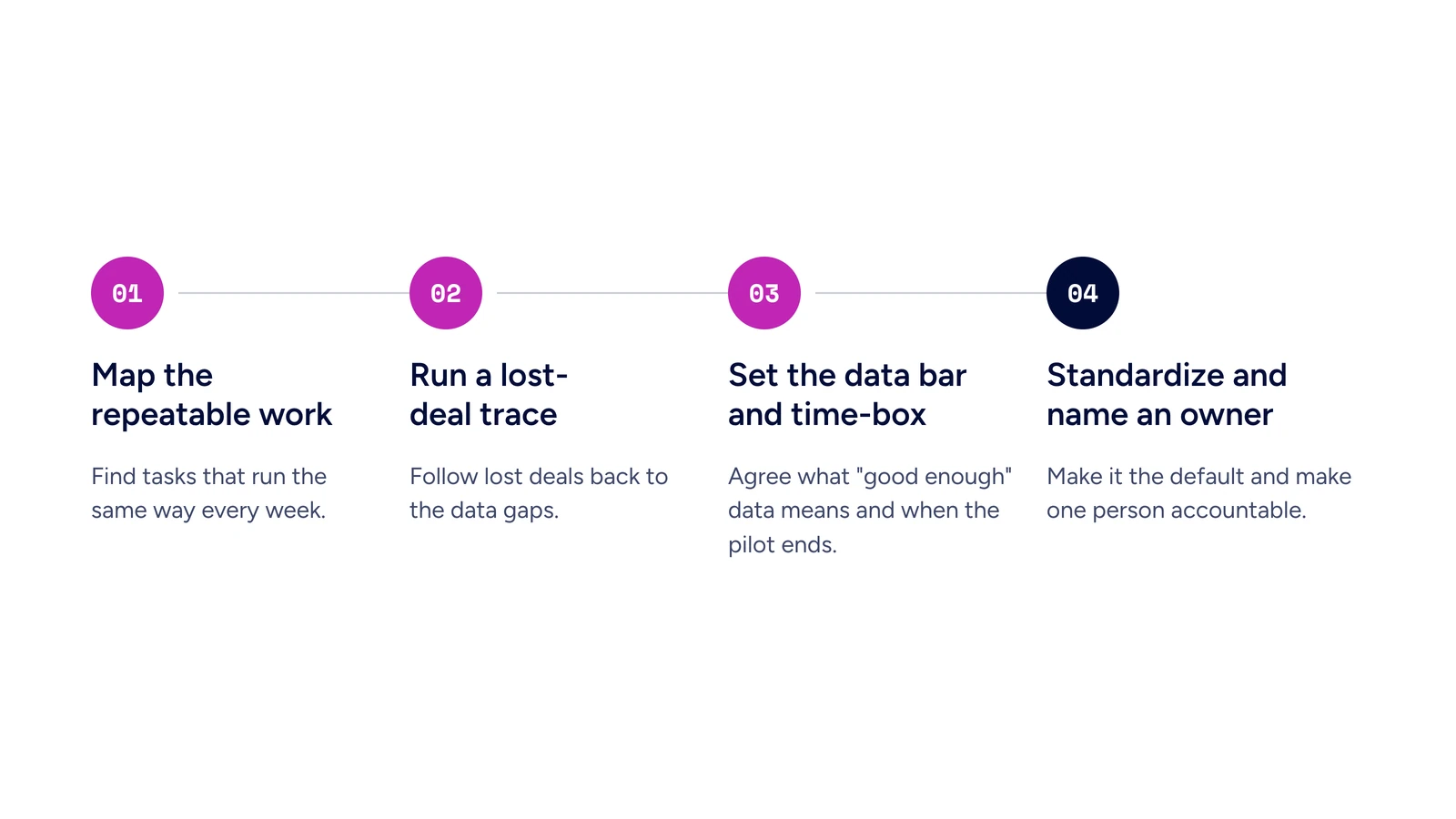
A four-step AI adoption framework for marketing ops.
1. Map the repeatable work
Brendan's starting point for any team early in AI adoption: "put yourself in the shoes of the various roles within your go to market org and think about what are the repeatable everyday or weekly tasks they do." For marketing ops, that means list pulls, campaign builds, UTM governance, lead routing checks, and weekly reporting. Mapping them against your marketing technology stack shows where each task's data lives. Then write down the data each task needs. If a person needs it to do the task well, an agent will too.
2. Run a lost-deal trace to pick the first build
John Lloyd's play for choosing where to start: take one deal that slipped and "we need to walk it backwards to find the single missing connection that would have changed that outcome. So that specific gap is your first build." In one client engagement, freemium users were flagged as customers in Salesforce, and a whitespace play missed hundreds of accounts because of it. Marketing can run the same trace on a campaign that underdelivered.
3. Set the data bar and time-box the first version
Use Mollie's data-confidence question from above to decide what "clean enough" means for this use case, then build a rough first version quickly and put it in front of the people who will use it. Nerdio's marketing ops team took this path. It unified conversation intelligence, intent signals, and system data into a single view and started with one proven use case, account blitzes, delivering pre-built account briefs to sellers.
4. Standardize, then name an owner
Mallory sees the most return from teams that standardize: "it's gonna be the people who have used it to kind of standardize a few things. Because if everyone is using it in a different way, then it's impossible to tell who's doing the best, what's working the best, how do we iterate on it?" Florin learned the same lesson at his previous company, after his team built hundreds of plays: "boil it down to five or six plays, and that process is owned by one person, our orchestration ended up being a lot better." Ownership should be specific. Mollie's rule: "It's like, it's a name and then it's a continuity of like a backup person." That owner may not be full-time. At Zipline, Mallory runs marketing operations as her "night job" alongside the demand gen team.
monday.com's enterprise demand team shows what standardizing looks like at scale. It proved GTM Studio with one sales team first, then grew from 8 ABM sales teams across 4 programs to 22 teams running 12, and cut program launch time from nearly four months to one.

"AI is supposed to give you the ability to be creative, to optimize, to see the full picture. It gives you the ability to drop the operations and take your marketing abilities to the next phase."
How to measure AI marketing ROI without counting activity
Mallory's reminder applies to every AI business case: "ROI means investment and you have to know how much you're investing." Count the licenses, the build time, and the review time, not only the output. Then be honest with your CFO about what you're measuring.
A defensible measure of AI marketing ROI has three layers:
Baseline first: Record the current metric for the workflow before the pilot starts, or you won't be able to show change.
Time saved as a leading indicator: Marketing AI users in the State of AI 2025 survey reported being 44% more productive, saving an average of 11 hours per week. Useful, but it's an input to ROI, not proof of it.
Revenue-tied outcomes as proof: MQL-to-opportunity rate, win rate, audience match rate, and speed-to-lead.
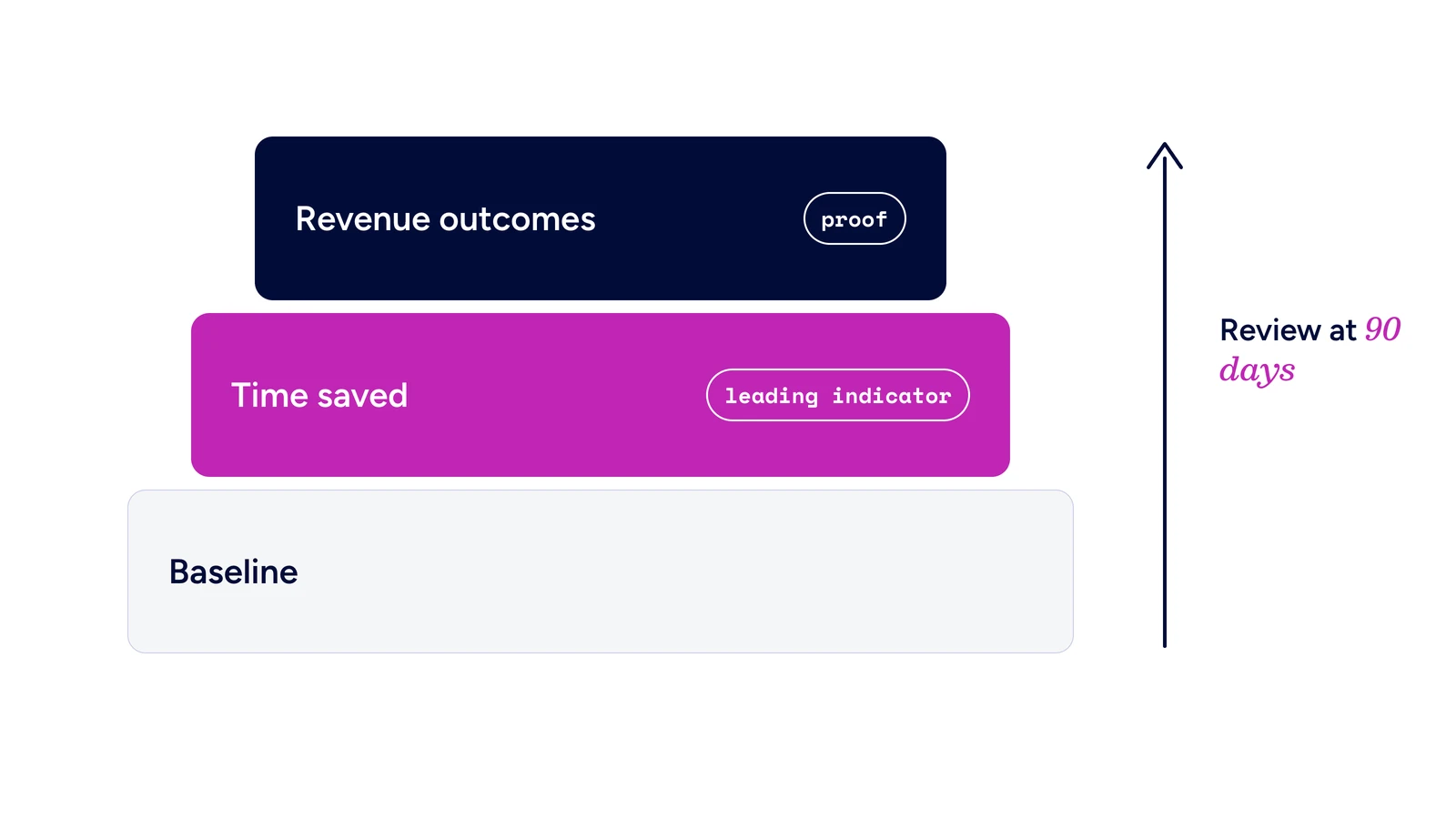
Three layers of AI marketing ROI, reviewed at 90 days.
Smartsheet saw 84% more MQLs from its highest-volume demo form, along with a 26% increase in opportunity rate and a 59% increase in win rate on that form. FormComplete, which enriches website form data behind the scenes, lifted form fills by 40%+ on every multi-field form where it was added. That is the chain to aim for: a workflow change, a funnel metric, and a revenue outcome.

"ZoomInfo is our one source of truth for account data, and even more so for contact data. There's no other provider in the market that provides you with that level of detail."
Set a review date. The State of AI 2025 roadmap recommends picking one workflow, not five, and revisiting the use case or the data quality foundation if at least two baseline metrics haven't moved within 90 days. And be very careful how you report on it. I've seen first-touch reports that would tell a CEO to cut the channel that was creating the demand in the first place. As I've said before, if you don't create the demand first, then you can't capture it. If your CRM data is duplicated or incomplete, campaign-to-revenue attribution breaks too, which is one more reason data quality comes first.
Where ZoomInfo fits in a marketing ops AI stack
ZoomInfo is an all-in-one AI GTM Platform built as three layers: Data, including the GTM Context Graph, Agent Orchestration, and Universal Access.
The foundation is data: 500M contacts, 100M companies, and 1.5B+ data points processed daily. The GTM Context Graph connects that data with your CRM records, conversation intelligence, and behavioral signals into one AI-readable structure. Forrester named ZoomInfo a Leader in The Forrester Wave: Marketing and Sales Data Providers for B2B, Q1 2026.
Agent Orchestration is where AI agents read, reason over, and act on the Graph, then write results back with governance and audit logging applied. Universal Access means your team uses the same data wherever it works: GTM Studio for marketers and marketing ops (here's a walkthrough of GTM Studio), GTM Workspace for sellers, and APIs and MCP for any tool or AI agent your team already runs, including through the ZoomInfo MCP server.
Request a demo to see GTM Studio on your own data.
Frequently asked questions about AI for marketing operations
What is AI for marketing operations?
AI for marketing operations applies AI to the systems work behind campaigns: data hygiene, enrichment, routing, reporting, content production, and audience building. It is different from customer-facing AI such as chatbots. The goal is to make every campaign run on cleaner data with less manual work.
Where should marketing ops start with AI?
Start with data quality and content scaffolding. Both are quick to set up, easy to judge, and every later use case, from segmentation to scoring, depends on clean data. To pick the first build, trace one lost deal or underperforming campaign backward, and check whether your CRM data isn't AI-ready yet.
Why do AI pilots fail?
Most fail because the data underneath is fragmented or incomplete. In the Revenue Architects interviews with 50 senior GTM leaders, half said they could not trust AI outputs without heavy human review. Output that is almost right creates review work that cancels out the time savings. Pilots also fail when nobody owns the workflow after the first version works.
How do you measure AI marketing ROI?
Record a baseline before the pilot, treat time saved as a leading indicator, and prove value with revenue-tied metrics such as opportunity rate and win rate. Smartsheet's results show the full chain from form fills to MQLs to win rate. Review at 90 days and change the use case or fix the data if nothing has moved.
What AI tools do marketing operations teams need?
Think in categories rather than brands: a data quality and enrichment layer, a content assistant, reporting and anomaly detection, and a marketing orchestration platform that triggers plays from signals. Add predictive and personalization tools once your data supports them. For vendor options, see this roundup of AI marketing tools.
How long does it take to see results from AI in marketing operations?
It depends on the use case. Data cleanup and content assistance can show results within weeks: Watermark Insights removed 100,000 duplicate records in a few weeks. Predictive models take longer because they need clean conversion history at volume, so use a 90-day checkpoint to decide whether to scale or change course.