

Your analytics tools can tell you how many people visited a page, but not which companies or buyers were behind the visit.
That blind spot is what website visitor tracking exists to remove, and the tools that do it range from simple company-level IP lookups to person-level identification that names the individual decision-maker.
This guide walks through how the technology works, what each identification tier actually reveals, and how ZoomInfo WebSight Buyer ID turns unnamed traffic into pipeline.
What Is Website Visitor Tracking?
Website visitor tracking is the practice of collecting and analyzing data about who visits your website, what they do there, and, for B2B teams, which companies or individuals those visitors represent.
Most analytics tools give you aggregate, anonymized data: page views, session counts, bounce rates. That's useful for measuring content performance, but it tells a B2B revenue team almost nothing about which accounts are showing buying intent. B2B website visitor tracking software closes that gap by connecting anonymous traffic to real companies and, at the person level, to specific decision-makers in a buying committee.
How much of your website traffic goes unidentified?
Around 98% of website visitors never fill out a form, according to ZoomInfo research, meaning the overwhelming majority of high-intent traffic leaves no trace in your CRM. With 80% of B2B sales interactions predicted to occur exclusively on digital channels, that anonymous gap represents a significant and growing blind spot for pipeline generation.
How Website Visitor Tracking Works: The 4 Core Technologies
Anonymous website visitor tracking relies on four distinct technical approaches, each surfacing different data and serving different use cases for B2B teams.
1. Cookie-based tracking
A small text file (cookie) is placed in the visitor's browser when they land on your site. On subsequent visits, the cookie identifies the returning visitor and stitches sessions together over time. This approach surfaces behavioral data like pages visited, session duration, and return frequency. It works well for both B2B and B2C but depends on browser cookie support, which is declining as third-party cookies are phased out across major browsers.
2. Pixel and tag tracking
A lightweight JavaScript snippet or image pixel fires when a page loads, sending event data to a tracking platform. Pixels capture page views, clicks, scroll depth, and conversion events. They are the foundation of most marketing analytics and ad retargeting systems. In a B2B context, pixels alone cannot tell you which company or individual is visiting, they track behavior without identity.
3. Form-based tracking
When a visitor submits a form, their contact information is captured and linked to their browsing session, creating a named visitor record. This is the most accurate identification method available, but it only works for the roughly 2% of visitors who convert. A less-discussed limitation: if a known contact clears their cookies after submitting a form, subsequent visits from that same person cannot be re-identified, creating a persistent gap even for contacts already in your CRM.
4. IP-lookup and identity graph tracking
When a visitor loads a page, their IP address is logged. IP-lookup tools cross-reference that address against a database of IP-to-organization mappings to identify which company the visitor belongs to. More advanced platforms extend this with a proprietary identity graph that matches IP data against verified contact records to identify the specific individual. ZoomInfo's approach combines IP lookup with a proprietary identity graph and continuously verified contact data to achieve person-level identification at scale.
Anonymous, Company-Level, and Person-Level Identification: What Each Tier Reveals
Anonymous website visitor tracking is the baseline capability most teams start with. But for B2B revenue teams, the identification tier you operate at determines whether visitor data becomes pipeline intelligence or stays a traffic report.
Identification tier | What you see | Typical tools | B2B use case |
|---|---|---|---|
Anonymous aggregate | Page views, sessions, bounce rates, traffic sources, no individual or company identity | Google Analytics 4, heatmap tools (Hotjar, Microsoft Clarity) | Content performance measurement, UX optimization |
Company-level | Company name, industry, size, and location of the visiting organization, but not the individual | Leadfeeder, Lead Forensics, HubSpot Breeze Intelligence (formerly Clearbit Reveal) | Account-based marketing targeting, sales territory alerts |
Person-level | Specific individual, job title, buying group membership, and contact details | ZoomInfo WebSight Buyer ID | Real-time SDR outreach, buying committee identification, CRM enrichment |
The vast majority of B2B website visitor tracking tools stop at the company level. Person-level identification, knowing the specific decision-maker visiting your pricing page, is what converts anonymous traffic into actionable pipeline intelligence.
How ZoomInfo WebSight Buyer ID Identifies Anonymous Web Visitors
ZoomInfo WebSight Buyer ID identifies anonymous website visitors by matching IP address data against a continuously verified B2B database, surfacing the specific individual behind each visit, including their company name, title, contact details, and buying group membership.
The product is built on ZoomInfo's WebSights technology, which uses a JavaScript cookie embedded on your website to capture visitor signals. What separates WebSight Buyer ID from standard IP-lookup tools is the identity resolution layer sitting behind it: ZoomInfo's proprietary identity graph, built on a continuously verified contact data.
Here is how the process unfolds:
Triggering the Signal: The feature identifies website visitors who are part of your active Buying Group or are Previously Engaged Contacts.
Precision Mapping: Using multiple data points, these visitors are mapped to real individuals within ZoomInfo, maximizing the value of every lead.
Real-Time Notifications: GTM teams receive immediate alerts with detailed information about the visitor, including their identity and title, allowing for quick and educated follow-up.
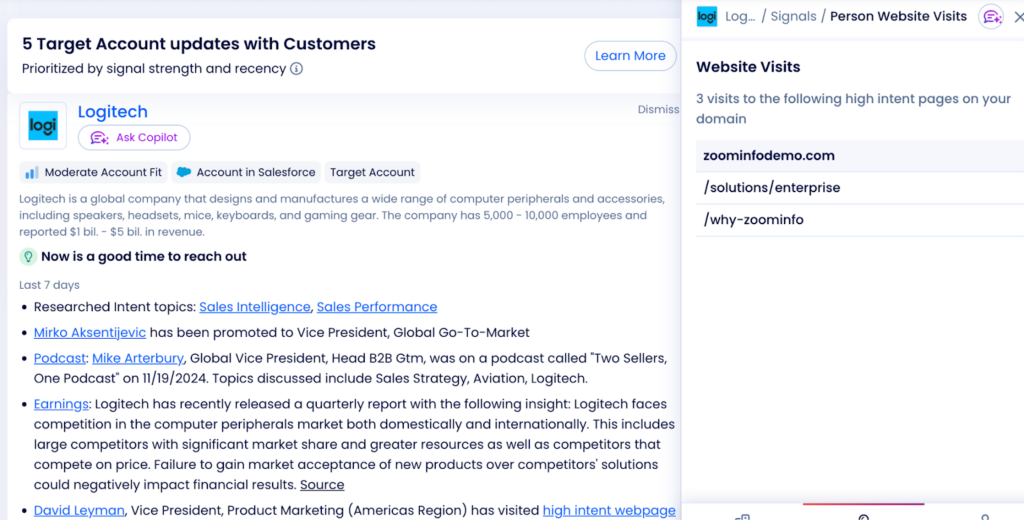
This layered approach surfaces the exact decision-maker visiting your pricing page, with their title, contact details, and buying group membership, so sellers can reach out within minutes of the visit.
WebSight Buyer ID leverages ZoomInfo's advanced WebSights technology to map high-value website visitors to ZoomInfo's person-level database. That database covers 500M verified contacts, 200M+ verified business emails, and 120M direct-dial phone numbers, verified by 300+ human researchers with up to 95% accuracy on first-party data.
ZoomInfo rebuilt its identity resolution infrastructure over multiple years to deliver person-level visitor identification, integrating first-party data with enhanced matching technology to produce accurate, consistent, and granular insights while maintaining compliance with U.S. privacy laws.
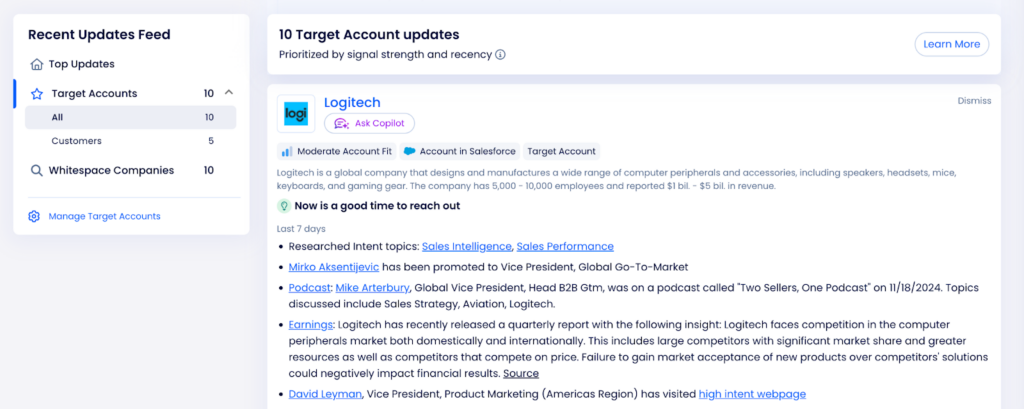
Your team is notified when a visitor meets specific criteria, such as being part of a target account and buying group, residing in the U.S., or having previously engaged with your team. This lets you immediately create tailored outreach.
WebSights also separates verified human company traffic from automated bot activity through Automatic Traffic Filtering, so only real visitors flow into your prospecting results. The analytics dashboard reports both Company Traffic (real people) and Automated Traffic (bots), giving you a clear read on your total identification strength rather than a number inflated by non-human visits.
How to Use ZoomInfo WebSights for B2B Prospecting
ZoomInfo WebSights turns anonymous website traffic into three prospecting actions: triggering direct SDR outreach from high-intent page visits, enriching CRM records to power account-based marketing plays, and scoring accounts by visit patterns to prioritize your pipeline.
1. Trigger SDR outreach from high-intent page visits
When a decision-maker visits your pricing page or demo page, their intent is at its highest point. Real-time alerts from person-level identification let SDR outreach reach the prospect within minutes of that visit, before they've moved on to a competitor's site or the moment has passed.
This addresses one of the most persistent sales-marketing alignment failures: accounts showing high engagement and repeated visits remain invisible to the sales team without a mechanism to surface them. Person-level identification closes that gap, giving sellers a specific name, title, and contact detail tied to a high-intent page visit rather than a generic "Company X visited your site" notification.
2. Integrate visitor data with your CRM for account-based marketing
Identified visitors can be matched directly to CRM records, enriching account profiles with real-time behavioral signals. A decision-maker who visited your product comparison page can trigger an update to their account's buying group membership, flag the account for an ABM sequence, or suppress them from a top-of-funnel nurture that would feel tone-deaf given their intent level.
GTM Studio enables codeless automation of these plays, so marketing teams can build the logic once and let it run without filing a RevOps ticket every time a new campaign or segment requires a workflow update. The result is ABM plays that launch in hours rather than weeks.
3. Score accounts by page-visit patterns to prioritize outreach
Not every visitor warrants immediate SDR outreach. Visit frequency, page depth, and buying group member identification together create a richer scoring signal than any single data point. An account where three members of the buying committee have each visited the pricing page twice in a week is a fundamentally different priority than an account where a single junior employee browsed the blog.
WebSights surfaces this automatically by flagging spiking companies, accounts visiting more often than their usual 30-day average, so teams can prioritize a genuine surge in interest rather than routine traffic.
Feeding these signals into the GTM Context Graph adds another layer of intelligence. The GTM Context Graph reasons across visitor signals, CRM records, and behavioral data to surface not just who visited, but why they matter to your pipeline, connecting a pricing-page visit to an open opportunity, a recent conversation intelligence signal, or a shift in account intent score that makes the timing right.
Here's what that looks like for a team that turned website visitor data into pipeline.

"The greatest benefit of ZoomInfo Sales is the ability to enhance the productivity of the Digital Sales team, while keeping headcount flat."
How to Choose the Right Website Visitor Tracking Software for B2B Teams
Tool selection for B2B website visitor tracking software should be anchored in data accuracy, integration ease, and third-party review ratings. These five questions map your requirements to the right tool category.
Do you need company-level or person-level identification? If your SDR motion depends on knowing the specific individual visiting high-intent pages, you need a person-level identification tool. Company-level tools are sufficient for ABM audience building and territory alerts but cannot support real-time individual outreach.
What is your compliance environment, US-only, GDPR-covered, or both? Person-level identification tools with US-only scope (including ZoomInfo WebSight Buyer ID) are not designed for GDPR-covered visitor populations. If your traffic is primarily European, a company-level IP-lookup tool with explicit GDPR compliance architecture is the appropriate starting point.
Which CRM and MAP do you need to integrate with? The value of visitor identification depends on whether identified visitors can be matched to existing CRM records and trigger downstream workflows. Evaluate native integrations with Salesforce, HubSpot, Marketo, and your marketing automation platform before committing to a tool.
What is your budget, free tier, mid-market, or enterprise? The best website visitor tracking software for enterprise B2B teams is priced accordingly. Entry-level tools offer company-level identification with limited monthly visitor credits. Person-level identification at scale is an enterprise capability.
Do you need real-time alerts or batch reporting? Real-time alerts are essential for SDR-led outreach motions where timing is the differentiator. Batch reporting is sufficient for weekly ABM audience refreshes or territory planning workflows where immediacy is less critical.
For enterprise B2B teams that need person-level identification, real-time alerts, and CRM integration backed by verified data at scale, ZoomInfo WebSight Buyer ID is purpose-built for this use case. As third-party validation: ZoomInfo earned 142 No. 1 rankings on G2 across Sales Intelligence, Buyer Intent, and Data Quality categories in Spring 2026, reflecting the data accuracy and integration quality that tool selection decisions should hinge on.
Privacy and Compliance Considerations for Website Visitor Tracking
Website visitor tracking sits at the intersection of marketing effectiveness and data privacy law. Understanding which methods require consent, and where geographic limitations apply, is essential before deploying any tracking tool.
Which tracking methods require consent under GDPR?
Cookie-based and pixel tracking require explicit user consent under GDPR for visitors from EU member states. A compliant consent banner must be deployed before these scripts fire, and visitors who decline consent must not be tracked. IP-based tracking is more nuanced under EU law: while IP addresses are considered personal data under GDPR, the legal basis for processing them varies by jurisdiction and use case. Organizations operating in GDPR-covered regions should not assume that IP-lookup tools are automatically exempt from consent requirements.
WebSight Buyer ID's geographic scope and compliance posture
This feature is currently limited to identifying U.S. website visitors, and ZoomInfo has developed this feature in a manner compliant with applicable U.S. laws. ZoomInfo's compliance is not a substitute for customer compliance when implementing and using the feature. You should work with your legal counsel to identify changes to your privacy policies, disclosures, or other processes that may be necessary to address your use of this feature based on U.S. laws that are applicable to your business.
What to look for in a data processing agreement
When evaluating any website visitor tracking tool, review the vendor's data processing agreement for: how long visitor data is retained, whether data is shared with third parties for enrichment or resale, and what deletion or opt-out mechanisms are available to identified individuals. ZoomInfo holds ISO 27001, ISO 27701, SOC 2 Type II, and TRUSTe GDPR/CCPA certifications, providing enterprise buyers with an auditable compliance baseline. For WebSights specifically, captured visit data is encrypted at rest using AES 256.
WebSight Buyer ID Within ZoomInfo's All-in-One AI GTM Platform
WebSight Buyer ID gives GTM teams visibility into the roughly 98% of website visitors who never fill out a form, turning anonymous high-intent traffic into qualified pipeline with real-time alerts tied to verified contact data.
That capability is built on ZoomInfo's most comprehensive B2B data platform: 500M contacts verified by 300+ human researchers, with up to 95% accuracy on first-party data. The Forrester Wave named ZoomInfo a Leader for Intent Data Providers B2B with the highest scores across eight criteria in Q1 2025, reflecting the data foundation that makes person-level identification possible at enterprise scale.
Visitor signals feed directly into the GTM Context Graph, which processes 1.5B+ data points daily, fusing your website traffic with CRM records, conversation intelligence, and behavioral signals into a unified reasoning layer. The result is not just a list of who visited your site, it is a prioritized view of which accounts are in motion, which buying committee members are actively researching, and which signals indicate readiness to engage.
Teams can act on those signals through GTM Workspace for sellers, GTM Studio for marketers, or any custom GTM workflows with AI agents via ZoomInfo's MCP server or Enterprise API. The same verified B2B intelligence is available across every workflow and every tool your team already uses.
Request a demo to see how WebSight Buyer ID turns your anonymous website traffic into qualified pipeline.
Your Questions About Website Visitor Tracking, Answered
Can you track website visitors?
Yes. Website visitor tracking tools use scripts, cookies, pixels, and IP-lookup databases installed on your site to log visitor actions such as page views, clicks, scroll depth, and session duration. For B2B teams, advanced tools like ZoomInfo WebSights go further, identifying the specific individual or company behind a visit using an identity graph matched against verified contact data.
How do you identify anonymous website visitors?
Anonymous website visitors can be identified through three methods: form-based identification, where a visitor submits their contact information; company-level IP lookup, which maps the visitor's IP address to an organization; and person-level identification, which cross-references IP data and behavioral signals against a verified B2B database to identify the specific individual. WebSight Buyer ID uses the third method, matching visitors against 500M verified contacts to surface decision-makers visiting high-intent pages.
Can someone tell if I visited their website?
Website owners can detect visits through analytics scripts, cookies, and IP-lookup tools. However, individual personal identity is typically anonymized in standard analytics tools unless a visitor fills out a form or a person-level identification tool is in use. For B2B visitors, tools like ZoomInfo WebSight Buyer ID can identify decision-makers visiting a site if the site owner has deployed the WebSights script and the visitor matches a verified contact in ZoomInfo's database. This capability is currently limited to US visitors and is developed in compliance with applicable US privacy laws.
What is the difference between company-level and person-level website visitor tracking?
Company-level tracking uses IP-lookup databases to identify which organization a visitor belongs to, you see the company name, industry, and size, but not the individual. Person-level tracking goes further, cross-referencing IP data and behavioral signals against a verified B2B database to identify the specific individual, their title, and their role in the buying committee. WebSight Buyer ID delivers person-level identification, surfacing decision-makers and previously engaged contacts visiting high-intent pages in real time.
Is website visitor tracking GDPR compliant?
It depends on the tracking method. Cookie-based and pixel tracking typically require explicit user consent under GDPR. IP-based tracking is more nuanced under EU law. ZoomInfo WebSight Buyer ID is currently limited to identifying US website visitors and has been developed in compliance with applicable US laws. Organizations operating in GDPR-covered regions should consult legal counsel to determine what disclosures or consent mechanisms are required for their specific use of visitor tracking tools.
Can ZoomInfo WebSights identify the specific person who visited my site?
Yes, with conditions. WebSight Buyer ID delivers person-level identification for U.S. website visitors who are either part of an active buying group or are previously engaged contacts matched against ZoomInfo's database of 500M verified contacts. For visitors who aren't yet matched, WebSights falls back to company-level identification, showing you the account without the individual. Person-level identification is currently limited to U.S. visitors.
Why is ZoomInfo WebSights not surfacing any visitors?
If WebSights isn't surfacing visitors, check three things: the tracking snippet isn't installed or firing on all pages; your visitors don't yet match Buyer ID's person-level criteria, active buying group members or previously engaged contacts, so you see company-level traffic without named individuals; or Automatic Traffic Filtering is working as designed, showing only IP-matched company traffic and excluding bots and personal IPs.