
Recruiting has spent decades trying to find the right people. We have built databases, perfected Boolean strings, invested in sourcing platforms and, more recently, introduced artificial intelligence capable of searching through enormous amounts of professional information.
We have become remarkably good at producing candidates.
Yet there is a distinction the recruiting industry still struggles to address. Finding someone who is qualified for a job does not necessarily mean finding someone who is right for the opportunity.
A software engineer may have every technical skill a hiring manager wants but have no interest in leaving their current company. A sales executive may have the right industry experience but have just accepted a promotion. A candidate may look perfect in a database, only for the recruiter to discover that their professional information is six months out of date.
These are not necessarily sourcing failures. They are reminders that recruiting involves more than matching professional experience to a job description.
As AI recruiting agents become more capable, the industry has an opportunity to reconsider what successful candidate discovery actually means.
The question is no longer simply how many qualified candidates technology can find. It is whether that technology can help recruiters identify people worth engaging, using accurate professional information and enough context to make better decisions.
That distinction is central to the next generation of AI recruiting technology, including Talent Autopilot, ZoomInfo Talent Solutions' AI recruiting agent.
What Makes Someone the Right Candidate?
Recruiters have traditionally evaluated candidate relevance through a relatively familiar collection of criteria: skills, experience, education, job titles, industry background and location.
Those characteristics matter. They help establish whether someone could reasonably perform a job.
But qualification is only one part of the equation.
A candidate can be qualified without being interested. They can be interested without being available. They can have relevant experience that is difficult to recognize through traditional search criteria. Their professional information may also be incomplete or outdated, creating a misleading picture of their suitability.
The right candidate requires a more complete understanding of three things: professional relevance, current context and timing.
Professional relevance establishes whether someone's experience makes sense for the opportunity. Current context helps recruiters understand where that person is in their career and what their professional circumstances look like today. Timing introduces a less predictable question: Is there a reasonable opportunity to begin a conversation?
None of these dimensions guarantees that someone will be interested in a job. Together, however, they provide a more useful foundation for candidate discovery than a list of matching keywords.
Why Candidate Quality Matters More Than Candidate Quantity
Recruiting has always involved numbers.
Recruiters measure how many candidates they source, how many messages they send, how many responses they receive and how many people advance through the hiring process. Those metrics help teams understand activity and identify bottlenecks.
But activity is not the same as progress.
A sourcing tool that produces 500 loosely relevant profiles may create considerably more work than one that identifies 25 people whose professional backgrounds genuinely align with the hiring objective.
The recruiter still has to review the profiles, verify information, determine who is worth contacting and decide how to approach each person.
Artificial intelligence can make those processes faster, but speed alone does not improve the underlying quality of the candidate pool.
If the technology simply generates more names, the recruiter may end up spending more time separating relevant candidates from irrelevant ones.
The better measure of candidate discovery is not how many profiles a system returns. It is how effectively those profiles help recruiters identify people worth considering and engaging.
This is one reason AI recruiting agents represent a meaningful shift from traditional sourcing software. Rather than merely returning results based on recruiter-defined search criteria, agents can interpret a hiring objective and reason across available professional information to help identify relevant candidates.
The opportunity is not to eliminate the numbers involved in recruiting. It is to improve the quality of the decisions behind them.
The Missing Variable in Candidate Discovery Is Time
Recruiting technology has become increasingly sophisticated at describing who someone is professionally.
It can capture job titles, employment history, skills, previous companies and professional contact information. More advanced systems can connect those details to broader company and organizational context.
What remains considerably harder to understand is whether the opportunity makes sense for that person right now.
Consider two candidates with nearly identical professional backgrounds.
One has spent five years at the same company, recently taken on additional responsibilities and may be open to exploring what comes next. The other accepted a new position last month and is focused on establishing themselves in that role.
Both may be qualified. Their willingness to engage could be very different.
The important distinction is that professional information cannot tell us with certainty what either person wants. Someone who recently changed jobs may still be interested in another opportunity. Someone who has remained with the same employer for years may have no intention of leaving.
Timing is a human variable, not a prediction that recruiting software can reliably make from a profile.
However, accurate and current professional information can help recruiters better understand the circumstances surrounding a candidate.
A recent promotion, employer change or shift in responsibilities may provide useful context for a conversation. It should not be mistaken for proof of job-seeking intent.
The objective is to help recruiters make more informed decisions about whom to engage and how to approach them.
Why Outdated Talent Data Makes Candidate Discovery Harder
Before recruiting technology can reason about professional relevance or timing, it needs reliable information about the people it is evaluating.
That is a bigger challenge than many organizations recognize.
In its 2026 report, The Confidence Gap: Why Verified Data Is the Foundation of Modern Recruiting, Aptitude Research found that 74% of respondents were very or extremely confident that their candidate data was accurate and current. Yet 61% believed at least a quarter of the records in their ATS or talent database were already out of date.
The same research found that 62% believed candidate information becomes unreliable within three months, including 32% who said it becomes unreliable within just 30 days.
Those findings expose an uncomfortable reality. Recruiting teams may have considerable confidence in information that is changing faster than their systems can keep up.
And that problem becomes more consequential when AI is involved.
A recruiter reviewing a profile may notice an inconsistency, check another source and correct the information before reaching out. An AI system operating across large volumes of professional records can encounter the same inaccuracies at a much greater scale.
Better algorithms cannot compensate for information that is fundamentally wrong.
An agent cannot accurately reason about someone's current professional circumstances if it does not know that person changed jobs. It cannot interpret career progression correctly if important experience is missing. And it cannot help initiate a conversation using contact information that no longer works.
This is why verified talent data is becoming foundational to AI recruiting.
The quality of candidate discovery depends on both the intelligence of the technology and the reliability of the information it can access. For a deeper look at how verified data grounds agent output, see how verified data grounds AI agents.
Can AI Recruiting Agents Improve Candidate Quality?
The promise of AI recruiting is often framed around efficiency. Agents can perform work that previously required manual searching, profile review and repetitive sourcing activity.
Those capabilities matter, but they are not the same as better recruiting outcomes.
The more meaningful opportunity is to improve the starting point of the recruiting process.
An agent that understands a hiring objective and reasons across professional information may help identify candidates who would not appear in a conventional search. It can recognize relevant experience beyond exact job titles, consider career progression and help recruiters explore a broader talent pool.
But candidate quality cannot be reduced to how sophisticated an algorithm is.
Recruiters still need to understand the role, evaluate the professional evidence and determine whether the person makes sense for the opportunity. They also need to consider whether the candidate can be reached and whether a conversation is worth pursuing.
That means AI recruiting agents should be evaluated on more than the number of profiles they produce or the speed at which they produce them.
A better question is whether they help recruiters spend more time with relevant candidates and less time sorting through people who were never a strong fit.
How Talent Autopilot Approaches Candidate Discovery
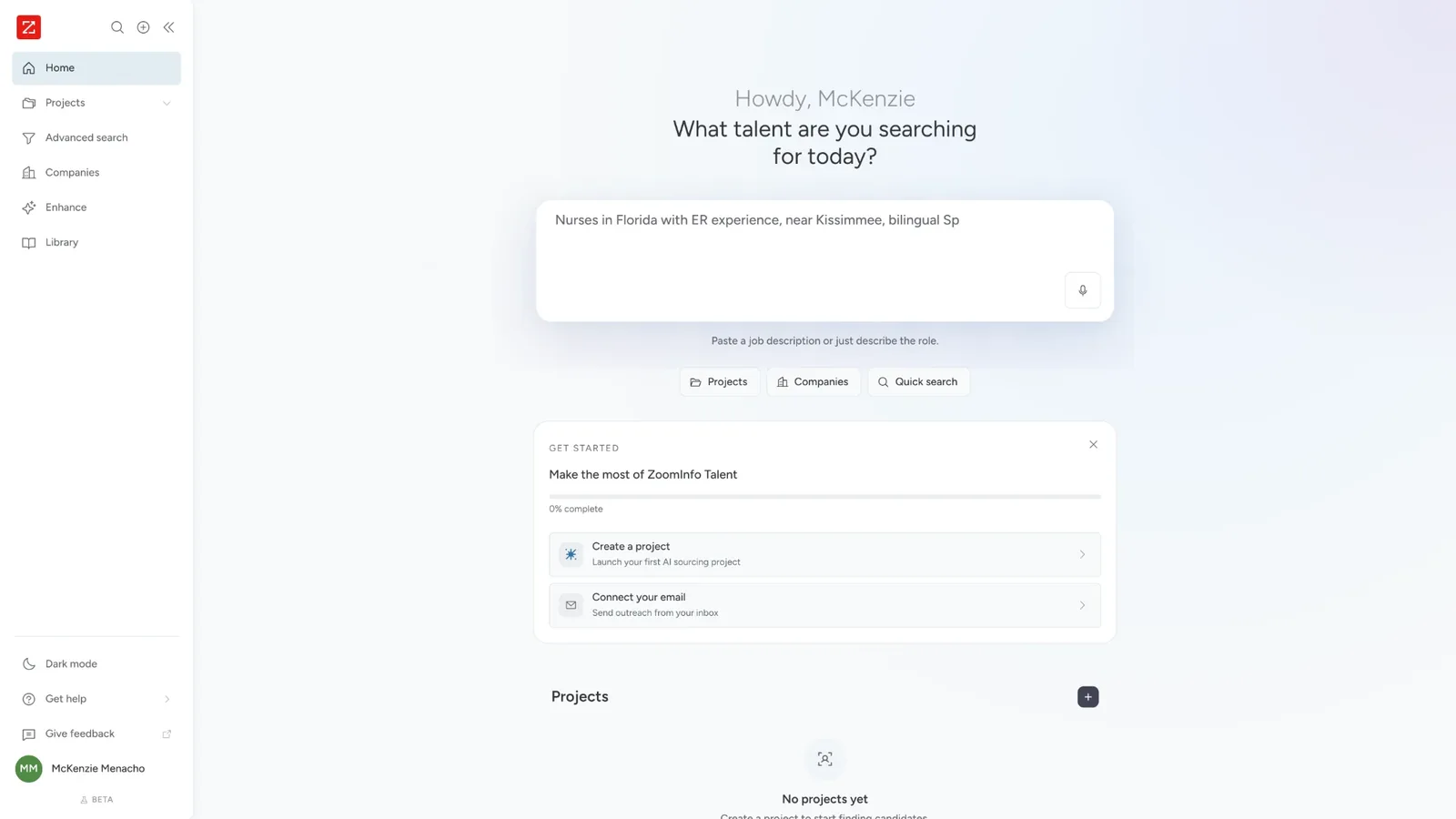
Talent Autopilot is ZoomInfo Talent Solutions' AI recruiting agent, designed to help recruiters discover, evaluate and engage qualified candidates using ZoomInfo's professional data and company intelligence.
The agent begins with the hiring objective. Instead of requiring recruiters to anticipate every relevant title, company or keyword, Talent Autopilot can reason across professional information to identify candidates whose backgrounds may align with the role.
This is particularly useful when the obvious search criteria fail to capture the full range of relevant experience.
Consider a recruiter searching for a customer success leader with experience managing complex enterprise relationships.
A traditional search might begin with people whose current titles include "director of customer success" or "head of customer success." Those searches may produce qualified candidates, but they can also exclude people who have developed similar capabilities in account management, implementation leadership or other customer-facing functions.
The recruiter may recognize those connections once they see the profiles. The challenge is knowing which alternative titles, companies and career paths to search for in the first place.
Talent Autopilot is designed to help with that discovery work.
By reasoning across professional context, the agent can help recruiters consider candidates outside the most obvious search criteria. Recruiters can then review the results, refine the hiring objective and determine which candidates warrant further attention.
Talent Autopilot also supports personalized outreach after recruiter approval, helping connect candidate discovery with engagement.
That distinction is important. Talent Autopilot is not designed to predict whether someone wants a new job or guarantee that a candidate will respond. Its value is helping recruiters discover relevant people and take the next steps toward a conversation.
Learn more about how Talent Autopilot works.
Candidate Engagement Is Where Discovery Meets Reality
A candidate profile can tell a recruiter a great deal about someone's professional history. It cannot tell the recruiter everything that matters.
Interest is ultimately established through conversation.
A recruiter may discover someone with an excellent background, only to learn that the opportunity does not align with their career goals. Another candidate may have a less conventional resume but be genuinely interested in the role and bring experience the hiring manager had not originally considered.
That is why recruiting technology should help recruiters reach the point where a meaningful conversation can happen.
The quality of the initial candidate pool matters, but so does the ability to contact people using accurate information and approach them with relevant context.
Aptitude Research found that 66% of respondents estimated at least 15% of their outbound candidate outreach never reached the intended recipient because of inaccurate contact information.
That is a significant obstacle between candidate discovery and engagement.
A sourcing system can identify someone who appears ideal for a position, but if the contact information is inaccurate, the recruiter may never have an opportunity to establish whether the person is interested.
This is another reason the data foundation behind an AI recruiting agent matters.
The value of discovery does not end when a profile appears on a screen. It extends into the recruiter's ability to act on that discovery.
How Should Recruiting Teams Measure Candidate Discovery Quality?
Recruiting teams should continue measuring sourcing activity, but those measurements need to be connected to outcomes.
A large candidate list may look productive. A high volume of outreach may create the appearance of momentum. Neither necessarily demonstrates that recruiters are finding better people.
A more useful evaluation considers several stages of the process.
First, how many discovered candidates are genuinely relevant to the hiring objective? This helps distinguish useful discovery from a large volume of loosely matched profiles.
Second, how much manual correction or additional research is required before the recruiter can engage those candidates? If recruiters still spend significant time validating titles, employment history and contact information, the technology may simply be transferring work rather than reducing it.
Third, how effectively does discovery translate into candidate engagement? Response rates, interested responses and meaningful conversations provide additional evidence about whether the initial candidate pool was worth pursuing.
Finally, how many of those candidates progress into the hiring process? Qualified conversations, hiring manager acceptance and interview progression can help organizations understand whether their sourcing strategy is producing value beyond activity.
None of these metrics should be interpreted in isolation. Response rates vary by role, market, outreach quality and other factors. Interview progression depends on hiring decisions that extend well beyond sourcing technology.
But together, they provide a more complete picture than counting profiles or messages alone.
The goal is not simply to generate more recruiting activity. It is to improve the quality of the opportunities that activity creates.
What Should Recruiters Look for in an AI Recruiting Agent?
Recruiters evaluating AI recruiting agents should begin with the problem they are trying to solve.
If the challenge is writing outreach messages, an AI assistant may be sufficient. If the challenge is searching an existing database more quickly, improved search capabilities may help.
But if recruiters are struggling to discover qualified candidates beyond their existing search criteria, they need to evaluate how an agent understands a hiring objective and what professional information it can use.
That includes examining the underlying data, the agent's ability to reason across professional context, how recruiters can refine results and what happens after candidates are discovered.
It also means understanding where human judgment remains essential.
An AI recruiting agent should not be judged by whether it can remove the recruiter from the process. It should be judged by whether it helps the recruiter make better decisions and perform more valuable work.
For teams exploring this approach, Talent Autopilot combines agentic candidate discovery with ZoomInfo's verified talent data and engagement capabilities.
The objective is to give recruiters a stronger starting point, not simply another database to search.
The Future of AI Recruiting Should Be About Better Candidates, Not More Candidates
Recruiting technology has spent years trying to make sourcing faster.
We can search larger databases, generate more complicated queries, automate outreach and produce candidate lists in a fraction of the time those activities once required.
But the fundamental challenge has not disappeared.
Recruiters still need to find people whose experience makes sense for an opportunity, understand enough about their professional circumstances to approach them intelligently and determine whether there is mutual interest.
AI recruiting agents have the potential to improve that process, particularly when they can reason across reliable professional information rather than relying exclusively on recruiter-defined searches.
But the industry should be careful not to confuse greater automation with better discovery.
A candidate who matches every requirement may have no interest in the role. Someone with a less obvious background may turn out to be an exceptional fit. And a seemingly perfect profile may be based on information that stopped being accurate months ago.
That is why candidate quality requires more than matching skills and experience. It requires relevant professional context, reliable information and a recruiter who understands that timing cannot be reduced to an algorithm.
The next generation of recruiting technology should help recruiters navigate those complexities, not pretend they no longer exist.
That is the opportunity behind Talent Autopilot. By combining AI recruiting agents with ZoomInfo's professional data foundation, we can help.