
An AI agent is only as good as the data it runs on. Ask one for your in-market accounts or the decision-makers at a target company, and it answers with equal confidence whether those records are current or two years old. It cannot tell the difference, so a wrong answer looks exactly like a right one.
Verified data is what prevents that. As agents take on real go-to-market work, whatever they are grounded on sets the ceiling on the output. This page covers what verified data for AI agents means, what unverified data costs once no one is checking, and how ZoomInfo grounds agents in data they can act on.
What Verified Data Means for an AI Agent
Verified data is data an agent can act on without a human checking it first. That last part is what changed. Data used to pass in front of a person who caught the obvious errors before anything happened, but agents removed that step, so the data has to be right the moment the agent acts. What makes it right comes down to three properties. It is accurate, current, and traceable to a source you can point to, and every source has to clear that bar before you put an agent on it.
Property | What it checks | What an agent gets wrong without it |
Accuracy | The record matches reality today | Emails someone who has left, dials a dead number |
Recency | The data is up to date | Acts on a title, team, or signal that has since changed |
Provenance | You can trace the source and confidence | Produces output no one can audit or defend |
When one property fails, the other two stop counting. A flawless-looking record for a decision-maker who left last quarter is correct in format and wrong in fact, and the agent has no way to know.
The Cost of Unverified Data
Unverified data turns an agent into a confident source of wrong answers. It keeps working without hesitation, and every stale record it touches flows into the next step, whether that is outreach, scoring, or routing. ZoomInfo CEO Henry Schuck calls this "fluent guesswork."
The cause is ordinary decay. About 70% of B2B contact data goes stale within a year as people change jobs, companies reorganize, and direct dials go dead. At the volume an agent works through, those errors are not caught one by one. They compound.
Agents compound errors in a way dashboards do not, because an agent rarely does just one thing. A prospecting workflow usually chains several steps.
Research the account
Score it against your ICP
Draft the outreach
Route it to the right rep
A wrong field at step one does not stay contained. It becomes a wrong assumption every later step inherits, and it carries into any agent this one hands off to.
The upside of getting this right shows up in the numbers. In TDWI research sponsored by ZoomInfo, only about 40% of organizations reported measurable or consistent value from their AI initiatives, even though most were already using the technology. The ones seeing real returns had grounded their AI in verified company data rather than off-the-shelf tools.
The most expensive errors are the clean ones. A well-formatted record that is quietly out of date gives an agent no reason to doubt it, so it acts.
What Makes Data Agent-Ready
Past the accuracy, recency, and provenance test, data an agent can reason over well tends to share five traits.
Continuous verification. Records are re-checked and refreshed on an ongoing basis, so what was right last quarter is still right today.
Multi-source validation. Facts are confirmed across several methods rather than trusted from a single feed.
Traceable provenance. Each field carries a sense of its source and confidence, so you can audit what the agent did and why.
Coverage beyond your CRM. The source sees org changes, new decision-makers, and in-market signals for companies your team is not already tracking.
Machine-readable context. The data carries relationships and meaning, so an agent can tell why a signal matters instead of only seeing that it fired.
That last trait is where CRM-only setups fall short. A CRM records what happened, that a deal changed stage or a contact was added, but says nothing about why, and it knows nothing about the accounts your team has never worked. An agent grounded on that alone reasons from a partial, aging picture with full confidence.
For the bigger picture, see why AI agents need to go beyond the CRM.
How ZoomInfo Grounds Agents in Verified Data
GTM AI is how ZoomInfo delivers verified data and context to agents. It connects ZoomInfo's data foundation to the AI tools your team already uses over MCP, a CLI, and APIs, so every agent works from the same source wherever it runs.
How the data gets verified
ZoomInfo verifies data continuously rather than in periodic batches. Four independent inputs feed the process: machine learning that scans 28 million website domains a day, third-party partner data, a contributory community of more than 200,000 ZoomInfo Lite users, and an in-house lab of over 300 researchers. Those inputs are cross-checked with NLP, machine learning, and data scientists, reaching up to 95% accuracy on first-party data, then monitored on an ongoing basis so a detected change is corrected, added, or removed in near real time. Compliance is built in, with ISO 27001, ISO 27701, SOC 2 Type II, and TRUSTe GDPR certifications.
The accuracy holds up outside ZoomInfo's own marketing. Forrester named ZoomInfo a Leader in Intent Data Providers and pointed to the largest R&D investment of any provider it evaluated. In a Fortune 500 RFP that compared 25 million contacts across vendors, the independent reviewer concluded that no other competitor came close.
From records to context
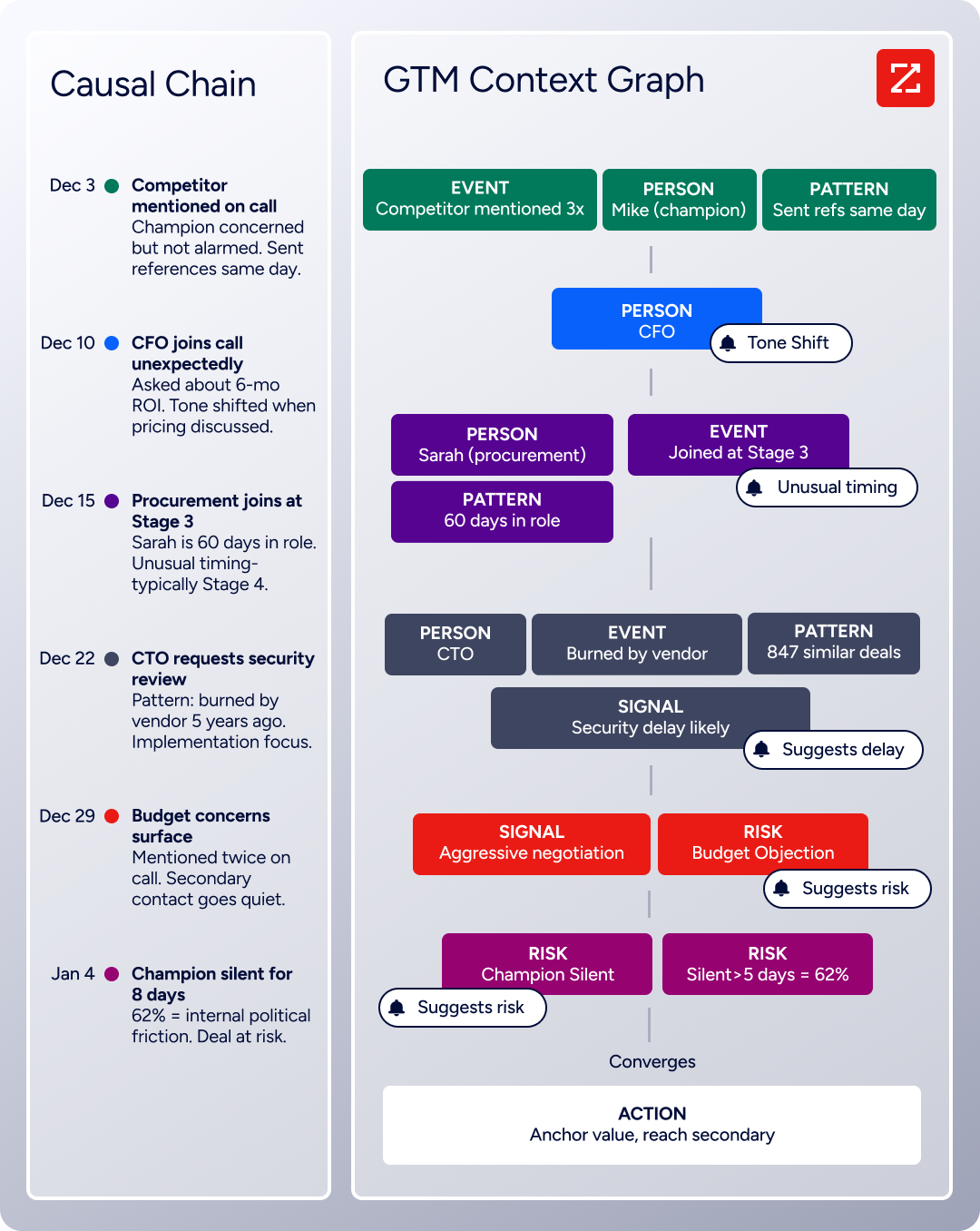
Verified records tell an agent who and what. The GTM Context Graph tells it why. It combines ZoomInfo's verified data, an identity-resolved graph of 100M+ companies and billions of buying signals, with your own first-party data, CRM history, conversation intelligence from calls, engagement, and behavioral signals, into one layer that processes 1.5B+ data points a day and captures the reasoning behind a deal, beyond the bare record of what changed.
This is what a plain "GPT on my CRM" project is missing. The CRM has the fields, but it never captured why a deal slipped or what similar deals did next, so an agent built on it can pull a row without understanding it. The GTM Context Graph turns that missing context into something an agent can reason over.
How agents reach the data
Through GTM AI, an agent calls verified ZoomInfo datasets directly, most of them free to search and metered only when it pulls full detail.
Verified companies and contacts, with firmographics, verified emails, and direct dials.
Buyer intent across 5,000+ topics, scored against each company's baseline and refreshed daily.
Scoops, the live buying triggers such as exec moves, funding rounds, and acquisitions.
Corporate hierarchies from parent to subsidiary, for account mapping and TAM.
Lookalike companies ranked against a best customer across ZoomInfo's graph.
It reaches all of this three ways, so an agent can connect however it runs, and everything stays inside your existing data entitlements and permissions.
Access lane | Best for | Cost model |
MCP server | Agents and reps inside Claude or ChatGPT | Finding free, enrichment on data credits, research on AI credits |
CLI | Scripts, cron jobs, and scheduled agent workloads | Token-efficient for anything on a schedule |
APIs | Embedding data in your own product or pipeline | Structured API suite and Enterprise API |
Whichever lane it uses, the agent reasons over the same verified foundation, so what one agent pulls in a terminal matches what another sees inside Claude.
For a look at the CLI lane in action, the demo below shows ZoomInfo's chief product officer running a full enrichment job from a coding agent.
Choosing a Data Source Your Agents Can Trust
Most data vendors describe themselves in similar language. A few questions cut through it when you are deciding what to ground your agents on.
How is the data verified, and how often is it refreshed? Continuous, multi-source verification is worth more than a periodic import.
Can you trace each field to a source and a confidence level? Without that, an agent's mistakes stay hidden until they cost you something.
Does the source reach past your own CRM into the wider market?
Does it carry context, or only records?
Can your agents connect through MCP, a CLI, or an API without a build project?
One test beats any accuracy figure on a slide. Run the vendor's own MCP server or API against ten accounts you already know cold, and stale titles, wrong domains, and missing signals show up within minutes.
Build Agents on Verified Data
Verification decides whether an agent's output is worth acting on. Accurate, current, traceable data lets an agent reason from facts. Anything weaker produces confident output you cannot rely on, and with no one reviewing the work before the agent acts, that output goes straight into the pipeline. The teams getting real value from agents start by getting the data foundation right.
GTM AI connects ZoomInfo's verified data and the GTM Context Graph to the AI tools and agents you already run, through MCP, a CLI, and APIs.
Start building with GTM AI to ground your agents in verified B2B data, or try ZoomInfo free to see the foundation behind it.
FAQ
What does verified data mean for an AI agent?
It means data whose accuracy, recency, and origin can be trusted at the moment the agent uses it. An agent cannot tell a fresh record from a stale one, so it treats both as equally true. Verified data removes that risk by being confirmed across several sources, refreshed on an ongoing basis, and traceable back to where each field came from.
Why does verified data matter more for agents than it did before?
Because the review step is gone. Data used to pass in front of a person who could catch an obviously stale record before it did damage. An agent acts on the record right away and at volume, so it has to be good enough to act on unsupervised, which is a higher bar than good enough to review.
Why can't an AI agent just run on my CRM data?
A CRM holds what your team captured, and that data decays fast, roughly 70% of B2B contact data goes stale each year. It also only covers accounts you already touch, so an agent grounded on it is blind to the wider market and to the reasons deals move. Verified third-party data plus context fills both gaps.
How is verified data different from simply having more data?
Volume without verification just adds more ways to be wrong. A bigger list that is not checked and refreshed decays like any other. What makes data useful to an agent is accuracy, currency, traceability, and context, rather than sheer volume.
How do AI agents access ZoomInfo's verified data?
Through GTM AI, which offers three routes to the same data: an MCP server for tools like Claude and ChatGPT, a CLI for scripts and scheduled agent workloads, and an API suite for embedding data into your own product or pipeline. The right route depends on how the agent runs, not on which data it gets, since all three reach the same verified foundation.
How accurate is ZoomInfo's data?
ZoomInfo reports up to 95% accuracy on first-party data, maintained through a multi-source pipeline of machine scanning, partner data, a contributory community, and 300+ human researchers, with continuous monitoring that updates records as changes are detected. Third parties including Forrester have recognized that data quality independently.
