
ActionIQ has changed hands. What started as an independent enterprise CDP (built to give marketing teams direct access to their customer data) is now the CDP Agent inside Uniphore's Business AI Cloud. The December 2024 acquisition didn't change the core product philosophy (keep customer data in your warehouse, query it in place), but it changed what you're evaluating when you consider ActionIQ today.
To write this ActionIQ review, we analyzed the platform in detail. It's the right choice if:
You're a large B2C enterprise with millions of customer records across multiple systems
You already run a cloud data warehouse (Snowflake, Databricks, BigQuery, or Redshift)
Your marketing team files IT tickets every time they need a new audience segment
You want to activate customer data without copying it into a vendor-controlled store
You need AI audience building and cross-channel journey orchestration
However, ActionIQ might not be the right choice if:
You don't have a cloud data warehouse or dedicated data engineering resources
You're a small or mid-market company without enterprise-level data complexity
You need transparent pricing or a way to evaluate the product before starting a sales cycle
You want a platform you can deploy in days rather than months
Your go-to-market needs include B2B prospecting, sales intelligence, or account-based outreach
On that last point: ActionIQ is built for B2C marketing only. Every case study, analyst recognition, and feature targets consumer customer data. If your organization also runs B2B sales and marketing (and many ActionIQ customers, including Dell, Atlassian, and HP, do), you'll need a separate platform for that side of the business.
That's where ZoomInfo fits. ZoomInfo is a GTM platform that provides the B2B data you don't already have (500M contacts, 100M companies, 135M+ verified phone numbers, and 200M+ verified business email addresses), connects it with your CRM and conversation intelligence through its GTM Context Graph to show why deals move or stall, and delivers that intelligence through dedicated seller and marketer interfaces or via API and MCP in any tool your team already uses.
We cover ZoomInfo in detail later in this review, as it addresses the B2B gap that ActionIQ doesn't. If you'd like to explore ZoomInfo directly, you can start with ZoomInfo Lite for free here.
What is ActionIQ?
ActionIQ was founded in 2014 in New York by Tasso Argyros and Nitay Joffe. Argyros had co-founded Aster Data, which Teradata acquired for approximately $325 million in 2011, and brought expertise in enterprise data infrastructure. Joffe came from a data engineering role at Facebook. Together, they set out to close the gap between where enterprise customer data lived and where marketers needed it.
The company raised approximately $144.7M across five rounds, backed by Sequoia Capital, Andreessen Horowitz, March Capital, and Amplify Partners. It went through several positioning phases: enterprise CDP (2014-2021), CX Hub (2022, when it briefly rebranded as "AIQ"), and composable CDP (2023-2024).
In December 2024, Uniphore acquired ActionIQ alongside Infoworks. Uniphore rebranded it as the CDP Agent within its Marketing AI suite. ActionIQ's original leadership, including Argyros and Joffe, no longer appears on Uniphore's public team pages.
Today, the CDP Agent calls itself "The AI-First, Composable CDP That Delivers Personalization at Scale." It targets large B2C enterprises in financial services, media, retail, and technology, where marketing teams need to build and activate audience segments without filing engineering requests.
Named customers include Dell, Atlassian, HP, Conde Nast, The Washington Post, Blue Cross Blue Shield, Hertz, Allstate, Skechers, and Priceline.
ActionIQ Pros & Cons
Pros | Cons |
|---|---|
- Zero-copy architecture keeps data in your warehouse | - Requires an existing cloud data warehouse to deliver full value |
- Leader in three analyst evaluations (Gartner, Forrester, IDC) | - No published pricing or self-serve evaluation path |
- AI-powered, no-code audience building | - Recent acquisition creates organizational uncertainty |
- Proven at enterprise scale (Dell, Atlassian, Skechers) | - B2C only, with no documented B2B capabilities |
- Drag-and-drop journey orchestration | - Implementation requires significant technical involvement |
- Data sovereignty and compliance controls | - Original founding team no longer with the company |
- Natural language audience creation | - Public user reviews difficult to verify independently |
ActionIQ Review: How it Works & Key Features
Customer Data Unification: ActionIQ connects to your data warehouse and makes customer data actionable without copying it.
The foundation of ActionIQ's CDP Agent is its zero-copy data architecture. Instead of requiring enterprises to extract, transform, and load customer data into a vendor-controlled store (the traditional CDP approach), ActionIQ connects to existing data sources and queries them in place.
The mechanism relies on a Virtual Data Fabric that uses query pushdown: rather than moving data, the platform pushes queries to the source, "eliminating redundancy and accelerating performance." It connects to structured and unstructured data across data warehouses, cloud environments, CRMs, and enterprise applications.
For enterprises already running Databricks, Snowflake, or BigQuery, this avoids months of ETL pipeline work and the ongoing cost of data duplication. A Semantic Layer translates business language into data queries, so marketers can build audiences without writing SQL or waiting on IT.
On top of the connectivity layer, Intelligent AI Data Agents automate data discovery, profiling, cleansing, and governance with minimal human oversight. The platform maintains data sovereignty through Zero Trust Data Access, meaning customer data never leaves its original location.
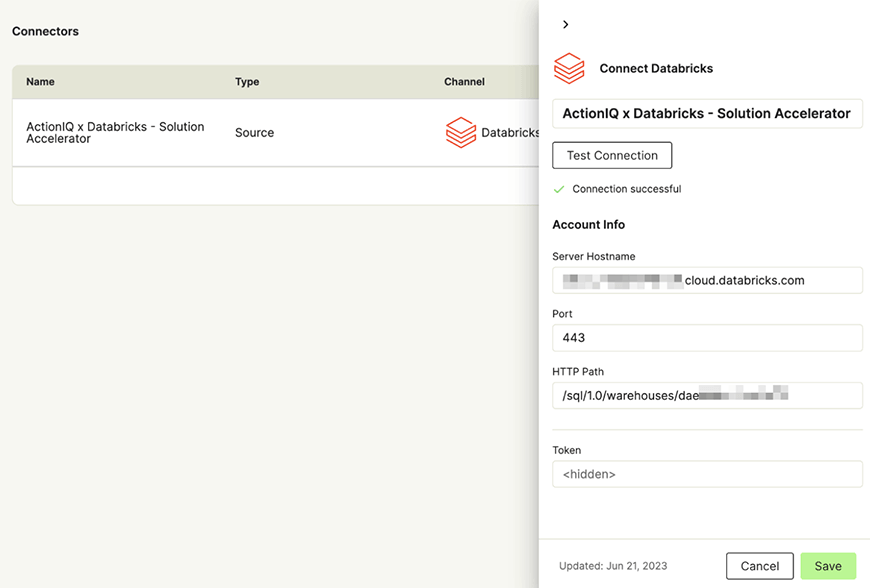
AI Segmentation & Predictive Audiences: ActionIQ lets marketers build precise audience segments without SQL or engineering tickets.
The segmentation engine runs queries against data where it already lives. ActionIQ's HybridCompute technology translates a marketer's no-code audience definition into optimized SQL executed against the customer's own warehouse.
Source: Uniphore
The audience builder gives marketers a visual, no-code interface to define segment criteria using behavioral, demographic, transactional, and psychographic attributes. As they add criteria, the system returns real-time count estimates so they can see segment size before activating.
Marketers can also create audiences using natural language prompts, letting less technical users define complex logic in plain English.
For predictive capabilities, the platform connects to machine learning models built inside the data warehouse. Propensity scores computed in Databricks using MLflow stay in the customer's own account; ActionIQ reads them in place via query pushdown without moving data.
The platform also supports lookalike audience modeling and can enrich first-party data with behavioral and demographic insights from third-party sources.
Additional capabilities include fall-out and overlap reporting (showing where users were added or removed via union, intersection, or suppression criteria), automated audience refresh, and real-time segments that combine streaming and historical data.
Journey Orchestration & Campaign Activation: ActionIQ enables multi-channel customer journeys driven by real-time behavioral data.
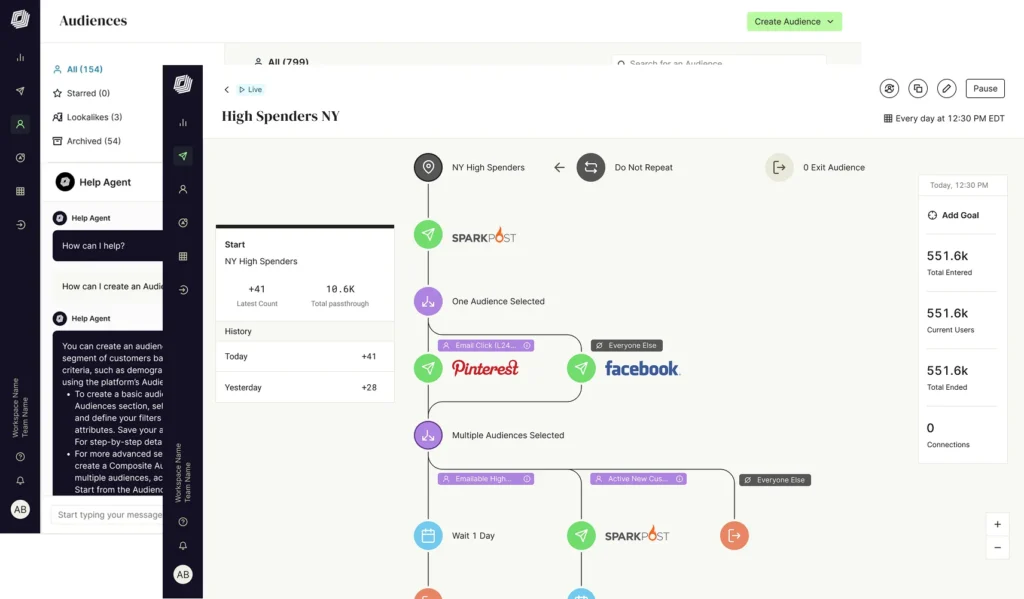
The Journey Management module lets marketers design, test, and deploy multi-step customer journeys from a single interface using a drag-and-drop UI. Rather than running isolated campaigns channel by channel, journeys incorporate behavioral and transactional data from unified customer profiles.
Source: Uniphore
Journey logic supports both streaming events and historical profiles. The Real-Time CX component combines these two data streams to power personalization "across online and offline channels, even from data in the warehouse." A journey can branch on a customer action that happened seconds ago (a website visit, cart abandonment, a service interaction) rather than waiting for a nightly batch process.
AI agents embedded in the journey layer "anticipate churn, identify high-value customers, and trigger next-best actions" at each touchpoint. Activation pushes decisions through built-in channel integrations covering owned channels (email, push, SMS, on-site) and paid channels (programmatic advertising, paid social).
Pricing: ActionIQ does not publish pricing and requires a sales engagement to evaluate.
ActionIQ does not disclose pricing on its website. The only entry point is a "Book a demo" form. No pricing tiers, per-seat rates, or usage-based fees are published.
ActionIQ follows a negotiated enterprise contract model. No free trial, free tier, or proof-of-concept sandbox exists. ActionIQ doesn't disclose whether third-party data enrichment carries additional cost. Buyers should also factor in their own cloud infrastructure costs (storage, compute), since the composable architecture runs on customer-operated data warehouses.
Where ActionIQ Falls Short
ActionIQ delivers a composable CDP for B2C enterprises, but several limitations emerge during evaluation. These stem from deliberate design and market choices, not oversights.
Acquisition Creates an Evaluation Wrinkle. Uniphore acquired and rebranded ActionIQ in December 2024. The original founding team is no longer publicly associated with the product. Buyers must evaluate whether Uniphore's broader AI platform strategy will keep prioritizing CDP investment.
The 2026 Gartner Leader placement is encouraging, but the acquisition is recent enough that long-term product direction remains an open question for anyone committing to a multi-year contract.
You Need a Data Warehouse Before You Start. The zero-copy architecture is ActionIQ's defining advantage, but it's also a prerequisite. The product assumes you already run a cloud data warehouse and have engineering resources to configure the integration.
Even Atlassian's case study describes moving from IT dependency to marketer autonomy as the transformation, meaning setup demands significant technical work before the self-service benefits appear. Organizations without Databricks, Snowflake, or BigQuery can't get full value from the platform.
No B2B Capabilities. All three analyst recognitions fall in the B2C CDP category. Every named case study targets consumer marketing. There is no documented positioning, feature set, or case study for B2B go-to-market, account-based marketing, or sales intelligence. Organizations with both B2C and B2B operations need a separate platform for their B2B work.
Pricing Opacity. No pricing information is publicly available. The demo-required entry point creates friction for teams in early discovery or budget planning. You can't benchmark ActionIQ's cost against competitors without starting a sales conversation, and total cost of ownership must include the cloud infrastructure the platform sits on.
Implementation Takes Time. The composable architecture requires connecting to your data warehouse, configuring data sources, setting up identity resolution, and training marketing teams on the audience builder. This is an enterprise implementation, not something you sign up for and run campaigns from the next day. For organizations that need faster time to value, the timeline matters.
These limitations reflect ActionIQ's focus on large B2C enterprises with existing data infrastructure. For organizations that fit that profile, the trade-offs are reasonable. But they create clear gaps, especially for companies that also need B2B go-to-market capabilities.
For B2B Go-To-Market Needs: ZoomInfo
ActionIQ answers one question: how do we unify and activate our B2C customer data? It does that well. But many enterprises evaluating ActionIQ (Dell, Atlassian, HP) also sell to other businesses. For B2B prospecting, sales intelligence, and account-based marketing, ActionIQ offers nothing.
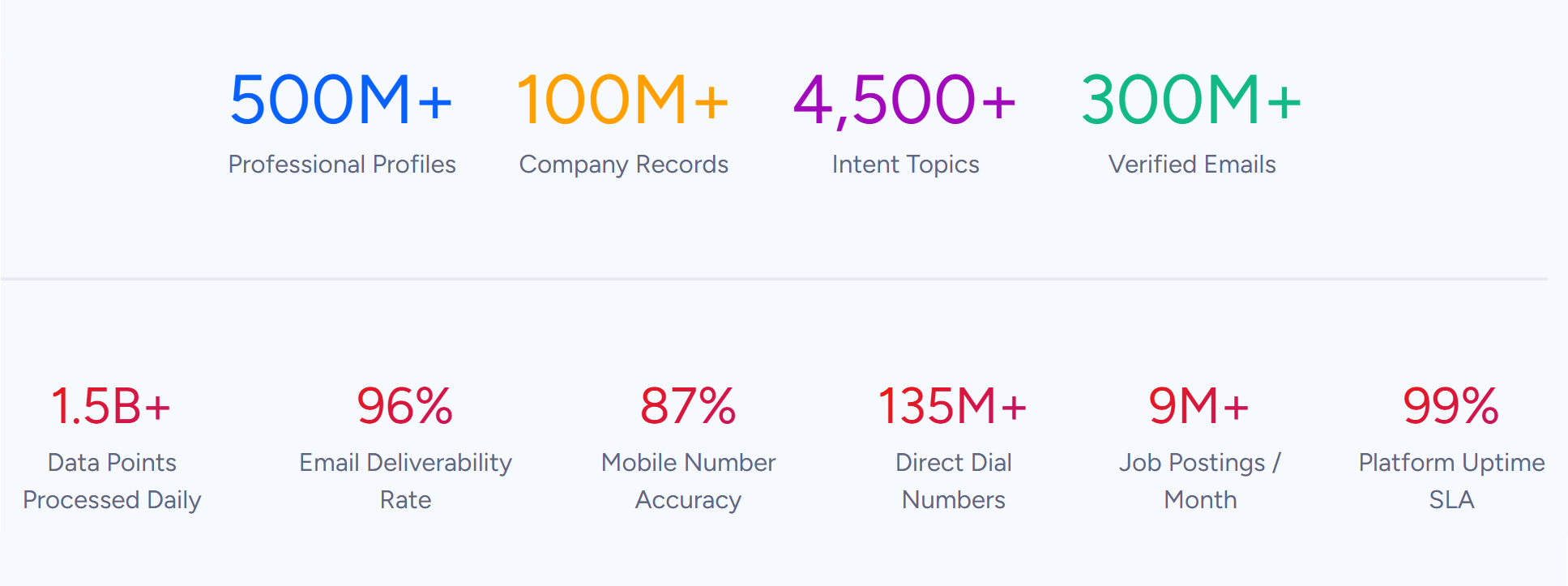
ZoomInfo fills that gap. It is a GTM platform built on a large B2B data foundation: 500M contacts, 100M companies, 135M+ verified phone numbers, and 200M+ verified business email addresses. Its GTM Context Graph processes 1.5B + data points daily and connects this data with your CRM records, conversation transcripts, and behavioral signals to reveal not just what happened in a deal, but why.
Source: ZoomInfo
That intelligence reaches your team through GTM Workspace for sellers, GTM Studio for marketers and RevOps, or APIs and MCP in any front-end.
Comprehensive B2B Data: ZoomInfo provides verified contact and company intelligence that B2B teams need to execute.
Where ActionIQ helps you activate customer data you already have, ZoomInfo provides the B2B data you don't. The platform covers 500M contacts, 100M companies, 135M+ verified phone numbers, 120M direct-dial phone numbers, and 200M+ verified business email addresses. This data runs through a verification process backed by 300+ human researchers, with up to 95% accuracy on first-party data.
The data spans three dimensions: identity data (who buyers are, where they work, how to reach them), company context (firmographics, org charts, technographics covering 30,000+ technologies across 30M+ companies), and dynamic signals that reveal when accounts are actively in-market.
Buyer Intent data tracks signals from 210 million IP-to-organization pairings and 6 trillion+ new keyword-to-device pairings sourced monthly.

Source: ZoomInfo
This data quality has outside validation. In a Fortune 500 competitive RFP analyzing 25 million contacts across vendors, the independent consultant concluded that "no other competitor came even close." ZoomInfo holds 133 No. 1 G2 rankings and is a Leader in Gartner's MQ for ABM and Forrester's Wave for Intent Data.
SpringDB saw 2x-3x increases in campaign conversions, a 300% increase in database usability, and 30-50% uplift in average deal size using ZoomInfo's enriched data. "You'll get 10x the value if you think of ZoomInfo as a full platform and not just a tool for one team," said John Kotsuros, Founder and CEO. (SpringDB Case Study)
GTM Context Graph: ZoomInfo's intelligence layer captures not just what happened in a deal, but why.
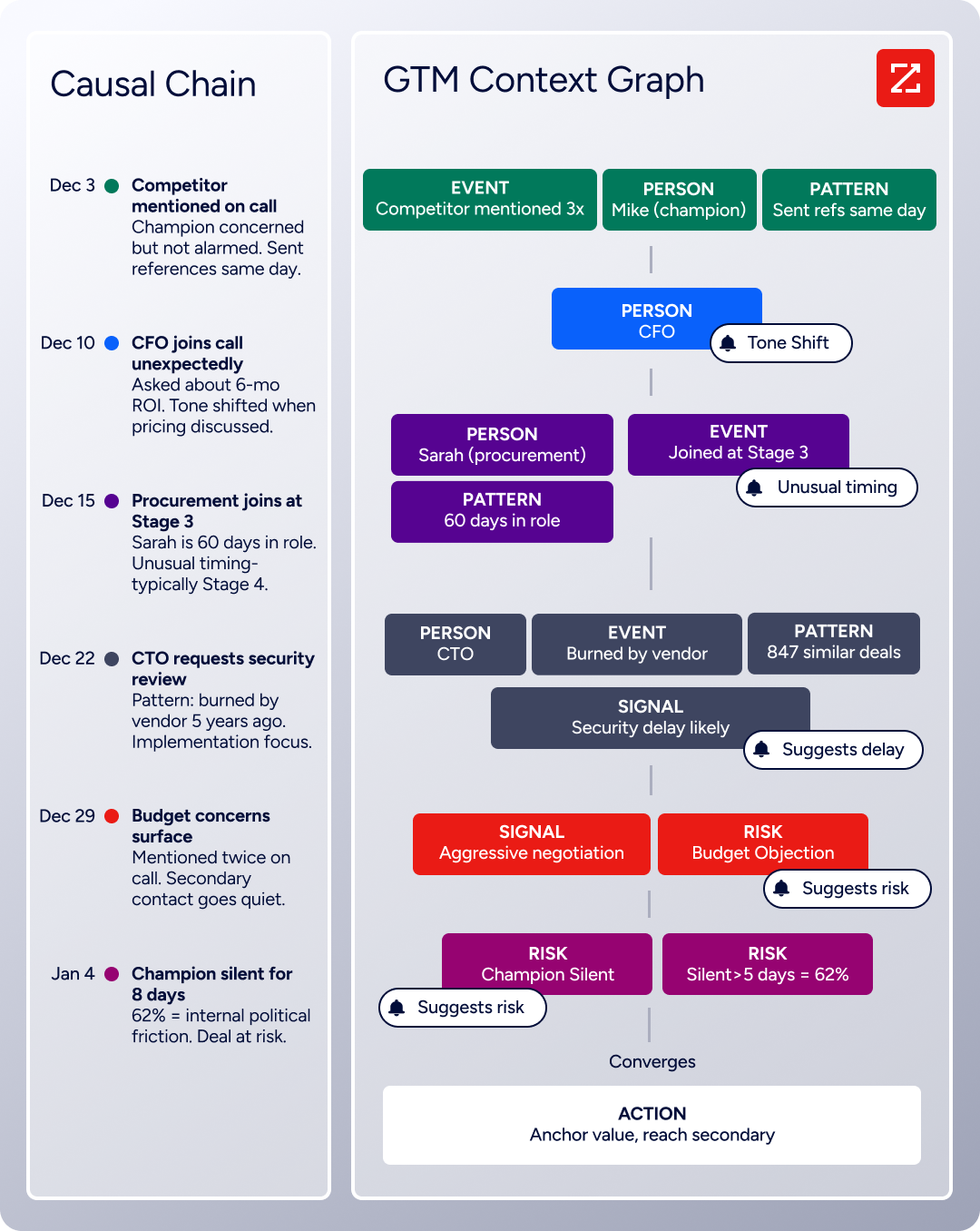
The data is the foundation. The GTM Context Graph is what makes it actionable. Processing 1.5B + data points daily, it fuses ZoomInfo's B2B data with a customer's CRM records, conversation transcripts, email interactions, and behavioral signals into a single layer that captures the connections between signals and outcomes.
Source: ZoomInfo
A CRM records that a deal moved to Stage 3. Conversation intelligence transcribes what the VP of Finance said on the last call. Intent data logs a spike in research activity. The GTM Context Graph connects all three to explain why the deal advanced and what should happen next.
As ZoomInfo's Chief Product Officer Dominik Facher writes: "The CRM recorded the state change. It has no record of why it happened."
This intelligence layer, built on twenty years of data unification work plus the context capture capabilities from Chorus (ZoomInfo's conversation intelligence platform), powers every downstream action: AI-drafted outreach addressing the specific concern a prospect raised, plays targeting accounts that match actual win patterns, and forecasts weighted by buying evidence rather than stage labels.

Source: ZoomInfo
Seismic attributed 39% of active pipeline to opportunities identified or influenced by ZoomInfo signals, with 54% productivity gains and 11.5 hours saved per week per seller. "That combination of our internal CRM data, external signals, and AI that's given all that context has helped us craft very specific account- and persona-based messages," said Toby Carrington, Chief Business Officer. (Seismic Case Study)
Universal Access: ZoomInfo delivers its intelligence through dedicated interfaces and open APIs.
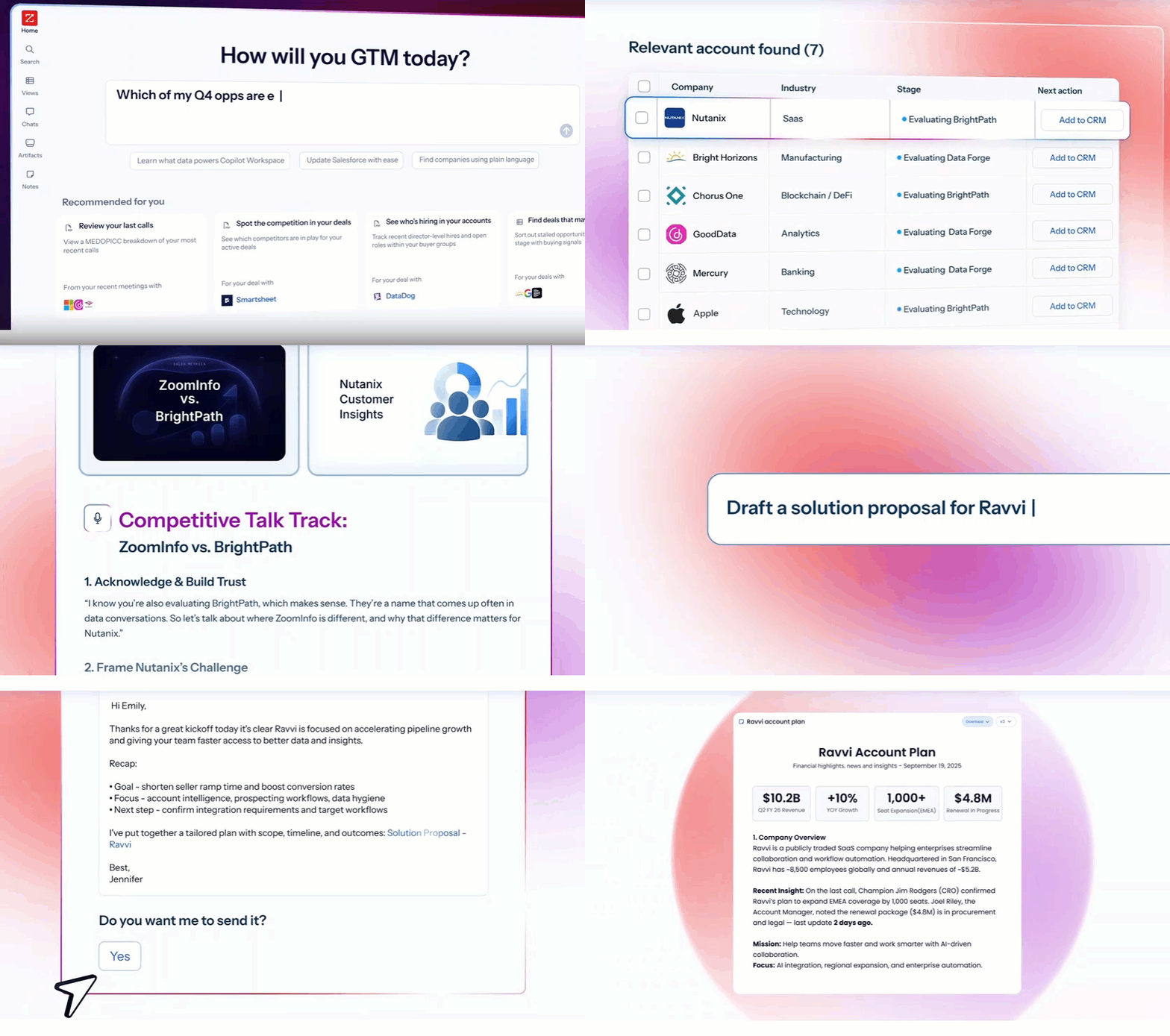
ZoomInfo's data and intelligence are accessible three ways. GTM Workspace is the seller's front-end: a single workspace where AI agents handle account research, outreach drafting, CRM updates, and signal monitoring. It tackles the context-switching problem (the average enterprise runs 23 GTM technologies) by putting everything sellers need in one view.
Source: ZoomInfo
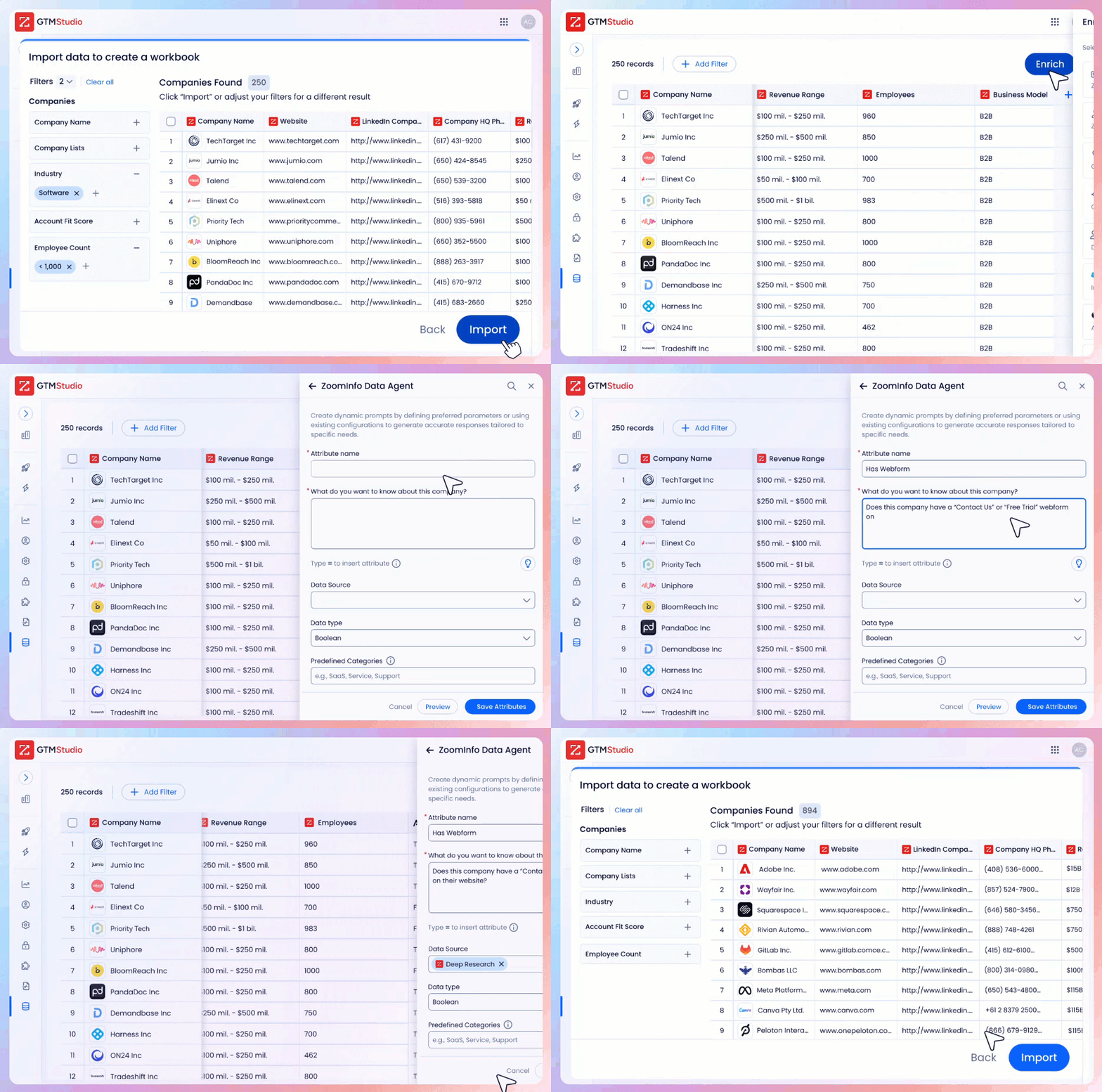
GTM Studio is the marketer and RevOps front-end: an AI-powered canvas where teams build audiences using natural language, define triggers, and activate plays across channels without engineering support. Expansion plays that used to take three weeks now launch in 30 minutes.
Source: ZoomInfo
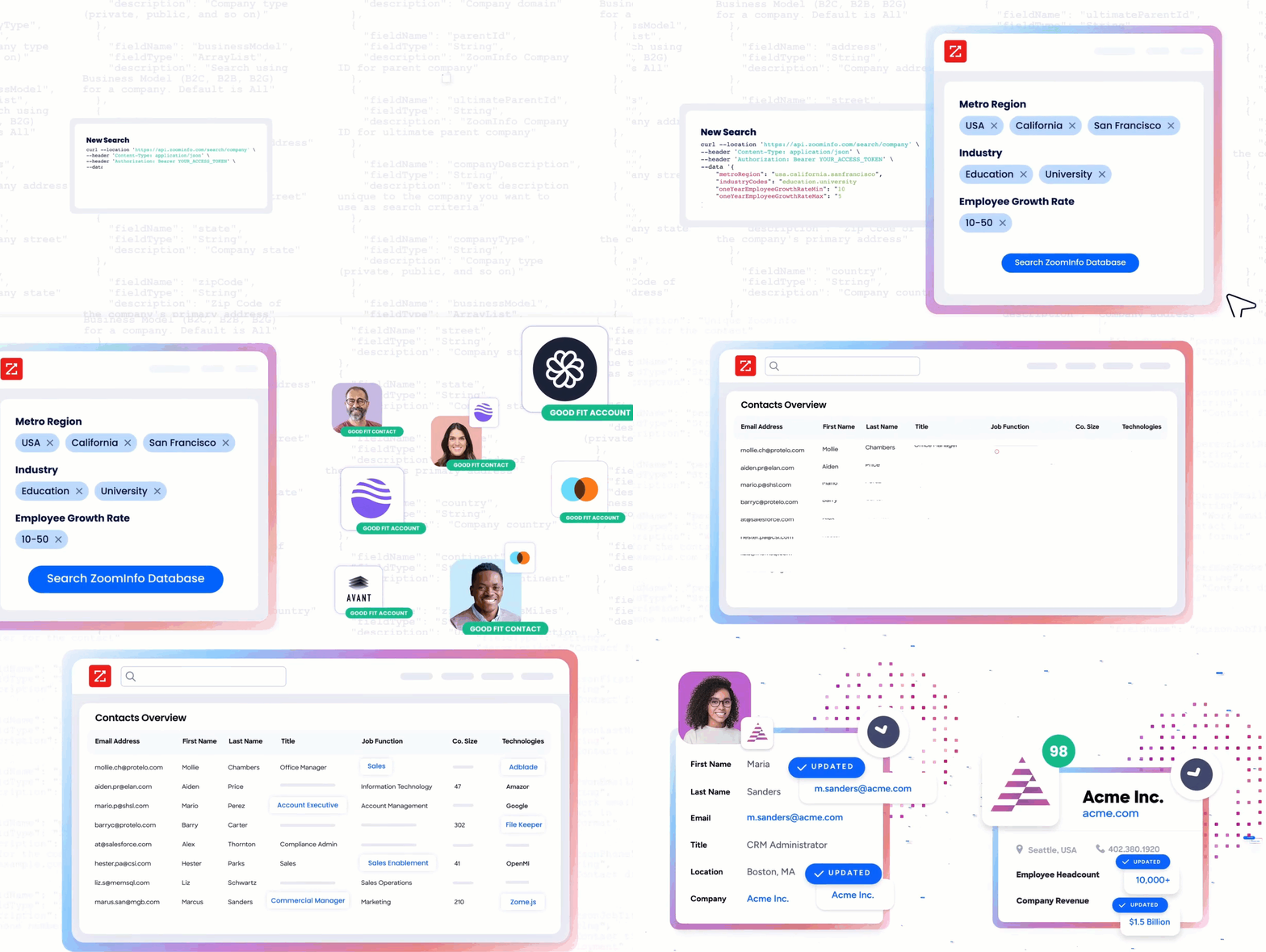
For teams building beyond ZoomInfo's own products, APIs and MCP expose the same intelligence to any custom agent, internal tool, or partner platform. ZoomInfo MCP is listed in the Claude directory and supports Claude and ChatGPT. All three surfaces draw from one GTM Context Graph: same data, same intelligence, regardless of which one your team uses.
Source: ZoomInfo
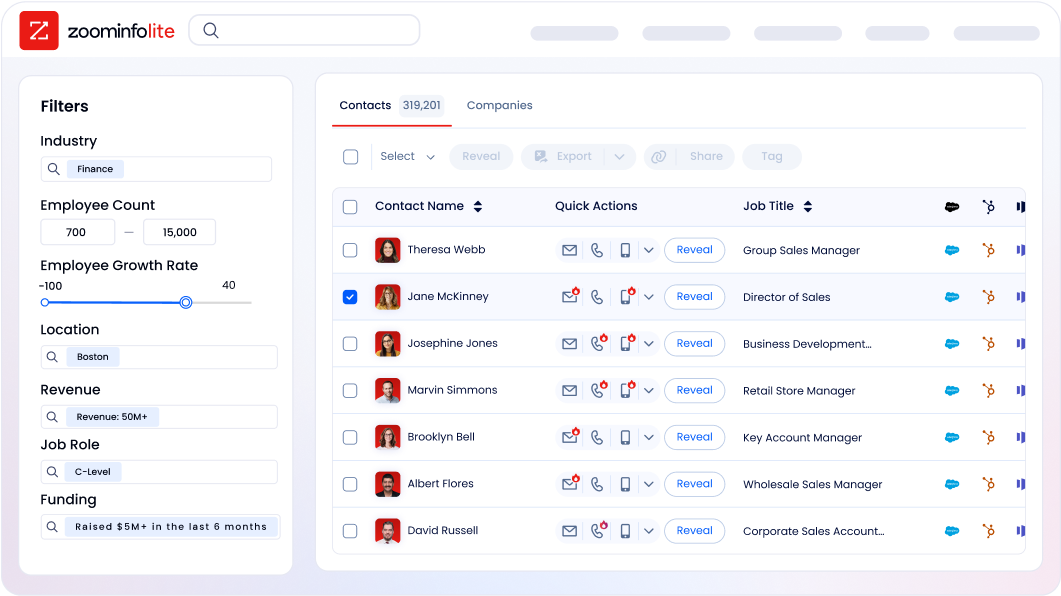
ZoomInfo also offers an entry point that ActionIQ lacks. ZoomInfo Lite is a permanent free tier (not a trial) that includes access to the B2B database, 10 monthly export credits, website visitor reveals, and HubSpot integration, with no credit card and no time limit. Paid plans use consumption-based pricing scaled around data access, API usage, and AI activity.
Source: ZoomInfo
BDO Canada activated ZoomInfo data directly within internal systems. "The plug-and-play aspect of the API means I can integrate it very easily into any process and get information at a moment's notice," said Jerry Wilson, Senior Marketing Intelligence Analyst, with the team achieving an 87% reduction in time spent on internal data dashboard updates. (BDO Canada Case Study)
ActionIQ and ZoomInfo: Comparison Summary
Aspect | ActionIQ (CDP Agent) | ZoomInfo |
|---|---|---|
Primary purpose | B2C customer data unification and activation | B2B go-to-market intelligence and execution |
Target buyer | Enterprise B2C marketing teams | B2B sales, marketing, and RevOps teams |
Data approach | Activates your existing customer data in place | Provides 500M contacts and 100M companies you don't already have |
Architecture | Composable, zero-copy CDP on your warehouse | Platform with proprietary data, GTM Context Graph, and multi-surface access |
AI capabilities | Audience segmentation, journey orchestration, churn prediction | GTM Context Graph intelligence, AI-drafted outreach, play automation, signal-to-action |
Analyst recognition | Gartner MQ Leader (CDP), Forrester Wave Leader (B2C CDP), IDC Leader (B2C CDP) | Gartner MQ Leader (ABM), Forrester Wave Leader (Intent Data), 133 No. 1 G2 rankings |
Free tier | None; demo required | ZoomInfo Lite (permanent, free, no credit card) |
Pricing transparency | Not published; negotiated enterprise contracts | Consumption-based pricing |
Implementation | Enterprise deployment requiring data warehouse integration | GTM Workspace deploys in weeks |
Best for | Large B2C enterprises with existing data warehouse infrastructure | B2B teams needing prospecting, intelligence, and GTM execution |
Final Verdict
ActionIQ and ZoomInfo serve different parts of an enterprise's go-to-market operations. The choice depends on which problem you're solving.
Choose ActionIQ if you're a large B2C enterprise with an existing cloud data warehouse that needs your marketing team to build, activate, and orchestrate audience segments without relying on engineering for every request.
The composable, zero-copy architecture is a real differentiator for organizations with first-party customer data spread across multiple systems. Three analyst Leader placements (Gartner, Forrester, IDC) validate the technology.
Go in with clear expectations: this is an enterprise commitment requiring existing data infrastructure, a sales-led evaluation, and a multi-month implementation. The Uniphore acquisition adds due diligence, but the 2026 Gartner Leader placement suggests the product remains a priority.
Choose ZoomInfo if your go-to-market needs include B2B prospecting, sales intelligence, account-based marketing, or any scenario where you need verified contact and company data you don't already have.
ZoomInfo provides the data foundation (500M contacts, 100M companies, 135M+ verified phone numbers, and 200M+ verified business email addresses), the intelligence layer to understand why deals move or stall, and the execution surfaces to act on that intelligence across sales and marketing. With a permanent free tier, a 7-day free trial, and consumption-based pricing, ZoomInfo also offers a more accessible evaluation path.
Get started with ZoomInfo Lite for free here.
For enterprises with both B2C customer engagement and B2B sales operations, the question isn't which platform to choose. It's recognizing that customer data activation and B2B go-to-market intelligence are separate problems that need separate solutions.
ActionIQ FAQ
What happened to ActionIQ after the Uniphore acquisition?
Uniphore acquired ActionIQ in December 2024 alongside Infoworks. Uniphore rebranded the product as "CDP Agent" within its Marketing AI suite, part of the broader Business AI Cloud platform. ActionIQ's original founders, Tasso Argyros and Nitay Joffe, are no longer publicly associated with the product.
The technology keeps its composable, zero-copy architecture, and the combined entity earned a Gartner Magic Quadrant Leader placement for CDPs in 2026 (an upgrade from ActionIQ's standalone Visionary position in 2024).
Does ActionIQ offer a free trial or free plan?
No. ActionIQ offers no free trial, free tier, or self-serve sandbox. The only way to evaluate the product is through a demo request on Uniphore's website. Buyers must engage with a sales team before accessing the platform. ZoomInfo, by contrast, offers a permanent free tier (ZoomInfo Lite) and a 7-day free trial for its paid features.
What data warehouse does ActionIQ require?
ActionIQ's composable architecture integrates with major cloud data warehouses including Databricks, Snowflake, BigQuery, and Redshift. The platform queries data directly in these environments without copying it into a proprietary store. An existing warehouse is a prerequisite. Organizations without one can't realize the platform's core value.
How much does ActionIQ cost?
ActionIQ does not publish pricing. No tiers, per-seat rates, or usage-based fees appear on the website. Pricing follows a negotiated contract model. Buyers should also factor in their own cloud infrastructure costs for the data warehouse that ActionIQ runs on.
Can ActionIQ handle B2B marketing or account-based targeting?
No. All three analyst recognitions and every named case study fall in the B2C CDP category. There is no documented positioning, feature set, or case study for B2B go-to-market, account-based marketing, or sales intelligence. Organizations with B2B needs will require a separate platform such as ZoomInfo, which is built for B2B prospecting, sales intelligence, and account-based marketing.
What industries does ActionIQ serve?
ActionIQ's documented customer base spans retail and consumer goods (Skechers, Dell), media and publishing (The Washington Post, Conde Nast), technology and SaaS (Atlassian, HP), financial services and insurance (Blue Cross Blue Shield, Northwestern Mutual, Allstate), and travel and hospitality (Hertz, Priceline). All are large B2C enterprises with significant first-party data volumes.
How does ActionIQ compare to other CDPs like Salesforce Data Cloud or Adobe Real-Time CDP?
ActionIQ's main differentiator is its composable, zero-copy architecture. Salesforce Data Cloud and Adobe Real-Time CDP typically require data ingestion into their own environments; ActionIQ queries data where it already lives in the customer's warehouse. This avoids data duplication costs and governance risks.
The trade-off: ActionIQ requires an existing data warehouse, while CDPs from Salesforce and Adobe may be more accessible for organizations already in those ecosystems.
What security certifications does ActionIQ hold?
Through Uniphore, the platform holds ISO/IEC 27001:2022, SOC 2 Type II, and PCI DSS Level 1 Service Provider certifications. It is GDPR, CCPA, and DPDPA compliant. Cloud infrastructure runs on AWS data centers with options for US or EEA data residency. The zero-copy architecture adds a layer of data sovereignty, since customer data never leaves its original location.
Researching ActionIQ? These comparisons and alternatives help you decide:
