
If you're comparing BoostUp vs. Clari for your revenue operations, you're likely wrestling with these five questions:
Do you need a platform that forecasts what will close, or one that explains why deals are moving or stalling?
Is your sales organization large enough to justify an enterprise-only revenue tool, or do you need flexible pricing tiers?
How important is it that your revenue intelligence draws on more than just CRM and call data?
Are you looking for a specialized revenue operations tool, or a broader platform that also covers prospecting, marketing, and data quality?
Does your team have the CRM data quality to make AI-powered revenue predictions reliable?
In short, here's what we recommend:
Terret (formerly BoostUp, rebranded in September 2025) serves CROs and RevOps leaders at mid-market B2B software companies who want more than dashboards from their revenue intelligence.
Its Revenue Graph connects CRM records, emails, calendar data, and call transcripts into a single model, and its Nexus engine turns analysis into playbooks, outreach drafts, and coaching.
Terret Forecast generates AI-written board narratives alongside machine predictions, claiming 92.4% accuracy after six quarters of calibration. Its strength is connecting insight to seller action.
But its AI models require several months of company data before predictions become reliable, pricing is enterprise-only with no published rates, and the platform works best for Salesforce organizations.
Clari serves enterprise revenue teams with large pipelines who need forecasting at scale. Its Revenue Database (RevDB) captures historical snapshots of every revenue signal, and the platform spans eight products covering data capture, sales engagement, and buyer collaboration.
Following its December 2025 merger with Salesloft, Clari calls itself a Predictive Revenue System, ingesting more than 10 billion revenue interactions and 1 trillion data signals.
But its interface draws consistent criticism for being unintuitive and clunky, acquisition integrations have been slow to finish, and the platform's complexity demands dedicated RevOps staff.
Both platforms work well with revenue data already in your CRM and communication tools. But neither controls the quality or completeness of that data. Revenue intelligence inherits every gap in your contact records, every stale company attribute, and every missing stakeholder. For teams that want their revenue tools built on verified, current data, there's a broader platform.
ZoomInfo is an all-in-one AI GTM platform that starts where Terret and Clari cannot: at the data layer. Its B2B dataset (500M contacts, 100M companies, 135M+ verified phone numbers, and 200M+ verified business emails) is the largest in the industry.
Its GTM Context Graph, processing 1.5B+ data points daily, combines this proprietary data with your CRM records, conversation transcripts, and behavioral signals to capture not just what happened, but why.
That intelligence reaches sellers through GTM Workspace, marketers and RevOps through GTM Studio, or any third-party tool through APIs and MCP.
For organizations that want revenue intelligence, prospecting, marketing, and data operations in one platform, ZoomInfo covers the full go-to-market lifecycle, not just the forecasting layer.
If building your revenue intelligence on a verified data foundation sounds right, start with a free ZoomInfo account.
BoostUp vs. Clari vs. ZoomInfo at a glance
Terret (BoostUp) | Clari | ZoomInfo | |
|---|---|---|---|
Core focus | Revenue intelligence + AI agents | Revenue orchestration + forecasting | All-in-one AI GTM platform |
Company scale | Private, ~$40M raised | Private, $2.6B valuation, $230M revenue | Public (NASDAQ: GTM), $1.25B revenue |
Data foundation | Revenue Graph (CRM + emails + calls) | RevDB (10B+ revenue interactions) | 500M contacts, 100M companies + GTM Context Graph |
Forecasting | Narrative-driven, 92.4% accuracy claimed | Multi-model, 98% accuracy by week 2 claimed | Predictive account intelligence via GTM Context Graph |
Conversation intelligence | Native Terret CI | Clari Copilot (acquired Wingman) | Chorus (14 technology patents) |
Primary CRM | Salesforce-native | Salesforce, HubSpot, Pipedrive | Salesforce, HubSpot, Dynamics 365 |
Pricing transparency | Not published | Not published | Not published; permanent free tier available |
Best for | Mid-market B2B SaaS with complex sales cycles | Enterprise teams needing systematic revenue operations | Teams wanting data and intelligence across the full GTM lifecycle |
Revenue intelligence is only as good as the data underneath
The value of any revenue intelligence platform depends on the data it ingests. These three platforms start from different foundations.
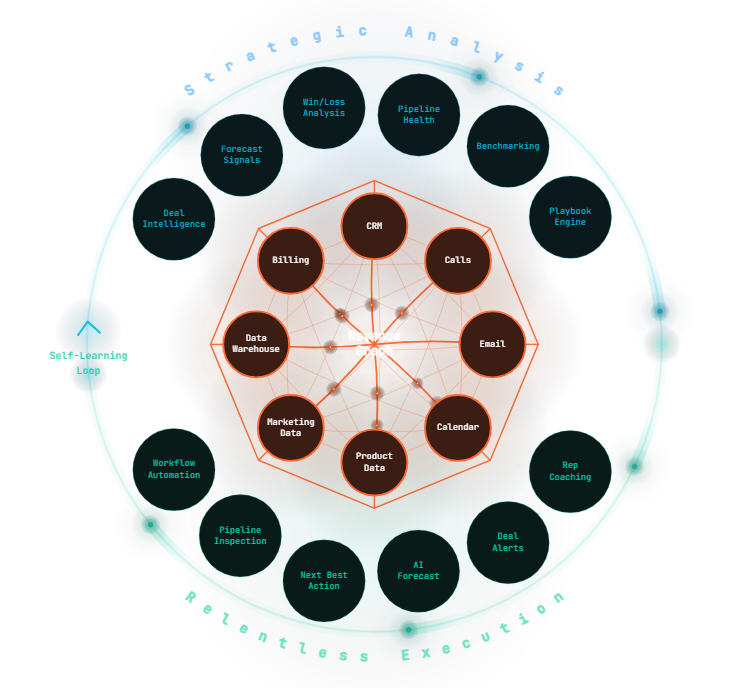
Terret's Revenue Graph unifies structured CRM data with unstructured signals from emails, calendars, call transcripts, and meeting notes.
Source: Terret
The goal: a single model where every signal connects to every deal. When a rep sends a follow-up email, that action links to the deal stage, the contact's engagement history, and the call that prompted it. This connected model lets Terret analyze not just pipeline numbers but the seller behaviors driving them.
The platform has demonstrated analysis across 45,000 calls, 345 reps, and 6,210 active deals in a single query pass.
Clari's RevDB takes a historical snapshot approach, recording every relevant revenue signal change over time. This creates a time-series database for revenue operations.

That historical depth enables trend analysis and accurate forecasting because RevDB knows not just where a deal is today but how it moved through every prior stage.
Clari's Capture feature feeds this database by automatically syncing activity data to CRM, processing over 300 million sales emails and 40 million sales meetings annually and capturing 47% more contact data than manual entry.
Both approaches work well. But both rely on information already inside your CRM and communication tools. If your CRM has incomplete contact records, stale company attributes, or missing stakeholders, those gaps flow directly into the intelligence these platforms produce.
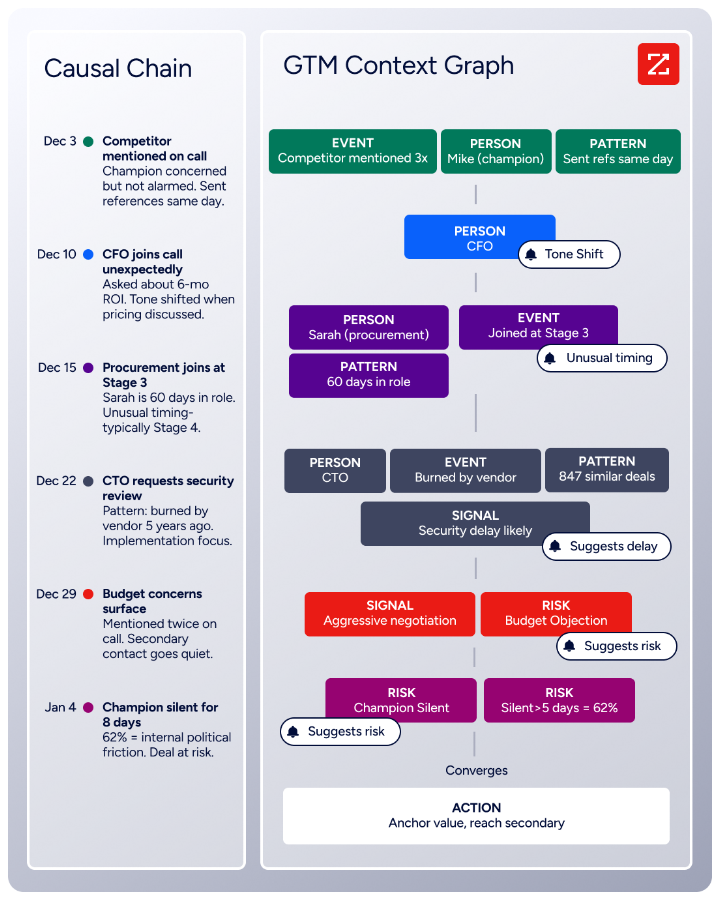
ZoomInfo's GTM Context Graph starts from a different premise. It combines your first-party CRM and conversation data with ZoomInfo's third-party dataset (500M contacts, 100M companies, and 200M+ verified business emails), processing 1.5B+ data points daily.
Source: ZoomInfo
A CRM records that a deal's stage changed. Conversation intelligence captures what the VP of Finance said on the last call.
The GTM Context Graph reasons across both, then enriches the picture with ZoomInfo's external data: org chart changes, new executive hires, intent signals showing the account is researching competitors, and technographic shifts that indicate a buying window.
As ZoomInfo's CPO Dominik Facher writes: "The CRM recorded the state change. It has no record of why it happened." The GTM Context Graph fills that gap by connecting signals and outcomes across first-party and third-party data at a scale point solutions cannot reach.
Seismic's sales team attributed 39% of active pipeline to opportunities identified or influenced by ZoomInfo signals, boosting productivity by 54%. Their CBO noted that combining internal CRM data with external signals and AI helped craft specific account-based messages that got immediate responses. (Seismic Case Study)
Terret forecasts with narratives, Clari forecasts at scale
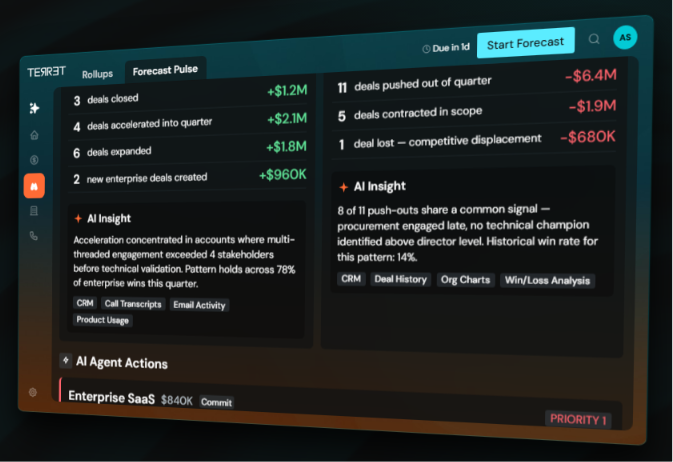
Terret Forecast pairs machine predictions with narrative generation. Traditional forecasting tools deliver numbers and leave leadership to figure out the story.
Source: Terret
Terret delivers both: machine predictions with confidence scores alongside auto-generated Forecast Narratives that summarize headwinds, tailwinds, and deal movement in board-ready language.
The system cross-checks machine predictions against rep-submitted forecasts, flagging divergence (for example, when the AI forecast exceeds rep commit by 14% as a bullish signal).
The trade-off: Terret's AI models require several months of data before predictions become reliable. Organizations with partner-driven or channel-influenced sales motions may also hit limitations, as G2 reviewers note the AI risk scoring can produce inflated flags on partner-managed deals.
Clari Forecast emphasizes prediction accuracy at enterprise scale. The platform claims 98% forecast accuracy by week two of the quarter and is the first to support subscription and hybrid models in a single interface.
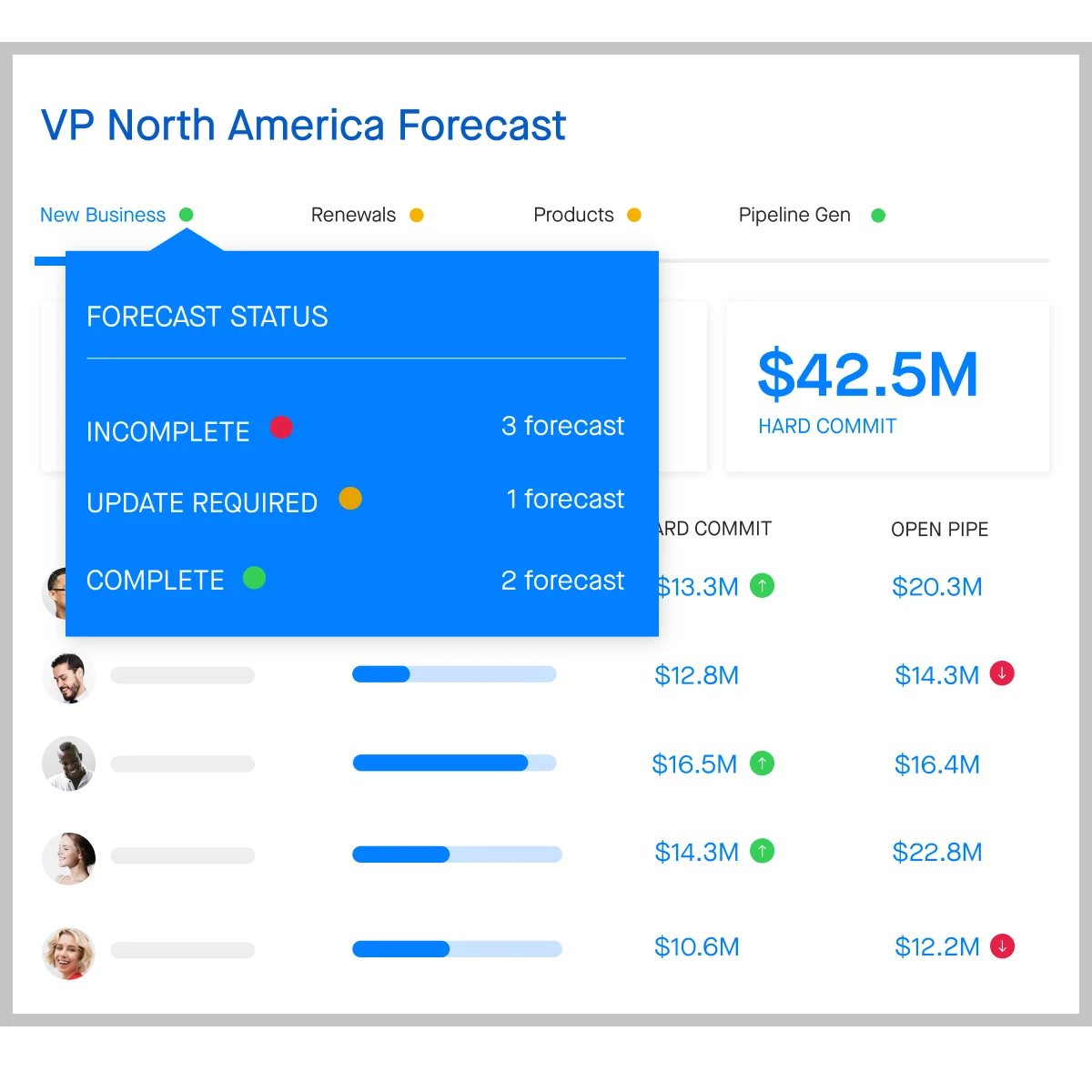
Source: Clari
Its Dynamic Forecasting uses machine learning to track real-time deal progress, with automated rollups from rep to manager to VP to CRO.
Clari's weak spot is data transparency. Users report difficulty understanding analytics, and despite the functionality, some teams still maintain separate spreadsheets to track deals alongside Clari.
ZoomInfo approaches forecasting differently. Rather than building a standalone forecasting engine, ZoomInfo's GTM Context Graph feeds predictive account intelligence into every surface where decisions happen.
GTM Workspace surfaces deal risk signals and recommended actions based on buyer behavior, including third-party intent data and engagement patterns that forecasting-only tools never see.
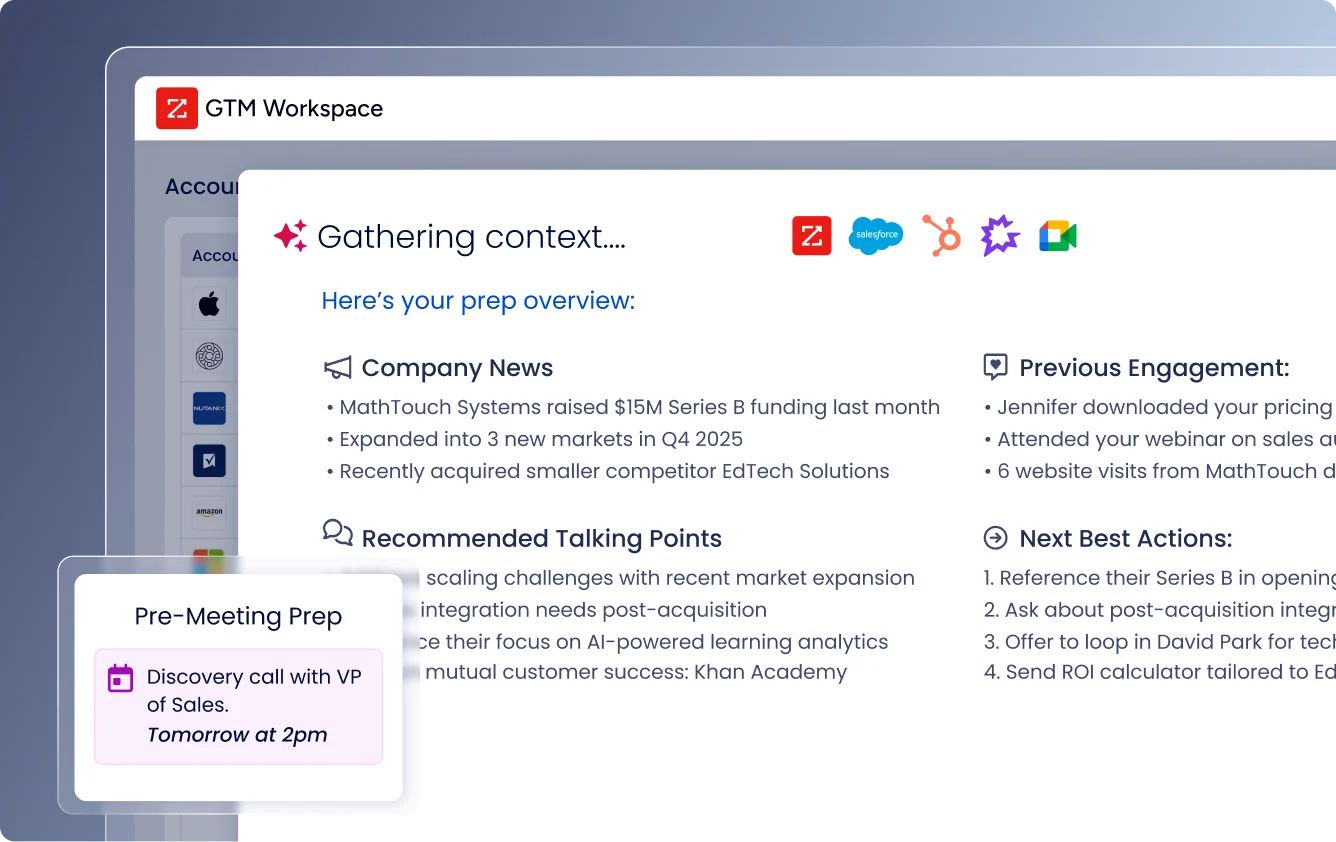
Source: ZoomInfo
The platform does not replace your forecasting tool. It strengthens whatever forecasting tool you use by keeping the data underneath current and complete, and by surfacing signals from outside your pipeline that show whether an account is accelerating or stalling.
Conversation intelligence follows three paths
All three platforms include conversation intelligence, but each treats it differently.
Terret Conversation Intelligence connects every call recording to its Revenue Graph. When a call ends, the platform scores it against a configurable sales methodology (like MEDDPICC), identifies sentiment by participant, surfaces "What Worked" and "What's Missing," and queues follow-up actions.
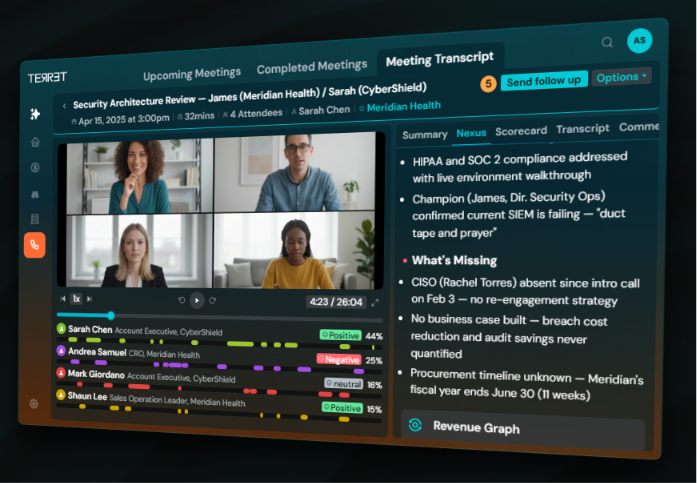
Source: Terret
Before calls, reps receive Slack-delivered briefs 30 minutes ahead with deal context, risk signals, and suggested talk tracks. After calls, AI agents auto-generate CRM updates and personalized follow-up emails.
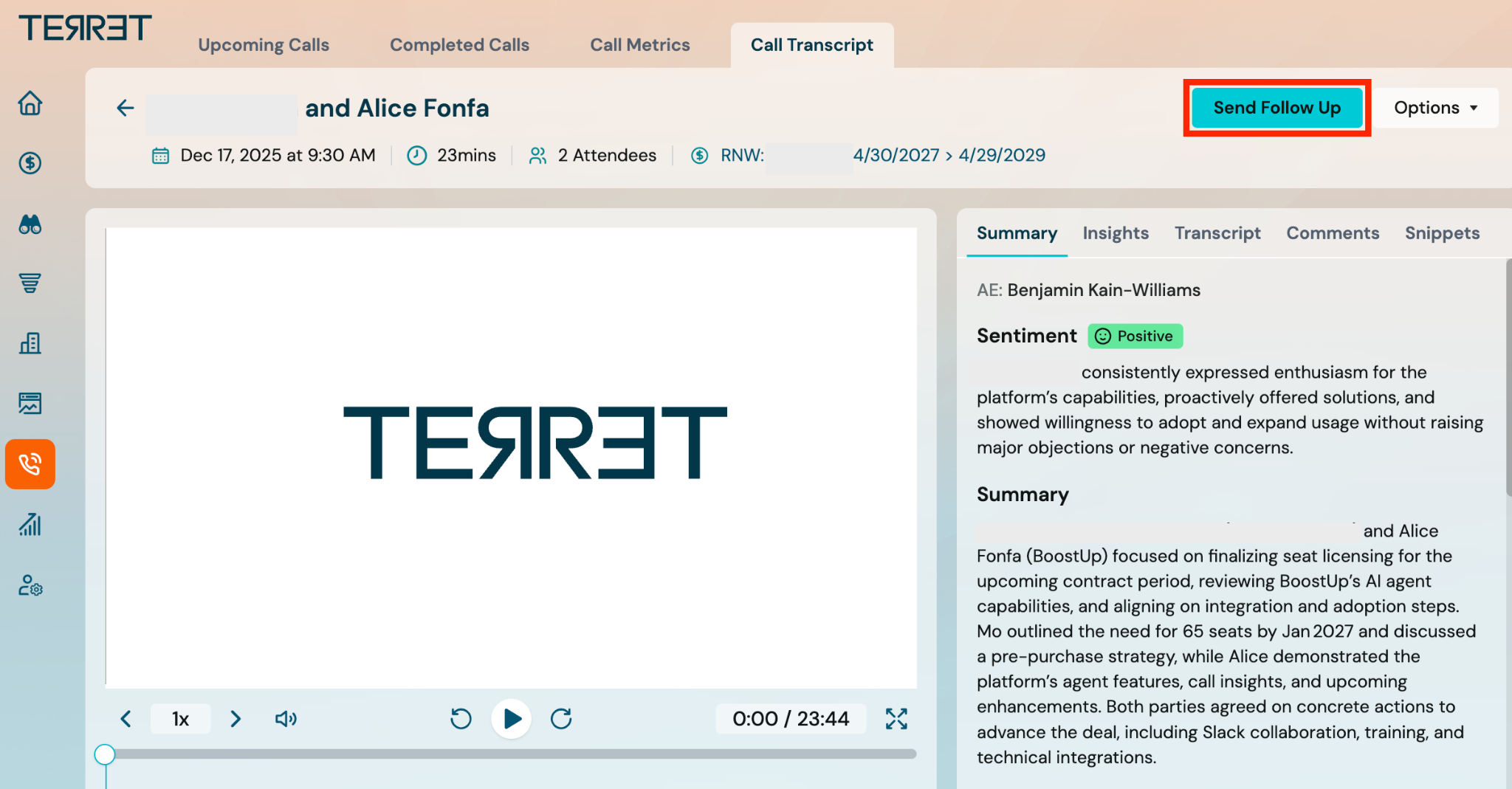
Source: Terret
All processing runs on Terret's own AI deployments, with no data sent to external vendors, a selling point for enterprise buyers with strict data governance.
Clari Copilot (acquired as Wingman in 2022) focuses on real-time, in-call coaching. When a buyer says "too expensive," the platform surfaces a pricing battlecard on the rep's screen during the live conversation.

Source: Clari
Clari reports that sellers using real-time battlecards see 10% more wins on average. After calls, CRM Suggestions auto-populate field updates from conversation data, and RevGPT drafts follow-up emails and call summaries.
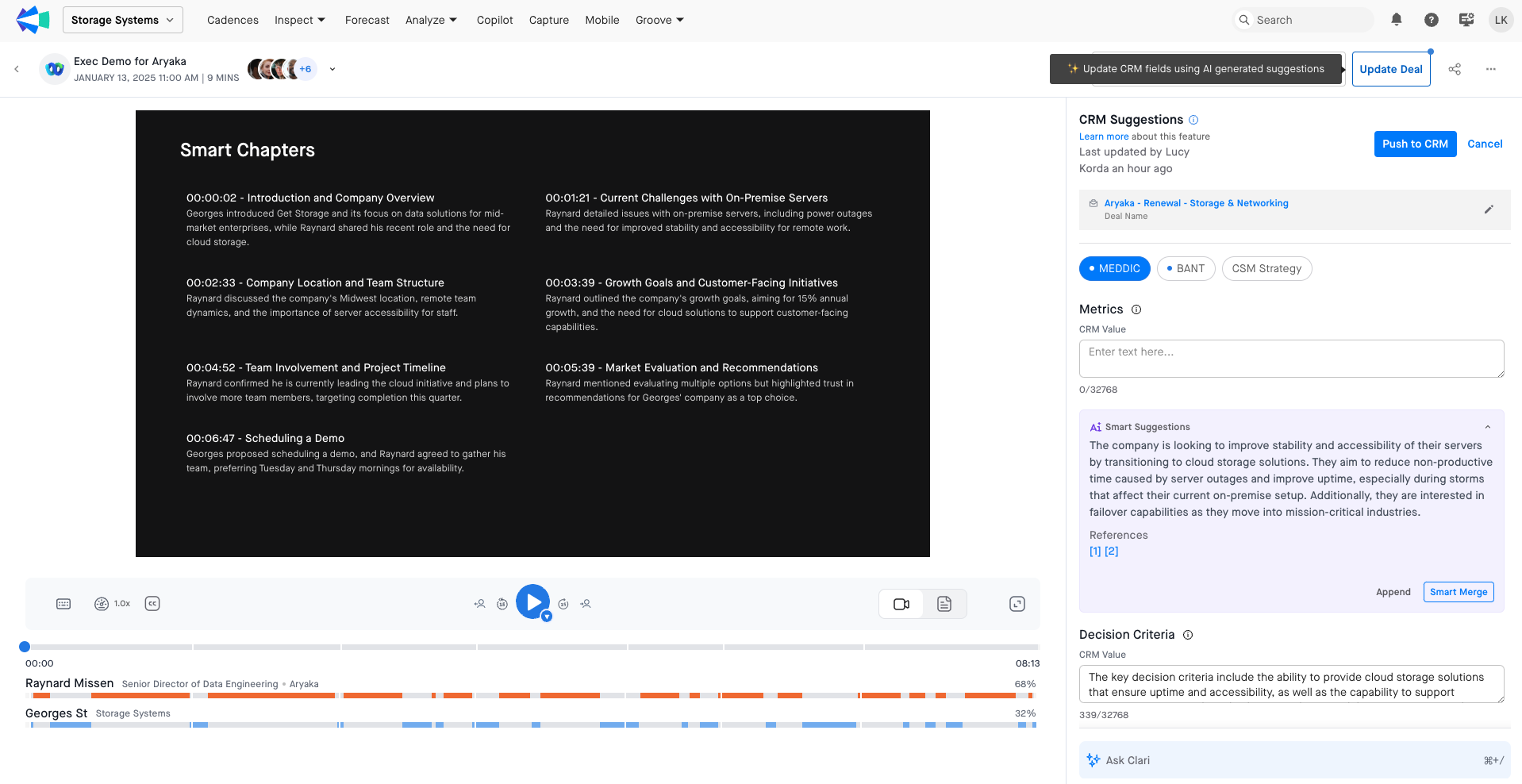
Source: Clari
One limitation: Ask Clari currently analyzes only one call at a time, and a 10-minute silence rule can produce incomplete recordings during meetings with natural pauses.
ZoomInfo's Chorus (acquired in 2021) holds 14 technology patents in conversation intelligence. Chorus captures calls, meetings, and emails, then analyzes talk ratios, sentiment, competitive mentions, and deal momentum signals.
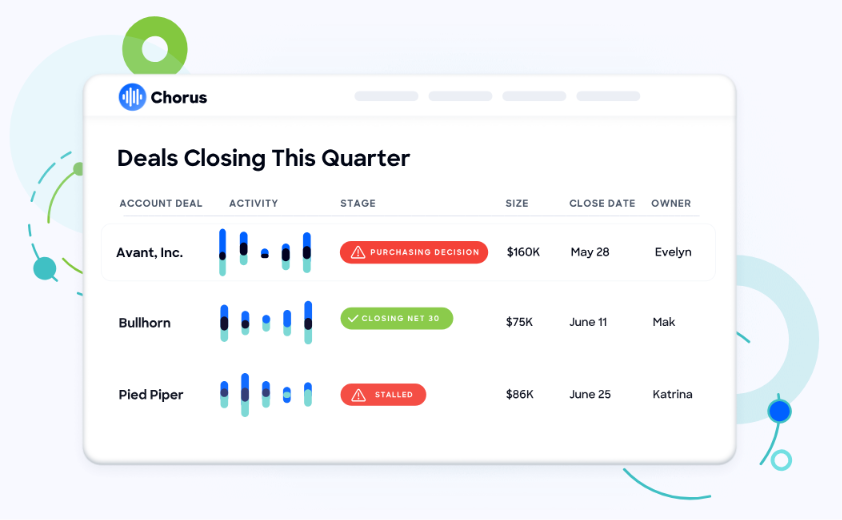
Source: ZoomInfo
What sets Chorus apart is Connected Intelligence: every call participant's full ZoomInfo profile (contact details, company insights, relationship history, and buying signals) appears alongside the conversation analysis, without cross-referencing a separate system.
A manager reviewing a call sees not just what was said but the business context of every person in the room, including org chart position, recent job changes, and technographic data.
Integration ecosystem and CRM fit
Terret positions itself as native to Salesforce, with reps staying inside their CRM to manage pipeline. G2 reviewers highlight the inline Salesforce editing experience as an adoption driver (one RevOps director noted it "keeps my team in our CRM").
Terret also supports HubSpot and integrates with data warehouses including Databricks and Snowflake. Third-party conversation intelligence tools (Gong, Chorus) are supported, so Terret can layer its Revenue Graph analysis on top of an existing CI investment.

Source: Terret
The Salesforce-native positioning is a strength for Salesforce shops but may limit appeal for organizations on other CRMs.
Clari offers broader CRM coverage with native integrations for Salesforce, HubSpot, and Pipedrive. Its integration ecosystem extends across communication tools (Slack, Microsoft Teams, Zoom, Google Meet), data platforms (Snowflake, PostgreSQL, BigQuery, Databricks), and sales tools (Outreach, Gong, Chorus, Highspot, ZoomInfo).
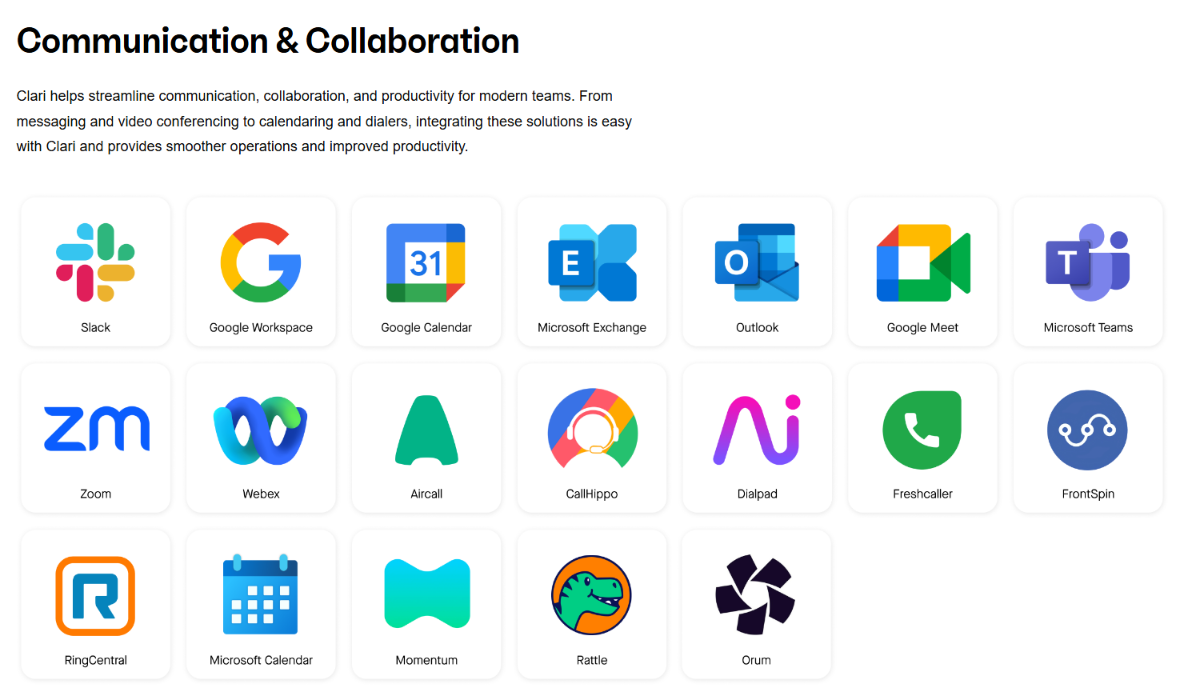
Source: Clari
Clari maintains public APIs for extracting forecast data and call intelligence. The December 2025 Salesloft merger brings sales engagement natively into the platform, though the joint roadmap was still in development as of early 2026.
Clari's earlier acquisition of Groove in August 2023 remained incompletely integrated two years later, a pattern suggesting integration timelines run longer than expected.
ZoomInfo's App Marketplace lists 120 partner integrations spanning CRM, marketing automation, sales engagement, data warehousing, and communications.
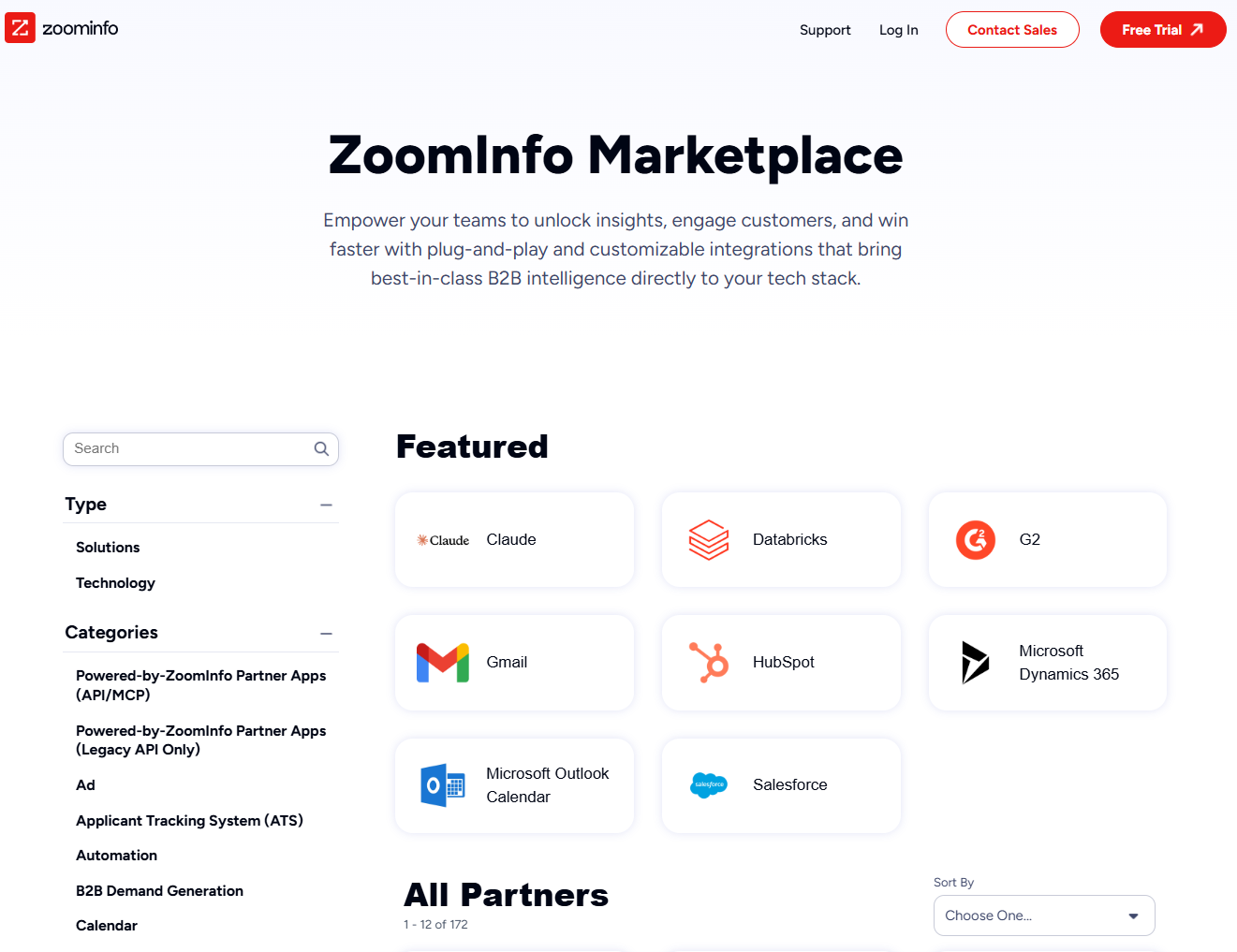
Source: ZoomInfo
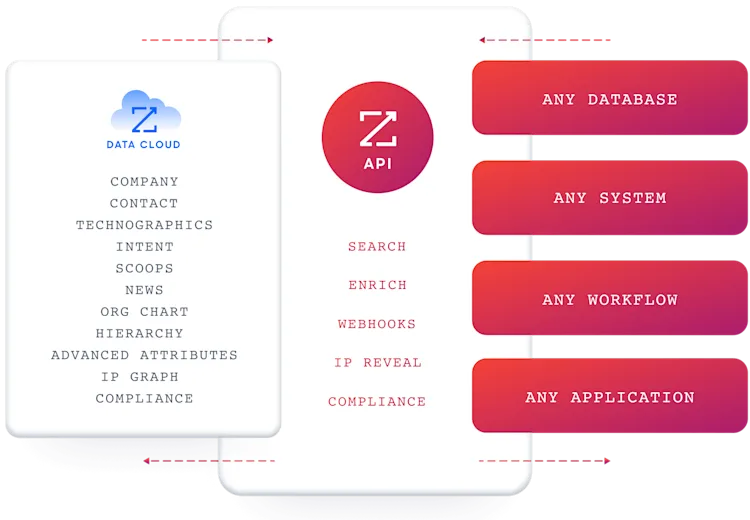
Beyond standard connectors, ZoomInfo's Enterprise API provides programmatic access to its data and GTM Context Graph, with OAuth 2.0 authentication and an interactive developer portal.
Source: ZoomInfo
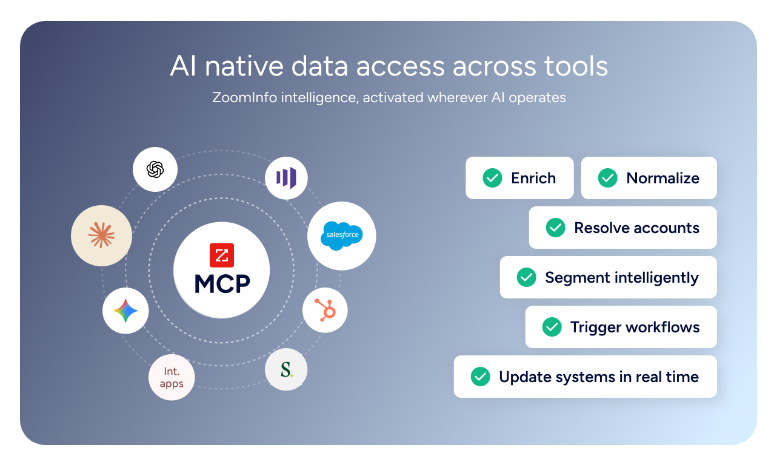
The MCP server lets any MCP-compatible AI agent (currently Claude and ChatGPT) use ZoomInfo data through natural language.
Source: ZoomInfo
API access is included in all relevant plans, so the same intelligence powering ZoomInfo's own products is available in any tool a customer builds with.
Platform scope diverges sharply
Terret and Clari are built for revenue operations. ZoomInfo covers wider ground, and that breadth matters when evaluating long-term platform investment.
Terret's three products (Nexus, Forecast, and Conversation Intelligence) focus on the post-pipeline stage: understanding deals, predicting outcomes, and coaching sellers.
The platform's AI agents handle tasks like drafting executive outreach, generating mutual action plans, building competitive approaches, and automating CRM updates. For its audience (CROs and RevOps at mid-market B2B SaaS companies), this depth is valuable.
But Terret does not help you find prospects, enrich contact data, run marketing campaigns, or identify in-market buyers before they enter your pipeline.
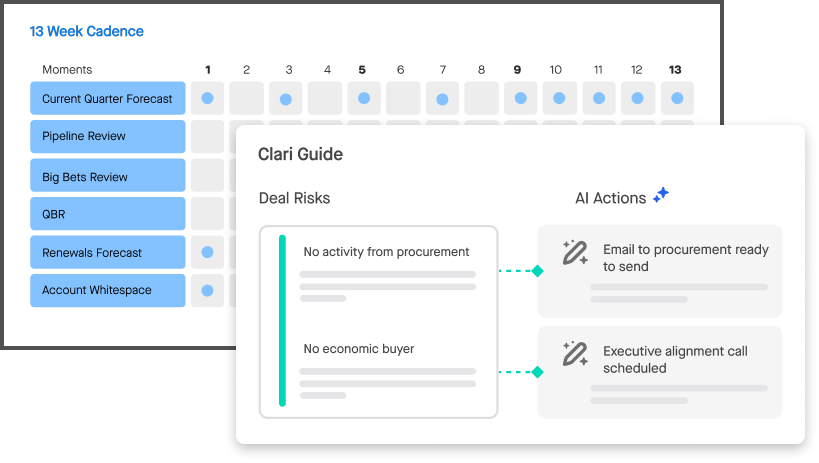
Clari spans more ground. Its eight products cover data capture (Capture), opportunity management (Inspect), sales engagement (Groove), buyer collaboration (Align), conversation intelligence (Copilot), forecasting (Forecast), and AI-guided execution (Guide).
Source: Clari
With the Salesloft merger, Clari adds cadence management and prospecting outreach. This makes Clari the more complete revenue operations platform of the two. Still, Clari operates within the bounds of existing CRM and sales activity data.
It does not provide prospect databases, company intelligence, or intent signals from outside your pipeline.
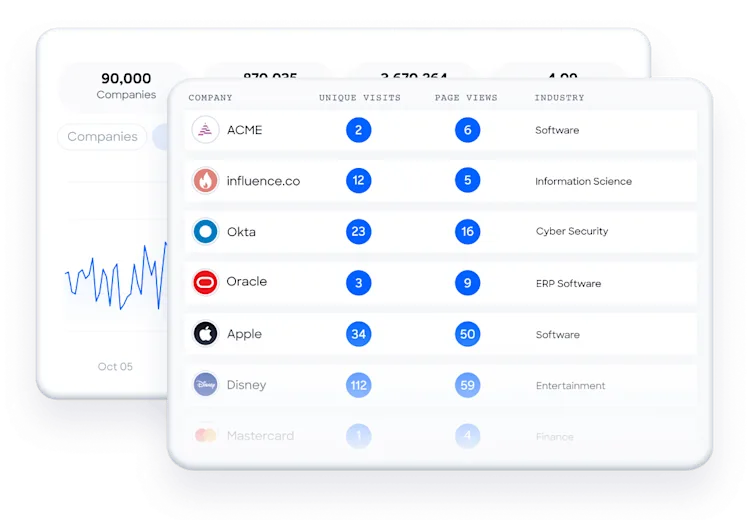
ZoomInfo operates at a different layer. The platform includes B2B contact and company data (500M contacts, 100M companies), buyer intent monitoring (tracking signals from 210 million IP-to-Organization pairings), account-based marketing with a native demand-side platform, data operations (enrichment, deduplication, lead routing), conversation intelligence via Chorus, and website visitor identification.
Source: ZoomInfo
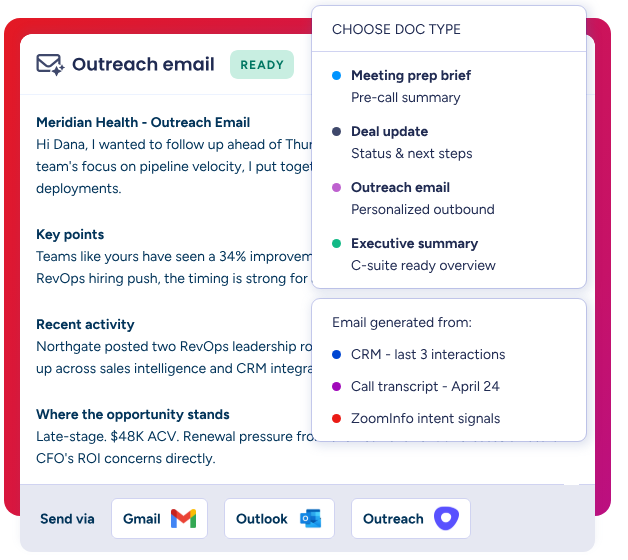
GTM Workspace brings this together for sellers with AI-driven account prioritization, signal monitoring, and automated outreach.
Source: ZoomInfo
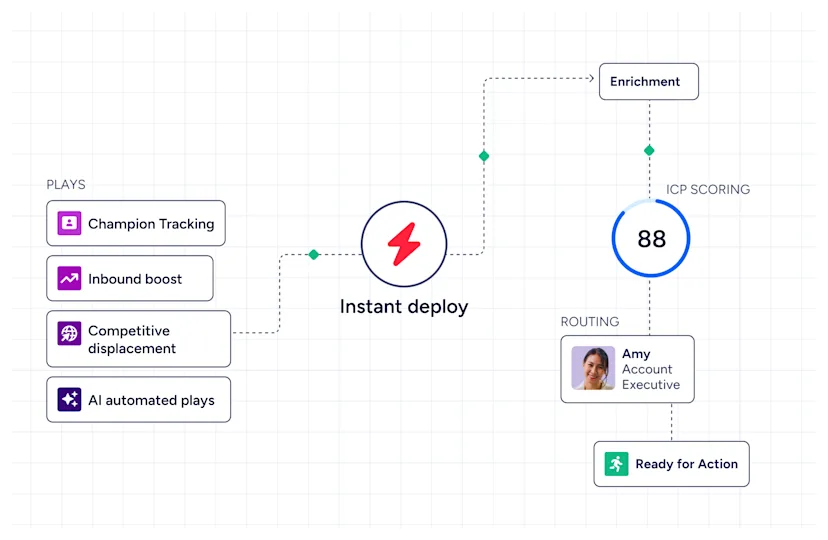
GTM Studio gives marketers and RevOps a canvas to design and launch GTM plays using natural language, without engineering support.
Source: ZoomInfo
For organizations evaluating their revenue tech stack, the question is whether you need a focused revenue operations tool or a platform that covers the full go-to-market lifecycle from prospecting through deal execution.
Snowflake uses ZoomInfo data in its Account Propensity Scoring model, feeding over 70 company and technographic fields. Accounts monitored using ZoomInfo-powered scores showed 90% higher opportunity open rates and 2x higher customer conversion rates. (Snowflake Case Study)
All three keep pricing behind a sales conversation
Terret does not publish pricing. All commercial terms go through signed Sales Orders, with subscription fees non-refundable.
The platform offers a "48-hour proof of concept" (sales-assisted, not self-serve). G2 reviewers note that pricing runs high and may be prohibitive for small teams or early-stage startups.
Clari also does not publish pricing. The pricing page directs buyers to "Get a quote" with no platform fees for integrations or ongoing support.
Clari offers a Copilot free trial and five free Align licenses with no time limit. Contracts auto-renew unless either party provides 30 days written notice.
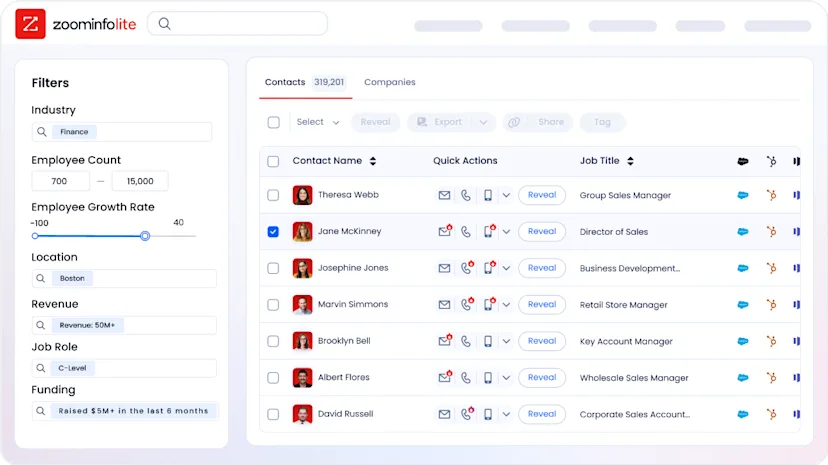
ZoomInfo uses consumption-based pricing with no published dollar amounts for paid tiers. But ZoomInfo is the only platform among the three with a permanent free entry point: ZoomInfo Lite provides free access to the B2B database with 10 monthly export credits, contact searches, a Chrome extension, and website visitor reveals, with no time limit and no credit card required.
Source: ZoomInfo
A 7-day full-feature trial is also available. Paid plans are organized into Sales (Professional, Advanced, Enterprise) and Marketing (Marketing Demand, ABM Lite, ABM Enterprise) tiers, each custom-quoted based on usage, seats, and credit volume.
None of the three will give you a price without a conversation. But ZoomInfo's free tier lets you test the data quality before committing, which neither Terret nor Clari offers.
BoostUp vs. Clari vs. ZoomInfo: Which should you choose?
The right platform depends on where your biggest revenue problem lives.
Choose Terret (BoostUp) if:
You run a mid-market B2B SaaS company with complex enterprise sales cycles
You want revenue intelligence that deploys playbooks and coaching from analysis, not just dashboards
Auto-generated forecast narratives would replace hours of manual board prep
Your team is on Salesforce and needs a tool reps will adopt daily
You've moved past AI pilots and want to change how your team runs revenue
Choose Clari if:
You're an enterprise organization managing large pipelines across multiple revenue models
Forecasting across subscription, consumption, and hybrid pricing is critical
You want to consolidate revenue tools (sales engagement, conversation intelligence, forecasting) into one platform
Structured Revenue Cadences for consistent team execution appeal to your RevOps function
The Salesloft merger's promise of combined sales engagement and forecasting fits your roadmap
Choose ZoomInfo if:
You want B2B data powering every revenue decision, from prospecting to deal close
Your CRM data quality limits what your current forecasting and intelligence tools can deliver
You need a platform that covers prospecting, marketing, deal intelligence, and data operations in one place
Access flexibility matters: intelligence available via GTM Workspace, GTM Studio, or APIs and MCP in any tool
You're building for a future where AI agents need verified contextual data to produce real value
See how ZoomInfo's GTM Context Graph powers revenue intelligence at every stage. Start free.
Terret and Clari both solve real problems in revenue operations. Terret excels at turning analysis into seller action for mid-market teams. Clari excels at forecasting for complex enterprise revenue models. But both work with data already in your systems. ZoomInfo provides the data foundation underneath those systems, then builds its own intelligence layer on top. For organizations that see data quality as the prerequisite for everything else in revenue operations, that distinction matters.
BoostUp vs. Clari vs. ZoomInfo FAQ
What is the main difference between BoostUp (Terret), Clari, and ZoomInfo?
Terret (formerly BoostUp) is a revenue intelligence platform focused on AI-driven forecasting, deal inspection, and conversation intelligence. Its distinct approach turns analysis directly into playbooks and coaching.
Clari is a revenue orchestration platform spanning eight products (including sales engagement via its Salesloft merger) that emphasizes forecasting and pipeline management at enterprise scale.
ZoomInfo is an all-in-one AI GTM platform that starts at the data layer with 500M contacts and 100M companies, then builds intelligence through its GTM Context Graph to cover the full go-to-market lifecycle from prospecting to deal execution.
Which platform has the best forecasting capabilities?
Terret and Clari both offer dedicated forecasting products but take different approaches. Terret Forecast generates AI-written board narratives explaining headwinds and tailwinds, claiming 92.4% accuracy after six quarters of calibration.
Clari Forecast emphasizes prediction at scale, claiming 98% accuracy by week two of the quarter, with support for subscription, consumption, and hybrid revenue models.
ZoomInfo does not offer a standalone forecasting module but provides the data foundation and contextual intelligence that makes any forecasting tool more accurate by keeping the underlying data complete and current.
Why did BoostUp rebrand to Terret?
BoostUp rebranded to Terret on September 9, 2025, alongside the launch of its AI agent fleet. The rebrand reflects a shift from forecasting and pipeline visibility toward an AI-native revenue operating system with agents that automate execution, not just reporting. The login portal still routes through app.boostup.ai as the transition continues.
How does the Clari-Salesloft merger affect the platform?
Clari and Salesloft completed their merger in December 2025. The combined company calls itself a Predictive Revenue System.
The joint roadmap was still in development as of early 2026. This follows a pattern: Clari acquired Groove in August 2023, and that integration remained incomplete two years later. Customers of either platform should expect a transition period before the combined product reaches full integration.
Which platform is easiest to evaluate before buying?
ZoomInfo offers the lowest-friction entry point with ZoomInfo Lite (a permanent free tier requiring no credit card) plus a 7-day full-feature trial.
Clari offers five free Align licenses and a Copilot free trial. Terret offers a 48-hour sales-assisted proof of concept.
For full deployment, all three require setup time: Terret's AI models need several months of data before delivering reliable predictions, Clari recommends persona-based enablement planning, and ZoomInfo provides a 90-day onboarding program reflecting the platform's breadth.
Do these platforms compete with each other, or can they work together?
Terret and Clari compete directly in revenue intelligence and forecasting. ZoomInfo operates at a broader level and can complement either.
ZoomInfo's B2B data feeds the CRMs that Terret and Clari analyze, Chorus conversation intelligence data can flow into Terret's Revenue Graph, and ZoomInfo's Enterprise API enables custom integrations with any revenue operations tool.
Several organizations use ZoomInfo alongside a dedicated revenue intelligence platform to strengthen the data foundation those tools rely on.
Which platform has the strongest conversation intelligence?
All three include conversation intelligence but prioritize different capabilities. Terret CI connects call analysis to its Revenue Graph and triggers automated follow-up actions and CRM updates.
Clari Copilot focuses on real-time in-call coaching with live battlecards that guide reps during conversations.
ZoomInfo's Chorus, backed by 14 technology patents, provides Connected Intelligence that surfaces full ZoomInfo profiles for every call participant alongside conversation analysis.
The best fit depends on whether you value post-call workflow automation (Terret), real-time rep guidance (Clari), or conversation analysis enriched with business context (ZoomInfo).
Which platform is best for a company with poor CRM data quality?
ZoomInfo is the strongest choice if CRM data quality is your primary challenge. Its data operations tools automate enrichment, deduplication, and lead routing, while the GTM Context Graph continuously appends verified third-party data to your CRM records.
Terret and Clari both analyze data already in your systems but do not fix upstream data quality problems. If your contact records are incomplete or stale, the intelligence those platforms produce will reflect those gaps.
See more Clari comparisons and alternatives:
