

What conversation intelligence software actually does
Conversation intelligence software automatically records, transcribes, and analyzes sales calls and meetings, extracting the coaching signals, deal risks, and behavioral patterns that separate top performers from the rest. The difference between an average team and a high-performing one often comes down to what happens after the call ends: notes not taken, CRM not updated, insights not shared. Conversation intelligence software closes that gap by turning every sales conversation into structured data your team can act on.
Without a systematic approach to sales call analysis, you're leaving pipeline on the table. Post-call knowledge evaporates, coaching stays reactive, and new reps take months to learn what top performers figured out in their first quarter.
Conversation intelligence tools go well beyond call recording. A basic recorder captures audio. Conversation intelligence software extracts patterns, surfaces coaching signals, and routes insights to the right stakeholders automatically. That distinction shapes what your team can actually do with the data.
Chorus and similar platforms apply NLP and ML to extract topics discussed, prospect sentiment, and the behavioral patterns that correlate with closed deals. This gives revenue teams three core training outcomes:
Scalable coaching: Managers identify coaching moments without attending every call
Peer learning: Reps study top-performer patterns and replicate what works
Methodology standardization: Revenue operations enforces a consistent approach across teams
Types of sales call analysis
Sales call analysis platforms perform distinct types of evaluation, each serving different purposes. Understanding these categories helps teams choose the right tools and metrics for their goals.
Speech and transcription analysis
Speech and transcription analysis converts spoken words into searchable text. This foundational capability makes every conversation analyzable at scale through three core technologies:
Automatic speech recognition (ASR): converts audio to text in real time
Speaker diarization: separates who said what during the conversation
Multi-language support: enables global team analysis across territories
Automating call transcription in each local language is crucial for teams that need to understand what's happening across territories and markets.
Sentiment and emotion analysis
Sentiment and emotion analysis uses AI to detect emotional tone, customer mood, and conversation dynamics. Platforms score conversations as positive, negative, or neutral, surfacing deal risk or buying signals through these detection methods:
Tone detection: identifies frustration, enthusiasm, or hesitation
Mood tracking: flags shifts during the call that indicate engagement or concern
Deal signals: connects sentiment to pipeline health and forecast accuracy
Rep performance analysis
Rep performance analysis evaluates individual seller behavior against proven patterns. The platform measures talk-to-listen ratio, longest monologue, question frequency, objection handling, and next-step commitments to identify what separates top performers:
Talk-to-listen ratio: measures balance of conversation
Question rate: tracks discovery depth
Longest monologue: identifies rambling patterns
Objection handling: evaluates response quality
Next steps: confirms commitment secured
How sales call analysis works
Sales call analysis follows a three-step workflow: capture the conversation, extract insights using AI, and push those insights into systems where teams take action.
Call recording and transcription
The capture phase records calls with consent, converts them to text, and organizes them by speaker through automated integration:
Recording capture: integrates with dialers, video platforms, and phone systems
Real-time transcription: converts speech to text as calls happen
Speaker separation: attributes statements to rep vs. prospect
Compliance considerations vary by jurisdiction:
One-party consent states: Recording allowed with one participant's knowledge
Two-party consent states: All parties must agree to recording
GDPR (Europe): Additional requirements for data handling and storage
AI-powered insight extraction
Once transcribed, AI processes the text to surface actionable patterns across four key areas:
Topic detection: identifies what was discussed, including pricing, competition, and timeline
Competitor mentions: flags when rivals come up in conversation
Coaching moments: flags time-stamped events for manager review
Action items: extracts commitments and next steps
Post-call automation reduces manual work:
Review and follow-up: Reps use call notes to respond quickly on next steps
Triggered workflows: Workflows automate actions based on topics mentioned during calls
CRM integration and reporting
Insights flow into Salesforce and other CRM tools, where automated logging reduces manual data entry and dashboards surface patterns across deals. Chorus, ZoomInfo's conversation intelligence product, integrates directly with Salesforce and other CRMs, giving users immediate access to deal information, video snippets, and conversion metrics.
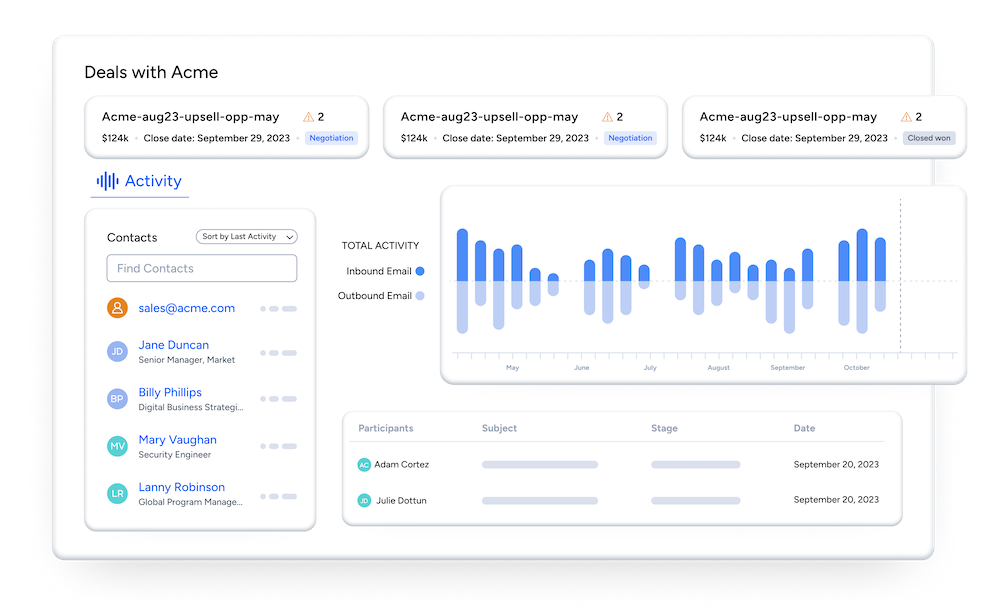
In the Salesforce dashboard, Chorus displays all customer interactions and conversation insights like key topics discussed or deal risks. The integration delivers three core workflow improvements:
Automated logging: call notes sync without manual entry
Deal visibility: insights attach to opportunities
Performance dashboards: aggregate patterns across reps and deals
Conversation intelligence data also enriches the broader revenue tech stack, reducing manual data entry and improving forecast accuracy. RevOps teams gain a reliable signal layer that doesn't depend on rep self-reporting.
That signal layer is only as valuable as the team's ability to act on it, which is where conversation intelligence changes how reps are trained, not just how deals are tracked.
How conversation intelligence accelerates sales training
Conversation intelligence software changes how teams onboard new reps, run coaching sessions, and improve playbooks over time. The shift is from opinion-based coaching to evidence-based development, grounded in what actually happens on calls.
Onboarding new reps faster
Before conversation intelligence, getting a new rep up to speed meant weeks of ride-alongs, shadowing live calls, and hoping they absorbed the right lessons. The process was slow, inconsistent, and dependent on manager availability.
With a call library built from top-performer recordings, new hires can study winning discovery calls and objection-handling moments before their first live call. They see exactly how your best reps handle a pricing pushback, re-engage a distracted prospect, or navigate a multi-stakeholder demo. The library is curated, searchable, and available on demand. Ramp time compresses because the learning is structured, not accidental.
Structured coaching with AI-flagged moments
Managers using AI call analysis don't review full recordings. They work from AI-flagged coachable moments: specific, time-stamped events in recordings that signal a coaching opportunity. A rep who talked for four straight minutes without a question. A discovery call where the competitor came up and the rep went silent. A close attempt that landed flat.
"It's much easier to understand what's going on across my team when I can watch the clips that matter most in between calls," says Sarena Wing, a ZoomInfo global sales manager focused on Europe, the Middle East, and Africa. "Chorus allows me to automatically analyze the performance of my reps at scale and create opportunities for growth with playlists and snippets."
Instead of reviewing a 45-minute call to find two minutes worth discussing, managers arrive at 1:1s with a focused agenda built from real call evidence.
Self-coaching via talk-pattern benchmarks
Reps who can see their own numbers change their behavior faster than reps who only hear feedback from managers. Conversation intelligence platforms surface each rep's talk-time ratio, question rate, and filler-word frequency, then benchmark those numbers against team averages and top-performer patterns.
A rep who sees that top performers ask twice as many questions in discovery and that their own question rate is half the team median has a concrete target to work toward. The feedback loop is continuous and doesn't require a manager to initiate it.
The playbook improvement loop completes the picture. NLP-extracted objection patterns and top-performer talk sequences feed back into training content and role-play scenarios, making playbooks empirically grounded rather than built on what managers remember from their own selling days. Seismic saved 11.5 hours per week per rep using this combination of conversation intelligence and ZoomInfo signals, while attributing 39% of active pipeline to ZoomInfo data.
Benefits of conversation intelligence for revenue teams
Those training gains compound into org-wide impact once conversation intelligence is embedded across the revenue team's daily workflows.
Sales managers face competing demands: monitor pitch performance, track prospect feedback patterns, and evaluate rep performance. Distributed teams add complexity with time zones and languages that make attending live calls difficult.
Sales call analysis consolidates conversation and market intelligence into a single view. This solves the data fragmentation problem across different roles:
Sales managers: Scale coaching without attending every call; use AI-flagged moments to run focused 1:1s instead of reviewing full recordings
SDRs and AEs: Reduce note-taking, improve follow-up speed, and benchmark their own talk patterns against top performers between calls
Revenue operations: Standardize methodology, track playbook adherence, and forecast with conversation data instead of rep self-reporting
Sales enablement: Build training playlists, surface real call examples, and accelerate onboarding with a curated call library
"When you're trying to manage many types of accounts in different regions, it can be challenging to make sense of it all," says Wing.
Automating conversation intelligence keeps reps focused on prospects instead of notes. An integrated tech stack gives stakeholders visibility at every step of the sales process.
According to McKinsey, more than 30% of sales-related activities can be automated, including training and sales support where conversation intelligence tools deliver measurable impact.
Thomson Reuters achieved 40% more closed-won deals and 115% average monthly quota attainment using GTM Workspace alongside conversation intelligence.
Getting those outcomes depends on choosing the right platform, the criteria below separate tools built for coaching from those built only for recording.
What to look for when evaluating conversation intelligence software
Not all conversation intelligence platforms deliver the same coaching depth. Evaluate on six criteria:
Transcription accuracy and multi-language support: The foundation of everything downstream. If the transcript is wrong, every coaching signal built on top of it is wrong. Verify accuracy rates across accents, call quality levels, and the languages your team actually sells in.
CRM and sales engagement integration: Insights must flow automatically into Salesforce, HubSpot, Outreach, or Salesloft without manual entry after every call. If reps have to copy notes by hand, they won't, and the data dies.
AI coaching signal quality: Look past basic call recording. Does the platform surface specific coachable moments, or just flag long monologues? The signals that matter are talk-time ratio, question rate, sentiment shifts, and competitor mentions tied to specific timestamps.
Call library and onboarding workflow: Can new reps access a curated library of top-performer recordings organized by scenario? This is the training-specific criterion that separates platforms built for coaching from those built only for recording.
Manager workflow: How does a frontline manager actually use the tool day-to-day? Look for AI-flagged moments, playlist creation, and snippet sharing that make 1:1 prep fast rather than manual.
Security and compliance: One-party vs. two-party consent handling, GDPR compliance, and SOC 2 certification matter as soon as legal or IT gets involved in the evaluation.
Chorus, ZoomInfo's conversation intelligence product, covers all these criteria and feeds call data directly into the GTM Context Graph, the intelligence layer that reasons across CRM records, intent signals, and conversation data to surface not just what happened in a deal, but why.
That cross-signal reasoning starts before the call. The same account and contact data that enriches Chorus post-call also arms reps before they dial.
How pre-call intelligence makes conversation analysis more powerful
"My life would be a nightmare without it," Wing adds.
Sales call analysis is more powerful when paired with pre-call intelligence. Showing up with firmographics, technographics, intent signals, and org charts helps reps lead with informed questions instead of starting from zero.
That context arrives in four forms, each adding a different layer of signal before the conversation begins:
Firmographics: company size, industry, revenue
Technographics: tools and systems in use
Intent signals: topics being researched
Org chart: buying committee structure
ZoomInfo, an all-in-one AI GTM Platform, provides account and contact data that arms reps with context before they dial. GTM Workspace helps with meeting prep and post-call email drafting, turning insights into immediate action. Teams building their own agentic workflows can access the same verified account and contact data through ZoomInfo's GTM Context Graph, available to AI assistants and agentic apps via APIs and MCP.
The GTM Context Graph fuses that account data with conversation intelligence from Chorus, CRM records, and behavioral signals to surface not just what's happening in an account, but why, so reps walk in with context that actually moves deals.
Talk to our team to see how ZoomInfo and Chorus work together.
Frequently asked questions about conversation intelligence software
What is conversation intelligence software?
Conversation intelligence software uses AI to automatically record, transcribe, and analyze sales calls and meetings, extracting coaching signals, deal risks, and behavioral patterns that correlate with closed deals. Unlike basic call recording, it applies NLP to surface specific insights: talk-time ratios, sentiment shifts, competitor mentions, and next-step commitments, then routes them to the right stakeholders automatically. Chorus is ZoomInfo's conversation intelligence product, connecting call data to CRM records, intent signals, and account context so revenue teams can act on what they learn from every conversation.
What is the best AI for sales training?
The best AI for sales training surfaces specific coachable moments from recorded calls, benchmarks rep talk patterns against top performers, and feeds winning objection-handling phrases back into training content. Chorus identifies these moments automatically, letting managers run structured 1:1s from AI-flagged timestamps rather than reviewing full recordings. For a broader comparison of platforms, see the roundup of best conversation intelligence software for revenue teams.
What's the best software for training new sales reps?
For onboarding new reps, the most effective conversation intelligence platforms provide a curated call library of top-performer recordings so new hires can study winning discovery calls and objection-handling moments before their first live call. This cuts ramp time by replacing weeks of ride-alongs with structured, self-paced call review. Seismic saved 11.5 hours per week per rep using this approach.
What data can be extracted from sales call transcripts?
Sales call transcripts reveal topics discussed, competitor mentions, objections, pricing, next steps, and sentiment indicators. AI platforms organize this into searchable insights for coaching, forecasting, and follow-up.
How does conversation intelligence integrate with CRM and sales engagement tools?
Conversation intelligence platforms sync call notes, topics, and deal signals directly into Salesforce, HubSpot, and sales engagement tools like Outreach and Salesloft, eliminating manual CRM entry after every call. Chorus integrates natively with Salesforce, automatically logging call summaries, flagged moments, and next-step commitments to the opportunity record. This gives RevOps teams accurate pipeline data without relying on rep self-reporting.
Can AI summarize sales calls automatically?
Yes. Modern platforms generate automated summaries, action items, and follow-up suggestions immediately after calls end, reducing administrative time while capturing commitments.