
Creatio has spent over two decades evolving from a Ukrainian CRM startup into something more ambitious: an agentic CRM and workflow platform with no-code and AI at its core. The pitch is that business teams, not developers, should own the applications and automations that run their operations.
With a composable architecture recognized by Forrester as the only Leader in low-code platforms for citizen developers, Creatio occupies a rare position: a single platform spanning CRM, business process management, and AI agent creation.
To write this Creatio review, we've analyzed the platform extensively. We believe it's the ideal choice if:
You need CRM and workflow automation unified under one platform
You want business users, not IT, to own application customization
You operate in a process-heavy, compliance-sensitive industry like banking, insurance, or manufacturing
You're looking for a Salesforce alternative with lower total cost of ownership
You need to build and deploy AI agents without writing code
However, Creatio might not be enough on its own if:
You need a verified B2B contact database with direct dials and business emails for prospecting
You want buyer intent signals that identify in-market accounts before they reach out
You need to enrich your CRM records automatically with third-party firmographic and technographic data
You want AI that reasons across your deal history, conversations, and market signals to tell reps who to contact, when, and what to say
In that case, you should consider pairing Creatio with ZoomInfo: an all-in-one AI GTM platform built on the most comprehensive B2B data in the industry (500M contacts, 100M companies, 135M+ verified phone numbers, and 200M+ verified business emails).
Where Creatio manages your CRM workflows and processes, ZoomInfo feeds them with the data intelligence and buyer signals that determine whether those workflows target the right accounts at the right time.
Because of that, we've included a detailed look at ZoomInfo later in this Creatio review, as the data intelligence layer that makes CRM automation actually productive. If you're ready to see what comprehensive B2B data can do for your go-to-market motions, you can start with ZoomInfo here.
What is Creatio?
Creatio is a cloud-based CRM and workflow automation platform founded in 2002 in Kyiv, Ukraine, by Katherine Kostereva and Oleksandr Popov.
Kostereva, a computer science graduate who had worked for IBM's European marketing team, saw unmet demand for CRM software in Eastern Europe and built the company to address it.
The company operated as Terrasoft, then rebranded to bpm'online in 2014 when it relocated its headquarters to Boston, Massachusetts. In 2019, it renamed itself Creatio to reflect a broader mission: a no-code platform where business ideas could be automated in minutes, not months.
What makes Creatio unusual is its architecture. Most CRM vendors bolt process automation onto a contact database. Creatio was built the other way around: a BPM engine at the core, with CRM modules (Sales, Marketing, Service) layered on top. The platform combines an intuitive low-code platform, CRM, and BPM in a single solution, reducing the need for separate tools.
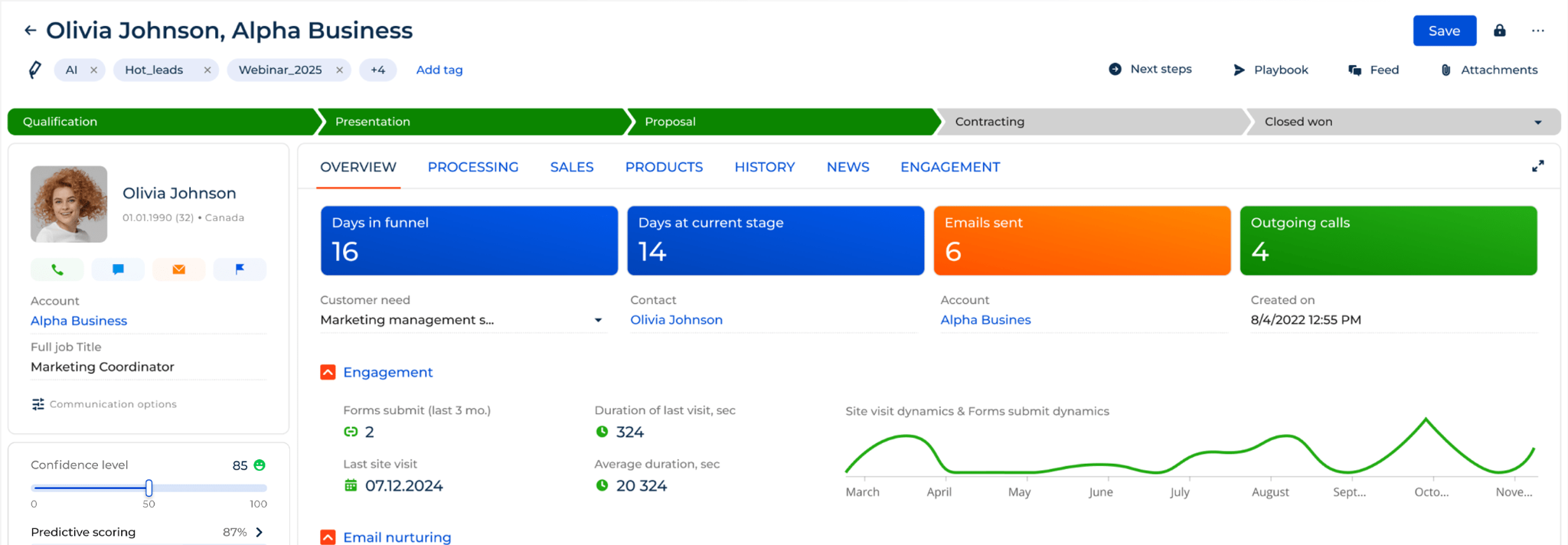
Source: Creatio
In June 2024, Creatio raised $200 million at a $1.2 billion valuation led by Sapphire Ventures, becoming a unicorn after bootstrapping without external capital for approximately seven years following its Boston relocation. Today, the company serves approximately 800 enterprise organizations across 100+ countries with 700+ employees and a local presence in 25 countries.
The ideal Creatio customer is a mid-market to enterprise organization that wants to consolidate CRM, process automation, and application development into one platform, with business users rather than IT owning the customization.
Creatio Pros & Cons
Pros | Cons |
|---|---|
- Composable no-code architecture; CRM + BPM + app building in one platform | - Slow load times; views and login can lag |
- Only Leader in Forrester's Low-Code Platforms for Citizen Developers (2024) | - Steep learning curve due to feature breadth |
- AI agents included in the base license at no extra cost | - Deep customization still requires dedicated technical resources |
- Fast implementation timelines (12 weeks for 7,000-user deployment) | - Weak mobile app compared to desktop experience |
- Transparent pricing with no hidden license restrictions | - Limited native third-party integrations; custom builds often required |
- Strong customer support (G2 "Highest Quality of Support") | - $10,000/year minimum spend; not suited for small businesses |
- On-premise, private cloud, and SaaS deployment options | - Reporting tools lack advanced calculated variables and export flexibility |
Creatio Review: How it Works & Key Features
No-Code Composable Architecture: Creatio's core differentiator is a platform where business teams build and modify enterprise applications without writing code.
Creatio Studio is the foundation everything else runs on.
It provides a no-code environment organized around six pillars: visual UI design, AI-driven development, composable component assembly, business process management, governance automation, and application lifecycle management.
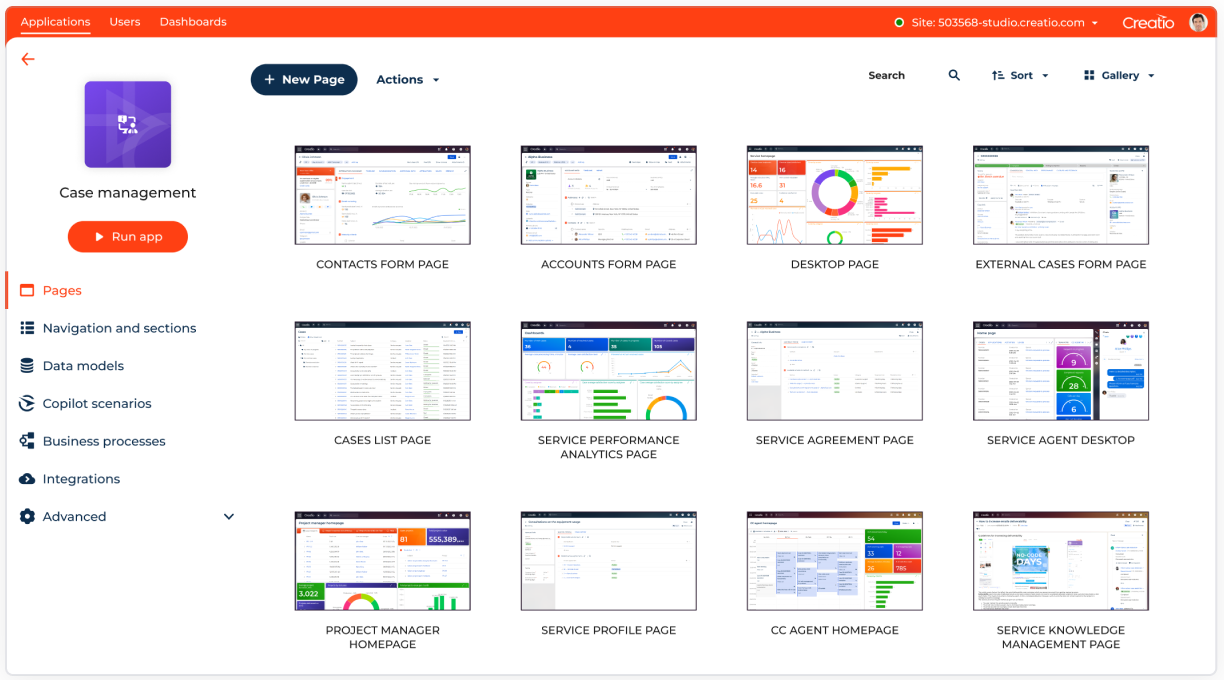
Source: Creatio
The Freedom UI Designer is a drag-and-drop editor for building fully responsive application pages. Users work from a component library that includes layout elements, data fields, interactive components (buttons, lists, charts, galleries), and specialized features like calendars, timelines, and approval systems. No programming knowledge required.
For process automation, the Process Designer uses BPMN 2.0 notation, a widely adopted standard for modeling business workflows. The visual tool handles structured, repeatable processes (approval chains, lead qualification sequences, order fulfillment). For unstructured work, the Case Designer supports dynamic case management where stages and steps can be reconfigured as situations evolve.
The composable architecture, introduced with Creatio 8.1 Quantum, treats all platform components as pluggable, replaceable, and reusable. Organizations assemble applications by combining pre-built components from the Creatio Marketplace (which hosts over 400 ready-to-use solutions) or build custom components and share them across teams.
Governance is built in, not bolted on. Studio enforces external compliance standards (GDPR, HIPAA, SOC 2) and automates internal audit workflows without requiring legal or IT specialists to configure them. For organizations in regulated industries, this addresses the common objection that no-code development creates ungoverned shadow IT.
AI-Native Capabilities: Creatio embeds predictive, generative, and agentic AI into the platform core, not as a paid add-on.
Creatio.ai is the embedded AI layer across the entire platform.
Unlike competitors that charge separately for AI features, Creatio includes all AI capabilities in the base software license with no hidden fees. This is a deliberate competitive position: no separate AI tier, no per-interaction pricing for standard usage.
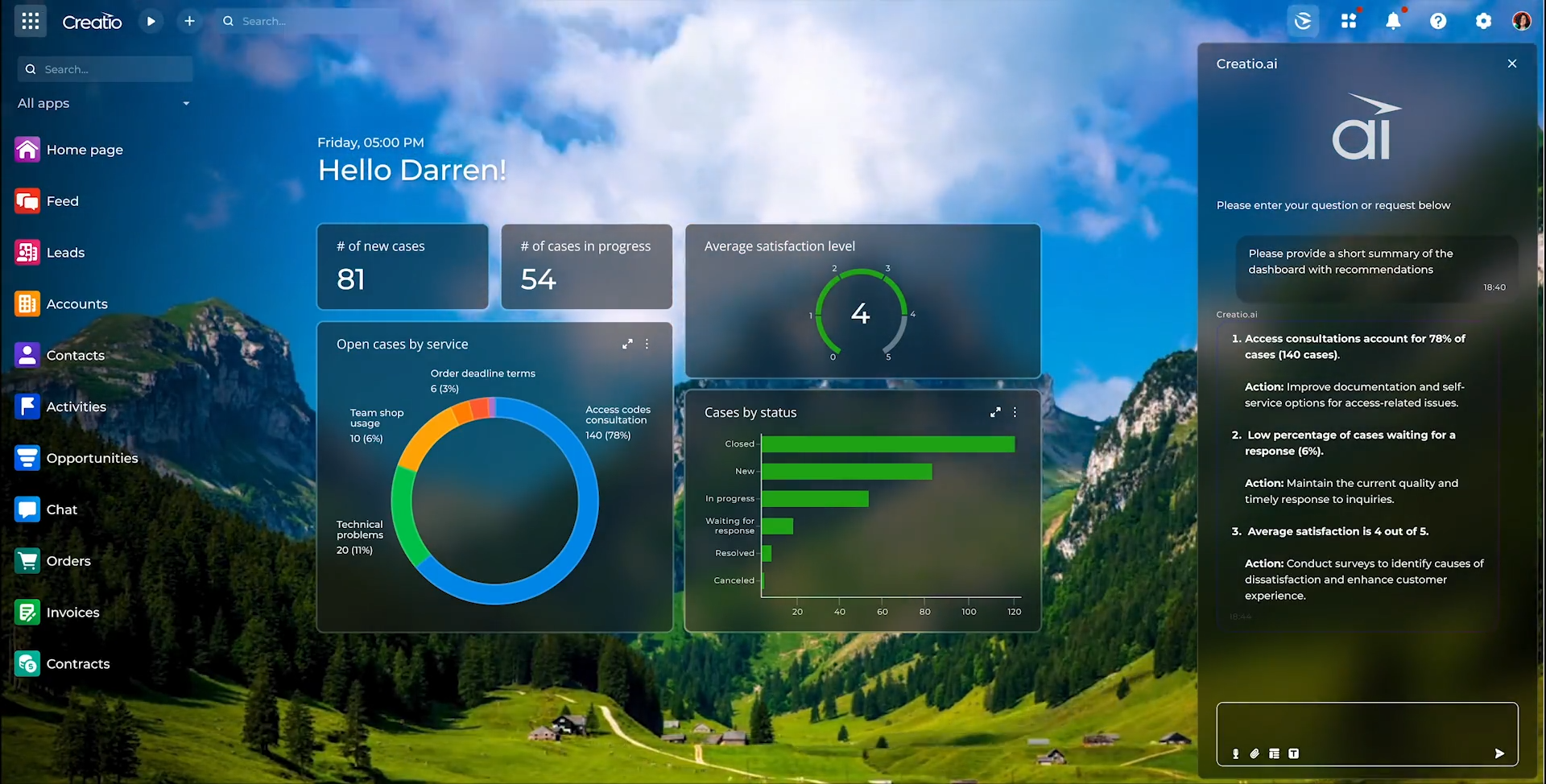
Source: Creatio
The AI architecture combines three paradigms under one framework: predictive AI (recommendations and next-best-action), generative AI (content creation and response drafting), and agentic AI (autonomous multi-step task execution). Users access it through a persistent chat panel available from any page in the interface.
The No-Code Agent Builder lets business users create AI agents by combining skills, workflows, and domain knowledge through a visual designer.
Each agent is defined by a role, a set of instructions, assigned AI Skills (individual business tasks like summarizing a case or drafting a call script), and available actions. When a user's query changes topic, Creatio automatically routes to the most relevant agent.
Out-of-the-box agents cover Sales (account research, quote generation, meeting preparation, forecasting), Marketing (content creation, campaign setup, lead scoring, lead routing), and Service (customer support, knowledge base curation, case classification, next best action).
The platform supports multiple LLM models including GPT-5, GPT-4.1, GPT-4o, and GPT-4.1 mini, and allows organizations to connect a custom LLM for data sovereignty requirements.
On the governance side, Creatio provides 80+ prebuilt governance policies and explicitly does not train any LLM on customer data. Customer data is encrypted using TLS 1.2+ in transit and AES-256 at rest, and each customer maintains a separate database with no cross-tenant access.
Unified CRM Suite: Sales, Marketing, and Service modules share a single data layer, eliminating the handoff friction of separate tools.
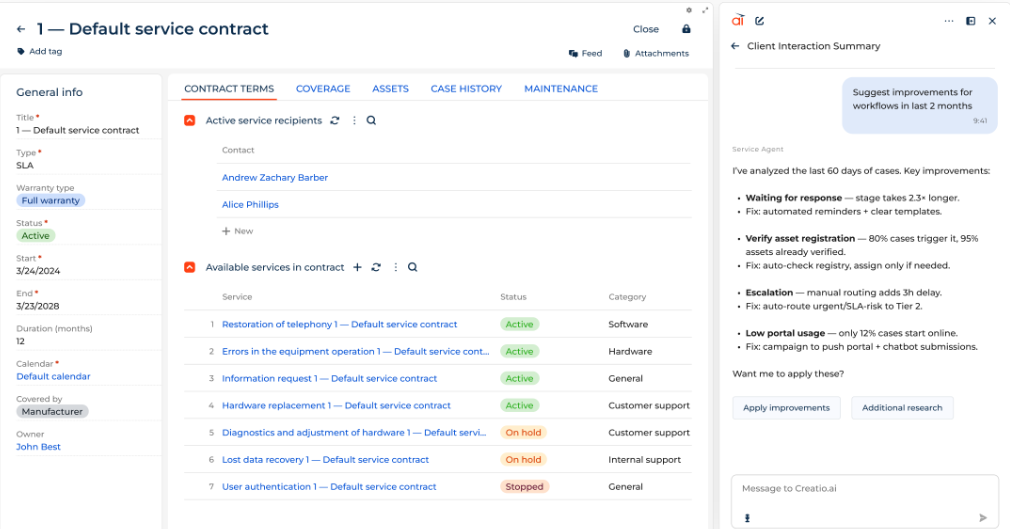
Rather than selling three disconnected products, Creatio runs its Sales, Marketing, and Service modules on the same platform with a shared customer record.
Source: Creatio
Sales covers the full revenue cycle: lead capture and qualification with a predictive scoring model, visual pipeline management, opportunity tracking, order and contract processing, and partner channel coordination.
Marketing provides omnichannel campaign automation, a visual Campaign Designer with branching logic, a drag-and-drop email designer, landing page creation, and multi-source lead capture from Facebook, LinkedIn, and web forms.
Service delivers omnichannel case management, SLA monitoring, field service dispatch, knowledge base management, and ITIL-based workflow templates.
The shared data layer means that a service agent sees the customer's full sales history and marketing engagement without requiring a separate integration. A marketing lead that converts to a sales opportunity carries its entire history forward.
This unified view extends to the Customer 360 profile, which displays available services, registered cases, and the full interaction history across all departments.
Pricing Structure: Creatio uses composable pricing with a platform layer plus CRM add-ons.
Creatio's pricing model has two layers. The first is the platform subscription (Studio Creatio), available in three tiers:
Tier | Price | Target |
|---|---|---|
Growth | SMB clients automating workflow and CRM use cases | |
Enterprise | Corporate and enterprise clients with complex requirements | |
Unlimited | Advanced enterprise scenarios at scale |
The second layer adds CRM-specific modules, each at $15/user/month: Sales Creatio, Marketing Creatio, and Service Creatio. So a user on the Growth platform with Sales CRM pays $40/user/month.
All plans are billed annually with a standard contract period of 3 years and a $10,000/year minimum spend. The Growth tier caps business process elements at 50,000 per month, API calls at 10,000 per day, and does not include SSO. Enterprise and Unlimited tiers remove these caps.
AI capabilities are included across all tiers at no additional cost.
Creatio offers a 14-day free trial for an unlimited number of users with full platform functionality and no credit card required. There is no permanent free plan.
Users consistently note the pricing transparency as a strength. As one reviewer put it, "your contract normally provides all (and more) of what you need; it's really weird to find unexpected restrictions in the licenses you buy" (Capterra).
Where Creatio Falls Short
While Creatio excels at CRM workflow automation, several limitations become apparent depending on your use case. These reflect the natural boundaries of a platform optimized for process management over go-to-market intelligence.
Performance Issues: Multiple independent reviewers flag slow load times consistently. Users report that "views and login load times are often slow and take a long time" (G2) and "it takes time to respond, the waiting times are very slow" (Capterra). The compilation model (changes require a recompile of the .NET application) is a structural cause cited by technical reviewers.
No B2B Prospecting Data Layer: Creatio manages customer records well but does not provide a verified contact database, buyer intent signals, or technographic data for identifying and reaching new prospects.
Sales teams using Creatio still need external sources for direct-dial phone numbers, verified business emails, and signals that indicate when target accounts are actively in-market. Without these, CRM automation runs on whatever data the team manually enters or imports.
Steep Learning Curve: The platform's breadth works against new users. Reviewers note that the numerous capabilities can cause a sense of overload, making it challenging to discern where to start or how to progressively leverage the tool's full potential (Capterra). Unlocking full value requires dedicated admin bandwidth.
Deep Customization Still Needs IT: While the no-code tools handle most configuration, reviewers note that to benefit from the software you need somebody dedicated to customizing the features (PeerSpot). For complex application creation, support of an IT team is still required (Capterra).
Weak Mobile Experience: Creatio's mobile app lacks intuitiveness and needs enhancement compared to the desktop experience. This is a recurring criticism across review platforms and a practical issue for field sales and service teams.
Limited Third-Party Integrations: Users flag that certain integrations with legacy systems require custom development, and the lack of existing solutions in the market forces custom builds (Capterra). The Creatio Marketplace is growing but remains narrower than competitors with mature app exchanges.
Not for Small Businesses: The $10,000/year minimum spend, 3-year standard contracts, and the need for at least one dedicated admin create a practical floor. Creatio's options are "heavy" for startups and small enterprises requiring simple and cheap solutions (PeerSpot).
These limitations are design choices, not failures. Creatio optimized for workflow depth and customization rather than prospecting intelligence. But they leave a clear gap: the CRM can automate what happens after you identify a prospect, but it provides no help in finding the right prospects in the first place or understanding when they're ready to buy.
The Data Intelligence Layer Creatio Needs: ZoomInfo
A CRM workflow is only as good as the data running through it. Creatio gives you the automation engine. ZoomInfo gives you the fuel.
ZoomInfo is an all-in-one AI GTM platform built on the most comprehensive B2B data in the industry: 500M contacts, 100M companies, 135M+ verified phone numbers, 120M direct-dial phone numbers, and 200M+ verified business email addresses.
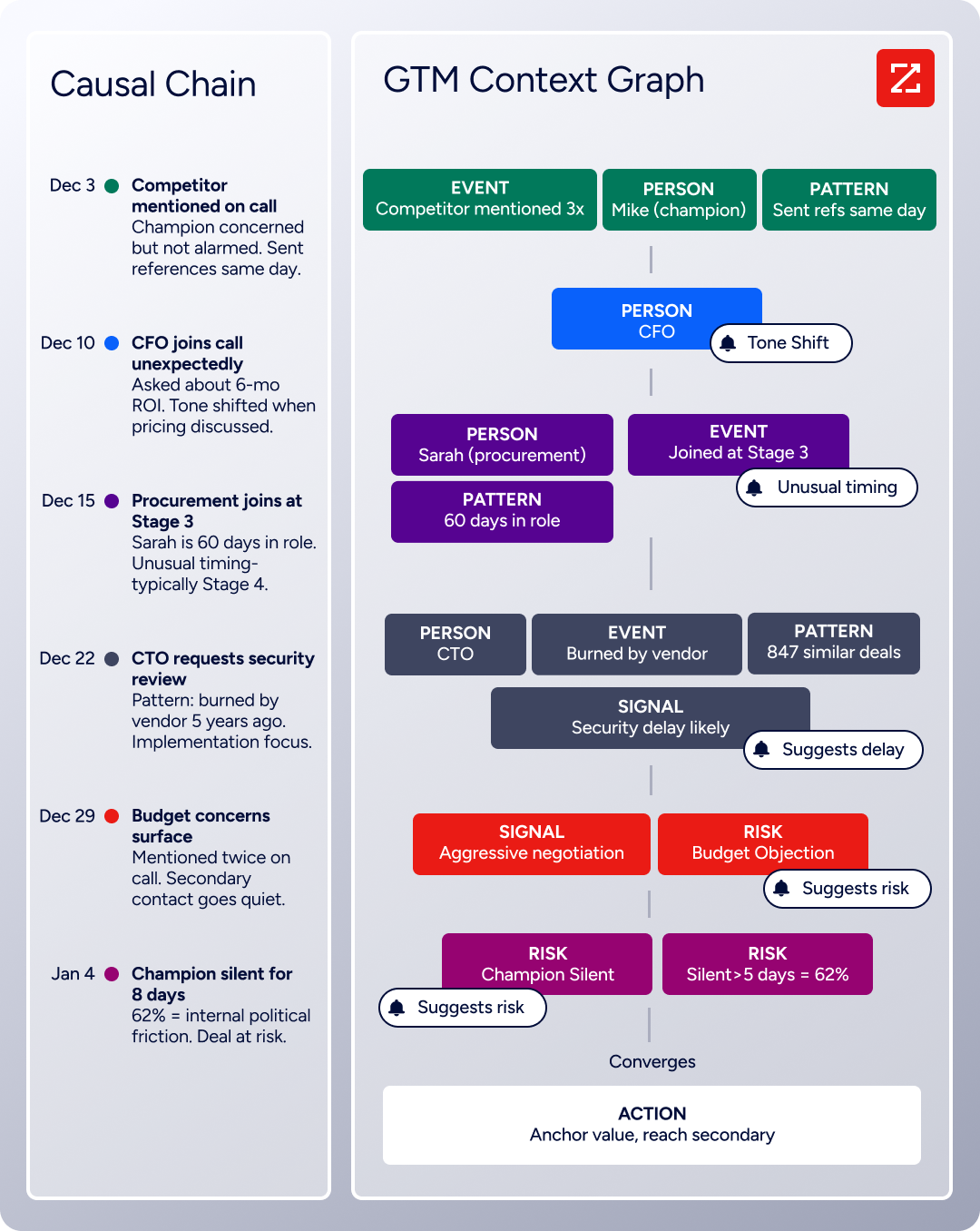
That data, combined with your CRM records, conversation transcripts, and behavioral signals, feeds ZoomInfo's GTM Context Graph, an intelligence layer that processes 1.5B+ data points daily and captures not just what happened, but why those outcomes happened.
Where Creatio automates lead qualification once a lead enters the system, ZoomInfo identifies the right leads before they ever arrive.
Comprehensive B2B Data: The foundation Creatio doesn't provide.
Creatio's CRM stores whatever data your team enters or imports. ZoomInfo supplies the data itself.
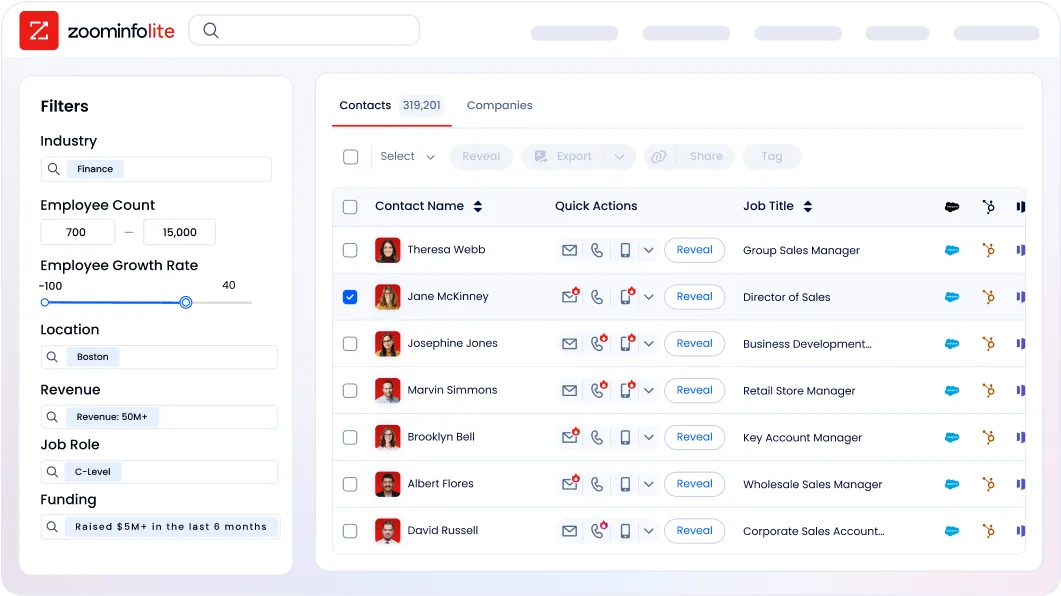
The platform covers three dimensions: identity data (who buyers are, where they work, how to reach them), company context (firmographics, org charts, technographics across 30+ million companies), and dynamic signals that reveal when accounts are actively in-market.
The data is verified at scale through a multi-source pipeline: automated ML scanning 28 million site domains daily, third-party partner data covering 95 million businesses, a contributory community of 200,000+ ZoomInfo Lite users, and an in-house Data Training Lab of 300+ human researchers. First-party data reaches up to 95% accuracy. The quality advantage is externally validated.
In a Fortune 500 competitive RFP analyzing 25 million contacts across vendors, the independent consultant concluded that "no other competitor came even close." ZoomInfo is a Leader in the 2025 Forrester Wave for Intent Data Providers, a Leader in the Gartner Magic Quadrant for ABM Platforms for two consecutive years, and holds 133 No. 1 rankings on G2.
For sales teams, the difference is practical: the direct dial actually rings and the email actually lands, instead of a 30% bounce rate that buries sequences in spam folders. For RevOps, enrichment workflows don't require stitching together three vendors and a manual research layer just to get a complete account picture.
"ZoomInfo gives us the information we need to execute. We don't have to go through and spend our time digging. It's already there, so we can be three steps ahead." (Vensure)
GTM Context Graph: Intelligence that understands why deals move, not just that they moved.
Creatio's CRM records pipeline stages. ZoomInfo's GTM Context Graph captures the context behind those stages.
A CRM records that a deal moved from Stage 3 to Stage 4. But as ZoomInfo's Chief Product Officer Dominik Facher writes: "The CRM recorded the state change. It has no record of why it happened." Perhaps the CFO joined the last call and asked about ROI. Perhaps the VP went quiet during an internal budget battle. CRMs were never designed to capture these underlying signals.
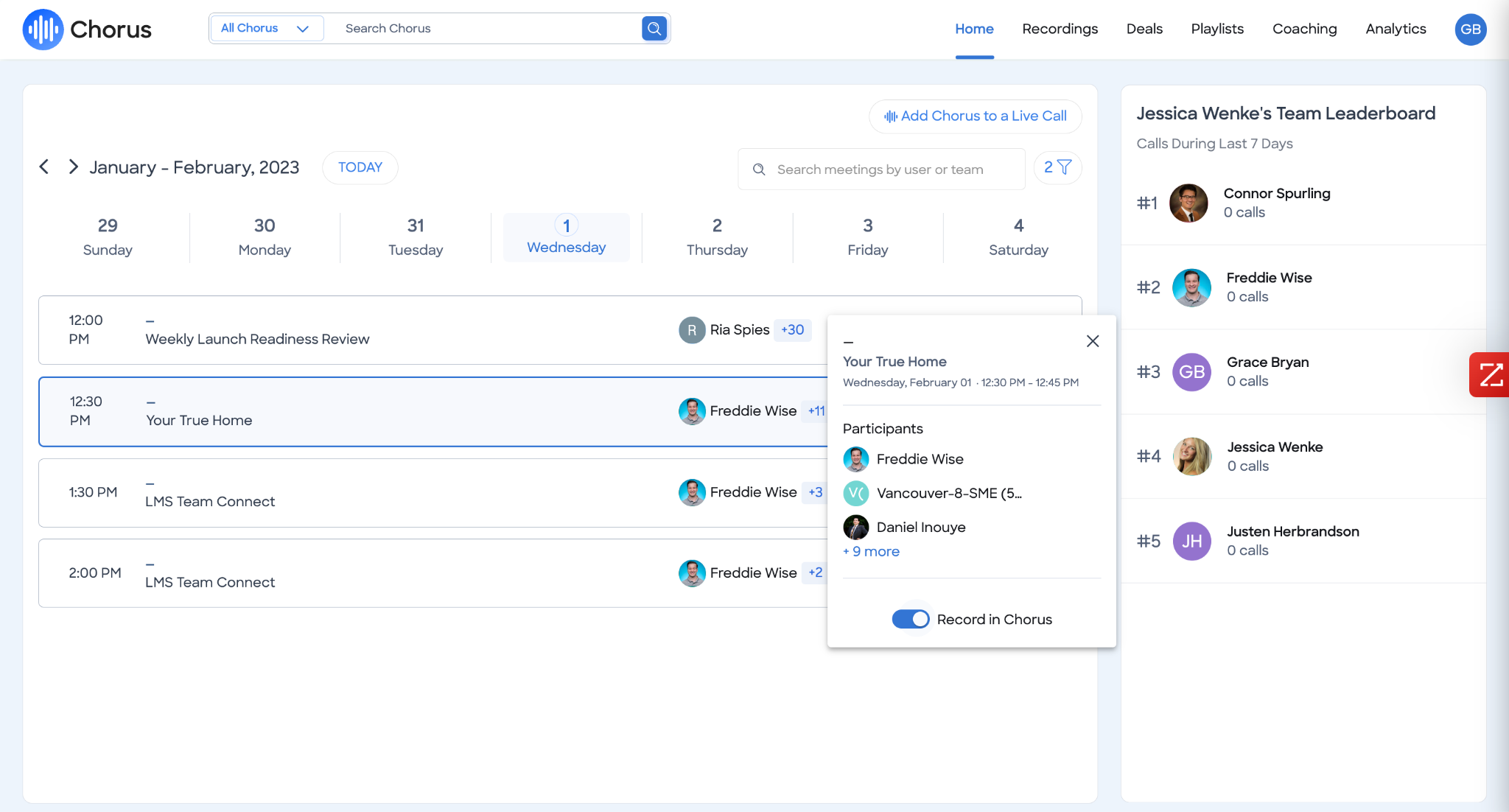
The GTM Context Graph unifies ZoomInfo's third-party B2B data with a customer's own CRM records, conversation transcripts (captured through Chorus, ZoomInfo's conversation intelligence engine), email interactions, and behavioral signals.
Source: ZoomInfo
It then reasons across all of it: mapping relationships between people, connecting actions to outcomes, recognizing patterns across thousands of similar deals, and identifying exceptions that reveal real blockers.
This contextual reasoning flows into every downstream action. Follow-up emails address the specific concern a stakeholder raised because the system understands why it matters. GTM plays target accounts whose signal combinations match actual win patterns rather than a keyword threshold. Forecasts weight deals by buying evidence rather than stage labels.
"That combination of our internal CRM data, external signals, and AI that's given all that context has helped us craft very specific account- and persona-based messages. And people have responded to them right away." (Seismic)
Universal Access: Use ZoomInfo's intelligence in Creatio or any other tool.
ZoomInfo delivers its intelligence through three lanes, ensuring it works wherever your team works:
GTM Workspace gives sellers a single interface where prioritized accounts, AI-drafted outreach, and deal execution converge. It replaces the context-switching between tools (the average enterprise has 23 GTM technologies) with one AI-powered surface.
GTM Studio gives marketers, RevOps, and GTM engineers an orchestration canvas where audience definition, campaign creation, and pipeline measurement happen in natural language rather than engineering tickets. Expansion plays that used to take 3 weeks now launch in 30 minutes.
APIs and MCP expose the same intelligence to any custom agent, internal tool, or partner platform. API access is included in all relevant plans. The MCP server connects AI models directly to ZoomInfo's B2B data as a native tool, currently supporting Claude and ChatGPT.
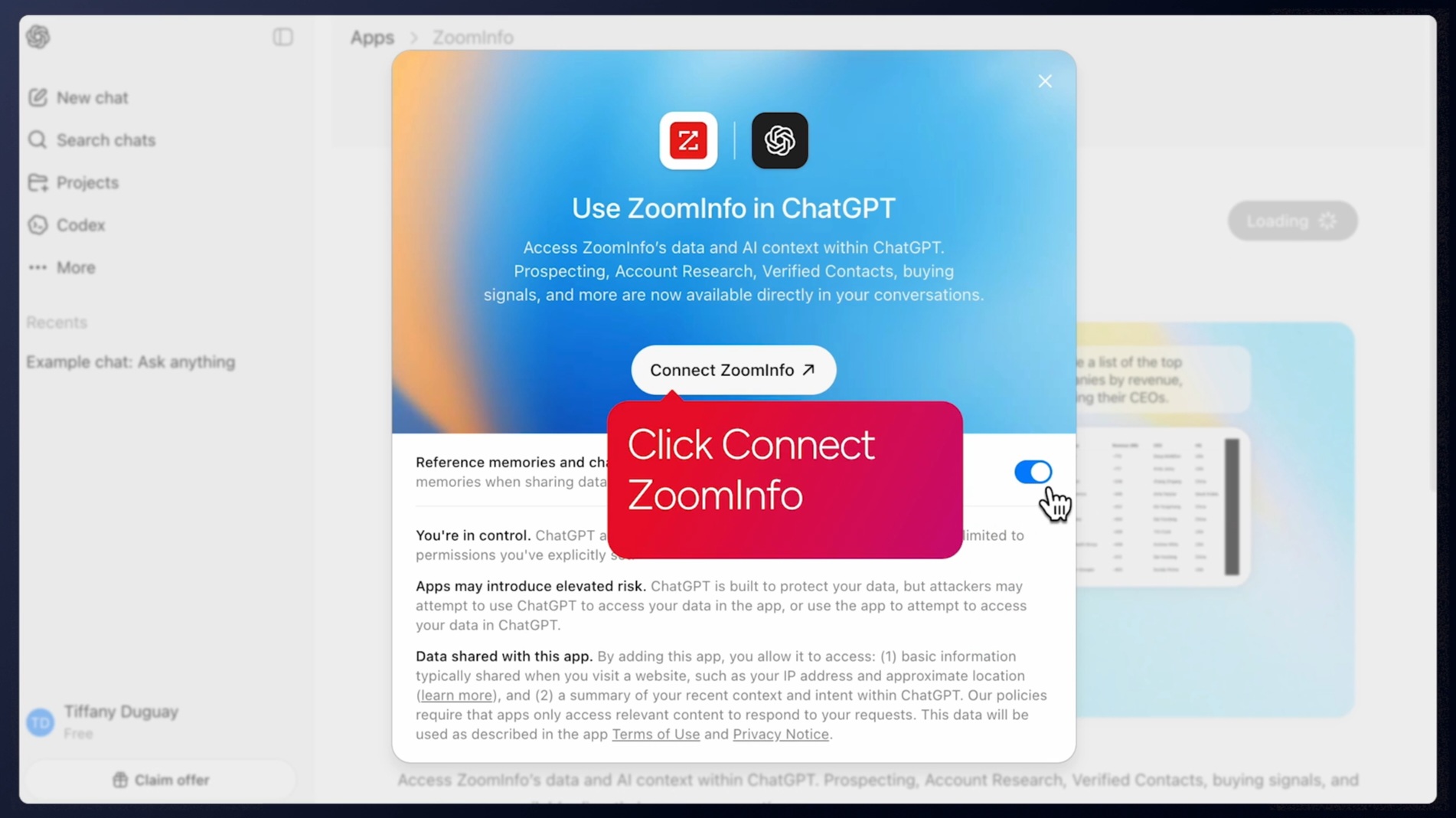
Source: ZoomInfo
The critical point is that all three lanes draw from one GTM Context Graph. The same data, the same reasoning, the same continuously learning model. Nothing is degraded by which surface you choose.
"The plug-and-play aspect of the API means I can integrate it very easily into any process and get information at a moment's notice." (BDO Canada)
Creatio and ZoomInfo: Comparison Summary
Aspect | Creatio | ZoomInfo |
|---|---|---|
Primary function | CRM + workflow automation + no-code app building | B2B data intelligence + go-to-market execution |
Core strength | Composable no-code architecture with embedded BPM | Comprehensive verified B2B data + GTM Context Graph |
Target users | Operations, IT leaders, CRM admins, citizen developers | Sales, marketing, RevOps, GTM engineers |
B2B contact data | Stores what you enter; no built-in database | 500M contacts, 135M+ verified phone numbers, 200M+ verified emails |
Buyer intent signals | Not available | Intent data from 210M IP-to-Org pairings, 6T+ keyword-to-device pairings monthly |
AI capabilities | Predictive, generative, and agentic AI for CRM workflows | GTM Context Graph reasoning + AI agents for prospecting and outreach |
No-code tools | Full visual designers for apps, processes, and AI agents | GTM Studio's natural-language play builder |
CRM depth | Full Sales, Marketing, Service suite with BPM engine | GTM Workspace for deal execution; native CRM integrations for Salesforce, HubSpot, Dynamics |
Analyst recognition | Leader: Forrester Low-Code; Leader: Gartner B2B MAP; Visionary: Gartner SFA | Leader: Forrester Intent Data; Leader: Gartner ABM; Customers' Choice: Gartner VoC |
Deployment | Cloud, on-premise, private cloud | Cloud-based |
Free tier | 14-day trial; no permanent free plan | ZoomInfo Lite (permanent free tier) + 7-day full trial |
Pricing | $25-$85/user/month platform + $15/user/month per CRM module | Custom-quoted; consumption-based pricing |
Best for | Automating CRM and operational workflows | Powering those workflows with data intelligence and buyer signals |
Final Verdict
Creatio and ZoomInfo are not competitors. They address different stages of the same revenue problem, and they're most effective when working together.
Choose Creatio if your primary challenge is managing and automating CRM workflows, customer service operations, or internal business processes.
It's the right platform for mid-market and enterprise organizations that need flexibility to build custom applications without relying on IT, especially in regulated industries where deployment options (cloud, on-premise, hybrid) and compliance governance matter.
The composable architecture, embedded AI agents, and proven BPM engine make it a strong alternative for organizations that find Salesforce too rigid or too expensive to customize. At its best, Creatio turns operational complexity into automated workflows that business teams own and evolve.
Add ZoomInfo when you need the data intelligence that makes those workflows productive. Creatio can automate lead scoring, pipeline management, and campaign orchestration, but it depends entirely on the quality of data flowing into it.
ZoomInfo provides the verified contacts, direct dials, buyer intent signals, and contextual deal intelligence that ensure your CRM automation targets the right accounts at the right time. The combination gives your organization both the intelligence to find and understand your buyers and the operational engine to engage them through automated, customizable workflows.
Get started with ZoomInfo here.
The strongest go-to-market operations pair intelligent data with automated execution. Creatio handles the execution. ZoomInfo provides the intelligence. Together, they close the gap between knowing who to pursue and having the operational infrastructure to pursue them well.
Creatio FAQ
What is Creatio used for?
Creatio is a CRM and workflow automation platform that unifies Sales, Marketing, and Service modules with a no-code development environment.
Organizations use it to manage customer relationships, automate business processes (lead qualification, order fulfillment, case routing, approval chains), and build custom applications without writing code. It is designed for mid-market to enterprise organizations, particularly those in process-heavy industries like banking, insurance, and manufacturing.
How much does Creatio cost?
Creatio uses a two-layer pricing model. The platform subscription (Studio Creatio) ranges from $25 to $85 per user per month across three tiers: Growth, Enterprise, and Unlimited. CRM modules (Sales, Marketing, Service) are add-ons at $15 per user per month each.
All plans are billed annually with a 3-year standard contract and a $10,000 per year minimum spend. AI capabilities are included in all tiers at no additional cost.
Does Creatio have a free plan?
No. Creatio offers a 14-day free trial with full functionality and unlimited users, but there is no permanent free plan. After the trial, a paid subscription is required.
ZoomInfo, by comparison, offers ZoomInfo Lite as a permanent free tier with access to its B2B database, 10 monthly export credits, and basic search and enrichment features with no time limit and no credit card required.
Is Creatio suitable for small businesses?
Generally, no. The $10,000 per year minimum spend, 3-year contract commitment, and the need for at least one dedicated administrator to manage configuration create a practical floor.
Reviewers note that Creatio's feature set is heavy for startups and small businesses that need simple, affordable CRM. The platform is designed for mid-market and enterprise organizations with the resources to invest in customization and process automation.
What makes Creatio different from Salesforce?
Creatio differentiates on three fronts.
First, its no-code composable architecture lets business users build and modify applications and workflows without IT involvement, while Salesforce customization often requires developers.
Second, pricing is transparent and includes AI capabilities in the base license, whereas Salesforce is known for add-on pricing complexity.
Third, Creatio supports on-premise and private cloud deployment alongside SaaS, which matters for regulated industries. However, Salesforce has a far larger integration ecosystem and broader market adoption.
For a deeper side-by-side look, see our Creatio vs Salesforce comparison.
Does Creatio include buyer intent data or a B2B contact database?
No. Creatio is a CRM and workflow automation platform, not a data provider. It stores and manages customer records but does not supply verified contact information, direct-dial phone numbers, buyer intent signals, or technographic data. Organizations using Creatio for sales prospecting need to source this data externally.
ZoomInfo provides 500 million contacts, 135 million verified phone numbers, and 200 million verified business emails, along with intent signals and company data that can feed into CRM systems.
What AI features does Creatio include?
Creatio embeds predictive, generative, and agentic AI into its platform at no additional cost. Users can create custom AI agents using a no-code visual builder, and the platform comes with pre-built agents for sales (account research, quote generation), marketing (content creation, campaign setup), and service (case resolution, knowledge base curation).
The system supports multiple LLM models and allows organizations to connect their own models. Governance features include 80 or more prebuilt policies and a commitment that no customer data is used for LLM training.
Can ZoomInfo integrate with Creatio?
ZoomInfo's Enterprise API and MCP server are designed to push B2B data into any system, CRM, or workflow. While ZoomInfo offers native pre-built integrations with Salesforce, HubSpot, and Microsoft Dynamics, its API architecture (supporting REST, OData, and OAuth 2.0 authentication) enables integration with other CRM platforms including Creatio.
This allows organizations to enrich Creatio records with verified contact data, company data, and intent signals from ZoomInfo's database.
Related breakdowns to help you choose:
