
Dock has built a solid AI revenue enablement platform. B2B SaaS companies use it as a buyer-facing workspace that covers digital sales rooms, customer onboarding portals, and client collaboration. It combines content management, mutual action plans, AI-generated documents, and a learning management system into a single branded experience where sellers and buyers work side by side.
But as your revenue operation scales, a workspace-first tool (even a well-designed one) leaves gaps. You may need B2B intelligence to identify the right buyers before a deal room exists. You may need content governance across hundreds of reps. Or you may need native e-signatures, rep coaching, or a more accessible entry point for a lean sales team.
That's where this guide comes in. Whether you're looking to:
Power every sales conversation with B2B intelligence and buyer intent data
Govern and optimize sales content at enterprise scale with AI-driven coaching
Close deals with legally compliant native e-signatures and Microsoft Dynamics support
Launch professional buyer microsites with minimal platform commitment
Measure and improve rep readiness with AI role play and conversation intelligence
Discover hidden stakeholders and automate deal execution with AI workspaces
Test a dedicated deal room experience before committing to a subscription
We'll explore alternatives that excel in these specific areas.
Some teams use these tools alongside Dock to fill capability gaps. Others replace Dock entirely with a tool better suited to their primary need. This isn't about finding a "better" platform. It's about finding the right fit for how your revenue team works.
Here are the Dock alternatives worth considering.
The Best Dock Alternatives
Best Alternative for B2B Data Intelligence and AI-Powered GTM Execution We chose ZoomInfo because it provides the intelligence that deal rooms lack: B2B data on 500M contacts, buyer intent signals, and the GTM Context Graph that captures why deals move, not just that they moved. |
|---|
Best Alternative for Enterprise Sales Enablement and AI Content Governance We chose Highspot because it delivers AI-powered content governance, guided selling inside the CRM, and conversation intelligence with coaching at enterprise scale, addressing enablement complexity that Dock's mid-market orientation wasn't designed for. |
Best Alternative for Native E-Signatures and Microsoft Dynamics Integration We chose GetAccept because it offers legally compliant, multi-tier e-signatures embedded inside deal rooms, plus the only native Microsoft Dynamics 365 integration in the digital sales room category. |
Best Alternative for Visual Buyer Microsites and SMB-Friendly Deal Rooms We chose Trumpet because its visual defaults, AutoBrand AI, and a functional free tier with 10 Pods make it the most accessible entry point for small teams wanting professional buyer experiences without a large platform commitment. |
Best Alternative for AI Rep Coaching and Sales Readiness Measurement We chose Mindtickle because its AI Role Play, conversation intelligence, and Rep Readiness Index link training investment to quota attainment, addressing the rep development gap that workspace-first platforms leave open. |
Best Alternative for AI-Native Deal Execution and Stakeholder Discovery We chose Aligned because its AI-powered stakeholder discovery surfaces hidden decision-makers the moment they interact with deal content, turning passive engagement tracking into proactive multi-threading intelligence. |
Best Alternative for Deal Rooms at No Upfront Cost We chose Flowla because its permanent free plan includes unlimited internal seats, buyer analytics, and mutual action plans, making it the most accessible digital sales room for teams testing the category before committing a budget. |
What is Dock?
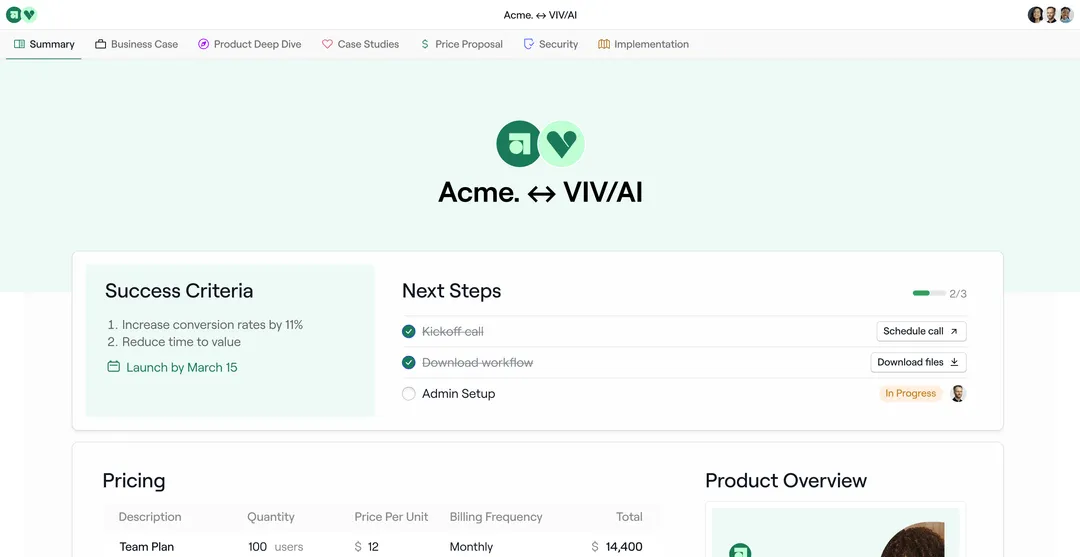
Source: Dock
Dock is an AI revenue enablement platform built around buyer-facing workspaces. These serve as branded collaboration hubs between a vendor's team and the customer's buying committee. Unlike traditional sales enablement tools designed for internal rep use only, Dock creates shared spaces where sellers and buyers work together throughout the customer lifecycle.
Its key features include:
Sales Deal Rooms that consolidate demos, case studies, pricing, security docs, and mutual action plans into a single branded link shared with the buying committee
Customer Onboarding portals that replace spreadsheets with personalized, self-serve resource hubs
Content Management with an AI-powered library, auto-tagging, and governed Slides for sales presentations
Dock AI with an Enablement Agent, AI Documents for generating business cases and proposals, and post-call AI Suggestions
Learning Management with Courses, Playbooks, and structured rep training
Order Forms with embedded e-signature for standard deal structures
Mutual Action Plans with interactive, shared project timelines between seller and buyer
When a rep sends a Dock workspace link after a discovery call, the buyer gets a single destination with everything from the demo recording and competitive positioning to next steps and signable pricing. As the deal progresses, hidden sections unlock, content updates propagate across all active workspaces, and CRM fields sync automatically.
A buyer-facing workspace that spans the sales-to-onboarding lifecycle creates an organized experience that scales consistently across your team. Dock holds a 4.7/5 rating on G2 with ease of use cited in the majority of reviews.
But as your revenue operation grows, a workspace-first tool won't address every challenge your GTM team faces. Whether you need B2B intelligence to identify buyers before the deal room exists, content governance across hundreds of reps, native e-signatures for complex contracts, or rep coaching tied to revenue outcomes, the tools on this list address those gaps.
Looking to power your deal rooms with B2B intelligence? ZoomInfo surfaces the right buyers, intent signals, and account context so every sales conversation starts informed. Learn more about ZoomInfo.
How We Curated Our List of Dock Alternatives
After testing Dock and researching the market, we focused on tools that address specific gaps in the revenue enablement workflow. Dock excels at creating buyer-facing workspaces, but some teams need stronger tools for:
Identifying and prioritizing the right buyers with B2B data and intent signals before the deal room is ever created
Governing sales content at enterprise scale with AI-powered coaching and conversation intelligence across hundreds of reps
Closing contracts with legally compliant e-signatures that don't redirect buyers to a separate signing tool
Launching professional buyer microsites with minimal commitment and an accessible price point for lean teams
Measuring and improving rep readiness through AI role play, skill gap analysis, and training tied to revenue outcomes
Discovering hidden stakeholders and automating deal execution with AI workspace intelligence
Testing the deal room workflow with a functional free plan before committing to a paid subscription
Each tool on this list leads in one of these areas. You might use them alongside Dock or switch entirely; it depends on what your revenue team needs most.
DISCLAIMER: We aren't covering every single tool in the market! Our focus is on highlighting the best alternatives that address some of Dock's limitations for various use cases. The goal is to provide insights into tools that cater to specific business needs. |
|---|
1. ZoomInfo — Best Alternative for B2B Data Intelligence and AI-Powered GTM Execution
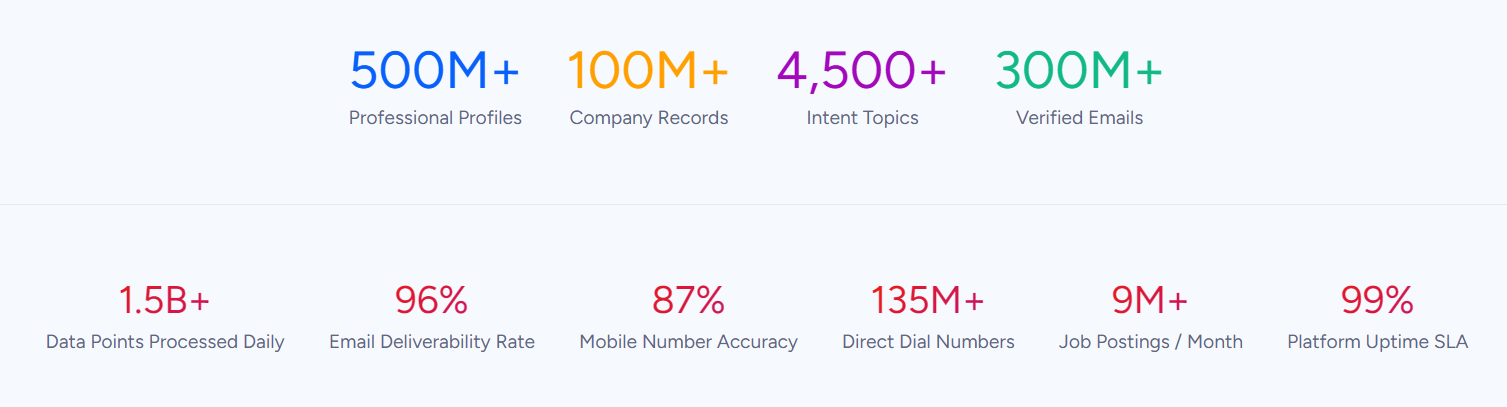
ZoomInfo is an AI GTM platform built on a B2B data foundation of 500M contacts, 100M companies, 135M+ verified phone numbers, and 200M+ verified business emails.
Its GTM Context Graph processes 1.5B+ data points daily, unifying this data with your CRM records, conversation transcripts, and behavioral signals to reveal the full context of your accounts. That context gives AI the fuel to show not just what happened, but why it happened, and which actions to take next. Your team can drive sales motions from the GTM Workspace, run GTM plays from GTM Studio, or power their own tools through the API and MCP in any front-end.
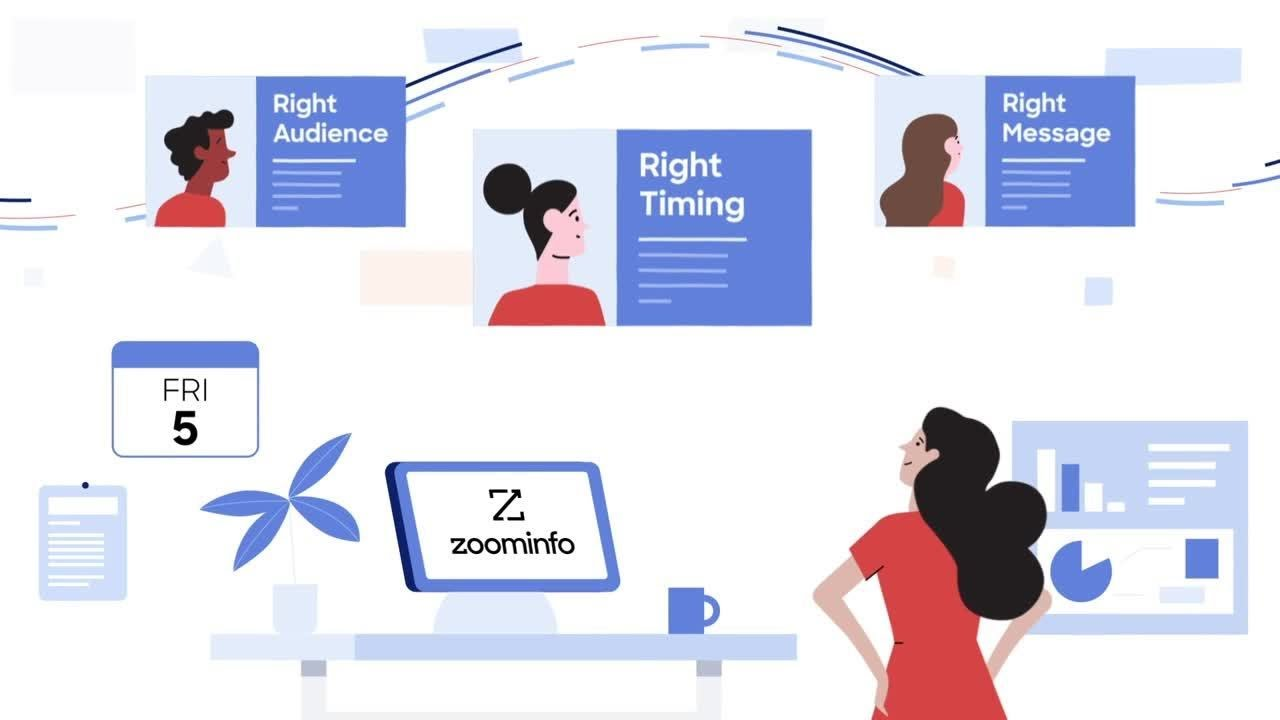
Dock gives you the workspace to collaborate with buyers. ZoomInfo ensures you're engaging the right buyers at the right time with the right message.
Its key capabilities include:
B2B data: 500M contacts and 100M companies with verified direct dials, business emails, company attributes, technographics, and org charts
Buyer Intent signals: 210 million IP-to-Organization pairings and 6 trillion+ keyword-to-device pairings that reveal when target accounts are actively researching solutions
GTM Context Graph: The intelligence layer that captures not just what happened in a deal, but why it happened, giving AI the context to recommend actions that match proven win patterns
GTM Workspace: A workspace with prioritized accounts, AI-drafted outreach, and deal intelligence in one view
Universal access: APIs and MCP that deliver ZoomInfo intelligence into any tool, workflow, or AI agent, including Claude and ChatGPT
For B2B revenue teams that need to solve the intelligence problem upstream of any deal room, ZoomInfo provides the data foundation, buyer signals, and context that inform every downstream sales interaction. Dock helps you collaborate with buyers once they're engaged. ZoomInfo helps you identify, prioritize, and understand those buyers before the first conversation happens.
Why Choose ZoomInfo Over Dock for B2B Intelligence and GTM Execution
Dock excels at buyer-facing collaboration. ZoomInfo addresses the intelligence gap that workspace tools leave open. The following sections show where ZoomInfo extends the revenue workflow beyond the deal room.
B2B Data: Know Your Buyers Before the First Conversation
Dock tracks buyer engagement within its workspaces: who viewed which page, how long they stayed, which documents they downloaded. That data is valuable for active deals. But Dock does not help you identify which companies should be in your pipeline, who the decision-makers are, or how to reach them.
ZoomInfo operates the largest B2B data platform in the industry: 500M contacts, 100M companies, 135M+ verified phone numbers, 120M direct-dial phone numbers, and 200M+ verified business email addresses. This data flows through a multi-source verification pipeline backed by 300+ human researchers with up to 95% accuracy on first-party data.
In a Fortune 500 competitive RFP analyzing 25 million contacts across vendors, the independent consultant concluded that "no other competitor came even close."
Beyond contact data, ZoomInfo's Buyer Intent tracks signals from 210 million IP-to-Organization pairings to reveal when accounts are actively researching solutions in your category. Guided Intent, exclusive to ZoomInfo, identifies topics historically correlated with deal success rather than requiring manual topic selection.
Source: ZoomInfo
ZoomInfo in Action: Before you ever build a deal room, ZoomInfo identifies the 15 companies in your territory actively researching your solution category this week. For each company, you see the complete buying committee: the VP of Sales who will champion the deal, the CFO who controls the budget, and the IT Director who will evaluate security requirements. Each contact comes with a verified direct dial, business email, and the specific intent topics they're researching. Your deal room conversation starts informed rather than cold.
GTM Context Graph: Understand Why Deals Move, Not Just That They Moved
Dock's analytics tell you what buyers did inside the workspace: page views, content engagement, time spent. That's useful for gauging interest. But it cannot tell you why the deal accelerated after the last call, what the CFO's specific concern was, or which pattern across your pipeline predicts a close.
The GTM Context Graph is ZoomInfo's intelligence layer.
It fuses your CRM records, conversation transcripts, email threads, and behavioral signals with ZoomInfo's third-party intelligence into a single graph that captures the connections between signals and outcomes. As CPO Dominik Facher writes: "The CRM recorded the state change. It has no record of why it happened." The GTM Context Graph fills that gap, making decision context machine-readable so AI can reason about your deals.
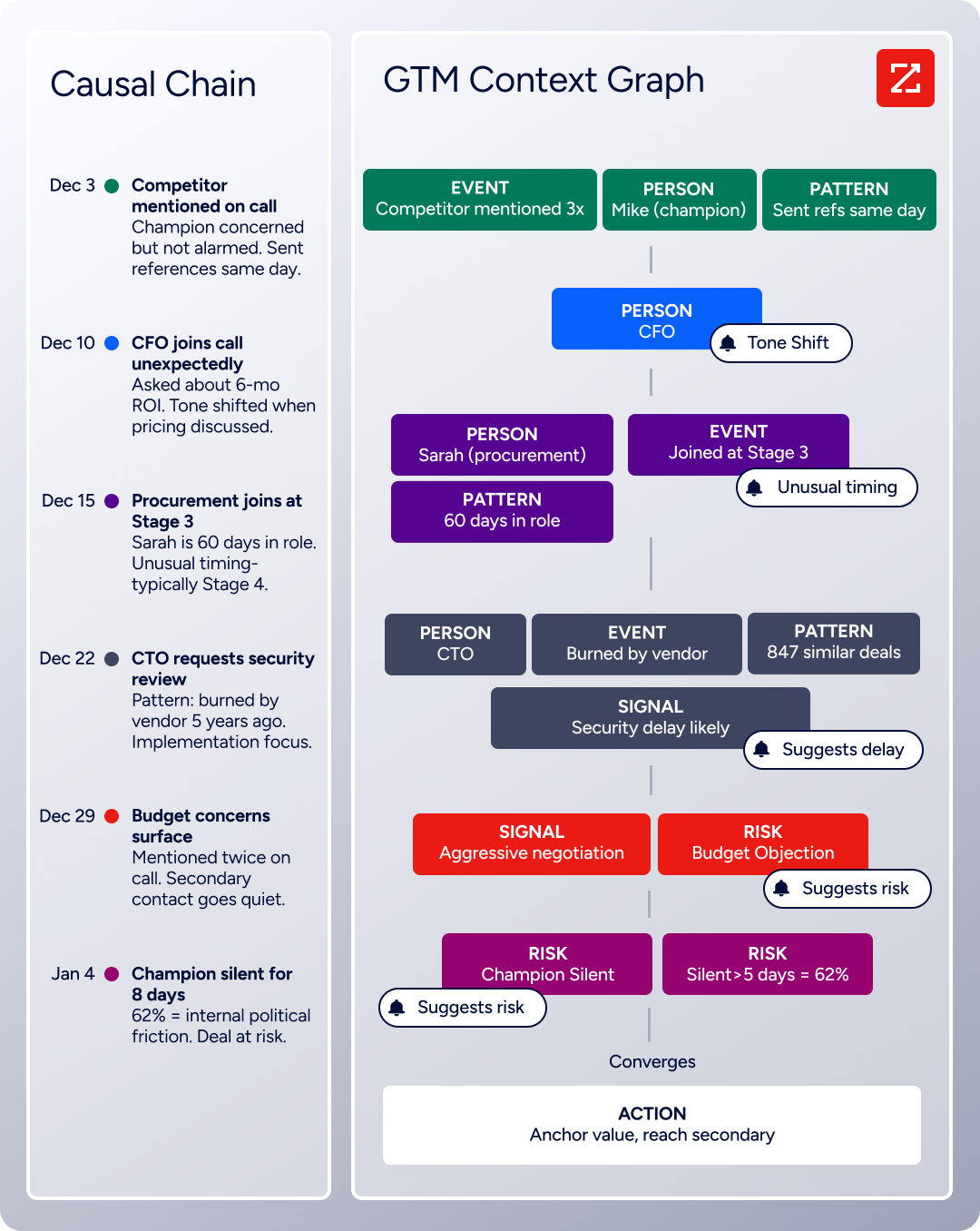
Source: ZoomInfo
ZoomInfo in Action: Your GTM Context Graph detects that the CFO joined the last call and asked about six-month ROI, which matches the pattern behind 73% of your closed-won deals in this segment. At the same time, ZoomInfo's third-party data shows the company just hired three new VPs and is researching your competitor. ZoomInfo connects these signals and surfaces the account as a high-priority opportunity with a specific recommended next action, not a generic alert.
"That combination of our internal CRM data, external signals, and AI that's given all that context has helped us craft very specific account- and persona-based messages. And people have responded to them right away." (Toby Carrington, Chief Business Officer, Seismic)
GTM Workspace and Universal Access: Intelligence in Every Tool
ZoomInfo delivers its intelligence through three channels.
GTM Workspace gives sellers a single surface where prioritized accounts, AI-drafted outreach, and deal execution converge. GTM Studio gives marketers, RevOps, and GTM engineers a builder for audience definition, campaign orchestration, and pipeline measurement in natural language. APIs and MCP expose the same intelligence to any custom agent, internal tool, or partner platform, including Claude and ChatGPT.
The critical point: all three channels draw from one GTM Context Graph. A buying signal one team detects is immediately actionable by every other team, and the investment compounds in the intelligence itself rather than locking into any single application.
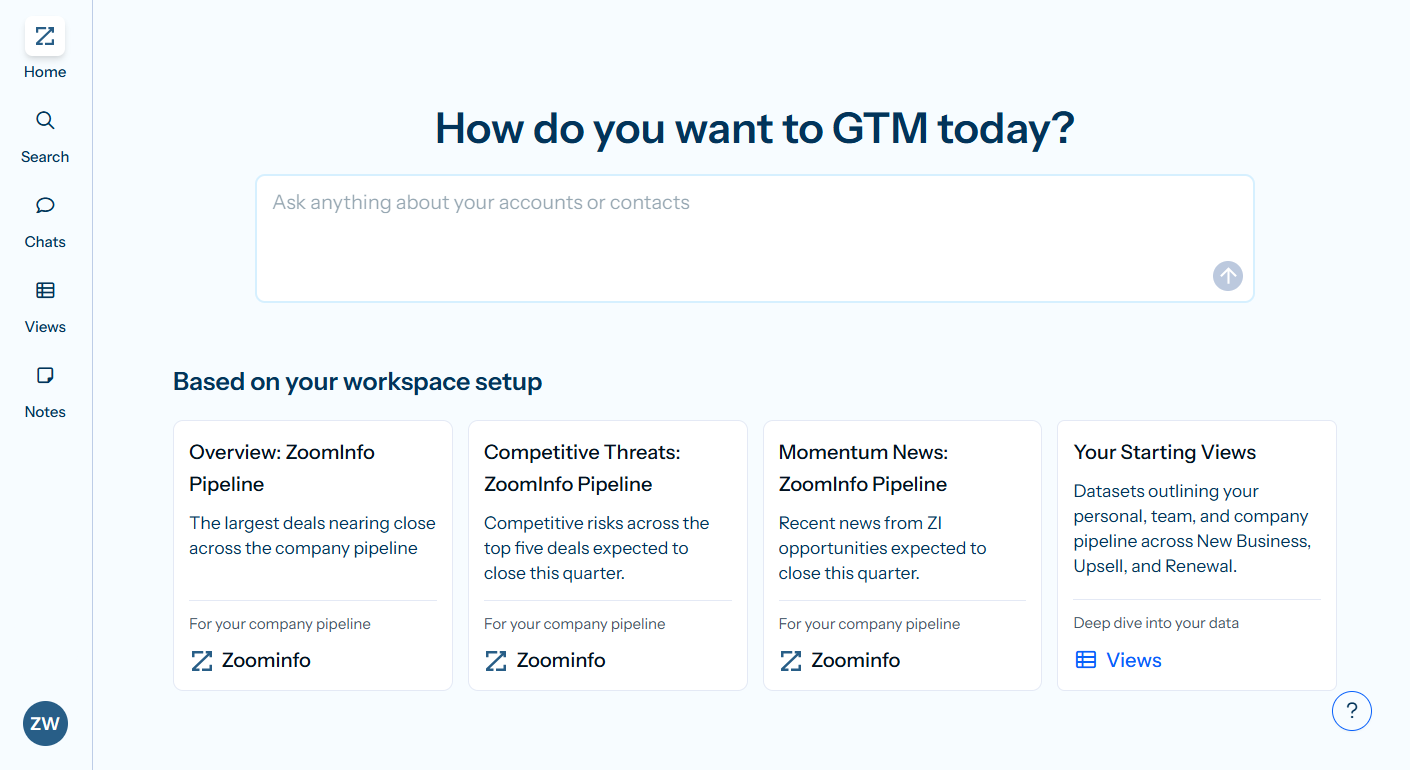
ZoomInfo in Action: A seller opens GTM Workspace to a prioritized account feed where AI-drafted outreach already addresses the specific objection identified from the last call. A marketer in GTM Studio describes an audience in plain language and launches a multi-channel play targeting accounts that match proven win patterns. An engineer plugs the same intelligence into a custom agent via MCP. Because every surface draws from one intelligence layer, data flows between teams without manual handoffs.
"Anything that minimizes our team's need to switch contexts is beneficial. ZoomInfo offers a unified view, eliminating the need to navigate between systems." (Ben Perceval, RevOps Manager, Spekit)
NOTE: We looked into other B2B intelligence platforms and found Apollo.io and Lusha frequently mentioned. Apollo.io offers an accessible engagement platform with strong SMB adoption, and Lusha provides solid contact enrichment at competitive pricing. However, neither approaches ZoomInfo's data scale (500M contacts vs. significantly smaller databases), and neither offers anything comparable to the GTM Context Graph or the breadth of ZoomInfo's API and MCP access for powering custom AI agents and workflows.
ZoomInfo Pricing
ZoomInfo uses a consumption-based pricing model tailored to each organization's usage patterns, number of users, monthly credit volume, features, and contract length. Costs depend on which channels and product tiers you need.
The pricing page is organized into Sales plans (Professional, Advanced, Enterprise) and Marketing plans (Marketing Demand, ABM Lite, ABM Enterprise), each with progressively deeper capabilities. Intent signals, AI features, advanced integrations, and dedicated support are gated by tier, not just credit volume.
ZoomInfo also offers two free entry points:
ZoomInfo Lite: A permanent free tier with no credit card, no annual commitment, and no time limits. Includes access to ZoomInfo's B2B database with 10 monthly export credits, individual and company searches, the ReachOut Chrome Extension, and HubSpot integration.
7-day free trial: Access to core platform features including contact and company search, intent signals, and email outreach with usage limits. No credit card required.
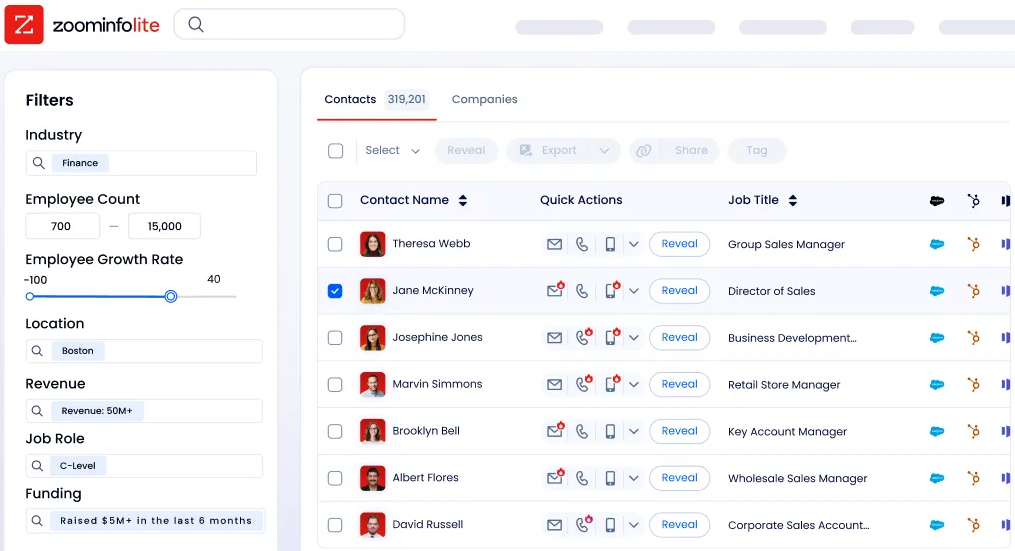
Source: ZoomInfo
ZoomInfo's credit system works on a 1-credit-per-export model: searching and viewing data within ZoomInfo does not consume credits. Credits are consumed only when exporting a profile to a CSV, Excel file, or CRM. API access is included in all relevant plans.
Who Should Use ZoomInfo?
Choose ZoomInfo if:
Your revenue team's biggest challenge is not the deal room experience itself but finding the right buyers, understanding when they're ready, and knowing what will resonate. ZoomInfo provides the intelligence foundation that makes every downstream sales interaction more effective.
You need to unify prospecting, intent data, conversation intelligence, and audience targeting across your entire GTM motion in a single platform, rather than stitching together multiple point solutions.
Your organization is building AI-powered workflows, custom agents, or internal tools that need access to B2B intelligence, and you want a platform that delivers that intelligence through APIs and MCP into any front-end.
Want to power every sales conversation with buyer intelligence? Start with a free ZoomInfo trial and see the data, signals, and AI-driven context that 35,000+ companies rely on to find, win, and grow customers.
2. Highspot — Best Alternative for Enterprise Sales Enablement and AI Content Governance
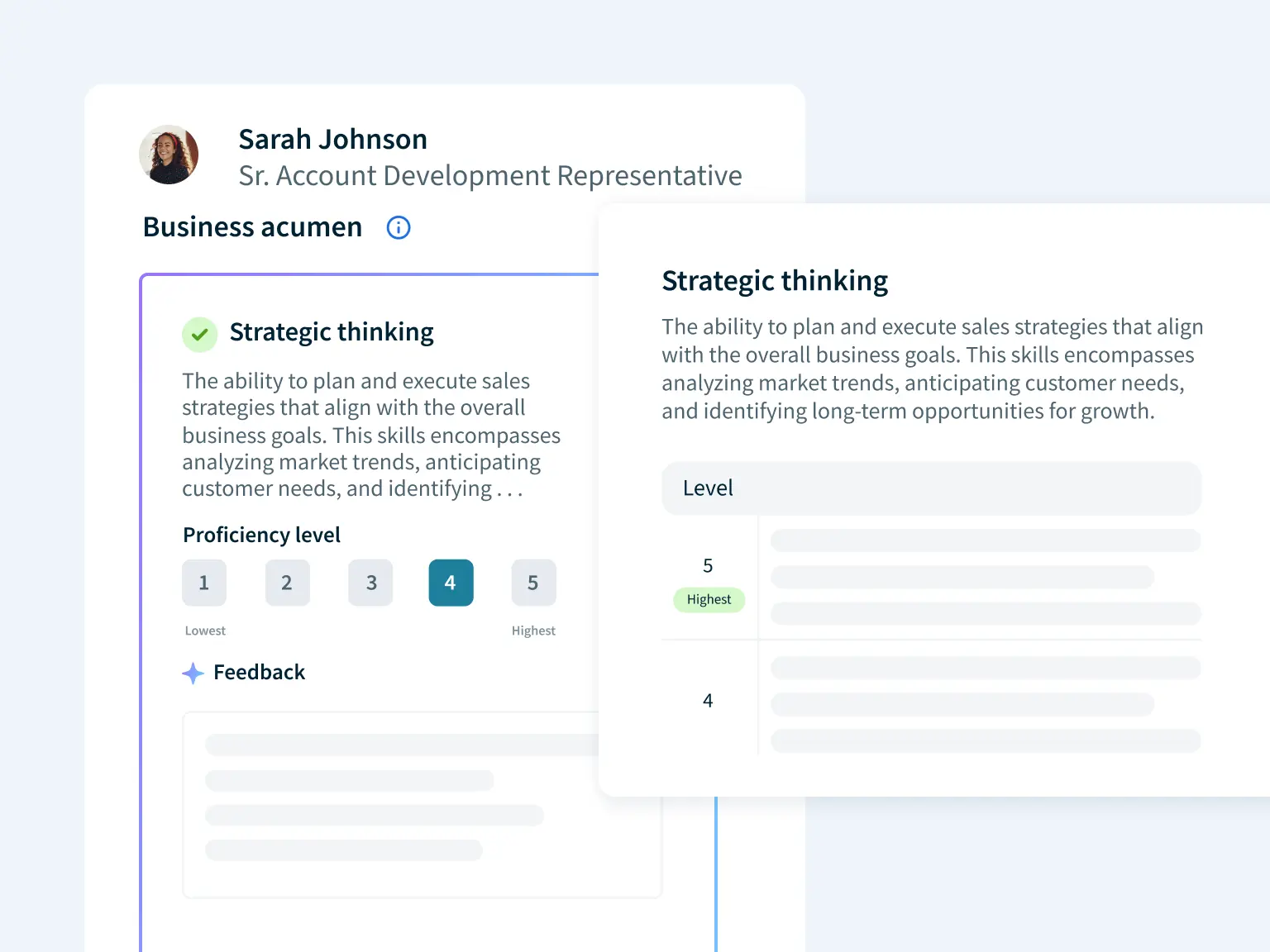
Source: Highspot
Highspot is a revenue enablement platform built for enterprise B2B organizations that need to manage thousands of sales assets across large distributed teams, coach reps at scale using AI-analyzed call data, and prove enablement's contribution to revenue. Backed by $648 million in funding at a $3.5 billion valuation, Highspot supports over 20 million users across enterprise customers.
Its key capabilities include:
AI-powered content management with SmartPages technology that surfaces the right asset for each deal stage and persona
Guided selling playbooks embedded inside Salesforce and HubSpot deal records
Conversation intelligence and AI coaching through Highspot Copilot, which analyzes sales calls and maps behaviors to individual skill gaps
Enterprise content analytics with revenue attribution tracking which assets influence pipeline progression
Why Choose Highspot Over Dock for Enterprise Sales Enablement and AI Content Governance
Highspot stands out in the following areas:
AI That Pushes Content to Reps, Not a Library Reps Must Browse
Dock's content management model is reactive: reps browse a tagged library, ask Dock AI a question, and pull assets into a workspace. Highspot inverts this. Its SmartPages technology creates dynamic, role-based homepages that surface relevant content based on deal stage, buyer persona, region, and competitive situation automatically, before a rep asks.
The Nexus AI engine replaces keyword search with semantic understanding, recommending assets proactively. For enterprise teams with thousands of assets across dozens of product lines, this difference compounds.
Guided Selling Delivered Inside the CRM, Not a Separate Tab
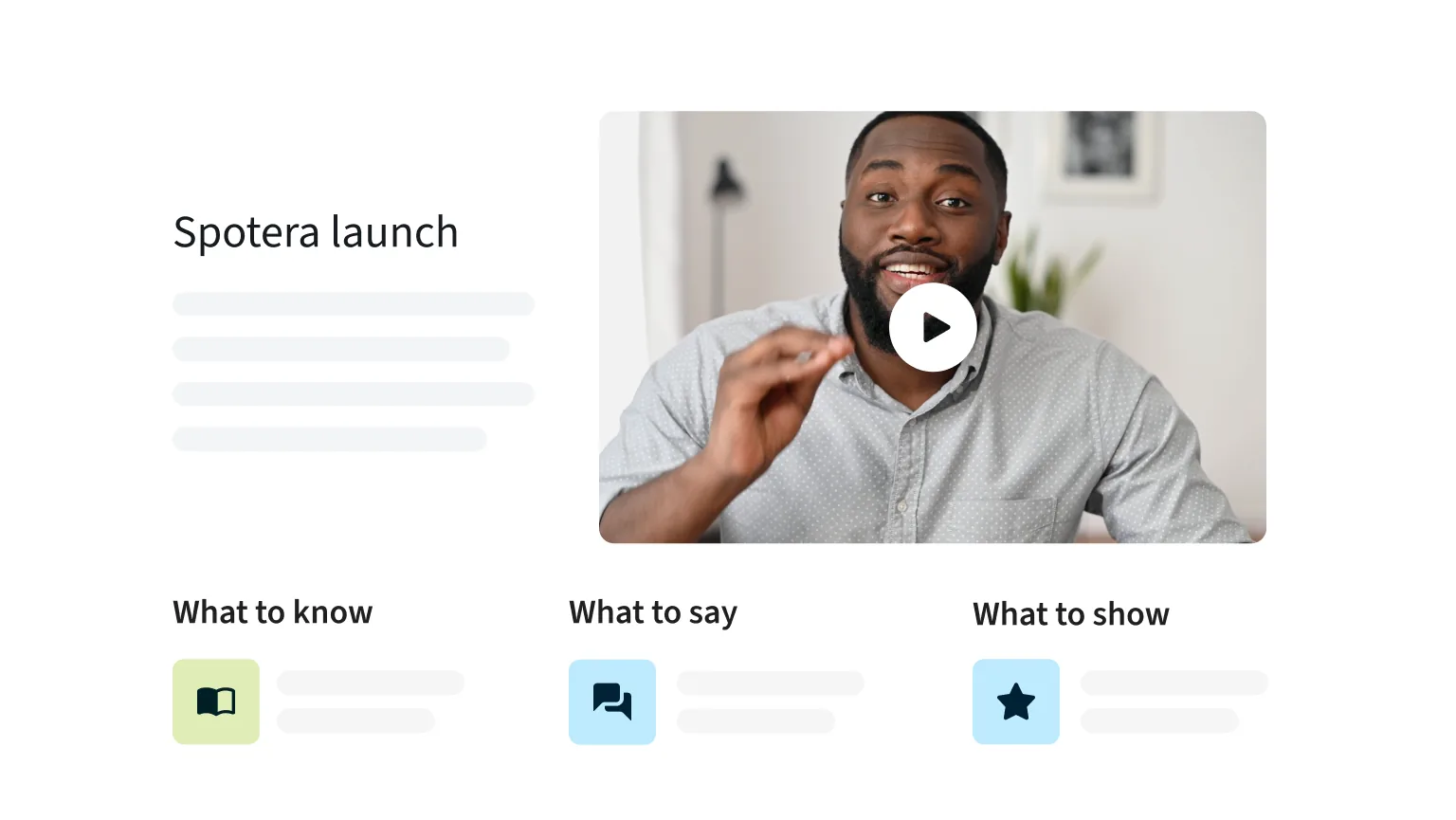
Dock's CRM integration excels at automation: creating deal rooms on stage change, syncing order form line items. Highspot operates at a different layer. It surfaces sales playbooks, battle cards, and AI-recommended content inside Salesforce and HubSpot deal records. A rep preparing for a renewal call sees objection handlers and relevant case studies without opening a second application.
Source: Highspot
AI Coaching With Conversation Intelligence
Highspot Copilot and Meeting Intelligence record sales calls, produce instant recaps, analyze delivery, and map each rep's call behaviors to the organization's GTM skill framework automatically. The system generates 360-degree coaching assessments blending self-reviews, manager reviews, AI role play results, and buyer feedback.
Dock's Courses feature supports structured training, but Highspot closes the loop between what reps learn and what they do on calls.
NOTE: We also evaluated Seismic and Mindtickle. Seismic is enterprise-grade with strong content governance (and notably announced a merger with Highspot in February 2026). Mindtickle offers strong rep-readiness training depth. Highspot offers the most balanced combination of content governance, AI coaching, and enterprise-scale analytics for teams that need a unified enablement platform.
If you're evaluating both platforms before the merger completes, see our Highspot vs Seismic comparison for a detailed breakdown.
Highspot Pricing
Highspot operates on a fully custom, quote-based pricing model. Three capability tiers define the scope:
Equip and Engage: AI-supported content organization, governance, Sales Plays, Digital Sales Rooms, and CRM integration
Train and Practice: Adds skills framework, AI-assisted training authoring, AI Role Play with skill scoring, and adaptive learning
Coach and Reinforce: Adds Meeting Intelligence, conversation analysis, rep and team scorecards, MCP Server, and Insights Layer APIs
CRM integrations are included at no additional charge across all tiers. No self-serve free trial is offered; evaluation begins with a scheduled demo.
Who Should Use Highspot?
Choose Highspot if:
Your organization has 200+ reps and a dedicated enablement function that needs to govern content at scale, enforce messaging compliance, and attribute specific assets to pipeline outcomes across a large, multi-region library.
You need AI to push relevant content and playbooks to reps inside their CRM at the moment of selling, rather than relying on reps to find the right material themselves.
Your coaching program requires conversation intelligence that connects real call behaviors to individual skill gaps without requiring managers to manually review recordings.
3. GetAccept — Best Alternative for Native E-Signatures and Microsoft Dynamics Integration
Source: GetAccept
GetAccept is an AI-powered Digital Sales Room and proposal platform that addresses several of Dock's most cited limitations: the absence of enterprise-grade native e-signatures, the lack of Microsoft Dynamics support, and a pricing structure that gates the full deal room experience behind a $350/month team commitment.
Its key capabilities include:
Native e-signatures with three legally distinct tiers (Simple, Advanced, Qualified) covering US, UK, and EU compliance simultaneously
The only digital sales room with a native Microsoft Dynamics 365 integration, alongside Salesforce and HubSpot
AI proposal generation drawing from meeting transcripts, buyer company data, and an org-level knowledge base
Participant Engagement Scores for per-stakeholder analytics
Why Choose GetAccept Over Dock for Native E-Signatures and Microsoft Dynamics
GetAccept stands out in the following areas:
E-Signatures Are Native, Not a Workaround
Dock's order forms handle basic signature capture for standard deals, but complex enterprise contracts requiring multi-signer authentication, eIDAS compliance, or tamper-proof audit trails still route through DocuSign or Adobe Sign.
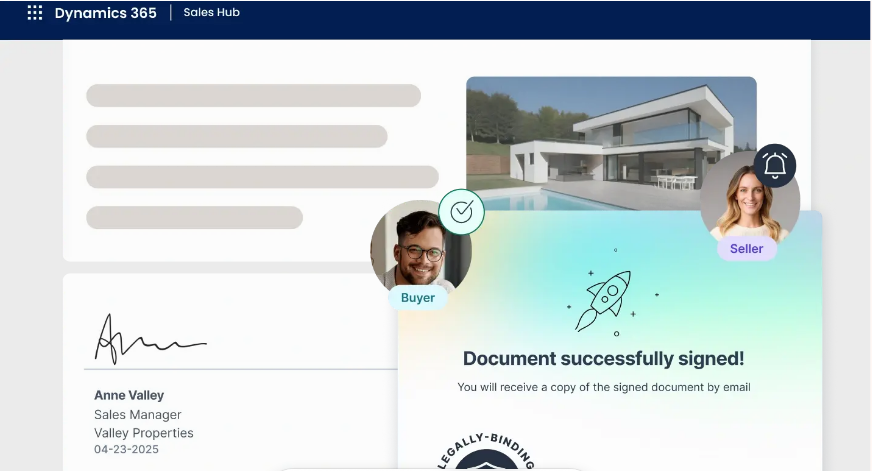
GetAccept's Electronic Signatures are embedded inside the same Digital Sales Room where proposals were reviewed, supporting Simple (click-to-sign), Advanced (eID-authenticated), and Qualified (legally equivalent to wet-ink in EU courts) tiers. Every completed document generates a UTC-timestamped signing certificate with IP address, browser fingerprint, and a unique document hash.
Native Microsoft Dynamics 365 Integration
Dock's automation and AI features are built around Salesforce and HubSpot. Teams on Microsoft Dynamics 365 cannot trigger workspace auto-creation, populate rooms with dynamic Dynamics fields, or push buyer engagement activity back into Dynamics records.
GetAccept is the only DSR platform with a native Dynamics integration that includes custom entity data, SharePoint integration, and bidirectional sync. GetAccept is also available on Microsoft AppSource.
AI Proposal Generation From Live Deal Context
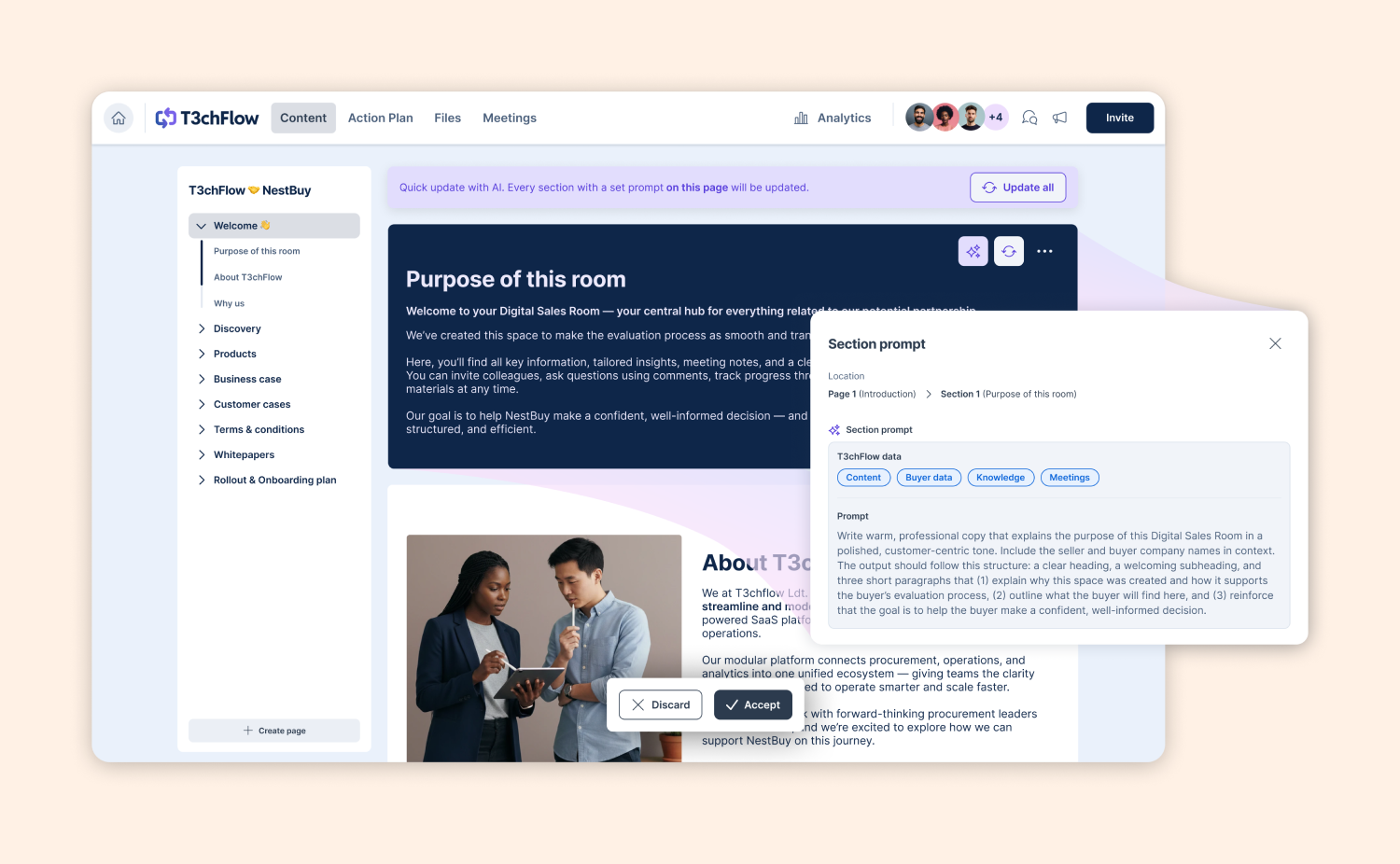
GetAccept's AI draws on content, meeting transcripts, buyer data, and an admin-configured knowledge base simultaneously. Section Prompts let admins pre-configure how AI behaves for each template section, so reps get consistent, on-brand output without writing prompts. The AI runs on a tuned version of Claude Sonnet on GetAccept's own EU server infrastructure, with no buyer data processed by external providers.
Source: GetAccept
NOTE: We also evaluated Aligned and Trumpet. Aligned has strong mid-market positioning but is newer with less enterprise CRM breadth, particularly on the Microsoft side. Trumpet suits smaller teams but is less suited for mid-market workflows requiring native e-signatures and Dynamics support. GetAccept offers the most complete combination of deal room functionality, native e-signature, and Microsoft ecosystem depth.
GetAccept Pricing
eSign: $25/user/month. Unlimited e-signatures, automated renewal reminders, basic contract management. No Deal Rooms or CRM integrations.
Professional: $49/user/month, minimum 5 users ($245/month minimum). Full AI Digital Sales Room experience, CRM integrations (Salesforce, HubSpot, Dynamics, Pipedrive), Mutual Action Plans, and the complete AI suite.
Enterprise: Contact sales. Adds CPQ, unlimited product library, SSO, API read access, and payment integrations.
Who Should Use GetAccept?
Choose GetAccept if:
Your team runs on Microsoft Dynamics 365 and needs a digital sales room with genuine native integration, not a workaround.
You close contracts requiring legally compliant e-signatures across multiple jurisdictions, and you want signatures collected inside the same environment as the proposal.
Your sales team sends proposals and needs AI that draws from actual meeting transcripts and a company knowledge base to generate accurate deliverables.
4. Trumpet — Best Alternative for Visual Buyer Microsites and SMB-Friendly Deal Rooms
Source: Trumpet
Trumpet is a digital sales room and customer onboarding platform that consolidates the full B2B buyer journey inside a branded, interactive workspace called a "Pod." Where Dock leads with a flexible workspace editor optimized for mid-market teams, Trumpet leads with polished visual defaults and a genuine free tier.
Its key capabilities include:
Drag-and-drop Pod builder with 70+ pre-built widgets and AutoBrand AI that applies prospect branding from a URL in one click
Native video and voice note recording with per-viewer engagement analytics
Native e-signature (TrumpetSign) without leaving the Pod
Free plan with 10 Pods for unlimited users, plus 40+ integrations and Mutual Action Plans
Why Choose Trumpet Over Dock for SMB-Friendly Deal Rooms
Trumpet stands out in the following areas:
A Meaningful Free Tier for Small Teams
Dock's free plan allows 50 workspaces but withholds CRM integration entirely, meaning teams cannot connect HubSpot or Salesforce without committing to the $350/month Standard plan. Trumpet's free plan provides 10 Pods per account with unlimited users, Mutual Action Plans, AI Org Charts, 40+ integrations, and basic analytics with no time limit. A small team running three to five concurrent deals can operate entirely on the free plan long enough to validate the workflow.
Polished Visual Output With AutoBrand AI
For small sales teams without a dedicated marketing function, Dock's blank-canvas editor can create as many problems as it solves. Trumpet addresses this with AutoBrand AI: a rep enters a prospect's website URL and Trumpet applies that company's logo, color palette, and visual identity to the Pod in one click. Trumpet also offers 50+ pre-built templates with locked brand sections and editable personalization zones.
Mutual Action Plans With Published Outcome Data
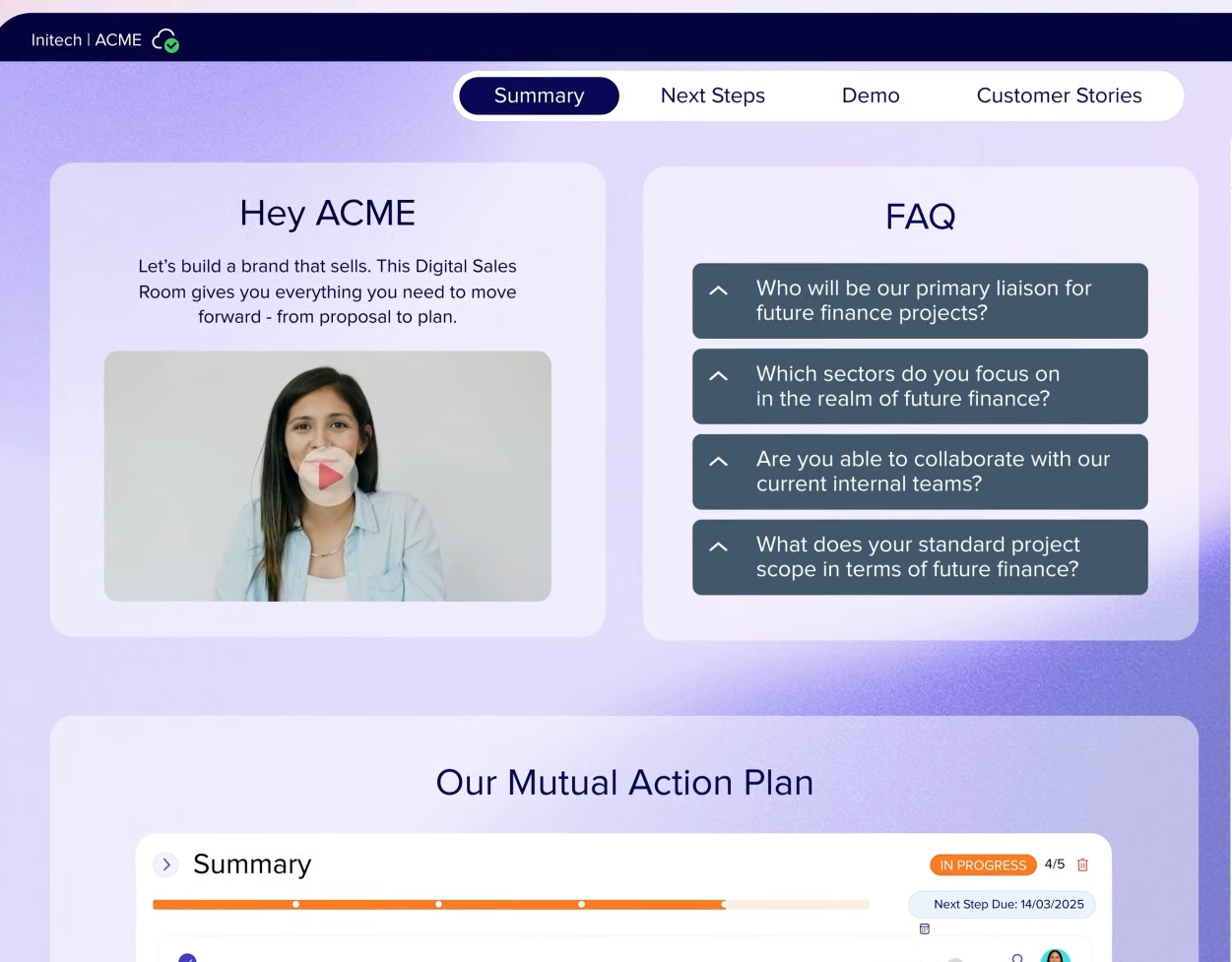
Trumpet's MAP data, drawn from 15,000+ revenue teams, shows a 26% higher close rate when any MAP is used vs. no MAP and a 92% win rate for deals with 11-15 completed MAP steps. This gives enablement managers data-backed benchmarks for MAP adoption rather than generic best practices. Trumpet also includes native video recording with per-viewer analytics, with 22% faster sales cycles reported when interactive demos are included.
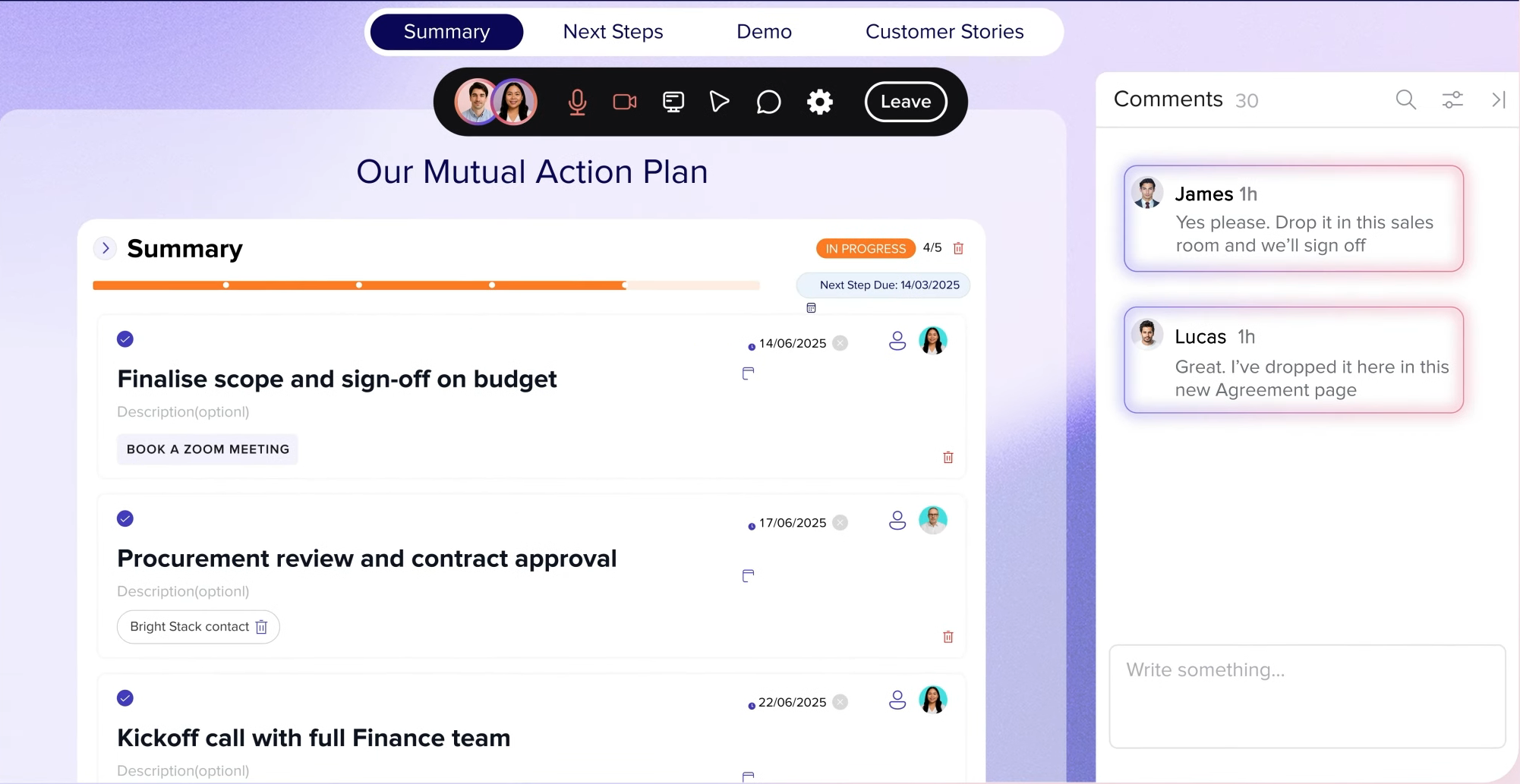
Source: Trumpet
NOTE: We also evaluated Flowla and Distribute. Flowla offers a free plan with 5 rooms that appeals to early-stage teams, but its visual output is less polished than Trumpet's defaults. Distribute provides simple free-tier deal rooms but fewer native features for mutual action plans. Trumpet offers the most balanced combination of a functional free tier, visual quality, and MAP depth at an SMB-friendly price point.
Trumpet Pricing
Free: $0/month, unlimited users, 10 Pods. Includes MAPs, AI Org Charts, 40+ integrations, basic analytics.
Pro: $45/user/month (max 5 users). Unlimited Pods, CRM integrations, AI engagement scoring.
Scale: $100/user/month. Adds TrumpetSign e-signature, full AI suite, video recording, proposals and quotes, and content analytics.
Elite: $160/user/month. Adds SSO, SCIM, full white-labeling, and dedicated customer success.
Who Should Use Trumpet?
Choose Trumpet if:
Your team is in the 1-15 AE range and needs to validate the buyer workspace workflow before committing to a $350/month platform.
You lack a dedicated design resource but still need buyer-facing Pods that look professionally branded out of the box.
Your deal cycles are complex enough to benefit from Mutual Action Plans, and you want data-backed benchmarks to anchor MAP adoption internally.
5. Mindtickle — Best Alternative for AI Rep Coaching and Sales Readiness Measurement
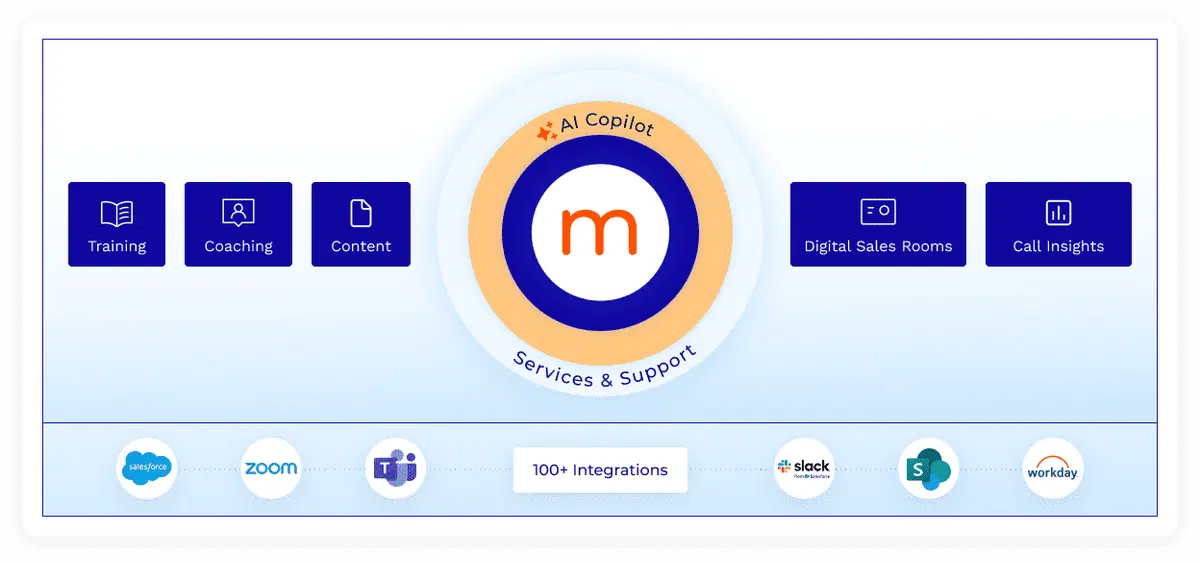
Source: Mindtickle
Mindtickle is a revenue enablement platform that consolidates sales training, AI-powered role play, conversation intelligence, and coaching into a single system built around a central thesis: rep readiness is the primary lever for revenue growth. Where Dock's value flows toward the buyer-facing workspace, Mindtickle's value flows inward, toward developing the rep before they enter the room.
Its key capabilities include:
AI Sales Role Play Simulator with dynamic, unscripted buyer personas that deliver instant scored feedback
Conversation Intelligence (Call AI) that maps call behaviors to individual rep skill gaps
Rep Readiness Index linking training, assessments, and call quality to CRM pipeline performance
ElevateOS Agentic AI spanning coaching, deal guidance, content creation, and buyer engagement
Why Choose Mindtickle Over Dock for AI Rep Coaching and Sales Readiness
Mindtickle stands out in the following areas:
AI Role Play That Closes the Gap Between Knowing and Doing
Dock's Courses feature offers structured LMS-style training with modules, quizzes, and manager review of video submissions. But the mechanism is passive: reps watch content, complete quizzes, and submit recordings for human review.
Mindtickle's AI Sales Role Play deploys AI buyer personas that raise real objections, push back dynamically, and score every submission without manager involvement. Sessions average 2-4 minutes, so a rep can practice immediately before a customer call. Dock's Courses feature has no equivalent for simulating live conversations with real-time structured feedback.
Conversation Intelligence That Turns Every Call Into a Coaching Loop
Dock tracks buyer behavior inside deal rooms but does not record or analyze what was said on calls. Mindtickle's Call AI captures, transcribes, and scores every buyer-seller conversation, then maps specific behavioral patterns (questions asked, pace, objection handling, competitor mentions) to individual rep skill gaps. Call insights trigger automatic assignment of targeted training content.
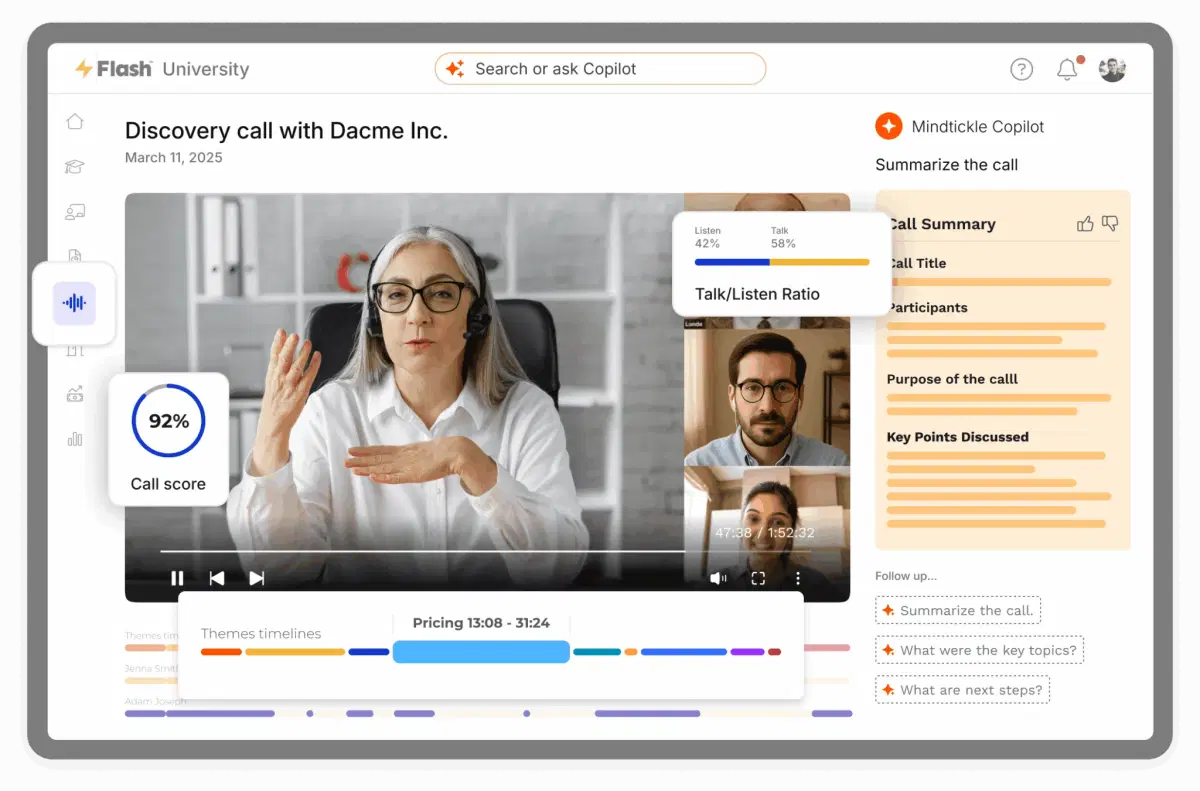
Source: Mindtickle
The Readiness Index: Enablement Tied to Revenue Outcomes
The Readiness Index builds an Ideal Rep Profile from top performer behaviors, then continuously scores every rep using training completions, call scores, and coaching results, correlating those scores to CRM revenue metrics like quota attainment and win rates. Revenue leaders can answer which enablement investments moved revenue and which did not.
NOTE: We also evaluated Allego and Brainshark. Allego offers comparable training-and-call-analysis focus but carries less AI coaching depth than Mindtickle's ElevateOS. Brainshark is established but has invested less aggressively in AI coaching recently. Mindtickle offers the most complete AI role play, conversation intelligence, and readiness infrastructure.
Mindtickle Pricing
Mindtickle does not publish pricing publicly. All terms are negotiated through a custom demo engagement. Four module tiers are documented:
LMS Package: Core learning management with Courses, Assessments, Certifications, and Readiness Index
Readiness Package: Adds Spaced Reinforcement, one-way Virtual Role-Plays, and Coaching Rooms
Enable Package: Adds Asset Hub and Digital Sales Rooms
Transform Package: Full platform including Call AI conversation intelligence
Two-way interactive AI Role Play requires a separate order on all tiers. Premium Support and Professional Services are separately scoped.
Who Should Use Mindtickle?
Choose Mindtickle if:
Your team has 100+ sellers and rep performance variability is the primary revenue constraint, making structured coaching and readiness the highest-leverage investment.
You need AI role play with measurable deal-outcome attribution and want managers to scale coaching without being present for every practice session.
Your enablement team is under pressure to prove ROI and needs a system that links training investment to quota attainment and win rate data from your CRM.
6. Aligned — Best Alternative for AI-Native Deal Execution and Stakeholder Discovery
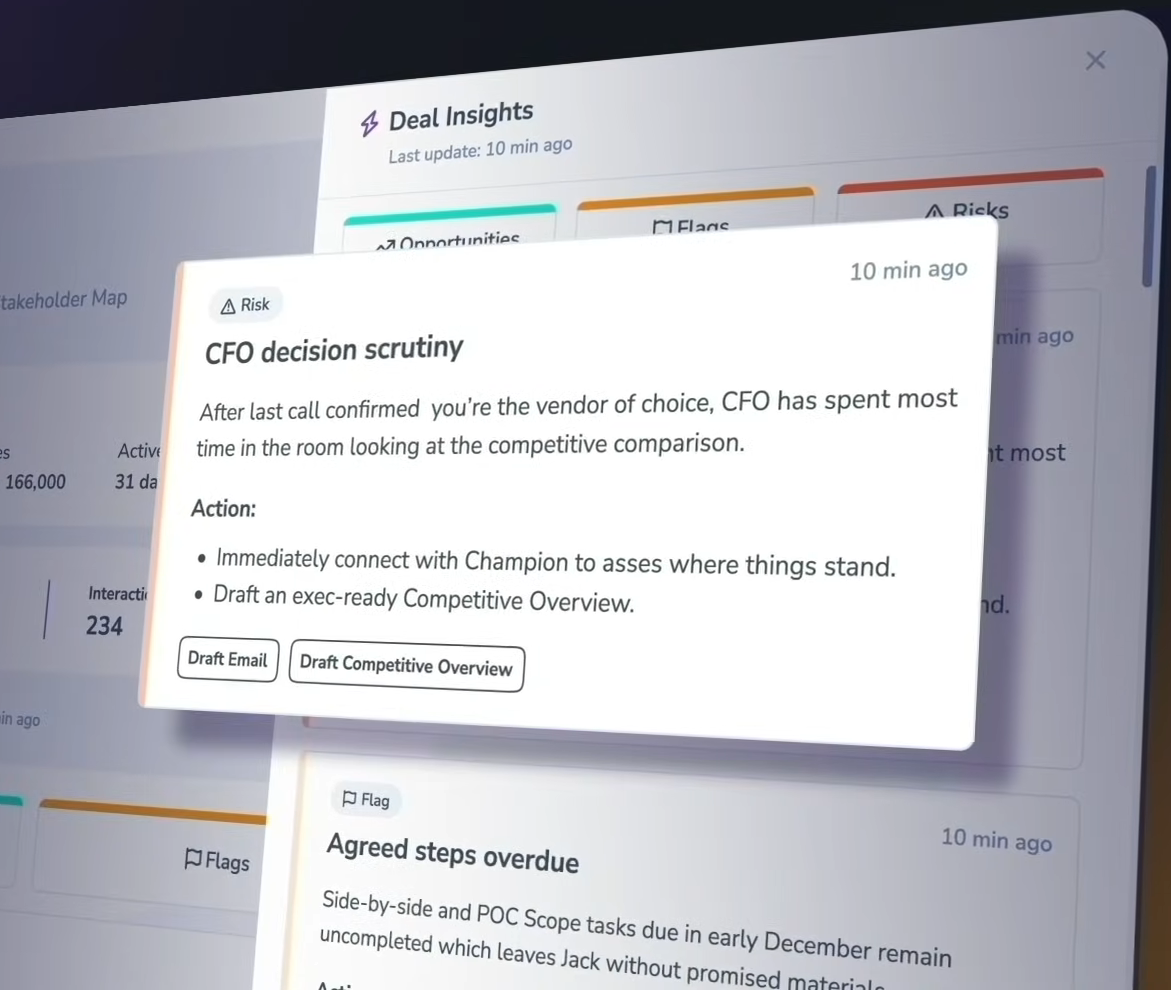
Source: Aligned
Aligned is an AI deal workspace platform that positions itself as the execution layer between your CRM and your buyer. Where Dock is a broad revenue enablement platform covering deal rooms, content management, an LMS, and order forms, Aligned focuses on deal execution and buyer collaboration with an AI-native approach.
Its key capabilities include:
AI-powered stakeholder discovery that surfaces new decision-makers the moment they interact with deal content
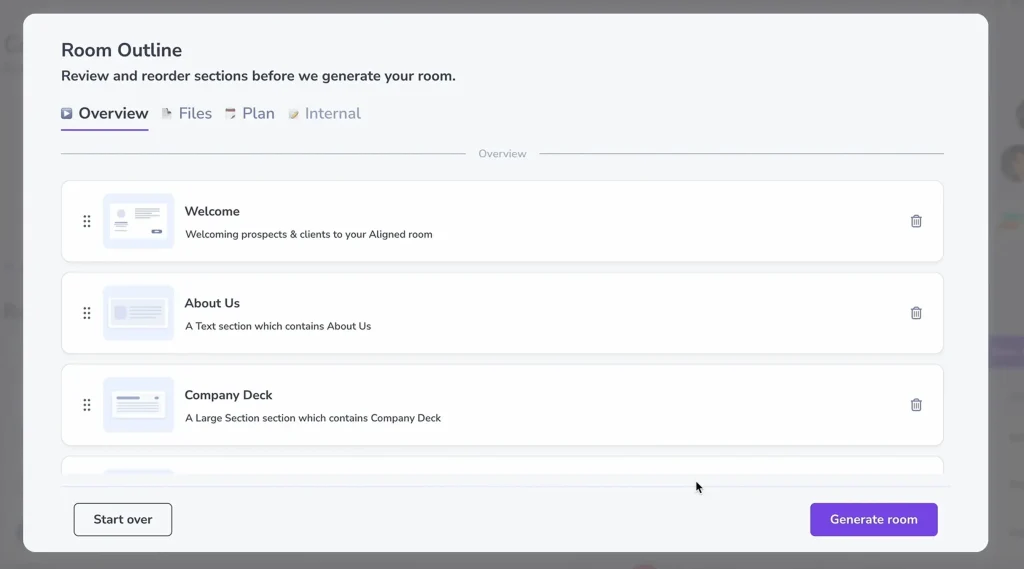
AI Room Builder that generates complete deal workspaces from call notes and meeting context in seconds
Real-time buyer engagement analytics with per-stakeholder tracking
Six-level sharing permission controls and a mobile-optimized buyer experience
A permanent free Starter plan with paid tiers starting at $29/seat/month
Why Choose Aligned Over Dock for AI-Native Deal Execution
Aligned stands out in the following areas:
AI-Powered Stakeholder Discovery
Dock provides buyer engagement analytics showing which pages were visited and for how long. But Dock is reactive: it tells you what happened after the fact. Aligned's stakeholder mapping capability surfaces hidden influencers and decision-makers the moment they interact with deal content, triggering an immediate alert and a behavioral profile.
The platform reports a +68% stakeholder revelation rate. For deals where 6-10 stakeholders are involved and procurement or a CFO often joins without formal introduction, this proactive intelligence differs meaningfully from passive view-tracking.
AI-Generated Deal Rooms From Meeting Context
Dock addresses setup friction through templates and CRM-triggered automation. Aligned's AI Room Builder goes further: it ingests post-call context, call transcripts, and action items, then builds a complete, personalized deal workspace in seconds. Reps who have a fully built room ready before their next meeting never face the friction that causes manual room-building to be skipped on busy days.
Source: Aligned
Mobile Optimization and Granular Permission Controls
Dock's G2 reviews include persistent mentions of mobile experience gaps. Aligned built its buyer experience with mobile-first design as a stated requirement. Alongside mobile optimization, Aligned offers six-level sharing permission controls for precise management of which stakeholders see which sections at which deal stage.
NOTE: We also evaluated Flowla and Valuecase. Flowla is gaining traction with its intuitive UI and generous free plan but offers less AI deal intelligence. Valuecase takes a strong onboarding-focused approach but has less market momentum. Aligned offers the most complete AI stakeholder discovery and documented G2 category leadership for multi-threaded deal execution.
Aligned Pricing
Starter: $0/seat/month (unlimited seats). 4 rooms per seat, room analytics, personal subdomain. No credit card required.
Basic: $29/seat/month (annual). Unlimited rooms and templates, task manager (MAPs), 1 TB content storage, CMS.
Pro: $49/seat/month (annual). Adds AI Client Assist, AI Content Generator, AI Deal Builder, and Gong integration.
Enterprise: Custom pricing. Adds bi-directional CRM sync (Salesforce, HubSpot), AI Insights, custom domain, SSO.
Note: Native CRM integration is gated to the Enterprise plan. Teams on Basic or Pro who need CRM sync must use Zapier or accept manual data management.
Who Should Use Aligned?
Choose Aligned if:
Your deals involve 4+ stakeholders and your team regularly loses visibility into who is evaluating the deal between calls.
Rep adoption of deal rooms is a known pain point and you need AI to eliminate the manual room-building step entirely.
Your buyers include procurement, legal, or finance reviewers who access vendor materials on mobile devices, and you need a mobile-first experience.
7. Flowla — Best Alternative for Deal Rooms at No Upfront Cost
Source: Flowla
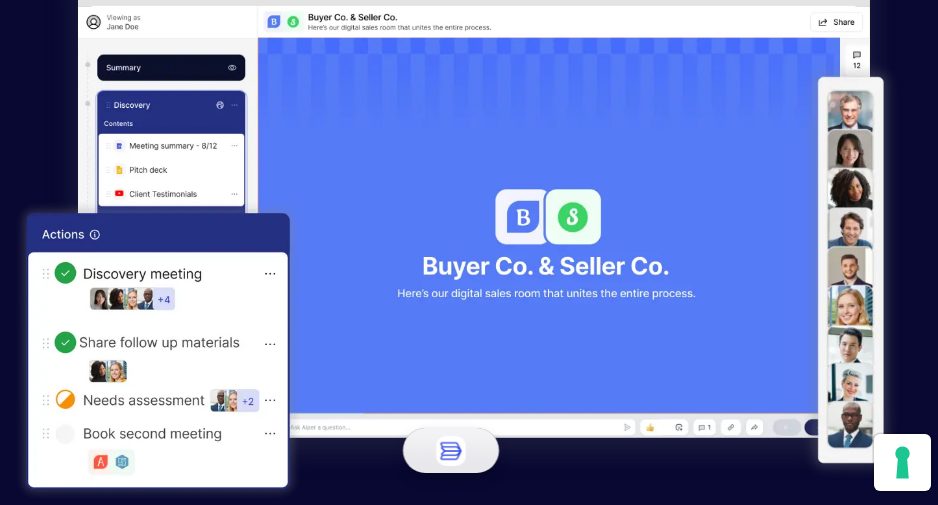
Flowla is an AI-powered digital sales room platform that positions itself as the "Customer Layer" of the revenue stack. Where Dock requires a $350/month commitment before teams can unlock CRM integration, Flowla offers a permanent free plan with five functional rooms, unlimited internal team seats, mutual action plans, and buyer engagement analytics.
Its key capabilities include:
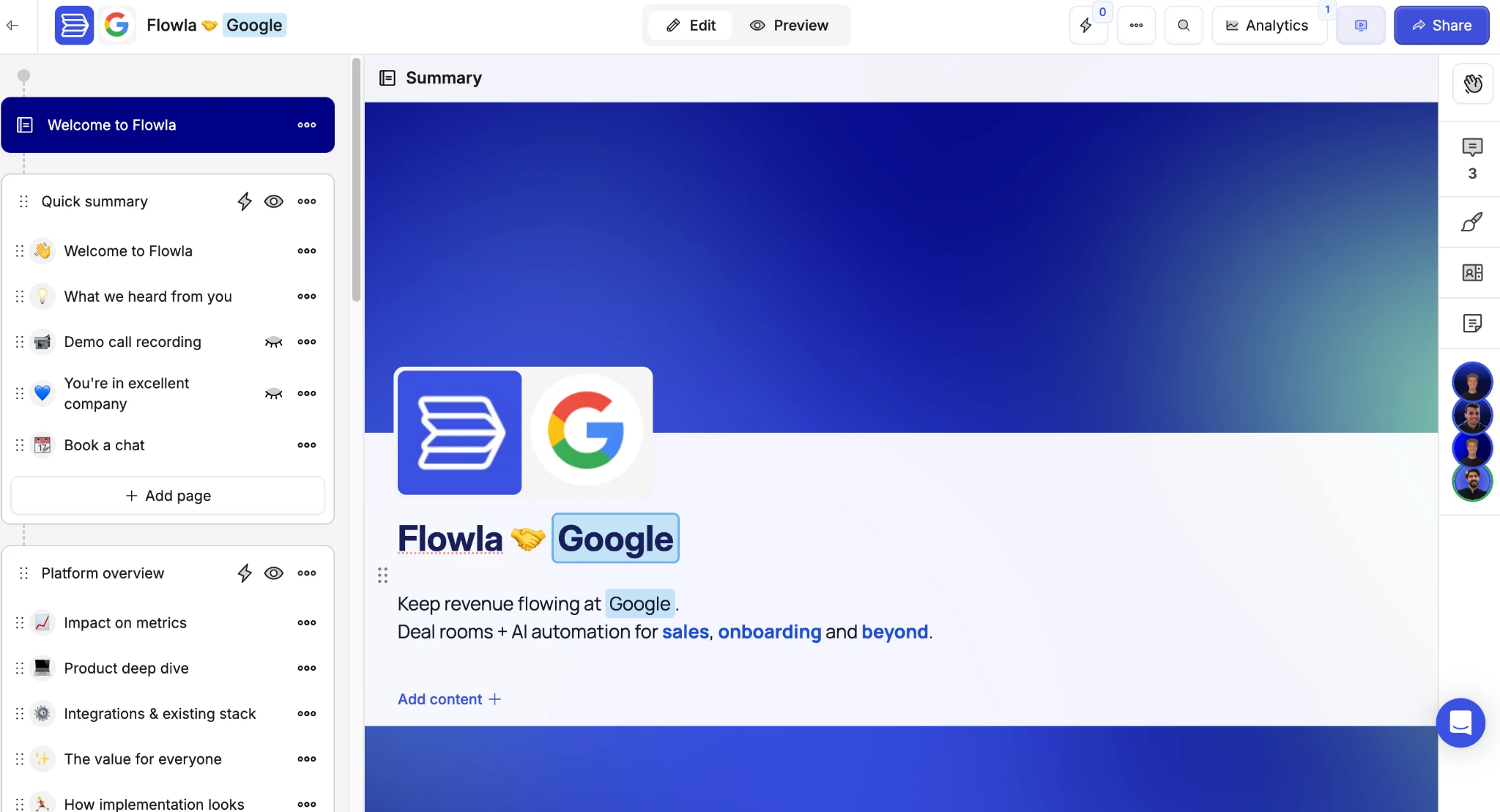
Digital sales rooms consolidating decks, videos, calendars, pricing, and mutual action plans into a single shareable link
Native AI workflow builder (AutoPilot) that triggers actions from room signals, CRM events, and call transcripts
Bi-directional HubSpot, Salesforce, and Attio integrations
Native e-signature via Dropbox Sign infrastructure, embedded in the room
Content library with AI auto-tagging and per-asset engagement analytics
Why Choose Flowla Over Dock for No-Commitment Entry
Flowla stands out in the following areas:
A Genuinely Functional Free Plan
Dock's free plan allows 50 workspaces but gates CRM connection, Gong/Chorus access, and team collaboration behind the $350/month Standard plan. Flowla's Starter plan imposes no seat restrictions on internal team members.
The five-room limit is the only constraint. Buyer engagement analytics are included at the free tier. A 10-person sales team on Flowla's Pro plan at $49/seat/month pays $490/month with unlimited rooms, full analytics, content library, e-signature, and all CRM integrations, compared to Dock's Standard at $350/month for just 5 seats.
Native AI Workflow Automation Built Into the Deal Room
Dock's advanced automation features (Workspace Automation, CRM-triggered creation, dynamic content logic) are locked to the Enterprise plan.
Flowla's AutoPilot, available on the Team plan, works proactively: when a prospect opens a room for the first time, AutoPilot can draft a tailored follow-up in the rep's Gmail. When a new decision-maker enters, a personalized introduction email is queued. Everything routes through the Smart Queue, a daily review inbox where reps approve or dismiss AI-drafted content before it reaches buyers.
Full Revenue Lifecycle in a Single Room
Dock's Connected Workspaces (Premium/Enterprise) link multiple workspace objects for the same account, but the connection is navigational. Flowla's room model is structurally continuous: the same room URL evolves across the entire customer relationship, with sections that lock and unlock based on deal stage, CRM triggers, or signed documents.
A section set to unlock when the contract is signed becomes the onboarding workspace the moment the deal closes, with no new link, no content migration, and no CS team rebuilding context.
Source: Flowla
NOTE: We also evaluated Notion and HubSpot's free CRM tier. Notion excels at building flexible client-facing workspaces but lacks buyer engagement analytics, MAP automation, or deal-stage awareness. HubSpot's free CRM includes basic document sharing but is a CRM, not a dedicated deal room. Flowla offers the most direct free alternative in the same product category as Dock.
Flowla Pricing
Starter (Free): $0/month, unlimited internal seats, 5 rooms and 5 templates. Buyer analytics included. 100 workflow credits/month.
Pro: $49/seat/month. Unlimited rooms and templates, analytics, content library, e-signature, all CRM integrations. 100 workflow credits/month.
Team: $79/seat/month (minimum 5 seats, $395/month floor). Adds AutoPilot smart workflows, management reports, custom domain, and 10,000 workflow credits/month.
Enterprise: Custom pricing (minimum 20 seats). Adds SSO, full white-label, dedicated account manager, and custom workflow credits.
Note: The 100-credit cap on Starter and Pro means teams treating AI automation as a primary purchase driver will exhaust this allocation quickly. Any team that wants AutoPilot as a live tool should budget for Team from day one.
Who Should Use Flowla?
Choose Flowla if:
Your team wants to test a dedicated digital sales room with real prospects before committing to a $350/month platform.
You're a small or growing team where Dock's flat pricing charges disproportionately relative to your headcount, and you need a per-seat model that scales proportionally.
Your CS team manages onboarding and renewals alongside sales, and you want a single room that transitions from deal context to onboarding without creating a new link or migrating content.
The Final Verdict
Dock excels as a buyer-facing revenue enablement workspace. But growing teams often need specialized tools with deeper capabilities in specific parts of the go-to-market workflow. Based on our research, here are the best alternatives:
ZoomInfo for B2B data intelligence, buyer intent signals, and AI-powered GTM execution that informs every downstream sales conversation
Highspot for enterprise content governance, guided selling inside the CRM, and AI coaching with conversation intelligence at scale
GetAccept for legally compliant native e-signatures and the only native Microsoft Dynamics 365 integration in the digital sales room category
Trumpet for polished visual buyer microsites, AutoBrand AI, and an SMB-friendly free tier with data-backed mutual action plan benchmarks
Mindtickle for AI role play, conversation intelligence, and rep readiness measurement tied to quota attainment and revenue outcomes
Aligned for AI stakeholder discovery, AI-generated deal rooms from meeting context, and mobile-first buyer experiences
Flowla for deal rooms at no upfront cost, with proactive AI workflow automation and full revenue lifecycle continuity in a single room
You don't have to choose between Dock and these alternatives exclusively. Many revenue teams combine a deal room platform with a B2B intelligence layer, or use a coaching platform alongside their existing workspace tool. Consider your team's specific gaps and growth plans when deciding which solution fits.
Want to power every sales conversation with buyer intelligence? ZoomInfo surfaces the right buyers, the right intent signals, and the right context so your team walks into every deal prepared. Start your free trial or explore ZoomInfo Lite and see why 35,000+ companies trust ZoomInfo to find, win, and grow customers.
Dock Alternatives FAQ
Why do teams look for Dock alternatives?
Dock is a strong buyer-facing workspace platform, but teams often need capabilities it doesn't provide: B2B data and intent signals for identifying buyers before the deal room exists, content governance across hundreds of reps, native e-signatures for complex multi-jurisdiction contracts, conversation intelligence with AI coaching, or a more accessible price point for smaller teams. The $0 to $350/month pricing gap between Free and Standard is also frequently cited.
What is the best overall Dock alternative?
There is no single best alternative because Dock covers multiple functions. ZoomInfo is the top choice for B2B data intelligence and GTM execution, Highspot leads for enterprise content governance and coaching, and Flowla is the strongest option for teams that need a functional deal room at no upfront cost.
Is there a free alternative to Dock?
Yes. Flowla offers a permanent free plan with 5 rooms, unlimited internal seats, and buyer engagement analytics. Aligned provides a free Starter plan with 4 rooms per seat and unlimited seats. Trumpet's free tier includes 10 Pods with unlimited users and mutual action plans. ZoomInfo offers ZoomInfo Lite, a permanent free tier for B2B data access with 10 monthly export credits.
Which Dock alternative is best for enterprise sales teams?
Highspot is built for enterprise with 20 million+ users, Gartner Magic Quadrant Leader status, AI-powered content governance, and conversation intelligence at scale. For enterprise teams focused on rep readiness and coaching, Mindtickle offers the deepest AI role play and Readiness Index infrastructure. ZoomInfo provides the enterprise B2B intelligence foundation with 500M contacts, the GTM Context Graph, and universal API/MCP access.
How does ZoomInfo compare to Dock?
ZoomInfo and Dock serve different but complementary parts of the revenue workflow.
Dock provides the buyer-facing workspace where teams collaborate on deals and share content. ZoomInfo provides the upstream intelligence: who to sell to, when they're in-market, why deals move, and what messaging will resonate. ZoomInfo's GTM Context Graph processes 1.5B+ data points daily to power AI-driven prospecting, outreach, and deal intelligence across any tool.
Which Dock alternative has the best e-signature capabilities?
GetAccept offers the most complete e-signature solution with three legally distinct tiers: Simple Electronic Signature, Advanced Electronic Signature (eIDAS compliant), and Qualified Electronic Signature (legally equivalent to wet-ink in EU courts). All three can be configured per-signer on the same document. Trumpet also offers native e-signature (TrumpetSign) on the Scale plan at $100/user/month.
Can I use a Dock alternative alongside Dock?
Yes. Many teams use ZoomInfo for B2B intelligence and prospecting alongside a deal room platform for buyer collaboration. Mindtickle for coaching can complement any workspace tool, and Highspot's content governance can power assets shared through deal rooms. The right approach depends on which gaps you need to fill.
Which alternative is best for small teams on a budget?
Flowla's free plan with unlimited internal seats is the most accessible starting point. Trumpet's free tier with 10 Pods and AutoBrand AI suits teams wanting polished visuals without a designer. Aligned's free Starter plan provides unlimited seats with 4 rooms each. For paid plans, GetAccept Professional at $49/user/month (minimum 5 users, $245/month total) offers a lower entry point than Dock's $350/month Standard plan.
Looking beyond Dock? Compare the strongest alternatives side by side:
