
You are evaluating a platform that promises to reshape how your enterprise hires, develops, and deploys talent, using deep-learning AI trained on over a billion career trajectories. Before you commit, you need a clear picture of what Eightfold AI does: every module, how each feature works, who it serves, and what access costs.
Eightfold AI is a talent intelligence platform covering the full talent lifecycle: autonomous AI-led interviewing, skills-based recruiting, internal career development, workforce marketplace, project staffing, and custom HR application building. This breakdown maps the feature set so you can see where it fits your organization.
Eightfold AI's feature set has you covered if:
You run high-volume enterprise hiring and need AI that can conduct structured screening interviews autonomously, in 22+ languages, around the clock
You want skills-based candidate matching that infers adjacent capabilities from career trajectories rather than filtering on resume keywords
You need to surface internal mobility paths, succession plans, and skills gaps across a large existing workforce
You run project-based staffing (consulting, professional services, manufacturing) and need AI to match employees to demands by skill depth and adjacency
You want a talent marketplace connecting job seekers, employers, and government agencies through skills-first matching
You need FedRAMP Moderate authorization and ISO 42001 AI governance certification for regulated or public-sector deployments
You'll reach the edges of its capabilities if:
You need B2B contact and company data to fuel your sales and marketing teams' outreach, not just your recruiting team's candidate sourcing
You want intent signals showing which companies are actively researching your product category before your sales team reaches out
You need conversation intelligence for sales calls, deal pipeline management, and revenue forecasting alongside your talent intelligence
You want account-based marketing, display advertising, or multi-channel campaign orchestration for your go-to-market teams
For those needs, the reference point is ZoomInfo: a GTM platform built on 500M contacts, 100M companies, and 135M+ verified phone numbers, a GTM Context Graph that fuses B2B data with CRM records, conversation intelligence, and behavioral signals, and access through APIs, MCP, GTM Workspace, and GTM Studio. Eightfold AI builds and develops the team; ZoomInfo equips that team with the go-to-market intelligence to find and win customers.
After the feature breakdown, this article covers where Eightfold AI's scope ends and how ZoomInfo fills the go-to-market gaps.
Eightfold AI Platform Overview
Eightfold AI is a talent intelligence platform targeting enterprise HR leaders, talent acquisition heads, and people operations leaders at large global organizations.
The platform trains on 1.6 billion+ career trajectories and 1.6 million+ skills, drawing on 10 years of aggregated anonymized talent data and 50+ scoring variables to match, develop, and deploy talent. Named customers include Salesforce, Vodafone, the Department of Defense, Bayer, Deutsche Telekom, HP, S&P Global, and EY, with a third of Fortune 500 companies on the customer roster.
The platform organizes around two pillars: Eightfold Talent Agents (autonomous AI workers that execute hiring tasks) and Eightfold Talent Intelligence (the modules covering the full talent lifecycle). Here is how they break down:
Module | What It Does | Notes |
|---|---|---|
Autonomous AI-led screening, functional, and coding interviews at any scale | Talent Agents suite; launched October 2025 | |
Real-time guidance for human-led interviews with auto-drafted feedback | Talent Agents suite; launched April 2026 | |
Skills-based sourcing, screening, hiring, and onboarding | Core intelligence module | |
Career development, succession planning, internal mobility, workforce readiness | Core intelligence module | |
Three-sided talent marketplace for job seekers, employers, and agencies | Public-sector orientation | |
Skills-based project staffing and demand matching | For consulting, professional services, manufacturing | |
Custom HR application development on Eightfold's intelligence layer | Launched May 2026 |
Eightfold does not publish pricing. All access is negotiated through sales-order-driven enterprise agreements, with fees, subscription terms, and module scope defined per customer. A limited trial (one month or 100 interviews, whichever comes first) is available through the sales process. Here is the full feature tour.
Eightfold AI Talent Agents: Autonomous Interviewing at Scale
The Talent Agents suite is where Eightfold invests most visibly, and the capability that most sharply distinguishes it from legacy recruiting platforms. It addresses what Eightfold calls the "Human Scale Ceiling": enterprise hiring has always been limited by how many interviews human recruiters can conduct, how consistently, and how fast.
Two agents currently make up the suite.
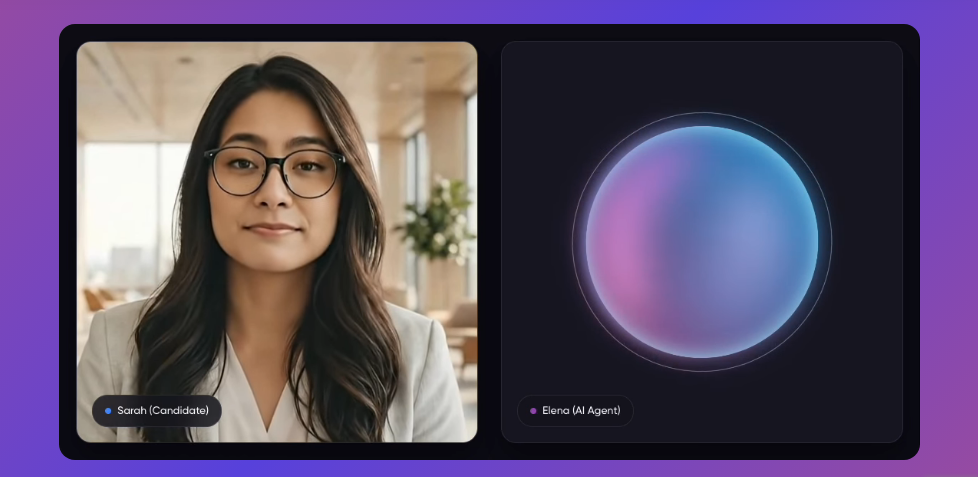
AI Interviewer, launched October 2025, conducts autonomous structured interviews at any volume. Recruiters send a link or connect their ATS, and the agent takes over. It runs adaptive interviews, asking follow-up questions based on candidate responses across functional, coding, soft-skills, and language evaluations. Candidates can participate via video, audio, or text in 22+ languages, available 24/7.
The 360 Interview capability collapses a multi-round evaluation into a single agent-run session, covering multiple competency areas without scheduling separate interviews for each. Fraud detection runs in parallel, tracking 12+ cheating signals including tab switching, camera manipulation, and voice duplication, with identity verification through ID.me and CLEAR.
Source: Eightfold AI
One design choice matters here: AI Interviewer evaluates only what candidates say, not how they look, sound, or emote. No facial expression analysis, no tone-of-voice scoring, no biometric evaluation.
This is content-only assessment, addressing the regulatory scrutiny AI-in-hiring tools have attracted. Eightfold claims the agent can conduct over one million interviews per hour and cites time-to-hire drops from 42 days to 5 days and 93% candidate NPS from early adopters.
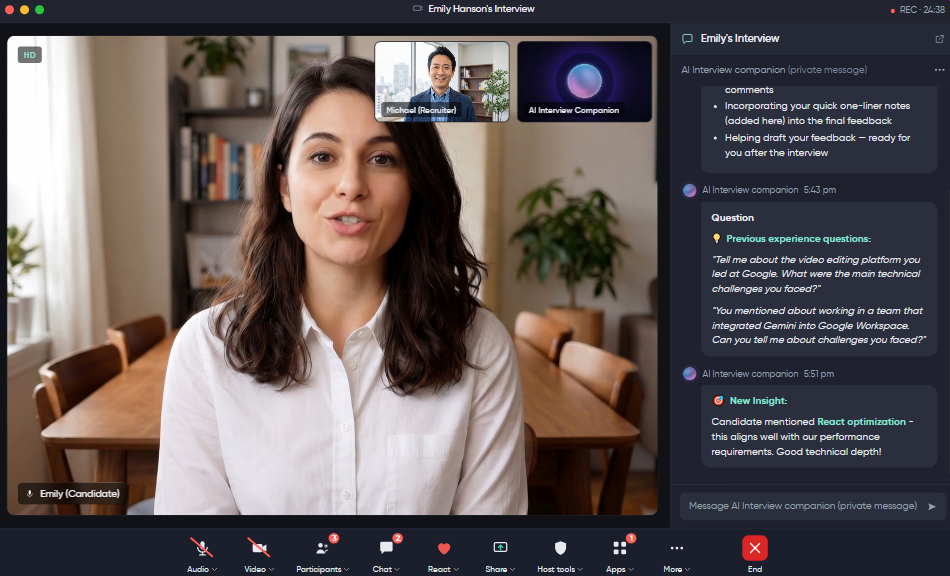
AI Interview Companion, announced April 2026, solves a different problem: the inconsistency and administrative burden of human-led interviews deeper in the hiring funnel. It joins live interviews on Zoom, Google Meet, or Microsoft Teams as a silent participant with no video, no voice, and no interruptions.
Before the call, it surfaces the candidate's profile, resume, and a skills-based feedback form so interviewers walk in prepared. During the call, it transcribes, takes notes, tracks competency coverage, and sends quiet nudges via chat suggesting follow-up questions. When the call ends, interviewers receive a structured feedback draft (pre-filled observations, ratings aligned to the scorecard) ready for review in 5 to 10 minutes rather than 30 to 45. Candidates are notified before every session and can opt out. Eightfold reports 40 minutes saved per interview and 95% feedback completion rates.
Source: Eightfold AI
Both agents run on Eightfold's Talent Intelligence engine, trained on 1.6 billion career trajectories, not a generic large language model.
The distinction matters: the AI evaluates candidates against real roles, skills, and career paths rather than applying general-purpose language processing to interview transcripts. The suite holds SOC 2, ISO 27001, ISO 42001, and FedRAMP Moderate certifications. HR Executive named it 2025 Top HR Product of the Year.
Eightfold Talent Acquisition: Skills-Based Hiring From Sourcing to Offer
Talent Acquisition is the broader recruiting suite that surrounds the Talent Agents. Where AI Interviewer and AI Interview Companion handle the interview stage, Talent Acquisition covers the full hiring lifecycle: requisition creation, sourcing, screening, hiring, and onboarding.
The matching engine is the core differentiator.
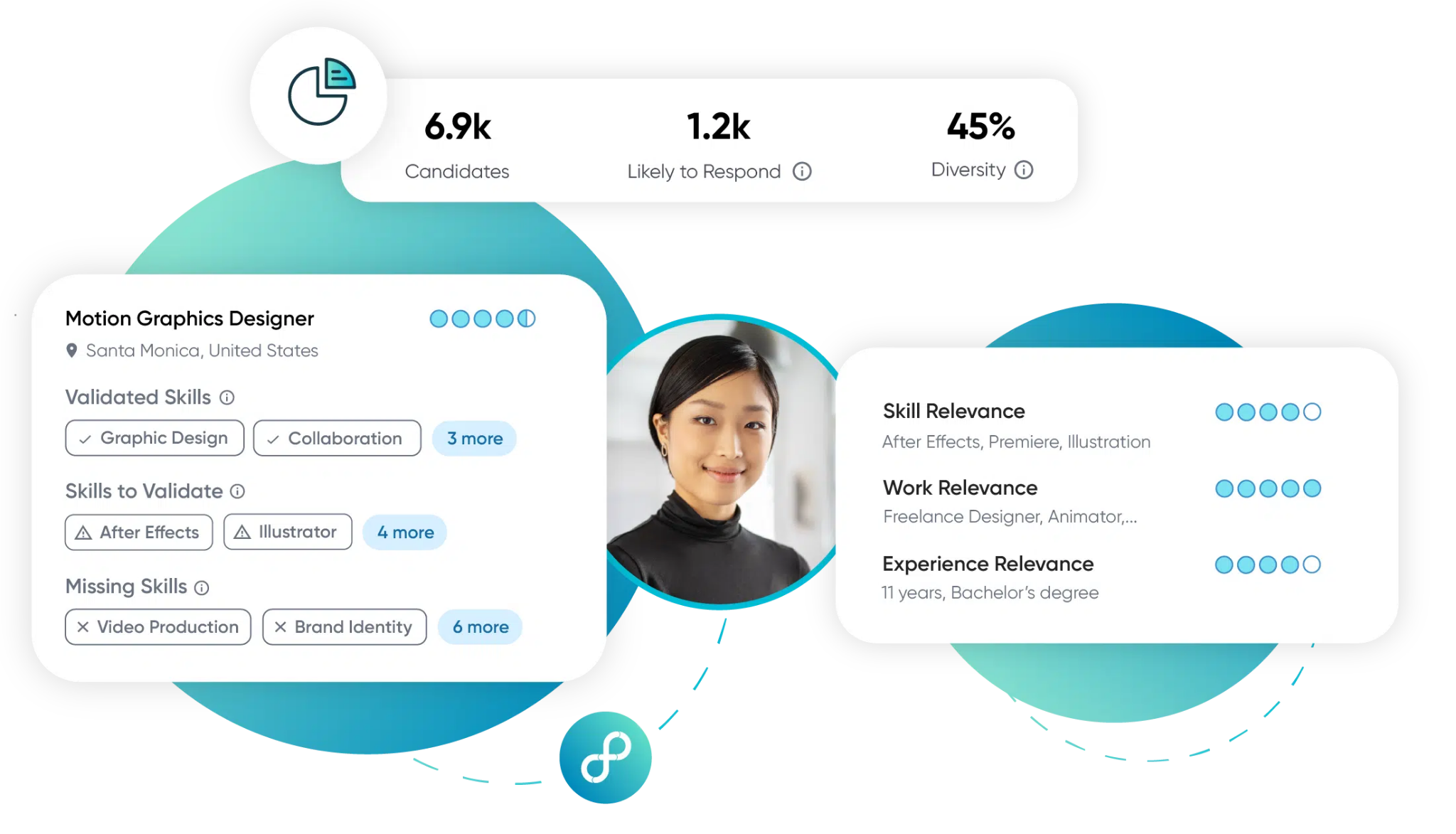
Rather than filtering candidates by keyword matches against job descriptions, the platform evaluates candidates against role skill requirements using a 1.6 million+ skill taxonomy. Each match record includes a numeric score, validated skills, inferred adjacent skills, and missing skills.
Source: Eightfold AI
The system reads career trajectories to surface candidates whose potential traditional systems miss: someone whose experience suggests they could excel in a role even though their resume does not contain the exact keywords. Eightfold claims this approach expands the talent pool by 100X.
The recruiting workflow runs on an agentic AI architecture that executes multiple tasks simultaneously:
Job creation and posting: AI agents create, refine, and manage role qualifications, generate job descriptions, manage approval workflows, plan interview structures, and publish postings.
Sourcing: The AI creates and executes a sourcing plan across multiple channels, manages the candidate pipeline, posts to job sites, and reaches out to candidates in a loop that improves with each cycle.
Talent rediscovery: The platform surfaces previously considered candidates and alumni when new roles open, searching the existing talent pool before external sourcing begins.
Screening and ranking: The platform screens and ranks candidates by match scores, with AI Interviewer available for autonomous interview stages.
Offer and onboarding: The AI collects candidate data, personalizes offer recommendations, manages approvals, extends offers, handles background checks, and begins onboarding.
The platform includes built-in diversity analytics for pipeline visibility. Eightfold claims recruiters move up to 5x faster through the hiring process and that the platform automates up to 80% of manual recruiter work.
The API supports multi-region deployments (US, EU, Gov, Canada, Middle East, Asia-Pacific), letting global enterprises maintain data residency compliance while running a unified recruiting process.
Eightfold Talent Management: Career Development and Workforce Intelligence
Talent Management is the employee-facing side of the platform. Where Talent Acquisition brings people into the organization, Talent Management develops, retains, and redeploys the existing workforce.
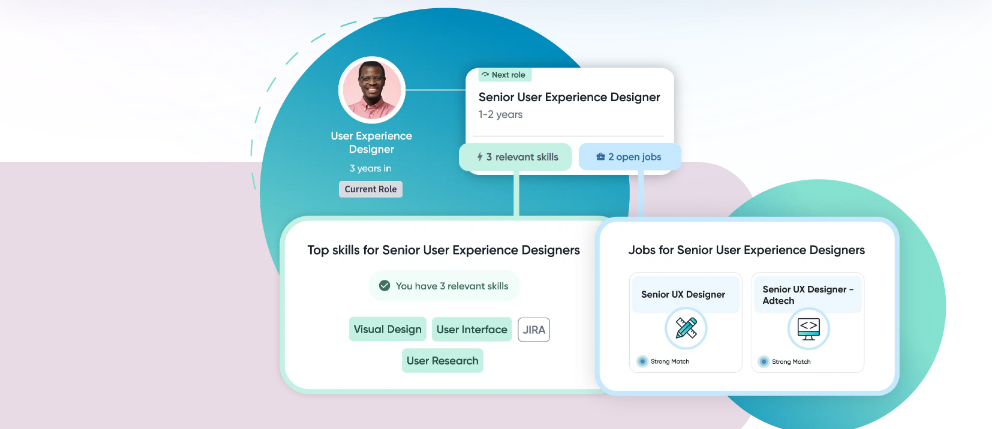
The foundation is the Eightfold Digital Twin: a live, evolving model of each employee's skills, contributions, and growth trajectory. Unlike static HR profiles that capture job titles and self-reported resume data, the Digital Twin draws on signals from emails, work applications, and completed tasks. It reflects what employees can do now, not what was recorded at their last performance review.
Source: Eightfold AI
Career Hub is the self-service portal where employees see their options. It aggregates open jobs, projects, gigs, mentors, and courses, all personalized to each employee's skills profile. The Career Navigator returns recommended career paths with matching skills, missing skills, open position counts, and peer profiles of employees in similar roles. A Career Coach AI agent provides career coaching inside Career Hub, helping employees understand their options and plan skill development.
Skills development connects the platform's understanding of what an employee does today with projects, courses, and experiences to build new capabilities. The Skill Gap Analysis API returns present skills and recommended skills for any employee-role pair, giving both the employee and their manager a concrete view of what development is needed for a target role.
Succession planning uses AI to build successor pipelines with integrated diversity metrics. The Succession Plans API models ordered successor lists with per-successor match scores, pipeline strength indicators, and diversity tracking (female percentage, diverse ethnicity percentage) as first-class fields. Equity monitoring is part of the succession data model, not a separate analytics layer.
Internal mobility uses the same skills-matching engine as Talent Acquisition, applied to employees rather than external candidates. The Employee Matched Demands API computes match scores (0 to 5 scale) for every open demand against an employee's profile, enabling rapid internal redeployment.
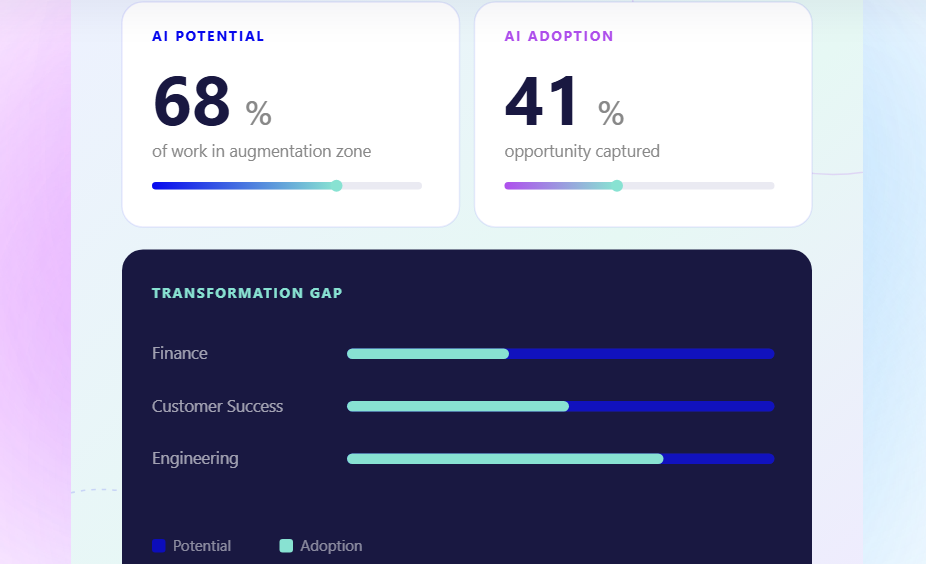
Workforce Readiness, a newer capability, provides two board-level metrics: AI Potential and AI Adoption, updated quarterly, with a Transformation Gap view by role, function, and location. This gives CHROs defensible numbers when the board asks whether the workforce is ready for AI-driven transformation.
Source: Eightfold AI
Eightfold Workforce Exchange: The Talent Marketplace
Workforce Exchange extends Eightfold's skills-based matching beyond a single enterprise into a three-sided marketplace connecting job seekers, hiring organizations, and support agencies (such as government labor departments).
The core mechanics work across three parties.
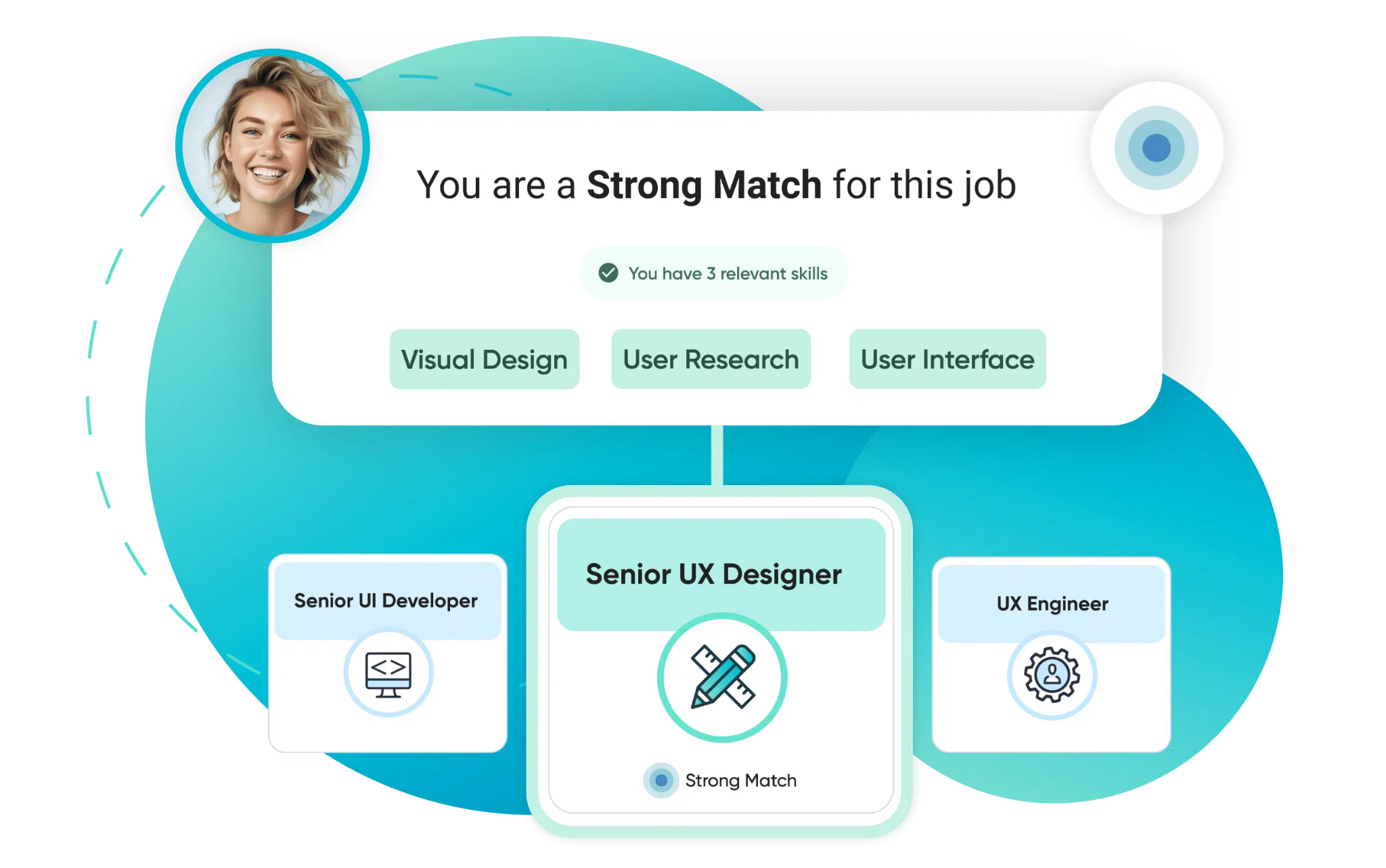
Job seekers onboard by uploading a resume, importing a career profile, or building one from scratch. The AI builds a richer skills profile by surfacing stated and inferred adjacent skills, then matches each job seeker to relevant roles with alerts. On the employer side, organizations post roles, search the candidate database, and track candidates through defined recruiting phases. Workforce development administrators oversee the ecosystem, monitoring outcomes and connecting job seekers with training opportunities.
Source: Eightfold AI
The module tilts toward the public sector. It powers GigEagle, a talent marketplace for the U.S. Department of Defense that matches Reserve and National Guard members with short-term project work. Its FedRAMP Moderate Authorization and dedicated eightfold-gov regional deployment open regulated government environments that most commercial talent marketplace vendors cannot reach.
Capabilities include career center matching, explainable skills insights that surface current, adjacent, and inferred skills with transparent reasoning, career planning tools for people in job transitions, and upskilling recommendations aligned to market demand. Unlike a job board that relies on keyword search, Workforce Exchange matches across non-linear career paths, expanding the pool beyond traditionally credentialed applicants.
Eightfold Resource Management: Skills-Based Project Staffing
Resource Management targets organizations where work is structured around projects and engagements: consulting firms, professional services, healthcare, banking, and manufacturing. Most project-staffed organizations still rely on spreadsheets and siloed tools to track availability and skills, staffing by who happens to be free rather than who is best qualified.
The workflow has four layers.
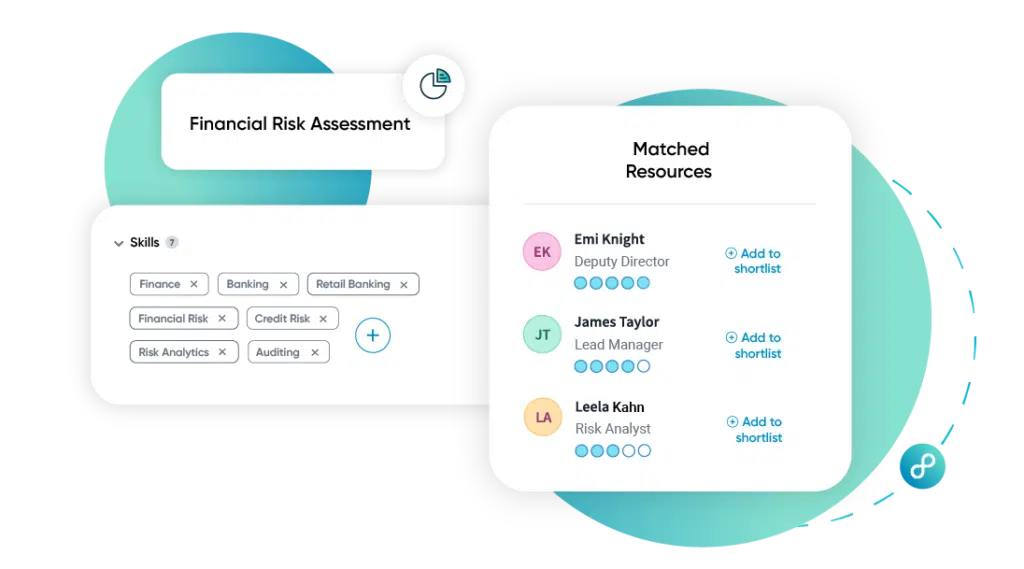
First, resource managers create a demand specifying required skills, proficiency levels, seniority, capacity, locations, and dates. The demand API schema supports relocation parameters, calibration data, and custom fields. Second, the AI matching engine scans the talent pool, ranking employees on depth and recency of skills, past engagement history, stated preferences, and adjacent capabilities, not just availability.
Source: Eightfold AI
Third, bookings track resource reservations through pending, approved, and rejected states, with capacity expressed in hours, percentage, or fraction at daily, weekly, or monthly granularity. Fourth, after projects conclude, built-in workflows let project leads assess employees' skill proficiency and let employees add newly gained skills. Each completed engagement improves future matching.
The Project Marketplace adds a two-sided view: employees browse and express interest in internal projects while managers find and invite best-fit employees. The module is available in more than 155 countries and 24 languages.
The advantage over standalone staffing tools: Resource Management shares the same AI foundation and skills graph as Talent Acquisition and Talent Management. An employee's hiring data, career development, and project history all feed the same skills profile.
TalentForge: Custom HR Application Development
TalentForge, launched May 2026, shifts Eightfold from application vendor to platform. Instead of delivering pre-built software, it gives enterprises the tools to build custom talent applications on Eightfold's intelligence layer.
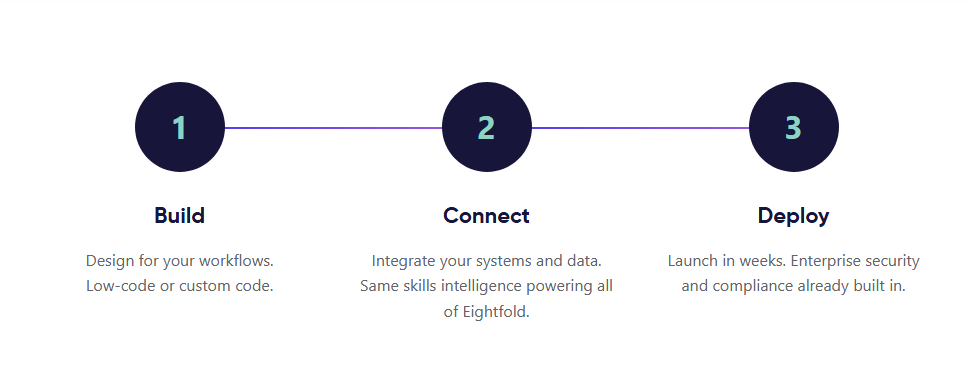
The workflow operates through three stages:
Build: Developers or HR teams design custom applications using low-code or custom code interfaces, with natural language and vibe-coding as input methods.
Connect: Applications integrate with existing enterprise systems. The same Eightfold skills intelligence (derived from over one billion career profiles) runs underneath; builders do not need to train or configure the AI.
Deploy: Applications launch in weeks with enterprise security, FedRAMP, ISO 42001, GDPR, and EEOC compliance built in.
Source: Eightfold AI
Standard HR software forces enterprises to configure a vendor's application and hire integrators to bridge the gaps. TalentForge lets organizations build what they need, with Eightfold's talent intelligence providing the AI reasoning a general-purpose builder cannot replicate.
TalentForge is additive, not a replacement for Eightfold's existing applications or Talent Agents. Enterprises own what they create on the platform.
Eightfold AI Platform Infrastructure: Security, Compliance, and Integrations
Eightfold's infrastructure reflects its enterprise and public-sector focus. The certification list runs deeper than most HR technology vendors:
Certification | What It Covers |
|---|---|
Security, availability, and confidentiality controls | |
Information security management | |
Privacy information management (directly relevant to candidate PII) | |
AI management system certification (rare among HR platforms) | |
U.S. federal government authorization covering NIST 800-53 Moderate baseline | |
Automated employment decision tool compliance with public bias audit results |
ISO 42001 deserves a note: it is an AI governance standard, and Eightfold is among the first HR platforms to hold it. The Ethics Council, an independent advisory body that includes former EEOC Commissioner Victoria Ann Lipnic, provides third-party governance oversight. Full bias audit results conducted by an external auditor (BABL AI Inc.) are published publicly.
Infrastructure runs on AWS with AES 256-bit encryption at rest, TLS 1.2 in transit, SAML 2.0 and SSO support, MFA, and least-privilege access. The platform meets WCAG 2.1 and 2.2 AA accessibility standards with screen reader compatibility, full keyboard navigation, and customizable display modes.
The API is a REST interface (v2) returning JSON data, with OAuth 2.0 password grant authentication issuing 24-hour access tokens. Rate limits sit at 100 requests per minute for standard endpoints and 20 per minute for bulk matching, with a 15 MB maximum payload size. Multi-region deployments (US, EU, Gov, Canada, Middle East, Asia-Pacific) provide domain-level data residency control.
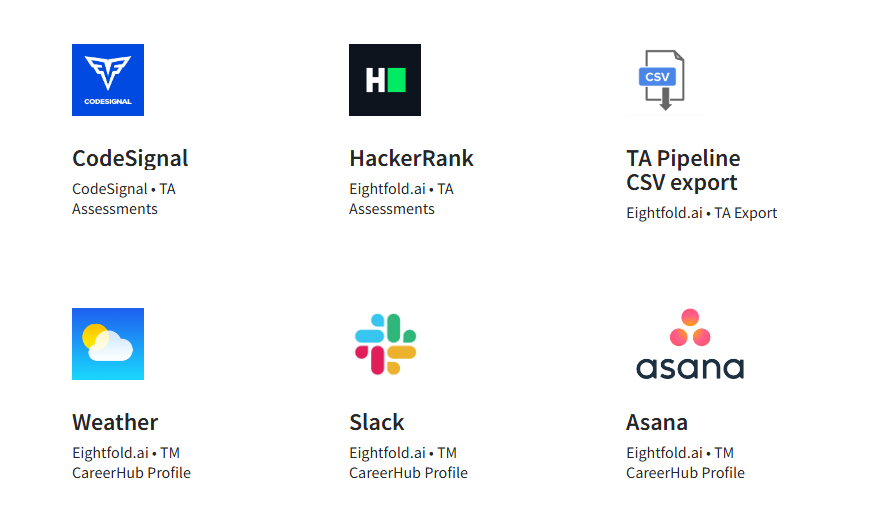
The App Marketplace includes native integrations with assessment platforms (CodeSignal, HackerRank, HireVue, SHL), learning tools (Degreed, Udemy, Go1), communication tools (Slack, GitHub), and career sites (LinkedIn, Glassdoor). The flagship HRIS integration is Oracle Recruiting, with AI Interviewer embedded inside Oracle Fusion Cloud Recruiting workflows and procurable via Oracle Universal Credits through Oracle Cloud Marketplace. A Salesforce partnership integrates talent agent capabilities into Salesforce's ecosystem.
Source: Eightfold AI
One gap: no native connectors to iPaaS platforms (Zapier, Make, Workato) appear in the public marketplace. Customers must build custom iPaaS connections through the REST API. Official SDKs are also absent; developers integrate via HTTP directly.
Where Eightfold AI Stops: The Gaps
Eightfold AI is a talent intelligence platform, focused on the hire-to-retire lifecycle: finding candidates, developing employees, staffing projects, and building the workforce an enterprise needs. That focus gives its features their depth. But every enterprise also needs to equip the teams it hires with intelligence and tools to find and win customers, and that is the surface Eightfold does not touch.
No B2B contact or company database for sales and marketing.
Eightfold's 1.6 billion career trajectories power hiring decisions. They contain no verified business emails, direct-dial phone numbers, company attributes, or organizational charts for sales prospecting. The sales and marketing teams your organization hires through Eightfold need a separate data source to know who to contact, at which companies, and how to reach them.
No buyer intent or account-level signals for revenue teams.
Eightfold tracks talent market movements: skills trends, career trajectories, workforce readiness indicators. It does not track which companies are researching your product category, visiting your website, or showing buying behavior. Revenue teams need intent signals to prioritize accounts and time outreach, and those signals sit outside Eightfold's scope.
No sales engagement, conversation intelligence, or pipeline management.
Eightfold's AI Interviewer conducts hiring interviews. It does not record sales calls, transcribe customer conversations, detect objections, manage deals, or forecast revenue. The teams Eightfold helps you hire still need a separate stack for go-to-market execution.
No marketing orchestration, ABM, or demand generation.
Eightfold serves HR and talent teams. Display advertising, audience management, account-based marketing, campaign orchestration, and demand generation require a separate platform.
No published pricing or transparent entry path.
Eightfold does not publish pricing on its website. All access requires a sales conversation and a negotiated enterprise agreement. The limited trial (one month or 100 interviews) is sales-qualified, not self-serve. Fees are non-refundable and non-cancellable by default, and pricing terms are contractually confidential.
How ZoomInfo Covers the Gaps
Eightfold AI builds and develops the team. The gaps above describe what the team needs once it is built: data on who to sell to, signals on who is ready to buy, intelligence on why deals move, and execution tools that turn that intelligence into revenue.
That is the ground ZoomInfo covers.
ZoomInfo's B2B Data Platform: The contact and company intelligence revenue teams need
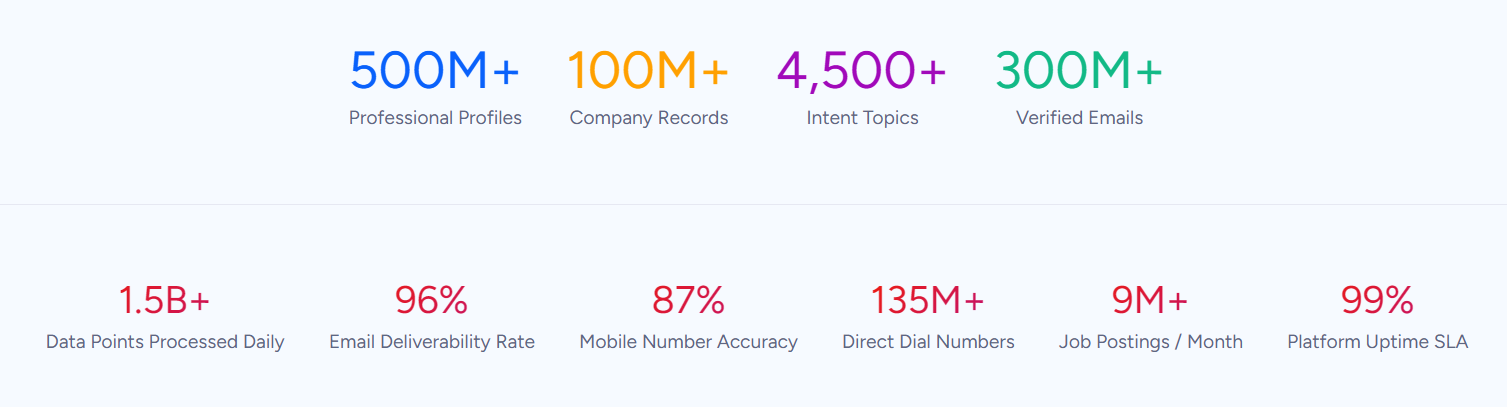
ZoomInfo operates a B2B data platform covering 500M contacts, 100M companies, 135M+ verified phone numbers, 120M direct-dial phone numbers, and 200M+ verified business email addresses. The data flows through a verification pipeline backed by 300+ human researchers and automated ML scanning of 28 million site domains daily, reaching up to 95% accuracy on first-party data.
Source: ZoomInfo
Where Eightfold's data describes who to hire and what they can do, ZoomInfo's data describes who to sell to and how to reach them. 300+ company attributes span industry and size data, org charts, technographic profiles tracking 30,000+ technologies across 200+ categories, and contact tracking with job-change alerts. Global coverage extends to 34M+ company profiles and 200M+ professional profiles outside North America.
The data quality is externally validated: Leader in the Forrester Wave for Intent Data Providers, Q1 2025, Leader in the Gartner Magic Quadrant for ABM Platforms for the second consecutive year, and 133 No. 1 rankings on G2 Summer 2025. In a Fortune 500 competitive RFP analyzing 25 million contacts across vendors, an independent consultant concluded that "no other competitor came even close."
ZoomInfo Intent and WebSights: Signals that reveal which accounts are in-market
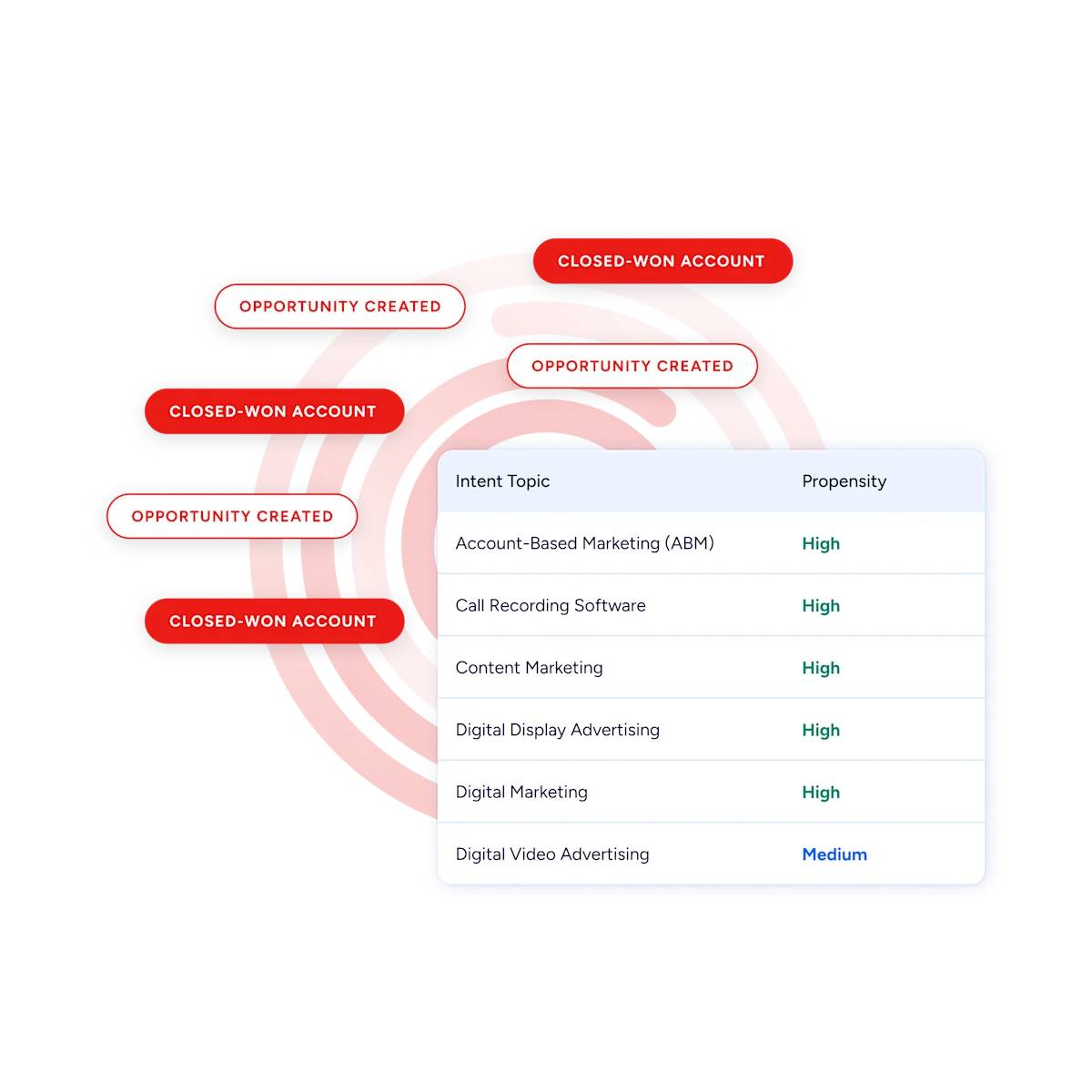
Eightfold tracks talent signals. ZoomInfo Intent tracks buying signals from 210 million IP-to-Organization pairings and 6 trillion+ new keyword-to-device pairings sourced monthly, showing which companies are researching topics related to your product before your sales team contacts them. Guided Intent, exclusive to ZoomInfo, identifies topics historically correlated with deal success rather than requiring manual topic selection.
Source: ZoomInfo
On the website side, WebSights resolves anonymous website traffic to companies with Automatic Traffic Filtering that distinguishes real visitors from bots. ZoomInfo Marketing extends this with contact-level visitor identification, showing who visited (not just which company) and triggering outreach.
ZoomInfo's GTM Context Graph and Chorus: Intelligence that captures why deals move
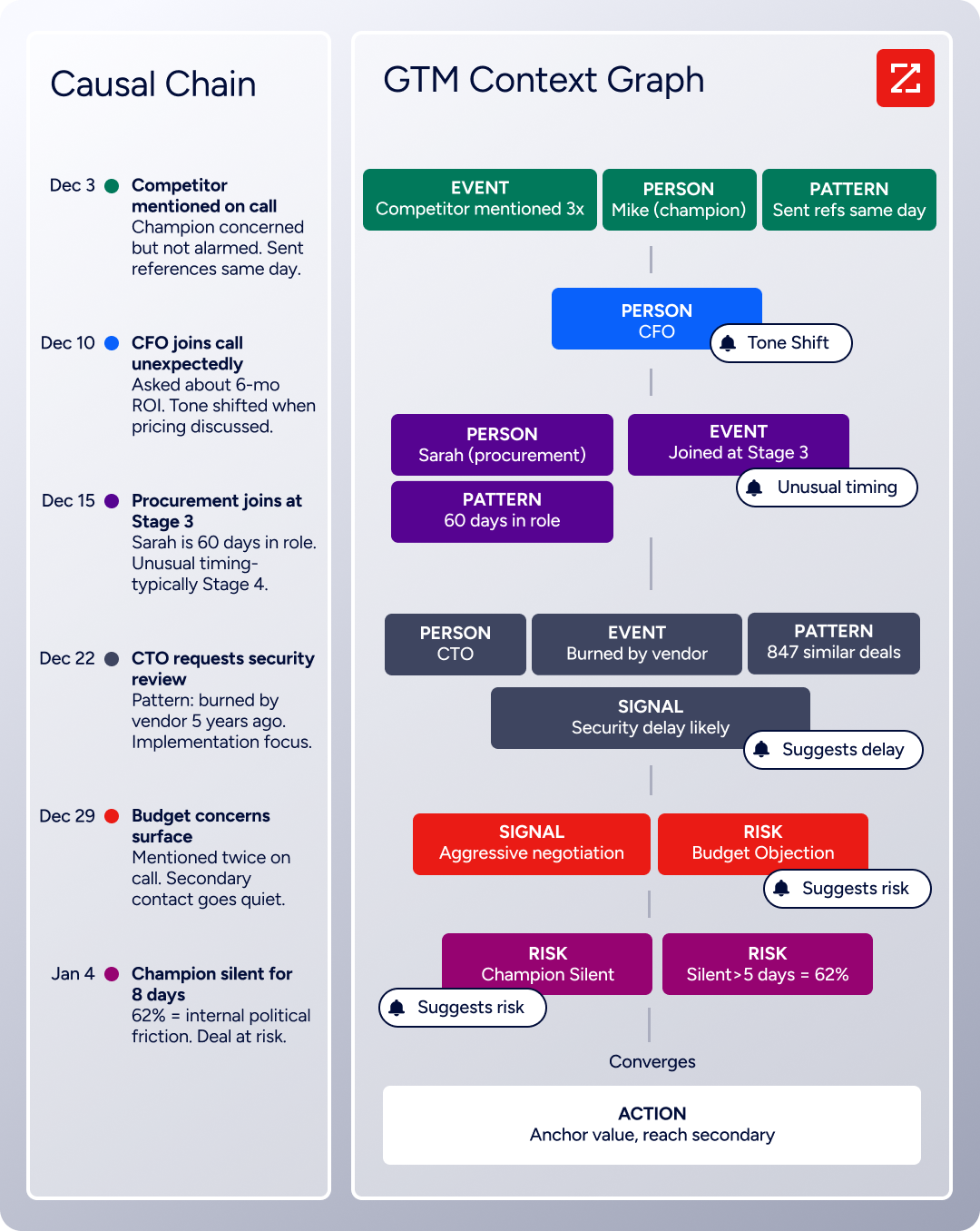
ZoomInfo's GTM Context Graph processes 1.5B+ data points daily, fusing B2B data with CRM records, conversation intelligence from Chorus, email interactions, and behavioral signals into a single layer that captures not just what happened in a deal but why it happened.
Chorus, ZoomInfo's conversation intelligence engine (backed by 14 technology patents), records and transcribes sales calls, surfaces AI-generated insights (talk ratios, sentiment, objection detection), syncs deal intelligence to the CRM, and provides coaching scorecards and clip sharing. It captures the context that CRM stage fields miss: why a champion went quiet, what a competitive mention signals about deal risk, which objection patterns predict lost deals.
Source: ZoomInfo
ZoomInfo GTM Workspace and GTM Studio: Where sales and marketing teams execute
GTM Workspace is ZoomInfo's seller front-end, providing a Book of Business view across CRM, ZoomInfo data, conversation history, and market intelligence. AI agents automate account research, outreach drafting, CRM updates, and signal monitoring. An Action Feed streams in-market buyers matched to target criteria with pre-drafted actions on every signal.
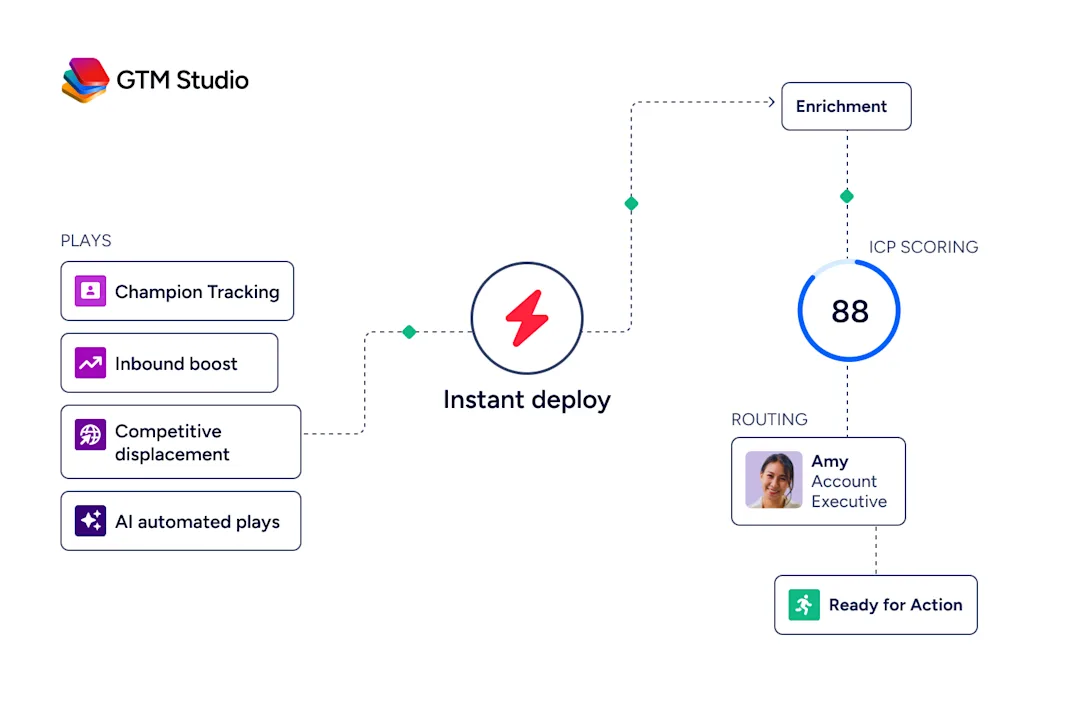
GTM Studio handles marketing orchestration. Marketers, RevOps teams, and GTM engineers can build audiences using natural language, enrich with first- and third-party data, define triggers, and activate plays across channels (email, calls, display ads, direct mail, LinkedIn, Meta, Connected TV) without engineering support. Pre-built GTM plays cover inbound acceleration, champion tracking, competitive displacement, and ICP targeting. Expansion plays that took 3 weeks now launch in 30 minutes.
Source: ZoomInfo
ZoomInfo Marketing includes a Demand-Side Platform that deploys display ads based on 300+ company attributes, FormComplete (which reduces forms to a single field while auto-appending data), and Account Fit Scoring with predictive AI scoring 0 to 100 based on company attribute patterns.
ZoomInfo APIs and MCP: GTM data accessible in any tool or AI agent
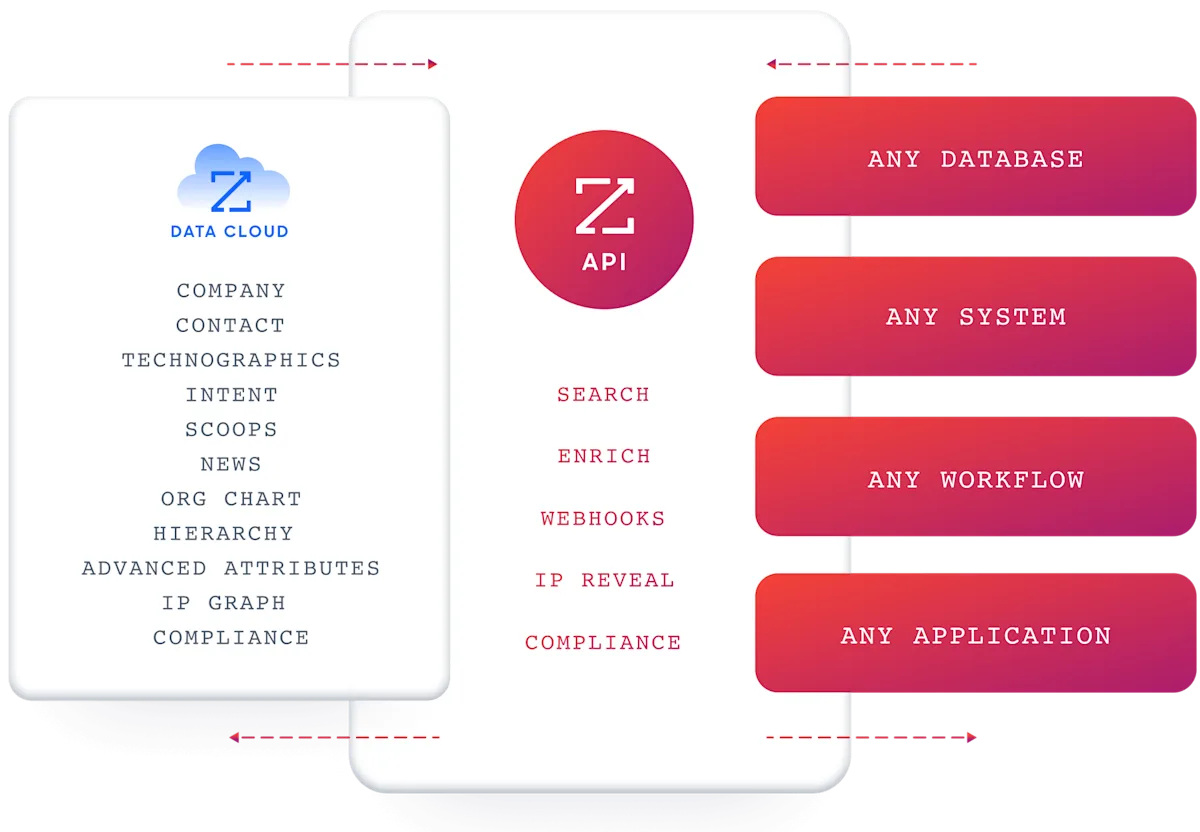
ZoomInfo delivers its intelligence through APIs and MCP (Model Context Protocol), so the data and GTM Context Graph powering ZoomInfo's own products is accessible inside any third-party tool or custom AI agent. The MCP server connects AI models to ZoomInfo's B2B data, supporting Claude and ChatGPT.
API access is included in all relevant plans, and the Enterprise API covers Search, Enrich, Copilot (AI intelligence), Marketing (audience management), and Engagements endpoints.
Source: ZoomInfo
ZoomInfo's Free Entry Points: A way to evaluate the platform before any commitment
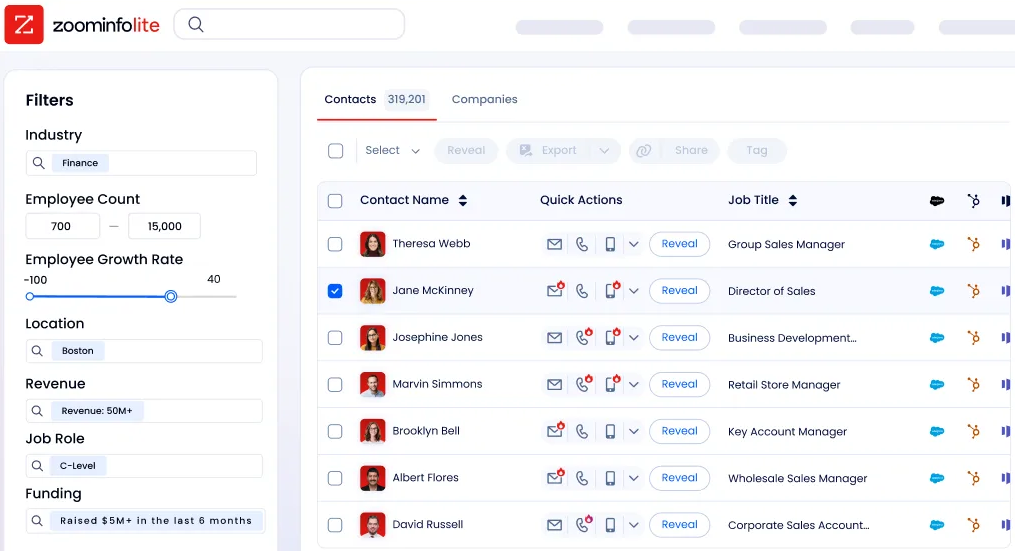
ZoomInfo offers what Eightfold does not: a self-serve path into the platform. ZoomInfo Lite is a permanent free tier with access to ZoomInfo's B2B database, 10 monthly export credits, individual and company searches, a Chrome extension, and WebSights Lite with up to 10 website visitor reveals per day. A separate 7-day free trial provides broader access with no credit card required.
Source: ZoomInfo
Seismic's sales team attributed 39% of active pipeline to opportunities identified or influenced by ZoomInfo signals, boosted productivity by 54%, and saved 11.5 hours per week per seller. (Seismic Case Study)
Final Summary
Eightfold AI is a focused toolkit for enterprise talent operations: autonomous interviewing at scale across 22+ languages, skills-based matching trained on 1.6 billion career trajectories, career development and succession planning with live Digital Twins, a three-sided workforce marketplace for public-sector and enterprise use, project staffing that matches by skill depth and adjacency, and a custom application layer for organizations that want to build on the intelligence rather than configure pre-built software.
Its security posture (FedRAMP Moderate, ISO 42001, SOC 2 Type II) positions it for regulated industries and government agencies that most HR platforms cannot serve. Its scope is talent, and talent alone. The platform does not extend to go-to-market intelligence, buyer intent signals, sales engagement, conversation intelligence for revenue calls, or marketing orchestration.
If your enterprise also needs to equip the teams Eightfold helps you build with the intelligence and tools to find and win customers, that is the ground ZoomInfo covers.
Its 500M-contact, 100M-company database gives sales teams the verified emails and direct dials to fill their pipeline. ZoomInfo Intent surfaces accounts researching your category from 6 trillion+ keyword-to-device pairings monthly. Chorus captures and analyzes every sales conversation. GTM Studio gives marketing teams multi-channel orchestration and ABM. The GTM Context Graph fuses it all into a single intelligence layer that tells revenue teams not just what happened, but why.
Eightfold builds the team. ZoomInfo equips the team. Start with ZoomInfo Lite for free, or request a demo to see how verified contacts and live intent signals connect to your pipeline.
FAQ
Does Eightfold AI support coding interviews?
Yes. AI Interviewer conducts coding interviews as one of its evaluation modalities alongside functional, soft-skills, and language assessments. The 360 Interview capability can combine multiple evaluation types into a single session. All interview types are available in 22+ languages, 24/7, with the same content-only evaluation model (no biometric scoring).
Which plan includes AI Interview Companion?
Eightfold does not publish pricing or define public plan tiers. AI Interview Companion is part of the Talent Agents suite, and access requires a negotiated enterprise agreement. The product works inside Zoom, Google Meet, and Microsoft Teams with no new software to install.
Can Eightfold AI identify skills gaps across an entire organization?
Yes. Talent Management's Workforce Readiness capability provides two board-level metrics (AI Potential and AI Adoption) updated quarterly, with a Transformation Gap view broken down by role, function, and location. The Skill Gap Analysis API returns present and recommended skills for any employee-role pair, and the Digital Twin continuously updates each employee's skills profile from live work signals rather than relying on periodic self-assessments.
Does Eightfold AI integrate with Oracle and other HCM systems?
AI Interviewer is embedded inside Oracle Fusion Cloud Recruiting workflows, procurable via Oracle Universal Credits through Oracle Cloud Marketplace. A Salesforce partnership integrates talent agent capabilities into Salesforce's ecosystem. The App Marketplace includes integrations with assessment tools (CodeSignal, HackerRank, HireVue), learning platforms (Degreed, Udemy), and communication tools (Slack). Broader HRIS connectivity is available through the REST API, though no pre-built iPaaS connectors (Zapier, Make, Workato) are documented.
What security certifications does Eightfold AI hold?
Eightfold maintains SOC 2 Type II, ISO 27001, ISO 27701, and ISO 42001 certifications, plus FedRAMP Moderate Authorization for U.S. federal agency deployments. NYC Local Law 144 bias audit results are published publicly. An independent Ethics Council provides third-party governance oversight. The platform runs on AWS with AES 256-bit encryption at rest and TLS 1.2 in transit.
Is there a free trial for Eightfold AI?
Eightfold offers a limited trial governed by published Trial Terms of Service: it expires at the earlier of one month or 100 completed interviews. The trial is not self-serve; it is provided through the sales process. There is no permanent free tier. All paid subscriptions are negotiated per customer, with fees that are non-refundable and non-cancellable by default.
Does Eightfold AI provide B2B sales data or go-to-market intelligence?
No. Eightfold AI's data (1.6 billion career trajectories, 1.6 million skills) is focused on talent intelligence: matching candidates to roles, inferring skills, forecasting career paths, and identifying workforce gaps. It does not include verified business emails, direct-dial phone numbers, company attributes, buyer intent signals, or any data designed for sales prospecting or marketing outreach.
For that layer, ZoomInfo provides 500M contacts, 100M companies, 135M+ verified phone numbers, intent data from 6 trillion+ keyword-to-device pairings monthly, and a GTM Context Graph that captures why deals move, accessible through APIs, MCP, GTM Workspace, and GTM Studio.
Other tools worth evaluating side by side:
