
HeyReach has become the LinkedIn automation platform of choice for agencies and sales teams that need to scale outreach without paying per seat. In under three years, the company grew from a bootstrapped side project in North Macedonia to a platform trusted by 5,000+ companies, reporting $10M in revenue with 23 employees. Its flat-fee pricing and multi-sender rotation made it popular with teams managing dozens of LinkedIn accounts.
To write this HeyReach review, we analyzed the platform closely. It's a good fit if:
You need to manage multiple LinkedIn accounts from a single dashboard
You run an agency handling LinkedIn outreach for several clients
You want unlimited sender rotation at a flat monthly rate
Your outreach strategy is LinkedIn-first
You use Clay, Instantly, or Smartlead and want native integrations
HeyReach might not be the best choice if:
You need B2B contact data beyond what LinkedIn provides
You want buyer intent signals to prioritize which accounts to target first
You need multi-channel execution across email, phone, ads, and LinkedIn from one platform
You need account intelligence that explains why deals move or stall
You're building a go-to-market operation, not just running LinkedIn sequences
In that case, consider ZoomInfo: an AI GTM platform that starts where HeyReach ends. Where HeyReach automates LinkedIn actions, ZoomInfo provides the data layer underneath: 500M contacts, 100M companies, 135M+ verified phone numbers, and 200M+ verified business email addresses, combined with your CRM records, conversation transcripts, and behavioral signals through the GTM Context Graph. That intelligence tells your team who to contact, when to engage, and what to say. It's accessible through the GTM Workspace for sellers, GTM Studio for marketers and RevOps, or APIs and MCP in any front-end.
We've included a detailed look at ZoomInfo later in this review as the next step for teams that need GTM intelligence behind their outreach. If you're ready to explore that, start with ZoomInfo Lite.
What is HeyReach?
HeyReach is a cloud-based LinkedIn automation tool for agencies, sales teams, and GTM operators, founded in 2023 and headquartered in Skopje, North Macedonia. Nikola Velkovski and Stefan Kotevski created it after their previous product, Howitzer (a Reddit DM automation tool), became unsustainable when Reddit's policies and API limitations shut down that market. The team pivoted to LinkedIn automation and positioned HeyReach as "the first agency-friendly LinkedIn outreach tool."
Growth has been fast. HeyReach hit $1M ARR in less than a year, grew to $6M ARR in under two, and reached $10M in revenue by 2025. It holds a 4.7 rating on G2 and G2 named it a 2026 Fastest Growing Product.
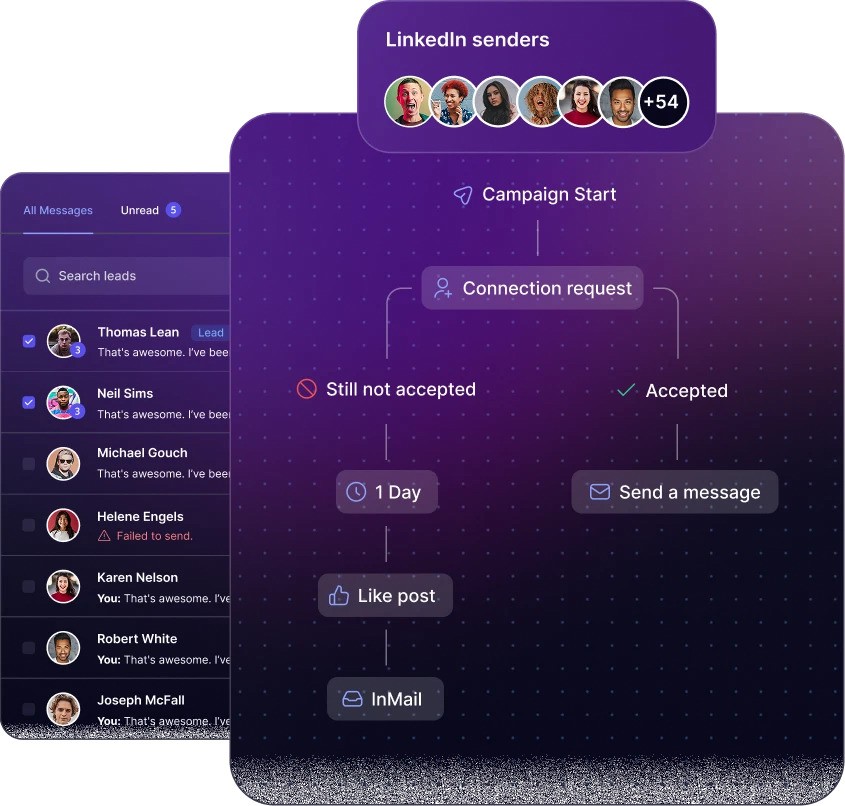
HeyReach's core value is unlimited senders for one fixed cost, letting teams connect multiple LinkedIn accounts and auto-rotate sending between them. This solves a real constraint: LinkedIn limited connection requests to 20-40 per day in May 2023, making multi-account rotation the primary way to scale LinkedIn outreach while keeping individual accounts safe.
Source: HeyReach
HeyReach Pros & Cons
Pros | Cons |
|---|---|
Unlimited sender rotation at a flat monthly rate | LinkedIn-only channel (no native email, phone, or ads) |
Agency-friendly features: whitelabel, workspaces, permissions | No built-in B2B contact database |
Native Clay, Instantly, and Smartlead integrations | No buyer intent signals or account prioritization |
Unified inbox across all LinkedIn accounts | Attachment sending not yet supported in Unibox |
14-day free trial with no credit card required | No permanent free plan |
Responsive customer support with dedicated Slack channels | Entry pricing at $79/month for a single sender |
MCP server for AI agent integrations | Inherent platform risk as unofficial LinkedIn automation |
HeyReach Review: How it Works & Key Features
Multi-Sender Campaign Management: HeyReach lets you connect unlimited LinkedIn accounts and rotate sending between them automatically.
This is HeyReach's defining feature. When LinkedIn capped connection requests at 20-40 per day, the only way to scale outreach was to add more accounts. HeyReach was built for this from the start, not as an afterthought.
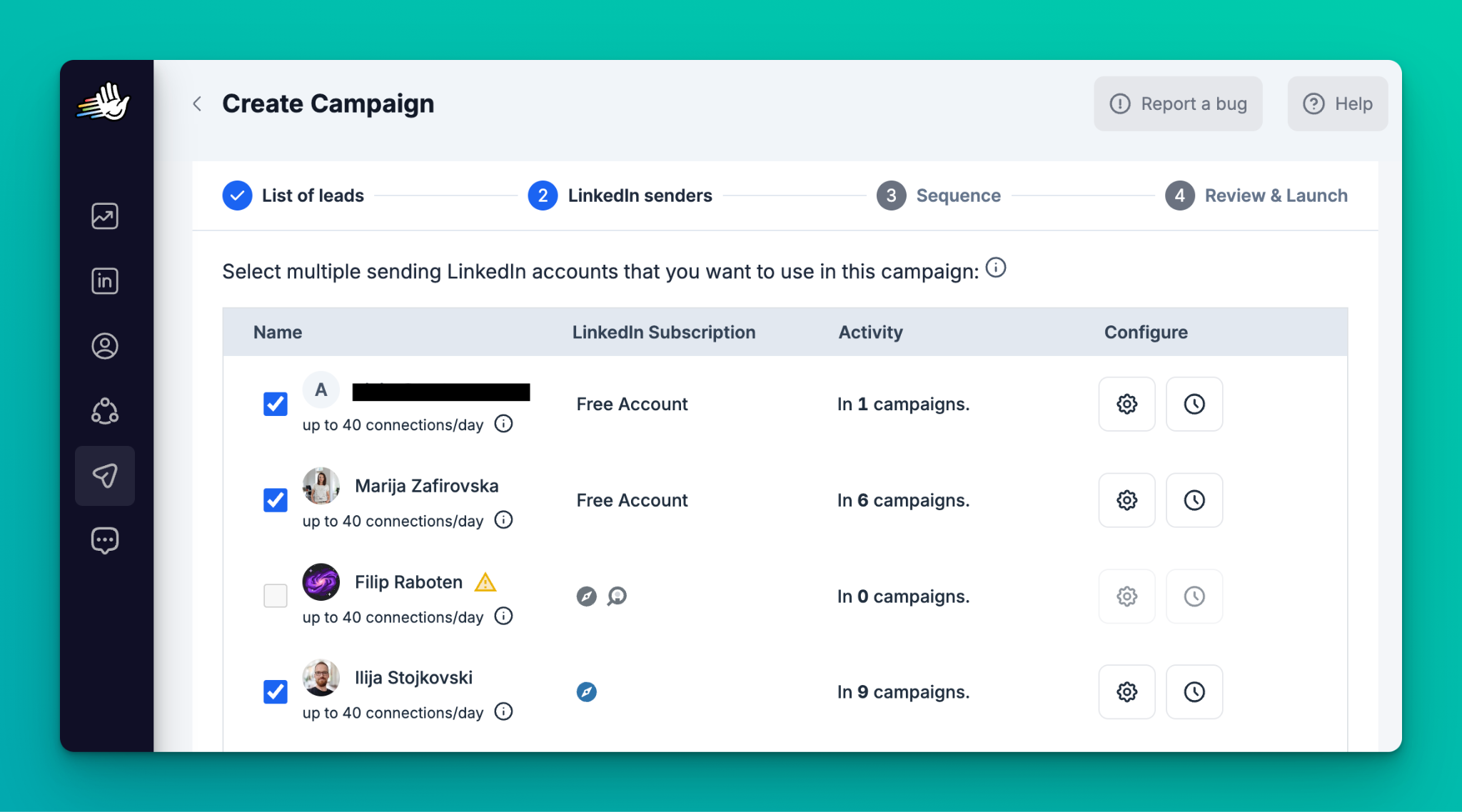
When you create a campaign, you select your LinkedIn senders and assign them. The platform rotates sending across accounts so no single account exceeds safe limits. HeyReach recommends 20-25 connection requests per day per sender, and the platform "will never ever try to bypass them or put your LinkedIn account at risk."
Source: HeyReach
Daily limits apply per LinkedIn sender, not per campaign. If a sender is active in three campaigns, limits are shared proportionally. Built-in deduplication prevents the same prospect from being contacted by multiple senders in the organization.
Each LinkedIn account gets a dedicated static residential proxy that is never shared, simulating real user behavior. The platform also freezes accounts automatically when they approach LinkedIn's weekly connection request limits, with no override available.
For agencies, this changes the economics. Instead of paying per seat (Expandi charges $99/seat/month), HeyReach offers $999/month for 50 senders or $1,999/month for unlimited senders. At scale, the savings add up.
For a full comparison of how HeyReach and Expandi stack up on pricing and features, see our Expandi vs HeyReach breakdown.
Campaign Sequencing & Automation: HeyReach offers visual workflows with conditional branching based on prospect behavior.
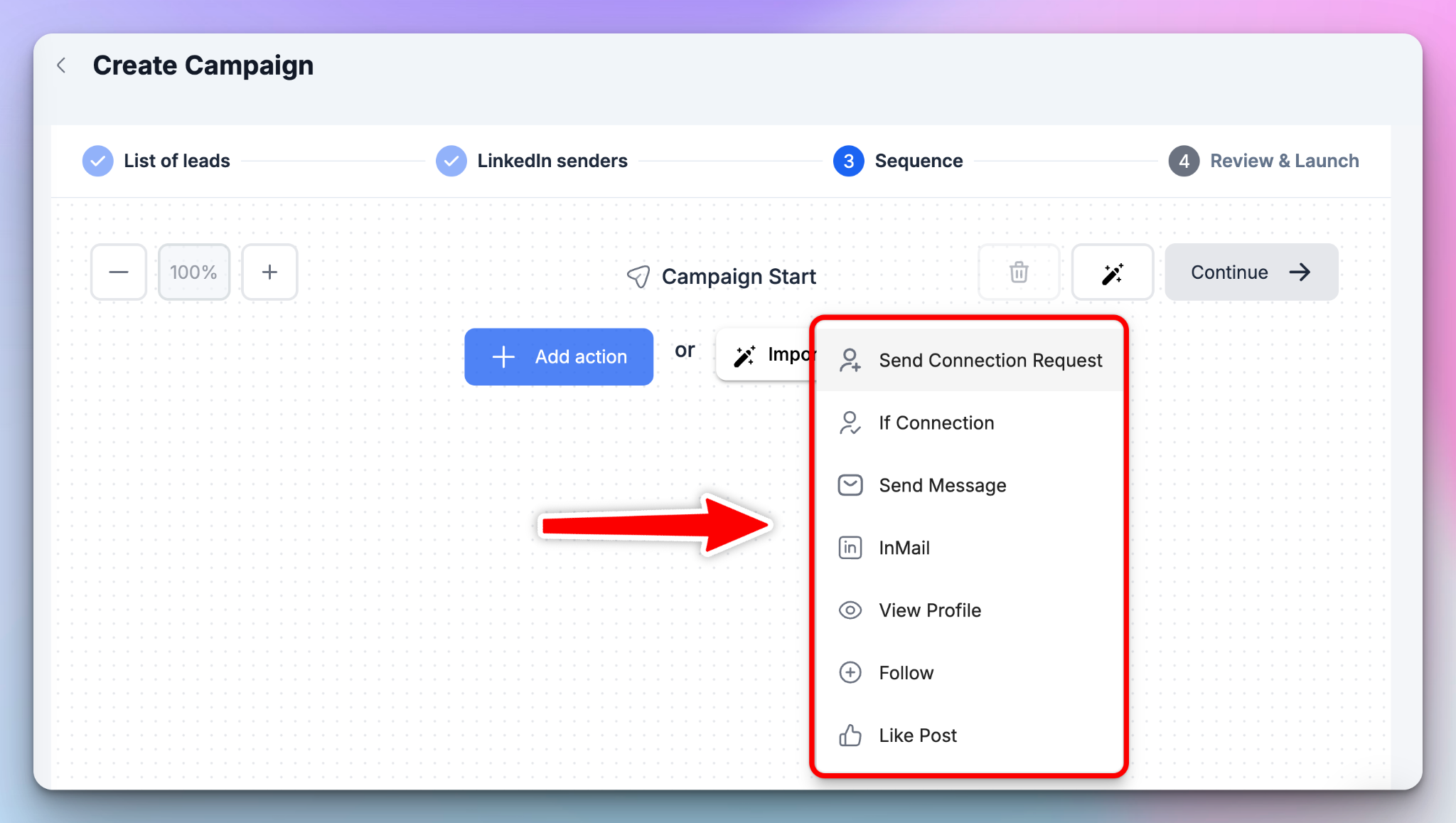
HeyReach's campaign builder lets you combine multiple LinkedIn actions into automated sequences through a visual workflow interface. You choose from seven action types: Send Connection Request, If Connection (conditional branching), Send Message, InMail, View Profile, Follow, and Like Post.
Source: HeyReach
What sets HeyReach's sequencing apart is its dual-branch architecture. Each decision point creates two paths: a right-side "success branch" for positive outcomes and a left-side branch for when actions don't get the desired response. If a prospect doesn't accept your connection request, the left branch might trigger profile views and post likes to build familiarity before the sequence ends.
The "If Connected" conditional logic checks whether a lead is already a 1st-degree connection. Connected leads skip to messaging; unconnected leads enter the connection request flow first. This prevents wasted actions on prospects you've already connected with.
All message actions support A/B testing with multiple variations, custom variables for personalization, and ChatGPT-generated personalized notes created from each lead's LinkedIn profile. A minimum delay of 3 hours between actions keeps sequences looking natural.
The builder also validates your setup. The Follow action can't be placed after Send Connection Request because sending a connection request automatically makes you a follower. These guardrails prevent common setup mistakes.
Lead Import & Management: HeyReach pulls prospects from Sales Navigator, Clay, RB2B, and CSV files into a centralized lead management system.
HeyReach supports six import methods for people: LinkedIn Search Bar, Sales Navigator, LinkedIn Recruiter, LinkedIn Event attendees, LinkedIn Post reactors, and CSV import. For company-level targeting, imports work via LinkedIn Search Bar or Sales Navigator.
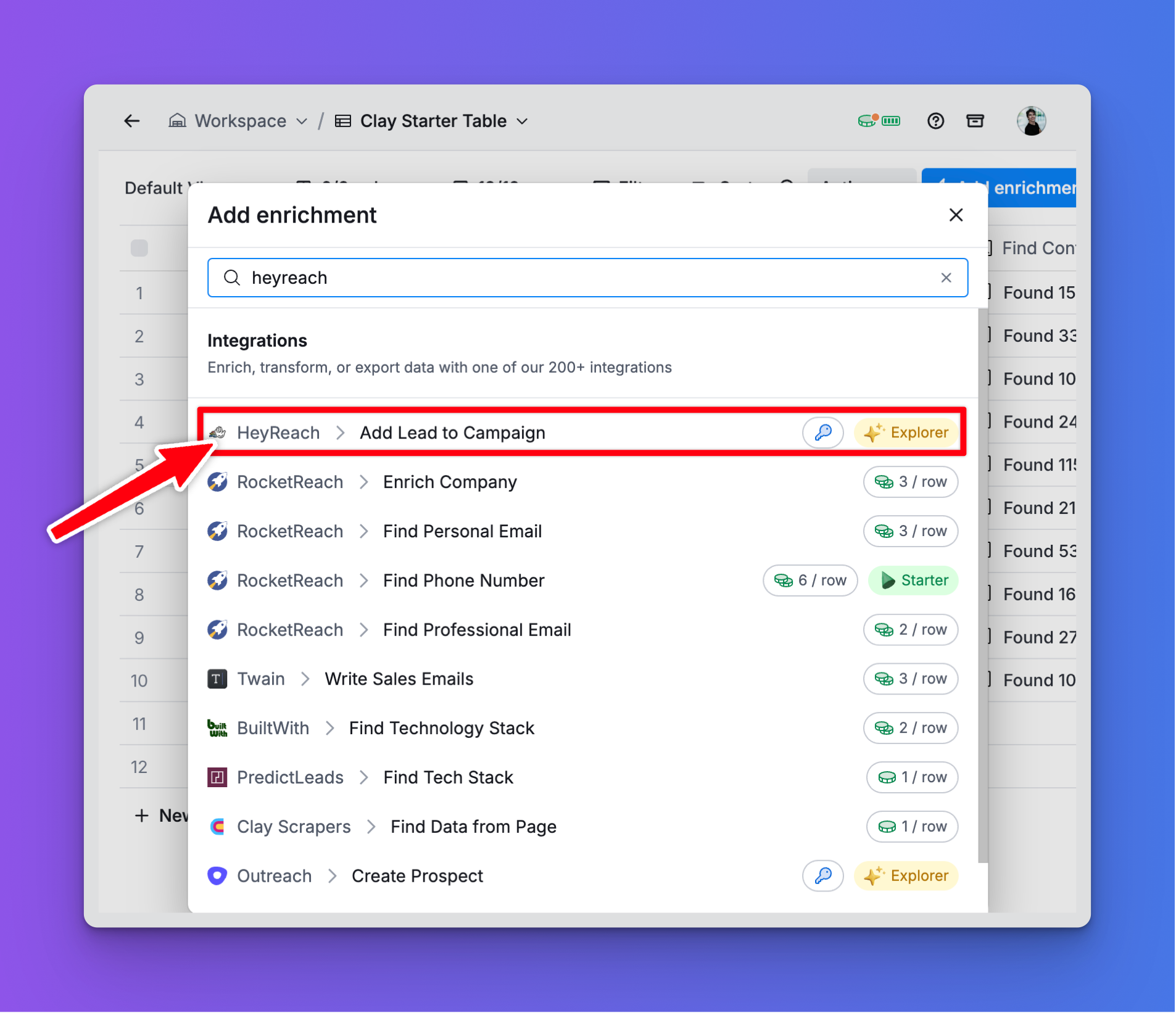
The native Clay integration stands out. Users add a "HeyReach > Add Lead to Campaign" enrichment column in Clay, connect via API key, and map data fields. With Clay's auto-update enabled, leads flow automatically into the designated HeyReach campaign without manual CSV handling. Custom personalization variables (formatted as {variable_name}) carry over from Clay into message sequences, so fields like AI-generated icebreakers or company summaries populate automatically.
Source: HeyReach
For inbound automation, the RB2B integration uses webhooks to push identified website visitors directly into HeyReach campaigns. When RB2B identifies a visitor's LinkedIn profile, the outreach sequence starts automatically.
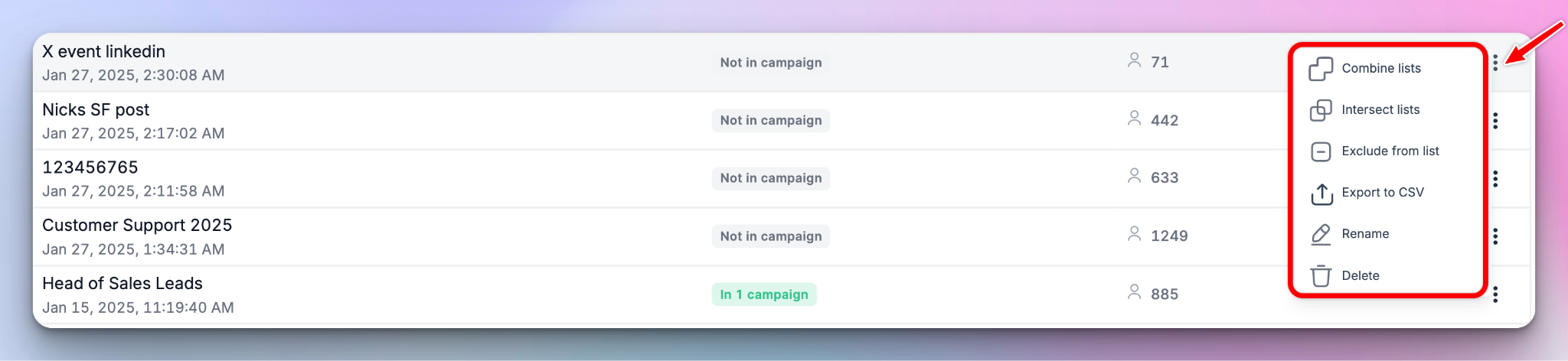
Lead management includes list operations (combine, intersect, exclude, export), automatic deduplication across campaigns, and campaign-to-campaign transfer for moving engaged prospects into different sequences.
Source: HeyReach
Unified Inbox: HeyReach consolidates all LinkedIn conversations from all senders into a single interface.
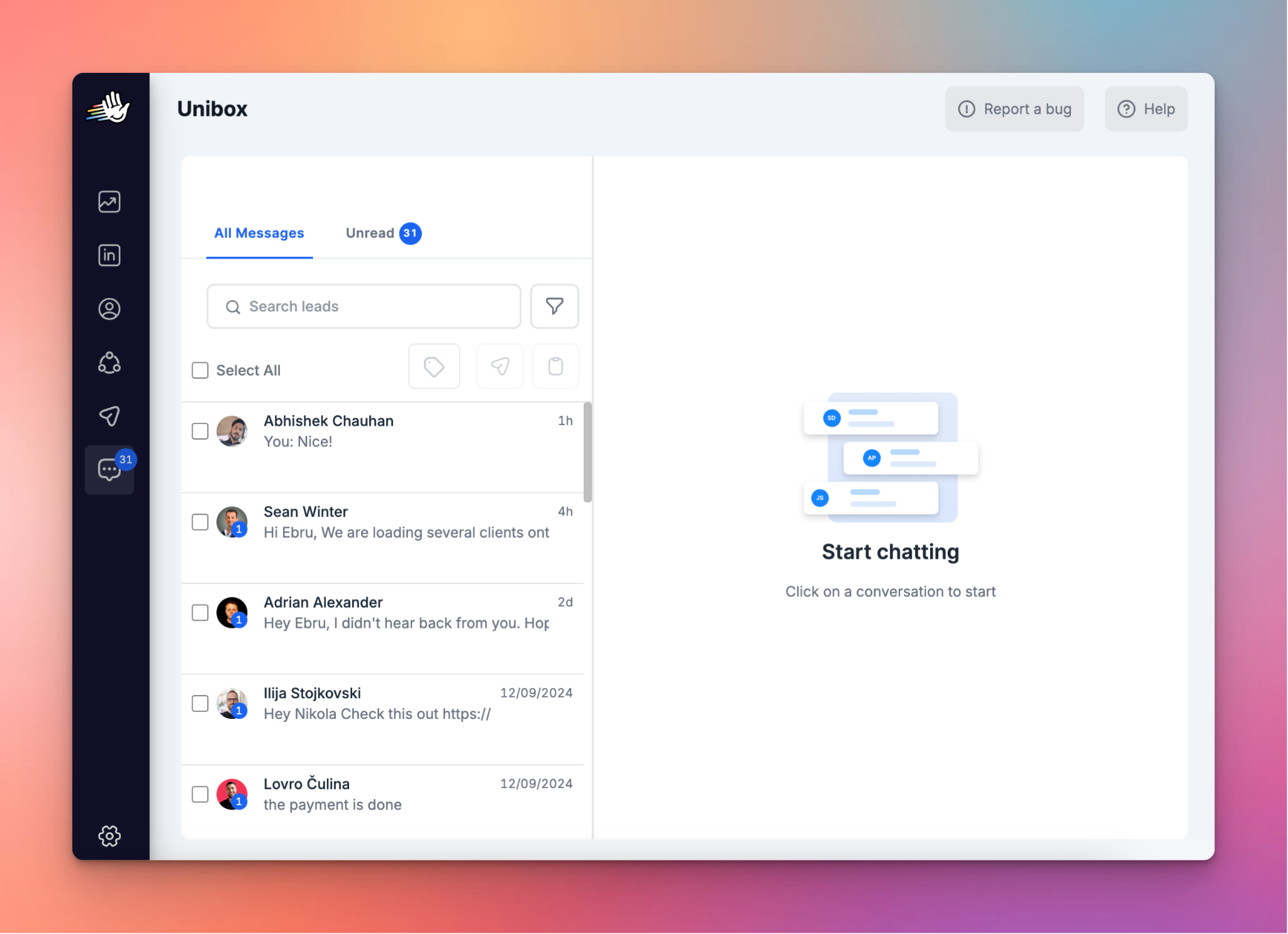
HeyReach's Unibox is where you manage replies. It compiles conversations from all LinkedIn senders in one place, covering LinkedIn messages, Sales Navigator messages, and Recruiter messages. For teams managing 10, 20, or 100 LinkedIn accounts, this eliminates logging in and out of individual profiles.
Source: HeyReach
You can filter by sender, campaign, tags, message type, and answered vs. unanswered conversations. Team members can reply on behalf of colleagues without being the account owner, and role-based permissions control who can view versus manage conversations.
A privacy feature worth noting: when connecting a LinkedIn account, you can choose whether to import all conversations from the last 30 days or track only HeyReach-generated conversations, keeping personal LinkedIn messages separate from business outreach.
The inbox supports canned messages, tag management, and bulk actions for processing multiple leads at once. You can also add leads to CRM or other campaigns directly from the inbox, though the CRM sync is one-directional (HeyReach to CRM) and triggered manually.
One limitation: attachment sending is not yet supported in the Unibox.
Multichannel Outreach: HeyReach extends beyond LinkedIn through native integrations with Instantly and Smartlead.
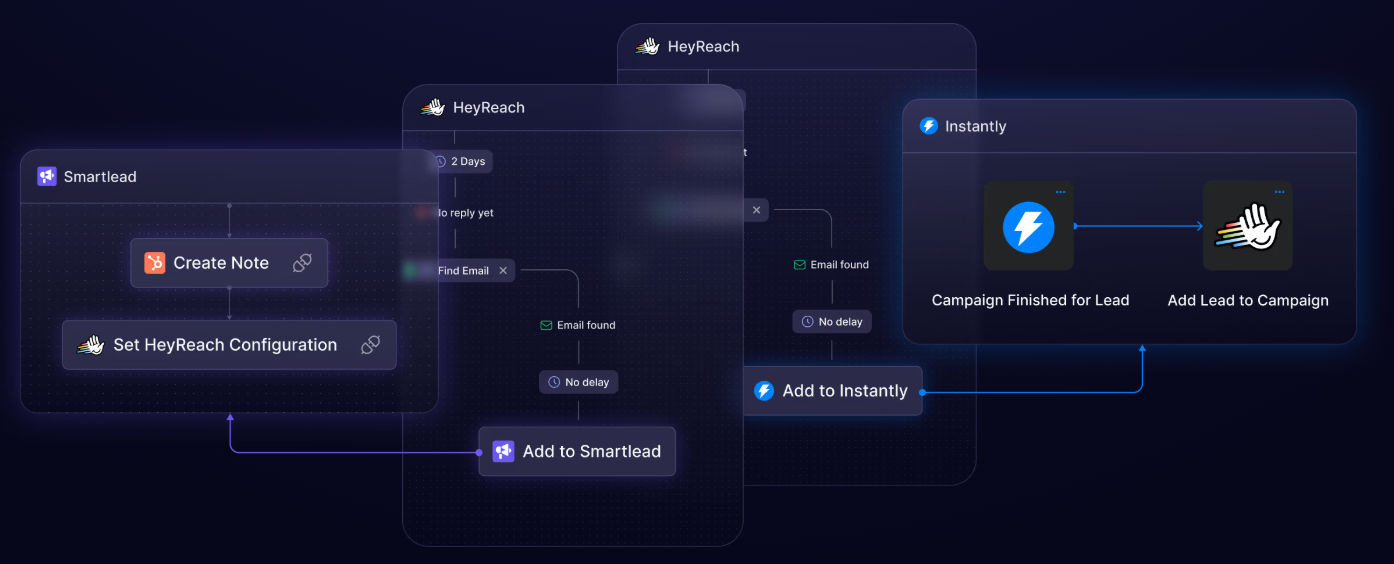
HeyReach itself is LinkedIn-only. But its multichannel outreach feature connects LinkedIn sequences with email campaigns through Instantly and Smartlead integrations. You can add an "Add to Instantly" or "Add to Smartlead" step anywhere in a LinkedIn sequence, routing prospects to email when LinkedIn outreach stalls, or back to LinkedIn when email goes unanswered.
Source: HeyReach
The Find Email action enriches leads mid-sequence by finding verified professional email addresses. It creates conditional branches: if an email is found, leads route to email platforms; if not, they continue through LinkedIn-only sequences. Each successful lookup costs 1 credit.
Cross-channel safeguards work automatically: when a lead replies on LinkedIn, email sequences pause, and when a lead replies via email, LinkedIn actions stop. This prevents the common problem of messaging someone on both channels at once.
The tradeoff: HeyReach's multichannel capabilities depend on third-party platforms. You need separate Instantly or Smartlead subscriptions, and the coordination happens through integration, not within a single system.
Integrations & API: HeyReach connects to 23+ platforms with native integrations, webhooks, and an MCP server.
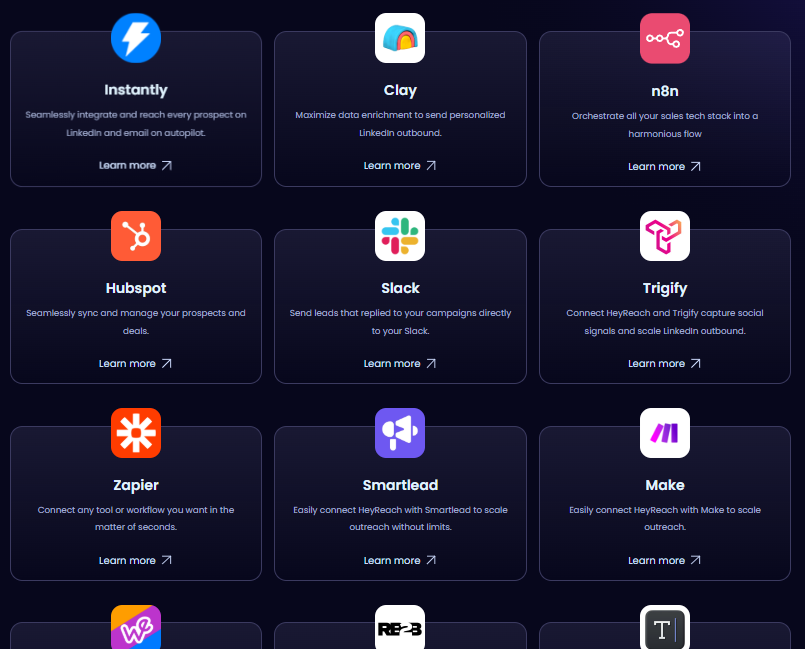
HeyReach offers native integrations with 23+ platforms spanning email sequencing (Instantly, Smartlead), enrichment (Clay, RB2B, Trigify, Persana), automation (n8n, Make, Zapier, Pabbly, Albato), CRM (HubSpot, Attio, Breakcold), and notifications (Slack).
Source: HeyReach
Webhooks push data in real time when campaign events occur (connection accepted, message replied, etc.), enabling automated workflows without polling. Webhooks can be scoped to specific campaigns rather than firing account-wide.
HeyReach's MCP (Model Context Protocol) server lets users connect AI models like Claude or ChatGPT to their workspace and use plain English to trigger actions: creating campaigns, tagging replies by sentiment, or filtering decision-makers in lead lists. Each workspace gets a unique MCP Connection URL, keeping client data segregated for agencies.
The REST API includes Postman documentation and enforces rate limits of 300 requests per minute. API keys never expire but can be deactivated manually.
Where HeyReach Falls Short
HeyReach is good at what it does: automating LinkedIn outreach at scale. But several limitations show up when you consider what go-to-market teams actually need.
No Built-in Contact Data: HeyReach automates the sending but doesn't help you find who to send to. The platform has no B2B contact database, no verified email addresses, no direct-dial phone numbers, and no company intelligence. You bring your own prospect lists from Sales Navigator, Clay, or CSV files. That means you're paying for additional data tools or limited to whatever LinkedIn's search surfaces.
No Buyer Intent or Account Prioritization: HeyReach treats all leads the same. There's no intent data showing which companies are researching solutions in your category, no signals revealing buying committee activity, and no prioritization to focus outreach on accounts likely to convert. Every campaign is a volume play.
LinkedIn-Only at Its Core: While HeyReach integrates with Instantly and Smartlead for email, the platform itself only executes LinkedIn actions. No native email sending, no phone dialing, no ad targeting, no chat. Teams running multi-channel GTM motions need to stitch together multiple subscriptions and manage coordination across platforms.
Limited Account Intelligence: HeyReach tells you whether someone accepted your connection request. It doesn't tell you why your deal with their company is stalling, who else in the buying committee you should engage, or what signals from your CRM and conversation history suggest about the best next step. The platform offers no deal context or buyer behavior analysis beyond LinkedIn engagement metrics.
No CRM Intelligence or Enrichment: The CRM sync is one-directional and click-triggered. HeyReach doesn't enrich CRM records, doesn't monitor data quality, and doesn't provide the firmographic, technographic, or organizational data that sales teams need for account planning. Your CRM stays as incomplete as it was before.
Agency-Tier Features Gated Behind Higher Plans: Whitelabel branding and done-for-you onboarding are restricted to Agency ($999/month) and Unlimited ($1,999/month) plans. Agencies on the Growth plan ($79/month per sender) can't access these, and at $79 per sender, the cost for a 10-sender operation ($590/month) approaches the Agency tier without the agency-specific features.
These gaps aren't failures of design. They reflect HeyReach's deliberate focus on LinkedIn automation. But for teams whose GTM strategy extends beyond LinkedIn, the gaps add up to a platform that handles one piece of the puzzle while leaving the rest to other tools.
Top HeyReach Alternative for Full GTM Intelligence: ZoomInfo
ZoomInfo addresses HeyReach's limitations by providing the intelligence and data infrastructure that powers a go-to-market operation across channels. Where HeyReach automates LinkedIn actions, ZoomInfo provides the foundation that makes those actions (and every other GTM motion) more informed: verified contact data, buyer intent signals, conversation intelligence, and AI that understands deal context.
The B2B Data Platform: ZoomInfo gives your team verified contacts, direct dials, and company intelligence at a scale no LinkedIn search can match.
HeyReach requires you to bring your own prospect lists. ZoomInfo provides them. The platform covers 500M contacts, 100M companies, 135M+ verified phone numbers, 120M direct-dial phone numbers, and 200M+ verified business email addresses, verified through a multi-source pipeline backed by 300+ human researchers with up to 95% accuracy on first-party data.
Beyond contact information, ZoomInfo's data spans firmographics (industry, headcount, revenue, parent-child hierarchies), technographics (30,000+ technologies across 200+ categories at 30M+ companies), org charts with department structure, and 300+ company attributes for market segmentation.
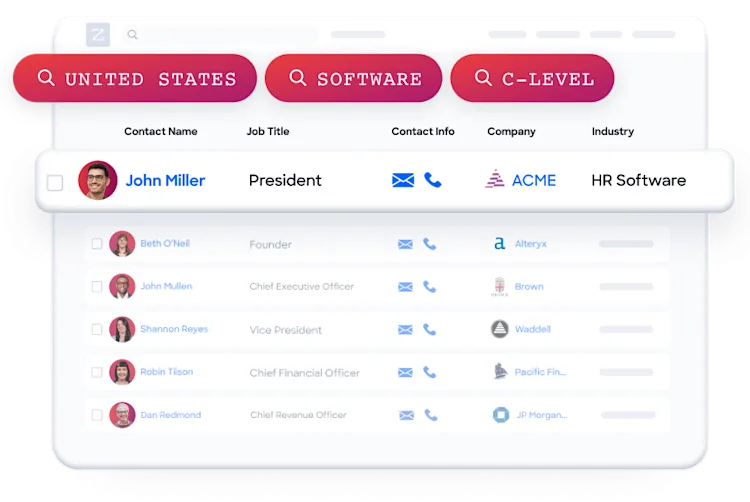
This isn't a static database. ZoomInfo runs automated ML scanning of 28 million site domains daily, and a community of 200,000+ ZoomInfo Lite users shares business contact updates back to the platform.
The quality gap shows in external validation. In a Fortune 500 competitive RFP analyzing 25 million contacts across vendors, the independent consultant concluded that "no other competitor came even close." ZoomInfo was named a Leader in Forrester's Wave for Intent Data Providers (Q1 2025), a Leader in Gartner's MQ for ABM Platforms (2024 & 2025), and holds 133 No. 1 rankings on G2.
For a team using HeyReach, this is the difference between running LinkedIn campaigns against whatever Sales Navigator surfaces and targeting verified decision-makers with accurate direct dials and emails across your entire addressable market.
"ZoomInfo gives us the information we need to execute. We don't have to go through and spend our time digging. It's already there, so we can be three steps ahead." (Vensure)
The GTM Context Graph: ZoomInfo's intelligence layer captures why deals move, not just that they moved.
HeyReach tracks LinkedIn engagement: who accepted, who replied, who went silent. ZoomInfo's GTM Context Graph, processing 1.5B+ data points daily, works at a different level. It combines ZoomInfo's third-party data with a customer's CRM records, conversation transcripts, email threads, and behavioral signals into a single intelligence layer that maps connections between signals and outcomes.
A CRM records that a deal moved from Stage 3 to Stage 4. Conversation intelligence transcribes what the VP of Finance said on the last call. Intent data logs a spike in competitor research. The GTM Context Graph reasons across all three to surface why the deal moved and what should happen next.
This intelligence powers Buyer Intent Data that tracks signals from 210 million IP-to-Organization pairings and 6 trillion+ new keyword-to-device pairings monthly. Guided Intent, exclusive to ZoomInfo, identifies topics historically correlated with deal success rather than requiring you to guess which keywords to monitor.
WebSights resolves anonymous website traffic to companies and buying team members, with Automatic Traffic Filtering to separate real visitors from bots.
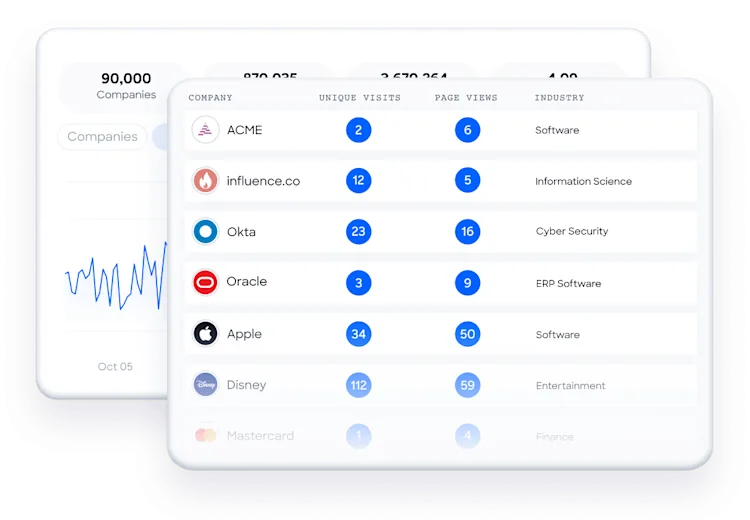
For teams using HeyReach, this means shifting from "send messages to everyone on this list" to "prioritize accounts showing buying signals and engage the right people at the right time."
"That combination of our internal CRM data, external signals, and AI that's given all that context has helped us craft very specific account- and persona-based messages. And people have responded to them right away." (Seismic)
Universal Access: ZoomInfo's intelligence works in any tool through GTM Workspace, GTM Studio, APIs, and MCP.
HeyReach is one application for one channel. ZoomInfo delivers its intelligence through three surfaces, reaching every team and workflow.
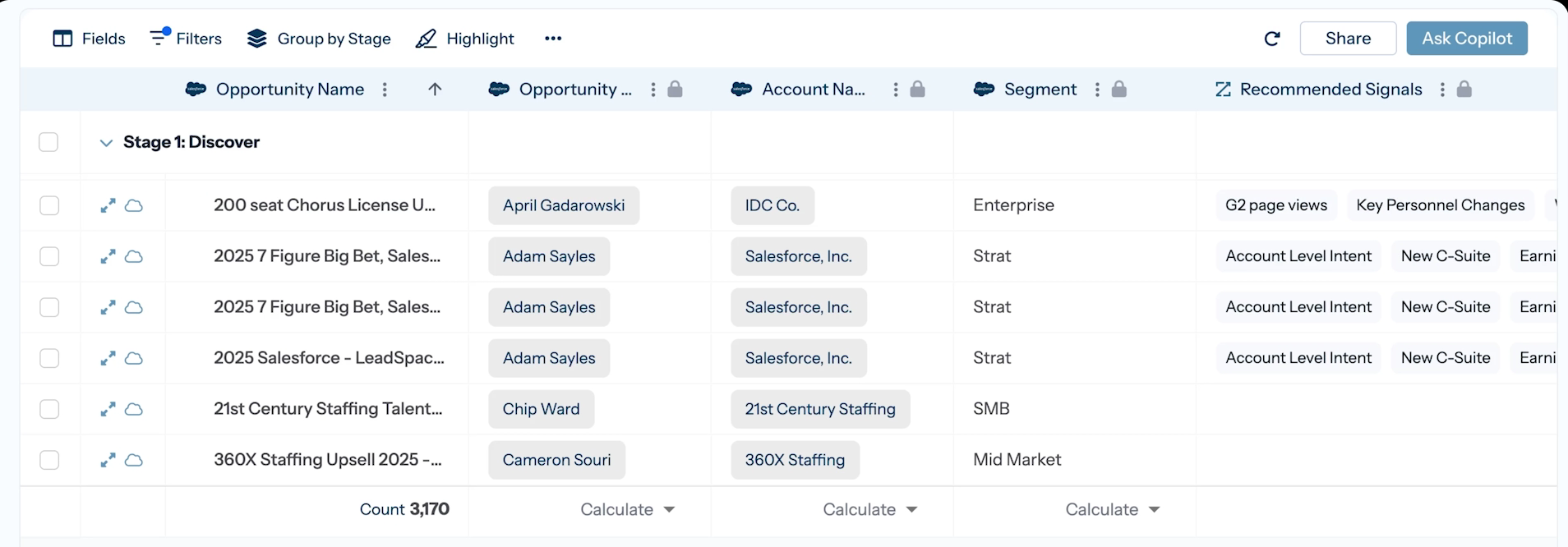
GTM Workspace is the seller front-end: a workspace where prioritized accounts, AI-drafted outreach, and deal execution come together. Built on Anthropic's Claude, its AI agents handle account research, outreach generation, signal monitoring, and CRM updates. The Action Feed delivers a live stream of in-market buyers matched to your target criteria, with pre-drafted actions on every signal. Views combine CRM data with real-time buying signals in dynamic, spreadsheet-style interfaces.
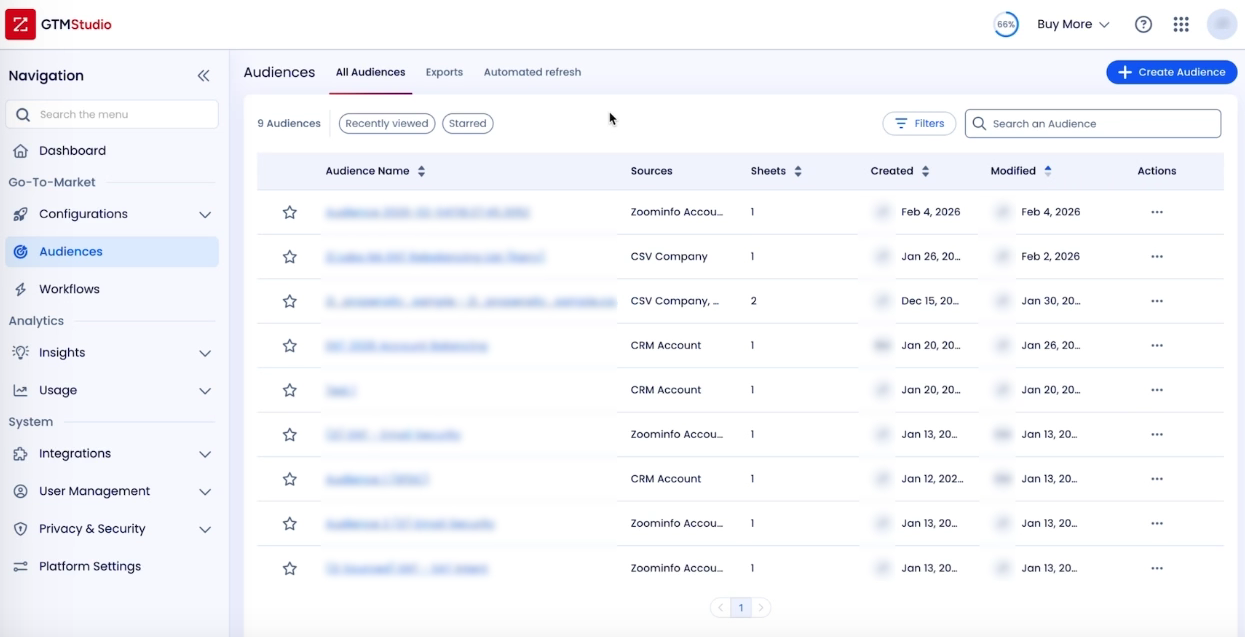
GTM Studio serves marketers, RevOps, and GTM engineers with an orchestration canvas. Teams build audiences using natural language, enrich with first- and third-party data, and activate multi-channel plays (email, calls, ads, direct mail) triggered by buyer behavior. Expansion plays that used to take 3 weeks now launch in 30 minutes without engineering support.
For teams that build beyond ZoomInfo's own products, Enterprise APIs and MCP expose the same intelligence to any custom agent, internal tool, or partner platform. ZoomInfo's MCP server is listed in the Claude directory and currently supports Claude and ChatGPT. API access is included in all relevant plans.
The key point: all three surfaces draw from one GTM Context Graph. Same data, same reasoning, same intelligence, regardless of where you access it.
"Anything that minimizes our team's need to switch contexts is beneficial. ZoomInfo offers a unified view, eliminating the need to navigate between systems." (Spekit)
Proven Results at Scale: ZoomInfo serves 35,000+ companies with documented, measurable impact.
ZoomInfo is a public company (NASDAQ: GTM) with $1.25 billion in annual revenue, 35,000+ customers, and 1,921 customers spending $100K+ annually. Named customers include Adobe, Microsoft, Snowflake, PayPal, Deloitte, and Thomson Reuters.
Security and compliance certifications include ISO 27001, ISO 27701, SOC 2 Type II, TRUSTe GDPR and CCPA, all renewed annually. ZoomInfo is a registered data broker in California and Vermont with a dedicated Trust Center.
Customer results: Seismic's sales team attributed 39% of active pipeline to ZoomInfo signals and saw 54% productivity gains. Snowflake achieved 90% higher opportunity open rates and 2x customer conversion rates on accounts monitored with ZoomInfo-powered scores. Thomson Reuters increased closed-won deals by 40%.
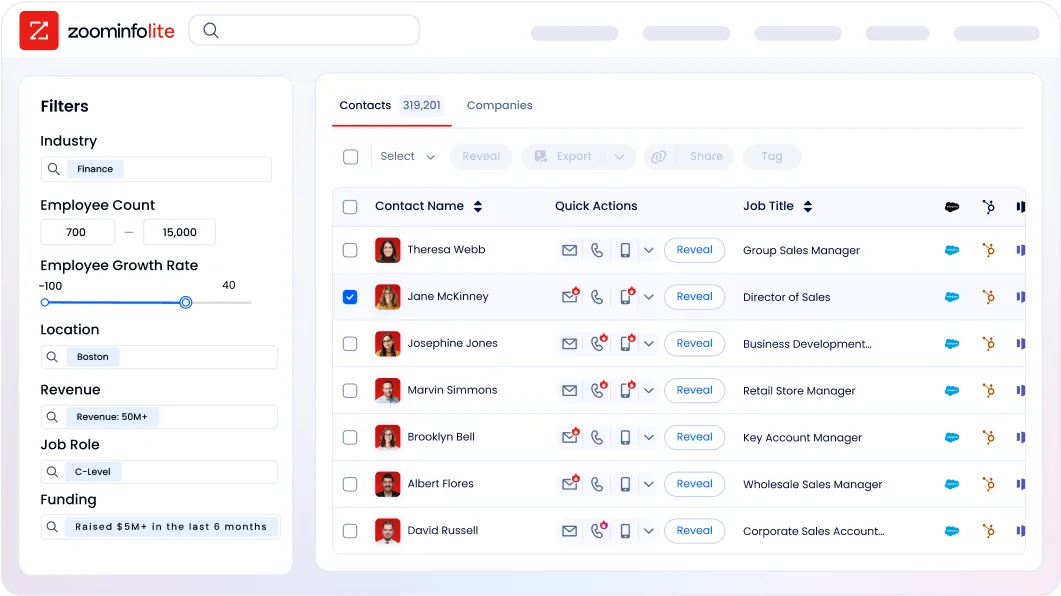
ZoomInfo also offers a permanent free tier. ZoomInfo Lite includes access to the B2B database with 10 monthly export credits, individual and company searches, the ReachOut Chrome Extension, WebSights Lite (up to 10 website visitor reveals per day), built-in email sending, and HubSpot integration. No credit card, no time limit.
"Without ZoomInfo, it would be extremely difficult (if not impossible) to achieve our business objectives. Without it, we wouldn't be able to understand the market, have the right contact data, and make meaningful connections." (Smartsheet)
HeyReach or ZoomInfo: Comparison Summary
Aspect | HeyReach | ZoomInfo |
|---|---|---|
Primary focus | LinkedIn outreach automation | AI GTM platform |
Target users | Agencies, sales teams, GTM operators | Enterprise sales, marketing, RevOps |
B2B contact database | None (bring your own lists) | 500M contacts, 200M+ verified email addresses, 135M+ verified phones |
LinkedIn automation | Multi-sender rotation, sequences, unified inbox | Outreach execution via GTM Workspace |
Buyer intent signals | Not available | 210M IP-to-Org pairings, Guided Intent |
Multi-channel execution | Via Instantly/Smartlead integration | Native email, phone, ads, chat, LinkedIn |
AI intelligence | MCP server, ChatGPT message generation | GTM Context Graph, AI agents, AI-drafted outreach |
CRM enrichment | One-directional, manual push | Automated enrichment, deduplication, waterfall |
Conversation intelligence | Not available | Chorus (call recording, analysis, deal intelligence) |
Free tier | 14-day trial (no credit card) | ZoomInfo Lite (permanent, no credit card) |
Pricing model | Flat fee per sender tier | Custom-quoted, seat-and-credit-based |
Entry pricing | $79/month (1 sender) | Custom quote (Lite is free) |
Agency features | Whitelabel, workspaces, permissions | Team-based with enterprise controls |
Security certifications | GDPR compliance | ISO 27001, ISO 27701, SOC 2 Type II, GDPR, CCPA |
Best for | Scaling LinkedIn outreach at a flat cost | GTM intelligence, data, and execution |
Final Verdict
The choice between HeyReach and ZoomInfo depends on what your go-to-market motion requires.
Choose HeyReach if your outreach strategy lives on LinkedIn and your primary challenge is scale. It's the right tool for agencies managing LinkedIn campaigns across multiple client accounts, sales teams that already have their prospect data and just need to automate sending, and GTM operators who've built their stack around Clay and Instantly and need a LinkedIn execution layer. The flat-fee pricing makes the economics work for teams running 10, 50, or 100+ LinkedIn accounts, and the unified inbox keeps everything manageable from one screen.
Choose ZoomInfo if you need the intelligence behind the outreach, not just the automation. ZoomInfo fits when you need verified contact data at scale, buyer intent signals to prioritize your accounts, AI that understands deal context from your CRM and conversation history, and multi-channel execution across email, phone, ads, and LinkedIn from one platform. For teams where LinkedIn is one channel among many, and where knowing who to contact and when matters as much as sending itself, ZoomInfo provides the foundation that makes every outreach motion more informed.
Get started with ZoomInfo Lite for free here.
HeyReach solves the LinkedIn automation problem well. ZoomInfo solves the go-to-market intelligence problem. Where your team's biggest gap is determines which platform deserves the investment.
HeyReach FAQ
What does HeyReach cost?
HeyReach uses flat-fee pricing based on the number of LinkedIn senders. The Growth plan starts at $79/month for 1 sender, with variable pricing for additional senders ($395/month for 5, $590/month for 10). The Agency plan costs $999/month for 50 senders and includes whitelabel branding, done-for-you onboarding, and a dedicated Slack channel. The Unlimited plan is $1,999/month for unlimited senders. All plans offer quarterly (15% discount) and yearly (25% discount) billing options.
Does HeyReach offer a free plan or free trial?
HeyReach offers a 14-day free trial with no credit card required. During the trial you can explore all features, though some paid-plan functionality may be restricted. There is no permanent free plan. Each email address can only be used for one trial, and accounts that have previously had a trial or paid subscription cannot register again. ZoomInfo, by contrast, offers ZoomInfo Lite as a permanent free tier with access to its B2B database, 10 monthly export credits, and website visitor identification.
Is HeyReach safe to use with LinkedIn?
HeyReach takes several precautions to protect LinkedIn accounts. Each account gets a dedicated static residential proxy that is never shared. The platform freezes accounts automatically when they approach LinkedIn's weekly connection request limits and stays within LinkedIn's 200-action-per-day limit. Recommended daily limits are 20-25 connection requests per sender. However, HeyReach is not associated with or endorsed by LinkedIn Corporation, so there is inherent platform risk common to all LinkedIn automation tools.
How does HeyReach's sender rotation work?
When you create a campaign, you assign multiple LinkedIn senders. HeyReach rotates sending between them, distributing the workload so no single account exceeds safe daily limits. Daily limits apply per LinkedIn sender, not per campaign. If a sender is active in three campaigns, limits are shared proportionally. The system includes deduplication that prevents the same prospect from being contacted by multiple senders.
Does HeyReach have a built-in contact database?
No. You need to import prospect lists from external sources like LinkedIn Sales Navigator, Clay, RB2B, or CSV files. The platform focuses on automating LinkedIn outreach, not providing contact data. ZoomInfo offers 500 million contacts, 200 million verified business email addresses, and 135 million verified phone numbers as part of its platform.
Can HeyReach do multi-channel outreach beyond LinkedIn?
HeyReach itself only executes LinkedIn actions. For email, it offers native integrations with Instantly and Smartlead, letting you route leads from LinkedIn sequences into email campaigns. The Find Email action identifies verified email addresses mid-sequence for 1 credit per lookup. You need separate subscriptions to those email platforms. ZoomInfo provides native multi-channel execution across email, phone, ads, chat, and LinkedIn within one platform.
What integrations does HeyReach support?
HeyReach offers native integrations with 23+ platforms including Clay, Instantly, Smartlead, RB2B, Trigify, Persana, HubSpot, Slack, n8n, Make, Zapier, Pabbly, Albato, Attio, and Breakcold. It also provides a REST API with Postman documentation, webhook infrastructure for real-time event-driven workflows, and an MCP server for connecting AI agents like Claude and ChatGPT to the platform.
Who is HeyReach best suited for?
HeyReach suits agencies managing LinkedIn outreach across multiple client accounts, sales teams with 5+ LinkedIn accounts that need sender rotation, and growth teams that have built their GTM workflows around Clay and need a LinkedIn execution layer. Individual sellers or teams needing only 1-2 LinkedIn accounts may not get enough value from the flat-rate pricing, and teams that need data intelligence or multi-channel execution should consider broader platforms.
Researching HeyReach? These comparisons and alternatives help you decide:
