
Choosing between HeyReach and SalesRobot for LinkedIn outreach often comes down to five questions:
Do you need to scale outreach volume across many LinkedIn accounts, or personalize each touchpoint with AI-generated voice and video?
Is LinkedIn your only outbound channel, or do you need native email sequences in the same platform?
Are you managing outreach for one sales team or coordinating campaigns across dozens of agency clients?
How critical is the quality of your prospect data versus the efficiency of your sending?
Do you need a tool that delivers messages, or a platform that tells you which messages to send and to whom?
In short, here's what we recommend:
HeyReach is the tool for agencies and sales teams that need to scale LinkedIn outreach by rotating messages across multiple sender accounts. Its unlimited senders for one fixed cost model lets you connect dozens of LinkedIn profiles, auto-rotate sending between them, and manage all conversations from a unified inbox without logging in and out of accounts.
With native Clay integration for data enrichment and an MCP server for AI agent connections, HeyReach is built for teams running high-volume LinkedIn campaigns. It handles LinkedIn only; email outreach requires separate integration with Instantly or Smartlead, and the platform provides no prospecting data of its own.
SalesRobot focuses on AI personalization and native multichannel outreach. It sends AI-personalized voice notes and video messages, and its AI Appointment Setter can handle entire conversations on its own, from first reply to a booked meeting.
With built-in cold email automation and cross-channel reply detection that pauses all follow-up when a prospect responds on any channel, SalesRobot removes the need for a separate email tool.
The trade-off: per-account pricing makes it more expensive than HeyReach for agencies running 50+ LinkedIn accounts, and its email deliverability doesn't match dedicated cold email platforms.
Both platforms automate LinkedIn outreach well. But automating the sending solves only half the problem. The other half (knowing who to contact, when to reach out, and what context to reference) requires B2B intelligence that neither tool provides.
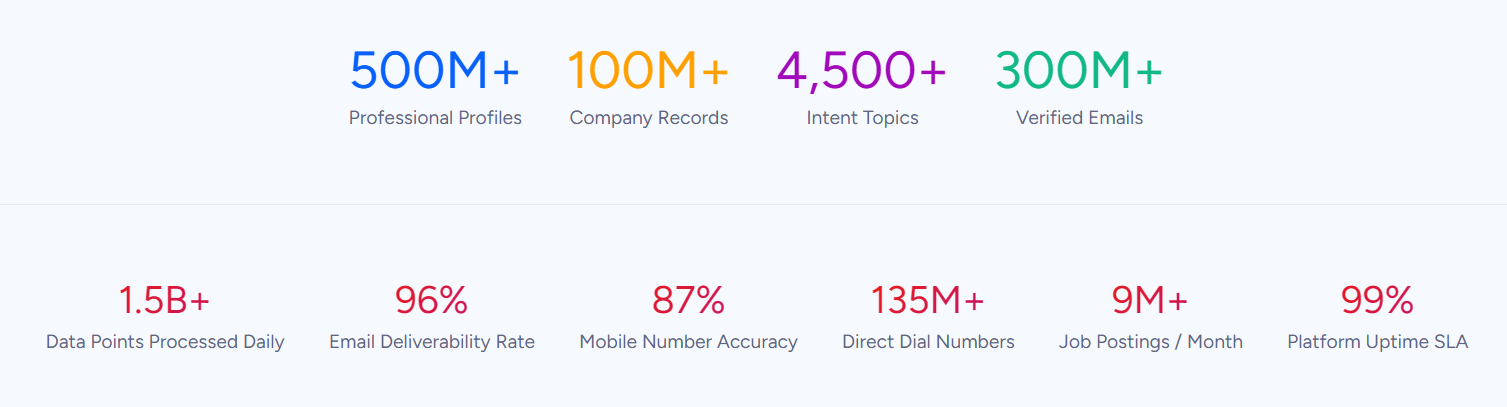
ZoomInfo is a B2B data and go-to-market platform with 500M contacts, 100M companies, 135M+ verified phone numbers, and 200M+ verified business email addresses. Its GTM Context Graph processes 1.5B+ data points daily, combining this data with your CRM records, conversation transcripts, and behavioral signals to identify not just who your buyers are, but when they're researching solutions.
Whether your team runs outreach through HeyReach, SalesRobot, or any other tool, ZoomInfo's API and MCP access deliver verified contacts and real-time buyer intent to power your campaigns.
If you want to target the right prospects at the right time, see how ZoomInfo works.
HeyReach vs. SalesRobot at a glance
HeyReach | SalesRobot | ZoomInfo | |
|---|---|---|---|
Primary focus | LinkedIn automation at scale | LinkedIn + email with AI personalization | B2B data, buyer intent, and go-to-market intelligence |
Pricing model | Flat rate by sender tier ($79-$1,999/mo) | Per LinkedIn account ($39-$79/mo annually) | Custom-quoted, seat-and-credit-based |
Multichannel | LinkedIn only; email via Instantly/Smartlead | Native LinkedIn + email in one platform | Omnichannel via GTM Workspace and GTM Studio |
AI capabilities | MCP for AI agents, ChatGPT message generation | AI voice notes, video avatars, AI Appointment Setter | GTM Context Graph, AI account intelligence, AI-drafted outreach |
Sender rotation | Unlimited multi-sender rotation | Team management with deduplication | N/A (intelligence layer, not sending tool) |
B2B contact data | None; relies on external sources | None; relies on external sources | 500M contacts, 200M+ verified emails, 135M+ verified phones |
Buyer intent signals | None | None | Real-time intent from 210M IP-to-org pairings |
Agency features | Whitelabel, workspaces, flat-rate pricing | Whitelabel, volume discounts, bulk campaigns | Enterprise API and MCP for custom deployments |
Free trial | 14 days, no credit card | 14 days, no credit card | 7-day trial + permanent free Lite tier |
Best for | Agencies and teams scaling LinkedIn volume | Teams wanting AI-personalized multichannel outreach | Teams needing verified data and intelligence to power any outreach tool |
Scaling volume vs. personalizing every touch
HeyReach and SalesRobot solve the LinkedIn outreach problem from opposite directions.
HeyReach is built around volume. When LinkedIn limited connection requests to 20-40 per day in May 2023, the only way to maintain outreach scale was to add more senders. HeyReach lets teams connect unlimited LinkedIn accounts and auto-rotate sending between them.
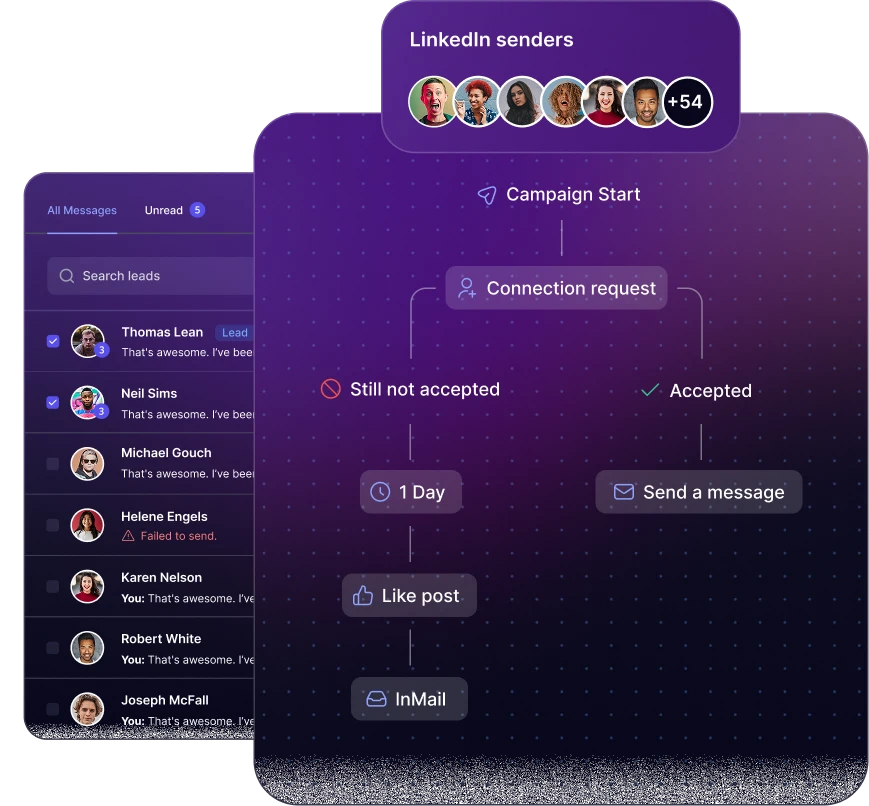
Assign ten senders to a campaign, each sending 20 connection requests per day, and you reach 200 prospects daily instead of 20.
The platform's anti-duplication logic ensures no prospect gets contacted twice, even across different campaigns and workspaces.
SalesRobot takes the opposite approach: make each message harder to ignore. Instead of scaling senders, SalesRobot scales personalization through AI-cloned voice notes and AI video avatars.
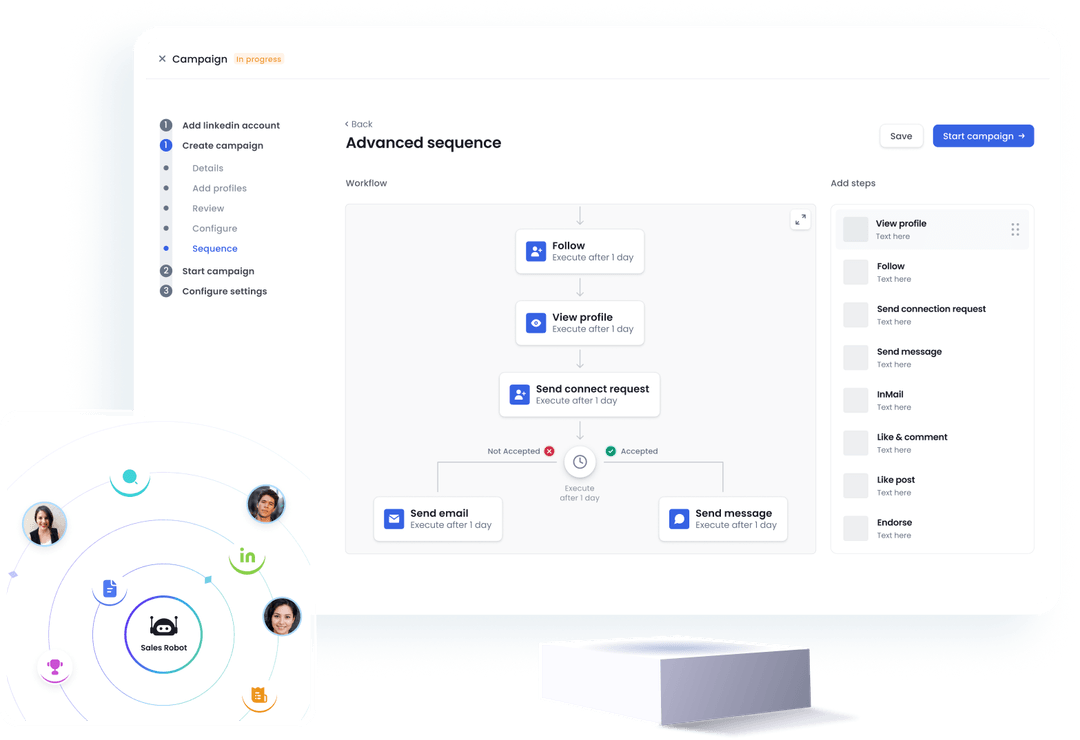
Record one 20-second voice sample, and SalesRobot generates a unique audio note in your cloned voice for each prospect, addressing them by name and company. The same works for video: one 30-45 second reference recording creates a reusable avatar that lip-syncs personalized scripts per recipient.
The right approach depends on your outreach philosophy. If you believe in casting a wide net with personalized text messages, HeyReach's sender rotation gives you volume. If you believe fewer, richer touchpoints produce better conversations, SalesRobot's AI media is the differentiator.
Neither approach addresses a more basic question: are you reaching the right people in the first place?
Multichannel outreach: native vs. integrated
When a prospect ignores your LinkedIn connection request, what happens next matters. The two platforms handle it differently.
SalesRobot builds email directly into the campaign sequence. LinkedIn and email steps sit side by side in the same drip, with conditional branching based on whether a prospect accepted your connection. If they didn't, the sequence switches to email automatically.
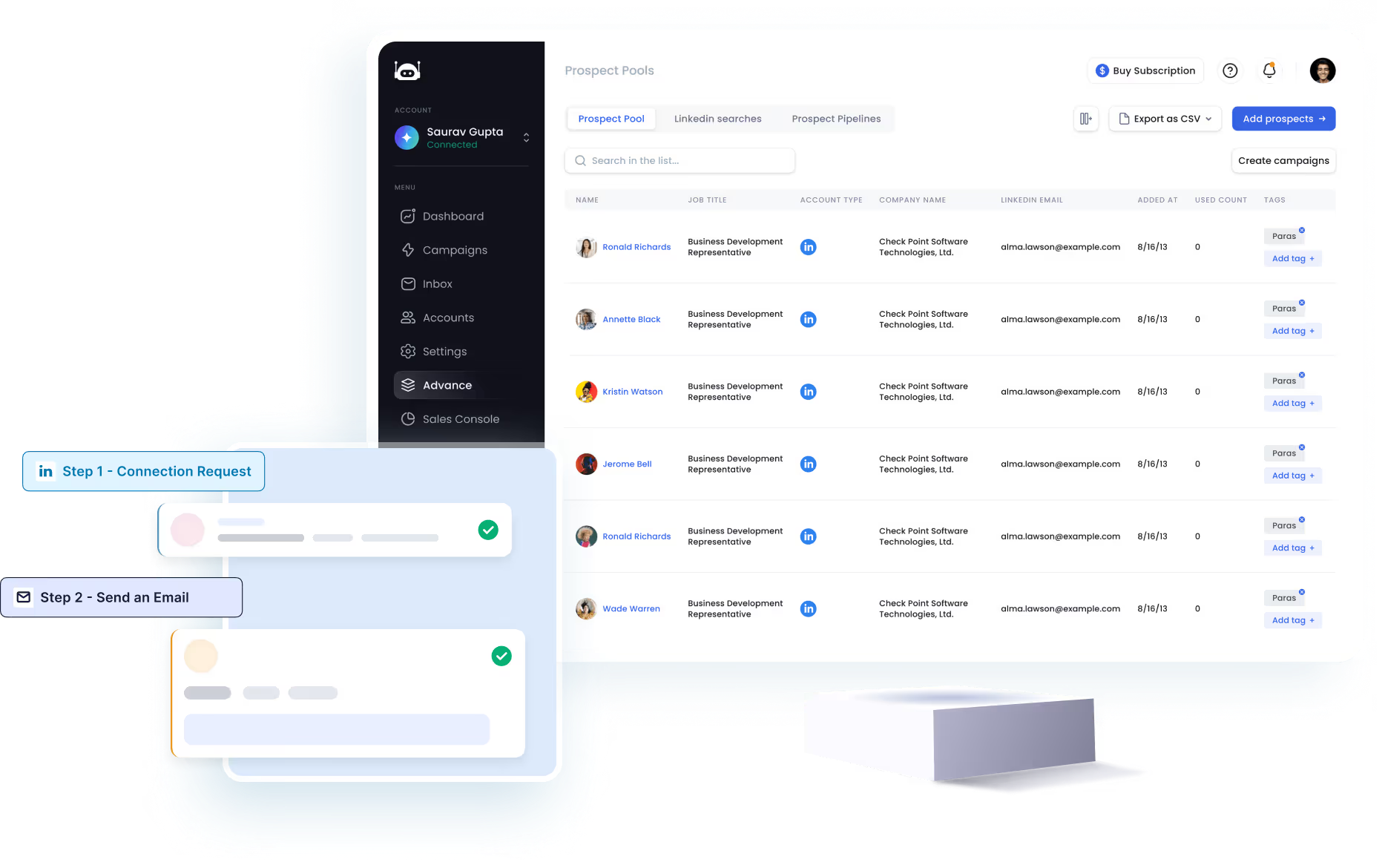
Source: SalesRobot
Smart Reply Detection monitors both channels: a reply on LinkedIn pauses the email sequence, and a reply to email pauses LinkedIn follow-up. SalesRobot claims combining LinkedIn and email triples response rates compared to LinkedIn alone.
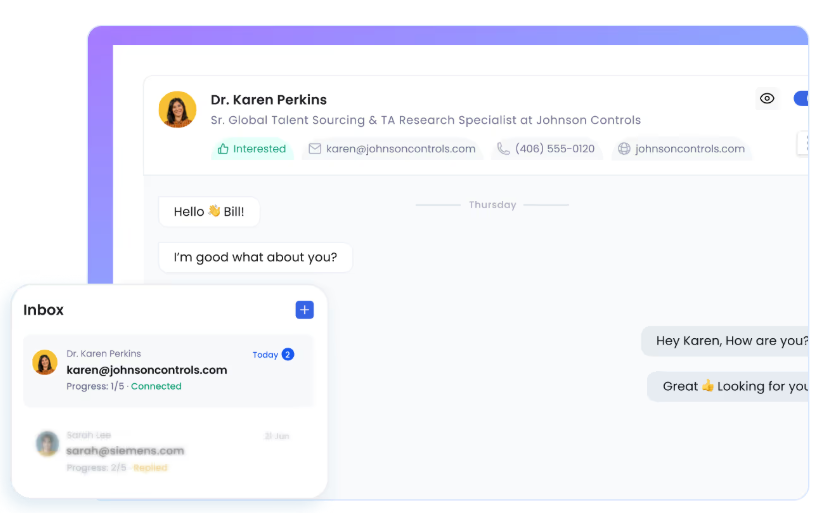
Source: SalesRobot
Email accounts connect through Gmail or Outlook via one-click OAuth, or any SMTP/IMAP provider. LeadMagic is built in to discover prospect email addresses from LinkedIn lists without leaving the platform.
HeyReach keeps LinkedIn and email separate by design. The platform offers native integrations with Instantly and Smartlead, letting users add an "Add to Instantly" or "Add to Smartlead" step anywhere in a LinkedIn sequence.
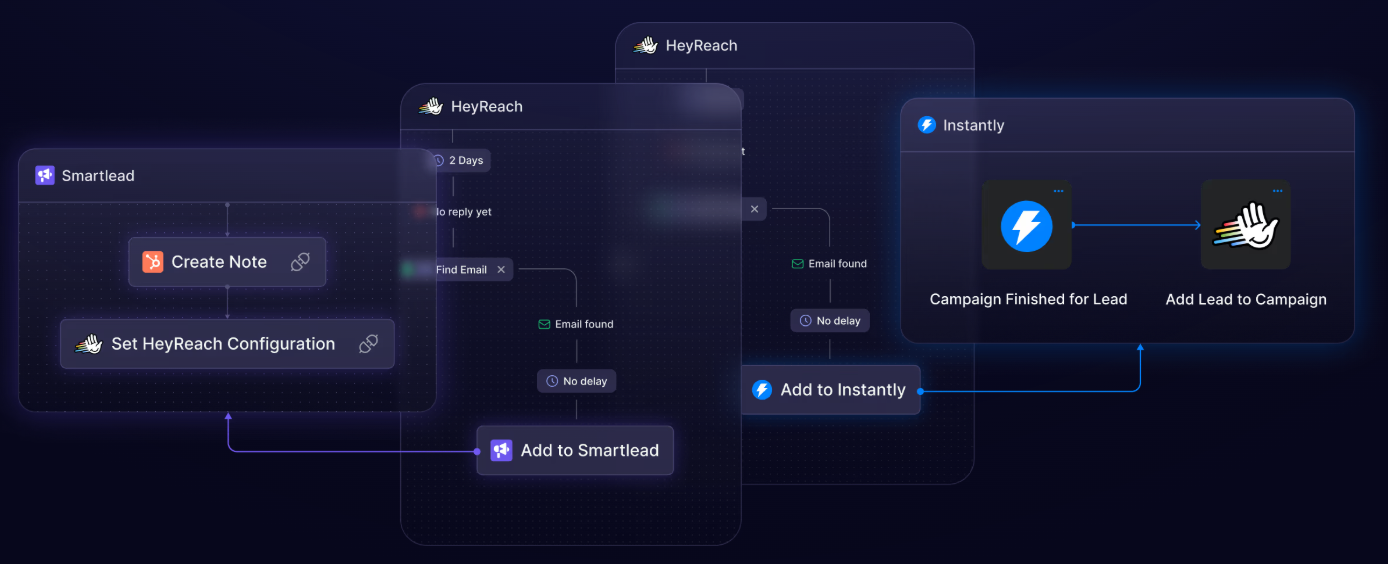
Source: HeyReach
When a prospect doesn't accept your connection request, HeyReach can push them to your email tool automatically.
The Find Email action discovers verified professional email addresses within HeyReach campaigns, routing leads based on whether an email was found. When a lead replies on LinkedIn, email sequences pause automatically, and vice versa.
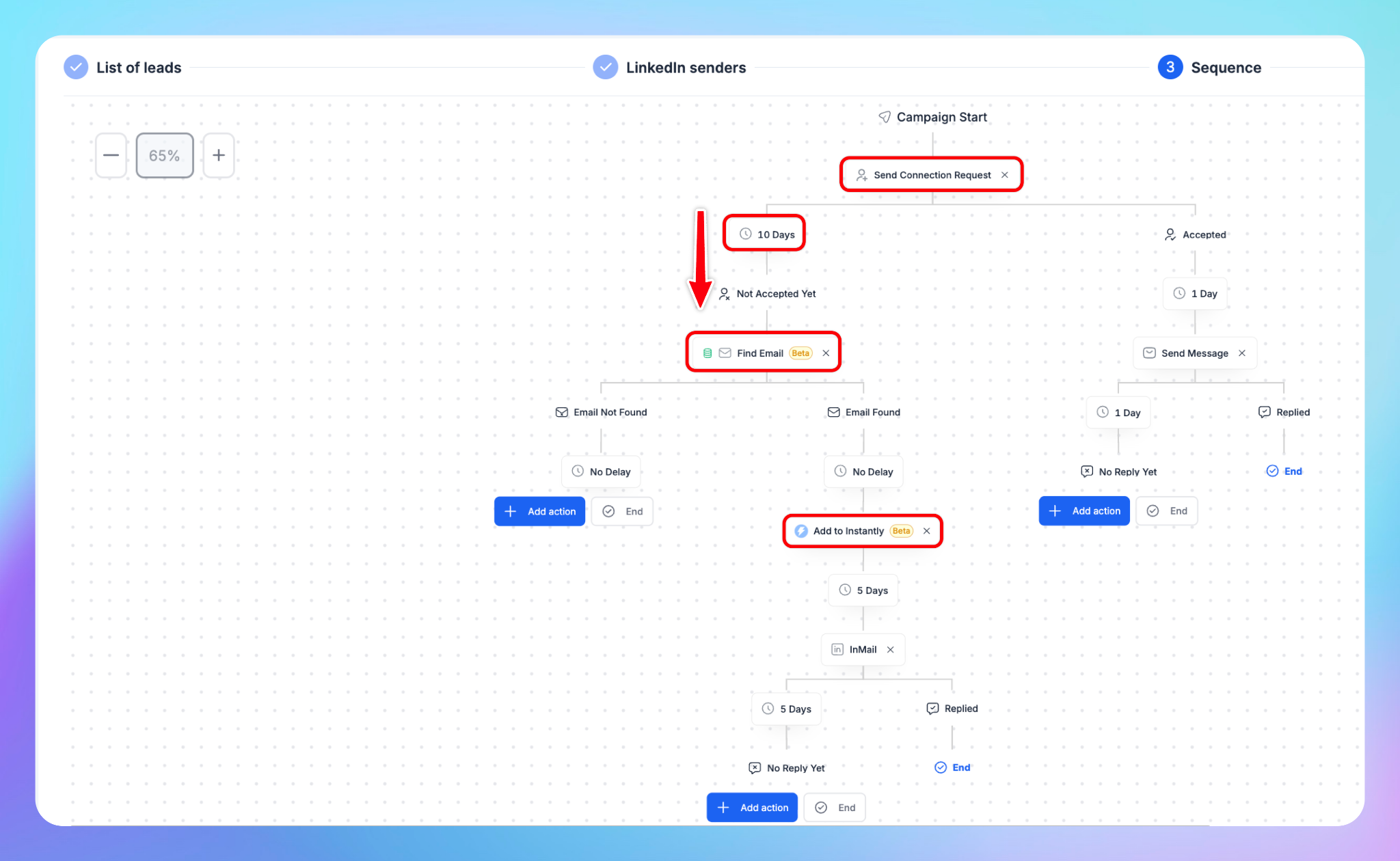
Source: HeyReach
SalesRobot's integrated approach is simpler to set up. HeyReach's modular approach pairs LinkedIn outreach with dedicated cold email tools (Instantly and Smartlead specialize in deliverability) at the cost of a second subscription and slightly more complex workflows. For teams already invested in a dedicated email platform, HeyReach avoids duplicating that capability. For teams starting from scratch, SalesRobot's combined approach means less setup.
The intelligence gap neither tool fills
Here's what both HeyReach and SalesRobot take for granted: that you already know who to contact.
Both platforms import prospects from LinkedIn Search, Sales Navigator, CSV uploads, or third-party enrichment tools. They don't verify whether that data is accurate, they don't tell you whether those prospects are in-market, and they don't provide the organizational context that makes outreach relevant.
A sales team imports 5,000 leads from Sales Navigator into HeyReach or SalesRobot. How many of those contacts have changed jobs since the list was built? How many email addresses will bounce? Which of those 5,000 companies are researching solutions right now, versus just matching a title and industry filter? Neither tool answers these questions, because neither provides B2B data or buyer intent signals.
ZoomInfo fills this gap. Its data platform maintains 500M contacts and 100M companies through a verification pipeline backed by 300+ human researchers, achieving up to 95% accuracy on first-party data.
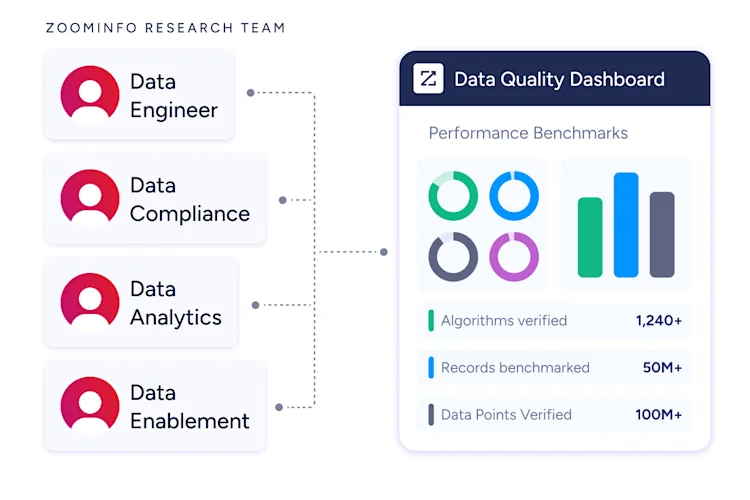
Source: ZoomInfo
In a Fortune 500 competitive RFP analyzing 25 million contacts across vendors, the independent consultant concluded that "no other competitor came even close."
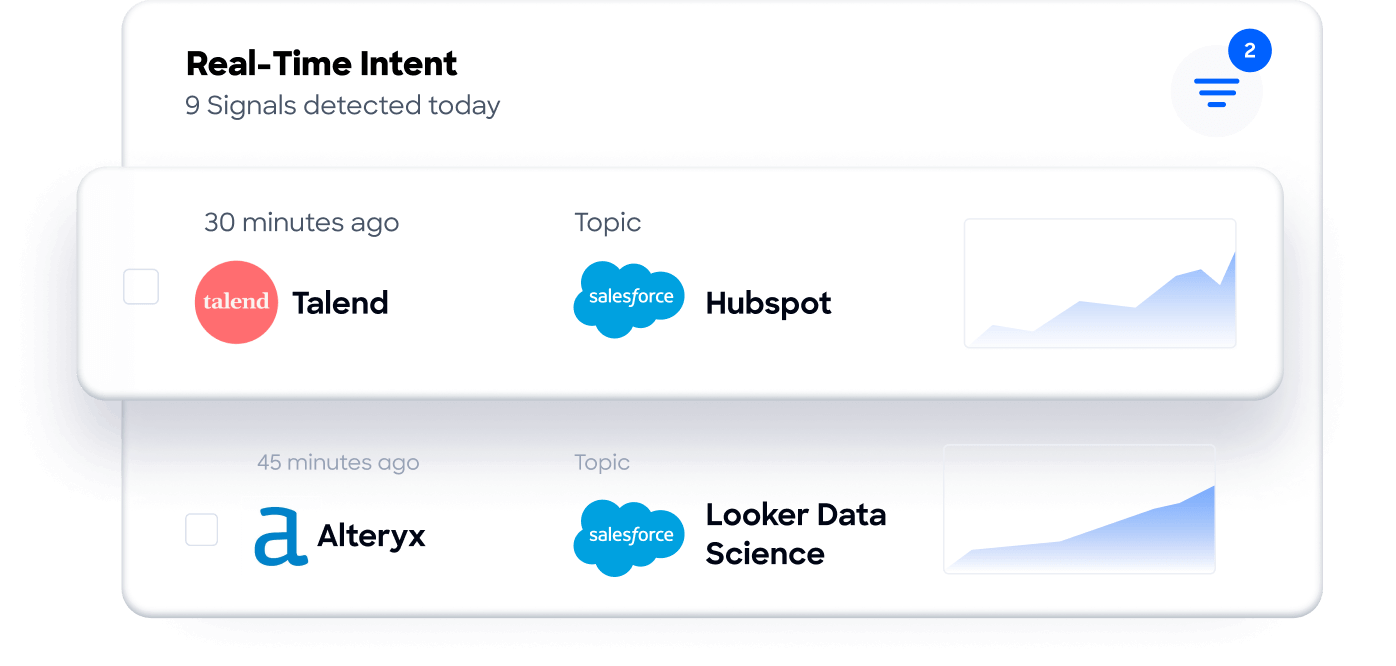
Beyond contact data, ZoomInfo's Buyer Intent tracks signals from 210 million IP-to-Organization pairings and 6 trillion+ new keyword-to-device pairings sourced monthly.
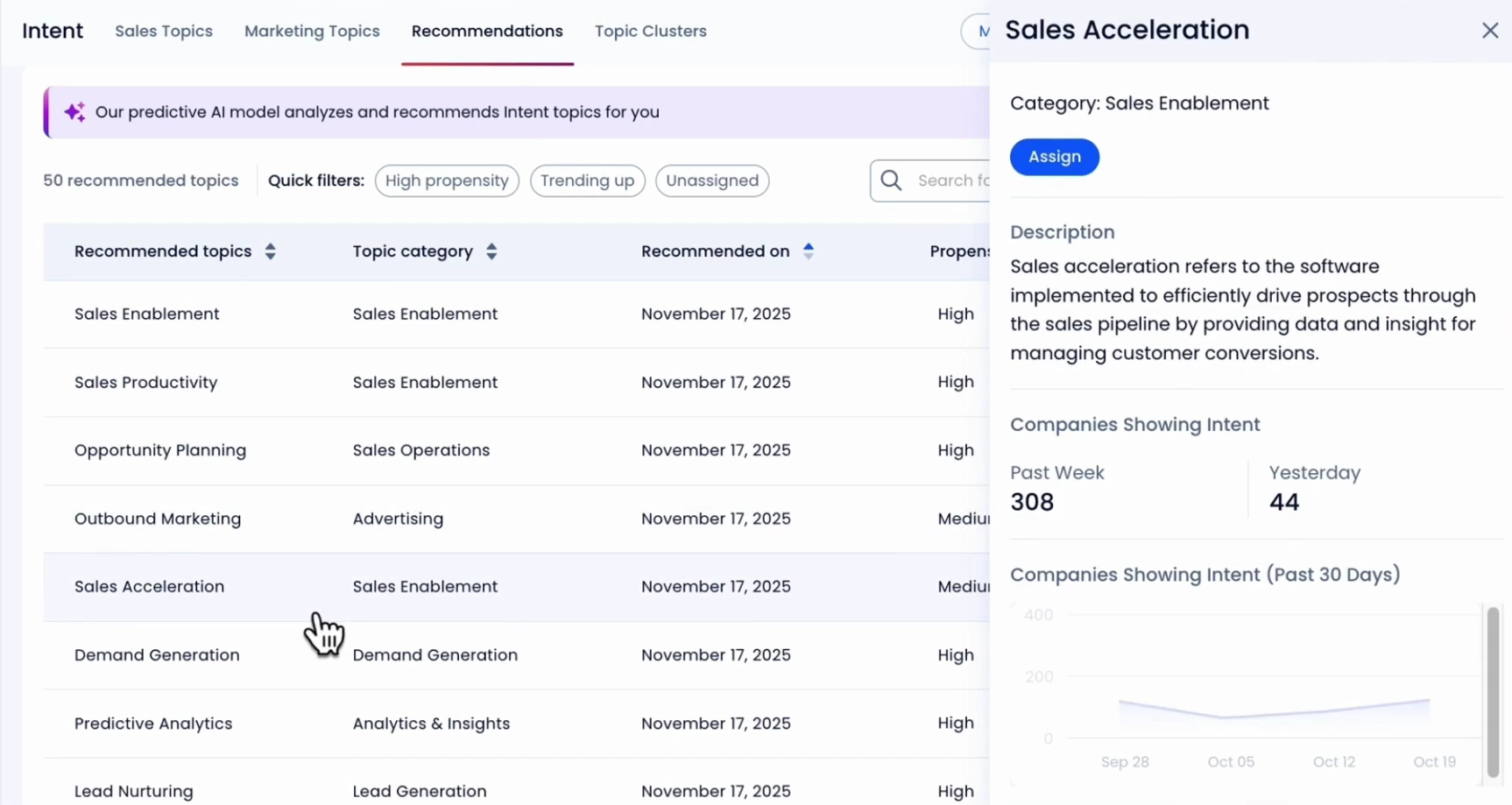
Guided Intent (exclusive to ZoomInfo) identifies the topics historically correlated with deal success in your segment, rather than requiring you to guess which keywords matter.
Source: ZoomInfo
For outreach teams, this changes the workflow. Instead of importing a static list and hoping some percentage is in-market, you start with accounts showing buying signals, enrich them with verified contacts (direct dials and business emails that work), and layer in organizational context: who reports to whom, what technology they use, whether they recently received funding. That enriched data feeds into HeyReach, SalesRobot, or any other outreach tool through ZoomInfo's API or MCP.
SpringDB used ZoomInfo's enriched data to achieve 2-3x increases in campaign conversions across channels, a 300% increase in database usability, and 30-50% uplift in average deal size. (SpringDB Case Study)
AI features serve different purposes
Both platforms use AI, but for different jobs.
SalesRobot focuses AI on the conversation itself. The AI Appointment Setter runs in two modes: CoPilot (you review AI-drafted replies before sending) and Autopilot (fully autonomous).
Give it an SOP describing your offer, ICP, and objection-handling approach, and it manages the full conversation from first reply to a booked meeting. This feature is included on all paid plans starting at $39/month, not gated to a premium tier.
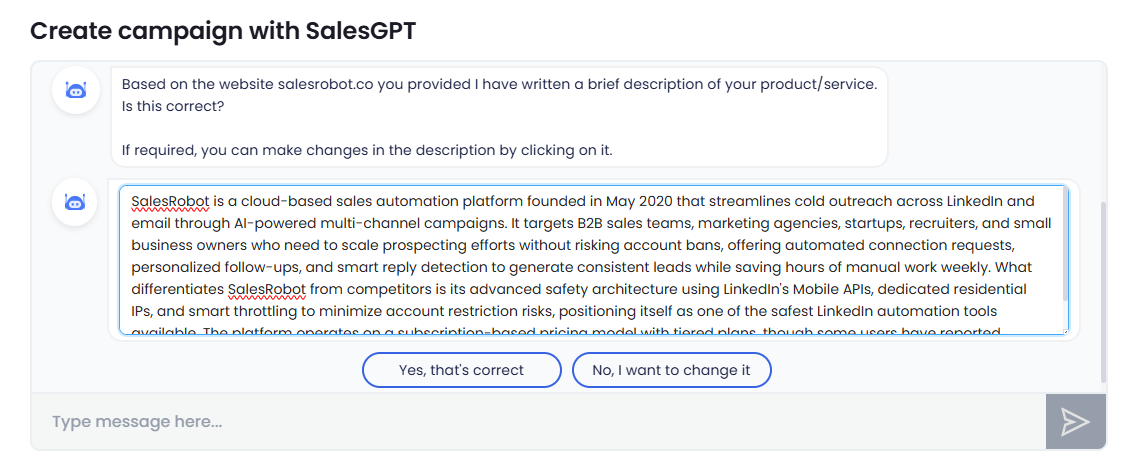
The AI voice cloning and video avatar features produce prospect-specific media. And SalesGPT generates complete campaign sequences from a plain-English description of your target audience and offer.
Source: SalesRobot
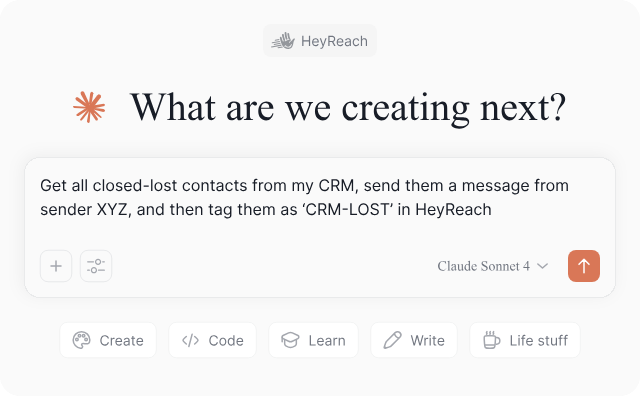
HeyReach focuses AI on workflow orchestration. Its MCP (Model Context Protocol) server lets users connect AI models like Claude or ChatGPT to their HeyReach workspace, then issue plain-English commands: create a campaign with custom messages, tag replies by sentiment, or filter decision makers in lead lists.
Source: HeyReach
This makes HeyReach one of the first LinkedIn automation tools with a public MCP server. Connection request notes can include ChatGPT-generated messages personalized for each lead based on their LinkedIn profile.
SalesRobot's AI is more visible to prospects (they hear your voice, see your face). HeyReach's AI is more visible to operators (they orchestrate campaigns in natural language). Both approaches work with whatever data you feed them. An AI that writes a personalized message from a scraped LinkedIn profile produces a different result than one drawing on verified company intelligence, org chart context, and real-time buying signals.
This is where ZoomInfo's GTM Context Graph matters. It combines 500M contacts and 100M companies with CRM records, conversation data, and behavioral signals, giving ZoomInfo's AI context on each account: who influences buying decisions, when accounts are researching solutions, and which patterns match past wins.
Source: ZoomInfo
That intelligence flows into HeyReach or SalesRobot campaigns through ZoomInfo's API and MCP server, improving the data behind every message either tool sends.
Seismic's sales team attributed 39% of active pipeline to opportunities identified or influenced by ZoomInfo signals, reporting 54% productivity gains and 11.5 hours saved per week per seller. (Seismic Case Study)
Agency economics compared
Both platforms target agencies, but their pricing models work differently depending on how many LinkedIn accounts you manage.
HeyReach charges a flat monthly fee based on sender tiers. The Growth plan starts at $79/month for 1 sender, scaling to $395/month for 5 senders and $590/month for 10 senders. The Agency plan covers 50 senders for $999/month, and the Unlimited plan covers unlimited senders for $1,999/month (subject to a fair-use cap of 500).
All plans include unlimited campaigns, all LinkedIn actions, unified inbox, integrations, API, webhooks, and MCP access. Agency and Unlimited plans add whitelabel branding, done-for-you onboarding, bring-your-own proxies, and a dedicated Slack channel. Annual billing saves 25%.
SalesRobot charges per LinkedIn account: $39/month (Basic), $59/month (Advanced), or $79/month (Professional) on annual billing. Volume discounts apply at scale: 33% off for 10+ accounts and 45% off for 20+ accounts. The Professional plan adds team management and activity control. Cold email is available as an add-on at $15/month per email account. White-label pricing requires contacting the team directly.
The math shifts at different scales:
5 accounts: HeyReach Growth at $395/month vs. SalesRobot Advanced (annual) at $295/month. SalesRobot costs less.
10 accounts: HeyReach Growth at $590/month vs. SalesRobot Advanced (annual, 33% volume discount) at roughly $395/month. SalesRobot still costs less.
50 accounts: HeyReach Agency at $999/month vs. SalesRobot Advanced (annual, 45% discount) at roughly $1,623/month. HeyReach's flat rate wins.
100+ accounts: HeyReach Unlimited at $1,999/month vs. SalesRobot at well over $3,000/month even with discounts. HeyReach pulls further ahead.
The crossover point sits around 30 LinkedIn accounts. Below that, SalesRobot's per-account model costs less. Above that, HeyReach's flat rate becomes increasingly cost-effective. For agencies managing many client accounts, this difference compounds month over month.
Both platforms offer 14-day free trials with no credit card required. SalesRobot adds a 15-day cancellation window with full refund for new customers. HeyReach's fees are non-refundable except in specific service non-conformity situations.
Account safety and LinkedIn compliance
Every LinkedIn automation tool operates in the same gray area. Both HeyReach and SalesRobot acknowledge that using their platforms may not comply with LinkedIn's User Agreement. The question isn't whether risk exists, but how each platform minimizes it.
HeyReach uses a cloud-based approach with dedicated static residential proxies, one per LinkedIn account and never shared.
The platform automatically freezes accounts approaching LinkedIn's connection request limits (roughly 100 per week) and enforces LinkedIn's 200-action-per-day ceiling. Agency and Unlimited plan users can bring their own proxies for additional control.
The platform recommends setting limits to 20-25 connections per day per sender to stay within safe territory.
SalesRobot takes a different technical path, using residential IPs combined with LinkedIn's mobile app APIs rather than browser emulation. This makes automated activity appear as if it originates from the LinkedIn mobile app.
SalesRobot allows up to 75 connection requests per day and up to 40 InMails per day to open profiles without consuming InMail credits. Some users report actual connection request limits plateauing at 40-41 rather than the stated maximum.
Both platforms report strong safety records. HeyReach users describe it as "the most reliable LinkedIn automation tool available" after extended use. SalesRobot customers report zero LinkedIn account bans over months of continuous operation.
Integration ecosystems reflect different philosophies
HeyReach and SalesRobot connect to your broader tech stack in different ways.
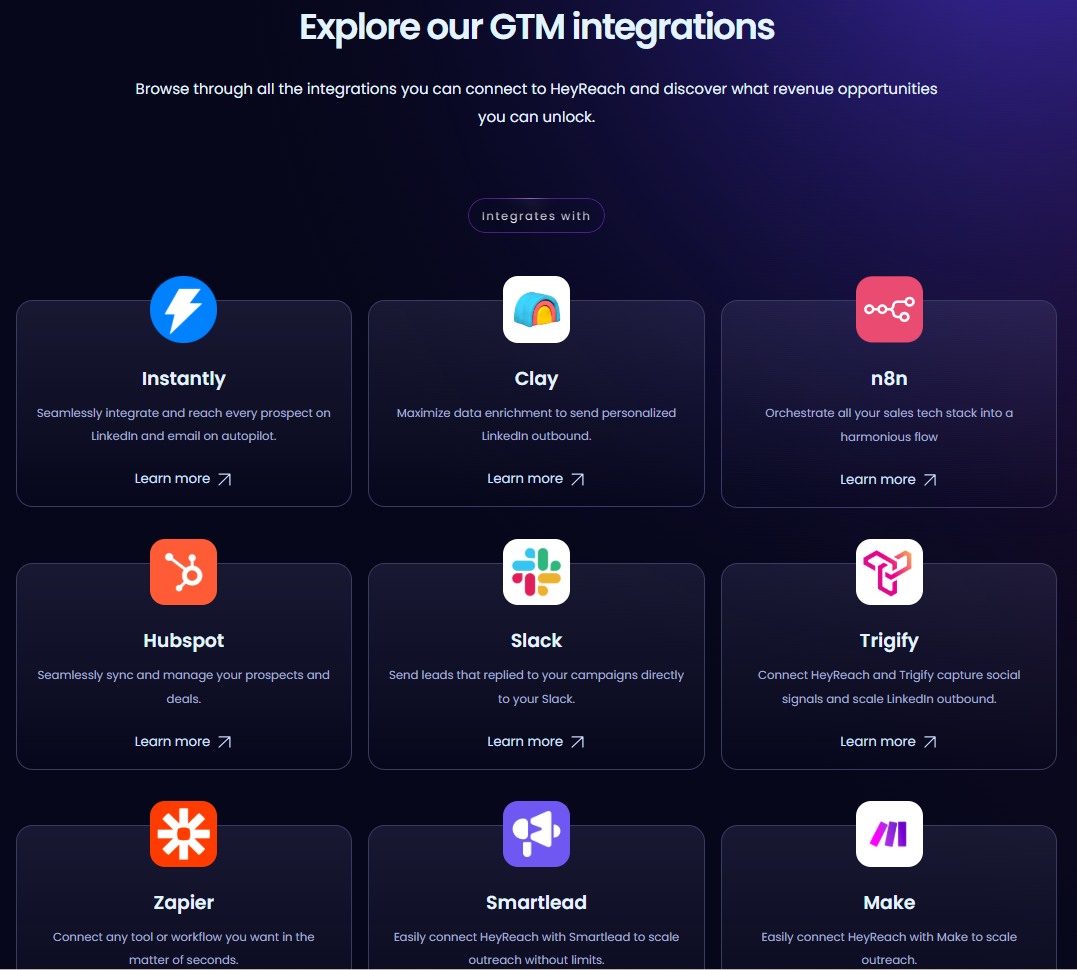
HeyReach offers 23+ native integrations spanning data enrichment (Clay, RB2B, Trigify, Persana), email platforms (Instantly, Smartlead), CRMs (HubSpot, Pipedrive via one-click sync), and automation tools (Zapier, Make, n8n).
Source: HeyReach
The Clay integration stands out: enriched prospects flow automatically from Clay tables into HeyReach campaigns with unlimited custom personalization variables.
The API provides 300 requests per minute with never-expiring keys, and the MCP server lets AI agents control HeyReach operations in natural language.
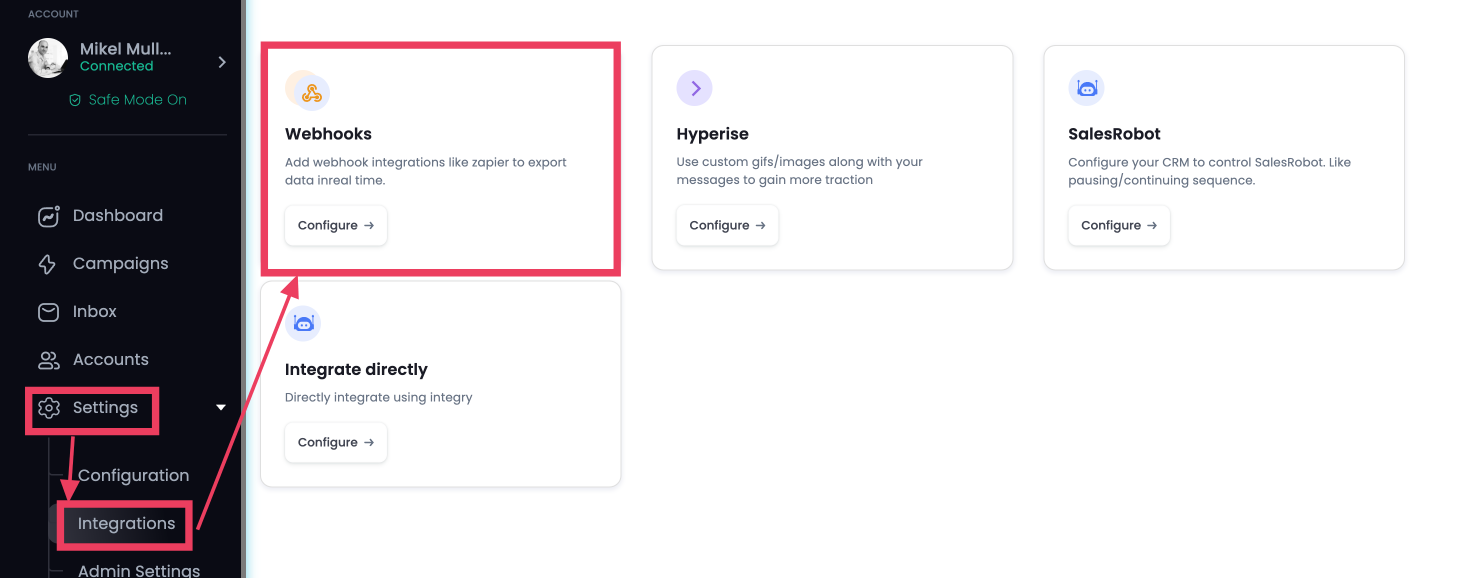
SalesRobot takes a middleware-first approach. Core integrations route through Zapier, Make, and n8n, plus webhooks and a REST API for custom builds. CRM connections reach HubSpot, Salesforce, Pipedrive, Zoho, and Copper through these connectors.
Source: SalesRobot
Webhook and Zapier integrations are gated to the Advanced plan at $59/month annually, so Basic plan users have limited options.
HeyReach's integration ecosystem is broader and more direct, with native connectors that avoid middleware costs and latency. SalesRobot's middleware approach provides flexibility but adds setup complexity and, for Zapier-dependent workflows, per-task costs.
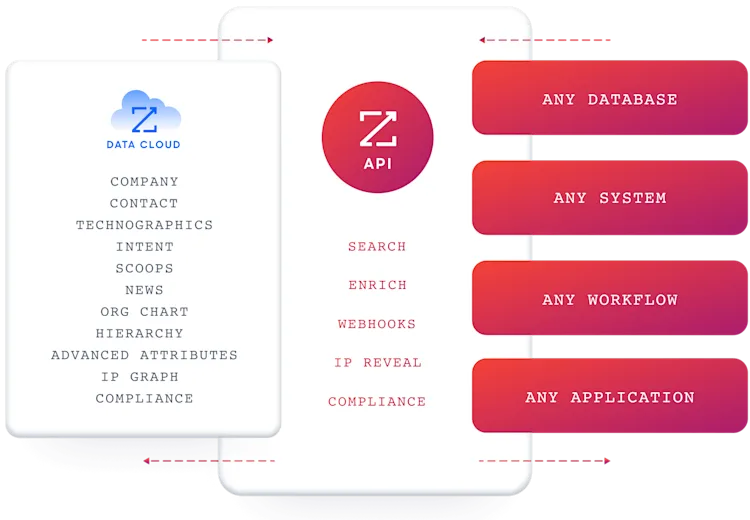
ZoomInfo sits upstream of both platforms in the data stack. Its Enterprise API and MCP server deliver verified contact data, company intelligence, and buyer intent signals into any tool, including HeyReach and SalesRobot.
Source: ZoomInfo
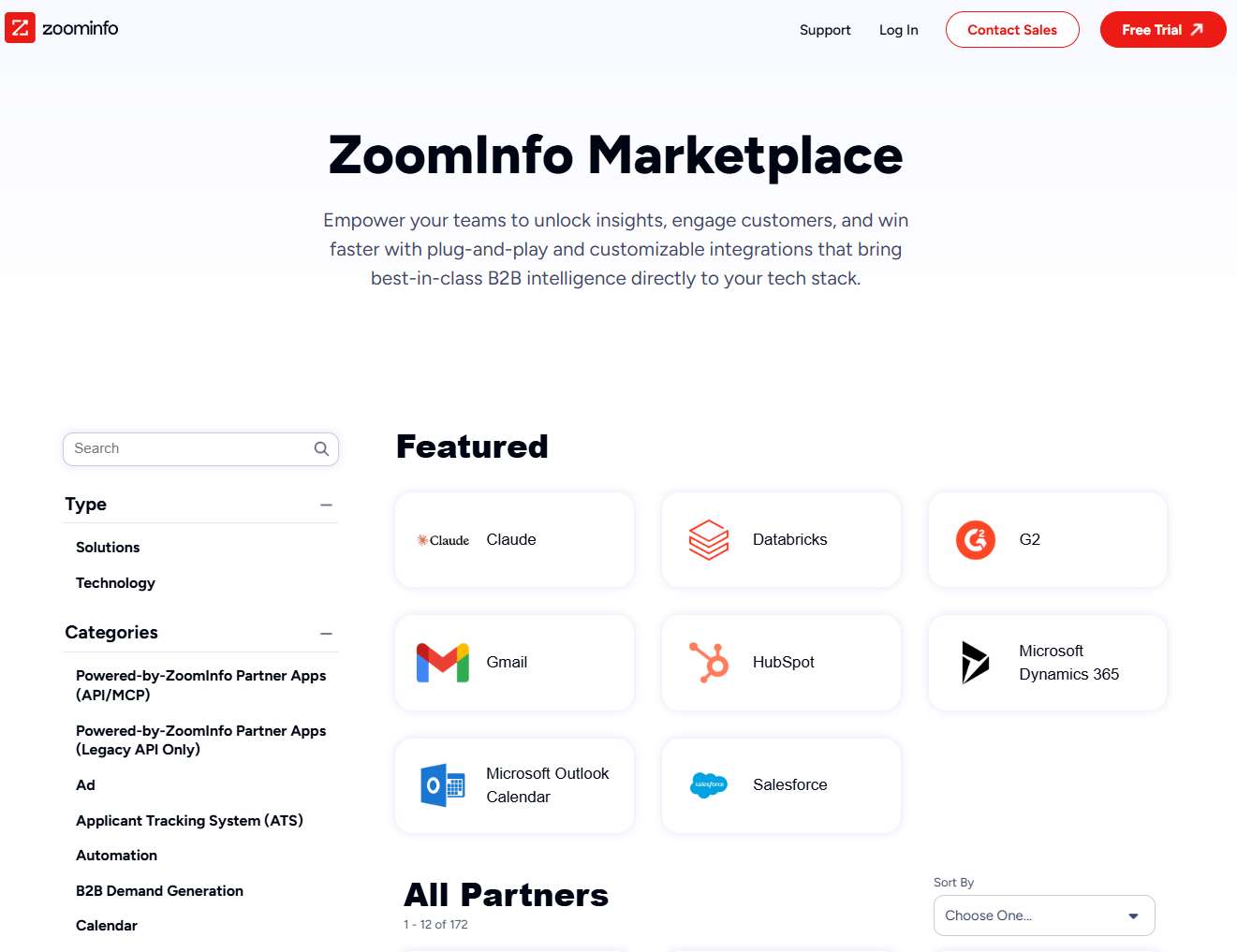
ZoomInfo's App Marketplace lists 120+ partner integrations across CRMs, marketing automation, sales engagement, and data warehouses.
Source: ZoomInfo
For teams already using ZoomInfo, data flows into the outreach tool of choice without rebuilding workflows. API access is included in all relevant plans.
BDO Canada achieved an 87% reduction in time spent on data updates using ZoomInfo's API. As Jerry Wilson, Senior Marketing Intelligence Analyst, described it: "The plug-and-play aspect of the API means I can integrate it very easily into any process and get information at a moment's notice." (BDO Canada Case Study)
Unified inbox and conversation management
Managing replies across multiple LinkedIn accounts is a problem both platforms share. Both solve it, with different scope.
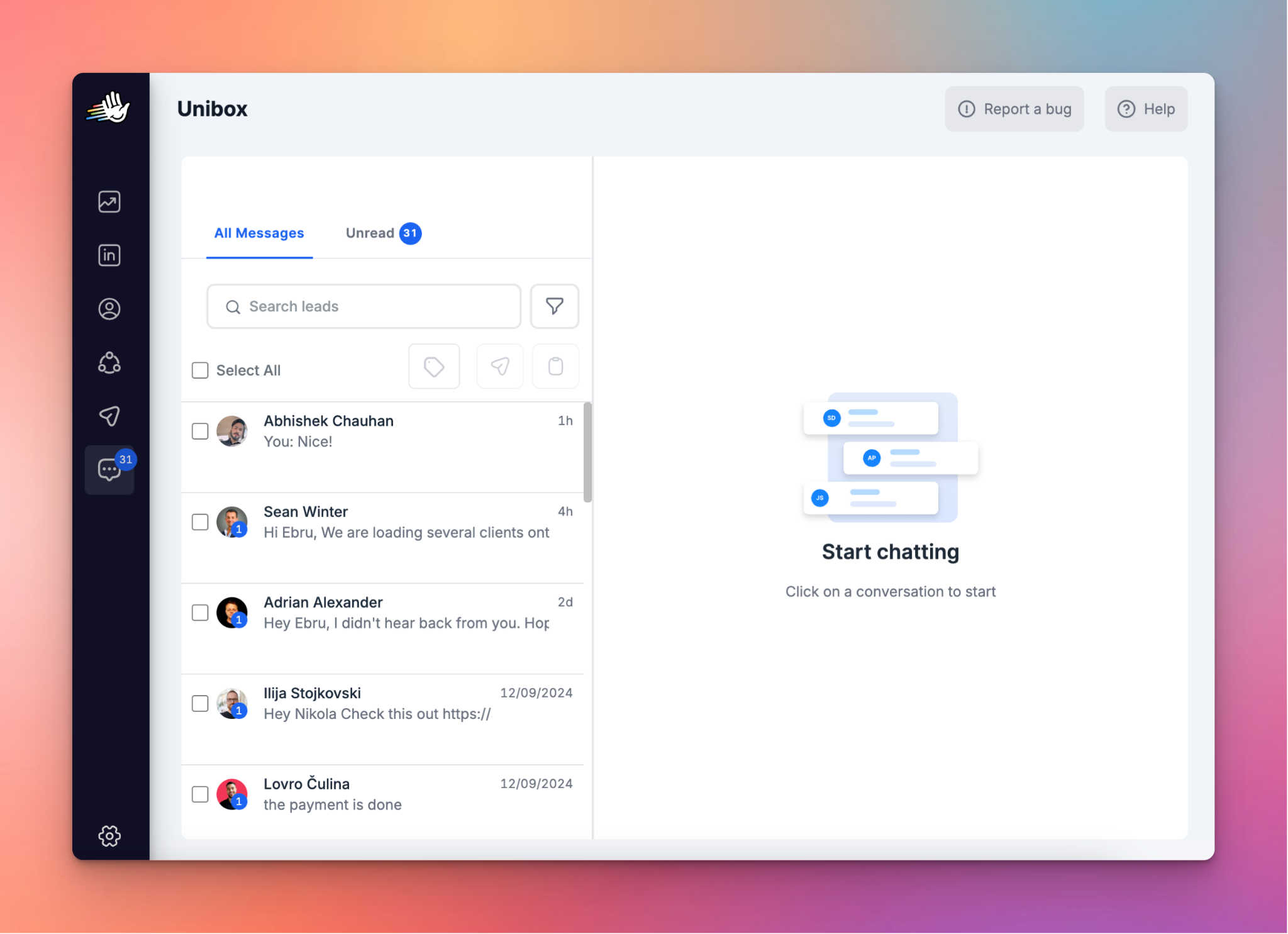
HeyReach's Unibox consolidates all LinkedIn conversations from every connected sender into a single interface.
Source: HeyReach
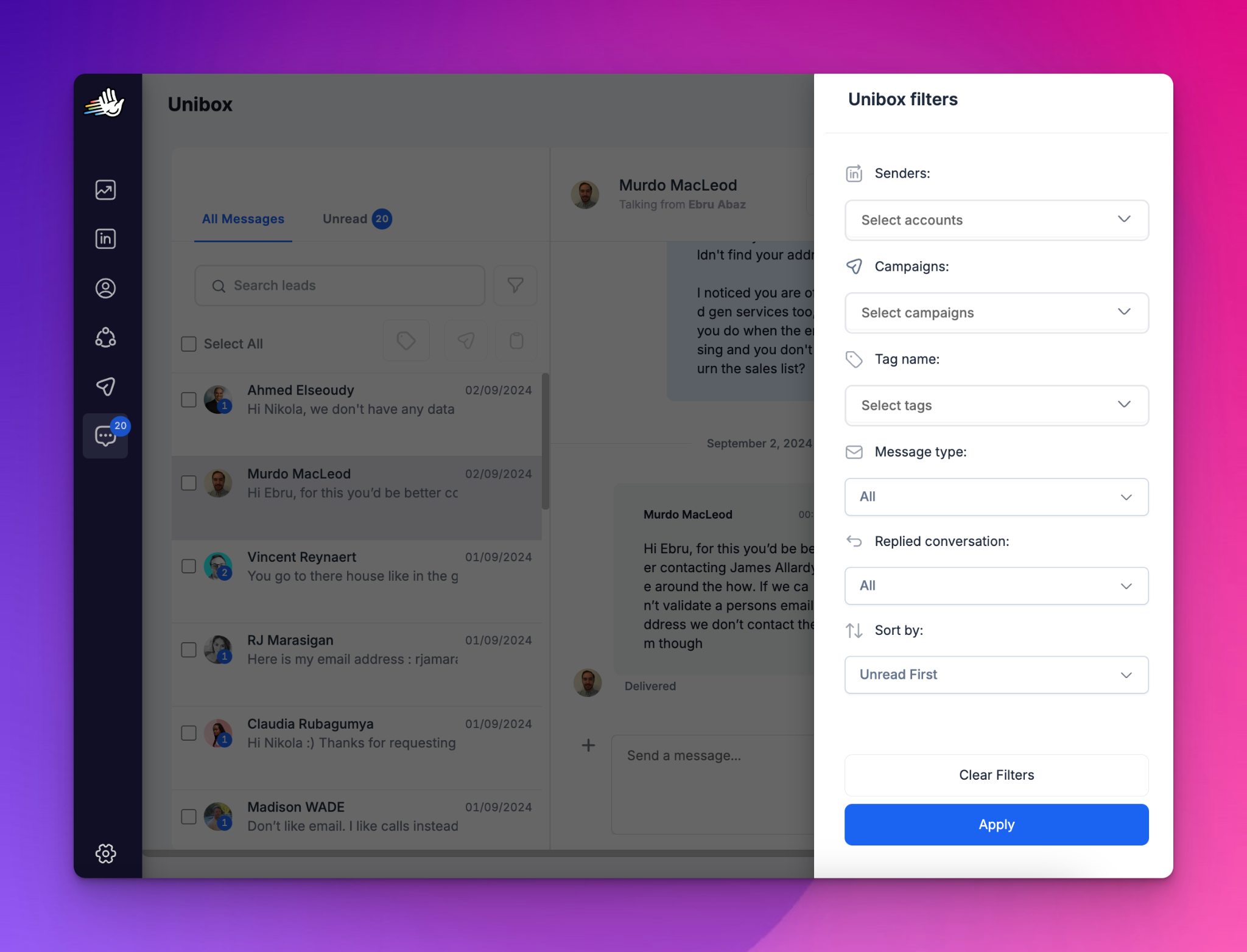
Team members can reply on behalf of colleagues without sharing credentials, filter by sender, campaign, or tag, and perform bulk actions like tagging and re-engagement routing.
Source: HeyReach
Privacy controls let users choose whether to import all LinkedIn conversations or only those started from HeyReach campaigns. The Unibox is LinkedIn-only and does not yet support attachments.
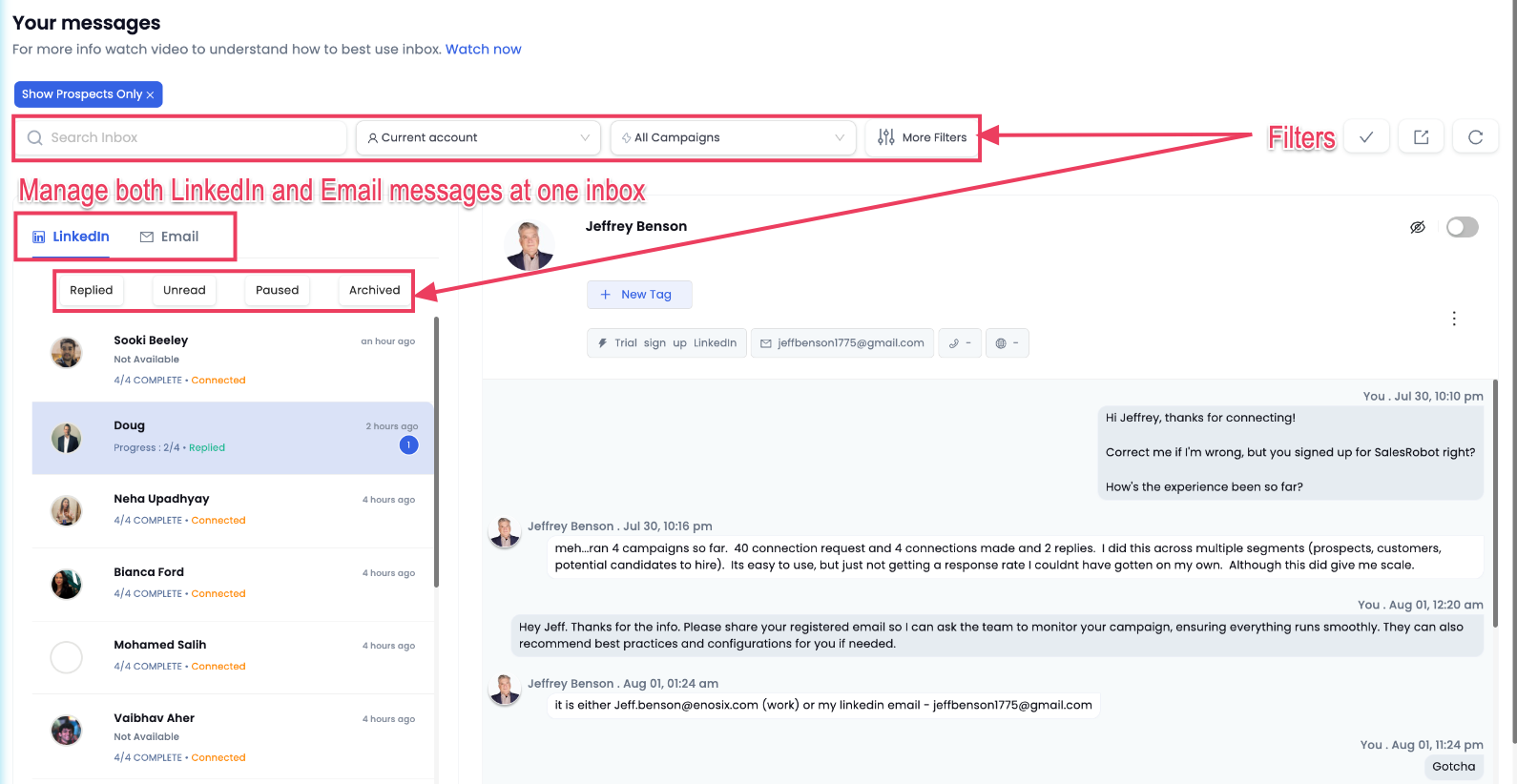
SalesRobot's Smart Inbox covers both LinkedIn and email threads across all connected accounts. AI-powered auto-tagging labels conversations the moment a prospect replies.
Source: SalesRobot
The inbox works as a lightweight CRM, letting users set follow-ups, track history, and add prospects to new campaigns. When the AI Inbox Manager is active, it reads incoming replies and continues conversations on its own based on a user-defined SOP.
For LinkedIn-only outreach, both inboxes handle the job. For teams running coordinated LinkedIn and email campaigns that need both channels visible in one place, SalesRobot's cross-channel inbox has the advantage.
HeyReach vs. SalesRobot vs. ZoomInfo: Which should you choose?
The right choice depends on what's missing from your current outreach workflow.
Choose HeyReach if:
You manage 10+ LinkedIn accounts and need flat-rate pricing that doesn't scale linearly with headcount
Sender rotation across multiple LinkedIn profiles is central to your volume strategy
Your outreach stack already includes a dedicated cold email tool like Instantly or Smartlead
Clay is a core part of your data enrichment workflow
You value a broad native integration ecosystem with API and MCP access
Choose SalesRobot if:
AI voice notes and video messages are the personalization edge you need
You want LinkedIn and email outreach coordinated natively in one platform
An AI agent that handles conversations through to a booked meeting fits your workflow
Your team manages fewer than 30 LinkedIn accounts, where per-seat pricing makes more sense
Cross-channel reply detection that pauses all channels when a prospect responds on any one matters to you
Add ZoomInfo if:
You need verified B2B contact data (direct dials, business emails) with up to 95% accuracy
Buyer intent signals should determine which accounts you target and when
Company intelligence (org charts, technographics, funding history) should inform your outreach
Your outreach tool needs a data foundation that stays current without manual research
You're building toward an intelligence-driven go-to-market approach, not just automating message delivery
See how ZoomInfo's data and intelligence power your outreach with a free trial.
LinkedIn outreach automation has matured to the point where sending messages is the easy part. HeyReach and SalesRobot both handle that well, each with a distinct approach to scale and personalization.
The harder problem, and the one that determines whether your outreach produces conversations or gets ignored, is targeting the right people at the right time with the right context. That's the intelligence layer ZoomInfo provides, regardless of which sending tool you choose.
HeyReach vs. SalesRobot vs. ZoomInfo FAQ
What is the core difference between HeyReach, SalesRobot, and ZoomInfo?
HeyReach is a LinkedIn automation tool that scales outreach by rotating messages across multiple sender accounts at a flat monthly rate.
SalesRobot is a LinkedIn and email automation tool that differentiates through AI voice notes, video avatars, and an AI Appointment Setter that handles conversations through to a booked meeting.
ZoomInfo is a B2B data and go-to-market platform that provides the contact data (500M contacts, 200M+ verified emails, 135M+ verified phone numbers) and buyer intent signals that determine who to contact and when, powering any outreach tool through its API and MCP server.
Which platform is cheaper for agencies managing many LinkedIn accounts?
HeyReach becomes more cost-effective above roughly 30 LinkedIn accounts due to its flat-rate pricing. Its Agency plan covers 50 senders for $999/month, and the Unlimited plan covers up to 500 senders for $1,999/month.
SalesRobot charges per LinkedIn account ($39-$79/month annually) with volume discounts of 33% for 10+ accounts and 45% for 20+. At 50 accounts, HeyReach costs roughly $999/month versus SalesRobot's estimated $1,600+ even with discounts. Below 30 accounts, SalesRobot's per-seat model typically costs less.
Does either HeyReach or SalesRobot include B2B contact data?
Neither platform provides its own B2B contact database. Both require importing leads from external sources like LinkedIn Sales Navigator, CSV files, or third-party enrichment tools such as Clay.
ZoomInfo fills this gap with 500M contacts, 135M+ verified phone numbers, and 200M+ verified business emails, maintained through a verification pipeline backed by 300+ human researchers with up to 95% accuracy on first-party data.
Which platform handles email outreach better?
SalesRobot has native cold email built into its platform, allowing LinkedIn and email steps in the same drip sequence with cross-channel Smart Reply Detection.
HeyReach requires integration with Instantly or Smartlead for email campaigns, which adds a separate subscription but gives access to dedicated cold email platforms with stronger deliverability. Neither matches a standalone cold email tool for high-volume sending.
Can I use ZoomInfo with HeyReach or SalesRobot?
Yes. ZoomInfo's API and MCP server deliver verified contact data and buyer intent signals into any tool in your stack. You can build enriched prospect lists in ZoomInfo, export them into HeyReach or SalesRobot, and target accounts showing active buying signals. This combines ZoomInfo's intelligence with either platform's outreach automation, improving both targeting and message relevance.
Which platform has stronger AI capabilities?
Each uses AI for a different purpose. SalesRobot focuses on prospect-facing personalization: voice cloning, video avatars, and an AI Appointment Setter that manages full conversations.
HeyReach focuses on operator-side orchestration through its MCP server, letting AI models control campaign operations via natural language.
ZoomInfo's AI works at the data layer, using its GTM Context Graph to identify accounts matching your win patterns, surface buying signals, and generate account intelligence for any outreach tool.
Are these tools safe to use with LinkedIn?
Both HeyReach and SalesRobot use cloud-based infrastructure with dedicated residential proxies to minimize account risk.
SalesRobot also routes through LinkedIn's mobile app APIs. Users of both platforms report strong safety records over extended periods.
Both companies acknowledge that automated outreach may not comply with LinkedIn's User Agreement, and users operate at their own discretion and risk.
What kind of support does each platform offer?
HeyReach provides in-app live chat and email support, with Agency plan users receiving a dedicated Slack channel and done-for-you onboarding.
SalesRobot offers live chat via Crisp, email support, and a Slack community, with Enterprise customers getting a dedicated Customer Success Manager. G2 reviewers give SalesRobot a 9.5/10 quality-of-support score.
ZoomInfo provides phone and email support, ZoomInfo University with certification courses, a Help Center with multiple resource channels, and dedicated customer service managers for Enterprise customers.
Comparing HeyReach and SalesRobot? These related breakdowns go deeper:
