
Kompyte has carved out a specific role in the B2B software landscape: automating competitive intelligence so product marketers and sales teams can stop manually tracking rivals and start winning more deals.
Now operating as "Kompyte by Semrush" after its 2022 acquisition, the platform promises to compress days of competitor research into roughly an hour per week through AI-powered monitoring and always-current Battlecards.
To write this Kompyte review, we've analyzed it extensively. We believe it's the ideal choice if:
You need dedicated competitive intelligence automation for tracking dozens of competitors
Your sales team relies on Battlecards to handle objections in competitive deals
You want a focused CI platform with fast implementation (1-2 weeks)
You have a product marketing or CI manager who owns the competitive program
You need win/loss analysis tied directly to competitive assets
However, Kompyte might not be the best choice if:
You need comprehensive B2B contact data and prospecting tools alongside competitive insights
You want AI-driven account prioritization based on buyer intent signals and behavioral data
You need a unified platform spanning sales execution, marketing automation, and competitive intelligence
You require conversation intelligence to capture competitive mentions from actual sales calls
Your go-to-market strategy demands more than tracking what competitors publish online
In this case, you should consider ZoomInfo: an all-in-one AI GTM platform that goes beyond competitive monitoring to give your team the B2B data, buyer intent signals, conversation intelligence, and AI-powered execution tools needed to run the entire go-to-market motion from a single platform.
Because of that, we've included a detailed look at ZoomInfo later in this Kompyte review, as the natural next step for teams that need competitive intelligence embedded within a broader go-to-market system. If you're ready to explore a more comprehensive approach, you can start with ZoomInfo's free trial here.
What is Kompyte?
Kompyte is a competitive intelligence automation and sales enablement platform founded in 2014 in Barcelona, Spain by Pere Codina, Albert Colmenero, and Sergio Ramirez.
The three co-founders studied Computer Engineering together at the Universitat Politecnica de Catalunya and previously collaborated on an earlier venture called Cocosoft.
The company launched as a website change-tracking tool for marketers, graduated from the 500 Startups accelerator, and gradually repositioned toward sales enablement.
By the time Semrush acquired Kompyte for approximately $10 million in March 2022, 88% of its user base was within sales organizations, a significant shift from its original marketing-team focus.
Today, Kompyte monitors competitors across websites, reviews, social media, ads, job postings, and more, then delivers AI-filtered intelligence through a centralized feed. The core output is sales Battlecards that integrate with CRMs and sales enablement tools.
Customers include Influitive, Podium, LegalZoom, BetMGM, GetResponse, CircleCI, and EagleView, spanning SaaS, legal, gaming, and enterprise software.
The platform is best suited for B2B SaaS companies with dedicated product marketing or CI ownership and sales teams of 10 or more reps who regularly compete against named rivals.
Kompyte Pros and Cons
Pros | Cons |
|---|---|
AI noise filtering trained since 2014 reduces CI work to ~1 hour/week | Analytics and reporting trail competitors (G2 scores of 7.7 on Reporting) |
Fast implementation: 1-2 weeks to full deployment | AI summaries can be inconsistent on complex or unstructured content |
Unlimited Battlecards on all plans with adoption analytics | Self-serve help center rated poorly; creates CSM dependency |
Dedicated Customer Success Manager included at no extra cost | Limited coverage of niche or emerging competitors outside major digital channels |
Broad multi-source monitoring (websites, reviews, social, ads, jobs) | No published pricing; requires contacting sales |
Bi-directional CRM integrations with Salesforce and HubSpot | Integration depth with HubSpot and Slack has reported functional gaps |
KompyteGPT AI layer for daily summaries and document analysis | Custom Battlecard fields require manual data population |
Kompyte Review: How It Works and Key Features
CI Automation and Competitor Tracking: Kompyte replaces manual research with an AI-filtered intelligence feed across dozens of digital sources.
The core of Kompyte is its always-on monitoring engine. Users configure competitor profiles in Settings by adding URLs, social handles, review profiles, and app store listings.
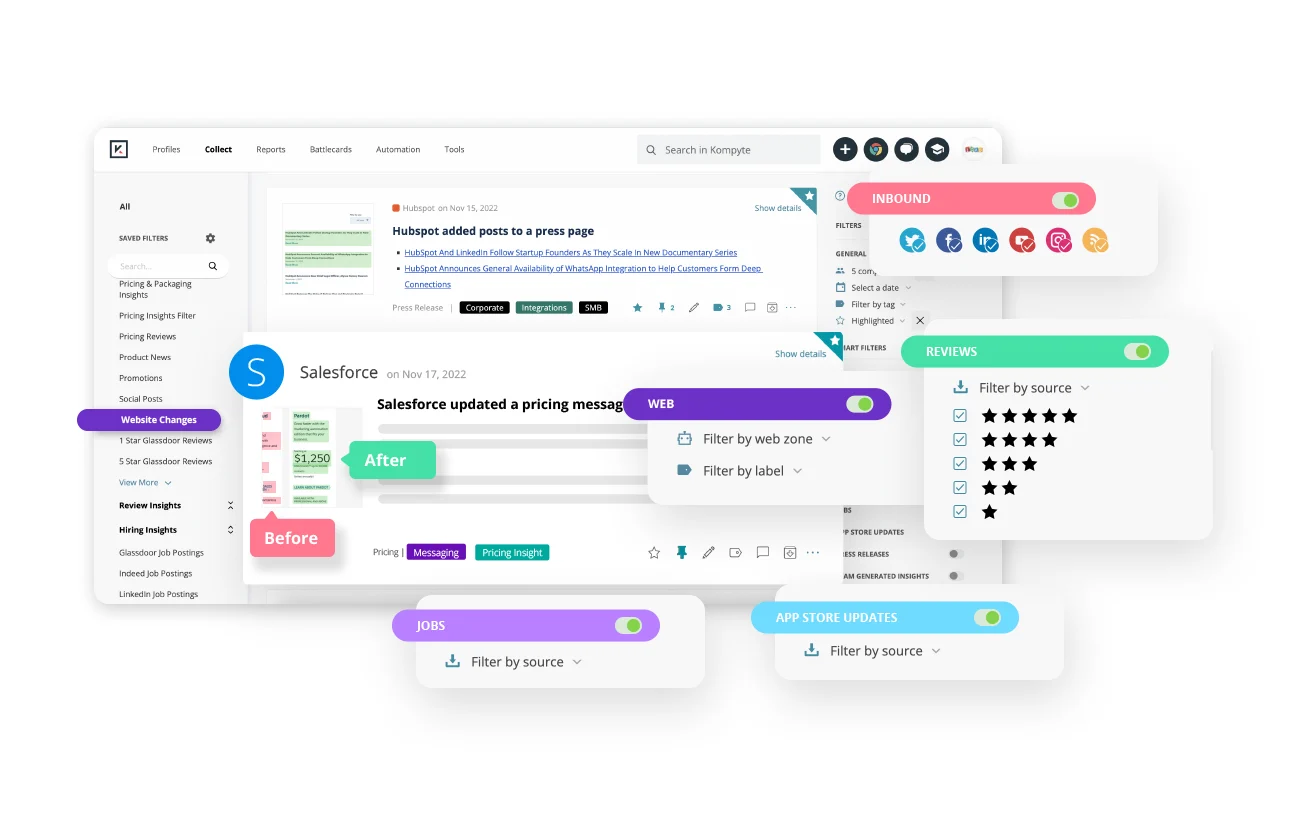
Kompyte then continuously monitors those sources, including competitor websites (50-150 URLs per company depending on plan), review platforms (G2, Capterra, TrustRadius, Gartner Peer Insights, Glassdoor), social media accounts, job postings, press outlets, app stores, RSS feeds, and search marketing activity.
Source: Kompyte
When a change is detected, the KAI engine (Kompyte Artificial Intelligence) performs four operations: categorizing the insight into one of 30+ web zones (pricing, product, press releases, etc.), separating A/B test changes from real updates, filtering out irrelevant noise, and assigning a machine-generated title and description.
Everything flows into the Collect Feed, a consolidated insight stream where each entry includes the source, detection date, taxonomy label, and curation controls. A "Show Details" button opens before-and-after visual snapshots for website changes.
The Time Machine tool lets users compare any two historical snapshots of a tracked URL, reconstructing how competitor messaging or pricing evolved over time.
Google Listening extends monitoring beyond first-party competitor properties through Boolean keyword tracking across news sites.
Battlecards and Sales Enablement: Kompyte builds always-current Battlecards that surface inside the tools sales reps already use.
Kompyte's Battlecard system is designed around one principle: competitive intelligence is only valuable if reps actually use it. Admins create Battlecards from templates or scratch, choosing from five visibility layouts (Benchmark Only, Benchmark + Companies, and others).
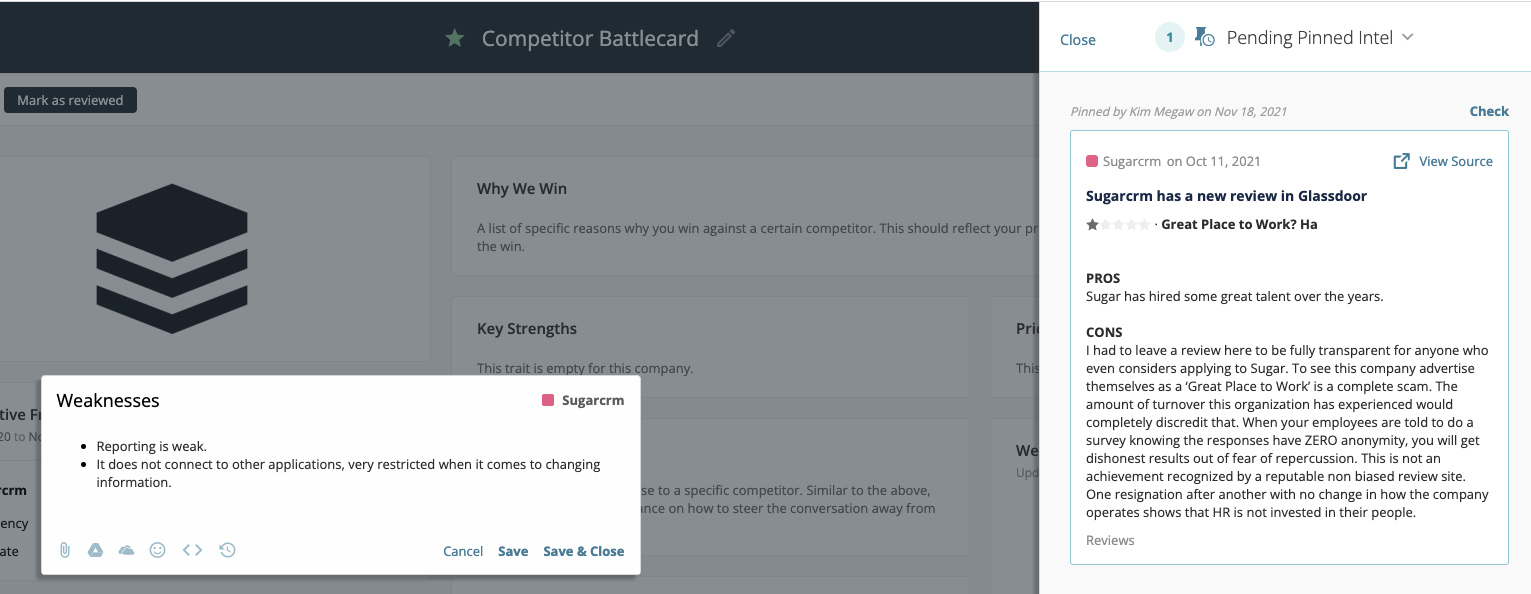
Each Battlecard is built from customizable traits and widgets (Strengths, Weaknesses, Kill Points, Pricing, Case Studies, or custom sections) that support text, links, videos, images, embedded files, and icons.
Source: Kompyte
Content reaches Battlecards through four paths: manual curation by admins, pinning insights directly from the Collect Feed, automated workflow rules that route specific insight types to specific traits (competitor case studies to "Notable Clients," negative reviews to "Weaknesses"), and the Chrome Extension for capturing live competitor web content.
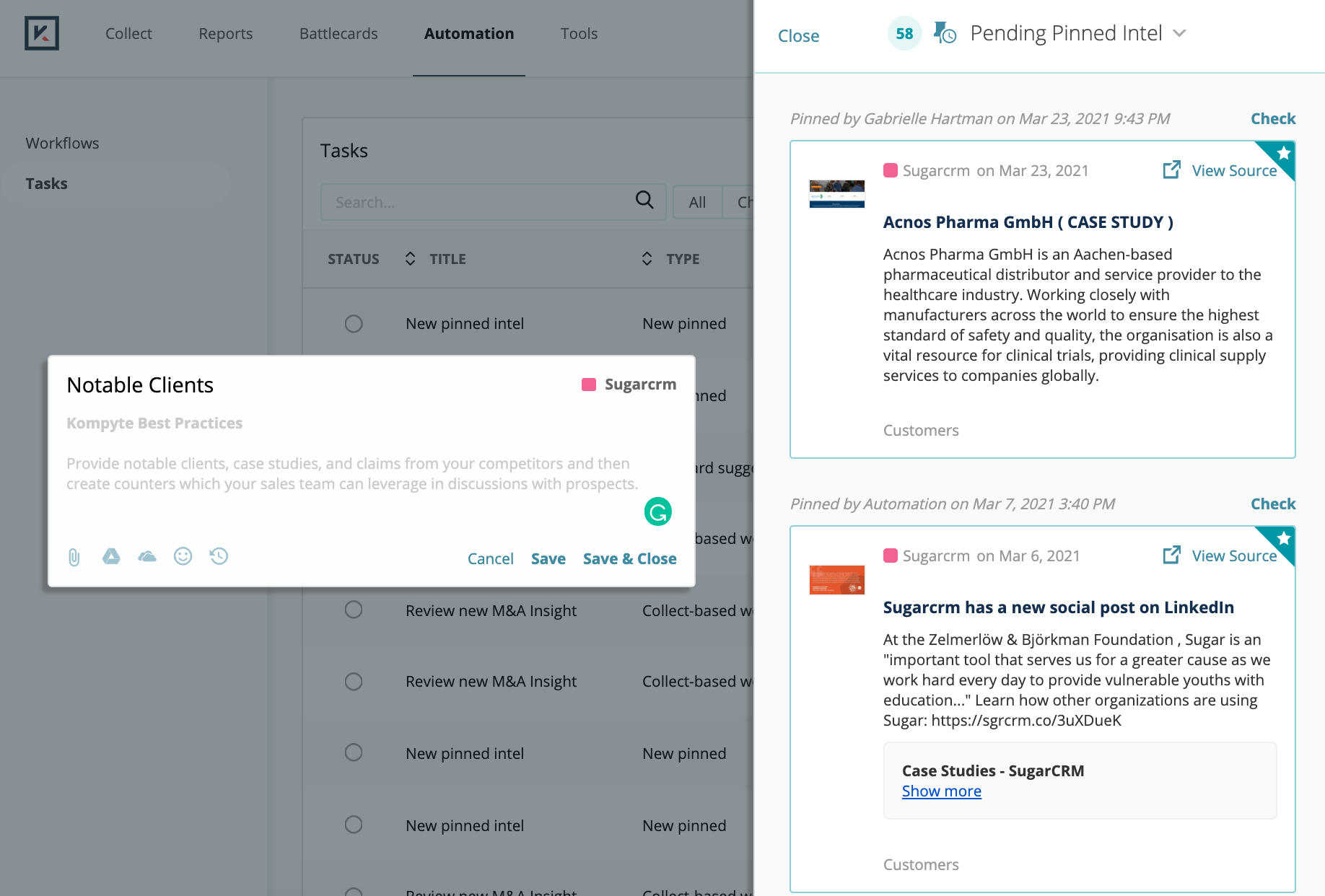
Source: Kompyte
KompyteGPT adds a fifth path: AI-generated Battlecard creation and real-time updates.
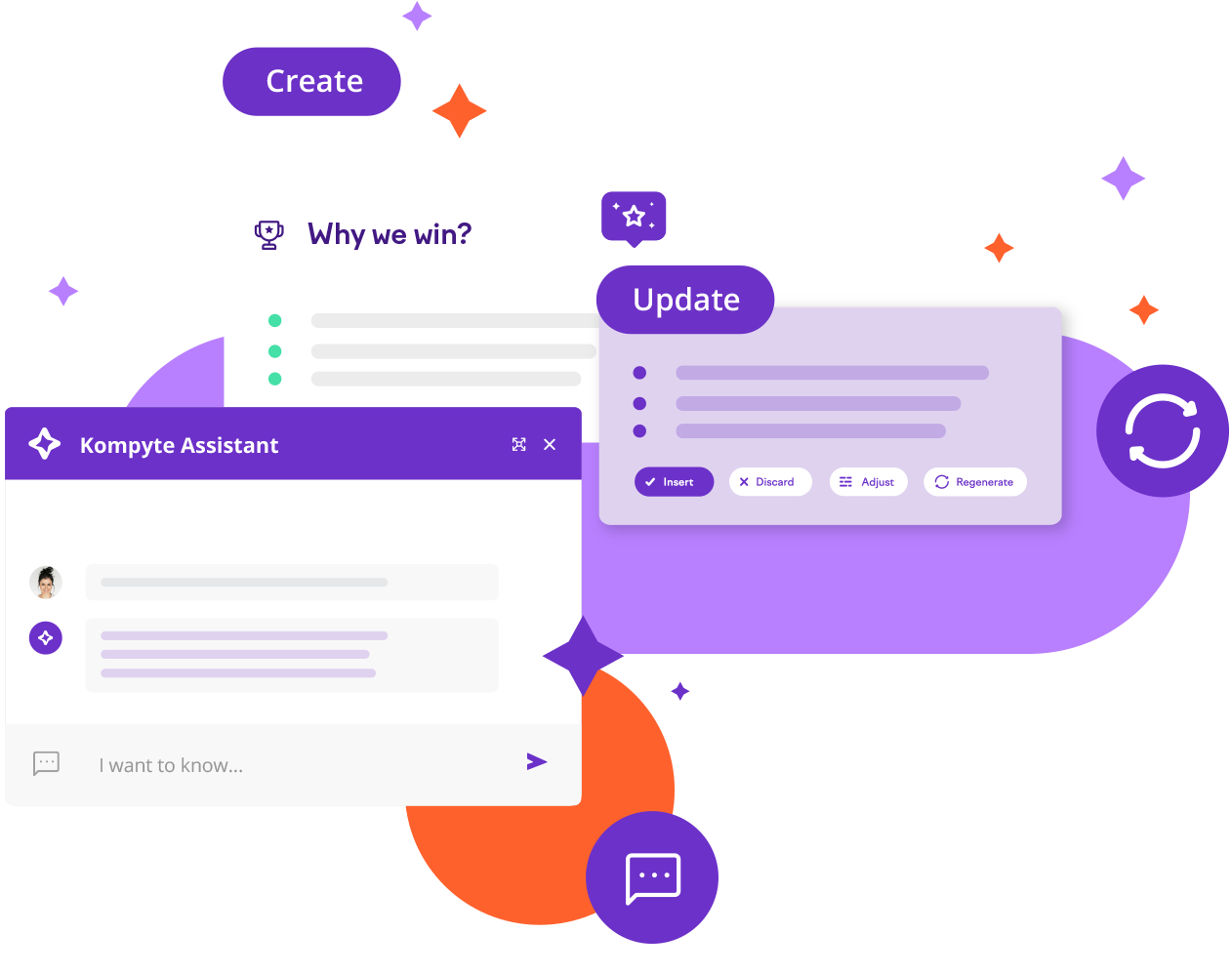
Source: Kompyte
Distribution happens through Salesforce and HubSpot native integrations, the Consumer Portal, Chrome Extension, embed codes for Highspot, Showpad, and Seismic, and PDF export. Because all channels pull from the same underlying source, reps see the latest version regardless of where they access it.
Sales reps can submit field intel and suggestions directly from Salesforce or the Chrome Extension, creating a feedback loop back to Battlecard admins.
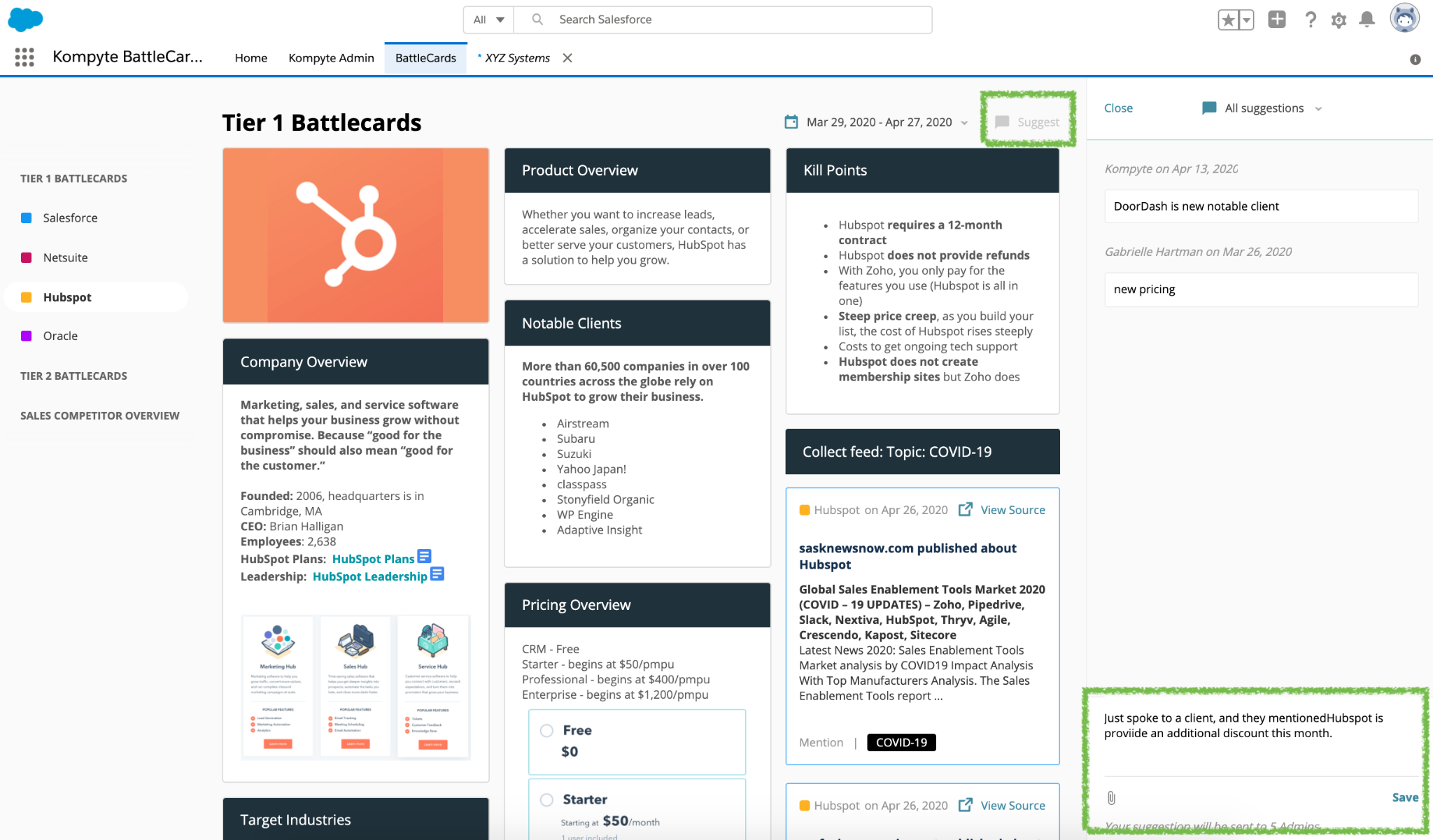
Source: Kompyte
All plans include unlimited Battlecards and Battlecard Adoption Analytics, which tracks total views, unique visitors, most active users, and most-checked competitors.
KompyteGPT and AI Features: Generative AI summaries reduce the time spent reviewing raw competitor updates.
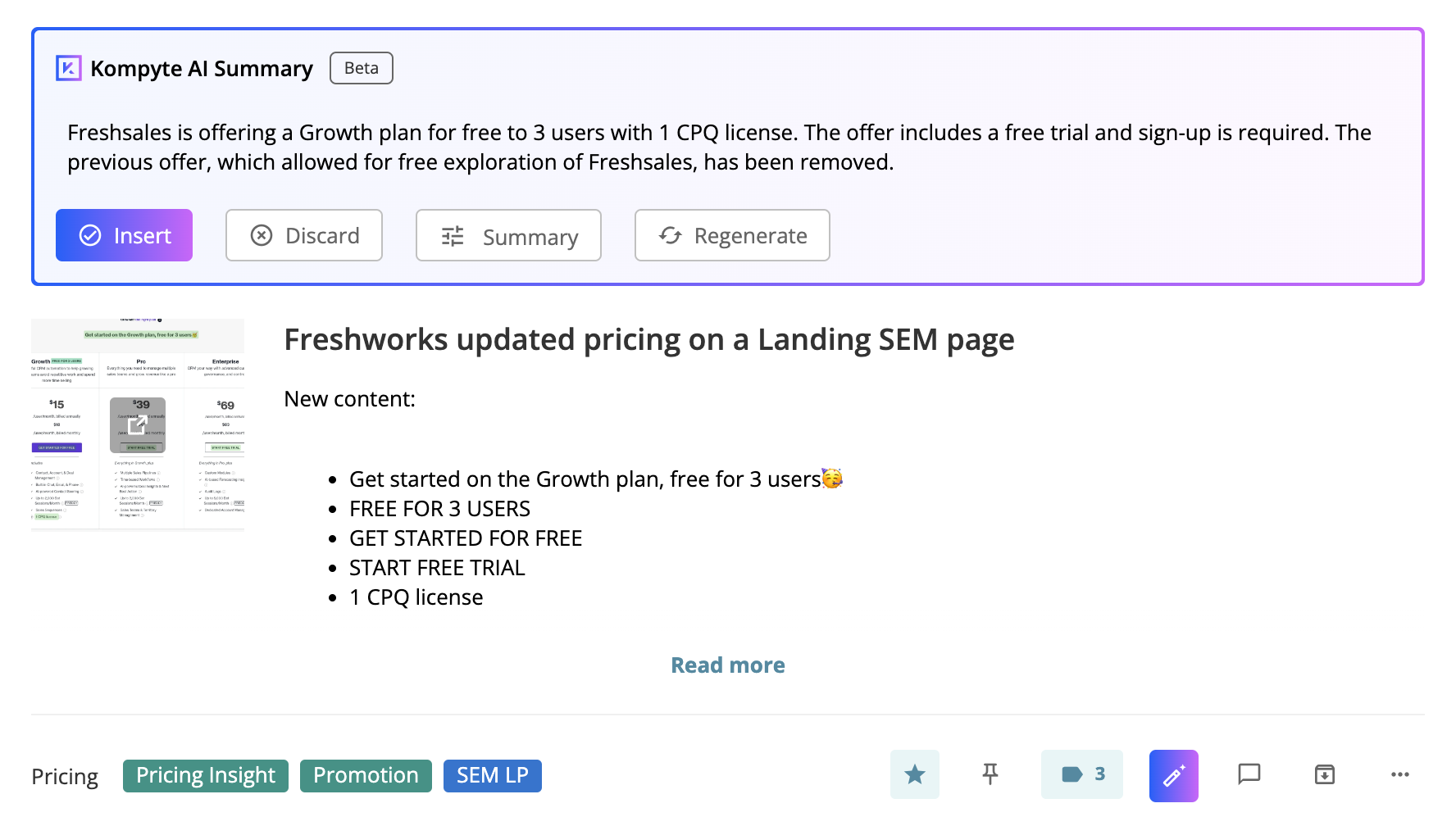
KompyteGPT is a suite of AI features powered by an OpenAI integration. The three primary capabilities are AI Daily Summaries, AI Auto Summarize, and AI Battlecard Creation.
AI Daily Summaries convert the daily stream of tracked competitor activity into a skimmable digest. They're accessible from three locations: the Profiles view, the Collect Feed, and Email Digests.
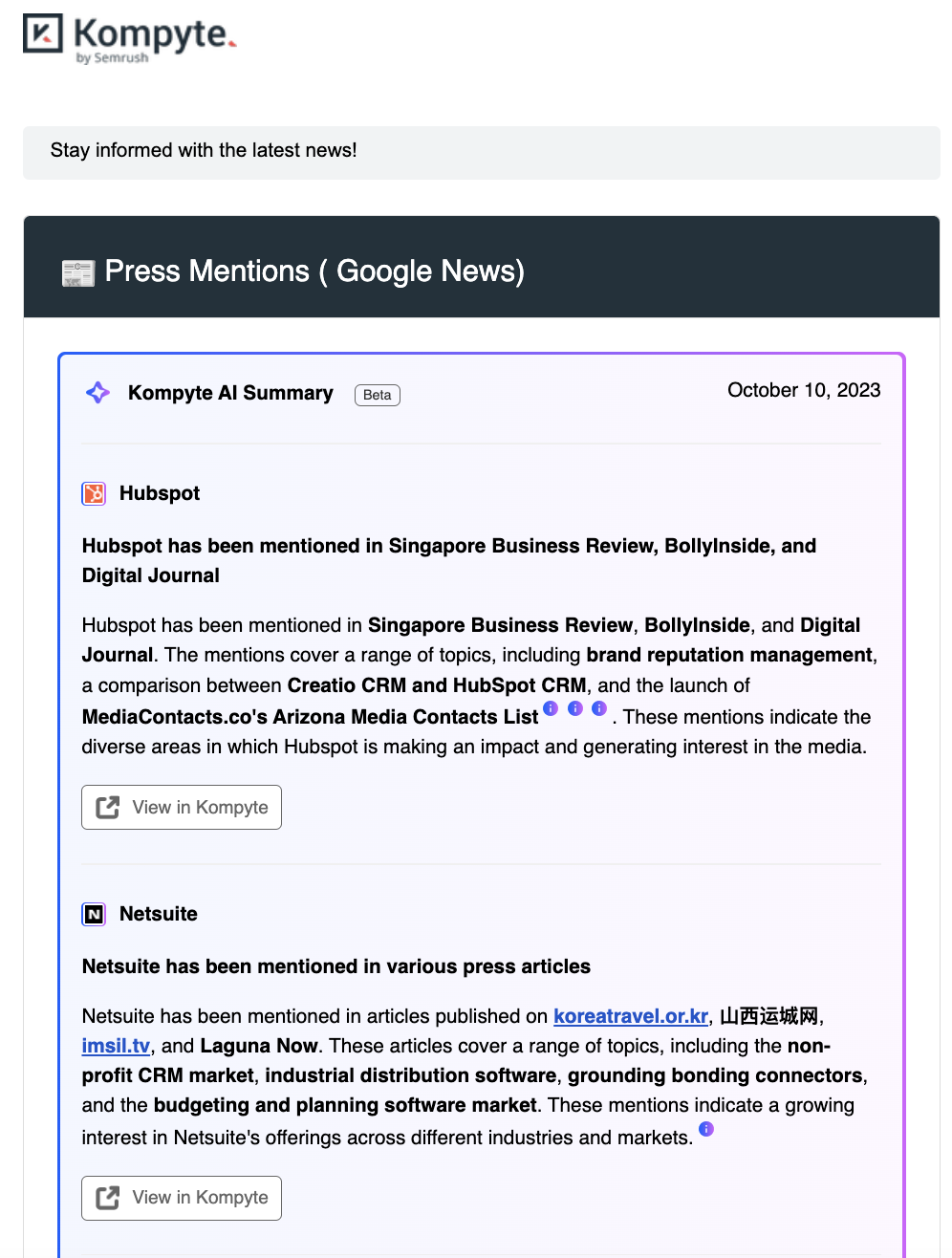
Source: Kompyte
In the Collect Feed, summaries reflect the user's active filters, so different team members see summaries scoped to their focus area. Users can mark individual headlines as relevant to train the AI and improve future summaries.
AI Auto Summarize generates on-demand summaries of individual insights and attached PDF documents. The system supports files up to 5MB and processes up to 70,000 characters (approximately 50 pages), with multiple summary formats available: concise, short, and bullet-point list.
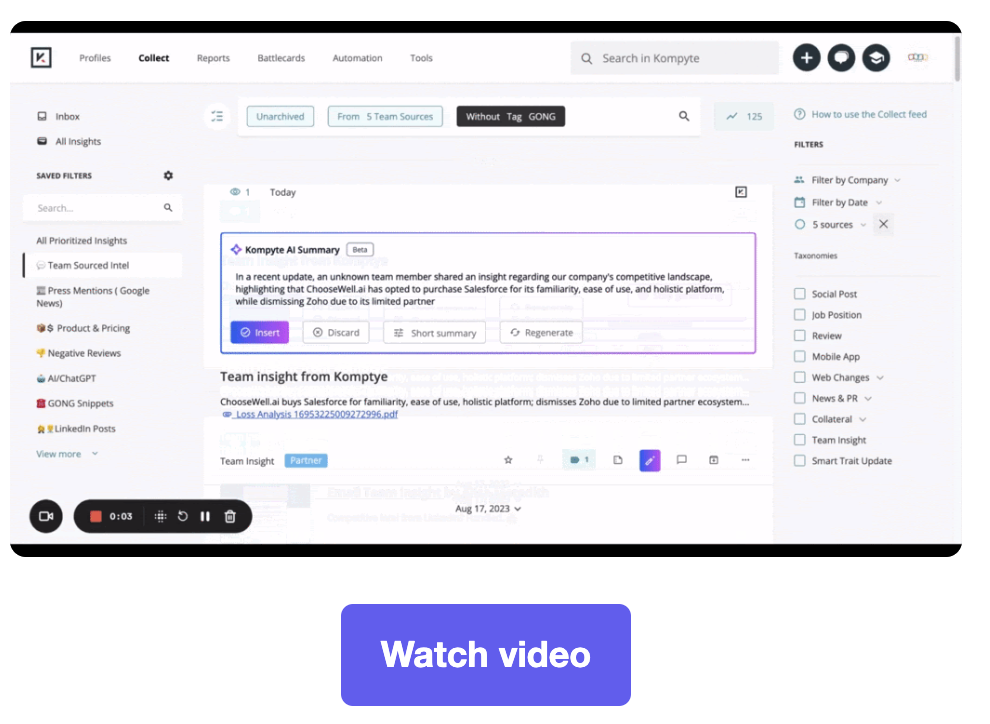
Source: Kompyte
Generated summaries can be inserted as takeaways on insight cards and then manually edited before sharing.
On the privacy front, Kompyte does not use client data to train general AI models. Inputs remain siloed to the customer's own account instance. PDF attachments are excluded from Daily Summary generation for additional privacy protection.
Win/Loss Analysis and Reporting: Kompyte connects competitive intelligence to actual deal outcomes.
Win/Loss Analysis closes the loop between competitive assets and revenue impact. Teams import deal data via structured CSV uploads with field mapping, and the platform surfaces competitive revenue, competitor frequency, and win rates with and without Battlecard usage.
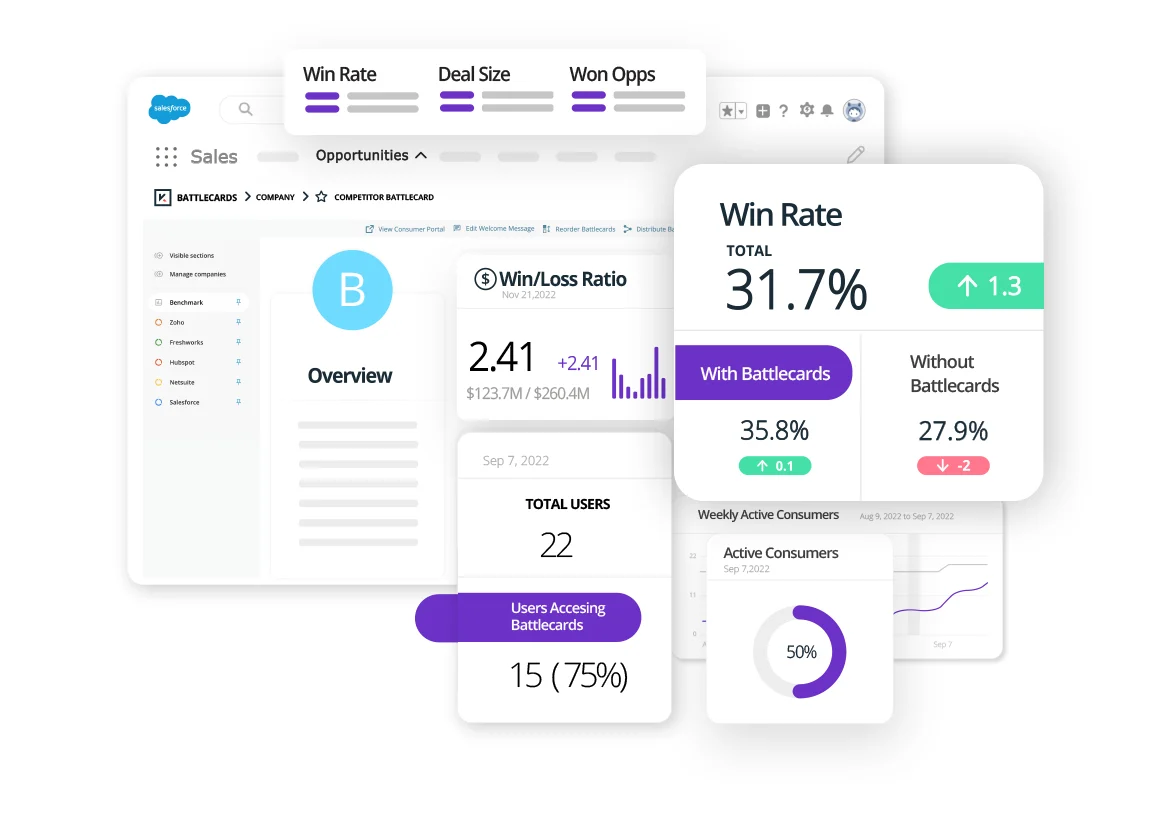
Source: Kompyte
The qualitative layer comes through the IcebergIQ partnership, which provides professionally conducted buyer interview research.
These third-party insights feed back into Reports and Battlecards, giving CI teams both the quantitative "what" from CRM data and the qualitative "why" from candid buyer feedback. The combination provides a 360-degree view of the market.
ROI Reporting converts competitive program activity into revenue terms, splitting outcomes into "Research Savings" and "Prevented Losses." Custom Dashboards and Unlimited Reports are available on all plans, with configurable date ranges, competitor selections, and saved filters.
Pricing: Custom-quoted tiers with no published prices.
Kompyte uses a contact-sales pricing model. No dollar amounts appear on the pricing page. The structure breaks into three tiers:
Essentials: 10 companies tracked, 25 user licenses. Website tracking covers 50 URLs per company with 25 search marketing keywords. Includes all core features: CI Automation, AI Insight Curation, Unlimited Battlecards, ROI/Win-Loss Reporting, Automation Workflows, CRM integrations, and a Dedicated Customer Success Manager.
Professional: 20 companies tracked, 100 user licenses. Website tracking expands to 100 URLs per company and 100 keywords. Adds the Companies Database.
Unlimited: Unlimited companies tracked, unlimited user licenses. 150 URLs per company, 200 keywords. Adds SSO and Advanced User Permission Management.
Notably, all plans include onboarding, ongoing support, and business reviews with a dedicated CSM at no additional cost. Integrations are included in all tiers. Competitors can be swapped without extra charges. Kompyte's average ARR per customer at acquisition was approximately $20,000, reflecting mid-market positioning.
Contracts renew automatically, cancellations take effect at the end of the pre-paid period, and all fees paid are non-refundable.
Where Kompyte Falls Short
Kompyte excels at its core mission of automating competitive intelligence for sales teams. But that focus also defines its boundaries. Several limitations become apparent for teams whose needs extend beyond dedicated CI.
Competitive Intelligence Without Contact Data. Kompyte tells you what competitors are doing. It does not tell you who to call about it. The platform monitors competitor websites, reviews, and ads, but it contains no B2B contact database, no verified phone numbers, no email addresses, and no buyer intent data tied to specific accounts.
Sales teams still need a separate platform to identify, reach, and engage the buyers who are comparing your product against those competitors right now.
No Conversation Intelligence. Kompyte tracks what competitors publish externally but has no way to capture what prospects say about competitors during actual sales calls.
Competitive mentions, objections, and buying criteria expressed in live conversations are among the richest sources of competitive intelligence.
Without conversation intelligence, Kompyte's Battlecards are built from public data rather than the language buyers actually use.
Reporting Lags the Category. G2 comparative data shows Kompyte scores 7.7 in Reporting and 7.3 in Alerts, below category leaders. Teams needing sophisticated analytics dashboards or fine-grained alert logic may find the platform insufficient for their requirements.
AI Summary Inconsistency. While KompyteGPT reduces manual review time, user feedback notes that AI summaries can be inconsistent and unreliable for complex or unstructured text. Summaries often require manual editing before they can be shared with stakeholders.
No Broader Go-to-Market Execution. Kompyte monitors competitors and creates Battlecards, but it does not help you build pipeline, run multi-channel outreach, score accounts, or orchestrate marketing campaigns.
For teams that want competitive intelligence integrated into their broader go-to-market motion (rather than siloed in a separate tool), Kompyte creates one more application to manage alongside the existing stack.
Limited Self-Service Support. G2 reviewers note the help center "doesn't help that much," creating dependency on the human CSM for troubleshooting. The dedicated CSM model is strong, but teams that prefer to solve problems independently may find the documentation insufficient.
These limitations are the natural result of building a focused CI automation tool. But they create a clear gap for teams that want competitive intelligence as part of a unified go-to-market platform rather than a standalone application.
Top Kompyte Alternative for Broader Go-to-Market Teams: ZoomInfo
ZoomInfo is an all-in-one AI GTM platform that addresses Kompyte's limitations by embedding competitive intelligence capabilities within the industry's most comprehensive go-to-market system.
Where Kompyte focuses exclusively on tracking what competitors do online, ZoomInfo combines the B2B data needed to find and reach buyers, the intent signals to know when they're in-market, the conversation intelligence to understand what they say about competitors on calls, and the AI-powered execution tools to act on all of it.
Comprehensive B2B Data: ZoomInfo provides the contact and company intelligence that Kompyte lacks entirely.
While Kompyte monitors competitor activity, ZoomInfo provides the foundation for reaching the buyers evaluating those competitors. The platform spans 500M contacts, 100M companies, 135M+ verified phone numbers, 120M direct-dial phone numbers, and 200M+ verified business email addresses.
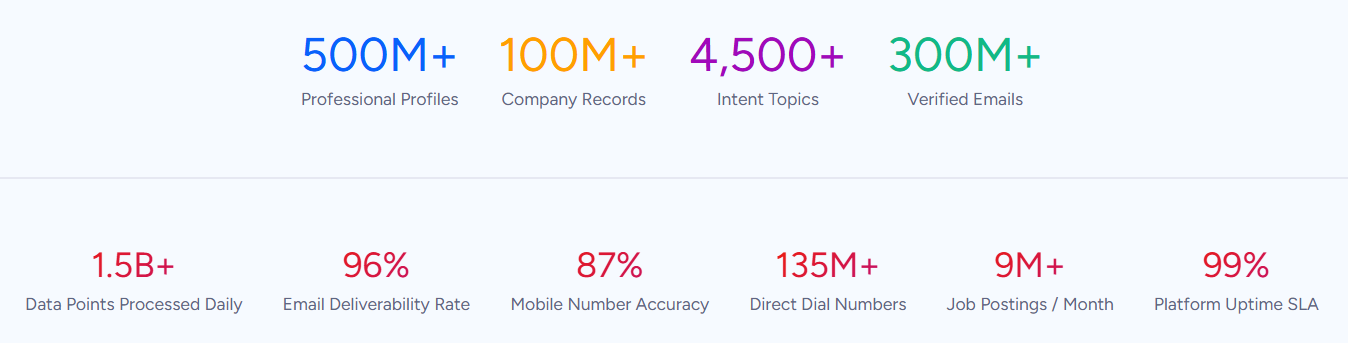
Source: ZoomInfo
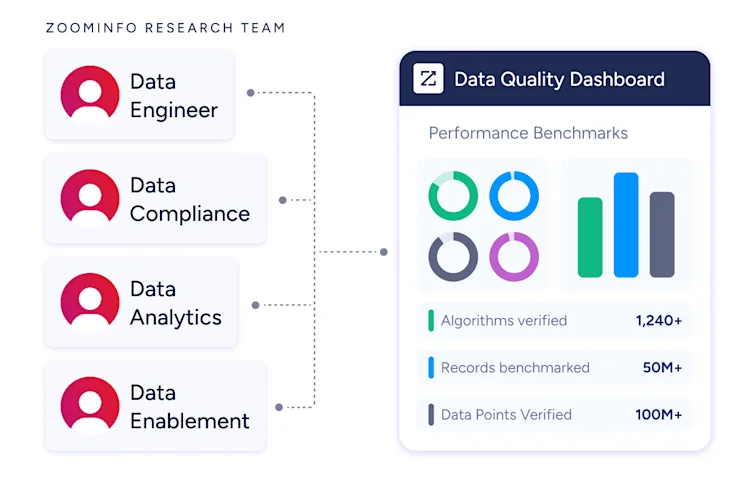
Data quality is maintained through a multi-source verification pipeline backed by 300+ human researchers, achieving up to 95% accuracy on first-party data.
Source: ZoomInfo
This data is not self-reported. In a Fortune 500 competitive RFP analyzing 25 million contacts across vendors, an independent consultant concluded that "no other competitor came even close."
ZoomInfo has been named a Leader in the Gartner Magic Quadrant for ABM Platforms for two consecutive years, a Leader in the Forrester Wave for Intent Data Providers, and earned 133 No. 1 rankings on G2.
For competitive deal situations, this means your team knows not just what a competitor changed on their website, but exactly who at the target account is evaluating them, how to reach those people directly, and what their company's tech stack, org chart, and buying signals look like.
"ZoomInfo gives us the information we need to execute. We don't have to go through and spend our time digging. It's already there, so we can be three steps ahead." (Vensure)
The GTM Context Graph: ZoomInfo captures not just what competitors publish, but why deals actually move or stall.
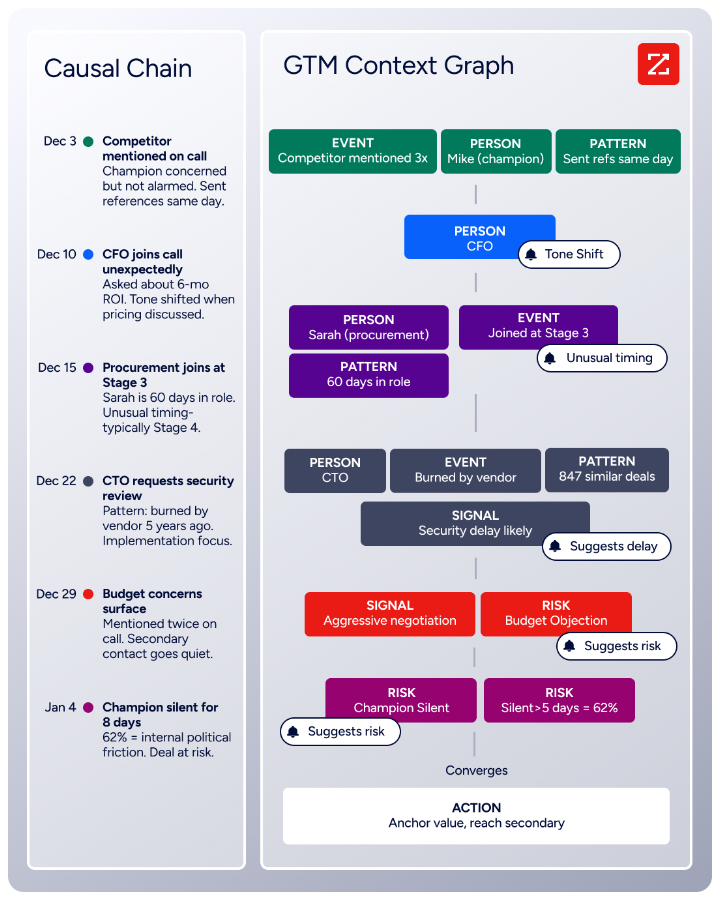
Kompyte tracks external signals: competitor website changes, review site updates, job postings. ZoomInfo's GTM Context Graph processes 1.5B+ data points daily by fusing ZoomInfo's B2B data with a customer's own CRM records, conversation transcripts, email interactions, and behavioral signals into a unified intelligence layer.
The difference matters for competitive deals. A CRM records that a deal moved from Stage 3 to Stage 4. But as ZoomInfo's CPO Dominik Facher writes: "The CRM recorded the state change. It has no record of why it happened."
Source: ZoomInfo
Perhaps the CFO joined the last call and asked about ROI. Perhaps the champion went quiet due to an internal budget battle. The GTM Context Graph captures this decision context and makes it actionable.
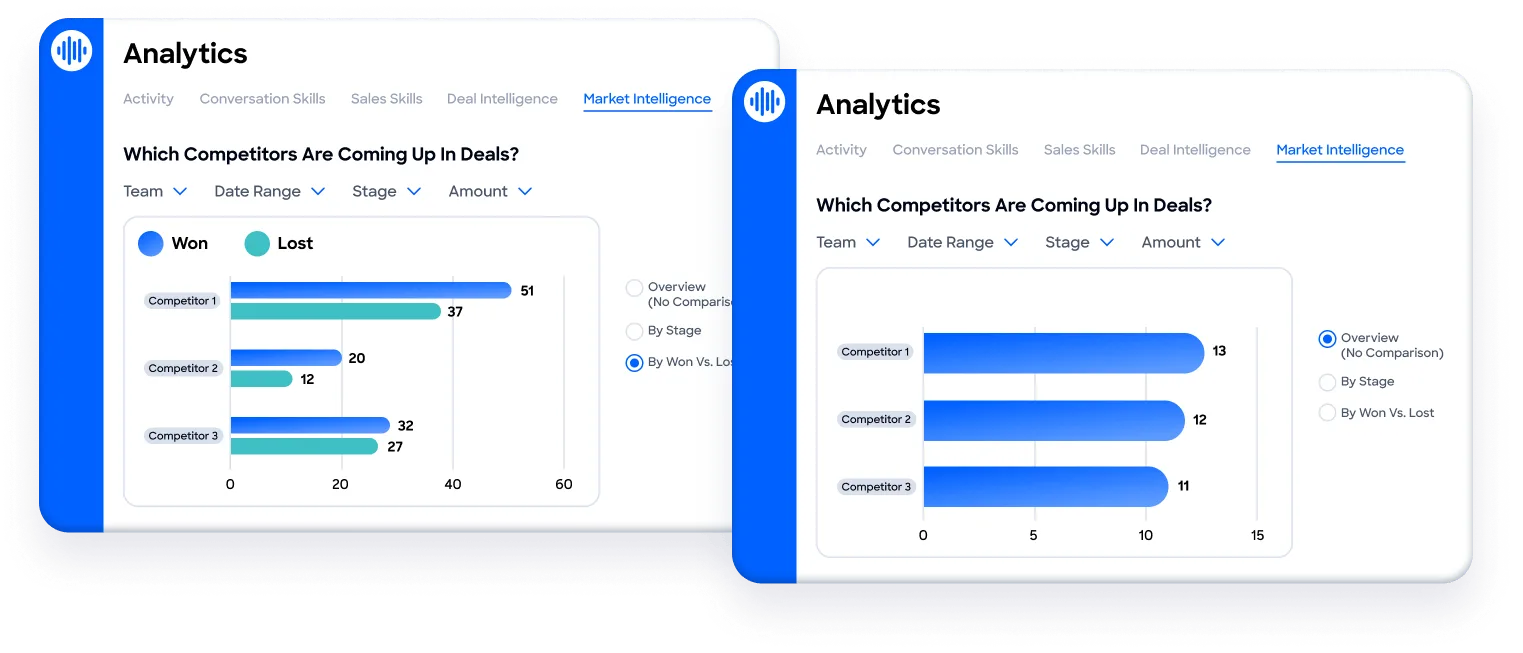
This intelligence layer is built on Chorus, ZoomInfo's conversation intelligence engine, which captures every customer call, meeting, and email. Chorus extracts competitive mentions, objection patterns, and buying criteria from live conversations, feeding real-world buyer language back into the system.
Source: ZoomInfo
Buyer Intent data tracks signals from 210 million IP-to-Organization pairings and 6 trillion+ new keyword-to-device pairings sourced monthly, identifying which accounts are actively researching your category or your competitors.
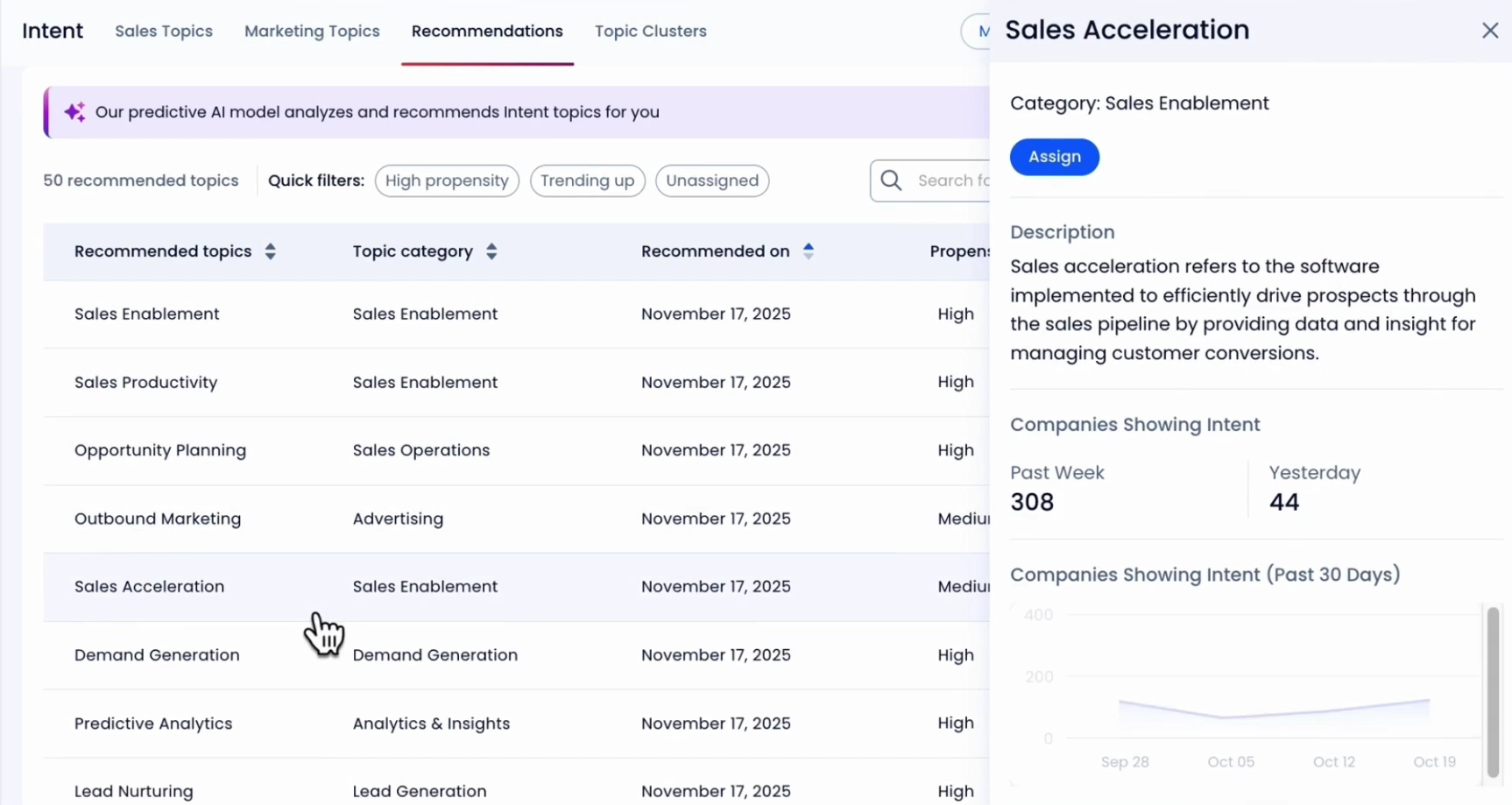
"That combination of our internal CRM data, external signals, and AI that's given all that context has helped us craft very specific account- and persona-based messages." Seismic attributed 39% of active pipeline to ZoomInfo-influenced opportunities and reported 54% productivity gains. (Seismic)
Universal Access: ZoomInfo delivers intelligence through purpose-built interfaces for every team and any third-party tool.
Kompyte distributes Battlecards through CRM integrations and embed codes. ZoomInfo delivers its full intelligence layer through three access lanes designed for different personas.
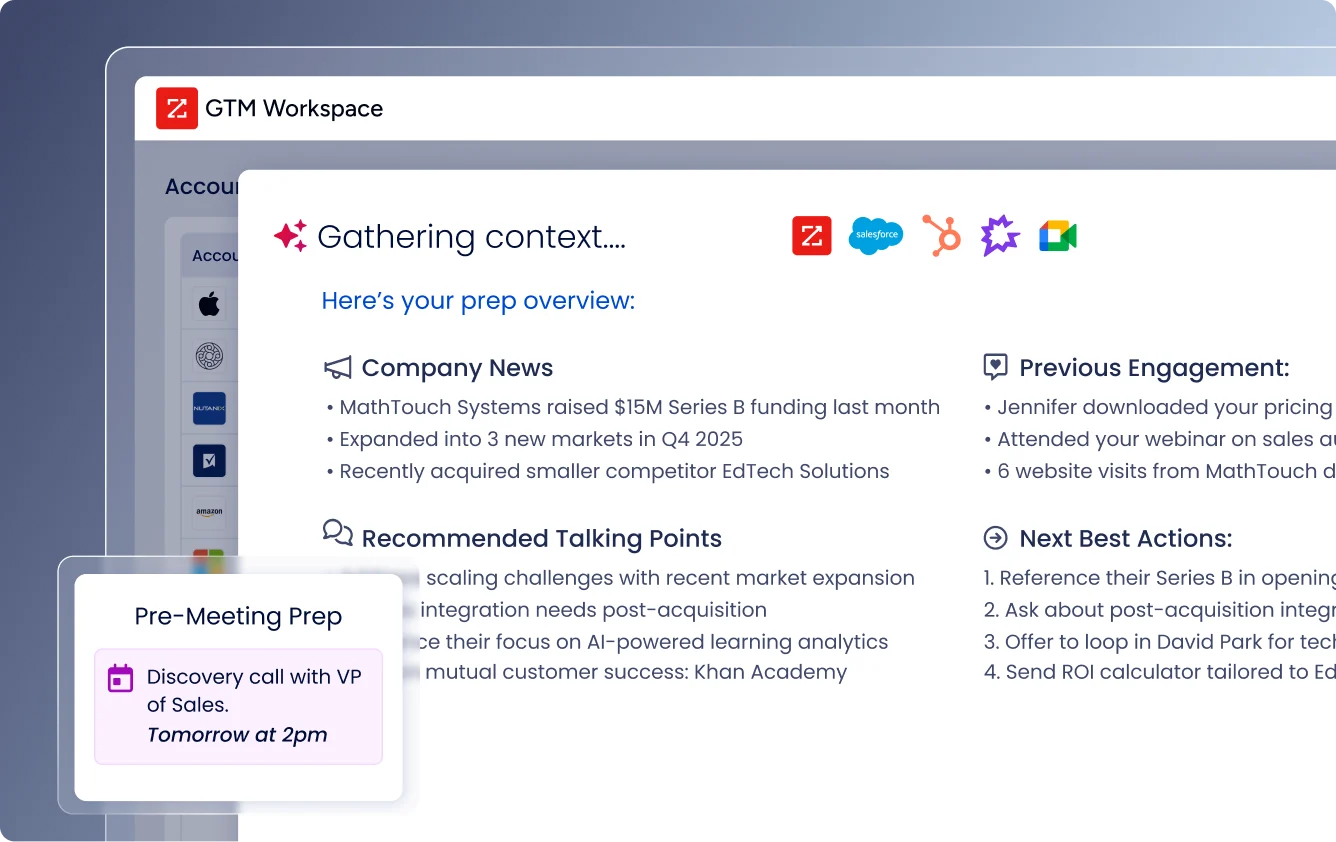
GTM Workspace is the seller's native front-end. It provides a complete book of business view across CRM, ZoomInfo data, conversation history, and market intelligence. AI agents handle account research, outreach drafting, CRM updates, and signal monitoring.
Source: ZoomInfo
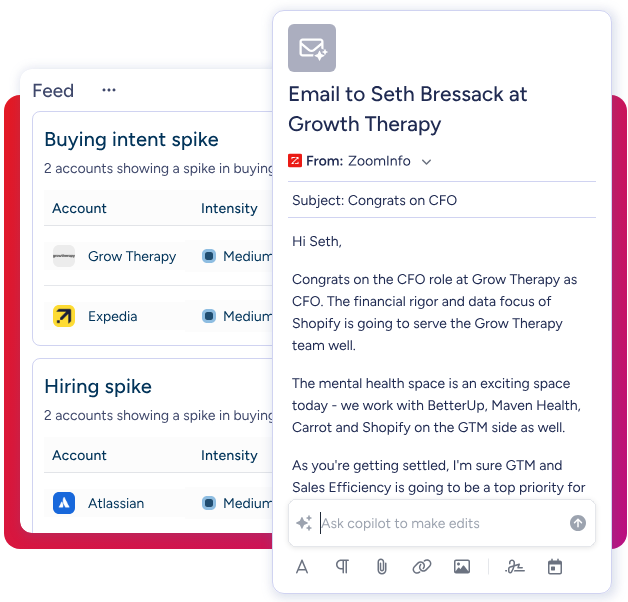
An Action Feed streams in-market buyers matched to target criteria with pre-drafted actions on every signal.
Source: ZoomInfo
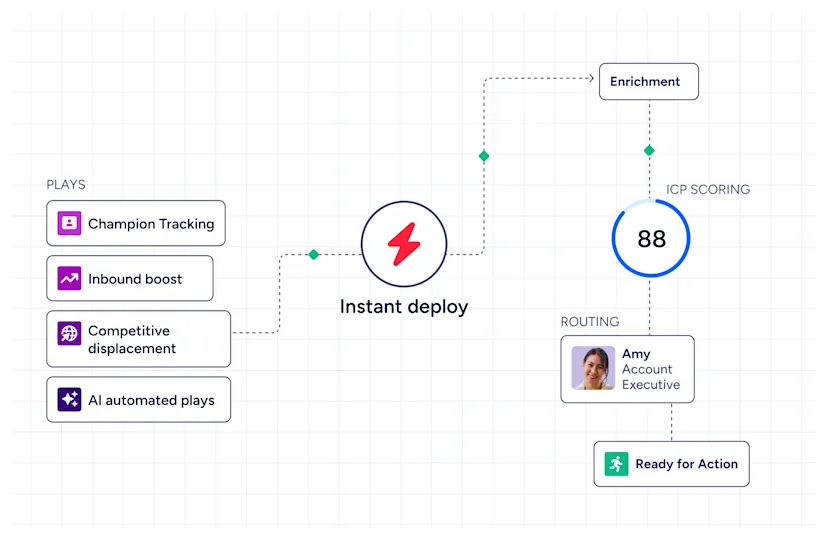
GTM Studio is the front-end for marketers, RevOps, and GTM engineers. Teams build audiences using natural language, define triggers, and activate multi-channel plays (email, calls, ads, direct mail) without engineering support. Expansion plays that used to take 3 weeks now launch in 30 minutes.
Source: ZoomInfo
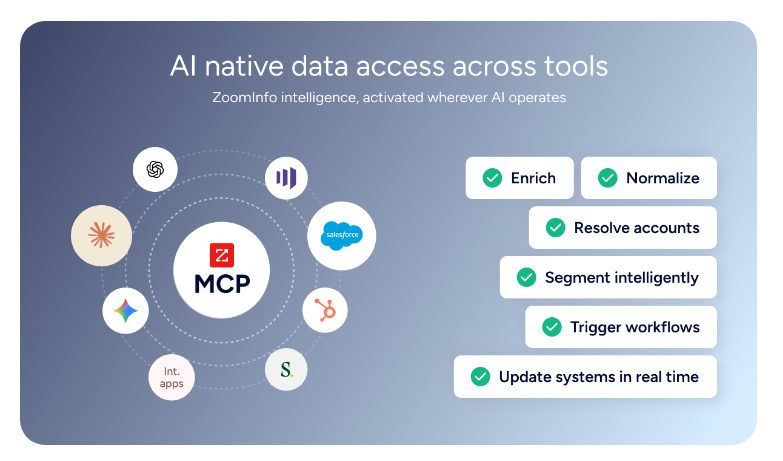
For teams that build beyond ZoomInfo's own products, APIs and MCP expose the same intelligence to any custom agent, internal tool, or partner platform. API Access is included in all relevant plans.
Source: ZoomInfo
"The plug-and-play aspect of the API means I can integrate it very easily into any process and get information at a moment's notice." BDO Canada achieved an 87% reduction in dashboard update time. (BDO Canada)
Pricing: Custom-quoted with a permanent free tier.
Like Kompyte, ZoomInfo uses a custom-quoted, consumption-based pricing model with no published prices. Pricing scales around seats, credits (1 credit = 1 export of a contact or company profile), and feature access. Plans are organized across Sales (Professional, Advanced, Enterprise), Marketing (Marketing Demand, ABM Lite, ABM Enterprise), and standalone products (Chorus, Chat).
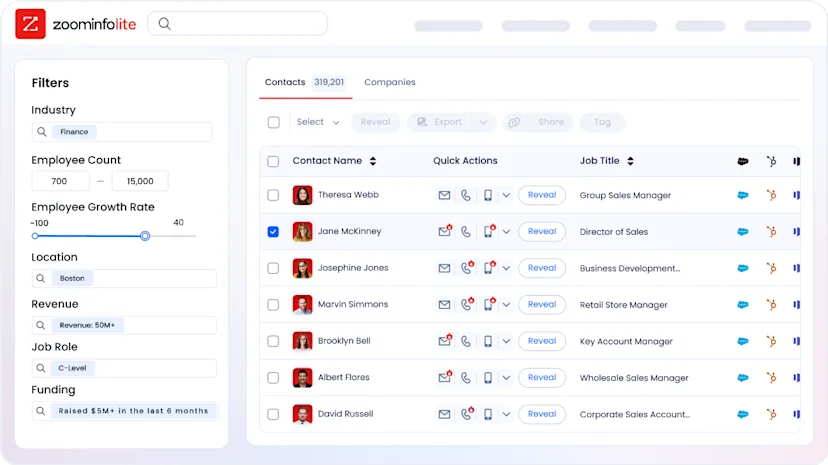
ZoomInfo offers two free entry points that Kompyte does not publicly advertise. ZoomInfo Lite is a permanent free tier (not a trial) with access to ZoomInfo's B2B database, 10 monthly export credits, the ReachOut Chrome Extension, WebSights Lite, and HubSpot integration.
Source: ZoomInfo
A separate 7-day free trial provides access to core platform features including contact and company search, intent signals, and email outreach.
Kompyte or ZoomInfo: Comparison Summary
Kompyte | ZoomInfo | |
|---|---|---|
Primary focus | Competitive intelligence automation and sales Battlecards | All-in-one AI GTM platform (data, intelligence, execution) |
B2B contact data | None | 500M contacts, 135M+ verified phone numbers, 200M+ verified emails |
Competitor monitoring | Websites, reviews, social, ads, job postings, app stores | Competitor alerts, intent signals, conversation intelligence (Chorus) |
Battlecards | Unlimited on all plans, with adoption analytics | Not a dedicated Battlecard tool; competitive insights embedded in seller workflows |
Buyer intent data | Not available | 210M IP-to-Organization pairings, 6T+ keyword-to-device pairings monthly |
Conversation intelligence | Not available | Chorus: call recording, transcription, competitive mention extraction |
Sales execution | Battlecard distribution to CRM and sales tools | GTM Workspace: AI agents, outreach drafting, account prioritization, CRM sync |
Marketing automation | Not available | GTM Studio: audience building, multi-channel plays, campaign orchestration |
AI features | KompyteGPT: daily summaries, document summarization | GTM Context Graph: account intelligence, outreach generation, deal context |
Implementation speed | 1-2 weeks | Weeks, not months (per CEO Schuck) |
Free tier | No publicly advertised free plan | ZoomInfo Lite (permanent free) + 7-day free trial |
Pricing model | Custom-quoted, three tiers | Custom-quoted, consumption-based |
Best for | Dedicated CI programs at B2B SaaS companies with 10+ sales reps | Teams that need competitive intelligence embedded in a full GTM platform |
Final Verdict
The choice between Kompyte and ZoomInfo depends on whether you need a dedicated competitive intelligence tool or a comprehensive go-to-market platform that includes competitive capabilities.
Choose Kompyte if your primary need is automating competitor tracking and maintaining sales Battlecards.
It excels for B2B SaaS companies with a dedicated CI or product marketing owner who wants to monitor dozens of competitors across digital channels and deliver always-current Battlecards directly into CRM and sales enablement tools.
The fast implementation, inclusive pricing (no extra charges for integrations, onboarding, or CSM support), and mature AI filtering make it a strong fit for teams that already have their prospecting and sales execution tools in place and need a focused CI layer on top.
Choose ZoomInfo if you need competitive intelligence as part of a broader go-to-market system. With the industry's most comprehensive B2B data, the GTM Context Graph capturing why deals move or stall, Chorus extracting competitive mentions from live sales conversations, and AI-powered execution through GTM Workspace and GTM Studio, ZoomInfo gives go-to-market teams the ability to identify who is evaluating competitors, understand the context behind those evaluations, and act on that intelligence immediately.
For teams that want one platform powering prospecting, competitive intelligence, intent monitoring, and deal execution, ZoomInfo eliminates the gap between knowing what competitors are doing and reaching the buyers who are comparing you against them.
Get started with ZoomInfo here.
Kompyte answers a valuable question: what are your competitors doing? ZoomInfo answers that question and the ones that follow it: who is evaluating them, why are they evaluating them, and what should you do about it right now?
Kompyte FAQ
What is Kompyte used for?
Kompyte is a competitive intelligence automation platform that monitors competitors across websites, reviews, social media, ads, job postings, and other digital sources. Its primary output is AI-curated intelligence feeds and sales Battlecards that integrate with CRMs and sales enablement tools.
The platform is designed for B2B companies where sales teams regularly face competitive deal situations and need current, accessible information about rivals.
How long does it take to implement Kompyte?
Kompyte claims an industry-best implementation timeline of 1-2 weeks to full deployment, with first insights arriving in 24-48 hours. Every plan includes a dedicated Customer Success Manager who guides onboarding and ongoing support. By comparison, Kompyte's own marketing claims that competitors like Klue and Crayon take 7-8 weeks to implement.
How much does Kompyte cost?
Kompyte does not publish pricing on its website. Prospective buyers must contact sales for a custom quote. The platform offers three tiers (Essentials, Professional, and Unlimited) differentiated primarily by the number of tracked competitors, user seats, and advanced features like SSO.
At the time of its acquisition by Semrush, Kompyte's average annual revenue per customer was approximately $20,000. All plans include integrations, onboarding, and CSM support at no additional cost.
Does Kompyte include a B2B contact database?
No. Kompyte tracks competitor activity and creates sales Battlecards, but it does not provide B2B contact data, verified phone numbers, or email addresses. Teams that need to identify and reach buyers evaluating competitors require a separate platform.
ZoomInfo provides 500M contacts, 135M+ verified phone numbers, and 200M+ verified business email addresses alongside intent signals and competitive intelligence capabilities.
What integrations does Kompyte support?
Kompyte integrates with Salesforce, HubSpot, Slack, Microsoft Teams, Google Drive, OneDrive, Trello, Gong, and sales enablement platforms including Highspot, Showpad, and Seismic. All integrations are included on all plans at no extra cost.
The Salesforce and Slack integrations are bi-directional, allowing reps to view Battlecards and submit intel without leaving their existing tools.
However, some users have reported functional gaps in the depth of certain integrations, particularly with HubSpot and Slack.
Does Kompyte have AI features?
Yes. KompyteGPT, powered by an OpenAI integration, provides AI Daily Summaries, AI Auto Summarize for individual insights and PDF documents, and AI-assisted Battlecard creation. The AI can process documents up to 5MB and 70,000 characters. Users can train the AI by marking summary headlines as relevant or irrelevant.
Client data is not used to train general AI models and remains siloed to each customer's account. However, user reviews note that AI summaries can be inconsistent on complex or unstructured content and often require manual editing.
Who are Kompyte's main competitors?
Kompyte competes primarily with Crayon and Klue in the dedicated competitive intelligence category. Kompyte differentiates on AI maturity (its engine has been learning since 2014), faster implementation (1-2 weeks versus 7-8 weeks claimed for rivals), and Semrush's data network.
For teams that need competitive intelligence as part of a broader go-to-market platform rather than a standalone CI tool, ZoomInfo offers an alternative approach that combines B2B data, buyer intent, conversation intelligence, and AI-powered execution.
For a side-by-side look at how Kompyte and Klue compare on features, implementation, and competitive positioning, see our Kompyte vs. Klue comparison.
Does Kompyte offer a free trial?
Kompyte's terms of service reference a discretionary free trial that may be offered at Semrush's sole discretion, but no self-serve free trial or permanent free tier is publicly advertised on the website. ZoomInfo offers both a permanent free tier (ZoomInfo Lite with 10 monthly export credits) and a 7-day free trial with access to core platform features.
More related comparisons and breakdowns:
