
Choosing between PitchBook and Tracxn for private market intelligence often comes down to five questions:
Are you tracking private capital markets (PE, VC, credit), or do you also need to reach the right people at the companies you find?
Do you need analyst research and fund performance benchmarks, or is startup discovery and sector mapping your main workflow?
Is your budget sized for an enterprise data platform, or do you need professional intelligence at a lower price?
Are you focused on North American and European deal flow, or do you need coverage across emerging markets like India and Southeast Asia?
Do you stop at identifying companies, or do you need verified contact data, intent signals, and outreach tools to turn research into revenue?
In short, here's what we recommend:
PitchBook is the platform for professional investors, bankers, and credit analysts who need the fullest view into private capital markets. It covers nearly 6 million companies, 2.7 million investments, 570,000 investors, and 147,000 funds, backed by 1,800+ researchers who verify data through direct calls with deal participants.
With Morningstar as its parent company, PitchBook bridges public and private markets in a single subscription. But pricing is opaque and enterprise-only, there's no self-serve tier, and smaller corporate development teams may struggle to justify the cost.
Tracxn serves venture capital funds, corporate innovation teams, and emerging-market investors who need broad startup discovery at a lower price.
It tracks 7.7M+ companies organized across 55,400+ taxonomy nodes, with particular strength in India, Southeast Asia, and niche sub-sector mapping. Its built-in deal-flow CRM and LiveDeals marketplace add workflow tools that go beyond data alone.
But historical financial data can be sparse, US private company coverage has gaps, and the platform lacks the research depth that PE and credit professionals require.
Both platforms help you find and evaluate private companies. But what happens after you've identified a target, a potential partner, or an account worth pursuing? Neither was built to help you reach decision-makers with verified contact data, buying signals, and automated outreach. That's where a different kind of intelligence becomes essential.
ZoomInfo is an AI-powered go-to-market platform that turns private market research into action. Where PitchBook and Tracxn tell you which companies to watch, ZoomInfo tells you who to contact, when they're in-market, and what to say. Its data spans 500M contacts, 100M companies, 135M+ verified phone numbers, and 200M+ verified business email addresses.
The GTM Context Graph processes 1.5B+ data points daily, combining this data with CRM records, conversation intelligence, and behavioral signals to reveal not just what's happening at an account, but why.
That intelligence is accessible through GTM Workspace for sellers, GTM Studio for marketers and RevOps, or API and MCP in any tool.
If turning market intelligence into pipeline sounds like the missing piece, see how ZoomInfo works with a free trial.
PitchBook vs. Tracxn vs. ZoomInfo at a glance
PitchBook | Tracxn | ZoomInfo | |
|---|---|---|---|
Primary focus | Private capital markets data & research | Startup discovery & sector intelligence | B2B contact intelligence & GTM execution |
Ideal buyer | PE/VC firms, investment banks, LPs, credit investors | VC funds, corporate innovation, emerging-market investors | Sales, marketing, and RevOps teams across B2B |
Company coverage | |||
Contact data | 4.4M people (investor/exec profiles) | Leadership bios and social links | |
Analyst research | 60+ analysts, dozens of daily reports | 1,000+ quarterly sector reports | AI-powered account research and buying signals |
Deal-flow CRM | No (integrates with external CRMs) | Built-in, included free | GTM Workspace with AI-driven deal execution |
Intent/buying signals | Limited (company signals, news alerts) | Funding alerts, sector newsletters | |
Pricing transparency | Sales-gated, no published prices | Sales-gated for Premium | Sales-gated, consumption-based |
Free tier | Gated free trial (limited data) | Lite plan (usage-capped, free forever) | (free forever) + 7-day full trial |
Security certifications | SOX (via Morningstar); no SOC 2 or ISO 27001 | GDPR compliance; no SOC 2 or ISO 27001 documented |
PitchBook owns private market depth
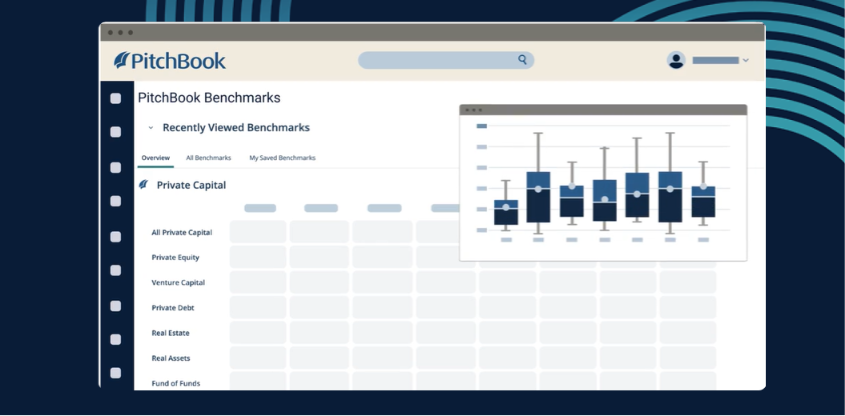
PitchBook was built for the professionals who move capital: general partners evaluating deals, limited partners benchmarking fund managers, investment bankers building buyer lists, and credit analysts tracking leveraged loan markets. No competitor matches its depth in these workflows.
Source: PitchBook
The platform covers 2.7 million investments and 570,000 investors, with deal-level detail that includes pre- and post-money valuations, cap tables, EBITDA multiples, and deal terms.
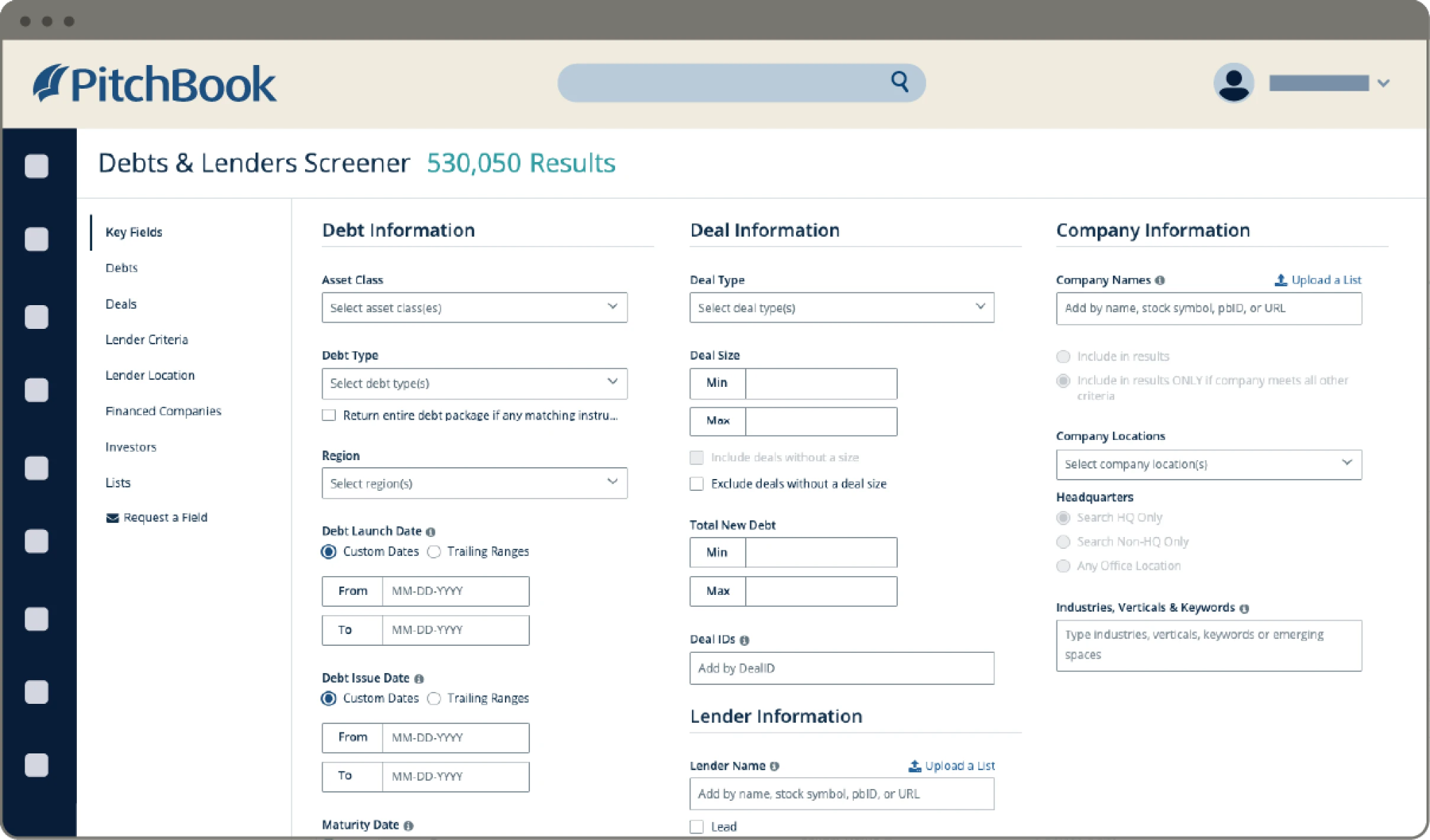
For credit professionals, the LCD dataset (acquired from S&P Global for up to $650 million) provides the industry-standard leveraged loan database, covering over 525,000 debt instruments with breaking credit news from 12 reporters with 25+ years of experience.
Source: PitchBook
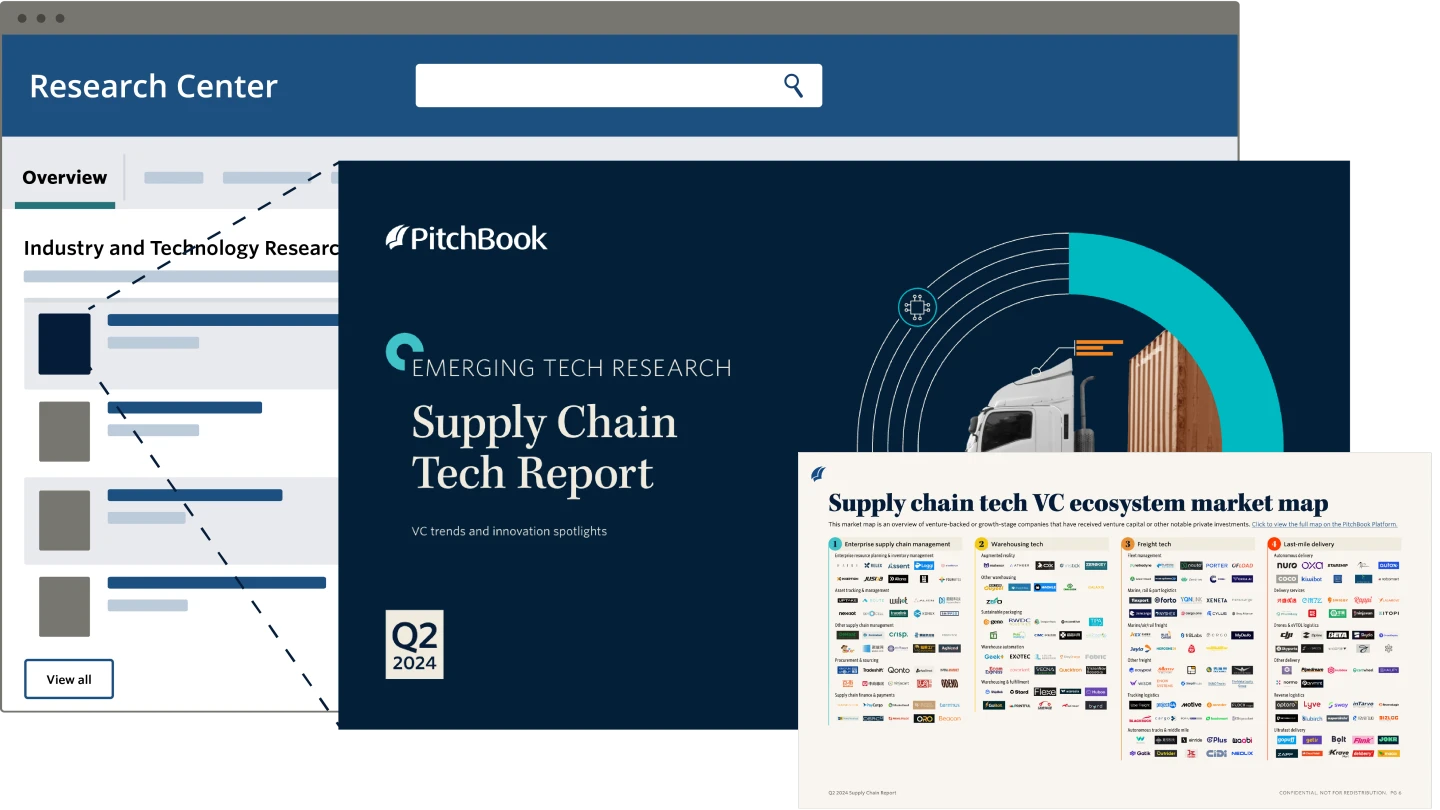
The research layer runs just as deep. The PitchBook Institutional Research Group employs 60+ analysts with CFA, CAIA, and PhD credentials, publishing dozens of new reports daily. The quarterly PitchBook-NVCA Venture Monitor is widely cited as the authoritative source on US venture capital.
Source: PitchBook
Quantitative tools like the VC Exit Predictor (which is 75% accurate, with top-decile companies 3.1x more likely to exit) and Manager Scores give LPs benchmarks for evaluating fund managers.
Where PitchBook separates from Tracxn most clearly is in its blend of public and private markets. As a Morningstar subsidiary, PitchBook integrates public company data alongside private market data, including consensus estimates from 800+ contributing analysts.
The Morningstar PitchBook US Modern Market 100 Index (the first benchmark blending public and private equity in a single index) is a product only this combination can build.
But this depth comes at a price. PitchBook does not publish pricing and requires a sales conversation for any quote. There's no monthly option, no self-serve tier, and license agreements typically run one to three years.
For smaller corporate development teams with limited deal volume, the cost may be hard to justify. Morningstar itself has acknowledged continued softness in the corporate client segment, especially among smaller firms.
Tracxn wins on startup discovery and emerging-market coverage
Tracxn approaches private market intelligence from a different angle. Instead of focusing on deal terms and fund performance, it's built for finding companies before they're on everyone's radar.
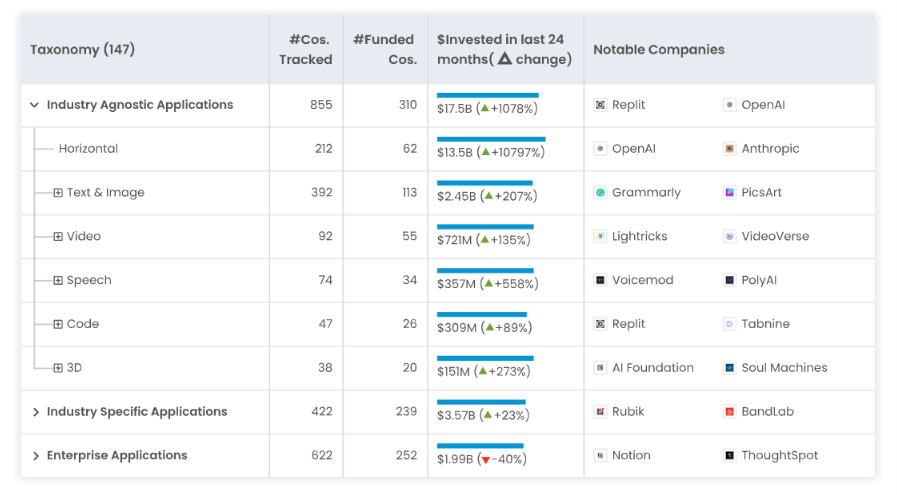
The platform's greatest strength is its 55,400+ taxonomy system. Where most databases classify companies by broad industry tags, Tracxn maps business models at a granular level. You can filter not just for "FinTech" but for specific business models within payments, lending, or insurance.
Source: Tracxn
This taxonomy makes it possible to source deals in niche sub-sectors like climate risk intelligence or quantum cryptography, where broad-category searches return noise.
Coverage tilts toward breadth over depth. Tracxn tracks 7.7M+ companies (including 7M+ unfunded companies), adds 7,400+ new profiles daily, and scans 981M+ web domains. This matters for investors who want to find companies before they raise their first round.
For emerging markets, particularly India and Southeast Asia, Tracxn's founding in Bengaluru and early focus on Asian markets produces coverage that Western alternatives often treat as secondary.
Over 70% of Tracxn's revenue comes from outside India (primarily Europe and the Middle East), which signals strong acceptance beyond its home market.
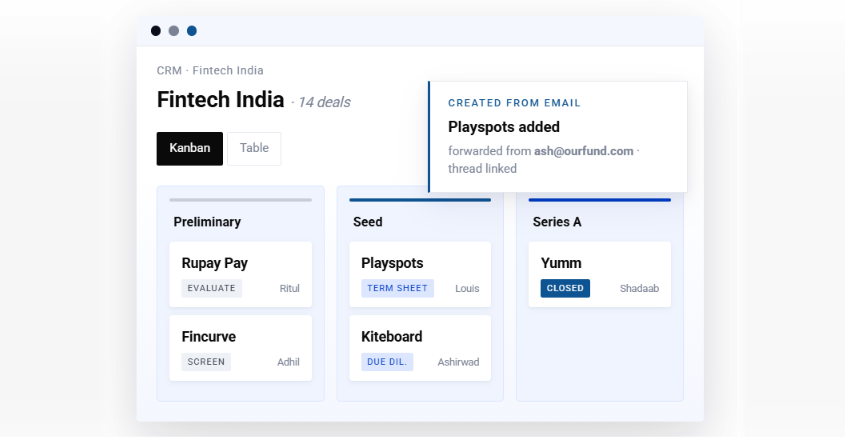
The platform also includes workflow tools that PitchBook doesn't offer natively. The Deal Flow CRM is built into the platform at no additional charge, so any company in the database can be pushed into a deal pipeline in one click.
Source: Tracxn
LiveDeals, a two-sided marketplace where startups post active fundraises, adds a unique inbound channel: 4,000+ deals posted to date, 130+ companies funded, and $200M+ in funding facilitated through the platform.
The trade-offs are real. G2 reviewers note that historical financial data is sparse, making longitudinal analysis hard. US private company financials are absent because US companies don't file publicly. And while the 1,000+ quarterly reports provide useful sector overviews, TrustRadius users note that sector reports "could be better and need improvement to justify the price" compared to PitchBook's analyst-driven research.
PitchBook goes deeper on data quality, Tracxn goes wider on discovery
The two platforms reflect different data philosophies.
PitchBook emphasizes primary research. Its 1,800+ person data operations team has logged over 10 million hours of research over five years, and researchers talk directly with companies, advisors, investors, lawyers, accountants, and lenders to cross-validate data and gather deal details not publicly available.
Datasets are updated six times a day. This matters when you're underwriting a $50 million investment and need to trust the cap table.
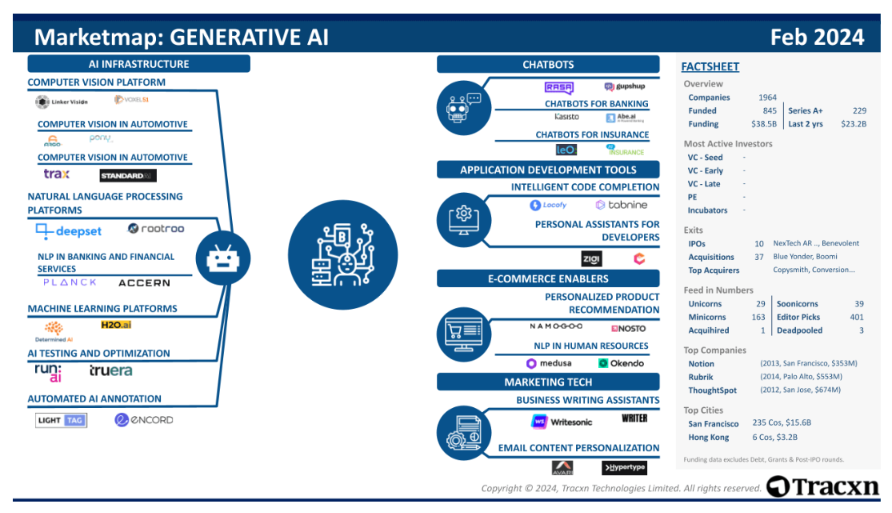
Tracxn emphasizes automated breadth backed by human review. Its "Technology + Human-in-the-Loop" approach pairs automated web crawling across 981M+ domains with ~90 sector-focused analysts who curate, classify, and respond to custom research requests.
Source: Tracxn
The result is broader company coverage (7.7M+ vs. ~6M) but less deal-level verification on individual transactions.
For a PE fund evaluating a leveraged buyout, PitchBook's deal-level depth is essential. For a corporate innovation team mapping AI-powered logistics startups across Southeast Asia, Tracxn's taxonomy-driven discovery is faster and more complete.
Neither platform, however, was designed to answer the question that often follows research: "Now that I've found this company, how do I reach the right person there?"
ZoomInfo fills the gap between research and revenue
PitchBook and Tracxn are research platforms. They help you understand markets, evaluate companies, and track deals. ZoomInfo is an execution platform. It helps you reach the people at those companies with the right message at the right time.
The distinction is structural. PitchBook tracks 4.4 million people, mostly investors and executives, with professional profiles. Tracxn includes leadership bios and social links. Neither provides the verified, direct-dial phone numbers and business email addresses that sales and business development teams need to start conversations.
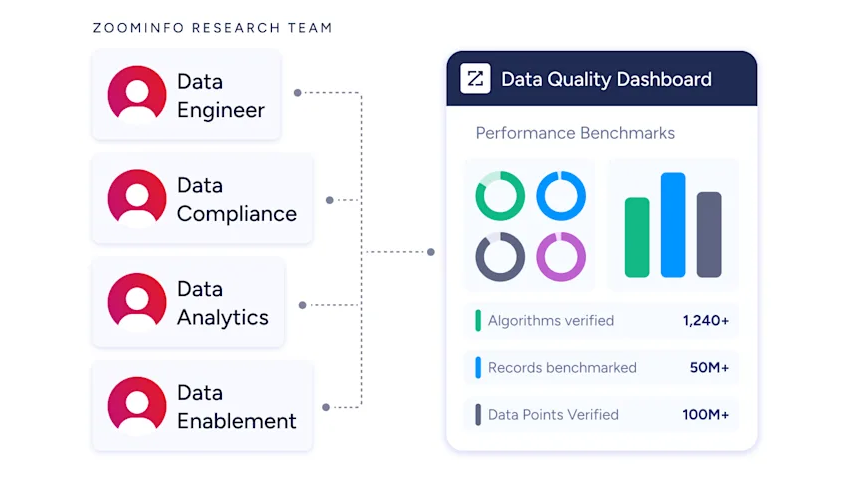
ZoomInfo covers 500M contacts with 135M+ verified phone numbers, 120M direct dials, and 200M+ verified business email addresses, verified through a multi-source pipeline backed by 300+ human researchers and achieving up to 95% accuracy on first-party data.
Source: ZoomInfo
In a Fortune 500 competitive RFP analyzing 25 million contacts across vendors, the independent consultant concluded that "no other competitor came even close."
But the advantage isn't just more contacts. It's the intelligence built on top of them.
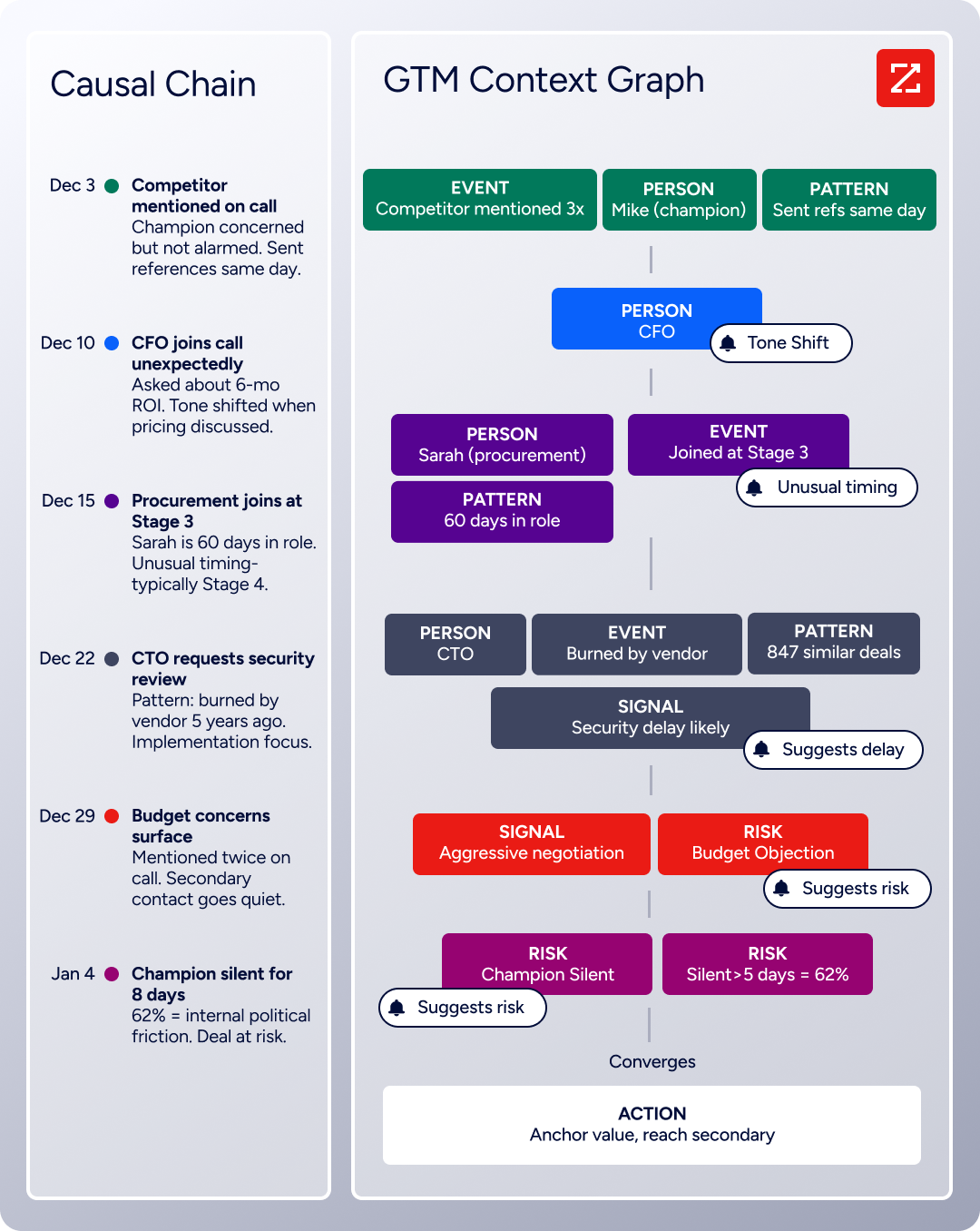
The GTM Context Graph processes 1.5B+ data points daily, combining ZoomInfo's B2B data with a customer's CRM records, conversation transcripts, and behavioral signals. A CRM records that a deal moved stages. Conversation intelligence captures what was said on the call. Intent data shows the company is researching your competitor.
The GTM Context Graph reasons across all three to surface why the deal is moving and what should happen next.
Source: ZoomInfo
This matters for teams that don't just research companies but sell to them, partner with them, or invest in them. Corporate development teams that identify acquisition targets in PitchBook or Tracxn can use ZoomInfo to reach the founders and board members at those targets with verified contact data and buying signals. Investment banks can identify which companies in their coverage universe are actively evaluating solutions. Service firms can spot which PE-backed companies are hiring into functions that signal upcoming advisory needs.
Seismic's sales team attributed 39% of active pipeline to opportunities identified or influenced by ZoomInfo signals, boosted productivity by 54%, and saved 11.5 hours per week. "It's bringing data together faster than anyone could. It's both a time saving and a quality improvement," said Toby Carrington, Chief Business Officer. (Seismic Case Study)
AI capabilities reflect each platform's core mission
All three platforms have invested in AI, but their implementations reveal different priorities.
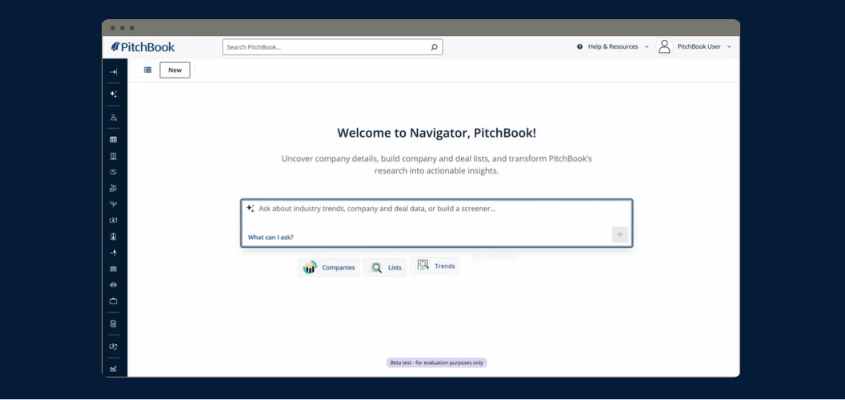
PitchBook launched PitchBook Navigator, a generative AI layer that lets users query the platform in natural language.
Source: PitchBook
It uses a proprietary AI + HI (Artificial Intelligence + Human Insights) methodology that grounds AI outputs in verified data, addressing the hallucination concerns financial professionals have about LLM-generated results.
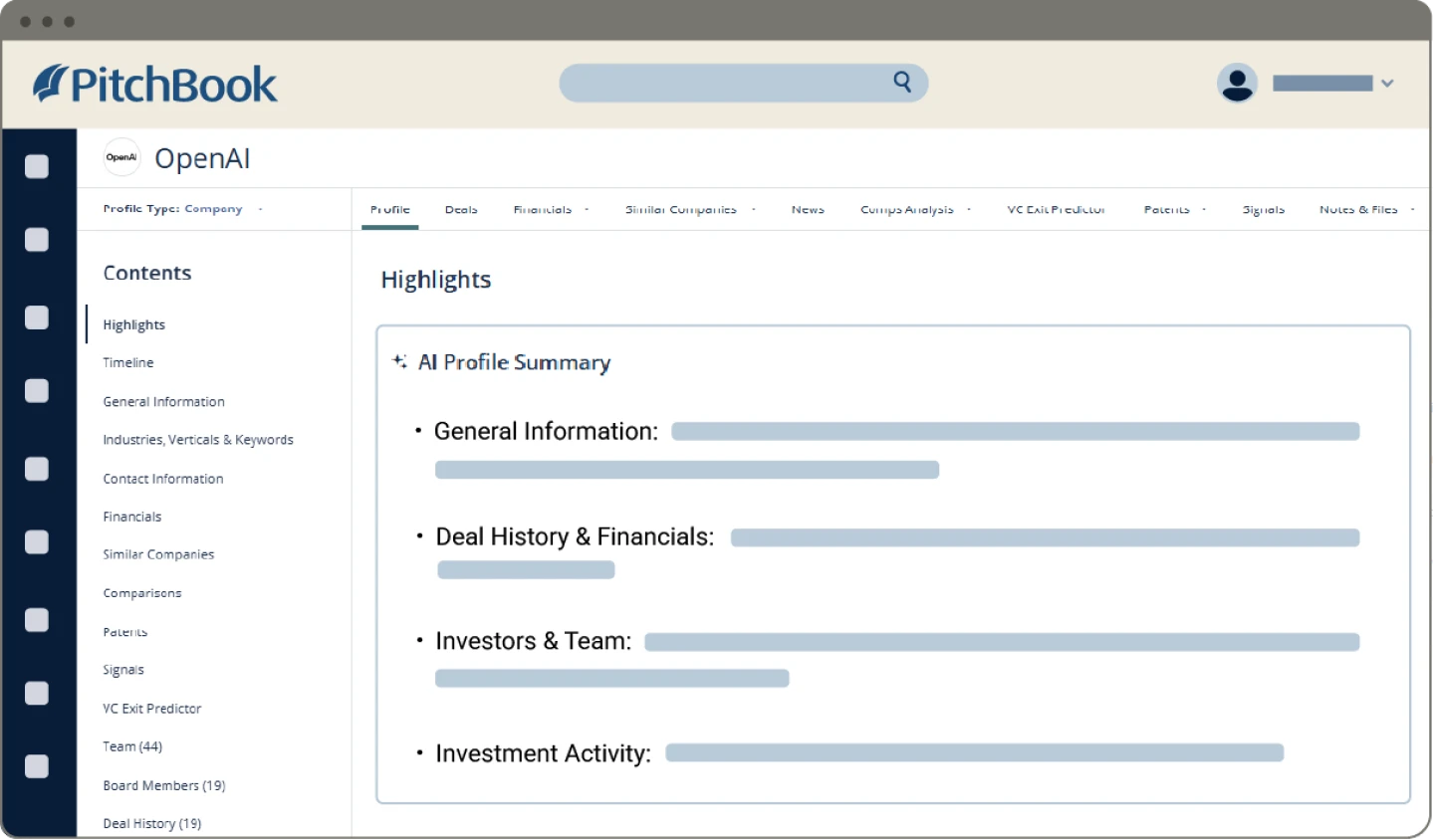
PitchBook's AI also powers profile summaries, transcript summaries, and valuation estimates, including the industry's first daily valuation model for VC-backed companies covering 15,000+ companies. The emphasis: faster research without sacrificing accuracy.
Source: PitchBook
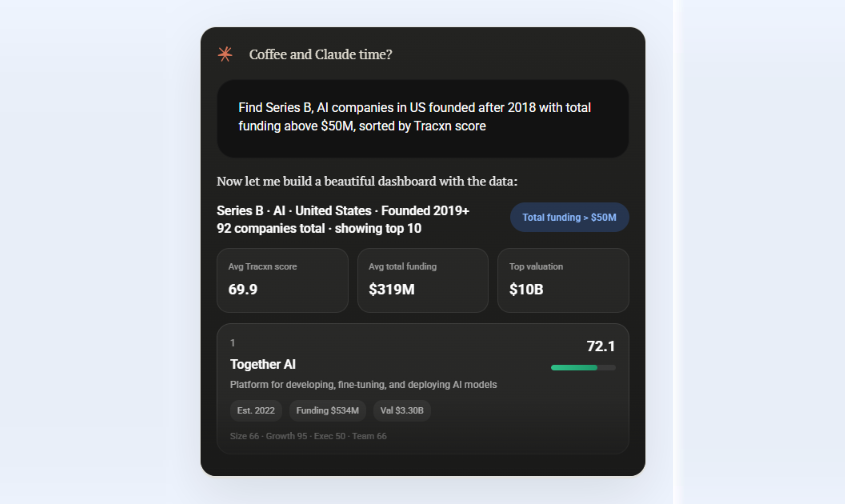
Tracxn has published an AI Suite roadmap with three stages: a live MCP integration for Claude and Gemini, an in-progress AI chatbot for natural-language data queries, and a planned agentic workflow layer. The ambition is clear, but the execution is earlier-stage than PitchBook's production deployments.
Source: Tracxn
ZoomInfo's AI operates at a different level because it's built on the GTM Context Graph, which reasons across CRM data, conversation intelligence, intent signals, and verified contact data at once.
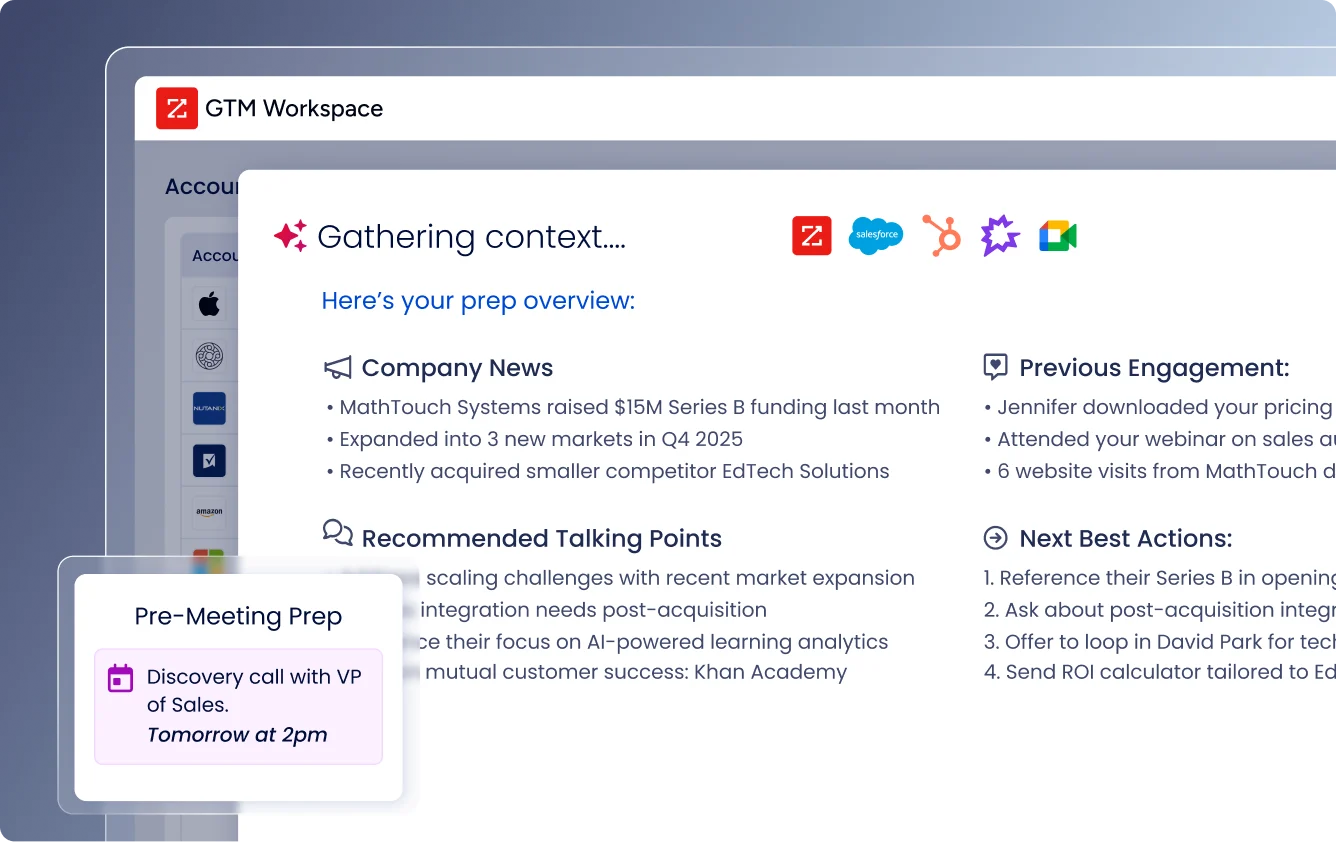
In GTM Workspace, AI agents research accounts, draft outreach based on what was said on the last call, update CRM fields, and surface the next best action.
Source: ZoomInfo
In GTM Studio, marketers describe audiences in plain language and launch multi-channel plays targeting accounts that match proven win patterns. PitchBook and Tracxn use AI to speed up research. ZoomInfo uses AI to speed up revenue.
"ZoomInfo's not just a contact data company anymore. They've built a full system of execution. GTM Intelligence works the list, writes the outreach, triggers the play, and helps drive predictable growth," said Ian Brodie, CEO & Co-Founder of Levanta. (Levanta Case Study)
Integration and access models differ significantly
How you access each platform's intelligence matters as much as what's in it.
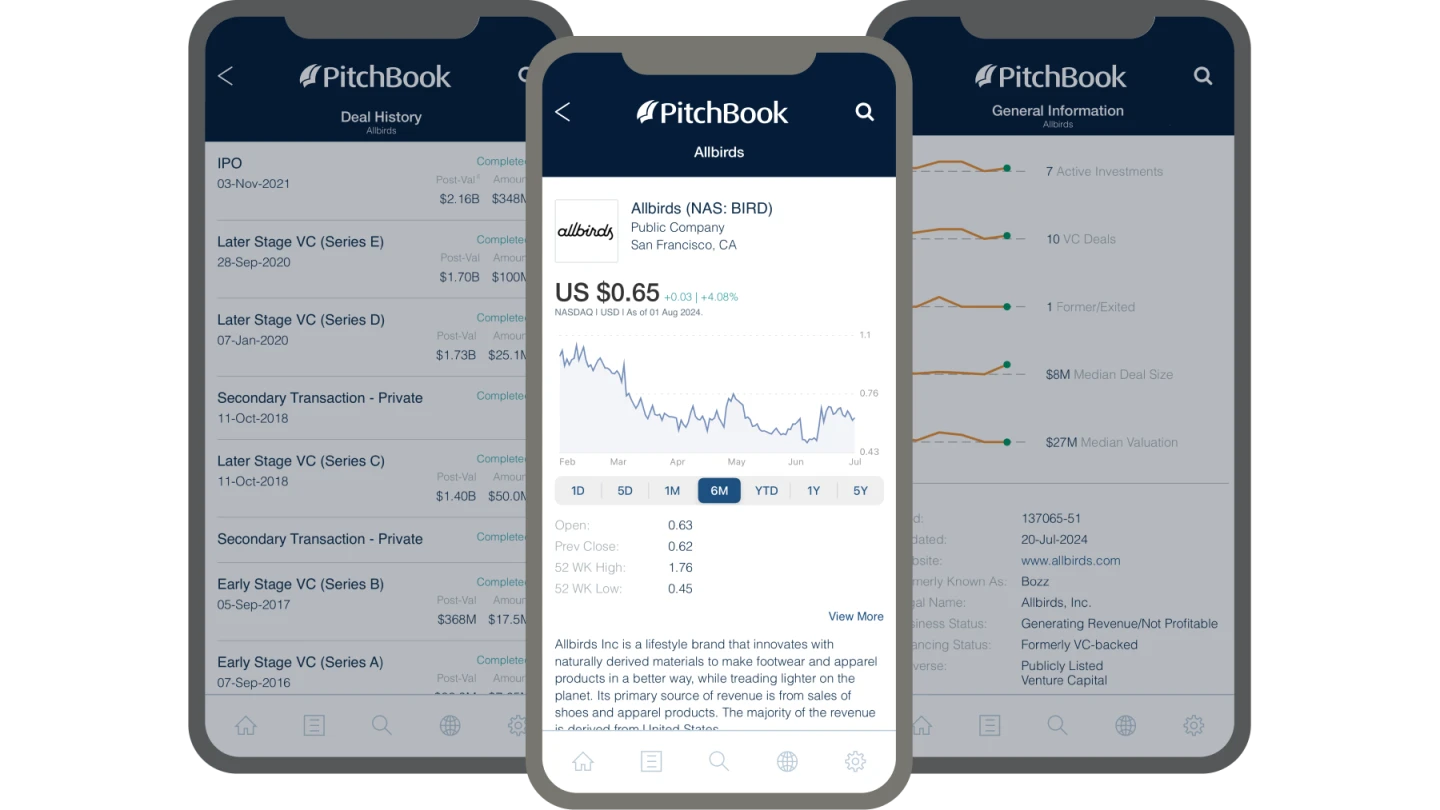
PitchBook delivers data through a browser-based desktop platform, a free Excel plugin with 30+ pre-built templates, a Chrome extension, and a mobile app. For programmatic access, the Direct Data API and Data Feed deliver bulk data to cloud platforms like AWS, Snowflake, and Azure.
Source: PitchBook
CRM integrations with Salesforce, HubSpot, and Microsoft Dynamics are available as premium add-ons.
PitchBook has also established LLM partnerships with Anthropic, OpenAI, Perplexity, and others, positioning its data as a grounding layer for financial AI tools.
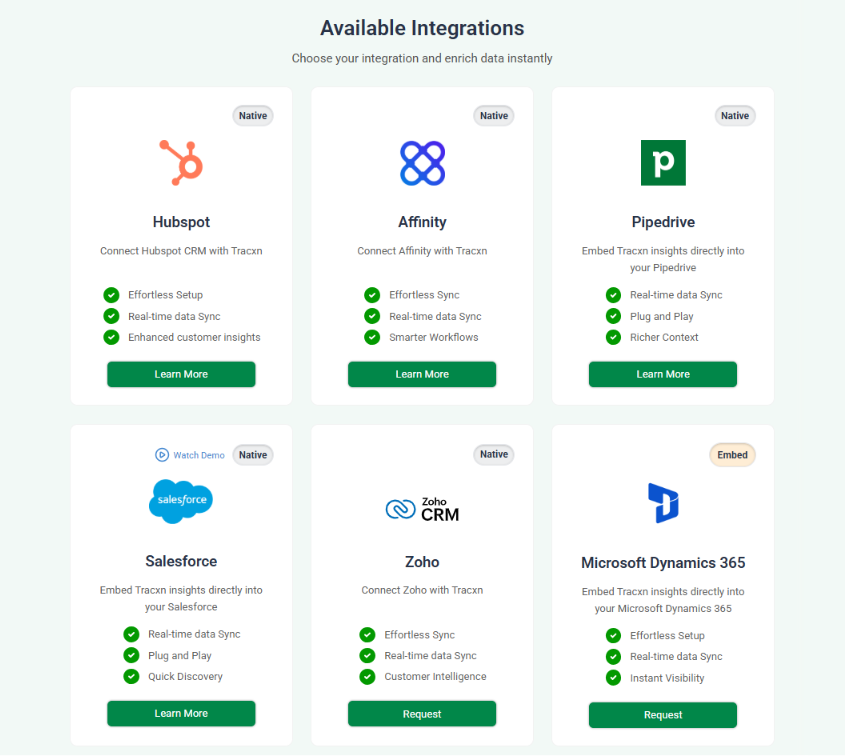
Tracxn offers browser extensions for Chrome and Firefox, a Google Sheets add-on, and mobile apps for Android and iOS. CRM integrations cover Salesforce, HubSpot, Pipedrive, Affinity, and Zoho.
Source: Tracxn
For data infrastructure teams, Tracxn offers Snowflake and Google BigQuery connections alongside scheduled SFTP dumps. The Tracxn MCP connects directly to Claude and Gemini. API access is gated behind Data Solutions licensing.
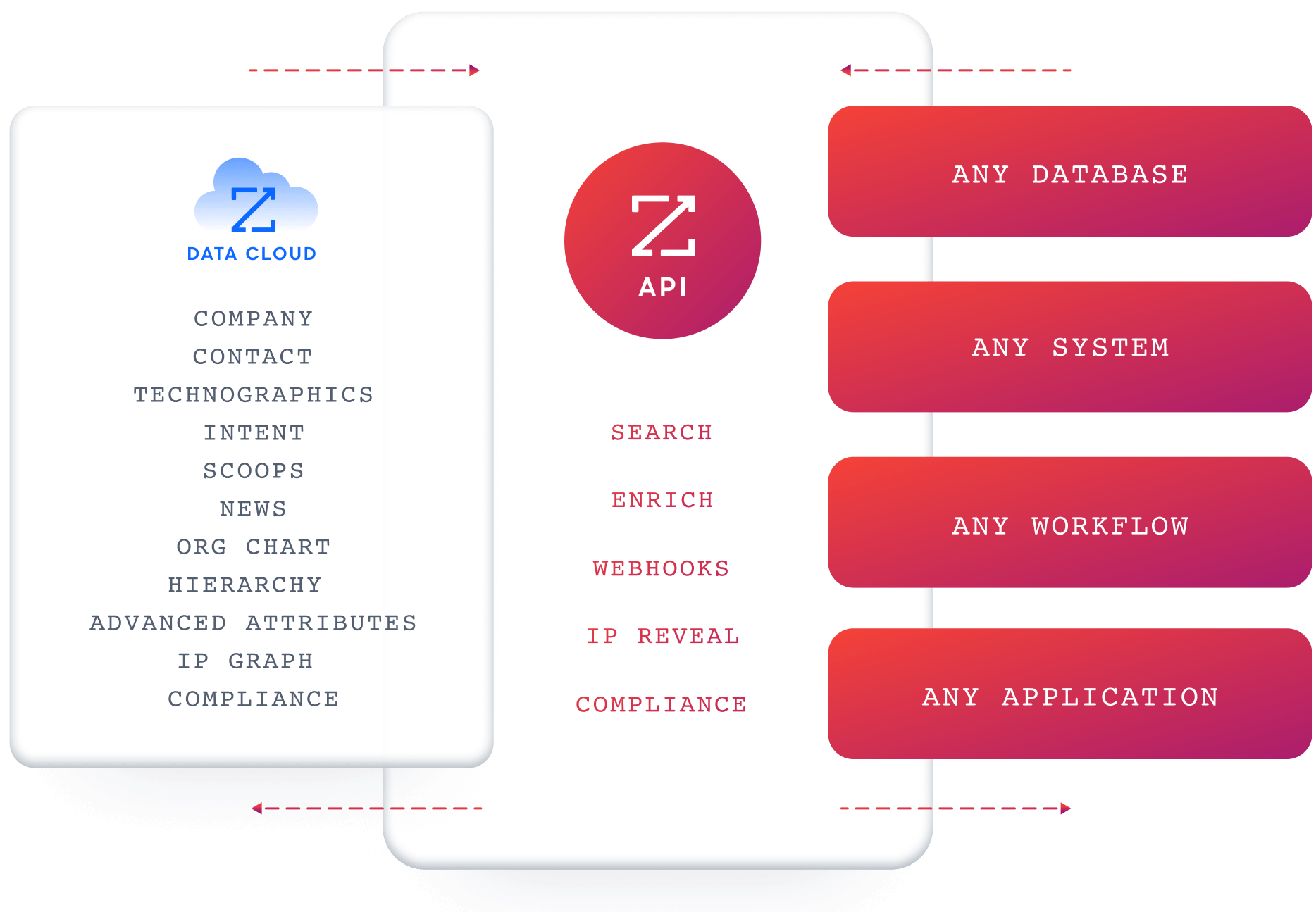
ZoomInfo takes the broadest approach. The Enterprise API covers search, enrich, AI intelligence, marketing audiences, and engagement data, with full OAuth 2.0 authentication and detailed developer documentation.
Source: ZoomInfo
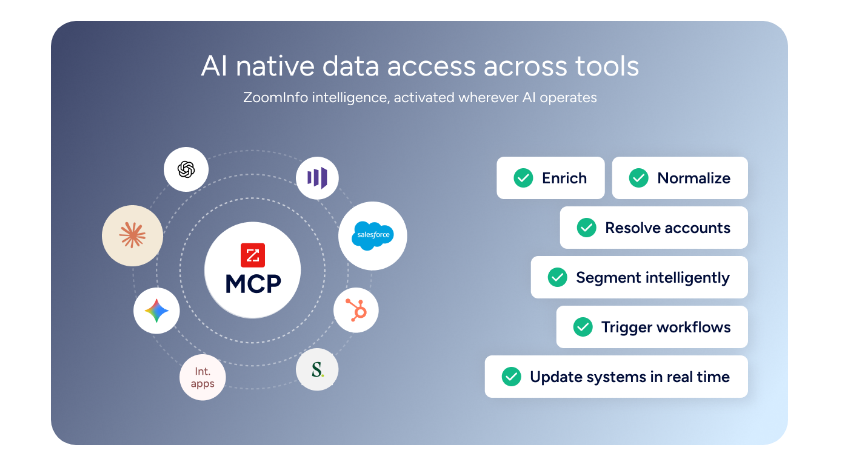
The ZoomInfo MCP server makes the same data available inside Claude, ChatGPT, and any MCP-compatible AI assistant.
Source: ZoomInfo
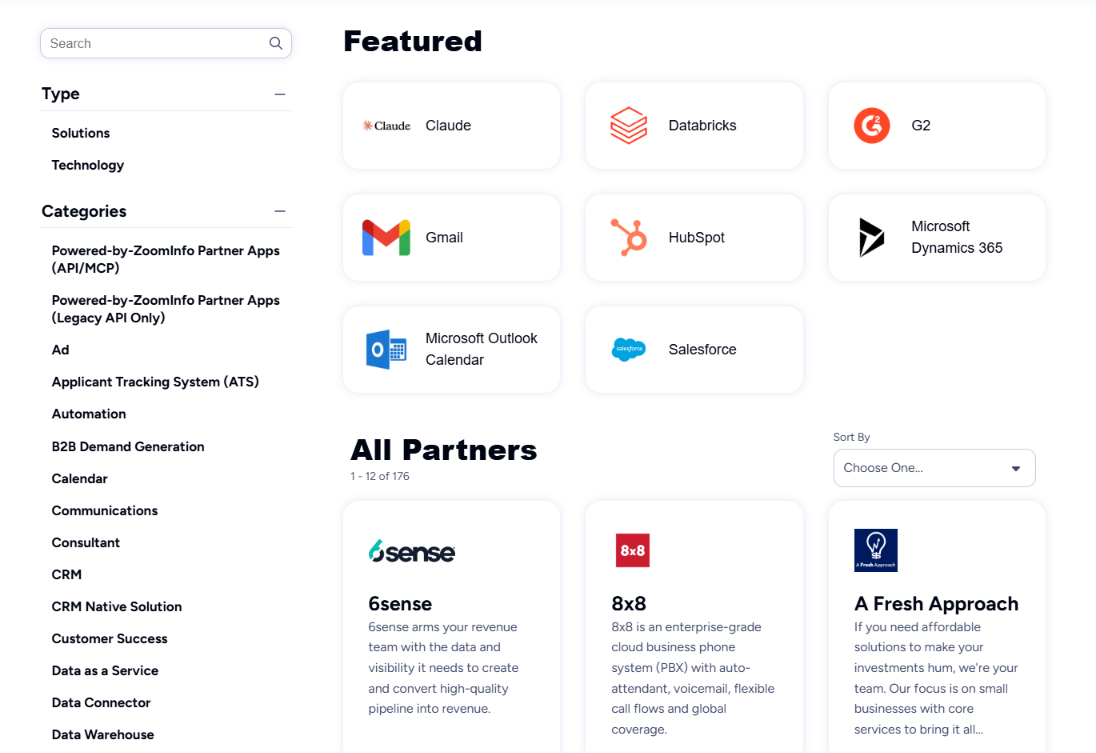
The App Marketplace lists 172+ integration partners, and Cloud Partners deliver data into AWS, Google Cloud, Snowflake, and Databricks. Critically, ZoomInfo has added API access to all relevant plans rather than restricting it to a premium tier.
Source: ZoomInfo
BDO Canada reduced time spent on internal data dashboard updates by 87% using ZoomInfo's API. "The plug-and-play aspect of the API means I can integrate it very easily into any process and get information at a moment's notice," said Jerry Wilson, Senior Marketing Intelligence Analyst. (BDO Canada Case Study)
Pricing and accessibility comparison
The three platforms occupy distinct positions on the accessibility spectrum.
PitchBook is the most expensive and least accessible option for smaller teams. No prices are published, and all inquiries route to sales.
Contracts typically run one to three years. One important distinction: every client gets complete access to all data with no feature tiering or data paywalls within the subscription. Every client also receives a dedicated customer success manager.
A limited free trial is available by request, and academic licenses serve major business schools, though with heavy restrictions (10 rows per day download limit).
Tracxn occupies the middle ground. The Lite plan is permanently free with no credit card required, providing access to the core startup database with usage caps (1 report download per day, 200 export credits per month). Premium pricing is sales-gated and confidential.
TrustRadius reviewers note that pricing runs higher than Crunchbase but lower than CB Insights, placing Tracxn as the mid-market option for professional private company coverage.
There is no documented monthly billing option, and per Tracxn's terms of service, subscriptions auto-renew with 30 days' cancellation notice required.
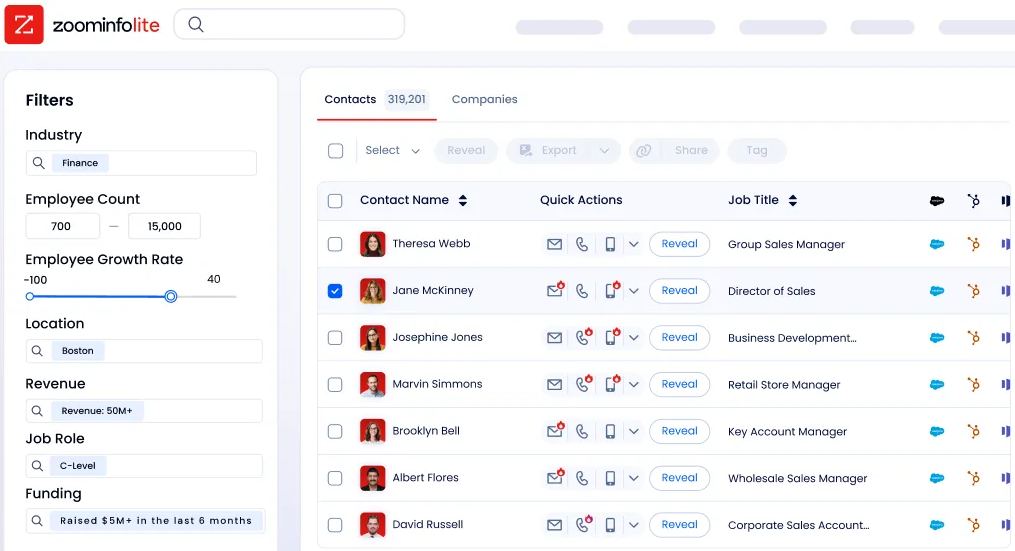
ZoomInfo uses consumption-based pricing where costs scale with usage, seats, and credit volume. Like the others, specific prices aren't published. But ZoomInfo offers two free entry points: ZoomInfo Lite (permanently free, no credit card, 10 monthly export credits with access to the B2B database) and a 7-day free trial with full feature access.
Source: ZoomInfo
Security and compliance postures vary
For financial services firms and regulated industries, security certifications influence vendor selection.
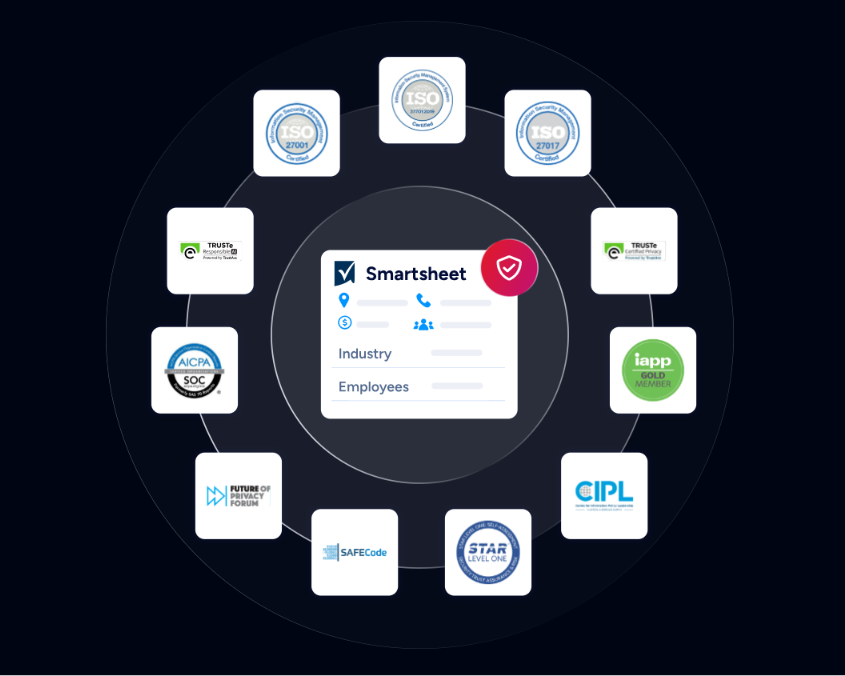
ZoomInfo holds the strongest certification stack: ISO 27001, ISO 27701, SOC 2 Type II, TRUSTe GDPR, and TRUSTe CCPA, all renewed annually. It is also a registered data broker in California and Vermont, with a dedicated Trust Center.
Source: ZoomInfo
PitchBook inherits SOX compliance from Morningstar and maintains security controls including annual penetration testing and quarterly vulnerability scanning.
However, per its Microsoft 365 Publisher Attestation, PitchBook does not hold SOC 2 Type II or ISO 27001 certifications, a notable gap for an enterprise data product serving financial institutions.
Tracxn maintains GDPR compliance with a dedicated contact at gdpr@tracxn.com and confirms data encryption in transit. However, no SOC 2, ISO 27001, or other third-party security certifications are documented in publicly available materials.
Buyers with strict enterprise security requirements should request a security questionnaire directly from Tracxn's sales team.
PitchBook vs. Tracxn vs. ZoomInfo: Which should you choose?
The right platform depends on what you're trying to accomplish and where your workflow bottleneck sits.
Choose PitchBook if:
You're a PE firm, VC fund, investment bank, LP, or credit investor who needs deal data at the institutional level
Fund performance benchmarking, deal comps, and valuation multiples are central to your workflow
You need integrated public and private market data in a single subscription
Access to 60+ analysts publishing daily research is worth the premium
Credit market coverage (leveraged loans, CLOs, private credit) is a requirement
Choose Tracxn if:
You're a VC fund, corporate innovation team, or incubator focused on startup discovery
Emerging-market coverage (India, Southeast Asia, EMEA) is critical to your mandate
You need a built-in deal-flow CRM and access to an active fundraising marketplace
Granular taxonomy-based sector mapping is your primary research method
You need professional private company data without enterprise-level pricing
Choose ZoomInfo if:
You need to turn market intelligence into conversations with verified contacts
Buyer intent signals and buying-committee mapping are essential to your outreach
You want AI-powered outreach, CRM enrichment, and pipeline execution in one platform
Your team spans sales, marketing, and RevOps and needs shared intelligence
You need the strongest compliance and security certification stack in the category
Start a free ZoomInfo trial to see how intelligence becomes action.
PitchBook and Tracxn are the right tools for understanding private markets. When the goal shifts from understanding to acting, from identifying a company to reaching the people who run it, ZoomInfo provides the intelligence that neither research platform was built to deliver.
PitchBook vs. Tracxn vs. ZoomInfo FAQ
What is the fundamental difference between PitchBook, Tracxn, and ZoomInfo?
PitchBook is a private capital markets platform covering PE, VC, M&A, and credit with deal-level data and analyst research.
Tracxn is a startup discovery and sector intelligence platform built for VC funds and corporate innovation teams, with particular strength in emerging markets and granular taxonomy mapping.
ZoomInfo is an AI-powered go-to-market platform with verified B2B contact data, buyer intent signals, and outreach tools that help teams turn market intelligence into pipeline and revenue.
Which platform has the most comprehensive company coverage?
ZoomInfo covers the most companies overall at 100M, though this is B2B company data focused on company attributes, contacts, and technographics.
Tracxn tracks 7.7M+ companies with the broadest startup and unfunded company coverage, including 7M+ unfunded companies discovered through web crawling.
PitchBook covers nearly 6M companies with the greatest deal-level detail, including cap tables, valuations, and financing history verified through primary research.
Which platform is best for venture capital deal sourcing?
PitchBook offers the deepest deal-level data, fund performance benchmarks, and LP intelligence for institutional VC investors.
Tracxn offers broader startup discovery across 55,400+ taxonomy nodes, a built-in deal-flow CRM, and a LiveDeals marketplace where startups actively seeking funding can be found.
ZoomInfo is best when VC-backed companies need to be reached for partnership, sales, or portfolio support, providing verified contact data and buying signals for decision-makers.
How does pricing compare across the three platforms?
None of the three publish specific prices. PitchBook is generally the most expensive, with enterprise-only sales-gated contracts typically running one to three years; its all-inclusive model means no feature gating within the subscription.
Tracxn sits in the mid-market, with TrustRadius reviewers noting it costs more than Crunchbase but less than CB Insights. ZoomInfo uses consumption-based pricing that scales with usage and seats.
All three offer free entry points: PitchBook has a gated trial, Tracxn has a permanent Lite plan, and ZoomInfo offers both a permanent Lite tier and a 7-day full-feature trial.
Can these platforms be used together?
Yes, and many organizations do. PitchBook or Tracxn can serve as the private market research layer for identifying companies, tracking deals, and monitoring sectors.
ZoomInfo then serves as the execution layer, providing verified contact data, intent signals, and outreach tools to reach decision-makers at those companies.
ZoomInfo's API and MCP integrations make it possible to pipe B2B intelligence into the same workflows and AI tools that consume PitchBook or Tracxn data.
Which platform has the best AI capabilities?
PitchBook's AI focuses on accelerating financial research, with Navigator enabling natural-language queries and AI powering daily private company valuations.
Tracxn's AI roadmap includes an MCP integration, an in-progress chatbot, and planned agentic workflows.
ZoomInfo's AI is the most action-oriented: the GTM Context Graph reasons across CRM, conversation, and intent data to power AI agents that draft outreach, prioritize accounts, and automate CRM updates through GTM Workspace and GTM Studio.
Which platform offers the strongest security certifications?
ZoomInfo holds the most comprehensive certification stack: ISO 27001, ISO 27701, SOC 2 Type II, TRUSTe GDPR, and TRUSTe CCPA, all renewed annually.
PitchBook inherits SOX compliance from Morningstar and conducts annual penetration testing, but does not hold SOC 2 or ISO 27001.
Tracxn maintains GDPR compliance but does not publicly document SOC 2 or ISO 27001 certifications.
Which platform is best for emerging-market coverage?
Tracxn has the strongest emerging-market coverage, particularly for India and Southeast Asia, owing to its Bengaluru headquarters and early focus on Asian markets.
PitchBook offers growing global coverage across 11 offices including London and Singapore, with particular depth in North American and European private markets.
ZoomInfo provides the broadest global B2B contact coverage with 34M+ company profiles and 200M+ professional profiles outside North America, but focuses on B2B contacts rather than private market deal data.
Compare more tools in this space:
