

Developers who needed programmatic access to LinkedIn profile data liked Proxycurl. Its API-first design, transparent pricing, and real-time scraping made it a go-to for engineering teams building B2B data applications. Then, in January 2025, LinkedIn sued Proxycurl for unauthorized scraping and the creation of fake accounts. By July 4, 2025, the service was permanently shut down.
If you're reading this, you either used Proxycurl and need to replace it, or you're evaluating B2B data enrichment tools and Proxycurl appeared in your research. Either way, the story matters because it exposes a risk baked into how many data enrichment providers work.
Before its shutdown, Proxycurl was a good fit if:
You needed a developer-first API for enriching contact and company records
You wanted real-time LinkedIn data rather than a stale database
You valued transparent, credit-based pricing with no "contact sales" gates
Your team had the technical skills to integrate a RESTful API directly
You primarily needed LinkedIn-sourced professional data
However, Proxycurl had serious limitations even before the lawsuit:
It depended entirely on scraping a single platform (LinkedIn)
It carried legal and compliance risk for customers
It offered no intent signals, buying behavior data, or go-to-market workflow tools
It required technical resources for every integration
It had no CRM connections, no native UI for non-developers, and no sales or marketing automation
For teams that need reliable, legally compliant B2B data enrichment at scale (with API access and broader capabilities), consider ZoomInfo: a B2B data and go-to-market platform covering 500M contacts, 100M companies, 135M+ verified phone numbers, and 200M+ verified business email addresses. ZoomInfo delivers this data through APIs and MCP for developers, GTM Workspace for sellers, and GTM Studio for marketers and RevOps, backed by ISO 27001, ISO 27701, SOC 2 Type II, and TRUSTe GDPR certifications.
We've included a detailed look at ZoomInfo later in this review as the strongest alternative for teams moving beyond Proxycurl. If you want to explore the platform now, you can start with ZoomInfo's free trial here.
What Was Proxycurl?
Source: Proxycurl
Proxycurl was a B2B data enrichment API platform founded by Steven Goh, a serial entrepreneur based in Singapore. The company started from a simple premise: developers shouldn't have to build and maintain their own LinkedIn scraping infrastructure just to get professional profile data.
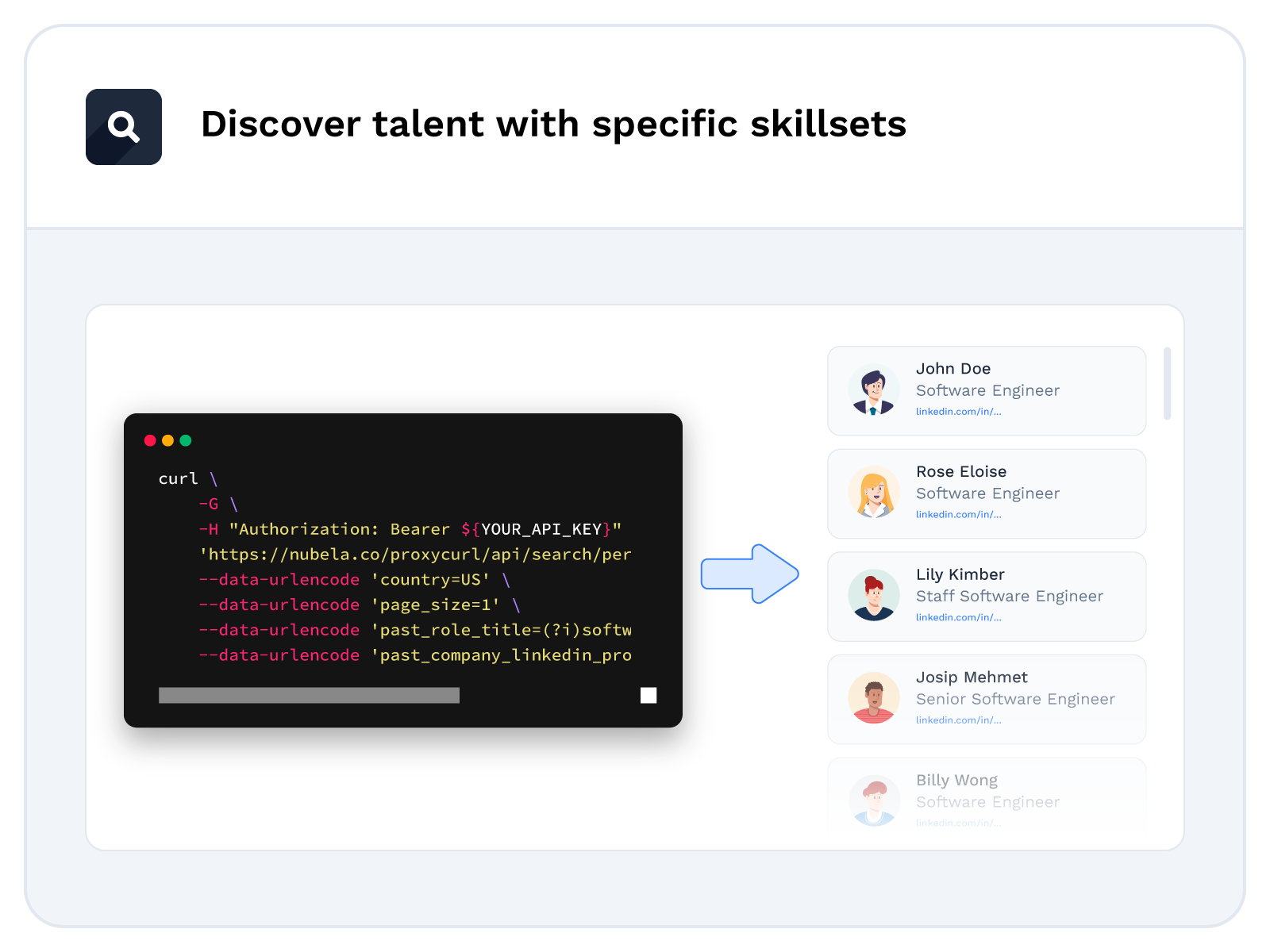
The platform offered eight API products covering people profiles, company data, contact discovery, job listings, school information, and search. At its core, Proxycurl accepted a LinkedIn profile URL or identifying information via API call, scraped the LinkedIn page in real-time, and returned structured JSON data (work history, education, skills, contact information, and company details).
Proxycurl served customers including IBM, Hewlett Packard, Rightbound, Agicap, and Dover. Sales intelligence platforms like Reply.io, Lusha, Apollo, and UpLead used Proxycurl's LinkDB dataset (nearly 473 million LinkedIn profiles) to power prospecting features in their own tools.
The company grew to roughly $10M in revenue as a bootstrapped operation before the LinkedIn lawsuit forced its closure.
Proxycurl Pros & Cons
Pros | Cons |
|---|---|
Developer-first API with clear documentation | Service permanently shut down (July 2025) |
Real-time data scraping for freshness | Entire model dependent on scraping one platform |
Transparent, public credit-based pricing | Legal and compliance risk for customers |
Broad API coverage (8 product categories) | No intent data, buying signals, or go-to-market tools |
Pay-per-result on some endpoints | Required technical resources for all integrations |
Responsive, founder-led customer support | No native CRM integrations or UI for non-developers |
Free endpoints for profile pictures and disposable email checks | 12-month commitment on subscription plans |
Proxycurl Review: How It Worked & Key Features
People API: Real-time professional profile enrichment from LinkedIn data.
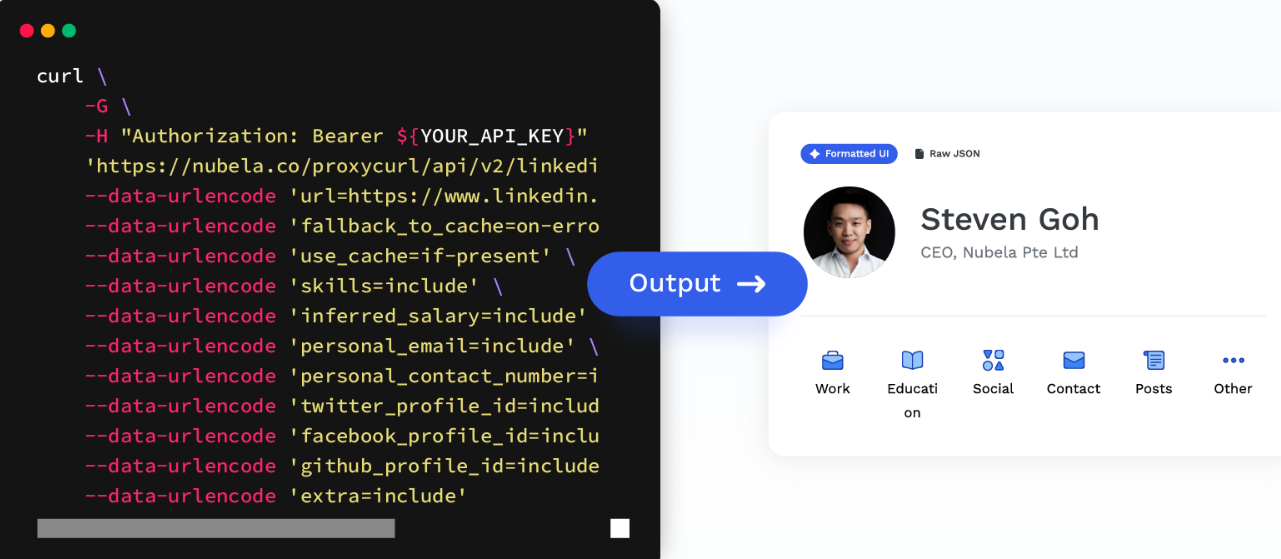
The People API was Proxycurl's core product. Developers sent an API request with a LinkedIn profile URL, a name-and-company pair, or an email address and received structured data about the individual: full name, current occupation, location, work history, education, skills, accomplishments, volunteering experience, and social profile links.
Source: Proxycurl
The API ran on a credit system: a Person Profile lookup cost 1 credit, a Person Lookup (by name and company) cost 2 credits, and a Role Lookup cost 3 credits. Profile pictures were free. Because Proxycurl scraped profiles on demand rather than serving from a static database, the data reflected whatever was on LinkedIn at the time of the request.
Company API: Organizational data and employee intelligence.
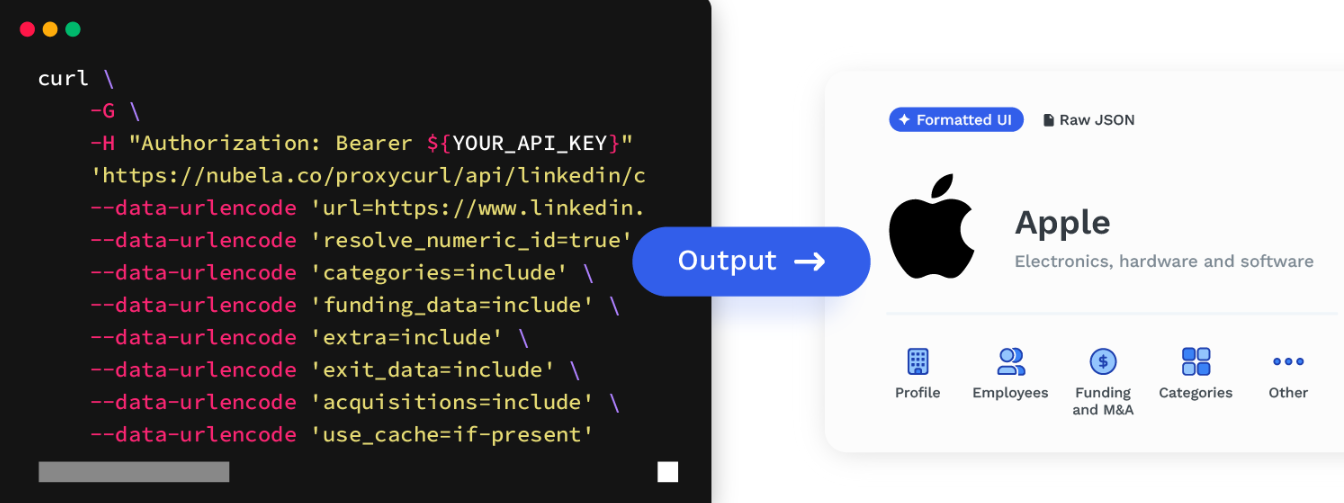
The Company API returned company profiles: name, website, headquarters, employee count, industry, founding year, specialties, funding history, and acquisition data. It could also retrieve full employee listings with individual profiles and search for specific roles within a company.
Source: Proxycurl
The Employee Search endpoint was one of the pricier features at 10 credits plus 6 credits per employee returned, but it let developers programmatically build org charts and identify decision-makers without manually browsing LinkedIn.
Contact API: Email and phone discovery.
The Contact API tried to find personal emails, work emails, and phone numbers for individuals. Its pricing used a pay-per-result model on some endpoints: personal email lookups charged 1 credit per email returned, so failed lookups were free.
The API also included a free disposable email checker, useful for filtering out temporary addresses during lead capture.
Search API: Boolean prospecting across LinkedIn's database.
The Search API let developers run filtered searches across LinkedIn's people and company databases. Filters included job title, company, location, industry, seniority level, years of experience, education, and skills. Results cost 3 credits each.
Proxycurl used its own Person Search API to hire a senior marketing manager from a pool of 7,209 candidates, showing the product's utility for automated recruitment.
LinkDB: Bulk dataset of nearly 473 million profiles.
LinkDB was a separate product offering bulk datasets of LinkedIn profiles. Companies purchased full database dumps or filtered subsets for building their own prospecting tools or data products. It served a different use case than the real-time API: companies that needed to build searchable databases rather than enrich individual records on demand.
Pricing: Credit-based with transparent public rates.
Proxycurl used a credit-based consumption model. Subscription plans ranged from the Starter tier (2,764 credits/month at $62) to the Ultra tier (211,264 credits/month at $2,163), with per-credit costs falling from $0.020 to $0.009 at higher volumes. Pay-as-you-go credits started at $10 for 100 credits ($0.10 each), scaling down to $0.0216 per credit at larger purchases.
All tiers included access to every API endpoint. The only differences were credit volume and per-credit cost. Subscription plans required a 12-month commitment, and unused monthly credits did not roll over.
Where Proxycurl Falls Short
Proxycurl's shutdown surprised nobody who was paying attention. The flaws that killed the company were visible well before the lawsuit.
Single-Platform Dependency: Proxycurl's business rested on accessing LinkedIn's data. Every API endpoint, every dataset, every customer workflow depended on scraping one platform controlled by one company. When LinkedIn enforced its terms, Proxycurl had no fallback.
Founder Steven Goh acknowledged this, saying his "biggest mistake with Proxycurl was choosing to grow it organically" rather than raising venture capital that might have funded a legal defense.
Legal and Compliance Exposure: LinkedIn's January 2025 lawsuit alleged "the unauthorized creation of hundreds of thousands of fake accounts and the scraping of millions of LinkedIn member profiles." While Proxycurl claimed CCPA and GDPR compliance, its data collection method violated LinkedIn's Terms of Service.
Customers building products on Proxycurl's data inherited this compliance risk, a concern enterprise buyers with strict data governance requirements could not dismiss.
No Intelligence Layer: Proxycurl delivered raw data. It could tell you a person's job title, work history, and company details, but not whether that person's company was researching solutions in your category, whether a buying committee was forming, or whether a deal was gaining momentum.
No intent signals, no behavioral data, no buying indicators. For sales and marketing teams, Proxycurl was only one piece of a larger puzzle.
Developer-Only Access: The API-first model was a strength for engineering teams but a wall for everyone else. Sales reps, marketers, and operations teams couldn't use Proxycurl without developer help. The one exception was Sapiengraph (a Google Sheets add-on), but it was a workaround, not a full interface.
No Workflow or Automation: Proxycurl returned data; what you did with it was your problem. No CRM integrations, no automated enrichment workflows, no lead routing, no outreach sequences, no campaign orchestration. Every downstream action required custom development or third-party tools.
These limitations aren't unique to Proxycurl. They're structural to any provider built on scraping a single external platform without investing in multi-source data collection, verification, or the intelligence and workflow layers that turn raw data into action. The shutdown made those risks impossible to ignore.
Top Proxycurl Alternative: ZoomInfo
ZoomInfo addresses Proxycurl's limitations not by replacing one scraping API with another, but by providing a different foundation: a multi-source, verified B2B data platform with intelligence and workflow tools built on top.
Where Proxycurl was an API that returned LinkedIn data, ZoomInfo is a B2B data and go-to-market platform spanning 500M contacts, 100M companies, 135M+ verified phones, 120M direct dials, and 200M+ verified business email addresses.
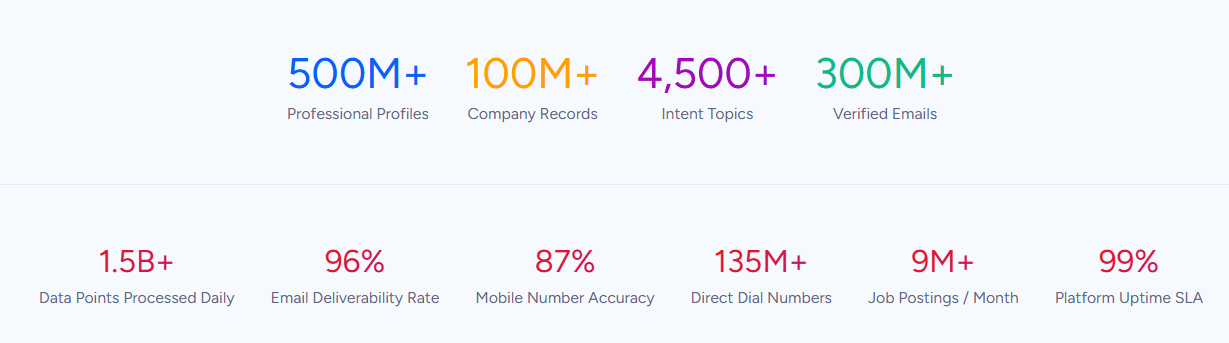
That data is collected and verified through multiple sources (not scraped from one platform) and feeds an intelligence layer called the GTM Context Graph that processes 1.5B+ data points daily.
Data Scale and Verification: Multi-source data verified by 300+ human researchers.
ZoomInfo's data comes from four source categories: automated ML scanning of 28 million site domains daily, third-party partner data covering 95 million businesses, a network of 200,000+ ZoomInfo Lite users who share business contact information from email signatures, and an in-house Data Training Lab of 300+ human researchers.
This multi-source approach means ZoomInfo isn't dependent on any single external platform. First-party data reaches up to 95% accuracy. In a Fortune 500 competitive RFP analyzing 25 million contacts across vendors, an independent consultant concluded that "no other competitor came even close."
The data spans three dimensions Proxycurl's LinkedIn-only model could not match: identity data (contacts, direct dials, verified emails), company context (firmographics, org charts, technographics tracking 30,000+ technologies across 30+ million companies), and signals indicating when accounts are actively in-market.
Vensure scaled prospecting with ZoomInfo's data: "ZoomInfo gives us the information we need to execute. We don't have to go through and spend our time digging. It's already there, so we can be three steps ahead." (Vensure)
Enterprise API and MCP: Developer access without platform dependency.
For teams that used Proxycurl's API, ZoomInfo's Enterprise API provides comparable programmatic access to a larger and more reliable dataset. The API is documented at docs.zoominfo.com and organized into four categories:
Data API (Search & Enrich): Search endpoints cover Contacts, Companies, Intent, News, and Scoops. Enrich endpoints return business emails, direct dials, employment history, corporate hierarchy, org charts, technographics, and more. The recommended workflow is two stages: search first, then enrich by ID.
Copilot API (GTM Workspace AI): Exposes ZoomInfo's AI layer programmatically, including Account Summary, Find Similar Companies, and Contact Recommendations ranked by use case (prospecting, deal acceleration, or renewals). Proxycurl had nothing like these.
MCP Server: ZoomInfo's Model Context Protocol server connects AI models to ZoomInfo's data through natural language, with no custom coding beyond one-time server configuration. It supports Claude and ChatGPT, with more tools planned.
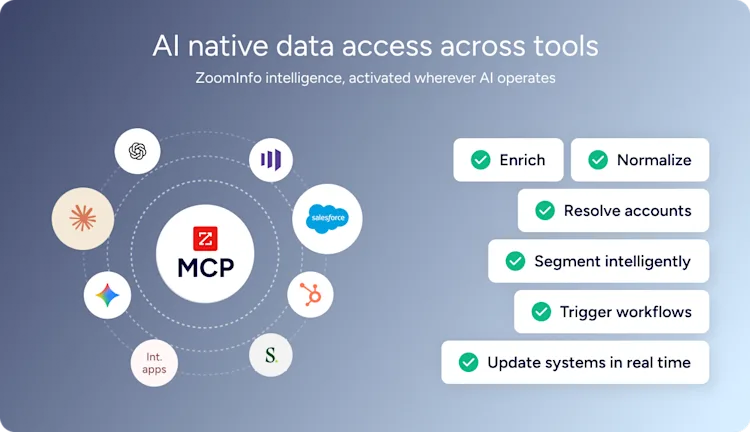
Authentication uses OAuth 2.0 with PKCE, and API access is included in all relevant plans, so developer access isn't locked behind an enterprise-only add-on.
BDO Canada plugged ZoomInfo's API into its internal systems: "The plug-and-play aspect of the API means I can integrate it very easily into any process and get information at a moment's notice," cutting time spent on data dashboard updates by 87%. (BDO Canada)
GTM Context Graph: Intelligence that goes beyond raw data.
Proxycurl returned data points.
ZoomInfo's GTM Context Graph returns context. The graph combines ZoomInfo's third-party B2B data with a customer's own CRM records, conversation transcripts, email threads, and behavioral signals, then reasons across all of it to surface not just what happened in an account but why.
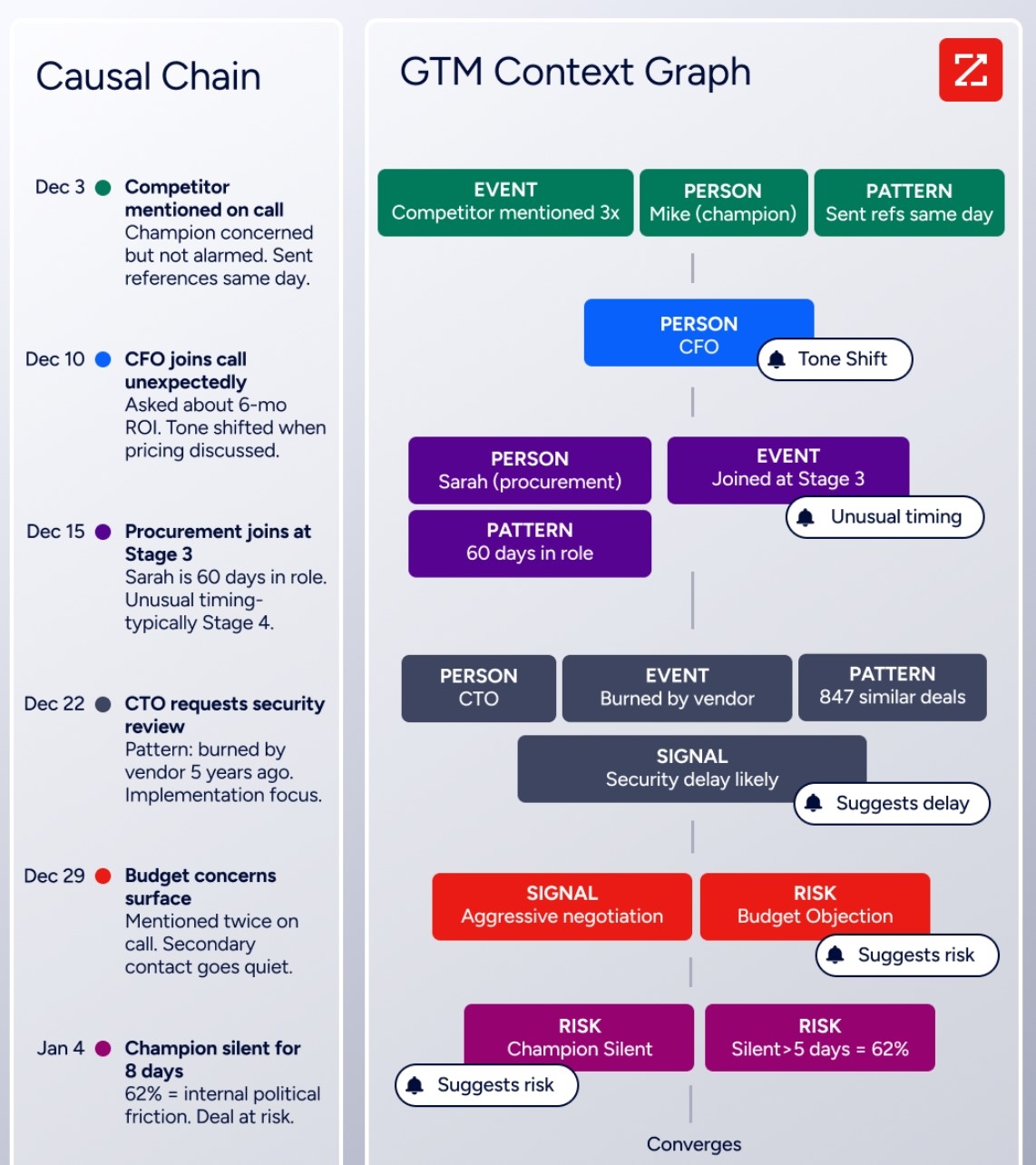
A practical example: a CRM records that a deal moved to a new stage. The GTM Context Graph connects that stage change to the fact that a CFO joined the last call and asked about ROI, that the company recently posted three VP-level job openings (a growth signal), and that the account has been researching a competitor's category on third-party sites.
That combined context tells a seller something no single data point could.
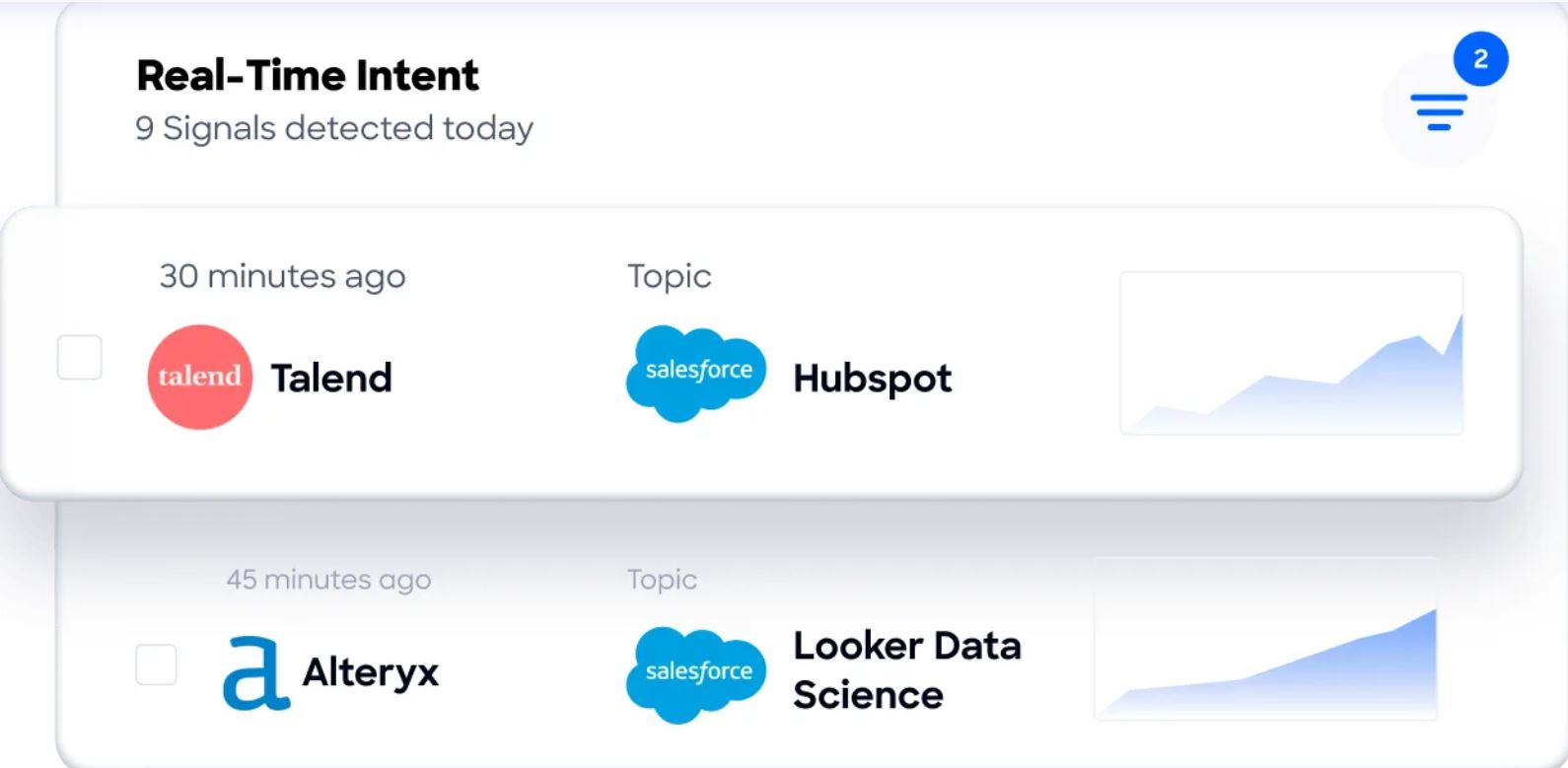
This intelligence powers Buyer Intent data tracking signals from 210 million IP-to-Organization pairings and 6 trillion+ new keyword-to-device pairings sourced monthly, Guided Intent (which identifies topics historically correlated with deal success), and WebSights (which resolves anonymous website traffic to companies and contacts).
Seismic attributed 39% of active pipeline to opportunities identified or influenced by ZoomInfo signals, reported 54% productivity gains, and described the combination of CRM data, external signals, and AI context as helping them "craft very specific account- and persona-based messages." (Seismic)
Native Front-Ends: Tools for every team, not just developers.
Proxycurl served developers. Everyone else needed custom integrations or workarounds. ZoomInfo gives three ways to access the same data and intelligence:
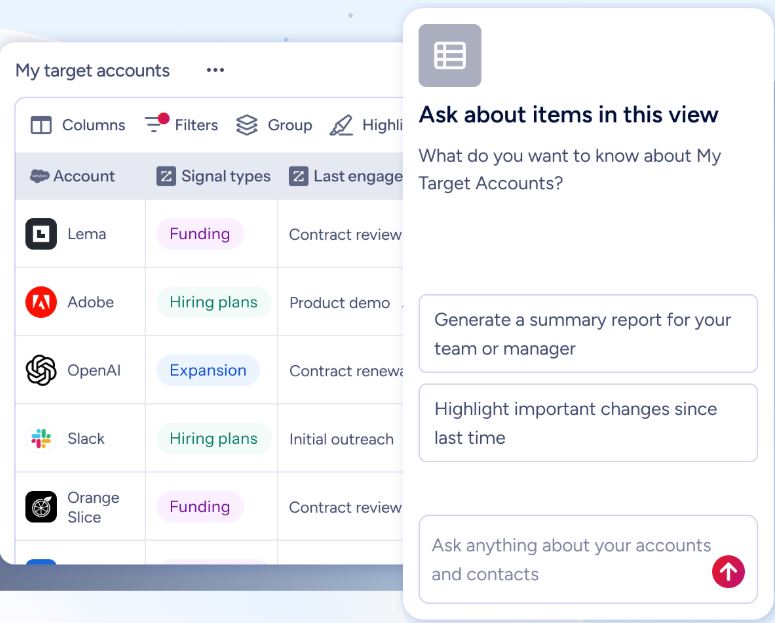
GTM Workspace serves sellers. AEs, SDRs, and account managers get a single workspace with prioritized accounts, AI-drafted outreach, and deal execution tools. AI agents handle account research, outreach generation, CRM updates, and signal monitoring.
GTM Studio serves marketers, RevOps, and go-to-market engineers with a canvas for designing audiences, enriching data, and launching plays across email, calls, ads, and direct mail. Teams can describe audiences in natural language and launch campaigns without engineering tickets.
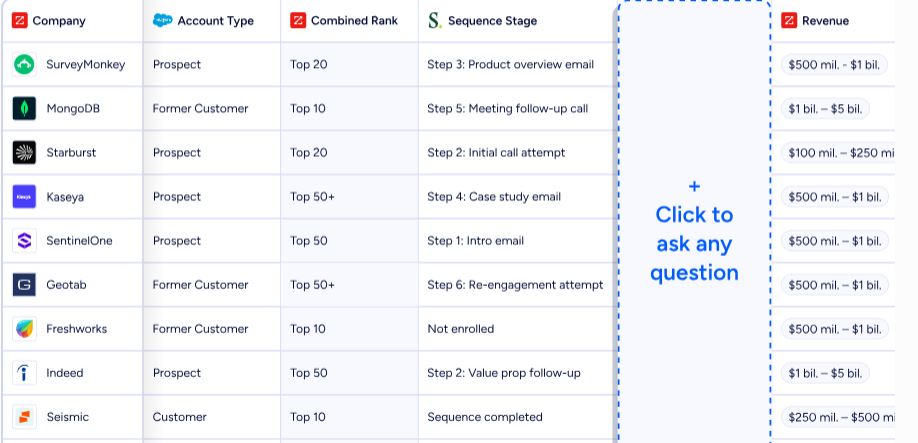
APIs and MCP serve the same use case Proxycurl did: programmatic access for developers building custom applications. The difference is that ZoomInfo's API delivers the same intelligence available in the native products, not a stripped-down subset.
Compliance and Security: Built for enterprise procurement.
Proxycurl claimed CCPA and GDPR compliance while running a business model that violated LinkedIn's Terms of Service. ZoomInfo holds ISO 27001, ISO 27701, SOC 2 Type II, TRUSTe GDPR, and TRUSTe CCPA certifications, all renewed annually. The company is a registered data broker in California and Vermont with a dedicated Trust Center.
For enterprise buyers in regulated industries, this compliance infrastructure isn't optional. It's a prerequisite for vendor approval.
Pricing: Custom-quoted with a permanent free tier.
ZoomInfo uses a custom-quoted, seat-and-credit-based subscription model. Costs depend on user count, credit volume, features, and contract length.
ZoomInfo does offer two free entry points. ZoomInfo Lite is a permanent free tier (not a trial) with access to ZoomInfo's B2B database, 10 monthly export credits, search filters, a Chrome extension, and HubSpot integration. A separate 7-day free trial provides access to core platform features with no credit card required.
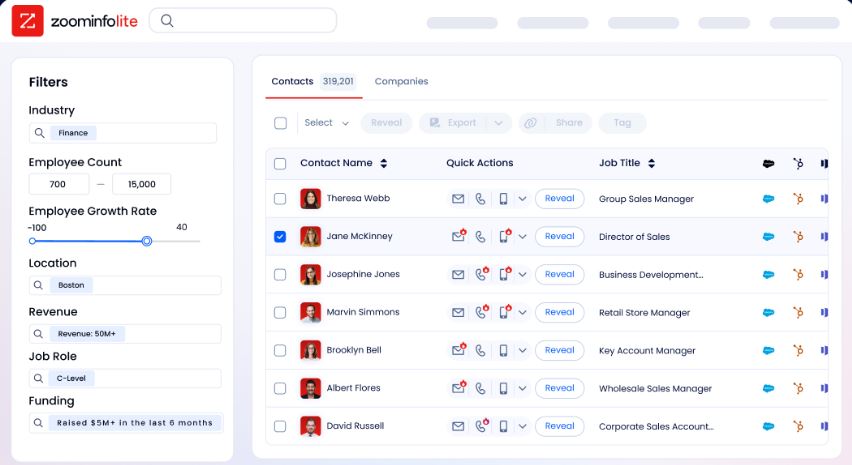
Paid plans span Sales (Professional, Advanced, Enterprise), Marketing (Marketing Demand, ABM Lite, ABM Enterprise), and standalone products (Chorus, Chat). The credit system works differently from Proxycurl's: 1 credit equals 1 export of a professional or company profile, and searching or viewing data inside ZoomInfo does not consume credits.
Proxycurl or ZoomInfo: Comparison Summary
Proxycurl (Discontinued) | ZoomInfo | |
|---|---|---|
Status | Shut down July 2025 | Active, publicly traded (NASDAQ: GTM) |
Data source | Single-platform LinkedIn scraping | Multi-source: ML scanning, partners, contributory network, 300+ researchers |
Data scale | ~473M LinkedIn profiles (LinkDB) | 500M contacts, 100M companies, 135M+ verified phones, 200M+ verified emails |
Data accuracy | Real-time scraping (freshness), no independent verification | Up to 95% accuracy, multi-layer verification |
API access | RESTful API, 8 product categories | Enterprise API with Search, Enrich, Copilot AI, Marketing, and Engagement endpoints |
AI/MCP access | None | MCP server for Claude, ChatGPT; Copilot API |
Intent signals | None | 210M IP-to-Org pairings, 6T+ keyword signals monthly |
Native UI | None (API-only, Sheets add-on) | GTM Workspace (sellers), GTM Studio (marketers/RevOps) |
CRM integrations | None | Salesforce, HubSpot, Dynamics 365, 120+ marketplace integrations |
Compliance | Claimed CCPA/GDPR; violated LinkedIn ToS | ISO 27001, ISO 27701, SOC 2 Type II, TRUSTe GDPR/CCPA |
Free tier | None (lowest entry: $10 for 100 credits) | ZoomInfo Lite (permanent free) + 7-day trial |
Pricing transparency | Public credit-based pricing | Custom-quoted |
Target user | Developers and engineering teams | Sales, marketing, RevOps, developers |
Best for | No longer available | B2B data with intelligence and workflow tools |
Final Verdict
Proxycurl no longer exists. For former users and anyone evaluating B2B data enrichment, the question isn't whether Proxycurl was a good product (it was, within its scope) but what comes next.
Proxycurl was a good fit for developers who needed a clean, well-documented API for LinkedIn data enrichment and accepted the legal and operational risks of a scraping-based model. The transparent pricing and pay-per-result endpoints made it accessible for small teams and startups. But the shutdown exposed the fragility of building on unauthorized access to a single platform.
Choose ZoomInfo if you need B2B data enrichment that is legally defensible, independently verified, and backed by a public company's infrastructure. For developers, ZoomInfo's Enterprise API and MCP server provide the programmatic access Proxycurl offered, connected to a larger dataset verified through multiple independent sources.
For the broader go-to-market team, ZoomInfo adds what Proxycurl never had: intent signals that show when accounts are actively buying, an intelligence layer that connects data points into actionable context, and native tools for sellers and marketers to act without waiting on engineering.
Get started with ZoomInfo here.
The lesson of Proxycurl's shutdown is simple: data infrastructure built on unauthorized access to a single platform carries existential risk. ZoomInfo's multi-source collection model, compliance certifications, and $1.25 billion revenue base represent a different level of reliability. For teams that depend on B2B data to drive revenue, that reliability matters as much as the data itself.
Proxycurl FAQ
What happened to Proxycurl?
Proxycurl shut down permanently on July 4, 2025. In January 2025, LinkedIn filed a federal lawsuit against Proxycurl and its founder Steven Goh for creating fake accounts and scraping millions of LinkedIn profiles without authorization.
Rather than fight a prolonged legal battle against Microsoft-owned LinkedIn, Proxycurl ceased operations. The team is now focused on NinjaPear, a B2B competitive intelligence data company.
Is Proxycurl still available?
No. The Proxycurl website now redirects to NinjaPear, the successor company. All Proxycurl APIs are offline. Former customers needed to migrate to alternative providers after the shutdown announcement.
What did Proxycurl cost?
Proxycurl used a credit-based pricing model. Subscription plans ranged from $62/month (2,764 credits) to $2,163/month (211,264 credits), with per-credit costs between $0.009 and $0.020 depending on volume. Pay-as-you-go credits started at $10 for 100 credits. All subscription plans required a 12-month commitment, and unused credits did not roll over.
What is the best alternative to Proxycurl?
ZoomInfo is the strongest alternative. It provides API access to 500M contacts and 100M companies through a multi-source, verified data platform. Unlike Proxycurl, ZoomInfo's data does not depend on scraping a single platform, and the company holds ISO 27001, SOC 2 Type II, and GDPR compliance certifications.
ZoomInfo also adds intent signals, conversation intelligence, and native sales and marketing tools that Proxycurl never offered.
Does ZoomInfo have an API like Proxycurl?
Yes. ZoomInfo's Enterprise API provides programmatic access to contact and company data through Search and Enrich endpoints, similar in concept to Proxycurl's People and Company APIs. ZoomInfo's API also includes a Copilot AI layer for account intelligence and contact recommendations, a Marketing API for audience management, and an MCP server for connecting AI models to ZoomInfo data. API access is included in all relevant ZoomInfo plans.
How does ZoomInfo's data compare to Proxycurl's?
Proxycurl scraped LinkedIn profiles in real-time, covering roughly 473 million profiles through its LinkDB dataset. ZoomInfo collects data from multiple independent sources (ML scanning of 28 million domains daily, third-party partners, a contributory network, and 300+ human researchers), covering 500M contacts and 100M companies with up to 95% accuracy on first-party data.
ZoomInfo also provides data types Proxycurl did not: direct-dial phone numbers, intent signals, technographics, and company hierarchies.
Is ZoomInfo free?
ZoomInfo offers a permanent free tier called ZoomInfo Lite, which includes access to the B2B database, 10 monthly export credits, search filters, a Chrome extension, and HubSpot integration. A separate 7-day free trial provides broader access to core platform features. Paid plans are custom-quoted based on users, credit volume, and features.
Why did LinkedIn sue Proxycurl?
LinkedIn's lawsuit alleged that Proxycurl created hundreds of thousands of fake LinkedIn accounts to scrape millions of member profiles, violating LinkedIn's Terms of Service and User Agreement. Proxycurl's founder said the company could not afford to fight a prolonged legal battle against LinkedIn's parent company Microsoft, citing the American Rule (where legal fees cannot be recovered even in a successful defense) and LinkedIn's effectively unlimited financial resources.
Researching Proxycurl? These comparisons and alternatives help you decide:
