

If you're searching for "Proxycurl vs. Crustdata," start here: Proxycurl shut down on July 4, 2025. LinkedIn sued the company for scraping millions of member profiles without authorization. Rather than fight Microsoft's legal team, Proxycurl's founder closed the business. The service that once powered data enrichment for IBM and HP no longer exists.
That changes the comparison. But the underlying question still matters: if you're building applications that need B2B people and company data via API, which platform should you trust?
The questions worth asking are:c
Are you building for AI agents that need real-time data, or for sales and marketing teams that need verified contacts?
Do you need raw API data for your own systems, or a platform that handles prospecting, outreach, and pipeline management?m
How much does data accuracy matter versus data freshness?
Can your use case survive on a single data source, or do you need multi-source intelligence with intent signals, technographics, and conversation data?
Does your team have engineers to build on an API, or do you need ready-made workflows?
In short, here's what we recommend:
Proxycurl was a developer-friendly API for enriching people and company profiles using LinkedIn data. It offered transparent credit-based pricing, real-time scraping, and a clean REST API that engineering teams valued. None of that matters now. LinkedIn filed a federal lawsuit in January 2025, citing fake accounts and the scraping of millions of profiles. Proxycurl shut down. The founder's team pivoted to NinjaPear, a different product. If you were a Proxycurl customer, you need a new provider.
Crustdata is the emerging option for teams building AI applications that need real-time B2B data. Backed by Y Combinator and serving customers like YC itself and HubSpot founder Dharmesh Shah's agent.ai, Crustdata positions itself as the data layer for AI agents. Its API delivers data from 10+ sources in a single call, with a Watcher API that pushes alerts on job changes, funding rounds, and hiring signals. Crustdata was designed for developers and AI agent builders, but it has no user interface for non-technical teams, no transparent pricing, and a limited track record as a company founded in 2023.
Both Proxycurl and Crustdata set out to solve the same problem: give developers programmatic access to B2B data. But API data is only the first step. Turning data into pipeline, revenue, and customer relationships requires intelligence, not just information.
ZoomInfo is a GTM platform built on a large B2B dataset: 500M contacts, 100M companies, 135M+ verified phone numbers, and 200M+ verified business emails. That data feeds ZoomInfo's GTM Context Graph, which unifies your CRM records, conversation transcripts, and behavioral signals with the 1.5B+ data points ZoomInfo processes daily, capturing not just what happened in your deals, but why. ZoomInfo delivers everything Crustdata and Proxycurl offered through its Enterprise API and MCP server, and goes beyond raw data. Your team can use it through GTM Workspace for sellers, GTM Studio for marketers and RevOps, or APIs and MCP in any front-end.
If you need B2B data that powers both AI agents and human-led GTM motions, see how ZoomInfo works with a free trial.
Proxycurl vs. Crustdata vs. ZoomInfo at a glance
Proxycurl | Crustdata | ZoomInfo | |
|---|---|---|---|
Status | Shut down (July 2025) | Active (founded 2023) | Active (founded 2007, public on Nasdaq) |
Data coverage | ~473M LinkedIn profiles (historical) | ||
Data verification | Real-time scraping, no human verification | Aggregated from 10+ sources | 300+ human researchers, up to 95% accuracy |
Primary access | API only | API only | |
Intent data | None | Job postings, social signals | Buyer Intent (210M IP-to-Org pairings), Guided Intent |
Conversation intelligence | None | None | Chorus (14 patents, native) |
Real-time alerts | None | Watcher API (webhooks) | Signal-triggered workflows, GTM plays |
Non-technical UI | None (Sapiengraph addon for Sheets) | None | Full platform with search, dashboards, AI agents |
Pricing transparency | Public credit-based pricing | Custom quotes only | Custom quotes; free Lite tier available |
Compliance | Claimed CCPA/GDPR (shut down by lawsuit) | ISO 27001, ISO 27701, SOC 2 Type II, TRUSTe GDPR/CCPA |
Proxycurl's shutdown changes everything
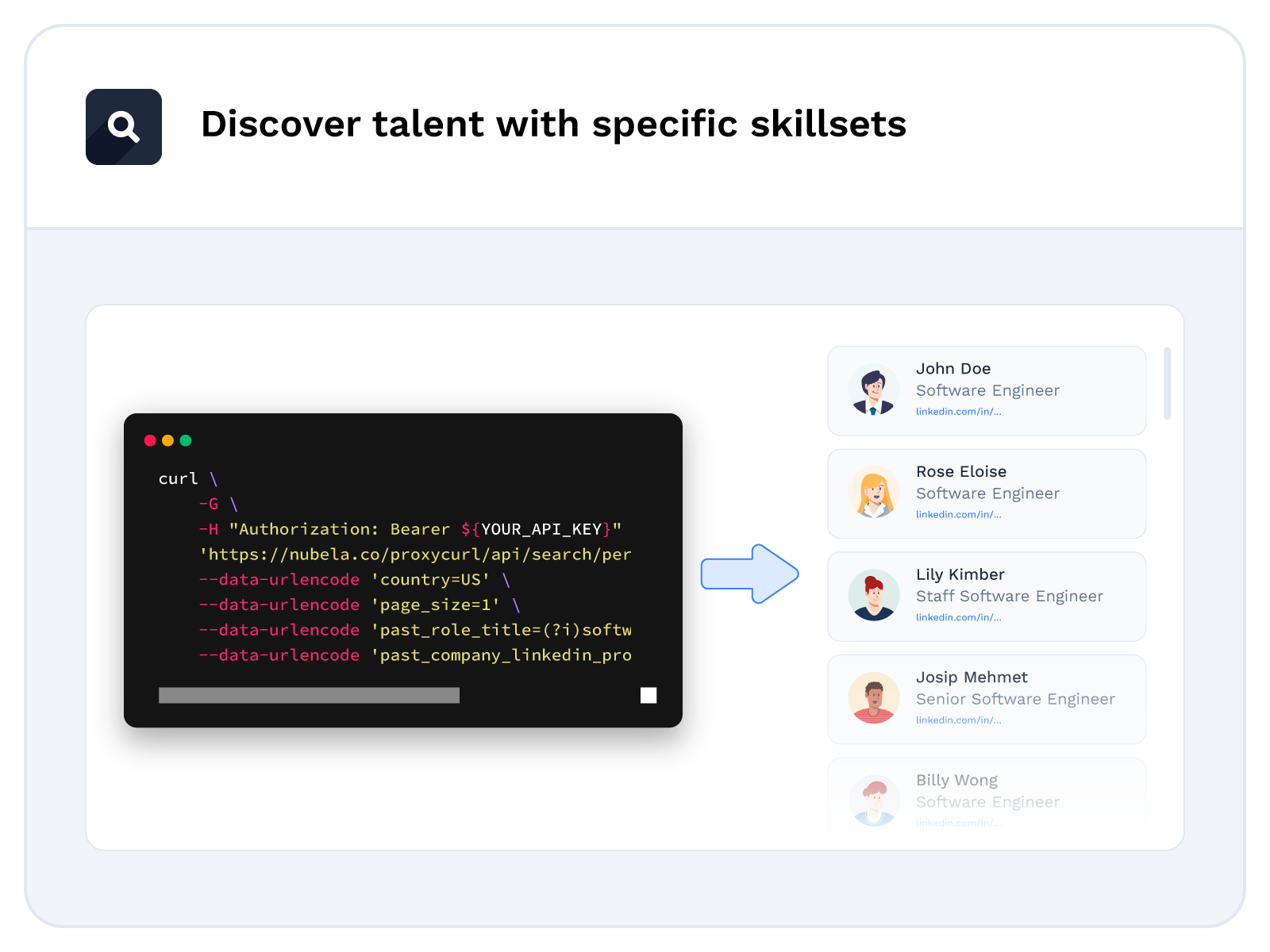
Proxycurl's story is a cautionary tale about building on scraped data.
Source: Proxycurl
The company reached roughly $10M in revenue as a bootstrapped operation. Developers loved the API. The documentation was clean. The pricing was transparent. Then, in January 2025, LinkedIn filed a lawsuit alleging Proxycurl had created "hundreds of thousands of fake accounts" to scrape millions of LinkedIn profiles.
Proxycurl's founder, Steven Goh, chose to settle rather than fight. He cited two reasons: the American Rule (legal fees can't be recovered even if you win) and LinkedIn's "unlimited war chest" as a Microsoft subsidiary. By July 4, 2025, the service was dead.
The shutdown didn't just affect Proxycurl. It affected every customer that had built systems on its API. Integrations broke. Data pipelines went dark. Engineering teams scrambled to find replacements.
Goh acknowledged the core vulnerability. His "biggest mistake" was growing organically without raising venture capital that could have funded a legal defense. But the deeper problem was architectural: the entire business depended on scraping a platform controlled by someone else. That dependency was always a risk, and it turned fatal.
For anyone evaluating B2B data providers, the lesson is clear. How a provider collects, verifies, and legally obtains its data matters as much as the data itself.
Crustdata fills part of the gap, but only part
Crustdata has positioned itself as the leading alternative after Proxycurl's shutdown, and the pitch resonates with a specific audience: teams building AI agents that need fresh data delivered programmatically.
The company grew to $4M+ revenue in seven months with zero outbound marketing and a sales team of one. Y Combinator CEO Garry Tan called Crustdata one of the strongest companies from the Fall 2024 YC batch. Customers include YC itself, Dharmesh Shah's agent.ai, and Ryan Reynolds' MNTN.
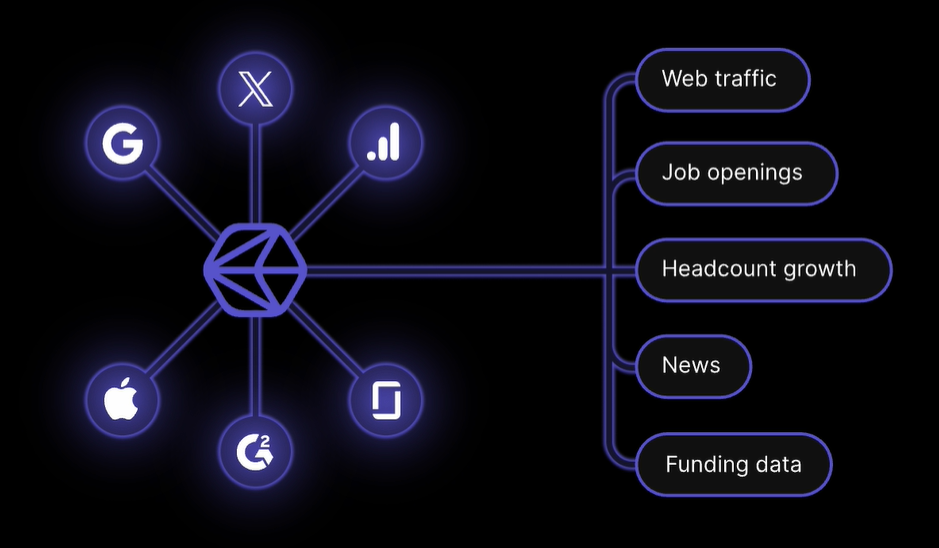
Where Crustdata excels is its API architecture. The Company Enrichment API returns 250+ datapoints from 15+ sources in a single call.
Source: Crustdata
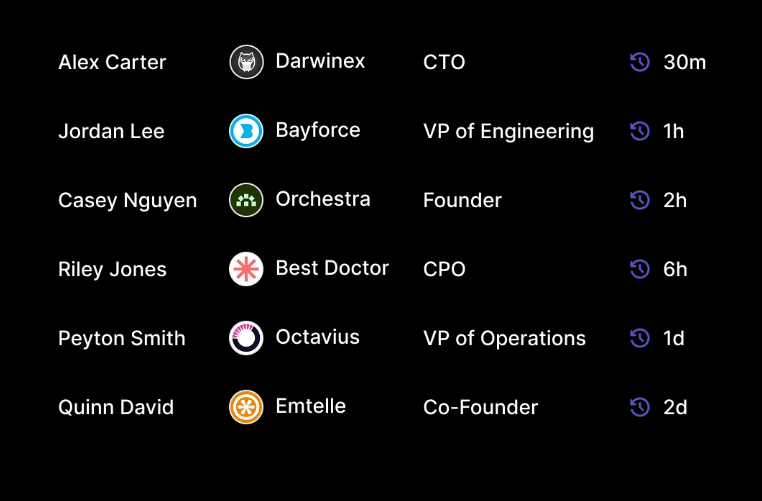
The People Search API covers 1 billion+ profiles with 60+ filters.
Source: Crustdata
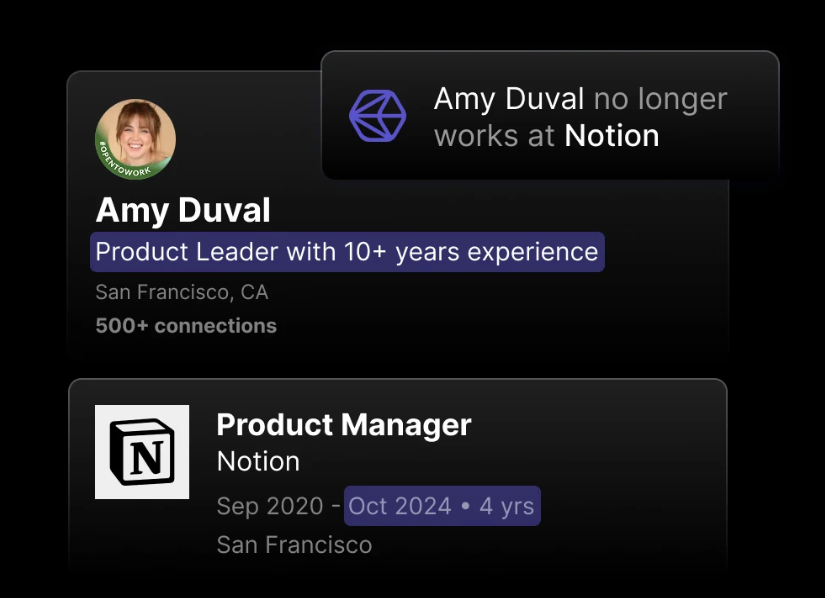
And the Watcher API delivers webhook-based alerts for job changes, funding rounds, and hiring signals, giving AI agents real-time triggers instead of stale batch data.
Source: Crustdata
For feeding AI SDRs and recruiting agents with fresh data, Crustdata works. But step outside that use case, and the limitations show.
Crustdata has no user interface for sales reps or marketers. It has no intent data showing which companies are researching solutions. It has no conversation intelligence capturing what prospects say on calls. It has no CRM integrations that keep records updated automatically for non-technical teams. It has no marketing automation, no website visitor identification, and no campaign orchestration.
It's an API. A good one, but still just an API.
ZoomInfo covers API access and everything beyond it
ZoomInfo's Enterprise API provides the same core capability that Proxycurl and Crustdata built their businesses on: programmatic access to B2B contact and company data.
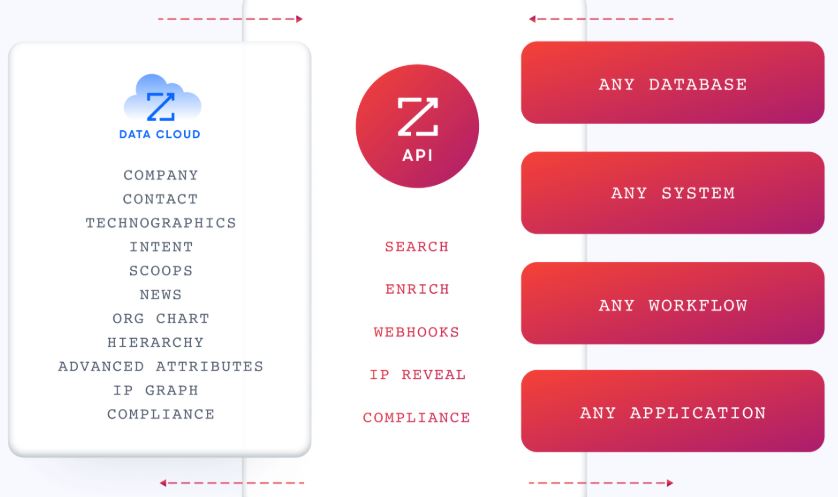
The API is organized into Search and Enrich endpoints covering contacts, companies, intent signals, and corporate hierarchies. The Copilot API adds AI-generated account summaries, lookalike expansion, and buying committee recommendations.
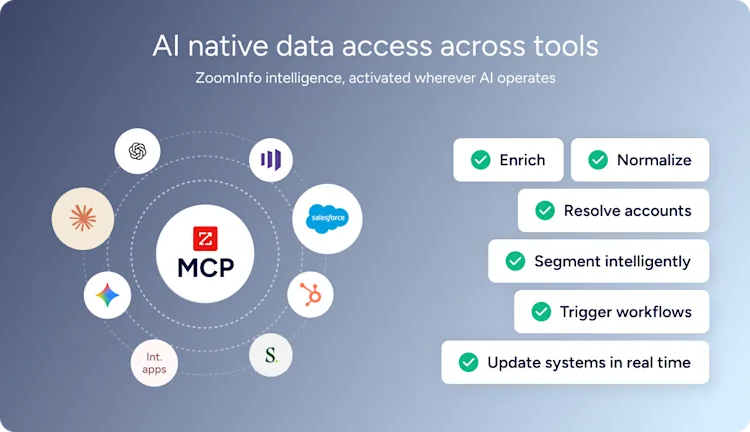
And the MCP server connects ZoomInfo to AI models like Claude and ChatGPT through natural language.
But ZoomInfo's advantage over API-only providers is what sits behind the API: data verified at scale.
ZoomInfo's collection pipeline combines automated ML scanning of 28 million site domains daily, third-party partner data covering 95 million businesses, a community of 200,000+ Lite users who share data back, and 300+ human researchers.
The result is up to 95% accuracy on first-party data, validated by external evaluations. In a Fortune 500 competitive RFP analyzing 25 million contacts across vendors, the independent consultant concluded that "no other competitor came even close."
For API consumers, verification matters. An AI agent sending outreach based on aggregated data is only as effective as that data is accurate. A bounced email or wrong phone number doesn't just waste a credit; it damages sender reputation and burns a prospect's first impression.
"ZoomInfo gives us the information we need to execute. It's already there, so we can be three steps ahead." (Vensure)
Data freshness vs. data accuracy: different philosophies
Crustdata's core pitch centers on freshness. The company calls itself the "truly real-time" data platform, with API requests that trigger live crawlers to fetch data from the web. The Company Enrichment API offers two modes: real-time enrichment (data pulled fresh, up to 10 minutes latency, 5 credits) and database enrichment (cached records updated within 24 hours, under 10 seconds, 1 credit).
Proxycurl took a similar approach, scraping LinkedIn profiles on demand rather than serving cached records.
ZoomInfo works differently. Rather than optimizing for the freshest snapshot, ZoomInfo runs a continuous, multi-layered verification pipeline. It monitors data constantly and updates records when it detects changes. This means ZoomInfo's data isn't just current; it's verified as current.
The difference matters most at scale. A real-time crawl of a LinkedIn profile might return the latest information, but it can also return inconsistencies, including outdated or incomplete records when source data is unreliable.
Crustdata users have noted concerns about noise without good filtering when monitoring multiple signals. ZoomInfo's verification layer catches these inconsistencies before they reach your systems.
For AI agent builders processing hundreds of thousands of records, the question isn't just "is this data fresh?" but "is this data right?" Both questions matter. But only one protects your sender reputation and pipeline quality.
Intent data and buying signals separate data from intelligence
This is where ZoomInfo occupies a category that neither Proxycurl nor Crustdata enters.
Crustdata tracks signals like job changes, funding rounds, and hiring patterns through its Watcher API. These are useful activity signals. They tell you something happened. They don't tell you whether a company is evaluating solutions in your category.
ZoomInfo's Buyer Intent tracks signals from 210 million IP-to-Organization pairings and 6 trillion+ new keyword-to-device pairings sourced monthly. When a company's employees start researching topics related to your product, ZoomInfo detects it.
Guided Intent, exclusive to ZoomInfo, goes further: it identifies which topics historically correlate with deal success in your specific business, rather than requiring you to guess which keywords matter.
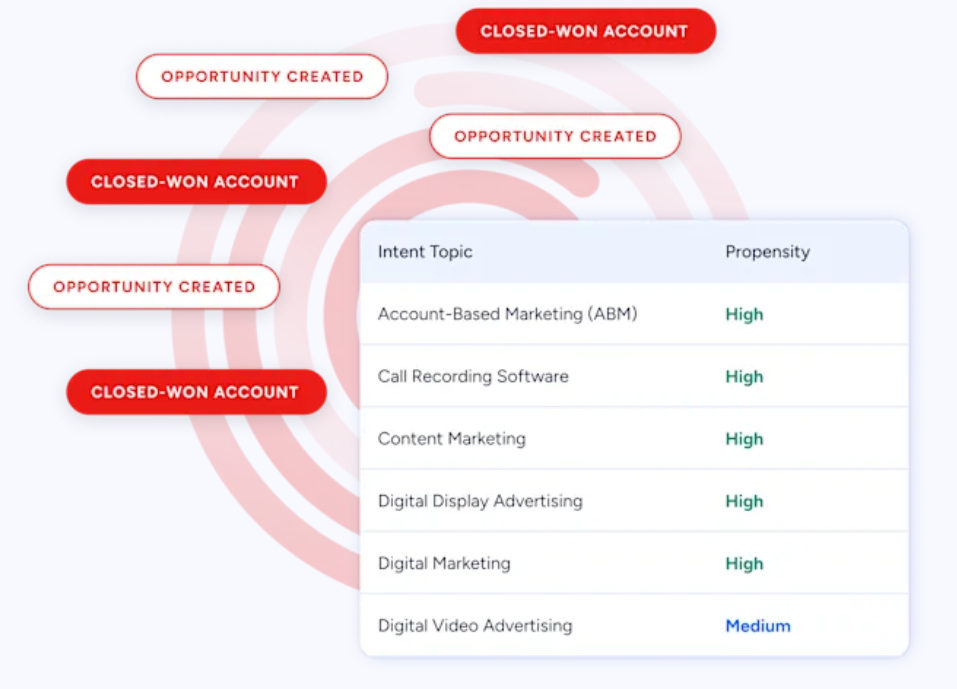
Add WebSights (which resolves anonymous website traffic to companies and buying team contacts) and Chorus (which captures and analyzes sales calls and meetings), and you have a layer that connects external signals with internal deal context.
This is the foundation of ZoomInfo's GTM Context Graph: it captures not just what happened (a CRM stage changed, a prospect visited your pricing page, a champion changed jobs), but why it happened and what it means for the next action.
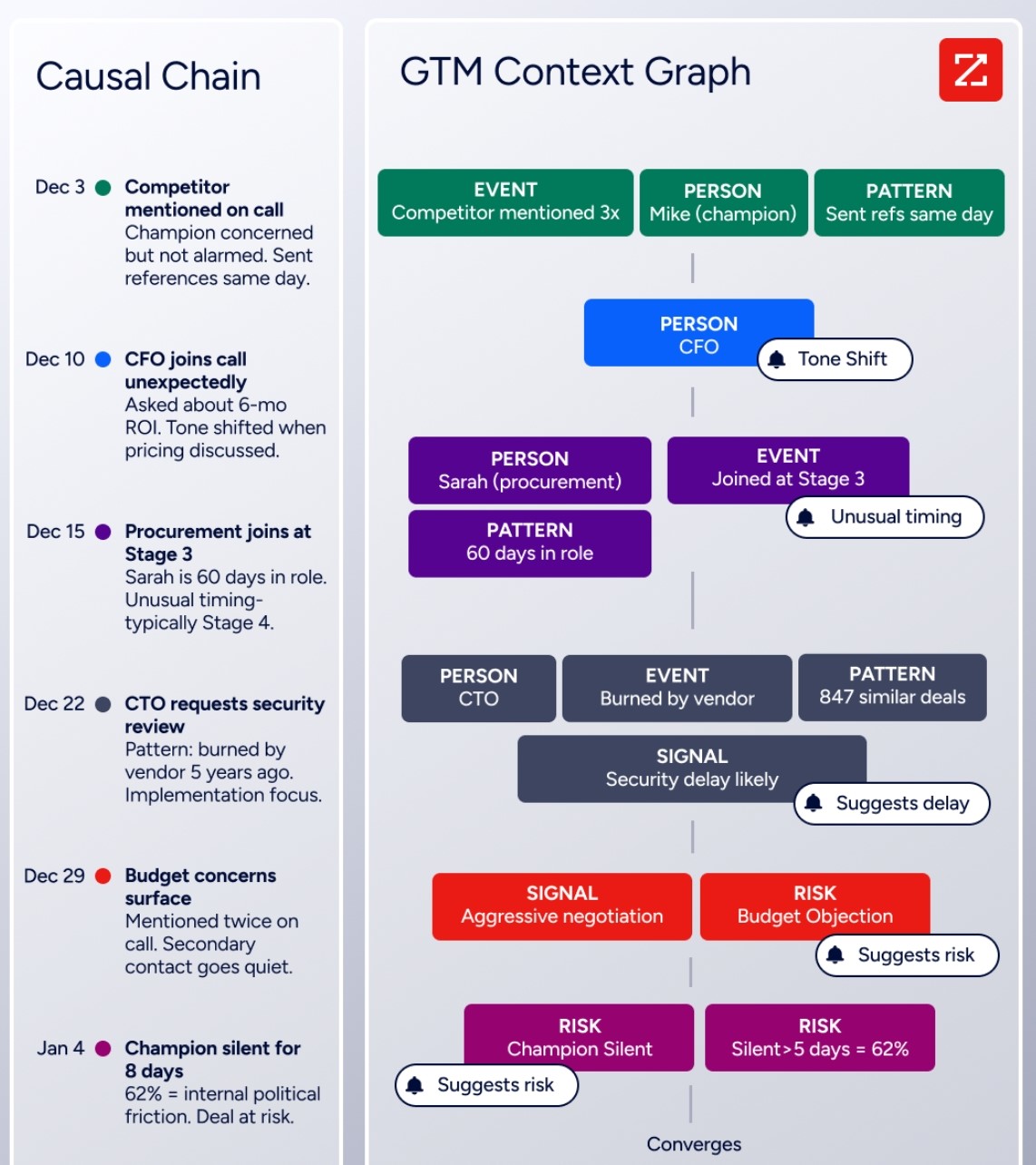
Crustdata's Watcher API is a useful signal source. But signals without context are just noise with a webhook attached.
Seismic attributed 39% of active pipeline to opportunities identified or influenced by ZoomInfo signals. "That combination of our internal CRM data, external signals, and AI that's given all that context has helped us craft very specific account- and persona-based messages." (Seismic)
API capabilities compared
For teams that primarily need programmatic data access, here's how the APIs stack up.
Crustdata offers a set of APIs designed for high-volume programmatic use:
Company Search API: 95+ filters across 60M+ companies, with both in-database and real-time search modes
Company Enrichment API: 250+ datapoints from 15+ sources, real-time or cached
People Search API: 60+ filters across 1B+ profiles
People Enrichment API: 90+ datapoints with real-time enrichment
Watcher API: Webhook-based monitoring for 11+ signal types
Jobs API: 35 search filters with 35 datapoints per listing
Posts API: Social post retrieval with engagement metrics
All endpoints use Bearer token authentication with rate limiting at 15 requests per minute for web search. Customers get dedicated Slack channels staffed by 4-5 Crustdata team members.
ZoomInfo's API is organized into four areas:
Data API (Search & Enrich): Contacts, companies, intent, news, and scoops, with corporate hierarchy, org charts, and technographic enrichment
Copilot API: AI-generated account summaries, company insights, lookalike expansion, and buying committee recommendations
Marketing API: Programmatic audience management for advertising
Platform API: Bidirectional engagement data (beta)
Authentication uses OAuth 2.0 with PKCE via Okta. Rate limits scale from 25 to 35 requests per second depending on tier. The MCP server at https://mcp.zoominfo.com/mcp lets AI assistants query ZoomInfo through natural language without custom API code.
Proxycurl (historical) offered eight API products: People, Company, Contact, Jobs, Search, School, Customer (experimental), and LinkDB (bulk datasets). All used a simple REST API with credit-based consumption. The API is no longer accessible.
The key difference: Crustdata's API delivers raw data. ZoomInfo's API delivers data plus intelligence (AI recommendations, lookalike models, intent signals, and account summaries). For teams building simple enrichment pipelines, both work. For teams that need to prioritize accounts or recommend next actions, ZoomInfo's Copilot API provides capabilities Crustdata doesn't offer.
BDO Canada activated ZoomInfo data directly within internal systems via the API. "The plug-and-play aspect of the API means I can integrate it very easily into any process and get information at a moment's notice," achieving an 87% reduction in time spent on data dashboard updates. (BDO Canada)
The compliance question Proxycurl's shutdown raised
Proxycurl claimed CCPA and GDPR compliance and was "in the process" of SOC 2 certification. None of that prevented a lawsuit that killed the company.
The issue wasn't whether Proxycurl encrypted data or followed privacy regulations. The issue was how the data was obtained. Creating fake accounts to scrape LinkedIn profiles violated LinkedIn's Terms of Service, and LinkedIn had the legal standing and financial resources to enforce those terms.
This creates a legitimate concern for anyone evaluating B2B data providers. If your data pipeline depends on a provider whose collection methods are legally vulnerable, your pipeline is legally vulnerable too.
Crustdata is SOC 2 certified, GDPR- and CCPA-compliant. The company aggregates data from over a dozen sources, which distributes the sourcing risk compared to Proxycurl's dependence on LinkedIn. But as a company founded in 2023, Crustdata's compliance infrastructure is still maturing.
ZoomInfo maintains a broad compliance stack: ISO 27001, ISO 27701, SOC 2 Type II, TRUSTe GDPR, and TRUSTe CCPA, all renewed annually. The company is a registered data broker in California and Vermont and operates a Trust Center.
Its data collection uses legitimate sources: automated scanning, licensed third-party partnerships, a contributory community, and human researchers. For enterprises in regulated industries, this infrastructure isn't optional.
Pricing approaches differ significantly
Proxycurl (historical) had the most transparent pricing. Credit-based tiers ranged from $62/month (2,764 credits) to $2,163/month (211,264 credits) on annual plans. Pay-as-you-go started at $10 for 100 credits. Individual API calls cost 1-10 credits depending on endpoint complexity. All plans came with a 12-month commitment, and unused subscription credits expired monthly.
Crustdata operates on a credit-based pricing model but does not publish specific pricing. Prospective customers must book a demo for custom quotes. Real-time enrichment costs 5 credits per profile, while database enrichment costs 1 credit per profile. A free trial is available for developers to test endpoint latency and data compatibility.
ZoomInfo uses custom-quoted pricing based on seats and credits. No prices are published.
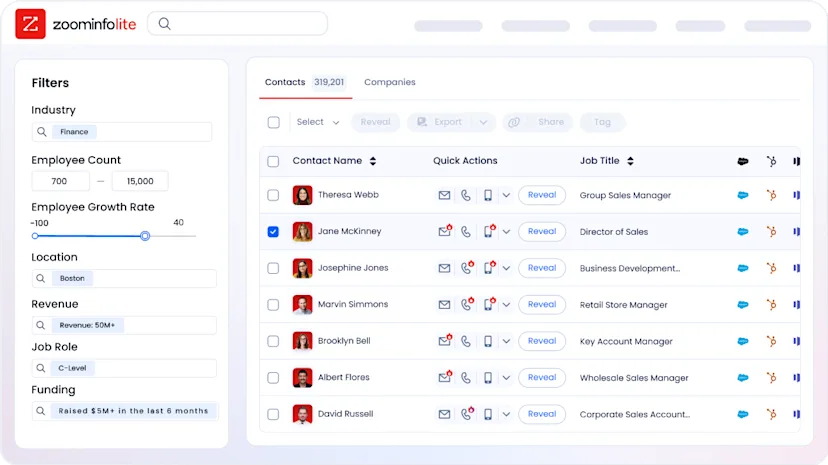
However, ZoomInfo offers two free entry points: ZoomInfo Lite (a permanent free tier with 10 monthly export credits and access to the B2B database) and a 7-day free trial of the full platform. Paid tiers (Professional, Advanced, Enterprise) unlock progressively more capabilities: intent signals, AI features, integrations, and dedicated support. API access is included in all relevant plans.
The comparison isn't apples-to-apples. Crustdata's pricing covers raw API data. ZoomInfo's pricing covers data plus intent signals, conversation intelligence, marketing automation, AI workflows, and execution tools. Evaluating cost requires understanding what you're buying: a data pipe, or a platform.
Who each platform is built for
The three platforms (two active, one historical) target different users.
Proxycurl was built for software engineers integrating B2B data into custom applications. The founder described it as a product "for developers, by developers". Non-technical users needed the Sapiengraph Google Sheets addon to access data without writing code. The ideal customer was a technical founder or engineering team building a sales intelligence or recruiting tool.
Crustdata targets a similar audience with a narrower focus: teams building AI agents. The company calls itself "Google for AI agents" and positions its data as infrastructure for AI agent builders, from AI SDRs to recruiting platforms and investment tools.
Crustdata serves customers including top-5 VC firms processing 200,000 weekly profile updates and AI platforms like agent.ai. It is not designed for teams without engineering resources, and the custom pricing model suggests a higher entry point than point-and-click alternatives.
ZoomInfo serves the full spectrum. The Enterprise API and MCP serve the same developer and AI agent use cases that Proxycurl and Crustdata target. GTM Workspace serves sales reps who need account intelligence and execution tools.
GTM Studio serves marketers, RevOps, and GTM engineers who need to build audiences, orchestrate campaigns, and measure pipeline. Customers include Adobe, Microsoft, Snowflake, PayPal, and Databricks, with 35,000+ companies served worldwide.
The choice depends on your team. If you're a developer building an AI agent and need raw data at the API level, Crustdata is worth evaluating. If you need that same data to also power human-led sales, marketing, and operations workflows, ZoomInfo provides both the API layer and the execution layer in one platform.
Proxycurl vs. Crustdata vs. ZoomInfo: Which should you choose?
Proxycurl is no longer an option. If you were a Proxycurl customer, you need to migrate. The service shut down on July 4, 2025, and the team has moved on to NinjaPear, a different product focused on competitive intelligence rather than LinkedIn profile data.
Choose Crustdata if:
You're building AI agents or automated systems that need real-time B2B data via API
Your team has engineers to integrate and maintain API connections
Data freshness is your top priority and you'll handle verification yourself
You need webhook-based signal monitoring for job changes, funding, and hiring
You're an early-stage company building a data-driven product and need a focused data layer
Choose ZoomInfo if:
You need verified B2B data that powers both AI agents and human-led GTM motions
Your team includes sellers, marketers, and ops professionals who need ready-made tools, not just APIs
Intent data and buying signals are critical to prioritizing accounts
You need a layer that connects external data with your CRM, conversations, and engagement history
Compliance and data provenance matter for your industry or customers
You want a platform that grows with you, from API data to full GTM execution
Start with ZoomInfo Lite for free, or request a demo to see the full platform.
Proxycurl's shutdown proved that convenience and developer experience aren't enough if the foundation is legally fragile. Crustdata offers a focused, well-built API for the AI agent era, but it's a data pipe, not a platform. ZoomInfo provides the data, the intelligence, and the execution layer, built on verification infrastructure validated by Fortune 500 evaluations, Forrester, and Gartner.
The question isn't just where your data comes from. It's whether your data provider can support every way your team needs to use it, today and as your GTM motion evolves.
"Without ZoomInfo, it would be extremely difficult, if not impossible, to achieve our business objectives. Without it, we wouldn't be able to understand the market, have the right contact data, and make meaningful connections." (Smartsheet)
Proxycurl vs. Crustdata vs. ZoomInfo FAQ
Is Proxycurl still available?
No. Proxycurl shut down on July 4, 2025, after LinkedIn filed a federal lawsuit alleging unauthorized scraping of millions of member profiles. The service is permanently discontinued. The team has launched NinjaPear, a separate company focused on competitive intelligence data, but it is not a replacement for Proxycurl's people and company enrichment APIs.
What is the best Proxycurl alternative in 2026?
It depends on your use case. For developers building AI agents that need real-time B2B data via API, Crustdata is the closest match to Proxycurl's developer-first approach. For teams that need verified data plus sales, marketing, and operations tools in one platform, ZoomInfo provides both API access and ready-made workflows.
ZoomInfo's Enterprise API and MCP server deliver the same programmatic access Proxycurl offered, backed by larger data coverage and multi-source verification.
How does Crustdata's data coverage compare to ZoomInfo's?
Crustdata covers 1 billion people profiles and 60 million companies, aggregated from 10+ sources with real-time crawling.
ZoomInfo covers 500 million contacts and 100 million companies, verified through automated scanning, third-party partnerships, a contributory network, and 300+ human researchers. Crustdata's raw profile count is higher, but ZoomInfo's verification pipeline delivers up to 95% accuracy on first-party data, a distinction that matters for outreach where bounced emails and wrong numbers damage sender reputation.
Does ZoomInfo offer API access like Crustdata?
Yes. ZoomInfo's Enterprise API provides programmatic access to contacts, companies, intent data, corporate hierarchies, org charts, and technographics. The Copilot API adds AI capabilities like account summaries, lookalike models, and buying committee recommendations.
ZoomInfo also offers an MCP server that connects AI models directly to its data through natural language. API access is included in all relevant ZoomInfo plans.
Which platform is better for building AI agents?
Crustdata was designed for AI agent infrastructure, with low-latency APIs, webhook-based signal monitoring, and a data model built for programmatic consumption.
ZoomInfo also supports AI agent development through its Enterprise API and MCP server, with the added advantage of verified data, intent signals, and AI intelligence endpoints. The choice depends on whether you need raw data (Crustdata) or data plus reasoning capabilities (ZoomInfo).
How do the platforms handle data compliance and legal risk?
ZoomInfo maintains the broadest compliance infrastructure: ISO 27001, ISO 27701, SOC 2 Type II, and TRUSTe GDPR/CCPA certifications, all renewed annually.
Crustdata holds SOC 2, GDPR, and CCPA certifications. Proxycurl claimed CCPA/GDPR compliance but was shut down by a LinkedIn lawsuit over its data collection methods, showing that compliance certifications alone don't eliminate legal risk from how data is sourced.
Can I use ZoomInfo just for API data without the full platform?
Yes. ZoomInfo's Data as a Service offerings include the Enterprise API for programmatic access, Cloud Data Cubes for direct data delivery into AWS, Snowflake, or Databricks, and the MCP server for AI model integration. Teams that only need data infrastructure can consume ZoomInfo through these channels without using the native UI products.
ZoomInfo Lite also provides a permanent free tier with 10 monthly export credits and access to the B2B database.
What happened to Proxycurl's customer data after the shutdown?
Proxycurl's founder stated he assisted customers with deboarding before the July 2025 shutdown. The Proxycurl website now redirects to NinjaPear. API documentation returned 403 Forbidden errors at the time of research. Customers who built systems on Proxycurl's API needed to migrate to alternative providers, as the service and all its endpoints are permanently offline.
More Proxycurl and Crustdata comparisons and alternatives:
