
Choosing between Salesforce and Unqork for your enterprise comes down to five questions:
Do you need a full CRM that handles sales, service, and marketing, or a platform to build custom operational applications without writing code?
Is your primary goal managing customer relationships, or modernizing legacy processes in a regulated industry?
Are you prepared to invest in dedicated administrators and implementation partners, or do you want business users building alongside IT?
Does your AI strategy center on autonomous customer-facing agents, or on governed application development that never generates new code?
Do you have the verified B2B data your enterprise platform needs to drive revenue?
In short, here's what we recommend:
Salesforce is the largest CRM platform, serving over 150,000 companies with a suite covering sales, service, marketing, commerce, and analytics. Its Agentforce AI agents handle customer interactions autonomously, and AppExchange offers over 9,000 partner applications. Salesforce spans 17 industry verticals and covers the full customer lifecycle.
That breadth brings complexity: implementations require partner support, pricing involves multiple add-on layers, and the platform demands dedicated administration.
Unqork is a no-code enterprise application platform designed for regulated industries. Its deterministic reasoning engine assembles applications from pre-built, security-vetted components rather than generating code, eliminating technical debt by design.
Financial services firms, insurers, healthcare organizations, and government agencies use Unqork to digitize processes that would take traditional development teams years to build. But Unqork has no CRM capabilities, documented performance limitations at consumer scale, and enterprise-only pricing with no public tiers or free tier.
The two platforms address different needs: Salesforce manages customer relationships and operations; Unqork builds the custom applications regulated businesses require. Neither creates the B2B intelligence go-to-market teams need to identify, reach, and convert buyers. That's a different problem.
ZoomInfo is a B2B intelligence and go-to-market platform built on a large B2B dataset: 500M contacts, 100M companies, 135M+ verified phone numbers, and 200M+ verified business email addresses. Its GTM Context Graph combines this data with your CRM records, conversation transcripts, and behavioral signals to show not just what happened in your pipeline, but why.
ZoomInfo integrates with Salesforce to enrich your CRM, and its API and MCP make the same intelligence available to any application. For enterprise teams evaluating their technology stack, ZoomInfo is the data layer that turns platform investment into revenue.
If verified B2B intelligence sounds like the missing piece of your enterprise stack, see how ZoomInfo works with a free trial.
Salesforce vs. Unqork at a glance
Salesforce | Unqork | ZoomInfo | |
|---|---|---|---|
Core function | CRM + enterprise application platform | No-code enterprise application builder | B2B data and go-to-market intelligence platform |
Target market | Companies of every size and industry | Large regulated enterprises (financial services, insurance, healthcare, government) | B2B enterprises with sales and marketing teams |
AI approach | Autonomous customer-facing agents (Agentforce) | Deterministic AI mapping requirements to pre-built components (UnqorkAI) | GTM Context Graph reasoning across 1.5B+ daily data points |
Security certifications | ISO 27001, SOC 1/2/3, FedRAMP, HITRUST | SOC 2 Type II, ISO 27001, FedRAMP, HIPAA | ISO 27001, ISO 27701, SOC 2 Type II, GDPR |
Learning curve | Steep; dedicated admin recommended | Moderate; certified creator training required | Moderate; 90-day structured onboarding |
Free option | Free CRM (max 2 users) | None | ZoomInfo Lite (permanent free) + 7-day trial |
Ecosystem | 9,000+ apps on AppExchange | Growing marketplace with partner applications | 172+ integration partners; API/MCP access |
Pricing | Published tiers from $25 to $550/user/month + add-ons | Custom enterprise quotes only | Consumption-based; free tier available |
Best for | Enterprises needing unified CRM and operations | Regulated industries eliminating technical debt | Revenue teams needing verified B2B intelligence |
Full CRM ecosystem vs. no-code application builder
Salesforce and Unqork answer different questions. Salesforce asks: "How do we manage every customer interaction across our organization?" Unqork asks: "How do we build custom enterprise applications without the burden of code?"
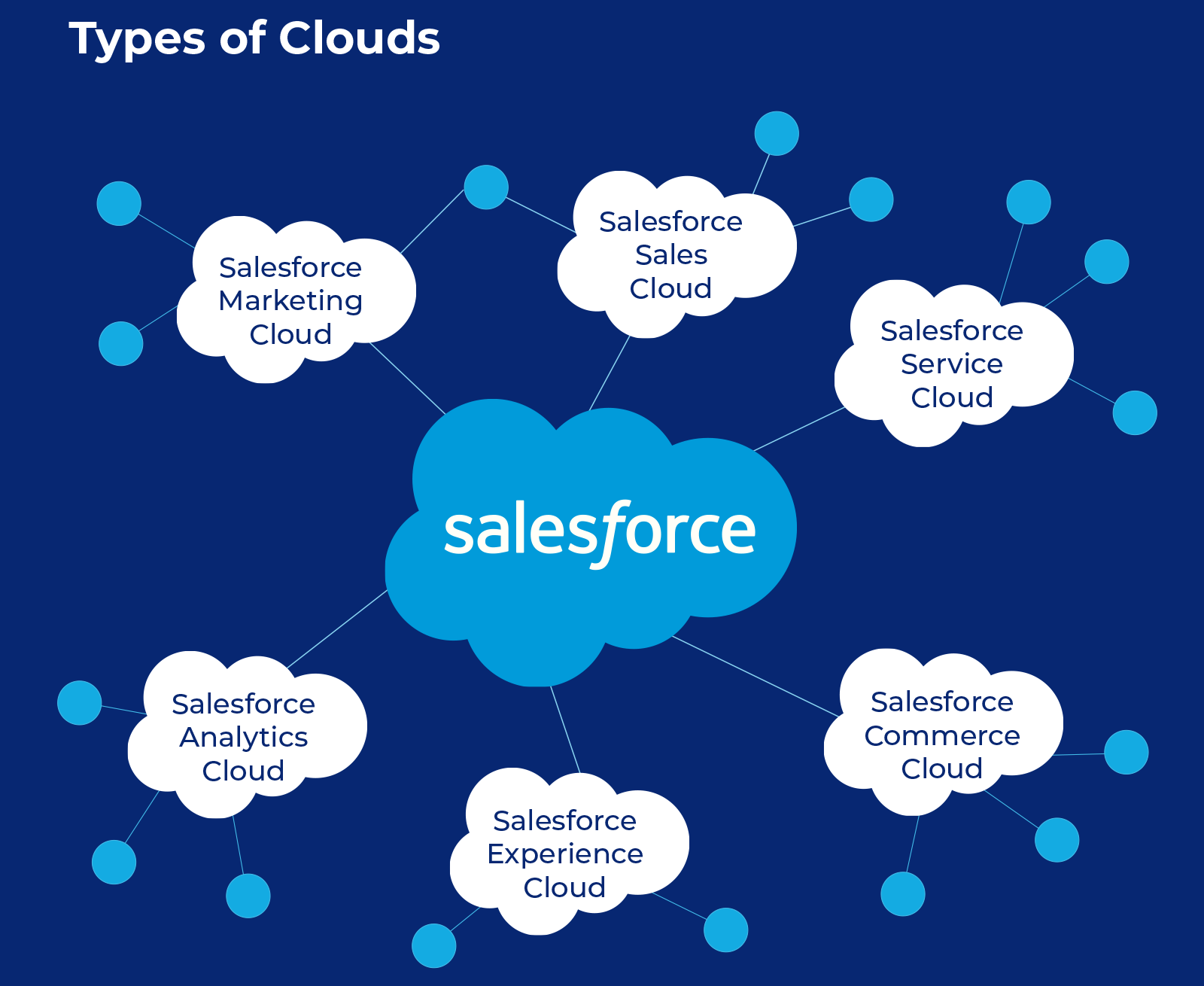
Salesforce gives you Sales Cloud, Service Cloud, Marketing Cloud, Commerce Cloud, Data Cloud, Tableau, and Slack, all sharing customer data.
Source: Salesforce
Your marketing team captures a lead. Your sales team converts them. Your support team serves them. Their purchase history shapes your next campaign. All within one system.
The trade-off is complexity. Salesforce assembled this suite over 27 years through major acquisitions including MuleSoft ($6.5B), Tableau ($15.7B), Slack ($27.7B), and Informatica (~$8B). Each expanded the platform's reach, but partners lead over 70% of implementations, and getting full value requires dedicated, trained administrators. Salesforce itself acknowledged being "historically built for large enterprises."
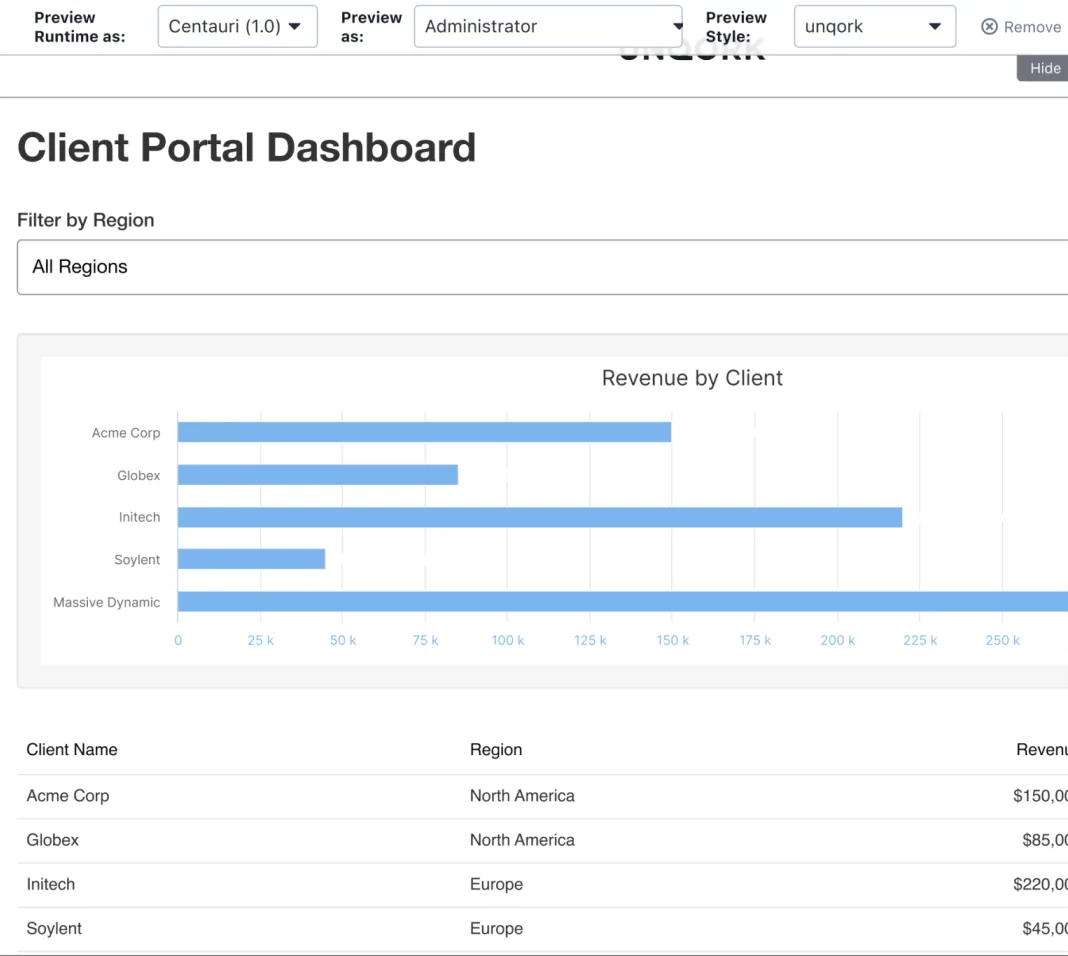
Unqork does one thing: build enterprise applications without code. No CRM, no marketing automation, no commerce storefront. It provides a visual canvas where business and IT teams assemble applications from pre-built components.
Source: Unqork
Need a client onboarding workflow for your insurance brokerage? An underwriting workbench? A government benefits portal? Unqork delivers these without a single line of generated code.
The architectural advantage is real. Enterprises historically spend 40% of IT budgets maintaining existing software. When Unqork patches the platform, every application updates automatically because there's no custom codebase to audit and refactor.
The limitation is equally clear. Unqork has no CRM, no customer engagement tools, no marketing automation. If you need to manage sales pipelines, run email campaigns, or serve customers across channels, you need another platform.
The intelligence layer your enterprise platform doesn't provide
Salesforce manages your customer relationships. Unqork builds your operational applications. Neither creates the B2B intelligence your revenue teams need to find buyers and understand why deals succeed or fail.
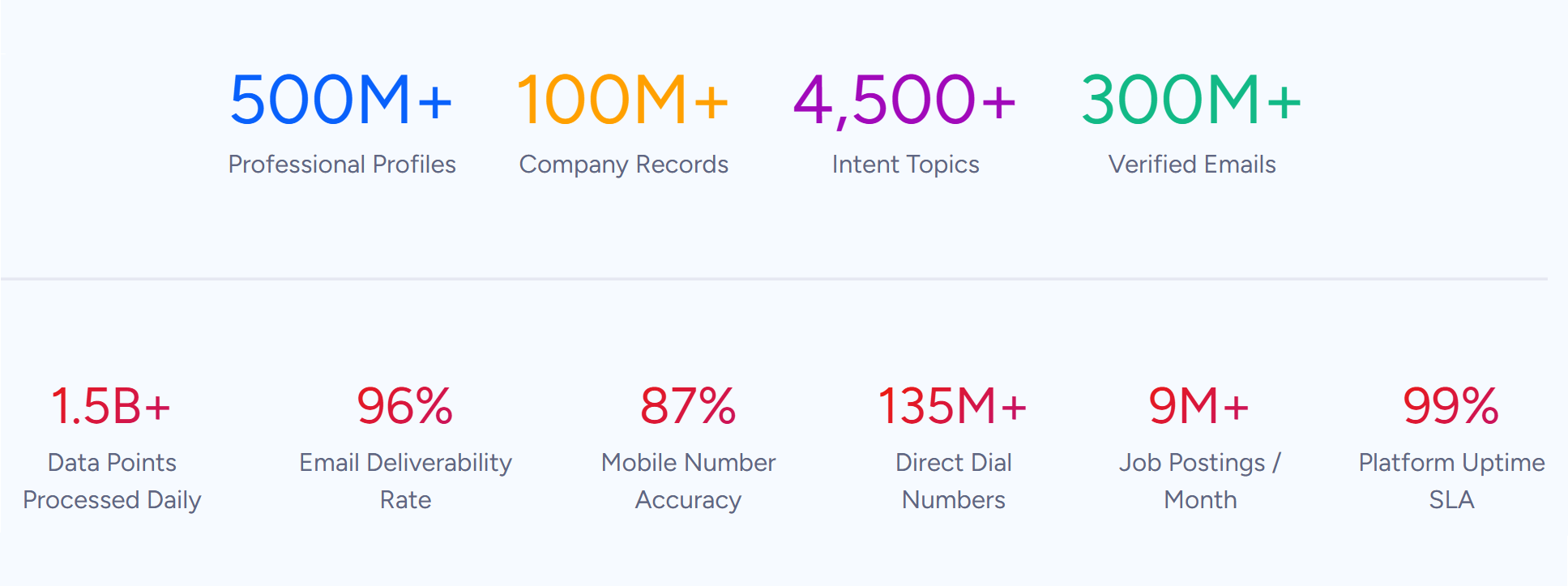
ZoomInfo fills that gap. Its data platform covers 500M contacts, 100M companies, 135M+ verified phone numbers, 120M direct-dial phone numbers, and 200M+ verified business email addresses, maintained by a multi-source pipeline with 300+ human researchers and up to 95% accuracy on first-party data.
Source: ZoomInfo
In a Fortune 500 competitive RFP analyzing 25 million contacts across vendors, the independent consultant concluded that "no other competitor came even close."
The data matters because your enterprise platform is only as good as what flows through it. A Salesforce CRM with incomplete records produces unreliable forecasts. An Unqork-built onboarding application that can't verify company details slows the process it was designed to speed up. Forbes estimates 91% of CRM data is incomplete.
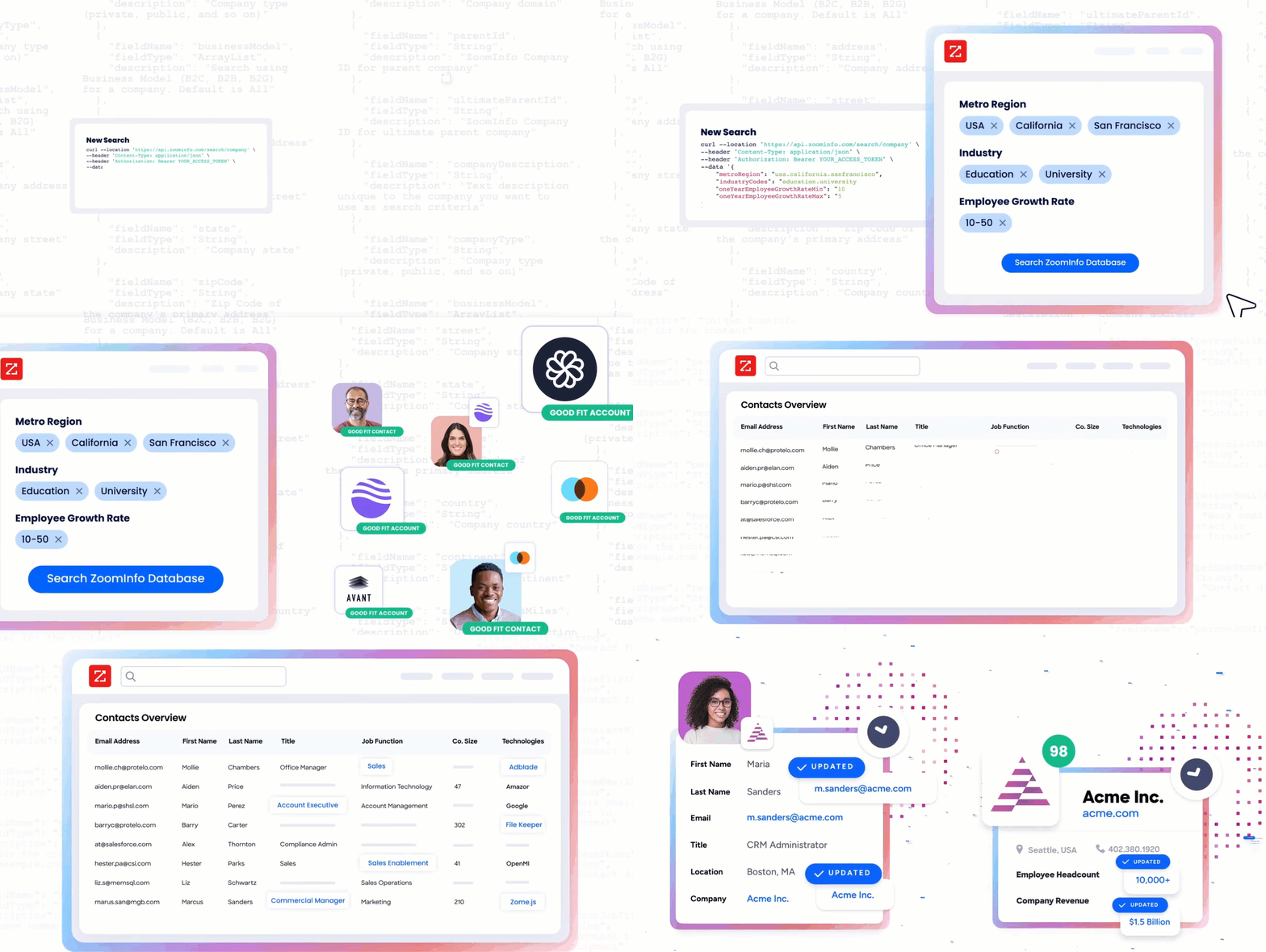
ZoomInfo delivers this intelligence several ways. For Salesforce users, a native integration enriches CRM records with verified contacts, intent signals, and company data. GTM Workspace gives sellers a place to research accounts, draft outreach, and track signals in one view.
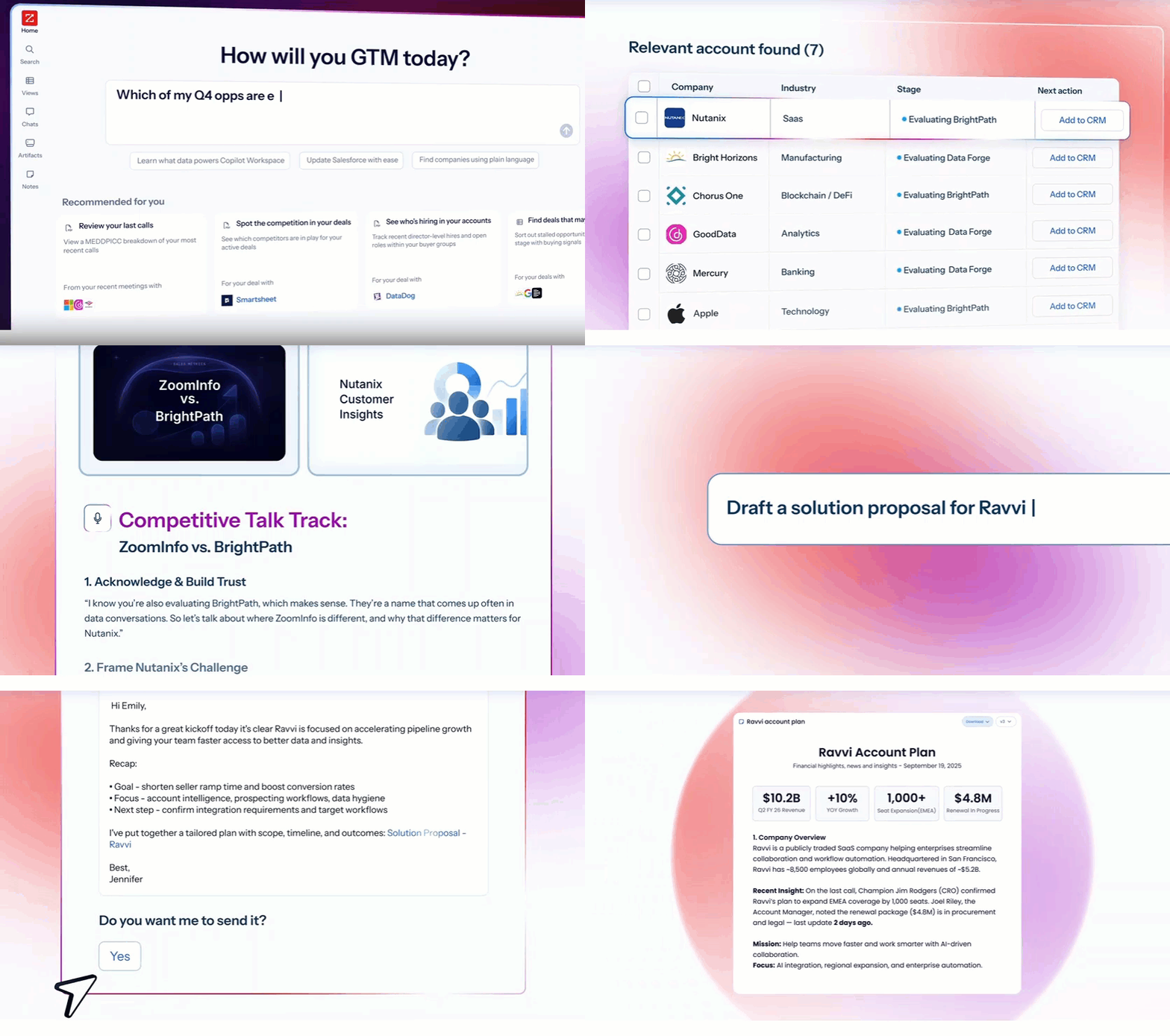
Source: ZoomInfo
GTM Studio lets marketers and RevOps teams design go-to-market plays in natural language. For any custom application (including systems built on Unqork), ZoomInfo's API and MCP expose the same intelligence programmatically.
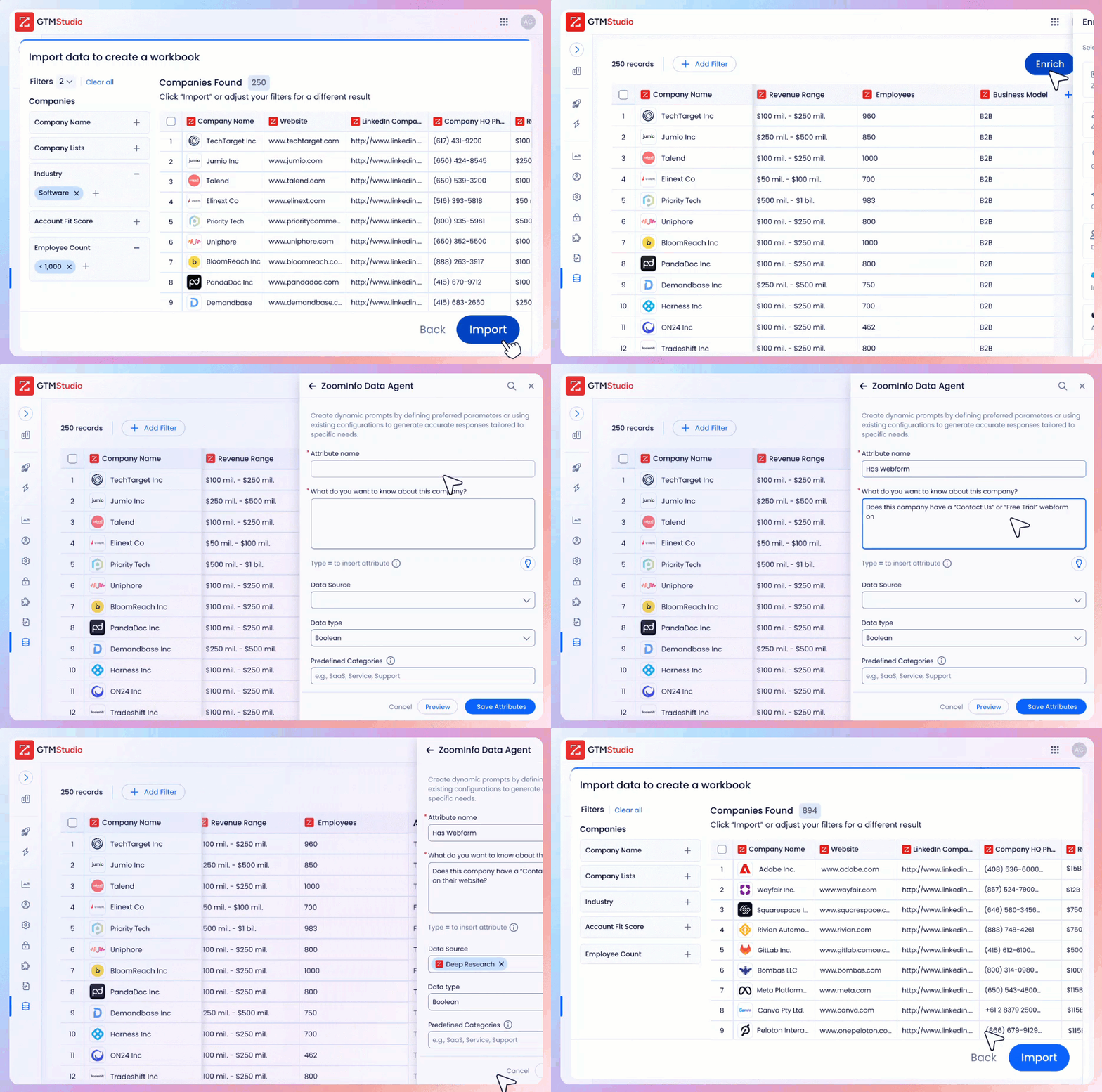
Source: ZoomInfo
For a closer look at how Salesforce and ZoomInfo compare, see our Salesforce vs. ZoomInfo analysis.
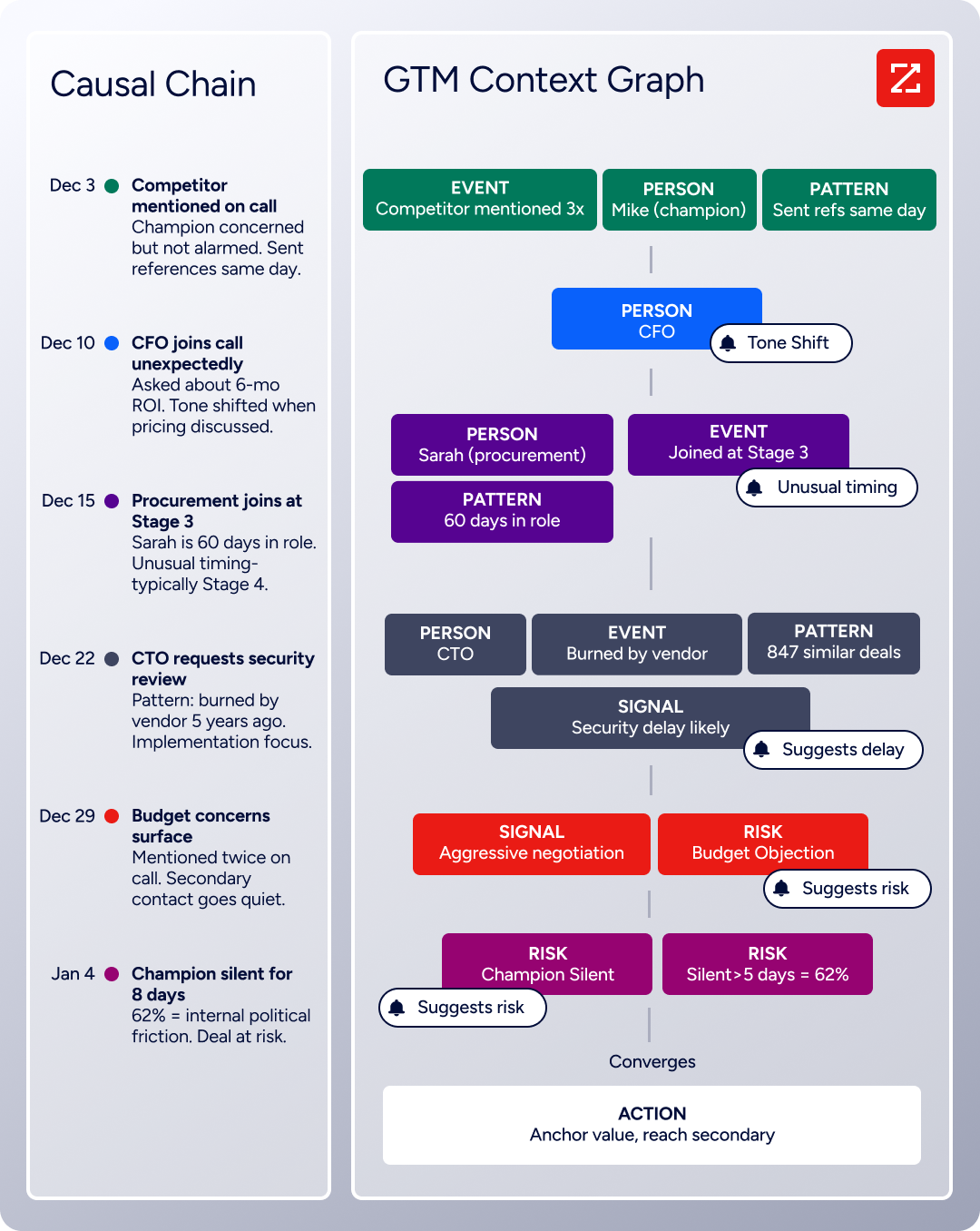
The key layer is the GTM Context Graph. A CRM records that a deal moved from Stage 3 to Stage 4 and the close date shifted. But as ZoomInfo's CPO Dominik Facher writes: "The CRM recorded the state change. It has no record of why it happened."
Maybe the CFO joined the last call and asked about six-month ROI. Maybe the VP went quiet for eight days during an internal budget battle. The GTM Context Graph captures these connections and makes them available to AI-powered workflows, so your next follow-up addresses the actual concern driving the deal.
Snowflake uses ZoomInfo for at least one-third of the most critical features in their Account Propensity Scoring model, feeding over 70 company and technographic data fields. Accounts tracked with ZoomInfo-powered scores showed 90% higher opportunity open rates and 2x higher customer conversion rates. (Snowflake)
AI capabilities follow different design philosophies
Both companies invested in AI, but their implementations serve opposite purposes.
Salesforce's Agentforce faces outward. Its AI agents interact with customers autonomously across every channel: resolving support tickets, qualifying leads, coaching sales reps, and guiding shoppers. The Atlas Reasoning Engine powers these agents through a reason-act-observe-adapt loop rather than fixed scripts.
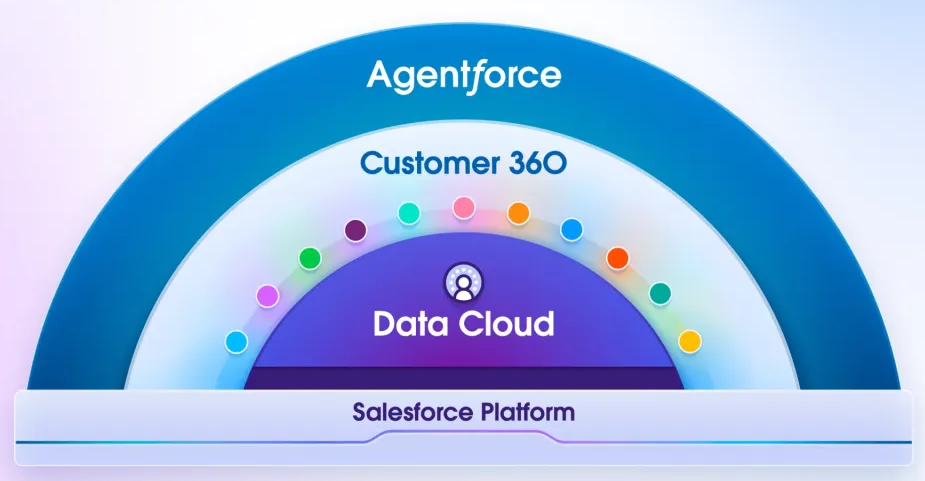
Source: Salesforce
Salesforce reports that Agentforce resolves 85% of its own support requests without human escalation.
Pre-built agents cover service, SDR, sales coaching, personal shopping, and campaigns, with industry-specific agents for healthcare, banking, retail, and field service. Teams build custom agents through Agentforce Builder using natural language. The Einstein Trust Layer enforces zero data retention with LLM partners and masks PII.
Unqork's AI faces inward. UnqorkAI automates the development lifecycle, turning requirements into applications through four phases (Plan, Build, Test, Document) without generating code. Its deterministic reasoning engine maps requirements to existing, vetted components rather than writing new ones.
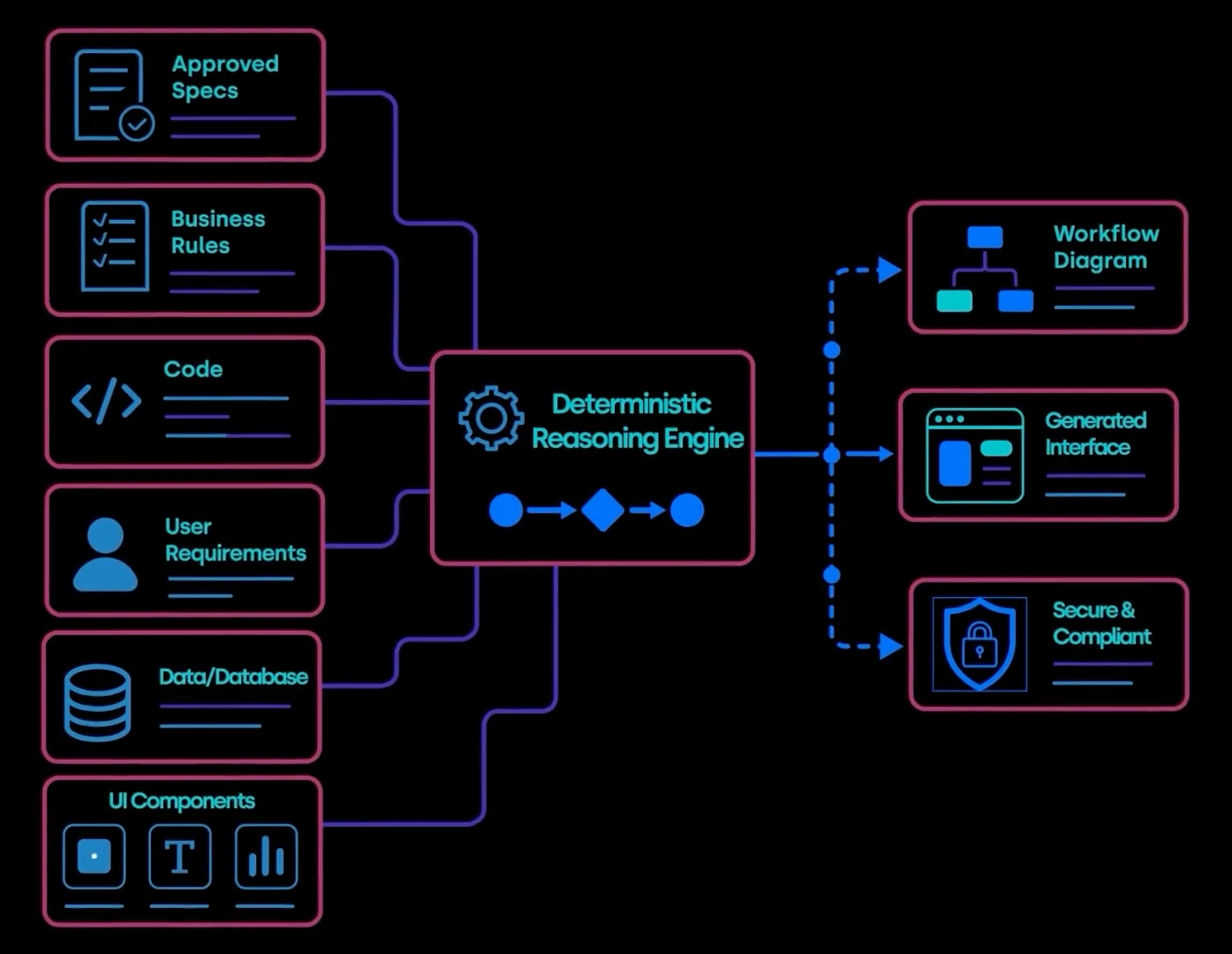
Source: Unqork
This is a deliberate choice. While tools like GitHub Copilot generate new code that teams must review and maintain, Unqork's AI "never generates new code", producing applications with known security and compliance properties. For regulated industries where every line of code requires auditing, that distinction matters.
The comparison isn't apples-to-apples. Agentforce helps your customers; UnqorkAI helps your developers. An enterprise might use both: Unqork to build custom internal applications and Agentforce to handle customer-facing interactions.
But both forms of AI share one requirement: accurate data. Agentforce is only as good as the customer data in your CRM. UnqorkAI assembles applications from requirements, but the data flowing through those applications determines their value.
ZoomInfo's GTM Context Graph addresses a different AI problem. Rather than automating customer service or application development, it reasons about your go-to-market: why deals move or stall, which accounts match your win patterns, and what signals predict a buyer is ready to engage.
Source: ZoomInfo
The GTM Context Graph processes 1.5B + data points daily, combining ZoomInfo's B2B data with CRM records, conversation intelligence, and behavioral signals. As CPO Dominik Facher describes it, the system captures not just what happened, but why it happened.
For teams using Salesforce, this intelligence flows into the CRM through native integration. For teams using any other system, ZoomInfo's API and MCP deliver the same data to any application.
Source: ZoomInfo
Seismic's sales team attributed 39% of active pipeline to opportunities identified or influenced by ZoomInfo signals, while boosting productivity by 54% and saving 11.5 hours per week per seller. (Seismic)
Security and compliance in regulated industries
Both Salesforce and Unqork serve regulated enterprises. Their approaches to compliance reflect different architectures.
Salesforce offers a layered security model. The base platform provides ISO 27001/27017/27018 and SOC 1/2/3 certifications, with FedRAMP authorization through Government Cloud and HITRUST certification.
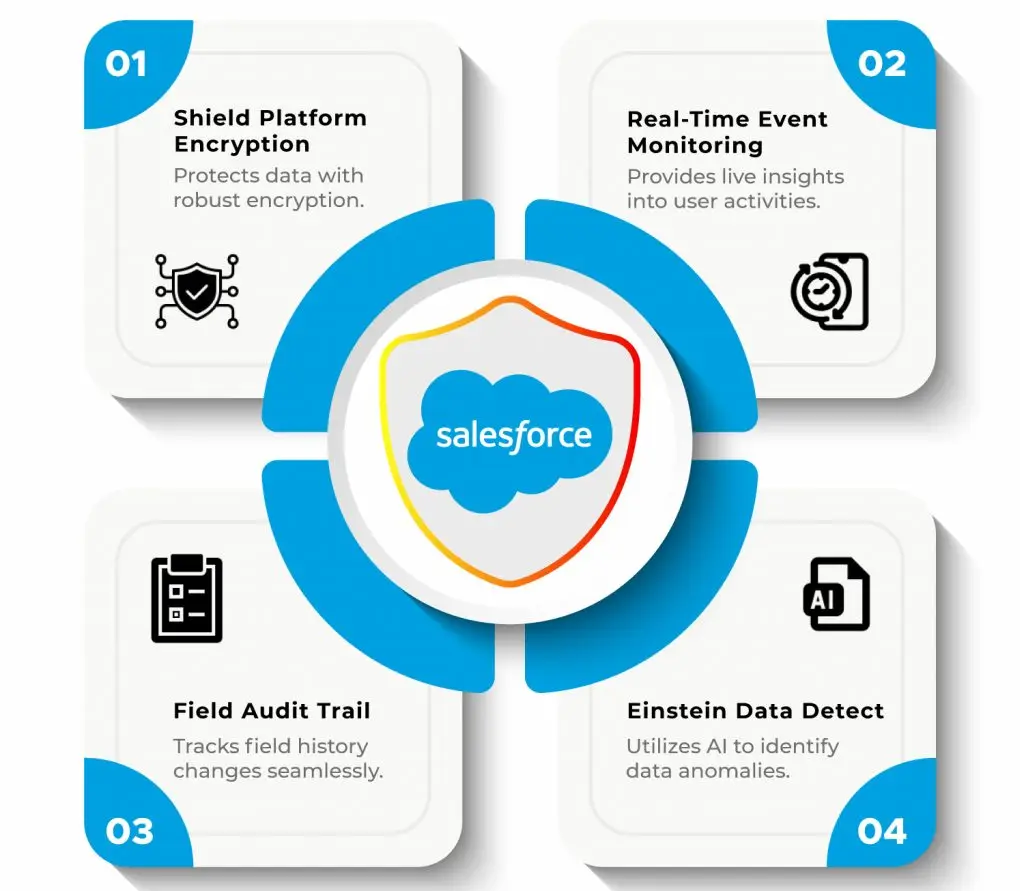
Salesforce Shield adds Event Monitoring, Platform Encryption with bring-your-own-key, and Field Audit Trail as a premium add-on. The Einstein Trust Layer provides AI-specific guardrails: zero data retention with LLM partners, PII masking, and toxicity detection.
Source: Salesforce
This model works, but depends on configuration. You can build secure applications on Salesforce, but your security posture depends on how your team sets up profiles, permission sets, sharing rules, and Shield settings. Hyperforce enables regional data residency, and the Security Center provides centralized management, but both require deliberate setup.
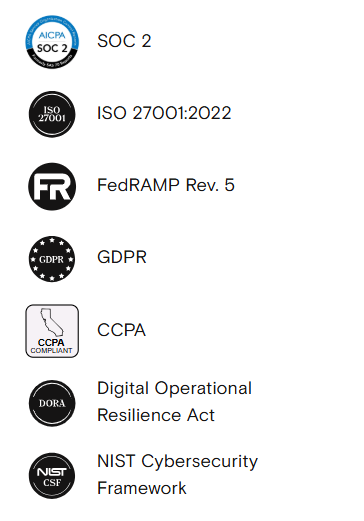
Unqork takes a different approach: security as an architectural property rather than a configuration layer. The platform carries SOC 2 Type II, ISO 27001, FedRAMP Moderate, HIPAA, and GDPR certifications as baseline requirements, not optional add-ons.
Source: Unqork
Because applications assemble from pre-built components rather than generated code, the architecture eliminates developer-introduced vulnerabilities by design.
Unqork offers further compliance advantages for regulated buyers: single-tenant deployment by default (each customer gets isolated production and non-production environments in a separate VPC), WORM immutable audit logs with no expiration (critical for HIPAA and PCI DSS), and FIPS-validated encryption for data at rest and in transit. When Unqork patches a vulnerability, every application updates automatically.
The difference is structural. Salesforce gives you security tools and the responsibility to use them correctly. Unqork gives you a smaller set of security outcomes built into the architecture. For a bank or insurer where misconfiguration can mean regulatory penalties, Unqork's approach eliminates an entire category of risk.
Pricing transparency and total cost
The pricing models reveal how each platform views its buyers.
Salesforce publishes its tier structure. Sales Cloud and Service Cloud range from a free suite (max 2 users) through Starter ($25/user/month), Pro ($100), Enterprise ($175), Unlimited ($350), and Agentforce 1 ($550). But the published tiers are the starting point. Marketing Cloud starts at $1,500/org/month.
Data Cloud credits run $500 per 100,000 credits. Premier Support costs 30% of net license fees. Commerce Cloud pricing is entirely quote-based. A 6% price increase took effect in August 2025 for Enterprise and Unlimited tiers.
The real cost includes implementation. With 70%+ of deployments partner-led, a mid-market organization can spend six figures on configuration, customization, data migration, and training before a single rep logs in. Salesforce itself acknowledged that its pricing model "needed to be easier to understand, more predictable, and more flexible."
Unqork publishes nothing.
Peer reviews describe the platform as relatively expensive, and Gartner noted that initial pricing can be attractive but ROI may drop for complex use cases that push against the platform's boundaries.
Unqork's cost argument is total lifecycle, not sticker price. The platform claims 65% lower lifecycle costs versus internal development and 3x faster time-to-market. Because there's no custom code to maintain, ongoing costs differ from traditional software.
ZoomInfo uses consumption-based pricing with no published dollar amounts for paid tiers.
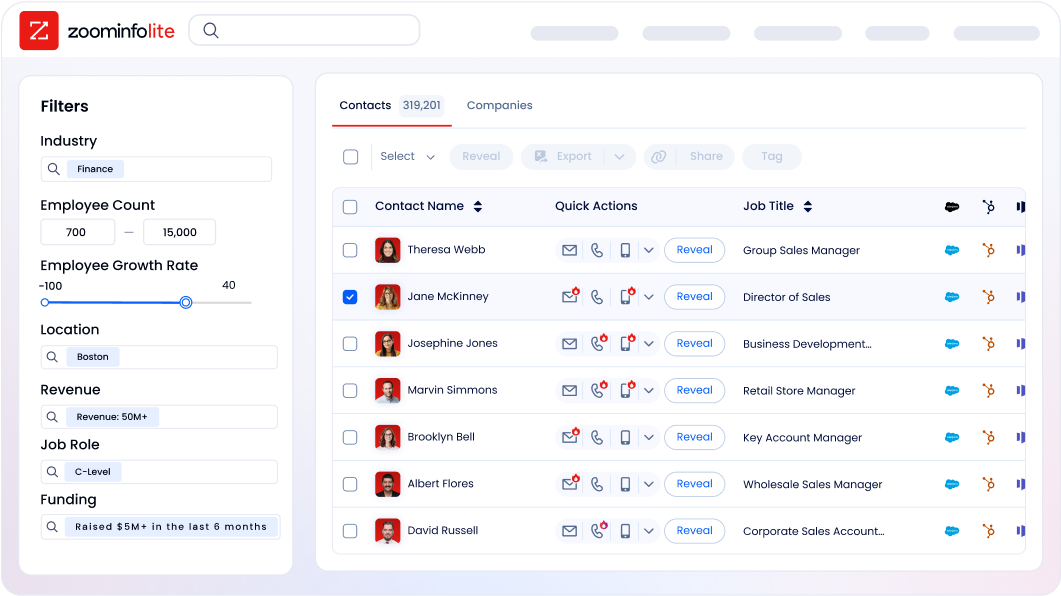
It offers two free entry points that neither Salesforce nor Unqork match: ZoomInfo Lite (permanent free tier with access to the B2B database, 10 monthly export credits, and basic features) and a 7-day free trial with full feature access. Paid plans scale around seats, credits, and feature access, with API access included in all relevant plans.
Source: ZoomInfo
Ecosystem and extensibility
How each platform connects to the rest of your technology stack reflects its maturity.
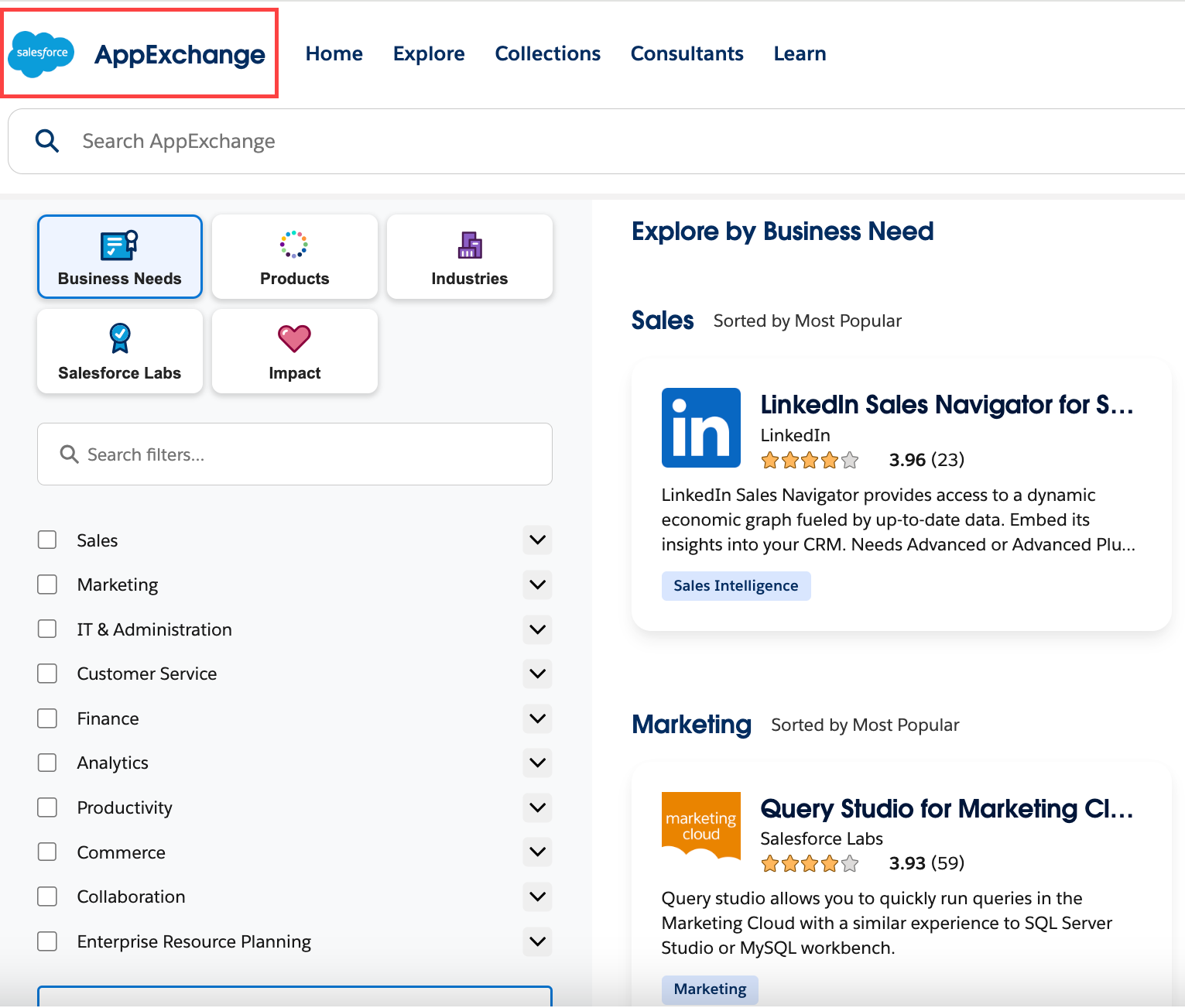
Salesforce has the largest enterprise application ecosystem in CRM. AppExchange hosts 9,000+ partner apps with 14+ million installs, and 91% of customers use at least one AppExchange app. The partner ecosystem spans 160,000+ companies, 5,000 ISVs, and 7,000 system integrators.
Source: Salesforce
MuleSoft handles enterprise integrations with hundreds of pre-built connectors. Salesforce's API portfolio includes more than 30 APIs spanning REST, SOAP, GraphQL, gRPC, and event-streaming protocols. Trailhead provides free learning with 6+ million learners and 1,500+ badges.
Whatever your enterprise needs, someone has probably built it for Salesforce. The challenge is navigating the volume of options and ensuring integration quality.
Unqork's ecosystem is smaller and more curated. The Marketplace provides pre-configured snippets, templates, integrations, and full applications built from the same vetted components as the platform itself.
Integration partners include DocuSign, Experian, Twilio, and SendGrid. Implementation partners include KPMG, EY, Persistent Systems, Slalom, and Cognizant. The Third Party Publisher Program lets certified partners publish applications.
The ecosystem is growing: creators use the Marketplace more than 900 times monthly, and over 250 applications have been built from templates. But the total scale is a fraction of Salesforce's.
For organizations in Unqork's target verticals (financial services, insurance, healthcare, government), the curated approach delivers relevant, compliant solutions. For organizations outside those verticals, options thin out fast.
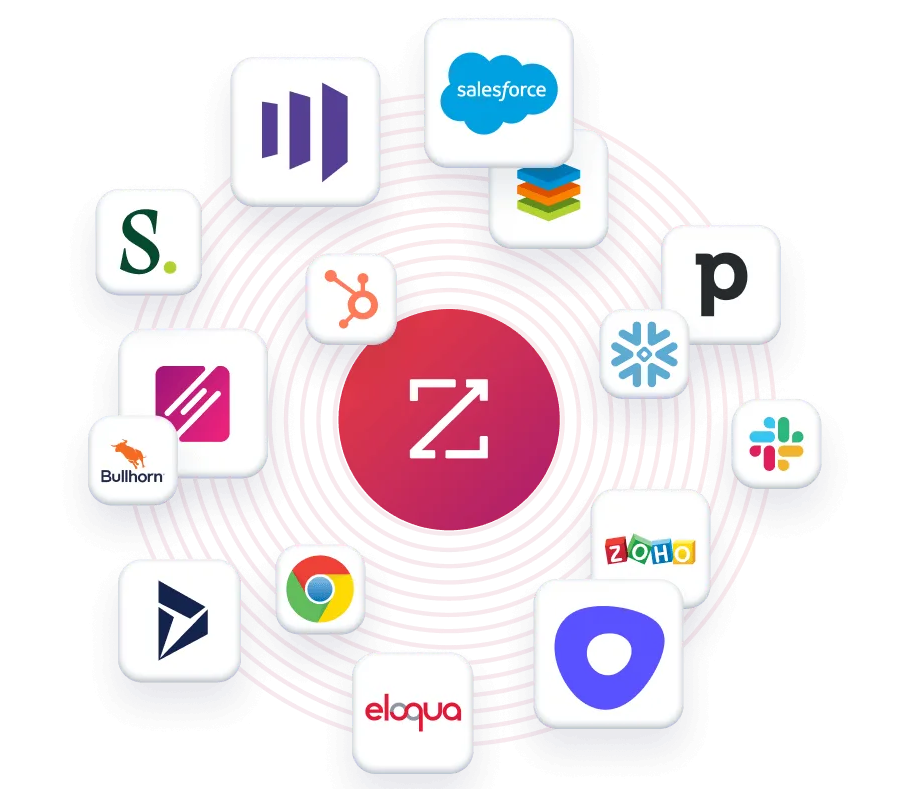
ZoomInfo connects to enterprise systems through a different lens: data delivery. Its Marketplace lists 172+ integration partners across CRM, marketing automation, sales engagement, data warehouse, and AI categories.
Source: ZoomInfo
Native integrations include Salesforce, HubSpot, and Microsoft Dynamics 365, along with cloud data partners like AWS, Google Cloud, Snowflake, and Databricks. The ZoomInfo MCP server connects AI models to ZoomInfo's B2B data, supporting Claude, ChatGPT, and any MCP-compatible AI client.
ZoomInfo's integration philosophy differs from both Salesforce and Unqork. It doesn't try to be the platform you build on. It provides the intelligence that flows into whatever platform you've chosen. API access comes with all relevant plans, and CEO Henry Schuck described a large financial services firm building an internal application on ZoomInfo's MCP server, calling it "a surface area we would never see before."
BDO Canada achieved an 87% reduction in time spent updating internal data dashboards by integrating ZoomInfo's API into their systems. (BDO Canada)
Salesforce vs. Unqork vs. ZoomInfo: Which should you choose?
The choice depends on the problem you're solving.
Choose Salesforce if:
You need a unified CRM for sales, service, marketing, and commerce
Your organization can invest in dedicated Salesforce administrators and implementation partners
You want access to the largest enterprise application ecosystem
Autonomous AI-powered customer interactions are a priority
You need platform breadth across multiple business functions and 17 industry verticals
Choose Unqork if:
You operate in financial services, insurance, healthcare, or government
Eliminating technical debt from your application portfolio is a priority
You need governed, compliant applications built without custom code
Your use case centers on custom operational applications (onboarding, underwriting, claims, benefits), not CRM
You want business users and IT to co-build on a visual canvas with built-in security
Use ZoomInfo with either platform if:
Your revenue teams need verified B2B data to find, reach, and convert buyers
You want intelligence that explains why deals move or stall, not just what happened
Incomplete CRM data is undermining your sales forecasts and marketing campaigns
Data accuracy matters: you need direct dials that ring and emails that land
See how ZoomInfo's intelligence powers your enterprise stack with a free trial.
Salesforce and Unqork address how your enterprise operates. ZoomInfo addresses how it grows. A Salesforce CRM with incomplete data produces unreliable pipelines. An Unqork application without market intelligence operates in a vacuum.
ZoomInfo provides the verified data and context that makes either platform investment produce revenue. The best enterprise stacks don't choose between operational capability and market intelligence. They combine both.
Levanta's CEO described ZoomInfo as "a full system of execution" that works the list, writes the outreach, triggers the play, and drives predictable growth, calling it far more than a contact data company. (Levanta)
Salesforce vs. Unqork vs. ZoomInfo FAQ
What is the fundamental difference between Salesforce, Unqork, and ZoomInfo?
Salesforce is a CRM and enterprise application platform that manages customer relationships across sales, service, marketing, and commerce, serving over 150,000 companies.
Unqork is a no-code enterprise application builder that assembles custom applications from pre-built components without generating code, focused on regulated industries like financial services, insurance, healthcare, and government.
ZoomInfo is a B2B data and intelligence platform that provides verified contact data, company intelligence, and intent signals to power go-to-market efforts, integrating with both Salesforce and custom applications via API.
Can Salesforce and Unqork be used together?
Yes. The two platforms address different needs. Salesforce handles CRM and customer-facing operations. Unqork builds custom operational applications like underwriting workbenches, client onboarding workflows, and benefits administration portals. An enterprise in financial services or insurance might use Salesforce for CRM and Unqork for custom regulated applications, connecting them through APIs.
Which platform is better for regulated industries?
Both serve regulated industries, but differently. Unqork was designed for regulated enterprises, with single-tenant architecture, WORM immutable audit logs, and security built into every component. It holds SOC 2 Type II, ISO 27001, FedRAMP Moderate, and HIPAA certifications as baseline capabilities.
Salesforce offers comparable certifications (including FedRAMP and HITRUST) plus industry-specific clouds across 17 verticals, but security depends more on how administrators configure the platform. Unqork's no-code architecture eliminates developer-introduced vulnerabilities by design.
How does pricing compare across the three platforms?
Salesforce publishes tier pricing from $25 to $550 per user per month for Sales and Service Clouds, with additional costs for Marketing Cloud, Data Cloud, Commerce Cloud, and support plans. Unqork publishes no pricing, using a custom-quote enterprise model with no free tier.
ZoomInfo uses consumption-based pricing with no published dollar amounts for paid tiers, but offers a permanent free tier (ZoomInfo Lite) and a 7-day free trial. All three require contacting sales for full enterprise pricing.
Does ZoomInfo integrate with Salesforce?
ZoomInfo has a native integration with Salesforce that enriches CRM records with verified B2B contact data, intent signals, company intelligence, and org chart information. Features like Account Deal Story surface inside Salesforce. Companies like Palo Alto Networks and Smartsheet use the integration to maintain data quality across their Salesforce instances.
Which platform has the strongest AI capabilities?
Each platform's AI serves a different purpose. Salesforce's Agentforce deploys autonomous AI agents that interact with customers across channels (resolving support cases, qualifying leads, and coaching reps), generating $800M in ARR. Unqork's UnqorkAI automates the development lifecycle, turning requirements into governed applications without generating code.
ZoomInfo's GTM Context Graph reasons across 1.5B + data points daily to explain why deals move or stall, powering AI-drafted outreach and pipeline prioritization. The three are complementary rather than competitive.
What are the main limitations of each platform?
Salesforce's breadth brings complexity: most implementations require partner support, pricing involves multiple add-on layers, and the platform demands dedicated administration. Unqork has no CRM capabilities, documented performance limitations at high user volumes, limited self-serve learning resources, and pricing that excludes smaller organizations.
ZoomInfo does not publish pricing for paid tiers, and its intelligence is B2B-focused, meaning B2C companies will not find relevant data.
Which platform is easiest to get started with?
ZoomInfo offers the lowest-friction entry with ZoomInfo Lite (permanent free access, no credit card required) and a 7-day free trial.
Salesforce offers a free CRM for up to 2 users and Starter Suite at $25 per user per month with month-to-month billing. Unqork has no free tier, no public trial, and no self-serve onboarding. All engagement begins with a custom pricing conversation and demo request aimed at enterprise buyers.
More Salesforce comparisons:
