
If you're comparing Salesforce vs. Veeva, you're almost certainly in life sciences, facing a decision that will shape your commercial operations for years.
On one side: the world's largest CRM, built for every industry. On the other: a platform built for one industry, and dominating it. The choice seems straightforward until you realize how many tradeoffs hide beneath the surface.
The real questions you should be asking:
Do you need a platform designed for pharmaceutical compliance, or a broader system you'll customize?
Is your commercial team primarily detailing to healthcare providers, or selling to a wider range of business buyers?
How important is out-of-the-box GxP compliance versus the flexibility to configure workflows your way?
Does your organization operate exclusively in life sciences, or across multiple verticals?
Is the data powering your CRM as strong as the CRM itself?
In short, here's what we recommend:
Salesforce is the right choice for life sciences companies that need a flexible CRM platform connecting sales, service, marketing, and commerce on a single system. With over 150,000 customers worldwide and 17 industry-specific clouds (including Health Cloud and Life Sciences Cloud), Salesforce can handle nearly any commercial need.
Its Agentforce AI platform and AppExchange ecosystem (9,000+ partner apps) make it extensible. The tradeoff: meeting life sciences compliance requirements like 21 CFR Part 11 and GxP demands significant customization, implementation partners, and ongoing administration.
Veeva is built exclusively for life sciences, and it shows. With roughly 80% of the global pharma CRM market and 50+ applications on its Vault Platform, Veeva ships pre-configured data models, audit trails, and compliance workflows that pharma and biotech companies would otherwise spend months building on a general-purpose platform.
Its integrated clinical, regulatory, quality, and commercial clouds share data natively through the Connections Hub, creating a single system for the entire drug lifecycle. The tradeoff: Veeva only serves life sciences, the proprietary Vault platform creates vendor lock-in, and total cost of ownership runs high.
Both platforms are strong choices for different types of life sciences organizations. But whichever CRM you choose, your commercial team's effectiveness depends on the quality of the data powering their daily work. CRM systems manage relationships. They don't generate the intelligence that tells your team who to call, when to engage, and why an account is ready to buy.
ZoomInfo is an AI-powered GTM platform that provides the commercial intelligence layer neither CRM delivers on its own.
Built on a B2B data foundation (500M contacts, 100M companies, 135M+ verified phone numbers, and 200M+ verified business emails), ZoomInfo's GTM Context Graph combines this data with your CRM records, conversation transcripts, and behavioral signals to show not just what's happening in your accounts, but why.
Your team accesses that intelligence through the GTM Workspace for sellers, GTM Studio for marketers and RevOps, a direct Salesforce integration, or API/MCP access for any platform.
If adding commercial intelligence to your CRM sounds like the missing piece, see how ZoomInfo works with your platform.
Salesforce vs. Veeva vs. ZoomInfo at a glance
Salesforce | Veeva | ZoomInfo | |
|---|---|---|---|
Core focus | Horizontal CRM and enterprise AI platform | Life sciences industry cloud | AI-powered GTM platform |
Target market | Every industry | Pharma, biotech, MedTech exclusively | B2B sales, marketing, and RevOps teams |
CRM approach | Customizable across departments | Pre-configured for pharma compliance | Enriches and powers any CRM |
Compliance | Requires customization and add-ons | Native GxP, 21 CFR Part 11, eCTD | N/A (data layer) |
AI capabilities | Agentforce (autonomous agents across all clouds) | Veeva AI (compliance-first agents in Vault) | GTM Context Graph with AI-powered intelligence |
Data capabilities | Data Cloud (unifies your existing data) | Network MDM, Compass, OpenData (HCP/HCO data) | 500M contacts, intent signals, org charts, technographics |
Ecosystem | 9,000+ AppExchange apps | Life-sciences-focused partner network | 120+ integrations, API/MCP access |
Pricing | Per-user tiers ($25–$550/user/mo) | Enterprise negotiated (no public pricing) | Consumption-based pricing |
Implementation | Weeks to 12+ months | Multi-month enterprise deployments | Deploys in weeks |
The fundamental divide: horizontal breadth vs. vertical depth
The Salesforce-Veeva comparison comes down to one architectural question: do you want a platform that can do anything, or one designed to do exactly what your industry needs?
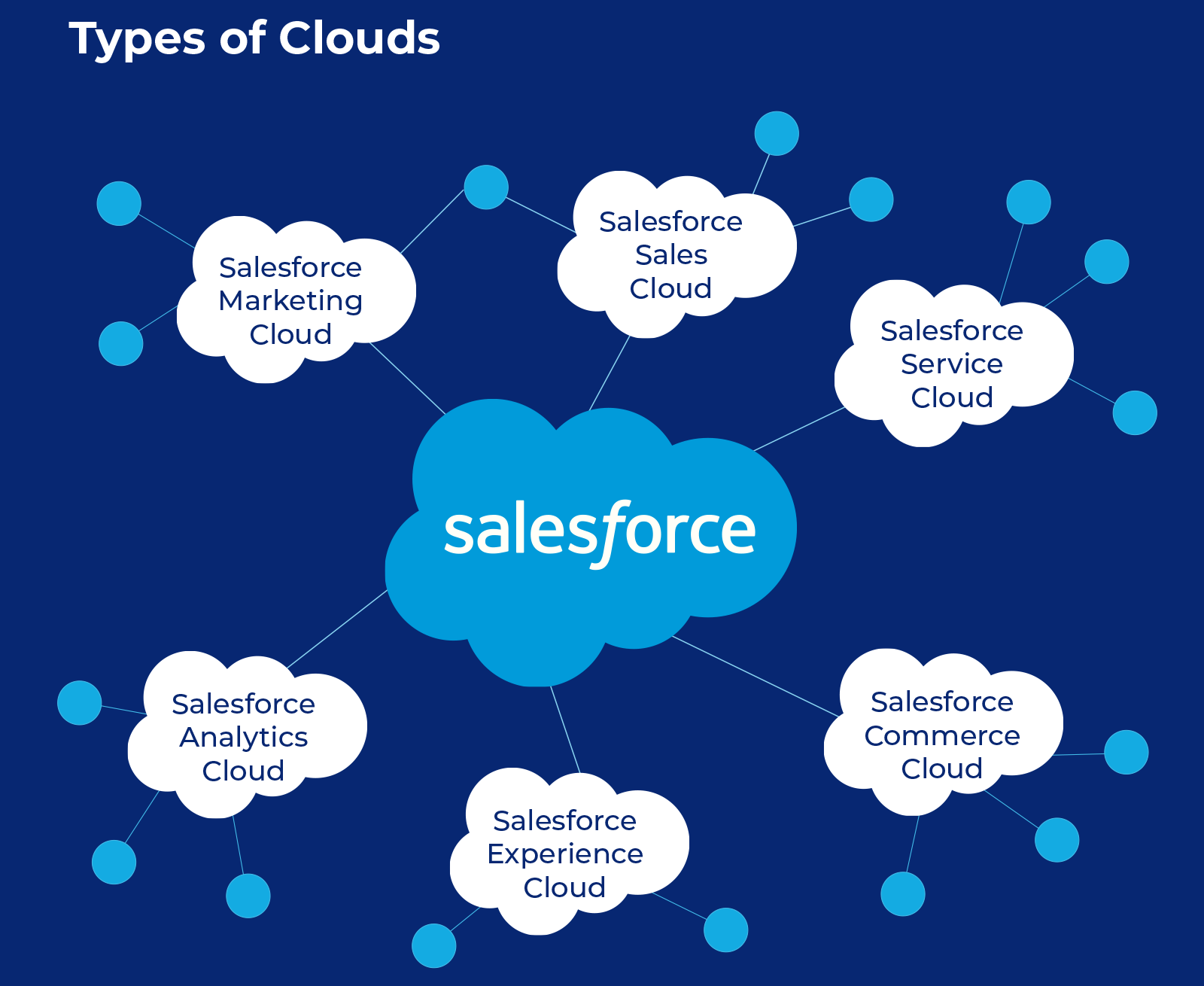
Salesforce covers the widest ground. Sales Cloud, Service Cloud, Marketing Cloud, Commerce Cloud, Data Cloud, Tableau, Slack, and MuleSoft form a single system serving companies across every industry. For life sciences, Salesforce offers Health Cloud and dedicated industry solutions, but these are overlays on a general-purpose foundation.
Source: Salesforce
You gain flexibility: your commercial team can run the same platform as your IT service desk, your marketing department, and your e-commerce operation. But you also inherit the complexity of adapting that platform to the compliance and workflow requirements of regulated industries.
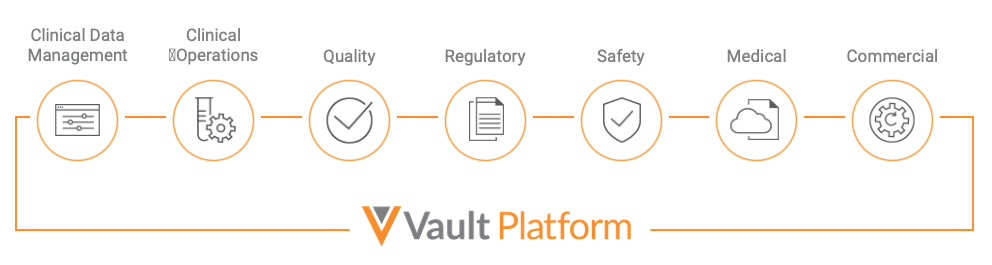
Veeva made the opposite bet. Every application on the Vault Platform is built around life sciences terminology, data models, and regulatory expectations.
Source: Veeva
When a Veeva customer sets up Vault QualityDocs, they get a pre-configured GxP Reference Model with document types already aligned to pharmaceutical quality management standards. When they deploy Vault RIM, the data model follows ICH eCTD structure and IDMP requirements. Customers report consolidating an average of 88 IT systems into a single Vault RIM environment.
This depth comes at a cost: Veeva only serves life sciences. If your company operates across multiple verticals, or if your commercial operations extend beyond pharmaceutical detailing, Veeva's specialization becomes a constraint.
The irony is that Veeva was originally built on Salesforce. Veeva CRM ran on the Salesforce platform for over a decade, and the company is now migrating to Vault CRM, with a target completion of 2030. That migration tells a story: even Veeva found that a general-purpose platform couldn't deliver the vertical integration it needed.
Compliance separates these platforms more than features do
For pharmaceutical and biotech companies, regulatory compliance isn't a feature. It's a prerequisite.
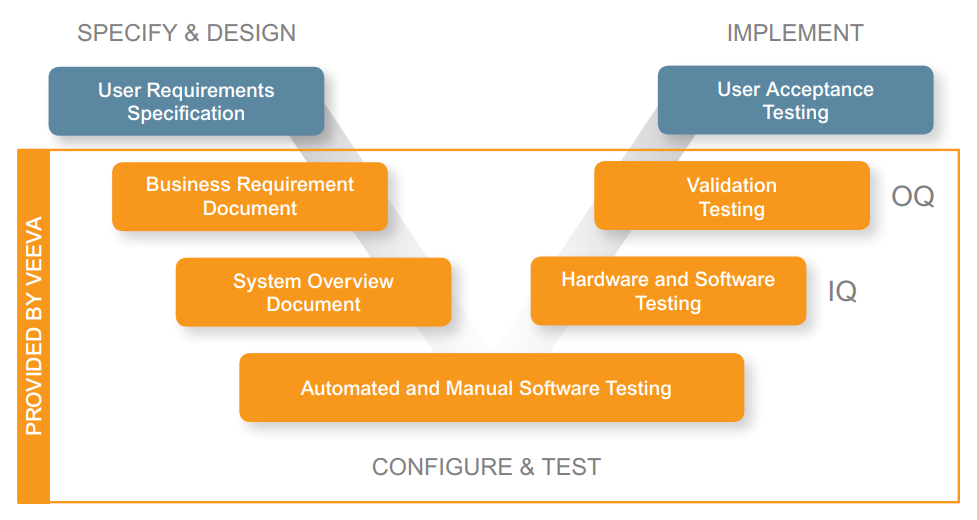
Veeva builds compliance into the platform layer. Every Vault application ships with 21 CFR Part 11 electronic records and signatures, GxP audit trails, and IQ/OQ validation packages delivered with each of three annual General Releases. When a document changes in Vault QualityDocs, Vault Training
automatically reassigns training to affected employees.
Source: Veeva
When a clinical study reaches a milestone in Vault CTMS, the corresponding Trial Master File documents auto-file in Vault eTMF. This integrated compliance architecture is what 500+ eTMF customers and 300+ QMS companies rely on daily.
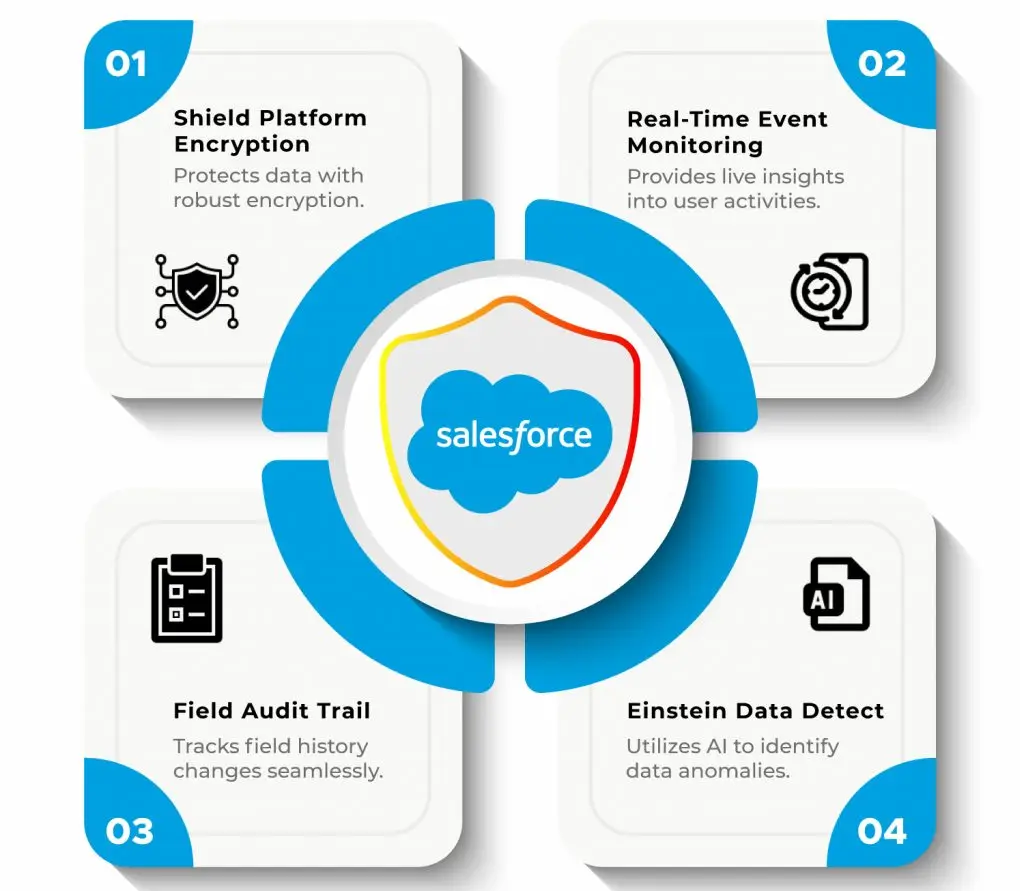
Salesforce can meet these requirements, but not out of the box. Salesforce Shield provides event monitoring across 50+ event types, platform encryption with bring-your-own-key, and field audit trail with indefinite retention. The platform holds compliance certifications including ISO 27001, SOC 1/2/3, FedRAMP, and HITRUST.
Source: Salesforce
But assembling a GxP-compliant environment on Salesforce requires additional configuration, third-party AppExchange solutions, and validation work that Veeva delivers natively. For companies whose primary need is pharmaceutical field force management with compliant call reporting and sampling, this gap matters.
Where Salesforce holds an advantage is security infrastructure for broader enterprise deployments. Hyperforce enables regional data residency across multiple countries at no additional cost. The Einstein Trust Layer enforces zero data retention with LLM partners, PII masking, toxicity detection, and full audit trails for AI interactions.
For life sciences companies deploying AI at enterprise scale across multiple business functions, this governance framework is more mature than what any single-vertical platform offers.
CRM capabilities: broad platform vs. pharma-specific workflows
The CRM comparison is where these platforms diverge most clearly.
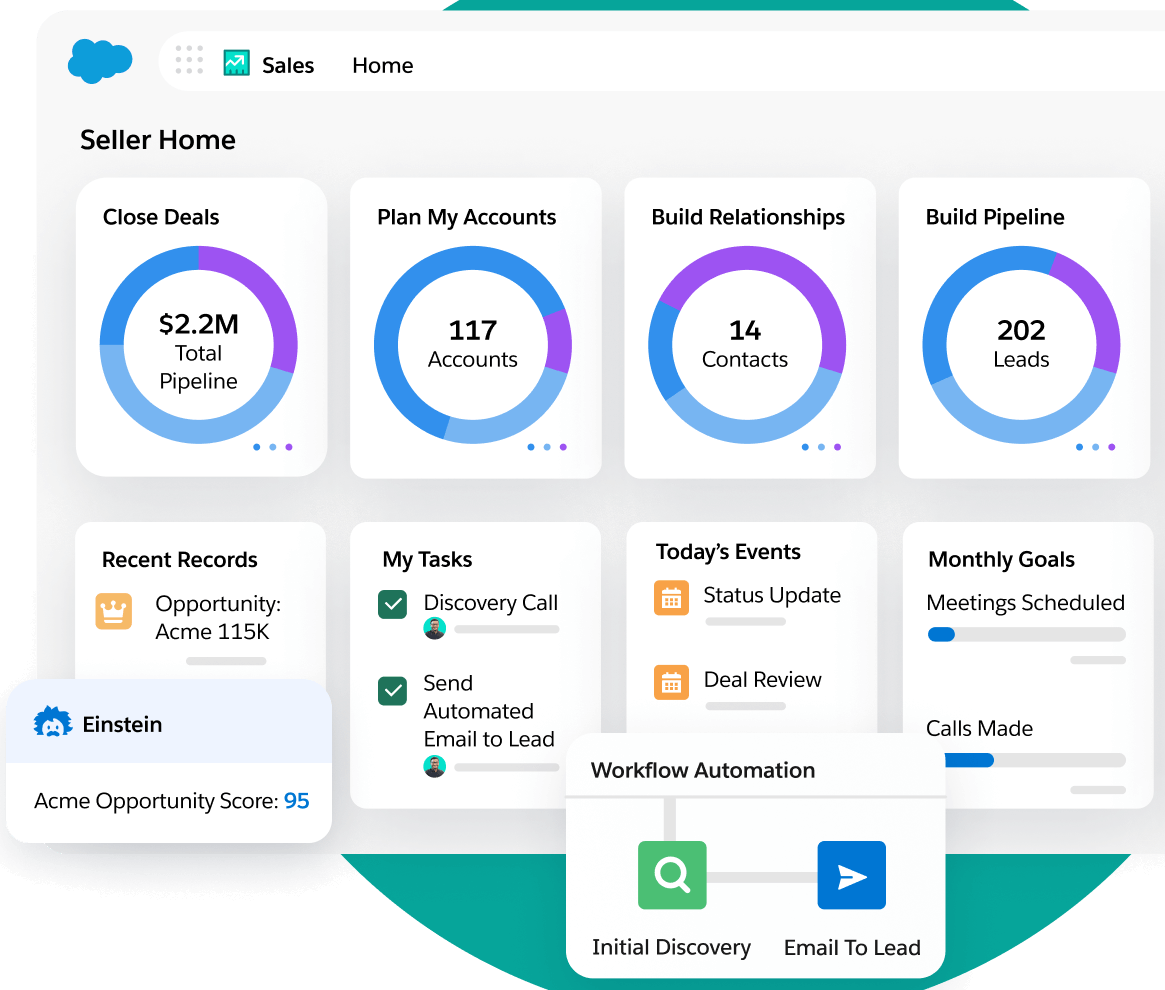
Salesforce Sales Cloud (now branded Agentforce Sales) is a general-purpose sales platform: lead management with Einstein Lead Scoring, pipeline management with AI deal insights, forecast management with real-time rollups, Revenue Lifecycle Management covering CPQ through billing, and conversation intelligence with native call recording.
Source: Salesforce
Salesforce has been the Gartner Magic Quadrant Leader for Sales Force Automation for 19 consecutive years. This breadth means your commercial, service, and marketing teams all work from the same customer record, with Einstein Activity Capture syncing emails and calendar events from Gmail and Outlook automatically.
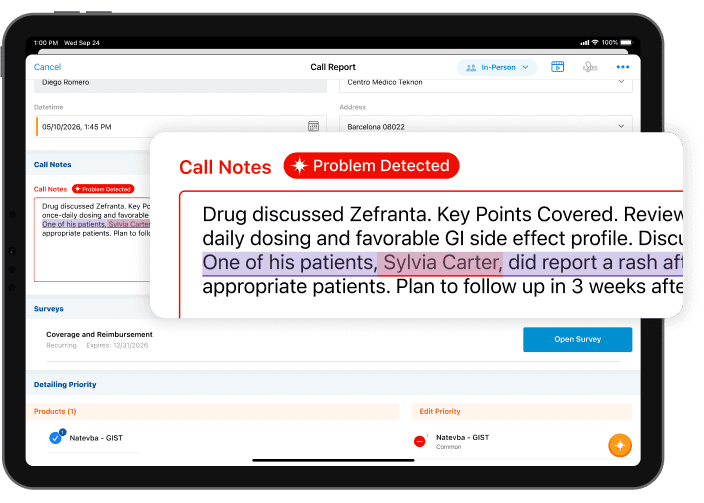
Veeva's Vault CRM does less, but does it specifically for pharmaceutical field operations. Offline-first mobile apps let reps record calls and manage samples without connectivity, a common reality in hospital and clinic settings. Vault PromoMats manages the medical-legal-regulatory review of promotional materials with configurable multi-step approval workflows.
Source: Veeva
Network MDM maintains 7 billion+ HCP/HCO records globally across 45,000+ field users with real-time sync to CRM. The entire workflow, from approved content creation through field delivery and call reporting, runs on one platform with compliance guardrails at every step.
The question isn't which CRM is better in the abstract. It's whether your commercial operation centers on regulated pharmaceutical detailing (where Veeva's pre-built workflows save months of customization) or spans broader business functions (where Salesforce's unified platform delivers more value).
AI approaches reflect different priorities
Both platforms invest heavily in AI, but their implementations reveal different priorities.
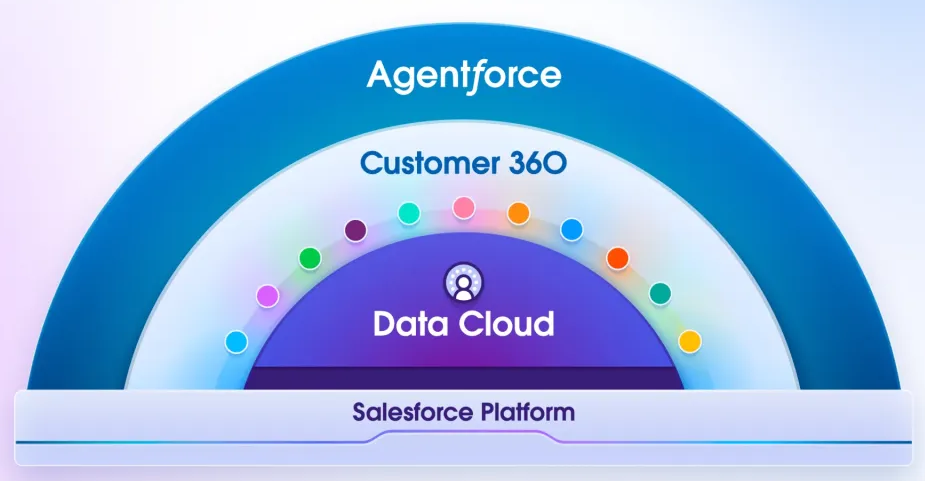
Salesforce's Agentforce is the company's main AI platform. Powered by the Atlas Reasoning Engine, Agentforce deploys autonomous AI agents across sales, service, marketing, and commerce. Pre-built agents handle prospecting, inbound lead engagement, sales coaching, and campaign creation.
Source: Salesforce
Salesforce reports that its own customer service resolves 85% of support requests without human escalation using Agentforce. The Agentforce Builder lets teams create custom agents through natural language at no additional cost. The scope: AI that operates across every cloud in the Salesforce ecosystem.
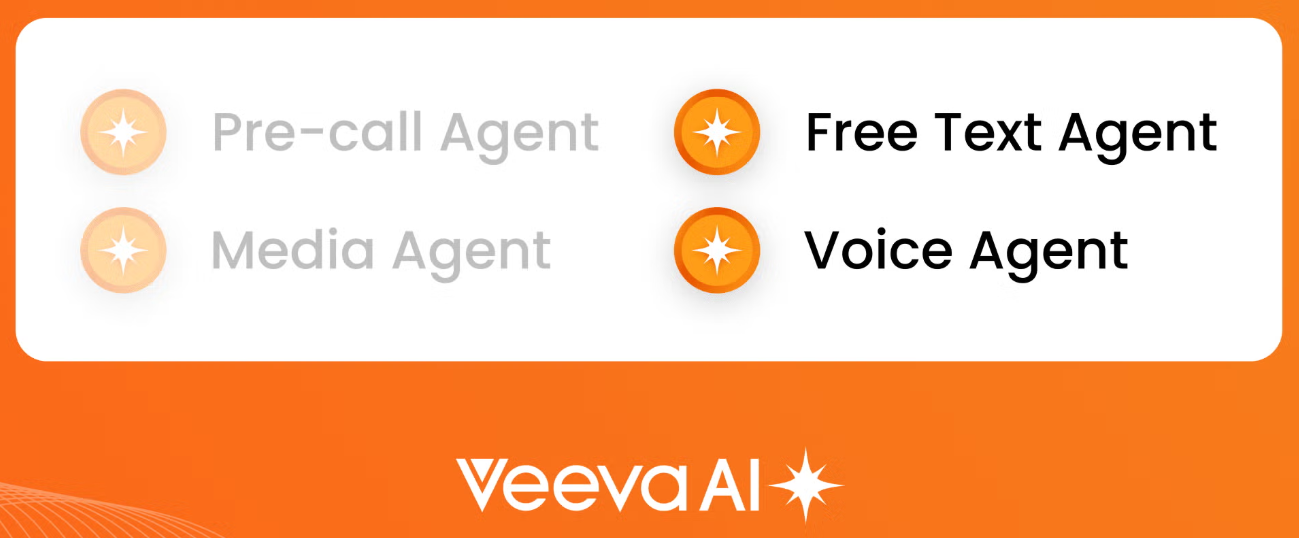
Veeva AI launched its standard agent portfolio in December 2025, built on Anthropic and Amazon LLMs via Amazon Bedrock. The scope is narrower but compliance-aware. The Free Text Agent converts unstructured call notes into structured report fields. The Pre-call Agent surfaces talking points from Vault data. The Quick Check Agent pre-screens promotional content for compliance before MLR review.
Source: Veeva
Safety and Quality agents are planned for April 2026, Clinical and Regulatory agents for August 2026, and Clinical Data agents for December 2026. Every agent runs inside the GxP-validated Vault environment with audit trails, so life sciences companies don't need to validate AI outputs separately.
Salesforce offers wider AI capability across more functions. Veeva offers AI that's already validated for regulated environments. For life sciences companies, the compliance readiness of the AI matters as much as its capability.
The data layer determines CRM effectiveness
Here's what most Salesforce-vs.-Veeva comparisons miss: neither platform solves the commercial intelligence problem.
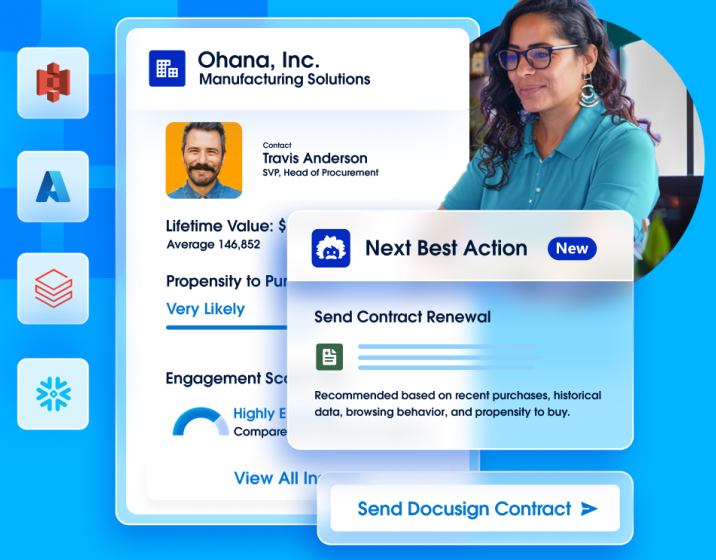
Salesforce's Data Cloud is a customer data platform that ingested 112 trillion records in FY26. It unifies your existing data from Salesforce clouds, databases, and third-party apps with 200+ pre-built connectors and zero-copy architecture connecting to Snowflake, Databricks, and BigQuery.
Source: Salesforce
But Data Cloud harmonizes data you already have. It doesn't generate the third-party intelligence that tells your team which accounts are ready to buy, who the decision-makers are, or how their organizations are structured.
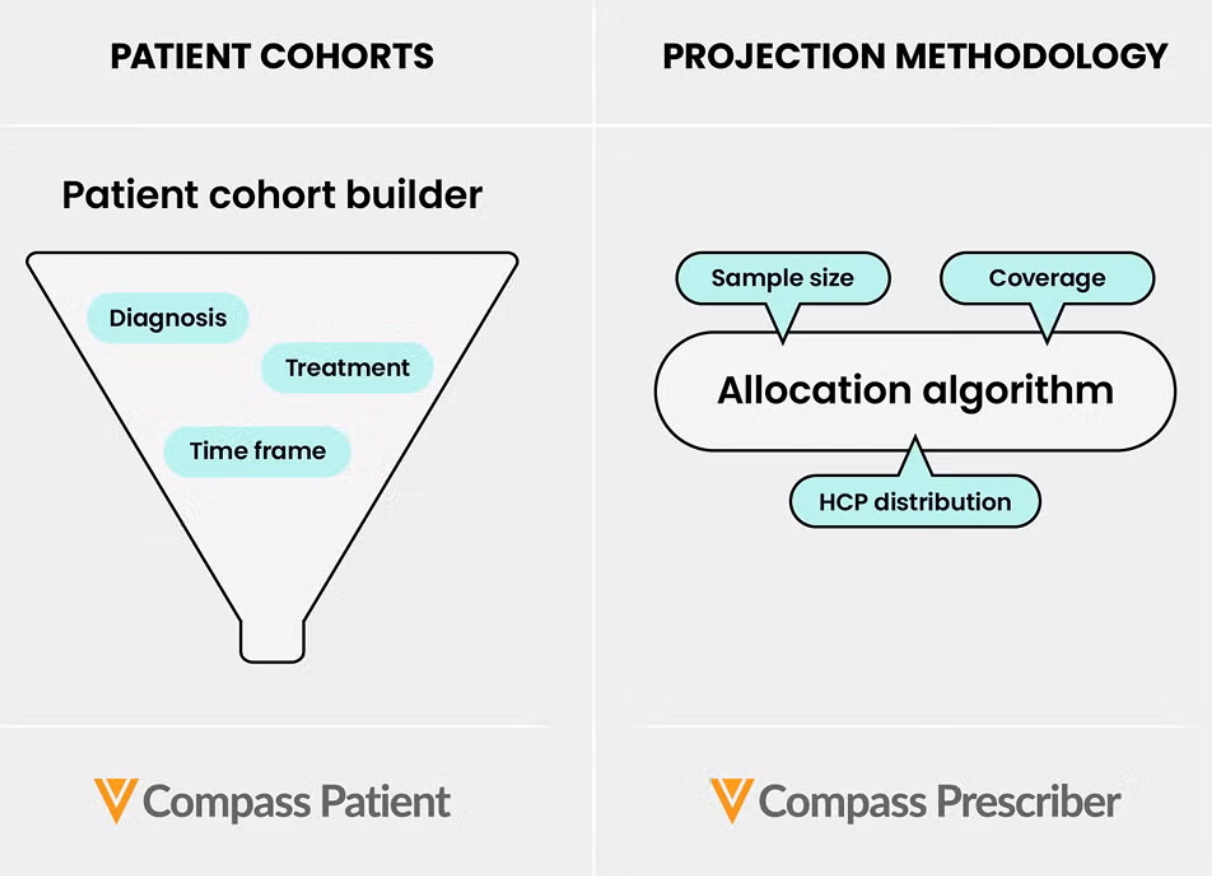
Veeva's Data Cloud provides life-sciences-specific reference data: OpenData for HCP/HCO records, Compass Prescriber tracking 4,000+ brands across 5.9 billion+ annual transactions, and Compass Patient covering 300M+ patients with 110 billion+ records. This data runs deep for pharmaceutical commercial operations targeting healthcare providers.
Source: Veeva
But it's scoped to the HCP and patient universe, not the broader B2B landscape of corporate decision-makers, organizational hierarchies, technology stacks, and buying intent signals.
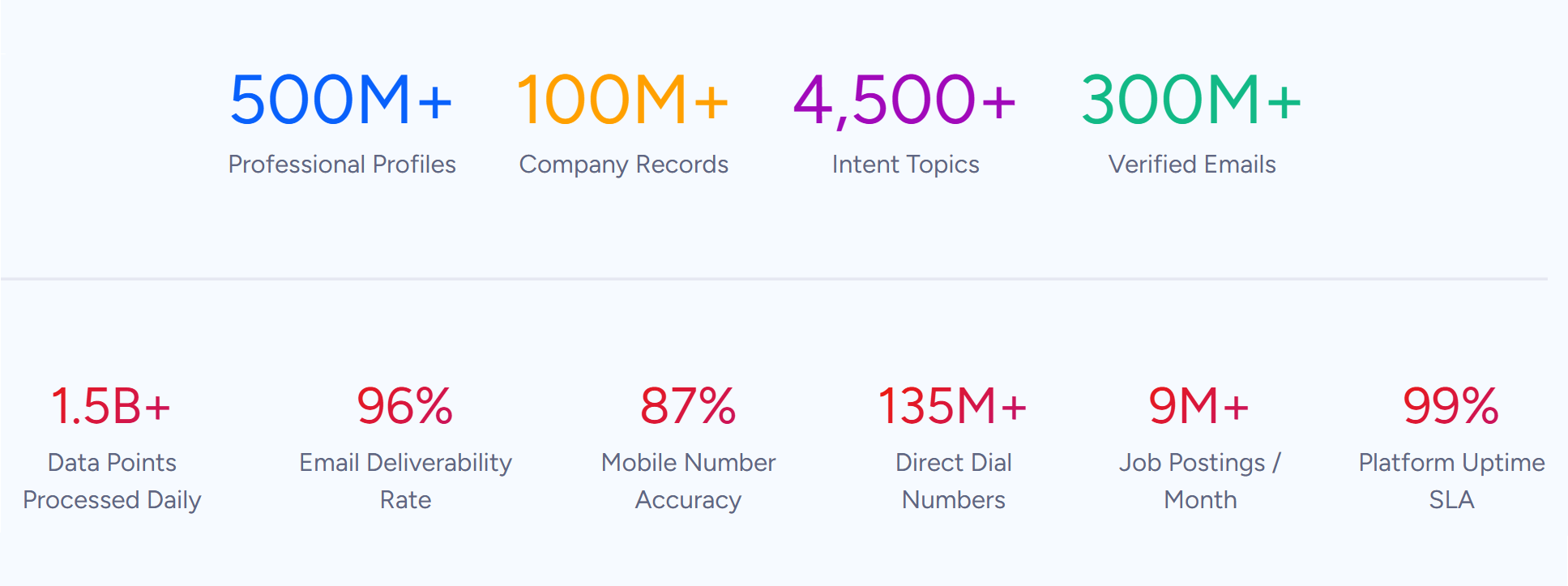
ZoomInfo fills the gap in both platforms. Its B2B data platform covers 500M contacts and 100M companies, verified through a multi-source pipeline backed by 300+ human researchers and delivering up to 95% accuracy on first-party data. In a Fortune 500 competitive RFP analyzing 25 million contacts across vendors, the independent consultant concluded that "no other competitor came even close."
Source: ZoomInfo
Beyond static records, ZoomInfo tracks buyer intent across 210 million IP-to-Organization pairings, profiles the tech stacks of 30+ million companies, and maps organizational hierarchies with department-level org charts and 120M direct-dial phone numbers.

Source: ZoomInfo
The GTM Context Graph goes further, combining ZoomInfo's third-party data with your CRM records, conversation transcripts, and behavioral signals. As ZoomInfo's Chief Product Officer Dominik Facher puts it: "The CRM recorded the state change. It has no record of why it happened."
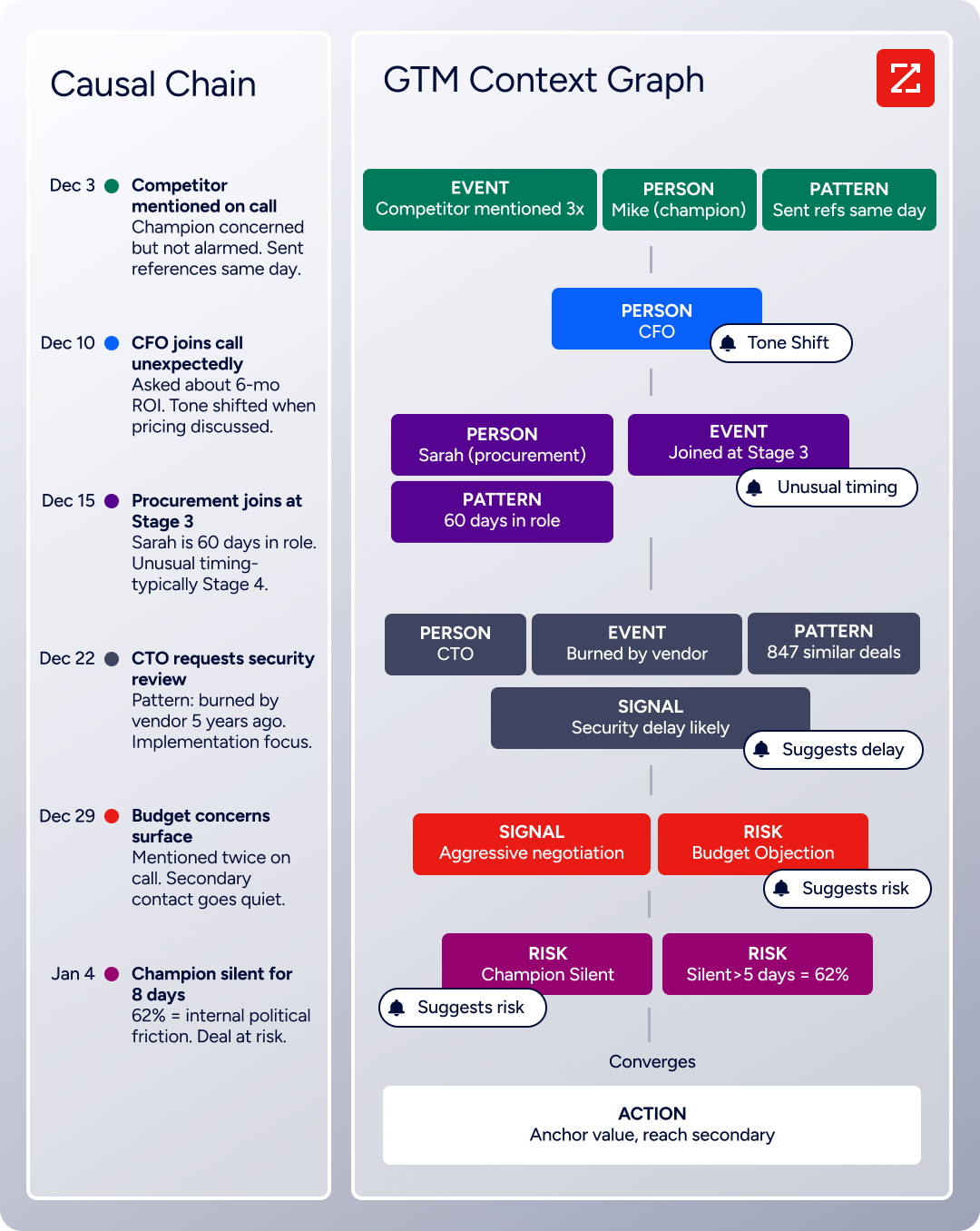
Source: ZoomInfo
The GTM Context Graph captures that context, processing 1.5B+ data points daily to connect signals with outcomes across every account in your pipeline.
For life sciences commercial teams, this intelligence layer matters in specific ways. MedTech companies selling into hospital systems need to reach procurement directors, IT leaders, and C-suite executives, not just physicians. Biotech companies pursuing partnership deals need to understand the organizational structure and buying dynamics of potential partners.
CROs and CDMOs competing for sponsor contracts need to identify which pharmaceutical companies are actively evaluating new vendors. In each case, the intelligence that drives effective engagement lives outside the CRM.
SpringDB used ZoomInfo's data for precise client targeting, achieving 2x–3x increases in campaign conversions and 30–50% larger average deal sizes. (SpringDB)
For a direct comparison of Salesforce and ZoomInfo across data, AI, and commercial intelligence capabilities, see our Salesforce vs. ZoomInfo breakdown.
Ecosystem and integrations
Salesforce has the largest enterprise app ecosystem in the market. AppExchange hosts 9,000+ partner apps with 14+ million installs, and 91% of customers use at least one AppExchange app. MuleSoft provides hundreds of pre-built connectors for enterprise integrations. Native integrations cover Google Workspace, Microsoft Outlook and Teams, and Slack.
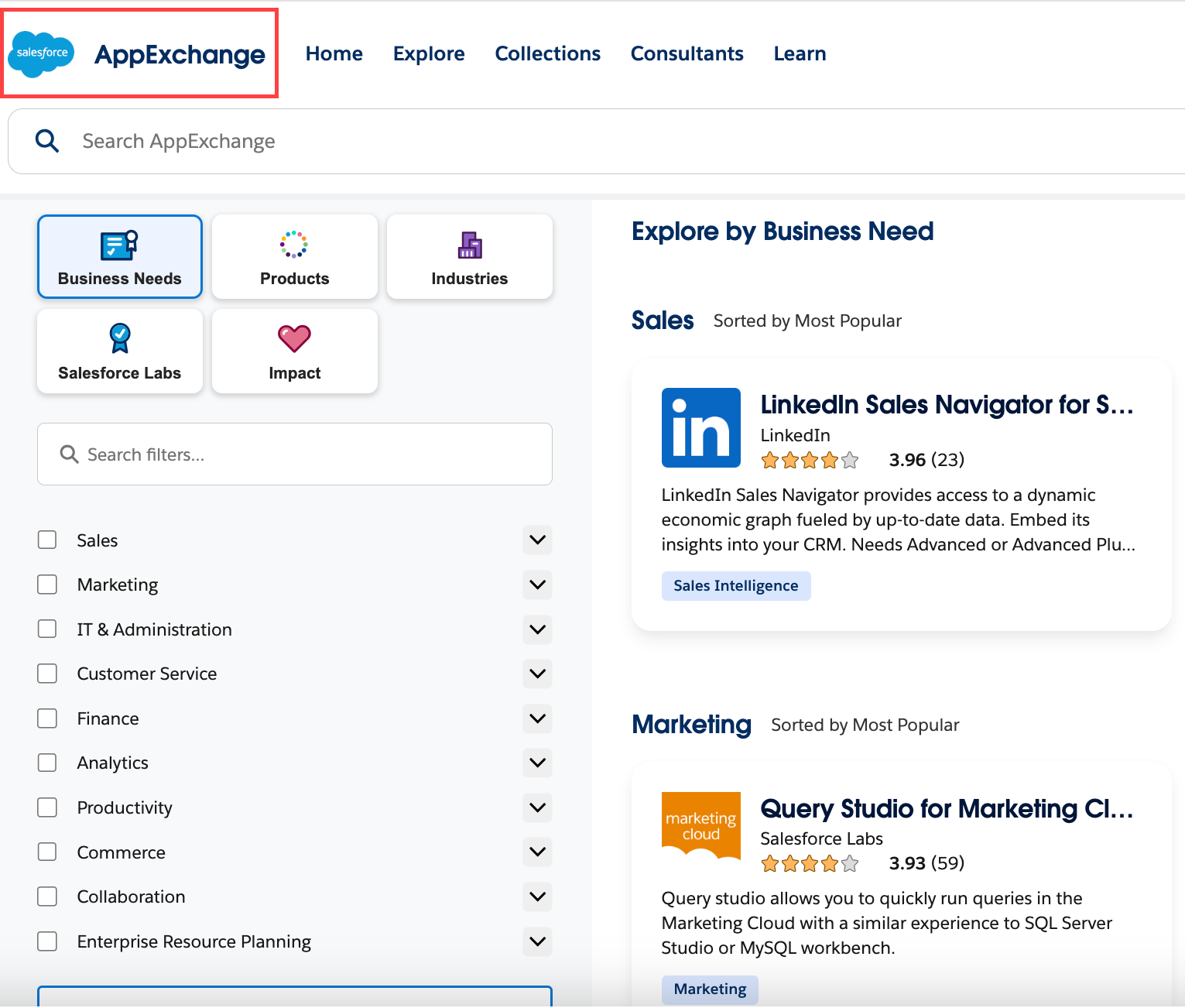
Source: Salesforce
For life sciences companies with complex IT environments spanning ERP, LIMS, and clinical systems, Salesforce's integration infrastructure handles nearly any connection. The partner ecosystem is approximately five times larger than Salesforce itself.
Veeva goes deeper but narrower. The Connections Hub provides pre-built, Veeva-maintained integrations between Vault applications, so clinical, regulatory, quality, and commercial data flows without custom middleware. The Direct Data API enables bulk extraction to Snowflake, Databricks, Amazon Redshift, and Microsoft Fabric at speeds up to 100x faster than standard REST APIs.
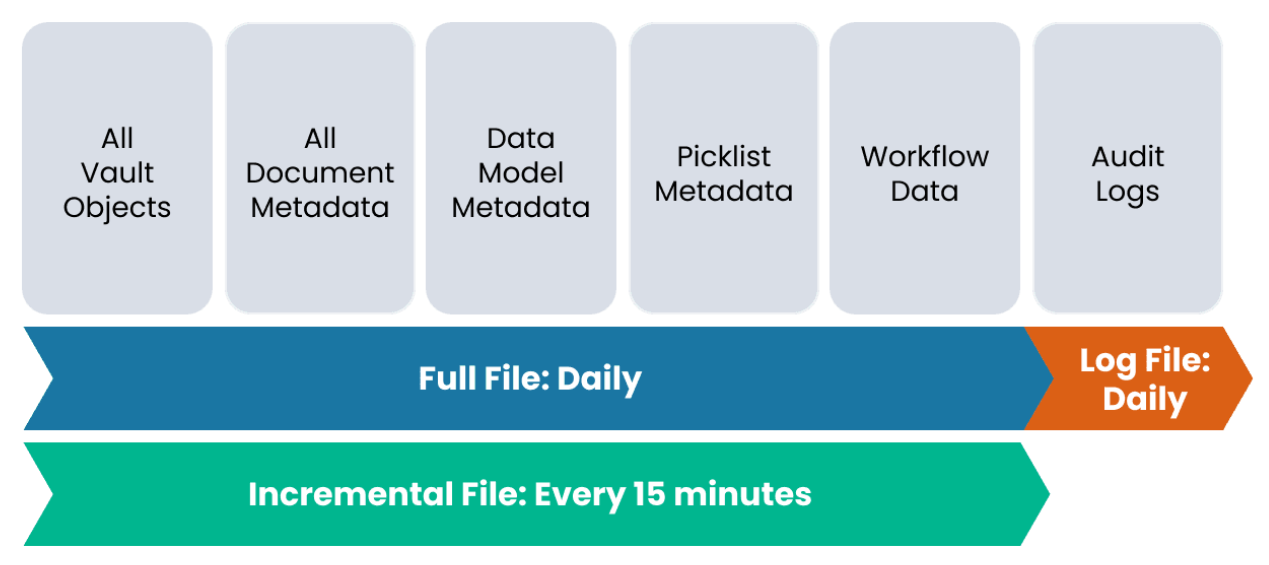
Source: Veeva
Technology partnerships with AWS, Microsoft, and data providers like IQVIA support enterprise deployment. But the ecosystem is life-sciences-focused. If you need to connect to a marketing automation platform, an e-commerce system, or a general-purpose analytics tool, the options are more limited than Salesforce's marketplace.
ZoomInfo connects to either ecosystem. Sellers access intelligence through the GTM Workspace, while marketers and RevOps teams build plays in GTM Studio.
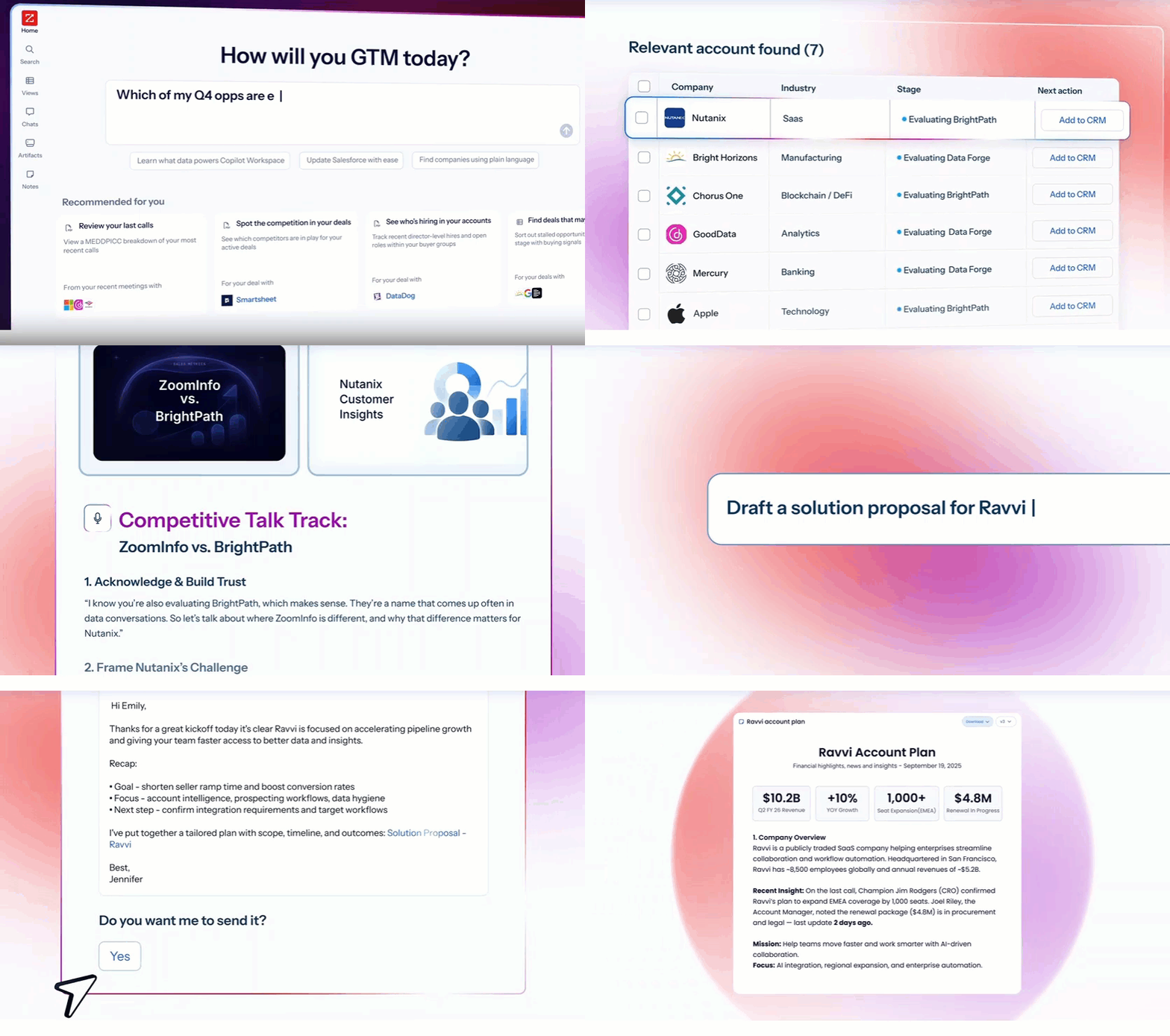
Source: ZoomInfo
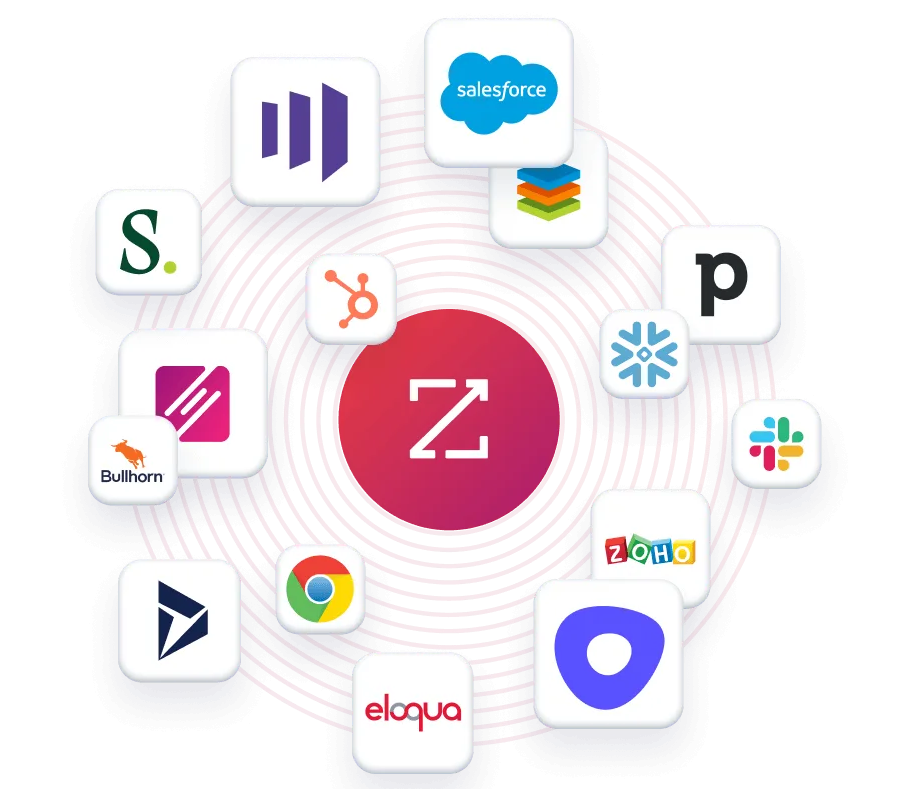
The ZoomInfo App Marketplace lists 120+ integrations across CRM, marketing automation, sales engagement, and data warehouse categories, with featured integrations for Salesforce, HubSpot, and Microsoft Dynamics 365.
Source: ZoomInfo
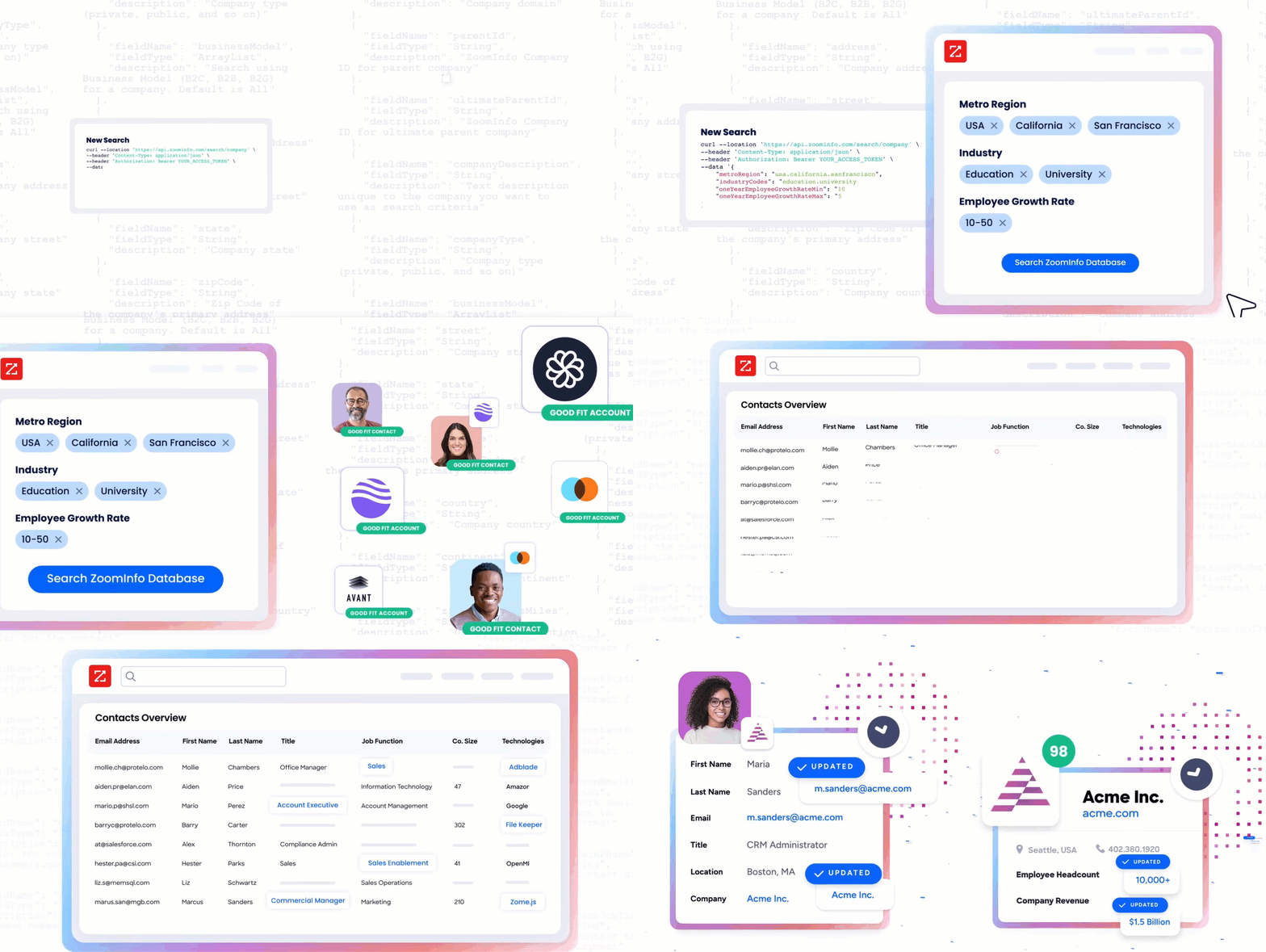
The Enterprise API pushes ZoomInfo's data into any system, and the MCP server makes that intelligence available to AI agents directly. API access is included in all relevant plans, not gated behind premium tiers.
Source: ZoomInfo
"ZoomInfo is our single source of truth for account data, and even more so for contact data. No other provider gives you that level of detail," says Thor Sanderson, Senior Manager of Sales Technology Enablement at Smartsheet. (Smartsheet)
Pricing models reflect different bets
The pricing structures reveal what each company optimizes for.
Salesforce publishes transparent per-user tiers. Sales Cloud and Service Cloud range from a free tier for up to 2 users through Starter Suite ($25/user/month), Pro Suite ($100), Enterprise ($175), Unlimited ($350), and Agentforce 1 ($550/user/month). Marketing Cloud starts at $1,500/org/month. Agentforce consumption adds $2 per conversation or $500 per 100,000 Flex Credits.
The true cost often exceeds list prices: Premier Success Plan costs 30% of net license fees, over 70% of implementations are partner-led (adding considerable services cost), and a 6% price increase hit Enterprise and Unlimited tiers in August 2025.
Veeva does not publish pricing. All subscriptions are negotiated enterprise agreements under a Master Subscription Agreement with annual Order Forms. Professional services for implementation, configuration, and validation are priced separately. Education courses range from approximately $1,900 to $4,750.
The only publicly free tier is SiteVault Free for clinical research sites managing 20 or fewer active studies. For pharmaceutical enterprises evaluating Veeva, expect total cost of ownership to include professional services and internal admin headcount alongside subscription fees.
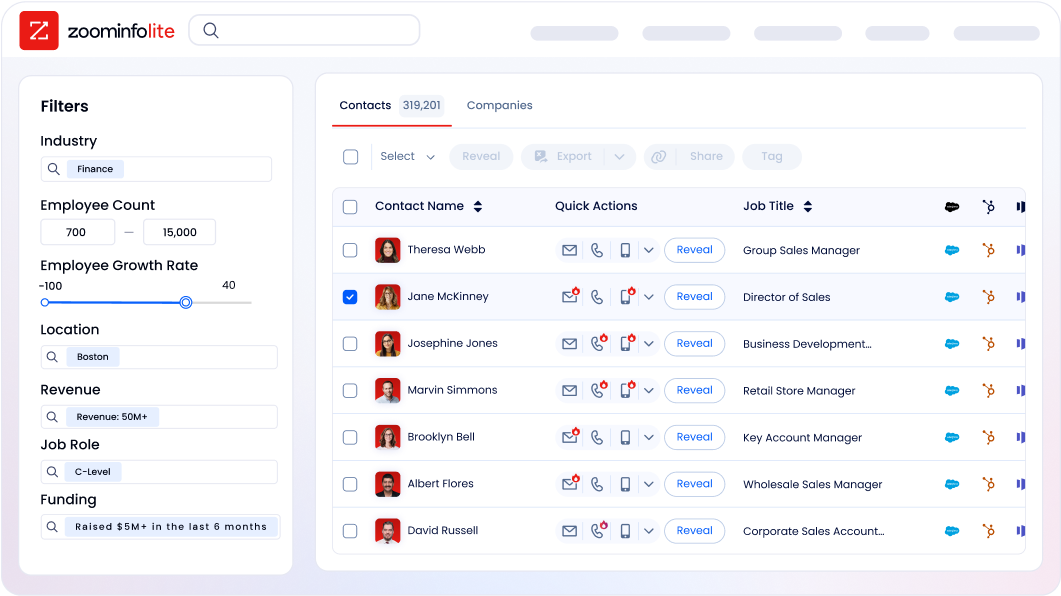
ZoomInfo uses consumption-based pricing organized into Sales, Marketing, and ABM tiers (Professional, Advanced, Enterprise). No prices are publicly listed. ZoomInfo Lite offers permanent free access with 10 monthly export credits and access to the B2B database, and a 7-day free trial allows full platform evaluation.
Source: ZoomInfo
For life sciences companies, ZoomInfo is an additional investment on top of whichever CRM you choose, but the intelligence it provides can reduce the cost of prospecting, account research, and data enrichment that would otherwise require manual effort or multiple point solutions.
Salesforce vs. Veeva vs. ZoomInfo: Which should you choose?
The choice between Salesforce and Veeva depends on where your organization sits on the spectrum between horizontal flexibility and vertical specialization. ZoomInfo is the intelligence layer that enhances either choice.
Choose Salesforce if:
Your company operates across multiple verticals, not just life sciences
You need a unified platform connecting sales, service, marketing, commerce, and IT
Your commercial operations extend beyond pharmaceutical field force work
You have the budget and internal resources for customization and partner-led implementation
You want the largest ecosystem of third-party apps and integrations
Choose Veeva if:
You are a pharmaceutical, biotech, or MedTech company with GxP compliance obligations
Pre-configured regulatory workflows for 21 CFR Part 11, eCTD, and IDMP are non-negotiable
Your commercial team primarily runs field force operations targeting healthcare providers
You want clinical, regulatory, quality, and commercial data on one platform without integration work
You're willing to accept vendor lock-in for depth of life sciences functionality
Add ZoomInfo to either if:
Your commercial team needs verified contact data, org charts, and direct dials beyond what your CRM provides
You want buyer intent signals showing when accounts are actively evaluating solutions
Your sales and marketing teams need to identify and engage decision-makers outside the HCP universe
You want AI-powered account intelligence that integrates directly with Salesforce or any platform via API
Data quality and completeness are limiting your CRM's effectiveness
See how ZoomInfo's intelligence layer powers your commercial team.
Seismic's sales team attributed 39% of active pipeline to opportunities identified or influenced by ZoomInfo signals, while boosting productivity by 54%. (Seismic)
The deeper question isn't just which CRM to buy. It's whether your commercial intelligence matches your CRM platform. No CRM can close deals your team doesn't know about, reach buyers they can't find, or prioritize accounts they can't evaluate. Getting the platform right is step one. Getting the data right is what makes it work.
Salesforce vs. Veeva vs. ZoomInfo FAQ
Is Veeva still built on Salesforce?
Veeva CRM was originally built on the Salesforce platform, and many customers still run the Salesforce-based version. Veeva is now migrating to Vault CRM, its own native infrastructure, with a target completion date of 2030. New customers evaluating Veeva CRM today should understand the migration timeline and its implications for their deployment.
Which platform is better for a biotech company that's pre-commercial?
Veeva is typically the stronger fit. Emerging biotech companies in Phase 2-3 development can start with Vault Clinical (eTMF, CTMS, EDC) and Vault Regulatory for submissions, then add Vault CRM as they approach commercialization. This builds on a single platform from development through launch.
Salesforce is a better fit if the biotech company has broader commercial needs beyond pharmaceutical detailing or operates across multiple verticals.
Can Salesforce meet 21 CFR Part 11 compliance requirements?
Salesforce can be configured for 21 CFR Part 11 compliance using Salesforce Shield, which provides event monitoring, platform encryption with bring-your-own-key, and field audit trail with indefinite retention. But this requires deliberate configuration, ongoing maintenance, and potentially third-party solutions from AppExchange.
Veeva delivers 21 CFR Part 11 compliance as a native platform capability with IQ/OQ validation packages included per release.
How does ZoomInfo complement Veeva specifically?
Veeva's data products (Network, OpenData, Compass) focus on healthcare provider and patient data for pharmaceutical commercial operations.
ZoomInfo provides broader B2B intelligence: company attributes, organizational hierarchies, buyer intent signals, technographics, and verified contact data for non-HCP decision-makers like procurement directors, IT leaders, and C-suite executives. Life sciences companies selling to other businesses, not just to physicians, benefit from both data sources.
Which platform has the fastest implementation?
ZoomInfo deploys in weeks since it's a data and intelligence layer, not a workflow platform. Salesforce implementations range from weeks for basic Sales Cloud to 3-12 months for multi-cloud enterprise deployments, and over 70% require implementation partners.
Veeva implementations are typically multi-month enterprise projects requiring professional services, configuration, and GxP validation, though Veeva provides validation packages with each release to reduce that burden.
How do the AI capabilities compare for life sciences use cases?
Salesforce Agentforce offers the broadest AI capability, with autonomous agents across sales, service, marketing, and commerce powered by the Atlas Reasoning Engine.
Veeva AI is narrower but compliance-aware: every agent runs inside the GxP-validated Vault environment with full audit trails, covering commercial and content workflows today with safety, quality, clinical, and regulatory agents on the roadmap through December 2026.
ZoomInfo's AI operates at the intelligence layer, using the GTM Context Graph to surface account insights, buyer intent, and recommended actions that flow into whichever CRM your team uses.
What are the biggest risks with each platform?
With Salesforce, the primary risk is implementation complexity and cost overrun. Meeting life sciences compliance requirements demands significant customization and ongoing administration. With Veeva, the primary risk is vendor lock-in: the proprietary Vault data model and high switching costs create long-term dependency.
With ZoomInfo, the consideration is budget justification, since it's an additional investment on top of your CRM platform rather than a replacement for it.
Can I use ZoomInfo with both Salesforce and Veeva?
ZoomInfo integrates directly with Salesforce through a native marketplace integration. For Veeva and any other platform, ZoomInfo's Enterprise API and MCP server deliver the same data and intelligence programmatically. API access is included in all relevant ZoomInfo plans, so teams using either CRM can incorporate ZoomInfo's intelligence into their workflows without additional access fees.
More Salesforce comparisons:
