
Choosing between Salesforce and Wealthbox for your financial advisory firm comes down to five questions:
Do you need a CRM built for wealth management, or one that can handle every business function your firm might ever need?
Is advisor adoption your biggest CRM challenge, or have you solved that and need more customization?
Are you willing to hire a dedicated Salesforce administrator, or do you want a platform your team can manage without one?
Do you need integrations with custodial platforms like Schwab, Fidelity, and LPL, or is a broader enterprise ecosystem more important?
How much are you willing to spend per user per month, and what does total cost of ownership actually look like for your firm?
In short, here's what we recommend:
Salesforce is the enterprise CRM that can do almost anything, if you're willing to invest the time and money to make it work. With Financial Services Cloud, Agentforce AI agents, and an ecosystem of 9,000+ apps on AppExchange, Salesforce lets large advisory firms build exactly the system they want. It's the #1 CRM by market share worldwide, serving over 150,000 companies. But that flexibility costs money: pricing starts at $175/user/month for Enterprise edition and climbs with add-ons, and most implementations require partner consultants and a dedicated admin.
Wealthbox is the CRM built for financial advisors who want a system their team will actually use. Rated #1 on G2 in the wealthtech CRM category with a 9.4/10 for ease of use, Wealthbox has overtaken Redtail as the market share leader among RIAs according to the Kitces AdvisorTech Report. Its 150+ wealthtech integrations, native AI Notetaker, and contact types designed for households and trusts make it feel like someone who runs an advisory practice built it. The trade-off: less customization than Salesforce, and a platform focused only on wealth management.
Both platforms give you a place to manage client relationships. But neither solves the problem upstream of every CRM: finding the right prospects, understanding when they're ready to engage, and knowing what to say when they are. That's where ZoomInfo comes in.
ZoomInfo is a B2B intelligence and prospecting platform that feeds your CRM with data it can't generate on its own. With 500M contacts, 100M companies, 135M+ verified phone numbers, and 200M+ verified business email addresses, ZoomInfo provides the prospecting data and buying signals that turn a CRM from a record-keeping tool into a pipeline builder. Its Context Graph processes 1.5B+ data points daily, combining your CRM data with conversation intelligence, intent signals, and behavioral data to show not just what's happening in your pipeline, but why. ZoomInfo integrates with Salesforce and delivers intelligence through the Workspace for sellers, Studio for marketers and RevOps, or APIs and MCP for any other front-end.
If adding a data-powered prospecting layer on top of your CRM sounds like the missing piece, see how ZoomInfo works with your stack.
Salesforce vs. Wealthbox at a glance
Salesforce | Wealthbox | ZoomInfo | |
|---|---|---|---|
Built for | Any industry, any size | Financial advisors specifically | B2B prospecting and intelligence |
Role in your stack | CRM and business platform | CRM for wealth management | Data, signals, and intelligence layer |
Starting price | Free tier available; consumption-based pricing | ||
Ease of use | Steep learning curve, requires admin | Sign up and go, no training required | Learning curve varies by product |
Custodial integrations | Via Financial Services Cloud + config | N/A (feeds data into your CRM) | |
AI capabilities | Context Graph, AI-powered prospecting | ||
Mobile app | Full-featured iOS/Android | Mobile app + Chrome extension | |
Implementation time | Weeks to 12 months | Days to weeks | |
Best for | Large firms needing customization | RIAs and advisory firms wanting high adoption | Teams that need to find and engage prospects |
Salesforce can do everything, Wealthbox does one thing well
This is the core tension: breadth versus depth.
Salesforce can be configured to run nearly any business process. With Sales Cloud, Service Cloud, Marketing Cloud, Commerce Cloud, and Financial Services Cloud, you can build a system that handles everything from lead tracking to client onboarding to marketing automation to compliance reporting.
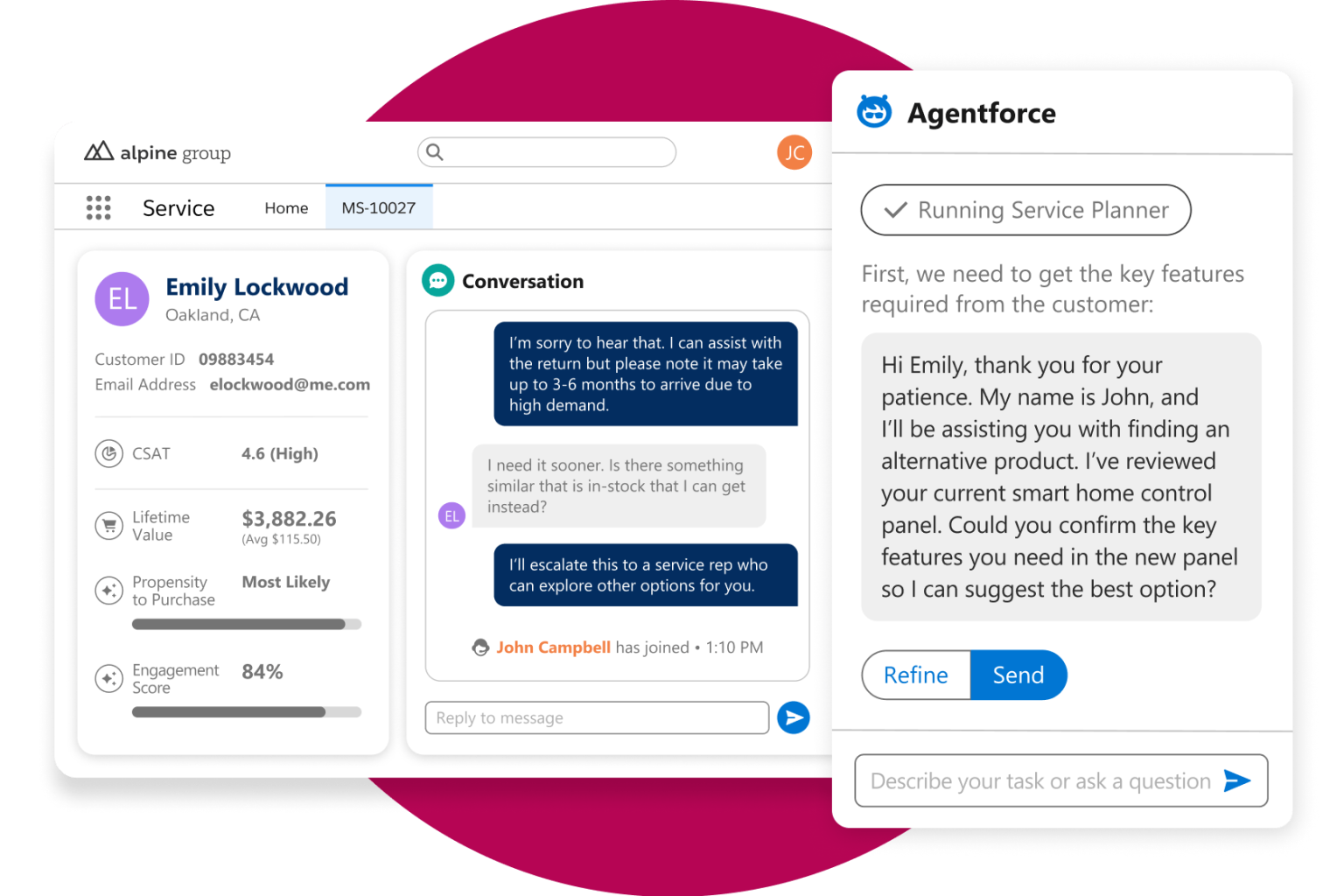
Source: Salesforce
The AppExchange ecosystem has 9,000+ apps with 14+ million installs, so there's probably already a solution for whatever edge case your firm encounters.
But that breadth creates a problem: Salesforce needs to be configured to work for financial advisors. Out of the box, it speaks the language of generic B2B sales (leads, opportunities, accounts). It doesn't know what a household is. It doesn't have fields for trust executors or grantors. It doesn't connect natively to Schwab or Fidelity.
Financial Services Cloud adds an advisory-specific layer, but it's still Salesforce underneath, which means setup time, admin overhead, and a learning curve that can stretch for months.
Wealthbox starts from the opposite direction. Every feature was built for the advisory workflow from day one. Contact records come in four types (People, Households, Companies, and Trusts), each with fields designed for that record type. Trust records include fields for Executor, Grantor, and Trustees.
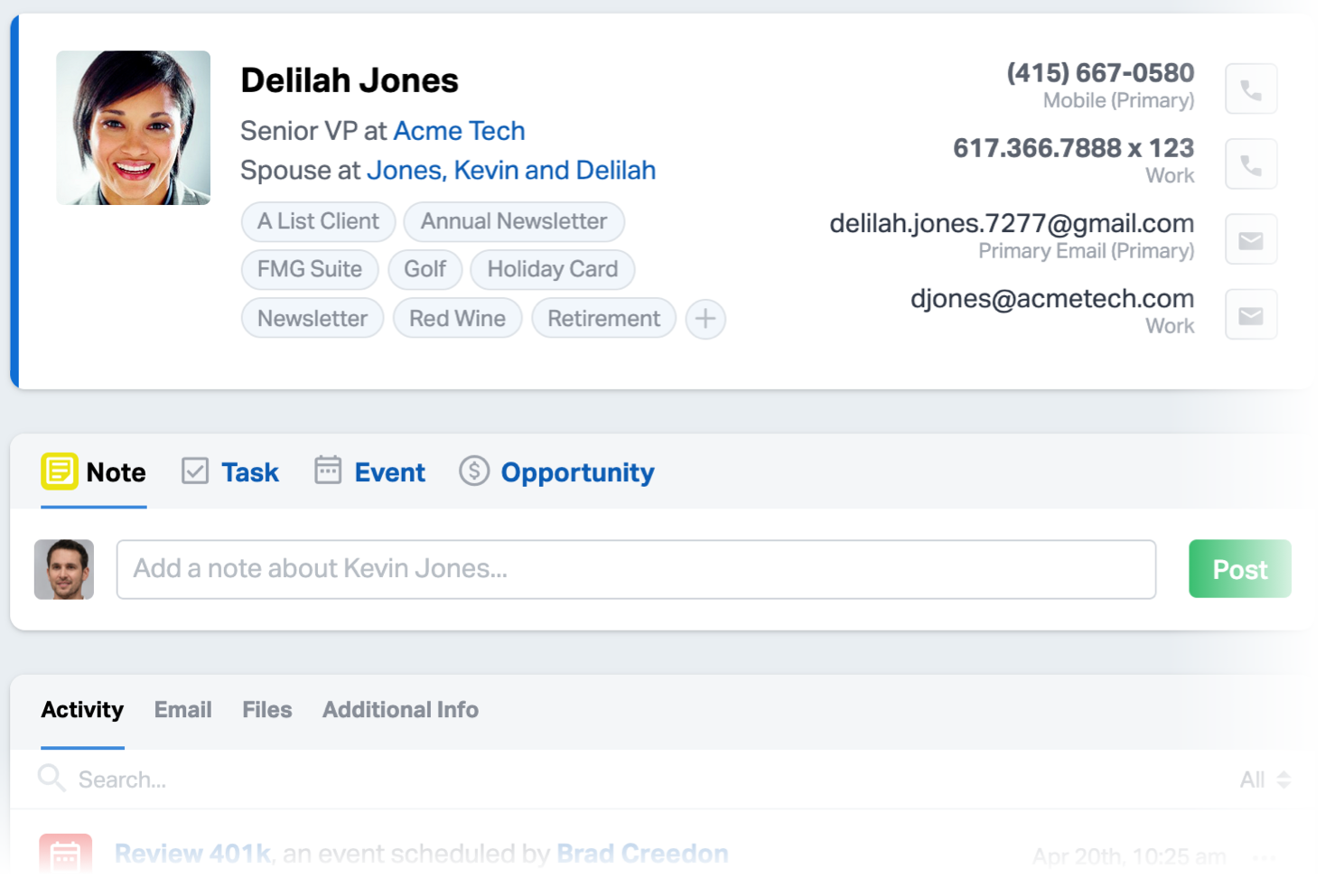
Source: Wealthbox
Workflow templates cover advisory processes like client onboarding, annual reviews, trade requests, and life event responses. None of this requires configuration or an admin to set up.
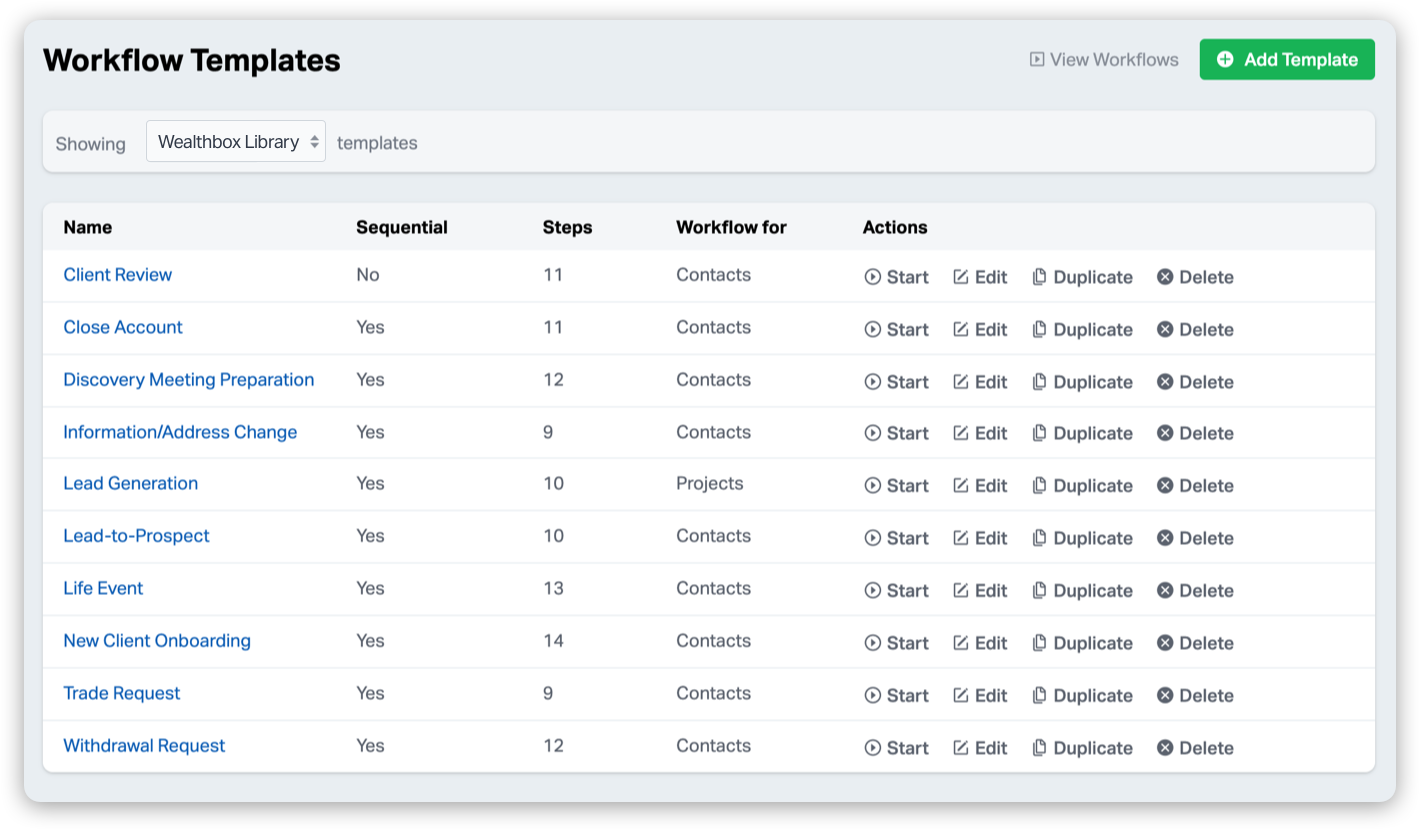
Source: Wealthbox
For firms where the primary challenge is getting advisors to use the CRM at all, that adoption gap matters more than any feature list.
The pricing math tells different stories at different firm sizes
Salesforce's pricing structure makes sense for large enterprises. It becomes harder to justify for smaller advisory firms.
Salesforce Sales Cloud starts at $25/user/month for Starter Suite, but that tier offers only basic lead and account management. Most advisory firms need at least Enterprise edition at $175/user/month for AI capabilities, pipeline insights, and workflow automation.
Adding Financial Services Cloud, Agentforce AI, and the Premier Success Plan (30% of net license fees) pushes the real cost well above the list price. Implementation typically requires partner consultants, with costs routinely running 100-150% of annual license fees.
For a 20-advisor firm on Salesforce Enterprise, base licensing alone runs $175/user/month, or $42,000 per year before add-ons, implementation, and ongoing admin costs.
Wealthbox pricing is straightforward. Basic starts at $59/user/month, Pro at $75/user/month, and Premier at $99/user/month, all billed annually. The same 20-advisor firm on Wealthbox Pro pays $18,000 per year. Add the AI Notetaker at $49/user/month and total cost reaches $29,760, still well below Salesforce's base licensing alone.
Wealthbox also includes managed data migration with an assigned specialist at no stated additional cost. Salesforce migrations typically require paid consultants.
The pricing gap narrows for very large firms (500+ users) where Salesforce's enterprise negotiation leverage and platform breadth can justify the premium. But for the majority of RIAs and mid-size advisory firms, Wealthbox delivers more relevant functionality per dollar.
Custodial and wealthtech integrations favor Wealthbox
For financial advisors, the most important integrations aren't with Slack or Jira. They're with custodial platforms, portfolio management systems, and financial planning tools.
Wealthbox has built 150+ integrations for the advisory ecosystem. Custodial connections include SSO with Charles Schwab, Fidelity Wealthscape, and LPL Financial ClientWorks (the latter with two-way account data sync). Portfolio management integrations cover Orion, Black Diamond, Addepar, Tamarac, and Envestnet.
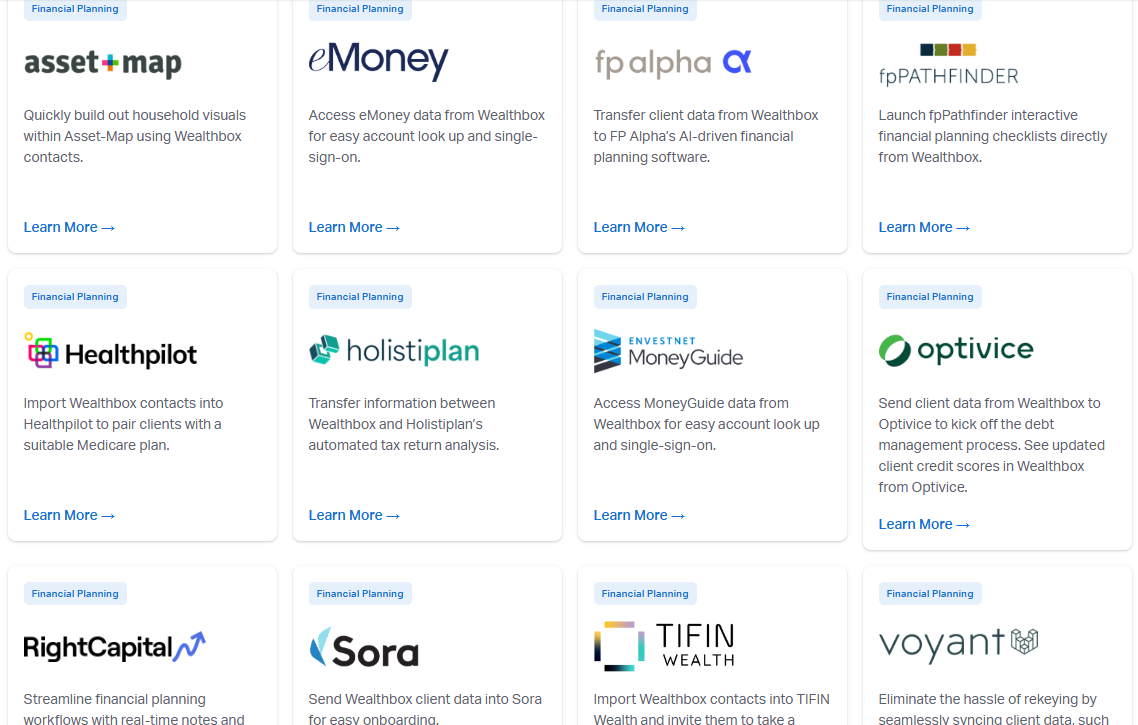
Source: Wealthbox
Financial planning tools include MoneyGuide, RightCapital, eMoney, and Holistiplan. These aren't generic API connections. They're integrations built for advisory firms that surface custodial account data inside the Wealthbox contact record.
Wealthbox's Send-To Actions go further: advisors can push actions into Schwab Advisor Center, Fidelity Wealthscape, and Docupace from within a workflow step, with each action automatically logged in the CRM.
Salesforce connects to the advisory ecosystem too, but the path is different. Financial Services Cloud provides the data model, and AppExchange partners like Practifi and Salentica add advisory-specific layers. Integrations with custodians exist but often require additional configuration, middleware, or partner-built connectors. The result works, but it's assembled rather than native.
For firms where custodial data visibility inside the CRM is a daily requirement, Wealthbox's native integrations save time and reduce integration maintenance.
AI capabilities are evolving fast on both sides
Both platforms are investing in AI, but their approaches reflect different philosophies.
Salesforce's Agentforce is the most ambitious AI effort in the CRM market. These are autonomous agents powered by the Atlas Reasoning Engine that handle tasks like case resolution, lead engagement, and sales coaching without constant human oversight. Salesforce reports that Agentforce resolves 85% of support requests without human escalation.
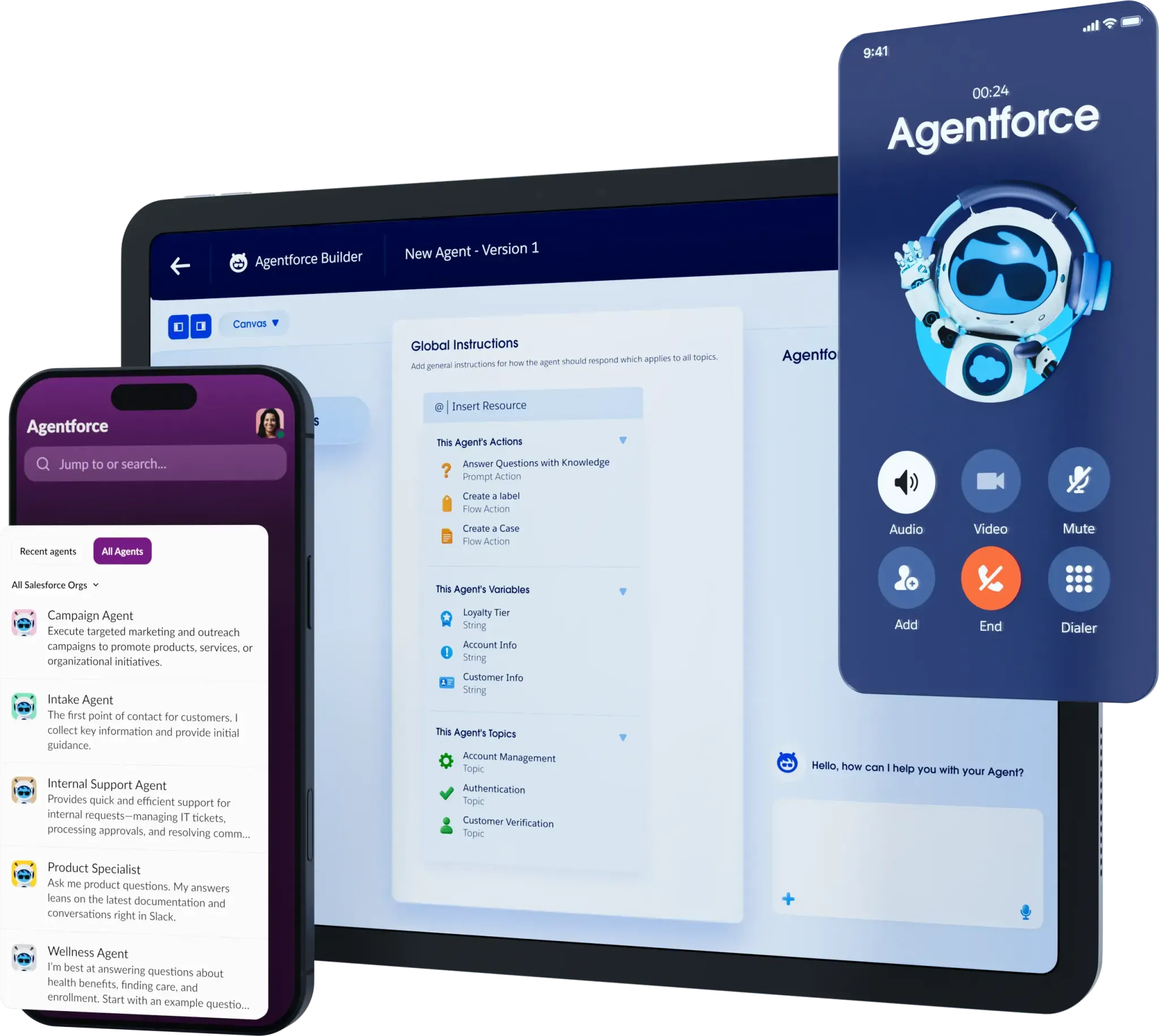
Source: Salesforce
The Einstein Trust Layer provides zero data retention with LLM partners, PII masking, and audit trails, which matters for regulated industries.
For firms that can invest the time and budget to configure Agentforce for advisory workflows, the potential is real.
Wealthbox's AI is narrower but immediately practical for advisors. The AI Notetaker joins Zoom and Teams calls, produces timestamped transcripts, generates meeting summaries, drafts follow-up emails, and suggests tasks, all stored on the contact record.
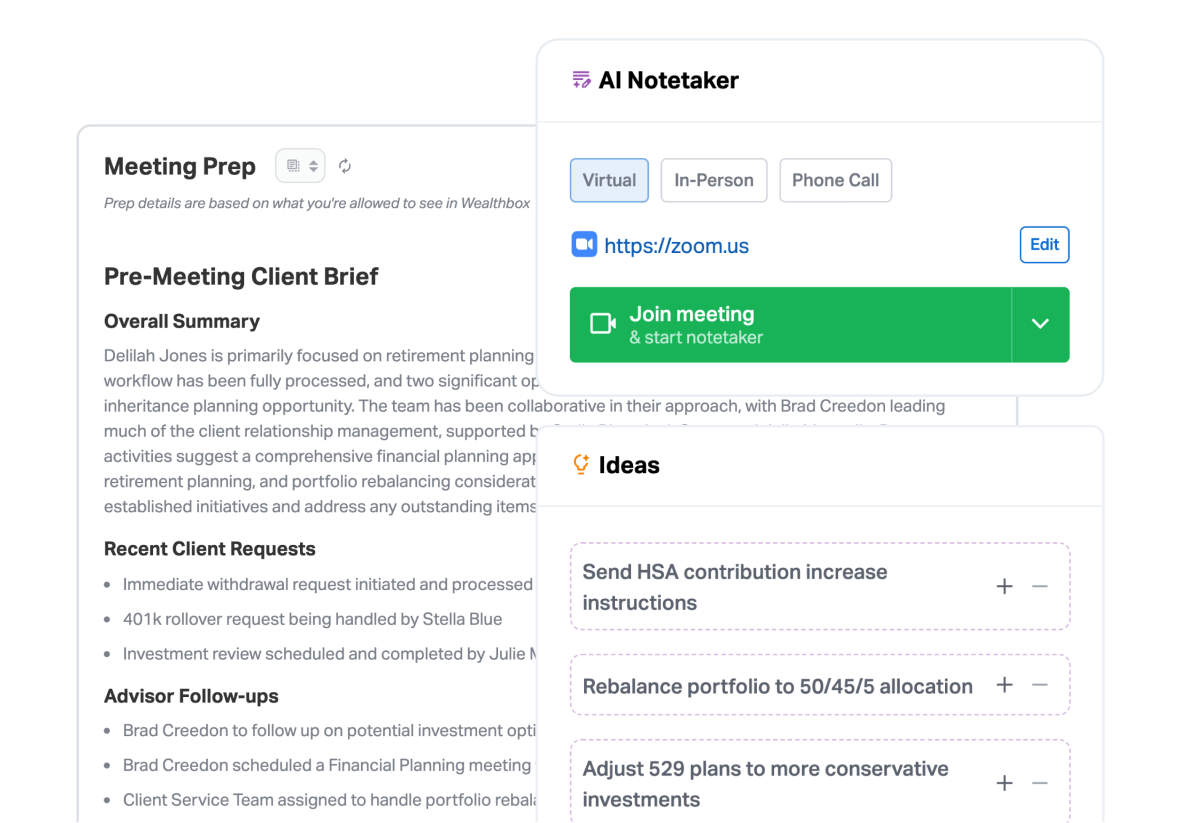
Source: Wealthbox
Meeting Prep briefs pull from the full client profile, including financial data, relationships, referral sources, and special dates.
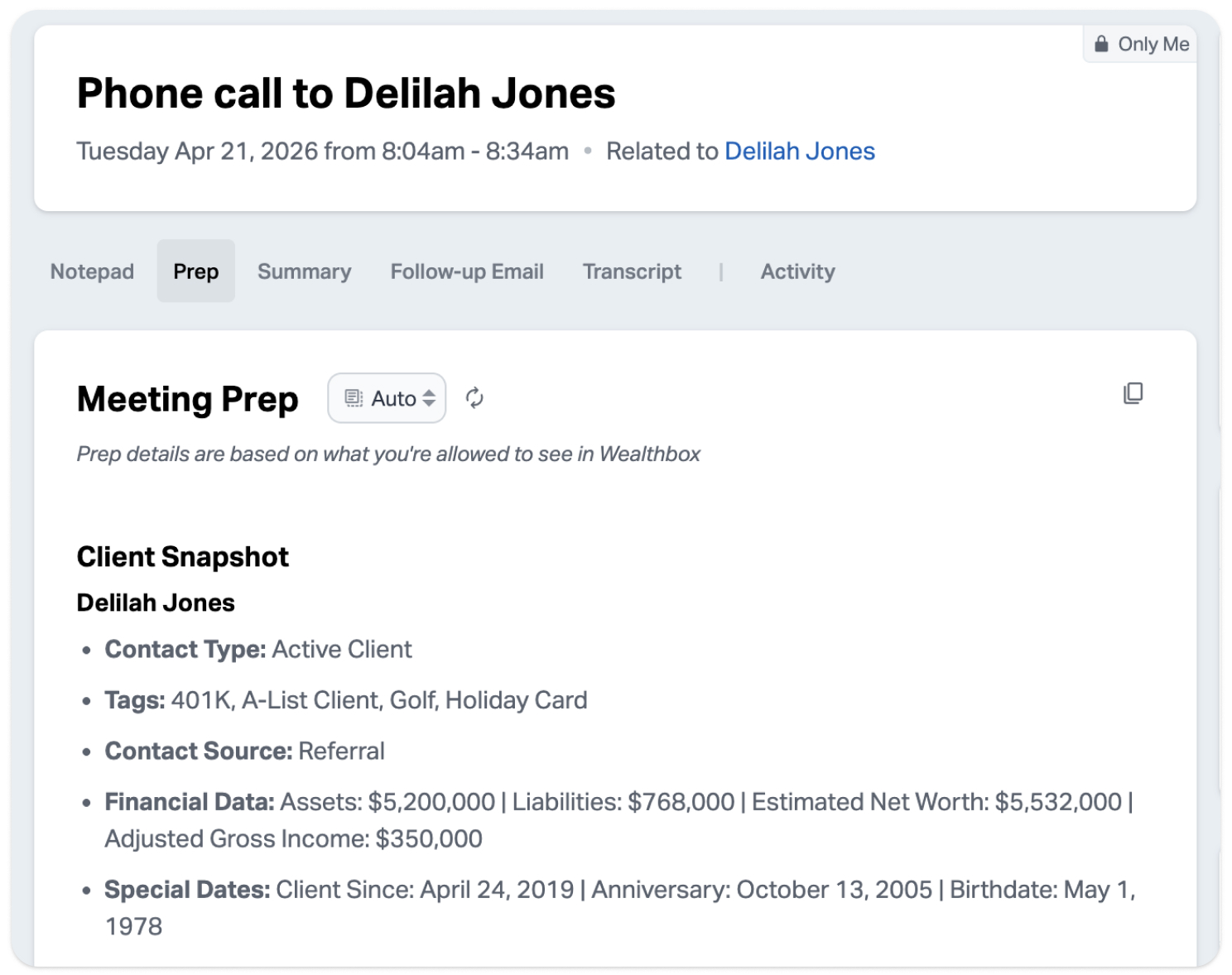
Source: Wealthbox
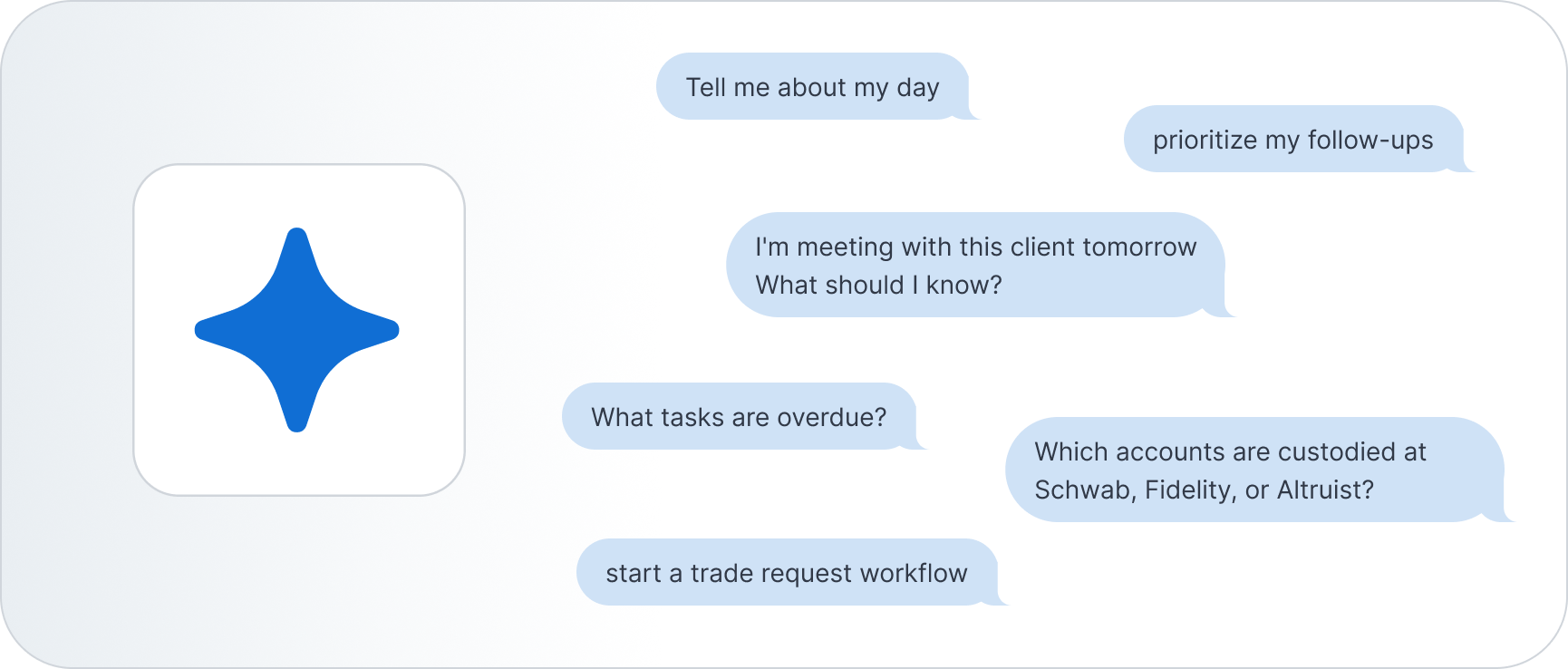
The AI Assistant answers natural-language questions about CRM data and requires human confirmation before writing to the database.
Source: Wealthbox
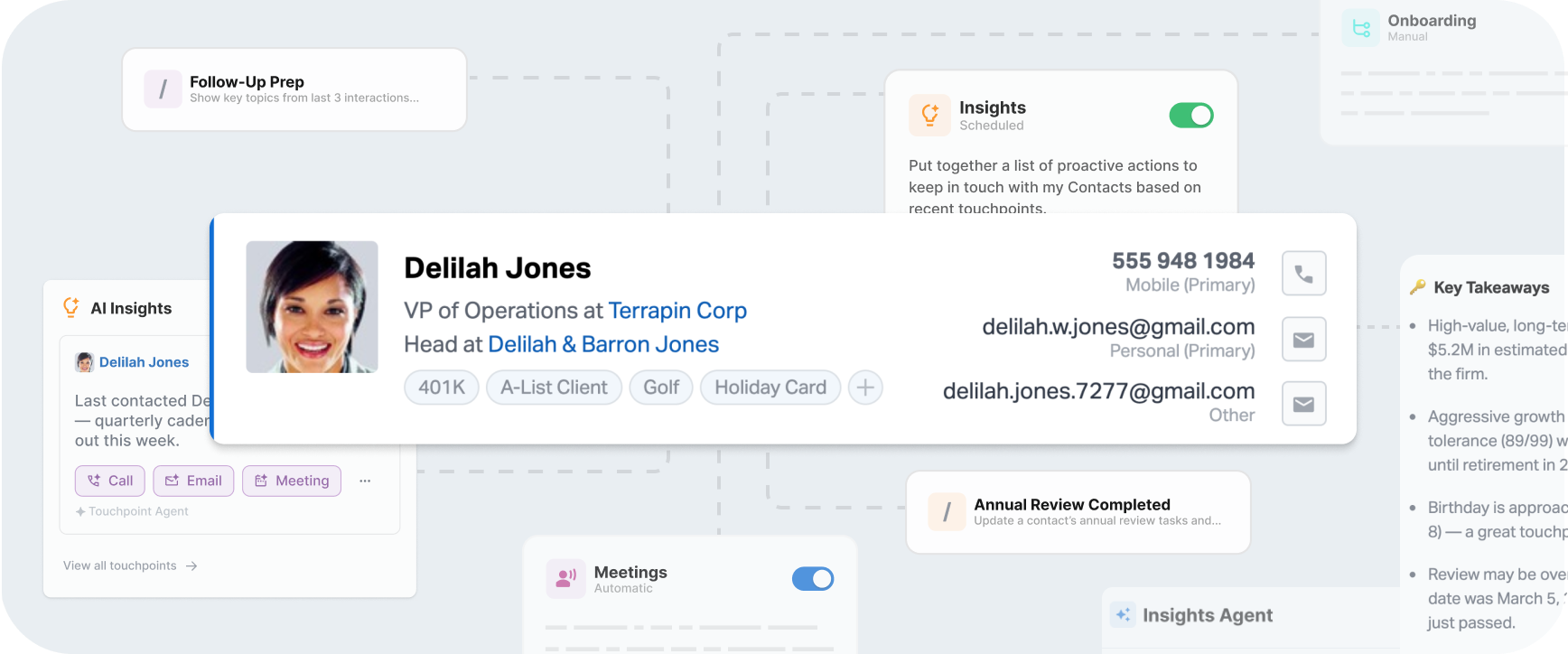
AI Agents (in early access) handle background processes like daily briefings and overdue task escalations.
Source: Wealthbox
The practical difference: Salesforce's AI requires configuration and Agentforce pricing on top of the base license. Wealthbox's AI is more limited in scope but works immediately in the advisory context. A solo RIA advisor benefits from the AI Notetaker on day one. Getting equivalent value from Agentforce requires a real implementation investment.
Your CRM is only as good as the data you put into it
Here's what neither Salesforce nor Wealthbox can solve on their own: where your next client comes from.
Both platforms manage existing relationships well. Salesforce tracks every touchpoint across its Customer 360 suite. Wealthbox keeps the advisory team aligned through activity streams and shared contact records.
But when it comes to identifying new prospects, understanding which companies are actively looking for advisory services, or building a pipeline of qualified leads, both CRMs depend on the data you feed them.
This is where ZoomInfo fills a gap no CRM can close internally.
ZoomInfo's B2B data platform covers 500M contacts and 100M companies, verified through a multi-source pipeline backed by 300+ human researchers and reaching up to 95% accuracy on first-party data.
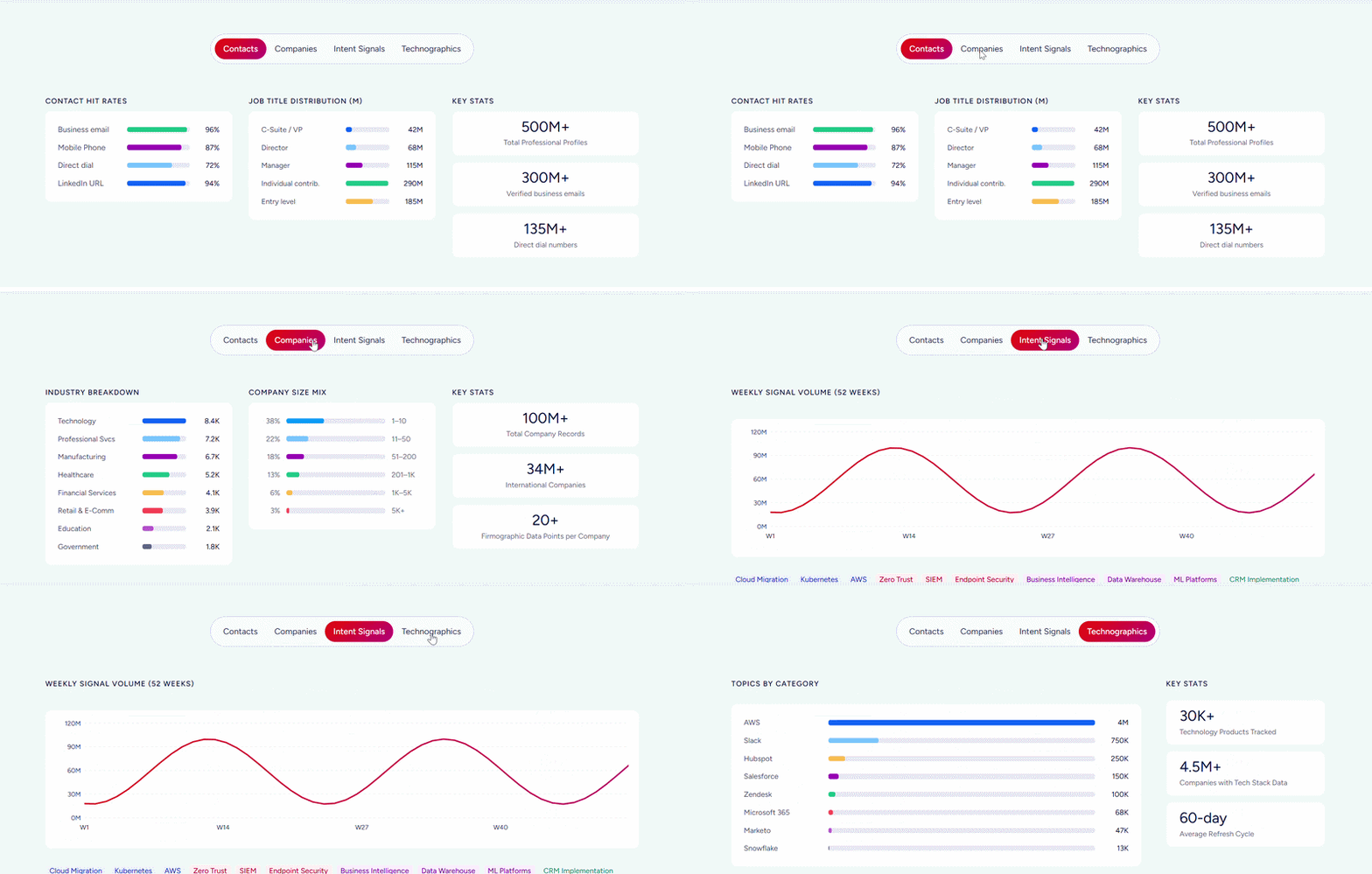
For advisory firms prospecting into the corporate market (targeting CFOs, heads of HR, or business owners who need retirement plan advisory, benefits consulting, or wealth management services) ZoomInfo provides the contact data, org charts, company attributes, and technographics that turn cold outreach into informed conversations.
Buyer Intent data tracks signals from 210 million IP-to-Organization pairings to identify when companies are actively researching relevant topics. For an advisory firm, that means knowing which companies are searching for retirement plan providers, wealth management solutions, or succession planning services before those companies fill out a form on your website.
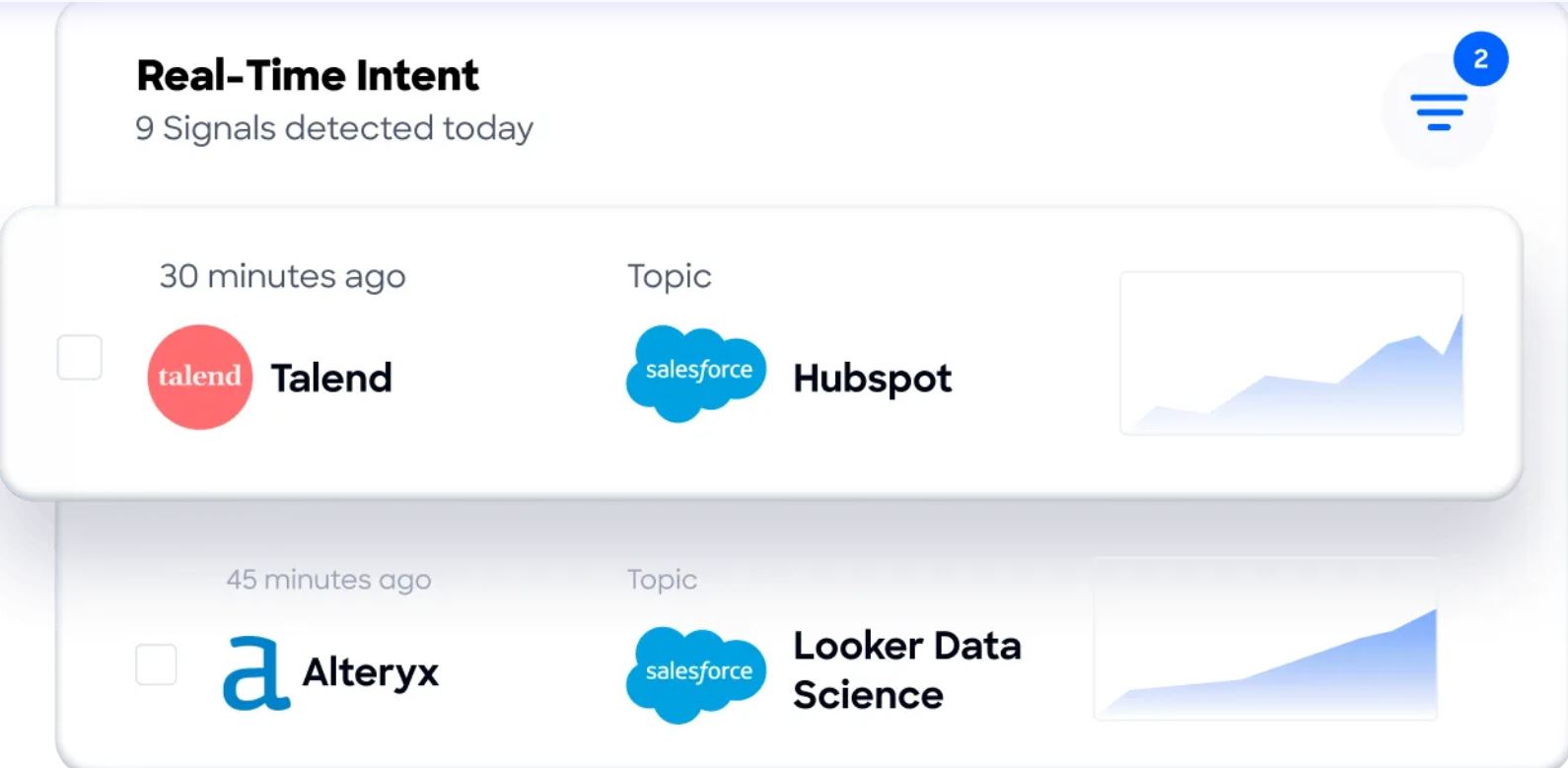
The Context Graph ties this together by combining ZoomInfo's third-party data with your CRM records, conversation history, and engagement signals.
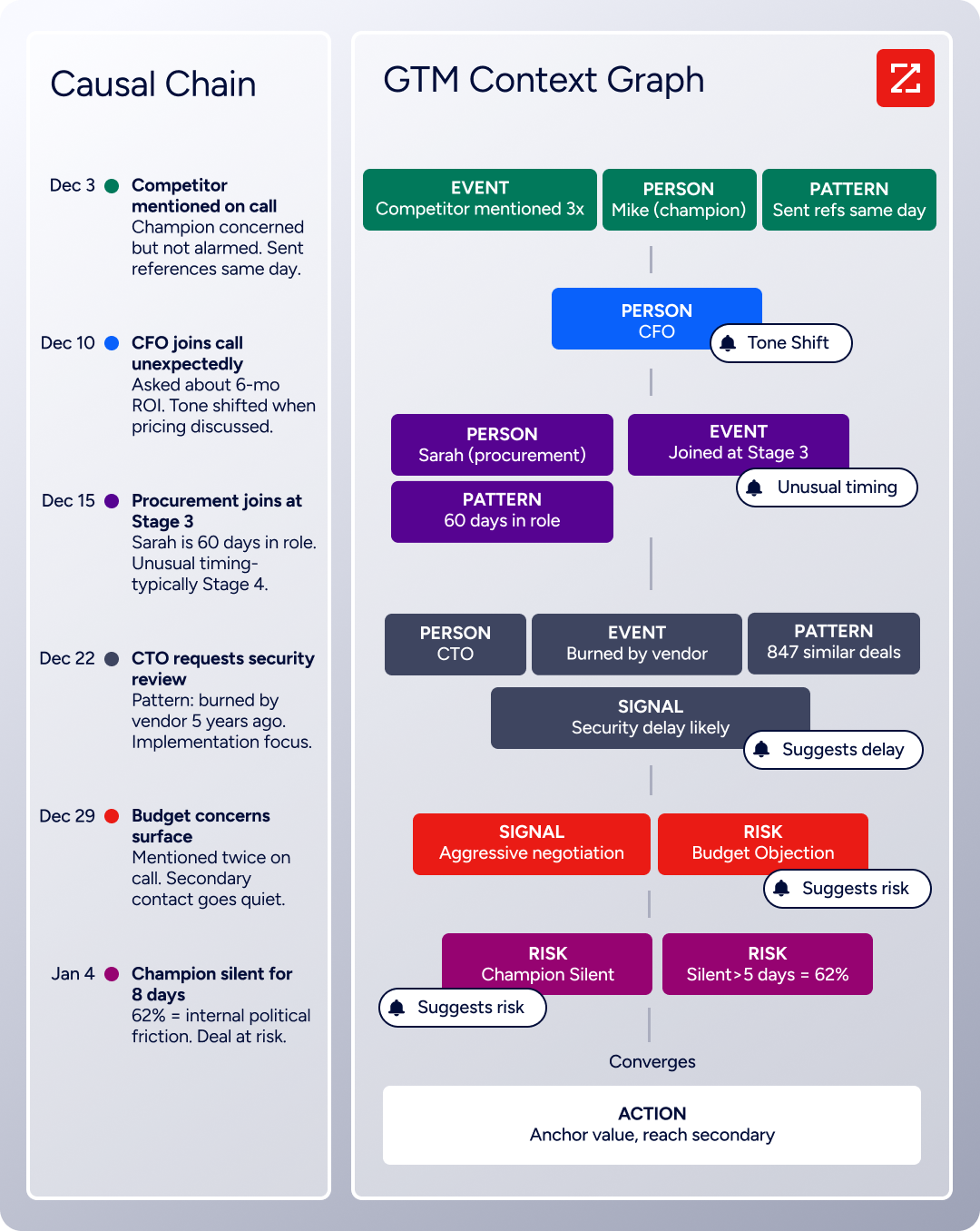
The result: your CRM doesn't just record what happened with each prospect. It shows why deals move and which patterns predict success.
Seismic's sales team attributed 39% of active pipeline to opportunities identified or influenced by ZoomInfo signals, reporting 54% productivity gains and 11.5 hours saved per week per seller. (Seismic case study)
ZoomInfo works with either CRM, no platform lock-in
ZoomInfo integrates with Salesforce through a native connector, enriching contact and account records with verified data, surfacing intent signals inside Salesforce records, and automating lead routing based on buying signals. For Salesforce users, ZoomInfo data flows into the CRM workflows your team already uses.
For Wealthbox users or any other platform, ZoomInfo's Enterprise API and MCP server provide programmatic access to the same data and intelligence.
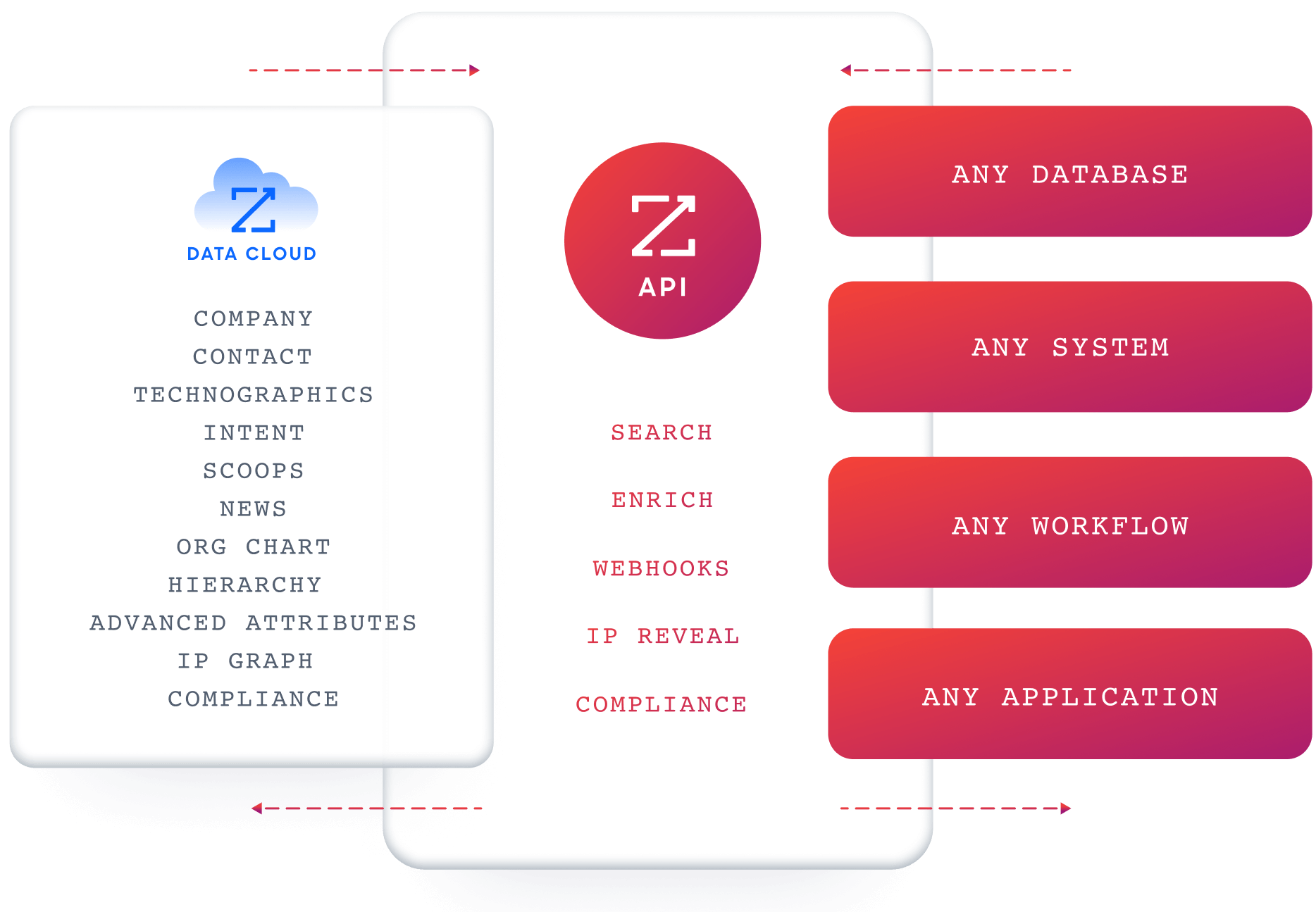
The API documentation covers search, enrichment, intent signals, account research, and audience management endpoints. The MCP server connects AI models to ZoomInfo's data as a native tool, with no custom coding beyond one-time configuration. Both are included in all relevant plans.
This means the CRM decision and the data intelligence decision are independent. Choose Salesforce or Wealthbox based on which CRM fits your firm's workflow. Then layer ZoomInfo on top to power prospecting, enrich records, and surface buying signals, regardless of which CRM you selected.
For a full breakdown of how Salesforce and ZoomInfo compare as standalone go-to-market platforms, see our Salesforce vs. ZoomInfo comparison.
"ZoomInfo is our one source of truth for account data, and even more so for contact data. There's no other provider in the market that provides you with that level of detail." — Thor Sanderson, Senior Manager of Sales Technology Enablement, Smartsheet (Smartsheet case study)
Enterprise scalability: where Salesforce pulls ahead
Wealthbox is growing upmarket. Recent enterprise wins include Gradient Financial Group (2,000+ users), Wedbush Wealth Management, Snowden Lane Partners, and Sanctuary Wealth (670 users). The recent launch of Custom Objects in June 2026 lets firms build new record types, narrowing the customization gap.
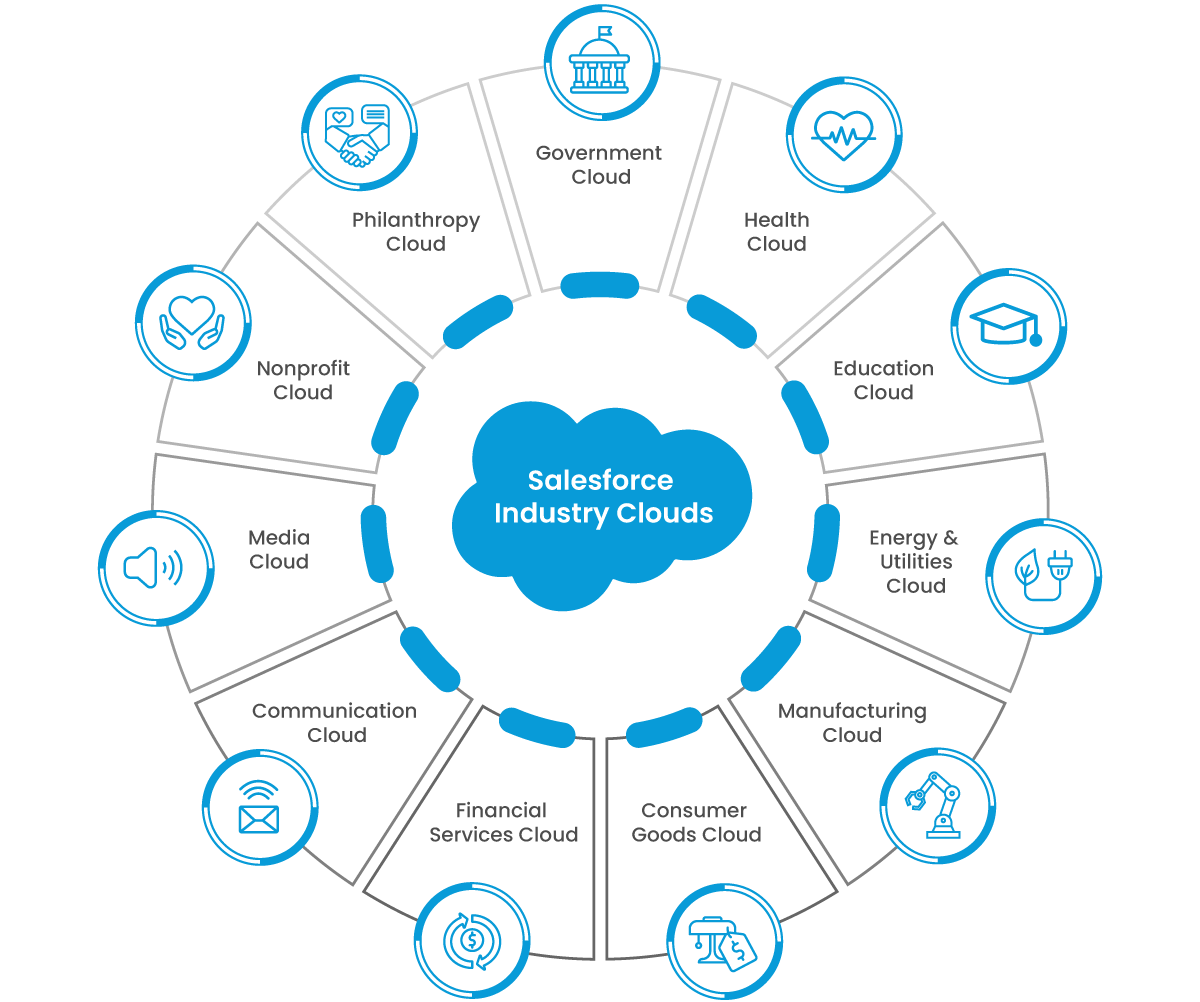
But Salesforce's enterprise capabilities remain in a different league. With 17 industry-specific clouds, the Salesforce Platform for custom app development, MuleSoft for enterprise integrations, and Hyperforce for regional data residency, Salesforce handles organizational complexity that Wealthbox isn't designed for.
Source: SkyPlanner
Financial Services Cloud alone powers $3.2 billion financial accounts and offers multi-entity relationship mapping, compliance workflows, and analytics through Tableau.
For a global wealth management firm with thousands of advisors across multiple countries, regulatory environments, and business lines, Salesforce provides the infrastructure for that complexity.
Wealthbox's multi-workspace model supports distributed teams with separate workspaces for branches and offices. But for firms managing complex organizational hierarchies, Wealthbox's customization ceiling (while rising with Custom Objects) isn't at parity with Salesforce. Formula fields and enhanced relationship functionality for Custom Objects remain on the roadmap.
The decision point is clear: if your firm's complexity demands a platform that can be architected to match your exact organizational structure, Salesforce is the safer choice. If your firm's complexity lives in client relationships rather than organizational hierarchy, Wealthbox handles it with less overhead.
Security and compliance: both platforms meet advisory standards
Financial advisory firms operate in a regulated environment, and both platforms take security seriously.
Salesforce holds ISO 27001/27017/27018, SOC 1/2/3, FedRAMP, and HITRUST certifications. Salesforce Shield (a premium add-on) provides event monitoring, platform encryption with BYOK, and indefinite field audit trail retention. The Einstein Trust Layer enforces zero data retention with LLM partners and PII masking for AI interactions.
Wealthbox is SOC 2 Type 2 certified with 256-bit encryption in transit, encrypted data at rest, two-factor authentication, and configurable session timeouts. Infrastructure runs on AWS data centers certified to ISO 27001, PCI Level 1, and FISMA Moderate. Organization-wide 2FA enforcement is available on Premier and Enterprise plans, and Enterprise adds SSO.
Both platforms meet baseline security requirements for RIA and broker-dealer compliance. Salesforce offers broader security customization and a larger certification portfolio, which matters for firms subject to additional regulatory frameworks like FedRAMP. For most advisory firms, Wealthbox's SOC 2 Type 2 certification and AWS-backed infrastructure provide sufficient assurance.
Salesforce vs. Wealthbox vs. ZoomInfo: Which should you choose?
The right choice depends on your firm's size, complexity, and priorities.
Choose Salesforce if:
You're a large advisory firm (200+ users) with complex organizational structures
You need a platform that handles more than CRM (marketing automation, commerce, custom apps)
You have the budget for dedicated Salesforce administration and ongoing partner support
Customization and multi-cloud integration are requirements, not nice-to-haves
You're already invested in the Salesforce ecosystem and switching costs are high
Choose Wealthbox if:
You're an independent RIA or mid-size advisory firm where advisor adoption is the priority
You want a CRM built for wealth management that works on day one
Native custodial integrations with Schwab, Fidelity, and LPL are part of your daily workflow
You want AI that's immediately useful for advisors (meeting notes, prep briefs, follow-ups)
You prefer predictable, transparent pricing without add-on complexity
Add ZoomInfo to either CRM if:
You need to identify and reach new prospects beyond your existing network
Buyer intent signals and verified contact data would accelerate your prospecting
You want your CRM enriched with company, technographic, and organizational data
You're building a proactive growth strategy, not just managing existing relationships
You want intelligence that works across any CRM through direct integration or API
Try ZoomInfo free with ZoomInfo Lite.
The most effective advisory firms don't choose between a great CRM and great intelligence. They use both. Salesforce or Wealthbox manages the client relationship. ZoomInfo powers the prospecting engine that feeds it. Together, they move your go-to-market approach from reactive to proactive.
Salesforce vs. Wealthbox vs. ZoomInfo FAQ
What is the fundamental difference between Salesforce and Wealthbox?
Salesforce is an enterprise CRM platform built for any industry, configurable for financial advisory workflows through Financial Services Cloud and AppExchange partners. Wealthbox is a CRM built exclusively for financial advisors, with contact types designed for the industry (People, Households, Companies, Trusts), native custodial integrations, and a design philosophy centered on advisor adoption without configuration overhead.
How much does each platform actually cost for a 20-advisor firm?
Wealthbox Pro costs $75/user/month billed annually, totaling $18,000 per year for 20 users. Adding the AI Notetaker at $49/user/month brings the total to roughly $29,760 per year. Salesforce Enterprise edition costs $175/user/month ($42,000 per year for 20 users) before add-ons like Financial Services Cloud, Agentforce AI, the Premier Success Plan, and implementation costs that typically run 100-150% of annual license fees.
Can Wealthbox handle large enterprise advisory firms?
Wealthbox is expanding upmarket, with recent wins including Gradient Financial Group (2,000+ users), Wedbush Wealth Management, and Sanctuary Wealth (670 users). Custom Objects launched in June 2026 allow firms to build new record types. However, formula fields and advanced relationship functionality are still on the roadmap.
For firms with complex multi-entity hierarchies and custom app development needs, Salesforce remains the more proven enterprise choice.
How does ZoomInfo complement either CRM?
ZoomInfo is not a CRM. It's a B2B data intelligence platform. It provides verified contact data, buyer intent signals, company and technographic data, and AI-powered account insights that feed into whichever CRM you use.
ZoomInfo integrates with Salesforce through a native connector and connects to any other platform through its Enterprise API and MCP server. It solves the prospecting and data enrichment problem that CRMs cannot address internally.
Which platform has better AI features for financial advisors?
Wealthbox's AI is built for advisory workflows: the AI Notetaker transcribes client meetings and generates follow-up emails, Meeting Prep pulls from the full client profile, and the AI Assistant answers natural-language CRM queries.
Salesforce's Agentforce is broader, with autonomous agents that handle case resolution, sales coaching, and lead engagement, but it requires more configuration and carries additional per-conversation or per-action pricing on top of the base license.
Which CRM has better integrations with custodial platforms?
Wealthbox has the advantage, with native SSO connections to Charles Schwab, Fidelity Wealthscape, and LPL Financial ClientWorks (including two-way account data sync with LPL). Wealthbox's Send-To Actions let advisors push actions into custodial platforms from within a workflow step. Salesforce can integrate with custodial platforms through Financial Services Cloud and AppExchange partners, but the connections typically require more configuration.
Is Wealthbox secure enough for a regulated advisory firm?
Wealthbox holds SOC 2 Type 2 certification and runs on AWS infrastructure certified to ISO 27001, PCI Level 1, and FISMA Moderate. It provides 256-bit encryption, two-factor authentication, configurable session timeouts, and organization-wide 2FA enforcement on Premier and Enterprise plans.
For most RIA and broker-dealer compliance requirements, this certification stack is sufficient. Salesforce offers a broader range of certifications including FedRAMP and HITRUST, which may be required for firms subject to additional regulatory frameworks.
Can I use ZoomInfo if my firm is on Wealthbox instead of Salesforce?
Yes. ZoomInfo's Enterprise API and MCP server provide programmatic access to the same data and intelligence regardless of your CRM. API access is included in all relevant ZoomInfo plans. While ZoomInfo has a native integration with Salesforce, any platform that can consume REST API data or connect through MCP can use ZoomInfo's contact database, intent signals, and account intelligence.
See how Salesforce compares to other platforms:
