
Choosing between Salesforce and Zendesk often comes down to five questions:
Do you need a full CRM covering sales, marketing, commerce, and service, or a dedicated customer service platform that does one thing well?
Is your priority unifying every department on a single platform, or getting your service team productive fast?
How important is it that your service interactions share data with sales pipeline and marketing campaigns?
Do you have the admin resources and budget for an enterprise-scale deployment, or do you need something your team can configure without specialists?
Does your team have access to verified B2B intelligence, or are your reps and agents working from incomplete customer data regardless of platform?
In short, here's what we recommend:
Salesforce is the platform for organizations that want everything under one roof. The world's #1 CRM by IDC market share, it spans sales, service, marketing, commerce, analytics, and collaboration across over 150,000 customers worldwide. Service Cloud sits on the same data model as Sales Cloud and Marketing Cloud, so service agents see the full customer relationship without integration work. The trade-off is complexity. Salesforce requires dedicated administrators, 70%+ of deployments are partner-led, and pricing layers across multiple clouds can escalate quickly.
Zendesk is the platform for teams that want focused, fast customer service with AI built in from day one. Trained on roughly 20 billion ticket interactions, Zendesk's AI agents can resolve over 80% of interactions end-to-end across messaging, email, and voice. The unified agent workspace handles every channel without toggling between tools, and the platform covers customer service, employee service, and contact center operations. But Zendesk is a service platform, not a CRM. It won't manage your sales pipeline, run marketing campaigns, or power e-commerce storefronts.
Both platforms are strong at what they do. But neither solves the quality and completeness of the B2B data feeding them. A CRM with incomplete contacts is a pipeline with blind spots. A service platform without account context is a ticket queue without priorities. That's the gap ZoomInfo fills.
ZoomInfo is a B2B intelligence platform that provides the data layer both Salesforce and Zendesk depend on. With 500M contacts, 100M companies, 135M+ verified phone numbers, and 200M+ verified business email addresses, ZoomInfo delivers verified data that keeps your CRM accurate and your service teams informed about who they're working with. The GTM Context Graph processes 1.5B+ data points daily, fusing this data with your CRM records, conversation transcripts, and behavioral signals to reveal not just what's happening in your accounts, but why. Whether you choose Salesforce or Zendesk, ZoomInfo integrates with both through native connectors, APIs, and MCP so your teams work from the most complete picture of every customer and prospect.
If verified B2B intelligence sounds like the missing piece, see how ZoomInfo works with your platform.
Salesforce vs. Zendesk vs. ZoomInfo at a glance
Salesforce | Zendesk | ZoomInfo | |
|---|---|---|---|
Core function | Unified CRM (sales, service, marketing, commerce) | AI-powered customer service platform | B2B data and GTM intelligence platform |
Customer service | Service Cloud with Agentforce AI | Omnichannel service with AI agents | Enriches customer context in either platform |
Sales capabilities | Sales Cloud with pipeline management | None (service-only) | GTM Workspace for sellers, intent signals, prospecting |
AI approach | Agentforce with Atlas Reasoning Engine | Resolution Platform with 20B-ticket trained AI | GTM Context Graph processing 1.5B+ data points daily |
Data foundation | Customer data you put in | Ticket and interaction data you generate | 500M contacts, 100M companies, verified and continuously updated |
Learning curve | Steep; requires dedicated admins | Moderate; faster time to value | Moderate; 90-day structured onboarding |
Starting price | $25/user/month (Starter Suite) | $19/agent/month (Support Team) | Custom-quoted; free tier available (ZoomInfo Lite) |
Integrations | 9,000+ AppExchange apps | 1,800+ Marketplace apps | 120+ native integrations plus API and MCP access |
Best for | Enterprises wanting unified front-office operations | Teams prioritizing fast, AI-driven customer service | B2B teams needing verified intelligence in any platform |
The fundamental split: unified CRM vs. dedicated service
Salesforce and Zendesk solve different problems at different scales.
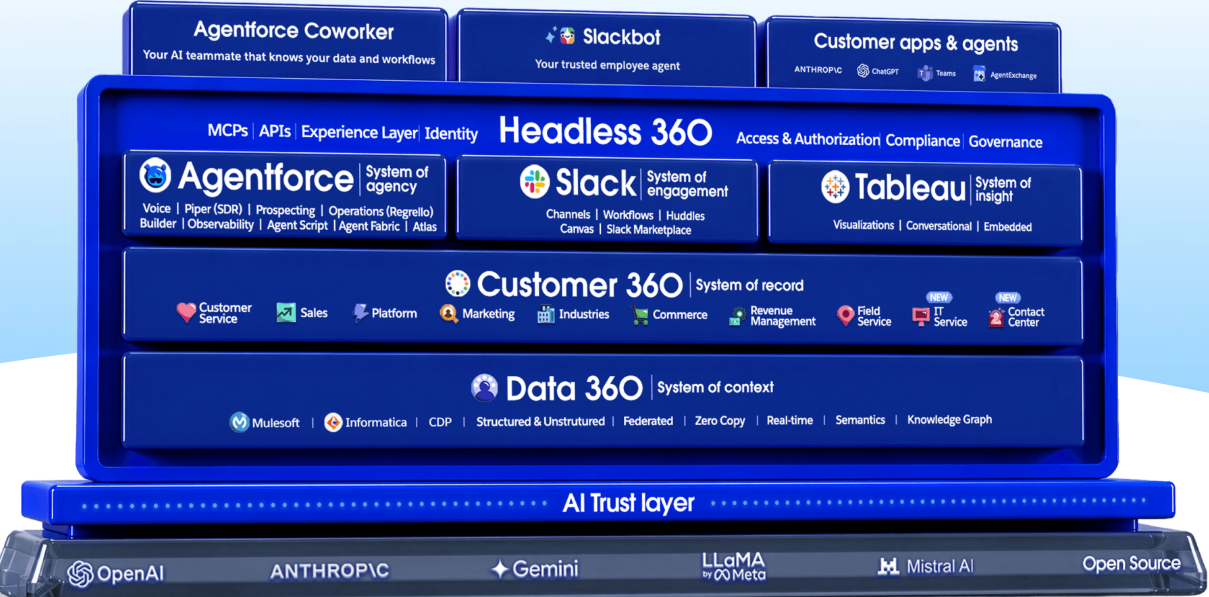
Salesforce built its business on unifying every customer-facing function into one platform. When a service agent opens a case in Service Cloud, they see the customer's purchase history from Commerce Cloud, their marketing engagement from Marketing Cloud, and their sales rep's notes from Sales Cloud. That's not integration; it's one database.
Source: Salesforce
For organizations where service, sales, and marketing need to act on the same customer data in real time, this structural advantage is hard to replicate.
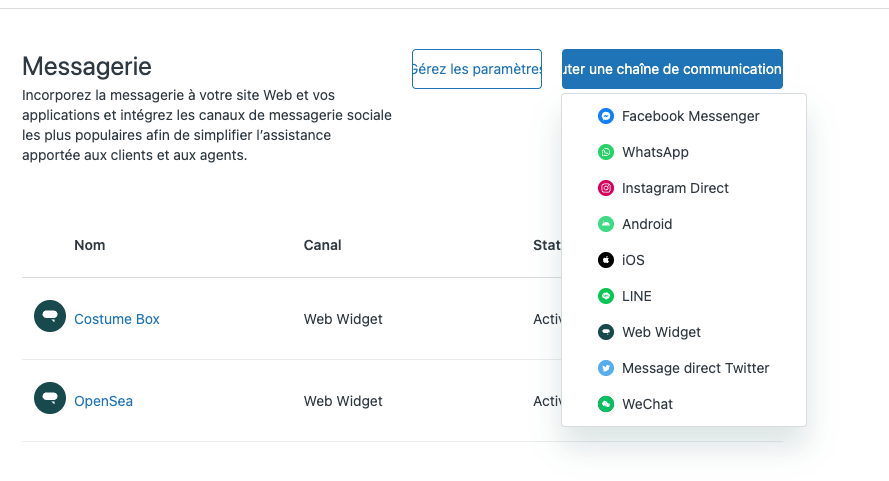
Zendesk built its business on making customer service work better and simpler than enterprise platforms could. When a support agent opens a ticket in Zendesk, they see a workspace spanning multiple channels including email, voice, live chat, web and mobile messaging, WhatsApp, and Facebook Messenger.
Source: Zendesk
Every channel feeds the same queue. Every interaction builds on the last, with persistent conversations that keep full history intact.
The question isn't which platform is "better." It's which problem you need to solve first. If your organization needs to unify sales, service, marketing, and commerce on a single platform, Salesforce is the only option here that does that. If your primary need is getting customer service right, with automation and fast deployment, Zendesk has a strong argument.
But regardless of which platform you choose, both face the same upstream challenge: the quality of data flowing into them determines how well they perform.
Customer service head-to-head
This is where Salesforce and Zendesk compete directly, and both bring real capabilities.
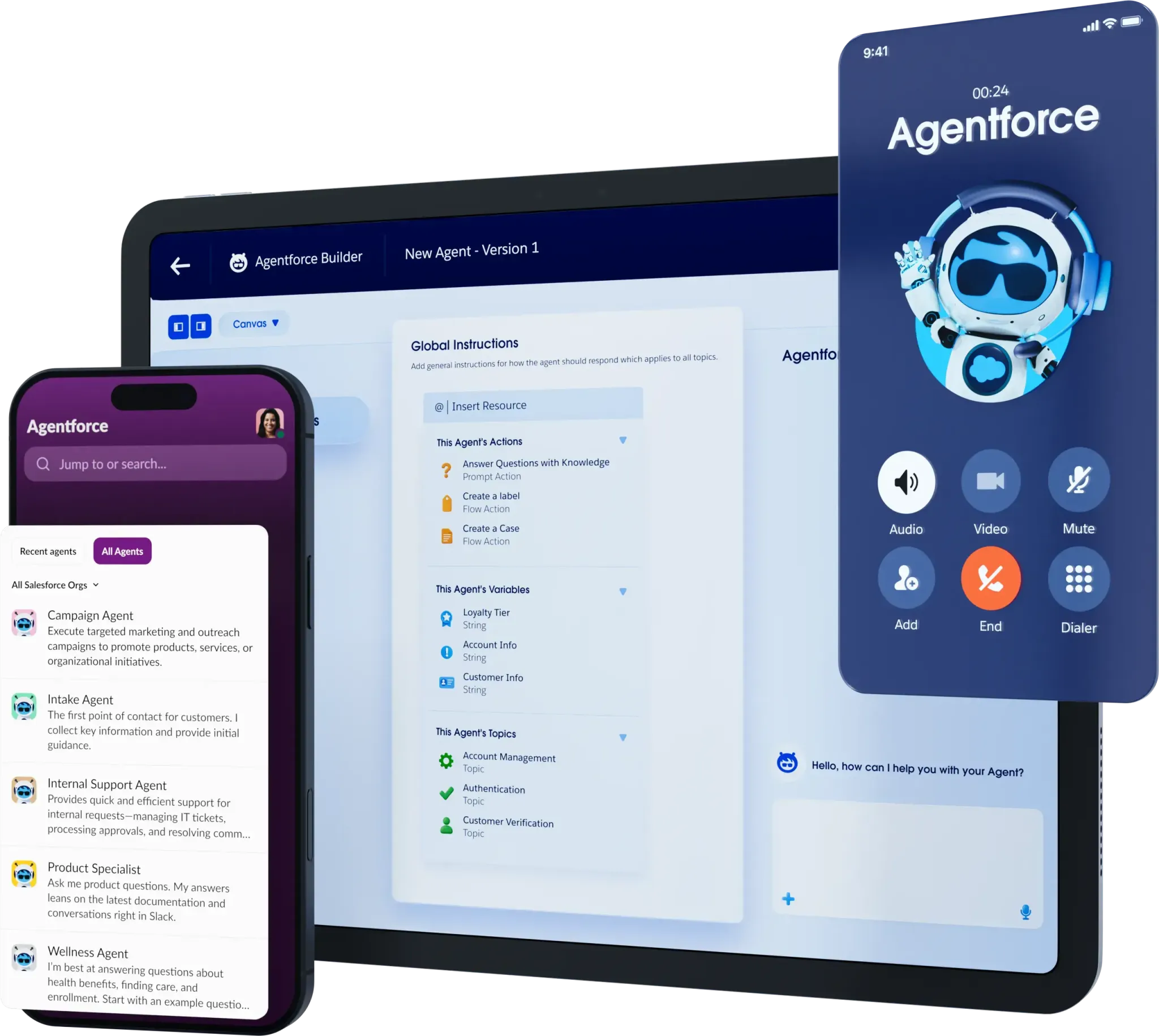
Salesforce Service Cloud (now branded Agentforce Service) offers case management, a unified service console, knowledge management, omnichannel engagement across chat, SMS, WhatsApp, Facebook Messenger, Apple Messages, and more, and a field service suite with AI scheduling and offline mobile access.
Source: Salesforce
The real differentiator: Service Cloud sits on the same data platform as Sales Cloud, Marketing Cloud, and Commerce Cloud. Service agents see the full customer relationship without integration work. When a high-value prospect submits a support ticket, your service team knows it immediately.
Zendesk counters with a service platform built from the ground up for speed and focus. The unified agent workspace handles every channel in a single view with omnichannel routing that pushes tickets to agents based on availability, capacity, and skills. SLA management, triggers, automations, and macros give teams workflow control without developer help.
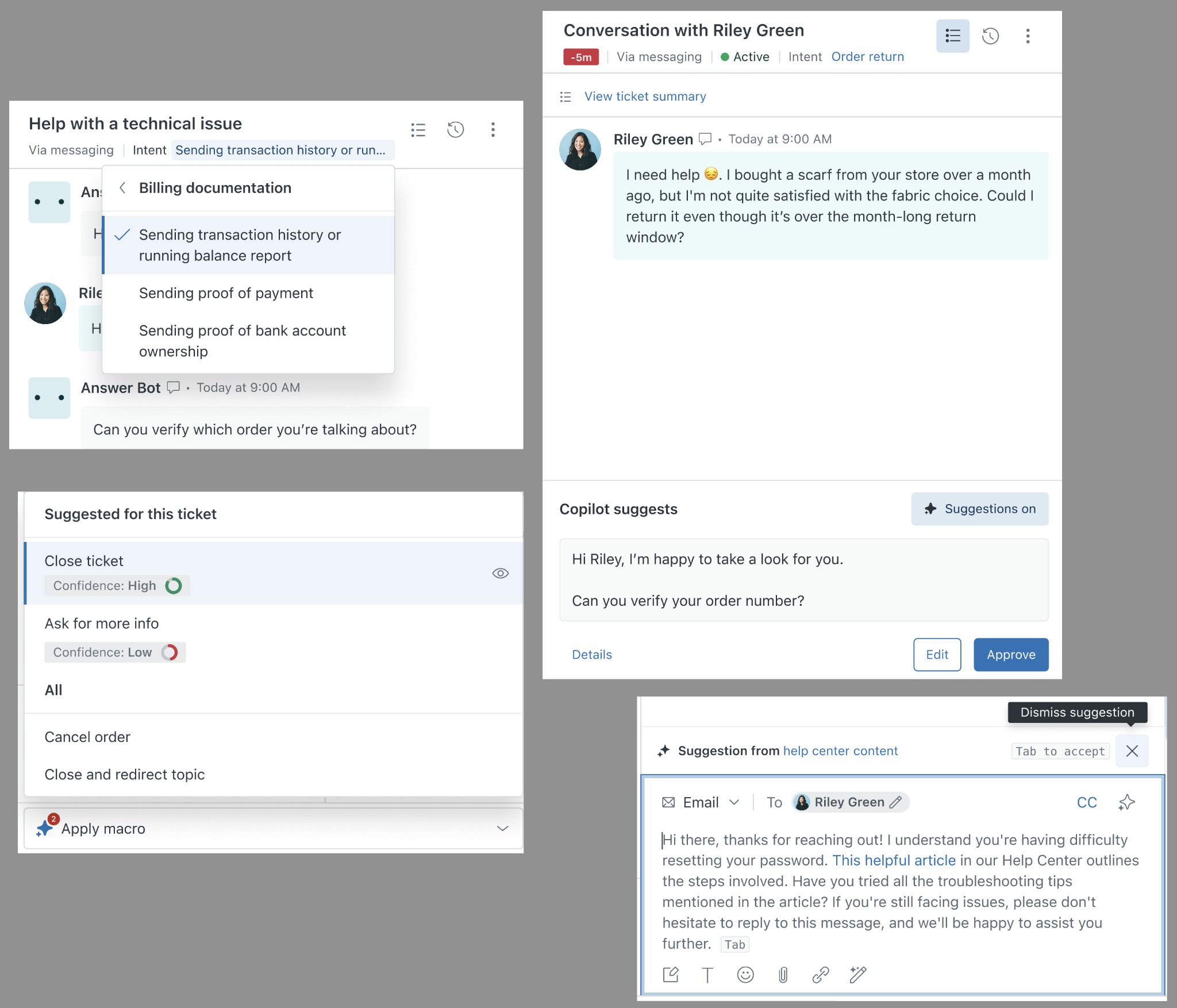
Source: Zendesk
Zendesk also ships workforce management and quality assurance as native add-ons. The WFM module uses AI to forecast staffing needs and build schedules down to the minute.
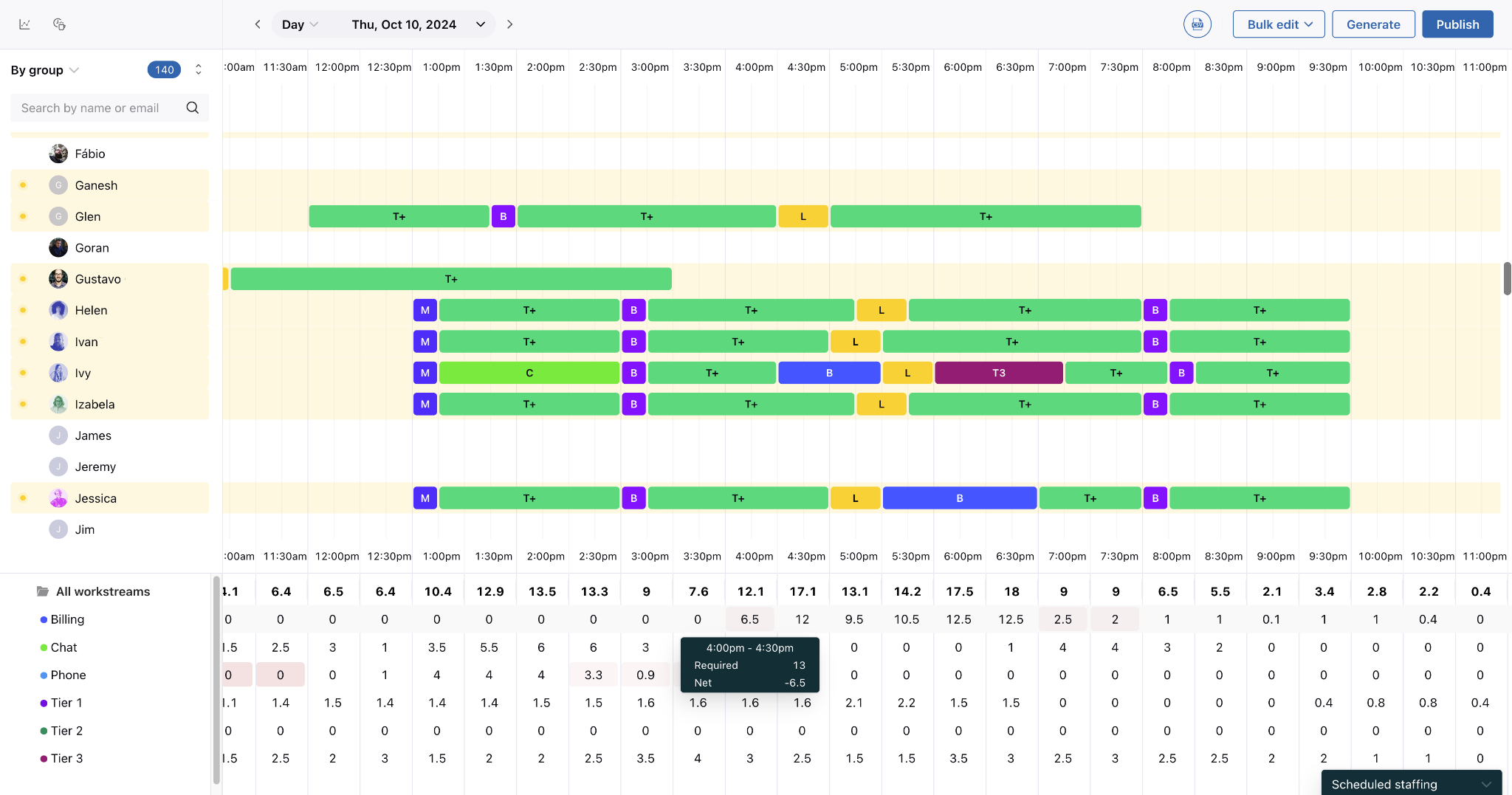
Source: Zendesk
The QA engine scores 100% of interactions automatically (including AI agent conversations), catching problems that manual sampling misses. Salesforce offers equivalent capabilities, but often through additional products and pricing layers.
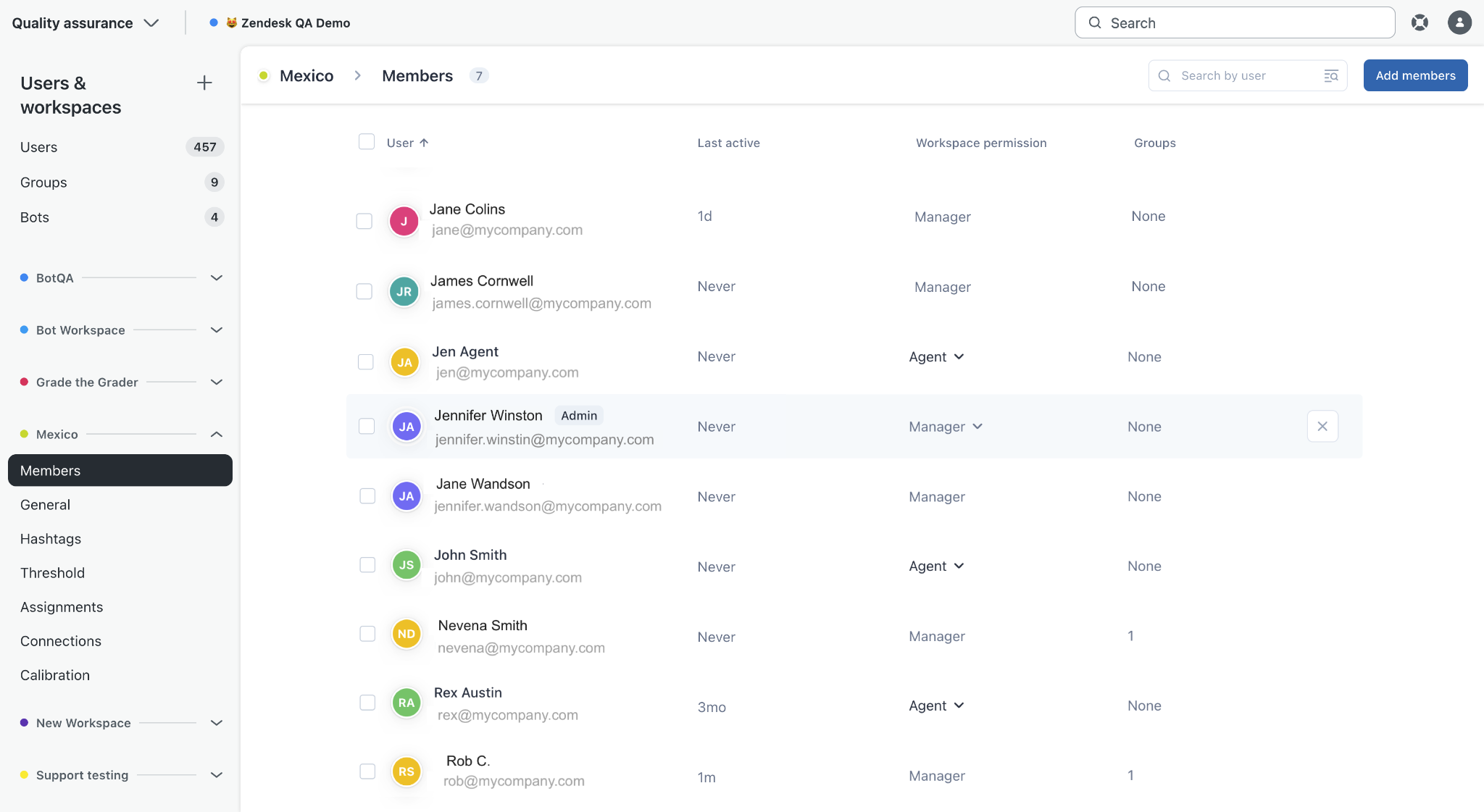
Source: Zendesk
For service-only deployments, Zendesk is typically faster to implement. Salesforce implementations range from weeks (simple Service Cloud) to 3 to 12 months for enterprise multi-cloud setups.
AI capabilities take different paths
Both platforms are investing heavily in AI, but their approaches reflect their architectures.
Salesforce's Agentforce is built on the proprietary Atlas Reasoning Engine, which uses a Reasoning and Acting (ReAct) loop of reason, act, observe, and adapt. Pre-built agents cover service, SDR, sales coach, personal shopper, campaign assistant, and more.
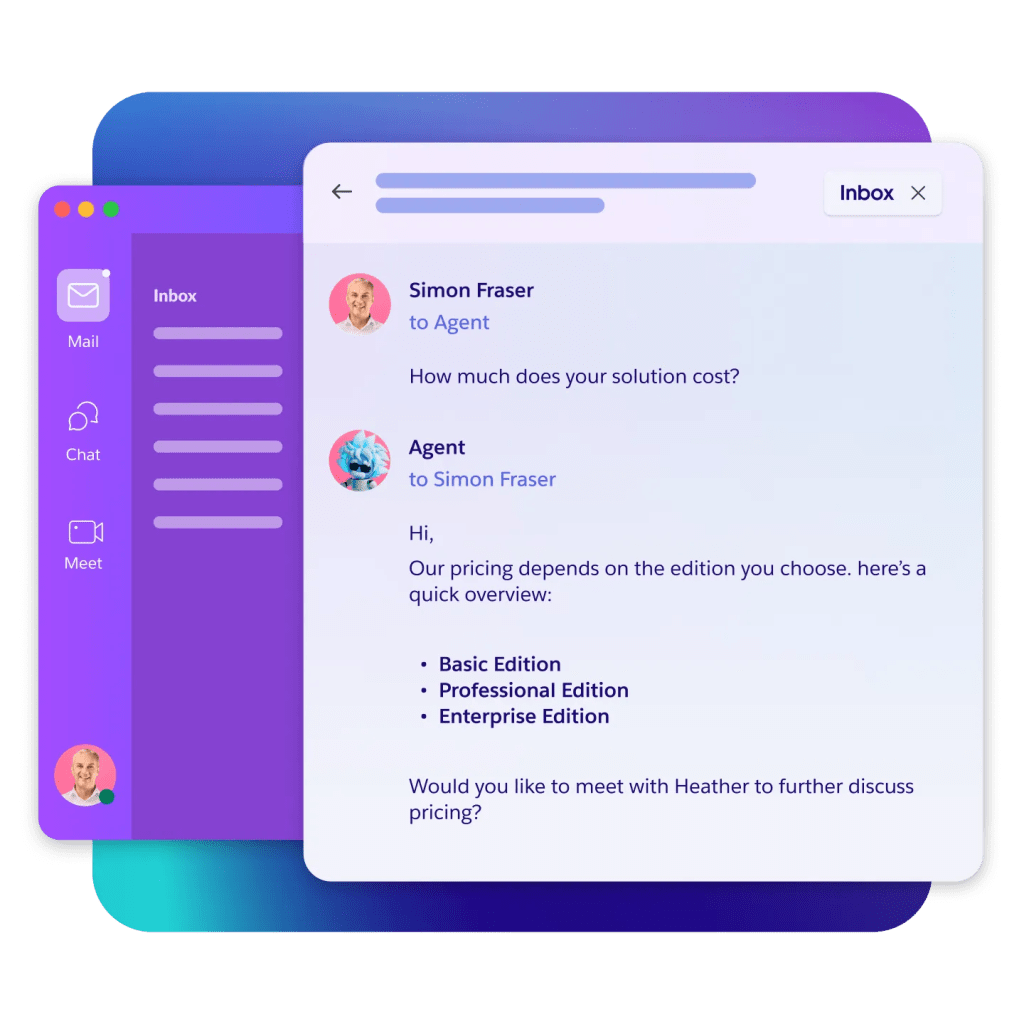
Source: Salesforce
Salesforce reports that Agentforce resolves 85% of its own support requests without human escalation. The Einstein Trust Layer adds zero data retention with LLM partners, PII masking, and toxicity detection.
The structural advantage: because Agentforce sits on top of Customer 360 and Data Cloud, the AI accesses the full customer context across sales, service, marketing, and commerce. An agent resolving a service case can draw on the customer's purchase history, open deals, and marketing engagement without extra data piping.
Zendesk's Resolution Platform takes a different approach. Its AI is trained on roughly 20 billion ticket interactions, giving it a training advantage specific to customer service. The Resolution Learning Loop captures insights from every resolved interaction to close knowledge gaps without manual retraining. The Forethought acquisition (completed March 2026) added self-improving AI agent capabilities.
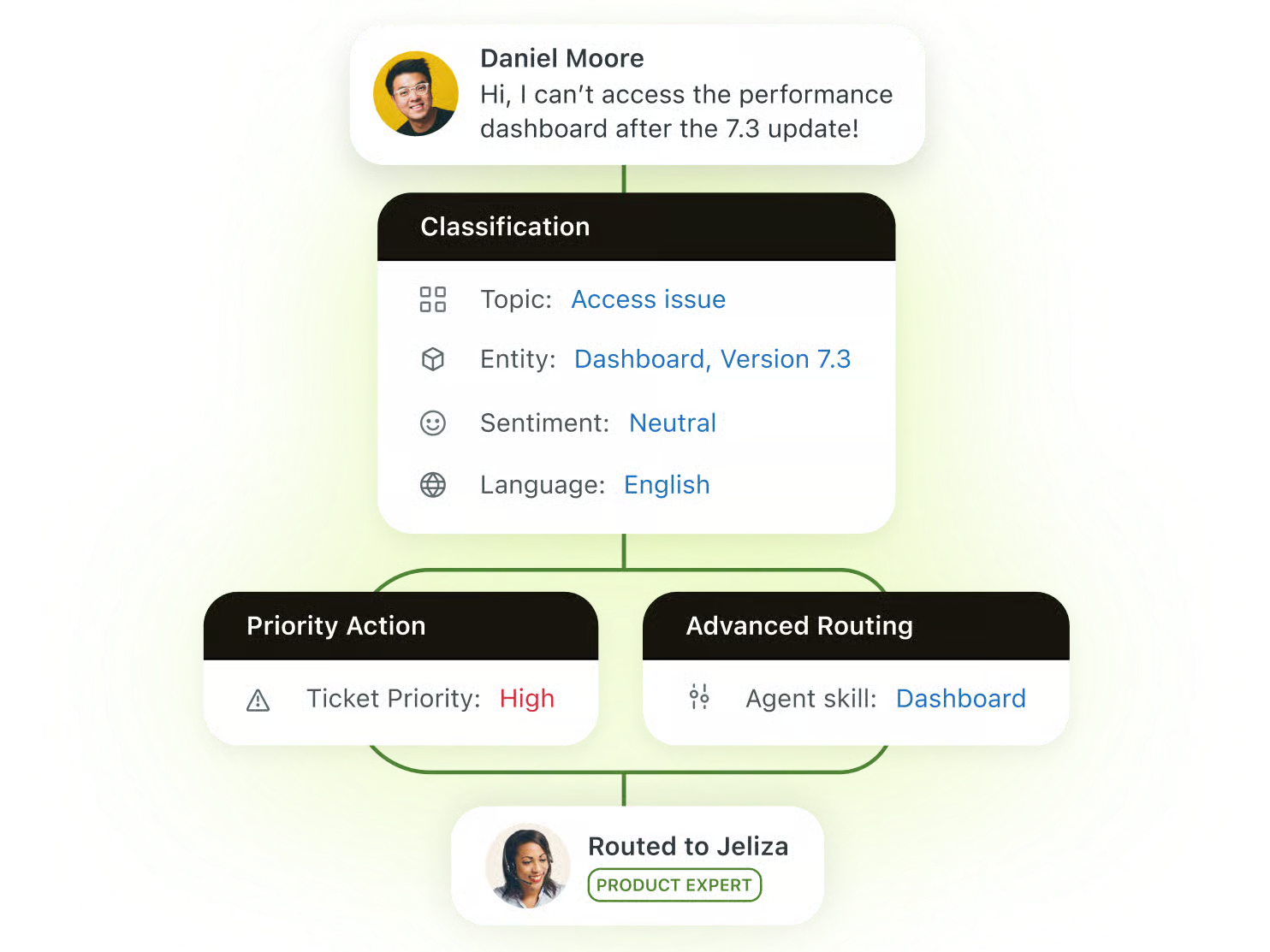
Zendesk's Copilot works proactively. Rather than waiting for agents to ask for help, Auto Assist surfaces guidance the moment a ticket opens.
Source: Zendesk
The difference: Salesforce's AI is broader (spanning every business function) while Zendesk's AI is deeper in service (trained on more service-specific data). Neither platform, however, generates the external B2B intelligence that tells your teams who they're dealing with before the first interaction.
The intelligence gap both platforms share
Salesforce and Zendesk are strong engines. But engines need fuel.
Salesforce's Service Cloud can show your agents the full customer relationship, but only if someone put that data there first. If your CRM has incomplete contact records, stale company information, or missing stakeholder maps, every workflow built on that data inherits those gaps. Salesforce itself acknowledged that "you have got to get your data right" as the top prerequisite for AI adoption.
Zendesk's AI can resolve tickets on its own, but it operates on whatever customer context your team has captured. If your service agents don't know that the person filing a ticket is the VP of Operations at a company showing active buying intent, that ticket gets the same priority as everything else.
This is where ZoomInfo changes the equation. ZoomInfo isn't a CRM or a service platform. It's the intelligence layer that feeds them.
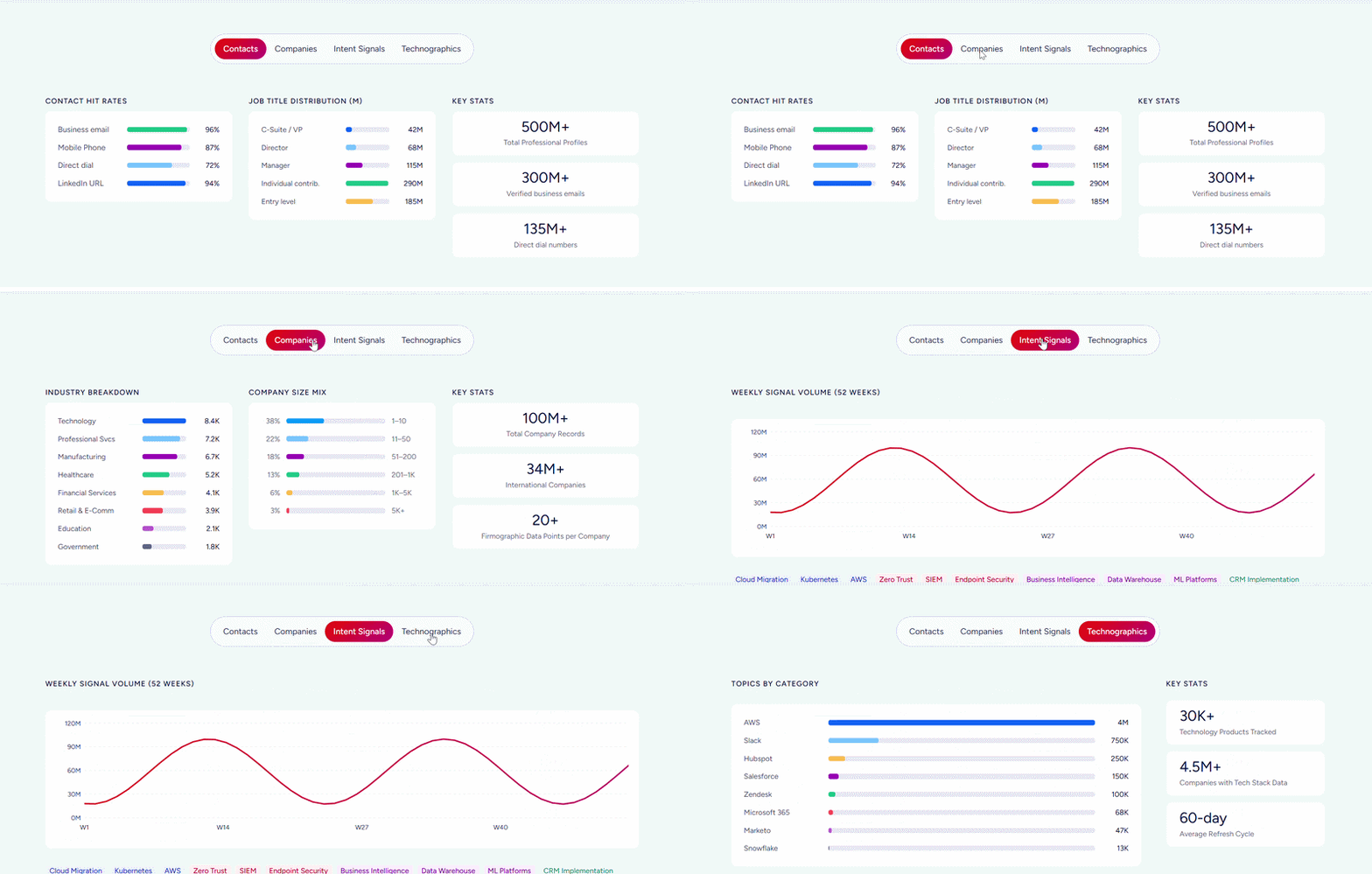
With 500M contacts, 100M companies, 135M+ verified phone numbers, and 200M+ verified business email addresses, ZoomInfo provides verified data that keeps your customer records accurate and complete.
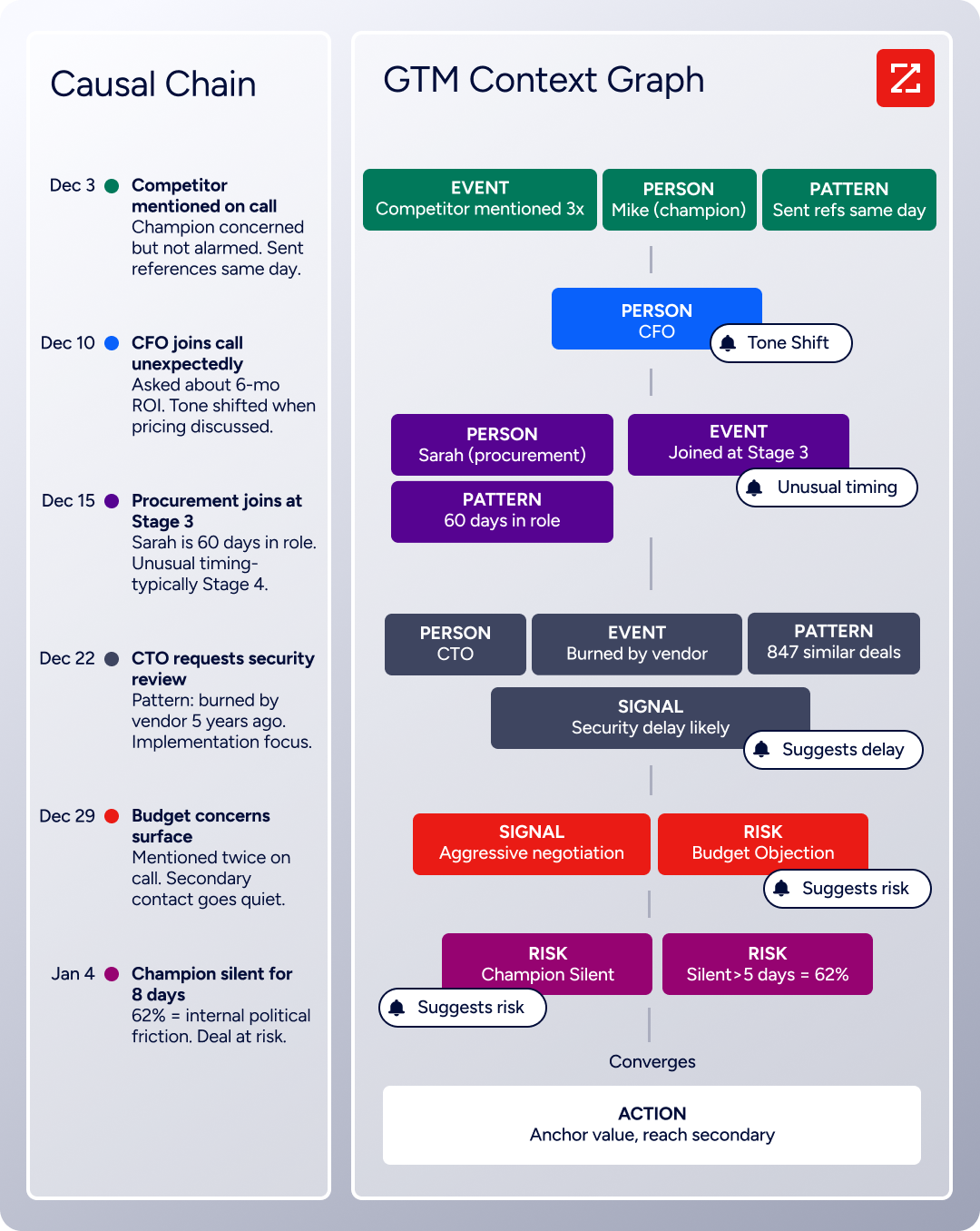
The GTM Context Graph goes further by fusing ZoomInfo's third-party data with your CRM records, conversation intelligence, and behavioral signals to capture not just what happened in an account, but why it happened.
For Salesforce users, the integration is native. ZoomInfo enriches Salesforce contacts with verified emails, direct dials, company attributes, org charts, and technographics. Intent signals surface which accounts are actively researching solutions.
The GTM Workspace gives sellers a single place where prioritized accounts and AI-drafted outreach converge.
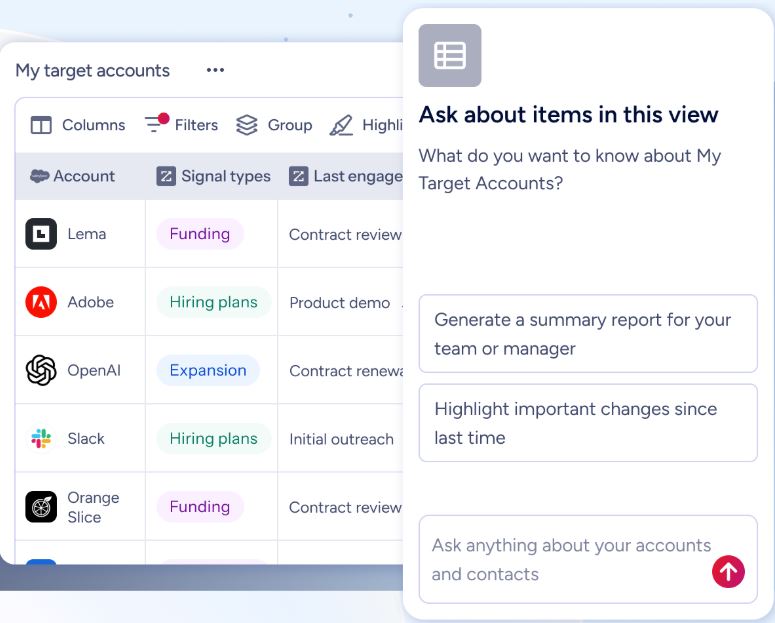
GTM Studio lets marketers and RevOps teams build audiences and launch plays in natural language.
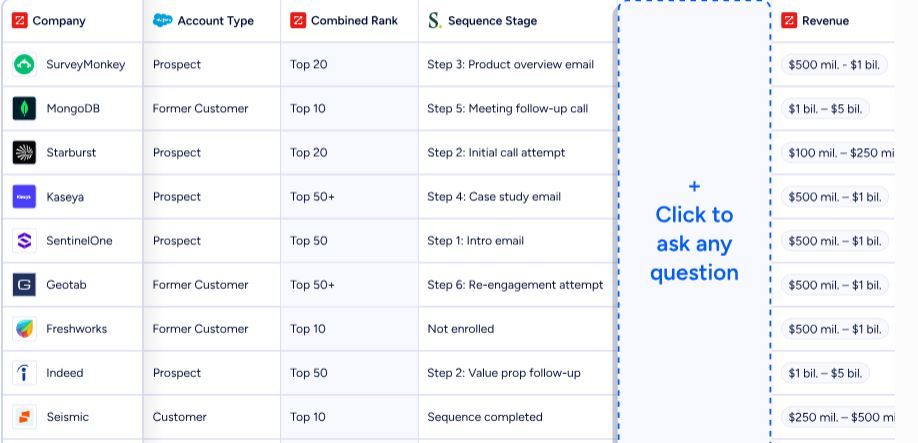
For a deeper look at how Salesforce and ZoomInfo stack up directly, see our Salesforce vs. ZoomInfo comparison.
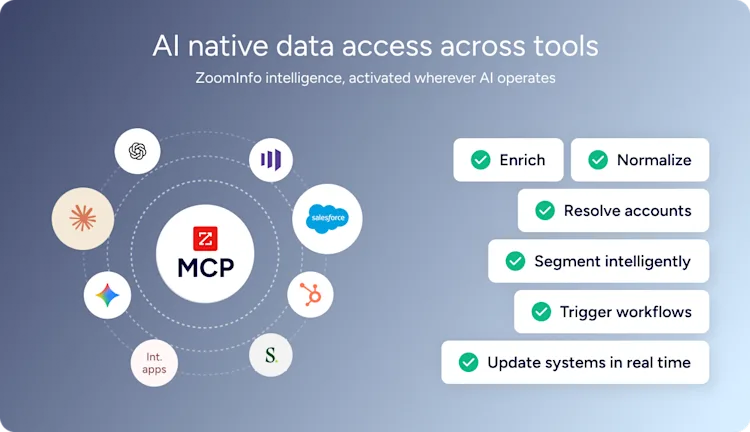
For any platform, including Zendesk, ZoomInfo's APIs and MCP deliver the same intelligence into any tool, workflow, or AI agent. The data isn't locked inside ZoomInfo's own products.
The practical impact is measurable. In a Fortune 500 competitive RFP analyzing 25 million contacts across vendors, an independent consultant concluded that "no other competitor came even close" to ZoomInfo's data quality.
Seismic attributed 39% of active pipeline to ZoomInfo-influenced opportunities. "That combination of our internal CRM data, external signals, and AI that's given all that context has helped us craft very specific account- and persona-based messages," said Chief Business Officer Toby Carrington. (Seismic Case Study)
Pricing tells very different stories
The pricing structures reflect each platform's philosophy and target market.
Salesforce uses a multi-cloud, multi-tier model. Service Cloud starts at $25/user/month (Starter Suite) and scales to $550/user/month (Agentforce 1 edition with unmetered AI). The core tiers:
Edition | Price | What you get |
|---|---|---|
Starter Suite | Basic case management | |
Pro Suite | Customization, AppExchange access | |
Enterprise | AI for service, pipeline insights | |
Unlimited | Full AI suite, Premier Success |
Add-ons layer on top: Digital Engagement at $75/user/month, Contact Center at $150/user/month, Agentforce for Service at $125/user/month, and Field Service from $175/user/month. Agentforce consumption is priced separately at $2 per conversation or $500 per 100,000 Flex Credits. Premier Success costs 30% of net license fees unless you're on the Unlimited tier.
Zendesk offers simpler tiers but still layers costs. Suite plans range from $55/agent/month (Team) to $115/agent/month (Professional), with Enterprise pricing on request. Support-only plans start at $19/agent/month. The full AI suite requires Suite Professional or higher. Workforce Management and Quality Assurance are each $50/agent/month add-ons.
Copilot (Auto Assist) requires Suite Enterprise or a separate add-on. AI agent automated resolutions come included in every plan but with limited allowances (5 to 15 per agent per month); overages require purchasing additional resolution packs.
ZoomInfo uses custom-quoted, consumption-based pricing. Costs depend on seats, credit volume, features, and contract length. ZoomInfo Lite is a permanent free tier with access to the B2B database and 10 monthly export credits, and a 7-day free trial is available for the full platform.
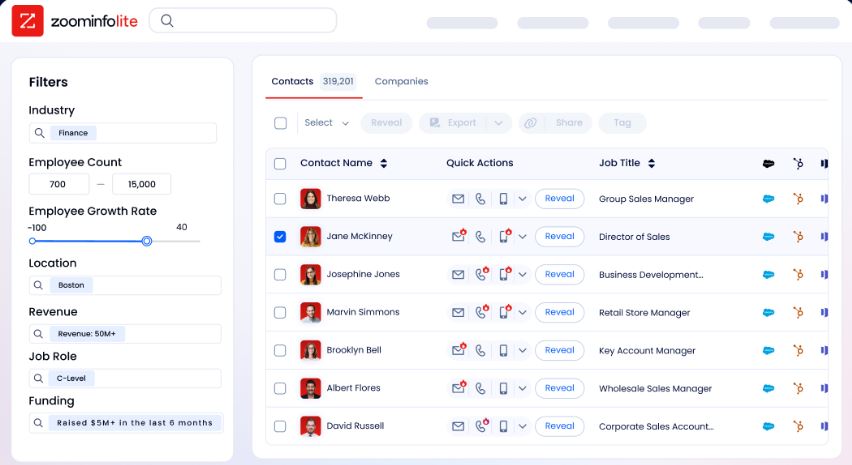
Because ZoomInfo is an intelligence layer rather than a CRM or service platform, its cost is additive but compounds the return of whichever platform you run. Clean, verified data means fewer duplicate records inflating your CRM seat costs and fewer misrouted tickets wasting agent time.
Snowflake uses ZoomInfo data for at least one-third of the most critical features in their Account Propensity Scoring model, feeding over 70 company and technographic data fields. Accounts monitored using ZoomInfo-powered scores showed 90% higher opportunity open rates and 2x higher customer conversion rates. (Snowflake Case Study)
Learning curves and implementation realities
How quickly your team gets productive matters.
Salesforce is the most complex option. Lightning Experience is a modern, component-based interface, but configuration beyond the basics requires trained administrators. Trailhead provides 1,500+ badges and 6+ million learners, and 60+ certifications exist for a reason: the platform rewards investment in expertise.
Implementation timelines range from weeks for simple deployments to 3 to 12 months for multi-cloud enterprise setups. The Trailblazer Community of 20 million members provides peer support, but the learning curve is real.
Zendesk deploys faster. The Admin Center centralizes configuration, and the platform is designed for teams that have outgrown shared inboxes but don't want full-time platform administrators.
That said, enterprise configurations with multi-brand setups, complex automation rules, and custom roles still require dedicated admin expertise. Zendesk maintains professional services and a training program for this reason.
ZoomInfo lands in the middle. The platform redesigned its onboarding from 30 to 90 days, structured across planning, technical implementation, education, and adoption. That redesign produced a 25% improvement in customer satisfaction scores. ZoomInfo University provides role-specific learning paths for sales, marketing, and administrators. For teams that just need the data, ZoomInfo Lite requires no onboarding at all.

Integration ecosystems reflect different philosophies
Salesforce has the largest enterprise app ecosystem. AppExchange offers 9,000+ partner apps with 14+ million installs, and 91% of customers use at least one AppExchange app. MuleSoft adds API management with hundreds of pre-built connectors.
Native integrations cover Google Workspace and Microsoft Outlook and Teams. Slack (acquired for $27.7 billion) provides the collaboration layer with Salesforce Channels that bring CRM data into conversations bidirectionally.
Zendesk offers 1,800+ apps and integrations through its Marketplace, plus an open REST API that developers frequently cite as a draw. Zendesk Integration Services (ZIS) provides hosted workflow orchestration. The Zendesk MCP Server (in early access) lets external AI platforms like Claude, ChatGPT, and Gemini connect directly to Zendesk's knowledge and ticket data.
ZoomInfo integrates with 120+ partner tools including Salesforce, HubSpot, Microsoft Dynamics 365, and Snowflake. The Enterprise API provides programmatic access to ZoomInfo's data, and API access is included in all relevant plans.
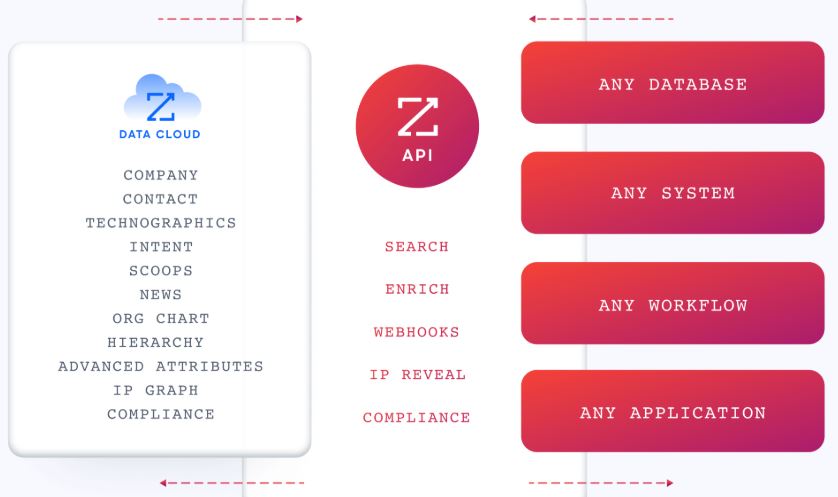
The MCP server lets AI agents consume ZoomInfo data through natural language, currently supporting Claude and ChatGPT. This means ZoomInfo's intelligence isn't locked into any single front-end.
"ZoomInfo is our one source of truth for account data, and even more so for contact data. There's no other provider in the market that provides you with that level of detail," said Thor Sanderson, Senior Manager of Sales Technology Enablement at Smartsheet. (Smartsheet Case Study)
Security and compliance for enterprise buyers
All three platforms meet enterprise security standards, but the details differ.
Salesforce holds ISO 27001/27017/27018, SOC 1/2/3, FedRAMP (Government Cloud), and HITRUST certifications. Salesforce Shield adds event monitoring, platform encryption with BYOK, and field audit trail as a premium add-on. Hyperforce enables deployment on public cloud infrastructure with regional data residency.
Zendesk maintains SOC 2 Type II, ISO 27001:2022, ISO 27018:2019, and has GDPR Binding Corporate Rules. HIPAA BAA is available, and Advanced Data Privacy and Protection (ADPP) is offered for Enterprise plans. Its AI layer uses a multi-LLM architecture with zero data retention endpoints.
ZoomInfo holds ISO 27001, ISO 27701, SOC 2 Type II, TRUSTe GDPR and TRUSTe CCPA certifications, all renewed annually. ZoomInfo is a registered data broker in California and Vermont. For B2B data providers, compliance is built into the data layer itself, not just the application layer.
Salesforce vs. Zendesk vs. ZoomInfo: Which should you choose?
The right choice depends on what problem you're solving.
Choose Salesforce if:
You need a unified platform across sales, service, marketing, and commerce
Your organization wants every department working from the same customer data
You have the budget and admin resources for an enterprise-grade deployment
You need industry-specific solutions across 17 verticals
Integration with the broadest enterprise app ecosystem matters
Choose Zendesk if:
Customer service is your primary need and you want the strongest capabilities there
Speed of deployment matters more than cross-departmental unification
You want AI trained specifically on customer service interactions at scale
Your team needs to be productive quickly without dedicated platform administrators
Workforce management and quality assurance need to be native to the service platform
Add ZoomInfo to either if:
You're a B2B organization and your CRM or service platform runs on incomplete customer data
Your sales team needs verified contacts, direct dials, and intent signals to build pipeline
You want intelligence that tells your team who to contact, when to engage, and what to say
Data enrichment, account prioritization, and buying signal detection are part of your GTM motion
You need the same intelligence accessible in your CRM, your service platform, or any AI agent via API and MCP
See ZoomInfo in action with a free trial, or start with ZoomInfo Lite at no cost.
"The plug-and-play aspect of the API means I can integrate it very easily into any process and get information at a moment's notice," said Jerry Wilson, Senior Marketing Intelligence Analyst at BDO Canada, who reported an 87% reduction in time spent on updates to internal data dashboards thanks to ZoomInfo's API. (BDO Canada Case Study)
Salesforce and Zendesk are both strong platforms for managing customer relationships and delivering service. The choice between them is a question of scope: everything in one place, or service done well. But for B2B organizations, the intelligence layer underneath either platform determines how effectively your teams find, serve, and grow customers. ZoomInfo provides that layer, and it works regardless of which platform you choose.
Salesforce vs. Zendesk vs. ZoomInfo FAQ
What is the core difference between Salesforce, Zendesk, and ZoomInfo?
Salesforce is a unified CRM platform spanning sales, service, marketing, and commerce, serving over 150,000 companies worldwide. Zendesk is a dedicated customer service platform with AI trained on roughly 20 billion ticket interactions, focused on support and service operations.
ZoomInfo is a B2B intelligence platform providing verified contact data, company insights, and buying signals that enrich whichever CRM or service platform your team uses.
Which platform is better for customer service specifically?
Both Salesforce Service Cloud and Zendesk are strong for customer service, but they approach it differently. Salesforce Service Cloud benefits from native data sharing with Sales Cloud and Marketing Cloud, so service agents see the full customer relationship.
Zendesk offers deeper service-specific capabilities out of the box, including native workforce management, quality assurance, and AI agents that can resolve over 80% of interactions on their own. Zendesk is typically faster to deploy for service-only use cases.
How does ZoomInfo relate to Salesforce and Zendesk?
ZoomInfo is not a competitor to either platform. It is a complementary intelligence layer that provides verified B2B data (500M contacts, 100M companies, 135M+ verified phone numbers) to keep your CRM or service platform accurate and complete.
ZoomInfo integrates natively with Salesforce and offers APIs and MCP access to connect with any platform. It solves the upstream problem of knowing who your customers and prospects are, which neither Salesforce nor Zendesk generates on its own.
Which platform is most expensive?
Salesforce has the highest potential total cost. Service Cloud alone ranges from $25 to $550 per user per month, with add-ons for digital engagement, contact center, and AI capabilities layered on top. Zendesk Suite plans range from $55 to $115 per agent per month with add-ons for workforce management and quality assurance at $50 per agent per month each.
ZoomInfo uses custom-quoted consumption-based pricing but offers a permanent free tier (ZoomInfo Lite) and a 7-day free trial.
Can I use Salesforce and Zendesk together?
Yes, many organizations use Salesforce as their CRM for sales and marketing while using Zendesk for customer service. Zendesk has a Salesforce integration in its Marketplace that syncs ticket data with CRM records. However, this approach introduces integration complexity and data synchronization issues that don't exist when using Salesforce Service Cloud natively within the Salesforce ecosystem.
Which platform has the best AI capabilities?
Salesforce's Agentforce offers the broadest AI, spanning sales, service, marketing, and commerce with the Atlas Reasoning Engine. Zendesk's Resolution Platform offers the deepest service-specific AI, trained on 20 billion ticket interactions with a self-improving Resolution Learning Loop.
ZoomInfo's GTM Context Graph processes 1.5 billion data points daily to reveal why accounts move and which actions to take next. The three platforms' AI capabilities are complementary rather than directly comparable.
How quickly can each platform be deployed?
Zendesk is the fastest for service deployments, with some customers reporting full operation in hours. Salesforce implementations range from weeks for simple setups to 3 to 12 months for enterprise multi-cloud deployments, with over 70% of implementations led by partners. ZoomInfo uses a structured 90-day onboarding program, though ZoomInfo Lite requires no onboarding at all.
Do any of these platforms offer a free option?
Salesforce offers a free CRM for up to 2 users with basic functionality. Zendesk offers a 14-day free trial of Suite Professional but has no permanent free plan. ZoomInfo offers both a permanent free tier (ZoomInfo Lite, with 10 monthly export credits and access to the B2B database) and a 7-day free trial of the full platform.
See how Salesforce compares to other platforms:
