
Tealium leads customer data orchestration, collecting, unifying, and activating customer data in real time for enterprises. With 1,300+ integrations, 2x Gartner Magic Quadrant Leader status, and compliance certifications like HIPAA BAA, SOC 2, and ISO 27701, it remains a top choice for large organizations running complex first-party data pipelines.
But as your go-to-market strategy evolves, a full-stack data orchestration platform may create friction where you need speed, transparency, or a different kind of intelligence. Tealium's absence of published pricing, its steep learning curve requiring technical expertise, and its focus on orchestrating existing first-party data rather than providing B2B intelligence may leave gaps in your GTM execution.
That's where this guide comes in. Whether you're looking to:
Access B2B intelligence data to find and engage buyers before they find you
Evaluate and deploy a modular CDP with transparent, self-serve pricing
Combine privacy-first analytics, consent management, and tag management in one suite
Deploy a mobile-native CDP with built-in AI predictions and schema-level data governance
Activate warehouse data directly without replicating it into a proprietary data store
Build developer-first data infrastructure with full data ownership and open-source flexibility
Resolve fragmented customer identities at scale with probabilistic matching
We'll explore Tealium alternatives that excel in each area.
Some organizations use these tools alongside Tealium to fill gaps. Others replace it entirely. This isn't about finding a "better" platform; it's about finding the right fit for your go-to-market needs.
Here are the alternatives and where each one fits.
The Best Tealium Alternatives |
|---|
Best Alternative for B2B Go-to-Market Intelligence We chose ZoomInfo because it takes a different approach to the GTM data problem, providing a B2B intelligence platform with 500M contacts, 100M companies, and a GTM Context Graph that reveals why deals move. |
Best Alternative for Modular CDP with Transparent Pricing We chose Twilio Segment because it offers a modular CDP with self-serve pricing, schema-first data governance, and built-in AI propensity scoring, giving teams a clear evaluation path that Tealium's sales-gated model cannot match. |
Best Alternative for Mobile-First Data Quality and AI-Native Predictions We chose mParticle because its mobile-native identity resolution, schema enforcement at the collection boundary, and built-in Cortex AI predictions make it a strong CDP for product-led growth companies with significant app traffic. |
Best Alternative for Privacy-First Analytics with Integrated Consent Management We chose Piwik PRO because it combines web analytics, tag management, consent management, and data activation in a single product with private cloud deployment and a self-serve entry point. |
Best Alternative for Warehouse-Native Customer Data Activation We chose Hightouch because it activates data directly from your warehouse into 250+ destinations without proprietary copies, and its AI Decisioning engine optimizes campaigns using reinforcement learning. |
Best Alternative for Developer-First Data Infrastructure with Full Data Ownership We chose RudderStack because its open-source, warehouse-native architecture gives engineering teams complete data ownership with published pricing and zero vendor-managed data storage |
Best Alternative for AI-Native Enterprise Identity Resolution We chose Amperity because its patented Stitch engine combines deterministic and probabilistic matching with up to 45 AI models, resolving the messy, incomplete records that rule-based identity stitching cannot handle. |
What is Tealium?
Tealium is a Customer Data Orchestration Platform built for enterprises that need to collect, unify, and activate customer data in real time across marketing, analytics, and AI workflows.
Launched in 2012 as a tag management system, Tealium now positions itself as the governed data layer between every customer touchpoint and every AI system.
Its key features include:
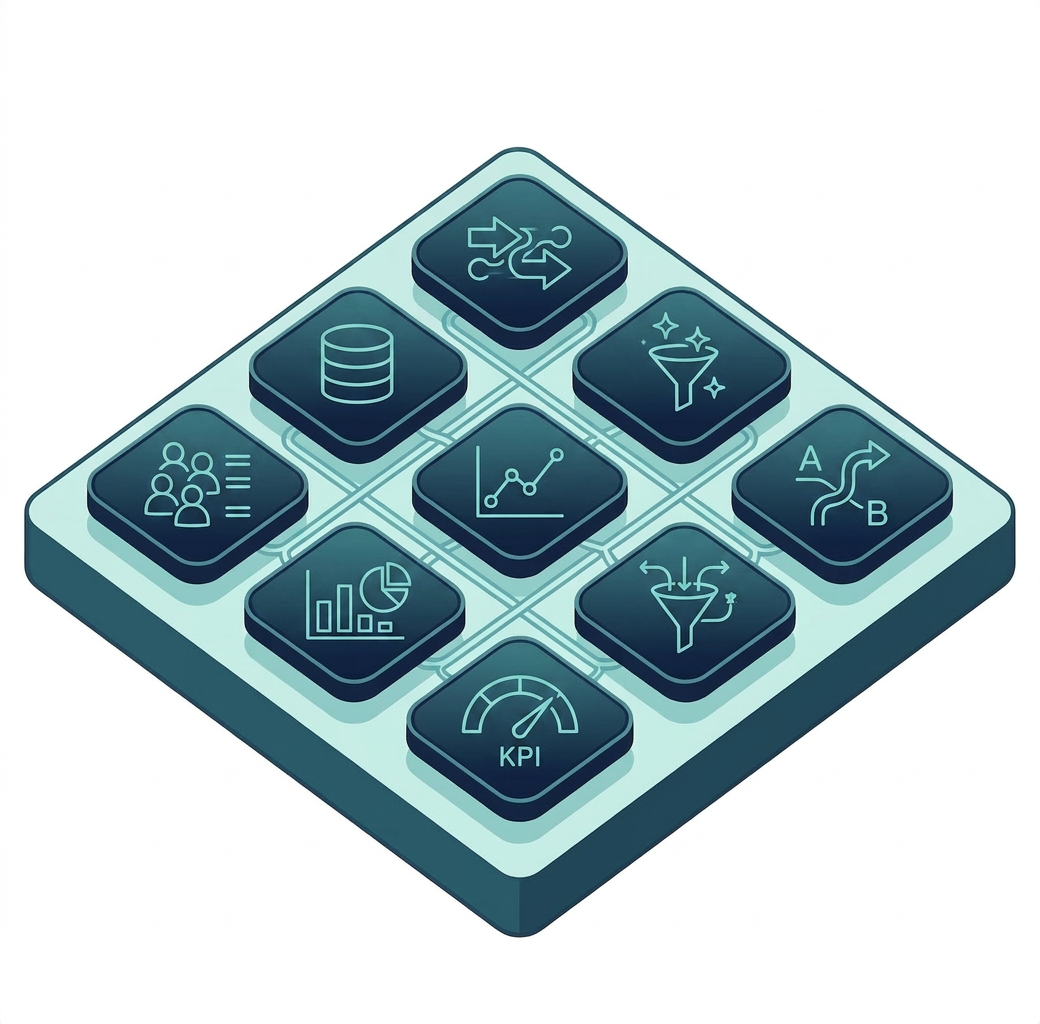
Data Collection (iQ Tag Management): Unifies web, mobile, server-side, and cloud event collection in one governed layer with events delivered in under 100ms
Customer Data Platform (AudienceStream): Real-time identity resolution and unified customer profiles with persistent visitor stitching
Enrichment & Orchestration (EventStream): In-memory event processing with serverless functions, consent enforcement, and 1,300+ connectors
Source: Tealium
Data Cloud Activation: Reverse ETL and zero-copy activation from Snowflake, Databricks, BigQuery, and Redshift
Tealium for AI: Feeds models and agents with real-time, consented customer context via connectors to AWS Bedrock, Vertex AI, OpenAI, and others
The platform processes 9 billion+ events per day and serves 850+ enterprise customers across financial services, healthcare, retail, telecommunications, and travel. When a customer interacts across your digital properties, Tealium stitches anonymous and known interactions into a unified profile, enriches it with business logic, and pushes segments to downstream tools in real time.
A single governed layer simplifies compliance (especially in regulated industries) and ensures every team works from the same customer data. But as your needs evolve, you may need more specialized tools.
Some organizations need transparent pricing they can evaluate without a sales cycle. Others need B2B intelligence rather than first-party data management. Still others need warehouse-native activation, developer-first infrastructure, or identity resolution that goes beyond Tealium's deterministic approach.
That's why this article focuses on platforms built for specific use cases where Tealium's breadth falls short.
Looking for B2B intelligence that helps your team find, engage, and win buyers? ZoomInfo combines a large-scale B2B dataset with AI-powered go-to-market execution. See how it works.
How We Curated Our List of Tealium Alternatives
After testing Tealium and researching the CDP market, we found its full-stack orchestration approach doesn't fit every organization or GTM strategy.
Specifically:
B2B go-to-market teams that need third-party intelligence for prospecting, account targeting, and deal execution, not first-party behavioral data orchestration
Mid-market teams that want a modular CDP with transparent, self-serve pricing they can evaluate before entering an enterprise procurement cycle
Regulated-industry organizations that need integrated analytics, consent management, and tag management in one product with private cloud deployment
Product-led growth companies with significant mobile app traffic that need native AI predictions and schema-level data quality enforcement at the collection boundary
Data-mature enterprises that have centralized customer data in a cloud warehouse and need activation tooling without duplicating data into proprietary storage
Engineering teams that want full data ownership with open-source infrastructure, published pricing, and developer-first tooling
Large consumer enterprises managing fragmented customer records across dozens of legacy systems that need AI-powered probabilistic identity matching
Each tool on this list leads in one of these areas. You might use them alongside Tealium or switch entirely. It depends on what your organization needs.
DISCLAIMER: We aren't covering every single tool in the market! Our focus is on highlighting the best alternatives that address some of Tealium's limitations for various use cases. The goal is to provide insights into tools that cater to specific business needs. |
|---|
1. ZoomInfo: Best Alternative for B2B Go-to-Market Intelligence
ZoomInfo is an AI-powered go-to-market platform built on 500M contacts, 100M companies, 135M+ verified phone numbers, and 200M+ verified business emails.
Source: ZoomInfo
While most alternatives on this list compete with Tealium in the CDP space, ZoomInfo takes a different approach. Instead of managing the first-party data you already collect, ZoomInfo provides B2B intelligence that helps you find, understand, and engage buyers you haven't reached.
Its key features include:
B2B Data: Identity, company context, and in-market signals, verified by 300+ human researchers with up to 95% accuracy on first-party data
GTM Context Graph: Fuses ZoomInfo's B2B data with your CRM records, conversation transcripts, and behavioral signals to reveal not just what happened in a deal, but why it happened
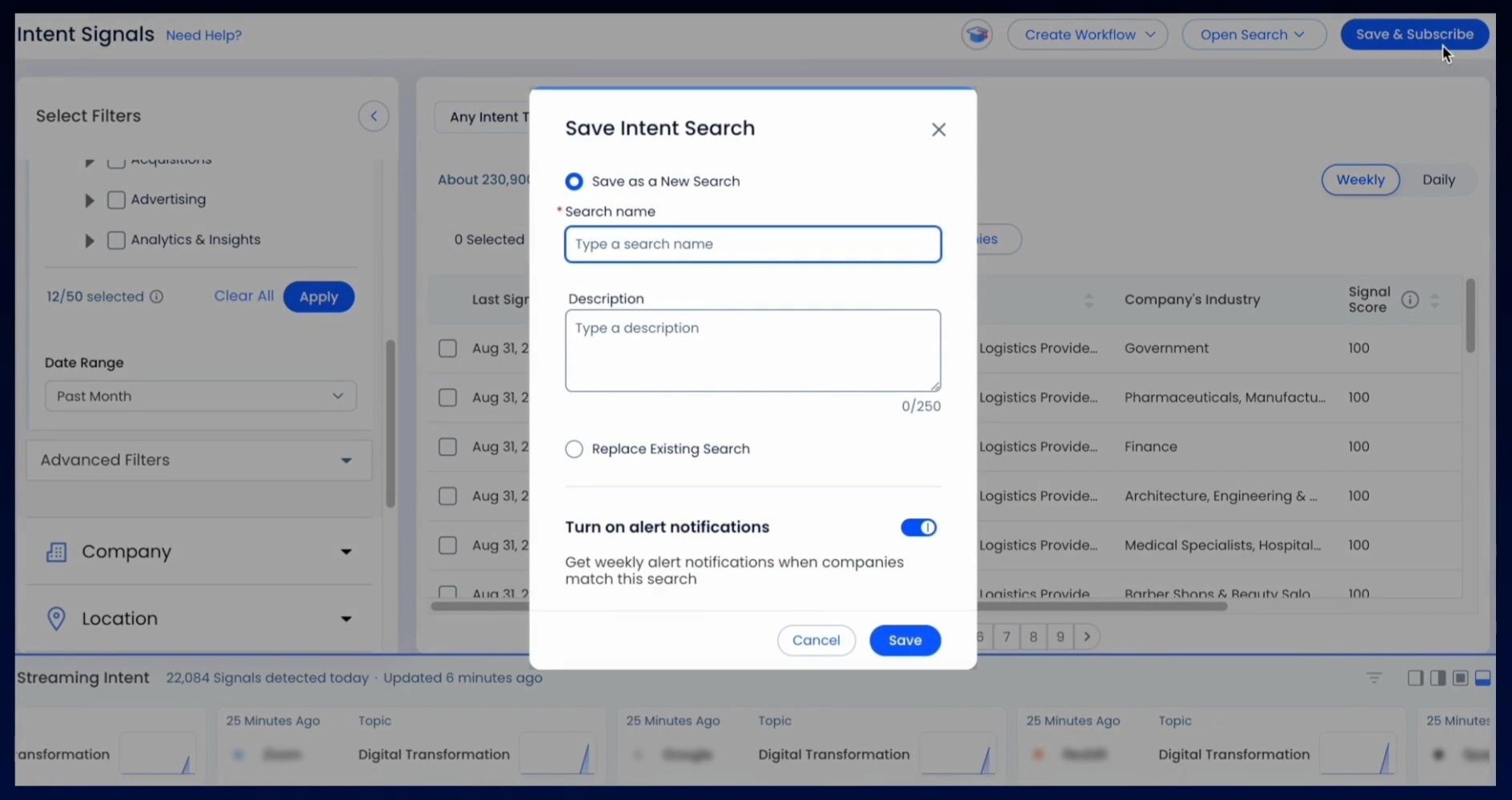
Buyer Intent Data: Tracks signals from 210 million IP-to-Organization pairings and 6 trillion+ keyword-to-device pairings monthly to surface accounts researching solutions like yours
Universal Access: APIs, MCP, GTM Workspace, and GTM Studio deliver intelligence to any tool, team, or workflow
For B2B organizations whose challenge is finding and understanding buyers they haven't reached (not orchestrating data they already have), ZoomInfo provides a different answer to the question "what data platform does our go-to-market team need?"
Why Choose ZoomInfo Over Tealium for B2B Go-to-Market Intelligence
Tealium collects first-party behavioral events and orchestrates them across your marketing stack.
ZoomInfo provides third-party B2B intelligence that tells you who to target, when to engage, and what to say. These are different problems, and the right choice depends on which one is your bottleneck.
B2B Intelligence Data at Scale: Know Every Buyer Before They Know You
Tealium captures the behavioral data your existing customers and website visitors generate: page views, clicks, form submissions, app events. That data helps with personalization and retention. But it tells you nothing about the thousands of potential buyers who have never visited your site, never opened your email, and never entered your CRM.
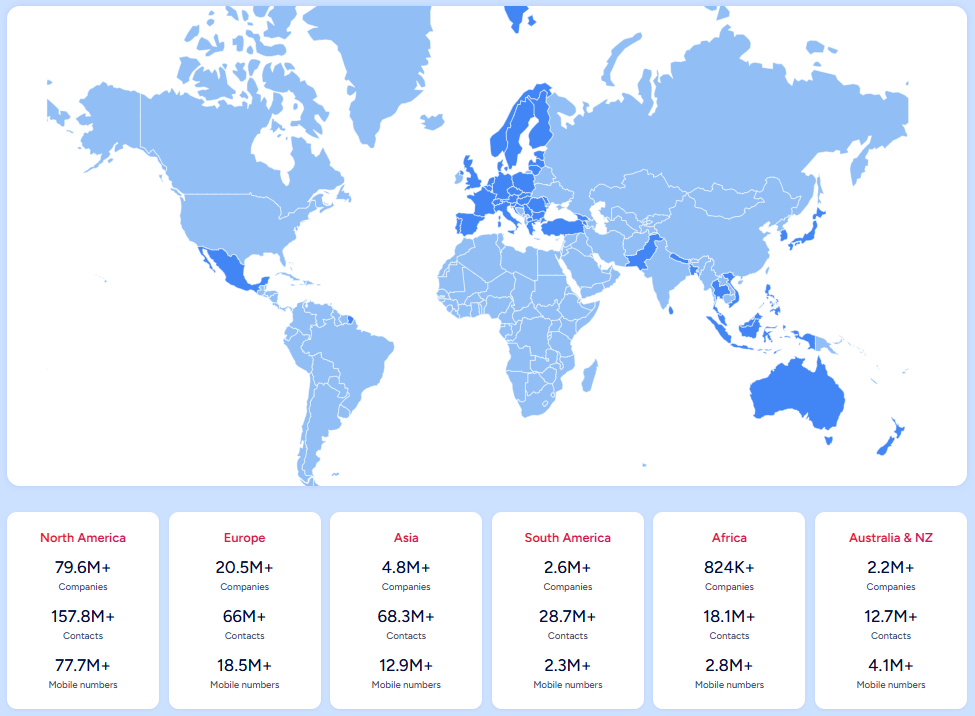
ZoomInfo closes that gap: 500M contacts, 100M companies, 135M+ verified phone numbers, 120M direct dials, and 200M+ verified business emails.
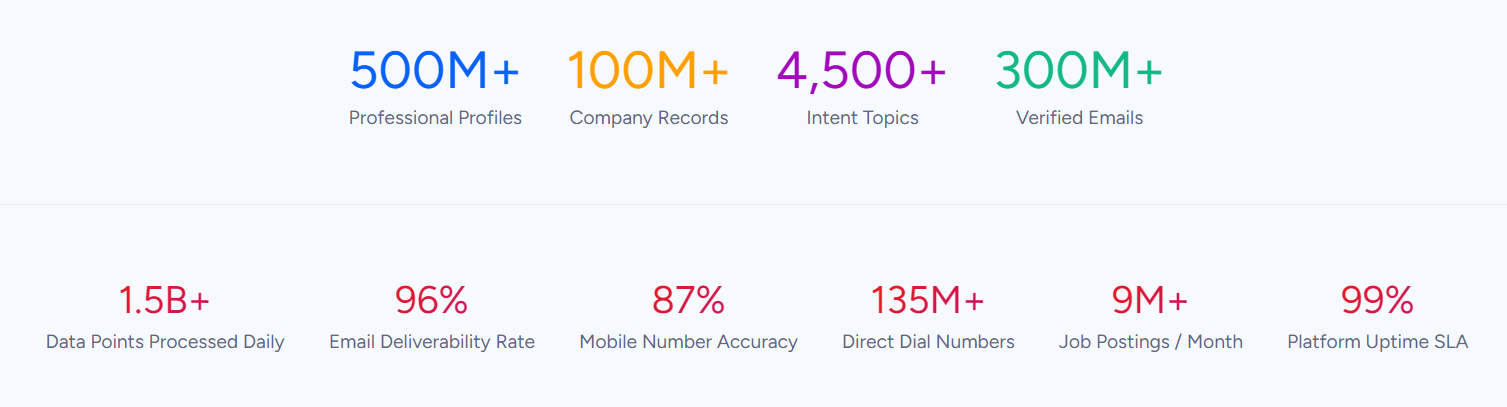
A verification pipeline backs this data: automated ML scanning of 28 million site domains daily, third-party partner data covering 95 million businesses, and an in-house team of 300+ human researchers. The result: direct dials that ring and emails that land.
Beyond contacts, ZoomInfo provides context that makes outreach informed: 300+ company attributes for market segmentation, department org charts with decision-makers identified, technographics tracking 30,000+ technologies across 30M+ companies, and Buyer Intent signals that show when accounts are researching solutions in your category.
Guided Intent, exclusive to ZoomInfo, identifies the intent topics correlated with deal success instead of requiring manual topic selection.
Source: ZoomInfo
This data advantage isn't self-reported. In a Fortune 500 competitive RFP analyzing 25 million contacts across vendors, the independent consultant concluded that "no other competitor came even close."
ZoomInfo in Action: Your marketing team is building account-based campaigns but struggling with incomplete contact data in your CRM.
Instead of waiting for prospects to visit your site (the events Tealium would capture), ZoomInfo provides verified contact information for the entire buying committee at your target accounts. Filter by industry, company size, technology stack, and intent signals to build a targeted list of decision-makers with direct dials and verified business emails you can act on immediately.
SpringDB used ZoomInfo to enable precise targeting for their clients, resulting in 2x to 3x increases in campaign conversions across channels, a 300% increase in database usability, 30-50% uplift in average deal size, and 20-40% reductions in customer churn. (SpringDB Case Study)
GTM Context Graph: Understand Why Deals Move, Not Just That They Moved
Tealium's AudienceStream builds unified customer profiles by stitching behavioral events into a persistent record. This tells you what customers did: which pages they visited, what they clicked, when they converted. It works well for marketing personalization.
ZoomInfo's GTM Context Graph, processing 1.5B+ data points daily, does something different: it captures why things happen in your deals.
It fuses ZoomInfo's B2B data with your CRM records, Chorus conversation intelligence, email interactions, and behavioral signals to connect signals with outcomes.
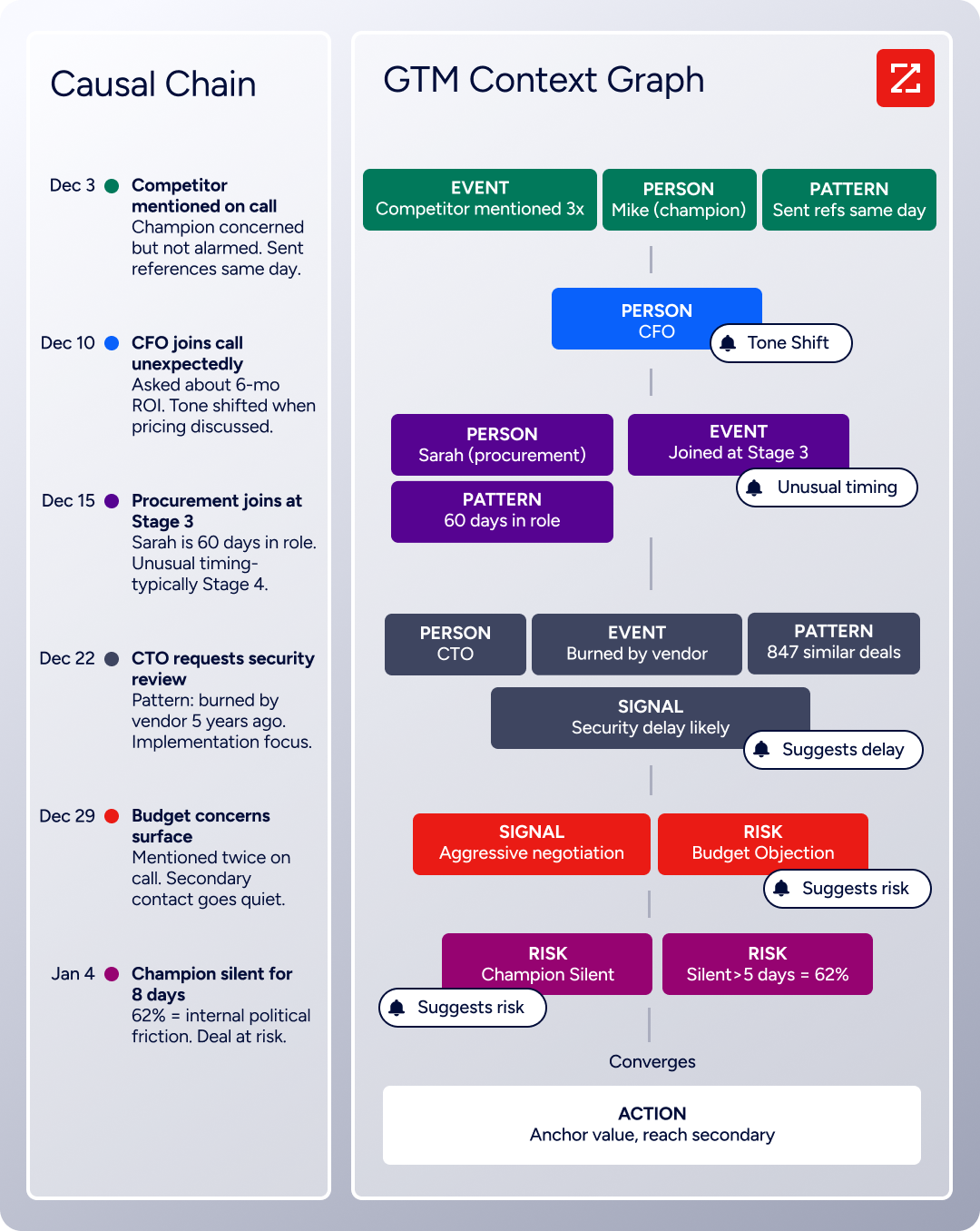
As ZoomInfo's Chief Product Officer Dominik Facher writes: "The CRM recorded the state change. It has no record of why it happened."
The GTM Context Graph captures the decision context: people and their relationships (who influences whom, who's blocking, who's championing), actions and their outcomes (what each action responded to, whether it worked), patterns and predictions (what thousands of similar deals suggest happens next), and exceptions and explanations (why things slipped and what that reveals about real blockers).
ZoomInfo in Action: Your sales team notices a deal has stalled at Stage 3 for two weeks. The CRM just shows a date change. The GTM Context Graph reveals that the CFO joined the last call and asked about six-month ROI (that's what accelerated the deal), while a competitor was mentioned twice in recent meetings.
This context transforms a vague "follow up" task into a specific next step: address the CFO's ROI concern with a relevant case study and acknowledge the competitive evaluation directly.
Seismic attributed 39% of active pipeline to opportunities identified or influenced by ZoomInfo signals, reported 54% productivity gains, and saved 11.5 hours per week per seller. "That combination of our internal CRM data, external signals, and AI that's given all that context has helped us craft very specific account- and persona-based messages." (Seismic Case Study)
Universal Access: Your Intelligence, in Any Tool
Tealium delivers its intelligence through 1,300+ pre-built connectors and a Moments API for real-time profile reads.
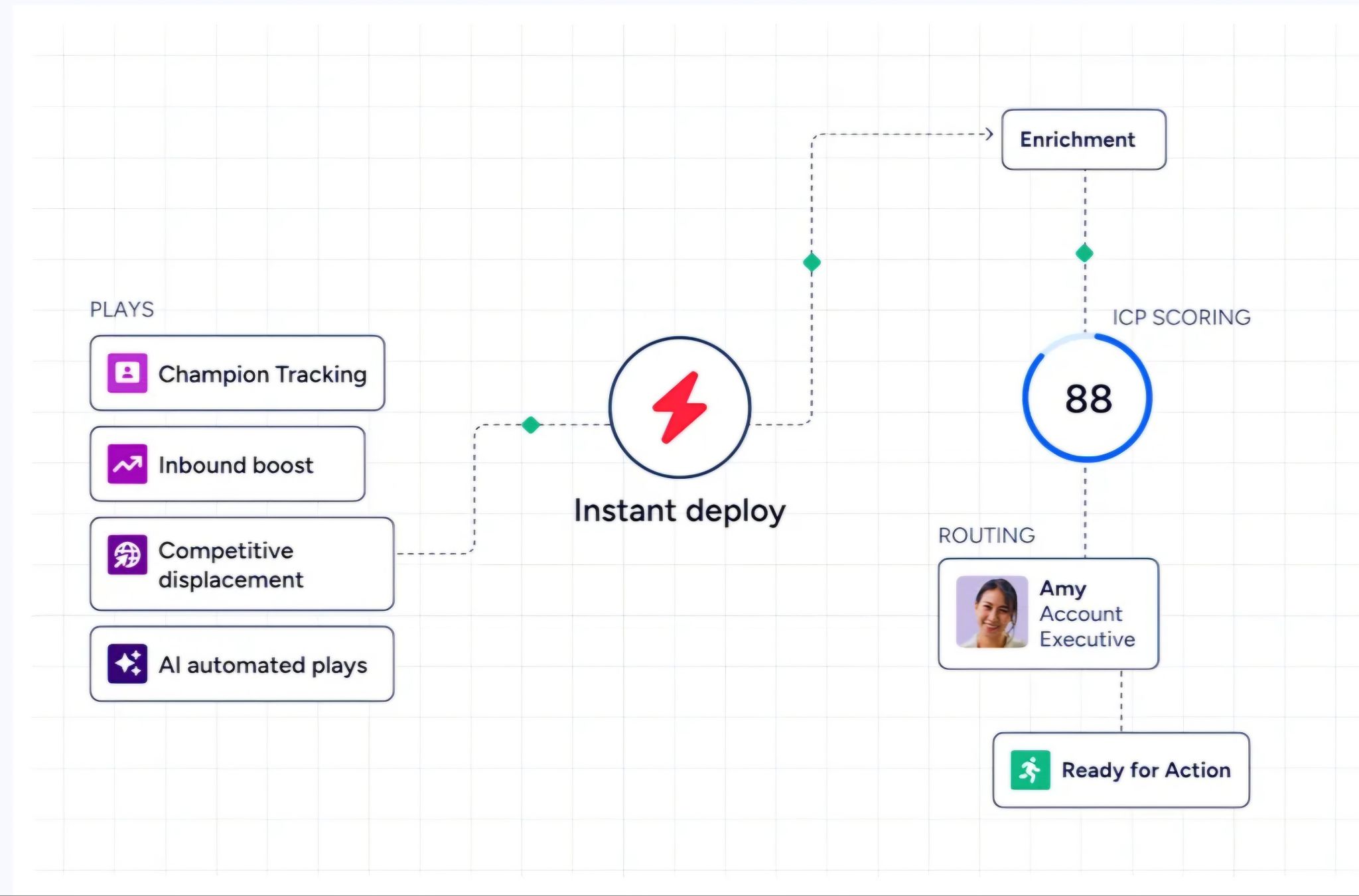
ZoomInfo takes a similar approach but applies it to B2B intelligence rather than behavioral data, offering three access methods:
APIs & MCP: Programmatic access to ZoomInfo's data and GTM Context Graph from any front-end. The MCP server connects AI models to ZoomInfo's data as a native tool, supporting Claude and ChatGPT. API access is included in all relevant plans.
GTM Workspace: The seller's front-end. Prioritized accounts, AI-drafted outreach, and deal execution in one workspace. AI agents research accounts, generate follow-ups, monitor signals, and update CRM fields.
GTM Studio: The marketer and RevOps front-end. Describe audiences in natural language, launch multi-channel plays, and measure pipeline impact in real time, no engineering ticket required.
Source: ZoomInfo
ZoomInfo in Action: Your data team has built GTM workflows across multiple tools. ZoomInfo's API and MCP deliver B2B intelligence into your existing tools instead of locking you into a single vendor's UI. A data engineer at BDO Canada described it this way: "The plug-and-play aspect of the API means I can integrate it very easily into any process and get information at a moment's notice."
BDO Canada achieved an 87% reduction in time spent on updates to their internal data dashboards thanks to ZoomInfo's API, activating high-quality data directly within their internal systems. (BDO Canada Case Study)
NOTE: We considered other B2B intelligence platforms, but ZoomInfo stands out for its data scale, the GTM Context Graph, and access through APIs, MCP, and dedicated interfaces for sellers and marketers. ZoomInfo was named a Leader in the Forrester Wave for Intent Data Providers B2B (Q1 2025) and holds 133 No. 1 rankings on G2 across Sales Intelligence, Buyer Intent, Data Quality, and more.
ZoomInfo Pricing
ZoomInfo uses a consumption-based pricing model where costs depend on usage patterns, number of users, monthly credit volume, features selected, and contract length.
One credit equals one export of a professional or company profile; searching and viewing data within ZoomInfo does not consume credits.
The platform is organized into three product lines:
Sales Plans (Professional, Advanced, Enterprise): From contact and company data to AI-driven account prioritization, buyer intent signals, and GTM plays with advanced automation.
Marketing Plans (Marketing Demand, ABM Lite, ABM Enterprise): From B2B data and audience targeting through dynamic audiences, intent data, and full-funnel analytics with AI insights.
Additional Products: Chorus (conversation intelligence) and Chat (data-powered website chat) are available as standalone add-ons.
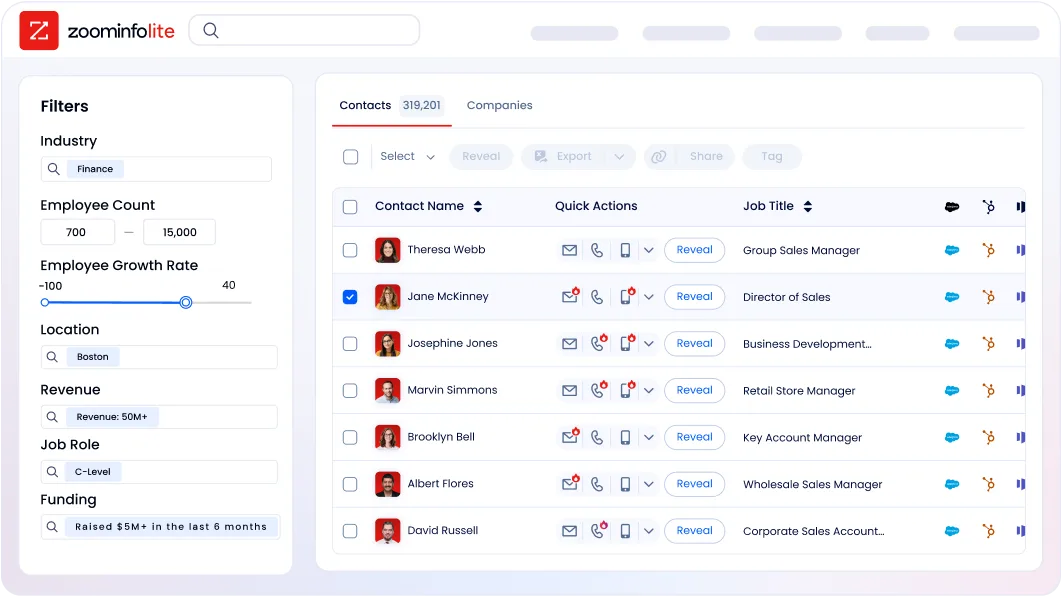
ZoomInfo Lite (Free Tier): ZoomInfo Lite is a permanent free tier, not a trial.
It includes access to ZoomInfo's B2B database with 10 monthly export credits, individual and company searches with advanced filters, the ReachOut Chrome Extension, WebSights Lite (up to 10 website visitor reveals per day), built-in email sending, and HubSpot integration. No credit card, no annual commitment, no time limits.
ZoomInfo also offers a 7-day free trial (separate from Lite) with access to core platform features, intent signals, and email outreach.
Who Should Use ZoomInfo?
Choose ZoomInfo if:
Your primary GTM challenge is finding and engaging buyers you haven't reached, not orchestrating the behavioral data of customers you already know.
You run an enterprise B2B sales or marketing organization and need verified contact data (direct dials, business emails) for the buying committees at your target accounts, with up to 95% accuracy and 120M direct-dial phone numbers available.
You want to understand not just what happened in your deals but why they moved or stalled, using an intelligence layer that fuses your CRM data with external signals.
You need B2B intelligence accessible in any tool, any workflow, or any AI agent via APIs and MCP, rather than locked inside a single vendor's UI.
Ready to see the full picture of your go-to-market opportunity? Start with ZoomInfo Lite for free or request a demo to explore the complete platform.
2. Twilio Segment: Best Alternative for Modular CDP with Transparent Pricing
Twilio Segment is a Customer Data Platform and event collection layer that routes customer behavioral data from any source to 700+ downstream destinations through a single SDK.
It addresses Tealium's core challenge (collecting, unifying, and activating customer data) but takes a developer-first, modular approach with self-serve pricing.
Its key capabilities include:
Connections with 700+ integrations: A single API and set of SDKs that collects events from web, mobile, and server-side sources, then routes them to any destination
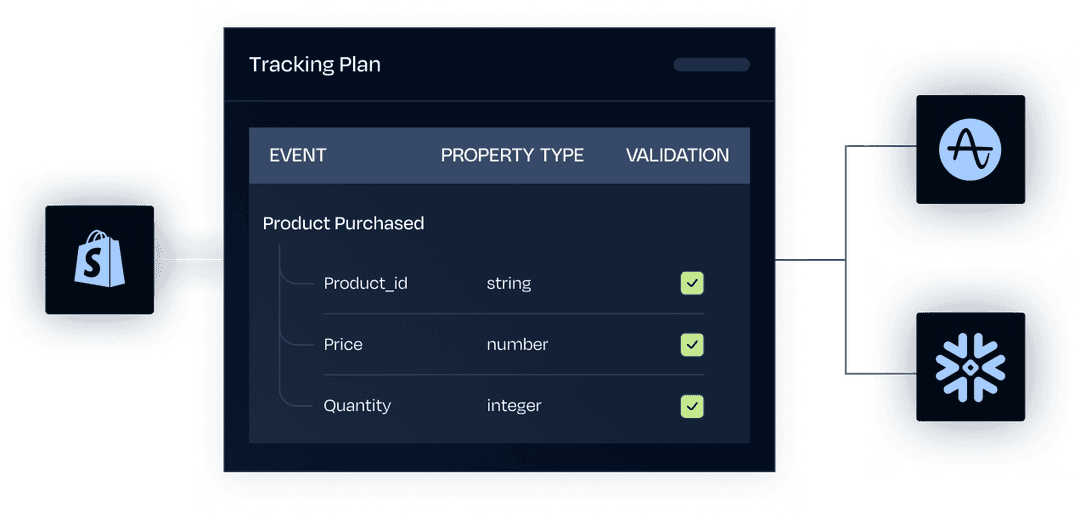
Protocols data governance: Formal schema enforcement that defines the expected shape of every event, catches violations in real time, and blocks malformed data before it reaches downstream tools
Unify identity resolution: Real-time cross-device profile resolution with continuous sync to the customer's data warehouse
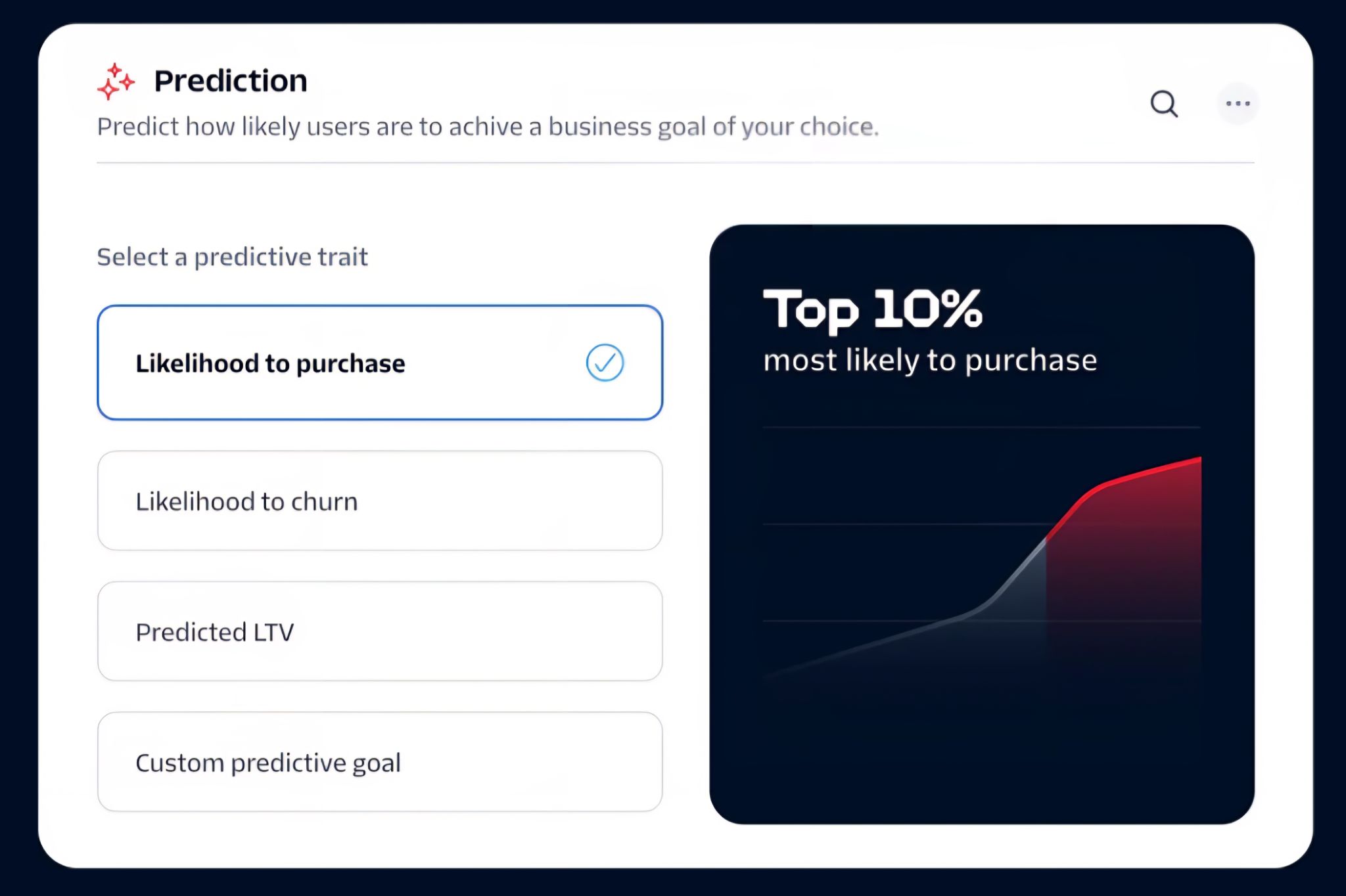
Intelligence (Predictions and Generative Audiences): Built-in AI propensity scoring and natural language audience creation without external ML tooling
Source: Twilio
Why Choose Twilio Segment Over Tealium as Your CDP?
Twilio Segment stands out in the following areas:
Published Pricing and a Self-Serve Entry Point
Tealium has no published pricing on its website, no free trial, and no self-serve sign-up path. Twilio Segment solves this with a published, tiered pricing structure. The free plan covers 1,000 Monthly Tracked Users with 2 sources and 1 warehouse destination, no credit card required.
The Team plan starts at $120/month for 10,000 MTUs with unlimited sources and a 14-day free trial. Teams can instrument tracking, validate integrations, and evaluate data quality before a commercial discussion.
Schema-First Data Governance Through Protocols
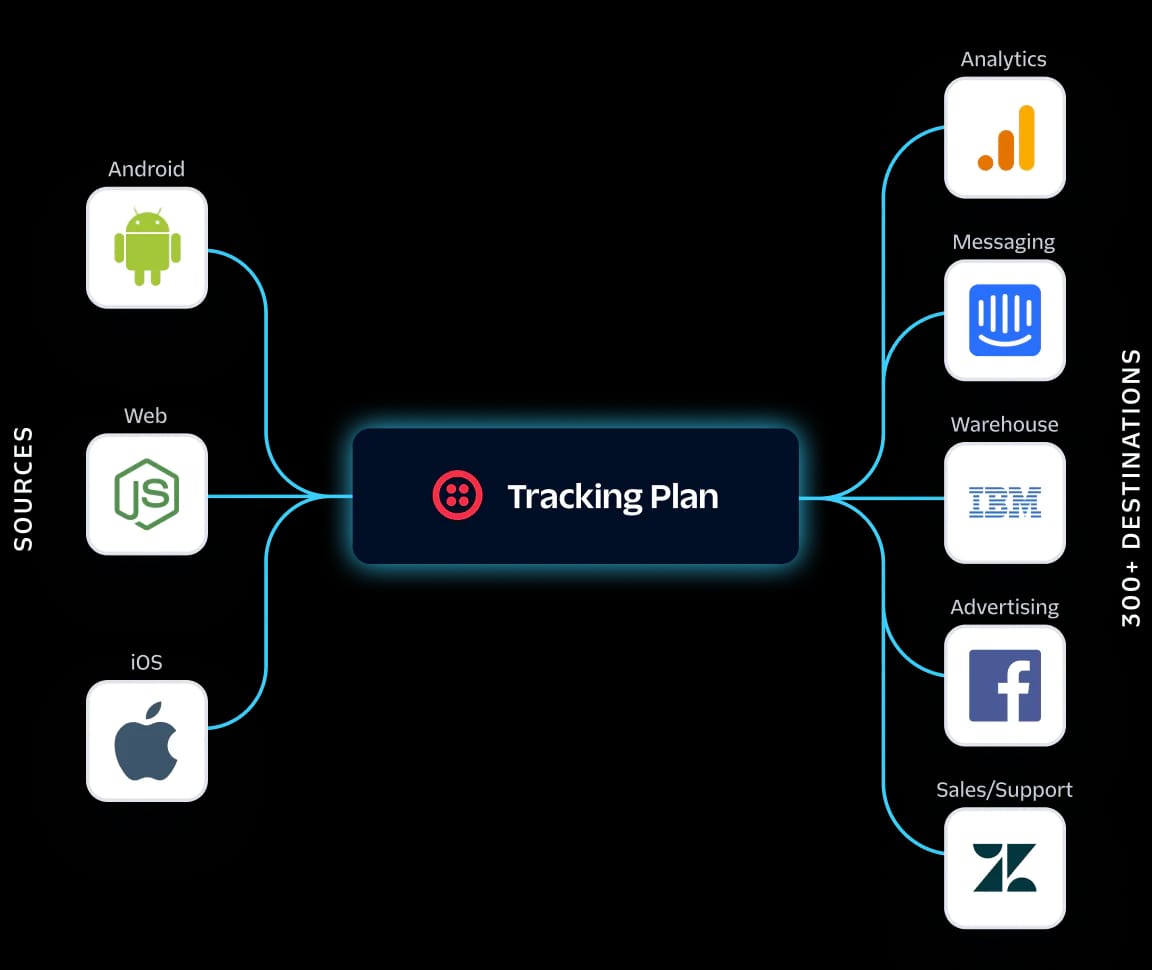
G2 reviewers flag the absence of staging and QA environments in Tealium as a long-standing gap. Twilio Segment's Protocols product provides a formal data tracking plan with schema enforcement between sources and destinations. The Typewriter CLI generates typed client libraries from the Tracking Plan, making schema compliance a compile-time check.
Source: Twilio
Built-In AI Propensity Scoring Without a Data Science Team
Tealium feeds external models but does not provide pre-built propensity models. Twilio Segment's Predictions product provides four model types (Likelihood to Purchase, Predicted Lifetime Value, Likelihood to Churn, and Custom Predictive Goals) trained automatically on historical event data.
The Generative Audiences feature lets marketers describe a target segment in plain English, and AI generates the audience conditions.
NOTE: We also evaluated Treasure Data and Bloomreach. While Treasure Data excels at enterprise data management for retail and manufacturing, and Bloomreach is built for e-commerce personalization, Twilio Segment offers a proven enterprise CDP, the largest certified integration library, a clear modular upgrade path, and the only platform in this tier with self-serve access alongside its enterprise offering.
Twilio Segment Pricing
Twilio Segment offers tiered pricing for its Connections product:
Free Plan: $0/month (permanent), 1,000 MTUs, 2 sources, 1 warehouse destination, 500,000 Reverse ETL records/month, 550+ destination integrations. No credit card required.
Team Plan: Starts at $120/month for 10,000 MTUs, unlimited sources, Public API access. 14-day free trial. Annual billing saves up to 20%.
Business Plan: Custom pricing. Adds Protocols data governance, advanced roles, HIPAA eligibility, and EU data residency.
CDP Bundle (Connections + Unify + Engage): Custom pricing through contact sales. Adds identity resolution, audience building, journey orchestration, AI Predictions, and Generative Audiences.
Who Should Use Twilio Segment?
Choose Twilio Segment if:
You need to assess CDP costs and validate the integration layer against your stack before entering an enterprise procurement cycle.
Your martech stack includes five or more tools and engineering spends disproportionate time maintaining separate tracking implementations for each one.
You require data governance at the collection layer with a formal tracking plan that enforces event schemas in real time.
You want ML-powered propensity scoring delivered to marketers without maintaining a separate data science team.
3. mParticle: Best Alternative for Mobile-First Data Quality and AI-Native Predictions
mParticle is a hybrid Customer Data Platform that combines real-time event streaming with warehouse-native composable activation, built for multi-channel consumer brands where mobile apps generate the primary behavioral signal.
Now operating as "mParticle by Rokt" after a January 2025 merger backed by $300 million, it delivers identity resolution, schema enforcement, and AI predictions through a single pipeline.
Its key capabilities include:
IDSync: Configurable, deterministic cross-device identity resolution built for mobile-native environments
Data Plans with Schema Enforcement: Validates incoming events against defined schemas in real time, optionally blocking malformed data before it reaches any downstream tool
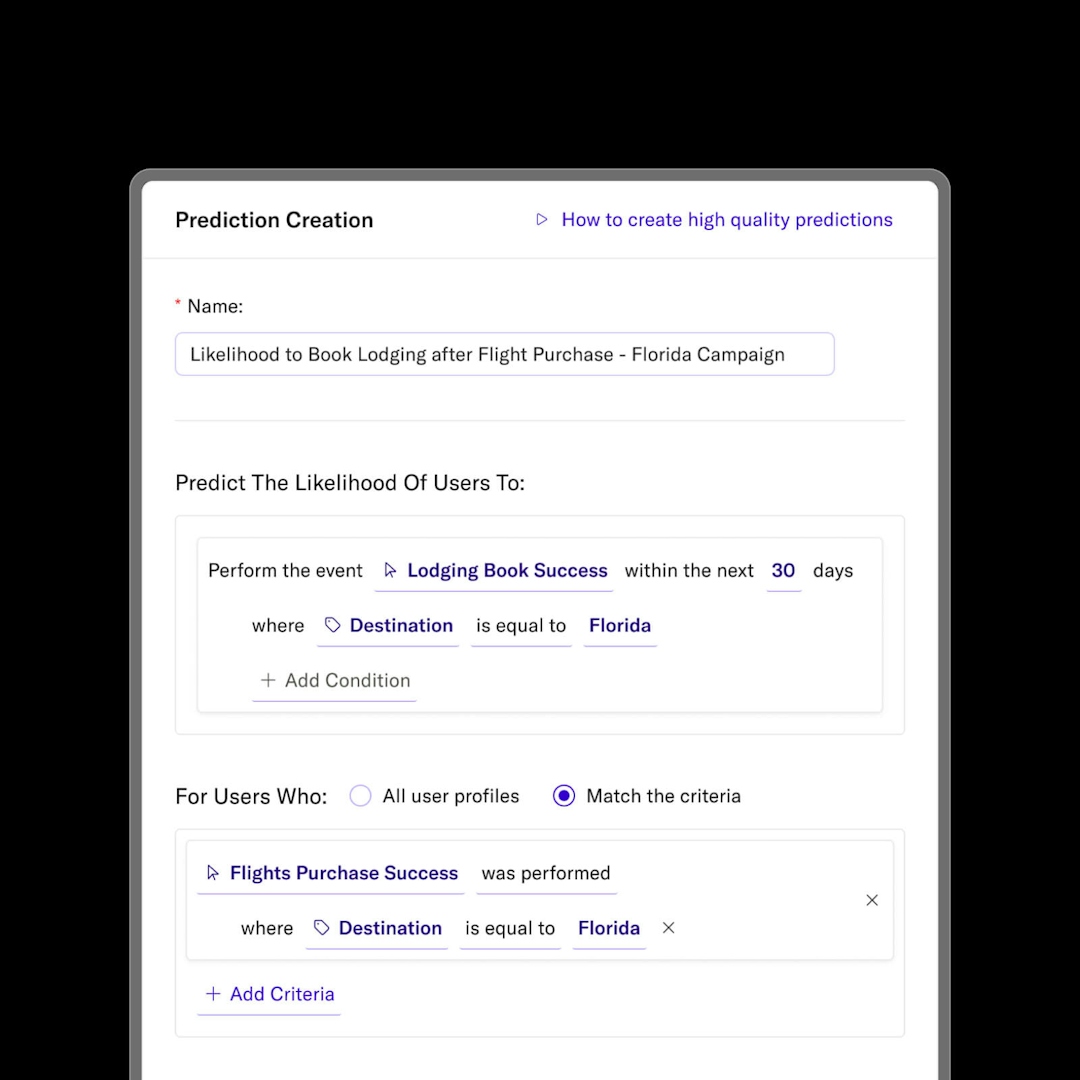
Cortex AI and ML Predictions: Native machine learning for churn risk scoring, purchase propensity, next best action, and lookalike modeling
300+ Mobile-Native Integrations: Server-side, API-based connectors covering the mobile marketing and analytics stack
Source: mParticle
Why Choose mParticle Over Tealium for Mobile-First Data Quality?
mParticle stands out in the following areas:
IDSync: Configurable Mobile-Native Identity Resolution
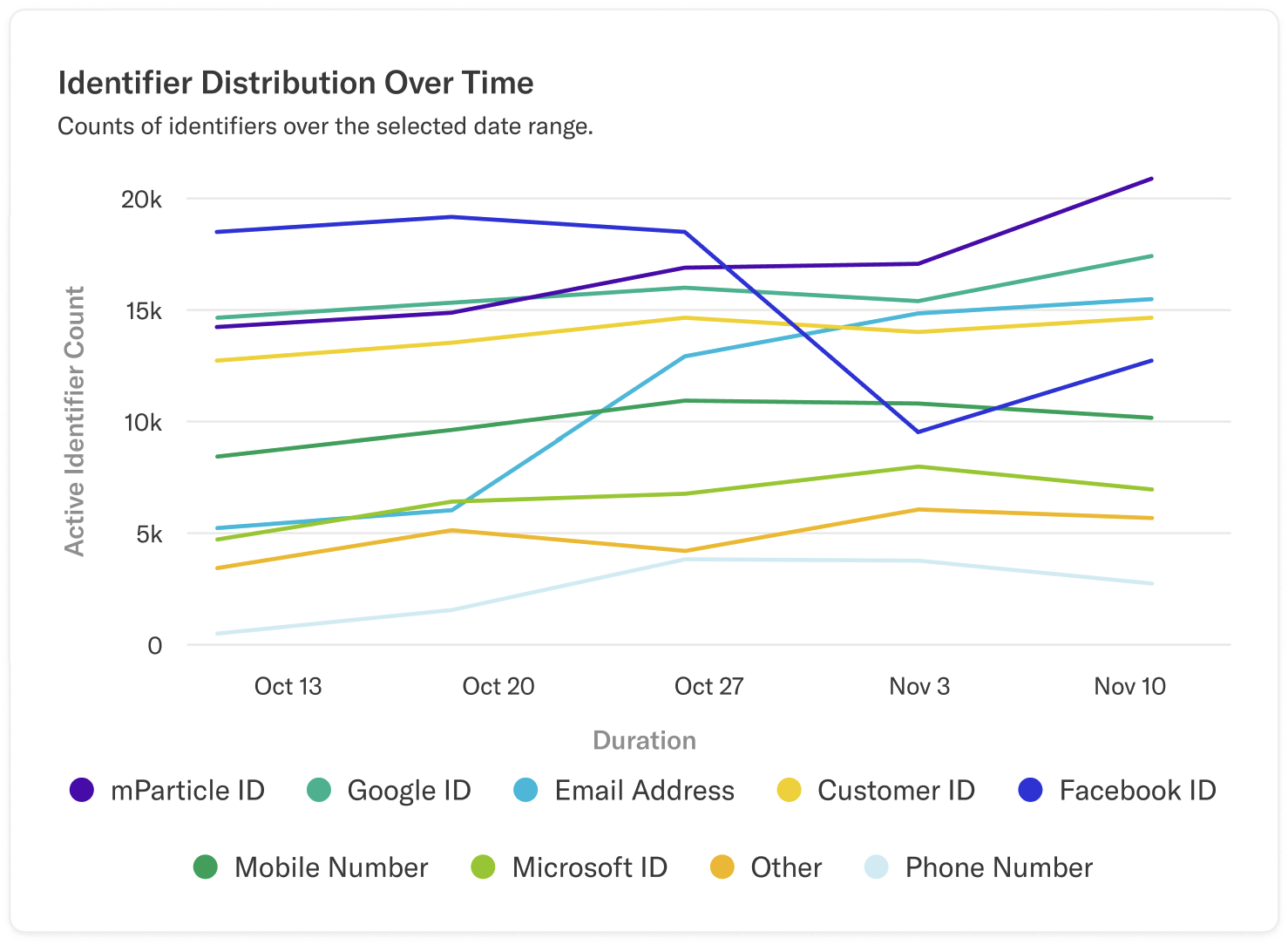
Tealium's visitor stitching was designed for web sessions. mParticle's IDSync framework was built for mobile identity fragmentation, exposing four API endpoints (/identify, /login, /logout, /search) and five identity strategies that define what happens to pre-login anonymous data when a known identifier arrives.
An Identity Dashboard and Identity Logs provide per-call logs of every resolution request and outcome.
Source: mParticle
Data Plans: Schema Enforcement at the Collection Boundary
Tealium's data quality model is distributed across tag templates, extension configurations, enrichment rules, and connector mappings.
mParticle's Data Plans enforce a schema contract at the point of ingestion: each incoming event is validated against a named plan, and teams can configure the platform to block malformed events before they reach profile storage or any downstream output. The Data Planning API allows plans to be managed programmatically and integrated into CI/CD pipelines.
Cortex AI: Native Predictive Intelligence Without Separate ML Infrastructure
Tealium feeds models but does not ship propensity models as native features. mParticle's Cortex engine provides Predictive Audiences, Predictive Attributes, Next Best Action, Uplift Modeling, and Lookalike Audiences as native features.
A marketer specifies a goal event, and Cortex automatically builds and retrains the model against the mParticle event stream. No SQL, no data science headcount required.
NOTE: We also evaluated Mixpanel and Amplitude. While Mixpanel excels at behavioral analytics and funnel visualization, and Amplitude offers strong product analytics with good data infrastructure depth, mParticle offers the most complete CDP built for product-led growth companies with significant mobile traffic, where data quality enforcement and AI predictions matter more than broader analytics depth.
mParticle Pricing
mParticle operates on a credits-based pricing model with no published rates, no self-serve sign-up, and no free plan.
All platform features are accessible at any credit commitment level; there are no gated feature tiers. Credits are consumed based on event volume. All pricing is obtained through a custom quote.
Who Should Use mParticle?
Choose mParticle if:
Your customer data originates primarily in native iOS and Android apps and you need identity resolution that handles mobile identity fragmentation without custom stitching logic.
Your team has experienced data quality problems caused by malformed events or inconsistent tracking, and you want schema enforcement that catches violations at the point of collection.
You need AI predictions (churn scores, purchase propensity, next best action) as a native CDP feature without adding a separate ML platform.
4. Piwik PRO: Best Alternative for Privacy-First Analytics with Integrated Consent Management
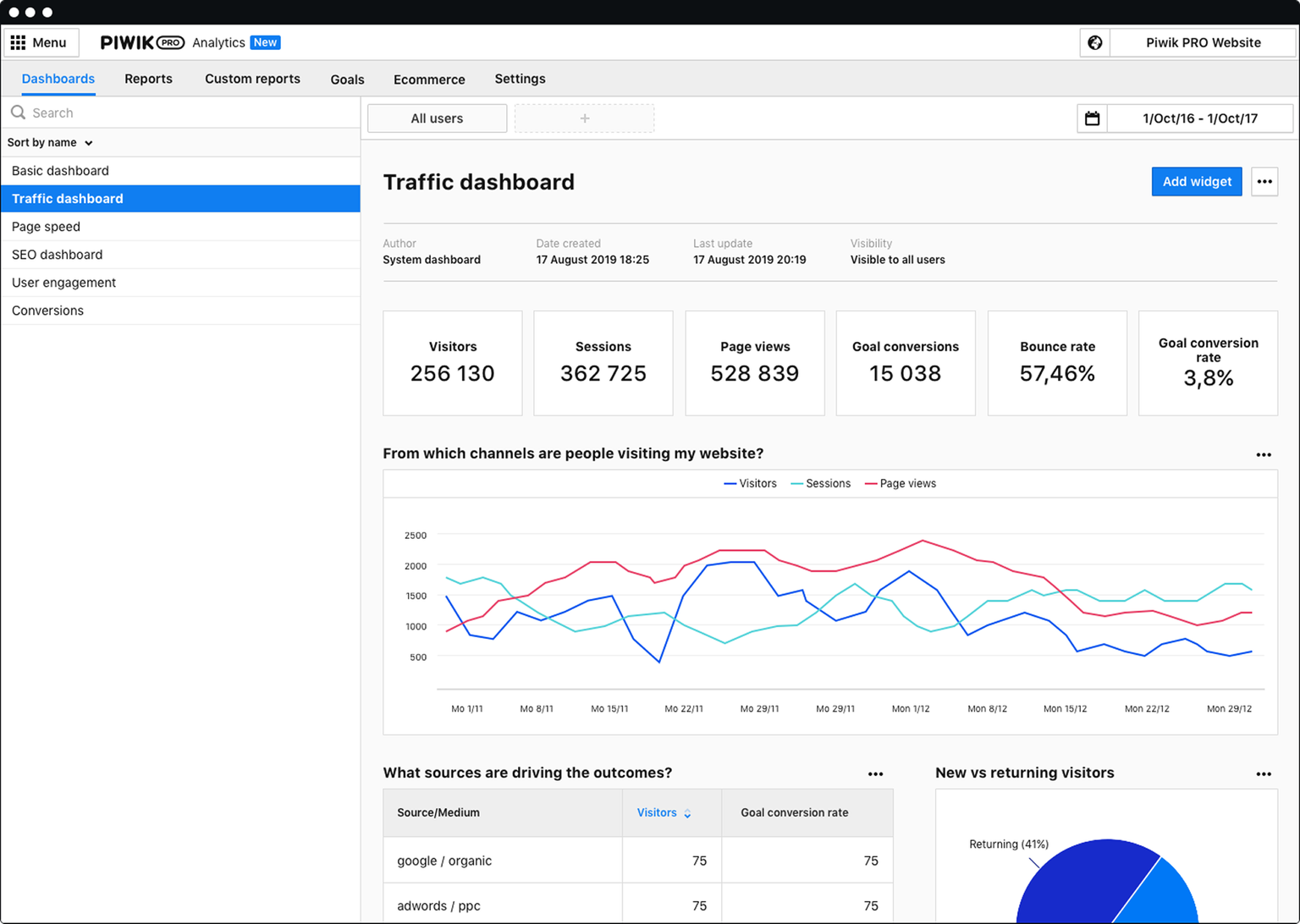
Piwik PRO is a privacy-first analytics and data activation suite that combines web analytics, tag management, consent management, and a customer data platform in a single product.
Source: Piwik PRO
It is a direct alternative to Tealium for regulated-industry organizations that need behavioral data under strict compliance conditions.
Its key capabilities include:
Integrated four-module platform: Analytics, Tag Manager, Consent Manager, and Data Activation under one license
Native consent management: Consent collection, tag-firing enforcement, and audit logging built as a first-class module
On-premise and private cloud deployment options alongside EU public cloud
Server-side tracking with a first-party collector and integrations with GTM Server-Side, JENTIS, Stape, and TAGGRS
30-day free trial of the full Business plan with no credit card required
Why Choose Piwik PRO Over Tealium for Privacy-First Analytics?
Piwik PRO stands out in the following areas:
Integrated Analytics Inside the Same Platform
Tealium is not an analytics product; organizations need a separate analytics layer (GA4, Amplitude, or similar) to interpret the behavioral data Tealium collects.
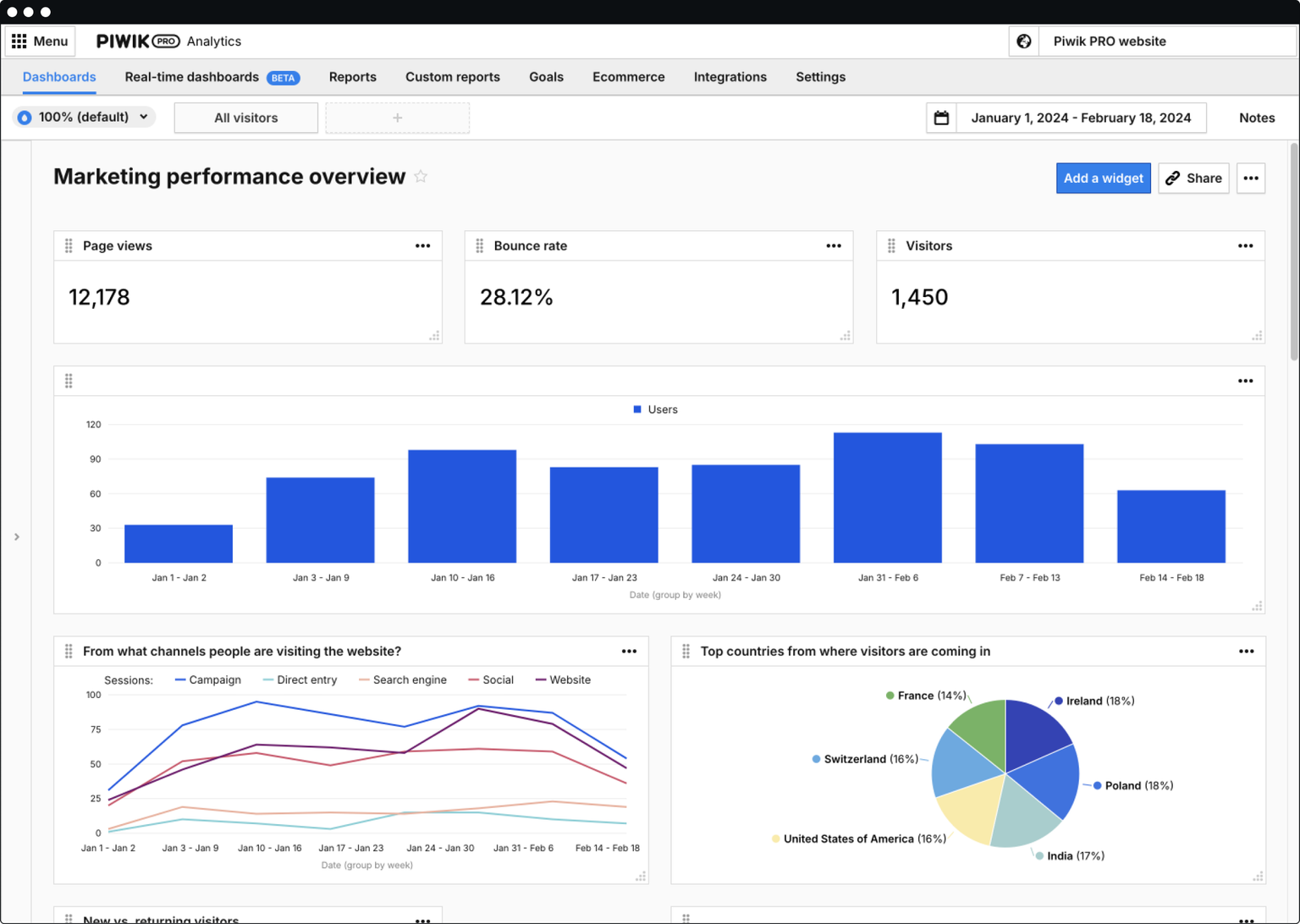
Piwik PRO includes a web analytics module as a core part of the suite: audience reports, acquisition reports, funnel tracking, custom dimensions, heatmaps, and real-time dashboards (refreshing every 10 seconds), all reading from the same tracking data that feeds consent and data activation.
Source: Piwik PRO
Consent Management as Architecture, Not an Integration
Tealium's consent enforcement relies on integrations with OneTrust, Didomi, and Usercentrics, which remain separate systems. Piwik PRO's Consent Manager is not a bolt-on; it is the same platform that runs analytics and fires tags. Each tag is categorized by one of eight consent types, and the platform produces a verified zero cookie load for unconsenting visitors.
Data Residency and Private Cloud Deployment
Tealium is SaaS-only. Piwik PRO lets customers remove Piwik PRO as a data processor by running on a private cloud, with 60+ Azure locations worldwide. For healthcare organizations, Piwik PRO provides HIPAA-certified Azure infrastructure in the US with a signed BAA.
A Reachable Entry Point Where Tealium Has None
Piwik PRO's Business plan starts at €35/month and is purchasable directly on the website; a 30-day free trial of the full platform activates immediately with no credit card required.
NOTE: We also evaluated Matomo and Plausible Analytics. While Matomo offers strong open-source analytics with EU-hosted cloud options, its CDP and activation capabilities are more limited. Plausible Analytics is a well-regarded privacy-first analytics tool but is analytics-only, with no tag management, consent management, or CDP activation.
Piwik PRO is the only platform in this category that combines all four modules in a single product with a self-serve business plan.
Piwik PRO Pricing
Business Plan: Starts at €35/month. All four modules included. Up to 2M actions/month and up to 20 root domains. EU public cloud hosting in Sweden (Elastx). 25 months data retention. 30-day free trial with no credit card required.
Enterprise Plan: Starts at €366/month billed annually; custom-quoted. Choice of public cloud data center or private cloud. SOC 2 Type II, SSO, and HIPAA BAA. Dedicated account manager on higher sub-tiers.
Who Should Use Piwik PRO?
Choose Piwik PRO if:
Your organization operates under GDPR, HIPAA, or similar regulations where routing behavioral data through SaaS-only vendors is a compliance liability.
You need both web analytics and a customer data platform in one system, rather than running separate vendors for analytics, tag management, and consent.
Your marketing and analytics team lacks dedicated data engineering support and needs a platform accessible enough for a digital analyst to configure.
5. Hightouch: Best Alternative for Warehouse-Native Customer Data Activation
Hightouch is a warehouse-native composable CDP that routes customer data from Snowflake, BigQuery, Databricks, or Redshift into 250+ marketing, sales, and advertising destinations without copying data into its own storage.
Tealium manages its own event pipelines and profile store. Hightouch enters at the activation layer, assuming organizations have already centralized their data in a warehouse.
Its key capabilities include:
Reverse ETL: Sync customer models from the data warehouse to 250+ destinations with no intermediate data copy
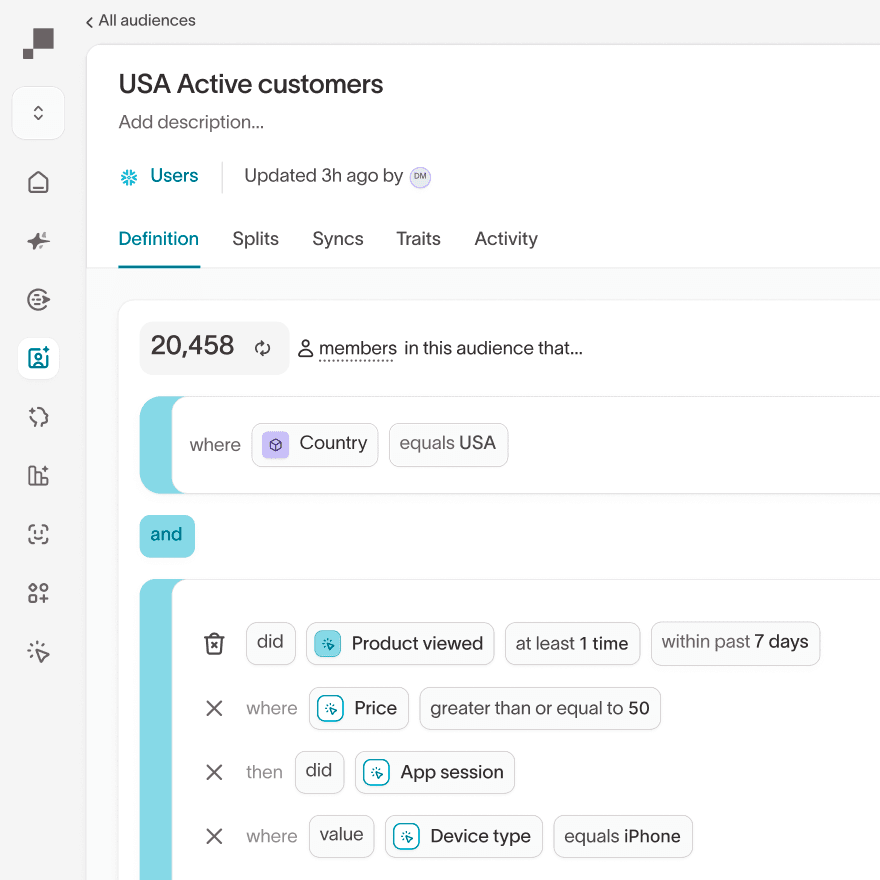
Customer Studio: A no-code visual audience builder that runs directly on warehouse data without requiring SQL
Source: Hightouch
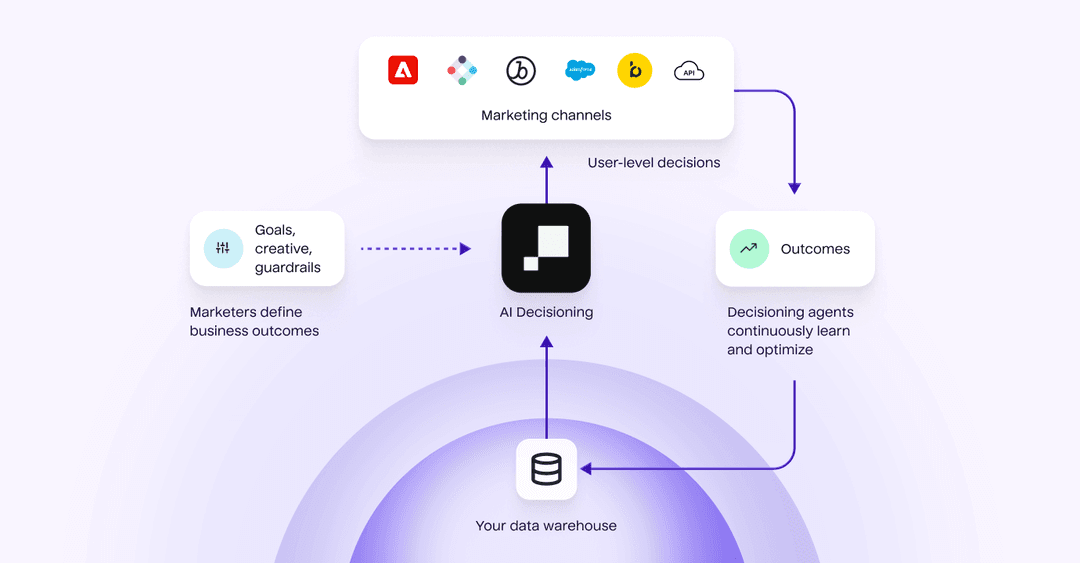
AI Decisioning: A reinforcement learning engine that optimizes message content, channel, timing, and creative for each customer
Identity Resolution: Deterministic and probabilistic matching processed inside the customer's own warehouse
Why Choose Hightouch Over Tealium for Warehouse-Native Activation?
Hightouch stands out in the following areas:
Single-Purpose Specialist Architecture
Tealium's reverse ETL (Data Cloud Activation) is part of a larger platform the team must configure and maintain. Hightouch made the opposite bet: build the best warehouse-to-destination activation layer.
The result is 250+ managed connectors with per-destination field mapping, sync mode configuration, row-level debugging, and a Lightning sync engine that uses the warehouse's own computer.
Customer Studio for Marketer Self-Service
G2 reviewers note that Tealium's interface becomes difficult to navigate at scale. Hightouch's Customer Studio bridges the gap between warehouse data and marketer self-service: visual interface, real-time audience size previews, a Traits engine for calculated attributes, and audience splits for A/B testing.
AI Decisioning Replaces Rule-Based Campaigns
Tealium feeds external models but does not optimize campaigns itself. Hightouch's AI Decisioning uses reinforcement learning to optimize message content, channel, send time, creative variant, and frequency for each customer. Where Tealium expects you to bring your own optimization model, AI Decisioning is the model.
Source: Hightouch
NOTE: We also evaluated Census and dbt. While Census is a competent reverse ETL specialist, it lacks Hightouch's AI Decisioning engine and Customer Studio depth. dbt is a data transformation layer but provides no data activation capability. Hightouch offers the most complete warehouse-native activation package: SQL syncs for engineers, self-service for marketers, and AI campaign optimization.
Hightouch Pricing
Free Tier (Permanent): 2 active syncs/month, all 250+ integration types, unlimited user seats. No trial expiration.
Self-Serve Paid: Up to 10 active syncs. Pricing not publicly listed.
Composable CDP (Business Tier): Usage-based pricing. Includes Customer Studio, Identity Resolution, Real-time Personalization, Match Booster. Quote-based.
AI Decisioning: Separate usage-based pricing based on monthly personalized actions. Quote-based.
Who Should Use Hightouch?
Choose Hightouch if:
Your organization already has a cloud data warehouse with well-modeled customer data and your primary bottleneck is activating that data into your marketing stack.
Your marketing team is hitting engineering ticket queues every time they need a new audience, and you need a self-service builder that runs directly on warehouse data.
Your lifecycle marketing runs on rule-based journeys and you want an AI optimization layer that personalizes across message, channel, and timing.
6. RudderStack: Best Alternative for Developer-First Data Infrastructure with Full Data Ownership
RudderStack is a warehouse-native, open-source customer data infrastructure platform built for data engineering teams that need full control over their data pipelines. It operates as a complete CDP pipeline without ever storing customer data on its own infrastructure.
Source: RudderStack
Its key capabilities include:
Real-time event collection via 16+ SDK sources and 200+ cloud destinations
Warehouse-native identity resolution and Customer 360 profile building (Profiles)
Reverse ETL to activate warehouse data downstream
In-pipeline JavaScript and Python transformations for real-time data enrichment
Full open-source self-hosting under AGPL-3.0, with SDKs under MIT
Why Choose RudderStack Over Tealium for Data Ownership?
RudderStack stands out in the following areas:
Open-Source Self-Hosting at Zero Cost
The core RudderStack data plane is open-source under AGPL-3.0, free to self-host on any infrastructure. Teams can deploy via Docker or Kubernetes on AWS, GCP, Azure, or any private infrastructure. Tealium has no open-source option, no self-hosted path, and no published pricing.
For organizations whose InfoSec teams refuse to let event data pass through vendor infrastructure, RudderStack self-hosting is the most direct path.
Published, Predictable Pricing
RudderStack's Free plan offers 250,000 monthly events at no cost forever, and the Starter plan begins at $220/month for 1 million monthly events. G2 reviewers flag Tealium's event-based pricing as unpredictable, with no published figures to plan against. RudderStack makes the pricing math explicit and public.
Warehouse-First Architecture: Zero Vendor Data Storage
All event data flows directly to the customer's own warehouse with sync times as fast as five minutes on Enterprise tier. As the security page states: "We do not store your data, giving you complete ownership, control and transparency."
Tealium's AudienceStream still builds profiles in Tealium-managed infrastructure, and DataAccess persists data in Tealium-managed Amazon S3 and Redshift Spectrum.
Developer Tooling and Infrastructure-as-Code
Terraform providers, a CLI, and SDKs in JavaScript, Python, Go, Ruby, PHP, Rust, and .NET allow engineering teams to manage data pipelines as code. Transformation logic is version-controlled with full PR and review workflows. RudderStack also integrates with Apache Airflow and Dagster for pipeline orchestration.
NOTE: We also evaluated PostHog and Snowplow. While PostHog excels at product analytics and feature flagging, it is not a general-purpose CDP data routing layer. Snowplow is a strong open-source event collection framework but requires significant engineering to extend toward full CDP activation and lacks RudderStack's permanent free cloud tier. RudderStack offers the best combination of a free cloud tier, open-source self-hosting, and a full CDP pipeline.
RudderStack Pricing
Free (forever): $0/month. 250,000 monthly events. 16+ SDK sources, 200+ cloud destinations, Reverse ETL (10 connections). 3-hour warehouse sync.
Starter: $220/month. 1 million monthly events. Unlimited tracking plans, email support, 99.95% uptime SLA. 1-hour warehouse sync.
Growth: Custom pricing. Custom event volume. Unlimited Transformations, dedicated support. 30-minute warehouse sync.
Enterprise: Custom pricing. Everything in Growth plus Python Transformations, Profiles & Data Apps, HIPAA compliance with BAA, SSO, 5-minute warehouse sync.
Open-Source Self-Hosted: Free software (AGPL-3.0). Infrastructure/hosting costs borne by the customer.
Who Should Use RudderStack?
Choose RudderStack if:
Your team uses Snowflake, BigQuery, Databricks, or Redshift as the primary data platform and wants a CDP pipeline that treats the warehouse as the system of record from day one.
You need published, predictable event-based pricing before entering a sales conversation, or you want a permanently free cloud tier.
Your data engineering team wants to manage data pipelines as code using the same infrastructure-as-code practices applied to the rest of your stack.
Your compliance posture requires zero customer event data stored in third-party infrastructure.
7. Amperity: Best Alternative for AI-Native Enterprise Identity Resolution
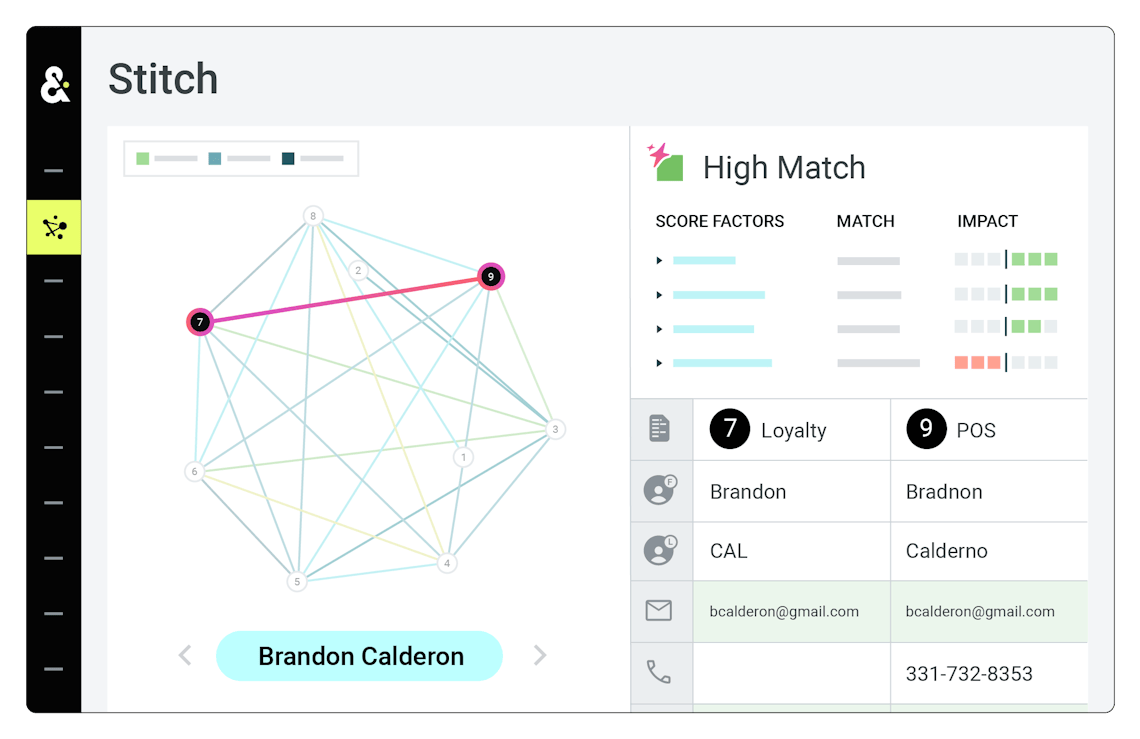
Amperity is a Customer Data Cloud built for large consumer enterprises that need to unify fragmented customer data across dozens of disconnected systems (loyalty programs, point-of-sale, e-commerce, call centers) into a single, probabilistically matched identity.
Tealium's AudienceStream relies on deterministic, first-party identifier matching. Amperity's patented Stitch engine combines deterministic and probabilistic matching using up to 45 AI models.
Source: Amperity
Its key capabilities include:
Stitch AI Identity Resolution: Patented matching engine backed by peer-reviewed research published at SIGMOD 2020 and five patents
Identity Resolution Agent: Launched April 2025 as the first AI agent of its kind in the CDP category, automating ongoing fragmented record detection and resolution
AmpAI Analytics Layer: Generative AI for summarizing segment characteristics and generating next-best-action recommendations in plain language
200+ pre-built source connectors and 200+ activation destinations with SOC 2, GDPR, HIPAA, and CCPA certifications
Why Choose Amperity Over Tealium for Enterprise Identity Resolution?
Amperity stands out in the following areas:
Probabilistic Identity Resolution for Messy Enterprise Data
Tealium's AudienceStream resolves identity deterministically: it stitches profiles when a visitor provides a known identifier like an email or login ID. This works for web-centric deployments.
It breaks down when the same person appears as "Jane Smith" in the loyalty database, "J. Smith" in the POS system, "jane.smith@gmail.com" in e-commerce, and "jsmith@work.com" in the email tool.
Amperity's Stitch engine runs a seven-stage pipeline combining semantic tagging, blocking, and machine learning scoring across name, email, address, phone, and birthdate using Jaro-Winkler distance, Levenshtein similarity, and population-level rarity distributions.
The First AI Agent for Ongoing Identity Maintenance
New fragmented records arrive daily. Tealium has no automated capability for this. Amperity launched its Identity Resolution Agent in April 2025, automating detection, evaluation, and resolution of fragmented records as they enter the platform. What was previously a recurring sprint for the data engineering team becomes a supervised, model-driven pipeline.
Built-In Generative AI Analytics Tealium is a data orchestration layer; built-in analytics and insight generation are widely cited as gaps. Amperity addresses this with AmpAI, a generative AI layer that summarizes segment characteristics, surfaces audience insights, and generates next-best-action recommendations in plain language, without SQL or analyst work.
NOTE: We also evaluated GrowthLoop and ActionIQ. While GrowthLoop is a composable CDP built on warehouse infrastructure, it is less proven at enterprise identity scale. ActionIQ delivers strong enterprise activation but its identity resolution is less developed than Amperity's Stitch approach. Amperity offers the most mature identity resolution for consumer enterprises managing millions of fragmented records.
Amperity Pricing
Amperity uses a consumption-based pricing model built around "Amps," a standardized measure of platform usage that scales with processing volume, segment building, identity resolution, and audience activation.
Storage is metered separately in terabytes.
Standard Edition: Full platform access. Support: 6am-6pm PT, Monday-Friday. Up to 10% of unused Amps roll over.
Enterprise Edition: Identical platform capabilities. 24/7 support with enhanced SLAs. Private instructor-led training.
No public pricing is disclosed; all contracts require a sales engagement. Premium paid media connectors (Facebook, Google Ads, TikTok Ads, Amazon Ads, The Trade Desk) carry an additional flat fee of 25,000 Amps per connector per month.
Who Should Use Amperity?
Choose Amperity if:
Your customer records arrive from ten or more systems with inconsistent naming conventions and mismatched identifiers, and your current identity approach leaves significant fragmented records unresolved.
You operate in retail, travel, hospitality, or financial services, where Amperity has the deepest pre-built data models and the most relevant transactional and loyalty attributes.
You are already invested in Databricks or Snowflake and need a CDP that shares data via zero-copy architecture rather than requiring a separate data copy.
Your identity challenge extends to post-M&A data merging, where consolidating customer databases from acquired brands is critical.
The Final Verdict
Tealium excels as a full-stack customer data orchestration platform for enterprises, but different organizations need more specialized or different solutions.
Based on our research, here are the best alternatives:
ZoomInfo for B2B go-to-market intelligence, buyer intent signals, and AI-driven GTM execution
Twilio Segment for modular CDP architecture with transparent, self-serve pricing and built-in AI predictions
mParticle for mobile-first data quality, schema enforcement, and native AI predictions
Piwik PRO for privacy-first analytics with integrated consent management and private cloud deployment
Hightouch for warehouse-native customer data activation with AI campaign optimization
RudderStack for developer-first data infrastructure with full data ownership and open-source flexibility
Amperity for AI-native enterprise identity resolution across fragmented consumer data systems
You don't have to choose between Tealium and these alternatives. Many organizations use Tealium alongside specialized tools. Consider your needs, technical capacity, and growth plans when deciding.
Ready to see what B2B intelligence can do for your go-to-market strategy? Start with ZoomInfo Lite for free, or request a demo to explore how ZoomInfo's GTM Context Graph, verified B2B data, and open access help your team find, win, and grow customers.
Tealium Alternatives FAQ
Why do organizations look for Tealium alternatives?
Tealium's most common pain points: no published pricing (every engagement requires a sales conversation), a steep learning curve requiring technical expertise for setup and ongoing management, no staging or QA environment for testing changes before production, and an interface that becomes hard to navigate as implementations grow.
Organizations also look elsewhere when they need capabilities outside Tealium's scope, such as B2B intelligence data, built-in analytics, or warehouse-native activation without proprietary data storage.
What is the best overall Tealium alternative?
No single best alternative exists because Tealium covers multiple functions and organizations have different needs.
Twilio Segment is the closest direct CDP competitor with transparent pricing.
ZoomInfo is the best choice for B2B teams that need intelligence data and GTM execution rather than first-party data orchestration.
Piwik PRO is strongest for regulated organizations that need analytics and consent management in one platform.
Is there a free alternative to Tealium?
Several alternatives offer free tiers or trials. ZoomInfo Lite is a permanent free tier with access to B2B data and 10 monthly export credits.
Twilio Segment's free plan covers 1,000 Monthly Tracked Users with 2 sources.
RudderStack's free plan includes 250,000 monthly events forever.
Hightouch offers a permanent free tier with 2 active syncs.
Piwik PRO provides a 30-day free trial of the full Business plan with no credit card required.
Which Tealium alternative is best for B2B sales and marketing teams?
ZoomInfo is built for B2B go-to-market teams, providing intelligence data (500M contacts, 100M companies, 135M+ verified phone numbers), buyer intent signals, and an AI-powered GTM Context Graph. While Tealium manages first-party behavioral data, ZoomInfo provides the third-party B2B intelligence that powers prospecting, account targeting, and deal execution.
Which alternative is best for organizations with strict privacy and compliance requirements?
Piwik PRO offers the strongest compliance-first solution: integrated consent management, HIPAA-certified infrastructure with a signed BAA, private cloud deployment across 60+ Azure locations, and ISO 27001 and SOC 2 Type II certifications.
RudderStack is the best choice for organizations that require zero customer data stored on vendor infrastructure, with full open-source self-hosting capability.
How does Twilio Segment compare to Tealium for CDP capabilities?
Twilio Segment and Tealium are the closest competitors on this list. Segment's key advantages are published, self-serve pricing (free plan plus $120/month Team plan), schema-first data governance via Protocols, and built-in AI propensity scoring.
Tealium's advantages include deeper real-time processing capabilities, broader integration breadth (1,300+ vs. 700+), and stronger compliance certifications for regulated industries like healthcare.
Which Tealium alternative works best for data warehouse-first organizations?
Hightouch and RudderStack are both built for warehouse-first architectures. Hightouch excels at the activation layer with AI Decisioning for campaign optimization and a no-code audience builder for marketers.
RudderStack excels at the infrastructure layer with full open-source self-hosting, developer-first tooling (Terraform, CLI, infrastructure-as-code), and published pricing starting at $220/month. Choose Hightouch if your bottleneck is activation; choose RudderStack if your bottleneck is the data pipeline itself.
Is it difficult to migrate from Tealium to one of these alternatives?
Migration complexity depends on what you use Tealium for. Replacing a single function like audience activation with Hightouch is relatively straightforward, as the data stays in your warehouse. Replacing the full stack (tag management, identity resolution, consent management, and activation) requires more planning.
Organizations that have customized Tealium with serverless Functions and complex enrichment rules face the hardest migration. Many organizations choose to use a specialized tool alongside Tealium rather than replacing it entirely.
Looking beyond Tealium? Compare the strongest alternatives side by side:
