
Choosing between Salesforce vs. Tealium for your customer data needs often comes down to five questions:
Do you need a full CRM with a built-in customer data platform, or a dedicated data orchestration layer that sits between your tools?
Is your primary goal managing customer relationships and sales pipelines, or collecting, unifying, and activating behavioral data across channels?
Do you want your data infrastructure tied to one vendor's ecosystem, or vendor-neutral and portable across any stack?
Are you focused on front-office execution (selling, serving, marketing), or on building the governed data layer that feeds every downstream tool and AI model?
Does your team have the B2B intelligence it needs to act on unified data, or are you still piecing together contact details, company context, and buying signals from multiple sources?
In short, here's what we recommend:
Salesforce is the enterprise CRM that has grown into a full platform for sales, service, marketing, commerce, and AI. With over 150,000 customers worldwide and $41.5 billion in annual revenue, it offers the broadest suite of front-office applications on a single codebase. Its Data Cloud ingests and harmonizes customer records across Salesforce's own clouds, and Agentforce adds autonomous AI agents that can resolve support cases, draft sales outreach, and run campaigns. Salesforce works best for organizations that want CRM, analytics, collaboration, and a customer data platform under one roof. The trade-off is complexity: configuration requires dedicated administrators, pricing layers stack quickly, and over 70% of implementations are partner-led.
Tealium is a vendor-neutral Customer Data Orchestration Platform that collects, unifies, and activates customer data in real time. It processes 9 billion+ events per day and connects to 1,300+ integrations, routing enriched customer profiles to any marketing, analytics, or AI system without locking you into one vendor. For enterprises that already have a CRM, marketing tools, and a data warehouse, Tealium acts as the governed data layer between all of them, with particular strength in privacy compliance (HIPAA BAA, SOC 2, ISO 27701). The trade-off is that Tealium doesn't provide front-office applications. It handles data; you still need separate tools to act on it.
Both platforms manage customer data, but from opposite directions. Salesforce starts with applications and adds a data layer. Tealium starts with the data layer and connects to applications. Yet neither generates the B2B intelligence that go-to-market teams need most: verified contact data, direct-dial phone numbers, company context, org charts, and real-time buying signals. That intelligence layer is where ZoomInfo fits.
ZoomInfo is a GTM platform built on broad B2B data: 500M contacts, 100M companies, 135M+ verified phone numbers, and 200M+ verified business email addresses. Its GTM Context Graph processes 1.5B+ data points daily, combining this data with your CRM records, conversation transcripts, and behavioral signals to reveal not just what happened in your deals, but why. ZoomInfo integrates with Salesforce, feeds data into platforms like Tealium, and delivers intelligence through GTM Workspace for sellers, GTM Studio for marketers and RevOps, or APIs and MCP in any front-end.
If verified B2B intelligence sounds like the missing piece, see how ZoomInfo works.
Salesforce vs. Tealium vs. ZoomInfo at a glance
Salesforce | Tealium | ZoomInfo | |
|---|---|---|---|
Primary function | CRM + enterprise application suite | Customer data orchestration platform | B2B intelligence + GTM execution |
Data approach | Unified CRM data across Salesforce clouds | Vendor-neutral data collection, unification, and activation | Verified B2B contact, company, and signal data |
CDP capability | Data Cloud (native to Salesforce ecosystem) | AudienceStream CDP (vendor-neutral, real-time) | GTM Context Graph (B2B intelligence layer) |
Integration breadth | 120+ marketplace integrations + API/MCP | ||
AI capabilities | Agentforce autonomous agents | Behavioral Insight Agent, AI connectors | GTM Context Graph + AI-powered Workspace |
Privacy compliance | Shield add-on, Einstein Trust Layer | HIPAA BAA, SOC 2, ISO 27701, native consent management | ISO 27001, ISO 27701, SOC 2 Type II, TRUSTe GDPR/CCPA |
Pricing transparency | Published tiers, complex add-ons | No public pricing | No public pricing |
Best for | Organizations wanting CRM + data platform in one | Enterprises needing vendor-neutral data infrastructure | GTM teams needing verified B2B data and intelligence |
Salesforce and Tealium solve different problems
The comparison between Salesforce and Tealium is less about which platform is better and more about which problem you're solving first.
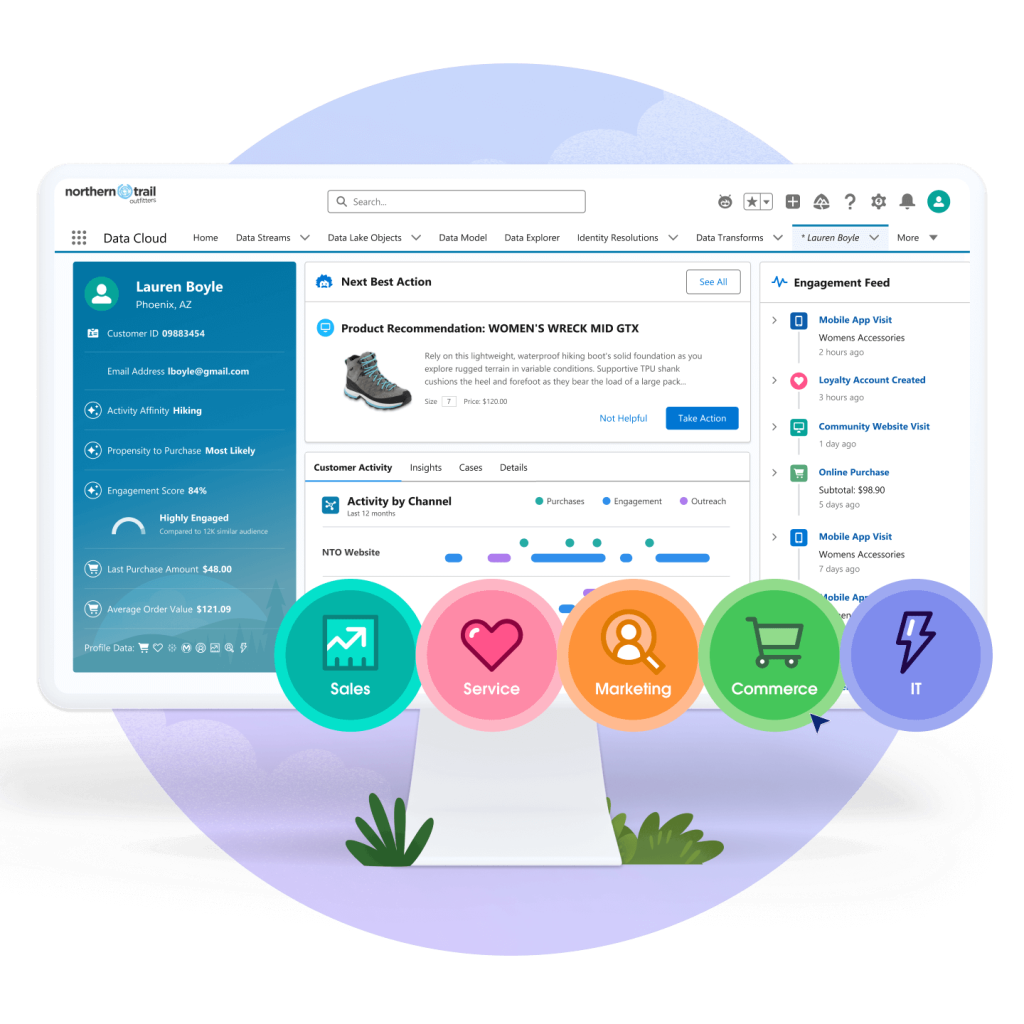
Salesforce is where your teams work. Sales reps manage pipelines in Sales Cloud. Service agents resolve cases in Service Cloud. Marketers build campaigns in Marketing Cloud. The platform's strength is that all of these applications share a single view of customer data and a common codebase.
Source: Salesforce
When a deal closes, the service team sees the full history. When a support case opens, the sales rep gets alerted. That integration between applications and data is what 150,000+ companies pay for.
Tealium sits in a different layer entirely. It doesn't compete with your CRM; it feeds it. When a prospect visits your pricing page, clicks a retargeting ad, opens an email, and then calls your sales team, Tealium captures all of those events, resolves them to a single identity, enriches the profile with behavioral context, and routes it to whatever downstream system needs it (Salesforce, a data warehouse, an ad platform, or an AI model).

Source: Tealium
The distinction matters because many organizations need both. Salesforce gives you the applications to engage customers. Tealium gives you the data infrastructure to ensure those applications work from complete, real-time information.
But neither generates the third-party B2B intelligence (verified contacts, company context, org charts, and buying intent signals) that go-to-market teams need to identify and reach buyers in the first place.
Salesforce Data Cloud vs. Tealium AudienceStream: The CDP comparison
Where Salesforce and Tealium overlap most directly is in customer data unification.
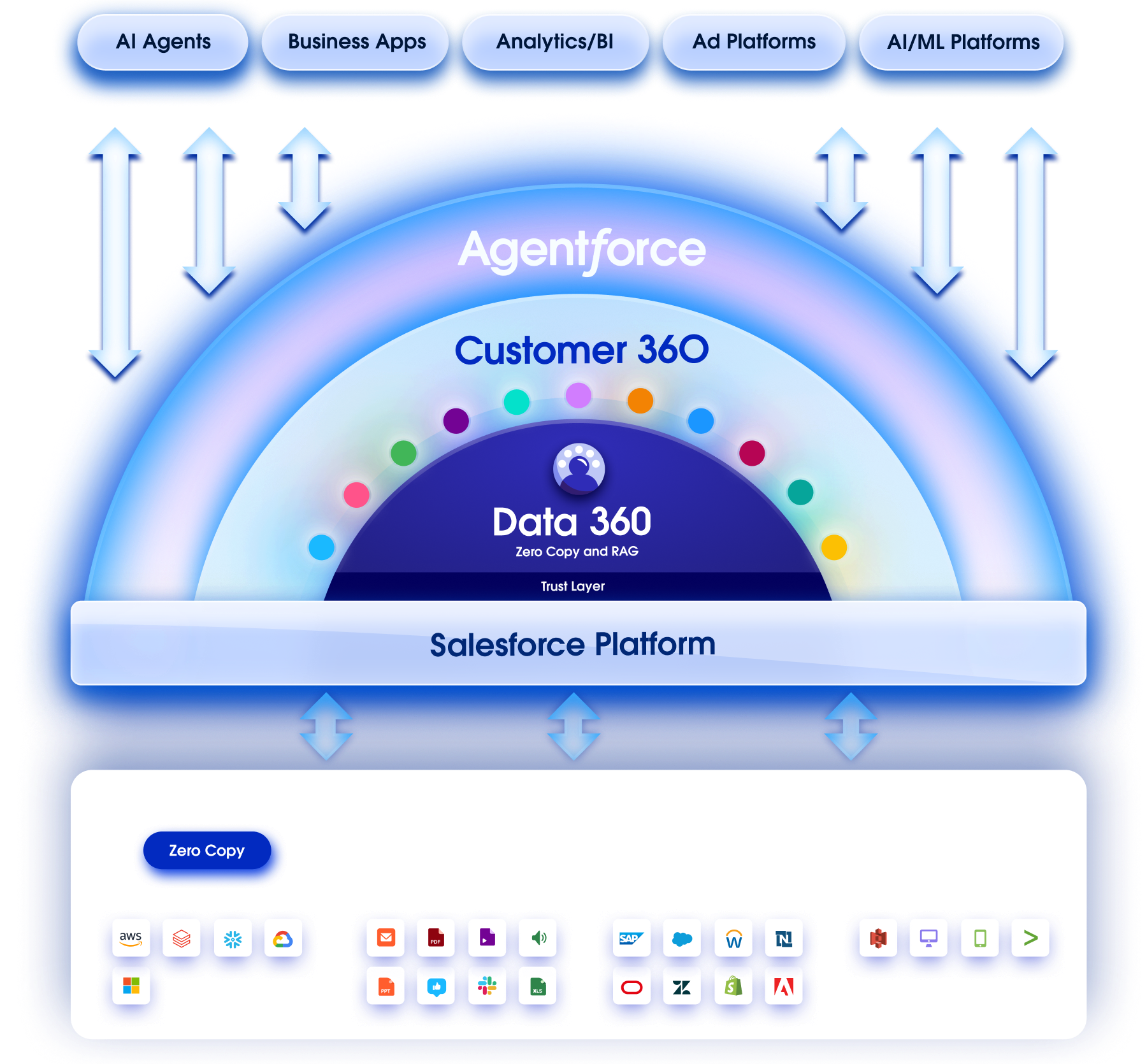
Salesforce's Data Cloud (formerly its CDP offering) connects to Snowflake, Databricks, and BigQuery through a zero-copy architecture and provides identity resolution, segmentation, and activation within the Salesforce ecosystem.
Source: Salesforce
The advantage is native access: any Salesforce application can query Data Cloud profiles without integration work.
Tealium's AudienceStream CDP takes a vendor-neutral approach. It launched in 2013 as what Tealium claims was the first-ever Customer Data Platform, and processes events from web, mobile, server-side, and offline sources into persistent visitor profiles.
Source: Tealium
The Moments API returns profile data with benchmarked average latency of 60ms, fast enough for in-session personalization. Tealium also supports zero-copy activation from Snowflake, Databricks, BigQuery, and Redshift without duplicating data.
The practical difference comes down to ecosystem commitment. If your organization runs on Salesforce and wants a CDP native to that environment, Data Cloud is the path of least resistance. If you run a mixed technology stack and need a CDP that routes data to any tool without vendor lock-in, Tealium is built for that.
But both CDPs unify first-party data (the behavioral and transactional information your customers generate through their interactions). Neither provides the third-party B2B intelligence that tells you who your buyers are, how to reach them, and when they're in-market.
ZoomInfo fills the B2B intelligence gap that both platforms leave open
Salesforce knows what your customers did inside your CRM. Tealium knows what your visitors did across your digital properties. ZoomInfo knows who your buyers are before they ever engage with you.
The ZoomInfo data platform covers three dimensions: identity data (500M contacts, 120M direct-dial phone numbers, 200M+ verified business emails), company context (100M companies with firmographics, org charts, and technographics), and dynamic signals that reveal when accounts are actively in-market. This data is verified through a multi-source pipeline backed by 300+ human researchers, achieving up to 95% accuracy on first-party data.
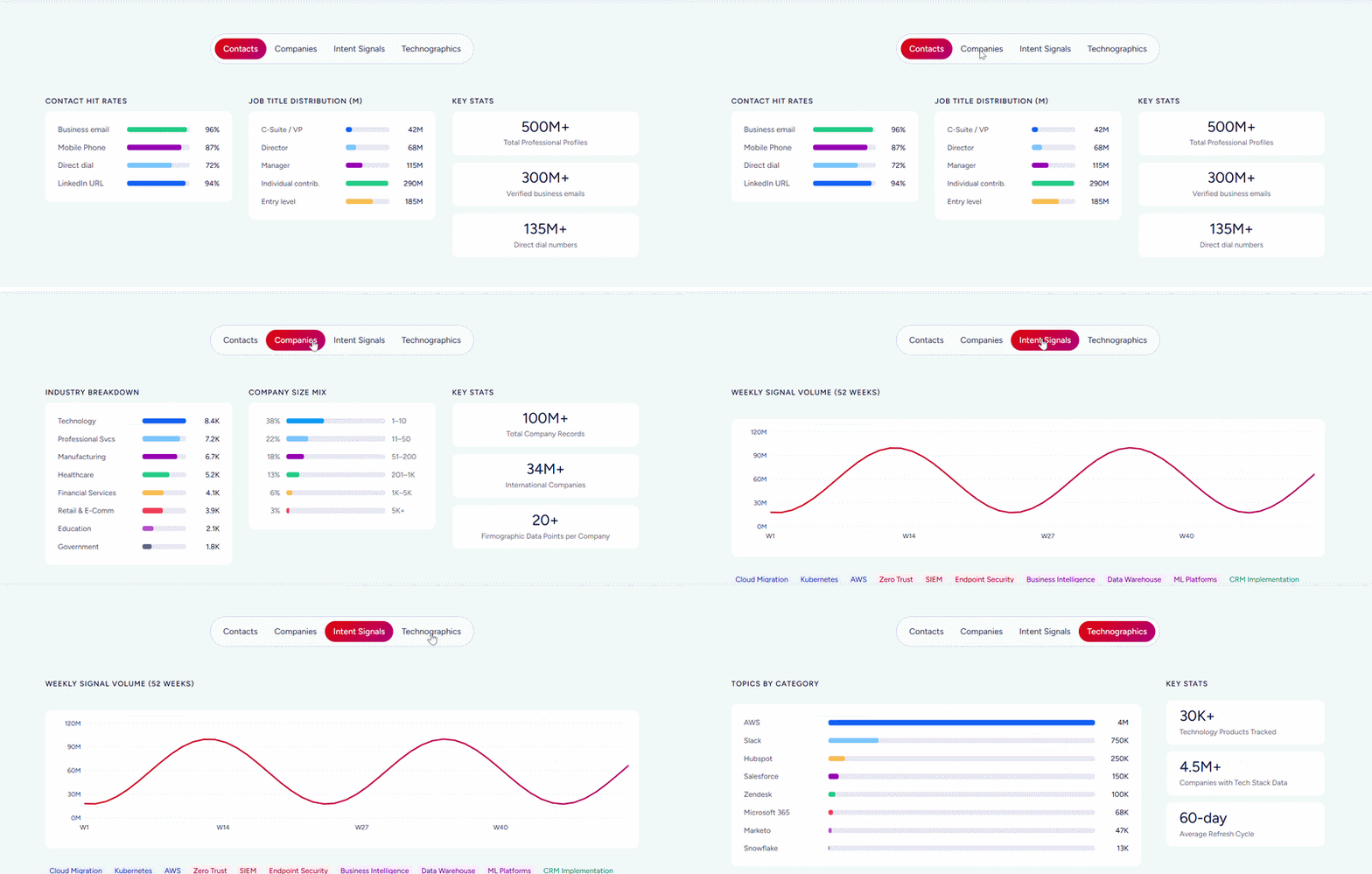
The data becomes intelligence through ZoomInfo's GTM Context Graph. Where a CRM records that a deal moved to Stage 3, and a CDP captures that a visitor browsed your pricing page, the GTM Context Graph reasons across both to surface why the deal moved.
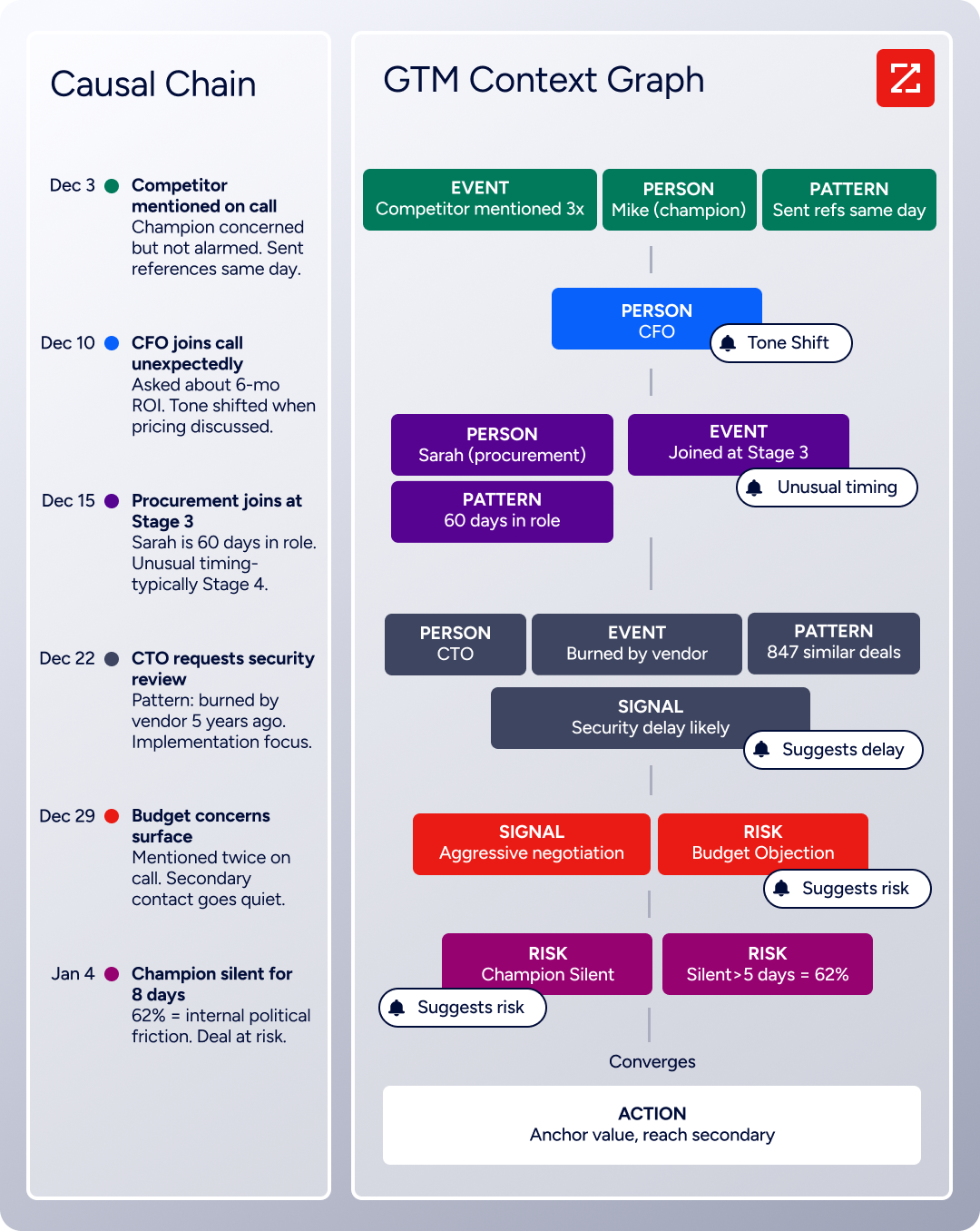
As ZoomInfo's Chief Product Officer Dominik Facher writes: "The CRM recorded the state change. It has no record of why it happened." The GTM Context Graph connects people, actions, patterns, and outcomes into a layer where AI can reason about go-to-market decisions.
This intelligence flows into Salesforce directly. ZoomInfo's native Salesforce integration enriches leads, contacts, and accounts with verified data, while buying signals sync into sales workflows for prioritized engagement.
Seismic's sales team attributed 39% of active pipeline to opportunities identified or influenced by ZoomInfo signals, boosted productivity by 54%, and saved 11.5 hours per week. CBO Toby Carrington put it this way: "That combination of our internal CRM data, external signals, and AI that's given all that context has helped us craft very specific account- and persona-based messages." (Seismic)
Real-time activation: Different architectures for different needs
How each platform handles real-time data activation reveals its design priorities.
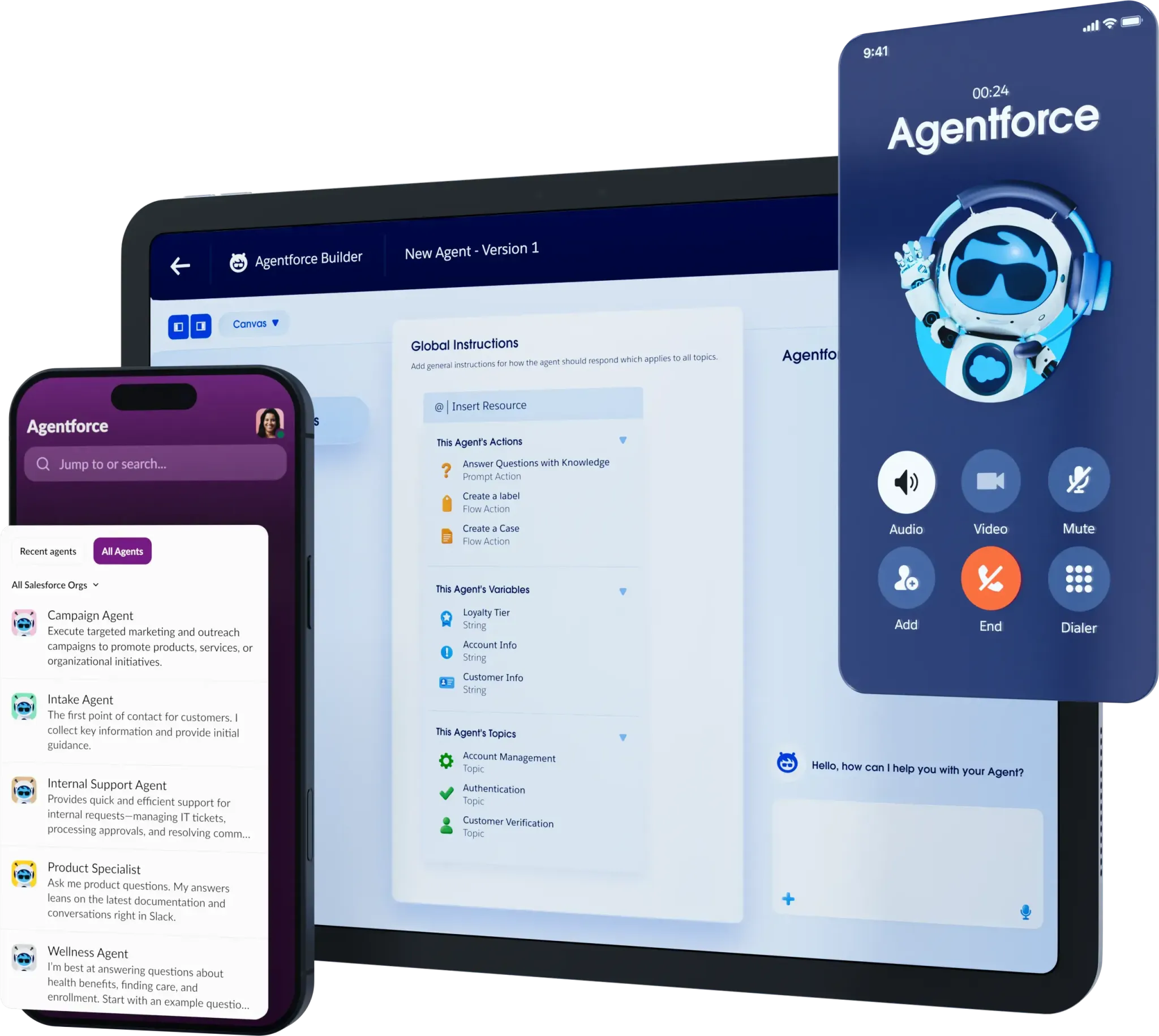
Salesforce's real-time capability lives within its own ecosystem. Data Cloud processes events and activates segments across Sales Cloud, Service Cloud, Marketing Cloud, and Commerce Cloud natively. The Agentforce platform adds autonomous AI agents that can resolve service cases, draft sales outreach, and pause underperforming ad campaigns, all grounded in unified CRM data.
Source: Salesforce
Salesforce reports that 85% of its own support requests are resolved without human escalation using Agentforce. But activating Data Cloud segments outside the Salesforce ecosystem requires MuleSoft or third-party integration, adding cost and complexity.
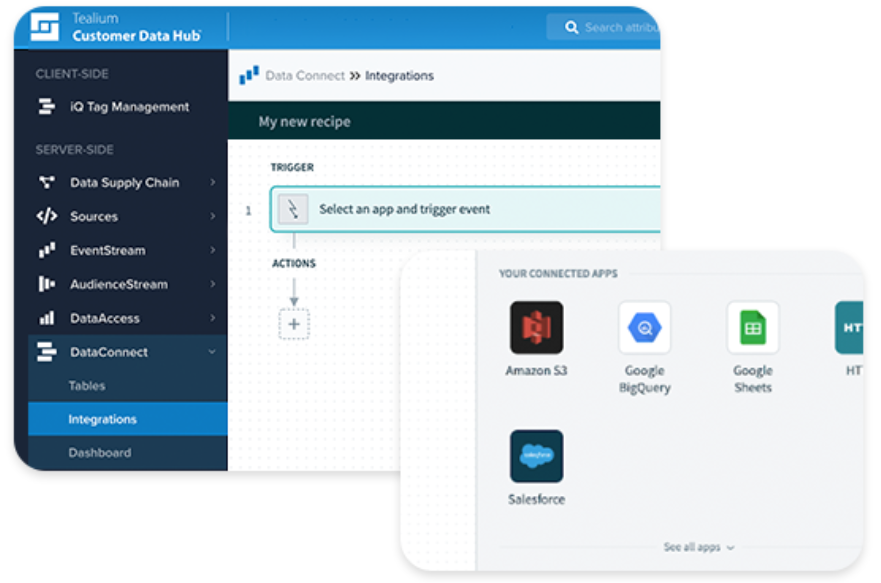
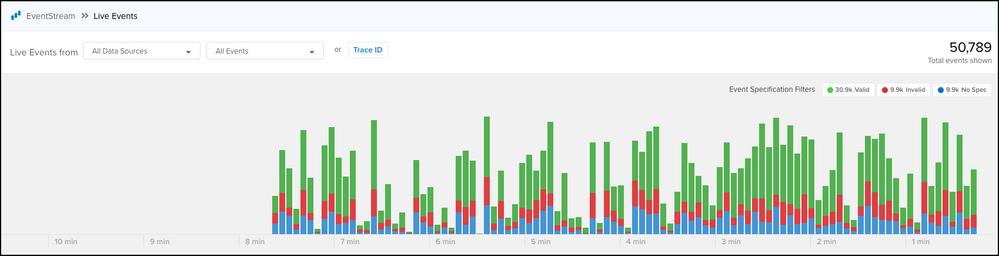
Tealium was built for cross-platform activation. Its EventStream API Hub processes events entirely in memory and routes enriched data to 1,300+ destinations in real time.
Source: Tealium
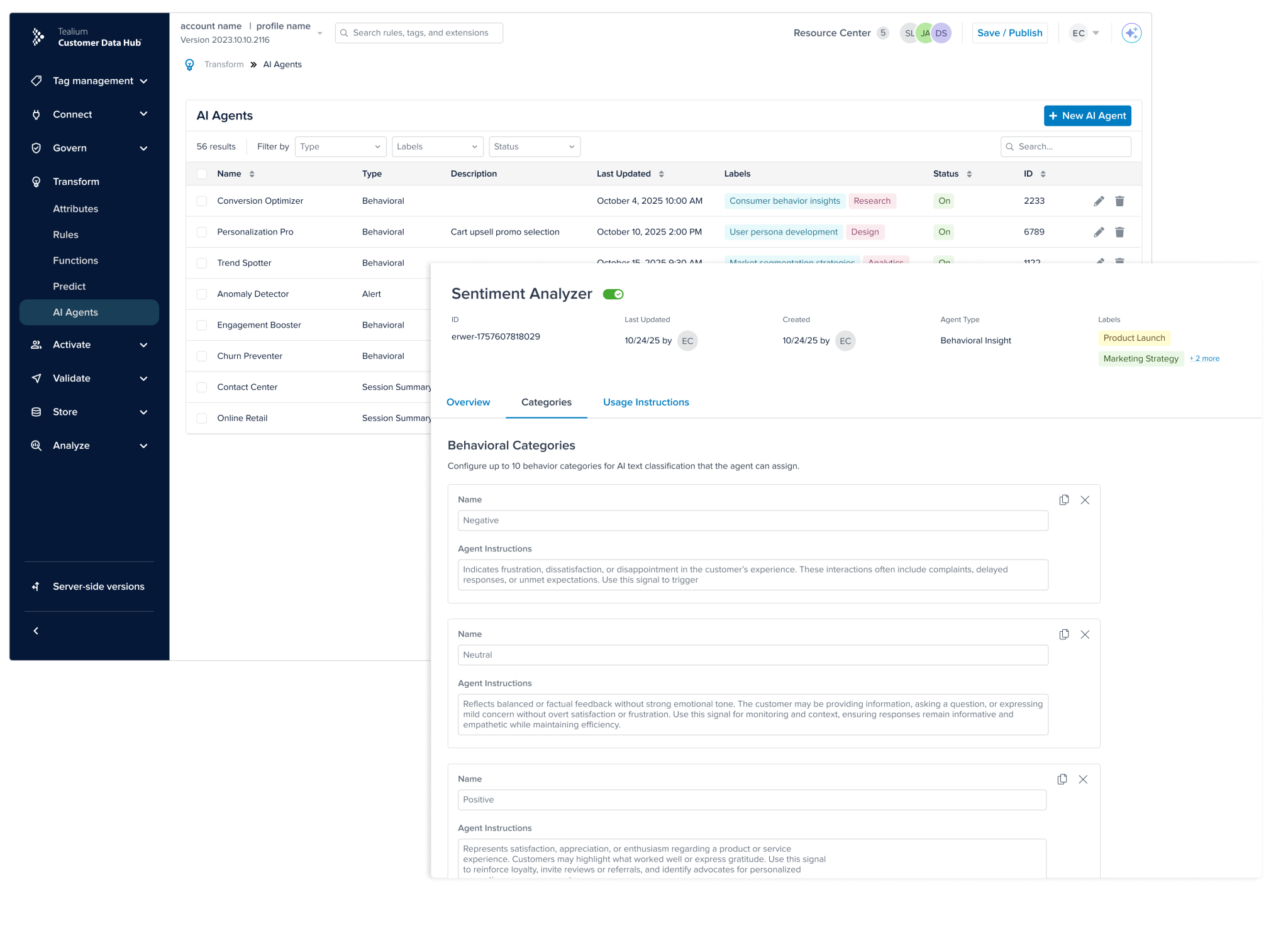
The Behavioral Insight Agent classifies intent and sentiment inside the event stream without exporting data. Consent enforcement is structural, not post-processing: tags that require consent don't fire if consent is absent.
Source: Tealium
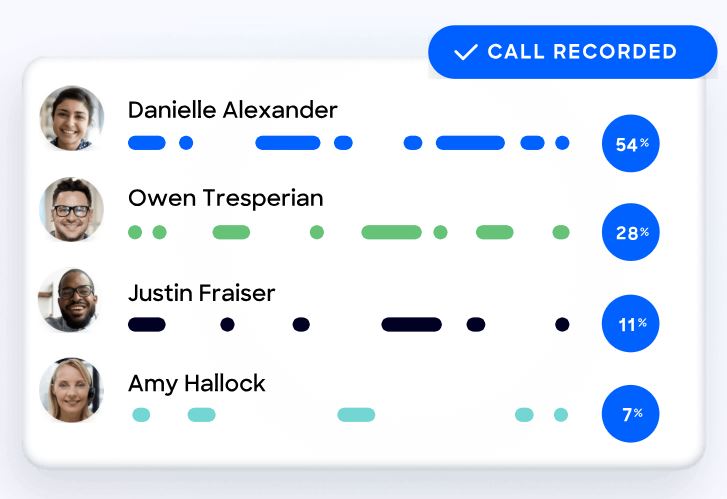
ZoomInfo's real-time activation works differently. Buyer Intent data tracks signals from 210 million IP-to-Organization pairings and 6 trillion+ new keyword-to-device pairings sourced monthly.
Guided Intent, exclusive to ZoomInfo, identifies topics historically correlated with deal success rather than requiring manual topic selection.
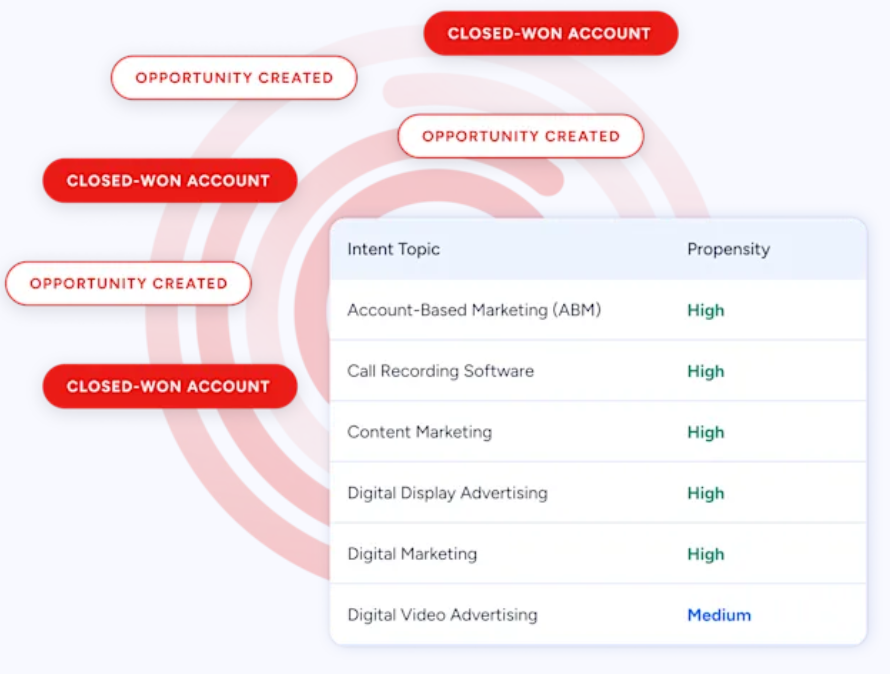
When intent signals fire, GTM Workspace delivers pre-drafted outreach to sellers, while GTM Studio can trigger multi-channel plays automatically.
Redwood Logistics achieved a 99% reduction in cost-per-click and a 310% increase in clickthrough rate using ZoomInfo's audience data. Chelsea Kenyon, Senior Director of Digital Strategy, noted: "It's not just the data itself. It's more about the right data at the right time to help us reach out with the right message across that full buyer journey." (Redwood Logistics)
Integration philosophy shapes your long-term flexibility
Each platform's integration approach reflects a different bet on how enterprise technology stacks should work.
Salesforce bets on platform consolidation. Its 9,000+ AppExchange apps and 14+ million installs create the largest enterprise app marketplace, and MuleSoft Anypoint Platform provides the integration backbone for connecting Salesforce to non-Salesforce systems.
The deeper you go into the Salesforce ecosystem (Sales Cloud, Service Cloud, Marketing Cloud, Slack, Tableau, Data Cloud), the more value you extract from the unified data model.
But the reverse is also true: the deeper you go, the harder it becomes to integrate with tools that lack native Salesforce connectors. MuleSoft is sold separately from CRM licenses, adding another cost layer for organizations with mixed stacks.
Tealium bets on vendor neutrality. Its founding principle is that customers should be able to adopt any tool, any cloud, and any model without their data infrastructure forcing proprietary paths. The 1,300+ integration marketplace spans ad platforms, CRMs (including Salesforce), data warehouses, AI services, and analytics tools.
Tealium acts as the orchestration layer between all of them, so changing one downstream tool doesn't require re-instrumenting your data collection.
ZoomInfo bets on intelligence as infrastructure. By adding API Access to all relevant plans and launching a Model Context Protocol server, ZoomInfo's B2B data and GTM Context Graph can be consumed inside any application, any AI agent, or any custom tool.
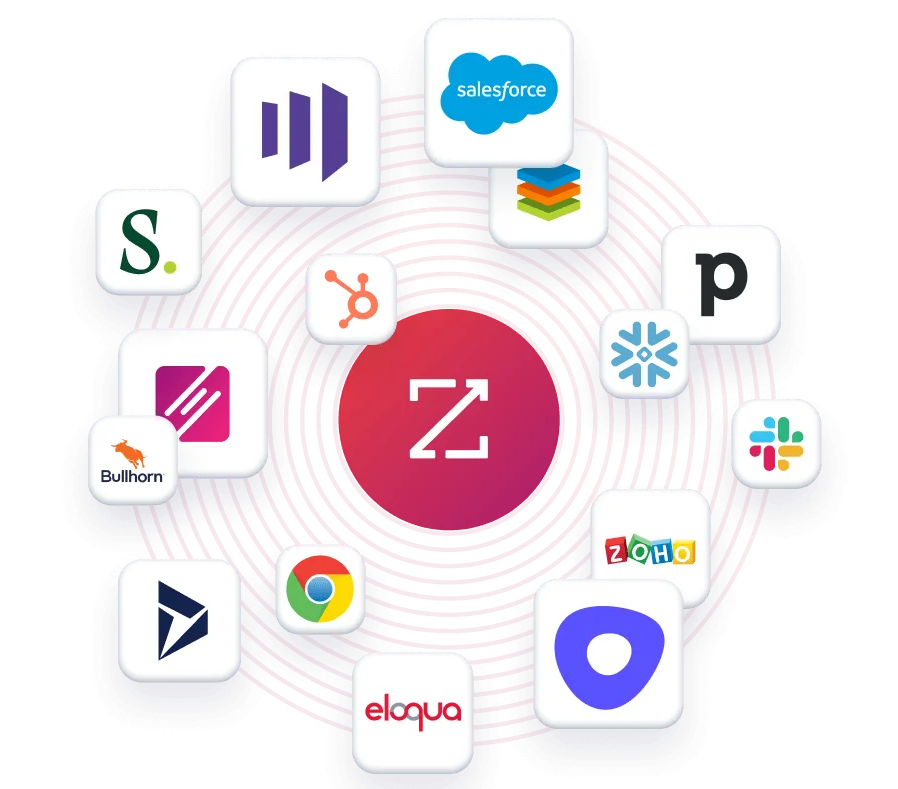
The ZoomInfo Marketplace lists 120+ partners, with native integrations for Salesforce, HubSpot, Microsoft Dynamics, Snowflake, and Databricks. ZoomInfo also delivers data into cloud environments through its Cloud Partners program, covering AWS, Google Cloud, Snowflake, and Databricks.
BDO Canada's Senior Marketing Intelligence Analyst Jerry Wilson described ZoomInfo's API approach: "The plug-and-play aspect of the API means I can integrate it very easily into any process and get information at a moment's notice," resulting in an 87% reduction in time spent updating internal data dashboards. (BDO Canada)
Privacy and compliance capabilities compared
All three platforms invest in data governance, but their compliance postures serve different regulatory needs.
Salesforce provides Shield as a premium add-on for event monitoring, platform encryption with bring-your-own-key, and field audit trails. The Einstein Trust Layer ensures zero data retention with LLM partners, PII masking, and toxicity detection for AI interactions. Certifications include ISO 27001/27017/27018, SOC 1/2/3, FedRAMP, and HITRUST. Hyperforce enables regional data residency at no additional cost.
Tealium embeds consent enforcement directly into its data collection architecture. Tags that require consent do not fire if consent is absent, with native integrations for OneTrust, Didomi, and Usercentrics. Certifications include HIPAA BAA, SOC 2, ISO 27001, ISO 27701, ISO 27018, and TISAX.
Tealium's HIPAA BAA certification matters most for healthcare and pharma organizations, and the platform offers regional cloud deployments including a dedicated AWS Singapore region for APAC data residency.
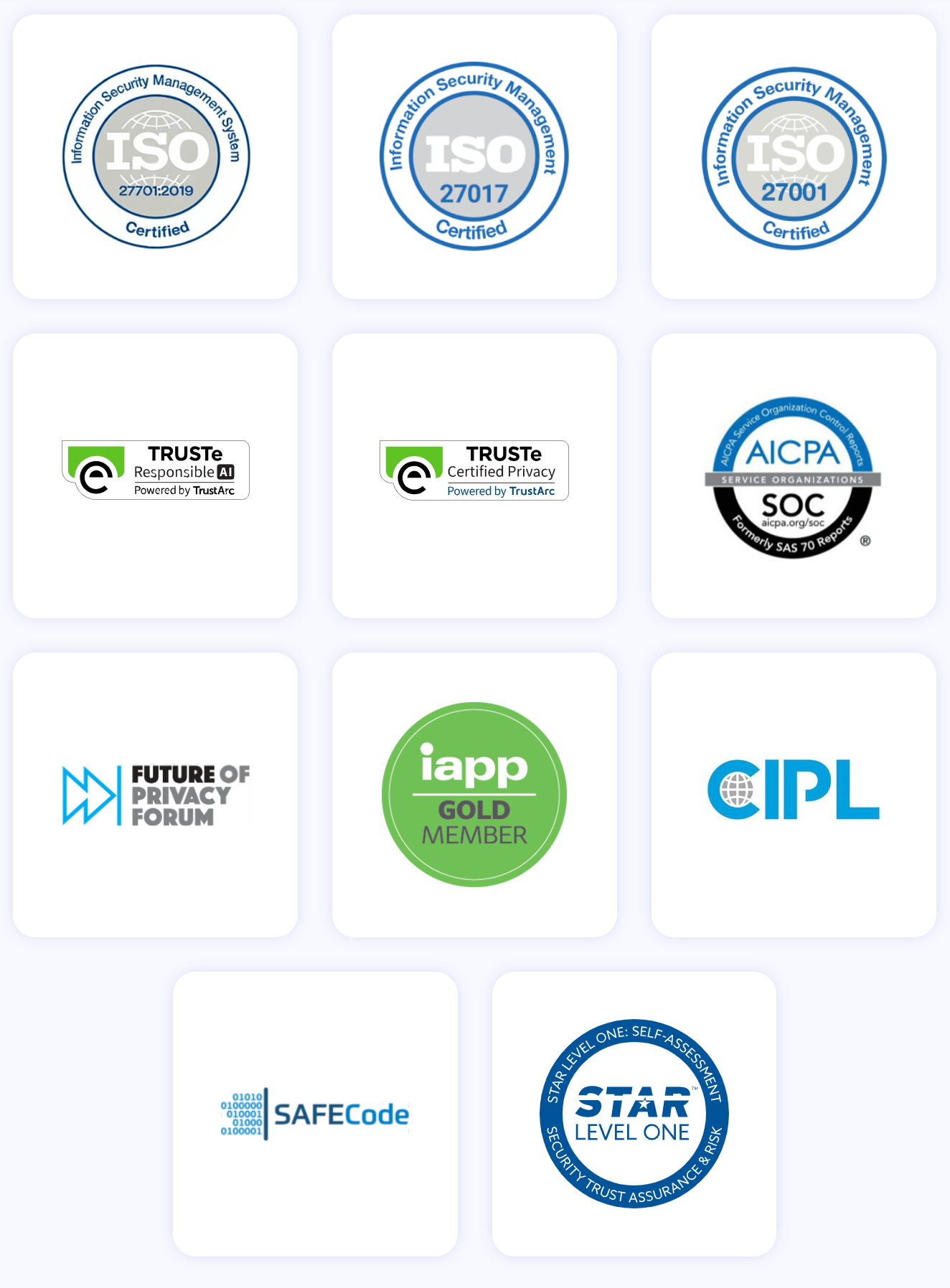
ZoomInfo holds ISO 27001, ISO 27701, SOC 2 Type II, TRUSTe GDPR, and TRUSTe CCPA certifications, all renewed annually. As a B2B data provider, ZoomInfo is a registered data broker in California and Vermont and maintains a dedicated Trust Center for transparency. Compliance controls are built into the data layer itself, so enrichment workflows inherit governance automatically.
AI strategies reflect different ambitions
Each platform's AI investment reveals where it thinks enterprise software is heading.
Salesforce is betting on autonomous AI agents. Agentforce uses the proprietary Atlas Reasoning Engine to power agents that can prospect, resolve service cases, create campaigns, and manage commerce experiences on their own. The platform reached $800M ARR, growing 169% year over year, with 29,000 deals closed.
The goal is to replace manual workflows with AI agents that collaborate with humans across every business function.
Tealium is positioning itself as the trusted data layer that feeds AI. Its homepage headline is "Trusted Data for AI", and the platform's AI module connects to AWS Bedrock, Vertex AI, OpenAI, SageMaker, Pinecone, and LangChain through bidirectional connectors. The Behavioral Insight Agent classifies intent and sentiment inside the event stream.
The MCP server integration lets external AI agents query unified profiles with consent state enforced on every request. Tealium's bet is that models are only as good as their data, and the company that governs the data layer governs the AI outcomes.
ZoomInfo is building AI that understands go-to-market. The GTM Context Graph doesn't just store data; it captures connections between signals and outcomes, identifying why deals move or stall across thousands of interactions.
The AI agents inside GTM Workspace, built on Anthropic's Claude, answer three questions for every rep: who to contact, when to engage, and what to say. GTM Workspace users report 23% larger pipelines and nearly 60% more meetings per week.
Levanta CEO Ian Brodie described ZoomInfo: "ZoomInfo's not just a contact data company anymore. They've built a full system of execution. GTM Intelligence actually works the list, writes the outreach, triggers the play, and helps drive predictable growth." (Levanta)
Pricing structures reflect different market positions
How each platform prices its offering tells you who it's built for.
Salesforce publishes tiered pricing for its core clouds. Sales Cloud and Service Cloud range from a free suite for up to 2 users to $550/user/month for Agentforce 1 (which includes unmetered Agentforce, Tableau Next, and Slack Enterprise+). Marketing Cloud starts at $1,500/org/month. Agentforce consumption adds $2 per conversation or $500 per 100,000 Flex Credits. Data Cloud is consumption-based at $500 per 100,000 credits.
The published tiers give a starting point, but enterprise agreements involve negotiation, and costs compound across clouds, add-ons, and support tiers (Premier Success runs 30% of net license fees).
Tealium does not publish pricing. The platform operates through custom enterprise contracts with no self-serve option and no public rate cards. Pricing scales with data volume, modules licensed, and support tier. G2 reviewers note that costs can scale unpredictably as event volumes grow. No published pricing adds friction to evaluation but is standard for enterprise CDPs serving regulated industries.
ZoomInfo uses a consumption-based pricing model organized into Sales, Marketing, and add-on tiers, but without published dollar amounts. Pricing scales around seats, credit volume, features, and contract length.
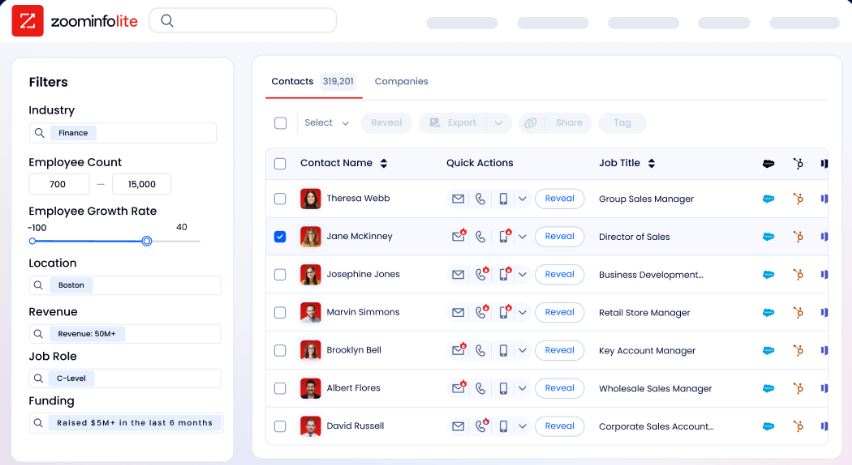
ZoomInfo does offer a permanent free tier: ZoomInfo Lite provides access to the B2B database with 10 monthly export credits and a 7-day free trial of paid features, giving prospects a way to evaluate before committing.
Implementation complexity varies significantly
Deploying each platform requires different levels of organizational investment.
Salesforce implementation timelines range from weeks for a simple Sales Cloud setup to 3-12 months for enterprise multi-cloud deployments. Over 70% of implementations are partner-led, which ensures quality but adds cost.
Configuration requires trained administrators, and Trailhead provides 1,500+ badges and 6+ million learners for upskilling. Once deployed, Salesforce's bi-annual release cycle moves everyone forward together, which creates consistency but limits flexibility.
Tealium implementations typically take 1-4 months for enterprise deployments depending on integration complexity. G2 reviewers consistently flag that initial setup requires technical expertise, and the platform is not self-serve for non-technical marketers. The MCP-powered Configuration Agent is an emerging solution that lets teams configure Tealium through natural language prompts, but a self-serve, low-code tier has not been announced.
ZoomInfo deploys fastest of the three. GTM Workspace "deploys in weeks, not months", and the company redesigned its onboarding from 30 to 90 days with structured planning, implementation, education, and adoption phases, producing a 25% improvement in customer satisfaction scores. ZoomInfo University provides role-specific learning paths, product certifications, and on-demand courses.

Salesforce vs. Tealium vs. ZoomInfo: Which should you choose?
These three platforms serve different layers of the go-to-market stack, and many organizations benefit from using more than one.
Choose Salesforce if:
You need a unified CRM and application suite for sales, service, marketing, and commerce
You want AI agents (Agentforce) that operate natively within your customer relationship data
Your organization can invest in dedicated Salesforce administration and partner-led implementation
You prefer a single vendor for front-office applications and customer data unification
You're already in the Salesforce ecosystem and want to add Data Cloud as your CDP
Choose Tealium if:
You need a vendor-neutral data orchestration layer that connects your entire technology stack
Real-time behavioral data activation across 1,300+ destinations is critical to your marketing
You're in a regulated industry (healthcare, financial services, pharma) where HIPAA BAA and consent enforcement are procurement requirements
You already have a CRM and other front-office tools and need the governed data layer between them
You want your CDP to feed AI models from any provider without vendor lock-in
Choose ZoomInfo if:
You need verified B2B contact data, company intelligence, and buying signals to power your go-to-market
Your team needs AI-driven intelligence that reveals why deals move, not just what happened
You want a platform that integrates with Salesforce, data warehouses, and any AI agent via API and MCP
Prospecting, pipeline generation, and account-based marketing are central to your revenue strategy
You want to start with a free tier and scale into enterprise features as needs grow
Start with ZoomInfo Lite for free, or request a demo of the full platform.
The best go-to-market stacks don't choose one of these platforms at the exclusion of the others. Salesforce manages relationships. Tealium orchestrates data.
ZoomInfo provides the intelligence. When all three layers work together, your CRM has complete, verified records, your data infrastructure routes the right signals to the right tools, and your sellers walk into every conversation knowing who to talk to, why it matters, and what to say next.
Salesforce vs. Tealium vs. ZoomInfo FAQ
What is the core difference between Salesforce, Tealium, and ZoomInfo?
Salesforce is a CRM and enterprise application suite for managing customer relationships across sales, service, marketing, and commerce. Tealium is a vendor-neutral customer data orchestration platform that collects, unifies, and activates behavioral data across your technology stack.
ZoomInfo is a B2B intelligence platform providing verified contact data, company information, buying signals, and AI-powered go-to-market execution. They operate at different layers and often complement each other.
Can Salesforce replace Tealium as a CDP?
Salesforce Data Cloud provides CDP capabilities (identity resolution, segmentation, and activation) but works best within the Salesforce ecosystem. Tealium's AudienceStream CDP is vendor-neutral and routes data to 1,300+ destinations regardless of vendor. Organizations committed to Salesforce may find Data Cloud sufficient; those with mixed technology stacks typically benefit from Tealium's vendor-neutral approach.
How does ZoomInfo work with Salesforce?
ZoomInfo integrates natively with Salesforce to enrich leads, contacts, and accounts with verified B2B data. The integration syncs contact details, company context, technographics, and buying signals directly into Salesforce records.
ZoomInfo's GTM Workspace also connects to Salesforce for CRM updates without context-switching, and the API/MCP access allows custom integrations with any Salesforce workflow. For a full side-by-side breakdown of how these two platforms compare, see our Salesforce vs. ZoomInfo comparison.
Which platform has the best AI capabilities?
Each platform's AI serves a different purpose. Salesforce's Agentforce provides autonomous AI agents for customer service, sales, and marketing within the CRM ecosystem. Tealium's AI infrastructure feeds models from any provider with real-time, consented customer data.
ZoomInfo's GTM Context Graph powers AI that understands go-to-market decisions, identifying who to contact, when to engage, and what to say based on verified B2B intelligence and deal patterns.
Which platform is most affordable to get started with?
ZoomInfo offers the lowest entry point with ZoomInfo Lite, a permanent free tier that includes access to the B2B database with 10 monthly export credits and a 7-day free trial of paid features. Salesforce offers a free suite for up to 2 users, with paid plans starting at $25/user/month. Tealium has no public pricing or free tier, operating exclusively through custom enterprise contracts.
Do I need all three platforms?
Not necessarily, but many enterprise organizations benefit from the combination. Salesforce manages the customer relationship and execution layer. Tealium provides the governed data infrastructure connecting your tools.
ZoomInfo provides the B2B intelligence that tells you who your buyers are and when they're ready to buy. The value of combining them depends on the complexity of your technology stack and the sophistication of your go-to-market strategy.
Which platform has the strongest privacy and compliance capabilities?
Tealium has the deepest native privacy infrastructure, with HIPAA BAA certification, structural consent enforcement at the data collection layer, and ISO 27701 compliance. Salesforce provides enterprise-grade security through Shield (premium add-on) and the Einstein Trust Layer, plus FedRAMP certification for government use cases.
ZoomInfo holds ISO 27001, ISO 27701, SOC 2 Type II, and TRUSTe GDPR/CCPA certifications, with compliance built into the data layer and a public Trust Center.
How do the platforms handle data from cloud warehouses like Snowflake?
All three connect to major cloud data platforms. Salesforce Data Cloud offers zero-copy access to Snowflake, Databricks, and BigQuery. Tealium's Data Cloud Activation module activates warehouse audiences through reverse ETL and a Snowflake Native App, without copying data into Tealium's storage.
ZoomInfo delivers data into Snowflake, Databricks, AWS, and Google Cloud through its Cloud Partners program and Data Cubes, enabling organizations to enrich warehouse records with verified B2B intelligence.
More Salesforce comparisons:
