
What is a database management system (DBMS)?
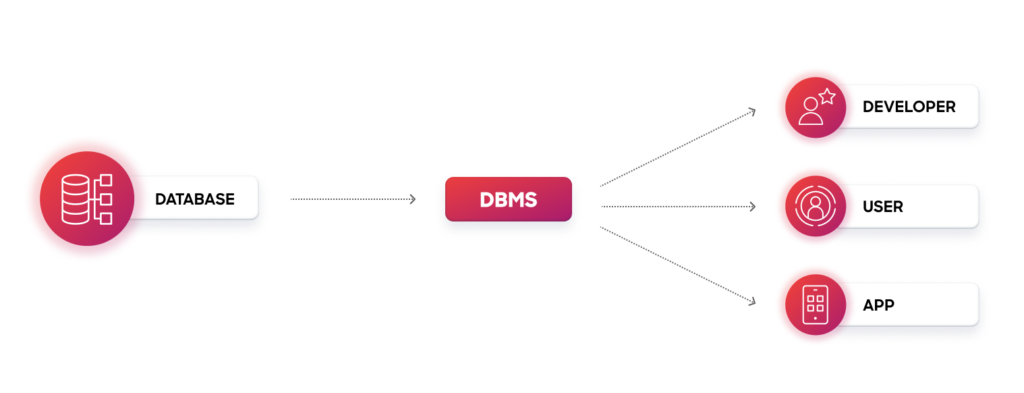
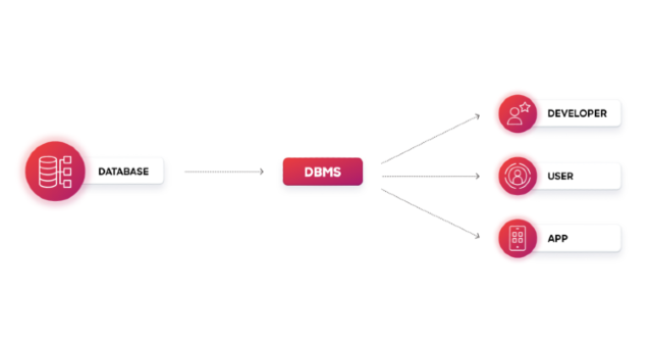
A database management system (DBMS) is software that acts as the bridge between a central data store and the applications, users, and automated workflows that need to read, write, and query that data. It manages storage, retrieval, access control, and data integrity, replacing the fragility of file-based systems with a governed, queryable foundation.
A DBMS sits above physical storage and exposes a schema layer that defines how data is structured, related, and constrained. That schema layer is what makes it possible to enforce field-level rules, maintain referential integrity across tables, and give applications a consistent interface regardless of how the underlying storage changes.
Multi-user access is a core capability that often goes underappreciated. A DBMS coordinates concurrent reads and writes from multiple users, applications, and automated processes simultaneously, using locking and transaction management to prevent conflicts and data corruption.
For GTM teams, the practical implication is direct: every enrichment pipeline, routing workflow, and AI scoring model is only as reliable as the data foundation it queries. When that foundation is fragmented or inconsistently maintained, every downstream system inherits the same gaps. Sound data management starts with understanding what a DBMS does and what it cannot do on its own.
A DBMS supports a modern go-to-market approach by giving revenue teams a governed, queryable data foundation that automated workflows can depend on without manual intervention.
How a DBMS differs from traditional file management
Unlike a traditional file management system, where data is stored in individual files, a DBMS centralizes data storage, making it more efficient and structured. This centralized approach allows for sophisticated data modeling, better data integrity, and reduced data redundancy.
With a DBMS, data can be fetched using complex queries, allowing for precise data extraction based on multiple criteria. Traditional file systems require manual searching and filtering, which is time-consuming and susceptible to errors.
Dimension | Traditional file system | DBMS |
|---|---|---|
Data organization | Separate files with no enforced structure | Centralized schema with defined relationships |
Query capability | Manual search and filtering | Structured query language (SQL) with multi-criteria precision |
Multi-user support | Limited; concurrent access causes conflicts | Native concurrent access with locking and transaction management |
Data integrity enforcement | None; depends on application logic | Enforced at the storage layer via constraints and rules |
Backup and recovery | Manual, ad hoc | Automated backup and point-in-time recovery |
Security and access control | File-level permissions only | Role-based access control at the object, row, and field level |
For RevOps teams, this comparison is not academic. Teams managing enrichment pipelines and routing workflows on top of inconsistent, siloed data files face the same fragility that drove enterprise adoption of DBMS in the first place. When enrichment data lives in CSVs and flat files, there is no enforcement layer to catch incomplete records, prevent overwrites, or maintain a consistent state across concurrent updates. A DBMS is the structural answer to that problem.
Types of database management systems
Database management systems fall into several distinct categories, each optimized for different data models, query patterns, and workload types. The table below provides a quick-reference summary before the detailed breakdown.
Type | Data model | Best use case | Named example |
|---|---|---|---|
Relational (RDBMS) | Tables with rows and columns | Transactional apps, CRM, ERP | MySQL, PostgreSQL, Oracle |
Hierarchical | Tree/parent-child | Mainframe, legacy enterprise | IBM IMS |
Network | Graph/web of nodes | Telecom, complex relationships | Raima Database Manager |
NoSQL | Document, key-value, column, graph | Big data, real-time apps, AI workloads | MongoDB, Cassandra |
Relational database management system (RDBMS)
Think of an RDBMS like a set of tables. Each table has rows and columns, similar to a spreadsheet, and the tables are related to each other so that data from one can be joined with data from another. Examples include MySQL, Oracle, PostgreSQL, and Microsoft SQL Server.
RDBMS platforms are the dominant choice for transactional applications because they provide ACID compliance, which guarantees that every write either completes fully or rolls back entirely. Mature tooling, broad developer familiarity, and decades of optimization work make relational systems the default for CRM, ERP, and order management workloads. The tradeoff is schema rigidity: changing the structure of a relational database requires a migration, and vertical scaling has hard limits that distributed architectures are designed to overcome.
Hierarchical database management system
A hierarchical database management system stores data in a tree-like format with parent and child structures connecting records. IBM's Information Management System (IMS), originally developed in the 1960s, is the canonical example. This model performs well for workloads with predictable, one-to-many relationships, but struggles when the same child record needs to belong to multiple parents, a limitation that the network model was designed to address.
Network database management system
Instead of a strict tree, a network database management system allows a flexible web of connections between records, supporting many-to-many relationships that hierarchical systems cannot handle. Examples include Raima Database Manager and the Oracle CODASYL DBMS. Like hierarchical systems, network databases are primarily found in legacy enterprise and mainframe environments rather than modern application stacks.
Object-oriented database management system (OODBMS)
An OODBMS stores data as objects, combining data and the methods that operate on it in a single unit, similar to how objects work in programming languages like Java or Python. InterSystems Cache and Actian NoSQL are examples. This model suits applications where the data structures map closely to object-oriented code, reducing the impedance mismatch between the application layer and the storage layer.
NoSQL database management system
NoSQL databases move away from the fixed table structure of relational systems, supporting a variety of data models suited to different workloads. Document databases like MongoDB store data as JSON-like documents, making them well-suited for content management and flexible-schema applications. Key-value stores like Redis optimize for speed, storing simple pairs for caching and session management. Columnar databases like Cassandra distribute data across nodes for high-write, high-availability workloads. Graph databases like Neo4j model relationships as first-class entities, making them effective for recommendation engines and network analysis. NoSQL systems trade ACID guarantees for horizontal scalability and schema flexibility, which makes them the default choice for big data pipelines and real-time AI workloads.
Flat file database
A flat file database stores data in a plain text file as a single table with no enforced relationships or constraints. It is simple and lightweight, appropriate for small, isolated tasks where the overhead of a full DBMS is unnecessary. Flat file systems are the direct predecessor to structured DBMS architectures and illustrate exactly the limitations that a DBMS is designed to overcome.
Cloud-native variants of each type now exist. AWS RDS and Azure SQL Database manage relational workloads without DBA provisioning overhead. Amazon DynamoDB and Google Cloud Bigtable handle NoSQL at scale. This cloud-native layer bridges directly to the emerging trends covered later in this article.
Database management system examples
The table below lists ten widely deployed DBMS products, their type, primary use case, and license model.
Product | Type | Primary use case | License model |
|---|---|---|---|
MySQL | Relational | Web apps, LAMP stack | Open-source / commercial |
PostgreSQL | Relational | Complex queries, analytics | Open-source |
Oracle Database | Relational | Enterprise transactional | Commercial |
Microsoft SQL Server | Relational | Windows enterprise | Commercial |
MongoDB | NoSQL / Document | Flexible schemas, content apps | Open-source / commercial |
Cassandra | NoSQL / Columnar | High-write distributed apps | Open-source |
Redis | NoSQL / Key-value | Caching, session management | Open-source / commercial |
IBM Db2 | Relational | Mainframe, enterprise | Commercial |
SQLite | Relational | Embedded, mobile apps | Open-source |
Elasticsearch | NoSQL / Search | Full-text search, log analytics | Open-source / commercial |
Choosing among these most popular database management systems depends on the workload type and data model. Relational systems are the right choice for transactional applications with structured data and well-defined relationships, where ACID compliance and mature query tooling matter. NoSQL systems are the right choice for flexible schemas, high-throughput distributed workloads, or embedding-based retrieval in AI pipelines. Most enterprise GTM stacks use both: a relational DBMS as the operational data store for CRM and enrichment data, and a columnar or document store for high-volume event data and analytics.
Advantages of database management systems
A DBMS delivers compounding operational benefits that file-based systems cannot replicate. The six core advantages below are the reason enterprise GTM stacks are built on governed database infrastructure rather than flat files and spreadsheets.
1. Improved data sharing and data security
A DBMS provides a single, centralized repository that authorized users and applications can access simultaneously without creating conflicting copies. Role-based access control ensures that different users see only the data they are permitted to access, and every read and write is logged for audit purposes. For GTM teams handling contact data and account intelligence, centralized access with enforced permissions is the foundation of both operational efficiency and regulatory compliance.
2. Effective data integration
A DBMS provides a governed integration point where data from multiple sources can be consolidated, deduplicated, and normalized into a consistent structure. Without this layer, integrating CRM data, enrichment feeds, and behavioral signals requires custom middleware that breaks whenever an upstream source changes its schema. A DBMS enforces the structural contracts that make integration maintainable rather than brittle.
3. Consistent, reliable data
Data consistency rules enforced at the storage layer mean that applications cannot write records that violate field constraints, referential integrity, or required-field rules. This is fundamentally different from enforcing consistency in application code, where each application has to implement the same rules independently and any gap creates an inconsistency in the underlying data. For RevOps teams, this means enrichment pipelines and routing workflows inherit clean, structured data rather than inheriting whatever inconsistencies the upstream application allowed through.
4. Compliance with privacy regulations
A DBMS provides the access control, audit logging, data retention, and encryption capabilities that privacy regulations like GDPR and CCPA require. Demonstrating compliance requires being able to answer specific questions: who accessed what data, when, and from which application. A DBMS makes those questions answerable. File-based systems do not.
5. Increased productivity
One of the core dbms benefits for operations teams is the elimination of manual data hygiene cycles. A DBMS paired with a continuous enrichment layer eliminates the manual data hygiene cycles that force RevOps teams to spend engineering capacity on list cleanup instead of building GTM leverage. When data quality is enforced at the storage layer and enrichment runs continuously, the team's time shifts from reactive cleanup to proactive GTM execution.
6. Better decision-making
The advantages of database management systems compound at the decision-making layer. A DBMS provides a framework that makes data quality initiatives easier to sustain, because better data management procedures generate higher-quality information, which leads to better decisions. When AI scoring and forecasting models are trained on incomplete or stale CRM data, the outputs are aspirational rather than actionable. A DBMS with continuous enrichment is the prerequisite for AI ROI.
Key components of a DBMS
A DBMS is an ensemble of components that work together to handle, maintain, and retrieve data with efficiency and security. Grouping those components into three logical clusters makes the architecture easier to reason about.
Data layer
Data stores are where the actual data resides. Think of them as the warehouses of the system, storing information in a systematic structure that allows for swift retrieval. In a GTM data pipeline, the data store is the authoritative record of account and contact information that enrichment workflows read from and write to.
Data storage refers to the mechanism and format by which data is saved within those stores. This ranges from traditional disk-based storage to cloud storage solutions. The storage mechanism determines the performance characteristics of reads and writes, the cost profile at scale, and the disaster recovery options available.
Metadata repository is the system's data dictionary: a structured record of the schema, field formats, relationships, constraints, and other characteristics of the data in the system. For RevOps teams, the metadata repository is what makes it possible to audit field mappings, understand what enrichment has been applied to a record, and trace data lineage from source to CRM field.
Indexing and hashing create data structures that improve the speed of retrieval operations. Without indexing, every query requires a full table scan. With indexing on the right fields, queries that filter by company domain, account ID, or intent signal return in milliseconds rather than seconds.
Access and query layer
Multi-user access is one of the most operationally significant capabilities of a DBMS. Whether it is a team of analysts running reports simultaneously or multiple enrichment workflows writing to the same account records, a DBMS coordinates concurrent access without data corruption. File-based systems cannot do this reliably.
Data retrieval is the foundational capability that makes a DBMS useful. Using structured query methods, users and applications can fetch specific records from the system with precision, filtering across multiple fields and joining data from multiple tables in a single operation.
Data querying is the structured interface for asking questions of the data. A DBMS provides users with tools, typically SQL-based, to craft queries that return precise results based on specific criteria. For a RevOps analyst, this is the difference between running a parameterized query to validate enrichment coverage and manually filtering a spreadsheet.
Access control enforces who can read, write, and delete specific data. In a GTM data pipeline, access control ensures that enrichment workflows can write to CRM fields without exposing raw contact data to unauthorized applications or users. This is the mechanism that makes multi-user environments secure rather than chaotic.
Reliability layer
Transaction management ensures the database remains in a consistent state even when system failures occur. A DBMS includes mechanisms for commit, rollback, and handling concurrent transactions, so that a failed enrichment job does not leave records in a partially updated state. For GTM pipelines where a single enrichment job may update thousands of records, transaction management is the difference between a recoverable failure and a data integrity incident.
Backup and recovery provides automated data protection and point-in-time restoration. For enterprise GTM stacks, backup and recovery is a compliance requirement as much as an operational one: data loss events affecting contact records or account intelligence have regulatory implications under GDPR and CCPA.
Modern DBMS implementations expose these components via APIs, making them accessible to microservices and AI agents without requiring direct database access. That API layer is what connects a governed DBMS to the enrichment platforms, routing engines, and AI agents that GTM teams depend on.
Database languages and SQL
Database management systems are queried and administered through structured languages. Three categories cover the full range of operations a database administrator or RevOps engineer performs.
DDL (Data Definition Language) defines the structure of the database itself. Commands like CREATE, ALTER, and DROP are used to build and modify tables, indexes, and schemas. A RevOps engineer uses DDL when adding a new field to the account object to capture a new enrichment attribute, or when creating a new table to store territory assignment history.
DML (Data Manipulation Language) is the language of data operations: SELECT, INSERT, UPDATE, and DELETE. This is the category most RevOps analysts work with day-to-day. A SELECT query joining the contacts table with the company table is the kind of query an analyst runs to validate enrichment coverage across the account base.
A simple example of that query looks like this:
-- Validate enrichment coverage: contacts with company firmographics
SELECT
  c.contact_id,
  c.first_name,
  c.last_name,
  c.email,
  co.company_name,
  co.industry,
  co.employee_count
FROM contacts c
JOIN companies co ON c.company_id = co.company_id
WHERE co.industry IS NULL
   OR co.employee_count IS NULL;
This query surfaces every contact whose associated company record is missing industry or employee count, which is exactly the kind of enrichment gap that breaks territory models and scoring models when left unaddressed.
DCL (Data Control Language) manages permissions. Commands like GRANT and REVOKE are how database administrators enforce the access control policies that prevent enrichment workflows from overwriting protected CRM fields or exposing contact data to unauthorized applications.
NoSQL databases use alternative query languages suited to their data models. MongoDB uses MQL (MongoDB Query Language) for document queries. Elasticsearch uses its own Query DSL for full-text and structured search. The underlying logic is similar to SQL, but the syntax and operators reflect the different data models.
One emerging capability worth noting: AI agents can now generate SQL from natural language descriptions, reducing the barrier for non-technical GTM team members who need to query enrichment data or validate routing logic without writing queries by hand. This capability depends on the underlying DBMS being well-structured and consistently maintained, because a natural language query against a poorly normalized database produces unreliable results.
Security, data integrity, and ACID compliance
Security and data integrity are not optional features in enterprise DBMS deployments. They are the mechanisms that make a DBMS trustworthy as a foundation for GTM workflows, AI models, and compliance obligations.
Authentication and authorization control who can access the system and what they can do once inside. Role-based access control (RBAC) is the standard mechanism for enterprise DBMS environments. RBAC assigns permissions to roles rather than individual users, so that an enrichment workflow gets write access to specific CRM fields without gaining access to the full account record, and a BI analyst gets read access to reporting tables without the ability to modify operational data. In multi-user GTM environments where dozens of applications and workflows interact with the same database, RBAC is the difference between a governed data environment and an uncontrolled one.
ACID compliance is the set of four properties that guarantee reliable transaction processing in relational databases.
Atomicity means a transaction either completes entirely or rolls back entirely. A lead enrichment job that updates 12 CRM fields either completes all 12 updates or rolls back entirely, with no partial enrichment that leaves records in an inconsistent state.
Consistency means every write must leave the database in a valid state, enforcing field-level constraints like required industry classification or standardized phone number format. A record that violates a consistency rule is rejected at the storage layer before it can corrupt downstream workflows.
Isolation means concurrent transactions do not interfere with each other. Concurrent enrichment jobs from multiple sources do not produce conflicting results because each transaction sees a consistent snapshot of the data at the time it begins.
Durability means that once a transaction is committed, it persists even if the system crashes before the next backup cycle. For GTM pipelines processing thousands of enrichment updates per hour, durability guarantees that completed work is not lost to infrastructure failures.
Encryption at rest and in transit is table-stakes for enterprise data pipelines handling personally identifiable information. Encryption at rest protects stored contact and account data from unauthorized access if storage media is compromised. Encryption in transit protects data moving between the DBMS and the applications that query it, including enrichment APIs, routing engines, and BI tools.
Compliance certifications are a practical selection criterion for enterprise DBMS decisions. SOC 2 Type II, ISO 27001, and GDPR/CCPA compliance frameworks each impose specific requirements on how data is stored, accessed, audited, and deleted. Evaluating a DBMS vendor's certification posture is a standard step in enterprise procurement, particularly for GTM stacks handling contact data subject to privacy regulations.
Emerging trends in database management
The DBMS landscape is evolving faster than at any point since the relational model displaced hierarchical systems. Four trends are directly relevant to RevOps and GTM engineering teams building modern data infrastructure.
Cloud-native DBMS has moved from emerging to default for most new deployments. Managed services like AWS RDS, Azure SQL Database, and Google Cloud Spanner eliminate the DBA overhead of provisioning, patching, and scaling database infrastructure. Gartner evaluates cloud DBMS vendors in its Magic Quadrant for Cloud Database Management Systems, which is a useful reference point for enterprise evaluators comparing managed service options. The operational shift is significant: teams that previously spent engineering cycles on database maintenance can redirect that capacity to the enrichment pipelines and routing workflows that actually drive GTM outcomes.
AI-augmented query engines are changing how GTM teams interact with their data. Natural language to SQL generation allows non-technical analysts to query enrichment coverage, validate routing logic, and surface account intelligence without writing queries by hand. AI-driven query optimization reduces the performance tuning burden on database administrators. Vector databases (Pinecone, Weaviate, pgvector) are a newer category that stores data as high-dimensional embeddings, enabling similarity search and retrieval-augmented generation (RAG) workflows for AI agents. Organizations investing in AI agents without first solving their data management foundation are building on an unstable base. DBMS data quality is a prerequisite for AI ROI, not a parallel workstream.
Data mesh architecture is the organizational response to centralized DBMS bottlenecks. In a traditional centralized model, every GTM team that needs a new data product submits a ticket to a central data engineering team. Data mesh distributes ownership: individual business units own their own "data products" as trusted, self-service assets with defined schemas, quality SLAs, and access controls. For RevOps teams, data mesh is the architectural pattern that eliminates the engineering ticket queue for audience segmentation, territory modeling, and enrichment pipeline changes. The governance challenge is ensuring that distributed data products maintain consistent quality standards and remain interoperable across the organization.
NewSQL systems like CockroachDB and Google Spanner address the traditional RDBMS scaling limitation directly. They combine ACID compliance with horizontal scalability, distributing data across nodes the way NoSQL systems do while preserving the transactional guarantees that relational systems are known for. For GTM stacks that need both the data integrity of a relational DBMS and the scale of a distributed system, NewSQL is the architecture worth evaluating.
For GTM teams, these trends converge on a single requirement: a data foundation that is continuously verified, API-accessible, and capable of powering AI agents without manual intervention.
How ZoomInfo connects your DBMS to verified B2B intelligence
ZoomInfo is an all-in-one AI GTM Platform, and for RevOps teams building GTM workflows powered by AI agents and enrichment pipelines, the reliability of that platform starts at the data layer.
ZoomInfo's B2B data foundation covers 500M contacts, 100M companies, and 135M+ verified phone numbers, verified by 300+ human researchers with up to 95% accuracy on first-party data. This is the intelligence layer that enrichment pipelines, territory models, and AI scoring systems depend on. ZoomInfo holds ISO 27001, ISO 27701, SOC 2 Type II, and TRUSTe GDPR/CCPA certifications, which are the table-stakes compliance requirements for any enterprise data pipeline decision involving contact data subject to privacy regulations.
That data is unified with CRM records, conversation intelligence, and behavioral signals through the GTM Context Graph, ZoomInfo's intelligence layer that processes 1.5B+ data points daily and captures not just what happened in accounts, but why. For RevOps teams who have tried to join intent data, product usage, and CRM activity manually in Python, the GTM Context Graph is the unified reasoning layer that makes that work disappear. It does not just enrich records; it reasons across first-party and third-party signals to surface the account context that scoring models and AI agents need to produce reliable outputs.
The access lane most relevant to RevOps is GTM Studio, ZoomInfo's codeless interface for enrichment, routing, and play automation that eliminates engineering ticket dependencies. GTM teams can build and launch audience segments, territory models, and enrichment workflows in natural language without writing SOQL queries or going through change management. For teams that need programmatic access, ZoomInfo also exposes the same data and intelligence through MCP or one API, giving AI agents and agentic apps access to ZoomInfo's verified B2B data on 100M+ companies and 500M contacts without requiring a new interface.
To see how ZoomInfo's GTM Context Graph connects your DBMS to verified B2B intelligence, compressing enrichment cycles and eliminating multi-vendor data stitching, talk to a ZoomInfo specialist.
Frequently asked questions
What are the 4 types of database management systems?
The four primary types are relational (RDBMS), hierarchical, network, and NoSQL. Relational systems like MySQL and PostgreSQL organize data in tables and are the most widely used for transactional applications. Hierarchical and network models are older architectures used in legacy enterprise and mainframe environments. NoSQL systems like MongoDB and Cassandra support flexible data models for big data and real-time applications.
What are the main advantages of a database management system over a file system?
A DBMS provides centralized data storage, multi-user concurrent access, structured querying via SQL, enforced data integrity, role-based access control, and automated backup and recovery, capabilities that flat file systems cannot provide. For GTM teams, the most operationally significant advantage is that a DBMS enforces data consistency rules at the storage layer, meaning enrichment pipelines and routing workflows inherit clean, structured data rather than inheriting the inconsistencies of individual files. A sound data management strategy starts with this governed foundation.
What is the difference between a DBMS and a data warehouse?
A DBMS is optimized for transactional workloads (OLTP), meaning fast reads and writes for operational systems like CRMs, ERPs, and enrichment pipelines. A data warehouse is optimized for analytical workloads (OLAP), aggregating and querying large historical datasets for reporting and business intelligence. Most enterprise GTM stacks use both: a DBMS as the operational data store for live CRM and enrichment data, and a data warehouse like Snowflake, BigQuery, or Redshift for historical analysis and attribution modeling.
How does a DBMS support AI agent workflows in GTM?
AI agents in GTM workflows, whether for lead scoring, enrichment, or outreach personalization, require structured, queryable data to function reliably. A DBMS provides the governed data foundation that AI agents query via APIs or MCP connections. Without a DBMS enforcing data integrity and access control, AI agents operate on inconsistent inputs and produce unreliable outputs. ZoomInfo's GTM Context Graph connects verified B2B data from a governed data layer to AI agents through MCP or a single API, giving agents access to 500M contacts and 100M companies without requiring a new interface.
What are examples of database management systems?
Common database management systems examples include MySQL and PostgreSQL (open-source relational), Oracle Database and Microsoft SQL Server (commercial relational), MongoDB (document NoSQL), Cassandra (columnar NoSQL), Redis (key-value NoSQL), and IBM Db2 (mainframe relational). The right choice depends on the workload: relational systems for transactional applications with structured data, NoSQL systems for flexible schemas or high-throughput distributed workloads.