
Revenue orchestration tools turn buying signals into coordinated action across sales, marketing and RevOps. When an account shows intent, a past champion changes jobs or a deal goes quiet, the platform decides what should happen next and makes sure it happens, in the CRM, the inbox and the sales engagement tools your team already uses.
We compared 10 revenue orchestration platforms on signals and data, decisioning, execution, governance and cost. ZoomInfo leads for agentic plays that run end to end. Salesloft, Gong and Outreach lead for seller execution and deal intelligence, while LeanData, UserGems, Demandbase and 6sense fit teams solving one layer of the problem.
What Is Revenue Orchestration?
Revenue orchestration is the practice of coordinating every revenue team’s next action around live buyer and account data. Analysts call the software category revenue action orchestration (RAO). Both terms describe platforms that capture signals, decide which accounts and people need attention, and trigger or carry out the work.
A CRM records what happened. An orchestration platform watches for what’s changing and acts on it. That’s also the line between revenue orchestration and data orchestration, which moves and prepares data without deciding what a seller or marketer should do with it.
Every revenue orchestration platform works across three layers:
Signals and data. Intent, website visits, job changes, funding, hiring, technographics, engagement and CRM events, matched to verified contacts and accounts.
Decisioning. Scoring, prioritization and the logic that picks the next best action for each account, from a routing rule to an AI agent’s reasoning.
Execution. The actions that follow, such as routing a lead, enrolling a buyer in a sequence, drafting outreach, alerting a rep in Slack and writing every step back to the CRM.
Point tools cover one layer. Intent platforms own signals, routing tools own a slice of decisioning, and sales engagement platforms own execution. The newest platforms connect all three, which is where agentic orchestration comes in.
Rules-Based vs Agentic Revenue Orchestration
Revenue orchestration has evolved through three models, and the model a platform uses shapes how much work it can take off your team. Here’s how they compare.
Rules-based | Guided | Agentic | |
How it decides | If-then rules and fixed workflows set by admins | AI scores accounts and recommends the next step | Agents reason from each account’s current state toward a defined outcome |
Who does the work | The workflow, for steps it was built to handle | Reps, prompted by recommendations | Specialist agents, across systems, with reps briefed on the result |
When something changes | The flow ends, restarts or needs a new branch | A new recommendation appears | The play resumes with full context and adapts |
Typical use | Lead routing, assignment, simple alerts | Prioritization, coaching, forecasting | End-to-end plays such as champion activation and renewal at risk |
Main limitation | Breaks on edge cases and needs constant upkeep | Execution still depends on rep time | Needs strong data and clear governance |
Rules-based orchestration follows the path an admin designed. It’s predictable and auditable, which is why lead routing has long run this way. The limit shows up when a play needs judgment. A workflow automation can create a task that says “reach out” when a past buyer changes jobs, and that’s where it stops.
Guided orchestration adds AI to the decisioning layer. The platform ranks accounts, flags deal risk and suggests the next best action, and a rep decides whether to act. Revenue intelligence and sales engagement platforms such as Salesloft and Revenue.io work this way.
Agentic orchestration is state-based and adaptive. You set the outcome and the bounds, such as converting an inbound lead or opening a target account, and agents work from where each account stands right now. If a buyer goes quiet for two weeks and then visits your pricing page, the play picks up where it left off with everything it already knows, and the agents decide whether to act, wait, suppress or escalate. It’s the same shift that separates a sales assistant from an AI sales agent.
Revenue Orchestration Tools at a Glance
Here’s how the 10 platforms compare on orchestration model, strongest layer, best fit, pricing model and G2 rating.
Platform | Orchestration model | Strongest layer | Best for | Pricing model | G2 rating |
|---|---|---|---|---|---|
ZoomInfo | Agentic | Signals, decisioning and execution | Complete plays across the revenue cycle | Custom, with AI Credits for Agent Teams | 4.5/5 (GTM Studio) |
Salesloft | Guided, with agentic features | Execution and forecasting | Sales teams running cadences and forecasts in one place | Custom | 4.5/5 |
Gong | Agentic | Decisioning from conversation data | Deal execution, coaching and forecasting | Custom, per user plus platform fee | 4.7/5 |
Outreach | Agentic | Execution | Sales engagement with agents across the deal cycle | Custom, seats plus AI credits | 4.3/5 |
Salesforce Agentforce | Agentic, CRM-native | Execution in Salesforce | Salesforce-standardized revenue teams | Flex Credits, per conversation or per-user add-ons | 4.3/5 |
Revenue.io | Guided | Execution in Salesforce | Salesforce teams that want guided selling and live call coaching | Custom, three plans | 4.7/5 |
UserGems | Signal-triggered, with AI agents | Signals | Job change and relationship-based pipeline | From $40,000 a year | 4.7/5 |
LeanData | Rules-based, with AI decision steps | Routing and matching | RevOps teams on Salesforce | Custom, three editions | 4.6/5 |
Demandbase | AI-assisted ABM | Account signals and advertising | Marketing-led account-based programs | Custom | 4.4/5 (Demandbase One) |
6sense | Predictive, AI-assisted | Signals and buying-stage prediction | Enterprise ABM and in-market account prioritization | Custom, three packages | 4.0/5 (Sales Intelligence) |
How We Evaluated These Tools
We assessed each platform against five criteria mapped to the three orchestration layers, using vendor documentation, release notes, pricing pages and G2 reviews.
Signals and data. Does the platform bring its own verified contacts, accounts and signals, or depend on what’s already in your CRM? Stale records feed bad decisions, and B2B data decay compounds the problem at scale.
Decisioning. Does it choose the next action with fixed rules, AI recommendations or agents that reason from account context? A strong context layer for AI agents separates good decisions from fast ones.
Execution. Does it act in the systems your teams use, such as Salesforce, HubSpot, Slack, Gmail and sales engagement tools, and write every step back to the CRM?
Governance. Can admins monitor what runs, control who builds and launches plays and see cost before work starts? Our guide to governing AI agents at scale covers what good controls look like.
Cost model. Is pricing per seat, per credit or per outcome, and can you forecast it against real volume?
1. ZoomInfo
G2 rating: 4.5/5 for GTM Studio (3,513 reviews)
ZoomInfo is an all-in-one AI GTM Platform that covers all three orchestration layers. Its data foundation of verified contacts and companies is kept current with up to 95% accuracy on first-party data. The GTM Context Graph fuses that data with your CRM records, calls, emails and behavioral signals, so every decision draws on the full account history.
Orchestration runs in GTM Studio, the workspace RevOps and marketing teams use to build audiences, enrich data and launch plays. Inside it, Agent Teams brings agentic orchestration to the whole revenue cycle. You give an Agent Team an outcome, specialist agents carry the play across your systems and a supervisor agent checks each step against your rules. A job change, form fill, intent spike or CRM event opens or resumes the play, so the work always starts from where the account stands today.
This overview shows how Agent Teams runs a play inside GTM Studio, from the first signal to a briefed rep.
Teams start from 50+ ready-made agents and templates, including Inbound Lead Activation, Outbound Prospecting, Closed/Won Account Handoff, Closed/Won Competitor Acceleration, Meeting Insights & CRM Update and Weekly Sales Briefing. They customize plays in plain language or code and can be live in a day, with a forward-deployed team helping with the first ones. Teams building their own agents can reach the same data and context headless through GTM.AI’s API, CLI and MCP.
Orchestration model: Agentic. Plays work from each account’s current state and keep running for weeks or months as conditions change.
Key features:
Agent Teams with 50+ ready-made agents, a supervisor agent and templates for inbound, outbound, handoff, meeting capture and weekly briefings
Intent, website-visit, job-change, hiring and technographic signals that open or resume plays
GTM Context Graph reasoning across CRM, conversation and behavioral data
Native actions in Salesforce, HubSpot, Slack, Gmail, Salesloft and Outreach, with every step written back to the CRM
Monitoring, admin dashboards, role-based access and a credit estimate before each play runs
SOC 2, ISO 27001 and ISO 27701 certifications
Pros:
Covers signals, decisioning and execution in one platform
Agents act on verified data, so outreach reaches the right people
Works inside the CRM and sales engagement tools teams already use
Part of GTM Studio, with no new SKU or contract
Cons:
Agent Teams is newer than ZoomInfo’s core platform, so it has a shorter track record
AI Credit usage needs scoping against your real play volume
Built for mid-market and enterprise teams more than early-stage startups
What users say on G2: A mid-market software developer calls GTM Studio “one of the best tools for creating business automations,” adding that its data connectors “integrate seamlessly with CRMs and marketing platforms.” A business development rep finds the platform “can feel overwhelming at first due to the number of features and configurations available.”
Best for: Mid-market and enterprise revenue teams that want agents to run complete plays across the cycle on verified data.
Pricing: Custom for GTM Studio. Agent Teams is included with no new SKU or contract and runs on consumption-based AI Credits, with an estimate shown before each play.

"AI is supposed to give you the ability to be creative, to optimize, to see the full picture. It gives you the ability to drop the operations and take your marketing abilities to the next phase."
2. Salesloft
G2 rating: 4.5/5 (9,908 reviews)
Salesloft is a revenue orchestration platform used by more than 4,000 organizations. It merged with Clari in December 2025 and moved to a single Salesloft brand in September 2026, combining cadence automation, conversation intelligence, deal management and Clari Forecast. Its Predictive Revenue System connects engagement, conversation, deal and forecast data to prioritize what each rep should do next.
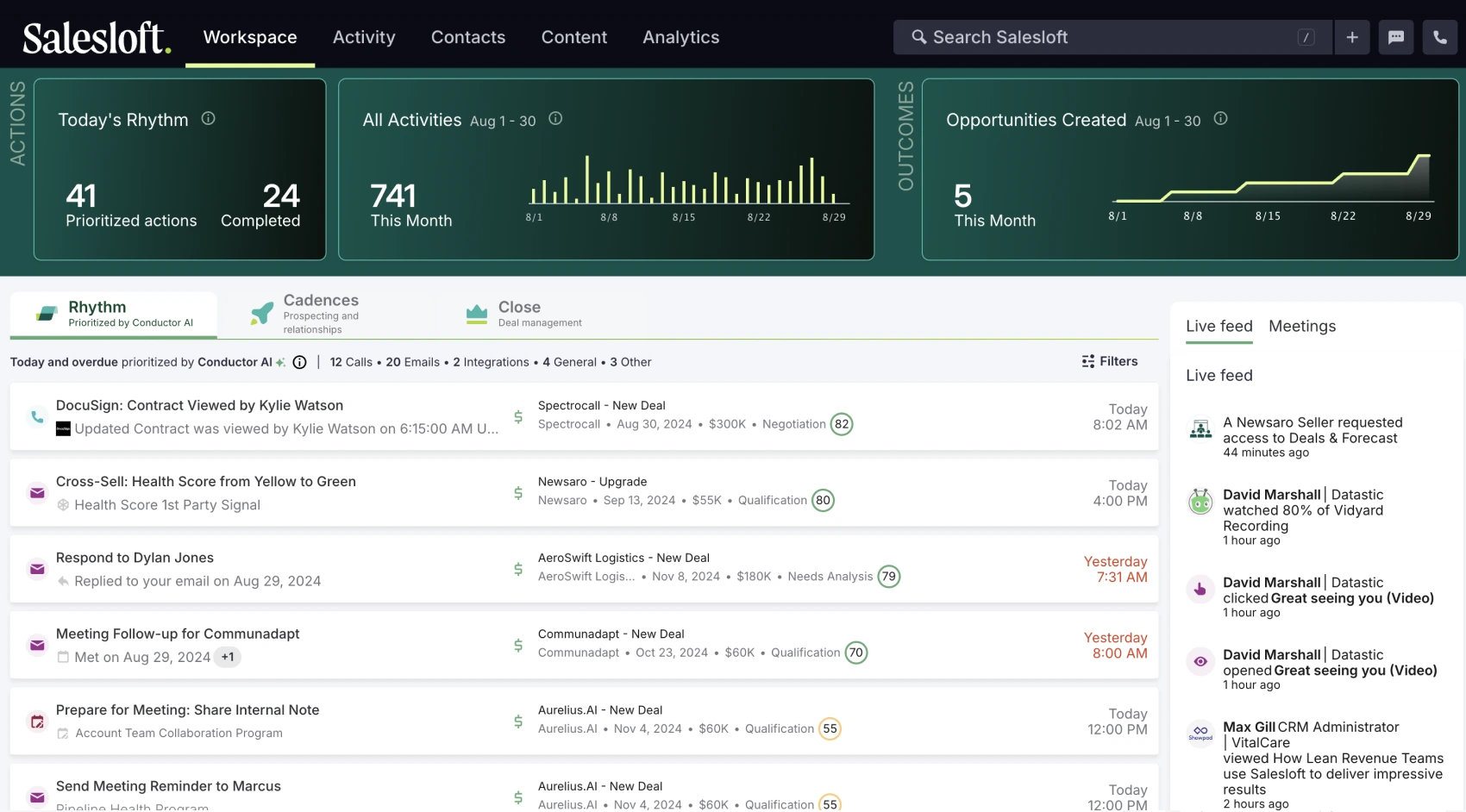
Rhythm ranks the next best action for every rep, AI Email Steps draft a personalized message at each cadence step and an Account Research agent prepares account context. Salesloft launched an MCP server in April 2026 and expanded it in July to cover forecasting, deal inspection and call data. Agent Teams connects to Salesloft natively, so teams can run plays in ZoomInfo and keep execution in Salesloft cadences.
Orchestration model: Guided, with agentic features. AI prioritizes and drafts, and reps carry out most actions.
Key features:
Cadence for multichannel sequences
Rhythm for signal-based action prioritization
AI Email Steps and an Account Research agent
Conversation intelligence, deal management and Clari Forecast
MCP server with write-back for external AI tools
Pros:
Engagement, deals and forecasting in one platform
Strong cadence governance for large sales teams
Native connection to Agent Teams
Cons:
No B2B contact data of its own
Agents are mostly assistive, so reps still execute outreach
No public pricing
What users say on G2: A mid-market CEO says Clari, now part of Salesloft, “turns complex sales data into clear insights,” helping the team “predict revenue more accurately.” A junior accountant notes that “some of the more advanced features can take time to learn and configure.”
Best for: Enterprise sales teams that want AI-guided cadences and forecasting in the same platform.
Pricing: Custom.
Weighing other options for sequencing? Compare them in our roundup of Salesloft alternatives. If forecasting is the main job, our list of Clari alternatives covers that side.
3. Gong
G2 rating: 4.7/5 (6,775 reviews)
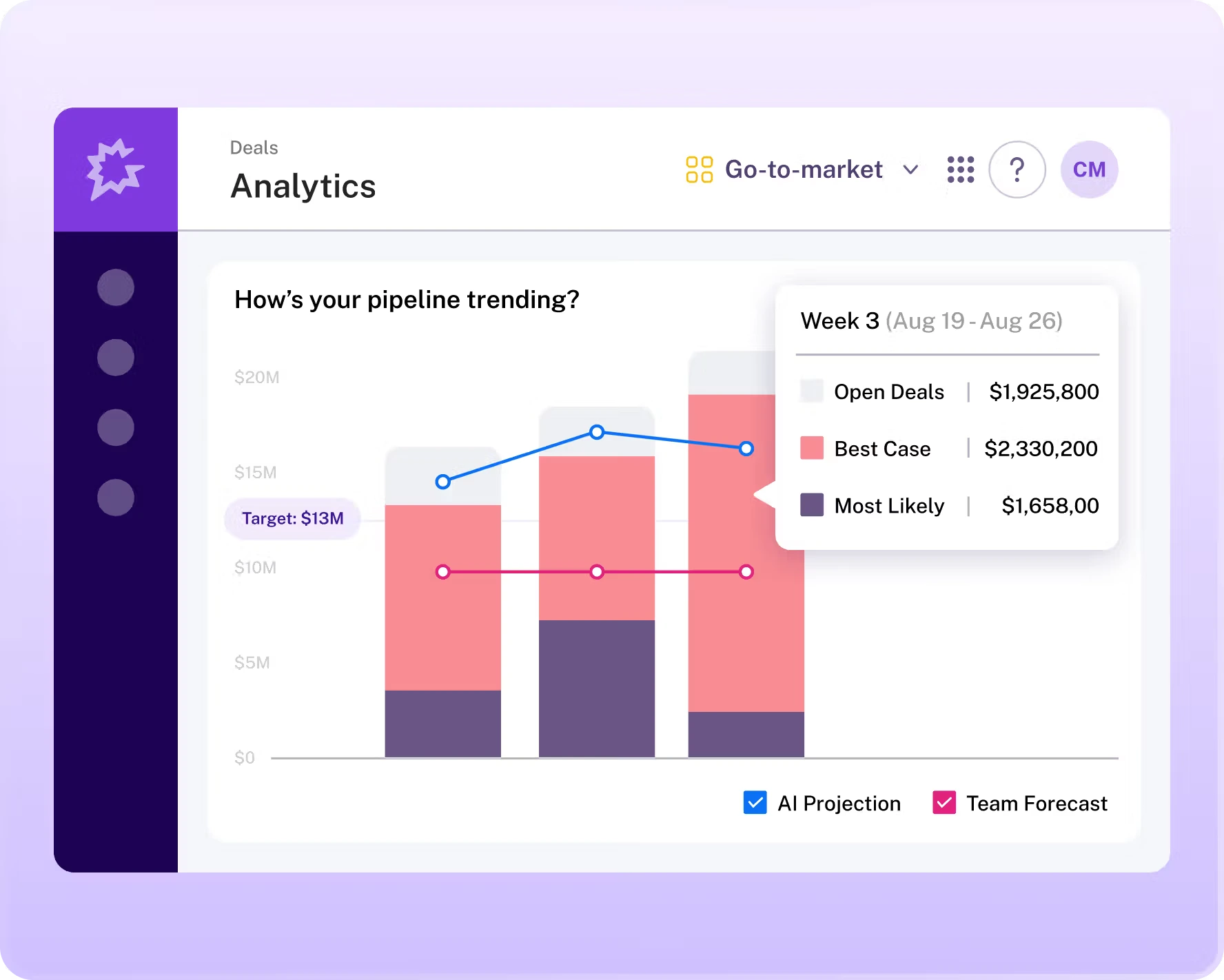
Gong is a revenue AI operating system built on the Gong Revenue Graph, which captures calls, emails and meetings across the revenue team. That makes its decisioning layer especially strong for deals already in motion. Specialized agents work across deal execution, forecasting and coaching, and Custom Agents let teams describe new agents in plain language, with scoped data access and an audit trail.
In June 2026, Gong launched the Revenue Harness, an agentic execution layer that governs, orchestrates and connects agents across the revenue cycle. Gong works with more than 5,000 companies and supports MCP, so outside AI tools can work with its data. Its signals come mainly from conversation intelligence, so teams pair it with another source for prospecting data and pre-pipeline intent.
Orchestration model: Agentic, centered on conversation and deal data.
Key features:
Revenue Graph built from customer conversations and activity
Agents for deal execution, forecasting and coaching
Revenue Harness for governing and orchestrating agents
Custom Agents built in plain language
MCP support for external AI tools
Pros:
Deep deal intelligence from real customer conversations
Strong coaching and pipeline inspection
Large customer base of 5,000+ companies
Cons:
No public pricing
Signals center on conversations, so prospecting data comes from elsewhere
Takes time to learn the full platform
What users say on G2: A business development rep says Gong “gives a good recap of the convo,” and that call recording and call analysis “have been solid.” An account manager finds the dashboards “can sometimes feel a bit cluttered,” so finding the exact information takes time.
Best for: Enterprise revenue teams that want agents built on conversation intelligence for deal execution and coaching.
Pricing: Custom. Gong charges a license per user plus a platform fee based on the number of users, and integrations with your existing stack are included.
For a side-by-side look at the wider field, see our list of Gong alternatives.
4. Outreach
G2 rating: 4.3/5 (3,671 reviews)
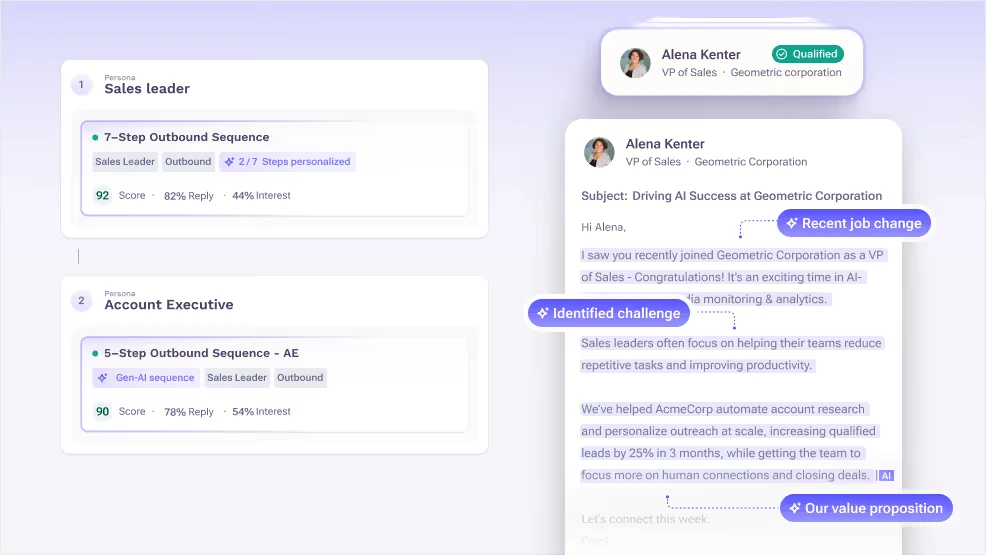
Outreach is an agentic AI platform for revenue teams, with agents across prospecting, deal management and coaching. Its April 2026 release added Omni, a conversational agent sellers and managers can use in the app, Slack or mobile, and Agent Studio, a visual canvas where RevOps teams build and schedule custom agents from templates. Named agents include a Research Agent, a Meeting Prep Agent for pre-meeting briefs and a Deal Agent that suggests deal-field updates in Slack.
In June 2026, Outreach added a full MCP suite so external AI tools can work with its data. It’s one of the sales engagement platforms Agent Teams works with natively, so teams can keep their Outreach sequences and let Agent Teams research accounts and enroll the right buyers.
Orchestration model: Agentic, inside a sales engagement platform.
Key features:
Multichannel sequences across email, phone and LinkedIn
Agent Studio for building and scheduling custom agents
Omni, plus Research, Meeting Prep and Deal agents
Deal and pipeline insights with notifications
MCP suite for external AI tools
Pros:
Mature sequencing engine many enterprise teams already run
Agents across the sales cycle in one platform
Custom agents without engineering through Agent Studio
Cons:
No B2B contact data of its own
More platform than many teams need on day one
No public pricing
What users say on G2: A market research analyst says “the deal and pipeline insights are very reliable and the notifications really help with decision making.” A data science mentor feels “pipeline management could be improved so it’s easier to use and understand.”
Best for: Enterprise sales organizations that want agents inside an established sales engagement platform.
Pricing: Custom. Outreach combines per-seat access with consumption-based AI credits across four Amplify packages (Essentials, Core, Plus and Pro), which include 10,000 to 100,000 AI credits.
For a hands-on view of the platform, read our full Outreach review.
5. Salesforce Agentforce
G2 rating: 4.3/5 (1,697 reviews)
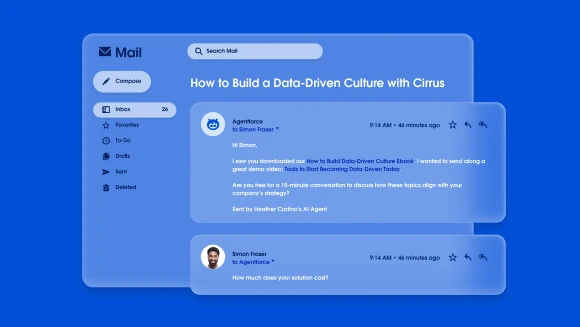
Salesforce Agentforce is Salesforce’s platform for building and running AI agents on CRM data, which makes it the natural execution layer for teams standardized on Salesforce. For revenue teams, it includes an SDR agent that nurtures inbound leads and books meetings, a Sales Coach agent and the Agentforce Prospecting Agent, plus a builder for custom agents.
ZoomInfo data powers the Agentforce Prospecting Agent, so mutual customers get verified contact, company, intent and Scoops data inside Agentforce through GTM.AI. Salesforce also completed its acquisition of Qualified on April 1, 2026, and is bringing Qualified’s agentic marketing capabilities into Agentforce.
Orchestration model: Agentic and CRM-native. Agents inherit Salesforce’s data model, permissions and automation.
Key features:
SDR agent for inbound lead nurture and meeting booking
Prospecting Agent with ZoomInfo data for account and contact research
Sales Coach agent for role-play and call feedback
Agent builder for custom workflows
Native access to Salesforce data, permissions and flows
Pros:
Agents run inside the system teams already treat as their source of truth
Inherits Salesforce security and permissions
Broad agent library across sales, service and marketing
Considerations:
Designed for teams that run on Salesforce
Flex Credit usage needs forecasting against agent volume
Agent output depends on the quality of the CRM data underneath
What users say on G2: An enterprise user likes “how agents can split up and work on things faster,” and found the initial setup “very easy.” A data science VP notes that per-conversation and per-action pricing “can quickly add up, especially at high interaction volumes.”
Best for: Revenue teams standardized on Salesforce that want agents inside their CRM.
Pricing: Flex Credits cost $500 per 100,000 credits, with a standard agent action using 20 credits and a voice action using 30.
Agentforce add-ons for Sales cost $125 per user per month for unmetered employee use.
Customer-facing agents can also be priced per conversation, and Salesforce Foundations includes Agentforce Builder at no cost.
To see how verified data reaches the agent, read how the Agentforce Prospecting Agent runs on ZoomInfo.
6. Revenue.io
G2 rating: 4.7/5 (580 reviews)
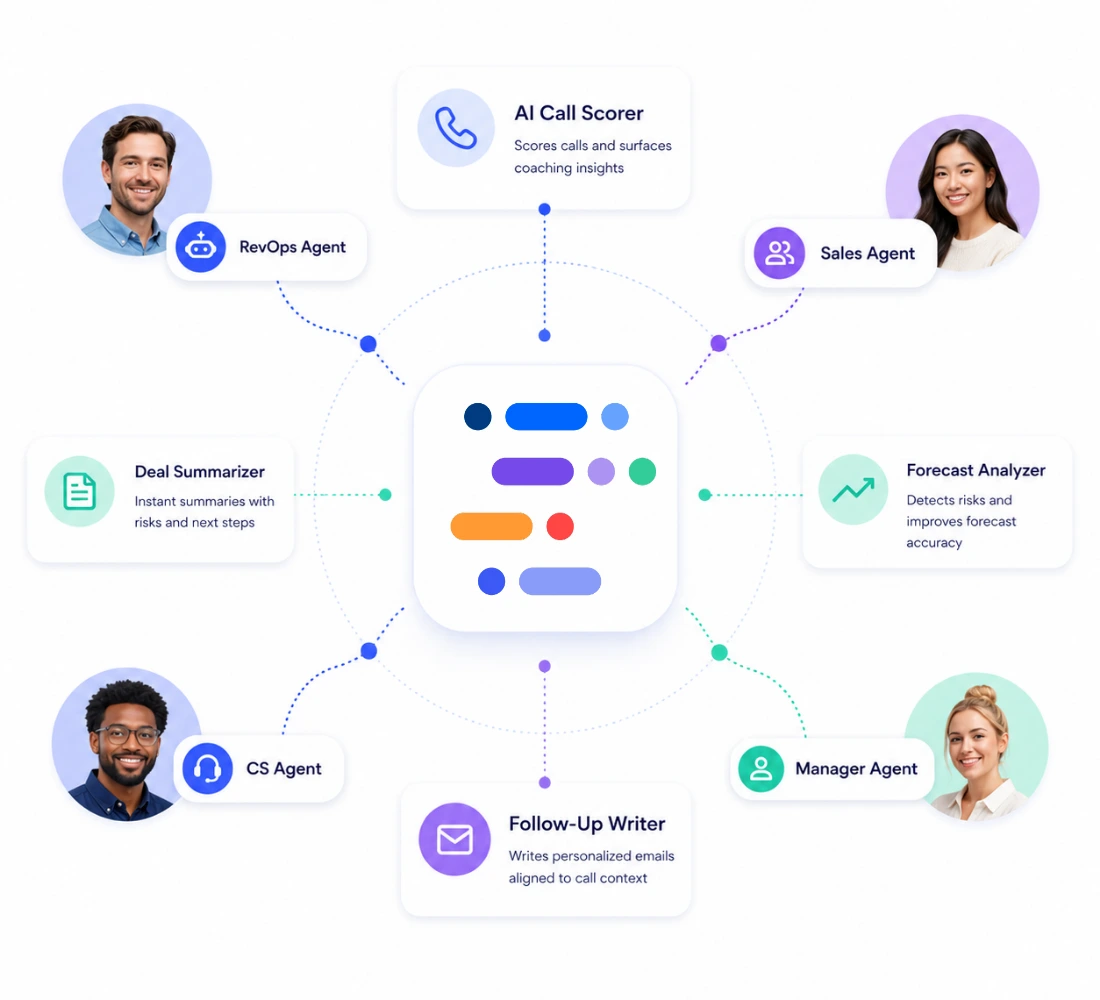
Revenue.io is a Salesforce-native revenue orchestration platform focused on guided selling and live conversations. Guided Selling tells reps whom to contact and which play to run, while Moments delivers real-time guidance and battlecards during calls. The platform also covers a Salesforce dialer, conversation and revenue intelligence, forecasting, AI scorecards and AI sales roleplay.
Ask Revenue AI answers questions about pipeline and deals in plain language, and the platform now includes AI Sales Agents. Because everything runs inside Salesforce, activity and follow-ups land in the CRM without extra sync work.
Orchestration model: Guided. AI recommends and coaches, and reps execute.
Key features:
Guided Selling cadences and playbooks
Moments for real-time call guidance
Salesforce-native dialer and call tracking
Conversation intelligence, AI scorecards and forecasting
Ask Revenue AI and AI Sales Agents
Pros:
Deep Salesforce integration with no separate data store
Strong live-call coaching for managers
Reviewers praise quick, responsive support
Cons:
Built for Salesforce teams only
No B2B contact data or intent signals of its own
No public pricing
What users say on G2: An enterprise sales development manager says “guided selling makes lead follow up and pipeline management a breeze.” An account executive dislikes the prompts to log a disposition after each call “because they can slow down my workflow.”
Best for: Salesforce-native sales teams that want guided selling and live call coaching.
Pricing: Custom, across three plans (Activate, Engage and Orchestrate), for Salesforce teams of 15 or more seats.
Comparing it with similar platforms? See our guide to Revenue.io alternatives.
7. UserGems
G2 rating: 4.7/5 (167 reviews)
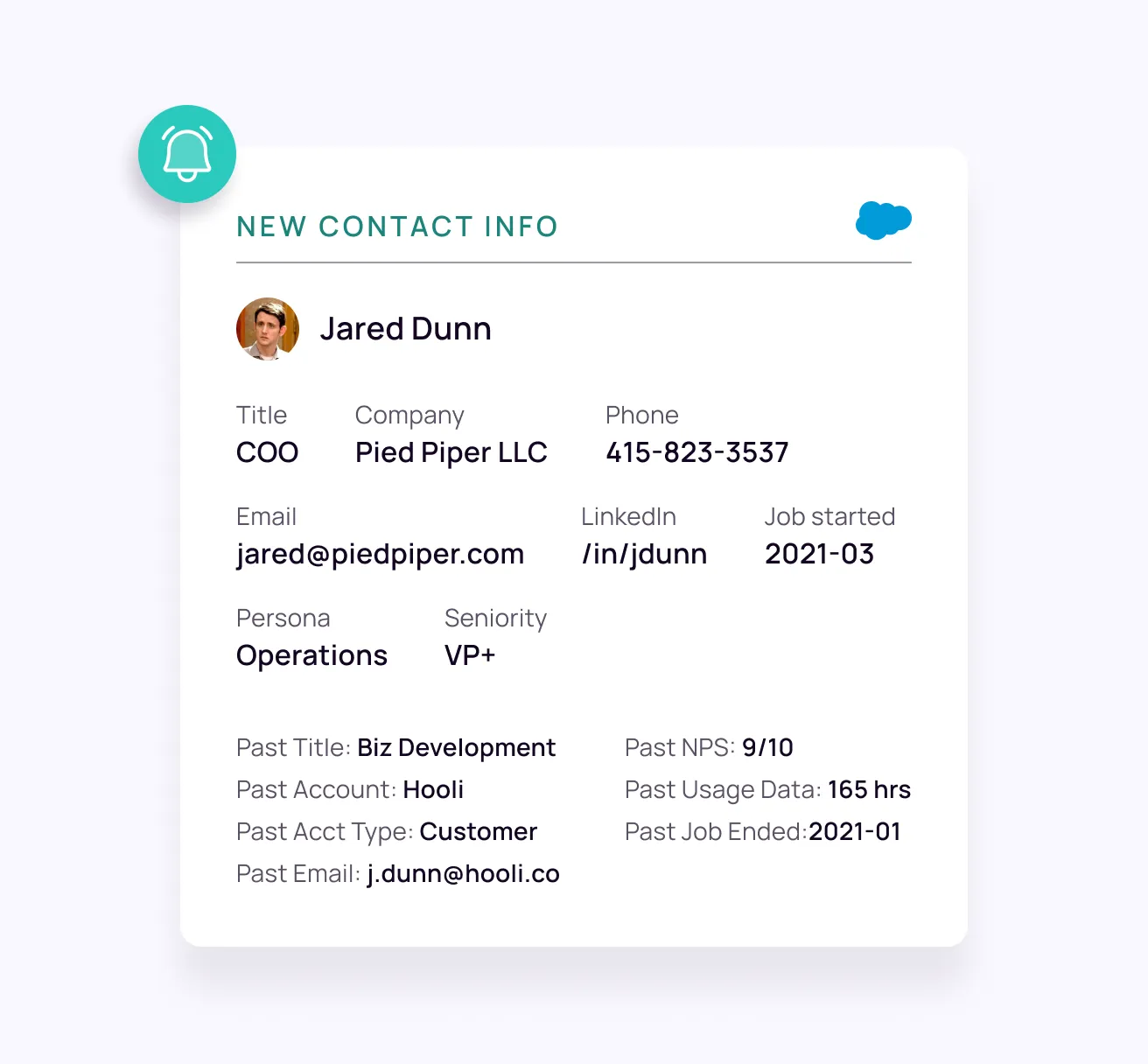
UserGems started as a champion-tracking tool and now works as an AI command center for signal-based pipeline. It monitors 30+ signal types, with job changes still the core use case, alongside intent, website visits, M&A activity, hiring and earnings reports. Gem-E is its orchestration layer, with Research, Writing and Orchestration agents that build lists, generate personalized email and run multi-touch sequences.
UserGems launched an MCP connection for Claude and ChatGPT in September 2026, along with updated Research and Writing agents. It fits best when relationships and job change alerts drive a large share of pipeline.
Orchestration model: Signal-triggered, with AI agents for research and outreach.
Key features:
Job change and past-customer tracking
30+ native signal types
Gem-E with Research, Writing and Orchestration agents
Account and contact scoring
MCP connection for external AI tools
Pros:
Turns relationship signals into pipeline with little manual work
Custom signals go well beyond job changes
Integrates with Salesforce, HubSpot, Dynamics and Marketo
Cons:
Credit-based pricing needs planning against signal volume
Narrower than full-cycle platforms on deal execution and renewal
Custom or niche CRMs take more setup
What users say on G2: A G2 reviewer likes how UserGems “turns passive relationship equity into actionable, revenue-driving opportunities without adding manual work.” A RevOps professional finds the tool “complex to use” and isn’t a fan of the credit system.
Best for: B2B teams whose pipeline depends on past customers, champions and relationship signals.
Pricing: Core starts at $40,000 a year, with unlimited users and 4 million credits.
Advanced and Elite add more credits and account coverage, each tier carries a one-time implementation fee, and Enterprise is custom. UserGems also offers a money-back guarantee if customers don’t see ROI in closed-won revenue.
For a tier-by-tier breakdown, see our guide to UserGems pricing.
8. LeanData
G2 rating: 4.6/5 (1,069 reviews)
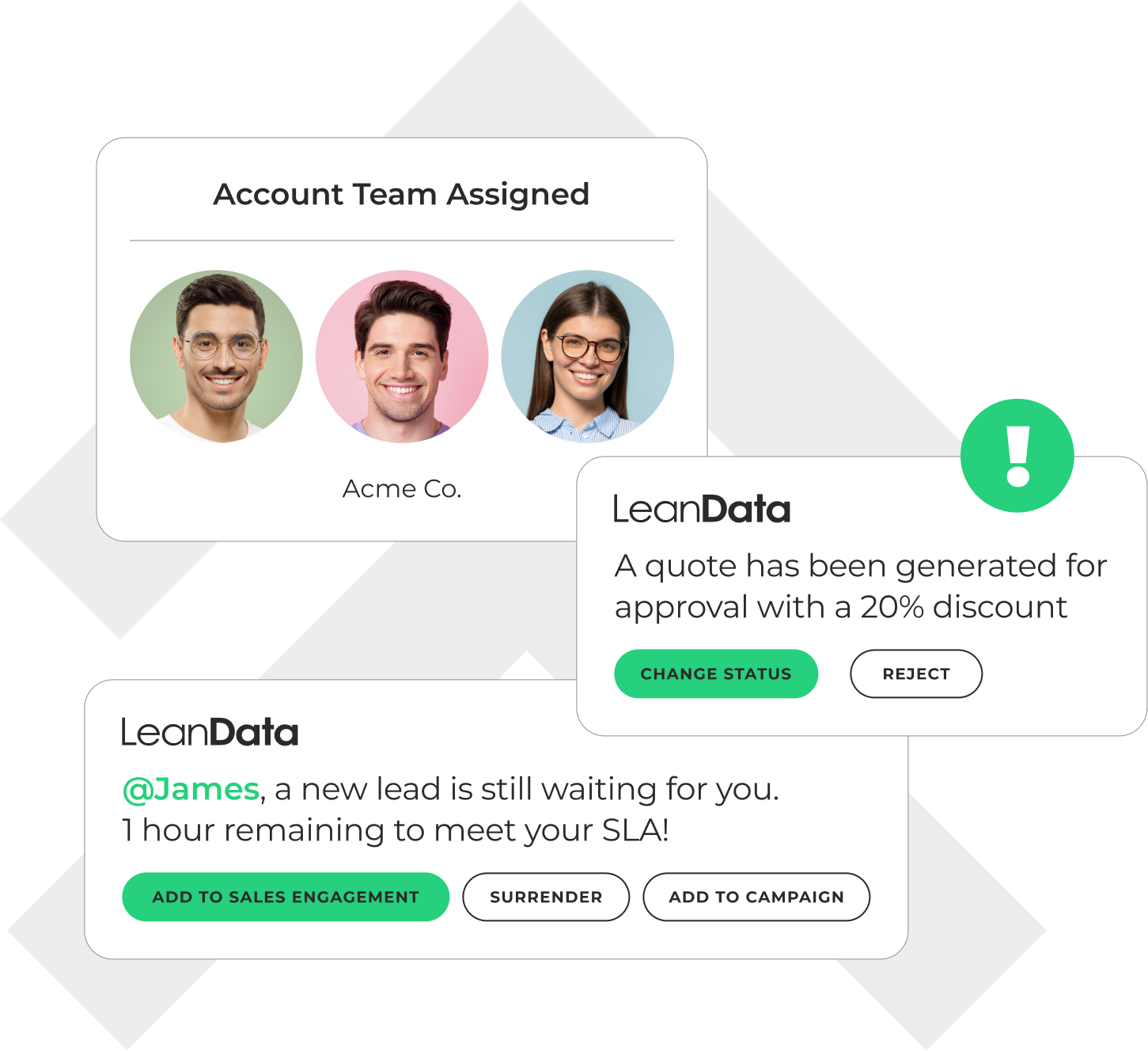
LeanData is a Salesforce-native GTM orchestration platform built around matching and routing. FlowBuilder, its no-code canvas, connects leads to the right accounts, assigns them by territory or round robin, enforces SLAs and logs every decision. BookIt adds meeting scheduling from forms, handoffs and booking links.
LeanData’s Q3 2026 release moved more AI into its deterministic flows. The AI Inference Node runs an LLM prompt at a routing decision point and passes the output into rule-based logic, a beta AI Assistant helps admins build graphs, and Journeys tracks buying committee coverage on each deal.
Orchestration model: Rules-based, with AI decision steps inside auditable flows.
Key features:
Lead-to-account matching and deduplication
FlowBuilder for routing, territory and round-robin logic
BookIt scheduling for forms, handoffs and links
AI Inference Node and AI Assistant
Journeys for buying-group signals and coverage
Pros:
Predictable, auditable routing logic
Deep Salesforce integration
Hands-on implementation support
Cons:
Routing graphs take ongoing upkeep as the business scales
No contact data or intent signals of its own
No public pricing
What users say on G2: A mid-market delivery lead praises “the ease of setting up workflows, which helps us get leads into the hands of salespeople faster.” A computer software reviewer notes that “setting up and maintaining routing rules, graphs, and edge cases often requires ongoing effort.”
Best for: RevOps teams on Salesforce that need precise matching, routing and scheduling.
Pricing: Custom, across Standard, Advanced and Premium editions. AI Assistant and the AI Inference Node come with Premium, Journeys is an add-on to Premium, and BookIt scheduling is sold separately.
For a fuller look at its strengths and gaps, read our LeanData review.
9. Demandbase
G2 rating: 4.4/5 for Demandbase One (2,016 reviews)
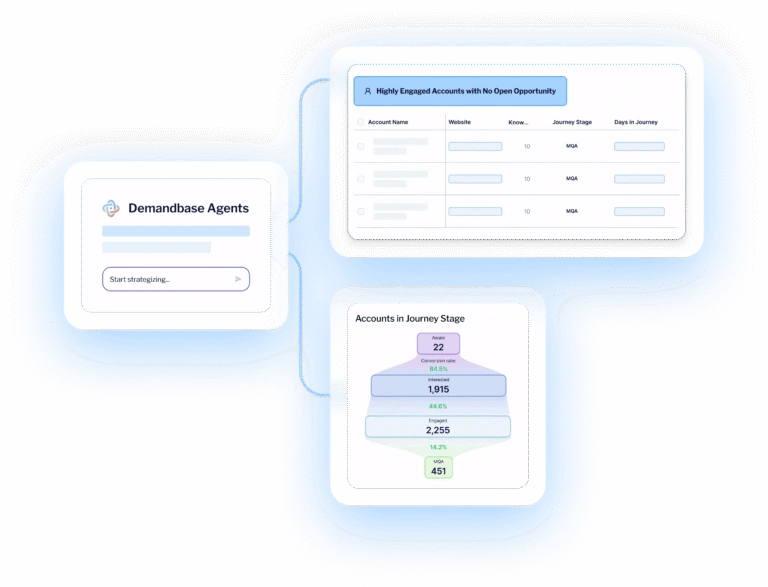
Demandbase is an account-based GTM platform for marketing and sales teams. Demandbase One identifies website visitors at target accounts, tracks engagement and intent, maps buying groups and runs B2B advertising from a single platform, which makes it strongest in the signals layer and in marketing-led execution.
Its agents include an Account Engagement Agent, an Intent Agent, an Email Personalization Agent, a Buying Group Setup Agent and a Campaign Outcomes Agent that optimizes ad bidding. In April 2026, Demandbase launched Demandbase AI, which adds a Site Customization Agent, AI Chat and MCP access to its account, contact and intent data.
Orchestration model: AI-assisted ABM orchestration across marketing and sales.
Key features:
Account identification and website visitor tracking
Intent, engagement and buying-group data
Specialized agents for engagement summaries, intent, email and campaigns
B2B advertising and site personalization
MCP access for external AI assistants
Pros:
Strong account-level view for ABM programs
Advertising and personalization in the same platform
Agents built on its own account intelligence
Cons:
Marketing-led, so seller execution often runs in other tools
Implementation can take a couple of months
No public pricing
What users say on G2: A small-business verifications specialist says the buying intent signals “help me find in-market accounts very reliably” and helped marketing and sales “feel much better aligned.” A product manager would have liked “deeper insights drawn from the existing data.”
Best for: Enterprise marketing teams running account-based programs with advertising.
Pricing: Custom.
For the wider category, see our comparison of ABM software.
10. 6sense
G2 rating: 4.0/5 for 6sense Sales Intelligence (1,097 reviews)
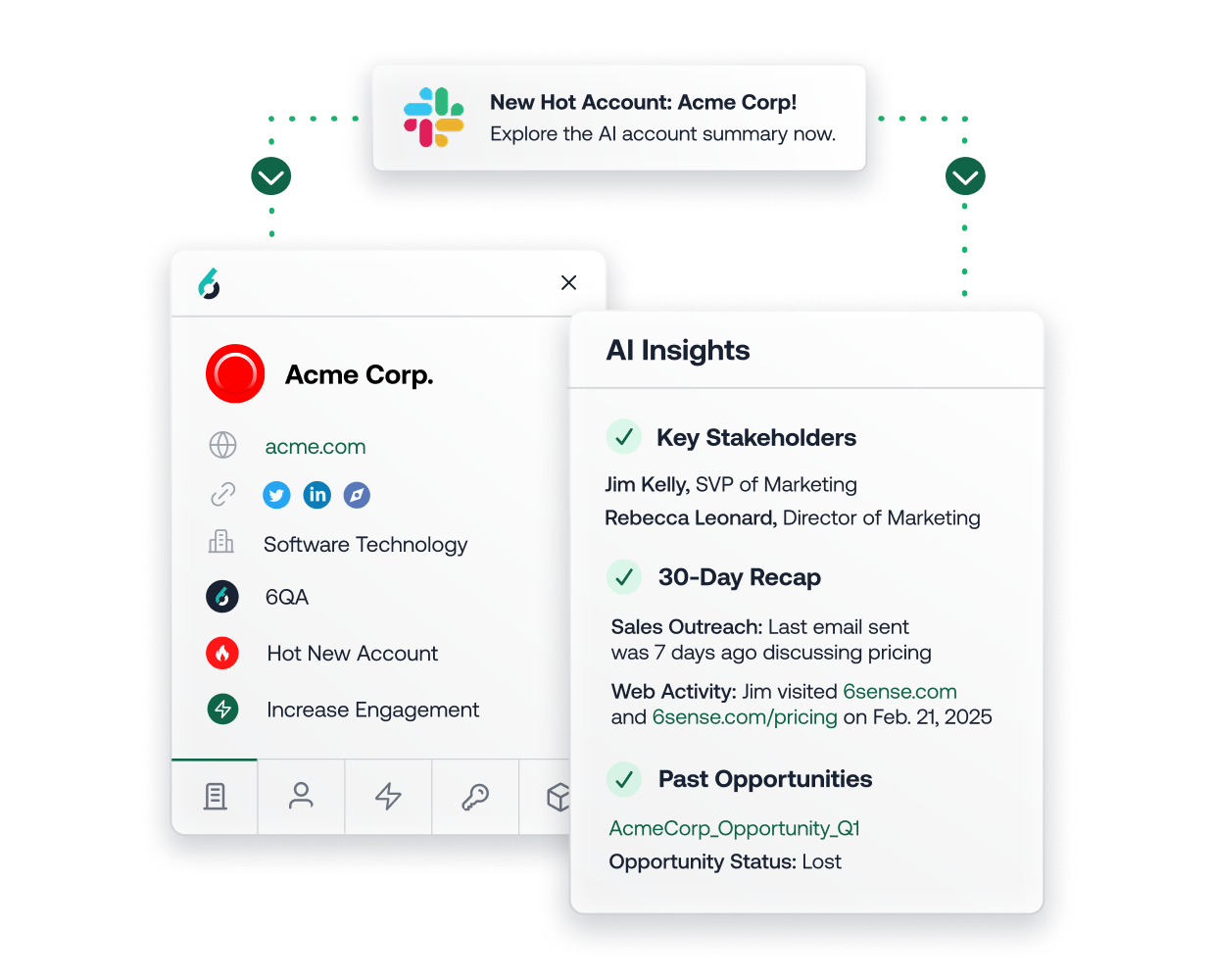
6sense is a revenue AI platform built around predicting which accounts are in market and where they sit in the buying journey. Its 6AI engine scores accounts on buying stage, intent and fit, and 6sense Sales Intelligence brings those insights to sellers with alerts, list building and account timelines.
Sales Copilot adds AI account summaries and recommended actions, AI Writer drafts outreach, and Email Agents run outreach for marketing teams. In July 2026, 6sense opened an MCP server in beta for Revenue Marketing customers, so external agents can query its intelligence. The predictive layer is the draw, and execution usually runs through connected intent data tools, ad platforms and sales engagement systems.
Orchestration model: Predictive and AI-assisted.
Key features:
Predictive account scoring and buying-stage models
Anonymous account identification and intent signals
Sales alerts, list builder and account timelines
Sales Copilot, AI Writer and Email Agents
MCP server in beta for Revenue Marketing customers
Pros:
Strong in-market account prediction
Shared account priorities for sales and marketing
Packages scale from data access to predictive AI
Cons:
Setup can take months to tune
Value depends on tight sales and marketing alignment
No public pricing
What users say on G2: An ABM manager says 6sense gives the team “a much clearer view of which accounts are actively showing buying intent.” A mid-market VP calls it “really pricey” and says setup “can take months to get it right.”
Best for: Enterprise teams running ABM that want predictive in-market account prioritization.
Pricing: Custom, across three Sales Intelligence packages that add data credits, Predictive AI or both.
Comparing 6sense with a workflow-first tool? Read our breakdown of 6sense vs Clay.
Other Tools Worth Knowing
A few tools often appear alongside revenue orchestration platforms, though they cover one piece of the stack.
Clay is a data enrichment and workflow builder that GTM engineers use to design custom plays, with waterfall enrichment across many providers. It’s flexible, and your team builds and maintains each workflow. See how it compares in GTM Studio vs Clay.
Bombora supplies company-level intent data from a cooperative of B2B publishers. It feeds the signals layer of other platforms and doesn’t run plays itself.
Highspot is a sales enablement platform for content, training and buyer engagement. It supports execution once a play reaches a seller.
How Agentic Orchestration Runs a Play
Agentic orchestration is easiest to understand through a single play. Here’s how Agent Teams runs champion activation, ZoomInfo’s hero play, from signal to outreach.
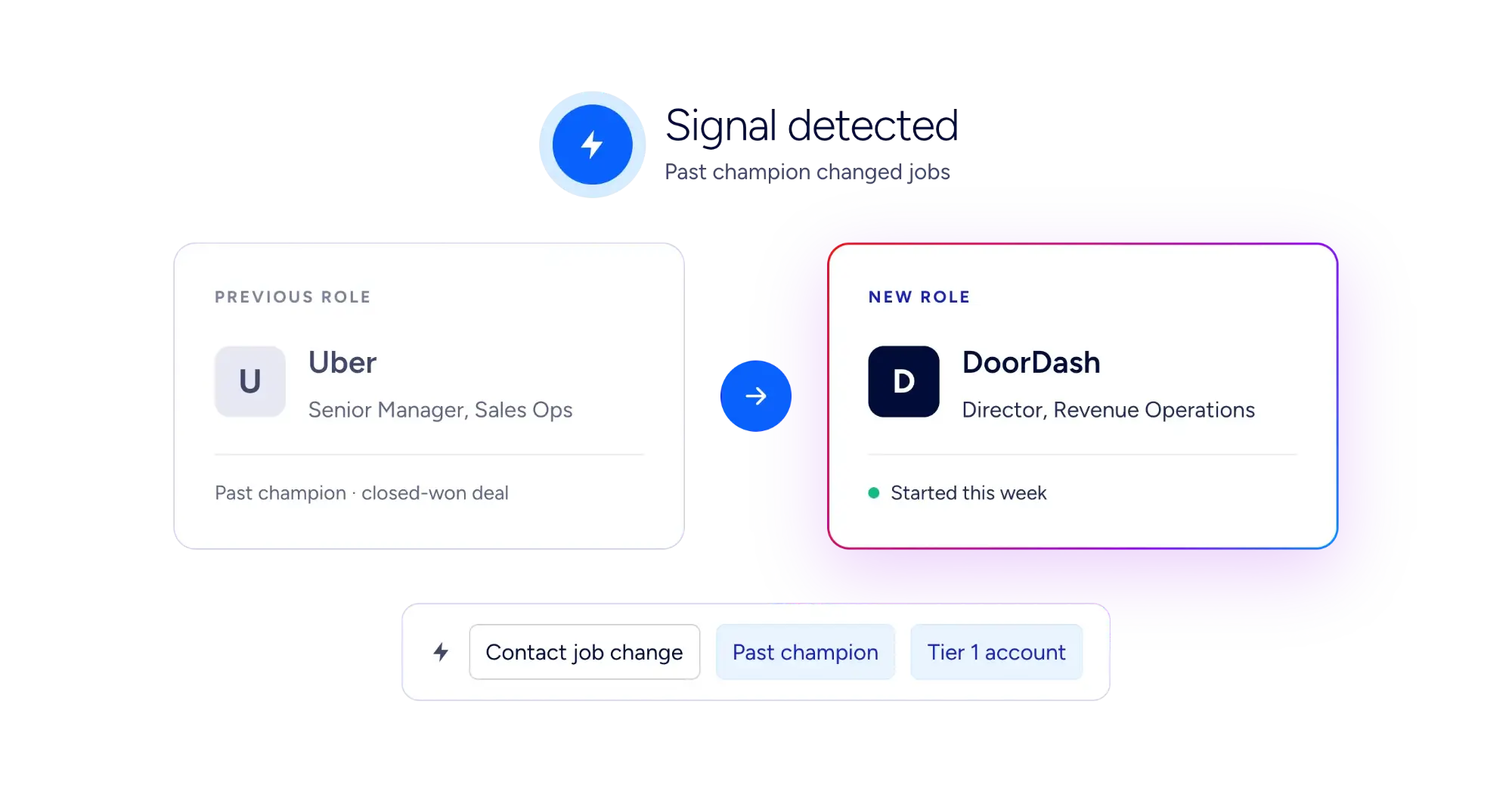
The signal. Jordan Ellis helped buy your product at Uber. Six months later, Jordan becomes Director of RevOps at DoorDash, a Tier 1 account.
Detection. An Agent Team running against a ZoomInfo Audience of past champions spots the move and resolves Jordan and DoorDash.
Context. It reconstructs Jordan’s role in the original Uber deal, finds the current DoorDash account owner and checks for open opportunities.
Action. It applies your champion play, drafts outreach grounded in the Uber relationship and briefs the account owner in Slack.
Adaptation. When Jordan visits your pricing page two weeks later, the play resumes with full context and moves to the next step.
Record. Every step is written back to Salesforce or HubSpot.
A rules-based flow would create a task and stop. The Agent Team carries the play to drafted outreach and a briefed owner, which is what turns champion tracking into pipeline.
The same approach runs across the cycle. Inbound Lead Activation researches each new inbound lead, routes it and briefs the rep. Closed-won lookalikes find similar companies after a win, MEDDIC capture writes qualification details from meetings to the opportunity, and closed-won handoff packages deal context for the account team. Renewal at risk uses the engagement signals behind a customer health score to flag accounts 90 days out, and closed-lost win-back revisits lost deals each month. Every run keeps CRM data enrichment current, so the next play starts smarter.
How to Choose a Revenue Orchestration Platform
Start with the layer where your revenue process breaks down, then match the platform to that gap.
Plays stall between the signal and the action. Look at agentic platforms such as ZoomInfo that connect signals, decisioning and execution, especially if pipeline depends on acting across many accounts at once.
Deals slip once they’re in motion. Gong, Salesloft and Outreach bring deal intelligence and execution to work reps already do, and our roundup of sales forecasting software covers the forecasting side.
Your team runs on one CRM. Agentforce and Revenue.io work natively in Salesforce, and LeanData handles Salesforce routing.
Relationships drive pipeline. UserGems specializes in job changes and past-customer signals.
Marketing leads account-based programs. Demandbase and 6sense focus on account identification, intent and advertising.
Whichever way you lean, run a pilot on your own accounts. Confirm that actions write back to the CRM, that admins can see what ran and why, and that you know the cost before plays go live. For a closer look at platforms built around agents, see our comparison of AI sales agent platforms. Marketing-led teams can start with our guide to marketing orchestration platforms.
Run Revenue Plays End to End With ZoomInfo
Revenue orchestration works when the signal, the decision and the action live in one place. Agent Teams brings all three together inside GTM Studio, running complete plays on verified data in the tools your team already uses, with monitoring and a credit estimate before every play.
Frequently Asked Questions
What is revenue orchestration?
Revenue orchestration is the practice of coordinating sales, marketing and RevOps actions around live buyer and account data. Revenue orchestration platforms capture signals, decide which accounts need attention and trigger or carry out the next step across the CRM and the tools teams use.
What is the difference between revenue orchestration and revenue action orchestration?
They describe the same category. Revenue action orchestration (RAO) is the term analysts use for platforms that turn revenue signals into prioritized actions, and many vendors use the shorter “revenue orchestration” for the same software.
What is agentic revenue orchestration?
Agentic revenue orchestration uses AI agents that work from each account’s current state toward a defined outcome. Agents decide whether to act, wait, suppress or escalate, and a play resumes with full context when new signals arrive. Rules-based orchestration follows a fixed path set in advance.
How is revenue orchestration different from sales engagement?
Sales engagement platforms run seller outreach, such as sequences, calls and email. Revenue orchestration spans the whole revenue team, deciding which accounts need action and coordinating work across sales, marketing and RevOps, often using a sales engagement platform for execution.
How is revenue orchestration different from revenue intelligence?
Revenue intelligence analyzes activity, conversations and pipeline to show what’s happening and forecast what will close. Revenue orchestration uses those insights, along with buyer signals, to trigger and carry out the next action.
What buyer signals do revenue orchestration tools act on?
Common signals include intent spikes, website visits, form fills, job changes, funding, hiring, technographic changes, email and meeting engagement, and CRM events such as stage changes or closed-won deals.
Do revenue orchestration tools replace the CRM?
No. The CRM stays the system of record. Orchestration platforms read from it, act across connected tools and write every step back, so the CRM stays current without manual entry.
How long does it take to implement a revenue orchestration platform?
Timelines range from a day for template-based plays to a few months for enterprise rollouts with custom routing, integrations and data work. Agent Teams can be live in a day for teams starting from templates.
Do revenue orchestration tools require technical expertise?
Common plays can be built in no-code builders. Custom logic, integrations and headless use through an API, CLI or MCP usually involve RevOps or GTM engineering support.
How much do revenue orchestration tools cost?
Eight of the 10 platforms here quote custom pricing based on seats, modules or usage. Some, such as Agentforce and Agent Teams, price agent work on credits, and a few publish tiers. Factor in implementation, CRM configuration and ongoing maintenance alongside license fees.
Is Agent Teams a separate product from GTM Studio?
No. Agent Teams is part of GTM Studio, with no new SKU or contract. It runs on consumption-based AI Credits, with a credit estimate shown before each play.
