
What you need to know about data as a service
Your CRM is decaying faster than your team can fix it, and every enrichment workflow, routing rule, and scoring model built on top of that foundation inherits the same gaps. Data as a Service (DaaS) is the architecture that stops that cycle.
What DaaS is: Data as a Service is a cloud-based model that delivers on-demand access to enriched, verified B2B data through APIs, cloud platforms, and native integrations, without on-premise infrastructure. It's the data layer underneath your GTM stack, not another tool on top of it.
How DaaS differs from SaaS and PaaS: SaaS delivers software applications (Salesforce, HubSpot). PaaS delivers a development environment (AWS, Azure). DaaS delivers the data itself, continuously refreshed and routed into those platforms automatically.
The key RevOps benefit: Continuous CRM enrichment runs without manual intervention, so your routing rules, territory models, and scoring logic always operate on current data rather than a six-month-old snapshot.
DaaS vs. Data as a Product: DaaS delivers ongoing, real-time data streams via subscription. Data as a Product (DaaP) delivers governed, reusable datasets for specific analytical or AI use cases. Most enterprise RevOps teams need both.
One evaluation action: When assessing DaaS providers, prioritize real-time refresh frequency and CRM integration depth above all other criteria. A provider with high coverage but slow refresh still leaves you routing on stale data.
What is data as a service (DaaS)?
Data as a Service (DaaS) is a cloud-based model that delivers on-demand access to enriched, verified B2B data through APIs, cloud platforms, and native integrations, without on-premise infrastructure. It eliminates on-site infrastructure needs and delivers AI-ready data directly into GTM workflows through scalable, subscription-based access.
Businesses access DaaS through multiple delivery methods:
APIs: Real-time data retrieval integrated directly into workflows
Cloud data platforms: Direct connections to Snowflake, Google BigQuery, and AWS
Flat files: Batch delivery for custom data warehouse needs
Key components of a DaaS architecture
A comprehensive DaaS offering includes six essential components:
Cloud delivery: Data hosted and delivered via cloud infrastructure, eliminating on-premise storage
On-demand access: Real-time data availability when teams need it
Subscription model: Flexible pricing that scales with usage
Data sourcing: Aggregation from multiple verified sources for comprehensive coverage
Data cleansing: Automated processes that remove duplicates and correct inaccuracies
Integration capabilities: APIs, webhooks, and connectors for direct CRM and marketing automation flow
DaaS platforms combine first-party data with third-party insights to build a single source of truth for predictive modeling and go-to-market strategies. This eliminates blind spots from relying solely on CRM data, which is typically messy, incomplete, and outdated.
DaaS vs. SaaS vs. PaaS vs. IaaS
DaaS is frequently confused with adjacent cloud service models, but the distinctions matter when you're evaluating where data fits in your stack. SaaS delivers software applications over the internet; PaaS delivers a development and deployment environment; IaaS delivers raw compute, storage, and networking infrastructure. DaaS delivers the data itself as a continuously updated service, sitting beneath your SaaS applications and feeding them with verified, enriched records. A RevOps team might run Salesforce (SaaS), build integrations on AWS (PaaS/IaaS), and rely on ZoomInfo (DaaS) to keep the records inside Salesforce accurate and complete.
Service Model | Primary focus | What is delivered | Primary buyer | Pricing model |
|---|---|---|---|---|
DaaS | Data access and enrichment | Enriched, verified data records via APIs, cloud platforms, or flat files | RevOps, Marketing Ops, Data Engineering | Subscription or consumption-based |
SaaS | Software functionality | Applications accessed via browser or API | End users, business teams | Per-seat or subscription |
PaaS | Development environment | Infrastructure + tools for building and deploying applications | Developers, engineering teams | Usage-based or subscription |
IaaS | Infrastructure | Compute, storage, and networking resources | IT, DevOps, engineering | Pay-per-use |
How data as a service works
A DaaS architecture consists of two interconnected layers: a data access layer that delivers the data points from which teams can draw insights, and a data management layer that provides the maintenance and enhancement services needed to make data work across a company.
Data access layer
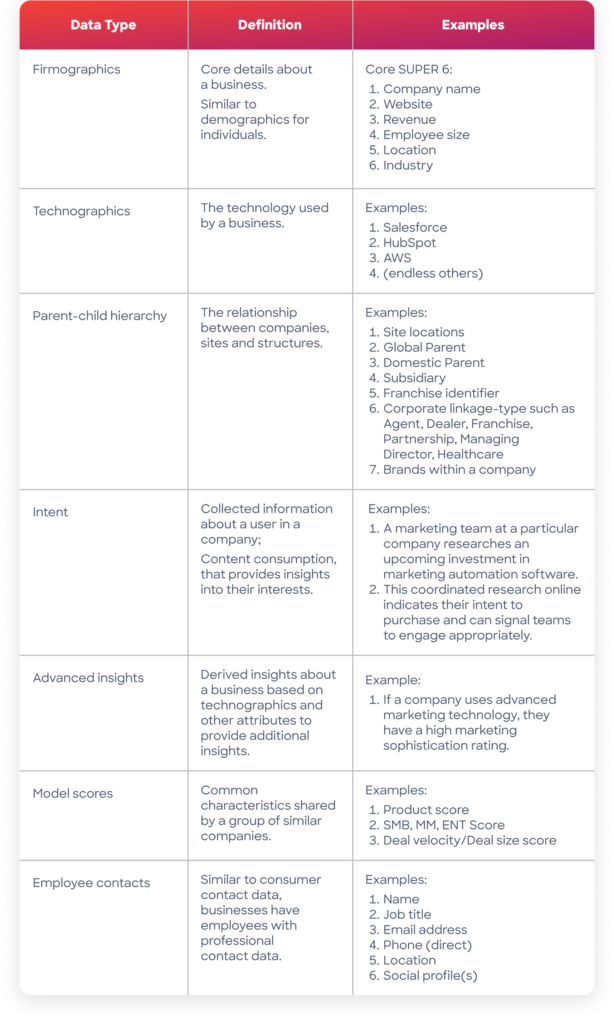
The data access layer draws on seven types of data:
Firmographics: Company name, website, revenue, employee size, location, and industry
Parent-child hierarchy: Relationships between companies, sites, global parents, domestic parents, subsidiaries, and franchise identifiers
Technographic data: Applications and software infrastructure like AWS, HubSpot, Salesforce, and ZoomInfo
Scoops: Actionable leads from surveys and research identifying projects and leadership moves for timely outreach
Location: Detailed address information including satellite offices and temporary locations
Contacts: Work email, direct dial phone numbers, and office addresses
Advanced insights: Detailed company information like marketing sophistication levels
Data management layer
The data management layer ensures the right data ends up in the right place through four core operations:
Cleanse: Automates database health through record deduplication, data normalization, standardization, and customer segmentation
Multi-vendor enrichment: Enriches databases with multiple data providers using flexible, rules-based logic that standardizes and segments to business requirements
Route: Automatically routes data into CRMs based on designated fields, creating routing workflows that assign leads for fast follow-up
APIs and webhooks: Integrates and updates B2B data directly in any system and workflow in real time at scale
DaaS solutions include specialized data services for custom requests, advanced analysis, and large-scale delivery needs:
Data cubes: Continually refreshed firmographics and technographics delivered via Snowflake, Google BigQuery, or AWS. ZoomInfo Data Cubes support master data strategy and advanced modeling
Custom enrichment services: Offline matching that resolves blanks left by real-time matching through periodic mass batches
Modeling and scoring services: Lookalike regression and custom models that identify cross-sell, upsell, and net-new opportunities. Score any object based on any attribute, including behavior, intent, and ICP fit
ZoomInfo's DaaS platform delivers advanced insights and intent data through Guided Intent, which identifies topics historically correlated with deal success rather than requiring manual topic selection.
DaaS delivery methods
DaaS platforms deliver data through four channels to fit different workflow requirements:
APIs and webhooks: Real-time integration into CRM and GTM tools with on-demand retrieval and automatic updates
Flat files: Batch delivery for custom data warehouse needs or legacy systems requiring periodic bulk updates
Cloud data platforms: Direct integration with Snowflake, Google BigQuery, and AWS for advanced analytics and machine learning
Native integrations: Pre-built connectors for Salesforce, HubSpot, Outreach, and Salesloft
Data as a service examples across industries
DaaS spans well beyond B2B sales data. The model applies wherever organizations need continuously refreshed, structured data delivered into operational systems without managing the underlying data infrastructure themselves. The table below covers the major data-as-a-service examples by category, with primary consumers and the core operational benefit each delivers.
Data type | Example use case | Primary consumer | Key benefit |
|---|---|---|---|
B2B contact and firmographic data | ZoomInfo continuously enriches Salesforce and HubSpot records with verified job titles, company size, and technographics. MarketSpark's 5x revenue growth came from identifying 30,000 prospect companies via ZoomInfo's DaaS API and S3 delivery. | RevOps, Sales, Marketing Ops | Eliminates manual prospecting and keeps CRM records current without batch imports |
Financial market data | Real-time pricing feeds, options chains, and order book data delivered to trading platforms and risk management systems | Quantitative analysts, trading desks, fintech developers | Sub-millisecond data freshness for time-sensitive execution decisions |
Geospatial and location data | Location intelligence feeds for logistics routing optimization and retail site selection analysis | Supply chain teams, real estate analysts, logistics operators | Continuous updates to traffic patterns, demographic shifts, and competitor locations |
Healthcare claims data | Payer and provider claims streams delivered to analytics platforms for utilization management and population health modeling | Health plan analysts, provider networks, healthcare consultants | Replaces manual claims extracts with continuously updated feeds for near-real-time analytics |
Intent and behavioral data | ZoomInfo's buying-signal feeds identify in-market accounts based on topics historically correlated with deal success, surfaced through Guided Intent | Demand generation, ABM teams, RevOps | Prioritizes outreach to accounts actively researching relevant solutions rather than relying on static lists |
IoT and sensor telemetry | Manufacturing equipment sensor streams delivered to predictive maintenance platforms for anomaly detection and downtime prevention | Plant operations, reliability engineers, industrial IoT teams | Converts raw sensor output into structured, queryable event streams without on-premise data infrastructure |
Benefits of data as a service for revenue teams
Data-as-a-Service from a GTM Intelligence provider goes beyond simple data delivery. It transforms how businesses access, analyze, and activate data to accelerate revenue growth and streamline go-to-market strategies.
Cost efficiency and scalability
GTM Intelligence platforms streamline operations by:
Eliminating disparate data tools through centralized solutions
Reducing infrastructure costs for storage and manual data management
Operating on subscription-based pricing that scales with business needs
Automating data cleansing, enrichment, and activation saves operational costs while increasing pipeline velocity and sales efficiency.
DaaS provides the foundation for strategic decision-making through GTM Studio analytics dashboards that surface account signals, funnel progression, and top-performing segments with predictive scoring built on ZoomInfo's verified data foundation. Capital One Commercial Banking's Andy Ruffles reduced ad-hoc data requests by centralizing data delivery, giving leadership self-service access to accurate, real-time data.
"My job is to bring the information to our sales teams as easily as possible. Now, instead of 100 different sales teams coming to me with requests, we put the data in one place. We give them a report, and they can get it themselves. It becomes more of that self-service model." Andy Ruffles, director of sales operations and strategy at Capital One Commercial Banking
Improved data quality and accuracy
Multi-vendor enrichment provides a holistic view of ideal customers by combining internal CRM insights with external third-party data and intent signals that reveal buyer readiness. This enables ICP refinement and precise targeting based on real-time insights.
A comprehensive Go-to-Market Intelligence provider delivers three core advantages over single-source data providers:
Automated cleansing via GTM Studio: Deduplication, normalization, and real-time correction without engineering tickets
Multi-vendor enrichment: Ensures complete, consistent datasets by aggregating from trusted sources
Real-time orchestration: Keeps data continuously updated without manual intervention
Faster time-to-insight
GTM Intelligence-powered DaaS delivers real-time, AI-ready data, enabling immediate response to market changes and buyer intent signals. Real-time orchestration accelerates lead prioritization based on dynamic intent and reduces sales cycle times.
DaaS ensures clean, well-structured data reaches teams when and where it matters through:
Real-time enrichment pipelines: Automatically update CRM systems
APIs and webhooks: Enable data flow across GTM tools
One-click access: Deliver engagement-ready data without manual preparation
DaaS delivers additional strategic advantages for revenue teams:
Personalized messaging: Granular customer insights enable personalized sales messaging that aligns with buyer needs at every journey stage, increasing engagement and conversion
Hidden revenue opportunities: Predictive analytics surface undiscovered market trends while lookalike modeling identifies cross-sell and upsell opportunities that scale through GTM Studio's automated play orchestration
AI model optimization: High-quality, AI-ready data trains machine learning models for precise predictions and powers generative AI applications without inaccurate outputs
DaaS use cases for go-to-market teams
Companies use DaaS in a variety of ways to drive go-to-market success:
Sourcing accurate account and contact data
For businesses that rely on physical address information like shipping or freight carriers, having accurate location data is mission-critical, yet quite challenging at scale. The task is even more difficult if your customer profile includes small businesses.
With DaaS, teams can leverage third-party data alongside their own internal customer records to accurately cover even the most difficult addresses, like warehouses, small business storefronts, branch offices, and satellite buildings.
GTM Studio's automated cleansing removes duplicates and corrects inaccuracies in real time through rules-based normalization and deduplication workflows, automates data normalization for semantic consistency across all GTM systems, and eliminates the manual enrichment step that causes routing delays. Momentive cut speed-to-lead from 20 minutes to 60 seconds by eliminating the manual enrichment step in its routing flow.
Building and refining ICPs
If a product serves a niche market, prioritizing new customer segments can be challenging. Sometimes a company's best accounts are not easily defined by traditional firmographics, like employee size or annual revenue.
Teams can leverage DaaS to pair nuanced company and contact attributes (such as decision-making authority, industry classification, and online behavior) with internal customer data (like time-to-close, deal size, and app download history) to uncover new industry segments with strong candidates for their solution.
Multi-vendor enrichment combines thousands of data points from multiple trusted vendors to ensure completeness and enables granular segmentation by supplementing ZoomInfo's proprietary data with niche datasets.
Enriching records for targeted outreach
Every revenue team wants to know more about its target audience in order to segment and prioritize accounts. Segmenting target account lists by industry is a common practice, but sometimes a default industry classification, such as "technology" or "manufacturing," can be too broad.
With DaaS, companies can select a handful of ideal accounts and plot their relevant terms or keywords onto a company semantics graph. This reveals related companies in new or adjacent industry segments that are potentially well-suited for what's being offered.
Real-time data orchestration automatically routes and integrates data across CRM, marketing automation, and sales engagement tools, and supports dynamic segmentation and intent-based outreach, ensuring GTM Studio-driven personalization at scale, triggered by real-time intent signals and dynamic segmentation.
"With go-to-market intelligence, we've achieved a significant boost in marketing campaign performance – the kind of results you only get by leveraging real-time insights to understand and connect with your audience." Tommie O'Brien, Chief Sales Officer, Semrush
How to build a DaaS architecture for GTM teams
Most DaaS implementation failures happen before a single API call is made. The architecture decisions made in the first two weeks, specifically around sequencing, field mapping, and delivery method, determine whether the platform reduces operational debt or creates new forms of it. The five steps below reflect the sequencing that works for RevOps teams connecting DaaS to an existing CRM and MAP stack.
Step 1: Audit your data sources. Inventory every CRM object, MAP record, and third-party feed you currently rely on. Map field-level gaps, identify duplicate record volume, and document which enrichment sources currently cover which fields. Common failure mode: teams that skip the audit inherit the same data gaps in the new pipeline, just with a new vendor name attached.
Step 2: Define your API and delivery layer. Choose between real-time API pulls, webhook triggers, flat-file batch, or cloud data platform delivery (Snowflake, BigQuery, or AWS) based on your actual latency requirements. Not every use case needs real-time. Common failure mode: choosing real-time API delivery for all use cases ignores rate limit constraints during inbound spikes, and high-volume periods will exceed thresholds without a batch fallback in place.
Step 3: Establish governance and access controls. Define field-level ownership, data stewardship rules, and compliance requirements covering GDPR, CCPA, and SOC 2 before you configure a single enrichment rule. Common failure mode: governance defined after deployment creates retroactive remediation debt that takes longer to fix than it would have taken to define upfront.
Step 4: Configure enrichment logic. Set waterfall enrichment source priority, deduplication rules, and normalization standards. GTM Studio's codeless interface lets you configure this without writing queries or opening engineering tickets. Common failure mode: enrichment that runs after routing sends leads to the wrong rep. Sequence enrichment before routing, not after.
Step 5: Automate routing and activation. Connect enriched records to routing workflows, scoring models, and GTM plays. GTM Studio's codeless workflow builder lets RevOps teams launch new enrichment rules, routing logic, and segmentation plays without writing a single query or opening an engineering ticket. Common failure mode: ops teams that depend on engineering for every routing change face two-week cycles for same-afternoon work.
The engineering bottleneck problem is real and well-documented. GTM Studio eliminates it for Steps 4 and 5 specifically, which are the two steps where most RevOps teams lose the most time to engineering dependencies. When your enrichment and routing logic lives in a codeless interface that ops owns directly, territory changes, new segment launches, and routing rule updates happen in hours, not sprint cycles.
DaaS vs. data as a product: choosing the right model
The debate between data as a service and data as a product is often framed as a binary choice, but that framing is wrong for most enterprise RevOps teams. DaaS and DaaP solve different problems and are most powerful when used together. DaaS is optimized for broad, scalable data distribution across GTM systems: continuous enrichment, real-time routing, and always-current CRM records. DaaP is optimized for governed, AI-ready, reusable data assets: the kind of trusted, well-documented datasets you'd use to train a scoring model, run a historical analysis, or build a data product that other internal teams consume.
Many enterprises combine both. DaaS handles the operational layer, keeping Salesforce, HubSpot, and your marketing automation platform fed with fresh, verified data. DaaP handles the analytical layer, providing the clean, governed datasets that data science and analytics teams need for modeling and reporting. The two models are complementary, not competing.
If your primary goal is broad data access across GTM systems, DaaS is the right foundation. If your goal is trusted, reusable data products for AI training and analytics, DaaP adds the governance layer. Most enterprise RevOps teams need both.
Factor | Data as a Service (DaaS) | Data as a Product (DaaP) |
|---|---|---|
Access Model | Continuous subscription | One-time or periodic purchase |
Data Flow | Real-time updates via APIs/webhooks | Static delivery via download or file transfer |
Cost Structure | Recurring subscription fees | Transaction-based pricing |
Best For | Ongoing GTM operations, CRM enrichment, intent monitoring | One-off analysis, research projects, historical modeling |
Decision guide: Broad GTM data access across CRM and MAP systems? DaaS. Governed, reusable AI-ready datasets for modeling and analytics? DaaP. Running continuous GTM operations while also building predictive models? Combine them.
For revenue teams running continuous outbound motions, DaaS eliminates the manual work of repeatedly purchasing and uploading data. For data science teams building predictive models on historical patterns, DaaP may provide the specific datasets needed without ongoing subscription costs.
Common DaaS challenges and how to overcome them
Successfully implementing DaaS requires overcoming several key challenges. The most successful DaaS strategies ensure AI-readiness, real-time data accuracy, and system-wide orchestration to support GTM operations.
Data security and compliance
Ensuring data security requires protecting against breaches, unauthorized access, and compliance failures related to global privacy regulations.
Go-to-Market Intelligence platforms address these challenges through:
Enterprise-grade encryption: Secure access controls that prevent unauthorized data access
Continuous auditing: Regular security audits and compliance certifications
Privacy-first frameworks: Built-in alignment with GDPR, CCPA, and other regulatory requirements
Revenue teams access real-time, engagement-ready data without compromising security or compliance standards.
Data quality and governance
DaaS implementation faces three primary challenges:
Data hygiene: Fragmented datasets, incomplete records, and outdated data that disrupt automated workflows and predictive analytics
Data governance: Complex requirements for data availability, usability, integrity, and stewardship to maintain compliance
Data silos: Isolated datasets that create transparency gaps, operational inefficiencies, and incomplete customer views
Go-to-Market Intelligence platforms automate solutions through:
Unified frameworks: Consistent data standards across all departments
Automated validation: GTM Studio's automated validation workflows eliminate manual errors
Real-time orchestration: Data unified across all GTM systems with prebuilt connectors
Single source of truth: Dynamic segmentation enables cross-departmental access for sales, marketing, and operations
Technical trade-offs
Connecting a DaaS platform to an existing CRM stack requires careful field mapping, deduplication logic, and routing sequence design. Enrichment that runs after routing sends leads to the wrong rep; a 14-day enrichment lag means territory assignments are made on stale data. The fix is sequencing enrichment before routing and using a platform that enforces this order automatically.
Real-time API enrichment also has practical limits. High-volume inbound spikes can exceed rate thresholds, making batch enrichment a necessary fallback for peak periods. A well-architected DaaS implementation plans for both delivery modes from the start rather than retrofitting batch support after the first spike event.
What to look for in a DaaS provider
When evaluating DaaS vendors and providers, prioritize these criteria to separate platforms that reduce operational debt from those that create new forms of it:
Data quality and freshness
Data accuracy and currency separate premium providers from budget alternatives. Evaluate providers on four criteria:
Verification methods: Multi-source verification delivers higher accuracy than single-source data
Refresh frequency: Real-time updates outperform quarterly refreshes for fast-moving GTM teams
Coverage depth: Comprehensive firmographics, technographics, and intent signals versus basic contact data
Accuracy guarantees: Specific deliverability rates and accuracy metrics with SLA commitments
Momentive compressed speed-to-lead from 20 minutes to 60 seconds by eliminating the manual enrichment step, a direct result of continuous data refresh in ZoomInfo's routing pipeline.
ZoomInfo processes 1.5B+ data points daily across 500M contacts and 100M companies, with 300+ human researchers maintaining up to 95% accuracy on first-party data. According to the Forrester Wave for Intent Data Providers B2B (Q1 2025), ZoomInfo earned the highest scores across 8 criteria in the evaluation. ZoomInfo is also Ranked #1 in 142 G2 Reports.
Integration capabilities
Data that lives in isolation delivers no value. Evaluate how easily provider data flows into your existing tech stack:
Native CRM integrations: Pre-built connectors for Salesforce, HubSpot, and platforms your team uses daily
API flexibility: Programmatic data pulls for custom workflows and applications
Marketing automation compatibility: Direct syncs with Marketo, Eloqua, and Pardot for campaign execution
Sales engagement tool support: Enriched data pushed directly into Outreach and Salesloft
The best DaaS providers offer multiple integration paths: native connectors for common tools, robust APIs for custom builds, and webhook support for real-time flows. This flexibility ensures data reaches the teams and systems that need it most.
For a curated list of DaaS providers by category, see our DaaS providers guide.
How ZoomInfo DaaS turns data complexity into pipeline
Data-as-a-Service from ZoomInfo, the all-in-one AI GTM Platform, transforms how businesses access, analyze, and activate data to fuel scalable growth and predictable revenue.
ZoomInfo's B2B data foundation covers 500M contacts and 100M companies, continuously verified by 300+ human researchers. The GTM Context Graph processes 1.5B+ data points daily, fusing your CRM records, conversation intelligence, and behavioral signals into a unified intelligence layer that reasons across sources, not just enriches them. That intelligence is accessible through GTM Studio for RevOps and marketers building codeless workflows, GTM Workspace for sellers, or directly via APIs and MCP in any tool or AI agent.
ZoomInfo's GTM Intelligence platform transforms fragmented data into a single source of truth, delivering real-time, verified data that feeds GTM Context Graph reasoning for faster account prioritization and routing decisions. Multi-vendor enrichment ensures complete, accurate customer profiles. Automated data orchestration handles end-to-end GTM execution. Engagement-ready insights surface at every stage of the buyer's journey.
MarketSpark identified 30,000 prospect companies and uncovered 5x revenue opportunities using ZoomInfo's Data as a Service API and S3 delivery, demonstrating what becomes possible when enrichment infrastructure runs continuously rather than on demand.
Talk to a data specialist to see how ZoomInfo DaaS integrates with your existing CRM and MAP stack.
Frequently asked questions
What is data as a service (DaaS)?
Data as a Service (DaaS) is a cloud-based model that delivers on-demand access to enriched, verified business data through APIs, cloud platforms, and native integrations, without on-premise infrastructure. Unlike SaaS, which delivers software applications, or PaaS, which delivers a development environment, DaaS delivers the data itself as a continuously updated service. For GTM teams, DaaS means CRM records stay current, routing logic operates on verified data, and enrichment runs automatically without manual intervention.
What is an example of data as a service?
ZoomInfo continuously enriches Salesforce and HubSpot records with verified contact data, firmographics, and intent signals. MarketSpark's 5x revenue growth illustrates the outcome: using ZoomInfo's DaaS API, MarketSpark identified 30,000 prospect companies it hadn't previously surfaced. Beyond B2B data, financial data providers deliver real-time pricing feeds to trading platforms, geospatial DaaS providers supply location intelligence for logistics routing, and healthcare DaaS providers stream claims data to payer analytics platforms.
Are DaaS and SaaS the same thing?
No. SaaS delivers software applications over the internet, like Salesforce or HubSpot. DaaS delivers data itself, enriched and verified records that flow into those applications continuously. SaaS gives you the tool; DaaS gives the tool accurate, current data to work with. A RevOps team might use Salesforce (SaaS) enriched by ZoomInfo (DaaS), where the two work together rather than substituting for each other.
What is the difference between data as a service and data as a product?
DaaS delivers continuous, subscription-based data streams with real-time updates via APIs and webhooks, making it ideal for ongoing GTM operations like CRM enrichment and intent monitoring. Data as a Product (DaaP) provides governed, reusable data assets designed for specific analytical or AI use cases, typically with stricter ownership and quality SLAs. Many enterprises use both: DaaS for broad data distribution across operational systems, DaaP for trusted AI-ready datasets used in modeling and analytics.
How does ZoomInfo DaaS integrate with Salesforce and HubSpot?
ZoomInfo DaaS connects to Salesforce and HubSpot through native pre-built connectors, real-time APIs, and webhook triggers. Enrichment runs before routing, so records are complete and correctly assigned before they reach a rep's queue. For custom workflows, GTM Studio's codeless interface lets RevOps teams configure field mappings, deduplication rules, and routing logic without engineering tickets.
What are the main challenges of implementing DaaS?
Three common challenges arise in most DaaS implementations. First, enrichment sequencing: enrichment must run before routing, not after, or leads go to the wrong rep. Second, field mapping complexity: configuring which enrichment fields map to which CRM objects is error-prone without a codeless interface that makes the mapping visible and auditable. Third, API rate limits: real-time API enrichment can hit rate thresholds during inbound spikes, making batch enrichment a necessary fallback for peak periods. Each challenge has a known solution: sequence enforcement, codeless configuration tools, and hybrid delivery modes that combine real-time and batch enrichment based on volume patterns.