
A complex B2B deal is rarely won or lost by one person. Gartner's 2025 sales research puts today's buying groups at five to 16 people spread across as many as four functions, each with their own priorities, and any one of them can quietly stall a deal you thought was closing. Stakeholder mapping is how you see that whole group, understand who holds power and who cares, and plan how to win each of them over.
This guide covers what stakeholder mapping is, the Power-Interest grid that underpins it, the roles you will find on a B2B buying committee, and how to build a map step by step. It also shows how to turn that map into pipeline by reaching every stakeholder with outreach that actually lands.
What Is Stakeholder Mapping?
Stakeholder mapping is the process of identifying everyone with influence over a decision, analyzing how much power and interest each one holds, and planning how to engage them. The output is a visual map that shows, at a glance, who matters most and how you should work with each person or group.
The method comes from project management, where a stakeholder map covers anyone affected by a project, from team members to regulators. In B2B sales it maps something more specific: the buying committee, the group of people who together decide whether your deal moves forward. Same technique, sharper target. Instead of managing a project's audience, you are working out who signs off on budget, who champions you internally, who can block you, and how to reach all of them.
That distinction matters because B2B buying has changed. Deals run through committees, not individuals, and the people on those committees rarely announce themselves. Stakeholder mapping replaces guesswork with a plan built on who actually influences the outcome, which is the foundation of any serious account-based marketing or enterprise selling motion.
Why Stakeholder Mapping Matters
The case for mapping is simple: you cannot win a group you cannot see. When as many as 16 people shape a decision, betting the deal on a single relationship is a structural risk, not a shortcut. Gartner also found that 74% of B2B buyer teams show unhealthy conflict during the decision, while groups that reach consensus are 2.5 times more likely to call the deal high-quality. Mapping the committee is how you spot that conflict early and steer the group toward agreement.
Three things go wrong without a map. First, deals stall when your one contact goes silent, changes roles, or turns out to have less authority than you assumed. Second, you miss the blocker, the person with the power to say no who was never in your conversations until it was too late. Third, you pitch the same message to everyone, when a CFO, a technical evaluator, and an end user each care about completely different outcomes.
A stakeholder map fixes all three. It forces you to name the full committee, weigh each person's influence, and build a multi-threaded sales approach that reaches the whole group before a single silent inbox can derail the deal.
The Power-Interest Grid
The most widely used stakeholder mapping tool is the Power-Interest grid, a simple two-by-two that plots each stakeholder by how much power they hold over the decision and how much interest they have in the outcome. Where someone lands tells you how to engage them.
High power, high interest: manage closely. These are your key players, the economic buyer and your champion. Engage them directly, involve them in the detail, and keep them close throughout the deal.
High power, low interest: keep satisfied. Senior stakeholders who can approve or block but are not in the weeds. Keep them informed of the big picture and address concerns fast, because their disengagement can turn into a late no.
Low power, high interest: keep informed. End users and evaluators who care a lot but do not control the budget. They often become internal advocates, so give them what they need to sell you internally.
Low power, low interest: monitor. Keep a light touch. Do not spend heavy effort here, but watch for anyone whose power or interest rises as the deal progresses.
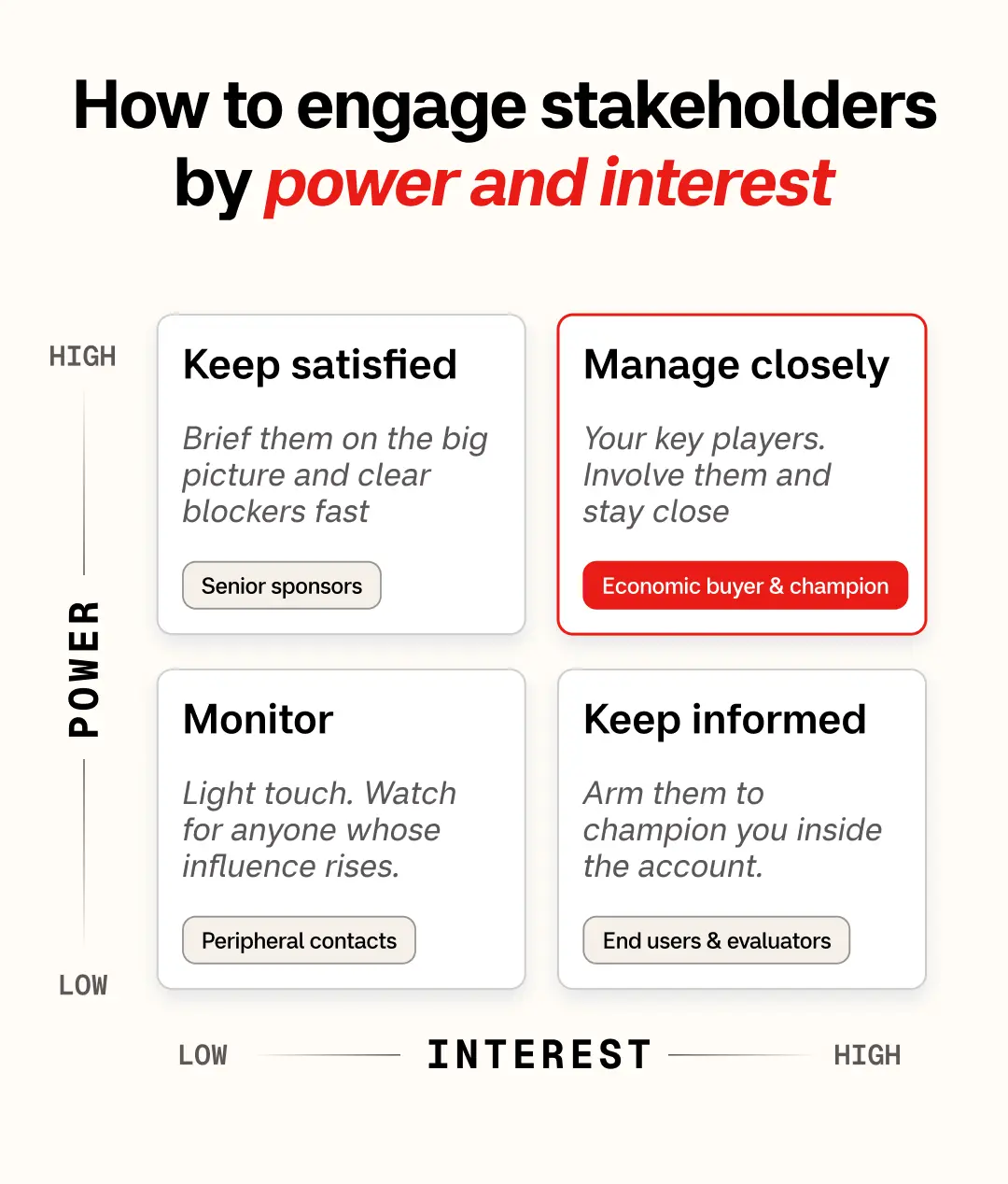
The grid is not static. People move quadrants as the deal evolves: a low-interest executive can become highly engaged once budget is on the table. Treat your stakeholder map as a living document you update as you learn.
The Roles on a B2B Buying Committee
The Power-Interest grid tells you how to engage someone. To use it, you first need to know who they are. Most B2B buying committees contain a predictable set of roles, and naming them is the fastest way to spot who is missing from your map.
Economic buyer. Controls the budget and gives final sign-off. High power, and your map's center of gravity.
Champion. Wants you to win and sells you internally when you are not in the room. Often lower formal power but high influence, so invest in arming them.
Decision-maker. Owns the problem you solve and makes the call on the solution, sometimes the same person as the economic buyer, often not.
Influencer. Shapes the decision without owning it, a respected senior voice or a trusted advisor whose opinion the buyer weighs.
Technical evaluator. Judges whether your product actually works, in IT, security, or operations. Cannot say yes alone, but can absolutely say no.
Blocker or gatekeeper. Has a reason to resist, an incumbent relationship, a competing priority, or control over access. Find them early.
End user. Lives with the product day to day. Low formal power, high interest, and a powerful advocate when you win them over.
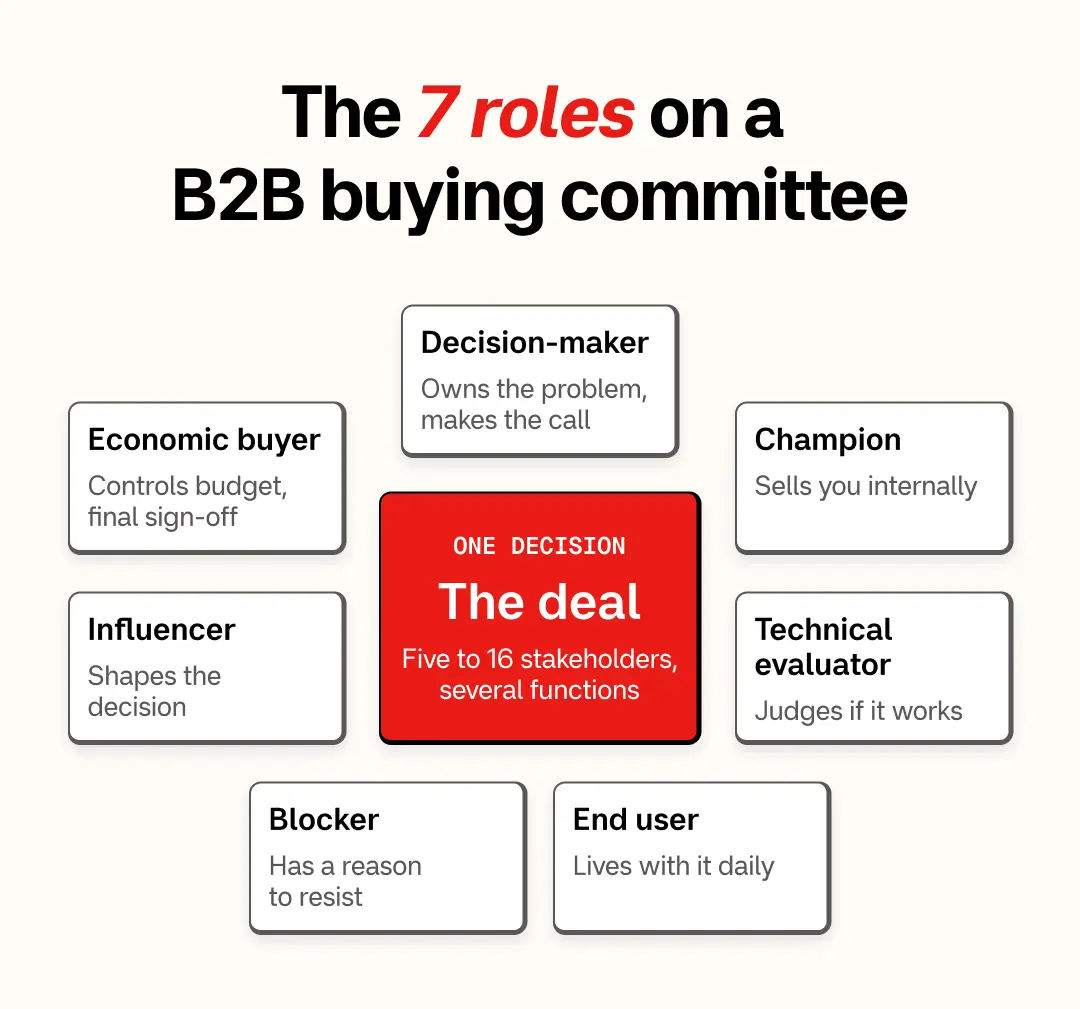
You will not always find every role, and some people wear two hats. The point is coverage: work through the list for each account so you reach the whole group, the way you would when selling to the C-suite or tailoring a pitch when selling to CIOs and selling to CFOs, who weigh very different things.
How to Build a Stakeholder Map: Step by Step
Building a stakeholder map follows four steps: identify, analyze, map, and plan. The method is the same whether you draw it on a whiteboard or build it inside your CRM.
1. Identify every stakeholder. Start from a named account and list everyone who touches the decision. An org chart is the fastest way to see the reporting lines and spot roles you have missed, which is why org charts are a core mapping tool. Cross-reference against your ideal customer profile and buyer personas so you know which titles to look for.
2. Analyze power and interest. For each person, judge how much power they hold over the decision and how much interest they have in the outcome, and note their role on the committee. This is where you turn a list of names into a ranked picture of who matters.
3. Map them visually. Plot each stakeholder on the Power-Interest grid, or lay them over the org chart, so the whole committee is visible in one view. Mark your relationships: who you have reached, who is a champion, who is a gap.
4. Plan engagement per group. Build a tailored plan for each quadrant and role. Decide the message, the channel, and the owner for every stakeholder, then fold it into your B2B sales process so mapping drives action instead of sitting in a slide.
Keep the map current. People change jobs, priorities shift, and new stakeholders join late, so revisit it at every stage of the deal.
How to Multi-Thread the Committee
A map is a plan; multi-threading is the execution. Single-contact outreach is a single point of failure, so the goal is to build real relationships with three to five stakeholders across the account, each with a message matched to what they care about. The payoff is measurable: ZoomInfo's 2025 Customer Impact Report found that sellers who expand the buying committee through multithreaded outreach drive 31% larger deals.
Tailor the angle by role. The economic buyer wants outcomes and return on investment. The technical evaluator wants proof it works. The end user wants their day to get easier. Sending all three the same pitch wastes the map you just built. Warm paths help too: an introduction from a champion or a mutual connection lifts reply rates well above cold outreach, so use the map to find the shortest route to each person.
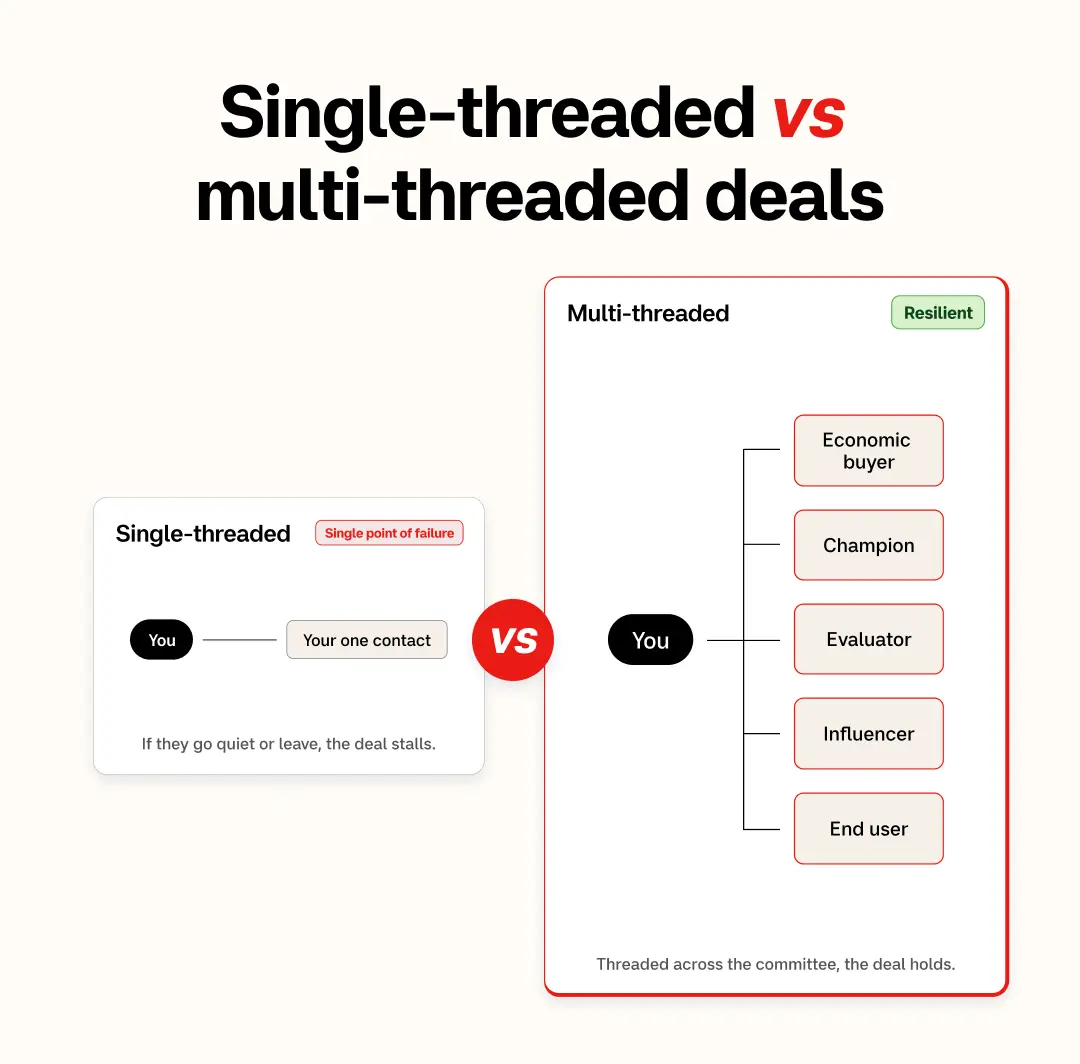
Multi-threading is also how you protect a deal against change. When a stakeholder leaves or a new one arrives, a team already threaded across the account keeps its footing, where a single-threaded rep has to start over. Fold the whole motion into a repeatable sales prospecting rhythm rather than treating each account as a one-off, and lean on your discovery calls to confirm the committee before you are deep in the deal.
Stakeholder Mapping Tools and Templates
For a single deal you do not need software. A simple table captures everything a stakeholder map needs: who is on the committee, how much power and interest each person holds, where that puts them on the grid, and what you will do next. Copy this structure into a doc or your CRM and fill one row per stakeholder:
Stakeholder | Committee role | Power | Interest | Engagement | Status | Next action |
Name | Economic buyer | High | High | Manage closely | Not engaged | Secure intro through champion |
Name | Champion | Low | High | Keep informed | Engaged | Arm with an ROI one-pager |
Name | Technical evaluator | Low | High | Keep informed | Gap | Book a technical deep-dive |
Name | Senior sponsor | High | Low | Keep satisfied | Engaged | Send a monthly progress note |
Update the Status and Next action columns as the deal moves, and the template doubles as a live account plan the whole team can work from.
At scale, three kinds of tooling do the heavy lifting. Org charts show reporting lines and surface the stakeholders you would otherwise miss. Your CRM holds the map so the whole team can see and update it. And a B2B data provider supplies the piece a template cannot: verified contact details and firmographics for every name on the map, plus the buyer intent signals that tell you which accounts are worth mapping in the first place. The template organizes what you know; the data platform makes each stakeholder reachable.
Common Stakeholder Mapping Mistakes
Even experienced teams lose deals to a few avoidable errors:
Mapping only the people who reply, and missing the powerful stakeholders who stay quiet until they block you.
Treating the map as a one-time exercise instead of updating it as roles and priorities change.
Confusing an org chart with a stakeholder map: an org chart shows reporting lines, not who actually influences the decision.
Sending every stakeholder the same message, which wastes the insight the map gives you.
Building a beautiful map on top of stale contact data, so half the people on it are unreachable or have already left.
How ZoomInfo Strengthens Stakeholder Mapping
A stakeholder map has three failure points: you cannot see the full committee, you cannot reach the people on it, and the map goes stale the moment someone moves. Those three gaps are exactly what ZoomInfo, the all-in-one AI GTM Platform, is built to close.
The platform stacks three layers:
A verified data foundation of 500M+ contacts, 120M+ direct dials, and 200M+ business emails, continuously reverified, so every name on your map comes with a way to reach them that works when you use it.
The GTM Context Graph, an intelligence layer that processes 1.5B+ data points a day to fuse intent, CRM, and behavioral signals, so you see which accounts are in-market and which stakeholders are engaging.
Universal access that delivers that intelligence wherever your team works, in a seller workspace, a RevOps studio, or through an API and MCP interface for teams building their own AI prospecting workflows.
For stakeholder mapping specifically, that plays out in three ways:
Org charts and buying-group data reveal the full committee inside an account, so you map who decides, who influences, and who blocks rather than guessing.
A verified direct dial and email for every stakeholder turn a name on the chart into a conversation.
Scoops and signals flag when a decision-maker changes or a new one arrives, so your map stays current instead of going stale.

"I give props to the data services team at ZoomInfo. They've done really a great job working with us to get us what we need."
Seeing and reaching the whole committee is the difference between a map that looks good and one that closes deals. And ZoomInfo is "Free to start with consumption credits based on usage," so teams can prove the motion before they commit.
Turning Your Stakeholder Map Into Pipeline
Stakeholder mapping is how modern B2B deals are won: by seeing the whole committee, understanding who holds power and who cares, and engaging each person on what matters to them. The Power-Interest grid and the committee roles give you the framework, and multi-threading turns it into momentum.
What separates a map that wins from one that gathers dust is reach. A committee you can see but cannot contact does nothing for the deal. That is where ZoomInfo comes in: org-chart data to map the full committee, verified dials and emails to reach every stakeholder, and signals that tell you the moment it changes.
See how ZoomInfo helps you map and win the whole buying committee. Book a demo.
Frequently Asked Questions
What are the four types of stakeholders?
In the Power-Interest model, stakeholders fall into four groups based on their power over the decision and their interest in the outcome: high power and high interest (manage closely), high power and low interest (keep satisfied), low power and high interest (keep informed), and low power and low interest (monitor). In a B2B deal, that maps roughly to the economic buyer and champion, senior approvers, end users and evaluators, and peripheral contacts. The category tells you how much attention and what kind of message each stakeholder needs.
What is the best tool for stakeholder mapping?
For a single deal, a Power-Interest grid drawn on a whiteboard or a simple template is enough to get value fast. For teams running many accounts, the best setup combines three things: org charts to see the committee, a CRM to hold and share the map, and a data platform to supply verified contact details and intent signals so every stakeholder is actually reachable. The right tool depends on scale, but the map is only as good as the data behind it.
What are the 7 C's of stakeholder management?
The 7 C's are a common framework for managing stakeholder relationships: clarity, communication, collaboration, commitment, consistency, credibility, and confidence. They describe how to engage stakeholders well once you have mapped them. Stakeholder mapping is the step that comes first, identifying and prioritizing who to manage, before you apply principles like these to the relationship.
What is the difference between a stakeholder map and an org chart?
An org chart shows formal reporting lines, who reports to whom. A stakeholder map shows influence over a specific decision, which does not always follow the hierarchy. A junior champion can carry more weight in your deal than a senior executive who is not engaged. Use the org chart as a starting point to identify people, then build the stakeholder map to capture who actually shapes the outcome.
How does stakeholder mapping work in B2B sales?
In sales, stakeholder mapping means identifying the buying committee inside a target account, analyzing each person's power and interest, and planning how to engage all of them rather than relying on one contact. You build the map from org charts and verified contact data, plot stakeholders by influence, then multi-thread across the committee with a message tailored to each role. Done well, it protects the deal from stalls and shortens the path to a yes.
