
ActiveCampaign has spent two decades evolving from a small email marketing consultancy into what it now calls an "autonomous marketing platform."
With 180,000+ customers across 170+ countries, it combines email marketing, SMS, WhatsApp, CRM, and AI-powered automation in one place. For small marketing teams, that breadth is the appeal: one platform to build, send, and optimize campaigns without stitching together a half-dozen tools.
To write this ActiveCampaign review, we analyzed it in detail. We believe it's the right choice if:
You need marketing automation with branching logic and behavioral triggers
You want email, SMS, WhatsApp, and CRM in a single platform
You're a growing SMB that has outgrown basic broadcast email tools
You have the time and resources to master a feature-rich platform
You need integrations with your existing tech stack
However, ActiveCampaign might not be the best choice if:
You need to identify which companies and contacts to target before you can market to them
You lack verified B2B contact data to feed into your automation workflows
You want to know which accounts are actively researching solutions like yours right now
You need to enrich your CRM with accurate company attributes, technographic, and org chart data
You're building outbound prospecting motions that require direct dials and verified business emails
In that case, ActiveCampaign handles one half of the equation (the engagement) but not the other (the intelligence).
ZoomInfo fills that gap as a GTM platform that identifies who to target, when they're in-market, and how to reach them, with 500M contacts, 100M companies, 135M+ verified phone numbers, and 200M+ verified business email addresses. Feed ZoomInfo's verified data and buyer intent signals into ActiveCampaign's automation engine, and the right contacts enter the right sequences at the right time.
We've included a detailed look at ZoomInfo later in this ActiveCampaign review as the intelligence layer that makes marketing automation work. If you're ready to see how verified B2B data transforms your campaigns, start with ZoomInfo's free trial here.
What is ActiveCampaign?
ActiveCampaign is a cloud-based marketing automation platform founded in 2003 by Jason VandeBoom in Chicago, Illinois.
What began as an on-premises email marketing tool has been through several reinventions: a migration to SaaS in the early 2010s, a "Customer Experience Automation" phase from 2016 to 2024, and most recently, a pivot to what the company calls "autonomous marketing" powered by its Active Intelligence AI system.
The company operated without outside investment for 13 years before raising a $20M Series A in 2016. Since then, it has raised $360M in total funding across three rounds, reaching a valuation exceeding $3 billion at its April 2021 Series C. Revenue reached $290.5M in 2024.
Today, ActiveCampaign's stated mission is "to help small teams power big business", targeting SMBs and mid-market companies (roughly 10 to 500 employees) that need strong marketing capabilities without large budgets. The platform spans email marketing, SMS, WhatsApp messaging, landing pages, CRM with sales pipelines, and marketing automation, all connected through 1,000+ app integrations.
ActiveCampaign Pros & Cons
Pros | Cons |
|---|---|
Visual automation builder with branching logic and behavioral triggers | Steep learning curve for advanced features |
Strong email deliverability (93% report better deliverability) | No permanent free plan (14-day trial only) |
Email, SMS, WhatsApp, and CRM under one subscription | Pricing escalates as contact lists grow |
Active Intelligence AI system for campaign creation and optimization | Limited landing page and form customization |
1,000+ third-party integrations | CRM is less capable than dedicated sales platforms |
300+ G2 badges in Spring 2026 including Leader across company sizes | Some AI features still in beta |
Free migration of contacts, templates, and campaigns from other platforms | Occasional bugs and platform stability concerns reported by users |
ActiveCampaign Review: How It Works & Key Features
Marketing Automation: ActiveCampaign's visual builder turns complex customer journeys into manageable workflows.
ActiveCampaign's core strength is its visual, drag-and-drop automation builder.
Users map customer journeys as flowcharts, setting triggers based on subscriber actions, deal stages, website visits, email engagement, and integration events. The platform supports if/then logic, wait times, goals, and split paths for A/B testing different routes through a sequence.
Source: ActiveCampaign
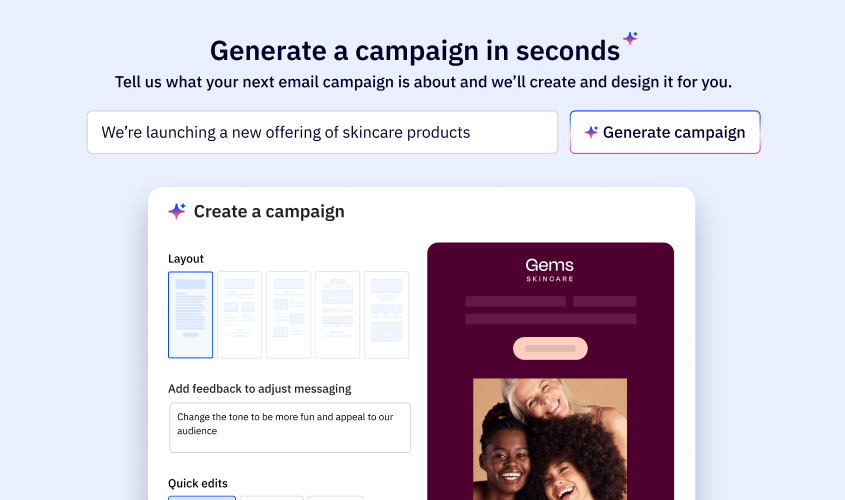
An AI layer sits on top of this builder. Users type a goal in plain language, and an LLM converts it into a configured automation (complete with wait periods, branching paths, and action steps) without manual setup.
Each automation supports multiple actions: sending emails or SMS, adding or removing tags, updating contact fields, creating deals in the CRM, assigning tasks to team members, and triggering webhooks to external applications.
The Automation Map gives a bird's-eye view of how workflows interact, which matters when you're running dozens of sequences at once. ActiveCampaign reports no cap on automation actions on Plus plans and above.
Predictive Sending deserves a mention: rather than choosing a single send time for an entire list, it analyzes each contact's engagement history to deliver emails when that person is most likely to open. This is more granular than the batch-level send-time optimization most platforms offer.
Email Marketing: A full suite with strong deliverability and AI-powered creation tools.
ActiveCampaign's email tools include a drag-and-drop Email Designer with 250+ pre-designed, mobile-responsive templates.
The editor supports standard elements (text, images, buttons, social links) plus dynamic content blocks that display different content to different recipients based on their data.
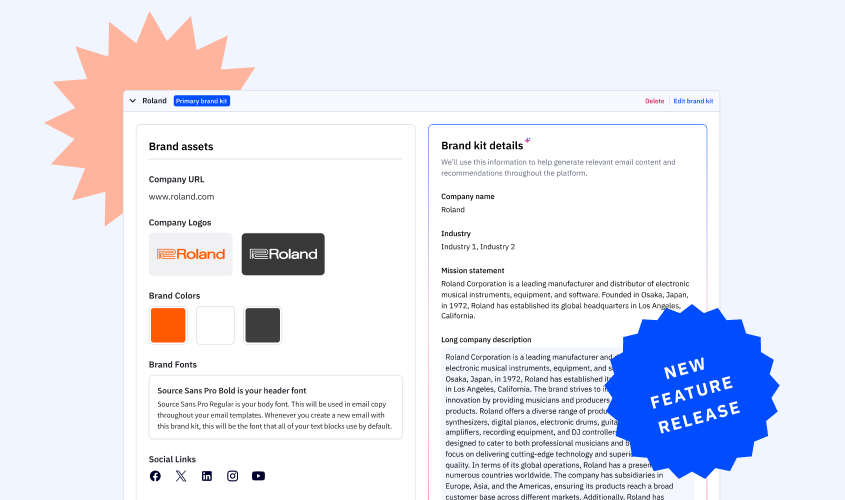
The AI Campaign Builder generates complete campaigns (subject lines, preheaders, body content, CTAs, images) from a single plain-language prompt. The AI Brand Kit pulls logos, fonts, colors, and visual elements from a website URL, removing manual brand setup.
Source: ActiveCampaign
Deliverability is a documented strength. ActiveCampaign reports 99.88% email deliverability, and EmailToolTester independently reports 94%. The infrastructure includes a private network for routing, DKIM and DMARC authentication, dedicated IP management with pre-warmed IPs, and a feature to filter Apple MPP opens that would otherwise inflate open rate data.
CRM and Sales Automation: Marketing and sales data in the same platform.
ActiveCampaign's built-in CRM, called "Deals," provides visual Kanban-style sales pipelines where deals move through customizable stages by drag-and-drop.
Each deal record holds the deal value, associated contacts, deal owner, notes, custom fields, and attached files. Users can create multiple pipelines for different products or sales processes.
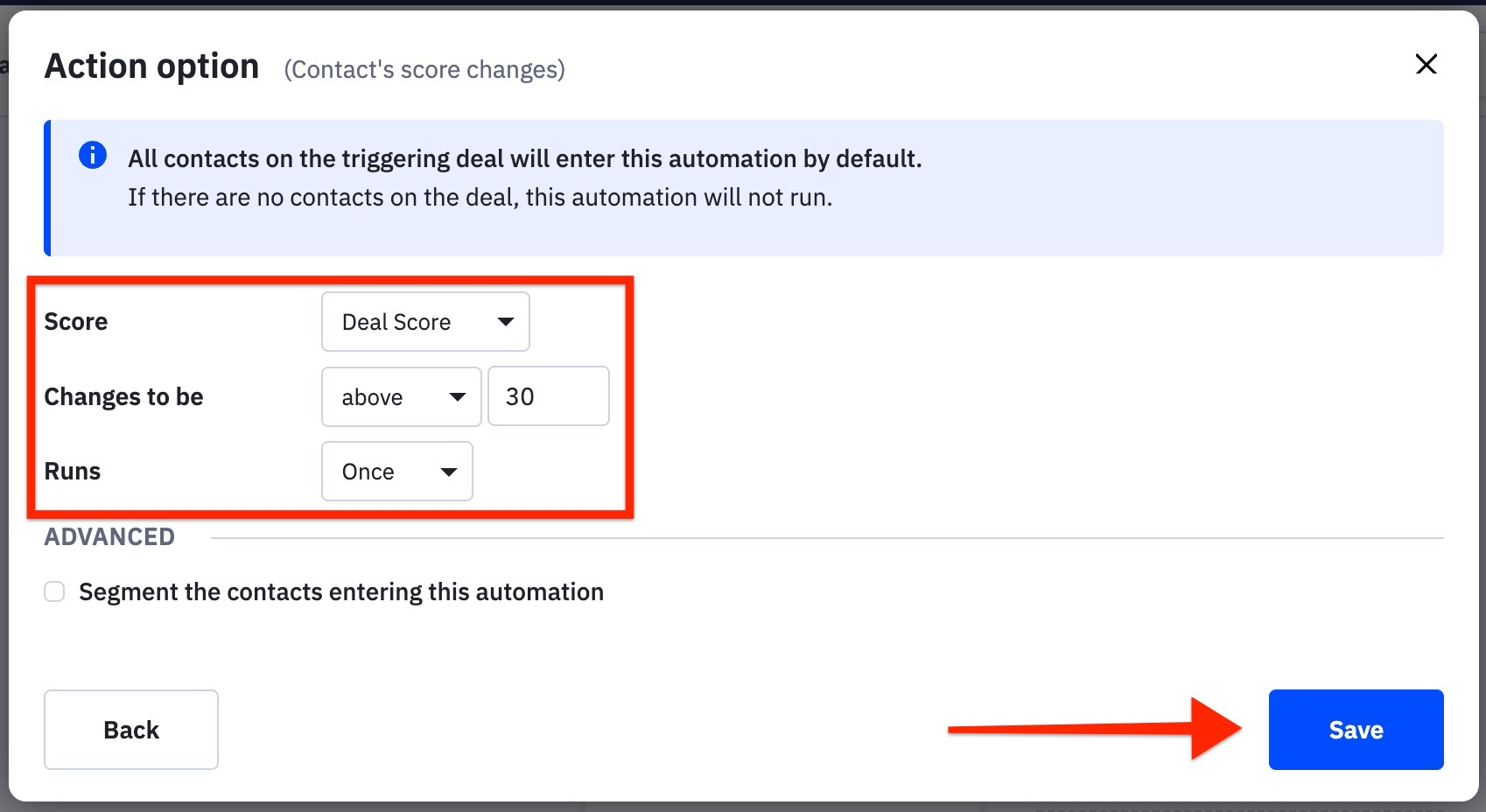
What sets this CRM apart from standalone tools is its direct link to the automation engine. Automations can create deals when a contact submits a form, trigger tasks when a deal stage changes, send personalized 1:1 emails when a deal enters a new stage, and adjust lead scores based on behaviors.
Source: ActiveCampaign
ActiveCampaign offers a dual scoring system: contact-level lead scores and deal-level scores, each built on a rules engine that can be static or dynamic. Sales routing assigns incoming deals to the right rep based on round-robin rotation, expertise, lead score thresholds, geography, deal value, or any custom field.
That said, this is a marketing-first CRM. Teams needing advanced deal forecasting, territory management, or detailed pipeline analytics will find it falls short of platforms like Salesforce or HubSpot's sales hub.
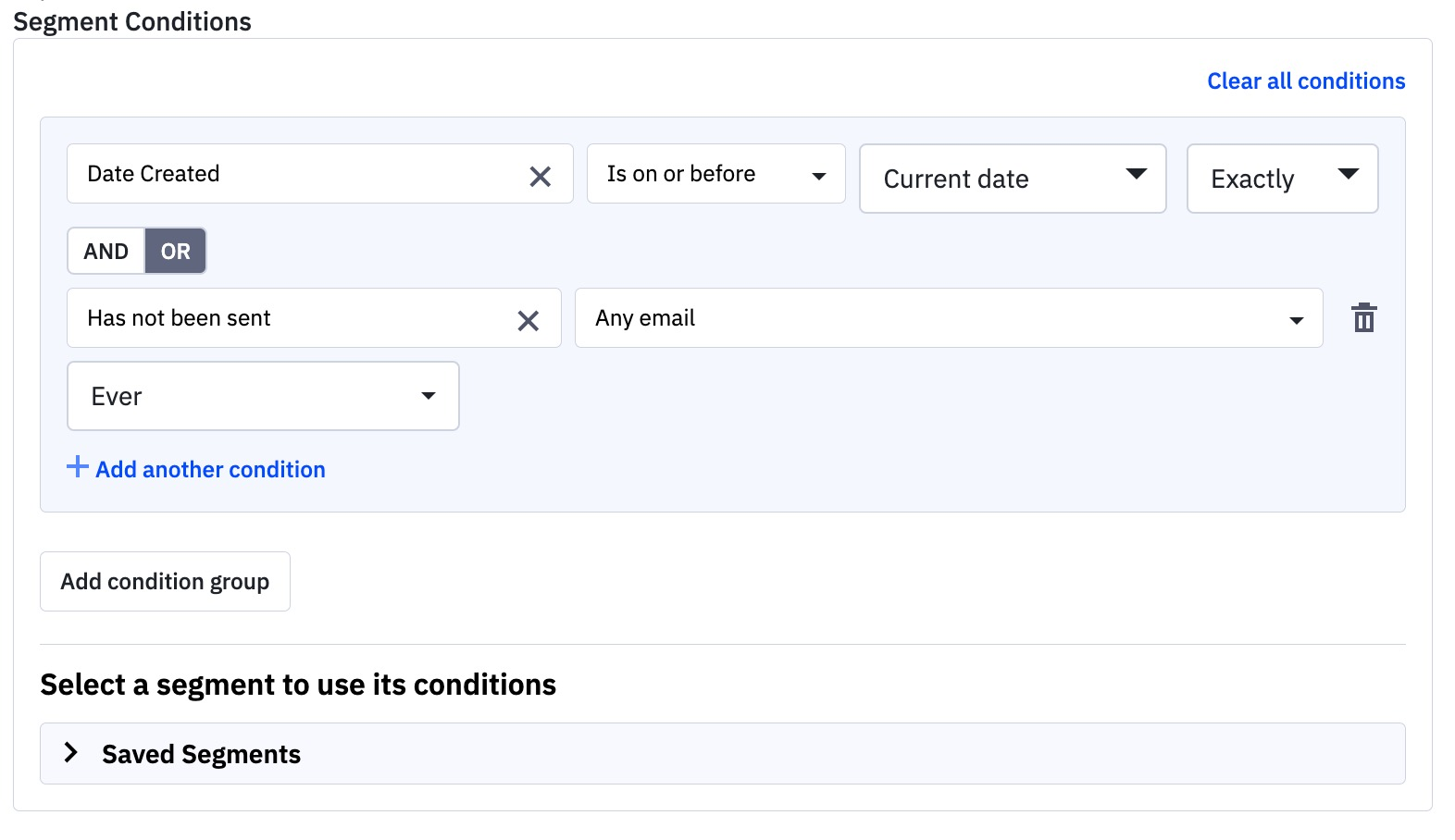
Active Intelligence: AI agents designed to move beyond task execution toward goal-directed marketing.
Active Intelligence, launched in May 2025 and described as the fastest-growing feature in ActiveCampaign's history, is a collection of AI agents covering campaigns, automations, segments, personalization, forms, goals, and insights.
The framework follows three phases: Imagine (a Business Goals agent maps a stated goal to proven strategies and determines subject lines, channel mix, and campaign structure), Activate (AI agents build campaigns including personalized content, segmented lists, and cross-channel automations), and Validate (real-time performance data and recommendations tied to the original goal).
Key capabilities include AI-Suggested Segments that analyze audience data to surface high-value groups, AI-Suggested Actions drawn from billions of anonymized data points from similar businesses, and an Active Intelligence sidebar that offers contextual recommendations based on whatever the user is working on.
Source: ActiveCampaign
ActiveCampaign also connects to external AI tools via MCP (Model Context Protocol), letting Claude, ChatGPT, and compatible tools read email stats, update contacts, trigger automations, and manage tags through chat prompts. The company says it is the first marketing platform in Claude's official connector directory.
Several agents (Forms, Personalization, Goals, Segments, Campaigns, Automations, Insights) remain in beta as of early 2026, so reliability and feature completeness are still maturing.
WhatsApp and SMS: Cross-channel messaging from the same automation builder.
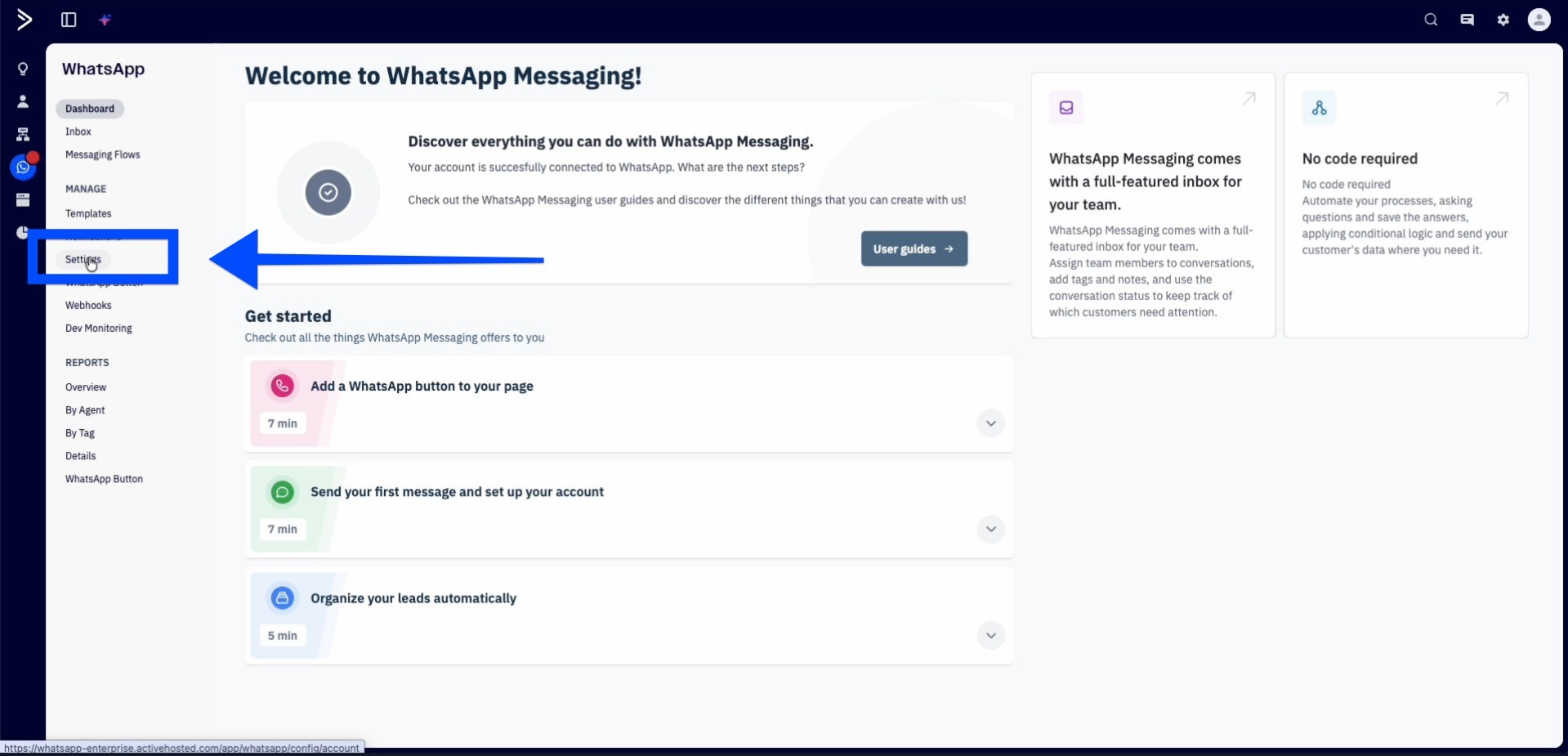
ActiveCampaign added WhatsApp Messaging in July 2025 through its acquisition of Hilos, a WhatsApp automation platform.
Source: ActiveCampaign
As a Meta Business Partner, ActiveCampaign provides direct WhatsApp Business API access with broadcast messaging, a no-code Flows builder for automated conversations, 1:1 chat, and a shared multi-user inbox.
SMS Marketing uses dedicated 10DLC long codes for deliverability protection. SMS campaigns run through the same automation builder used for email, so a contact's SMS response can trigger email follow-ups or WhatsApp outreach in the same workflow. The platform supports two-way SMS messaging with a dedicated inbox, and Active Intelligence can plan, draft, and execute SMS campaigns.
Both channels share the same contact database and segmentation engine, so a single automation can coordinate touchpoints across email, SMS, and WhatsApp without separate tools.
Pricing Structure: Contact-based pricing across four tiers with no permanent free plan.
ActiveCampaign uses a contact-based pricing model where the monthly cost scales with the number of contacts stored.
The platform charges once per unique contact regardless of how many automations, tags, or segments that contact appears in.
Starter (from $15/month): Email marketing and automation essentials. Limited to 1 user seat, 25,000 contacts, and 5 actions per automation. Email send limit of 10x the contact limit per month. No landing pages, no AI content generation, no advanced segmentation.
Plus: Everything in Starter, plus unlimited automation actions, landing pages, web push notifications, AI content generation, multichannel marketing automation, and custom user permissions. Additional user seats purchasable.
Professional: 3 user seats included. Adds advanced segmentation, advanced reporting, connected automations, conditional content, predictive sending, revenue and conversion attribution, custom event tracking, and priority support. Email send limit increases to 12x the contact limit.
Enterprise: 5 user seats. Adds custom reporting, SSO, HIPAA support, premium CRM integrations (Salesforce, Microsoft Dynamics 365), a dedicated account team, and a Service Level Agreement. Email send limit of 15x the contact limit. Custom pricing.
ActiveCampaign offers a 14-day free trial (no credit card required, limited to 100 emails) and a 30-day money-back guarantee for first-time paid subscribers. As a pricing reference, Starter costs $149/month for 10,000 contacts. WhatsApp plans are priced separately with Core, Advanced, and Premium tiers. If send limits are exceeded, overage fees of $0.005 per email apply.
Where ActiveCampaign Falls Short
ActiveCampaign is a strong marketing automation platform, but several limitations surface with sustained use.
These reflect a platform built for campaign execution, not prospect identification.
Steep Learning Curve for Advanced Features. Capterra's editorial verdict notes that "some users cite complexity and a steep learning curve." Basic automations are accessible, but mastering conditional logic, tagging systems, multi-step branching, and custom reports takes real time. The platform's 15+ help center categories show the surface area new users must navigate.
Price Escalation as Lists Grow. G2 reviewers report that pricing has climbed over the past three years and rises fast as contact lists grow. TrustRadius reviewers flag pricing as steep relative to competitors at scale. A business with 10,000 contacts on Starter pays $149/month, and costs only go up as you move to Plus or Professional for needed features.
No Built-in Prospect Intelligence. ActiveCampaign excels at nurturing contacts already in your system. But it gives you no tools for finding which companies or contacts should be there in the first place.
There's no B2B contact database, no intent data showing which accounts are researching solutions, no company attribute or technographic enrichment, and no org chart mapping. Your automation sequences are only as good as the contacts feeding them, and ActiveCampaign assumes you've solved that problem elsewhere.
Limited Landing Page and Form Customization. Capterra's pros/cons summary lists "limited page and form customization" as a top recurring con. Users who want pixel-level design control or advanced multi-step form logic often integrate Unbounce, Typeform, or LeadPages alongside ActiveCampaign.
CRM Depth vs. Dedicated Sales Platforms. The built-in CRM handles basic pipeline management and sales automation well, but users who need advanced deal forecasting, territory management, or detailed pipeline analytics will find it lacking next to Salesforce or HubSpot's sales hub.
The CRM works best as a marketing companion, not a standalone sales tool. For a closer look at how ActiveCampaign and Salesforce stack up on CRM, see our ActiveCampaign vs Salesforce comparison.
These limitations reflect ActiveCampaign's focus: it automates engagement but does not identify opportunity. Marketing automation runs on data, and ActiveCampaign depends on its users to supply the contacts, company information, and buying signals that make campaigns effective. That gap is where a B2B intelligence platform becomes essential.
Note: Beyond Salesforce and HubSpot, ActiveCampaign is often compared against other marketing and CRM platforms depending on team size and use case. See how it stacks up against Pardot for Salesforce-centric teams, Zoho for a broader CRM-plus-marketing suite, Autopilot for visual-journey-first automation, and Hatchbuck for very small teams.
The Intelligence Layer ActiveCampaign Needs: ZoomInfo
ActiveCampaign automates the engagement. ZoomInfo tells you who to engage, when they're ready, and how to reach them.
ZoomInfo is a GTM platform built on a B2B data foundation of 500M contacts and 100M companies, 135M+ verified phone numbers, and 200M+ verified business email addresses.
By combining this data with your CRM records, conversation transcripts, and behavioral signals, ZoomInfo's GTM Context Graph (processing 1.5B+ data points daily) maps the context around your accounts: not just what happened, but why, and what to do next.
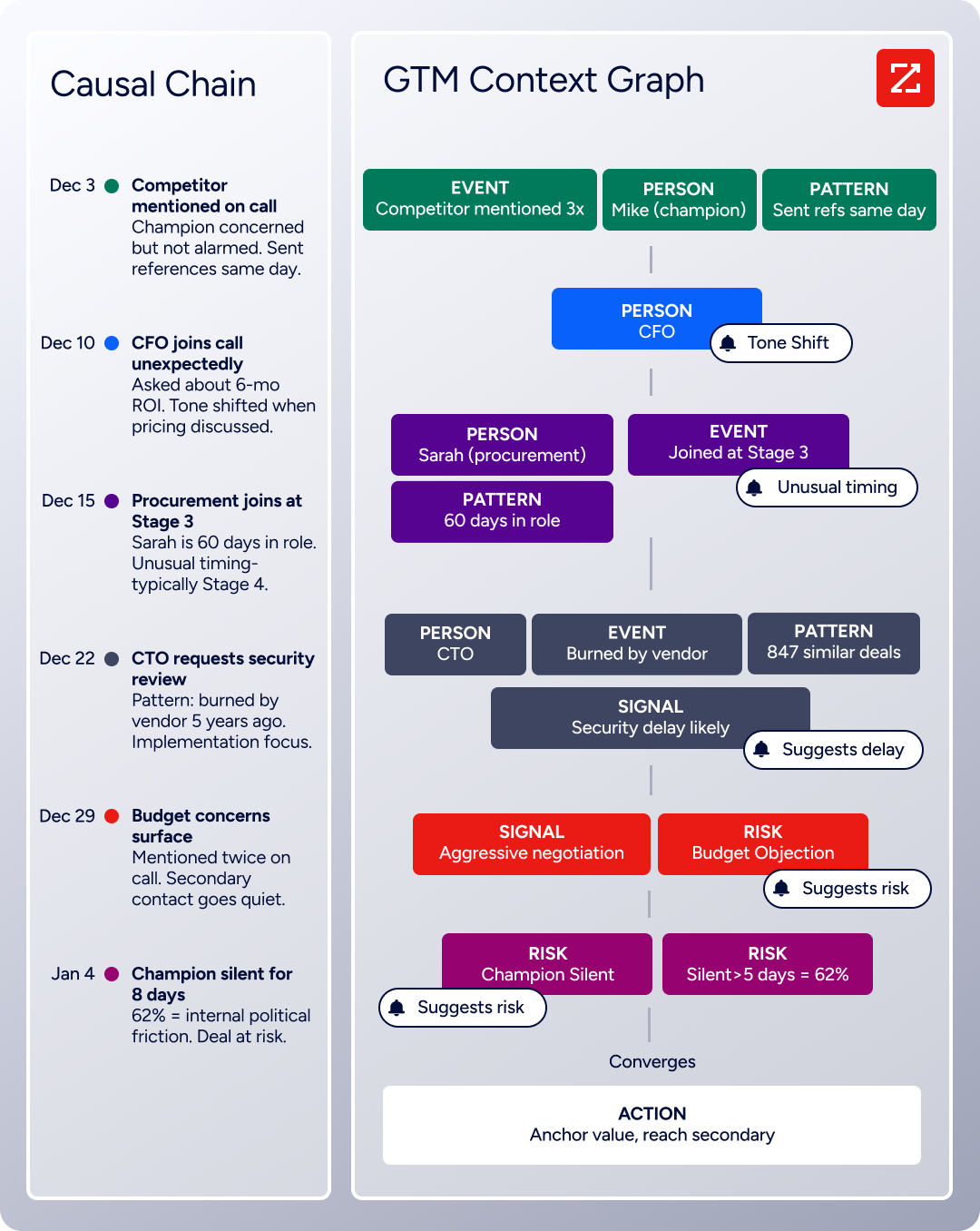
Your team can work from the GTM Workspace, build GTM plays in GTM Studio, or pipe the same intelligence into their own tools through the API and MCP, including ActiveCampaign.
Verified B2B Data: The contacts ActiveCampaign's automations depend on.
ActiveCampaign's sequences are only as effective as the contacts inside them. ZoomInfo provides the verified data that makes those sequences reach real people.
The platform's Contact & Company Search covers 300+ company attributes for market segmentation, including department org charts with decision-makers' direct dials and emails, job-change alerts, and one-click CRM export.
Source: ZoomInfo
First-party data reaches up to 95% accuracy, verified through a multi-source pipeline backed by 300+ human researchers and automated ML scanning of 28 million site domains daily.
External evaluators have validated this data quality: in a Fortune 500 competitive RFP analyzing 25 million contacts across vendors, the independent consultant concluded that "no other competitor came even close." Gartner's 2025 report positioned ZoomInfo as the only vendor in the Customers' Choice quadrant, with a 4.7/5.0 average rating.
For ActiveCampaign users, this means the contacts entering your welcome sequences, nurture campaigns, and abandoned cart flows have been verified before they arrive. No wasted sends to outdated emails. No automation metrics skewed by bad data.
"ZoomInfo gives us the information we need to execute. We don't have to go through and spend our time digging. It's already there, so we can be three steps ahead." (Vensure)
Buyer Intent Data: Knowing when accounts are actively researching.
ActiveCampaign's automation triggers fire when contacts act inside your system: opening emails, clicking links, visiting web pages. But what about buying activity happening outside your view?
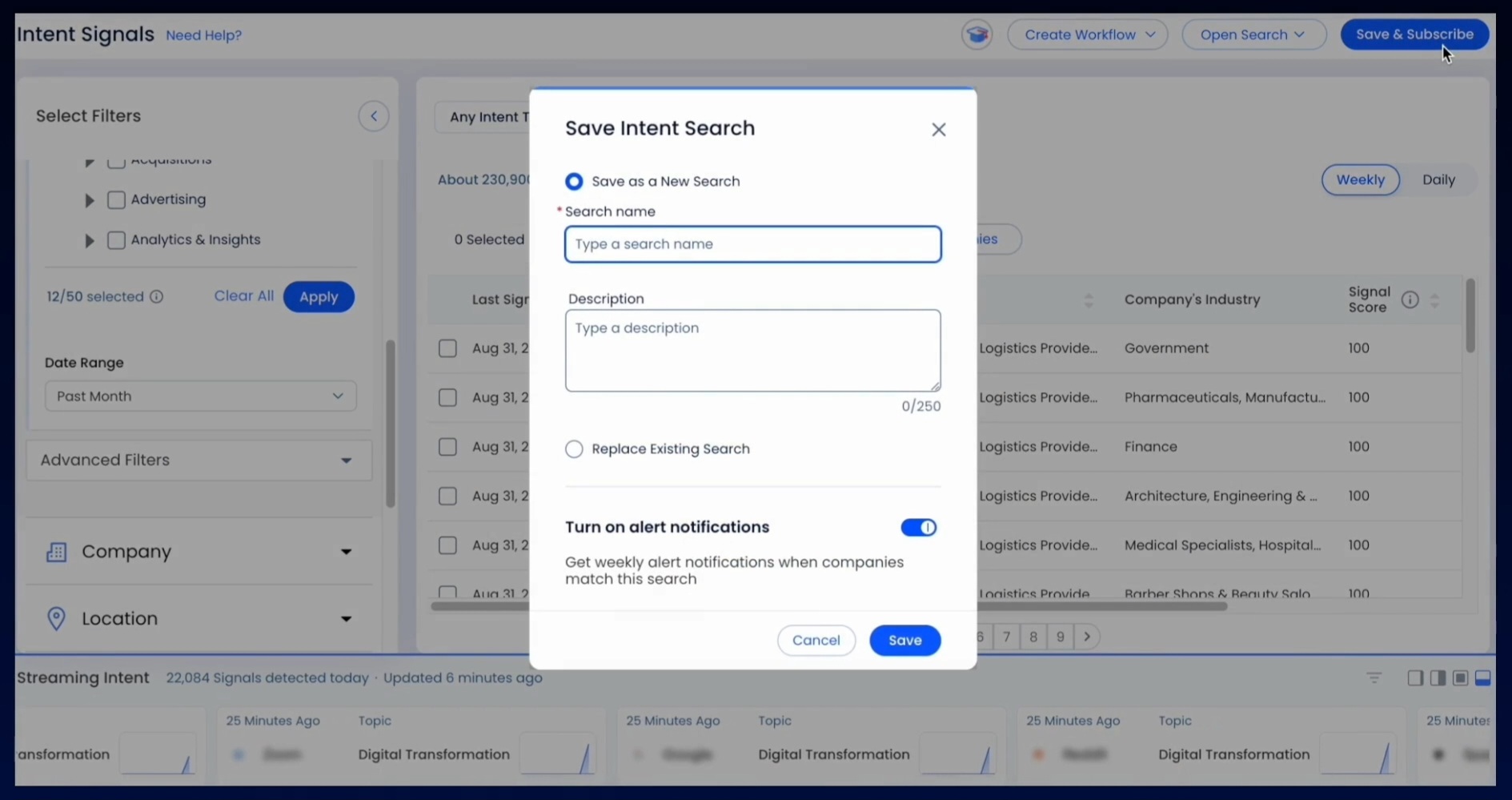
ZoomInfo Intent tracks signals from 210 million IP-to-Organization pairings and 6 trillion+ new keyword-to-device pairings sourced monthly.
Guided Intent, exclusive to ZoomInfo, identifies the topics historically correlated with deal success rather than requiring manual topic selection.
Source: ZoomInfo
WebSights resolves anonymous website traffic to companies, identifies buying team members, and provides direct contact information. It includes Automatic Traffic Filtering that separates real visitors from bots, keeping your data clean.
Combined with ActiveCampaign, this creates a workflow where ZoomInfo identifies accounts researching solutions in your category, and ActiveCampaign enrolls those accounts in the right nurture sequence at the moment of peak interest. Timing stops being guesswork.
"That combination of our internal CRM data, external signals, and AI that's given all that context has helped us craft very specific account- and persona-based messages. And people have responded to them right away." (Seismic)
GTM Workspace and GTM Studio: Where intelligence becomes action.
ZoomInfo delivers its intelligence through three channels.
GTM Workspace gives sellers a single screen where prioritized accounts, AI-drafted outreach, and deal execution converge. AI agents research accounts, generate follow-ups, monitor signals, and draft outreach, all drawing from the GTM Context Graph. Customer results include Seismic's sales team boosting productivity by 54% and Databricks reaching prospects 50% faster.
GTM Studio gives marketers, RevOps, and GTM engineers a builder where they define audiences, orchestrate campaigns, and measure pipeline in natural language. Expansion plays that used to take 3 weeks now launch in 30 minutes, without technical support. Plays run around the clock and get smarter as prospects respond.
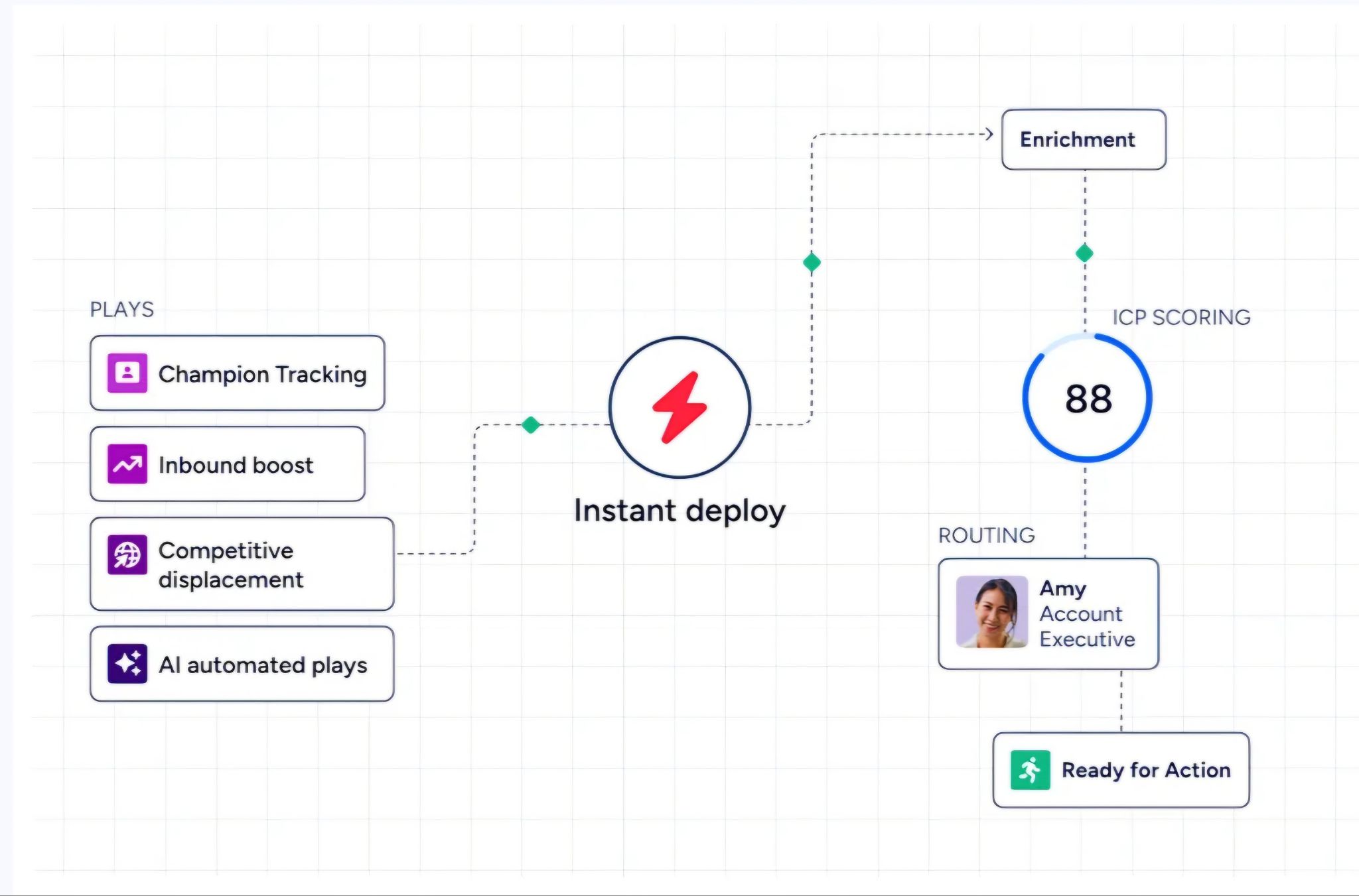
Source: ZoomInfo
For teams building beyond ZoomInfo's own products, APIs and MCP expose the same intelligence to any custom agent, internal tool, or partner platform. All three channels draw from one GTM Context Graph: the same data, the same intelligence.
"Without ZoomInfo, it would be extremely difficult, if not impossible, to achieve our business objectives. Without it, we wouldn't be able to understand the market, have the right contact data, and make meaningful connections." (Smartsheet)
Accessible Entry Points: Start free, scale when ready.
ZoomInfo Lite is a permanent free tier (not a trial) that includes access to ZoomInfo's B2B database with 100M+ verified profiles, 10 monthly export credits, advanced search filters, the ReachOut Chrome Extension, and WebSights Lite with up to 10 website visitor reveals per day. No credit card, no annual commitment, no time limits.
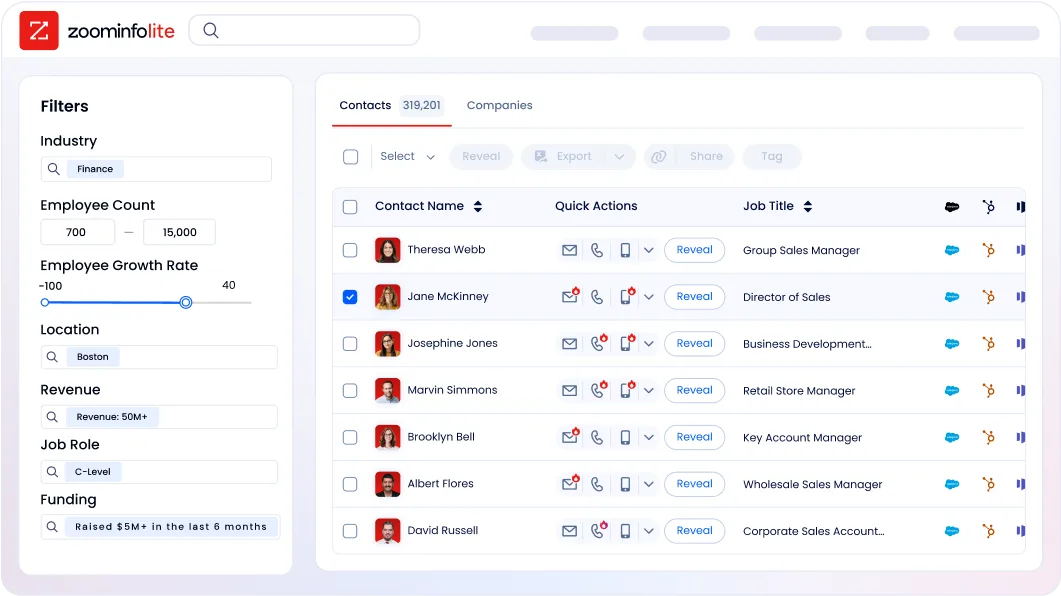
A separate 7-day free trial provides access to core platform features including intent signals and email outreach with usage limits.
Paid plans (Professional, Advanced, Enterprise for Sales; Marketing Demand, ABM Lite, ABM Enterprise for Marketing) use consumption-based pricing where customers pay based on seats, credit volume, and feature access. All pricing is custom-quoted.
ActiveCampaign and ZoomInfo: Comparison Summary
Aspect | ActiveCampaign | ZoomInfo |
|---|---|---|
Primary purpose | Marketing automation and campaign execution | B2B data intelligence and prospect identification |
When used | Engaging and nurturing known contacts | Finding the right contacts and accounts to engage |
B2B contact database | None; depends on user-supplied lists | 500M contacts, 200M+ verified business emails, 135M+ verified phones |
Buyer intent data | None | 210M IP-to-Org pairings, 6T+ keyword-to-device pairings monthly |
Email marketing | Full-featured with AI campaign builder and 250+ templates | Not an email marketing platform |
Marketing automation | Visual builder with branching logic, 1,000+ integrations | GTM plays via GTM Studio with multi-channel orchestration |
CRM | Built-in with pipelines and deal scoring | GTM Workspace for seller execution; integrates with Salesforce, HubSpot, Dynamics |
AI capabilities | Active Intelligence for campaigns, segments, and content | GTM Context Graph intelligence across deals, signals, and conversations |
Free plan | 14-day trial only | ZoomInfo Lite (permanent free tier) + 7-day trial |
Best for | Automating engagement with existing contacts | Identifying, enriching, and prioritizing the right targets |
Final Verdict
ActiveCampaign and ZoomInfo serve two different but complementary stages of the go-to-market workflow.
ActiveCampaign is an effective marketing automation platform for teams that need to build and run campaigns across email, SMS, and WhatsApp. Its visual automation builder, strong email deliverability, and expanding AI capabilities make it a good fit for SMBs and mid-market companies that want to nurture leads through complex customer journeys without combining multiple tools.
The CRM adds lightweight sales functionality, and the 1,000+ integration ecosystem connects it to most existing tech stacks. If your contacts are already in your system and you need to engage them at scale, ActiveCampaign handles that well.
ZoomInfo determines who those contacts should be. Its verified B2B database, buyer intent signals, and GTM Context Graph identify which accounts are worth pursuing, when they're researching, and who to reach.
For teams running ActiveCampaign, ZoomInfo turns automation into a targeted operation: the right contacts enter the right sequences because the data behind them has been verified, enriched, and timed to buying signals. Whether accessed through GTM Workspace, GTM Studio, or APIs and MCP, the intelligence is the same.
Get started with ZoomInfo here.
Marketing automation without good data is a machine running on bad fuel. Branching logic and AI campaigns don't help if the contacts are wrong, the data is stale, or the timing is off. ActiveCampaign provides the engine. ZoomInfo provides the fuel. Together, they create a pipeline where intelligence and execution work as one system.
ActiveCampaign FAQ
Does ActiveCampaign have a free plan?
No. ActiveCampaign offers a 14-day free trial limited to 100 emails, with no permanent free tier. After the trial, paid plans start at $15/month for a small number of contacts and scale with list size. A 30-day money-back guarantee applies to first-time paid subscribers.
ZoomInfo, by contrast, offers ZoomInfo Lite as a permanent free tier with access to its B2B database, 10 monthly export credits, and WebSights Lite, with no credit card or time limit.
How much does ActiveCampaign cost for 10,000 contacts?
The Starter plan costs $149/month for 10,000 contacts. Higher tiers (Plus, Professional, Enterprise) cost more and add features like unlimited automation actions, predictive sending, advanced segmentation, revenue attribution, and premium CRM integrations. All plans are contact-based, so costs increase as your list grows. Overage fees of $0.005 per email apply if monthly send limits are exceeded.
What marketing automation capabilities does ActiveCampaign offer?
ActiveCampaign includes a visual automation builder with branching logic and behavioral triggers, an AI builder that converts plain-language prompts into configured workflows, Predictive Sending for per-subscriber send-time optimization, cross-channel orchestration across email, SMS, and WhatsApp, and a library of pre-built automation recipes. Plus plans and above support unlimited automation actions.
Does ActiveCampaign include a CRM?
Yes. ActiveCampaign includes a built-in CRM called "Deals" with visual Kanban-style pipelines, dual scoring (contact-level lead scores and deal-level scores), sales routing, 1:1 tracked emails, task management, and Chrome and Outlook extensions.
It lacks advanced deal forecasting, territory management, and detailed pipeline analytics found in dedicated CRM platforms. Teams needing those capabilities often pair ActiveCampaign's CRM with a full-featured sales tool.
Does ActiveCampaign support WhatsApp messaging?
Yes. ActiveCampaign launched WhatsApp Messaging in July 2025 through its acquisition of Hilos.
As a Meta Business Partner, it provides WhatsApp Business API access with broadcast messaging, a no-code Flows builder for automated conversations, 1:1 chat, and a shared multi-user inbox. WhatsApp plans are priced separately from email plans, with Core, Advanced, and Premium tiers. WhatsApp credits are non-refundable and expire monthly.
What integrations does ActiveCampaign support?
ActiveCampaign integrates with over 1,000 third-party apps including Shopify, WooCommerce, WordPress, Salesforce, Slack, Stripe, Square, Calendly, Google Ads, Facebook, Zapier, Make, and Clay. The platform also connects to external AI tools via MCP connectors for Claude and ChatGPT. A REST API and webhooks are available for custom integrations. All integrations require a paid plan.
Can ActiveCampaign help me find new B2B leads?
No. ActiveCampaign is built for engaging and nurturing contacts already in your database. It does not include a B2B contact database, buyer intent signals, company attribute data, technographic data, or company identification tools.
Teams that need to find which companies and contacts to target use a platform like ZoomInfo (500M contacts, 200M+ verified business emails, buyer intent data, and org chart intelligence), then feed those contacts into ActiveCampaign's automation workflows.
Is ActiveCampaign suitable for enterprise organizations?
ActiveCampaign primarily targets SMBs and mid-market companies. The Enterprise tier adds SSO, HIPAA support, premium CRM integrations, custom reporting, and a dedicated account team, making it viable for some enterprise use cases.
Organizations needing BI integrations, multi-brand management, advanced pipeline forecasting, or dedicated deliverability infrastructure may find it lacking compared to enterprise marketing platforms. The 30-day results guarantee (launched February 2026) and free migration services reduce switching risk for teams evaluating it.
