
Choosing between ActiveCampaign and Drip for email marketing and automation comes down to five questions:
Do you need automation across multiple channels (email, SMS, WhatsApp, CRM), or do you run an ecommerce store that needs targeted email campaigns?
Is a built-in CRM with sales pipeline management important, or do you handle sales outside your email platform?
Are you willing to learn a complex platform, or do you need something your team can run without a specialist?
Does your business sell products online through Shopify, WooCommerce, or BigCommerce, or do you operate a service business, SaaS, or multi-vertical company?
Do you need AI-powered campaign creation, or are proven manual workflows enough for your current stage?
Here's what we recommend:
ActiveCampaign is a marketing automation platform for businesses that have outgrown basic email tools and need multi-channel campaigns. Its visual automation builder handles branching logic across email, SMS, and WhatsApp, while a built-in CRM tracks deals from first touch to close. Active Intelligence (a suite of AI agents that build campaigns from plain-language prompts) lets the platform execute strategy, not just send messages. The tradeoff: a learning curve for advanced features, pricing that climbs with your contact list, and a CRM that works better as a marketing companion than a standalone sales tool.
Drip is an ecommerce email marketing platform for independent online brands that want personalization without enterprise overhead. Its native integrations with Shopify, WooCommerce, and BigCommerce pull in purchase history, cart events, and product catalog data to drive behavioral automation from day one. Drip's dynamic segmentation updates in real time as shoppers browse and buy, and every feature ships with the $39/month entry plan. The limitation: Drip focuses only on ecommerce retail, lacks native SMS, has no CRM, and offers fewer integrations than broader platforms.
Both platforms solve real problems. But neither addresses the quality of the data feeding your campaigns. The best automation can't fix an incomplete picture of who you're selling to, and that gap widens as your business scales.
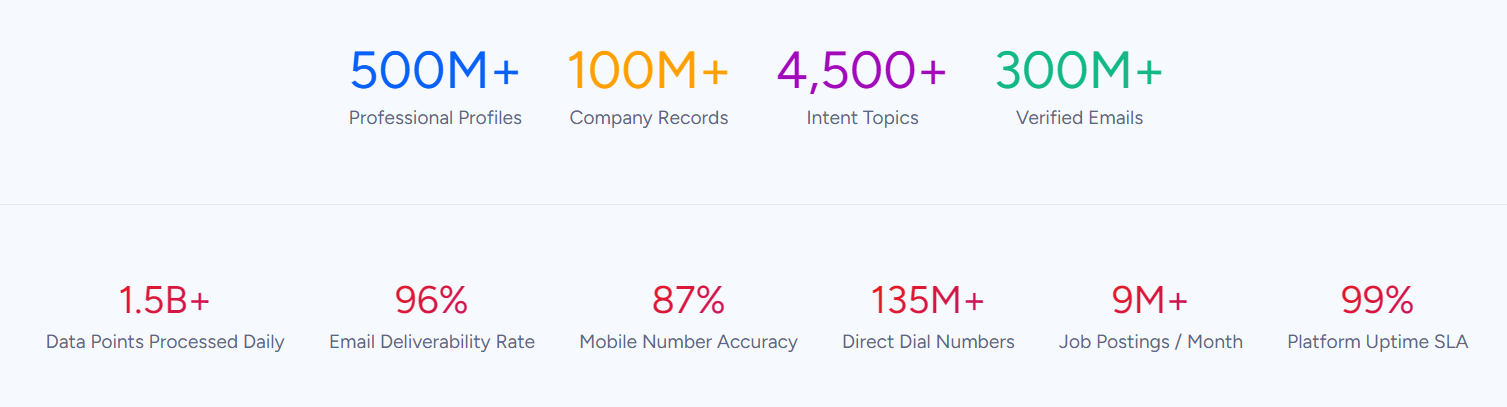
ZoomInfo is a go-to-market platform built on the largest B2B database in the industry: 500M contacts, 100M companies, 135M+ verified phone numbers, and 200M+ verified business emails. Where ActiveCampaign and Drip help you reach contacts you already have, ZoomInfo finds the right contacts first, then enriches your existing database so every campaign targets verified, current information. Its GTM Context Graph processes 1.5B+ data points daily, combining this data with your CRM records, conversation transcripts, and behavioral signals to show not just what happened in your pipeline, but why. Teams access this through GTM Workspace for sales, GTM Studio for marketing, or the API and MCP server to feed any other tool in the stack, including ActiveCampaign or Drip.
If verified, enriched data sounds like the missing piece of your marketing stack, see how ZoomInfo works.
ActiveCampaign vs. Drip at a glance
ActiveCampaign | Drip | ZoomInfo | |
|---|---|---|---|
Primary focus | Multi-channel marketing automation + CRM | Ecommerce email marketing + automation | B2B data intelligence + go-to-market execution |
Automation depth | Visual builder with unlimited actions (Plus+) | Visual workflows with ecommerce-native triggers (up to 50 active) | AI-powered plays and signal-triggered workflows |
Built-in CRM | Yes, with deal pipelines and lead scoring | No | Yes, with GTM Context Graph intelligence |
Channels | Email, SMS, WhatsApp, landing pages | Email, onsite pop-ups, Facebook Custom Audiences | Email, ads, calls, direct mail via GTM Studio |
AI capabilities | Active Intelligence: AI campaign builder, predictive sending, AI agents | No AI features announced | GTM Context Graph with AI agents for outreach, account research, and scoring |
Native SMS | Yes | Coming soon (not yet launched) | No (partner integrations) |
Starting price | $15/month (1,000 contacts, Starter) | $39/month (2,500 contacts, all features) | Free tier (ZoomInfo Lite); consumption-based pricing |
Free plan | 14-day trial only | 14-day trial only | ZoomInfo Lite (permanent free tier) |
Integrations | 1,000+ | 50+ | 172+ marketplace partners + API/MCP |
Best for | SMBs and mid-market across industries | B2C ecommerce stores on Shopify/WooCommerce/BigCommerce | B2B sales, marketing, and RevOps teams |
Automation depth separates these platforms
ActiveCampaign and Drip both offer visual automation builders, but the gap in what those builders can do is significant.
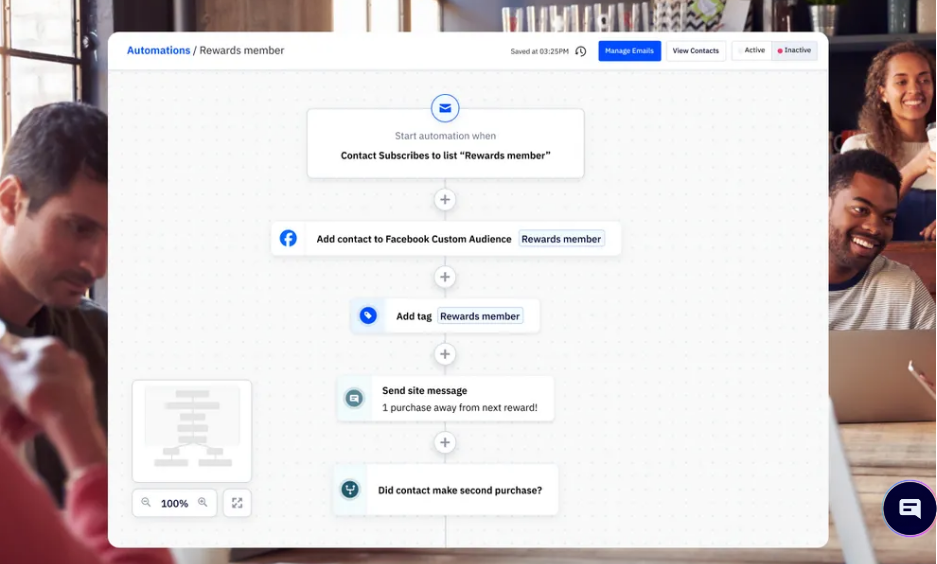
ActiveCampaign's automation builder is the platform's defining feature.
Capterra reviewers (4.6/5, 2,559 reviews) call it the platform's top strength. Workflows branch on behavioral triggers: a subscriber who clicks a pricing link gets one sequence, someone who opens but doesn't click gets another, and a contact whose deal score crosses a threshold gets routed to sales. The builder supports unlimited actions on Plus plans and above, nested if/then branching, and cross-channel sequences where an email non-open triggers an SMS follow-up, which can trigger a WhatsApp message.
Active Intelligence goes further: describe a goal in plain language, and AI agents build the automation, including wait periods, branching paths, and action steps.
Source: ActiveCampaign
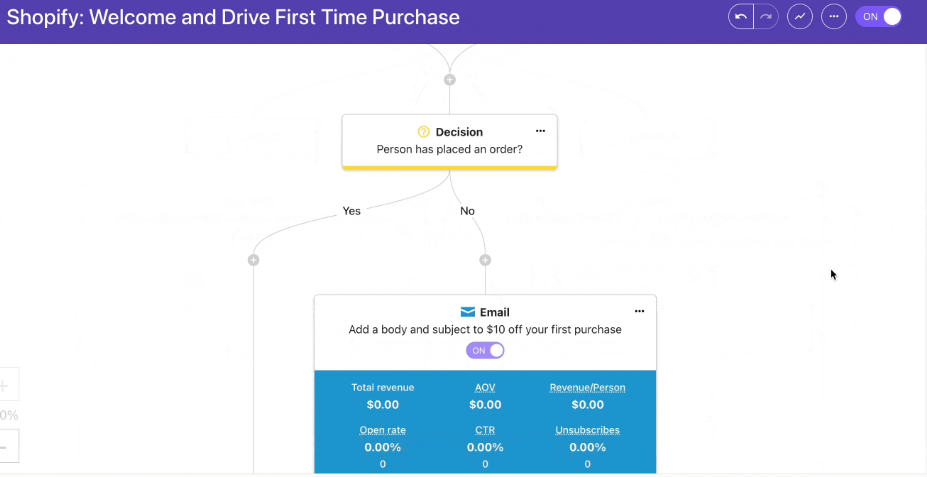
Drip's Workflow builder is deliberately simpler.
It handles ecommerce automation well: abandoned cart recovery, post-purchase sequences, welcome series, browse abandonment, and win-back flows. All plans include up to 50 active Workflows, and the visual canvas is intuitive enough for store owners without marketing backgrounds to build and launch sequences.
The Add to Cart trigger (January 2026) catches shoppers before they reach checkout, and date-based automations handle birthdays, anniversaries, and subscription renewals.
Source: Drip
But Drip's automation stops at ecommerce. There's no CRM deal-stage automation, no lead scoring, no SMS/WhatsApp channels, and no AI-powered automation building. For an online store running proven ecommerce plays, this is enough. For a business that needs automation spanning sales, marketing, and customer success, it's a constraint.
ActiveCampaign includes a CRM; Drip doesn't
This is an architectural difference, not a feature gap.
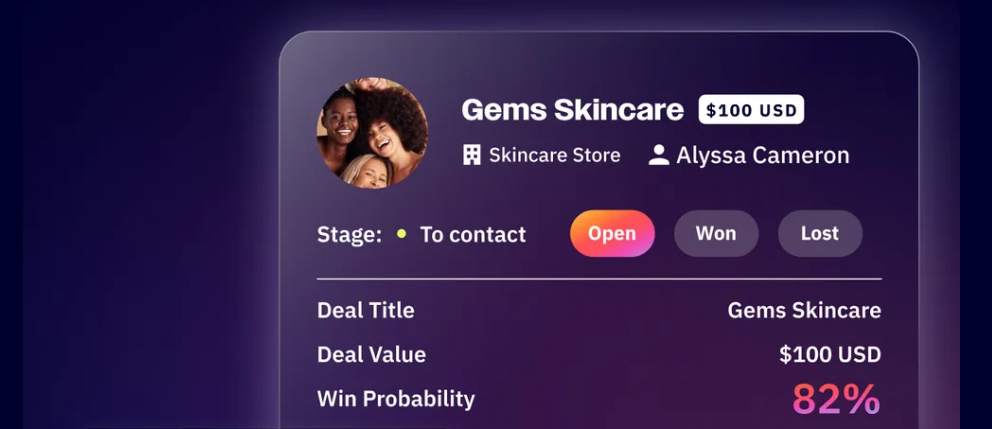
ActiveCampaign's Sales CRM embeds deal tracking inside the marketing automation platform. A contact's full history (every email opened, page visited, form submitted) lives on the same record that tracks their deal through your pipeline.
Automations can create deals when a contact submits a form, trigger tasks when a deal changes stage, and send personalized emails from the rep's address when a deal enters negotiation. Lead scoring evaluates contacts on behavioral signals, and a separate deal scoring system evaluates each opportunity, so teams can answer "is this person a good lead?" and "is this deal likely to close?" independently.
Source: ActiveCampaign
Drip does not have a CRM, and it's not trying to build one. The platform is designed for B2C ecommerce where the "pipeline" is the shopping cart, not a sales process. If your business has a sales team working deals, Drip isn't the right tool, and Drip knows it.
For businesses that need both marketing automation and CRM intelligence, ZoomInfo adds a different dimension.
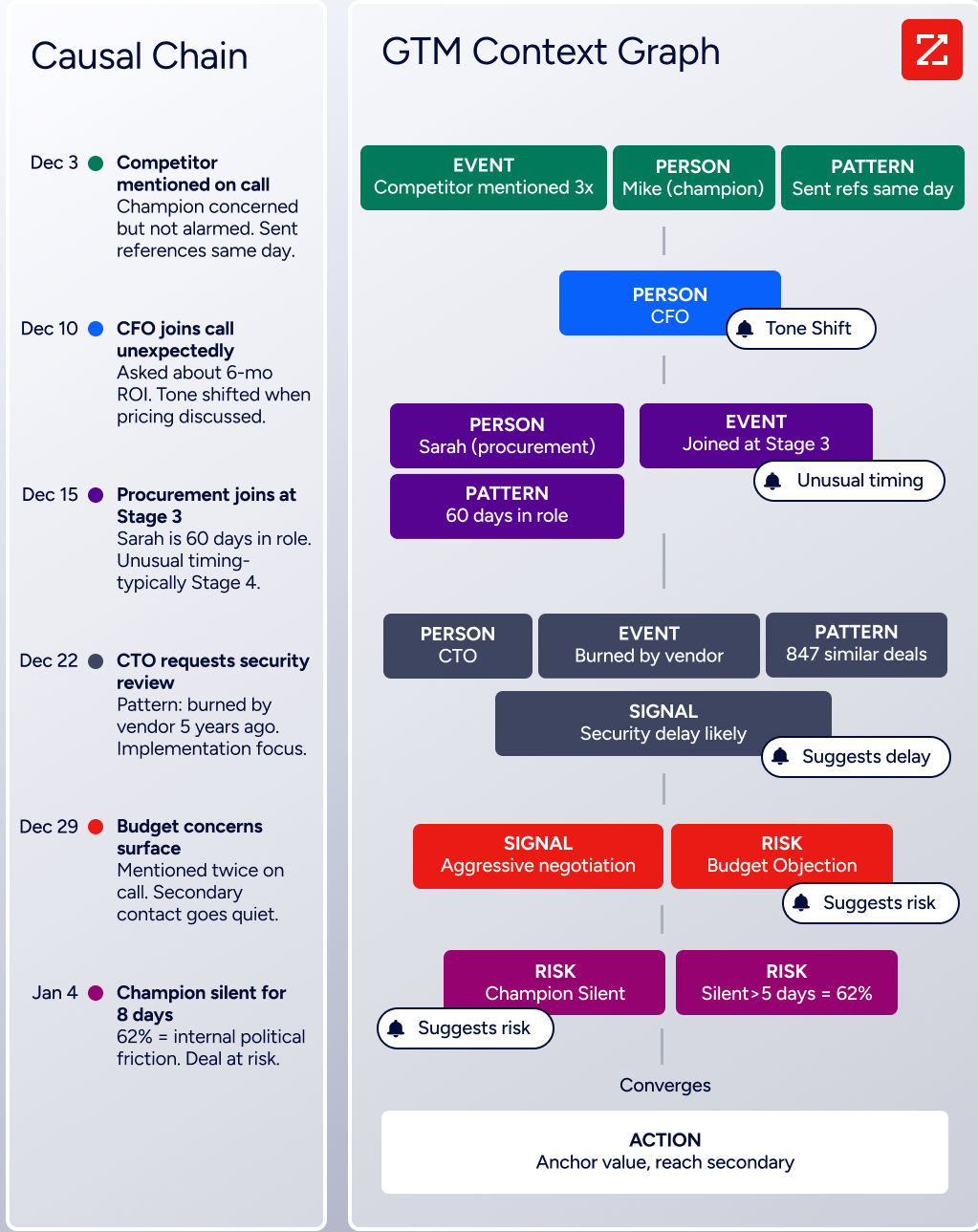
Instead of tracking deals after they enter your pipeline, ZoomInfo's GTM Context Graph identifies which accounts are worth pursuing before your team reaches out. It combines your CRM data, conversation transcripts, and behavioral signals with ZoomInfo's B2B data to show not just who to contact, but why a deal is moving or stalling.
GTM Workspace gives sellers prioritized accounts with AI-drafted outreach. GTM Studio lets marketers and RevOps teams build and launch plays in natural language.
Source: ZoomInfo
Seismic's sales team attributed 39% of active pipeline to opportunities identified or influenced by ZoomInfo signals and boosted productivity by 54%. (Seismic Case Study)
Ecommerce capabilities tell a clear story
Drip was built for ecommerce. ActiveCampaign added ecommerce. The difference shows.
Drip's native integrations with Shopify, WooCommerce, and BigCommerce pull in purchase history, cart events, product catalog data, and browse behavior automatically.
The email builder includes Dynamic Product Blocks that insert live product data (top sellers, behavioral recommendations) into emails without copy-pasting. Abandoned cart emails include the actual items left in the cart with direct checkout links. Dynamic coupon codes generate unique Shopify discounts inside automated emails. The Product Library lets merchants audit synced products and hide specific items from campaigns.
Source: Drip
ActiveCampaign integrates with Shopify and WooCommerce through its apps marketplace, and its ecommerce integrations support abandoned cart recovery, purchase-based automation, and product recommendations.
But these are integrations layered onto a general-purpose platform, not the core architecture. ActiveCampaign's ecommerce workflows work, but they require more configuration to achieve what Drip does natively.
ActiveCampaign compensates with breadth: the same platform handles SaaS onboarding, service business appointment reminders, healthcare patient communications, and franchise multi-location marketing. Drip attempts none of these.
Segmentation works differently at a fundamental level
Both platforms offer segmentation, but the underlying models diverge.
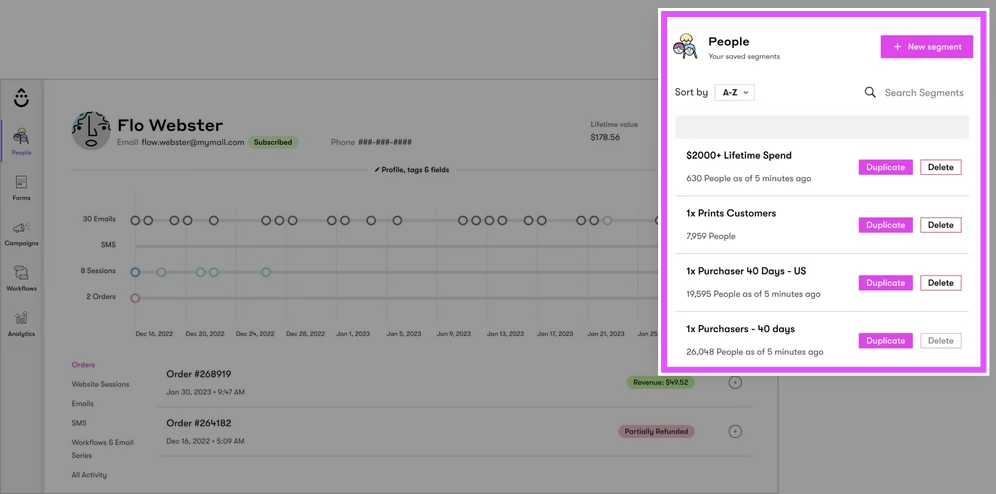
Drip's segmentation is dynamic and not list-based.
Every segment is a saved filter that updates in real time as subscriber behavior changes. A shopper who makes a purchase automatically moves from "Prospects" to "First-time buyers" without anyone touching a list. Segments combine store data (purchases, cart activity, products viewed), zero-party data (quiz responses, declared preferences), email engagement, and tags using AND/OR logic. Every segmentation feature is included from the $39/month plan, with no gating at higher tiers.
Source: Drip
ActiveCampaign uses a tag-based system where one subscriber carries multiple tags, allowing segmentation without duplicate contacts across lists.
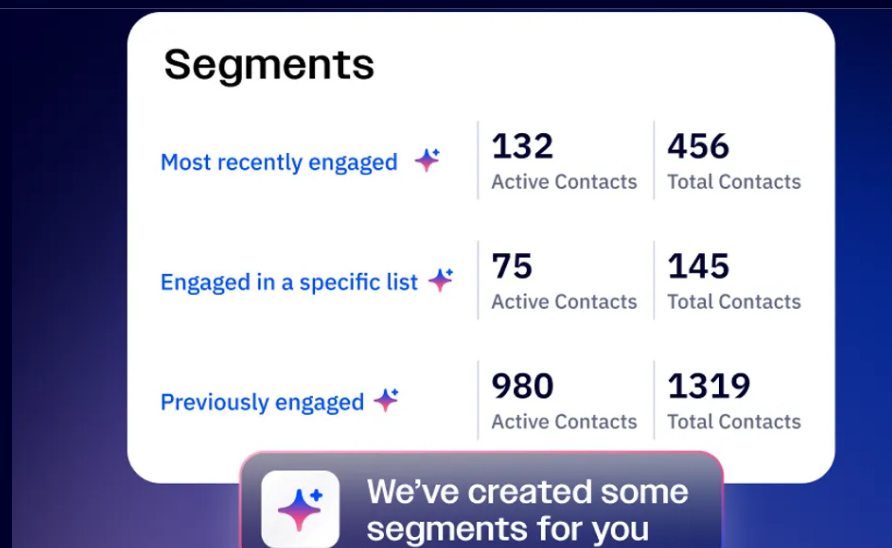
AI-Suggested Segments analyze audience data and surface groups marketers might miss. The segmentation engine draws from email engagement, site tracking, CRM deal data, custom fields, and behavioral triggers across all channels, giving it wider data inputs than Drip's ecommerce-focused model.
Source: ActiveCampaign
The practical difference: Drip segments deeper within ecommerce (purchase history, cart behavior, product-level targeting). ActiveCampaign segments broader across business contexts (deal stages, lead scores, multi-channel engagement, cross-departmental data).
Channel coverage comparison
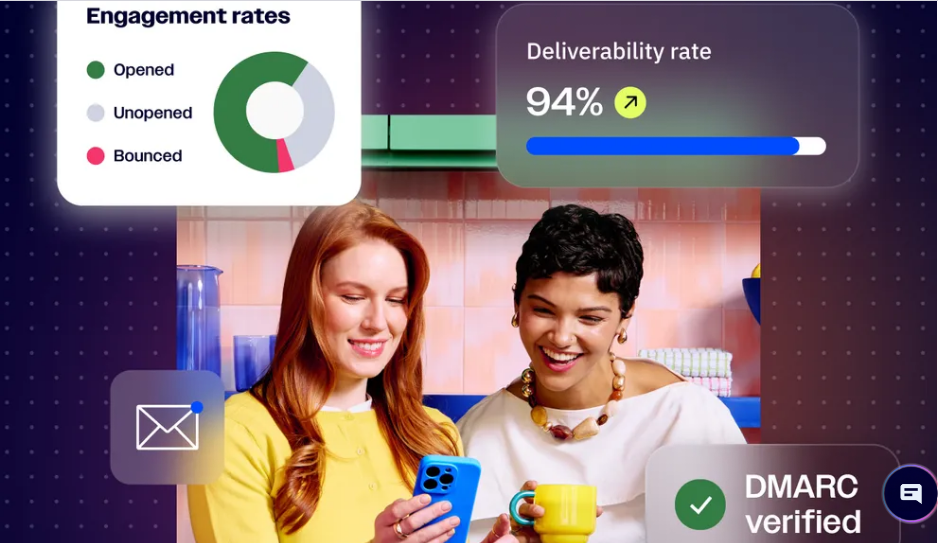
Email: Both platforms handle email well. ActiveCampaign reports 99.88% deliverability (self-reported) and 94% per EmailToolTester. Drip reports 99.8% delivery rate. Both offer dedicated deliverability teams. ActiveCampaign adds Predictive Sending, which optimizes send time per subscriber, and an AI Campaign Builder that generates campaigns from a prompt.
Source: ActiveCampaign
SMS: ActiveCampaign offers native SMS marketing with two-way messaging, a dedicated inbox, and AI-assisted campaign planning. Drip's February 2026 release notes added an SMS Consent Element to onsite forms to "set you up for Drip's upcoming SMS product," confirming native SMS does not yet exist. This is Drip's largest channel gap.
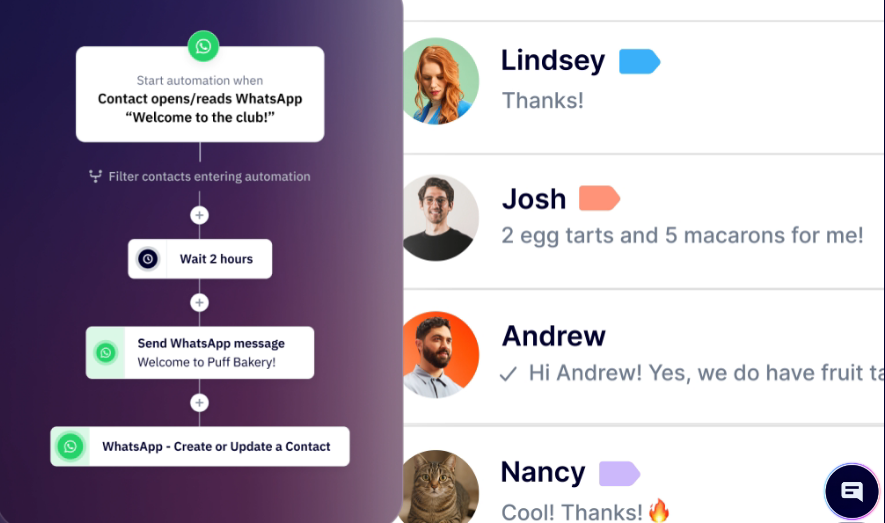
WhatsApp: ActiveCampaign launched WhatsApp Messaging in July 2025 after acquiring Hilos, adding broadcast messaging, a no-code Flows builder, and a shared inbox. Drip does not offer WhatsApp.
Source: ActiveCampaign
Onsite: Drip includes native Onsite Pop-ups (pop-ups, slide-ins, sticky bars, sidebars, embedded widgets) and separate Embedded Forms on all plans. ActiveCampaign offers landing pages and forms but with limited customization compared to standalone tools, a recurring complaint in reviews.
Social retargeting: Drip segments sync to Facebook Custom Audiences for coordinated email and paid ads. ActiveCampaign integrates with Google Ads and Facebook for ad targeting through its marketplace.
AI is where the platforms diverge most sharply
ActiveCampaign is investing in AI. Drip is not, at least not publicly.
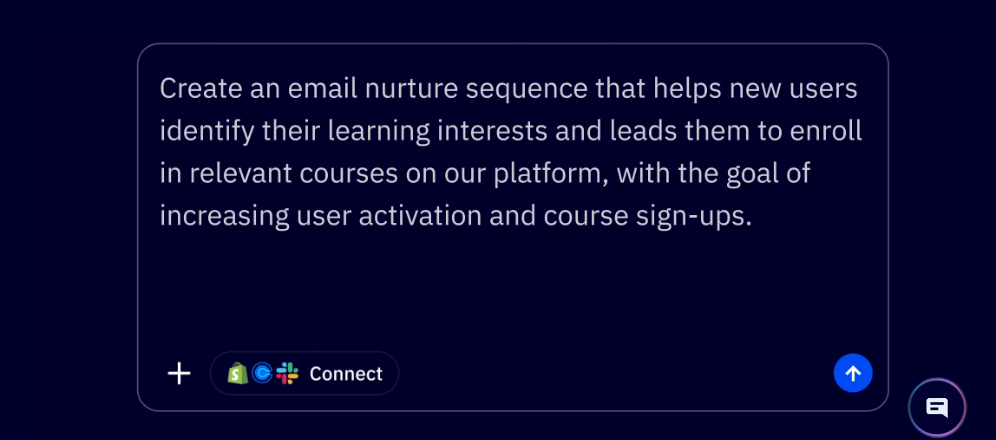
ActiveCampaign's Active Intelligence, launched May 2025 and called the fastest-growing feature in the platform's history, is a suite of AI agents spanning campaign creation, automation building, segmentation, content generation, image creation, and translation.
The system follows an "Imagine, Activate, Validate" cycle: a marketer states a goal, and AI agents build the campaign, select the audience, write the content, and track performance. Predictive Sending delivers each email when each subscriber is most likely to open it, based on their engagement history. The AI Brand Kit imports brand assets from a website URL. Several agents (Forms, Personalization, Goals, Segments, Campaigns) remain in beta.
Source: ActiveCampaign
Drip offers no public AI features for predictive send times, product recommendations, subject line generation, or campaign building. Its pitch is manual control and simplicity, not AI-assisted automation.
ZoomInfo takes AI in a different direction.
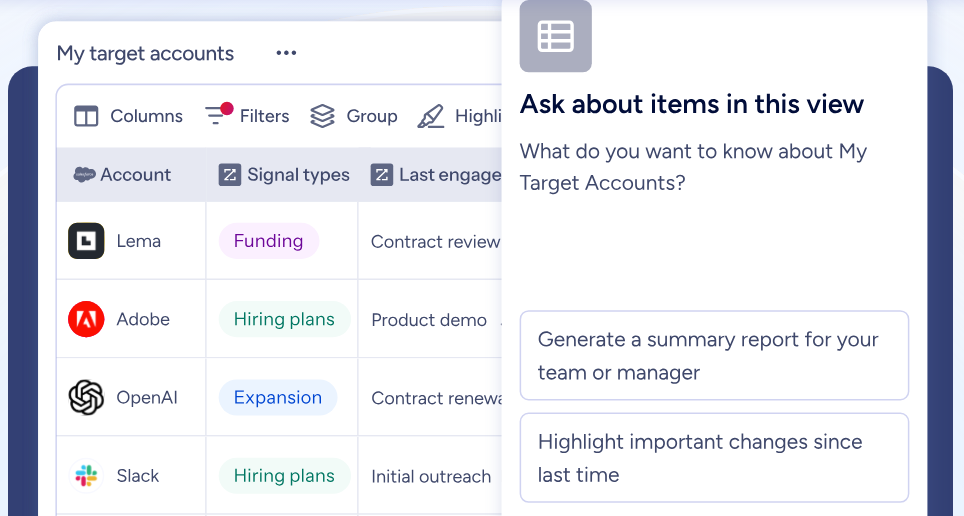
Instead of generating email copy or optimizing send times, ZoomInfo's AI analyzes your go-to-market strategy. The GTM Context Graph shows why deals move or stall, not just that they did. AI agents in GTM Workspace handle account research, outreach generation, CRM updates, and signal monitoring. GTM Studio lets marketers describe audiences in natural language and launch plays targeting accounts that match proven win patterns.
Source: ZoomInfo
Pricing models reflect different philosophies
ActiveCampaign uses contact-based pricing across four tiers (Starter, Plus, Professional, Enterprise), each unlocking more features.
The Starter plan begins at $15/month but caps automations at 5 actions, excludes landing pages, and limits AI features. At 10,000 contacts, Starter costs $149/month. Plus, Professional, and Enterprise pricing requires the dynamic calculator on the pricing page. ActiveCampaign charges once per unique contact regardless of how many automations or segments include that contact, which prevents duplicate billing.
G2 reviewers report that pricing has increased by nearly 100% over the past three years and climbs quickly as lists grow. Email sends are capped at 10x–15x the contact limit per month (depending on plan), with $0.005 per email charged for overages.
Drip uses a single-plan model where every paying customer gets every feature from day one.
The entry price is $39/month for up to 2,500 contacts with unlimited email sends. Pricing scales as the contact list grows. There is no feature gating, no premium tiers to unlock, and no separate charges for automation, segmentation, or onsite tools. The only service split: live chat support requires a $99/month+ plan.
At small list sizes, ActiveCampaign's Starter plan costs less ($15 vs. $39) but includes far less: a 5-action automation cap, no landing pages, no AI content generation, no advanced segmentation. At 10,000 contacts, ActiveCampaign Starter costs $149/month while Drip's full-feature plan reportedly costs approximately $154/month (per third-party estimates; confirm on drip.com/pricing). ActiveCampaign's higher tiers that unlock comparable automation depth cost more still.
Both platforms offer 14-day free trials.
ActiveCampaign adds a 30-day money-back guarantee for first-time subscribers. Drip advertises up to 100 days money-back on its comparison pages, though terms should be confirmed directly.
The data problem neither platform solves
ActiveCampaign and Drip both do their jobs well: orchestrating campaigns and automating customer journeys. But both assume you already know who to talk to.
For B2C ecommerce brands using Drip, this assumption mostly holds. Shoppers arrive at your store, interact with products, and generate behavioral data that Drip captures and acts on. The data problem is smaller because customers identify themselves through shopping behavior.
For B2B businesses using ActiveCampaign, the assumption breaks down. Your CRM data decays. Job titles change. Companies restructure. Email addresses bounce. And the contacts you don't have (the decision-makers you've never identified) represent a pipeline you can't target.
This is the problem ZoomInfo was built to solve.
ZoomInfo maintains the largest B2B database in the industry, verified by 300+ human researchers and achieving up to 95% accuracy on first-party data. In a Fortune 500 RFP analyzing 25 million contacts across vendors, an independent consultant concluded that "no other competitor came even close."
Source: ZoomInfo
ZoomInfo's data doesn't compete with ActiveCampaign or Drip. It feeds them. ZoomInfo integrates with ActiveCampaign through the apps marketplace, and its Enterprise API and MCP server push enriched contact data into any marketing platform. The result: your ActiveCampaign automations target verified contacts at the right companies, and your Drip segments rest on clean, current data instead of decaying lists.
SpringDB saw 2x–3x increases in campaign conversions, a 300% increase in database usability, and 30–50% uplift in average deal size using ZoomInfo's enriched data. (SpringDB Case Study)
Support models match each platform's audience
ActiveCampaign offers chat and ticket support on all paid plans, with priority support on Professional plans and a dedicated account team on Enterprise.
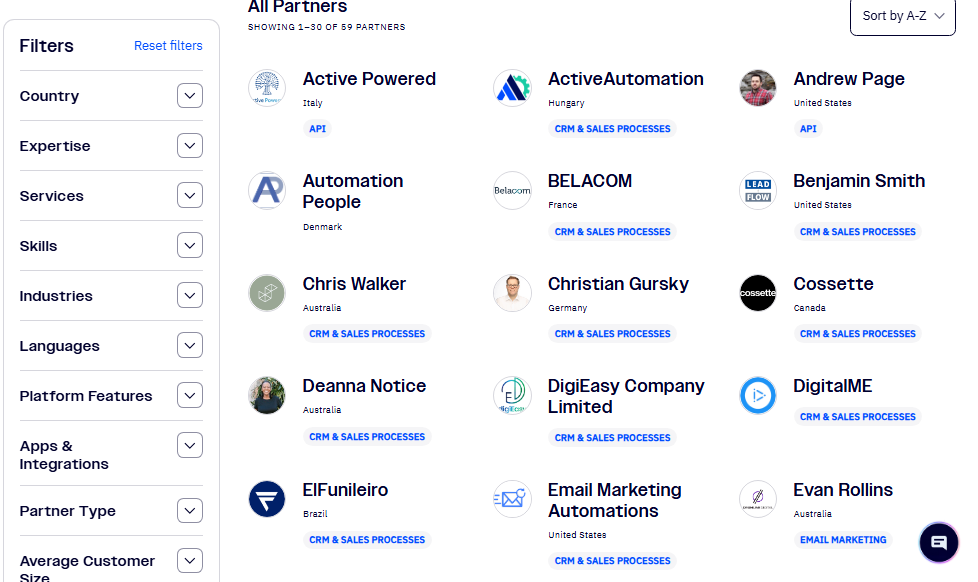
Paid specialist sessions start at $79, and a consultant directory connects users with vetted experts. A 180,000+ member community and learning portal support self-service users. Free migration covers contacts, templates, segments, and campaigns from competing platforms.
Source: ActiveCampaign
Drip advertises a 97.3% satisfaction score, live chat response under 2 minutes, and email response under 1.6 hours.
G2 reviewers confirm this, particularly for deliverability issues. The catch: live chat is only available on $99/month+ plans. Below that, support is email-only, Monday through Friday, with no weekend coverage. For accounts with 17,500+ contacts, Drip provides free migration and personalized onboarding for the first 90 days.
The difference reflects each platform's target customer. ActiveCampaign serves a broader range of businesses, so it tiers support by plan size. Drip serves ecommerce operators who tend to be self-directed, so it invests in fast response times for customers who need them.
Integration ecosystems differ in scale
ActiveCampaign lists 1,000+ app integrations, covering CRM, ecommerce, forms, advertising, communication, analytics, and developer tools.
Key integrations include Salesforce (Pro/Enterprise), Shopify, WordPress, Zapier, Stripe, and Calendly. The platform also offers a REST API, webhooks, and an App Studio for building custom integrations. ActiveCampaign's MCP connectors for Claude and ChatGPT let AI tools query marketing data in natural language.
Drip's integration catalog spans 50+ tools across 20 categories, with core strength in ecommerce: Shopify, Shopify Plus, BigCommerce, WooCommerce, and Stripe.
Zapier bridges to tools outside the native catalog. Drip provides a REST API with official Ruby and Node.js SDKs, plus a Shopper Activity API for custom store connections. G2 reviewers flag integration limitations compared to broader platforms, a real constraint for brands running tools beyond Shopify and WooCommerce.
ZoomInfo connects to both ecosystems.
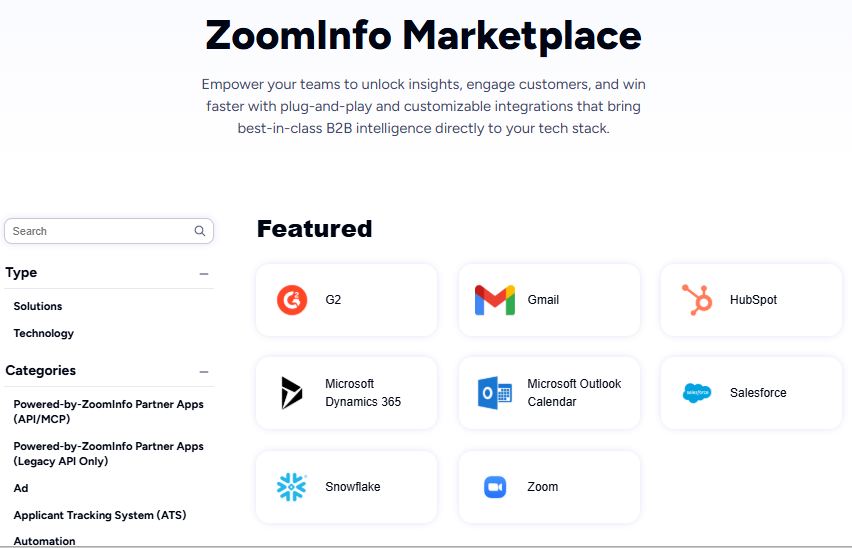
Its Marketplace lists 172+ integration partners, including direct connectors for Salesforce, HubSpot, Microsoft Dynamics 365, Snowflake, and Databricks. The Enterprise API and MCP server let any application, including ActiveCampaign or Drip, consume ZoomInfo's data. API access comes with all relevant plans.
Source: ZoomInfo
ActiveCampaign vs. Drip vs. ZoomInfo: Which should you choose?
The right platform depends on what your business needs.
Choose ActiveCampaign if:
You need multi-channel automation spanning email, SMS, and WhatsApp
A built-in CRM with sales pipeline tracking is important to your workflow
You operate a service business, SaaS, or multi-vertical company, not just ecommerce
AI-powered campaign creation and predictive optimization appeal to your team
You want the deepest automation builder available for SMBs
Choose Drip if:
You run an ecommerce store on Shopify, WooCommerce, or BigCommerce
You want every feature from day one without tier-based gating
Your team needs to run ecommerce automation without a dedicated specialist
Transparent, predictable pricing matters more than breadth of channels
You value fast, responsive support and high deliverability
Choose ZoomInfo if:
You need verified B2B contact and company data to fuel your campaigns
Your CRM data is incomplete, stale, or missing key decision-makers
You want intelligence that identifies which accounts to pursue and why
You need to enrich your ActiveCampaign or Drip lists with accurate, current information
Your go-to-market strategy depends on intent signals, buying committees, and account prioritization
See how ZoomInfo's data and intelligence can power your marketing stack.
ActiveCampaign and Drip both orchestrate campaigns well once you know who to target. ZoomInfo ensures you're targeting the right people with the right data.
For B2B teams, that data is the foundation everything else depends on. For ecommerce brands, Drip's native store integrations create that foundation automatically. And for businesses that need automation across multiple channels and departments, ActiveCampaign's depth is hard to match.
The strongest stacks don't force a choice between data quality and campaign execution. They combine both.
ActiveCampaign vs. Drip vs. ZoomInfo FAQ
What is the core difference between ActiveCampaign, Drip, and ZoomInfo?
ActiveCampaign is a multi-channel marketing automation platform with a built-in CRM, serving SMBs and mid-market businesses across industries.
Drip is an ecommerce email marketing platform built for online stores on Shopify, WooCommerce, and BigCommerce.
ZoomInfo is a B2B data and go-to-market platform that provides verified contact data, company intelligence, and buyer intent signals for sales and marketing.
Which platform is best for an ecommerce business?
Drip is the best choice for ecommerce. Its native store integrations pull in purchase history, cart events, and product catalog data to drive behavioral automation from day one. Dynamic Product Blocks insert live product data into emails, and the platform was designed for B2C online retail. ActiveCampaign integrates with Shopify and WooCommerce but requires more configuration to achieve similar ecommerce workflows.
Which platform has the most advanced automation?
ActiveCampaign offers the deepest automation capabilities. Its visual builder supports unlimited actions (Plus plans and above), conditional branching, cross-channel sequences across email, SMS, and WhatsApp, and AI-powered automation through Active Intelligence.
Drip's Workflow builder is simpler and focused on ecommerce, with a cap of 50 active Workflows and no native SMS or WhatsApp.
How does pricing compare between ActiveCampaign and Drip?
ActiveCampaign starts at $15/month for 1,000 contacts on the Starter plan, but this plan caps automations at 5 actions and excludes many features. Drip starts at $39/month for 2,500 contacts and includes every feature from day one. At higher contact counts the pricing gap narrows, but ActiveCampaign's advanced plans (which unlock comparable automation) cost more than Drip's single tier.
Does Drip have SMS capabilities?
Not yet. Drip's February 2026 release notes added an SMS Consent Element to onsite forms to prepare for an upcoming SMS product, but native SMS has not launched.
ActiveCampaign offers native SMS marketing with two-way messaging, a dedicated SMS inbox, and AI-assisted campaign planning.
Can ZoomInfo work alongside ActiveCampaign or Drip?
Yes. ZoomInfo is not a replacement for either platform. It feeds verified contacts, company data, and buyer signals into your marketing tools.
ZoomInfo integrates with ActiveCampaign through the apps marketplace and pushes enriched data into any platform via its Enterprise API and MCP server. For B2B teams, this means your automations target verified, current contacts instead of decaying lists.
Which platform has the best AI features?
ActiveCampaign leads in marketing AI with Active Intelligence: AI campaign building, predictive send-time optimization, content and image generation, and AI-suggested segments. ZoomInfo leads in go-to-market AI with the GTM Context Graph, which analyzes deal momentum, buying committees, and account prioritization. Drip does not offer public AI features.
Which platform offers the best deliverability?
Both ActiveCampaign and Drip invest in deliverability.
ActiveCampaign reports 99.88% deliverability (self-reported) and 94% per EmailToolTester's independent testing, with private network routing, dedicated IP management, and DKIM/DMARC authentication. Drip reports a 99.8% delivery rate and maintains a deliverability team that monitors accounts proactively.
Both platforms offer deliverability support and compliance tooling.
See how ActiveCampaign stacks up elsewhere:
