
Choosing between Amperity and Treasure Data (now Treasure AI) for your customer data platform often comes down to five questions:
Do you need the best identity resolution for messy, fragmented consumer data, or a broader platform that handles both data unification and marketing execution?
Is your data team ready to work within a lakehouse-native architecture, or do you need a hybrid deployment that adapts to your existing infrastructure?
Are you primarily a North American operation, or do you need strong APAC coverage with native support for channels like LINE and Yahoo! Japan?
Do you want a focused CDP that feeds your existing marketing tools, or a platform that aims to replace several of them?
Does your organization also need B2B intelligence for go-to-market teams selling to other businesses?
In short, here's what we recommend:
Amperity is the identity resolution specialist. Its patented Stitch engine uses up to 45 AI models to unify fragmented consumer records across dozens of systems, running deterministic and probabilistic matching at once. For enterprises with messy, multi-source customer data (think post-M&A brand consolidation or omnichannel retail), Amperity finds connections other CDPs miss. The trade-off: Amperity is a data foundation, not a marketing execution platform. It unifies and activates audiences through your existing tools, but you still need your own email, paid media, and personalization stack downstream.
Treasure AI is the broader platform. Recently rebranded from Treasure Data, it has evolved from a CDP into an Agentic Experience Platform that combines data unification with five AI-powered activation suites covering engagement, creative production, personalization, paid media, and customer service. For enterprises tired of stitching together a CDP, an ESP, a personalization engine, and a creative tool, Treasure AI pitches one governed system where the same customer intelligence drives every channel. The risk: the activation layers are new (Studio went GA in April 2026), and the platform still carries a steep learning curve for non-technical users.
Both platforms solve the consumer data problem. But many enterprises that manage B2C customer relationships also run B2B go-to-market motions, whether through partnerships, enterprise sales teams, or channel strategies. That B2B intelligence challenge is fundamentally different from consumer data unification, and it's where ZoomInfo fits.
ZoomInfo is a B2B go-to-market platform built on a large, continuously verified dataset: 500M contacts, 100M companies, 135M+ verified phone numbers, and 200M+ verified business emails. While Amperity and Treasure AI unify your consumer data, ZoomInfo provides the intelligence your sales, marketing, and RevOps teams need to find, win, and grow business accounts. Its GTM Context Graph fuses this data with your CRM records, conversation transcripts, and behavioral signals to reveal not just what happened in a deal, but why. Teams access that intelligence through GTM Workspace for sellers, GTM Studio for marketers and RevOps, or APIs and MCP in any third-party tool.
If your organization needs B2B intelligence alongside your consumer data platform, see how ZoomInfo's GTM Context Graph works.
Amperity vs. Treasure AI vs. ZoomInfo at a glance
Amperity | Treasure AI | ZoomInfo | |
|---|---|---|---|
Core focus | Identity resolution and consumer data unification | CDP + AI-powered marketing activation | B2B go-to-market intelligence |
Founded | 2016 | 2011 | 2007 |
Target buyer | CDOs, data engineers, marketing technologists at consumer brands | Enterprise marketers and data teams at global B2C brands | Sales, marketing, and RevOps teams at B2B organizations |
Identity resolution | Patented Stitch engine with 45 AI models, 5+ patents | Diamond Record with deterministic, probabilistic, and rule-based matching | Entity resolution across 500M contacts and 100M companies |
Architecture | Lakehouse-native (zero-copy with Databricks, Snowflake) | Hybrid CDP (complete or composable on existing warehouse) | GTM Context Graph processing 1.5B+ data points daily |
Built-in activation | Audience Hub with 200+ destination connectors | Five AI Suites (Engagement, Creative, Personalization, Paid Media, Service) | GTM Workspace, GTM Studio, native DSP, multi-channel orchestration |
AI capabilities | AmpAI assistants, Chuck CLI agent, predictive models | Treasure AI Studio, Marketing Super Agent, AI Agent Foundry | GTM Context Graph, AI-powered outreach, GTM Workspace AI agents |
Analyst recognition | Gartner Niche Player (CDP, 2026) | Gartner Leader, Forrester Leader, IDC Leader (CDP, 2024) | Gartner Leader (ABM Platforms, 2024 & 2025), Forrester Leader (Intent Data, 2025) |
Pricing model | Consumption-based (Amps) | Profile + behavioral events | Custom consumption-based |
Best for | Enterprises needing strong identity resolution feeding existing marketing tools | Enterprises wanting to consolidate CDP and marketing execution into one platform | B2B teams needing verified contact data, intent signals, and go-to-market automation |
Identity resolution is the core battleground
For any CDP, identity resolution determines everything downstream. Unified profiles are only as valuable as the matching engine that creates them.
Amperity built its company around this problem.
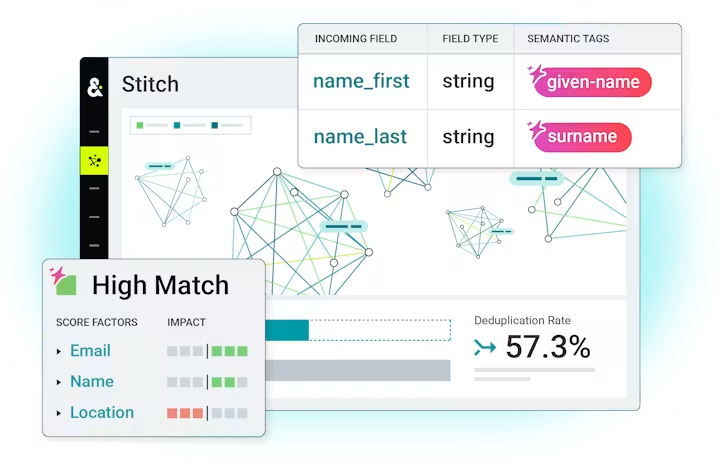
Its Stitch identity engine runs a seven-stage pipeline that combines deterministic matching (exact email, phone) with probabilistic matching (name similarity, address overlap, behavioral patterns) at the same time. What makes Stitch distinctive is its three concurrent identity graphs: a Growth Graph for probabilistic reach, a Trust Graph for deterministic precision, and an Opportunity Graph that measures the gap between the two.
Teams choose which graph fits the use case, running high-confidence matching for compliance and broader matching for marketing without rebuilding the identity layer.
Source: Amperity
Stitch's approach is backed by peer-reviewed research published at SIGMOD 2020 and protected by 5+ patents covering stable ID maintenance, transitive stitching, and dynamic table merging. For regulated industries, this academic and patent foundation gives auditors something concrete to evaluate.
Treasure AI takes a different approach with its Diamond Record.
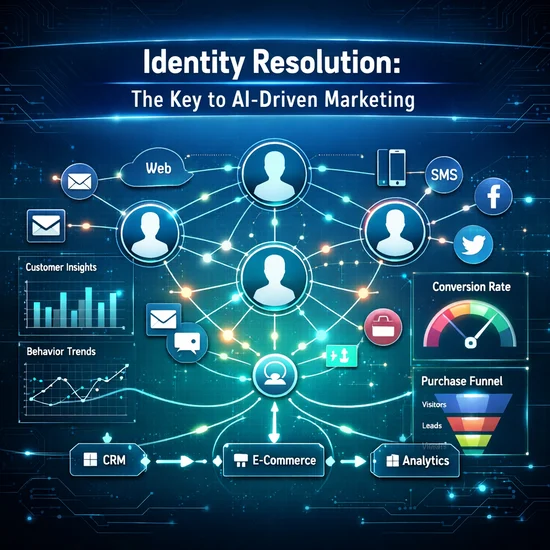
Rather than running batch identity stitching on a schedule, the Diamond Record uses continuous resolution that combines deterministic, probabilistic, and rule-based matching methods as new data arrives. Treasure AI frames this as an evolution beyond the traditional "Golden Record" model, where identities update in real time rather than waiting for manual refreshes.
Source: Treasure AI
The practical difference: Amperity gives you more control over how matching works (tunable thresholds, configurable blocking strategies, separation keys for deterministic un-matching), while Treasure AI prioritizes continuous resolution that requires less manual configuration.
For enterprises with complex identity challenges (post-M&A consolidation, multi-brand portfolios with overlapping customers), Amperity's granular control is an advantage. For enterprises that want identity resolution to work as part of a broader platform without heavy tuning, Treasure AI's approach reduces operational overhead.
Platform scope: data foundation vs. activation platform
This is the most consequential difference between the two CDPs.
Amperity is a data platform.
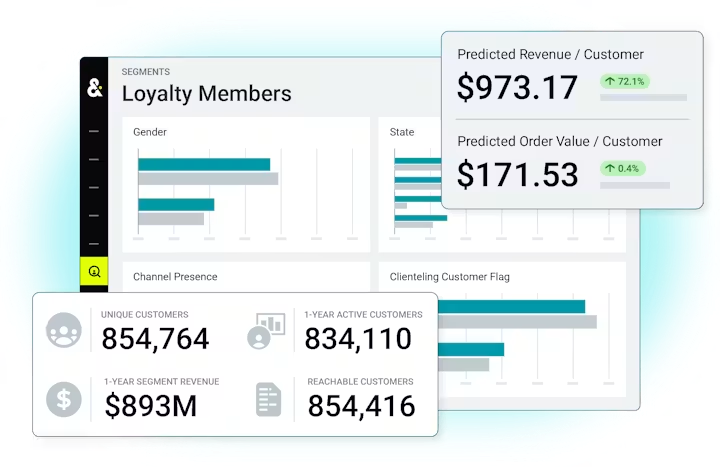
It ingests raw data from any source, resolves identities, builds unified profiles, and delivers audiences to downstream tools through 200+ pre-built destination connectors. Its Audience Hub handles segmentation, campaign building, and journey orchestration, but the actual email sending, ad serving, and personalization happen in your existing stack (Braze, Klaviyo, Salesforce Marketing Cloud, Meta Ads, Google Ads, and others).
This architecture has a clear advantage: Amperity doesn't try to replace your marketing tools. It makes them better by feeding them unified, identity-resolved data.
Source: Amperity
Treasure AI bets in the opposite direction.
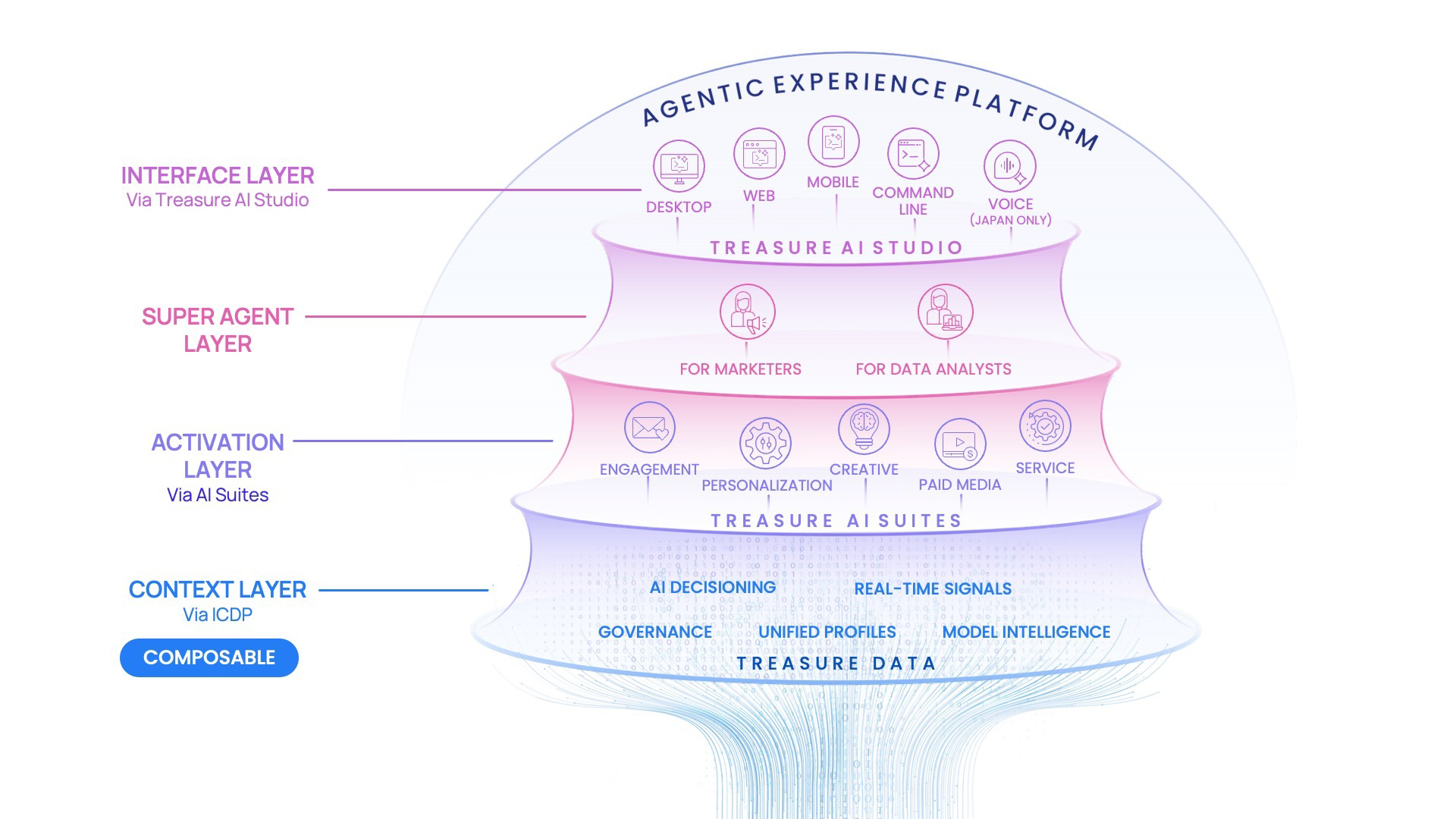
Its five AI Suites (Engagement, Creative, Personalization, Paid Media, and Service) extend the CDP into channels that customers would otherwise staff with separate vendors.
The Engagement AI Suite handles cross-channel journey orchestration with email and mobile push (SMS and in-app messaging coming soon). The Creative AI Suite generates brand-compliant assets using AI agents. The Personalization AI Suite powers real-time web experiences. The Paid Media AI Suite optimizes ad spend through data clean rooms and cross-channel analytics.
Source: Treasure AI
The trade-off is maturity.
Treasure AI's activation suites are new. Treasure AI Studio went GA in April 2026. The Engagement Suite's email and push capabilities work but haven't reached feature parity with dedicated platforms like Braze or Klaviyo.
For enterprises with established marketing tool investments, Amperity's connector-based approach preserves those investments. For enterprises willing to consolidate, Treasure AI offers a simpler architecture with fewer vendor contracts.
Architecture: lakehouse-native vs. hybrid
How each platform fits into your existing data infrastructure matters as much as what it does.
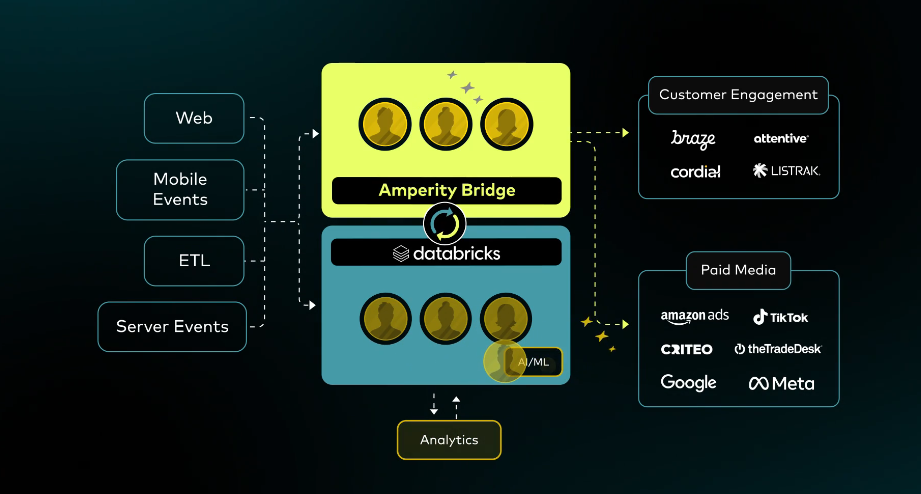
Amperity is built around a lakehouse-native architecture.
Its Bridge enables zero-copy data sharing with Databricks (via Delta Sharing), Snowflake (via Secure Data Sharing), and Google BigQuery. Customer data stays in the customer's own data lake. No forced migration, no data duplication.
Source: Amperity
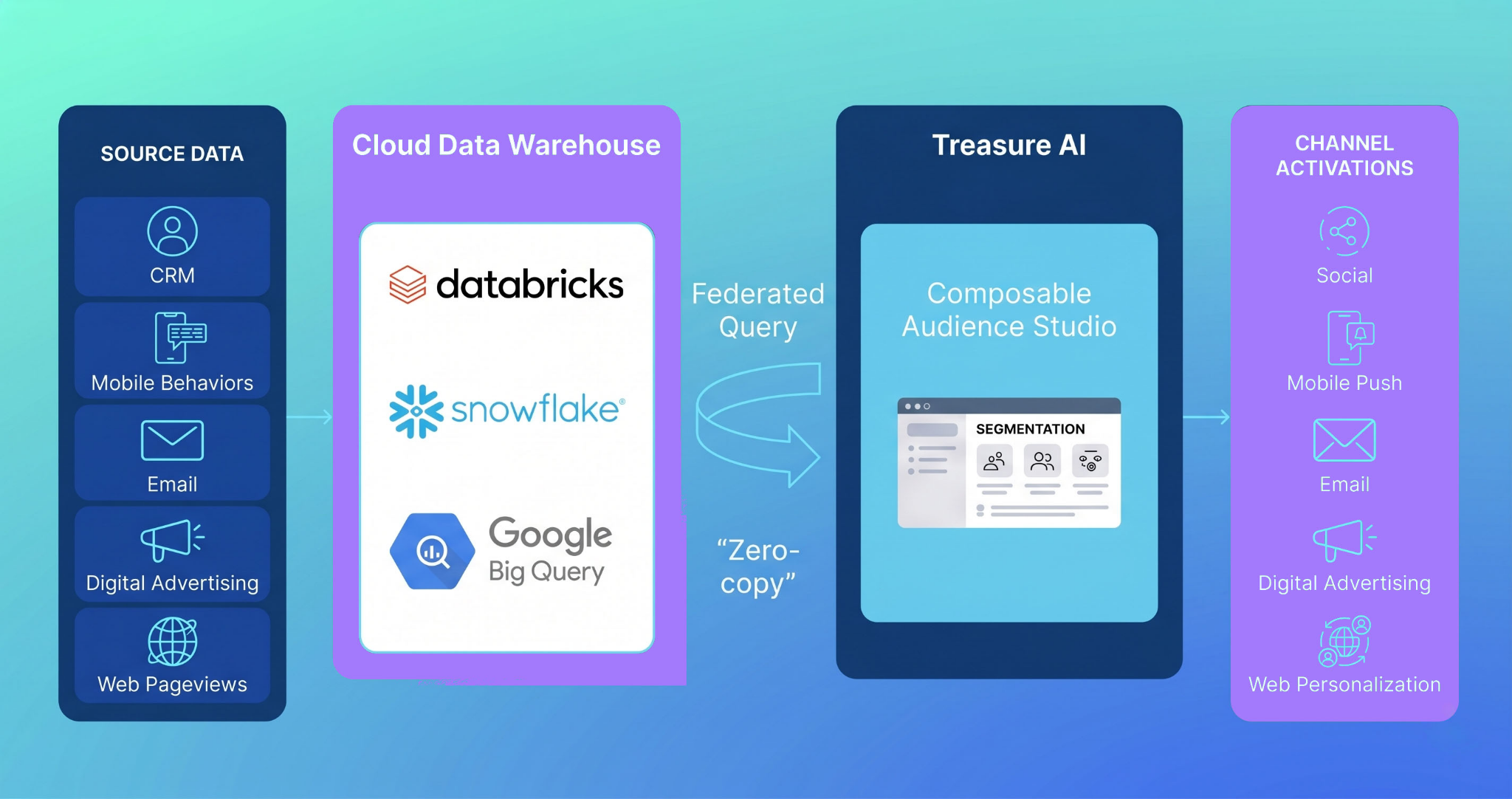
Treasure AI offers a Hybrid CDP architecture that supports two deployment paths.
The Complete CDP is a fully managed solution. The Composable CDP runs on a customer's existing data warehouse (Snowflake, BigQuery, Databricks, Redshift) with zero-copy, zero-ETL integration. This flexibility means enterprises can choose based on their data maturity: teams with existing warehouse investments use the composable path, while teams without one get a fully managed option.
Source: Treasure AI
Both approaches avoid the traditional CDP trap of copying all customer data into a vendor-controlled silo. The distinction is emphasis: Amperity assumes you have a lakehouse and builds natively on it. Treasure AI lets you bring a warehouse if you have one, or provides one if you don't.
AI capabilities take different forms
Both platforms have invested in AI, but their implementations reflect their different philosophies.
Amperity's AI focuses on data intelligence.
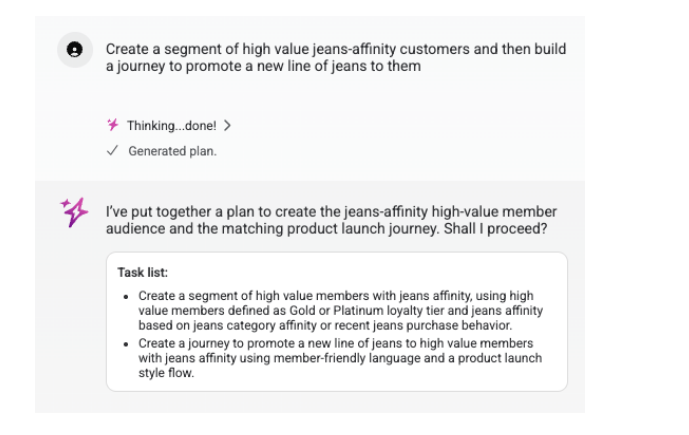
AmpAI embeds generative AI assistants into the segment editor, journey builder, query editor, and consumption dashboard. Marketers describe what they want in plain language and the AI generates segments, journeys, or SQL queries grounded in the customer's own data. Chuck, a command-line AI agent for Databricks, lets data engineers standardize raw data and build identity graphs using natural language.
Amperity's predictive models run natively against resolved profiles: predicted CLV, churn propensity, product affinity, and event propensity scoring. Because these models operate on the same deduplicated identity layer that powers segmentation, predictions tie to real individuals rather than fragmented records.
Source: Amperity
Treasure AI's AI focuses on marketing execution.
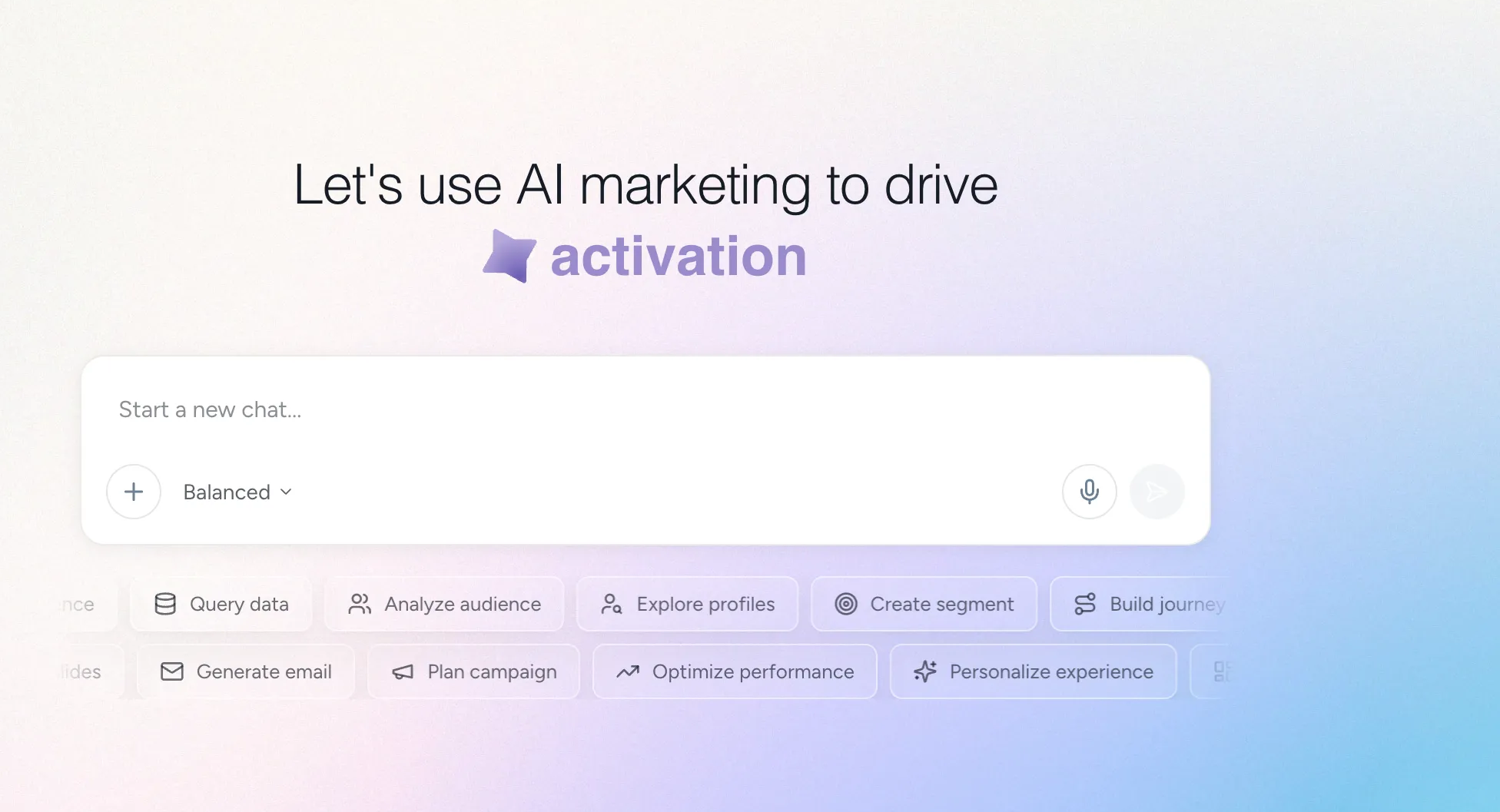
Treasure AI Studio is a conversational workspace where marketers build segments, orchestrate journeys, run queries, and generate reports through natural language. The Marketing Super Agent (GA January 2026) orchestrates the full marketing lifecycle autonomously within human-set guardrails. The AI Agent Foundry lets enterprises build custom governed AI agents on top of their CDP data.
Source: Treasure AI
The ambition differs.
Amperity uses AI to make data teams faster at building audiences and extracting insights. Treasure AI uses AI to reduce the need for data teams in everyday marketing workflows.
Both platforms require caution.
Amperity's autonomous AI agents are still in private beta as of May 2026. Treasure AI Studio only went GA in April 2026. Buyers evaluating either platform's most advanced AI capabilities are purchasing proven CDP foundations with AI layers that are still maturing in production.
Pricing: consumption vs. profiles, neither transparent
Neither platform publishes prices. Both require a sales conversation to understand total cost of ownership.
Amperity charges through a proprietary unit called "Amps" that measures platform consumption across data processing, segmentation, campaign activation, and analytics.
Both its Standard and Enterprise editions include identical platform capabilities; the difference is support coverage (6am-6pm PT vs. 24/7) and training options. The "no add-ons and no hidden fees" claim comes with caveats: premium connectors carry a 25,000 Amps/month surcharge for 20 advertising destinations including Meta, Google, and TikTok, and compute resource sizing directly affects consumption rate. Only 10% of unused Amps roll over between contract terms.
Treasure AI uses a profile-and-behavior (P+B) unit model that charges based on unified customer profiles and behavioral events, not query volume or compute power.
One P+B unit covers 1 million profiles or 1 billion behavioral events. Billing uses the 4th-highest daily total each month, absorbing three peak-day spikes. The advantage is predictability: costs scale with your customer base size, not with how often your team queries the data. However, exceeding ingest or storage limits triggers automatic tier upgrades billed for the remainder of your subscription term.
Implementation costs differ.
Treasure AI's full CDP deployment typically takes 8-12 weeks. Amperity's timeline varies by data complexity.
Treasure AI's Trade-Up Program offers ESP or CEP replacements up to 24 months free on the Engagement AI Suite and lets CDP switchers delay payments until their incumbent contract expires. That program targets customers considering consolidation, offsetting the switching cost for enterprises willing to replace existing tools rather than integrate with them.
Where ZoomInfo fits: your B2B intelligence layer
Amperity and Treasure AI solve the consumer data problem. They unify purchase histories, loyalty profiles, website behavior, and email interactions across your B2C customer base. But many enterprises that manage consumer relationships also sell to businesses, run partnerships, or operate enterprise sales teams.
That B2B challenge requires a different data foundation. Consumer CDPs unify first-party data you already have. B2B intelligence requires third-party data about companies and people you haven't met yet.
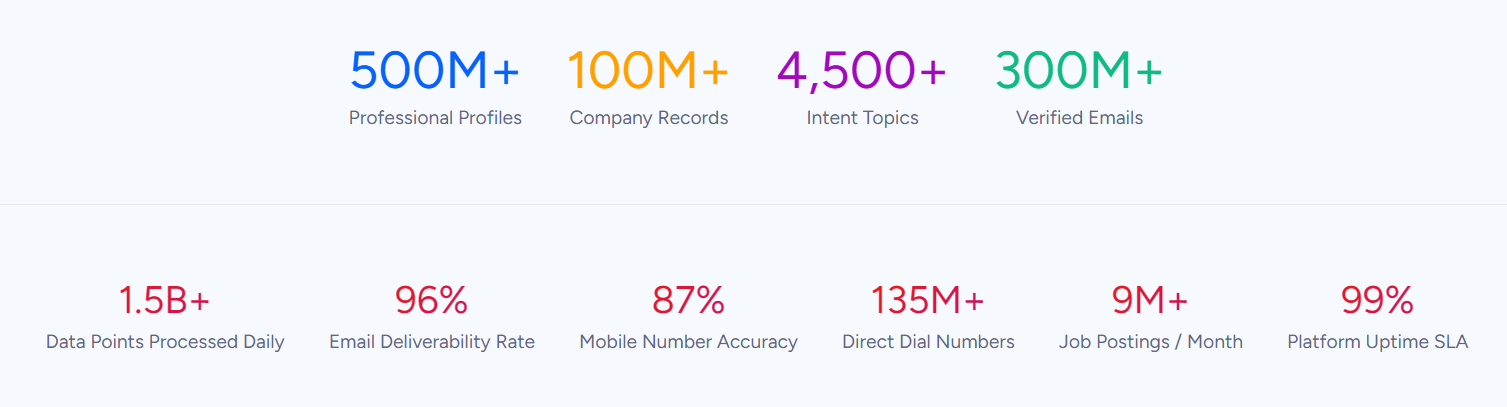
ZoomInfo is a B2B go-to-market platform built for this problem. Its data covers 500M contacts, 100M companies, 135M+ verified phone numbers, and 200M+ verified business emails, verified through a pipeline backed by 300+ human researchers with up to 95% accuracy on first-party data.
In a Fortune 500 competitive RFP analyzing 25 million contacts across vendors, an independent consultant concluded that "no other competitor came even close."
Source: ZoomInfo
But the data alone isn't what makes ZoomInfo complementary to a CDP.
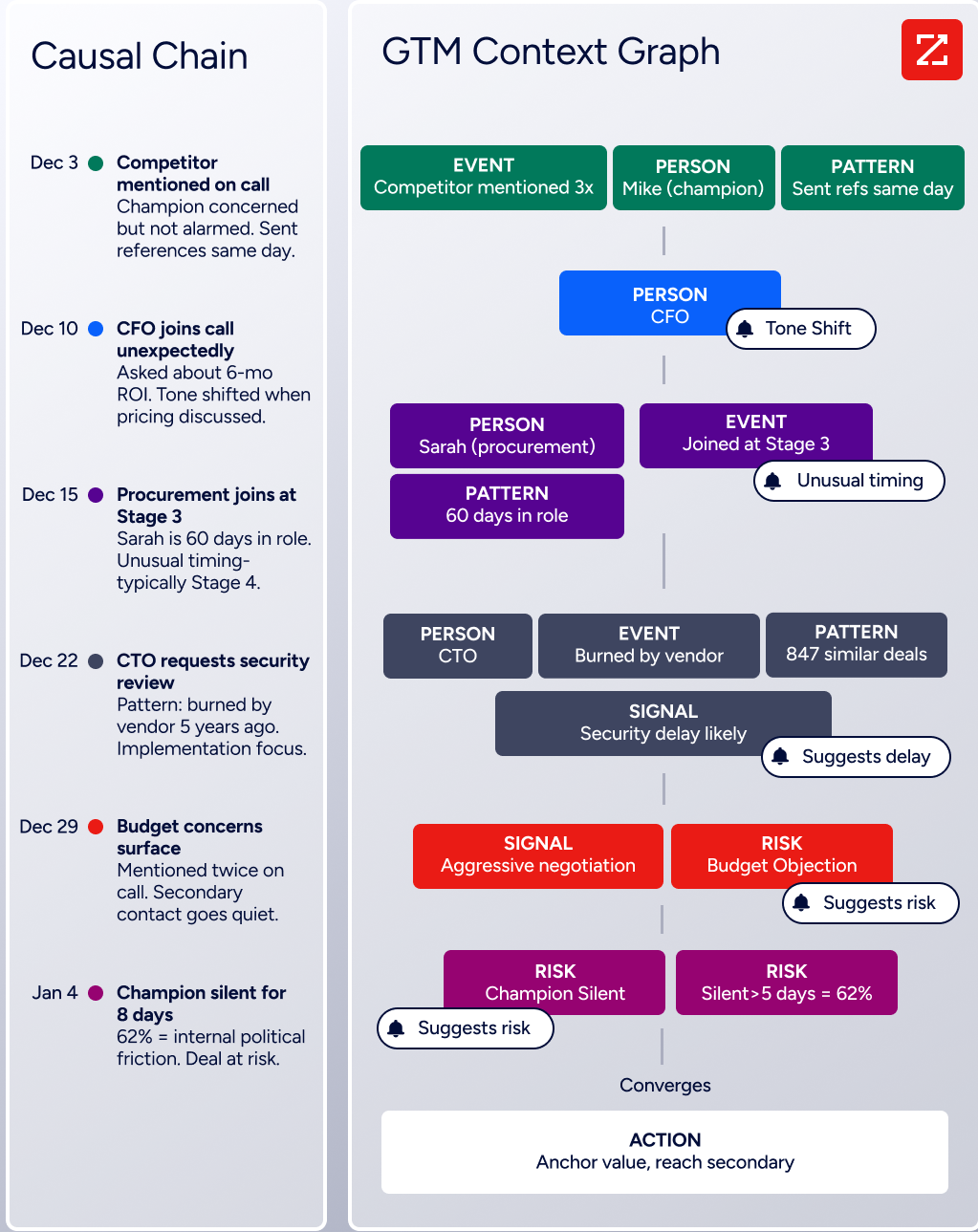
The GTM Context Graph fuses ZoomInfo's B2B data with your CRM records, conversation transcripts, and behavioral signals into a single intelligence layer that captures not just what happened in a deal, but why. Your CDP tells you which consumers to re-engage. ZoomInfo tells your sales team which business accounts are in-market, who the decision-makers are, and what message will resonate based on patterns across thousands of similar deals.
Source: ZoomInfo
Teams access this intelligence three ways: GTM Workspace gives sellers a single surface with prioritized accounts and AI-drafted outreach. GTM Studio gives marketers and RevOps a builder for audience definition, campaign orchestration, and pipeline measurement. APIs and MCP expose the same intelligence to any custom agent or third-party platform.
Seismic's sales team attributed 39% of active pipeline to opportunities identified or influenced by ZoomInfo signals, reported 54% productivity gains, and saved 11.5 hours per week per seller. (Seismic)
For enterprises running both B2C and B2B motions, the stack makes sense: a CDP (Amperity or Treasure AI) unifies your consumer data for marketing personalization, while ZoomInfo provides the B2B intelligence your go-to-market teams need to find and win business accounts. The two layers address different data, different teams, and different outcomes.
Learning curve and support
Both CDPs are enterprise tools with real onboarding investments.
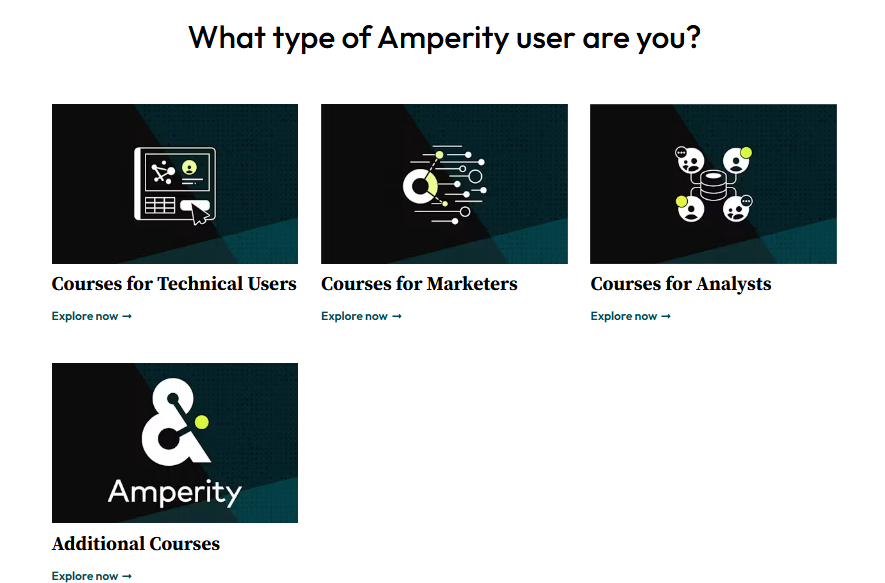
Amperity targets three personas: marketers (segments, campaigns, journeys), analysts (queries, dashboards, predictions), and operators (configuration, SQL, data management).
The operator role requires Presto SQL and Spark SQL familiarity. Amperity addresses this with Learning Lab, a role-based training portal with video courses and seasonal release content. Documentation at docs.amperity.com integrates LLM querying buttons on every page. Enterprise edition customers get private instructor-led training and 24/7 support with priority SLAs.
Source: Amperity
Treasure AI structures onboarding into four user tracks: marketers, data engineers, IT admins, and AI agents.
The platform's complexity is well-documented by users; G2 reviewers consistently cite SQL dependency as a barrier for non-technical marketers. Treasure AI Studio aims to fix this, but its April 2026 GA date means the older, more complex interfaces remain in active use. Support scales across four tiers from Standard (email only) to Enterprise (Zoom for severity 1-2 issues, priority from experienced agents). Treasure AI Academy offers CDP and AI certification programs.
ZoomInfo redesigned its onboarding from 30 to 90 days, producing a 25% improvement in customer satisfaction scores. ZoomInfo University provides role-specific learning paths and certifications. GTM Workspace "deploys in weeks, not months", a faster timeline than either CDP.

Security and compliance
All three platforms hold enterprise security certifications, with differences that matter for specific regulatory environments.
Amperity holds SOC 2, ISO 27001, HIPAA, GDPR, CCPA, and Australian Privacy Principles certifications. Its built-in privacy rights workflow engine handles DSARs, record deletion, and selective PII removal with support for GDPR, CCPA, PIPEDA, and APP. The sandbox-based change management system prevents untested configurations from reaching production data.
Treasure AI carries the broader certification portfolio: SOC 2 Type 2, ISO 27001, ISO 27701, ISO 27017, ISO 27018, HIPAA Type 2, CSA STAR Level 1, CSA STAR for AI Level 1, TRUSTe Responsible AI, PrivacyMark, and FISC. The FISC certification and PrivacyMark (Japan-specific) matter most for enterprises with Japanese operations. Data at rest uses at least AES-256 encryption via AWS KMS.
ZoomInfo maintains ISO 27001, ISO 27701, SOC 2 Type II, TRUSTe GDPR, and TRUSTe CCPA certifications, all renewed annually. As a registered data broker in California and Vermont, ZoomInfo operates under explicit regulatory oversight for its B2B data collection practices.
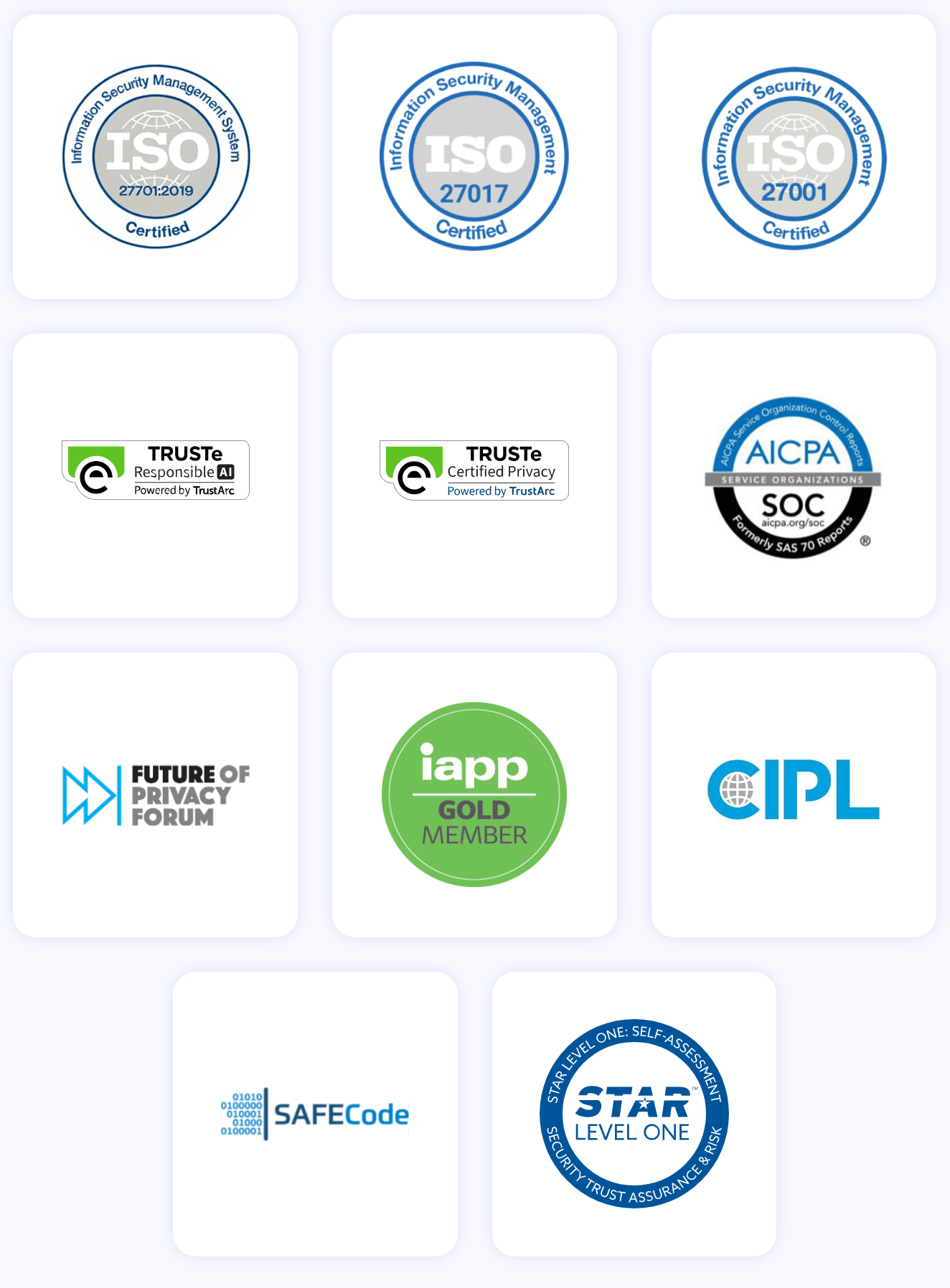
For enterprises operating across the US, Europe, and APAC simultaneously, Treasure AI's certification breadth gives it an edge. For enterprises primarily in North America and Europe, all three platforms meet standard requirements.
Amperity vs. Treasure AI vs. ZoomInfo: Which should you choose?
The decision depends on what your organization needs.
Choose Amperity if:
Identity resolution quality is your highest priority
You have complex, fragmented consumer data across many systems (especially post-M&A)
Your data team is invested in Databricks or Snowflake and wants a lakehouse-native CDP
You prefer a focused data foundation that integrates with your existing marketing tools
You need granular control over matching rules, thresholds, and identity graphs
Choose Treasure AI if:
You want to consolidate your CDP, email, personalization, and paid media tools into one platform
You have significant APAC operations requiring native Japan, LINE, and local compliance support
Analyst validation matters to your procurement process (triple Leader in 2024)
You prefer a platform that handles both data unification and marketing execution
You want AI-powered marketing automation with human-in-the-loop governance
Choose ZoomInfo if:
Your organization has B2B go-to-market teams that need verified contact data, intent signals, and deal intelligence
You need an intelligence layer that tells your sales team who to contact, when to engage, and what to say
You want B2B data and AI-powered execution accessible through native products, APIs, or MCP in any tool
Your RevOps team needs to enrich CRM data, automate lead routing, and orchestrate multi-channel GTM plays
See how ZoomInfo's GTM Context Graph powers go-to-market execution.
Redwood Logistics reduced cost-per-click by 99% and increased click-through rate by 310% using ZoomInfo's audience insights. "It's not just the data itself. It's more about the right data at the right time to help us reach out with the right message across that full buyer journey," said Chelsea Kenyon, Senior Director of Digital Strategy. (Redwood Logistics)
These platforms aren't mutually exclusive. A CDP manages your consumer data. ZoomInfo manages your B2B intelligence. For enterprises with both B2C customer bases and B2B sales motions, the combination addresses data challenges that neither category solves alone.
Amperity vs. Treasure AI vs. ZoomInfo FAQ
What is the core difference between Amperity, Treasure AI, and ZoomInfo?
Amperity is a customer data platform focused on identity resolution and consumer data unification, using patented AI to merge fragmented records across dozens of systems into accurate customer profiles.
Treasure AI (formerly Treasure Data) is an Agentic Experience Platform that combines CDP capabilities with five AI-powered marketing activation suites for email, creative, personalization, paid media, and customer service.
ZoomInfo is a B2B go-to-market intelligence platform providing verified contact data, company intelligence, intent signals, and AI-powered execution tools for sales, marketing, and RevOps teams. Amperity and Treasure AI serve B2C consumer data needs, while ZoomInfo serves B2B go-to-market needs.
Which platform has better identity resolution: Amperity or Treasure AI?
Amperity has the stronger reputation for identity resolution. Its Stitch engine uses up to 45 AI models, is protected by 5+ patents, and is backed by peer-reviewed academic research. It offers three concurrent identity graphs (Growth, Trust, and Opportunity) with tunable matching thresholds. Treasure AI's Diamond Record uses continuous resolution with deterministic, probabilistic, and rule-based methods.
Both produce measurable results: Amperity's customers report 3x improvement over internal deduplication, while a Treasure AI customer unified 61 million records in under 10 minutes.
Which platform has stronger analyst recognition?
Treasure AI holds the broadest analyst endorsement, earning Leader status in the Gartner Magic Quadrant for CDPs (2024), the Forrester Wave for B2C CDPs (Q3 2024), and the IDC MarketScape for B2C CDPs (2024-2025). Amperity was rated a Gartner Niche Player for CDPs in 2026.
ZoomInfo was named a Gartner Leader for ABM Platforms in 2024 and 2025, a Forrester Leader for Intent Data Providers in Q1 2025, and the only vendor in the Gartner Voice of the Customer Customers' Choice quadrant with 133 No. 1 rankings on G2.
How do pricing models compare across the three platforms?
None of the three publish prices. Amperity uses consumption-based "Amps" that scale with data processing, segmentation, and activation volume, with premium connector surcharges for major advertising destinations. Treasure AI charges based on customer profiles and behavioral events rather than query volume or compute, with automatic tier upgrades if usage exceeds limits.
ZoomInfo uses consumption-based pricing. All three require sales engagement for specific pricing.
Can an enterprise use both a CDP and ZoomInfo?
Yes, and many do. A CDP like Amperity or Treasure AI unifies consumer data for marketing personalization (purchase histories, loyalty profiles, website behavior).
ZoomInfo provides B2B intelligence for go-to-market teams (verified business contacts, company attributes, intent signals, and deal intelligence). They address different data types, different teams, and different business outcomes. Enterprises with both B2C customer bases and B2B sales motions benefit from both layers.
Which platform is easier to implement?
ZoomInfo's GTM Workspace deploys in weeks. Amperity's implementation timeline varies by data complexity: Virgin Atlantic unified profiles in under four days, while the most complex enterprise deployments compound value over years. Treasure AI's full CDP deployment typically takes 8 to 12 weeks, though the company states AI features can reduce time-to-value to days once the platform is configured.
None of the three offers a true self-serve onboarding path for their core enterprise products.
Which CDP is better for organizations with APAC operations?
Treasure AI has the stronger APAC presence, with native support for LINE messaging, Yahoo! Japan, and Japan-specific compliance certifications (PrivacyMark, FISC). Its Japan subsidiary operates under separate leadership, and major Japanese enterprises like SMBC, Fujitsu, Asahi, Yamaha, Mitsubishi, and Honda are customers.
Amperity recently expanded into Australia with an AWS partnership and Melbourne office, but its APAC presence is newer and less developed than Treasure AI's decade-long investment in the region.
Do either of these CDPs handle B2B data?
Neither Amperity nor Treasure AI is built for B2B go-to-market use cases. Amperity has no account-based marketing capabilities and focuses exclusively on consumer data. Treasure AI earned Strong Performer (not Leader) in Forrester's B2B CDP evaluation and Major Player in the IDC B2B MarketScape, indicating weaker fit for B2B than B2C.
For B2B intelligence (verified business contacts, company data, intent signals, and sales execution tools), ZoomInfo is the purpose-built solution.
More Amperity comparisons:
