
If you're comparing Amperity and mParticle, you're looking at two customer data platforms built for consumer brands. Both unify fragmented customer profiles, activate audiences across channels, and apply AI to marketing workflows.
But they approach these problems from different starting points, and the right choice depends on where your data lives, how fast you need to act on it, and how messy your customer records are.
Before deciding, ask yourself these questions:
Is your biggest challenge stitching together messy customer records from dozens of disconnected systems, or streaming real-time behavioral events across mobile, web, and in-store touchpoints?
Do you need probabilistic identity matching (linking records that share no common key), or is deterministic matching (linking records with shared identifiers) sufficient for your data?
Is your data team already invested in a cloud lakehouse like Snowflake or Databricks, and do you want your CDP to work directly on that infrastructure?
How critical is sub-second, in-session activation versus batch-processed audience delivery?
Does your organization also need B2B intelligence for prospecting, pipeline generation, or account-based marketing?
In short, here's what we recommend:
Amperity is the best fit for large consumer brands with fragmented, inconsistent customer data spread across dozens of systems. Its patented Stitch identity engine runs probabilistic and deterministic matching at the same time, using up to 45 AI models to find connections that rules-based approaches miss.
Built on a data lakehouse architecture with zero-copy sharing for Databricks, Snowflake, and BigQuery, Amperity keeps data where it already lives instead of forcing migration. The platform serves more than 400 enterprise brands and turns messy first-party data into unified profiles.
The tradeoff: Amperity requires a real implementation investment, has no self-serve tier, and its real-time activation launched only recently.
mParticle is built for multi-channel brands that need to act on customer behavior the moment it happens. Its real-time architecture processes billions of events per month, streaming data from mobile apps, web, OTT, and server-side APIs into 300+ downstream destinations.
The October 2025 launch of its Hybrid CDP on Snowflake added warehouse-native composable activation, letting teams work with both real-time and batch data in one governed platform. Customers rely on mParticle for everything from predictive audience targeting to consent management.
The tradeoff: mParticle supports only deterministic identity matching today (probabilistic is on the roadmap but not shipped), and implementation requires significant technical resources.
Both platforms unify consumer data and activate marketing audiences well. But neither addresses a gap that matters to organizations with B2B sales and marketing operations: finding, understanding, and engaging business buyers.
ZoomInfo is a B2B intelligence platform that provides the data layer neither CDP offers. With 500M contacts, 100M companies, 135M+ verified phone numbers, and 200M+ verified business email addresses, ZoomInfo gives sales and marketing teams the data to identify, prioritize, and engage business buyers.
Its GTM Context Graph (an intelligence layer) fuses this data with CRM records, conversation intelligence, and behavioral signals to capture not just what happened in a deal, but why it happened. For organizations that need both consumer data unification and B2B intelligence, ZoomInfo complements either CDP through its Enterprise API and MCP server, delivering B2B data into any tool or workflow.
If your organization needs B2B intelligence alongside its consumer data strategy, see how ZoomInfo works with a free trial.
Amperity vs. mParticle vs. ZoomInfo at a glance
Amperity | mParticle | ZoomInfo | |
|---|---|---|---|
Primary focus | Consumer identity resolution and CDP | Real-time hybrid CDP | B2B go-to-market intelligence |
Founded | 2016 | 2013 | 2007 |
Identity resolution | Probabilistic + deterministic (patented) | Deterministic only (configurable) | B2B entity resolution across 500M contacts |
Architecture | Lakehouse-native, batch-first | Streaming-first, hybrid | Cloud-native, API-first |
Real-time activation | Newly launched (May 2026) | Core capability since founding | Real-time intent and buying signals |
Data warehouse support | Databricks, Snowflake, BigQuery (zero-copy) | Snowflake, Databricks, BigQuery, Redshift (zero-copy) | Snowflake, Databricks, AWS (Cloud Partners) |
AI capabilities | AmpAI, predictive CLV, product affinity | Cortex: predictive audiences, next best action | GTM Context Graph, AI agents |
Integrations | 200+ pre-built connectors | 300+ server-side integrations | 120+ marketplace integrations + API/MCP |
Pricing model | Consumption-based (Amps), custom-quoted | Universal credits (mPCs), custom-quoted | Consumption-based pricing; permanent free tier available |
Best for | Enterprise consumer brands with fragmented data | Multi-channel brands needing real-time activation | B2B sales, marketing, and RevOps teams |
Identity resolution is the core differentiator
This is where the two CDPs diverge most sharply.
Amperity's Stitch engine runs probabilistic and deterministic matching simultaneously through a seven-stage pipeline. It scores record pairs using a machine learning classifier, evaluating name similarity (including popularity distribution and nickname lookup tables), email matching across domains, physical address similarity, phone matches, and birthdate scoring.
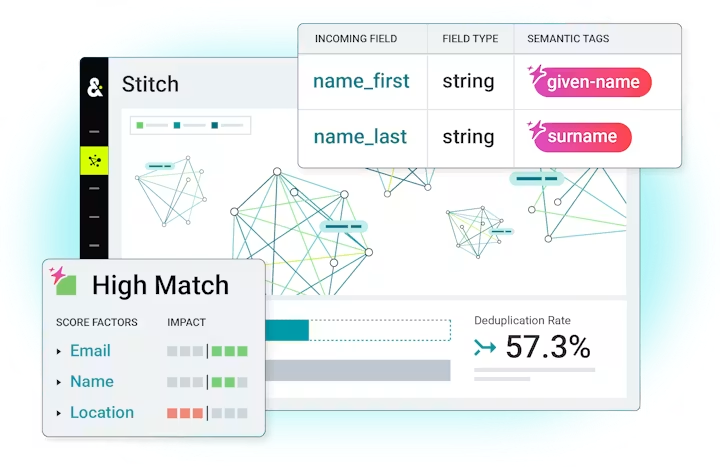
Source: Amperity
The result is three concurrent identity graphs: a Growth Graph (probabilistic), Trust Graph (deterministic), and Opportunity Graph that measures the gap between the two. Teams choose which graph to use based on the accuracy-vs.-reach tradeoff their use case requires.
mParticle's IDSync takes a different approach. It provides five configurable identity strategies (Profile Conversion, Default, Profile Link, Profile Isolation, Best Match) that let enterprises define exactly how profiles merge, split, or stay isolated at login, logout, and session start.
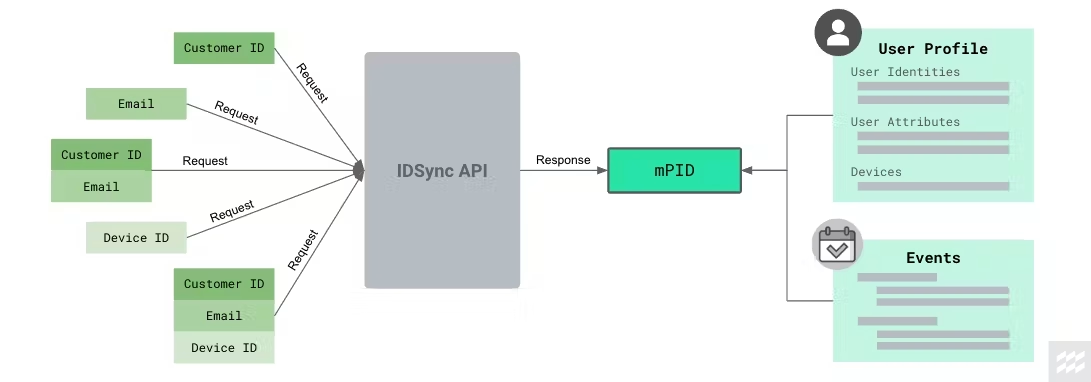
Source: mParticle
The Identity Dashboard shows identifier coverage across your user base, and Identity Logs trace every resolution request for self-service diagnostics.
The critical gap: mParticle supports only deterministic matching today. Probabilistic matching is on the roadmap but has not shipped. For brands with high volumes of anonymous traffic (common in retail and media), this means mParticle cannot link records that share no common identifier.
If your customers reliably log in across touchpoints (subscription services, financial apps, loyalty programs with authenticated sessions), deterministic matching may be sufficient. If your data is fragmented and full of inconsistencies, Amperity's probabilistic engine is the stronger choice.
Architecture: real-time streaming vs. lakehouse-native
mParticle was built for speed. Its real-time architecture ingests events from native SDKs (iOS, Android, Web, Roku, Fire TV) and a server-side Events API, validates them against Data Plans (schema definitions that block malformed data before it propagates), resolves identities via IDSync, and forwards processed data to downstream destinations in the same pipeline.
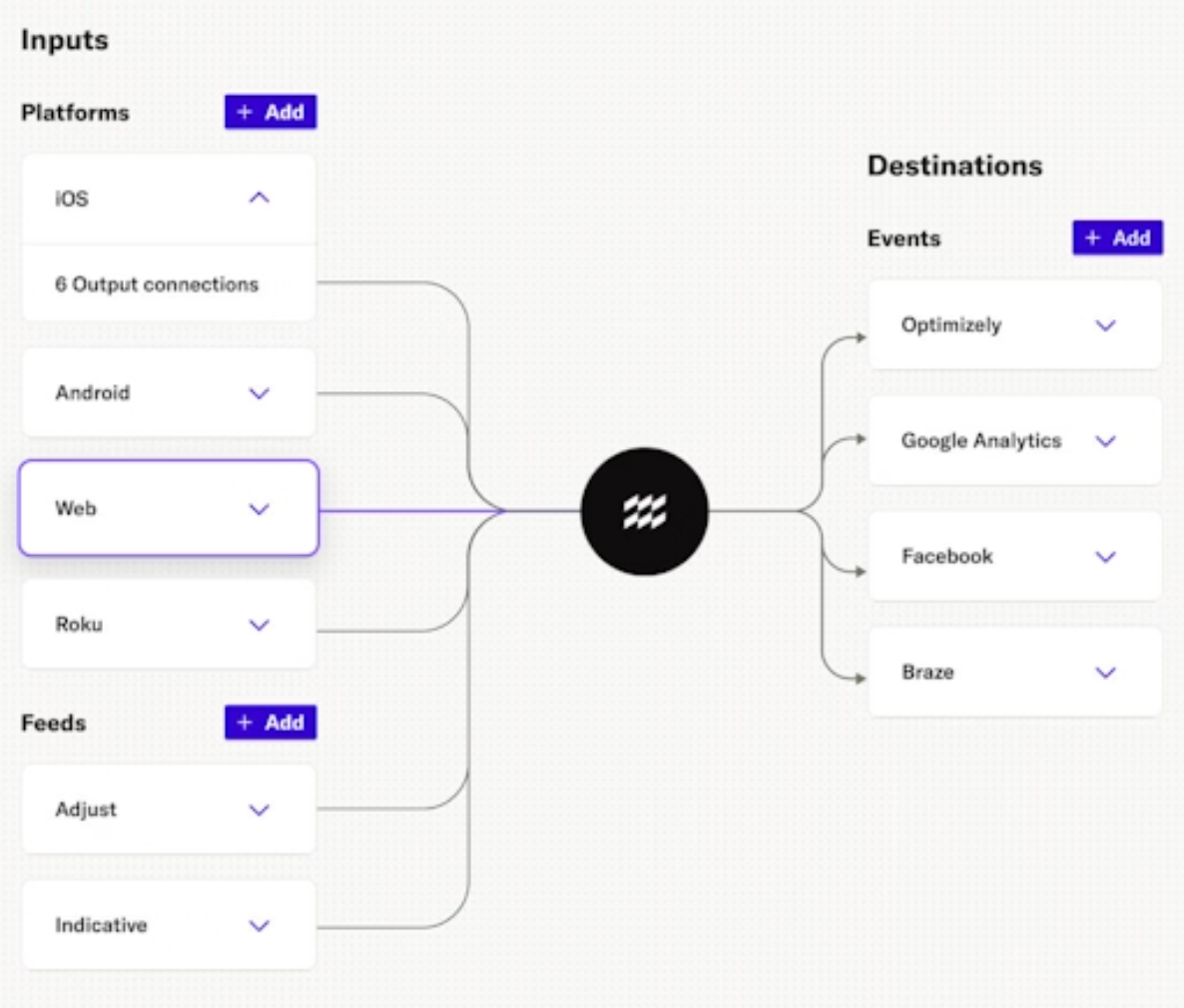
Source: mParticle
This streaming-first design means mParticle handles in-the-moment use cases well: triggering a personalized offer when a user adds an item to cart, suppressing a converted customer from an ad campaign within seconds, or updating audience membership as behavior changes.
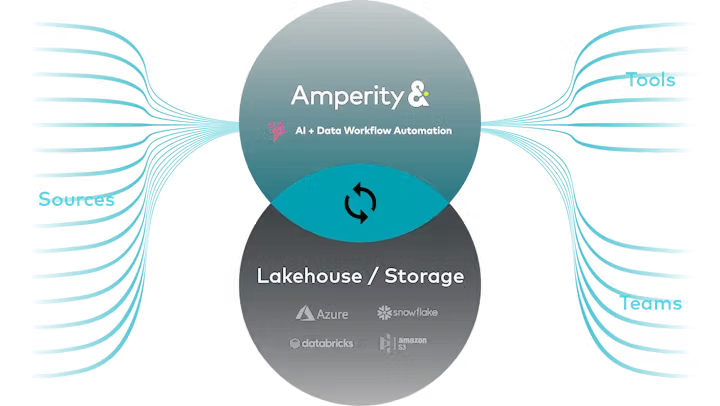
Amperity works differently. Built on a data lakehouse architecture, the platform processes large volumes of historical data from many sources, resolves identities across all of them, and produces unified profiles for batch activation.
Source: Amperity
Amperity Bridge enables zero-copy data sharing with Databricks, Snowflake, and BigQuery using each warehouse's native open-format protocol (Delta Sharing for Databricks, Secure Data Sharing for Snowflake). Data never leaves the customer's lakehouse.
Both platforms have moved toward the other's strength. mParticle launched its Hybrid CDP on Snowflake in October 2025, adding zero-copy composable activation from a customer's warehouse. Amperity announced real-time site personalization and journey abandonment recovery at Amplify 2026 in May. But maturity matters.
If you need to react to customer behavior the moment it happens, mParticle's streaming architecture is battle-tested. If your priority is unifying years of fragmented data across many systems and activating it through your existing data warehouse, Amperity's lakehouse integration is more proven.
Your CDP handles consumer data. What about B2B?
Both Amperity and mParticle are explicit about what they don't do. Amperity is "consumer-data focused with no account-based marketing capabilities." mParticle's user-and-events data model has no native support for account hierarchies or B2B-specific data objects.
For purely consumer businesses (a retailer, a hotel chain, a streaming service), this doesn't matter. But many organizations operate in both worlds. A SaaS company sells to business customers while running a consumer app.
A financial services firm markets to individual consumers and enterprise clients. A media company monetizes consumer subscriptions while selling advertising packages to B2B buyers. For these organizations, the CDP covers only half the intelligence picture.
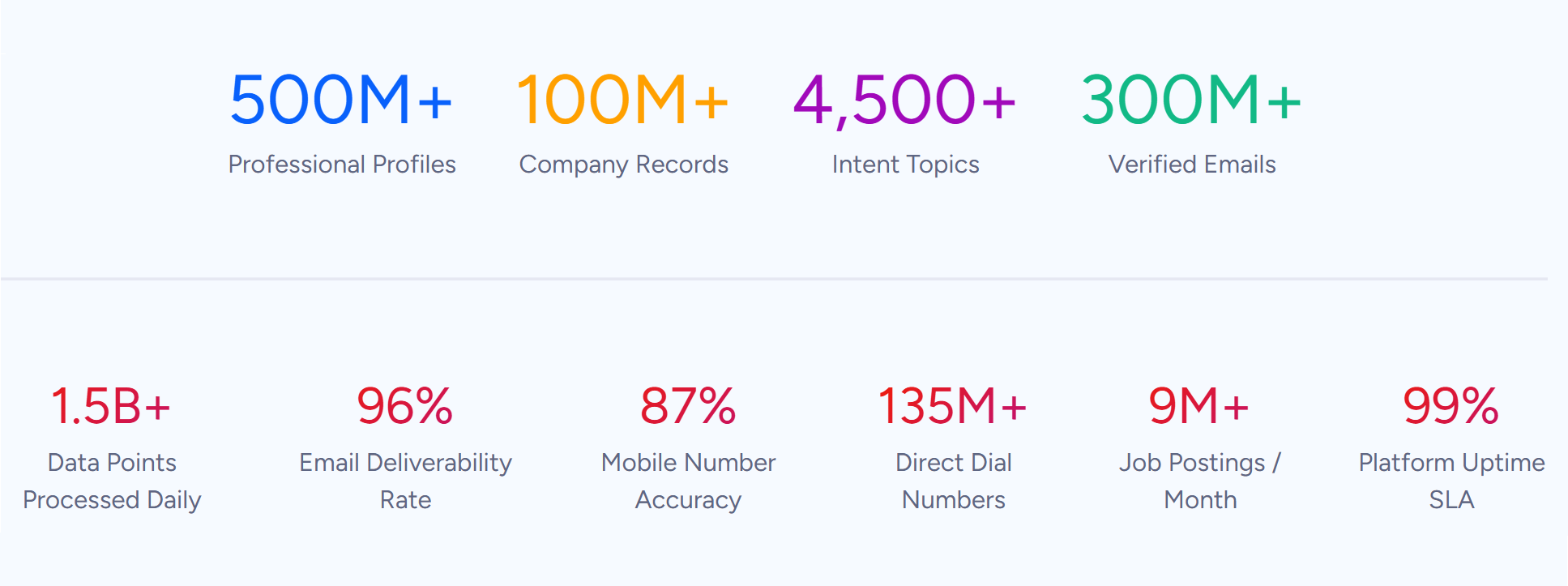
ZoomInfo fills the other half. The platform provides 500M contacts, 100M companies, 135M+ verified phone numbers, and 200M+ verified business email addresses, verified through a pipeline backed by 300+ human researchers and achieving up to 95% accuracy on first-party data.
Source: ZoomInfo
Where a CDP like Amperity or mParticle unifies data you already have about your customers, ZoomInfo provides intelligence about prospects and accounts you haven't reached yet, including company attributes, technographics, org charts, and buyer intent signals tracked from 210 million IP-to-Organization pairings.

Source: ZoomInfo
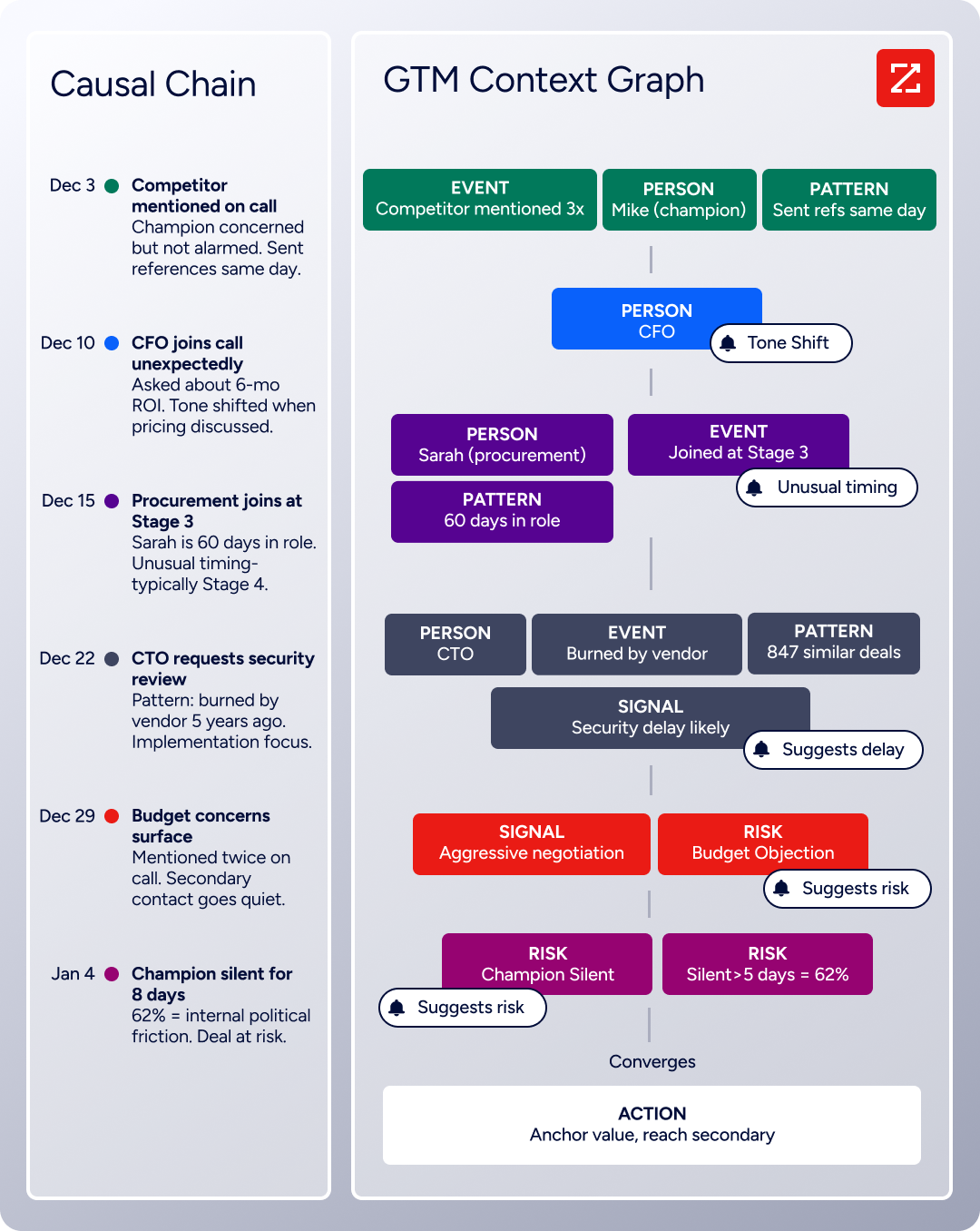
The GTM Context Graph, which processes 1.5B + data points daily, adds an intelligence layer neither CDP provides: understanding why deals move or stall. It fuses ZoomInfo's B2B data with CRM records, conversation intelligence, and behavioral signals to capture context that CRM stage fields alone cannot record.
Source: ZoomInfo
A CRM shows that a deal moved from Stage 3 to Stage 4. The GTM Context Graph captures that the CFO joined the last call and asked about six-month ROI, the context that accelerated the deal.
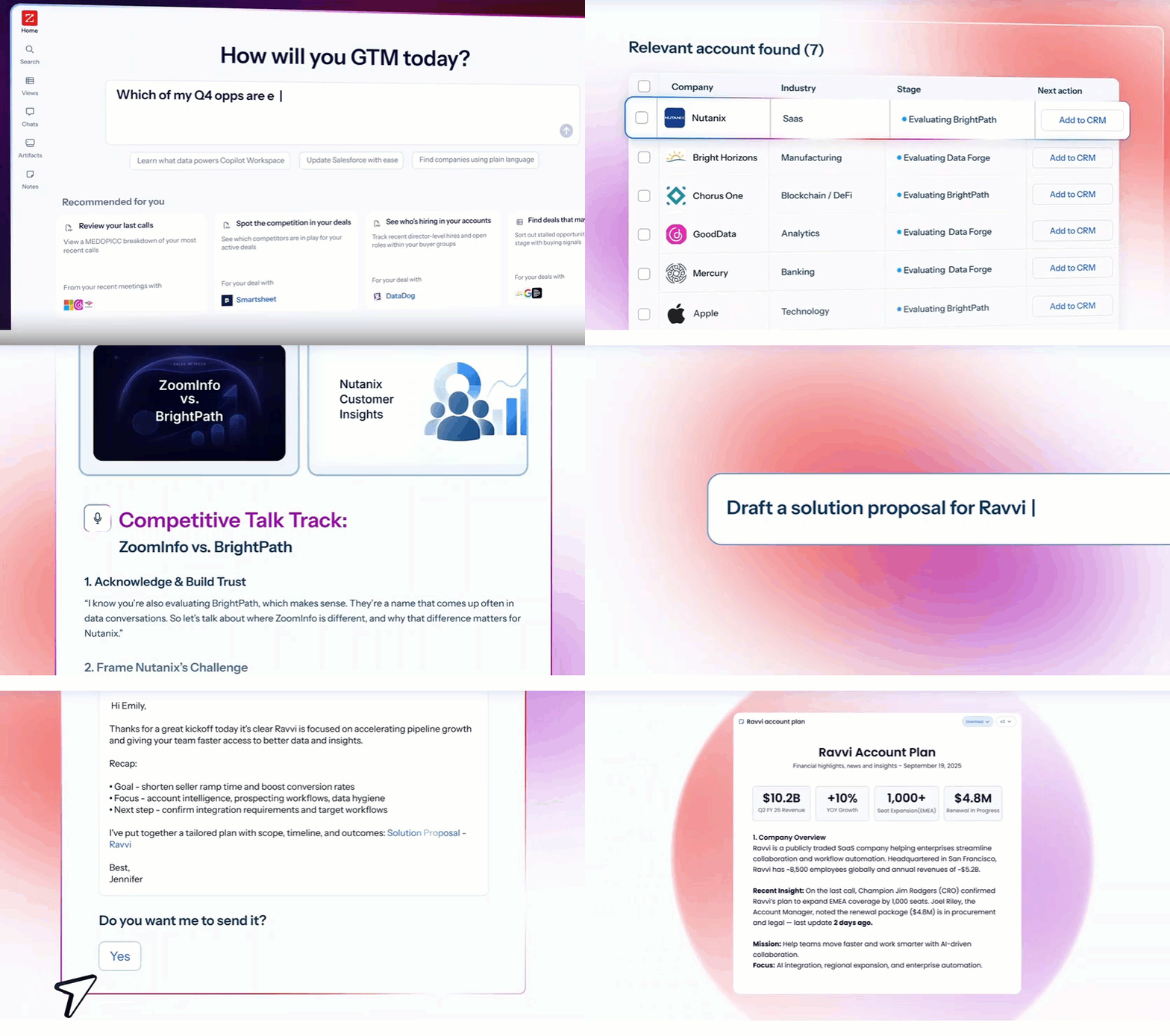
For teams that need both consumer data unification and B2B intelligence, ZoomInfo works alongside either CDP. Its Enterprise API and MCP server deliver B2B data into any tool, workflow, or AI agent, while GTM Workspace gives sellers a dedicated workspace and GTM Studio gives marketers and RevOps teams a workflow builder.
Source: ZoomInfo
Snowflake uses ZoomInfo data for at least one-third of the most critical features in their Account Propensity Scoring model, feeding over 70 company and technology data fields. Accounts monitored using ZoomInfo-powered scores showed 90% higher opportunity open rates and 2x higher customer conversion rates. (Snowflake Case Study)
AI and predictive capabilities
Both CDPs invest in AI, but with different priorities.
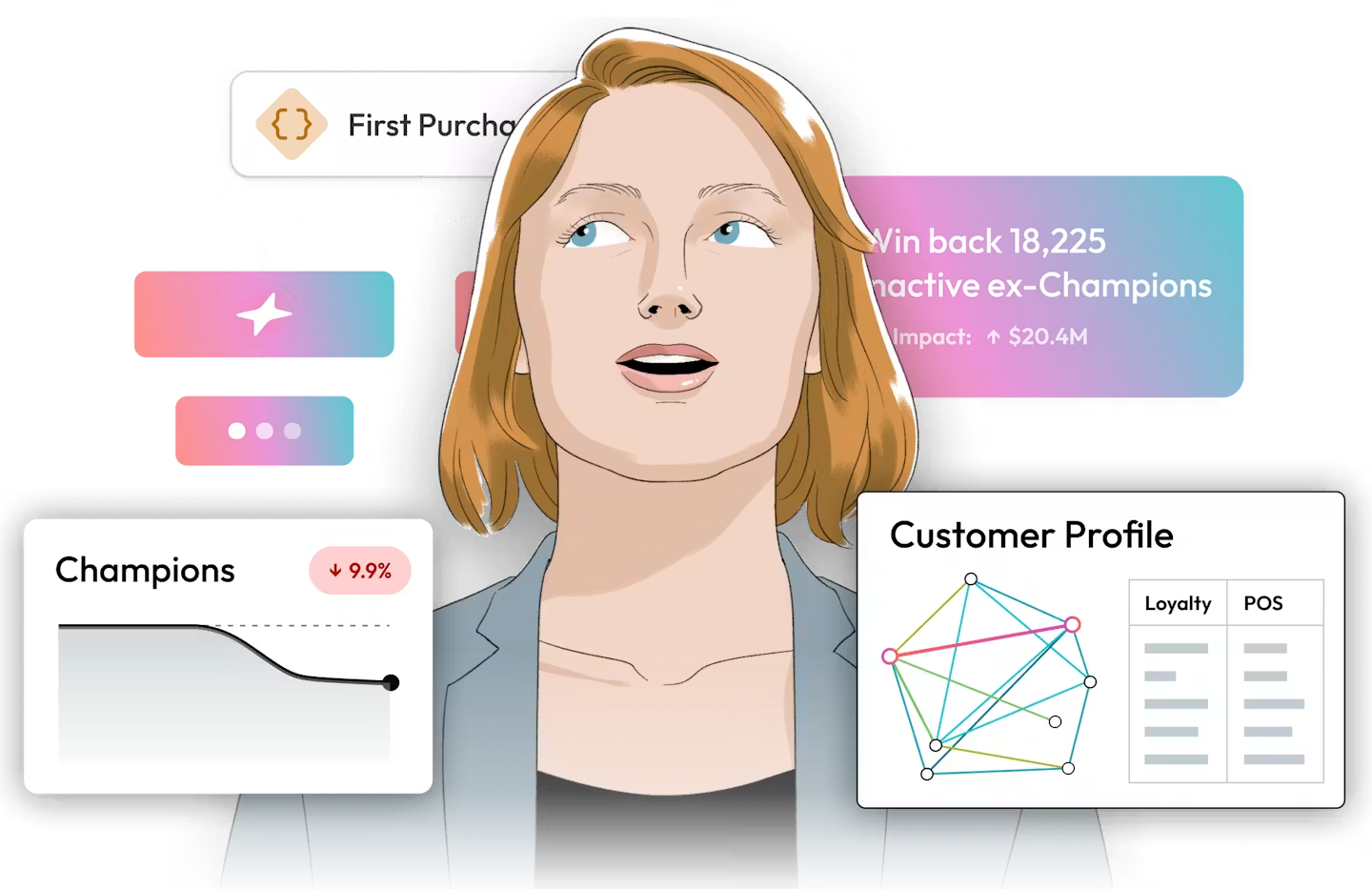
Amperity's AmpAI is a set of assistants embedded across the platform: a Customer Data Assistant for natural-language access to insights, a Segments AI Assistant for audience creation, a Journeys AI Assistant for multi-step journey building, and a Queries AI Assistant for writing and debugging SQL.
Source: Amperity
These run on Azure OpenAI Service and are grounded in tenant-specific data (schema metadata, field descriptions, usage patterns), with a custom prompting capability that lets brands encode their own business logic and terminology.
On the predictive side, Amperity offers four native models: Predicted CLV, churn propensity, product affinity, and event propensity. These run against the resolved identity layer and output directly into the segment builder.
Separately, Chuck is a command-line AI agent that brings Amperity's identity resolution models into Databricks, letting data engineers standardize raw customer data, resolve identities, and build Customer 360 profiles using natural language in their terminal. Chuck includes a free tier with Databricks-native CLI, PII detection, semantic tagging, and identity graph capabilities.
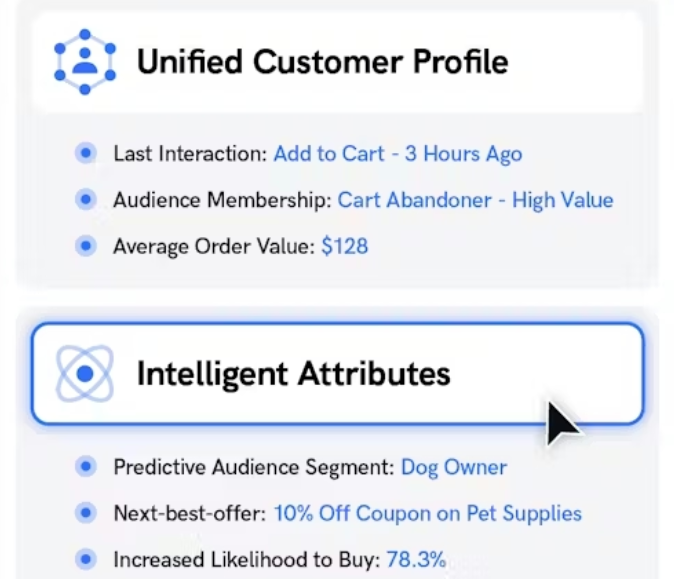
mParticle's Cortex engine (acquired via Vidora in 2022) takes a more action-oriented approach. It automates the full ML lifecycle (data cleaning, feature engineering, model training, prediction generation) through a no-code interface.
Source: mParticle
Pipeline types span the full customer lifecycle: Future Events (predict behavior within a time window), Uplift (measure incremental effect of an intervention), Look-Alike (find users similar to a seed audience), and Recommendations (rank items per user).
The Decisioning SDK enables sub-session real-time ML scoring: the system evaluates an anonymous first-time visitor and returns a decision within that same page visit.
The distinction: Amperity's AI leans toward data exploration and self-service insight (ask questions in natural language, build segments, generate SQL). mParticle's AI leans toward automated decision-making and real-time scoring (predict outcomes, decide actions, optimize targeting).
If your team needs to ask better questions of their data, Amperity's conversational AI is more developed. If your team needs the platform to make better targeting decisions automatically, Cortex is more mature.
Data governance and compliance
Both platforms treat governance as a core capability, but their emphasis differs.
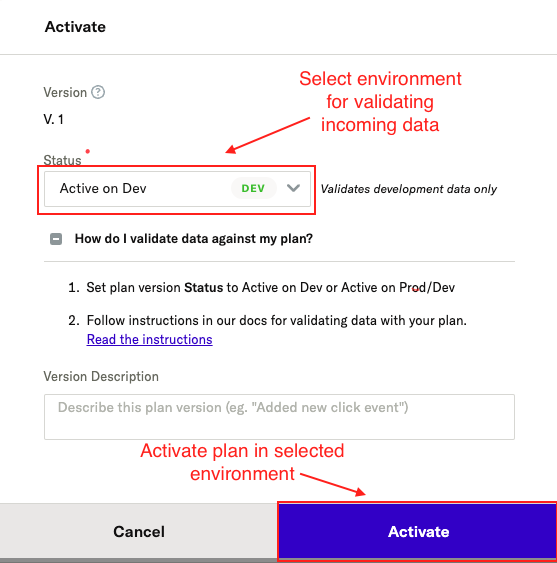
mParticle's standout is Data Plans: schema definitions that validate incoming events in real time and block malformed data before it reaches profiles or downstream systems. This "validate at ingestion" approach prevents bad data from propagating through the stack.
Source: mParticle
The Data Planning API allows plans to be managed as code and integrated into CI/CD pipelines, treating data quality as a software engineering discipline.
For privacy, mParticle's consent management supports GDPR, CCPA, and LGPD with consent stored on user profiles and enforced as native routing rules. Its DSR forwarding automatically propagates deletion requests to downstream integrations (Amplitude, Braze, AppsFlyer, and others), eliminating the need to orchestrate cross-system deletions manually.
Amperity approaches governance from the data foundation layer. PII encryption and redaction are applied at the point of ingest, and the platform holds certifications including SOC 2, ISO 27001, HIPAA, GDPR, CCPA, and Australian Privacy Principles.

Source: Amperity
Its built-in privacy rights workflow engine handles DSAR, record deletion, and selective PII nullification with auditable reporting tables. The sandbox validate-to-promote workflow ensures configuration changes are tested in isolation before reaching production data.
For regulated industries, one difference stands out: Amperity holds HIPAA certification, which mParticle does not list among its compliance certifications. mParticle's Data Plans offer stricter real-time schema enforcement at the point of data collection.
The right choice depends on whether your primary governance concern is data quality enforcement at ingestion (mParticle) or compliance certification breadth for regulated verticals (Amperity).
Both hold SOC 2 and ISO 27001 certifications. Both support SSO, role-based access controls, and encryption at rest and in transit. Neither platform offers on-premises deployment.
Pricing and implementation
Neither platform publishes pricing, and both require enterprise sales engagements to get started.
Amperity uses a consumption-based model built around "Amps", a proprietary unit measuring platform usage across source ingestion, identity resolution, database builds, analytics, and activation. Two editions (Standard and Enterprise) provide identical platform features, differing only in support coverage and training access.
Premium connectors for advertising platforms (Meta, Google, TikTok, The Trade Desk, and others) carry an additional flat fee of 25,000 Amps per connector per month. Up to 10% of unused Amps roll over to the next contract term.
mParticle uses mParticle Credits (mPCs), a universal currency drawn against a contractual commitment. All features are accessible with any credit purchase.
Events are classified into three tiers (Connect, Preserve, Personalize) with different levels of processing and storage, letting customers align compute costs with the actual value each data type provides. Currently, mParticle requires an upfront contractual credit commitment with no post-pay or month-to-month option.
Both models share a challenge: unpredictable cost scaling. Amperity's costs increase with compute resource sizing and activation volume. mParticle's costs compound with event volume and AI feature usage. Without published pricing, modeling total cost of ownership requires a sales engagement for either platform.
Implementation is complex for both. Both require enterprise environments with dedicated data engineering resources. Amperity's early partnerships (like Alaska Airlines, which started in 2017) suggest ROI compounds over years, not weeks. mParticle's implementation requires upfront decisions about identity strategy, and reviewers note that integration setup can be inconsistent across destinations.
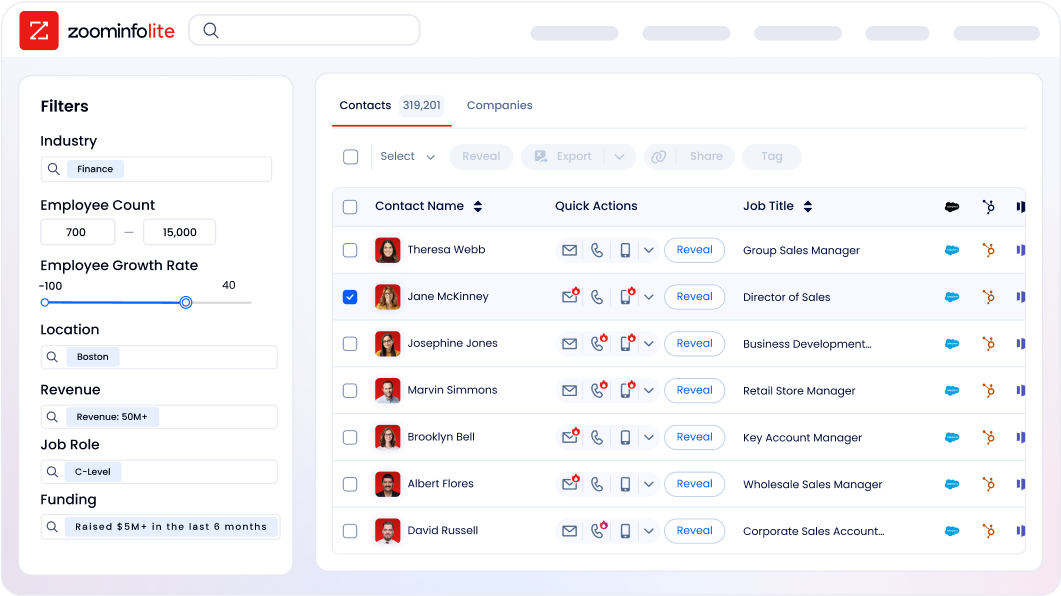
ZoomInfo is more accessible. A permanent free tier (ZoomInfo Lite) provides access to the B2B database with 10 monthly export credits, and a 7-day free trial offers full platform access with no credit card required. Paid plans use consumption-based pricing, but starting for free and evaluating before committing is something neither CDP offers.
Source: ZoomInfo
SpringDB reported 2x-3x increases in campaign conversions, a 300% increase in database usability, and 30-50% uplift in average deal size using ZoomInfo as a full platform. "You'll get 10x the value if you think of ZoomInfo as a full platform and not just a tool for one team," said John Kotsuros, Founder and CEO. (SpringDB Case Study)
Amperity vs. mParticle vs. ZoomInfo: Which should you choose?
The choice depends on what data problem you're solving and who you're trying to reach.
Choose Amperity if:
Your biggest challenge is unifying messy, fragmented consumer data across dozens of disconnected systems
You need probabilistic identity matching that handles inconsistent names, multiple emails, and shared household addresses
Your data team is already invested in Databricks, Snowflake, or BigQuery and wants zero-copy lakehouse integration
You're in retail, travel, hospitality, or financial services with high transaction volumes and complex identity challenges
Batch-processed audience activation meets your current needs
Choose mParticle if:
Real-time, in-session activation is critical to your marketing strategy
You need to stream behavioral events from mobile apps, web, and OTT platforms simultaneously
Your identity data includes strong deterministic identifiers (customer IDs, emails from logged-in users)
You want predictive ML audiences without building a data science team
You're in media, streaming, fintech, or QSR where sub-second decisioning drives conversion
Add ZoomInfo if:
Your organization needs B2B intelligence that neither CDP provides
You want to find, prioritize, and engage business buyers with verified contact data and intent signals
You need a B2B intelligence platform that works alongside your consumer data strategy
You want B2B data accessible via API, MCP, or dedicated seller and marketer interfaces
You value a free tier that lets your team evaluate before committing
See how ZoomInfo complements your data stack with a free trial.
Amperity and mParticle are both strong CDPs for consumer data, and the right one depends on whether your priority is identity resolution depth (Amperity) or real-time activation speed (mParticle). And if your organization also operates in B2B, ZoomInfo provides the intelligence layer that neither CDP was built to deliver.
Seismic's sales team attributed 39% of active pipeline to opportunities identified or influenced by ZoomInfo signals, boosted productivity by 54%, and saved 11.5 hours per week. "It's bringing data together faster than anyone could. It's both a time saving and a quality improvement," said Toby Carrington, Chief Business Officer. (Seismic Case Study)
Amperity vs. mParticle vs. ZoomInfo FAQ
What is the core difference between Amperity, mParticle, and ZoomInfo?
Amperity is a customer data platform focused on identity resolution for consumer brands, using patented probabilistic and deterministic matching to unify fragmented customer profiles across many systems. mParticle is a hybrid CDP built for real-time event streaming and activation, combining sub-second behavioral data processing with warehouse-native composable activation.
ZoomInfo is a B2B intelligence platform that provides verified business contact data, company intelligence, and intent signals for sales and marketing teams. Amperity and mParticle serve consumer data use cases; ZoomInfo serves B2B go-to-market needs.
Which platform has better identity resolution for consumer data?
Amperity's Stitch engine uses both probabilistic and deterministic matching simultaneously, backed by five patents and peer-reviewed research published at SIGMOD 2020. It runs up to 45 AI models and produces three concurrent identity graphs for different accuracy-vs.-reach tradeoffs. mParticle's IDSync supports only deterministic matching with five configurable strategies.
For messy consumer data with inconsistent identifiers, Amperity's probabilistic matching catches connections that deterministic-only systems miss. mParticle has stated that probabilistic matching is on its roadmap but has not shipped it.
Which platform is better for real-time activation?
mParticle has the stronger real-time capabilities. Its streaming architecture has processed billions of events per month since the company's founding in 2013, with native SDKs for iOS, Android, Web, Roku, and Fire TV.
Amperity announced real-time site personalization and journey abandonment recovery at its May 2026 Amplify conference, but these capabilities are newly launched. For use cases requiring sub-second, in-session decisioning, mParticle's architecture is more proven.
How does pricing compare across the three platforms?
Both Amperity and mParticle use consumption-based pricing with no published rates. Amperity charges in "Amps" with additional fees for premium advertising connectors. mParticle charges in universal credits (mPCs) with an upfront contractual commitment required. Both target enterprise buyers and require a sales engagement for pricing.
ZoomInfo uses consumption-based pricing for paid tiers but offers a permanent free tier (ZoomInfo Lite) with 10 monthly export credits and a 7-day free trial, providing entry points that neither CDP matches.
Can Amperity or mParticle handle B2B use cases?
Neither platform is designed for B2B. Amperity is consumer-data focused with no account-based marketing capabilities. mParticle's user-and-events data model does not natively support account hierarchies or B2B-specific data objects.
Organizations with B2B go-to-market needs should look at ZoomInfo, which provides 500M contacts, 100M companies, verified phone numbers and emails, buyer intent signals, and GTM intelligence built for B2B sales and marketing teams.
Which platform integrates better with cloud data warehouses?
Both CDPs support zero-copy data sharing. Amperity's Bridge connects to Databricks, Snowflake, and Google BigQuery using each warehouse's native open-format sharing protocol.
mParticle's composable architecture supports Snowflake, Databricks, BigQuery, and Amazon Redshift. mParticle's Hybrid CDP on Snowflake launched in October 2025, while Amperity's lakehouse integration has been a core capability for longer. ZoomInfo delivers data to Snowflake, Databricks, and AWS through its Cloud Partners program.
Which platform has the better AI capabilities?
Amperity's AmpAI provides natural-language assistants for segment creation, journey building, and SQL generation, plus four native predictive models (CLV, churn propensity, product affinity, event propensity). mParticle's Cortex engine automates the full ML lifecycle with no-code predictive audiences, next best action, uplift modeling, and real-time decisioning via its SDK.
Amperity's AI is stronger for data exploration and self-service insights. mParticle's AI is stronger for automated predictive targeting and real-time ML decisioning. ZoomInfo's GTM Context Graph (an intelligence layer) provides B2B AI for deal pattern recognition, account prioritization, and outreach generation.
Do any of these platforms offer a free plan or trial?
Amperity has no public free trial or free plan for its core platform. Its Chuck tool for Databricks offers a free tier for data engineers. mParticle has no free plan for the core CDP; existing customers can activate a 30-day trial of its Analytics module only.
ZoomInfo offers both a permanent free tier (ZoomInfo Lite, with access to its B2B database and 10 monthly export credits) and a 7-day free trial of the full platform with no credit card required.
More Amperity comparisons:
