
Attio is a CRM that lets you choose both power and simplicity. Launched in 2023 after three years of development, it targets startups and scale-ups that want a flexible system they can shape to match their business. With a data model that supports custom objects, built-in AI powered by multiple language models, and a visual automation engine on every plan, Attio has attracted 5,000 paying customers and $116 million in funding.
To create this Attio review, we analyzed the platform extensively. We believe it's the right choice if:
You need a CRM that adapts to your business model, not the reverse
You're a startup or scale-up (11-250 employees) with unique workflows
You value a modern interface and fast setup over legacy feature depth
You want to connect product usage data directly to your CRM
You prefer building automations yourself without engineering support
However, Attio might not be the best choice if:
You need B2B contact data and verified direct dials
You require buyer intent signals to identify in-market accounts
You're running high-volume outbound across multiple channels
You need conversation intelligence tied to full deal context
Your marketing team runs account-based campaigns at scale
In this case, you should consider ZoomInfo: an AI GTM platform built on a B2B data foundation of 500M contacts, 100M companies, 135M+ verified phone numbers, and 200M+ verified business emails. Its GTM Context Graph processes 1.5B+ data points daily, unifying this data with your CRM records, conversation transcripts, and behavioral signals to reveal the full context of your accounts. That context fuels AI that shows not just what happened, but why it happened and which actions to take next. Your team can access that intelligence through GTM Workspace for sellers, GTM Studio for marketers and RevOps, or APIs and MCP in any front-end.
We've included a detailed look at ZoomInfo later in this Attio review for teams that need GTM intelligence beyond CRM. If you're ready to explore what a full GTM platform looks like, you can start with ZoomInfo Lite for free here.
What is Attio?
Attio is a cloud-based CRM founded in November 2019 in London by Nicolas Sharp and Alexander Christie.
The company grew from Sharp's experience as an investor at Passion Capital, where frustration with existing CRM tools led him to build Fundstack, a vertical CRM for venture capital. In 2019, Sharp and Christie pivoted to a broader CRM and spent three years building the product before becoming generally available in March 2023.
The platform calls itself the "AI CRM for GTM", offering teams a flexible data model instead of rigid templates, instant setup through email and calendar syncing, and AI capabilities built into the core product rather than added afterward.
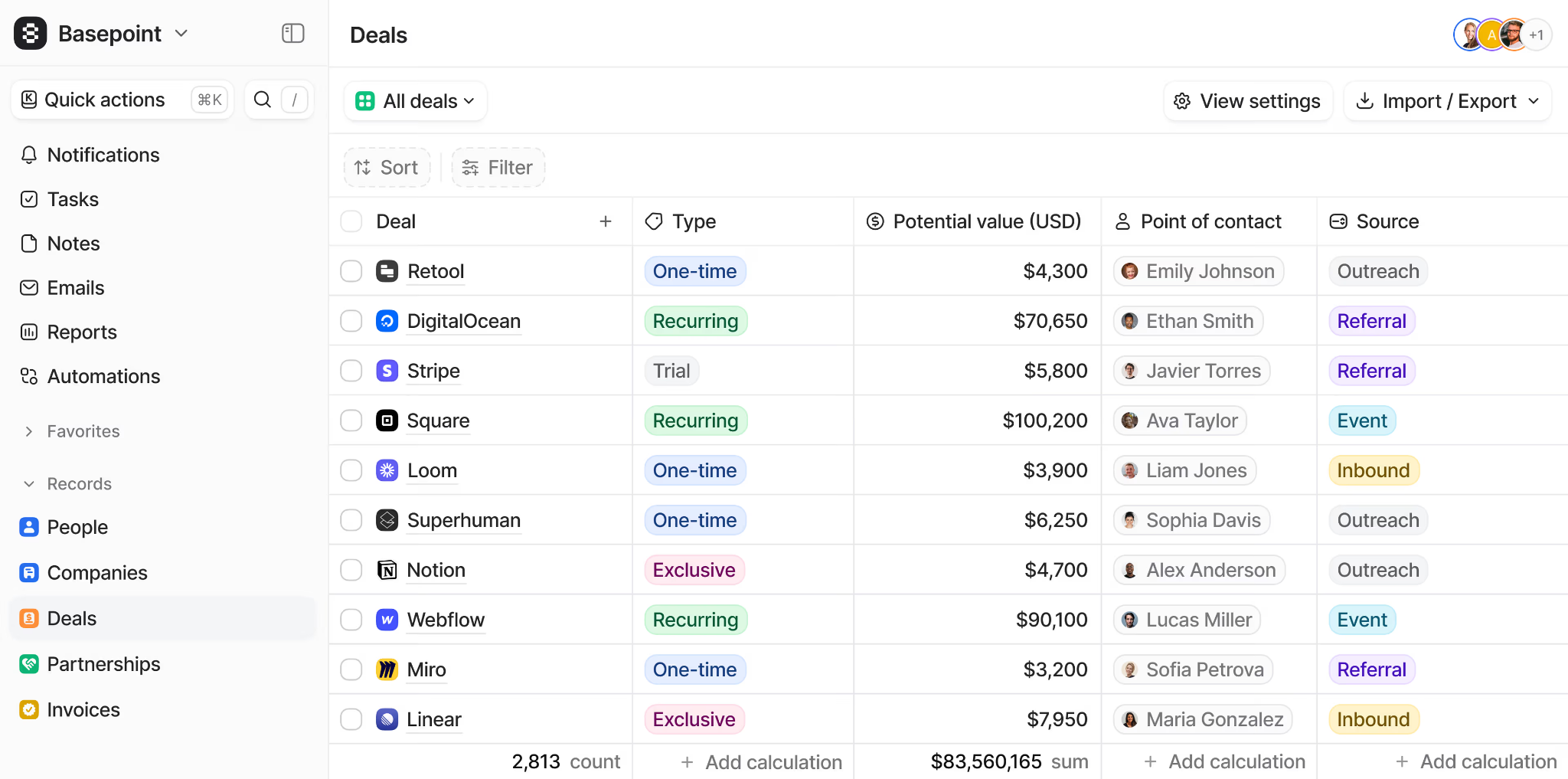
Source: Attio
Attio has raised $116 million across four funding rounds, most recently a Series B of $52 million led by GV (Google Ventures) in August 2025. At that point, the company reported 5,000 paying customers and projected 4x ARR growth for 2025. Notable customers include Granola, Modal, Railway, Flatfile, Union Square Ventures, and Snackpass.
The platform's core audience is startups and scale-ups, particularly those in SaaS, B2B tech, the creator economy, and venture capital, typically with 11-250 employees.
Attio Pros & Cons
Pros | Cons |
|---|---|
- Flexible data model with custom objects and 17 attribute types | - Limited native integrations compared to established CRMs |
- Modern, intuitive interface with sub-50ms latency | - Steep learning curve for workflow setup |
- AI assistant (Ask Attio) with multi-model support | - No built-in B2B contact database or intent signals |
- Visual automation available on all plans including Free | - Email sequences limited to Pro and Enterprise plans |
- Automatic contact and company enrichment | - Basic mobile app functionality |
- Native call recording with customizable insight templates | - Customer support scored 3.1/5 on Capterra |
- Developer-friendly with API, SDK, and MCP server | - No SMS, dialer, or A/B testing in sequences |
Attio Review: How it Works & Key Features
Flexible Data Model: Attio lets teams build a CRM that mirrors their actual business rather than conforming to rigid templates.
Attio's data model is its defining feature.
Instead of forcing every business into the same contact-company-deal structure, the platform lets you create custom objects for anything your business tracks: partnerships, subscriptions, invoices, marketplace transactions, or anything else.
Each object supports 17 attribute types including text, currency, location, phone number, record reference, and status fields. Objects connect through relationship attributes in Attio's graph model, creating a web of linked data rather than isolated tables.
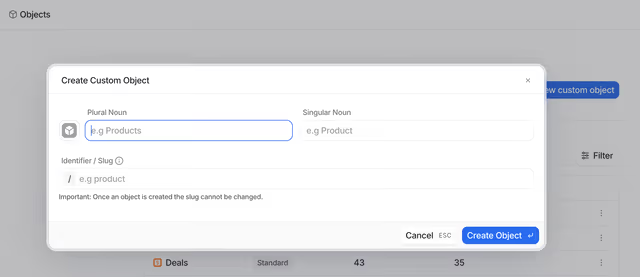
Source: Attio
The system includes automatic enrichment that populates company records with logos, descriptions, location, estimated ARR, employee ranges, funding data, and social profiles, and person records with profile pictures, job titles, and contact information. This enrichment draws from hundreds of sources and updates automatically as new information appears.
Data enters Attio through multiple channels: real-time syncing via email and calendar, Excel and CSV imports, reverse ETL tools like Census, Hightouch, and Polytomic, and a free migration service for Plus plans and above supporting imports from Salesforce, HubSpot, Pipedrive, Zoho, and Notion.
According to G2's CRM Grid Report, Attio leads in "ease of customization" with a 9.4/10 rating. The Free plan supports up to 3 custom objects, scaling to unlimited on Enterprise.
Ask Attio: Natural language AI that searches, updates, and acts on CRM data through conversation.
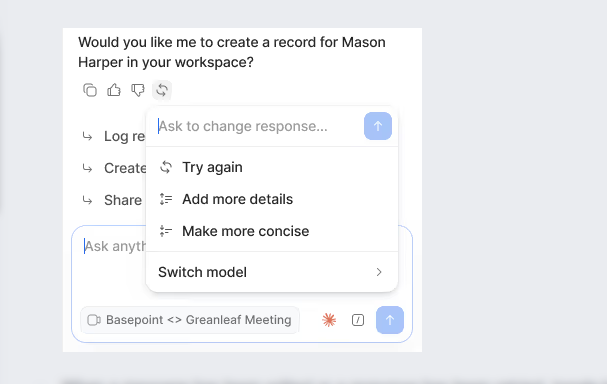
Ask Attio is a built-in AI assistant that lets users interact with their CRM through natural language.
Instead of clicking through records and filters, you type requests like "prep for next meeting" or "what were the main objections in this call?" and the system retrieves, summarizes, and acts on data across the workspace.
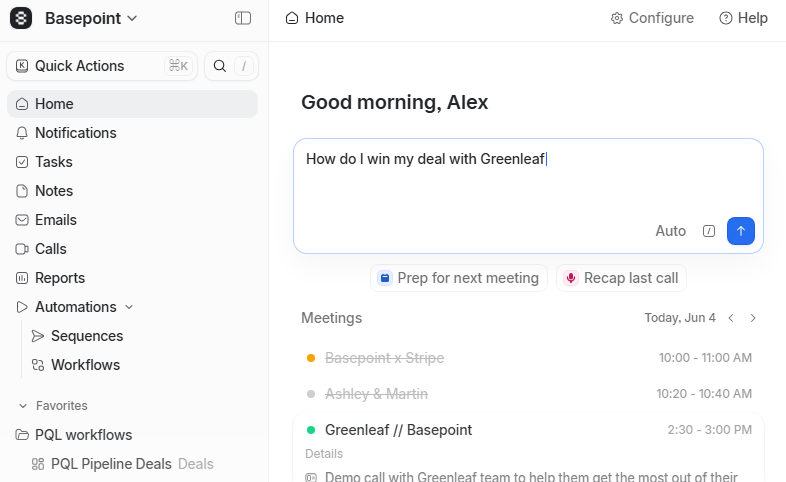
Source: Attio
The feature runs on Universal Context, which semantically indexes everything in the CRM (records, emails, calls, notes, product data, and connected tools) as one connected whole. When a user asks a question, Attio decides which sources to query, pulling from calendar events, call transcripts, emails, records, and even real-time web research.
Users can select from multiple AI models including Anthropic's Sonnet and Opus, Google's Gemini Flash and Pro, and OpenAI's GPT, with an "Auto" mode that picks the right model for the task. A prompt library offers templates for daily briefs, objection handling, account research, and meeting prep.
Ask Attio can create new records, suggest attribute updates, draft emails, and create tasks, with all suggested changes requiring user approval before taking effect. It also integrates with Slack for channel-based queries and respects existing permissions, so users only access data they're authorized to see. Customer data is never used to train AI models.
Source: Attio
Workflows: Visual automation that handles everything from lead scoring to deal stage updates without engineering support.
Workflows is Attio's visual automation engine, available on all plans including Free.
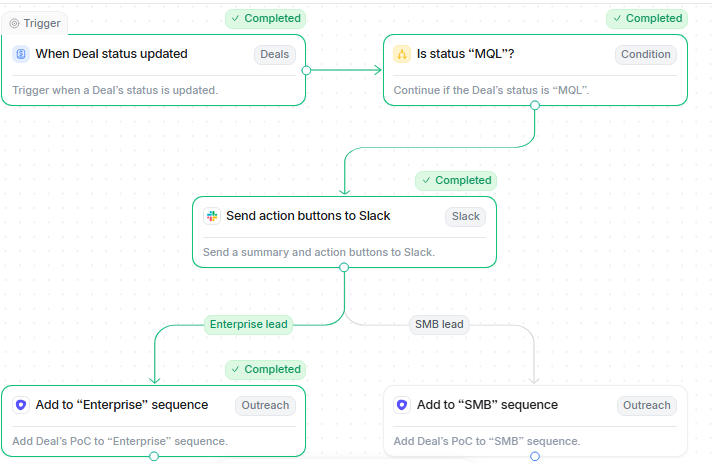
Users build automations by connecting modular blocks on a canvas: a trigger block starts the process (when a record is created, a deal status changes, or on a schedule), followed by action blocks that create records, enroll contacts in sequences, send Slack notifications, or make HTTP requests.
Source: Attio
The system supports conditional branching through Switch and If/else blocks, Loop blocks for iterating over multiple items, and delay blocks for time-based orchestration. AI-powered blocks can classify data, summarize information, and complete prompts, while Research agent blocks deploy AI to answer questions about records using web research.
A template library provides pre-built workflows for common scenarios like won deal notifications, MQL scoring, and customer renewal tracking. Workflows use a credit-based billing model that scales with complexity rather than charging per workflow.
Call Intelligence: Native meeting recording that makes conversations searchable and actionable inside the CRM.
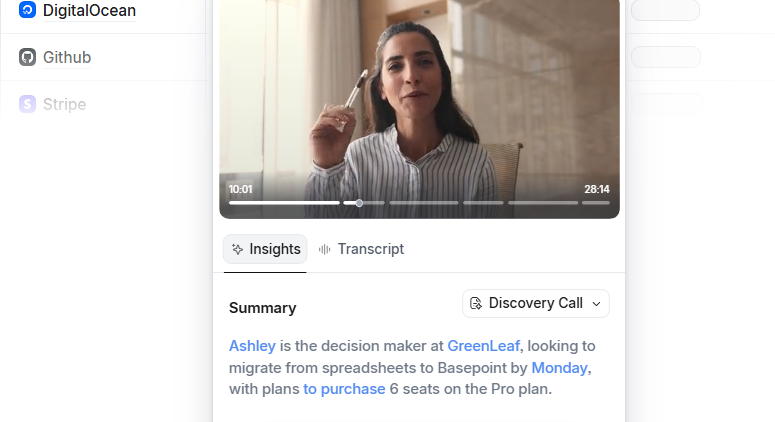
Call Intelligence records, transcribes, and analyzes meetings directly within Attio, removing the need for a separate conversation intelligence tool. The feature integrates with Google Meet, Zoom, and Microsoft Teams and supports transcripts in 100+ languages.
Source: Attio
The standout capability is customizable insight templates.
Users create templates with specific prompts telling the AI what to extract and how to format it. Pre-built presets cover Sales, Success, Product, Marketing, Recruiting, and Fundraising use cases. Any template can be applied retroactively to past recordings, so you can surface new insights from old calls without re-watching them.
Focus Mode lets reviewers zoom in on specific speakers and skip less relevant portions. Users who join a call late can see AI-generated summaries of what they missed. Every conversation becomes searchable and linked to relevant CRM records.
Call Intelligence is available on Plus, Pro, and Enterprise plans.
Reporting: Real-time dashboards that process data in milliseconds regardless of volume.
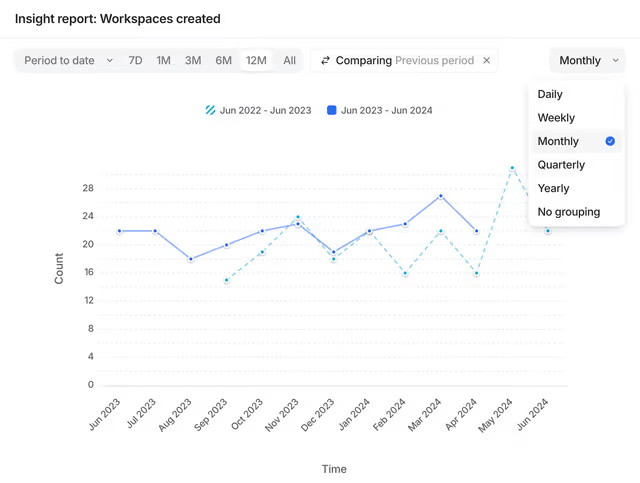
Attio's reporting system produces live visualizations of CRM data. Users create reports by selecting a data source (any object or list), choosing a metric (record counts or numeric aggregates), and optionally grouping by attributes like date, owner, or category.
The platform offers several report types: Insight reports for current data snapshots, Historical Values reports for tracking changes over time, and pipeline-specific reports including Funnel, Time in Stage, and Stage Changed. Visualizations include bar charts, pie charts, line graphs, and geospatial mapping.
Source: Attio
Users can drill into report data by clicking visualizations to explore underlying records, set target goals, and compare across time periods. The Free plan includes up to 3 reports, scaling to 100+ on Enterprise.
Pricing: Per-seat pricing with a permanent free plan and credit-based AI usage.
Attio uses a per-seat pricing model with monthly or annual billing and a 20% discount on annual plans.
Free ($0): Up to 3 seats, 50,000 records, 3 objects, 250 workspace credits/month, 200 emails/month, and 3 reports. No access to Call Intelligence, Ask Attio, or AI agents.
Plus ($29/seat/month annual, $36 monthly): No seat limits, 250,000 records, 5 objects, 1,500 workspace credits/month, 1,000 emails/month, 15 reports, plus Ask Attio, Call Intelligence, and AI agents.
Pro ($69/seat/month annual, $86 monthly): 1,000,000 records, 12 objects, 10,000 workspace credits/month, unlimited emails, 100 reports, email sequences, and advanced access permissions.
Enterprise (Custom): Unlimited objects, custom workspace credits, single sign-on, and migration service.
Beyond per-seat costs, Attio uses a credit system for AI features and workflow automations. When included credits run out, additional packages start at $70/month for 5,000 credits (annual) and scale to $475/month for 50,000 credits.
Attio offers a 14-day free trial of the Pro plan and an 80% discount on the annual Pro plan for the first year through its startup program.
Where Attio Falls Short
Attio works well as a flexible CRM for startups, but several limitations surface as teams scale. These reflect a platform built for CRM customization, not full GTM intelligence.
No B2B Data or Intelligence Layer: Attio's automatic enrichment adds context to existing records (company descriptions, employee counts, funding data), but it doesn't provide a B2B contact database, verified direct-dial phone numbers, buyer intent signals, or technographic data for prospecting.
The enrichment also cannot be triggered on demand, which limits its usefulness for researching specific accounts. Teams that need to find and reach new prospects must rely on separate data providers.
Limited Native Integrations: Integration gaps are Attio's most cited weakness. Users note the lack of LinkedIn inbox integration, no native connectors for tools like Apollo or Lemlist, and no LinkedIn Sales Navigator integration. Many connections require Zapier as an intermediary, adding complexity and cost.
Basic Outbound Capabilities: Attio's sequences aren't built for high-volume outbound or multi-channel cadences. There's no SMS, no dialer, and no A/B testing. Sequences are only available on Pro and Enterprise plans, and even then, they support email only. Teams running serious outbound operations need additional tools.
Reporting Gaps: Attio's real-time reporting handles the basics, but it lacks the depth of mature platforms. Users cite missing formula fields, limited sales forecasting, and fewer visualization options than established CRMs offer.
Support Accessibility: Standard support responds in 12-24 hours via email with no live chat on lower tiers. Capterra reviewers rated Customer Service at 3.1/5, the lowest category rating on the platform. Priority support is reserved for Pro and Enterprise plans.
These aren't failures. They're the natural result of building a CRM-first product for startups that value flexibility and speed over breadth.
But they create a gap for teams that need more than a place to manage relationships: a system that tells them who to target, when accounts are ready to buy, and why deals are moving or stalling.
Top Attio Alternative for Complete GTM Intelligence: ZoomInfo
ZoomInfo addresses Attio's intelligence gaps with a platform that extends well beyond CRM. Where Attio gives teams a flexible place to manage relationships, ZoomInfo gives them the data, signals, and AI to know which relationships matter most and when to act.

Comprehensive B2B Data: A B2B data platform that gives teams the contacts, context, and signals CRMs can't provide on their own.
While Attio enriches records you've already collected, ZoomInfo starts with the contacts you haven't found yet.
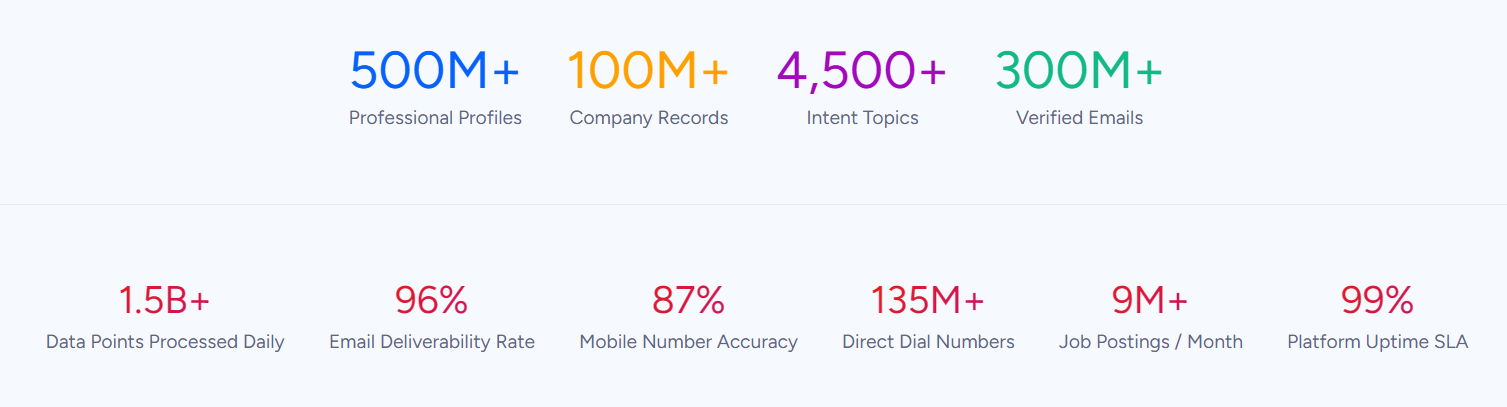
The platform maintains 500M contacts, 100M companies, 135M+ verified phone numbers, 120M direct-dial phone numbers, and 200M+ verified business email addresses.
It covers three dimensions at once: identity data (who buyers are and how to reach them), company context (firmographics, org charts, and technographics tracking 30,000+ technologies across 30M+ companies), and signals that reveal when accounts are actively in-market.
Source: ZoomInfo
ZoomInfo verifies this data through a multi-source pipeline backed by 300+ human researchers, achieving up to 95% accuracy on first-party data. In a Fortune 500 competitive RFP analyzing 25 million contacts across vendors, an independent consultant concluded that "no other competitor came even close."
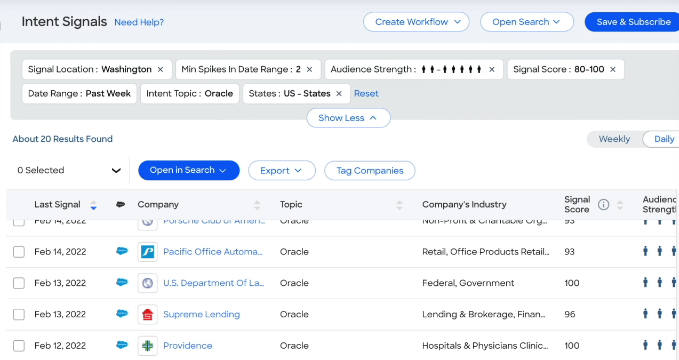
Buyer Intent data tracks signals from 210 million IP-to-Organization pairings and 6 trillion+ new keyword-to-device pairings monthly. Guided Intent, exclusive to ZoomInfo, identifies topics historically correlated with deal success rather than requiring manual topic selection. WebSights resolves anonymous website traffic to companies, including specific buying team members and their direct contact information.
Source: ZoomInfo
For teams using Attio's enrichment, this is a different category of data. Attio tells you about the companies already in your CRM. ZoomInfo tells you about the companies that should be.
"We don't have to go through and spend our time digging. It's already there, so we can be three steps ahead." (Vensure)
GTM Context Graph: An intelligence layer that captures why deals move, not just that they moved.
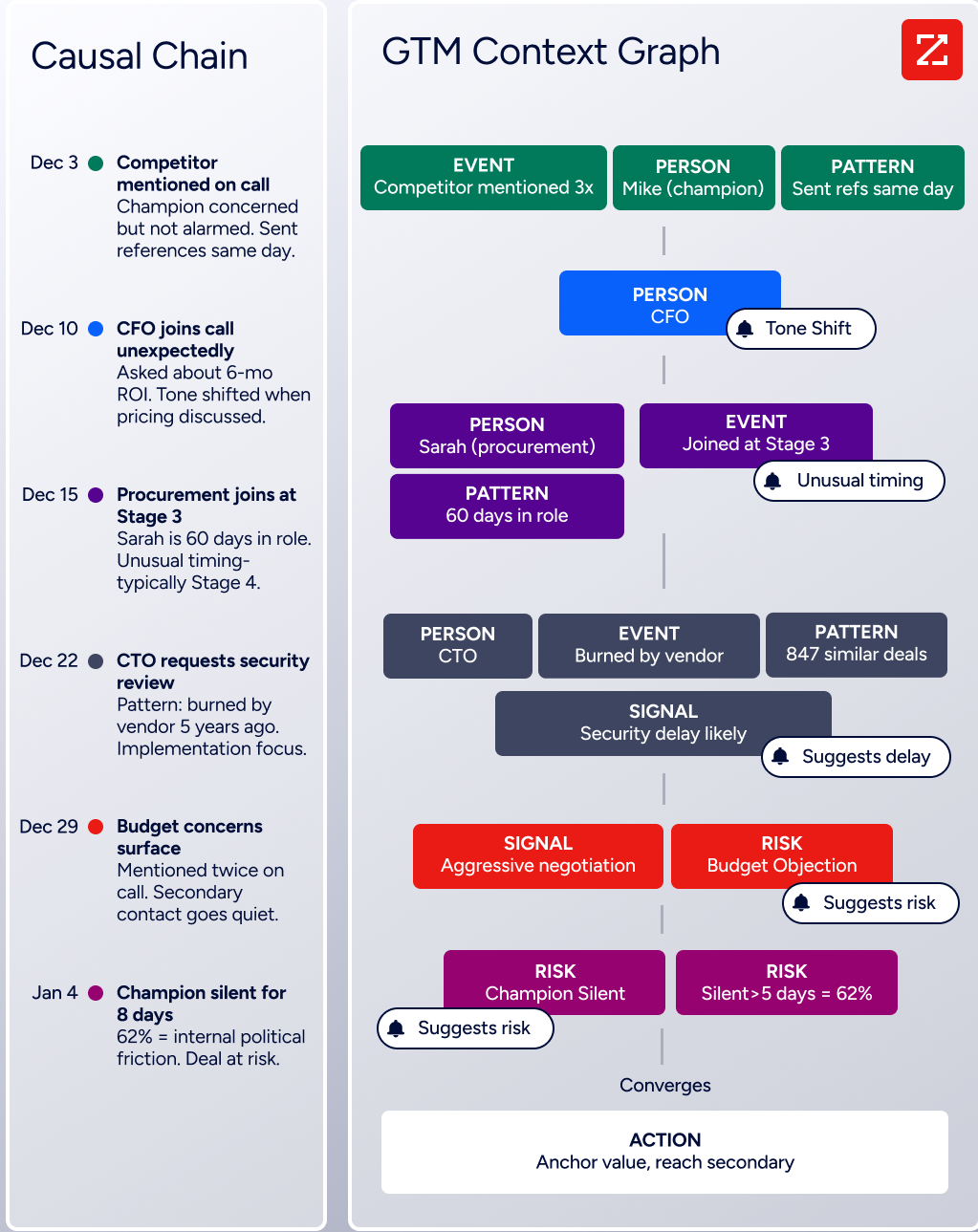
Data alone doesn't explain what's happening in your pipeline. A CRM records that a deal moved from Stage 3 to Stage 4, but as ZoomInfo's Chief Product Officer Dominik Facher writes: "The CRM recorded the state change. It has no record of why it happened."
The GTM Context Graph solves this by fusing ZoomInfo's B2B data with a customer's CRM records, conversation transcripts, email threads, and behavioral signals into a single intelligence layer that processes 1.5B+ data points daily. It captures connections between signals and outcomes: who is influencing, blocking, or championing a deal; what worked and what didn't; and patterns across thousands of deals that predict what happens next.
Source: ZoomInfo
This layer exists because of two decades of infrastructure investment. ZoomInfo acquired Chorus for its context capture and reasoning engines, which extract not just what was said on a call but why a deal accelerated or stalled. Combined with the third-party data platform, the result is AI that understands your deals rather than simply accessing your data.
Attio's Ask Attio indexes CRM data and provides useful summaries, but it's limited to what's inside the CRM. The GTM Context Graph unifies internal data with external signals (org changes, funding rounds, intent spikes, hiring patterns) to surface context that no CRM can capture alone.
Seismic attributed 39% of active pipeline to opportunities identified or influenced by ZoomInfo signals, with 54% productivity gains. "That combination of our internal CRM data, external signals, and AI that's given all that context has helped us craft very specific account- and persona-based messages." (Seismic)
Universal Access: Use ZoomInfo's intelligence in any tool, any workflow, or any AI agent.
ZoomInfo delivers its intelligence through three channels, so teams aren't locked into a single interface.
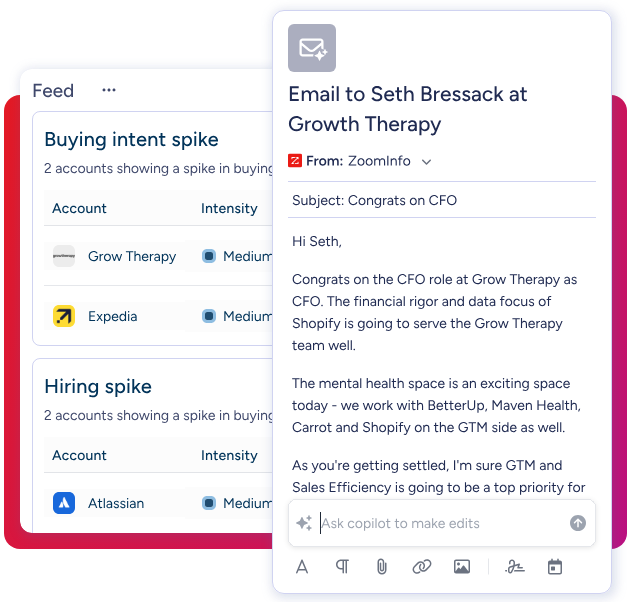
GTM Workspace is the front-end for sellers. It pulls together the full book of business (CRM data, ZoomInfo signals, conversation history, and market intelligence) into one view. AI agents handle account research, outreach drafting, CRM updates, and signal monitoring. An Action Feed delivers a live stream of in-market buyers with pre-drafted actions on every signal.
Source: ZoomInfo
GTM Studio is the front-end for marketers, RevOps, and GTM engineers. Teams build audiences using natural language, define triggers, and activate multi-channel plays (email, calls, ads, and direct mail) that run continuously and improve as prospects respond. Expansion plays that used to take 3 weeks now launch in 30 minutes.
For teams building beyond ZoomInfo's own products, APIs and MCP expose the same intelligence to any custom agent, internal tool, or partner platform. ZoomInfo MCP is listed in the Claude directory and currently supports Claude and ChatGPT. API access is included in all relevant plans.
All three channels draw from one GTM Context Graph: the same data, the same reasoning, the same model. Where you work never limits the intelligence available to you.
BDO Canada achieved an 87% reduction in time spent on data dashboard updates by integrating ZoomInfo's API into internal systems. "The plug-and-play aspect of the API means I can integrate it very easily into any process and get information at a moment's notice." (BDO Canada)
ZoomInfo Pricing: Consumption-based pricing with a permanent free tier.
ZoomInfo uses consumption-based pricing with no published prices. Costs depend on usage patterns, number of seats, credit volume, features, and contract length.
The platform is organized into Sales tiers (Professional, Advanced, Enterprise) and Marketing tiers (Marketing Demand, ABM Lite, ABM Enterprise), each with increasing levels of data access, AI features, and automation.
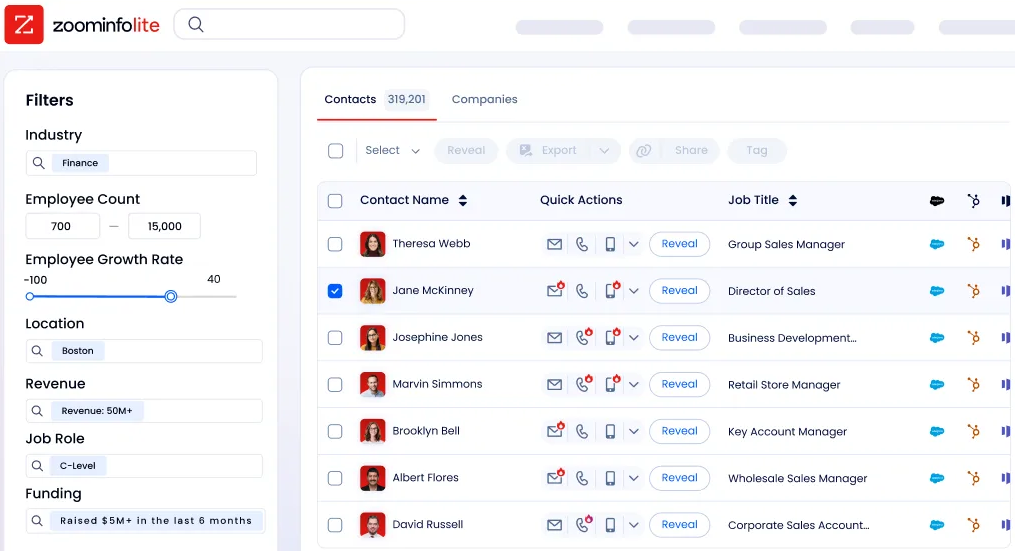
ZoomInfo Lite is a permanent free tier (not a trial) that includes access to ZoomInfo's B2B database, 10 monthly export credits, company and contact search with advanced filters, the ReachOut Chrome Extension, WebSights Lite (up to 10 website visitor reveals per day), and HubSpot integration. A separate 7-day free trial provides access to core platform features with no credit card required.
Source: ZoomInfo
Attio or ZoomInfo: Comparison Summary
Attio | ZoomInfo | |
|---|---|---|
Primary focus | Flexible CRM for startups and scale-ups | AI GTM platform |
Target audience | 11-250 employee startups, PLG companies, VC firms | Enterprise and upper mid-market B2B companies |
B2B contact database | No native database; enriches existing records | 500M contacts, 200M+ verified emails, 135M+ verified phones |
Buyer intent signals | Not available | 210M IP-to-Org pairings, Guided Intent, 6T+ keyword signals/month |
Conversation intelligence | Native Call Intelligence (record, transcribe, analyze) | Chorus with full deal context, CRM sync, and coaching tools |
Data enrichment | Automatic from hundreds of sources (company + person) | Multi-vendor waterfall enrichment from 60+ vendors |
Sales automation | Email sequences only (Pro and above), no SMS or dialer | Multi-channel outreach, AI-drafted messaging, Salesloft integration |
Marketing and ABM | Not available | Native DSP, FormComplete, audience management, multi-channel orchestration |
AI capabilities | Ask Attio (multi-model), AI workflow blocks | GTM Context Graph, AI agents in Workspace and Studio, MCP |
CRM flexibility | Custom objects, 17 attribute types, relationship graph | Integrates with Salesforce, HubSpot, Dynamics; GTM Workspace as seller front-end |
Integrations | Limited native; Gmail, Outlook, Slack, Zapier, Segment | 120+ marketplace integrations, API, MCP, cloud partner delivery |
Free option | Permanent free plan (3 seats, 50K records) | ZoomInfo Lite (permanent, 10 export credits/month) + 7-day trial |
Paid pricing | From $29/seat/month (annual) | Custom-quoted, consumption-based |
Best for | Startups needing a customizable CRM | Teams needing B2B data, intelligence, and GTM execution |
Final Verdict
The choice between Attio and ZoomInfo depends on where your GTM operation stands and what problems you need to solve.
Choose Attio if you need a CRM that adapts to how your business works.
It's the right tool for startups and scale-ups that have outgrown spreadsheets or rigid CRM templates and want a system they can shape themselves. The flexible data model, modern interface, and built-in AI make it strong for product-led growth companies, venture capital teams, and engineering-driven organizations between 11 and 250 employees.
If your primary need is organizing relationships, tracking deals, and automating internal workflows without engineering support, Attio delivers at a reasonable price.
Choose ZoomInfo if your GTM operation needs more than a place to store and manage relationships.
ZoomInfo is the right platform when you need to know who to target before they enter your CRM, when accounts are in-market, and why your deals are moving or stalling. Its B2B data, GTM Context Graph, and access through GTM Workspace, GTM Studio, and APIs give revenue teams an intelligence layer that no CRM, however flexible, can provide alone.
For organizations where prospecting, multi-channel execution, and data-driven decisions drive revenue growth, ZoomInfo provides the foundation.
Get started with ZoomInfo Lite for free here.
A CRM tells you what happened in your pipeline. A GTM intelligence platform tells you why it happened and what to do next. Attio is one of the better options for the first job. ZoomInfo is built for both.
Attio FAQ
What is Attio best suited for?
Attio is a CRM designed for startups and scale-ups between 11 and 250 employees that need flexibility to model their business in the CRM rather than conforming to rigid templates. It's strong for product-led growth companies, SaaS startups, and venture capital teams. It is not designed for high-volume outbound sales, enterprise compliance requirements, or teams that need B2B data intelligence.
ZoomInfo serves those needs as an AI GTM platform with 500M contacts, buyer intent signals, and multi-channel execution tools.
Does Attio have a free plan?
Yes, Attio offers a permanent free plan that includes up to 3 seats, 50,000 records, 3 custom objects, 250 workspace credits per month, and up to 3 reports. The free plan does not include Ask Attio, Call Intelligence, or AI agents. A 14-day free trial of the Pro plan is also available.
ZoomInfo Lite is also permanently free, providing access to its B2B database with 10 monthly export credits and WebSights Lite.
How much does Attio cost?
Attio's Plus plan starts at $29 per seat per month billed annually (or $36 monthly). The Pro plan is $69 per seat per month annually (or $86 monthly). Enterprise pricing is custom. AI features and workflow automations consume workspace credits, which come with each plan but can be purchased separately starting at $70 per month for 5,000 additional credits.
ZoomInfo uses consumption-based pricing with no published prices.
Does Attio offer buyer intent data or a B2B contact database?
No. Attio provides automatic enrichment for records already in your CRM, adding company descriptions, employee counts, and funding data. But it does not include a B2B contact database, buyer intent signals, or technographic data for prospecting. Teams needing these capabilities require a separate data intelligence platform.
ZoomInfo maintains 500M contacts, 200M+ verified business emails, and tracks buyer intent through 210 million IP-to-Organization pairings and over 6 trillion keyword signals per month.
What integrations does Attio support?
Attio offers native integrations with Gmail, Outlook, Slack, Segment, Mailchimp, Typeform, Outreach, Mixmax, and Zapier. The platform also provides API, SDK, and MCP server access for custom integrations. Users frequently cite limited integration options as a weakness, particularly the absence of LinkedIn inbox integration and connectors for popular sales tools.
ZoomInfo's App Marketplace lists 120+ partner integrations and includes API and MCP access on all relevant plans.
Can Attio handle high-volume outbound sales?
Attio's email sequences are available only on Pro and Enterprise plans and support email only. There is no SMS, dialer, or A/B testing. The sequences are designed for warm leads and existing customer outreach, not high-volume cold prospecting.
Teams running large-scale outbound operations typically need dedicated sales engagement tools or a platform like ZoomInfo, which includes multi-channel outreach, AI-drafted messaging, and integration with Salesloft for full sequencing.
How does Attio's AI compare to ZoomInfo's?
Attio's Ask Attio uses multiple AI models to search, summarize, and act on data within the CRM through natural language. It draws from records, emails, calls, and notes inside the workspace.
ZoomInfo's AI operates on the GTM Context Graph, which unifies CRM data with 500M+ external contacts, buyer intent signals, conversation intelligence, and behavioral data.
Attio's AI reasons about what's in your CRM. ZoomInfo's AI reasons about your entire go-to-market landscape, capturing not just what happened in deals but why.
Is Attio secure and compliant?
Attio is ISO 27001 certified, designed to comply with GDPR and CCPA, and registered with the UK Information Commissioner's Office. The platform runs on Google Cloud Platform with a 99.9% uptime commitment and encrypts all data in transit using TLS 1.2 or above. Enterprise plans include SAML 2.0 single sign-on.
ZoomInfo holds ISO 27001, ISO 27701, SOC 2 Type II, and TRUSTe GDPR and CCPA certifications, all renewed annually.
Still researching Attio? These comparisons and alternatives help you decide:
