
A B2B sales process flowchart maps the path a deal takes from first contact to closed won, stage by stage, including the decision points where a deal branches, stalls, or loops back. It turns an abstract sales process into something a rep can follow and a manager can coach against.
The flowchart below shows the seven stages in order, the clean mental model of how a deal should move. Use it to learn the process, then compare it against how deals actually move in your pipeline.
The B2B Sales Process Flowchart
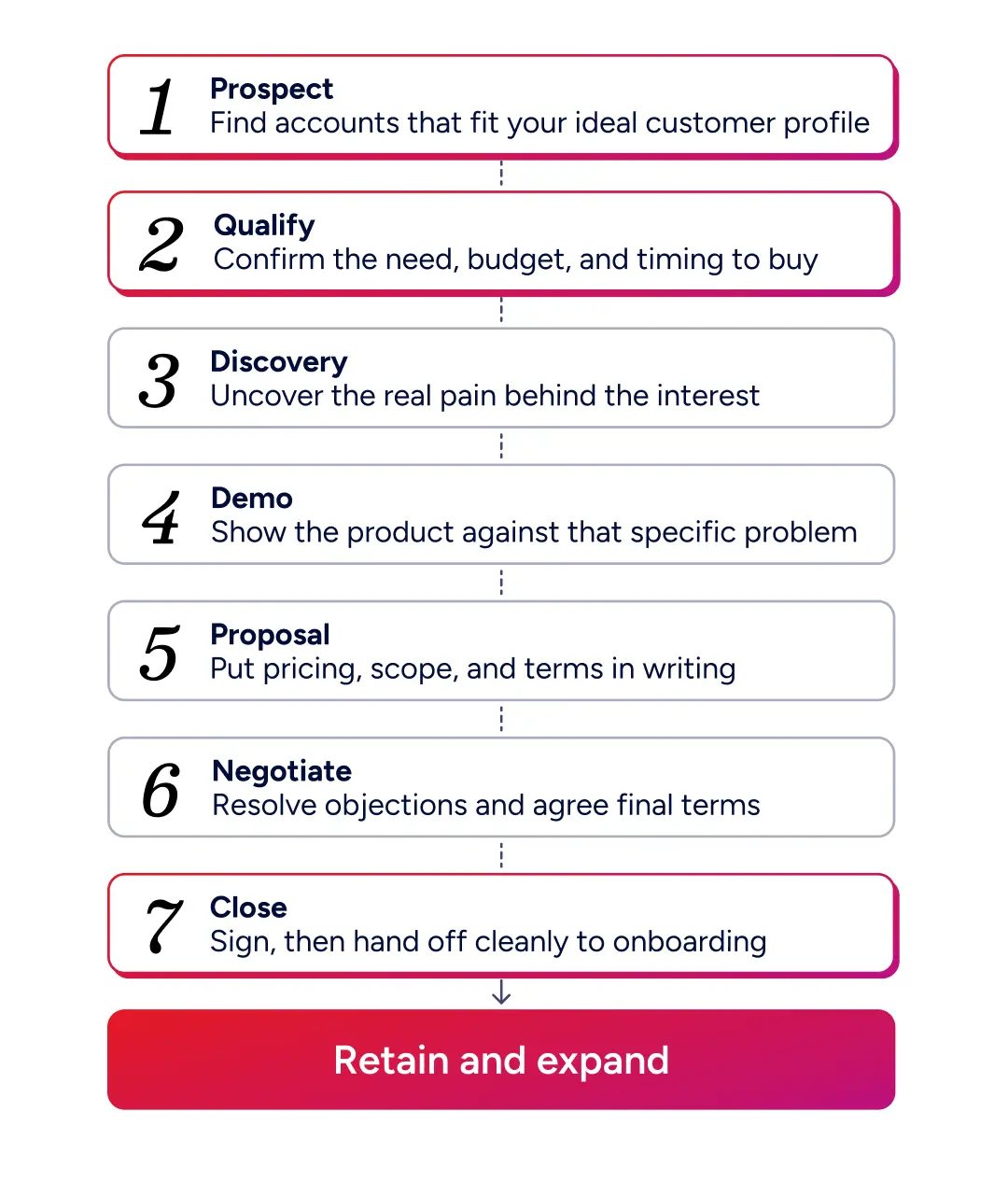
The flowchart shows seven stages, but they aren't equal. The first two decide the outcome of everything after them, and the middle stages are where selling skill shows. Here's what each one is for.
Stage 1: Prospect
Goal: Build a list of accounts worth pursuing rather than a long one.
Prospecting sets the ceiling for the whole deal, because no skill in the later stages rescues an account that was never a fit. Build against your ideal customer profile rather than reaching out broadly with outbound lead generation, and research each account enough to have a real reason to make contact.
Do: Target accounts that match your best existing customers using account-based selling, and build a focused sales prospect list with a hook for each one.
Advance when: You have a named, ICP-fit account and a specific reason to reach out. That reason is what makes appointment-setting work.
Watch for: A long list of loosely-fit accounts, which feels productive and converts terribly.
Stage 2: Qualify
Goal: Confirm the account can actually buy before you invest real hours.
Disqualifying feels like losing a deal when it's actually protecting the pipeline, which is why teams tend to rush this stage. Work a framework like BANT honestly across budget, authority, need, and timing, and use sales qualification questions that force honest answers rather than polite ones.
Ask: Does the problem justify budget, is there a path to the decision-maker, is the need urgent, and is there a real timeline.
Advance when: There's a business problem with a cost attached and a reason to act this quarter. Those same signals should feed your lead scoring model.
Watch for: Interest with no urgency, the deal that quietly eats a rep's month.
Stage 3: Discovery
Goal: Find the real problem behind the surface-level interest.
Everything downstream runs on what you learn here, so skipping discovery means the demo, proposal, and negotiation all run on guesswork. Strong discovery calls dig past the stated ask to the business cost underneath it, which is the foundation of value-based selling.
Ask: What does this problem cost them today, what have they already tried, and who else is affected.
Advance when: You can name the buyer's problem and the cost of leaving it unsolved. A quantified cost is also what you need when selling to a CFO.
Watch for: Taking the first answer at face value instead of finding the pain under it.
Stage 4: Demo
Goal: Show the product against their specific problem rather than touring every feature.
The best demos feel custom because they walk straight from the buyer's stated pain to the capability that solves it. A generic sales presentation that covers everything is the fastest way to lose the room.
Do: Map each thing you show to something discovery surfaced, and cut everything else.
Advance when: The buyer can see a clear path from their problem to your solution. Timing helps, so pick the right day and time for the demo.
Watch for: Demoing features nobody asked about because they're impressive to you.
Stage 5: Proposal
Goal: Put pricing, scope, and terms in writing, mapped to the value discussed.
Sequence is everything here. A proposal that lands before value is established becomes a negotiation about price, while one that lands after becomes a decision about fit, which is why when you discuss price shapes the whole late stage.
Do: Tie the price to the cost of the problem you quantified in discovery.
Advance when: The buyer has a proposal they can take to their decision-makers.
Watch for: Sending pricing early to "keep things moving," which anchors the deal on cost.
Stage 6: Negotiate
Goal: Resolve terms and objections, and keep the deal moving to a yes.
Late-stage friction usually comes from the buyer working out how to say yes. Treat the sales objections that surface as buying questions to answer, which is the same reframe that runs through strong sales coaching.
Do: Get to the objection behind the objection, since the first one stated is rarely the real one.
Advance when: Terms are agreed and the remaining objections are handled.
Watch for: Discounting to close instead of resolving the actual concern.
Stage 7: Close
Goal: Sign the deal, then hand off cleanly so momentum survives.
The close is done when the next team has full context, which usually comes a while after signature. Use proven closing techniques to get the signature, then protect the win, because the first ninety days set up customer loyalty for the life of the account. That handoff feeds the last box on the flowchart, retain and expand, where the account either grows or quietly churns.
Do: Confirm next steps in writing and brief onboarding before the buyer's excitement cools.
Advance when: The contract is signed and onboarding has everything it needs.
Watch for: A cold handoff right after the win, where hard-earned momentum leaks away.
How to Read and Use the Flowchart
A flowchart is only useful if it changes how the team works. Four ways to put it to work:
Map your real stages against it. Line your stages up against the flowchart and look for the point where deals stall or skip ahead, which is usually where the process is broken. A win/loss analysis makes the stall points impossible to ignore.
Define exit criteria for each stage. A stage is done when a specific thing is true, budget confirmed, decision-maker engaged, proposal sent. Time passing on its own doesn't count. Writing those criteria down is what makes a repeatable process, and what sales automation can then enforce.
Match stages to your CRM. Your CRM pipeline stages should mirror the flowchart, so sales reporting and forecasting reflect where deals actually are. When CRM data quality is clean and CRM hygiene is enforced, the flowchart and the forecast tell the same story.
Coach against the flowchart. Use it as the shared reference in 1:1s and pipeline reviews so reps and managers are talking about the same stages with the same exit criteria.
Where Deals Actually Branch
Real deals don't run in a straight line. The flowchart above is the ideal. In practice, two decision points send deals off the main line and back into it.
The qualification point is a loop rather than a dead end. An account that doesn't qualify today goes into lead nurturing and re-enters the process when something changes. A job change or a new funding round can turn a "not now" into a "now."
The buying decision rarely resolves on the first pass either. A "not ready" answer routes back through objection handling and stays in the pipeline. Deals that look stalled are often one resolved objection away from moving, which is why follow-up discipline separates reps who hit quota from those who don't.
Where the Flowchart Flexes by Deal Type
The seven stages hold across modern B2B sales, but their weight shifts with deal size and motion.
Deal type | Where the process concentrates |
Transactional (low ACV) | Fast qualify and close, light discovery |
Mid-market | Balanced, full seven stages |
Enterprise | Heavy discovery and negotiation, multiple stakeholders |
Product-led | Qualification happens in-product before sales engages |
An enterprise SaaS sales process spends most of its time in discovery and negotiation because of the buying committee, while a transactional deal compresses the middle stages almost to nothing. A product-led motion shifts the front of the flowchart into the customer acquisition funnel itself, so sales picks up already-qualified users. The flowchart is the same shape, but where a deal spends its time changes everything about how you staff and coach it. Adapting it well is the core of sales process optimization.
How Data Drives the First Two Stages
Prospect the wrong accounts or qualify them loosely, and the later stages have nothing to work with. That's why the front of the process runs on data, and why data belongs in your GTM tech stack from day one.
ZoomInfo powers prospecting and qualification with verified B2B data and real-time signals:
Better prospecting. Access to 500M+ contacts and 100M+ companies with firmographic and technographic data means the prospect list is built on accounts that actually fit, not guesses.
Sharper qualification. Intent data flags which accounts are actively researching your category, so reps qualify against real buying signals instead of gut feel, and signals like funding and job changes tell them when to move.
Cleaner handoffs. When records are verified and enriched, the handoff from SDR to AE, or between any SDR and BDR roles, carries full context instead of a half-filled record, lifting lead conversion rate at the point it matters most.
A flowchart stays a picture until you attach exit criteria and honest data to it. Holding a deal back until it's earned the next stage is what closes the execution gap between the diagram and the pipeline. Map your real stages against the flow above, find the stage where deals stall, and fix that one first. Then make sure prospecting and qualification run on data you can trust, because that's where the outcome of every deal is quietly decided.
Get a ZoomInfo demo and see what verified data does to your win rate.
Frequently Asked Questions
What are the stages of the B2B sales process?
The seven core stages are prospecting, qualification, discovery, demo, proposal, negotiation, and closing, usually followed by onboarding and expansion. Teams split or combine stages depending on how they sell, but the underlying steps stay recognizable.
What is the difference between a sales process and a sales funnel?
A sales process is the set of actions the sales team takes, prospect, qualify, demo, and so on. A sales funnel is the buyer's view of the same journey, showing how many prospects move from one stage to the next. The process is what you do, the funnel is what happens to volume as deals progress.
How do you make a sales process flowchart?
Start with your real stages rather than a template. List every step a deal takes from first contact to close, add the decision points where deals branch (qualified or not, ready to buy or not), and mark where deals loop back. Then define what has to be true for a deal to exit each stage. The flowchart on this page is a starting structure you can adapt.
Why do deals stall in the sales process?
Stalls often trace back to the first two stages, an account that was never a good fit or one that was qualified too loosely. Others stall at the buying decision, where an unresolved objection, often from an unmapped member of the buying committee, keeps the deal from moving. A flowchart makes these stall points visible, which is the first step to fixing them.
How many stages should a B2B sales process have?
Five to eight is a common range. Fewer than five usually means stages are being skipped, and more than eight tends to add administrative overhead without improving forecasting. Seven is a workable default, but the right number is the one that matches how your deals actually move.
