
Beamery spent over a decade evolving from a talent CRM into what it now calls an AI platform for workforce transformation. The pitch: give enterprises a real-time picture of their workforce skills, connect it to external labor market signals, and use AI to help HR leaders make faster decisions about hiring, redeployment, and reskilling. With customers like Salesforce, Wells Fargo, and Hilti, the platform has proven it works at enterprise scale.
To create this Beamery review, we analyzed the platform extensively. We believe it's the right choice if:
You're a large enterprise (10,000+ employees) needing to connect talent strategy to business outcomes
You run Workday or SAP SuccessFactors and want a skills intelligence layer on top
You need to model the impact of AI and automation on your workforce before acting
You want independently audited, bias-tested AI for hiring decisions
You have the internal resources and budget for a consultative, multi-month implementation
However, Beamery might not be the best choice if:
You're a mid-market or growth-stage company (under 2,000 employees)
You need a self-serve tool with transparent pricing and fast deployment
Your primary challenge is finding and reaching the right B2B contacts, not managing internal workforce data
You want a platform that combines talent sourcing with go-to-market intelligence
You need broad integrations beyond the Workday and SAP ecosystems
For organizations whose talent acquisition strategy depends on reaching the right people with verified contact data and buying signals, ZoomInfo offers a complementary capability: an AI-powered GTM platform with 500M contacts, 135M+ verified phone numbers, and 200M+ verified business email addresses that can power the sourcing and outreach side of recruiting workflows.
We've included a brief overview of ZoomInfo later in this review, as a complementary tool for talent acquisition teams that need verified contact data at scale. If you're ready to explore it, you can start with ZoomInfo's free trial here.
What is Beamery?
Source: Beamery
Beamery is a private, London-based enterprise software company founded in 2013 by brothers Abakar and Sultan Saidov along with co-founder Michael Paterson. The founding thesis grew from personal experience: as children of immigrants from Dagestan whose parents' professional qualifications were not recognized in the UK, the Saidovs saw firsthand how credential-based systems block opportunity.
They built Beamery on the belief that talent allocation should be based on skills, not pedigree.
The company started as a talent CRM, helping recruiters build relationships with passive candidates before roles opened. Over the following decade, it expanded into talent marketing, sourcing, career sites, and event recruiting.
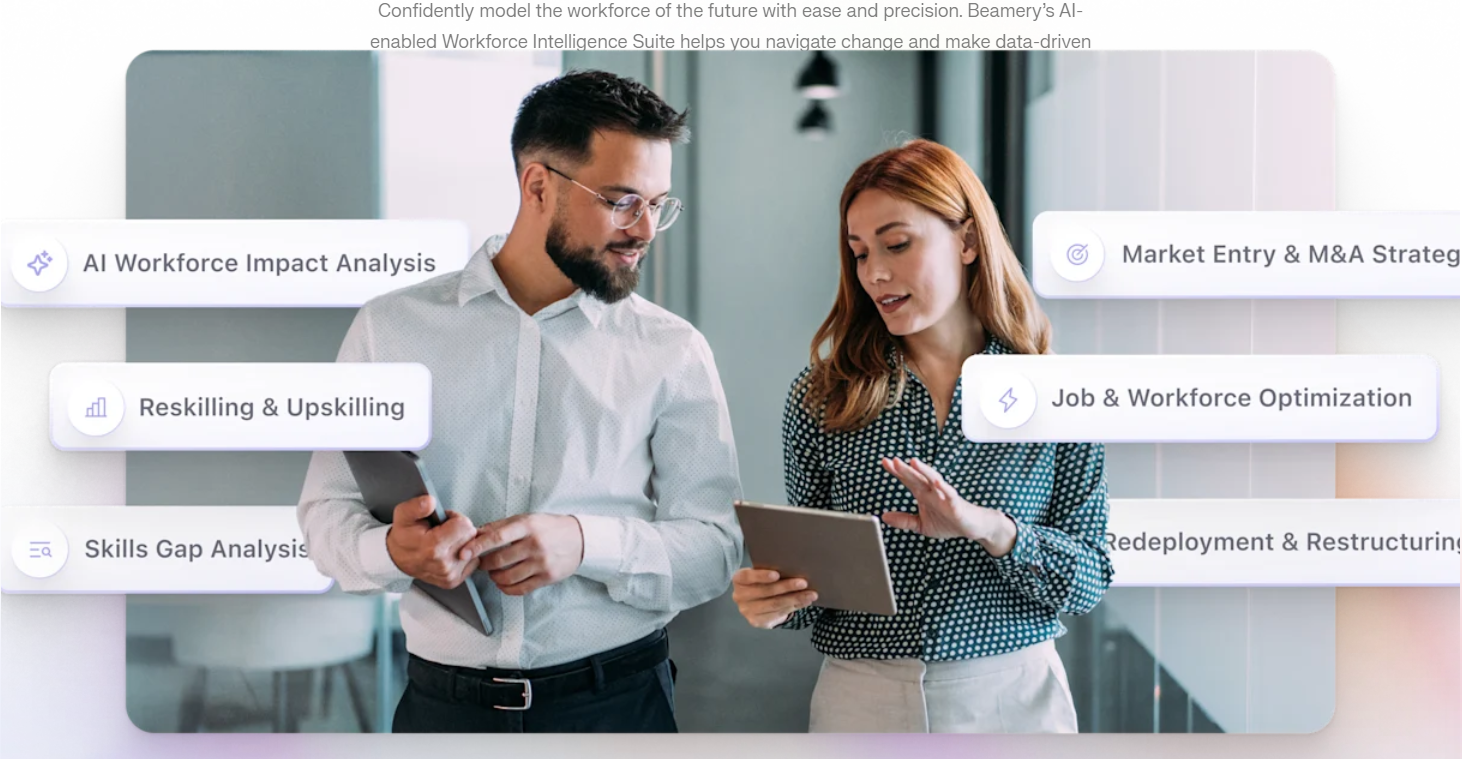
The most significant shift came in 2025 with the launch of the Workforce Intelligence Suite, which moved Beamery beyond recruitment into workforce planning, task-level role analysis, and organizational design.
Today, Beamery positions itself as "The AI Platform For Workforce Transformation" and targets CHROs, Chief People Officers, and C-suite executives at organizations with tens of thousands of employees.
Beamery Pros & Cons
Pros | Cons |
|---|---|
Enterprise track record with major reference customers | High complexity and steep learning curve |
Unified skills-and-task data layer | Enterprise-only pricing with no published rates |
ISO 42001 certified with independently audited AI (Warden AI) | Reporting customization scores lower than other capabilities |
Certified integrations with Workday and SAP SuccessFactors | Integration breadth limited outside Workday/SAP ecosystems |
AI consultant (Ray) for workforce planning | Occasional platform bugs and browser extension reliability issues |
Consultative implementation with 94 post-training NPS | Requires broad data import for full AI matching value |
First mover in task-level workforce modeling | Limited independent review volume for buyer validation |
Beamery Review: How It Works & Key Features
Workforce Intelligence Suite: Beamery gives enterprises a real-time model of their entire workforce, down to individual tasks.
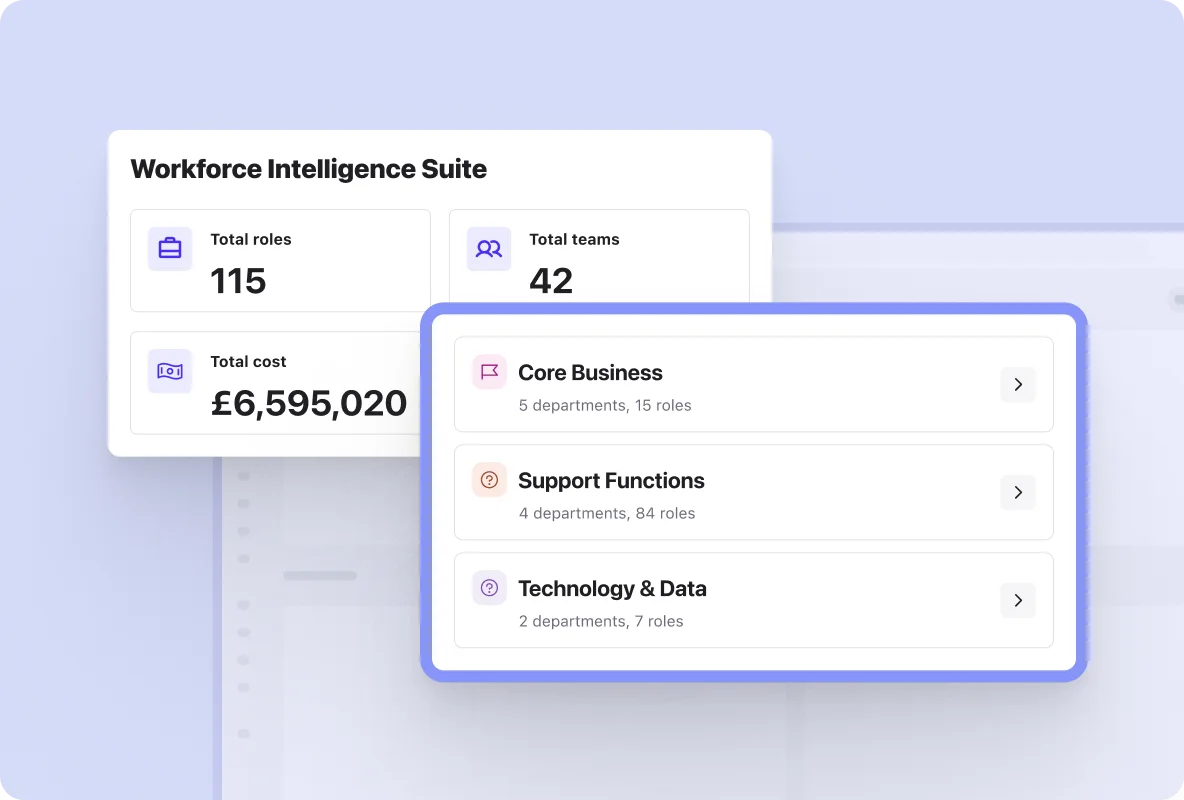
The Workforce Intelligence Suite is Beamery's strategic planning environment, launched in July 2025. It addresses a persistent problem in workforce planning: most HR teams rely on static, backward-looking headcount snapshots that can't keep pace with organizational change or AI-driven role disruption.
Source: Beamery
The Suite combines internal HRIS data with three layers. Skills Intelligence maps roles to required skills with 90% relevance on first implementation. Task Intelligence breaks roles into individual tasks to surface automation potential and reskilling pathways. Talent Market Insights overlays real-time external data on salary ranges, talent availability, and emerging skills.
On top of this data, the Suite provides a digital organizational twin that lets planners simulate restructuring scenarios before committing to changes. An embedded AI consultant named Ray lets users query the data in natural language rather than building reports manually. Beamery claims the combined approach saves 4 to 6 months that would otherwise go to creating job, task, and skill insights from scratch.
Skills Intelligence: A living skills framework built in days, not months.
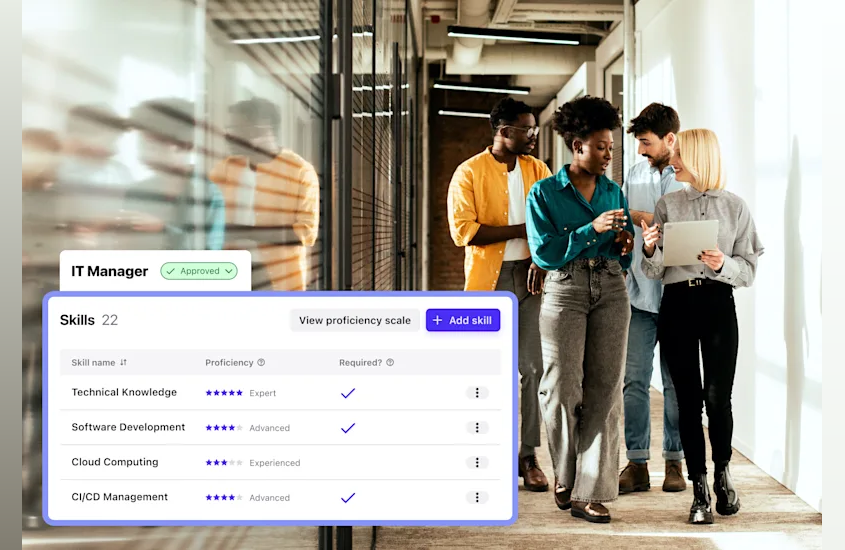
Skills Intelligence is the foundation everything else in Beamery rests on. Most enterprises lack a standardized understanding of what skills their workforce has and what each role requires. Without that foundation, workforce planning, internal mobility, and skills gap analysis are guesswork.
Source: Beamery
Beamery's approach ingests unlimited data sources (internal job descriptions, HCM data, external market data) and uses AI to produce a structured skills taxonomy. The platform claims up to 90% skills relevance on first review before any human editing, with a 1-day time to value compared to the months-long manual taxonomy projects most enterprises endure.
Once live, the framework updates dynamically. It surfaces emerging skills gaining relevance in the external market and flags declining ones. The taxonomy integrates natively with SAP SuccessFactors and Workday so talent decisions use consistent skill definitions across systems.
The underlying dataset includes 20 billion+ talent data points, 600M+ global talent profiles, and 300M+ normalized job descriptions.
Talent CRM & Sourcing: Beamery combines proactive pipeline building with AI-powered candidate matching.
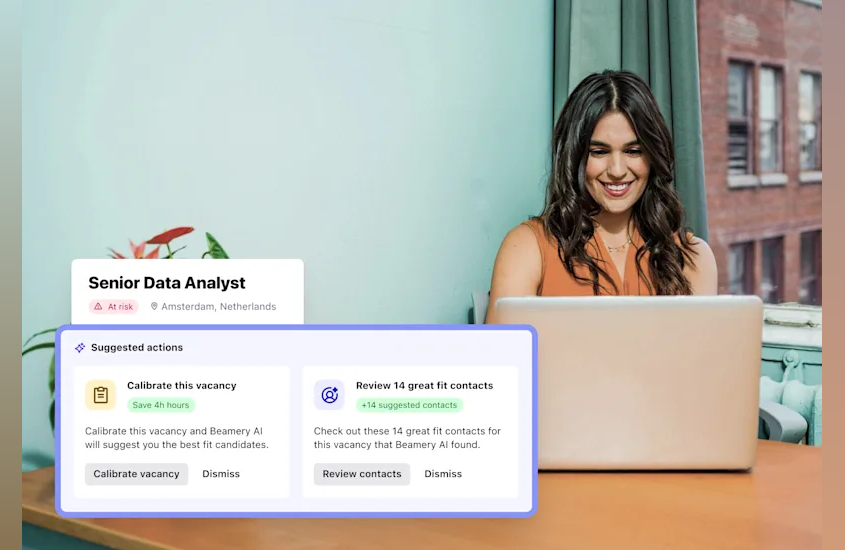
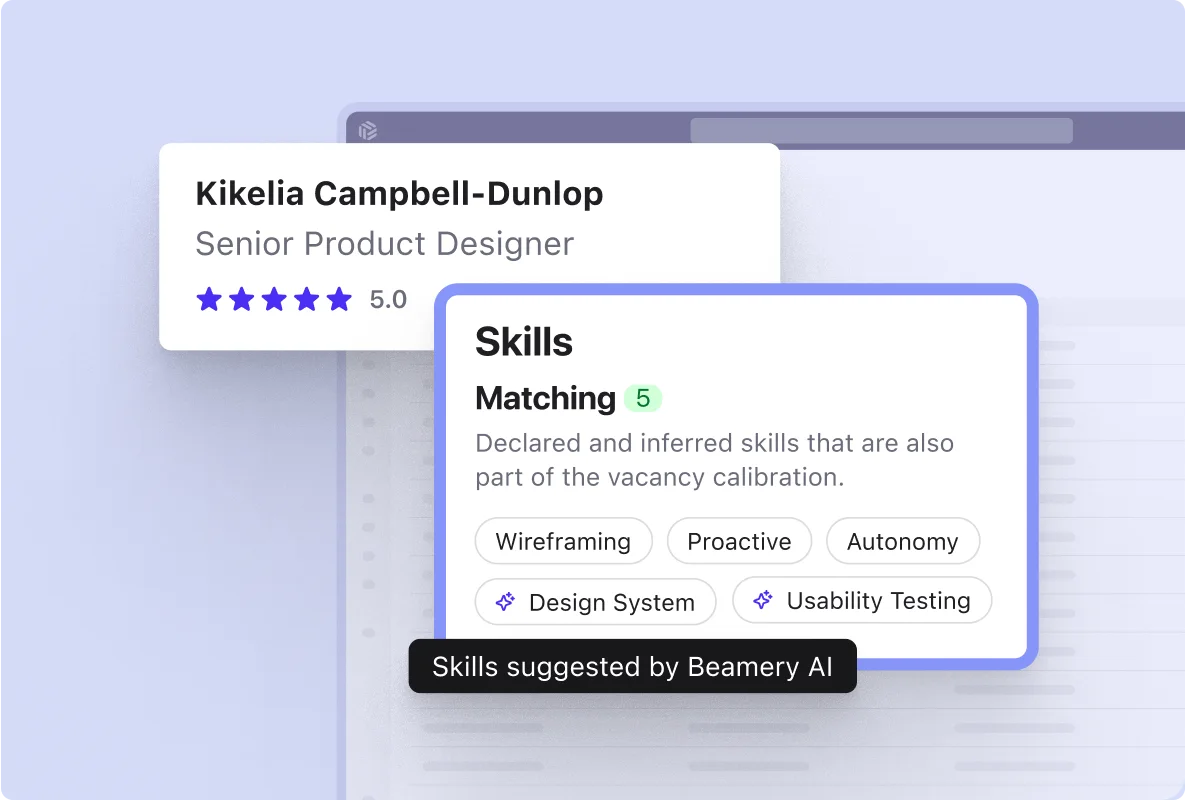
The Talent CRM is where Beamery's roots show. It sits upstream of the ATS, giving recruiters a structured place to build and nurture talent pipelines before a role opens. The system enriches contacts with both declared and AI-suggested skills on unified profiles. Internal employees from the HCM and external candidates live in the same view, so every search considers both internal mobility and external hiring at once.
Source: Beamery
The Sourcing & Matching module layers AI on top of the CRM to surface best-fit candidates from previous applicants, recently engaged contacts, and internal talent in a single search. The AI converts unstructured job descriptions and profiles into usable skill definitions rather than relying on keyword matching.
Source: Beamery
A native LinkedIn CRM Connect integration imports LinkedIn profiles directly without creating duplicates, and the Beamery Extension lets recruiters check whether a candidate is already in the system from any website.
Talent Marketing & Career Sites: Beamery turns recruiters into marketers and career sites into pipeline generators.
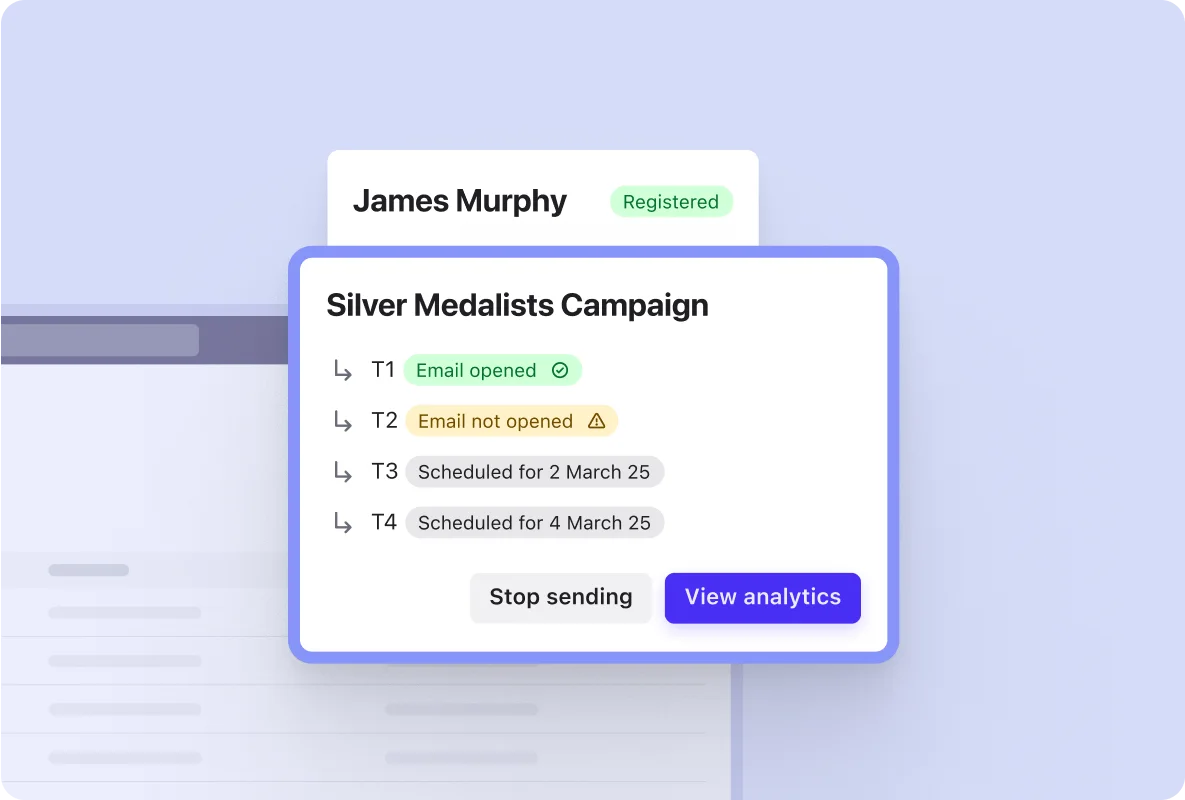
Talent Marketing lets recruiting teams run automated, multi-channel outreach campaigns across email, SMS, and WhatsApp. Teams segment campaigns using structured CRM data (skills, experience, engagement history) and trigger them by candidate behavior rather than time-based schedules.
Source: Beamery
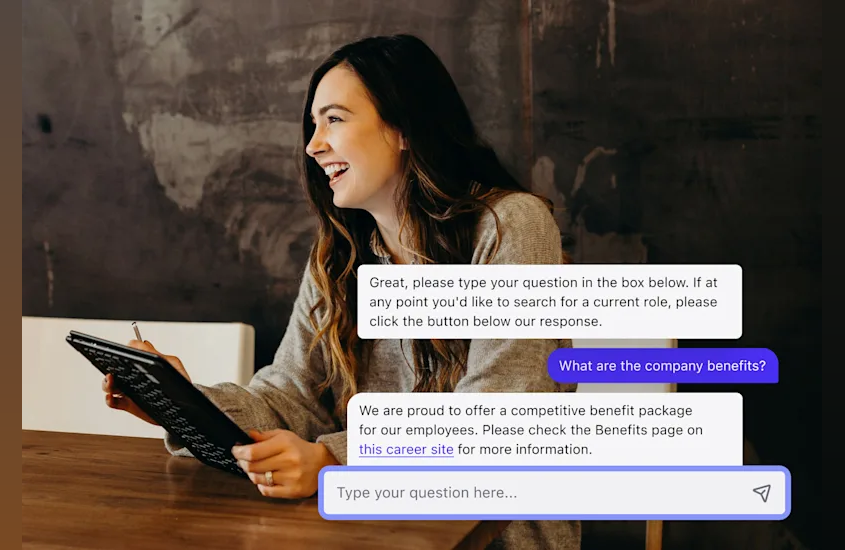
The Career Sites & Chatbot module provides a self-service career site builder with built-in SEO optimization and an AI-powered chatbot. Candidate sign-ups flow directly into the Beamery CRM for immediate follow-up.
Source: Beamery
Events & Campus Recruiting: Beamery connects event data directly to hiring outcomes.
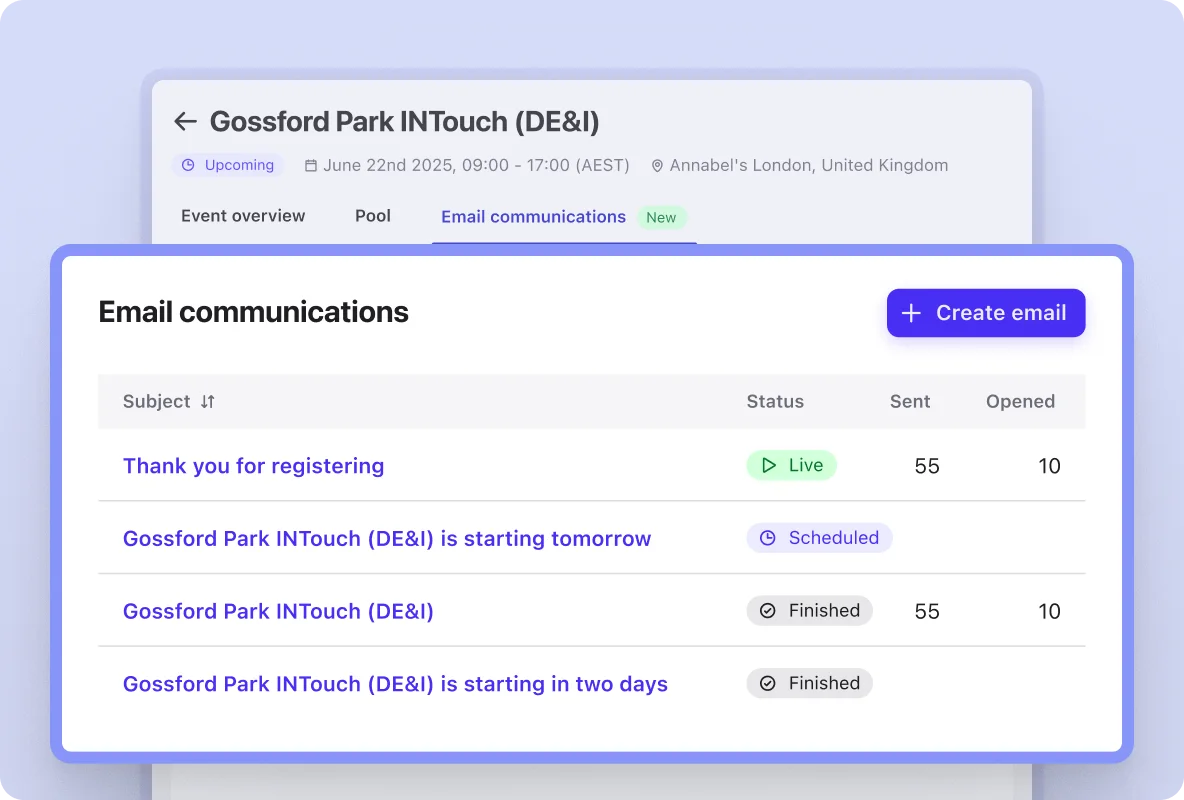
The Events & Campus module manages in-person and virtual recruiting events end to end: registration, QR code check-in, real-time CRM data capture, automated post-event follow-up, and interview scheduling. The key difference from standalone event tools is that registration data flows directly into the CRM at the point of capture, so post-event follow-up is immediate and measurable.
Source: Beamery
Where Beamery Falls Short
Beamery offers real depth for enterprise workforce transformation, but several limitations surface during evaluation. These reflect a platform built for large-scale, consultative deployments rather than broad accessibility.
Steep Learning Curve and UX Complexity: G2 reviewers note the interface can be "overwhelming for new users" and that the platform "can be quite difficult to learn as there are so many moving parts." Beamery acknowledges this implicitly by positioning its Implementation & Enablement as a core service investment, not a self-serve activity.
The platform rewards dedicated internal champions but creates friction for occasional users.
Reporting Customization Gaps: G2 scores Beamery's Reporting at 7.3/10, lower than its other capability scores. For a platform targeting C-suite workforce decisions, limited self-serve reporting customization means some enterprises will still need to export data to external BI tools for the analysis depth their leadership expects.
Integration Breadth Outside Workday and SAP: Beamery's strongest integrations are with Workday and SAP SuccessFactors, where it holds certified partner status. G2 integration scores of 7.0/10 reflect frustration among enterprises running Oracle HCM, ADP, or other HR systems. Those organizations face higher integration costs and less out-of-the-box functionality.
No Published Pricing: Beamery publishes no pricing. The sole entry point is a "Book a demo" call-to-action. While this is standard for enterprise software, it makes it hard for buyers to set budget expectations early and nearly impossible to do side-by-side cost comparisons.
Platform Reliability Issues: G2 reviewers report that "Beamery is still quite a bit buggy" and that the browser extension "will take quite a few times to load." For recruiters who depend on the extension in their daily sourcing workflow, these reliability issues create real friction.
Limited Independent Review Volume: TrustRadius lists only 15 reviews and scores Beamery 7.5/10. While Beamery's enterprise customer list is strong, the thin volume of independent reviews makes it harder for prospects to compare experiences across different deployment contexts.
These limitations aren't failures. They're the natural result of building a consultative enterprise platform. But they create clear gaps for teams that need faster access to verified contact data and broader integrations for their talent acquisition workflows.
Complementary Tool for Talent Sourcing: ZoomInfo
Beamery excels at managing talent relationships and workforce intelligence once candidates are in the pipeline. But sourcing depends on a different kind of data: verified contact information, direct-dial phone numbers, and signals about when companies and individuals are actively in-market. This is where ZoomInfo fits as a complementary layer.
ZoomInfo is an AI-powered GTM platform built on one of the largest B2B data foundations available: 500M contacts, 100M companies, 135M+ verified phone numbers, and 200M+ verified business email addresses. Its primary market is sales and marketing teams, but the same data infrastructure powers recruiting use cases where verified contact reach matters.
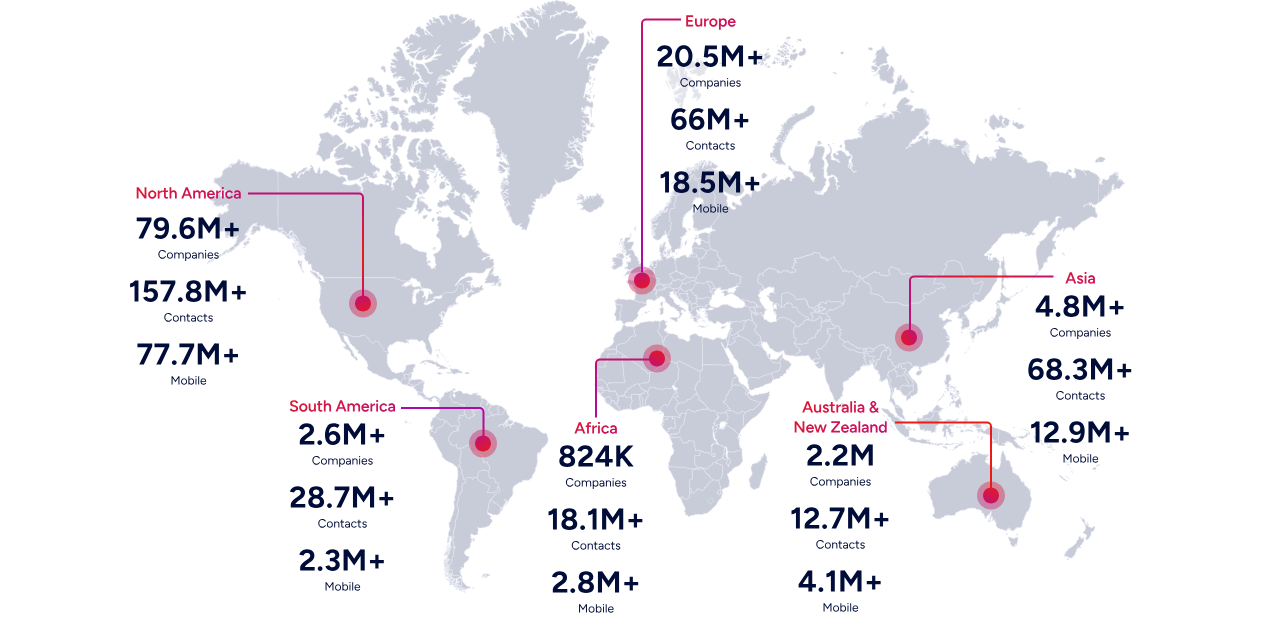
Verified Contact Data at Scale: ZoomInfo provides the contact accuracy that talent sourcing depends on.
Recruiting teams sourcing passive candidates face a data problem: LinkedIn InMails have limited response rates, and the contact information in most HR databases decays as people change roles. ZoomInfo's data pipeline addresses this with 300+ human researchers and multi-source verification that delivers up to 95% accuracy on first-party data.
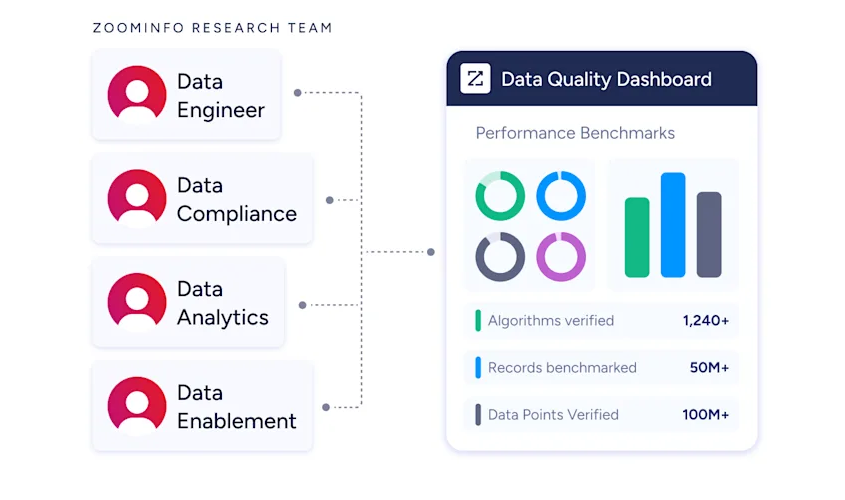
The platform covers 120M direct-dial phone numbers and 200M+ verified business email addresses, giving recruiters direct access to candidates without relying on platform-mediated messaging. For executive recruiting and hard-to-fill technical roles where reaching the right person directly is the bottleneck, this data layer fills a gap that talent CRMs like Beamery don't address natively.
In a Fortune 500 competitive RFP analyzing 25 million contacts across vendors, an independent consultant concluded that "no other competitor came even close" to ZoomInfo's data quality.
Vensure scaled its prospecting with ZoomInfo's data. "ZoomInfo gives us the information we need to execute. We don't have to go through and spend our time digging. It's already there, so we can be three steps ahead." (Vensure Case Study)
Intent Signals and Company Intelligence: ZoomInfo reveals when organizations are actively hiring or restructuring.
Beyond contact data, ZoomInfo's Buyer Intent capabilities track signals from 210 million IP-to-Organization pairings and 6 trillion+ new keyword-to-device pairings sourced monthly.
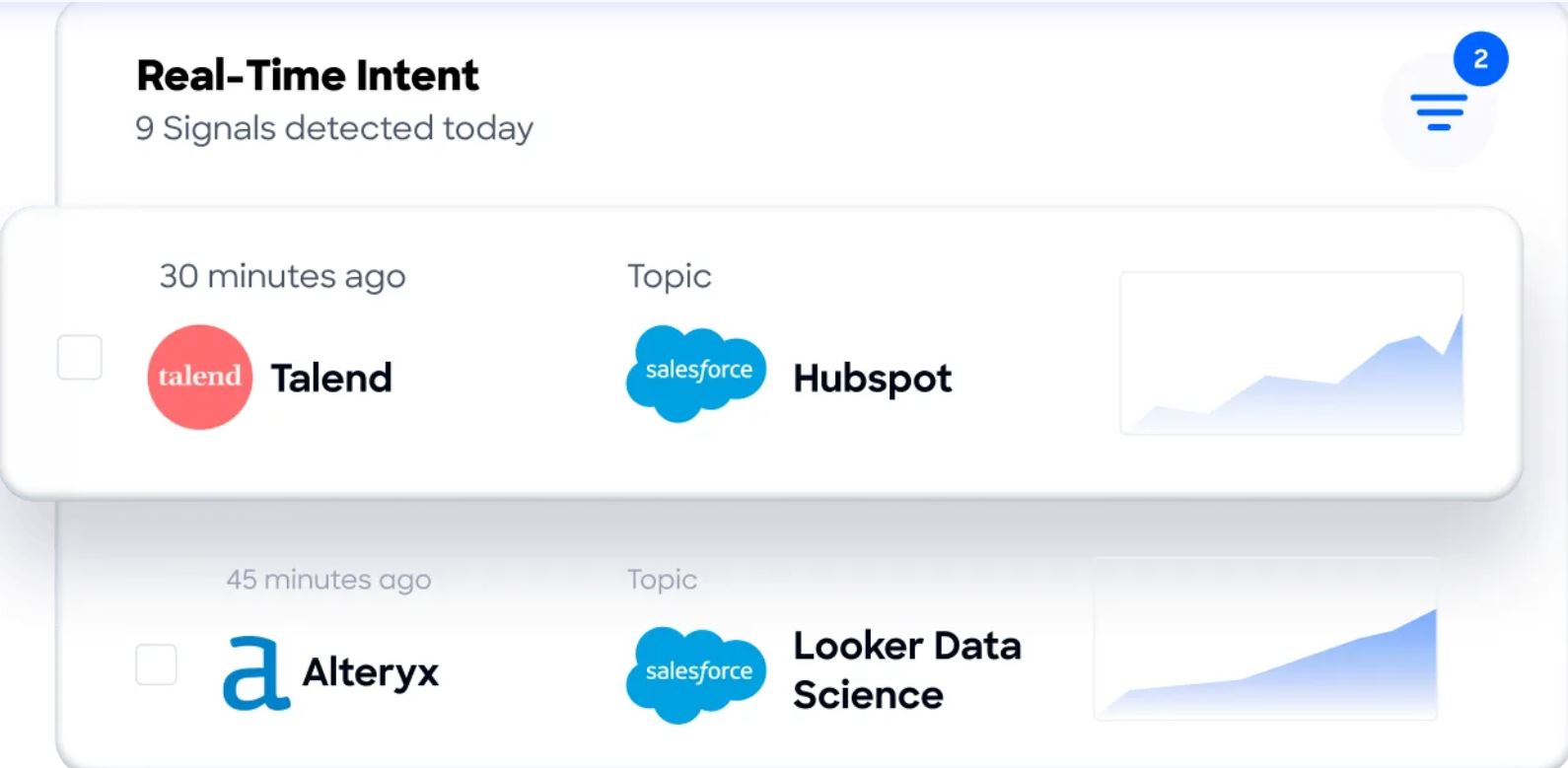
For talent acquisition teams, these signals surface companies actively researching topics that indicate hiring intent, organizational change, or technology adoption, before those companies post public job listings.
Technographic data profiles the tech stacks of 30+ million companies. This helps both with sourcing candidates who have specific technology experience and with understanding a target company's technology environment before outreach.
Universal Access Through API and MCP: ZoomInfo's data works inside any system, including recruiting tools.
ZoomInfo's Enterprise API and MCP server let its data be consumed inside any application, including internal recruiting tools, custom AI agents, or third-party platforms. Organizations using Beamery for talent relationship management can programmatically enrich Beamery profiles with ZoomInfo's verified contact data and company intelligence, without manual research or context switching.
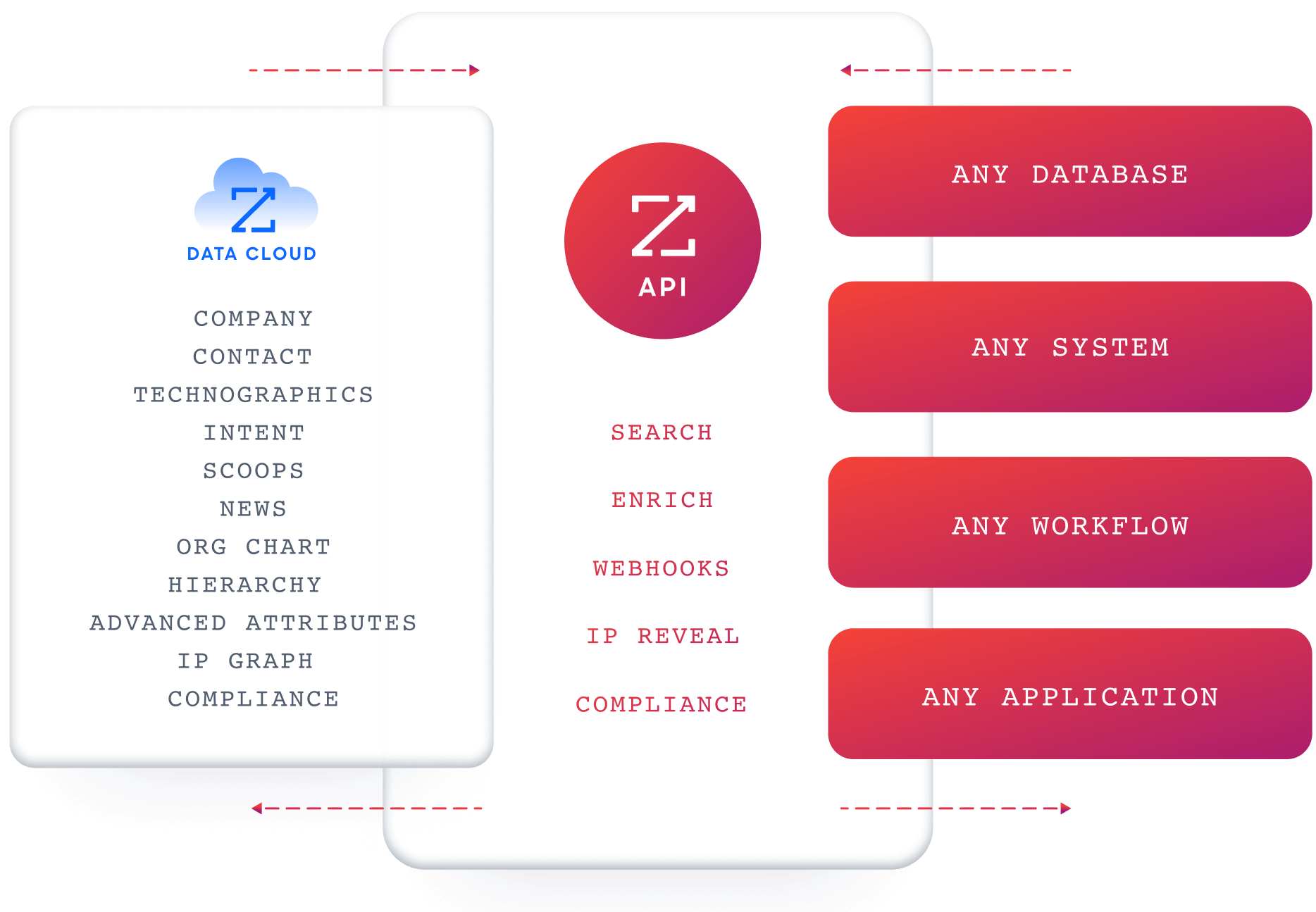
API access is included in all relevant plans, and the MCP server connects directly to AI assistants like Claude and ChatGPT for natural-language data access.
BDO Canada activated ZoomInfo's data directly within internal systems. "The plug-and-play aspect of the API means I can integrate it very easily into any process and get information at a moment's notice," with an 87% reduction in time spent on internal data dashboard updates. (BDO Canada Case Study)
Flexible Entry Points: ZoomInfo offers permanent free access and a 7-day trial.
Unlike Beamery's enterprise-only, quote-only model, ZoomInfo provides multiple entry points. ZoomInfo Lite is a permanent free tier with access to the B2B database, 10 monthly export credits, individual and company searches, and a Chrome extension. A 7-day free trial of paid features is also available with no credit card required.
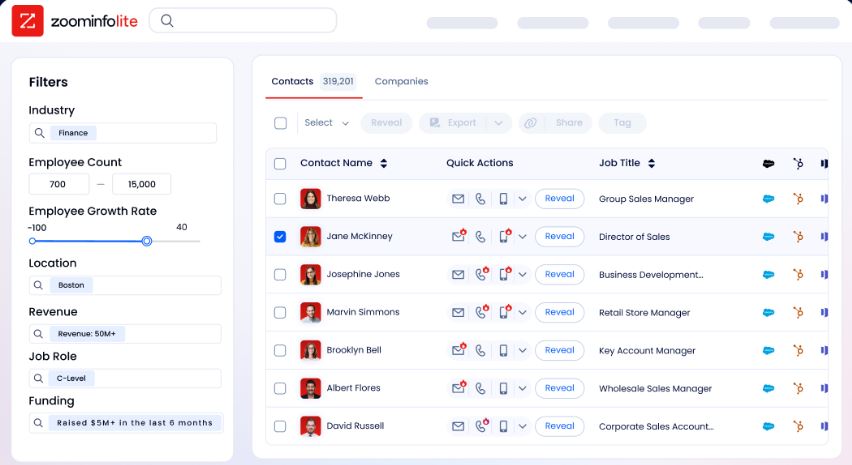
Paid plans are organized into Sales, Marketing, and Chorus tiers, with consumption-based pricing that scales around seats, credits, and feature access. While specific prices are custom-quoted, the tiered structure (Professional, Advanced, Enterprise) gives buyers a clearer sense of the cost trajectory than Beamery's quote-only model.
Beamery and ZoomInfo: How They Work Together
Aspect | Beamery | ZoomInfo |
|---|---|---|
Primary Focus | Workforce transformation and talent management | B2B data, go-to-market intelligence |
Core Strength | Skills-based workforce planning and talent CRM | Verified contact data and buying signals |
Target Buyer | CHROs, HR leaders at enterprises (10,000+ employees) | Sales, marketing, and RevOps leaders |
Talent Acquisition Role | Manage talent relationships and pipelines | Provide verified contact data for sourcing outreach |
Data Foundation | Internal HRIS + skills taxonomy + labor market insights | 500M contacts, 100M companies, 135M+ verified phones |
AI Capabilities | Workforce consultant (Ray), skills inference | GTM Context Graph, AI-powered account intelligence |
Integration Approach | Certified Workday and SAP partner | 172+ marketplace integrations, API, MCP |
Pricing Transparency | No published pricing, enterprise-only | Tiered structure with free tier and free trial |
Compliance | ISO 42001, SOC 2, GDPR, Warden AI bias audit | ISO 27001, ISO 27701, SOC 2 Type II, TRUSTe GDPR/CCPA |
Deployment Speed | Multi-month consultative implementation | Deploys in weeks; Lite available instantly |
Final Verdict
Beamery and ZoomInfo solve different problems, and for many organizations, the most effective talent acquisition strategy uses both.
Choose Beamery if you're a large enterprise that needs to connect talent strategy to business outcomes at an organizational level. It's the right choice when your challenge is understanding what skills your workforce has, what skills you'll need, and how to close that gap through hiring, redeployment, and reskilling. The platform rewards organizations willing to invest in a multi-month implementation and ongoing change management, with workforce intelligence that few competitors match.
If you already run Workday or SAP SuccessFactors, Beamery's certified integrations make it a natural extension of your existing HR ecosystem.
Add ZoomInfo if your talent acquisition team needs verified contact data to reach passive candidates directly, company intelligence to prioritize target organizations, or intent signals to identify companies with active hiring or restructuring activity.
ZoomInfo's data layer complements Beamery's talent management capabilities by filling the sourcing gap with 500M contacts and 135M+ verified phone numbers that can power outreach before candidates ever enter a CRM pipeline. The API and MCP access means ZoomInfo's data can flow directly into existing recruiting workflows without manual entry.
Start with ZoomInfo's free trial here.
The talent acquisition landscape increasingly rewards organizations that combine strategic workforce planning with precise sourcing execution. Beamery provides the planning intelligence; ZoomInfo provides the contact data and signals that turn those plans into outreach that reaches the right people.
Beamery FAQ
What is Beamery used for?
Beamery is an enterprise workforce transformation platform that helps organizations plan, build, and optimize their workforces using AI. It combines talent CRM, sourcing, talent marketing, career sites, events management, and workforce intelligence into a single platform.
The typical buyer is a CHRO or HR leader at an organization with 10,000+ employees who needs to connect talent strategy to business outcomes through skills-based hiring, internal mobility, and workforce planning.
How much does Beamery cost?
Beamery does not publish pricing. The platform is sold through enterprise sales with pricing disclosed only through direct negotiation. Contracts are governed by a Master Services Agreement with fees fixed for the term of each Order. Professional services (implementation, advisory, training) are contracted and invoiced separately.
There is no free plan, no self-serve trial, and no published tier structure, though structured proof-of-concept engagements are available before full contracts.
Does Beamery integrate with Workday and SAP?
Yes. Beamery holds certified partner status with both platforms. It is the only SAP Endorsed App offering certified integrations with SAP SuccessFactors Talent Intelligence Hub, Job Profile Builder, and Recruiting.
For Workday, Beamery is Workday's only Certified CRM partner, with bidirectional data sync covering vacancies, candidates, applications, and Skills Cloud integration. Enterprises running Oracle HCM, ADP, or other HR systems will face higher integration effort.
What is Beamery's Task Intelligence?
Task Intelligence is a data module launched in July 2025 that breaks roles into individual tasks using AI-powered inference. It identifies duplicate work across functions, scores tasks by frequency and effort, and calculates the potential time and cost savings from automation before any changes are executed.
The module feeds into the Workforce Intelligence Suite to power reskilling, redeployment, and workforce planning decisions. It draws on 20 billion+ talent data points and 300 million+ normalized job descriptions.
How does Beamery handle AI ethics and bias?
Warden AI has independently audited Beamery's AI for bias and fairness, with a publicly verifiable audit certificate. The platform achieved ISO 42001 certification, the first international standard for AI Management Systems. Beamery is an EU AI Pact signatory, SOC 2 and GDPR compliant, and never uses personally identifiable information to train its AI models.
The AI consultant Ray operates within a human-in-the-loop framework with role-based access controls.
Is Beamery suitable for mid-sized companies?
Beamery is built for enterprises, with documented customers mostly in the 10,000 to 225,000 employee range. Its pricing, implementation complexity, and feature depth don't fit companies below roughly 2,000 employees. Organizations seeking a lighter-weight talent acquisition tool or one with self-serve deployment would find Beamery's consultative model and enterprise-only pricing a poor fit.
What is Ray, Beamery's AI consultant?
Ray is Beamery's AI consultant embedded within the Workforce Intelligence Suite. It lets users query workforce data in natural language, simulate workforce shifts, model automation cost savings, and receive guidance on role simplification and skill priorities. Unlike generic AI assistants, Ray is powered by an organization's specific workforce data, skills, and task insights.
It operates within pre-approved user permissions and organizational policies, and Warden AI has independently audited it.
Can ZoomInfo complement Beamery for talent acquisition?
Yes. While Beamery manages talent relationships and workforce planning, ZoomInfo provides the verified contact data (500M contacts, 135M+ verified phone numbers, 200M+ verified business emails) and company intelligence that recruiters need to reach passive candidates directly.
ZoomInfo's API and MCP server let its data be consumed inside any recruiting tool or custom workflow. Its intent signals can also identify companies with active hiring or restructuring activity, giving talent teams earlier visibility into sourcing opportunities.
Researching Beamery? These comparisons and alternatives help you decide:
