
BriteVerify has been a familiar name in email verification since 2009, built on a simple premise: clean contact data protects sender reputation and keeps campaigns out of spam folders. Now operating as the "Contact Data Quality" capability inside Validity Engage, BriteVerify verifies email addresses, phone numbers, and mailing addresses through a four-layer pipeline that checks syntax, domain, MX records, and mailbox existence.
To write this BriteVerify review, we analyzed the platform extensively. We believe it's the right choice if:
You need email list verification before campaign sends
You already use Validity's Everest or DemandTools and want verification in the same platform
You run a Salesforce-centric CRM and want native, no-code verification inside your records
You need multichannel verification (email, phone, and postal address) from a single vendor
Your verification volumes are large and consistent enough to justify annual credit purchases
However, BriteVerify might not be the best choice if:
You need contact discovery and enrichment, not just verification of existing data
You want intent signals, buyer behavior tracking, or account-level intelligence alongside data quality
You need granular accuracy on catch-all domains common in B2B prospecting
You prefer transparent, self-serve pricing over sales-quoted credit blocks
You want a free tier that lets you evaluate the product on your own data before committing
In this case, consider ZoomInfo: a GTM platform that goes beyond verifying the contacts you already have. Built on a B2B data platform covering 500M contacts, 100M companies, 135M+ verified phone numbers, and 200M+ verified business email addresses, ZoomInfo doesn't just clean your list.
It builds the list, enriches it with firmographic and technographic context, layers on buyer intent signals, and powers AI-driven outreach through GTM Workspace for sellers and GTM Studio for marketers and RevOps teams.
We've included a detailed look at ZoomInfo later in this review, as the natural next step for teams that need more than verification. If you're ready to explore what a complete GTM data platform looks like, you can start with ZoomInfo Lite for free here.
What is BriteVerify?
Matt McFee and James McLachlan founded BriteVerify in 2009 in Charlotte, North Carolina. The company operated as an independent, bootstrapped email verification service, scaling to 500 million email verifications per month and counting Oracle, MailChimp, Return Path, Marketo, and Salesforce among its clients.
Validity, Inc. acquired BriteVerify on June 12, 2018.
Validity's CEO described it at the time as "a bootstrapped, high-growth and very profitable SaaS company." Validity then acquired Return Path (email deliverability) in 2019 and Litmus (email building and testing) in April 2025, assembling the product portfolio that became Validity Engage.
As of July 1, 2026, BriteVerify no longer operates as a standalone brand. It powers the "Contact Data Quality" capability within Validity Engage, sitting alongside DemandTools (CRM data management), Everest (inbox placement monitoring), and Litmus (pre-send email QA).
The target buyer is the enterprise marketing or revenue operations team running high-volume email programs where dirty contact lists degrade deliverability.
BriteVerify Pros & Cons
Pros | Cons |
|---|---|
Multi-channel verification (email, phone, address) in one platform | Credits expire after one year with no refunds for unused balances |
Native Salesforce integration for in-CRM verification | No standard free trial length; evaluation terms set at Validity's discretion |
Part of Validity Engage ecosystem (Everest, Litmus, DemandTools) | Catch-all domain handling returns domain-level flag only, no mailbox scoring |
Processing speed of 1,200+ emails verified per minute | No data enrichment or contact discovery capabilities |
Typo correction at point of capture (Q1 2026) | Pricing not publicly listed; requires sales contact |
SOC 2, ISO 27001, ISO 27701 certified | Billing and support friction reported by multiple reviewers |
Consistent ease-of-use ratings across review platforms | English-only interface limits multinational deployments |
BriteVerify Review: How it Works & Key Features
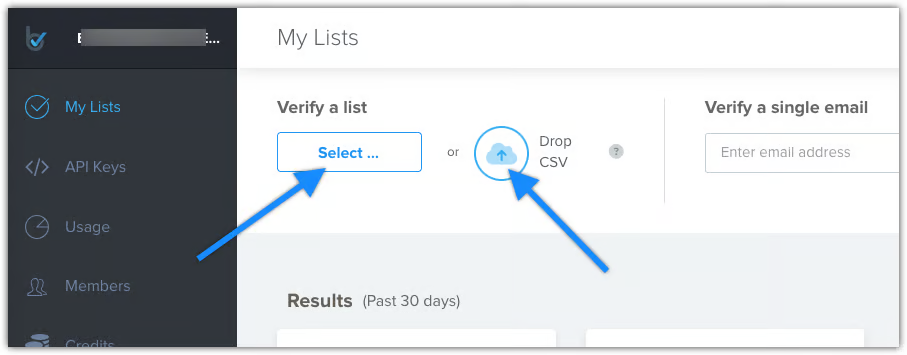
Email Verification: BriteVerify validates addresses through a four-layer pipeline that checks syntax, domain, MX records, and mailbox existence.
BriteVerify runs every email address through a sequential verification process.
First, it checks structure (the presence of @, valid characters, proper domain formatting). Then it verifies the domain is registered and active. Next, it queries DNS for Mail Exchange records to confirm the domain can receive mail. Finally, it connects to the mail server via SMTP handshake to confirm the specific mailbox exists, without sending a message.
Source: Validity
Each address receives one of three statuses: valid, invalid, or risky. The risky category breaks into four sub-types: Accept All (catch-all servers that claim every address is valid), Unknown (domain not responding at verification time), Role-Based (addresses like info@ or sales@ that route to multiple recipients), and Disposable (temporary addresses that expire after short use).
This lets senders decide which risky sub-types to include in a campaign based on their deliverability posture.
Verification runs in two modes. The Real-Time API handles point-of-capture validation at up to 500 verifications per API key per minute with roughly 0.5-second response time, suitable for web forms and landing pages. The Bulk Verification API processes large lists asynchronously, handling up to 1 million addresses per job at roughly 4,000 verifications per minute.
A typo correction feature shipped in Q1 2026 detects and corrects common email entry errors at signup (catching mistakes like "gmial.com" before they reach the database), shifting from reactive list cleaning to proactive data capture.
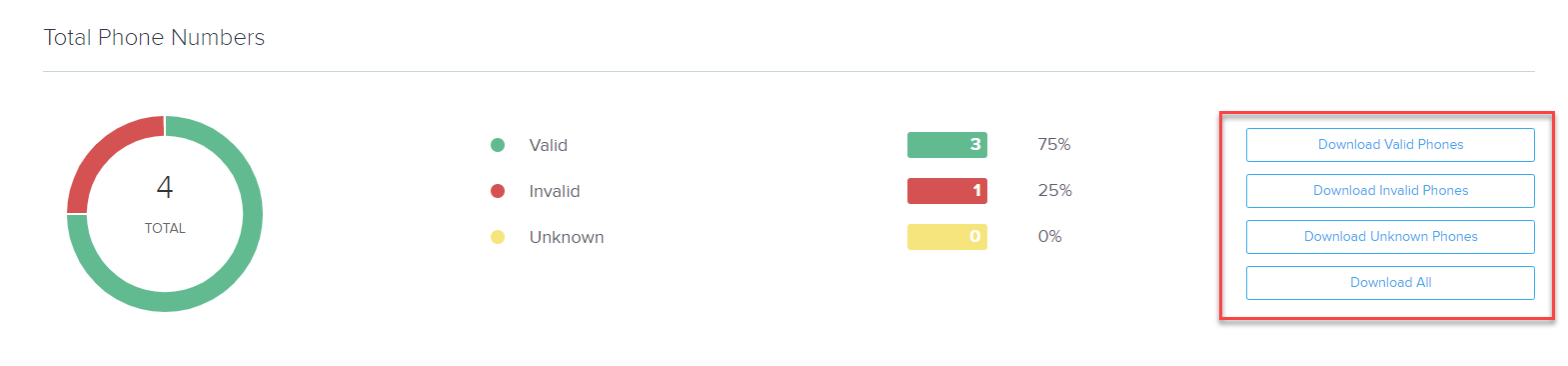
Phone Validation: BriteVerify confirms phone numbers exist and classifies them by line type and location.
The phone validation feature checks whether a phone number exists in carrier network databases and returns three attributes per lookup: status (valid, invalid, or unknown), line type (landline, mobile, or VoIP), and location designation (residential, business, or small office).
Source: Validity
Line type detection matters for SMS compliance. Sending marketing texts to landlines is pointless, and routing certain messages to VoIP numbers may trigger carrier spam filters. The three-part output (status, line type, location) provides routing intelligence rather than a simple pass/fail.
Coverage is limited to US and Canada. Both real-time and batch processing modes are available, sharing the same rate limits as email verification.
Address Validation: BriteVerify checks physical mailing addresses against USPS CASS-certified databases.
For businesses running direct mail campaigns or fulfillment operations, BriteVerify validates US mailing addresses through USPS CASS (Coding Accuracy Support System) certified databases.
The service checks street addresses, city, state, and postal code, then reformats them to USPS preferred style (standardizing abbreviations, normalizing directional prefixes, and appending ZIP+4 where available).
The API returns 14 distinct error codes covering specific problems: street_number_invalid, suite_missing, non_deliverable_address, zip_code_invalid, and others. A suite_missing result prompts a different follow-up action than a non_deliverable_address result, so teams can target specific issues for re-collection rather than discarding entire records.
Address validation is US-only, tied to USPS CASS certification. Whether BriteVerify supports international address validation is not publicly documented.
Duplicate Management & Data Quality: DemandTools provides CRM deduplication and monitoring within the same platform.
Within Validity Engage, DemandTools' duplicate management handles the CRM hygiene work that verification alone cannot address.
It uses 20 matching algorithms across three precision tiers (exact, relaxed, and cleaned field) to catch duplicates that Salesforce's native rules miss. Cross-field matching (comparing Email against Alternate Email, or Phone against Mobile) catches duplicates that same-field comparisons overlook.
The system ships with 29 pre-built deduplication scenarios covering common use cases, and supports fuzzy and phonetic matching for spelling variations and homophones. Merge rules operate at two layers: Winner Rules select which record becomes the master, and Field Rules specify per-field value retention (newest phone number from one record, oldest account owner from another).
DupeBlocker prevents duplicates in real time at the point of record creation, and JobBuilder automates scheduled deduplication runs.
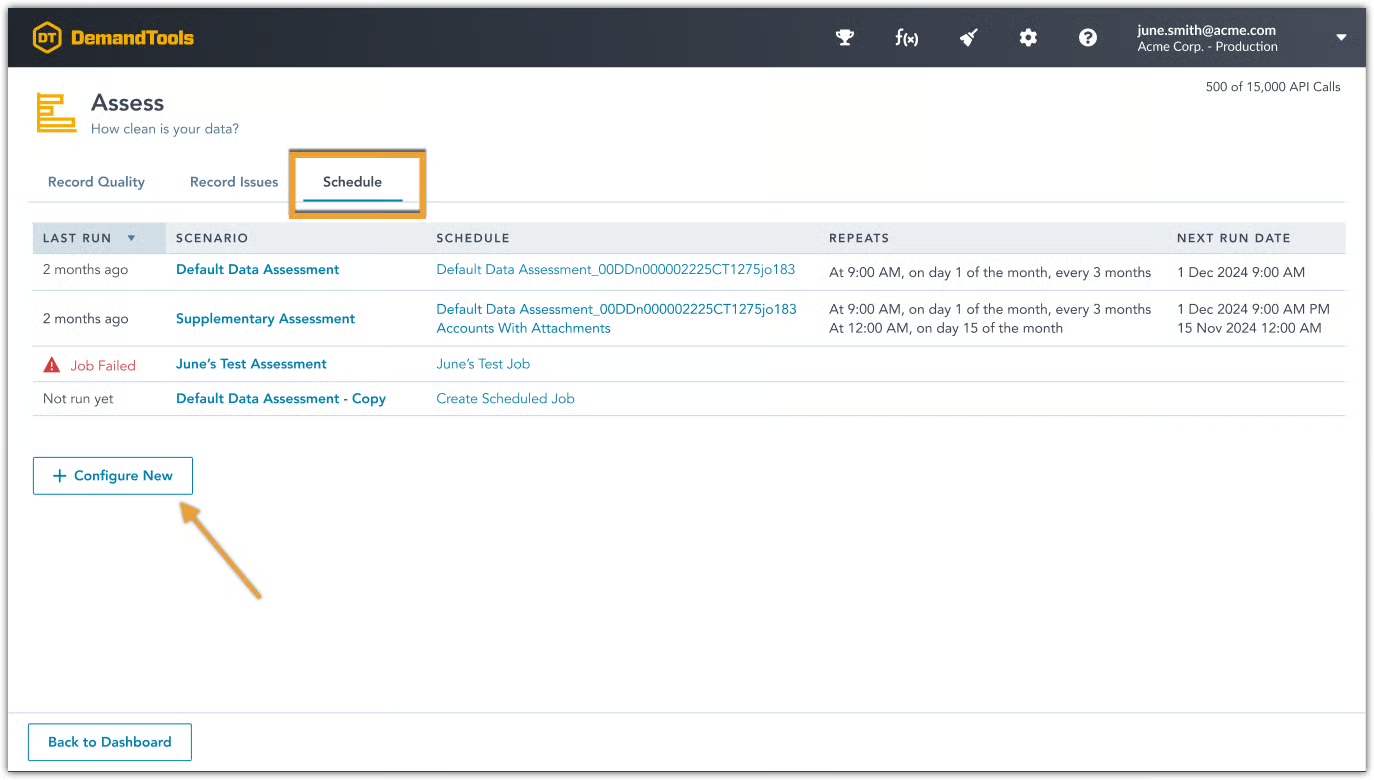
The Assess module monitors CRM data health across six dimensions (duplicates, invalid emails, missing engagement points, missing business segmentation, incomplete decision support, and malformed content), scoring records into five tiers from "Unactionable" to "Validified."
Source: Validity
DemandTools is available for both Salesforce and Dynamics 365.
Integrations: BriteVerify connects natively with Salesforce and several ESPs, with Zapier for broader reach.
BriteVerify offers a native Salesforce integration for real-time email verification within CRM records without export/import cycles.
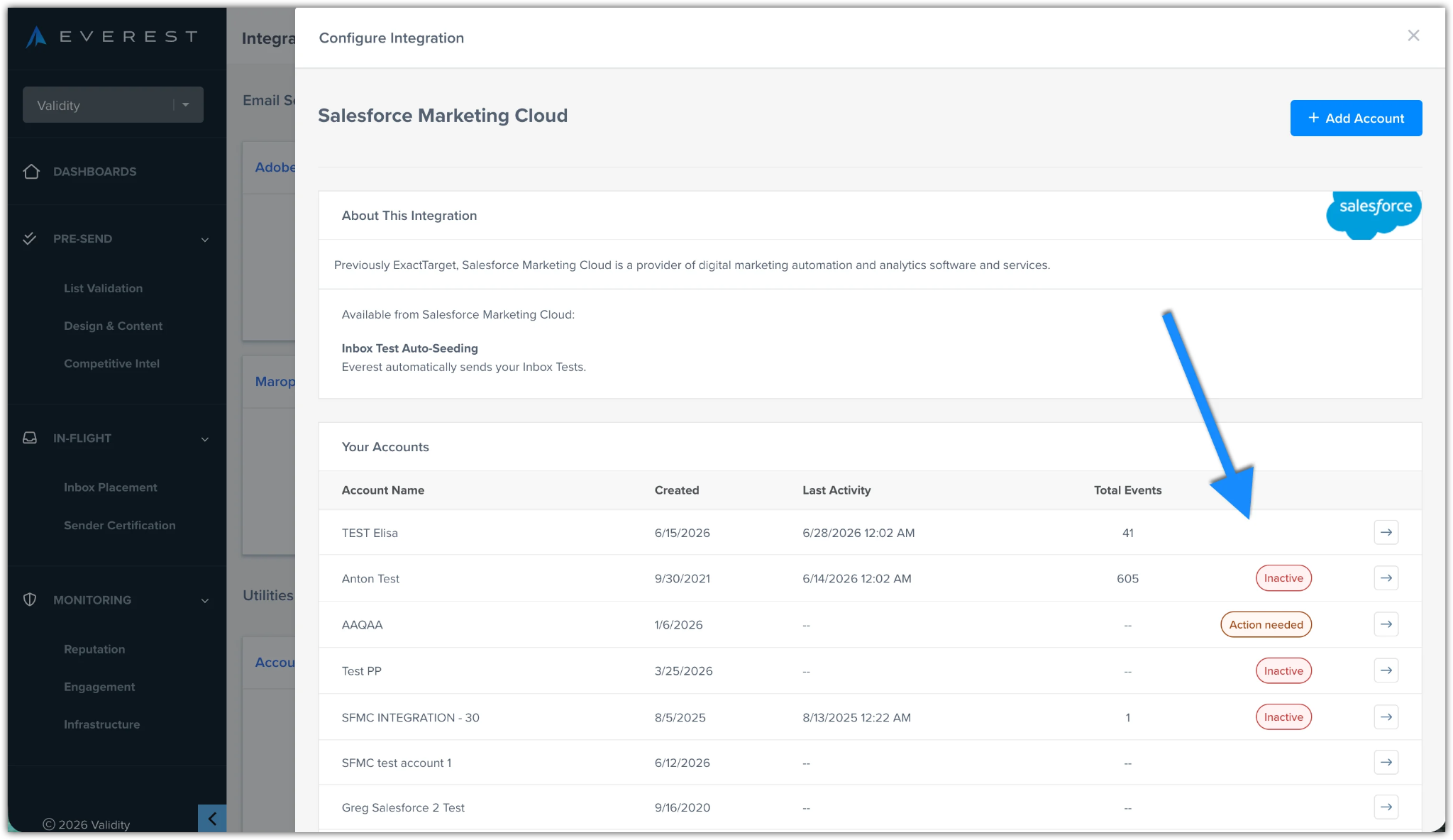
Source: Validity
An Iterable integration supports pre-send list hygiene within Iterable campaigns. The SendGrid integration transfers verified lists back to SendGrid accounts directly.
For platforms without native connectors, BriteVerify maintains a Zapier app with pre-built templates connecting to Google Sheets, Airtable, HubSpot, Marketo, Pardot, Mailchimp, Slack, and Gravity Forms. Additional iPaaS connectors exist through Tray.ai and Appmixer.
The dedicated integrations page at validity.com/briteverify/integrations/ currently returns a 404, indicating the full catalog has not yet migrated to the Validity Engage site structure. No official SDKs are published in any language; the API documentation provides only cURL examples.
Where BriteVerify Falls Short
BriteVerify handles contact verification reliably at scale, but several limitations surface for teams whose data quality needs extend beyond validation.
Verification Only, No Enrichment. BriteVerify validates what you bring it. It cannot find new contacts, append missing fields, or build prospect lists. Teams doing outbound from purchased lists or expanding their addressable market still need a separate contact discovery vendor, leaving a gap between knowing an address is valid and knowing whether it belongs to someone worth contacting.
Catch-All Domain Blind Spot. BriteVerify returns a domain-level "Accept All" flag for catch-all servers but provides no individual mailbox-level probability score.
TrustRadius reviewers have flagged the desire for "more detailed results for unknown/accept all emails" as the most cited unmet need. On enterprise B2B lists, where catch-all configurations are common, this can suppress 10–30% of contacts as indeterminate, leaving senders to guess which addresses are real.
Opaque Pricing and Credit Expiry. BriteVerify does not publish pricing on its website. The pricing URL resolves to a lead form, not a pricing page. Credits are purchased in prepaid blocks and expire one year from purchase with no refunds for unused balances, penalizing seasonal senders who buy in advance. Multiple Capterra reviewers flag cost and credit structure as primary concerns.
No Standard Evaluation Path. The Terms of Service specify that trial duration is set at "Validity's sole and exclusive discretion" with no standard length advertised. Buyers cannot test accuracy on their own list type before committing to a credit purchase, a friction point in nearly every competitive evaluation.
Billing and Support Friction. Multiple reviewers on Capterra and G2 describe confusing billing communications and frustrating support experiences, particularly around credit consumption disputes and inconsistent verification results. A Capterra reviewer with 2+ years of use reported accuracy at roughly 80% compared to competitors, citing domain verification gaps.
US-Centric Physical Address Validation. Address validation is tied to USPS CASS-certified databases, making it US-only. Phone validation covers US and Canada only. The interface is English-only, which Capterra reviewers cite as a limitation for multinational deployments.
These limitations are not failures. They reflect BriteVerify's design as a focused verification tool within a larger Validity ecosystem. But for teams that need to find the right contacts, understand buyer intent, and act on signals (not just confirm that existing addresses are valid), a broader platform fills the gaps BriteVerify leaves open.
Top BriteVerify Alternative for Complete GTM Data: ZoomInfo
ZoomInfo addresses BriteVerify's scope limitations by operating at a different level.
Where BriteVerify answers "is this email address valid?", ZoomInfo answers "who should you be contacting, why now, and what should you say?" It is a GTM platform built on a large B2B data foundation, designed for teams that need the full lifecycle of contact intelligence, from discovery through engagement.
Comprehensive B2B Data: ZoomInfo provides the contacts BriteVerify can't find.
BriteVerify validates the data you already have. ZoomInfo builds the dataset itself.
The platform covers 500M contacts, 100M companies, 135M+ verified phone numbers, 120M direct-dial phone numbers, and 200M+ verified business email addresses. That data flows through a proprietary verification pipeline backed by 300+ human researchers and automated ML scanning of 28 million site domains daily, achieving up to 95% accuracy on first-party data.
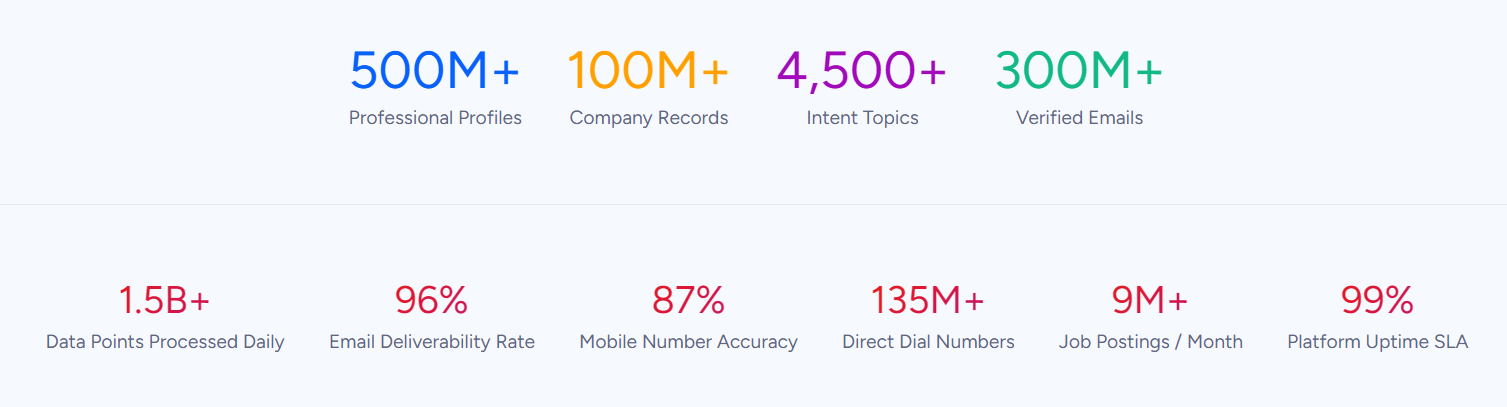
The difference goes beyond volume. ZoomInfo provides 300+ company attributes for market segmentation: firmographics, department org charts with direct dials and verified emails, technographic profiles tracking 30,000+ technologies across 30+ million companies, parent-child company hierarchies, and job-change alerts.
A verification tool tells you an email is deliverable. ZoomInfo tells you the recipient's title, department, direct dial, what technology their company uses, and whether they're researching solutions in your category.
This data advantage is externally validated. In a Fortune 500 competitive RFP analyzing 25 million contacts across vendors, the independent consultant concluded that "no other competitor came even close." ZoomInfo has been named a Leader in Gartner's MQ for ABM Platforms (2024 and 2025) and a Leader in Forrester's Wave for Intent Data Providers for B2B (Q1 2025).
Vensure Employer Solutions scaled prospecting with ZoomInfo's data. "ZoomInfo gives us the information we need to execute. We don't have to go through and spend our time digging. It's already there, so we can be three steps ahead," said William Kenimer, Vice President of Revenue Operations. (Vensure case study)
GTM Context Graph: ZoomInfo captures why deals move, not just what changed.
BriteVerify operates in isolation. It processes a list, returns statuses, and the interaction ends.
ZoomInfo's GTM Context Graph processes 1.5B+ data points daily, fusing ZoomInfo's third-party B2B data with a customer's own CRM records, conversation transcripts, email interactions, and behavioral signals into a single intelligence layer.
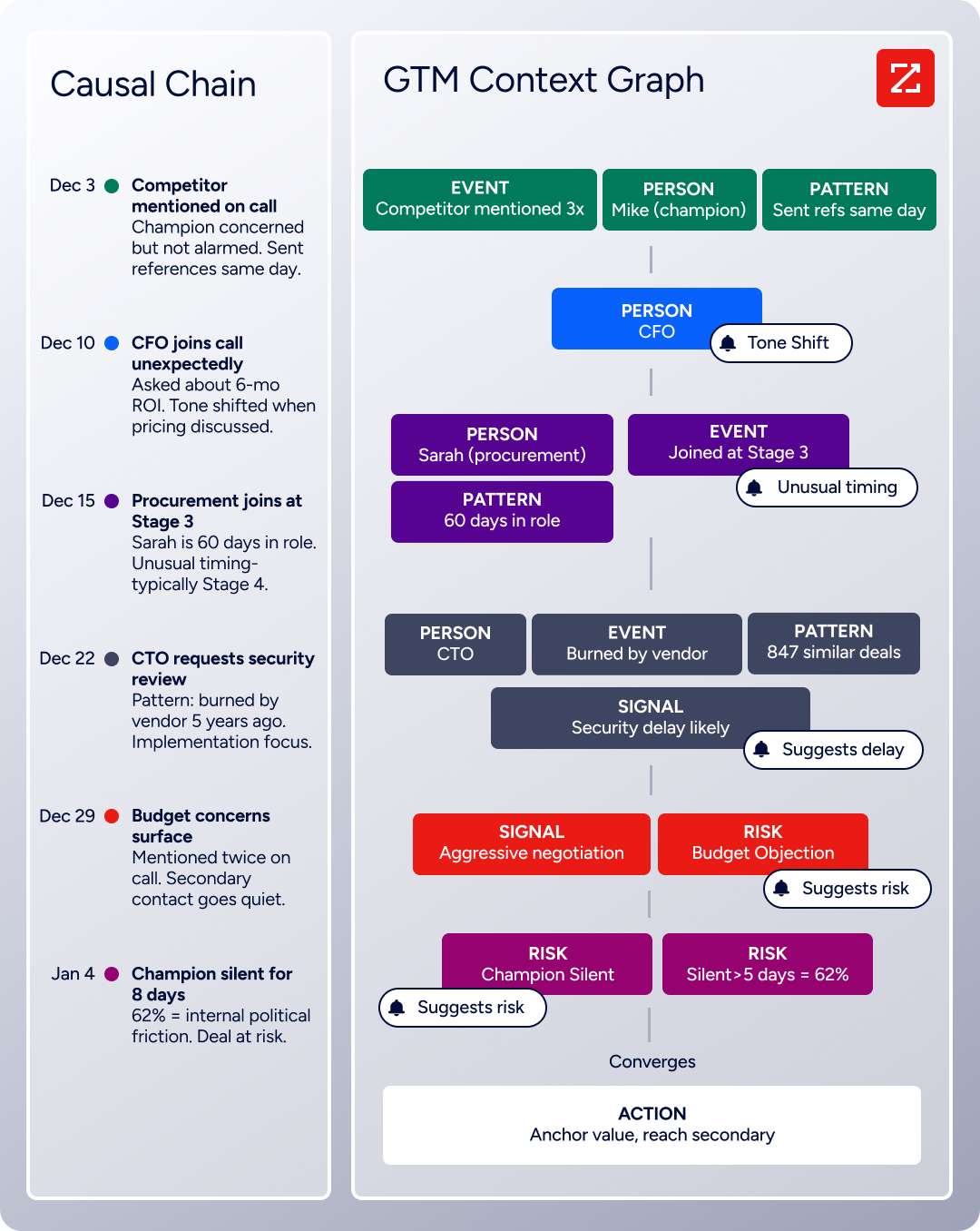
The practical difference: a CRM records that a deal moved from Stage 3 to Stage 4. The GTM Context Graph captures that the CFO joined the last call and asked about six-month ROI (the event that actually accelerated the deal), that a competitor was mentioned in a specific context, and that the company just posted three VP-level job openings, a hiring pattern that historically correlates with buying decisions.
Buyer Intent data tracks signals from 210 million IP-to-Organization pairings and 6 trillion+ new keyword-to-device pairings sourced monthly. Guided Intent, exclusive to ZoomInfo, identifies topics historically correlated with deal success in your specific segment rather than relying on manual topic selection.
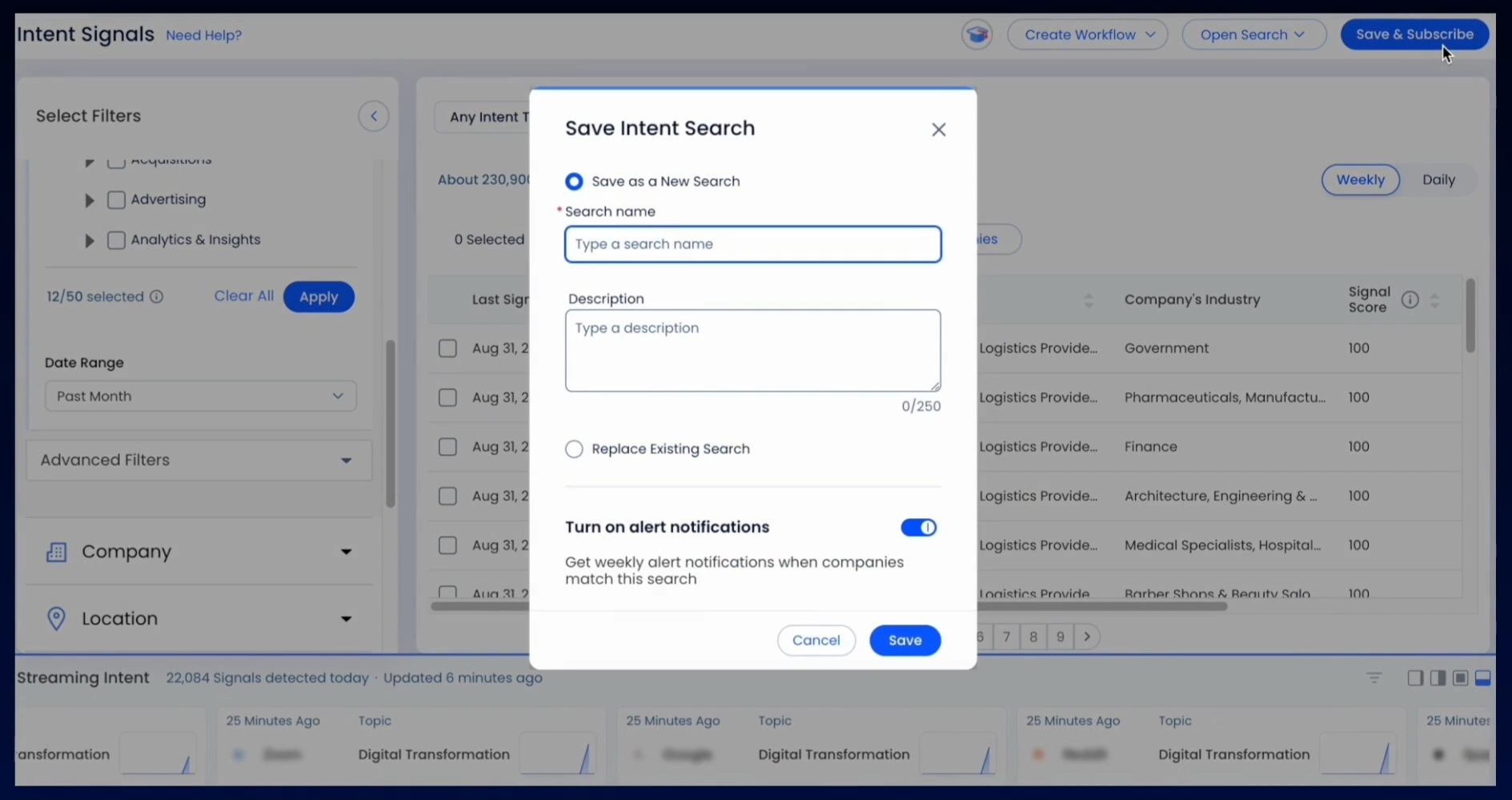
Source: ZoomInfo
For data quality, ZoomInfo Operations provides automated deduplication, verification, and multi-vendor enrichment from roughly 60 vendors through a codeless interface, with perimeter protection that blocks bad data at entry. This handles the same CRM hygiene work BriteVerify and DemandTools address, but within a platform that also powers prospecting, intent monitoring, and campaign execution.
Seismic's sales team attributed 39% of active pipeline to opportunities identified or influenced by ZoomInfo signals, and boosted productivity by 54%. "That combination of our internal CRM data, external signals, and AI that's given all that context has helped us craft very specific account- and persona-based messages. And people have responded to them right away," said Toby Carrington, Chief Business Officer. (Seismic case study)
Seller and Marketing Execution: ZoomInfo turns data into action across GTM channels.
BriteVerify's output is a verified list. What happens next requires other tools. ZoomInfo closes that gap with dedicated execution tools.
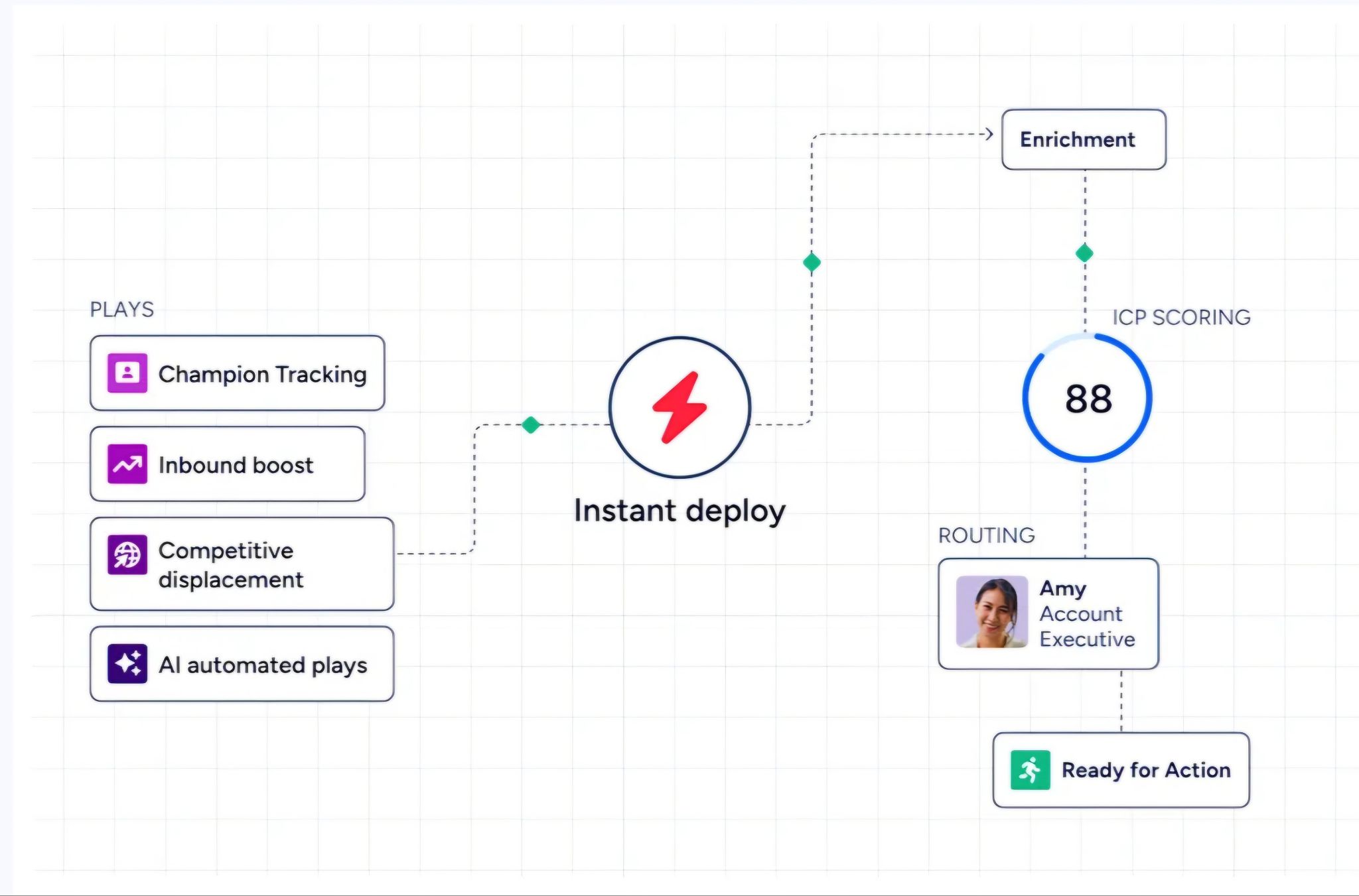
GTM Workspace gives sellers a single workspace where prioritized accounts, AI-drafted outreach, and deal execution converge. Built on Anthropic's Claude, AI agents research accounts, generate follow-ups, monitor signals, draft outreach, and update CRM fields. The Action Feed delivers a live stream of in-market buyers matched to target criteria, with pre-drafted actions on every signal.
GTM Studio gives marketers and RevOps teams an AI-powered canvas where audience definition, campaign orchestration, and pipeline measurement happen in natural language. Expansion plays that used to take three weeks now launch in 30 minutes without engineering support.
Source: ZoomInfo
For teams building beyond ZoomInfo's own products, APIs and MCP expose the same intelligence to any custom agent, internal tool, or partner platform. The MCP server connects directly to AI models like Claude and ChatGPT, with no custom coding required.
BDO Canada activated ZoomInfo's data directly within internal systems. "The plug-and-play aspect of the API means I can integrate it very easily into any process and get information at a moment's notice," said Jerry Wilson, Senior Marketing Intelligence Analyst, reporting an 87% reduction in time spent on updates to their internal data dashboards. (BDO Canada case study)
Accessible Entry Points: ZoomInfo offers a permanent free tier and a 7-day trial.
Unlike BriteVerify's opaque evaluation process, ZoomInfo provides two clear entry points.
ZoomInfo Lite is a permanent free tier (no credit card, no time limit) with access to the B2B database, 10 monthly export credits, individual and company searches with advanced filters, the ReachOut Chrome Extension, and WebSights Lite with up to 10 website visitor reveals per day.
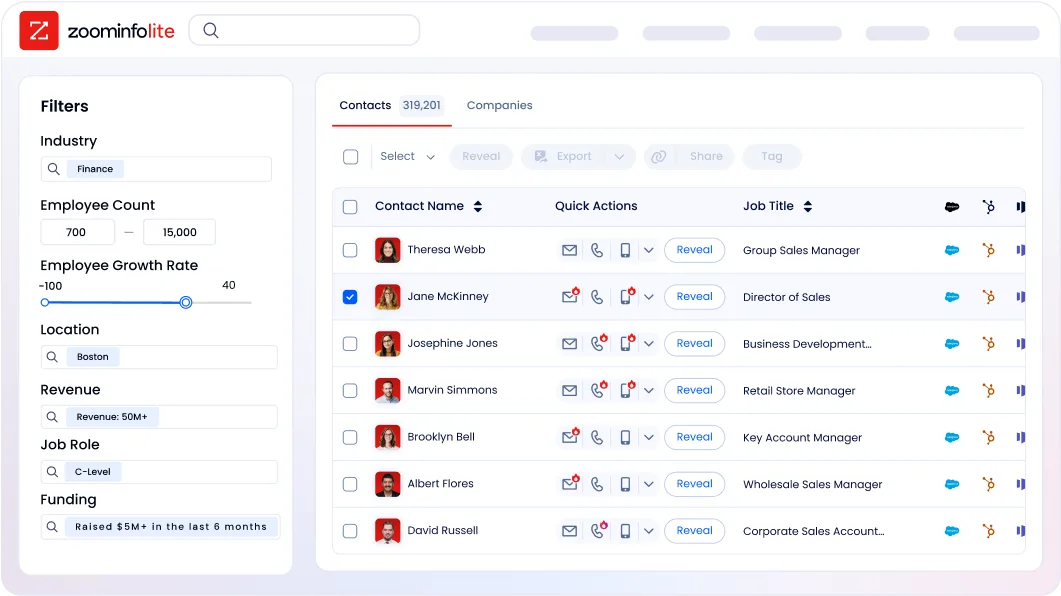
A separate 7-day free trial provides access to core platform features including contact and company search, intent signals, and email outreach.
Paid plans are organized into Sales, Marketing, and Chorus tiers. ZoomInfo uses a consumption-based pricing model where customers pay based on usage (seats, credits, API consumption, and AI activity). No prices are published; all paid plans are custom-quoted. API access is included in all relevant plans.
BriteVerify or ZoomInfo: Comparison Summary
Aspect | BriteVerify | ZoomInfo |
|---|---|---|
Primary function | Contact data verification | AI GTM platform |
Data scope | Validates existing contacts | 500M contacts, 100M companies, 200M+ emails, 135M+ phones |
Email verification | Four-layer pipeline (syntax, domain, MX, SMTP) | Built-in verification plus enrichment from ~60 vendors |
Phone validation | US/Canada; status, line type, location | 135M+ verified globally; direct dials included |
Contact discovery | Not available | Full prospecting with 300+ company attributes |
Intent signals | Not available | 210M IP-to-Org pairings, 6T+ keyword-to-device signals monthly |
CRM integrations | Salesforce (native) | Salesforce, HubSpot, Dynamics 365 + 120+ marketplace partners |
AI capabilities | Typo correction at signup | AI agents for outreach, research, CRM updates, signal monitoring |
Free tier | No standard trial; terms at Validity's discretion | ZoomInfo Lite (permanent, free) + 7-day trial |
Pricing model | Prepaid credit blocks (expiry after 1 year) | Consumption-based; custom-quoted |
Catch-all handling | Domain-level flag only | Multi-source verification with enrichment context |
Best for | Enterprise email list hygiene within Validity ecosystem | Teams needing the full cycle: find, verify, enrich, engage |
Final Verdict
The choice between BriteVerify and ZoomInfo depends on whether your data quality challenge is about verification alone or extends into discovery, intelligence, and action.
Choose BriteVerify if your contact lists are already built and your primary need is cleaning them before sends. It fits well within the Validity Engage ecosystem, particularly for Salesforce-centric teams that already use Everest for inbox monitoring or DemandTools for CRM deduplication.
The multichannel verification (email, phone, and postal address in one platform), processing speed, and security certifications make it a reliable choice for high-volume, hygiene-focused operations.
Choose ZoomInfo if verification is only one part of what you need. When the real challenge is finding the right contacts, understanding when they're in-market, and reaching them with informed outreach, ZoomInfo covers the full scope.
Its data foundation, intent signals, AI-powered execution tools, and access through APIs and MCP make it the platform for teams that want to move from reactive list cleaning to proactive pipeline generation, with verification built into the workflow rather than bolted on separately.
Get started with ZoomInfo Lite for free here.
The difference is scope. BriteVerify confirms that the contacts you have are reachable. ZoomInfo helps you find the contacts you should have, understand why they matter now, and act on that intelligence before your competitors do.
BriteVerify FAQ
What does BriteVerify do?
BriteVerify is a contact data verification service that validates email addresses, phone numbers, and physical mailing addresses. It runs each email through a four-layer check (syntax, domain, MX records, and mailbox existence) and returns a status of valid, invalid, or risky. It is now part of the "Contact Data Quality" capability within Validity Engage.
ZoomInfo also verifies data but extends into contact discovery, enrichment, intent signals, and AI-powered sales and marketing execution.
How much does BriteVerify cost?
BriteVerify does not publish pricing on its website. The pricing URL redirects to a lead form. It operates on a prepaid credit model where each credit equals one verification. Credits are purchased in blocks and expire one year from purchase with no refunds for unused balances.
ZoomInfo also uses custom-quoted pricing but offers a permanent free tier (ZoomInfo Lite) with 10 monthly export credits and a 7-day free trial, giving buyers two ways to evaluate before committing.
Does BriteVerify offer a free trial?
BriteVerify's Terms of Service state that trial duration is determined at Validity's "sole and exclusive discretion" with no standard length advertised. There is no permanent free plan.
ZoomInfo offers both a permanent free tier (ZoomInfo Lite, no credit card or time limit) and a separate 7-day free trial with access to core features including contact search, intent signals, and email outreach.
How accurate is BriteVerify on catch-all domains?
BriteVerify returns a domain-level "Accept All" flag for catch-all servers but does not provide individual mailbox-level probability scores. TrustRadius reviewers have cited this as the most common unmet need. On enterprise B2B lists where catch-all configurations are common, this can leave 10–30% of contacts in an indeterminate state.
ZoomInfo's multi-source verification pipeline and enrichment layer provide additional context for resolving ambiguous addresses.
Does BriteVerify verify phone numbers and addresses?
Yes. Phone validation covers the US and Canada, returning status, line type (landline, mobile, or VoIP), and location designation (residential, business, or small office). Address validation checks US mailing addresses against USPS CASS-certified databases. Both features are limited to North America.
ZoomInfo's database includes 135M+ verified phone numbers with global coverage, including 45M+ mobile numbers outside North America.
Can BriteVerify help find new contacts?
No. BriteVerify validates contacts you already have but does not offer contact discovery, data enrichment, or list building. Teams doing outbound prospecting or expanding their addressable market need a separate vendor for contact sourcing.
ZoomInfo covers both verification and discovery, providing access to 500M contacts with firmographic, technographic, and intent data for building targeted prospect lists.
What CRM integrations does BriteVerify support?
BriteVerify offers a native Salesforce integration for real-time in-CRM verification, an Iterable integration for pre-send list hygiene, and a SendGrid integration for verified list transfer. Broader connections are available through Zapier, Tray.ai, and Appmixer.
ZoomInfo integrates natively with Salesforce, HubSpot, and Microsoft Dynamics 365, operates a marketplace with 120+ integration partners, and provides APIs and an MCP server for connecting to any custom tool or AI agent.
Who should use BriteVerify versus ZoomInfo?
BriteVerify suits enterprise marketing teams that already have their contact lists built and need reliable, high-volume verification before campaign sends, especially within a Salesforce and Validity ecosystem.
ZoomInfo suits teams that need to find the right contacts, understand buyer intent, and take action, not just confirm existing addresses are valid. If verification is your entire data quality need, BriteVerify handles it. If verification is one step in a larger go-to-market motion, ZoomInfo covers the full workflow.
Researching BriteVerify? These comparisons and alternatives help you decide:
