
Choosing between Cirrus Insight and Salesloft comes down to five questions:
Do you need a tool that keeps reps productive inside their inbox, or a platform that coordinates multi-channel engagement across the revenue cycle?
Is your main challenge getting reps to log activity in Salesforce, or getting them to execute the right outreach at the right time?
Are you looking for a lightweight CRM add-on, or a full system with AI agents, deal management, and forecasting?
Does your team run on email and calendar, or do they need phone, SMS, LinkedIn, and website chat working together?
Is your prospect data good enough to make any engagement tool effective?
In short, here's what we recommend:
Cirrus Insight is built for Salesforce teams that want to close the gap between their inbox and their CRM. It embeds Salesforce data inside Gmail and Outlook, letting reps view contacts, log emails, track engagement, and schedule meetings without leaving their email client. With modular pricing starting at $5/user/month per feature, it's an accessible entry point for teams whose biggest problem is CRM adoption. But Cirrus Insight works only with Salesforce, focuses on email, and lacks the multi-channel sequencing, deal management, and forecasting that larger sales organizations need.
Salesloft is a revenue orchestration platform for mid-market and enterprise sales teams that need to coordinate prospecting, deal execution, coaching, and forecasting in one system. Its multi-channel Cadence engine, AI-powered Rhythm prioritization, Conversations intelligence, and Deals pipeline management give revenue leaders visibility from first touch to closed-won. The trade-off is complexity: Salesloft requires implementation investment, doesn't publish pricing, and demands dedicated RevOps support to reach its potential.
Both platforms help sales teams execute. But execution without intelligence produces activity with uncertain results. Reps can send well-timed sequences and log every email to Salesforce, but if they're reaching the wrong people, missing buying signals, or working from incomplete data, the pipeline suffers. That's where ZoomInfo fits in.
ZoomInfo is an AI GTM platform built on a data foundation of 500M contacts, 100M companies, 135M+ verified phones, and 200M+ verified business emails. Its GTM Context Graph processes 1.5B+ data points daily, unifying this data with your CRM records, conversation transcripts, and behavioral signals to reveal the full context of your accounts. That context fuels AI that shows not just what happened, but why it happened, and what your team should do next. Sellers access this intelligence through GTM Workspace, where AI agents handle account research, draft outreach, and surface next-best actions. Marketers and RevOps teams build and activate plays through GTM Studio. For teams using Salesloft, Cirrus Insight, or any other tool, ZoomInfo's APIs and MCP deliver the same intelligence into any workflow.
If you want to see how ZoomInfo's data and intelligence can drive your go-to-market motion, start a free trial.
Cirrus Insight vs. Salesloft vs. ZoomInfo at a glance
Cirrus Insight | Salesloft | ZoomInfo | |
|---|---|---|---|
Core function | Salesforce inbox integration | Revenue orchestration platform | AI GTM platform |
Primary strength | CRM adoption via inbox | Multi-channel engagement + AI agents | B2B data + GTM intelligence |
Channels | Email and calendar | Email, phone, SMS, LinkedIn, website chat | Prospecting, engagement, advertising, website chat, APIs |
CRM support | Salesforce only | Salesforce, HubSpot, Dynamics | Salesforce, HubSpot, Dynamics |
AI capabilities | Meeting AI, CRM AI (emerging) | Dozens of AI agents | GTM Context Graph, GTM Workspace AI agents |
Conversation intelligence | Basic transcription + coaching | Full recording, analysis, coaching | Chorus (14 patents, full analysis) |
Deal management | None | AI risk detection, pipeline dashboard | GTM Workspace with deal intelligence |
Forecasting | None | AI Forecast with company-specific training | Signal-driven pipeline intelligence |
B2B data included | None | None (partner integrations) | 500M contacts, 100M companies, intent signals |
Pricing | $5–$20/user/month per feature | Not published (contact sales) | Custom-quoted; free tier available |
Free option | 14-day trial | No free plan or self-serve trial | ZoomInfo Lite (permanent free tier) + 7-day trial |
Two different approaches to helping reps sell
Cirrus Insight and Salesloft solve different problems for different teams.
Cirrus Insight starts from a simple observation: sales reps spend most of their day in email, but their CRM data lives in Salesforce.
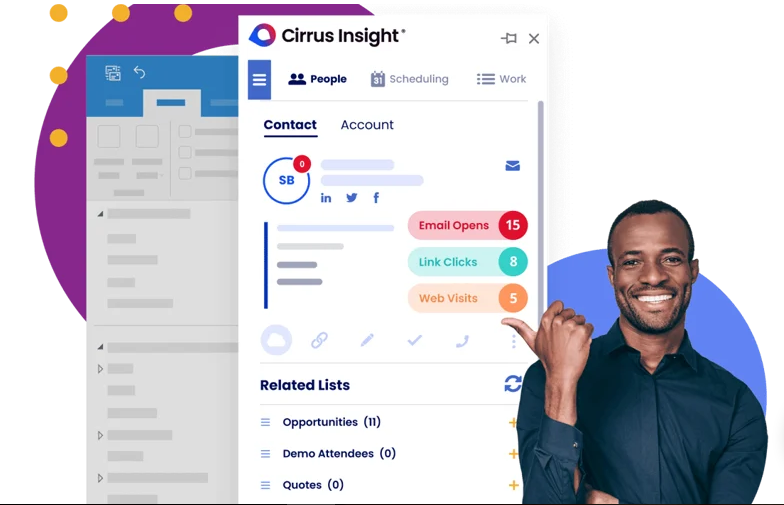
The Salesforce Sidebar bridges that gap by embedding live CRM records inside Gmail or Outlook. Reps can view contacts, update opportunities, and log activity without switching tabs. Salesforce Sync captures 100% of emails, meetings, and tasks automatically, addressing the reality that 40% of activity updates never reach the CRM.
Source: Cirrus Insight
Salesloft starts from a broader premise: revenue teams need one system that coordinates every interaction across the buyer lifecycle.
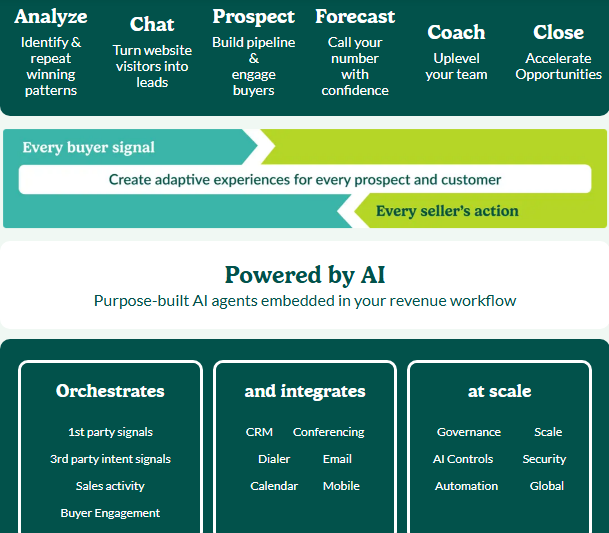
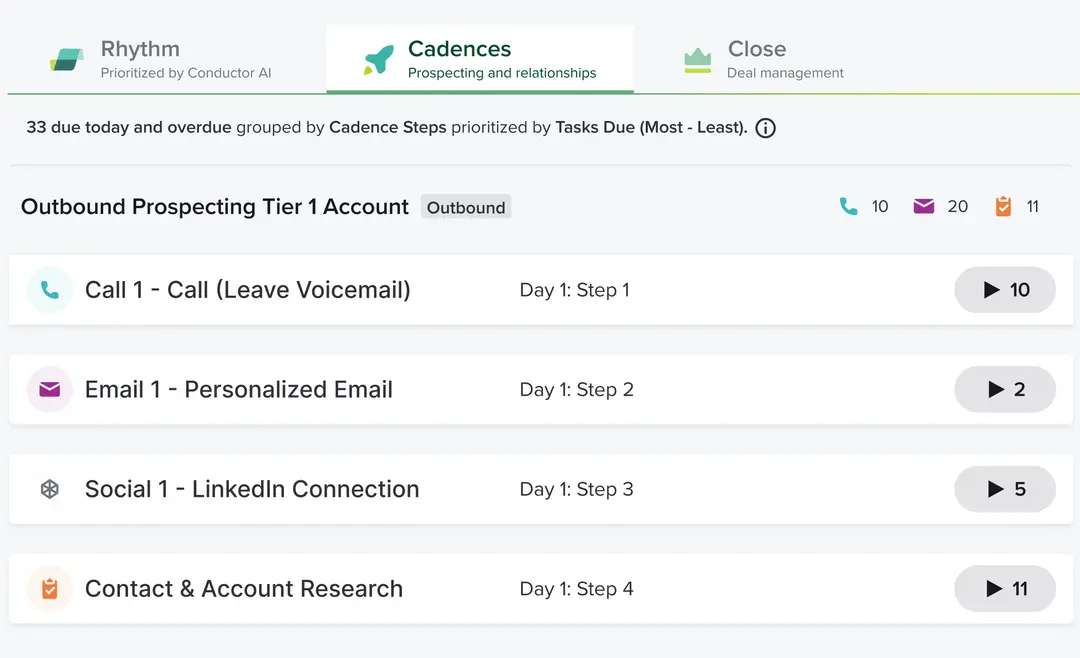
Instead of making email work better with Salesforce, Salesloft orchestrates multi-channel sequences across email, phone, SMS, LinkedIn, and website chat into structured cadences. Its Rhythm engine then ranks which actions a rep should take next, based on AI analysis of buyer signals across all those channels.
Source: Salesloft
The difference shows up in daily workflow.
A Cirrus Insight user opens their inbox, sees the Salesforce sidebar populate with account data, logs an email, checks buyer signal scores, and schedules a meeting. A Salesloft user opens a prioritized action feed, executes a multi-step cadence across channels, reviews AI-generated call summaries, and inspects deal health with risk flags.
Neither approach is wrong. They serve different levels of sales complexity.
CRM integration depth: Cirrus Insight's core advantage
Cirrus Insight's Salesforce integration goes deeper than what most engagement platforms offer.
The product writes data to standard Salesforce objects, making all captured activity available through Salesforce's native reporting and dashboards.
This matters.
Some sync tools store activity in proprietary databases that can't be queried inside Salesforce. Cirrus Insight has passed the Salesforce security review for 10+ consecutive years, supporting OAuth 2.0, SSO, and TLS encryption across Professional, Enterprise, Unlimited, and Experience Cloud editions.
For CRM admins, the customization options count.
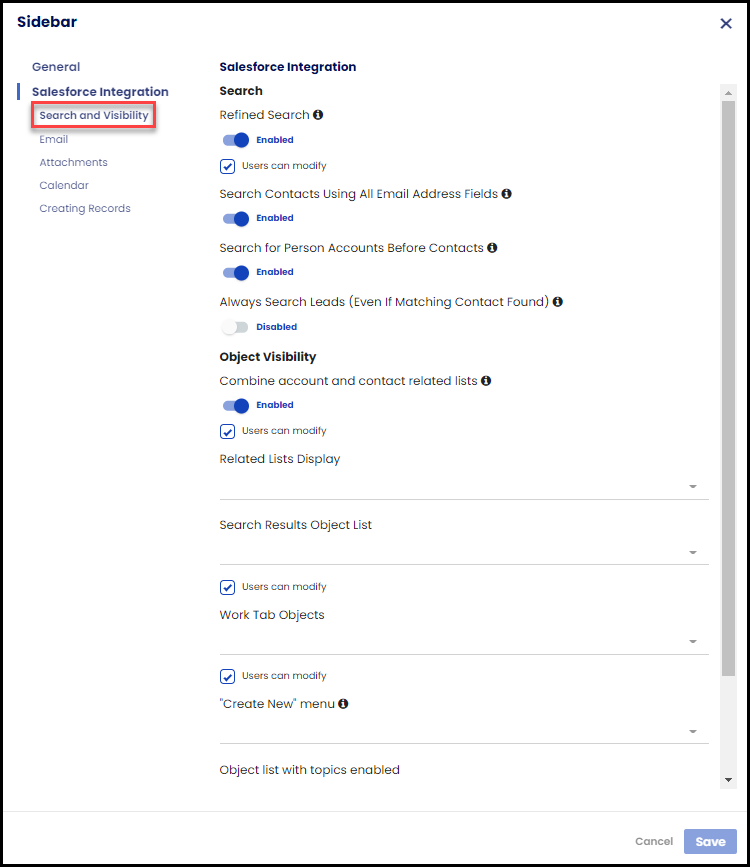
Admins can adjust sidebar layouts independently of Salesforce page layouts, block specific domains from triggering record lookups, and control which features individual users see. Thread-Based Smart Link maintains record associations across an entire email thread, even when ownership changes mid-conversation.
Source: Cirrus Insight
Wenger Corporation estimated that Cirrus Insight saves 30 minutes per user per day across 80+ professionals. OpenTable captured more than 100,000 data points from rep inboxes and calendars.
Salesloft also syncs with Salesforce (plus HubSpot and Dynamics), and its bi-directional CRM sync works well. But Salesloft treats CRM integration as one feature among many. Cirrus Insight treats it as the product's reason for existing.
Multi-channel engagement: Salesloft's defining strength
Salesloft's Cadence module goes well beyond what Cirrus Insight's email-focused approach can offer.
A Salesloft cadence coordinates email, phone calls via a native dialer, SMS, LinkedIn InMail, and calendar booking into a single structured sequence. The platform supports 200+ integrations including Vidyard for video and LinkedIn Sales Navigator. AI email agents draft personalized messages using account research, role context, and past interactions.
Source: Salesloft
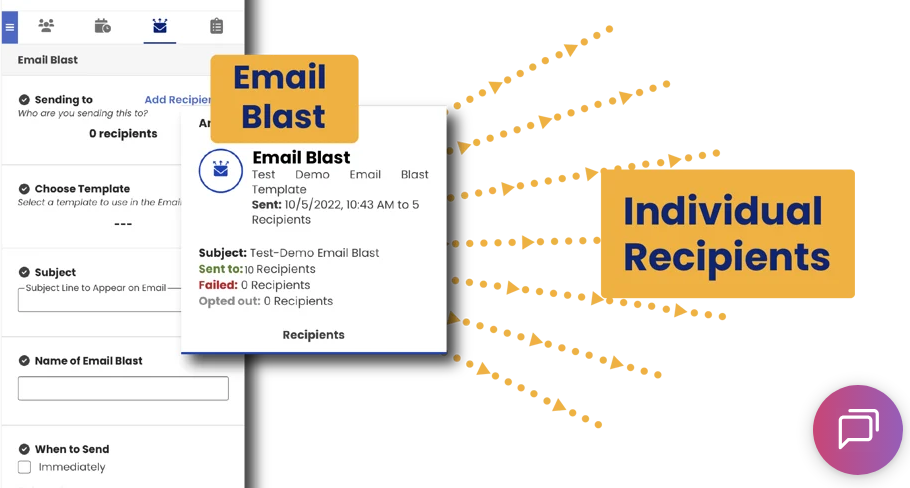
Cirrus Insight's outbound capabilities center on Email Blast, which lets reps send personalized mass emails from their own inbox using Salesforce merge fields.
It's useful for email-focused prospecting, and pulling recipient lists directly from Salesforce reports is a real workflow advantage. But there's no native dialer, no SMS, and no LinkedIn automation. For teams whose outreach is purely email-based, this may be enough. For teams running multi-channel motions, Salesloft covers far more ground.
Source: Cirrus Insight
Salesloft reports 4.7x engagement improvement from multi-channel cadences and a 60% increase in response-to-opportunity rate.
AI capabilities: from inbox assistance to autonomous agents
Both platforms are investing in AI, but at different scales.
Cirrus Insight's AI is organized into three capabilities.
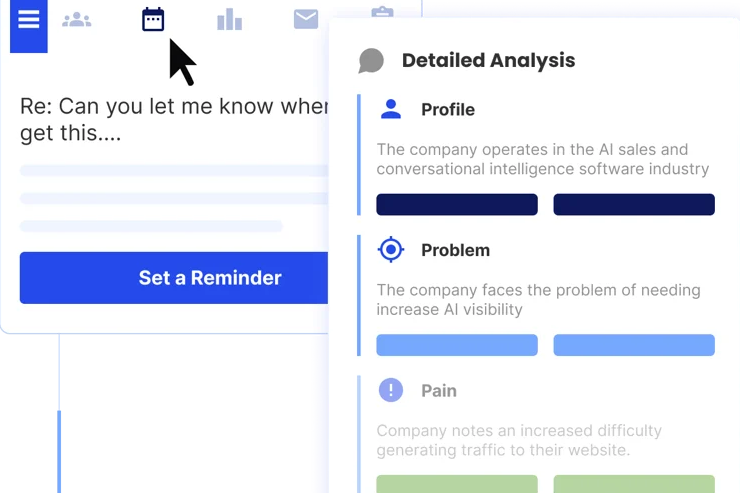
Meeting AI ($13/user/month) scans a rep's calendar each morning and delivers an AI-compiled briefing for every external meeting, pulling from public web sources and Salesforce data. CRM AI runs in the background, queuing suggested Salesforce updates (close amount, projected close date, key tasks) for one-tap approval. Conversation Intelligence provides meeting transcription, real-time coaching prompts during calls, and post-call action extraction.
Source: Cirrus Insight
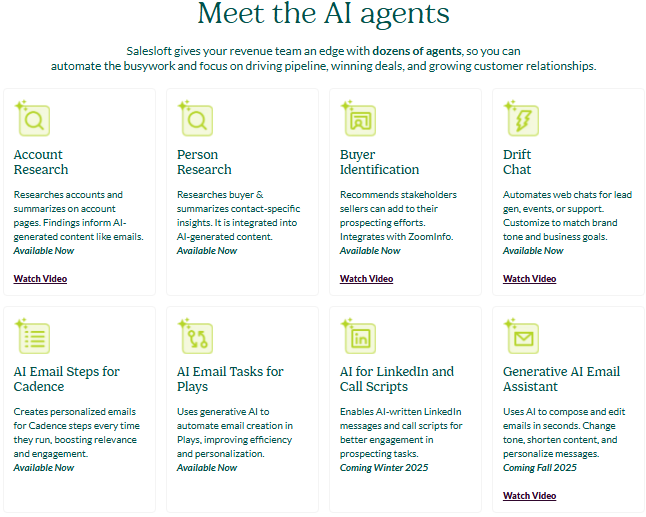
Salesloft's AI spans dozens of agents across the revenue cycle.
Account Research and Person Research agents automate pre-call preparation. The Rhythm Prioritizer ranks daily actions based on buyer signals. Conversation Summaries and Key Moments extract insights from call transcripts. Sales Methodology Extraction auto-populates MEDDPICC frameworks from recorded conversations.
The AI Forecast agent predicts deal outcomes using each company's historical data. And Create Your Own Agent lets teams build custom automations from proprietary signals.
Source: Salesloft
The scope difference reflects each platform's ambition. Cirrus Insight adds AI to make inbox workflows smarter. Salesloft builds AI agents to handle entire categories of sales work on their own.
The intelligence gap both platforms share
Here's what neither Cirrus Insight nor Salesloft can provide on their own: the underlying data that tells reps who to contact, whether those contacts are reachable, and whether an account is actually in-market.
Cirrus Insight surfaces whatever data already exists in your Salesforce instance.
If a contact record is missing a phone number, the sidebar shows a blank field. If your CRM has outdated company information, Meeting AI's briefing inherits that staleness. Cirrus Insight doesn't generate or verify prospect data. It works with what you already have.
Salesloft is the same.
Its AI agents can research accounts, draft emails, and prioritize actions, but the platform depends on data flowing in from external sources. The Buyer Identification agent integrates with data providers (ZoomInfo included) rather than maintaining its own contact database. Without a data layer feeding it, even well-built engagement sequences reach the wrong people or bounce off invalid addresses.
Source: Salesloft
This is the gap ZoomInfo fills.
ZoomInfo's data platform covers 500M contacts, 100M companies, 135M+ verified phones, 120M direct dials, and 200M+ verified business email addresses. That data runs through a verification pipeline backed by 300+ human researchers, achieving up to 95% accuracy on first-party data.
In a Fortune 500 competitive RFP analyzing 25 million contacts across vendors, the independent consultant concluded that "no other competitor came even close."
Source: ZoomInfo
The practical impact: when a rep opens ZoomInfo's GTM Workspace, they see verified direct dials that ring and email addresses that land. When a marketer builds an audience in GTM Studio, they're targeting a continuously verified census of their buyable market. And when any tool (including Salesloft or Cirrus Insight) connects to ZoomInfo via API or MCP, it inherits that same data quality.
"ZoomInfo gives us the information we need to execute. It's already there, so we can be three steps ahead." — William Kenimer, VP of Revenue Operations (Vensure)
From data to context: how ZoomInfo's intelligence layer works
The data is the foundation. What sets ZoomInfo apart is the GTM Context Graph.
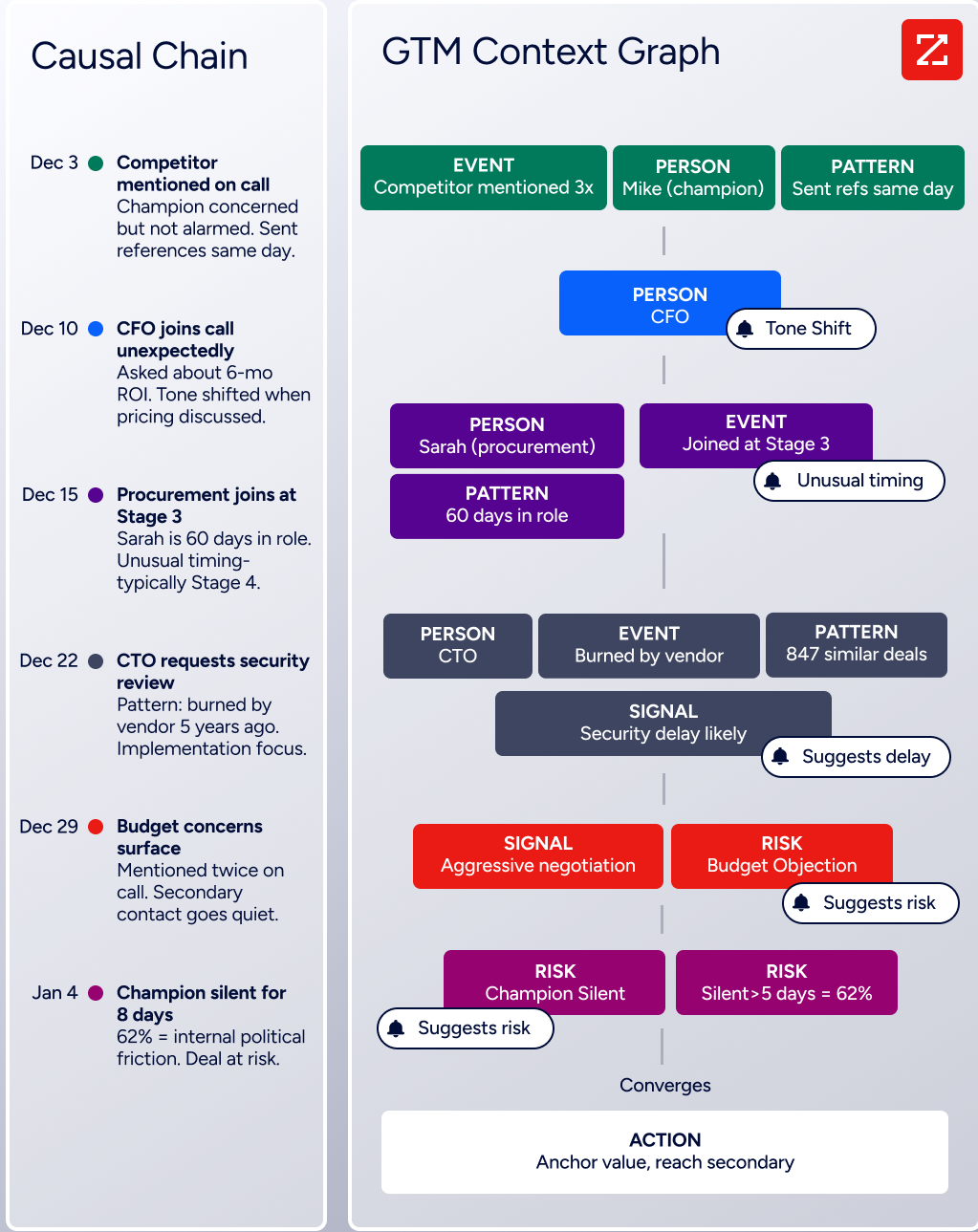
The GTM Context Graph processes 1.5B+ data points daily, combining ZoomInfo's third-party intelligence with a customer's CRM records, conversation transcripts, email interactions, and behavioral signals.
As ZoomInfo's CPO Dominik Facher writes: "The CRM recorded the state change. It has no record of why it happened." The GTM Context Graph captures that "why," connecting people, actions, outcomes, and patterns into a graph where AI can make smarter go-to-market decisions.
Source: ZoomInfo
For sellers, this means GTM Workspace doesn't just show that a deal moved to Stage 3. It understands that executive sponsorship entered at this stage, the CFO asked about six-month ROI, and these signals match the pattern behind closed-won deals in your segment. The follow-up email addresses the specific concern because the system understands why it matters. The forecast weights deals by buying evidence rather than stage labels.
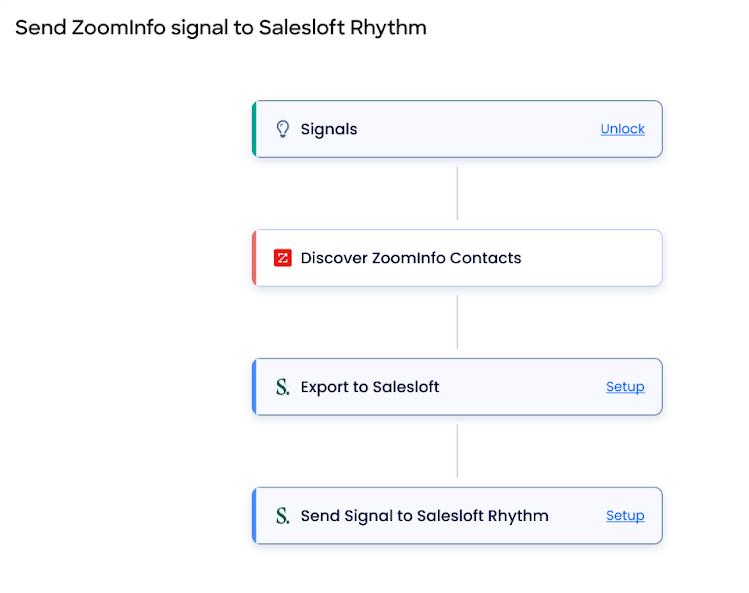
For teams using Salesloft's cadences, ZoomInfo's buying signal integration feeds intent data directly into Salesloft's Rhythm engine, triggering personalized outreach the moment a prospect starts researching. This signal-to-sequence flow is a direct example of ZoomInfo's intelligence powering a partner platform.
Source: Salesloft
"That combination of our internal CRM data, external signals, and AI that's given all that context has helped us craft very specific account- and persona-based messages. And people have responded to them right away." — Toby Carrington, Chief Business Officer, Seismic (Seismic Case Study)
Conversation intelligence: three different approaches
All three platforms now offer conversation intelligence, but the implementations vary.
Cirrus Insight's Conversation Intelligence covers pre-meeting, in-meeting, and post-meeting workflows.
A bot joins calls, records and transcribes, and a live coaching layer (Discovery AI) surfaces follow-up questions during the conversation. Post-call, the system drafts follow-up emails and extracts action items. It's billed hourly (roughly $300/month for a 10-person team for transcription alone) and is SOC 2 Type 2 compliant.
The three-phase coverage is broad for a tool at this price point, though specific accuracy benchmarks aren't publicly disclosed.
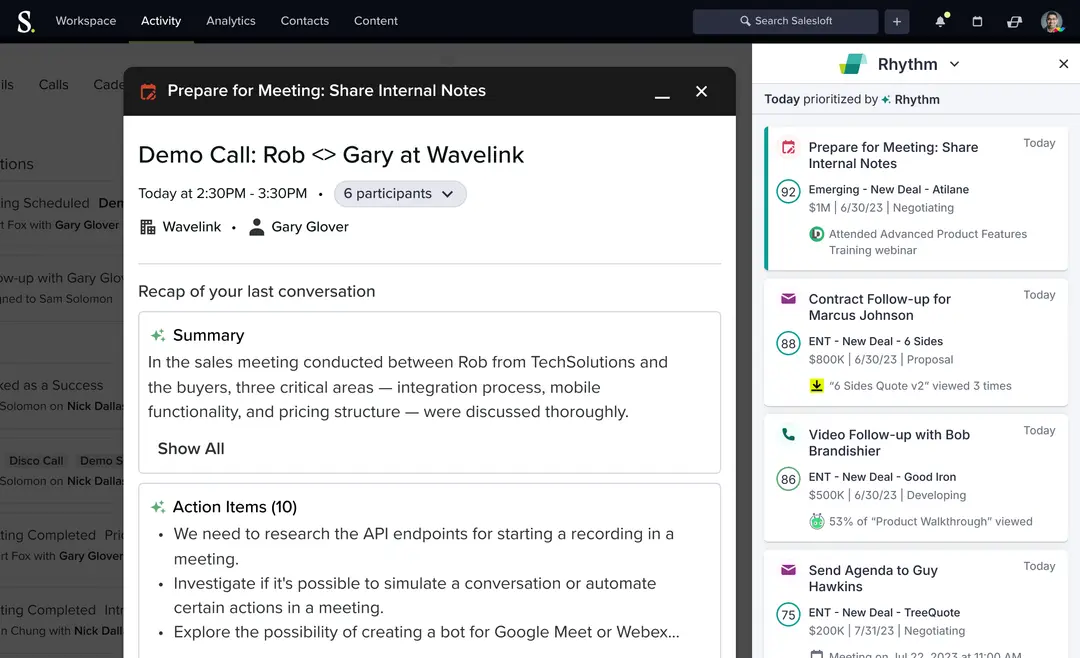
Salesloft's Conversations module is tightly integrated with its broader platform.
Call insights flow into Rhythm workflows, AI-assisted scorecards appear as prioritized coaching actions for managers, and Key Moments surface competitor mentions, objections, and decision-maker sentiment across calls. The integration with Deals means conversation data feeds directly into pipeline risk assessment.
Source: Salesloft
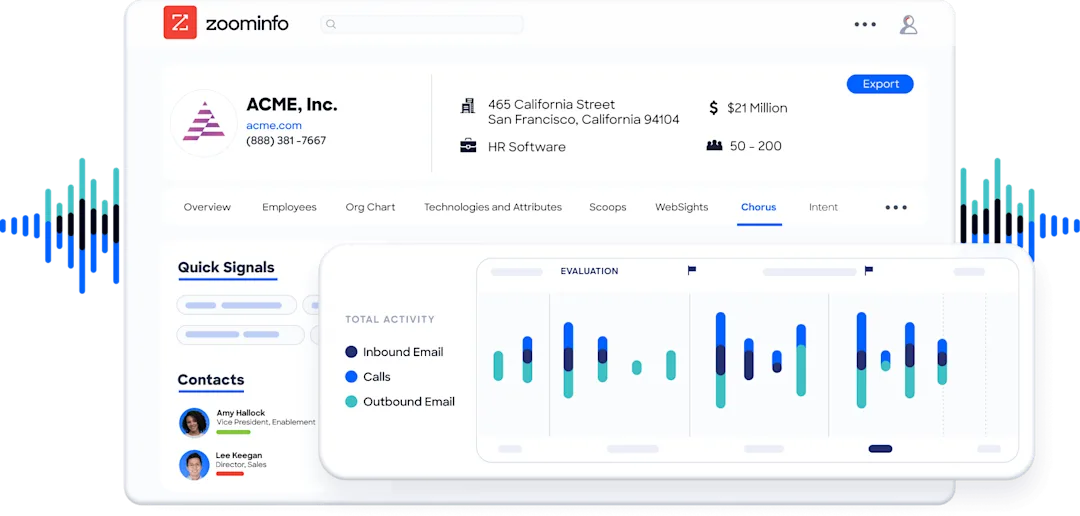
ZoomInfo's Chorus is backed by 14 technology patents and serves as the context capture engine for the GTM Context Graph.
Beyond transcription and coaching, Chorus extracts the signals behind deal movement: why a champion went quiet, what a competitive mention predicts about deal risk, how executive involvement at a given stage correlates with outcomes. Connected Intelligence surfaces ZoomInfo's full profile and relationship history for every call participant, without requiring a separate system.
Source: ZoomInfo
The distinction: Cirrus Insight and Salesloft capture what was said. Chorus captures why it matters, feeding those insights into the GTM Context Graph where they improve every subsequent recommendation.
Scheduling and meeting booking
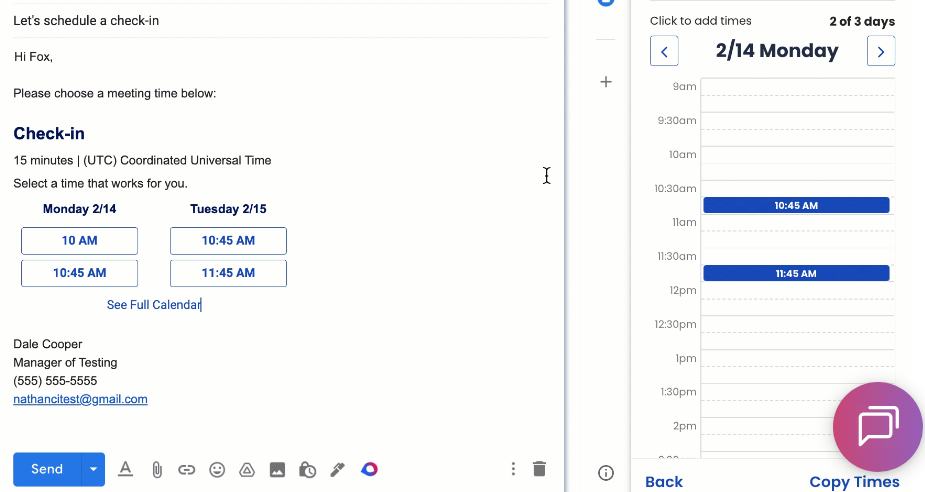
Scheduling is one area where Cirrus Insight competes directly with both standalone tools and platform features.
Cirrus Insight offers two scheduling products.
Calendar Scheduling ($7/user/month) handles individual rep scheduling with personalized booking pages, meeting types, SMS reminders, and automatic Salesforce sync. Smart Scheduler ($20/user/month) adds team-level lead routing with three distribution algorithms (Utilization, Customer Availability, and Match Maker), supporting up to 50 hosts per schedule, UTM code capture, and auto-creation of Salesforce Key Interactions.
The Salesforce depth here is notable: every booked meeting carries full attribution data natively, without middleware.
Source: Cirrus Insight
Salesloft includes calendar integration within Cadence, letting recipients schedule time directly from emails. It's a feature within the broader platform rather than a standalone product.
ZoomInfo's scheduling capability comes through GTM Workspace, where meeting booking sits alongside account research, outreach drafting, and signal monitoring. The scheduling action is part of a broader context-aware workflow rather than an isolated tool.
Pricing structures reflect different markets
Cirrus Insight's modular pricing is the most transparent of the three.
Each feature is priced independently, from $5/user/month for Email Sync to $20/user/month for Smart Scheduler. Teams select only the features they need, and annual billing provides a 20% discount. A concrete example from the pricing page: 10 users with 3 features costs $368/month at annual billing. Multi-year commitments offer discounts up to 40%. A 14-day free trial requires no credit card.
Salesloft does not publish pricing.
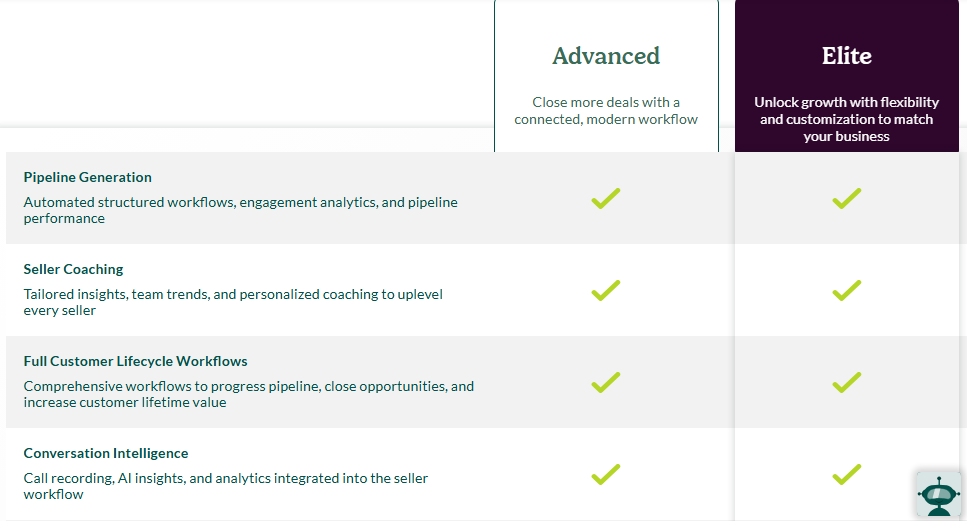
The pricing page lists four packages (Prospect, Sell, Engage, Enterprise) but requires contacting sales for a quote. All fees are non-cancelable and non-refundable, and multi-year subscriptions are committed for the full duration. Implementation, onboarding, and training are priced separately.
Additional costs include dialer overage charges (above 3,000 minutes/user/month pooled), Drift volume pricing, and Account Agent overages.
Source: Salesloft
For a deeper look at what each Salesloft package includes and how additional costs add up, see our Salesloft Pricing Breakdown.
ZoomInfo uses custom-quoted pricing based on seats, credit volume, features, and contract length.
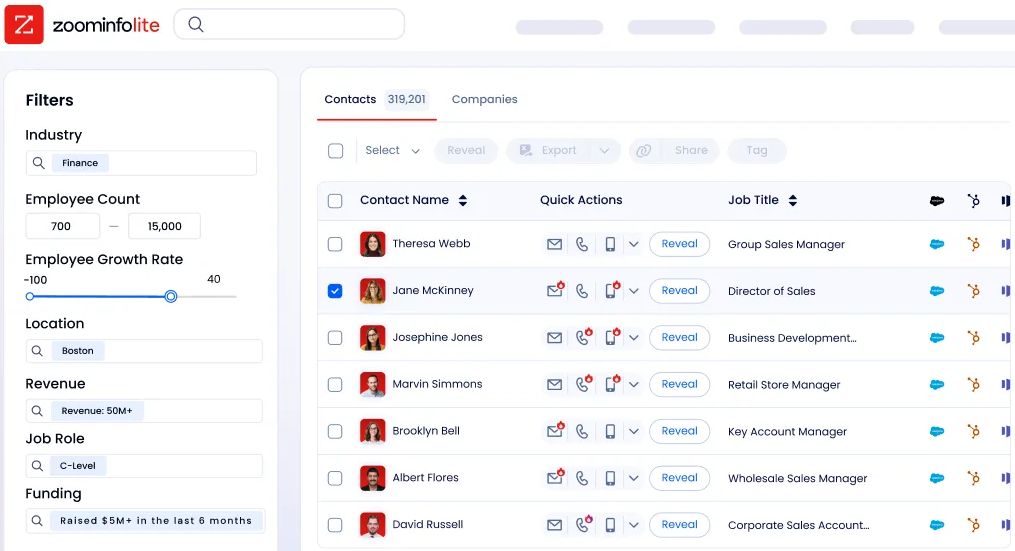
Transparency varies by tier, but ZoomInfo offers two free entry points that neither competitor matches: ZoomInfo Lite is a permanent free tier with access to the B2B database, 10 monthly export credits, Chrome extension, and website visitor reveals. A separate 7-day free trial provides fuller access to platform features.
Source: ZoomInfo
Note: ZoomInfo is transitioning toward a consumption-based pricing model.
For smaller teams, Cirrus Insight's a la carte model is the easiest to budget. For enterprise buyers evaluating Salesloft or ZoomInfo, the lack of published pricing means procurement requires sales conversations, though ZoomInfo's free tier lets teams test data quality before committing.
Security and compliance
All three platforms meet enterprise security requirements, with some differences in depth.
Cirrus Insight holds SOC 2 certification and has passed the Salesforce security review for 10+ consecutive years. Authentication uses OAuth only; Cirrus Insight does not store passwords for any third-party service.
The platform supports Citrix and Terminal Server deployments, which matters for financial services and healthcare organizations using virtual desktop infrastructure.
Salesloft maintains SOC 2 Type 2, ISO 27001, and ISO 27701 certifications. Its infrastructure runs on AWS and GCP in US and EU regions, with TLS 1.2+ in transit, AES-256-GCM at rest, WAF/EDR/XDR, and a zero-trust corporate IT model. GDPR compliance includes a DPA with Standard Contractual Clauses.
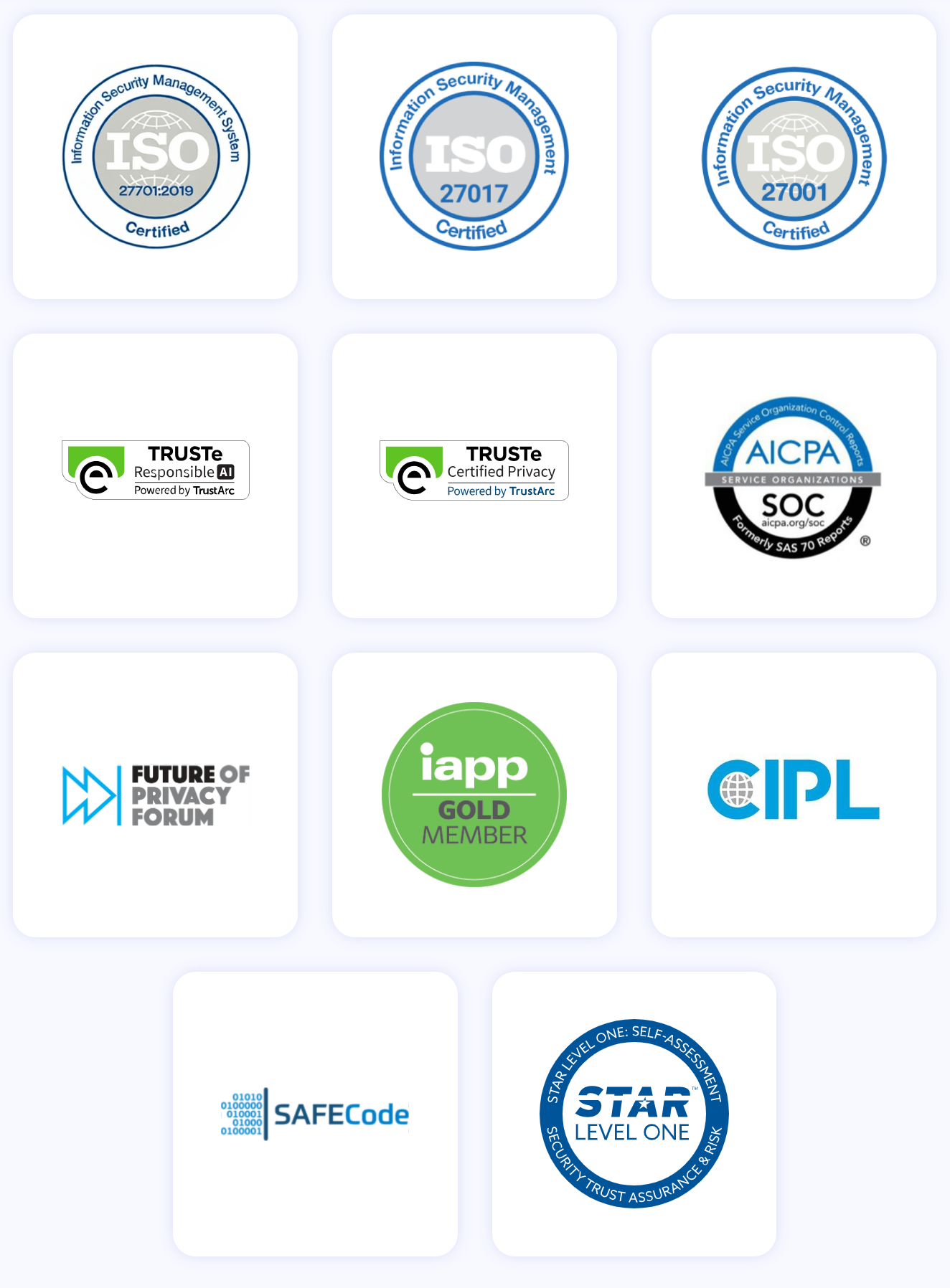
ZoomInfo carries the broadest compliance stack: ISO 27001, ISO 27701, SOC 2 Type II, TRUSTe GDPR, and TRUSTe CCPA certifications, all renewed annually. Because ZoomInfo's core product is B2B data, privacy compliance is built into the data layer itself. ZoomInfo is a registered data broker in California and Vermont.
Cirrus Insight vs. Salesloft vs. ZoomInfo: Which should you choose?
The right choice depends on the problem you're solving and the scale you're operating at.
Choose Cirrus Insight if:
Your sales team runs on Salesforce and lives in Gmail or Outlook
Your primary challenge is CRM adoption and getting reps to log activity
You want modular pricing where you only pay for the features you need
Email and calendar are your team's primary engagement channels
You need proven Salesforce integration without a heavy implementation
Choose Salesloft if:
You need multi-channel sales engagement across email, phone, SMS, and LinkedIn
Your organization requires deal management, forecasting, and coaching in one platform
You have RevOps resources to implement and manage a revenue orchestration system
AI-powered action prioritization across the buyer lifecycle is a priority
You're an enterprise team with the budget for a full-platform investment
Choose ZoomInfo if:
You need the intelligence layer that makes any engagement tool more effective
Accurate, verified B2B data (direct dials, emails, org charts, intent signals) is foundational to your GTM motion
You want AI that understands the context behind your deals, not just the data fields
You need to access intelligence through your own tools via API and MCP, or through ZoomInfo's GTM Workspace and GTM Studio
You want a platform that partners with your existing stack rather than replacing it
Start with ZoomInfo Lite for free, or request a demo to see the full platform.
Cirrus Insight makes Salesforce work inside the inbox. Salesloft coordinates multi-channel revenue execution. But both depend on the quality of data flowing through them.
ZoomInfo provides the data foundation, the contextual intelligence, and the access layer that make every tool in your GTM stack perform better, whether your team works inside ZoomInfo's own products or powers their preferred tools through the API.
"ZoomInfo's not just a contact data company anymore. They've built a full system of execution that works the list, writes the outreach, triggers the play, and helps drive predictable growth." — Ian Brodie, CEO & Co-Founder, Levanta (Levanta Case Study)
Cirrus Insight vs. Salesloft vs. ZoomInfo FAQ
What is the core difference between Cirrus Insight, Salesloft, and ZoomInfo?
Cirrus Insight is a Salesforce productivity tool that embeds CRM data inside Gmail and Outlook, focused on email sync, activity logging, and scheduling.
Salesloft is a revenue orchestration platform that coordinates multi-channel sales engagement, AI-powered coaching, deal management, and forecasting.
ZoomInfo is an AI GTM platform built on the industry's largest B2B data foundation, providing the intelligence layer (data, signals, and contextual understanding) that powers prospecting and engagement across any tool.
Which platform is best for a team that only uses Salesforce and email?
Cirrus Insight is the most natural fit. It was built for Salesforce users working in Gmail and Outlook, with modular features priced from $5 to $20 per user per month. If your reps' workflow centers on sending emails and logging them to Salesforce, Cirrus Insight removes the friction without requiring a platform change.
Does Salesloft include its own B2B contact database?
No. Salesloft is an engagement and orchestration platform, not a data provider. It relies on integrations with data vendors (including a direct partnership with ZoomInfo) to populate contact records and buyer signals.
ZoomInfo is the only one of the three that provides its own verified B2B data, with 500M contacts, 135M+ verified phone numbers, and 200M+ verified business email addresses.
Can ZoomInfo work alongside Cirrus Insight or Salesloft?
Yes. ZoomInfo data and intent signals integrate directly with Salesloft through a native partnership, feeding buyer intelligence into Salesloft's Rhythm engine for AI-prioritized engagement. ZoomInfo also offers APIs and MCP access that can power any tool in the sales stack. Teams can use ZoomInfo for data and intelligence while using Cirrus Insight or Salesloft for execution.
How do the pricing models compare?
Cirrus Insight is the most transparent, with per-feature pricing listed publicly (for example, 10 users with 3 features costs roughly $368/month at annual billing). Salesloft does not publish pricing and requires contacting sales for every tier.
ZoomInfo uses custom quotes based on seats and credits, but offers a permanent free tier (ZoomInfo Lite) and a 7-day free trial that neither competitor provides.
Which platform has the strongest AI capabilities?
Salesloft and ZoomInfo both offer extensive AI agent catalogs. Salesloft has dozens of agents covering prospecting, engagement, coaching, deal management, and forecasting, trained on 5B+ buyer-seller interactions. ZoomInfo's GTM Context Graph provides the intelligence layer beneath AI actions, processing 1.5B+ data points daily and capturing why deals move or stall.
Cirrus Insight's AI is newer and more focused, covering meeting prep, CRM hygiene, and real-time call coaching.
Which platform is best for enterprise sales teams?
Salesloft and ZoomInfo are both enterprise-grade. Salesloft was named a Leader in the inaugural Forrester Wave for Revenue Orchestration Platforms and serves companies like 3M, IBM, and Shopify. ZoomInfo was named a Leader in the Gartner Magic Quadrant for ABM Platforms and serves Adobe, Snowflake, and JPMorgan.
Cirrus Insight serves mid-market Salesforce teams but lacks the deal management, forecasting, and multi-channel engagement that enterprise organizations typically require.
Is Cirrus Insight limited to Salesforce users?
Yes. Every Cirrus Insight feature requires a Salesforce subscription. The product does not support HubSpot, Microsoft Dynamics, or any other CRM. This is a structural constraint, not a temporary limitation.
Teams using a CRM other than Salesforce should evaluate Salesloft (which supports Salesforce, HubSpot, and Dynamics) or ZoomInfo (which integrates with all three plus 120+ marketplace partners).
More Cirrus Insight and Salesloft comparisons:
