

Salesloft started as a sales engagement tool. After its December 2025 merger with Clari and years of product expansion, it now covers multi-channel outreach, conversation intelligence, deal management, AI forecasting, and website visitor engagement in one platform. Over 5,000 companies use it, including 3M, IBM, Stripe, and Shopify. Forrester named it a Leader in its inaugural Revenue Orchestration Platforms Wave in 2024, and Gartner Peer Insights recognized it as a Customers' Choice for two consecutive years.
To write this Salesloft review, we analyzed the platform in detail. It fits well if:
You need one platform for managing multi-channel sales engagement sequences
You want AI prioritization to guide daily seller actions
You require conversation intelligence, deal management, and forecasting in one system
Your team follows structured sales methodologies like MEDDPICC
You're a mid-market to enterprise organization with dedicated RevOps resources
Salesloft might not be the best choice if:
You need a B2B contact and company database alongside your engagement tools
You want buyer intent signals, technographic data, and account intelligence built into the same platform
You require marketing capabilities like account-based marketing, advertising, and audience orchestration
You prefer transparent, self-serve pricing before committing
You need a free tier to evaluate the platform before a sales conversation
In that case, consider ZoomInfo: a GTM platform built on a large B2B data foundation (500M contacts, 100M companies, 135M+ verified phone numbers, and 200M+ verified business emails), with the GTM Context Graph as an intelligence layer that captures not just what happened in a deal but why. Teams access it through GTM Workspace for sellers, GTM Studio for marketers and RevOps, and open APIs that deliver the same intelligence into any tool.
We've included a detailed look at ZoomInfo later in this Salesloft review as the broader alternative for teams that need data intelligence and execution in one platform. If you're ready to explore ZoomInfo, you can start a free trial.
What is Salesloft?
Salesloft is a revenue orchestration platform founded in September 2011 by Kyle Porter and David Cummings in Atlanta, Georgia. The two met at Georgia Tech's Advanced Technology Development Center, pivoted from an initial data-enrichment product, and built one of the first sales engagement platforms on the market.
The company raised several funding rounds, reaching a $1.1 billion valuation in January 2021 after a $100 million Series E. Later that year, Vista Equity Partners acquired a controlling stake at a $2.3 billion valuation. In 2023, Salesloft acquired Drift, adding conversational AI and website chat. Then in December 2025, Salesloft merged with Clari, the revenue forecasting company. The combined entity ingests more than 10 billion revenue interactions and 1 trillion data signals.
Today the platform has seven product areas: Cadence (multi-channel engagement), Rhythm (AI signal prioritization), Conversations (call recording and analysis), Drift (website chat), Deals (pipeline management), Analytics (reporting), and Forecast (AI revenue predictions). Beneath these sits an Enterprise Data Platform for unifying buyer signals and a growing library of AI Agents that handle tasks from account research to email drafting.
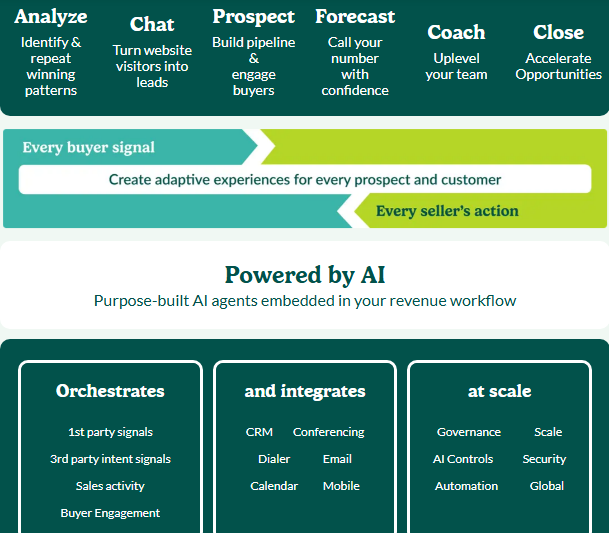
Source: Salesloft
Salesloft targets Sales Leaders, Revenue Operations, SDRs/BDRs, Account Executives, Marketing, and Customer Success teams, with solutions for Professional Services, Manufacturing, and Medical Software & Devices.
Salesloft Pros & Cons
Pros | Cons |
|---|---|
Full revenue lifecycle coverage in one platform | No publicly disclosed pricing |
Multi-channel cadences (email, phone, SMS, LinkedIn) | No built-in B2B contact or company database |
AI agents spanning prospecting through forecasting | Requires dedicated RevOps for full implementation |
Conversation intelligence with coaching tools | No free plan or self-serve trial |
Forrester Wave Leader in Revenue Orchestration | Drift integration still maturing (separate login) |
MEDDPICC methodology extraction from calls | LinkedIn AI automation not yet available |
Bi-directional CRM sync with major platforms | Annual contracts with no mid-term cancellation |
Salesloft Review: How it Works & Key Features
Cadence: Salesloft's multi-channel engagement engine structures outreach across email, phone, SMS, and LinkedIn.
Cadence is the core of Salesloft's platform. It lets sales teams build step-based sequences that specify the channel, timing, and content for each touchpoint. Reps select from existing cadence frameworks or build their own, then execute through a centralized workflow.
Execution happens in the Cadence Focus Zone, a view that surfaces the most engaged contacts first, sorted by channel, time zone, and account priority. This removes the daily question of "who do I contact next?"
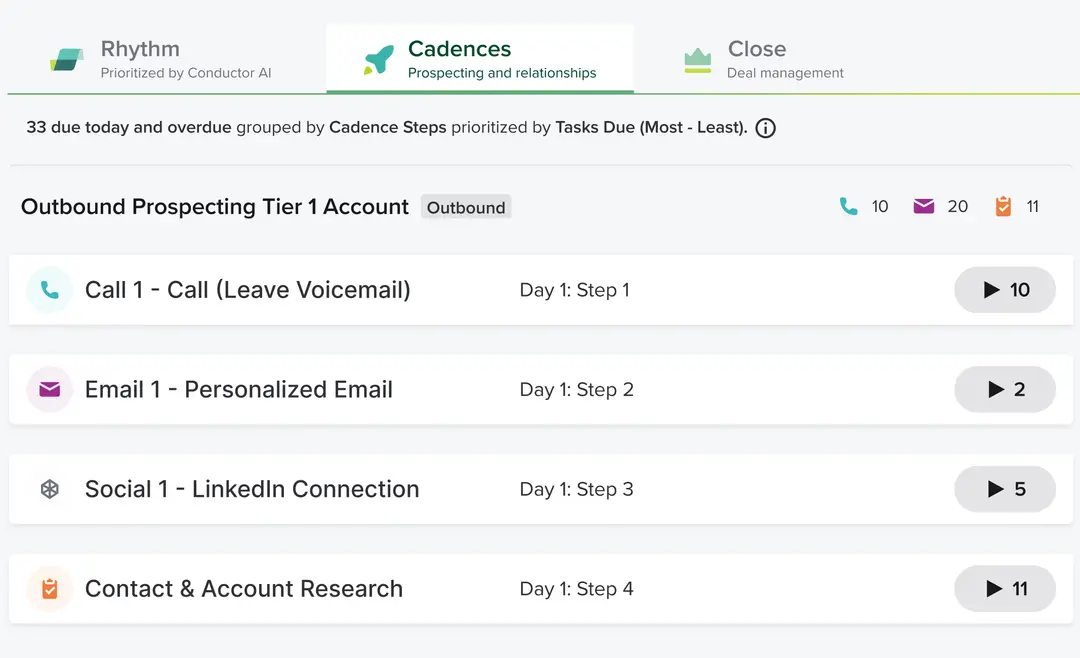
Source: Salesloft
Channels include email, phone, SMS, LinkedIn InMail, and third-party integrations, with 200+ integrations including Vidyard for video messaging. The AI Email Agent drafts messages using account and buyer context, working with the Account Research Agent to pull relevant details into each draft. A native dialer lets reps call directly from the platform, and automation rules handle lead enrollment, CRM updates, and out-of-office detection.
Rhythm & AI Agents: Salesloft translates buyer signals into a prioritized daily action list for each seller.
Rhythm is the AI engine that sits on top of everything else. It analyzes buyer and seller interaction data to produce a prioritized workflow for each seller: who to contact, what to do, and why it matters now. Claimed results include a 20% reduction in cycle time, 25% increase in close rates, and 39% decrease in activities needed to schedule a meeting.
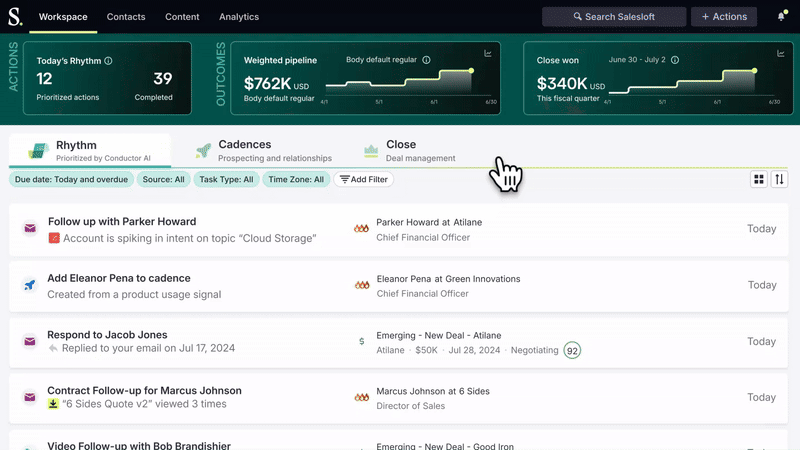
Source: Salesloft
Rhythm captures signals broadly: website activity, content views, and upsell/cross-sell opportunities, plus data from partner integrations and proprietary sources. Plays are automations that trigger seller actions based on buyer signals, with both pre-built frameworks and unlimited custom Plays available.
Beyond Rhythm, Salesloft offers dozens of AI agents across the sales cycle.
These include agents for Account Research, Person Research, and Buyer Identification in prospecting, Conversation Summaries, Key Moments, and Action Items for call analysis, Sales Methodology Extraction for auto-populating MEDDPICC fields from transcripts, and Deal Summaries and AI Forecast for pipeline intelligence. A Create Your Own Agent feature lets teams build custom automation from their own data sources.
The AI trains on 5B+ buyer-seller interactions, and agents explain every recommendation they surface.
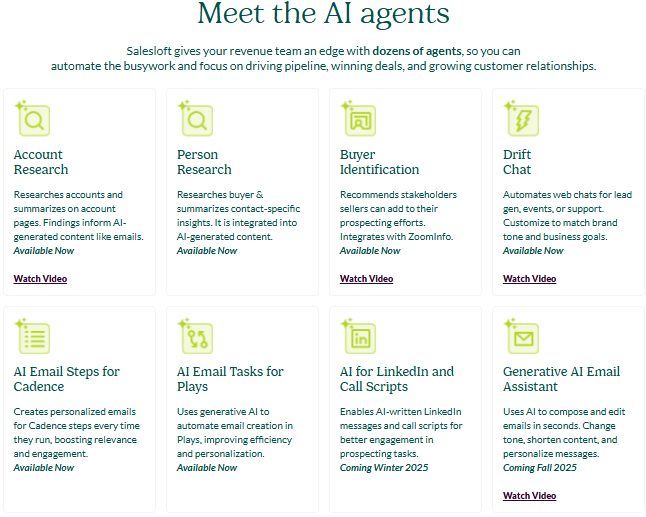
Source: Salesloft
Conversations & Coaching: Salesloft records, transcribes, and analyzes every sales conversation to surface coaching opportunities.
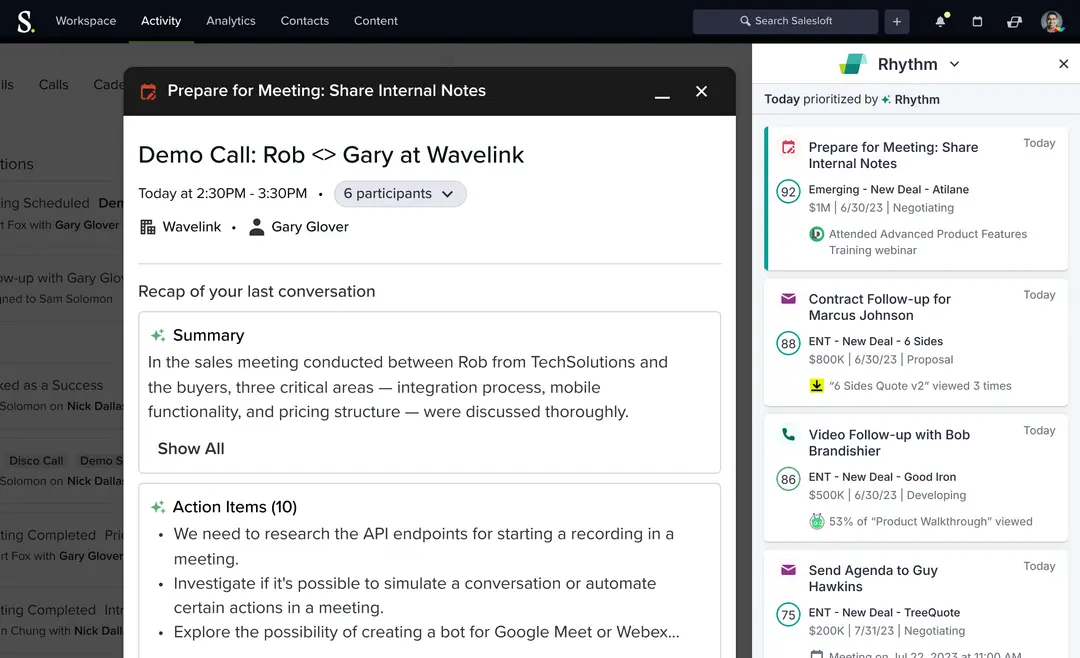
Conversations is Salesloft's built-in conversation intelligence, replacing the need for a separate conversation intelligence tool. AI agents transcribe, analyze, and summarize every conversation, linking insights to relevant deals and feeding them into sellers' Rhythm workflows.
Conversation Agents automate note-taking, draft follow-up emails, flag objections and competitor mentions, and consolidate past conversation data into pre-meeting summaries. Key Moments uses AI to flag critical discussion points (methodology, pricing, decision-maker involvement) with no admin configuration required.
Source: Salesloft
For managers, AI-Assisted Scorecards pre-populate rep performance assessments, which appear as action items in managers' Rhythm workflows. The coaching framework rests on four elements: data-driven coaching via scorecards, seller dashboards, coaching aligned to revenue goals, and shareable playlists of best practices.
Tracker Trends visualizes patterns like competitor mentions across conversations, giving leadership visibility into market dynamics they wouldn't otherwise see.
Pricing Structure: Salesloft uses custom, sales-quoted pricing with no published rates.
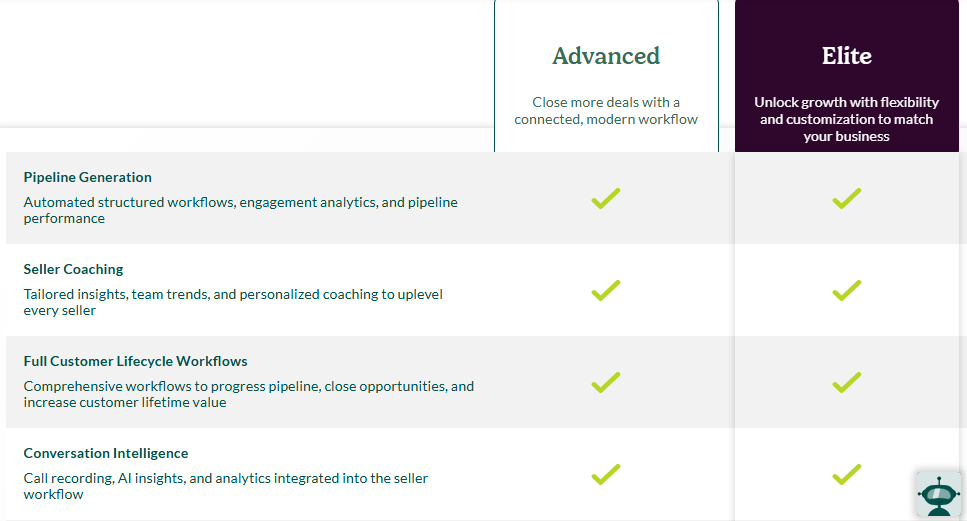
Salesloft does not publish pricing. The pricing page lists four packages, but every tier requires contacting sales:
Prospect (for pipeline-building teams, centered on Cadence and Rhythm. Designed for SDR and BDR teams.)
Sell (for deal-closing teams, adding Deals and Conversations to the Prospect package.)
Engage (for customer relationship teams, targeting account management and customer success.)
Enterprise (the full platform with no feature exclusions.)
Source: Salesloft
Two paid add-ons sit outside the base packages: Account Agents (automated account research with 100 Agent Runs per user per month) and Forecast as a standalone module. Drift pricing is handled separately.
Contract terms are strict. All fees are non-cancelable and invoiced in advance. Multi-year subscriptions are committed for the full duration. There is no mid-term termination for convenience. Seats can be added mid-term but not reduced. No free plan exists, and any trial is arranged through sales, provided "AS IS" without warranty, SLA, or support.
Costs can grow beyond the base subscription. The Unlimited Dialer covers North America and Europe, but usage exceeding 3,000 minutes per user per month triggers excess charges. Professional Services for implementation, onboarding, and optimization are priced separately.
Where Salesloft Falls Short
Salesloft covers sales engagement and revenue orchestration well, but several gaps reveal a platform built for execution rather than for the intelligence and data that fuel it.
No B2B Contact or Company Database: Salesloft is an engagement platform, not a data platform. It has no searchable database of contacts, companies, or direct-dial phone numbers. Teams need a separate data provider to identify who to target before they can build a cadence. That means additional vendor costs, integration work, and potential sync issues between your data source and your engagement platform.
Opaque Pricing with Rigid Contracts: With no published pricing and a "Talk to Sales" requirement for every package, evaluating Salesloft takes a time investment before you learn the cost.
The contract structure compounds this: non-cancelable fees, multi-year commitments by default, and no way to reduce seats mid-term. For teams that want to test the platform before a large financial commitment, the lack of a free tier or self-serve trial creates a barrier.
Platform Complexity Requires Implementation Investment: Salesloft offers Professional Services for implementation, daily Office Hours, an Academy with role-based training, and certifications. This support infrastructure exists because the platform is not easy to self-implement. Organizations without dedicated RevOps staff may struggle to configure and optimize seven product modules.
No Built-in Buyer Intent or Market Intelligence: Salesloft ingests signals from other tools through integrations, but it does not generate its own buyer intent data, technographic profiles, or account intelligence.
If you want to know which companies are researching solutions in your category, or what technologies a target account uses, you need a separate platform. Rhythm's signal prioritization is only as good as the signals it receives from your other tools.
Drift Integration Still Maturing: Drift, acquired in 2023, still has a separate login at start.drift.com and appears as a distinct product on the AI agents page. The website visitor engagement capability is useful, but the workflow integration between Drift signals and Salesloft's seller workflows is still evolving. For teams expecting a single experience from website visit to closed deal, the seams are visible.
These gaps reflect Salesloft's identity as a sales execution platform, not a full go-to-market intelligence system. They open the door for platforms that combine data, intelligence, and execution in one place.
Top Salesloft Alternative for Full GTM Intelligence: ZoomInfo
ZoomInfo addresses Salesloft's core gap by combining B2B data with an intelligence layer that understands deal context, and delivering that intelligence into any tool or workflow.
Where Salesloft handles the "how" of sales engagement, ZoomInfo answers the "who, when, and why" while also providing its own execution capabilities.
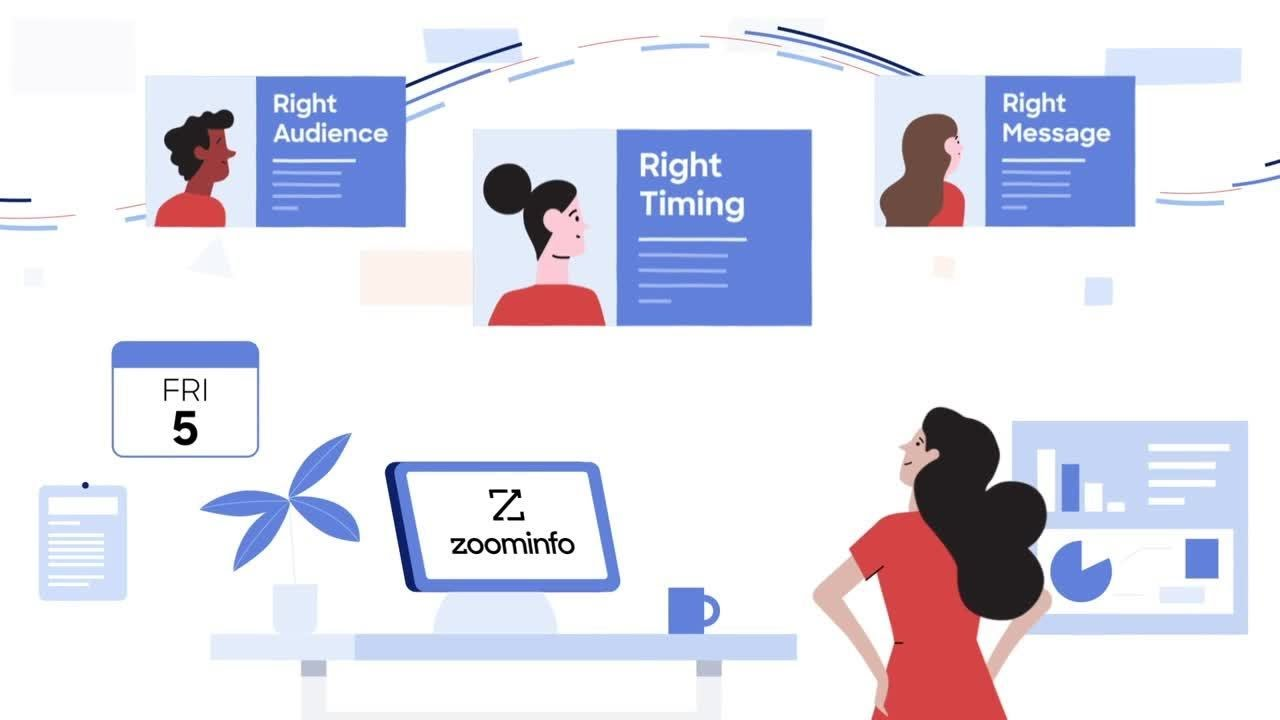
Comprehensive B2B Data: ZoomInfo provides the contact, company, and signal data that Salesloft doesn't include.
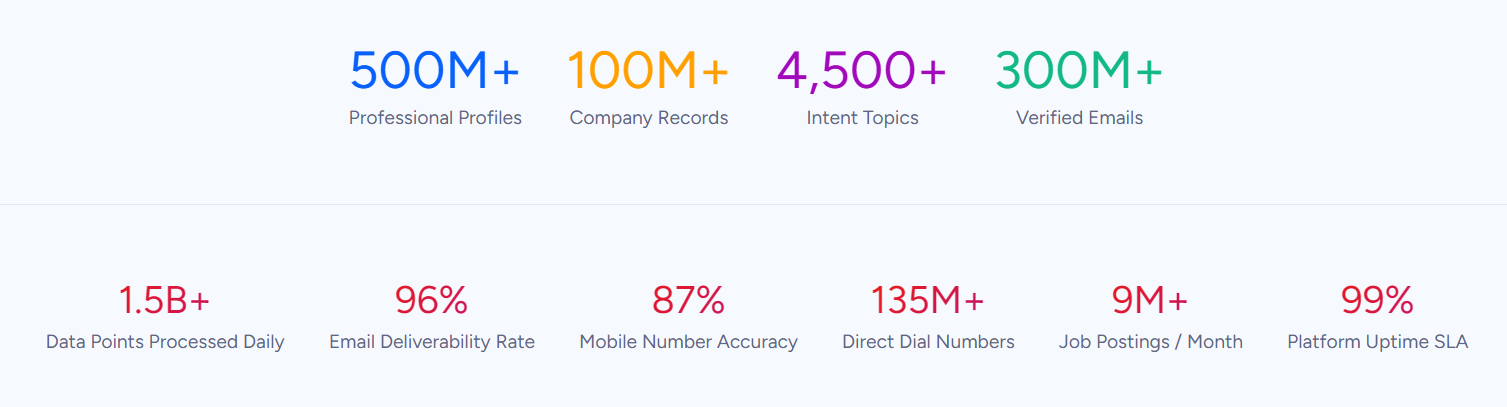
ZoomInfo operates a large B2B data platform: 500M contacts, 100M companies, 135M+ verified phone numbers, 120M direct dials, and 200M+ verified business email addresses. A multi-source pipeline backed by 300+ human researchers verifies this data, achieving up to 95% accuracy on first-party records.
The data covers three dimensions. Identity data tells you who buyers are and how to reach them. Company context covers 300+ attributes including firmographics, org charts, and the tech stacks of 30+ million companies. Dynamic signals reveal when accounts are in-market through buyer intent data tracked from 210 million IP-to-Organization pairings and website visitor identification that resolves anonymous traffic to companies.
Source: ZoomInfo
These aren't self-reported numbers.
In a Fortune 500 competitive RFP analyzing 25 million contacts across vendors, an independent consultant concluded that "no other competitor came even close." ZoomInfo has earned 133 No. 1 G2 rankings and was named a Forrester Wave Leader for Intent Data Providers and a Gartner MQ Leader for ABM Platforms two years running.
For sales teams using Salesloft without a dedicated data provider, the practical difference is between building cadences on incomplete, aging lists and engaging verified buyers through direct dials that connect.
"ZoomInfo gives us the information we need to execute. We don't have to go through and spend our time digging. It's already there, so we can be three steps ahead." (Vensure)
GTM Context Graph: ZoomInfo's intelligence layer captures why deals move, not just that they moved.
The GTM Context Graph separates ZoomInfo from a traditional data provider. Processing 1.5B+ data points daily, it fuses ZoomInfo's B2B data with a customer's CRM records, conversation transcripts, email threads, and behavioral signals into one intelligence layer.
The distinction matters.
A CRM records that a deal moved from stage 3 to stage 4. Conversation intelligence transcribes what the VP of Finance said on the last call. Intent data logs a spike in research activity. The GTM Context Graph connects all three to capture why the deal moved, and what that pattern suggests about similar deals.
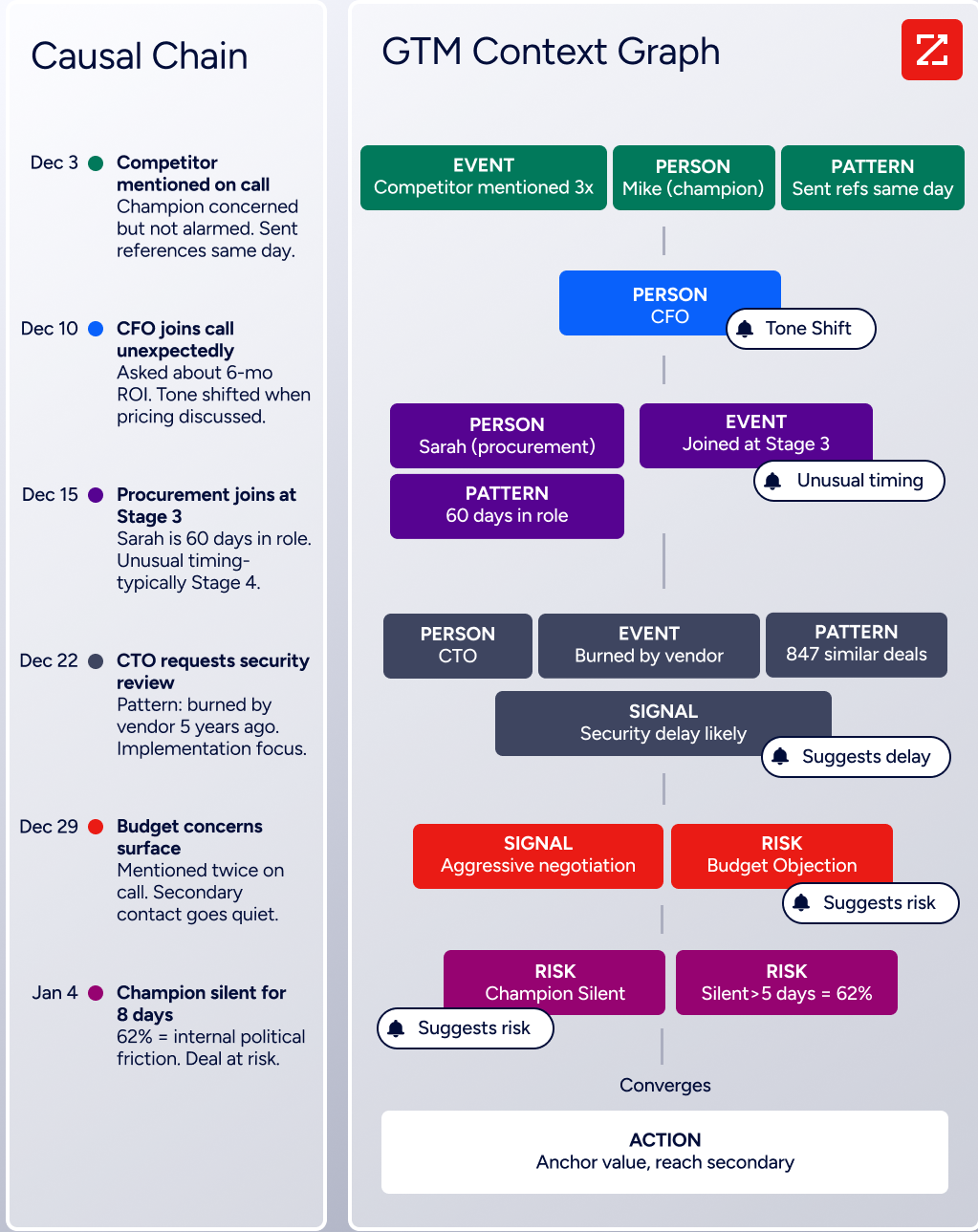
Source: ZoomInfo
This intelligence powers every downstream action.
Guided Intent, exclusive to ZoomInfo, identifies topics historically correlated with deal success rather than requiring manual topic selection. Account scoring reflects actual buying evidence rather than arbitrary thresholds. And AI-drafted outreach addresses the specific concerns behind a conversation, not just the fact that a conversation happened.
ZoomInfo built this through nearly two decades of data unification work, augmented by Chorus and Workbounce acquisitions that added context capture and analysis. As CPO Dominik Facher writes: "If you rebuilt the GTM stack for AI, you'd end up with ZoomInfo for first-party data."
"That combination of our internal CRM data, external signals, and AI that's given all that context has helped us craft very specific account- and persona-based messages. And people have responded to them right away." (Seismic)
Universal Access: ZoomInfo delivers intelligence through a seller workspace, a marketing studio, and open APIs.
ZoomInfo's intelligence reaches teams through three channels, each drawing from the same GTM Context Graph.
GTM Workspace is the seller's front-end.
It gives sellers a complete view of their book of business across CRM data, ZoomInfo intelligence, conversation history, and market signals. AI agents automate account research, generate outreach, monitor signals, and update CRM fields.
An Action Feed delivers a live stream of in-market buyers matched to target criteria, with pre-drafted actions on every signal. Thomson Reuters increased closed-won deals by 40% and achieved 115% average quota attainment each month using it.
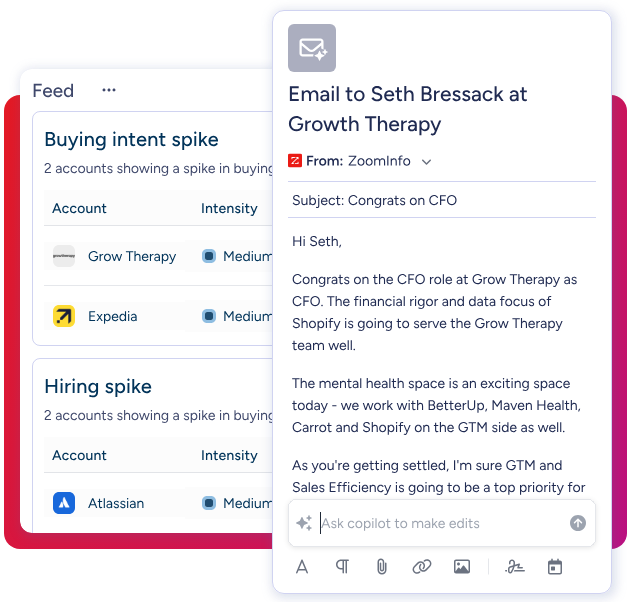
Source: ZoomInfo
GTM Studio serves marketers, RevOps, and GTM engineers.
Teams describe audiences in natural language, launch multi-channel plays, and measure pipeline impact without engineering support. Expansion plays that used to take three weeks now launch in 30 minutes. Salesloft doesn't address this area; its focus is seller workflows, not marketing orchestration or RevOps workflow design.
For teams that build their own tools, APIs and MCP expose the same intelligence to any custom agent, internal tool, or partner platform. API access comes with all relevant plans, and the MCP server currently supports Claude and ChatGPT. Same data, same intelligence, regardless of which interface your team uses.
"Anything that minimizes our team's need to switch contexts is beneficial. ZoomInfo offers a unified view, eliminating the need to navigate between systems." (Spekit)
Accessible Entry Points: ZoomInfo offers a permanent free tier and self-serve evaluation.
ZoomInfo provides something Salesloft doesn't: a way to evaluate the platform before talking to sales.
ZoomInfo Lite is a permanent free tier with no credit card, no annual commitment, and no time limit. It includes access to ZoomInfo's B2B database with 10 monthly export credits, WebSights Lite for up to 10 website visitor reveals per day, AI email generation, a Chrome extension, and HubSpot integration. A separate 7-day free trial offers broader access to paid features with no credit card required.
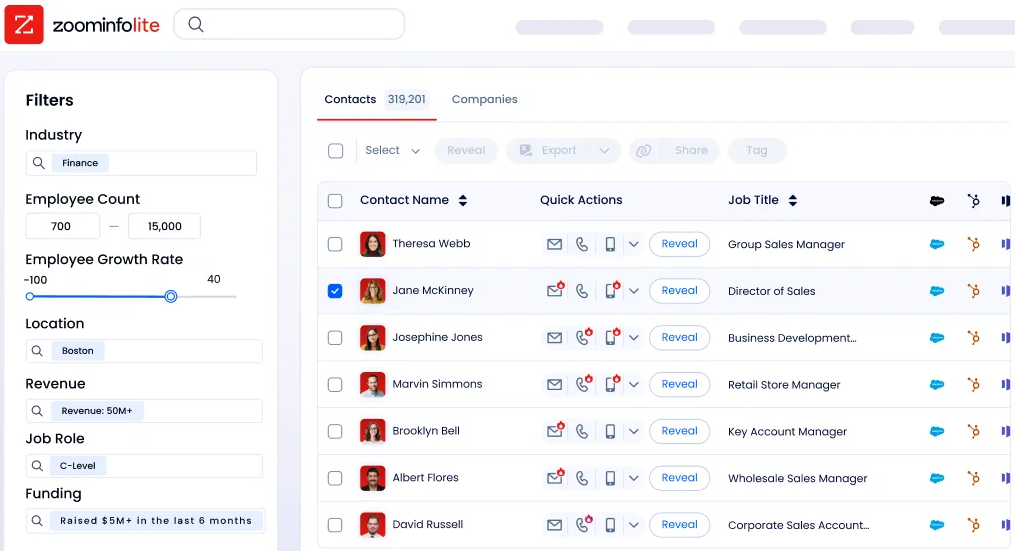
Source: ZoomInfo
Paid plans are organized into Sales, Marketing, and Chorus tiers, each with Professional, Advanced, and Enterprise levels. Pricing is custom-quoted based on seats, credit volume, and features, but the tiered structure and public feature lists give buyers a clearer picture before engaging sales.
ZoomInfo is also shifting toward consumption-based pricing covering enterprise licenses, API consumption, and AI activity, so customers pay for what they use.
Salesloft or ZoomInfo: Comparison Summary
Salesloft | ZoomInfo | |
|---|---|---|
Primary focus | Sales engagement and revenue orchestration | GTM platform (data + intelligence + execution) |
B2B data | No built-in contact or company database | 500M contacts, 100M companies, 135M+ verified phone numbers |
Buyer intent signals | Relies on third-party integrations | Native intent data from 210M IP-to-Org pairings |
Multi-channel engagement | Email, phone, SMS, LinkedIn via Cadence | GTM Workspace action feed + automated outreach |
Conversation intelligence | Built-in Conversations module | Chorus (14 patents, connected to data layer) |
Deal management | Deals with AI risk detection | GTM Workspace deal intelligence |
Revenue forecasting | AI Forecast (post-Clari merger) | Via GTM Context Graph signals |
Website visitor engagement | Drift (acquired 2023) | WebSights + ZoomInfo Chat |
Marketing capabilities | Not a marketing platform | GTM Studio, ABM, native DSP, FormComplete |
AI agents | Dozens of agents across the sales cycle | GTM Workspace and Studio AI agents |
Open API/MCP access | RESTful API, 180+ marketplace partners | Enterprise API, MCP, API access on all plans |
Free tier | No free plan, no self-serve trial | ZoomInfo Lite (permanent free) + 7-day trial |
Pricing transparency | All tiers require sales contact | Consumption-based pricing |
Best for | Sales teams needing execution and engagement tooling | Teams needing data, intelligence, and execution in one platform |
Final Verdict
The choice between Salesloft and ZoomInfo depends on whether you need engagement execution or go-to-market intelligence with execution built in.
Choose Salesloft if your team already has a reliable data provider and needs a platform for orchestrating seller workflows across the revenue cycle.
Salesloft structures multi-channel outreach sequences well, prioritizes daily actions from buyer signals, records and coaches on sales conversations, and manages pipelines with AI risk detection. Its depth in sales engagement, combined with Clari's forecasting, makes it a solid choice for mid-market to enterprise sales organizations with the RevOps resources to implement and maintain it.
Choose ZoomInfo if you need data, intelligence, and execution in one platform rather than stitching together separate tools for each.
ZoomInfo combines a large B2B dataset, the GTM Context Graph that captures deal context across every interaction, and access through a seller workspace, a marketing studio, and open APIs, so your entire go-to-market team (sales, marketing, and RevOps) operates from the same intelligence. For organizations that want to close the gap between knowing who to target and engaging them, ZoomInfo provides the broader platform.
Get started with ZoomInfo here.
Salesloft built a strong system for executing sales workflows. ZoomInfo built the intelligence infrastructure that makes those workflows, and every other go-to-market motion, more effective. Your choice depends on whether you need a tool for the "how" of selling, or a platform that also answers the "who," "when," and "why."
Salesloft FAQ
What is Salesloft used for?
Salesloft is a revenue orchestration platform that helps sales teams manage multi-channel outreach sequences, prioritize daily actions using AI, record and analyze sales conversations, manage deals and pipeline, and forecast revenue.
It covers the execution side of the sales process from prospecting through deal closing and customer renewal. It does not include a B2B contact database or marketing capabilities, so teams typically pair it with a data provider like ZoomInfo.
How much does Salesloft cost?
Salesloft does not publish pricing. Four packages (Prospect, Sell, Engage, and Enterprise) appear on the pricing page, but all require contacting sales for a quote. Contracts are annual with non-cancelable fees, and multi-year subscriptions are committed for the full duration. Additional costs can include Account Agents, Forecast, Drift, Professional Services, and dialer overages.
ZoomInfo also uses custom pricing but offers a permanent free tier (ZoomInfo Lite) and a 7-day free trial for self-serve evaluation.
Does Salesloft have a free plan or free trial?
No. Salesloft does not offer a free plan or a self-serve free trial. Any trial access must be arranged through the sales team and is provided without warranty, SLA, or support.
ZoomInfo offers ZoomInfo Lite, a permanent free tier with 10 monthly export credits, website visitor identification, and HubSpot integration, plus a separate 7-day free trial with broader feature access and no credit card required.
Does Salesloft include a B2B contact database?
No. Salesloft is an engagement and orchestration platform, not a data provider. It does not include a searchable database of contacts, companies, phone numbers, or email addresses. Teams need a separate tool to source contact data before building cadences.
ZoomInfo includes 500M contacts, 100M companies, 135M+ verified phone numbers, and 200M+ verified business emails, with up to 95% accuracy on first-party data.
What AI features does Salesloft offer?
Salesloft offers dozens of AI agents trained on over 5 billion buyer-seller interactions, covering account research, email drafting, conversation summaries, MEDDPICC methodology extraction, deal risk detection, forecasting, and coaching insights. The Rhythm engine prioritizes daily seller actions based on buyer signals. A Create Your Own Agent feature allows custom automation.
ZoomInfo's AI operates on the GTM Context Graph, which fuses its B2B data with CRM records, conversation intelligence, and behavioral signals to capture why deals move or stall.
What CRM integrations does Salesloft support?
Salesloft offers native bi-directional sync with Salesforce, Microsoft Dynamics 365, HubSpot, and Zoho. Its marketplace includes over 180 partner integrations across categories like AI/Automation, Buyer Intent, and Marketing Automation. A RESTful API and Chrome extension provide additional connectivity.
ZoomInfo integrates with Salesforce, HubSpot, Microsoft Dynamics, and over 120 marketplace partners, plus offers Enterprise APIs and an MCP server for AI agent access.
How does Salesloft compare to ZoomInfo?
Salesloft focuses on sales engagement execution: building cadences, managing deals, analyzing conversations, and forecasting revenue. ZoomInfo is broader, combining a large B2B data platform with an AI intelligence layer (the GTM Context Graph) and execution tools for sales (GTM Workspace), marketing (GTM Studio), and developers (APIs/MCP).
The two platforms can work together through integration, but ZoomInfo also provides its own engagement and orchestration capabilities that overlap with parts of Salesloft's offering.
Does Salesloft support LinkedIn automation?
Salesloft supports LinkedIn InMail as a step within cadences, but native LinkedIn AI automation is not yet available. The AI agents page lists "AI for LinkedIn and Call Scripts" as a coming feature. Currently, sellers must manually execute LinkedIn steps within their sequences.
More Salesloft comparisons and alternatives:
