
Crystal occupies an unusual position in B2B sales tools. Rather than competing on contact data or automation, it bets on one idea: that knowing a prospect's personality before you reach out makes every interaction more effective. It predicts DISC personality types from LinkedIn profiles and coaches reps on how to communicate with each person, so they can adjust their tone before a conversation starts.
To write this Crystal review, we analyzed the platform in depth. It's the right choice if:
You want personality-based communication guidance for one-on-one sales conversations
You need DISC-based insights on prospects without requiring them to take an assessment
You value pre-meeting preparation focused on interpersonal dynamics
Your sales team already follows a consultative, relationship-heavy process
You want a lightweight tool to layer on top of your existing sales stack
However, Crystal might not be the best choice if:
You need B2B contact data, direct dials, and verified emails at scale
You require buyer intent signals to know when accounts are in-market
You want AI prospecting that identifies who to contact, not just how to communicate
You need account intelligence, org charts, and technographic data for deal planning
You're looking for a single platform that covers the full go-to-market process
In this case, consider ZoomInfo: an AI GTM platform that covers the revenue process from finding prospects with verified contact data on 500M contacts and 100M companies, to detecting when they're in-market through intent signals, to executing outreach with AI tools that tell reps who to contact, when to engage, and what to say.
We've included a detailed look at ZoomInfo later in this review as the broader alternative for teams that need more than personality insights to build pipeline. If you're ready to explore a full GTM platform, you can start with ZoomInfo's free trial.
What is Crystal?
Crystal is a personality intelligence platform founded in 2015 in Nashville, Tennessee by Drew D'Agostino and Greg Skloot. D'Agostino built the product while managing an engineering team and looking for better ways to handle workplace relationships. The company launched as one of the first tools to predict other people's personalities from public information.
The core product predicts how people think, communicate, and make decisions using the DISC framework. What separates Crystal from traditional DISC tools is that it generates predictions for other people (prospects, teammates, candidates) by analyzing public data, without requiring anyone to take an assessment.
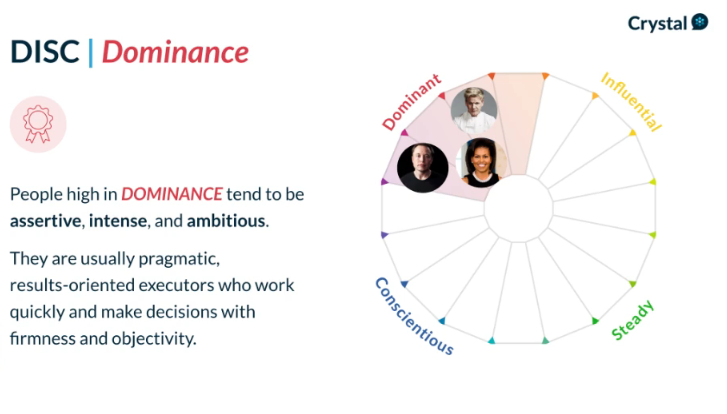
Source: Crystal
Crystal serves four segments with distinct product lines: For Sales (personality predictions from LinkedIn to tailor outreach), For Teams (assessments and collaboration tips across the organization), For Hiring (behavioral fit analysis for candidates), and Personality AI (an MCP layer that feeds personality context into AI tools like Claude and ChatGPT).
1,000+ organizations use Crystal, including Adobe, Verizon, Randstad, Amazon, and Ogilvy. Crystal reports more than 10,000 sales professionals as active users of its sales product.
Crystal Pros & Cons
Pros | Cons |
|---|---|
- Predicts personality from LinkedIn without requiring an assessment from the prospect | - Accuracy of AI-predicted profiles is variable compared to assessed profiles |
- Communication coaching for specific sales scenarios | - Only 5 free profile views, then paid access required |
- Chrome Extension works inside LinkedIn, Salesforce, and HubSpot | - 20 profiles/month cap on the Premium monthly plan |
- Covers DISC, Enneagram, 16 Personalities, and Big Five in one platform | - Business plan pricing not publicly listed |
- Free DISC assessment with no time limit | - Native CRM integrations limited to Salesforce and HubSpot |
- Low price point at $49/year for individuals | - English-only platform with no localization |
- G2 Leader badges across multiple categories | - No mobile app; Chrome Extension requires desktop browser |
Crystal Review: How it Works & Key Features
For Sales: Crystal predicts buyer personality and delivers communication guidance at each stage of the sales process.
Crystal's sales product works through the Chrome Extension, which runs on Chromium-based browsers (Chrome, Edge, Brave). When a rep navigates to any LinkedIn profile, including LinkedIn Recruiter and Sales Navigator profiles, a "View Personality" button appears. Clicking it reveals the prospect's predicted DISC type and communication preferences in a side panel.
The extension also works inside Salesforce and HubSpot, showing personality data on CRM contact records. The extension saves viewed contacts to the Crystal Dashboard under Sales > Customers automatically.
For deal preparation, Sales Playbooks generate guides for specific buyers across sales scenarios: how they prefer to discuss pricing, how much pushback they accept in negotiations, and what types of urgency cues prompt action. Crystal documents three Playbook stages: Discovery, Negotiations, and Closing.
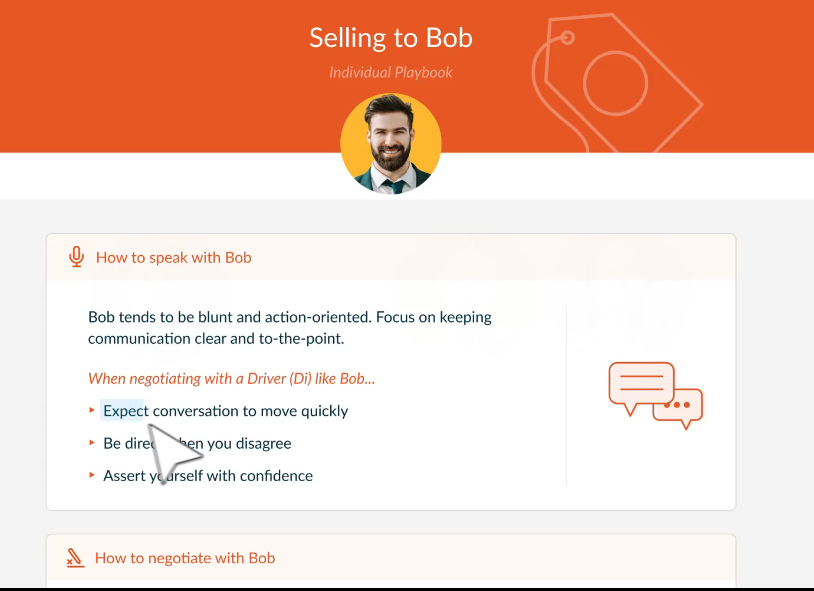
Source: Crystal
Integrations with Gmail, Google Calendar, and Outlook Calendar extend personality guidance to meeting prep. The Crystal Meetings app connects to your calendar and sends a morning digest listing that day's meetings with each participant's DISC type and communication tips.
For Teams: Crystal provides company-wide personality assessments with collaboration guidance.
Crystal for Teams lets organizations deploy DISC assessments company-wide and make personality data part of daily work.
Admins push assessments across the organization and track completion. Once assessed, each team member's profile becomes visible to colleagues on a Coworkers page, showing strengths, values, communication preferences, and behavioral tendencies.
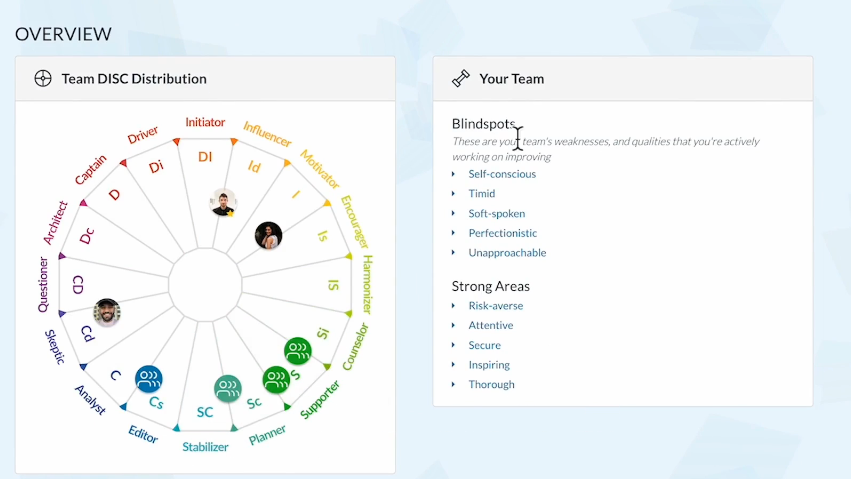
Source: Crystal
Team Builder reports go beyond individual profiles, generating group views covering Team Dynamics, Conflict Resolution, Collaboration, Brainstorming, and Goal Setting. Playbooks provide 1:1 communication guides for specific coworker pairings or group situations. Business-tier users can create custom Playbook templates with up to 12 sections.
Each profile covers four frameworks: DISC, Enneagram, 16 Personalities, and Big Five, giving a fuller picture of interpersonal dynamics than single-framework tools. Crystal also connects personality data to AI tools (ChatGPT, Claude) so employees get personality-aware coaching without leaving the tools they already use.
For Hiring: Crystal adds behavioral fit analysis to the recruiting process.
Crystal for Hiring addresses the gap between skills-based screening and behavioral fit. Crystal's premise: "Skills show if they can do the job. Behaviors shape how they'll experience it."
The workflow starts when a recruiter creates a Crystal Job by entering the job description. Crystal analyzes it to predict the DISC traits the role requires. A Stakeholder Candidate Expectation Survey lets the hiring team weigh in on desired traits, which factor into the Ideal Personality Profile.
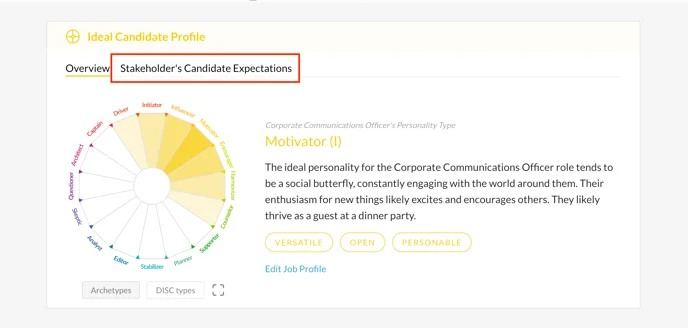
Source: Crystal
Recruiters add candidates via email invites, shareable links, existing Crystal profiles, or LinkedIn-predicted profiles. Candidates don't need a Crystal account. For each candidate, Crystal generates an Interview Playbook with behavioral overlaps and gaps, plus interview questions focused on those gaps.
After the hire, the same profile data produces coaching guides and onboarding playbooks, so the assessment carries into onboarding and retention.
Personality AI: Crystal feeds DISC personality context into third-party AI tools.
Crystal's Personality AI connects DISC profiles to AI platforms so responses adapt to individual users and the people they work with. The problem: generic AI gives identical advice to everyone, regardless of how a person communicates or decides.
Setup involves completing Crystal's DISC assessment, then connecting AI tools via an MCP Server or a single terminal command (npx skills add crystal-project-inc/personality-ai). Current integrations include Claude, Cursor, Windsurf, GitHub Copilot, and 30+ tools via skills.sh. Claude Connectors and ChatGPT Apps are coming soon.
Once connected, the AI adjusts tone and structure to match the user's working style. When the user asks about communicating with a colleague, the AI retrieves that person's DISC profile and generates phrasing advice for emails, meetings, and feedback conversations. The same message can be rewritten in four styles: direct (D), energetic (I), reassuring (S), or precise (C).
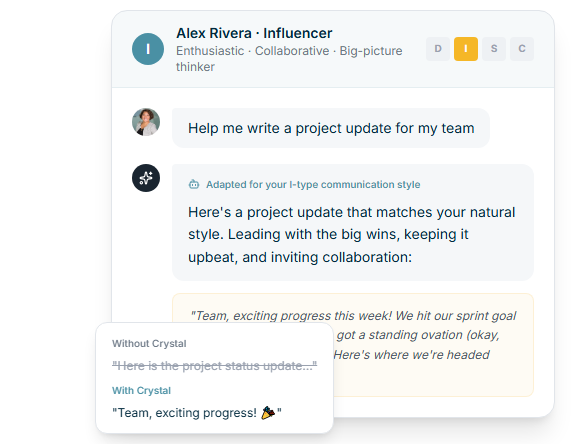
Source: Crystal
For developers, the Crystal API exposes two endpoints: a Profile API that returns DISC type and behavioral content by email or LinkedIn URL, and an Analysis API that predicts personality from text samples.
Pricing: Crystal uses a tiered model with a free entry point and annual individual plans.
Crystal's pricing:
Free Plan ($0 forever):
DISC personality assessment
Shareable personality profile
5 free profile view credits (Chrome Extension)
No support, no PDF reports, no Teams/Hiring/Sales features
Premium Plan ($49/year or $59/month):
Full personality profile with PDF download
Learning path
Email support
20 profiles/month on the monthly plan
No access to Teams, Hiring, or Sales workspace features
Business Plan (contact sales):
All Premium features plus Teams, Hiring, and Sales
Customer Success Manager with onboarding and training
Custom profile volume based on contract
Salesforce and HubSpot integrations included
A separate Data Plan offers API access for CRM enrichment, priced by volume. Cancellations take effect at the end of the current billing cycle.
Where Crystal Falls Short
Crystal does communication coaching well, but several limitations affect teams that need more from their sales intelligence tools. These reflect a platform built for one dimension of sales effectiveness.
Personality insights without prospecting data.
Crystal tells you how to talk to a prospect, but it doesn't help you find that prospect in the first place. There is no contact database, no verified emails, no direct-dial phone numbers, no company firmographics, and no org chart data. Sales teams still need a separate data provider to build target lists, identify decision-makers, and get accurate contact information.
No buyer intent or account signals.
Crystal cannot detect when a company is in-market for a solution. It offers no intent signals, no website visitor identification, no buying committee mapping, and no account prioritization from engagement data. Reps can personalize their communication style, but they have no data-driven way to prioritize which accounts to pursue or when.
Accuracy questions on predicted profiles.
Predicting personality from LinkedIn data is Crystal's most distinctive feature, and its most debated. G2 and Capterra reviewers call accuracy variable, with some describing predictions as "close enough but not accurate." Crystal publishes an accuracy report from 12,000+ professionals who reviewed their own predictions, but assessed profiles carry higher confidence than predicted ones.
Narrow integration ecosystem.
Native CRM integrations are limited to Salesforce and HubSpot. Outreach, Salesloft, Apollo, and other sales engagement platforms are absent. The Chrome Extension works only on Chromium browsers; Firefox and Safari are not supported. For sales teams that run sequences across engagement platforms, Crystal's insights sit outside the workflow.
English-only and desktop-only.
Crystal is available only in English, with no localization. There is no mobile app. For global sales teams and reps who prepare for meetings on the go, these are barriers.
Profile caps constrain high-volume prospecting.
The Premium plan's 20-profile-per-month limit constrains reps who prospect at volume. Once credits run out, Crystal directs users to contact the sales team about upgrading to Business, with no self-serve top-up.
These aren't failures. They're the natural result of a platform focused on personality intelligence. But they leave a gap for teams that need more than communication coaching: finding the right prospects, detecting buying signals, and executing outreach at scale.
Top Crystal Alternative for Full GTM Intelligence: ZoomInfo
ZoomInfo addresses Crystal's limitations by providing the go-to-market infrastructure that personality intelligence alone can't deliver.
Where Crystal focuses on one part of sales (communication style), ZoomInfo covers the full pipeline: finding prospects, knowing when they're ready to buy, and executing outreach with AI that draws on account intelligence.
ZoomInfo is an AI GTM platform built on 500M contacts and 100M companies, 135M+ verified phone numbers, and 200M+ verified business emails.
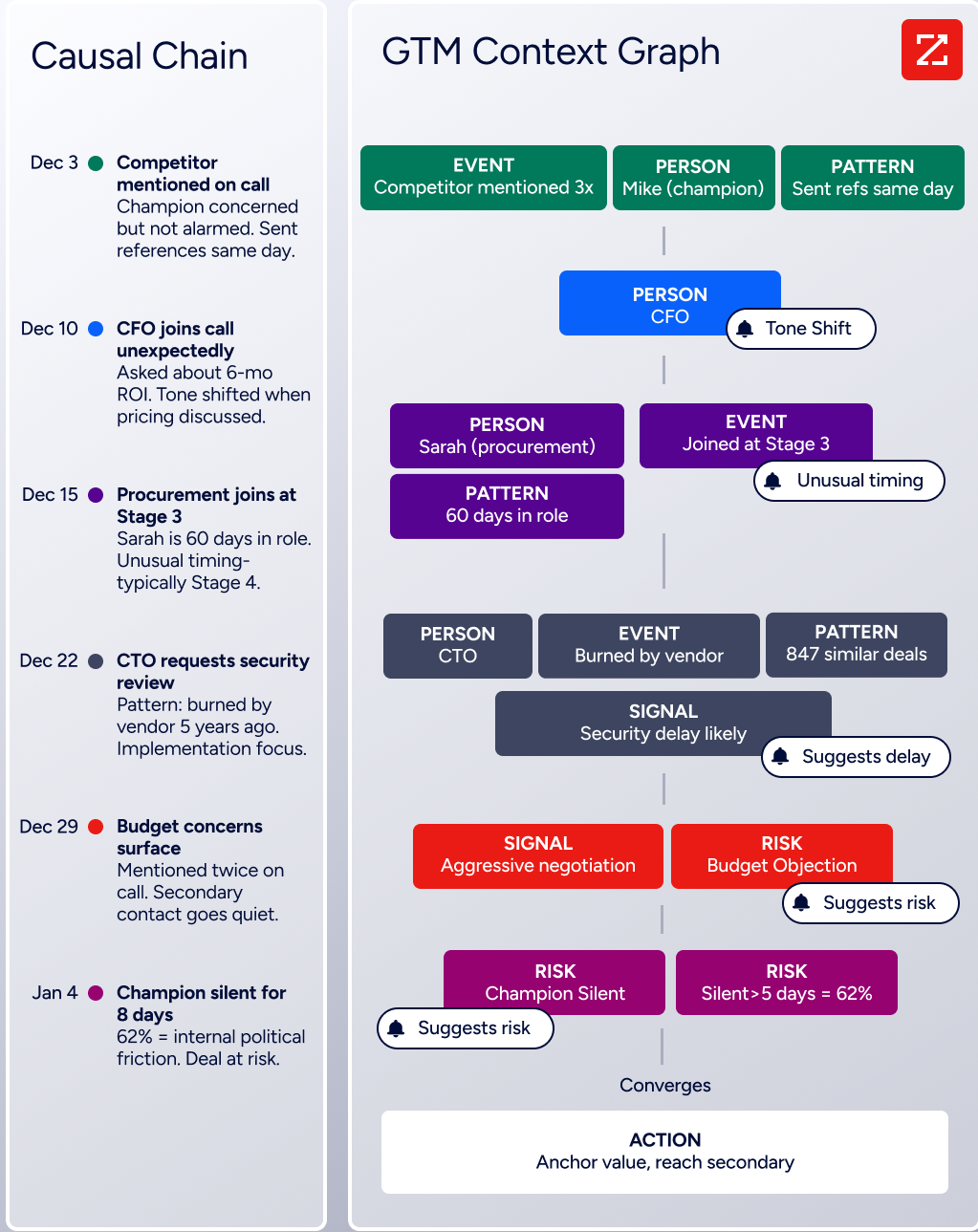
Its GTM Context Graph processes 1.5B+ data points daily, combining this data with your CRM records, conversation transcripts, and behavioral signals to show the full context of your accounts (not just what happened in a deal, but why, and what to do next). That intelligence reaches your team through GTM Workspace for sellers, GTM Studio for marketers and RevOps, or APIs and MCP for other tools.
Comprehensive B2B Data: ZoomInfo provides verified contact data, company intelligence, and org charts at a scale Crystal doesn't attempt.
Crystal can predict a prospect's personality type. ZoomInfo can tell you who that prospect is, how to reach them, what technology they use, how their company is structured, and whether they're currently researching solutions in your category.
The data covers three dimensions: identity (who buyers are and how to reach them), company context (firmographics, org charts, technographics), and signals (intent data showing when accounts are in-market).
Contact data includes 120M direct-dial phone numbers and 200M+ verified business emails, with up to 95% accuracy on first-party data. 300+ human researchers verify this data continuously through a multi-source pipeline.
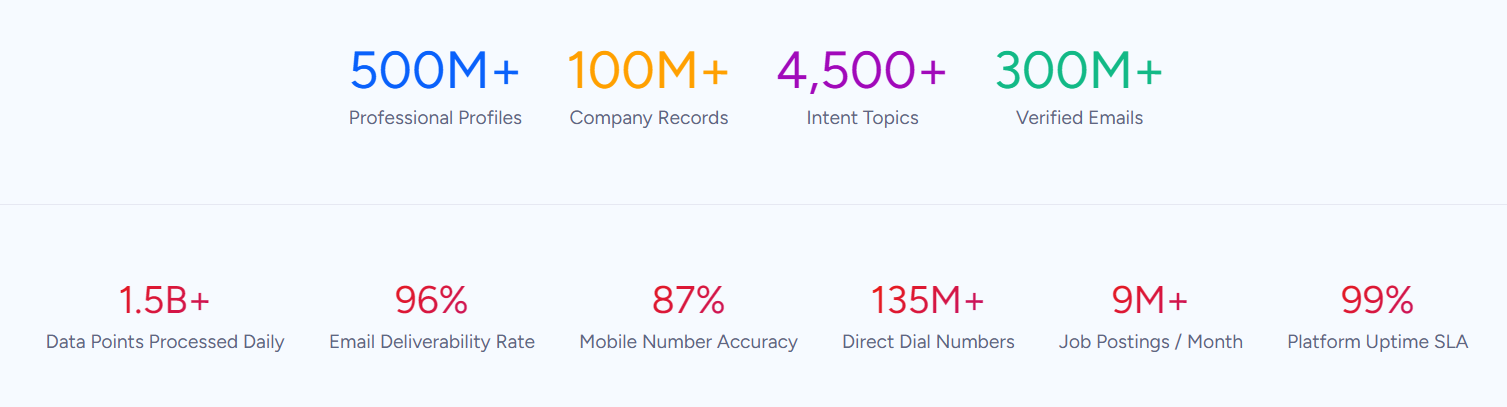
Source: ZoomInfo
Third parties confirm this.
In a Fortune 500 competitive RFP analyzing 25 million contacts across vendors, the independent consultant concluded that "no other competitor came even close." ZoomInfo holds 133 G2 No. 1 rankings across Sales Intelligence, Buyer Intent, and Data Quality, plus Gartner Magic Quadrant Leader for ABM Platforms and Forrester Wave Leader for Intent Data Providers.
"ZoomInfo gives us the information we need to execute. We don't have to spend our time digging, it's already there, so we can be three steps ahead." (Vensure Case Study)
GTM Context Graph: ZoomInfo's intelligence layer captures why deals move, not just how to phrase a message.
Crystal's insight is interpersonal: it tells you whether a prospect prefers direct communication or detailed analysis. ZoomInfo's intelligence is contextual: it tells you why a deal is accelerating, who's championing it, and what signals predict what happens next.
The GTM Context Graph combines ZoomInfo's third-party data with a customer's CRM records, conversation intelligence from Chorus (ZoomInfo's call recording and analysis tool), email interactions, and behavioral signals into a single intelligence layer.
As ZoomInfo's Chief Product Officer Dominik Facher writes: "The CRM recorded the state change. It has no record of why it happened." The GTM Context Graph captures that missing context: who joined the call, what concerns they raised, which signals predict the next step.
Source: ZoomInfo
Buyer Intent data tracks signals from 210 million IP-to-Organization pairings to identify companies researching relevant topics. Guided Intent (exclusive to ZoomInfo) identifies topics correlated with past deal success instead of requiring manual topic selection. WebSights resolves anonymous website visitors to companies and identifies buying teams.
Seismic attributed 39% of active pipeline to ZoomInfo-influenced opportunities and reported 54% productivity gains: "That combination of our internal CRM data, external signals, and AI has helped us craft very specific account- and persona-based messages, and people have responded to them right away." (Seismic Case Study)
GTM Workspace and GTM Studio: ZoomInfo provides workspaces for each GTM role.
Crystal delivers personality insights through a Chrome Extension overlay. ZoomInfo provides working environments built on the GTM Context Graph.
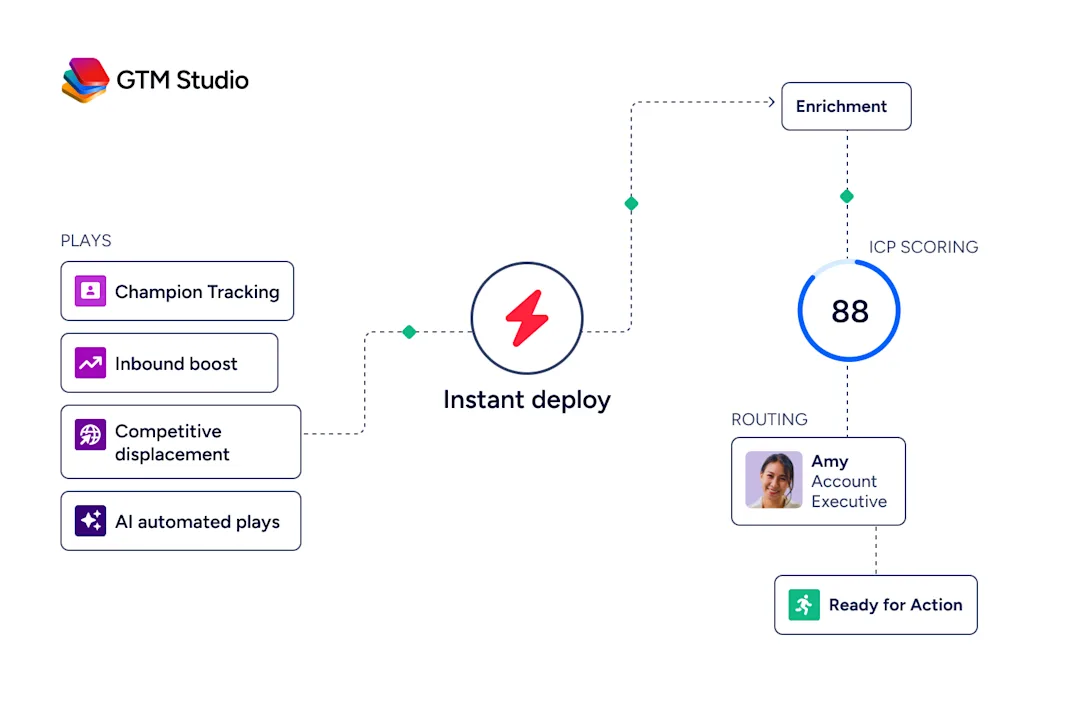
GTM Workspace is the seller's front-end: a workspace where prioritized accounts, AI-drafted outreach, and deal execution come together.
AI agents (built on Anthropic's Claude) research accounts, generate follow-ups, monitor signals, and update CRM fields. The Action Feed shows a live stream of in-market buyers with pre-drafted actions for each signal. The AI Assistant generates one-click account briefs that pull CRM history, company news, and stakeholder context into a summary in seconds.
GTM Studio serves marketers, RevOps, and GTM engineers with an AI orchestration canvas. Teams build audiences using natural language, enrich with first- and third-party data, and activate plays across email, calls, ads, and direct mail. Expansion plays that once took three weeks now launch in 30 minutes, without engineering support.
Source: ZoomInfo
For teams building beyond ZoomInfo's products, APIs and MCP expose the same intelligence to any AI agent, internal tool, or partner platform. The ZoomInfo MCP server connects to Claude, ChatGPT, and other MCP-compatible tools, letting users query ZoomInfo's data through natural language.
Spekit found opportunities at higher-scoring accounts were 43% more likely to qualify and moved 58% faster: "ZoomInfo offers a single view, eliminating the need to navigate between systems." (Spekit Case Study)
Pricing: ZoomInfo offers custom-quoted plans with a permanent free tier and a 7-day trial.
ZoomInfo uses consumption-based pricing with custom-quoted tiers. Pricing scales with seats, credit volume, features, and AI usage. No prices are publicly listed.
Sales plans come in three tiers: Professional (contact and company data, CRM integrations, Chrome Extension, AI email generation), Advanced (adds intent signals, buyer intent clusters, website visitors, Account Fit Score, GTM plays), and Enterprise (adds real-time intent, advanced signals, AI account summaries, dedicated support, custom integrations).
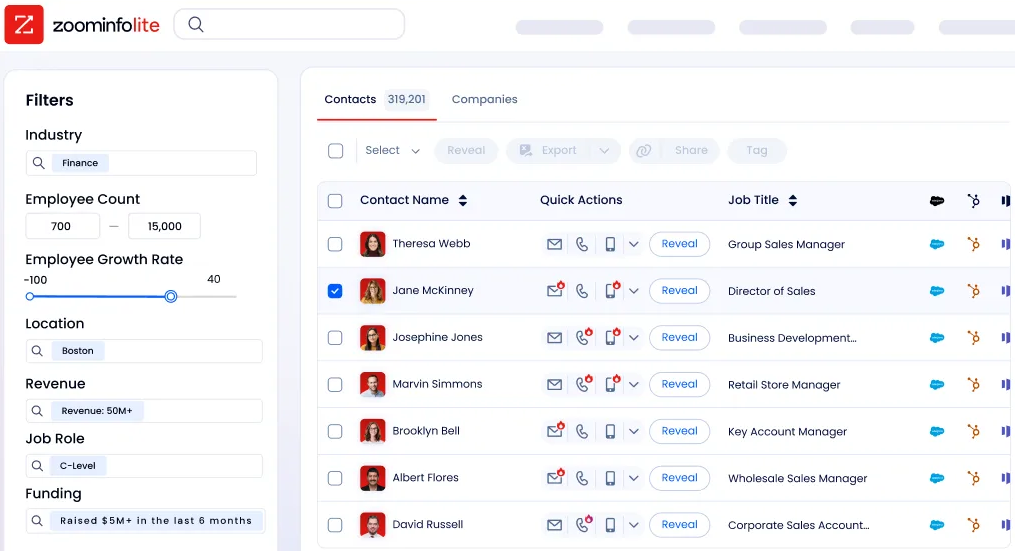
Two free entry points exist. ZoomInfo Lite is a permanent free tier with access to ZoomInfo's B2B database, 10 monthly export credits, advanced search filters, the ReachOut Chrome Extension, built-in email sending, and HubSpot integration. A separate 7-day free trial provides broader access to core platform features including intent signals and outreach tools.
Source: ZoomInfo
Crystal or ZoomInfo: Comparison Summary
Crystal | ZoomInfo | |
|---|---|---|
Primary focus | Personality intelligence for communication | B2B data, intelligence, and GTM execution |
Target users | Individual sales reps, managers, recruiters | Sales, marketing, RevOps, and GTM engineering teams |
Contact database | No contact data; personality predictions only | 500M contacts, 135M+ verified phone numbers, 200M+ verified emails |
Company intelligence | None | 100M companies with firmographics, org charts, technographics |
Buyer intent signals | None | 210M IP-to-Organization pairings; Guided Intent exclusive |
AI capabilities | Personality-adapted communication coaching | AI agents for account research, outreach, CRM updates, signal monitoring |
Conversation intelligence | None | Chorus (call recording, transcription, AI analysis) |
CRM integrations | Salesforce and HubSpot (Business plan) | 120+ integrations including Salesforce, HubSpot, Dynamics 365, Snowflake |
API/MCP access | API for Business/Enterprise; MCP for AI tools | API and MCP included in all relevant plans |
Free tier | 5 profile views, free DISC assessment | ZoomInfo Lite (permanent, 10 monthly exports) + 7-day trial |
Paid pricing | $49/year (Premium); Business contact sales | Custom-quoted, consumption-based |
Analyst recognition | G2 Leader badges | Gartner MQ Leader, Forrester Wave Leader, 133 G2 No. 1 rankings |
Best for | Personalizing communication style for known prospects | Finding, prioritizing, and engaging prospects across the full GTM motion |
Final Verdict
The choice between Crystal and ZoomInfo depends on whether you need help with one part of sales or the whole go-to-market process.
Choose Crystal if you already have reliable prospecting data and want to sharpen how your team communicates with individual buyers.
It fits when your reps are already reaching the right people at the right time and need help building rapport, especially in consultative sales with longer cycles. Crystal's DISC insights can improve conversations that are already happening, at a price ($49/year for individuals) that makes it accessible.
Choose ZoomInfo if you need the full infrastructure for finding, understanding, and engaging buyers.
ZoomInfo answers questions Crystal doesn't touch: who to contact (verified contact data), when to engage (buyer intent signals and account prioritization), and what context matters (the GTM Context Graph combining CRM, conversation intelligence, and behavioral signals). For teams that need to build pipeline, not just improve the tone of their outreach, ZoomInfo provides the data, intelligence, and execution layers in one platform.
Get started with ZoomInfo here.
Crystal makes individual conversations better. ZoomInfo makes the revenue engine work. If your team's challenge is knowing what to say in a conversation, Crystal adds value. If the challenge extends to building and prioritizing pipeline from end to end, ZoomInfo provides the data, intelligence, and execution that personality insights can't replace.
Crystal FAQ
What is Crystal and how does it work?
Crystal is a personality intelligence platform that uses the DISC framework to predict how individuals think, communicate, and make decisions. Its Chrome Extension analyzes public LinkedIn data to generate a personality prediction for any prospect, without requiring that person to take an assessment. The platform then provides communication tips, sales playbooks, and guidance for each person's predicted DISC type.
How accurate are Crystal's personality predictions?
Crystal generates its predictions from public LinkedIn data, and they are probabilistic by nature. The company publishes an accuracy report based on 12,000+ professionals who reviewed their own predictions, though some user reviews describe predicted profiles as approximate rather than precise. Verified profiles, where the person completes Crystal's own DISC assessment, carry higher confidence than AI-predicted profiles.
How much does Crystal cost?
Crystal offers a permanent free plan with 5 profile view credits and a free DISC assessment. The Premium plan costs $49/year (or $59/month) and includes full profiles, PDF downloads, and email support, with 20 profiles per month on the monthly plan. The Business plan (which adds Teams, Hiring, and Sales features plus a Customer Success Manager) requires contacting Crystal's sales team for pricing.
Does Crystal integrate with CRM platforms?
Crystal integrates with Salesforce and HubSpot on the Business plan. The Chrome Extension shows personality data on CRM contact records in those platforms. For other CRMs, Crystal supports CSV-based enrichment as a manual workaround. Integrations with sales engagement platforms like Outreach, Salesloft, and Apollo are not currently available.
Can Crystal help with hiring and team collaboration?
Yes. Crystal for Hiring generates behavioral fit profiles for roles, allows candidates to complete DISC assessments via shareable links, and produces interview playbooks focused on personality gaps. Crystal for Teams deploys assessments company-wide and provides group reports covering team dynamics, conflict resolution, and collaboration. Both features require the Business plan.
What personality frameworks does Crystal support?
Crystal covers four frameworks in a single profile: DISC, Enneagram, 16 Personalities, and Big Five. DISC is the primary framework for sales and business use. Multi-framework coverage is available for all assessed profiles and gives a more detailed behavioral picture than single-framework tools.
Does Crystal provide B2B contact data or prospecting tools?
No. Crystal focuses on personality intelligence. It does not include a contact database, verified emails, phone numbers, firmographics, org charts, intent signals, or prospecting tools. Teams that need this data use Crystal alongside a B2B data provider.
ZoomInfo covers all of these in one platform, with 500M contacts, 135M+ verified phone numbers, and 200M+ verified business emails.
Is Crystal available in languages other than English?
No. Crystal is available only in English, with no localization. Users who need other languages are directed to browser-based translation tools. There is also no mobile app. The platform runs on desktop browsers and the Chrome Extension.
Researching Crystal Knows? These comparisons and alternatives help you decide:
