
Choosing between HubSpot and Zoho CRM often comes down to five questions:
Do you want a platform that works out of the box, or one you can configure to match your exact processes?
Is your priority ease of use for a growing team, or features per dollar spent?
Are you willing to pay premium prices for a polished experience, or would you rather invest time in setup to save on licensing?
How important is it that your marketing, sales, and service tools share one data layer?
Does your team have the B2B contact data and buying signals it needs, or are your reps still spending hours researching prospects manually?
In short, here's what we recommend:
HubSpot is the CRM for teams that want everything connected and working fast. Its platform ties marketing, sales, service, content, and commerce together on a single database, with an interface most users can navigate within hours. HubSpot's Breeze AI adds agents for prospecting, customer support, and data queries across every hub. The tradeoff is cost: pricing scales quickly as your team grows, mandatory onboarding fees at Professional and Enterprise tiers add thousands upfront, and mixing hub tiers forces all seats to the highest tier's rate.
Zoho CRM delivers CRM features that rival enterprise platforms at a fraction of what HubSpot and Salesforce charge. Its Enterprise plan costs $40/user/month on annual billing. That includes Zia AI, territory management, journey orchestration, custom functions, customer portals, and a sandbox environment. No mandatory onboarding fees. Month-to-month billing available. No multi-year contracts required. The tradeoff is setup time: success requires investing in configuration rather than expecting out-of-box functionality.
Both platforms are strong CRM choices. But here's the question neither answers: where does the data come from? A CRM organizes the contacts, companies, and deals your team works. It doesn't find them. It doesn't verify that a phone number still rings or an email won't bounce. And it doesn't tell you which accounts are researching solutions like yours right now. That gap is where deals stall, pipelines thin out, and reps waste hours on manual research.
ZoomInfo is a B2B data intelligence and GTM platform that fills that gap for either CRM. Built on 500M contacts, 100M companies, 135M+ verified phone numbers, and 200M+ verified business emails, ZoomInfo feeds your HubSpot or Zoho CRM with verified contact data, company intelligence, and real-time buying signals. Its GTM Context Graph combines this data with your CRM records and conversation transcripts to reveal not just what's happening in your pipeline, but why, so reps walk into calls knowing which accounts are in-market and marketers launch plays against accounts matching proven win patterns. Sellers access this intelligence through GTM Workspace, marketers and RevOps through GTM Studio, and engineers through APIs and MCP in any tool they choose.
If feeding your CRM with verified data and real-time buying signals sounds like the missing piece, see how ZoomInfo works with your stack.
HubSpot vs. Zoho CRM vs. ZoomInfo at a glance
HubSpot | Zoho CRM | ZoomInfo | |
|---|---|---|---|
Core function | Unified CRM and customer platform | CRM and business software suite | B2B data intelligence and GTM platform |
Starting price | Free CRM; Starter at $15/seat/mo (annual) | Free (3 users); Standard at $14/user/mo | Free (ZoomInfo Lite); consumption-based pricing |
AI capabilities | Breeze AI (agents for prospecting, support, data) | Zia AI (predictive scoring, agents, generative CRM setup) | GTM Context Graph, AI-drafted outreach, signal-based prioritization |
Marketing automation | Native Marketing Hub | Native omnichannel + Zoho Campaigns | ABM, display ads, intent-driven campaign orchestration |
Integrations | 2,000+ marketplace apps | 1,100+ marketplace extensions + 55 Zoho apps | 120+ integrations + API/MCP for any tool |
Learning curve | Low to moderate | Moderate to steep | Moderate |
Data focus | Stores and manages customer data | Stores and manages customer data | Sources, verifies, and enriches B2B data |
Best for | Teams prioritizing ease of use and fast deployment | Budget-conscious teams needing customization | Teams needing verified B2B data, intent signals, and GTM intelligence |
Two approaches to the all-in-one CRM
HubSpot and Zoho CRM both want to be the central system for your go-to-market teams. They take different paths to get there.
HubSpot built everything on a single codebase.
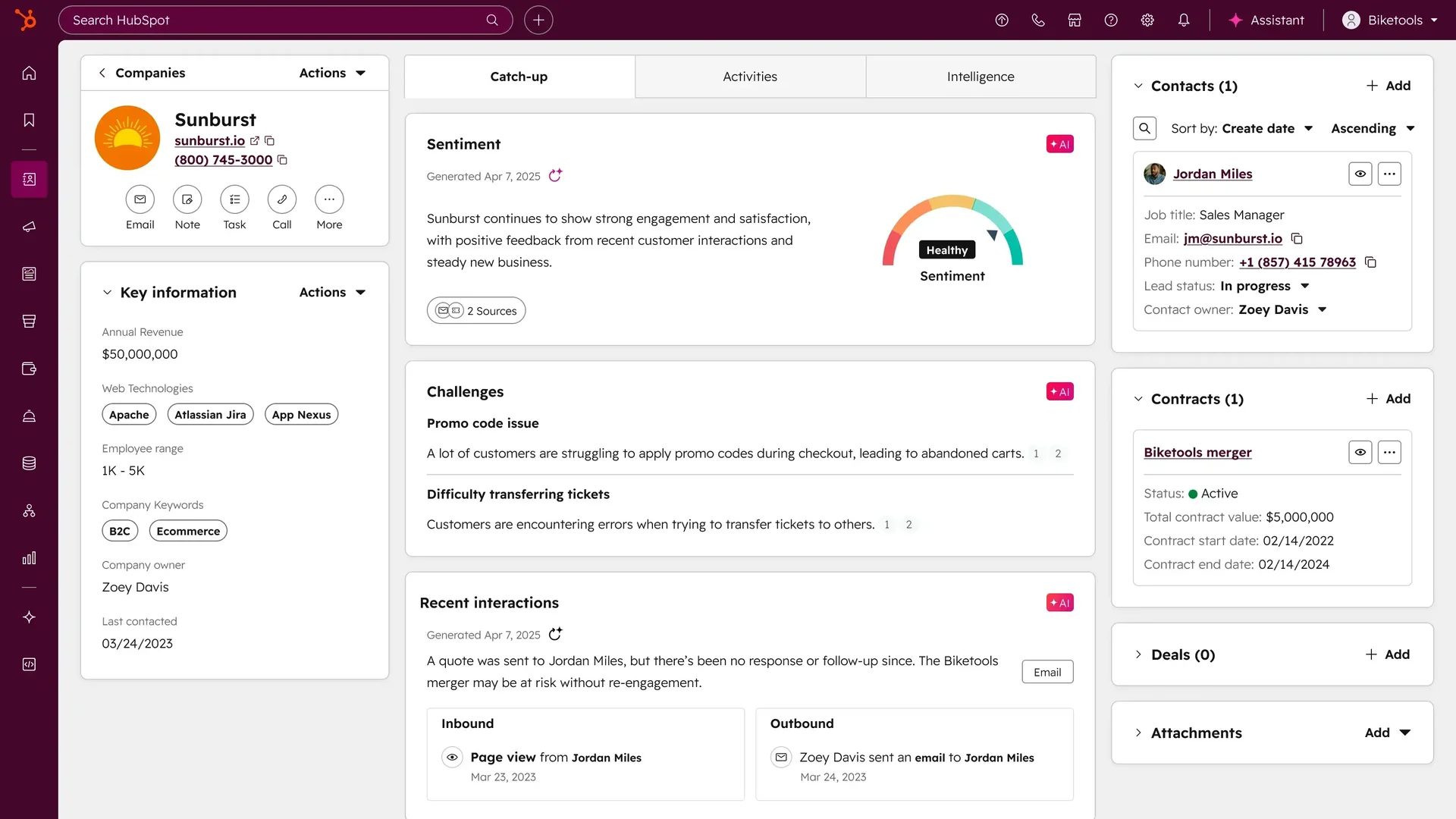
Marketing Hub, Sales Hub, Service Hub, Content Hub, Data Hub, and Commerce Hub all share one Smart CRM database. When a lead fills out a form, that record is immediately available to sales sequences, service tickets, and reporting dashboards. No syncing, no data mapping, no integration to configure.
This is HubSpot's defining advantage: when you use two or more Hubs together, data connects automatically, letting you track the customer journey from first website visit to closed deal.
Source: HubSpot
Zoho took a different route.
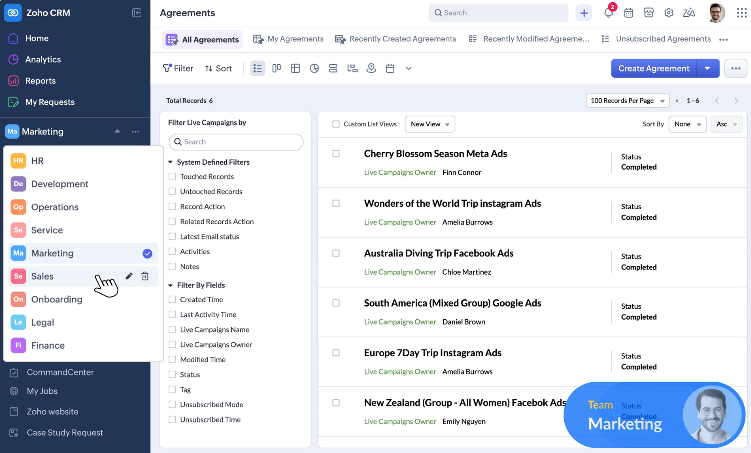
Rather than building a single CRM, Zoho built an entire business software ecosystem of 55+ applications. Zoho CRM sits at the center, connecting natively to Zoho Books, Campaigns, Desk, Sign, Analytics, SalesIQ, and Projects.
The advantage is breadth: Zoho can run your accounting, HR, project management, and customer support alongside your CRM, all from one vendor. The tradeoff is that cross-app integration, while strong, isn't as invisible as HubSpot's single-database approach.
Source: Zoho
For small teams that want a CRM working within days, HubSpot's design wins. For organizations that want one vendor for nearly every business function, Zoho's ecosystem is hard to match.
The pricing gap is significant
This is where the comparison gets uncomfortable for HubSpot.
Zoho CRM's Enterprise plan, its most popular tier, costs $40/user/month on annual billing.
That includes Zia AI, territory management, journey orchestration, custom functions, customer portals, and a sandbox environment. No mandatory onboarding fees. Month-to-month billing available. No multi-year contracts required.
HubSpot's pricing adds up differently.
Sales Hub Professional costs $100/seat/month (annual) with a $1,500 mandatory onboarding fee. Marketing Hub Professional is $800/month (annual) for 2,000 marketing contacts, with a $3,000 onboarding fee. Need both? The costs stack. And there's a pricing rule most buyers discover late: if you subscribe to multiple Hubs at different tiers, all Core Seats are billed at the rate of the highest tier.
For a 20-person sales team on Professional plans, the annual difference between HubSpot and Zoho runs into tens of thousands of dollars before you factor in onboarding fees or marketing automation costs.
HubSpot's counterargument is time-to-value.
The platform claims customers reach meaningful value within 90 days. And HubSpot's permanently free CRM tier is useful for small teams starting out. But as you scale past Starter plans, the pricing complexity grows fast.
Zoho keeps it simple: per-user pricing, no mandatory fees, and a 15-day free trial of the full Enterprise tier with no credit card required.
AI capabilities: Breeze vs. Zia
Both platforms have invested heavily in AI, and both deliver real value.
HubSpot's Breeze is an AI layer running across all hubs.
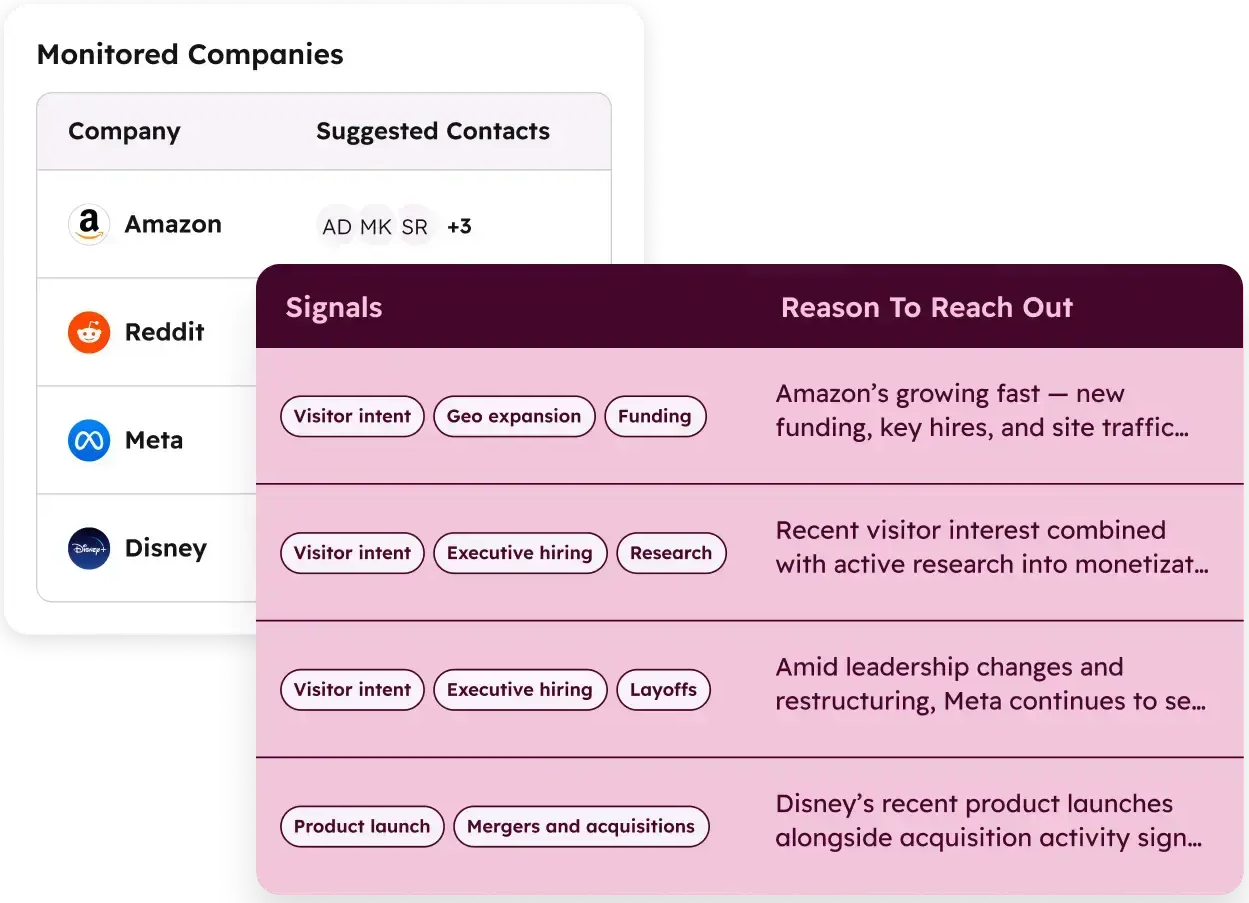
Its agents handle specific jobs: the Prospecting Agent monitors buying signals, researches prospects, and drafts personalized outreach emails using the full customer history. The Customer Agent resolves inquiries across chat, email, and WhatsApp. The Data Agent answers natural-language questions about CRM data. Breeze features come with Professional and Enterprise subscriptions on a credit-based system.
Source: HubSpot
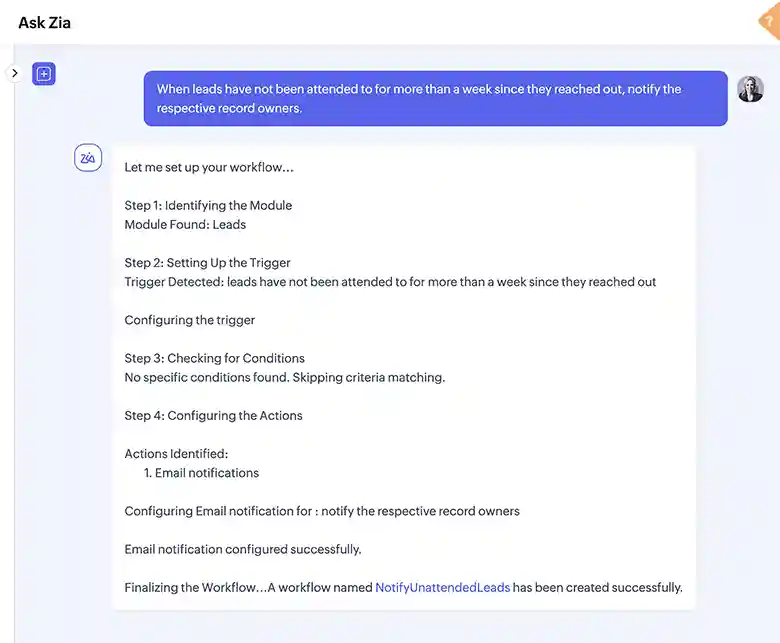
Zoho's Zia covers three tiers of AI: predictive intelligence (lead scoring, churn prediction, field prediction, AI forecasting), generative AI (module creation, workflow creation, and report generation from natural language), and agentic AI with autonomous agents for SDR tasks, deal analysis, and follow-up scheduling.
Zia's email intelligence analyzes sentiment, intent, and emotion across eight categories, and its call transcription extracts summaries and insights automatically. Zoho also runs its own language models rather than relying entirely on third-party AI providers.
Source: Zoho CRM
The distinction: HubSpot's AI advantage is context, drawing on the complete customer history across all hubs. Zoho's AI advantage is breadth, covering predictive, generative, and agentic capabilities across the full CRM at a lower price point. Both are advancing rapidly, and several features on each side remain in beta.
Marketing automation: native power vs. ecosystem depth
HubSpot's Marketing Hub is one of the strongest marketing automation platforms available.
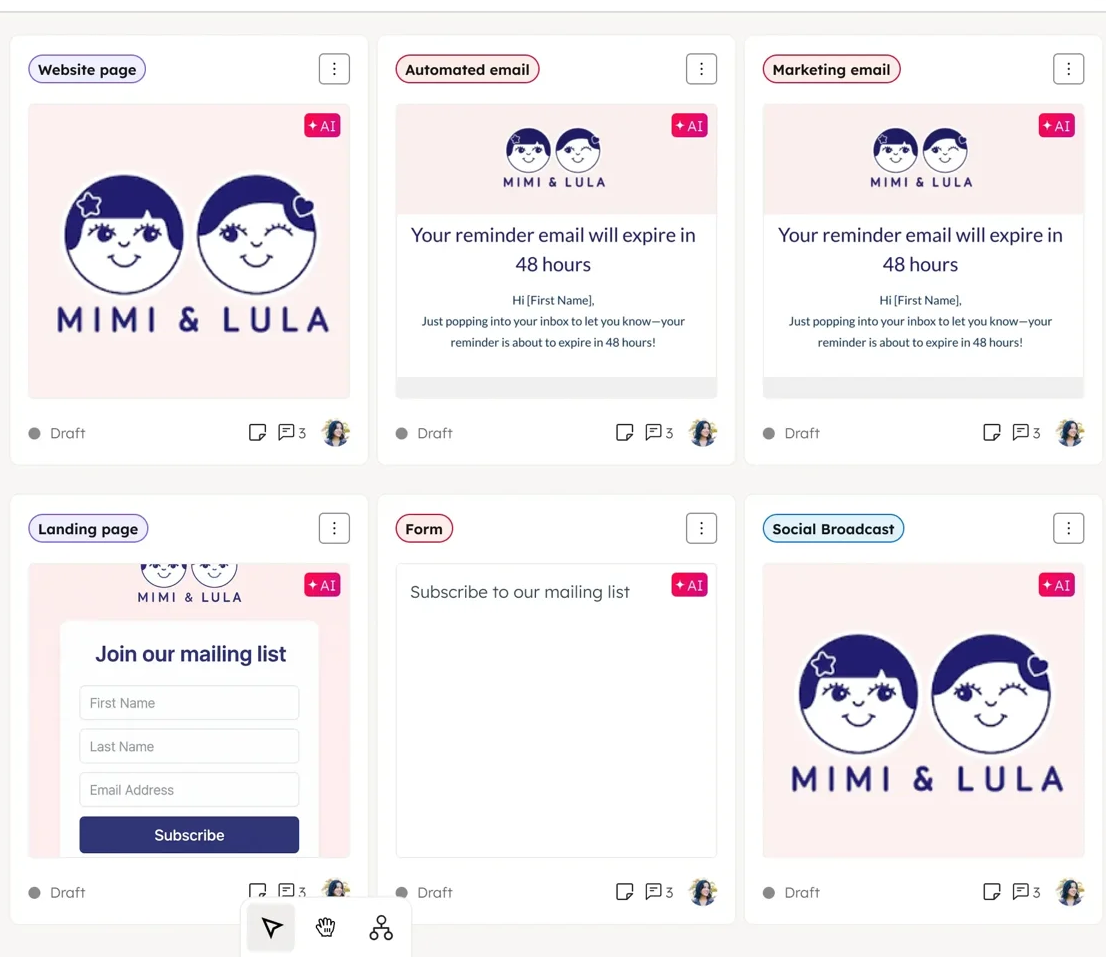
Visual workflow builder, multi-channel campaign automation, audience segmentation, email marketing with send-time optimization, landing page builder, social media management, and multi-touch attribution reporting, all sharing the same CRM database as your sales and service teams.
For companies running content-led inbound strategies, HubSpot's marketing tools are the main reason they chose the platform.
Source: HubSpot
Zoho CRM includes solid marketing capabilities natively.
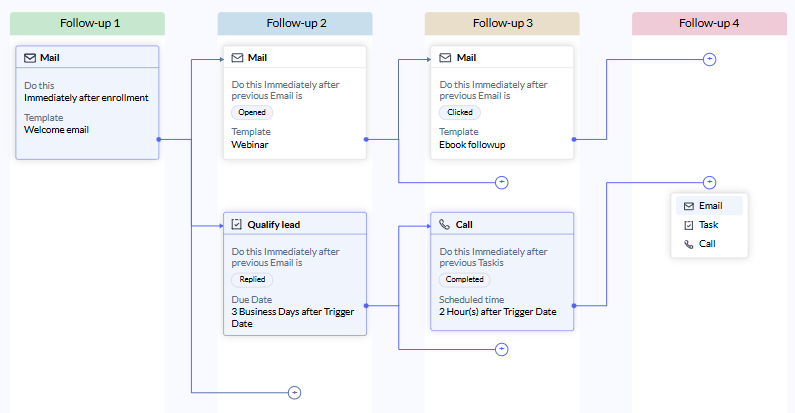
Cadences powers multichannel follow-up sequences that branch based on prospect behavior. SalesSignals fires real-time notifications when prospects engage on any channel. CommandCenter orchestrates customer journeys across departments. And for dedicated email marketing campaigns, Zoho Campaigns integrates natively.
The individual tools are capable, but the marketing stack requires assembling pieces from Zoho's app ecosystem rather than finding everything in one hub.
Source: Zoho
For teams where marketing automation is the primary use case, HubSpot's integrated approach is stronger. For teams where marketing supports sales rather than leading it, Zoho's built-in features may be enough, especially at the price difference.
The data problem neither CRM solves
Here's what both HubSpot and Zoho assume: that your team already has the data it needs.
A CRM is a system of record. It organizes contacts, tracks deals, and automates workflows around data that already exists. But it doesn't answer the questions that come before the CRM matters: Which companies should we target? Who are the decision-makers? Are their phone numbers accurate? Are they even in-market right now?
HubSpot's Smart CRM enriches records automatically using email threads, calls, and web activity, but this enrichment works on contacts already in your database. Zoho CRM's Zia enrichment fills in missing fields from existing records. Neither platform generates new prospect data at the scale sales teams need.
This is the gap ZoomInfo fills.
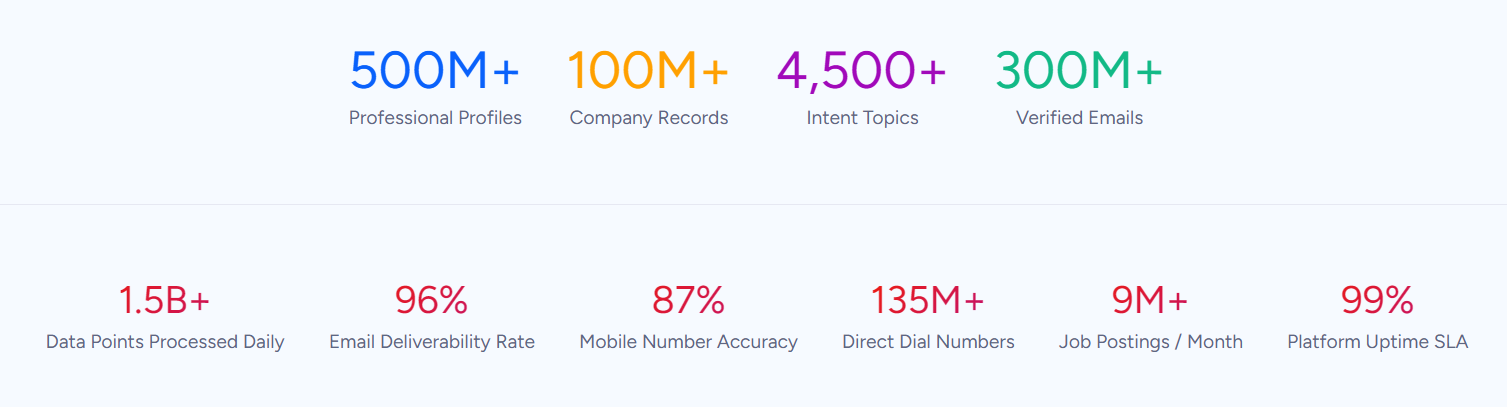
While HubSpot and Zoho manage the customer data you have, ZoomInfo provides the customer data you need. 500M contacts, 100M companies, 135M+ verified phone numbers, 120M direct dials, and 200M+ verified business emails, backed by 300+ human researchers and a multi-source verification pipeline achieving up to 95% accuracy on first-party data.
Source: ZoomInfo
The practical difference: instead of a rep spending 30 minutes researching each prospect, they find the verified direct dial, the org chart, the tech stack, and the intent signals in one platform, then push that data into HubSpot or Zoho CRM with a click.
"ZoomInfo gives us the information we need to execute. We don't have to go through and spend our time digging. It's already there, so we can be three steps ahead." (Vensure)
For a closer look at how HubSpot and ZoomInfo compare as standalone platforms, see our HubSpot vs. ZoomInfo breakdown.
ZoomInfo adds intelligence, not just data
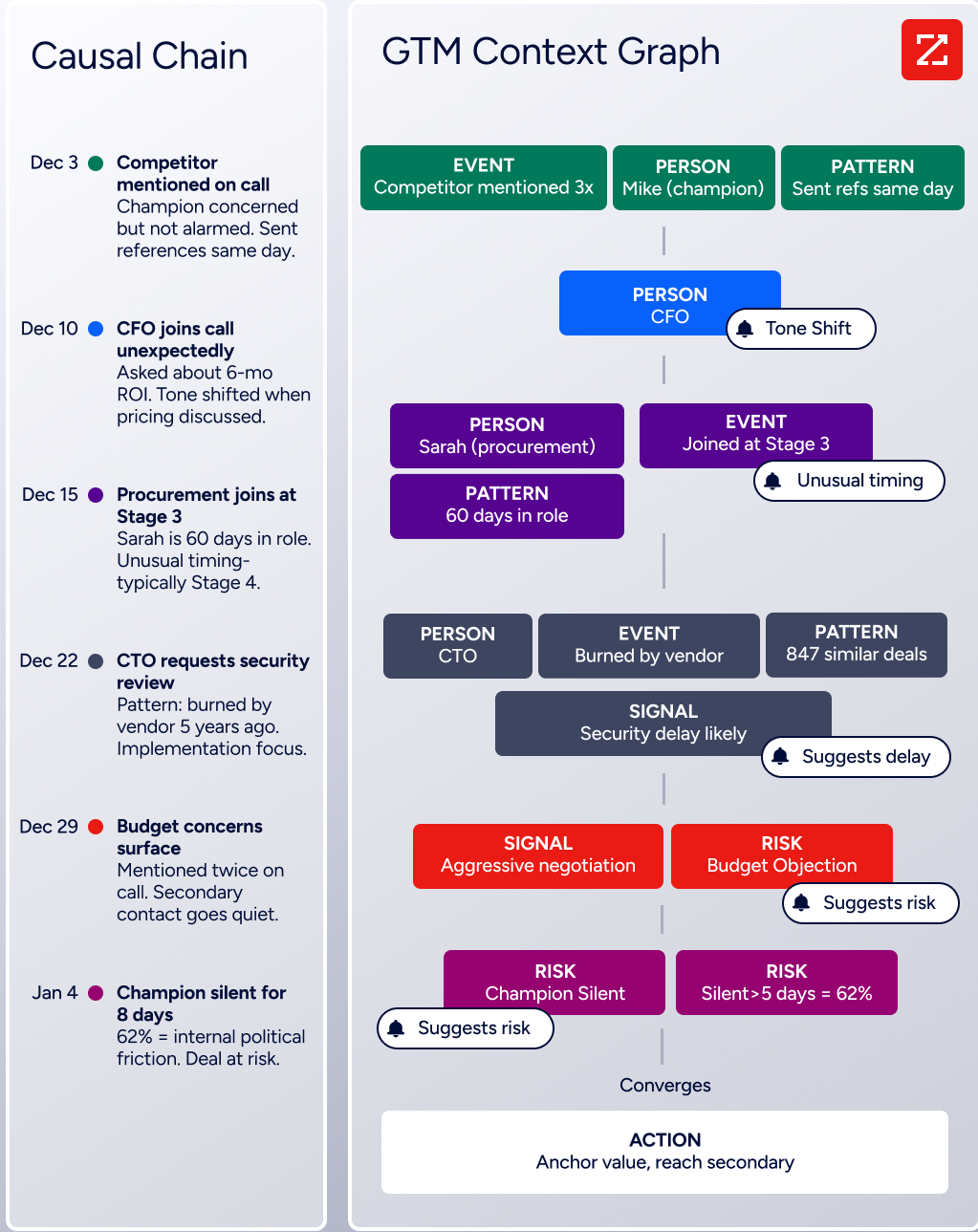
Data alone is a starting point. What separates ZoomInfo from a static contact database is the GTM Context Graph, which processes 1.5B+ data points daily.
The GTM Context Graph combines ZoomInfo's B2B data with your CRM records, conversation transcripts, email interactions, and behavioral signals. A CRM records that a deal moved to Stage 4. Conversation intelligence captures that the CFO joined the last call and asked about six-month ROI. Intent data shows the company is researching your competitor.
The Context Graph unifies all three to surface why the deal is accelerating and what to do next.
Source: ZoomInfo
For sellers, this surfaces through GTM Workspace: a prioritized account feed with AI-drafted outreach that addresses the specific concerns identified in conversations, not generic templates. For marketers and RevOps, GTM Studio lets teams describe audiences in plain language, launch multi-channel plays, and watch pipeline impact in real time.
And because ZoomInfo integrates directly with both HubSpot and Zoho CRM, the intelligence flows into whichever CRM your team uses.
The results are documented. Seismic's sales team attributed 39% of active pipeline to opportunities identified or influenced by ZoomInfo signals, boosted productivity by 54%, and saved 11.5 hours per week per seller.
"That combination of our internal CRM data, external signals, and AI that's given all that context has helped us craft very specific account- and persona-based messages. And people have responded to them right away." (Seismic)
Ease of use vs. depth of customization
HubSpot's interface is the reason many teams choose it over technically capable alternatives.
The platform is consistent across every hub, navigation is intuitive, and most users are productive within hours. HubSpot's free tier works as a genuine onboarding ramp: explore the CRM, learn the interface, upgrade when ready.
Zoho CRM is more capable out of the gate but demands more from administrators.
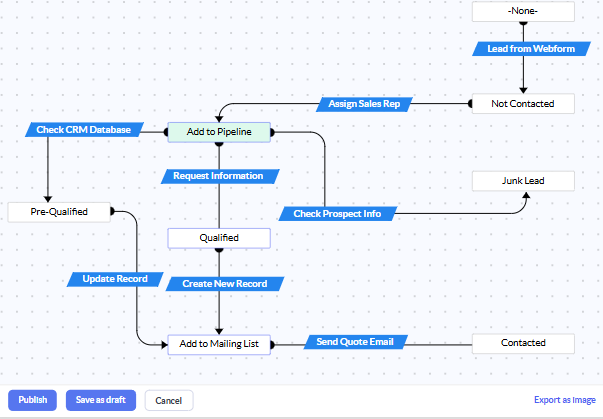
Canvas Design Studio lets admins rebuild the interface without code, Kiosk Studio creates guided process flows, and Blueprint enforces step-by-step deal progression so reps can't skip required actions. These tools reward organizations that invest in configuration. But as SoftwareReviews notes, "success requires investing time in setup and configuration rather than expecting immediate out-of-box functionality."
Source: Zoho
The tradeoff is clear: HubSpot optimizes for the first 90 days, Zoho optimizes for year two and beyond. Teams that need fast deployment choose HubSpot. Teams with technical admins willing to configure choose Zoho.
Integrations and ecosystem
HubSpot's App Marketplace has surpassed 2,000 integrations with over 2.5 million active installs. The ecosystem is mature, with bidirectional integrations for most major business tools. HubSpot's developer platform supports UI extensions, custom objects, and serverless functions.
Zoho offers 1,100+ marketplace extensions, plus the 55+ first-party Zoho applications that integrate natively. For teams already using Zoho Books, Desk, or Projects, the cross-app integration avoids third-party connector fragility entirely. Zoho's REST and GraphQL APIs, serverless Deluge functions, and Widget SDK serve developers building custom integrations.
ZoomInfo integrates with both ecosystems directly.
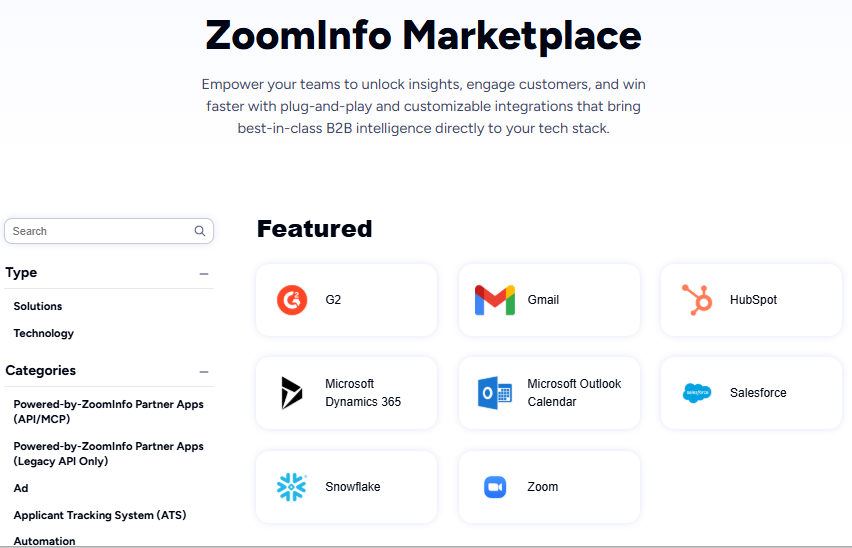
The ZoomInfo App Marketplace lists 120+ partner integrations across CRM, marketing automation, sales engagement, and data warehouse categories. For technical teams, ZoomInfo's Enterprise API and MCP server deliver the same intelligence into any custom application or AI agent. API access is included in all relevant ZoomInfo plans.
Source: ZoomInfo
"The plug-and-play aspect of the API means I can integrate it very easily into any process and get information at a moment's notice." (BDO Canada)
Security and compliance
All three platforms meet enterprise security standards, with different emphases.
HubSpot holds SOC 2 Type II, HIPAA attestation, GDPR, and CCPA compliance, with AES-256 encryption at rest and TLS 1.2/1.3 in transit. An EU data center is available for data residency requirements. SSO, 2FA, and IP allowlisting are supported.
Zoho holds ISO 27001, ISO 27701, SOC 2 Type 2, and HIPAA certifications, and operates its own data centers globally (rather than hosting on AWS or Azure) with 18 data centers across the US, EU, India, UAE, Japan, and more.
Zoho's privacy stance is explicit: no advertising-based revenue, no data selling, no third-party trackers. Field-level encryption is available at Enterprise tier and above.
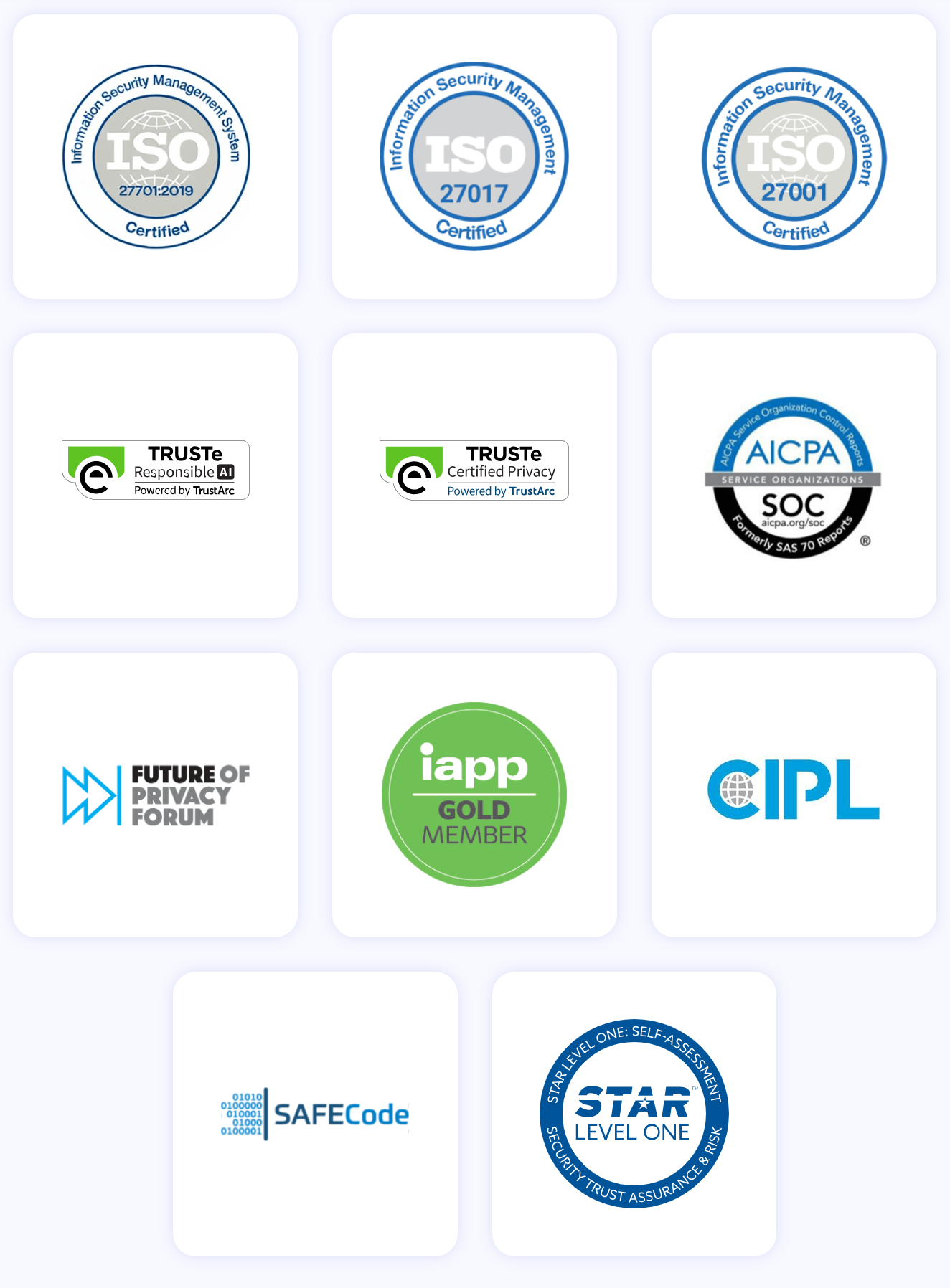
ZoomInfo maintains ISO 27001, ISO 27701, SOC 2 Type II, TRUSTe GDPR, and TRUSTe CCPA certifications, all renewed annually. ZoomInfo is a registered data broker in California and Vermont, with a dedicated Trust Center for transparency.
For organizations where data sovereignty is the primary concern, Zoho's self-operated data centers and privacy-first business model stand out. For regulated industries needing comprehensive certifications, all three platforms qualify.
HubSpot vs. Zoho CRM vs. ZoomInfo: Which should you choose?
The answer depends on what problem you're solving first.
Choose HubSpot if:
Fast time-to-value matters more than cost savings
Your marketing team drives lead generation and needs full automation
You want a polished, consistent interface across every function
You prefer a platform that prescribes best practices over one that demands configuration
Your budget can handle per-hub, per-seat pricing with onboarding fees
Choose Zoho CRM if:
Total cost of ownership is a primary buying criterion
You need customization without hiring developers
You want one vendor for CRM, finance, HR, project management, and support
Month-to-month billing and no onboarding fees matter to your procurement process
Your admin team has the time and skill to configure the platform properly
Add ZoomInfo to either CRM if:
Your reps spend too much time researching prospects instead of selling
You need verified direct dials and emails, not stale database records
Knowing which accounts are in-market would change how you prioritize pipeline
You want AI that understands why deals move, not just that they moved
Your growth depends on outbound prospecting, ABM, or data-driven territory planning
Start free with ZoomInfo Lite or request a demo to see the full platform.
The CRM you choose organizes your customer relationships. The data you feed it determines whether those relationships start. HubSpot and Zoho each excel at organizing. ZoomInfo ensures your teams have the verified data and buying signals to fill the pipeline your CRM manages, whichever CRM that is.
HubSpot vs. Zoho CRM vs. ZoomInfo FAQ
What is the core difference between HubSpot, Zoho CRM, and ZoomInfo?
HubSpot is a unified CRM platform connecting marketing, sales, and service on a single database, built for ease of use and fast deployment.
Zoho CRM is part of a 55+ app business suite offering CRM features at lower per-user pricing, with extensive customization options.
ZoomInfo is not a CRM. It is a B2B data intelligence and GTM platform that provides the verified contacts, company data, and buying signals that feed into either CRM.
Which CRM is more affordable: HubSpot or Zoho?
Zoho CRM costs substantially less. Its Enterprise plan runs $40/user/month compared to HubSpot Sales Hub Professional at $100/seat/month, and Zoho charges no mandatory onboarding fees. HubSpot requires $1,500 to $7,000 in onboarding fees for Professional and Enterprise tiers.
Zoho also offers month-to-month billing with no multi-year contracts, while HubSpot's paid subscriptions can only be canceled at the end of the commitment term.
Does ZoomInfo replace HubSpot or Zoho CRM?
No. ZoomInfo complements both platforms and integrates directly with each.
HubSpot and Zoho manage your customer relationships, deals, and workflows. ZoomInfo provides the B2B contact data, company intelligence, and intent signals that populate and enrich your CRM. Many organizations use ZoomInfo alongside their CRM to improve prospecting accuracy, pipeline quality, and account targeting.
Which platform has better AI capabilities?
Each platform's AI serves a different purpose.
HubSpot's Breeze AI runs across all hubs with agents for prospecting, customer support, and data queries, drawing on the full customer history for context. Zoho's Zia AI covers predictive scoring, generative CRM setup, email and call intelligence, and autonomous sales agents at a lower price point.
ZoomInfo's GTM Context Graph processes 1.5 billion data points daily to understand why deals move or stall, powering AI-drafted outreach and signal-based account prioritization that neither CRM can replicate alone.
Which is easier to set up: HubSpot or Zoho CRM?
HubSpot is faster to set up. Its unified interface and free CRM tier let most teams get productive within days. HubSpot claims customers reach meaningful value within 90 days. Zoho CRM offers more customization (tools like Blueprint, Canvas Design Studio, and Kiosk Studio) but requires more admin investment before delivering full value.
Organizations with technical resources that invest in Zoho's configuration tend to find the long-term flexibility worth the initial setup effort.
How does ZoomInfo's data compare to the enrichment built into HubSpot and Zoho?
HubSpot's Smart CRM enriches existing records using email threads, calls, and web activity. Zoho's Zia fills in missing fields on current contacts. Both work with data already in your database.
ZoomInfo provides new prospect discovery at scale (500 million contacts, 100 million companies, and 135 million verified phone numbers) backed by 300+ human researchers and up to 95% accuracy on first-party data. In a Fortune 500 competitive evaluation analyzing 25 million contacts across vendors, an independent consultant concluded that no other competitor came close to ZoomInfo's coverage.
Can I use ZoomInfo with both HubSpot and Zoho CRM?
Yes. ZoomInfo integrates natively with both HubSpot and Zoho CRM, along with Salesforce, Microsoft Dynamics 365, and other major platforms. Data flows from ZoomInfo into your CRM through direct integrations, the ZoomInfo Chrome extension, or the Enterprise API. ZoomInfo also offers MCP access for teams building custom AI agents on top of the data.
Which platform is best for account-based marketing?
ZoomInfo is the strongest choice for ABM, named a Leader in the Gartner Magic Quadrant for ABM Platforms in both 2024 and 2025. Its intent data tracks signals from 210 million IP-to-Organization pairings and 6 trillion keyword-to-device pairings monthly, with Guided Intent identifying topics historically correlated with deal success.
HubSpot's Marketing Hub supports ABM workflows and ad targeting but lacks the depth of ZoomInfo's third-party intent data. Zoho CRM includes ABM-adjacent features through its journey orchestration and analytics tools but does not offer native intent signal tracking or display advertising.
Comparing HubSpot and Zoho? These related breakdowns go deeper:
