
Key Takeaways
Go-to-market (GTM) data is the combined company, contact, behavioral, and signal data that revenue teams use to find, win, and grow customers.
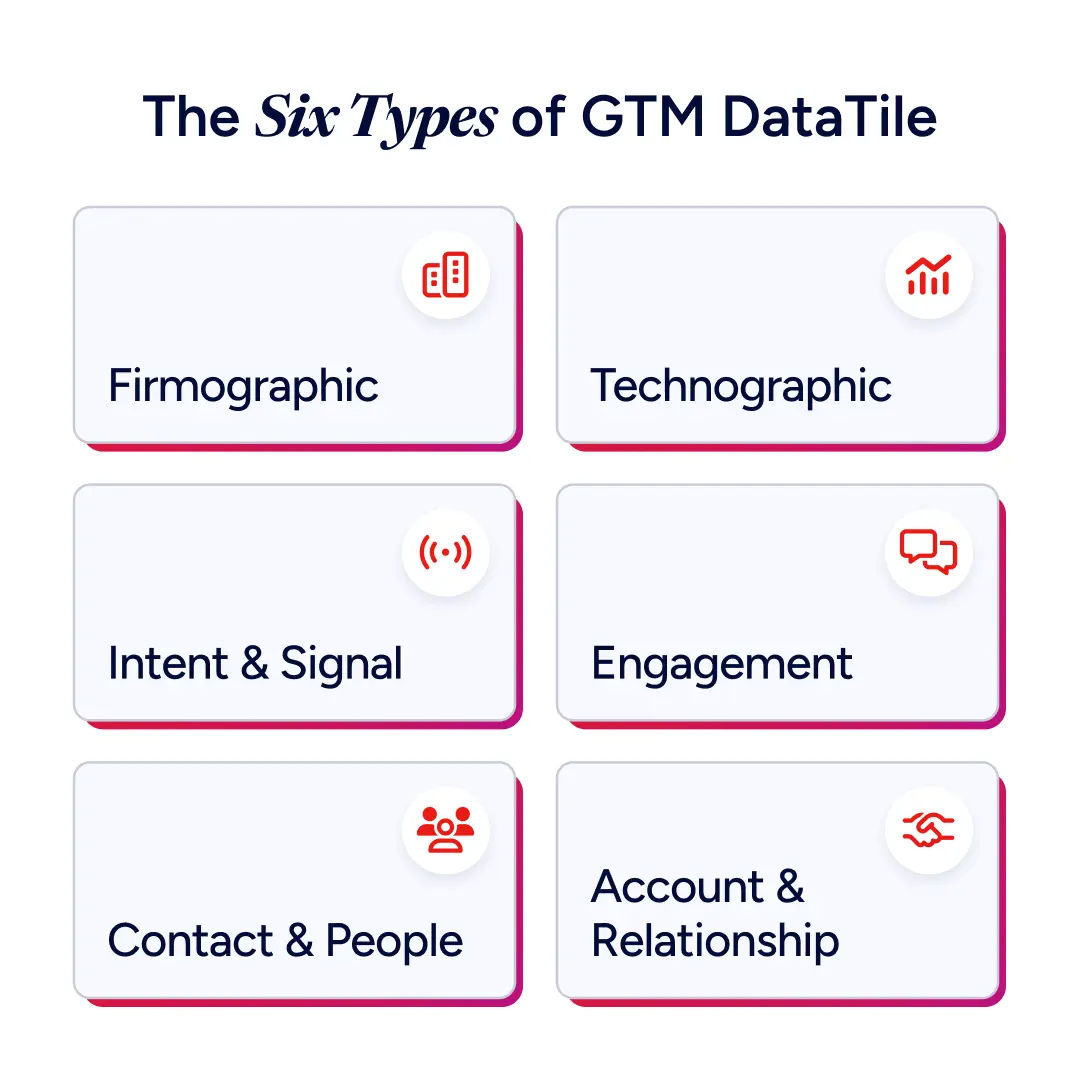
Six core data types power a modern GTM motion: firmographic, technographic, intent, engagement, contact, and account relationship data.
95% of GTM leaders say poor data quality has hurt their results. The real gap is trust in the data they already have.
AI agents now act on data without a human review step. That raises the bar from clean enough to read to accurate enough to act on.
Companies treating GTM data as a single foundation outperform peers on revenue growth, profit, and valuation by multiples.
Pipeline, win rates, and forecast accuracy all trace back to one thing: the data feeding your go-to-market motion.
When that data is right, sales reps reach the right buyer at the right time, marketing spends budget on accounts that convert, and RevOps builds forecasts that leadership can trust. When it's wrong, every tool in the stack amplifies the mistake.
This guide covers the six types of go-to-market (GTM) data that matter and how revenue teams put them to work. It also breaks down what separates a working data foundation from one that costs you deals.
What Is Go-to-Market (GTM) Data?
GTM data is the information revenue teams use to identify accounts, understand buyer activity, and support go-to-market execution.
It typically falls into four categories:
Who is the company? Industry, size, revenue, geography, and business structure
Who are the people involved? Roles, seniority, reporting lines, and contact information
What is happening inside the business? Technology adoption, hiring activity, funding events, expansion, and leadership changes
How are buyers engaging? Research activity, website visits, content consumption, meetings, and product usage
The value comes from combining these data types, not treating them as separate systems. That's what turns raw information into usable GTM intelligence.
Why GTM Data Matters in 2026
Revenue teams have never had more tools, dashboards, or data sources feeding their pipeline.
What many still lack is confidence that the underlying data is accurate. In a ZoomInfo survey of 450 GTM professionals, 95% of sales, marketing, and RevOps leaders said poor data quality negatively impacted their GTM efforts.
That number reframes the problem. The issue facing revenue orgs in 2026 isn't access to data. It's whether the data they already have can be trusted to drive a sales call, fire an ad campaign, or train an AI agent.
Reliable GTM data improves targeting, prioritization, forecasting, and campaign performance. It also keeps teams and systems operating from the same set of signals instead of fragmented account views.
AI raises the stakes even further. Agents are now writing emails, prioritizing accounts, and scoring leads with minimal human review.
When the underlying data is wrong, mistakes scale at machine speed. That changes the cost of bad data from an operational issue into a revenue risk.
The 6 Types of GTM Data
A working GTM data foundation pulls from six categories. Few teams have all six unified. Let’s take a closer look at each.
1. Firmographic Data
Firmographic data describes the company itself. It tells you whether an account fits your Ideal Customer Profile (ICP) before any conversation starts.
What it covers:
Industry and sub-industry
Employee count and revenue
Headquarters location and office geography
Ownership structure (public, private, PE-backed)
Year founded
Parent and subsidiary relationships
Used for: building ICP definitions, segmenting territories, sizing TAM, and qualifying inbound leads.
Looking for a firmographic data provider? See the top firmographic data providers compared.
2. Technographic Data
Technographic data tells you what software, hardware, and platforms a company runs on. It surfaces competitor users, integration fits, and accounts that just made a stack change worth a sales conversation.
What it covers:
CRM, marketing automation, and analytics tools
Cloud infrastructure providers
Security and compliance platforms
Integration partners
Recently adopted or replaced tools
Used for: targeting competitor replacements, identifying integration fit, prioritizing accounts with adjacent tech stacks.
See the difference between firmographic and technographic data.
3. Intent and Buyer Signal Data
Intent data captures behavioral signals that suggest a company is researching a solution. Buyer signals extend this to events like funding, hiring, and leadership changes. Together they show you which accounts are in-market now.
What it covers:
Topics being researched across the web
Surges in research activity vs baseline
Job postings that signal new initiatives
Funding announcements and M&A activity
Leadership changes
Product launches and expansion news
Used for: timing outreach, building account prioritization scores, triggering automated plays.
4. Engagement Data
Engagement data is your first-party record of how prospects interact with you. It tells you where someone sits in their buying journey and which messages are landing.
What it covers:
Email opens, clicks, replies
Website visits and page depth
Content downloads
Webinar and event attendance
Sales call participation and outcomes
Product trial activity
Used for: lead scoring, retargeting, sales handoff context, and churn risk modeling.
5. Contact and People Data
Contact data identifies the humans inside a target account. It tells you which people to reach, where they sit in the org, and how to actually get hold of them.
What it covers:
Name, title, seniority, department
Direct phone, mobile, verified email
LinkedIn and other professional profiles
Reporting structure
Tenure and career history
Used for: prospecting, multithreading deals, mapping buying committees, and sales enablement.
6. Account and Relationship Data
Account data captures the full state of a relationship between your company and a target account. It includes what they've bought, who champions you internally, and the path to expansion or renewal.
What it covers:
Open opportunities and historical deal activity
Past purchases and contract terms
Support tickets and CSAT scores
Relationship strength scores
Champion and detractor mapping
Renewal dates and expansion potential
Used for: account planning, expansion strategy, renewal forecasting, and customer health monitoring.
How GTM Data Powers Modern Revenue Teams
The teams pulling ahead aren't the ones with the most data. They're the ones putting it to work across functions.
According to ZoomInfo's analysis of the Fortune 500, companies using GTM intelligence to fuel their revenue motion show 5x higher revenue growth, 89% higher profits, and are 2.5x more valuable than peers.
Here's how each function uses it.
Sales Teams
Prioritize accounts using intent and signal data instead of alphabetical lists
Personalize outreach with firmographic and technographic context
Multithread deals using complete buying committee maps
Forecast more accurately with relationship and engagement signals
Marketing Teams
Build precise ICP-matched audiences for paid campaigns
Trigger nurture flows based on intent surges rather than form fills
Suppress mismatched accounts to protect campaign budget
Hand off marketing-qualified accounts with full context attached
RevOps Teams
Standardize data definitions across CRM, MAP, and ad platforms
Score and route leads based on multi-source signals
Enforce data quality at the point of entry, not after the fact
Measure pipeline contribution across every data source
Three Data-Stacking Plays That Work
Play 1: Competitor displacement. Combine technographic data (uses competitor product) with intent data (researching alternatives) and buyer signals (recent leadership change). Hand it to sales with the timing rationale built in.
Play 2: Expansion targeting. Layer account data (existing customer, healthy NRR) with firmographic data (recent funding round) and engagement data (new stakeholder visiting pricing page). The expansion conversation writes itself.
Play 3: ABM activation. Use firmographic and technographic filters to build the account list, intent data to surface which accounts are in-market, and engagement data to time the campaign push. Same list, three data layers, dramatically tighter conversion.
How GTM Data Is Delivered
GTM data reaches revenue systems in three primary ways, each optimized for different operational needs.
Method | Best For | Trade-Offs |
API and real-time enrichment | Active sales workflows, inbound lead routing, on-demand prospecting | Higher technical lift, usage-based pricing |
Flat files and batch uploads | Initial CRM cleanups, periodic refreshes, audience builds | Data is stale the moment it lands |
Reverse ETL and warehouse syncs | Enterprise teams running on a unified data layer | Requires existing data warehouse infrastructure |
Where GTM Data Gets Activated
Once delivered, GTM data powers workflows across the revenue stack.
Tool Category | What GTM Data Powers |
CRM (Salesforce, HubSpot) | Account and contact enrichment, lead routing, opportunity scoring |
Marketing Automation (Marketo, HubSpot, Pardot) | List segmentation, lead scoring, nurture triggers |
ABM Platforms (6sense, Demandbase) | Account selection, intent overlays, campaign orchestration |
Sales Enablement (Outreach, Salesloft) | Sequence personalization, prospect prioritization |
Ad Platforms (LinkedIn, Google, Meta) | Audience targeting, suppression lists, retargeting |
CDPs and Data Warehouses (Snowflake, BigQuery) | Unified customer view, attribution modeling, AI training data |
Common GTM Data Quality Problems (and How to Solve Them)
GTM data problems used to mean dirty CRM records and duplicate contacts. The bar has moved.
According to ZoomInfo's State of Data Quality report, "clean but wrong is more dangerous today than messy but right."
A perfectly formatted record for a stakeholder who left six months ago will mislead a rep, a campaign, and an AI agent at the same time.
The five common GTM data quality problems:
Decay. Contact and company data goes stale fast. People change jobs, companies restructure, tech stacks turn over. A record that was accurate last quarter may be wrong now.
Fragmentation. The same account exists in three different forms across CRM, MAP, and ad platforms. Each team optimizes against a slightly different version of reality.
Missing context. A name and email isn't enough anymore. Without seniority, reporting structure, and signal context, AI can't make a useful recommendation.
No traceability. When data lands in the CRM without a clear source, no one knows whether to trust it. That kills adoption faster than any quality issue.
AI-ready vs human-ready. The standard for "good enough" used to be whether a rep could read it and act. Now it's whether an AI agent can act on it without supervision.
The fix isn't more cleansing. It's a unified data foundation with traceability, freshness, and context built in from the start.
Pro Tip: Before buying another data tool, audit how many systems hold a definition of "account." If the answer is more than one, you have a data unification problem, not a data quantity problem.
How ZoomInfo Delivers a Unified GTM Motion
This is where the principles above stop being theoretical. ZoomInfo is the platform built to deliver them in practice: verified, traceable, AI-ready data the entire revenue motion can run on.
Verified data, up to 95% accurate
ZoomInfo's data is maintained by a multi-source verification pipeline:
AI and ML-based validation
Continuous web-scale signal detection
Human research and verification teams
Community-contributed updates
Real-time enrichment and streaming delivery
The scale of the underlying database:
500M+ professional profiles
100M+ company records
300M+ verified business emails
135M+ direct dial numbers
4,500+ intent topics
1.5B+ data points processed daily
Every signal (intent, hiring, funding, leadership change, tech-stack shift) is refreshed against the same graph the products run on, so reps, marketers, and AI agents act on the same reliable inputs.
Activation across the revenue motion
Verified data only matters where it lands. ZoomInfo activates the foundation through a connected set of products:
GTM Workspace: the unified workspace for sellers. CRM data, buying signals, and contact intelligence in one surface, so reps stop tab-hopping to assemble account context.
GTM Studio: list building, enrichment, and campaign orchestration. Waterfall enrichment across 25+ vendors, activation directly into LinkedIn, Meta, Google, and email. No engineering required.
ZoomInfo Copilot: the AI-powered sales assistant for sellers. Surfaces verified decision-makers, prioritizes accounts in real time, and drafts personalized outreach.
Chorus: conversation intelligence. Records and analyzes sales calls, surfaces deal risks, feeds those signals back into pipeline and forecasting.
And as AI agents become part of the revenue motion themselves, GTM.ai is ZoomInfo's distribution layer for the agentic era. Verified data, skills, audiences, and pre-built plays live in a marketplace and MCP surface, discoverable both to GTM engineers and to the AI agents working on their behalf. It meets operators and agents where they already are.
The intelligence layer competitors don't have
The GTM Context Graph processes 1.5B+ data points daily across ZoomInfo's database, your CRM, conversation intelligence, and external market signals.
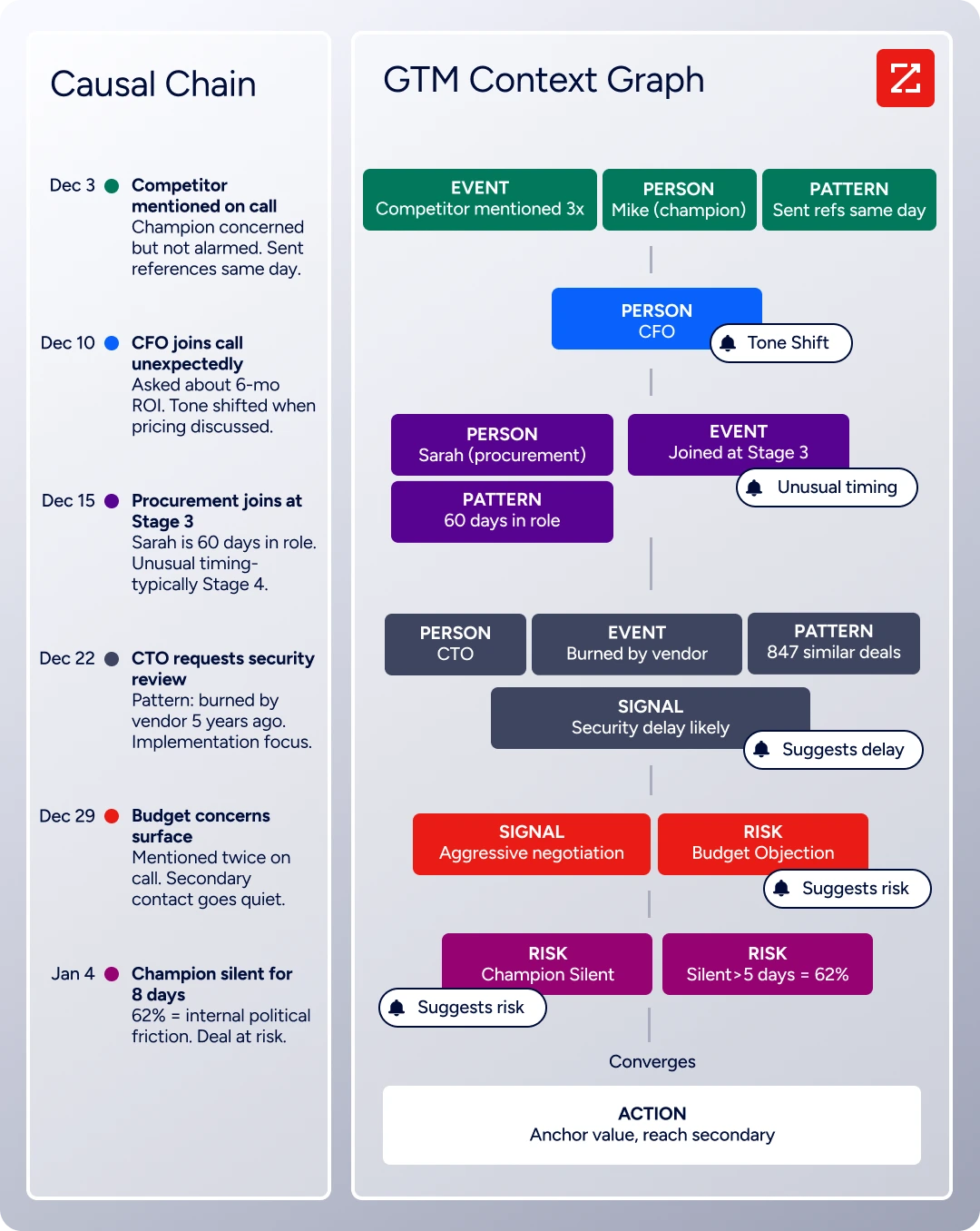
A CRM tells you what happened: deal moved to Stage 4, contact opened the email. The Context Graph tells you why, and what's likely to happen next. It's what separates an intelligence platform from a data vendor.
From GTM Data to GTM Advantage
The teams that win in 2026 won't be the ones with the flashiest AI tools. They'll be the ones with the data foundation those tools depend on. ZoomInfo's 2026 GTM Predictions report puts it directly: "AI fails because of inputs, not models."
A working GTM data foundation is what turns AI from a science experiment into a revenue engine. Build that, and every other tool in your stack starts pulling its weight.
Want to see what good looks like? Talk to our team.
FAQs
What's the difference between GTM data and CRM data?
CRM data is what your team has logged. GTM data is the wider universe of company, contact, and signal data that should flow into your CRM and keep it accurate.
Is GTM data the same as sales intelligence?
Sales intelligence is one use case for GTM data. GTM data is broader and powers marketing, RevOps, and customer success workflows too.
How often should GTM data be refreshed?
Contact data should refresh continuously. Firmographic and technographic data benefit from at least monthly refreshes. Intent and signal data needs to be near real-time to be useful.
Can I build a GTM data foundation with free tools?
You can start, but coverage and freshness will limit you fast. Free tools work for early-stage teams. Mid-market and enterprise teams need verified, refreshed, AI-ready data to compete.
What's the best GTM data platform?
The right platform depends on team size, motion, and stack. ZoomInfo, Apollo, Cognism, and LinkedIn Sales Navigator are the commonly evaluated options. Coverage depth, refresh frequency, signal breadth, and integration quality should drive the decision, not feature counts.
How does AI change GTM data requirements?
AI agents act on data without human review. That raises the standard from readable to reliable enough for automated action. Data needs to be accurate, traceable, and structured in ways that agents can actually use, not just clean enough for a rep to scan and judge for themselves.
