
Choosing between Mailtrack vs. Yesware for your sales email needs often comes down to five questions:
Do you just need to know if your emails were opened, or do you need a full outreach system with multi-channel campaigns?
Are you a solo professional working out of Gmail, or part of a sales team that needs shared templates, reporting, and CRM sync?
Is your budget under $10/month per user, or can you invest more for sales engagement features?
Do you only need email tracking, or do you also need to identify which accounts to target and why?
Are you looking for a single tracking tool, or a platform that connects data, signals, and outreach into one workflow?
In short, here's what we recommend:
Mailtrack (now rebranded as Mailsuite) is the best choice for individual professionals and small teams who live inside Gmail and want email tracking without changing how they work. With 3+ million users and a 4.5-star Chrome Web Store rating across 11,500+ reviews, Mailsuite does one job well: telling you when your emails are opened. Its free tier offers unlimited open tracking, and the paid plan at €9.99/month adds document tracking, mail merge, and a lightweight CRM. But Mailsuite is locked to Gmail/Chrome, has no native CRM integration beyond BCC forwarding, and lacks the multi-channel campaigns and prospecting data that growing sales teams need.
Yesware is built for sales teams that need more than tracking. It adds multi-channel campaigns, shared templates with performance analytics, a meeting scheduler, and a B2B prospecting database of 100+ million contacts. It supports both Gmail and Outlook, and its Salesforce integration on the Enterprise plan gives sales managers visibility into rep activity and campaign performance. Customers report saving up to 175 hours per month by eliminating manual CRM data entry. But Yesware's CRM integration is limited to Salesforce, users report false open tracking from corporate firewalls, and the platform struggles with high-volume outbound teams.
Both tools solve a real problem: they tell you what happens after you hit send. But knowing that a prospect opened your email is only useful if you're emailing the right prospect. Neither Mailtrack nor Yesware can tell you who to target, when an account is researching solutions like yours, or why a deal is stalling. That's where intelligence matters.
ZoomInfo is a GTM platform that starts where email tracking tools stop. Instead of monitoring opens and clicks, ZoomInfo provides the data (500M contacts, 100M companies, 135M+ verified phone numbers, and 200M+ verified business email addresses) and the intelligence (the GTM Context Graph, processing 1.5B+ data points daily) that tells your team who to contact, when to engage, and what to say. Sellers work in GTM Workspace, where AI-drafted outreach, prioritized account feeds, and deal execution live in one place. Marketers and RevOps teams use GTM Studio to build and launch GTM plays in natural language. For teams building their own tools, APIs and MCP expose the same intelligence to any application or AI agent.
If you're ready to move beyond tracking emails to understanding your entire market, see ZoomInfo in action.
Mailtrack vs. Yesware vs. ZoomInfo at a glance
Mailtrack (Mailsuite) | Yesware | ZoomInfo | |
|---|---|---|---|
Primary function | Email tracking and Gmail productivity | Sales engagement and email outreach | AI-powered GTM platform |
Email tracking | Unlimited opens (free); link and document tracking (paid) | Unlimited opens, links, and attachments (paid) | Engagement tracking built into GTM Workspace |
B2B contact database | None | 100M+ contacts (add-on) | 500M contacts, 200M+ verified emails, 135M+ verified phones |
Multi-channel campaigns | Mass email via Gmail only | Email, phone, LinkedIn, custom tasks | Email, calls, ads, direct mail |
CRM integration | BCC forwarding to Salesforce/HubSpot | Salesforce only (Enterprise tier) | Native Salesforce, HubSpot, Dynamics 365 + 120 marketplace integrations |
Buyer intent signals | None | None | |
AI capabilities | Follow-up reminders based on open status | AI recommendations (in development) | AI account prioritization, outreach drafting, and deal intelligence |
Email platform support | Gmail primary; Outlook add-in secondary | Gmail and Outlook | Platform-agnostic via integrations and API |
Free plan | Yes (unlimited tracking, branding on emails) | Yes (5 users max, 24-hour tracking window) | ZoomInfo Lite (permanent, 10 monthly credits) |
Paid starting price | Custom-quoted, consumption-based |
Email tracking: both tools deliver, with different depth
Email tracking is the core feature that put both Mailtrack and Yesware on the map. Both use invisible tracking pixels embedded in outgoing emails to detect opens, and both send real-time notifications when recipients engage.
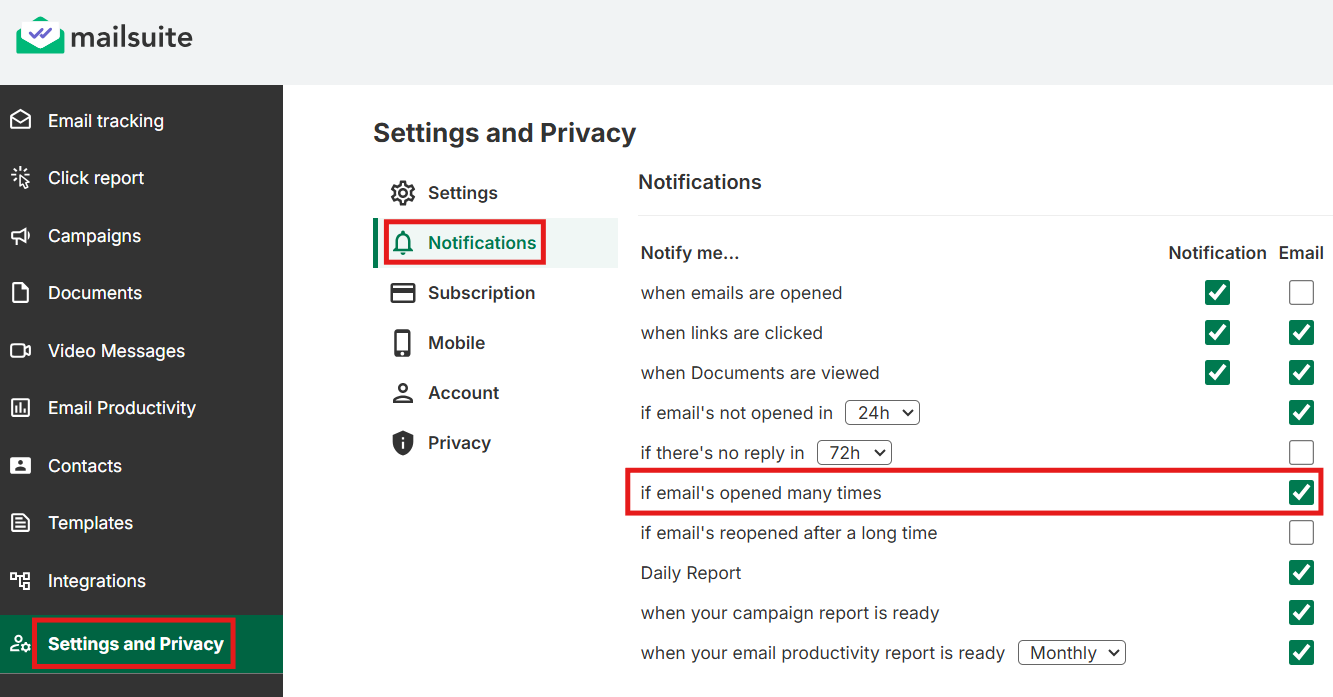
Mailtrack has refined this single capability for over a decade. The double-checkmark system (grey for delivered, green for read) appears in Gmail's sent folder and thread view. Beyond open tracking, Mailsuite adds behavioral signals most trackers miss: Hot Conversations alerts fire when a recipient opens an email multiple times in quick succession, and Revival alerts notify you when someone reopens a message after a long gap. These signals help salespeople and real estate agents time their follow-ups to the moment of peak interest.
Source: Mailsuite
Mailsuite also tracks document engagement at the page level, showing which pages of a PDF a recipient viewed, for how long, and in what order. For anyone sending proposals or contracts, knowing a prospect spent three minutes on the pricing page tells you more than a simple "opened" notification.
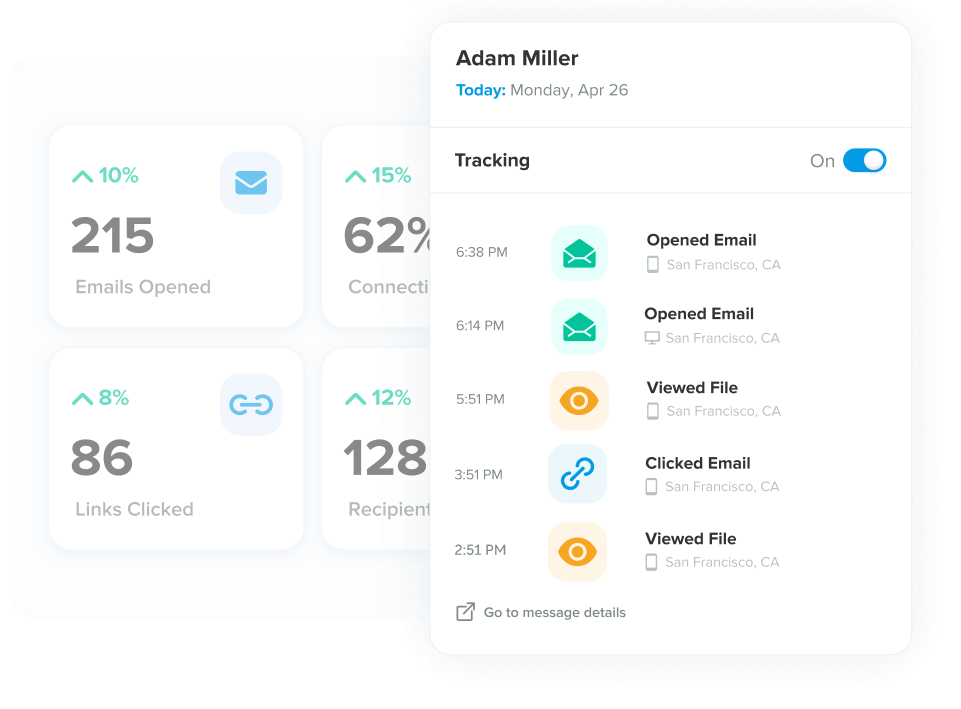
Yesware covers the same ground (open tracking, link clicks, attachment views) but adds team-level visibility. The Recipient Engagement Report aggregates tracking data across all emails sent to a specific contact, so managers can see engagement without checking individual threads. The dashboard shows weekly performance metrics at a glance: open rates, reply rates, and week-over-week trends.
Source: Yesware
Both tools share a fundamental limitation: pixel-based tracking is imperfect. Corporate firewalls, antivirus scanners, and image-blocking settings can trigger false opens or suppress real ones. False open tracking is the most common complaint in Yesware's reviews, and Mailsuite acknowledges that institutional email addresses are more likely to interfere with tracking. Neither tool can detect email forwarding.
The tracking data is useful for timing follow-ups. But it tells you nothing about whether you're emailing the right person, whether the account is in-market, or what the rest of the buying committee looks like. That context requires a different kind of intelligence.
Outreach and campaigns: Yesware pulls ahead, Mailtrack stays simple
If all you need is tracked one-to-one emails from Gmail, Mailtrack handles it. But the moment you need structured outreach sequences, the gap between the two platforms becomes clear.
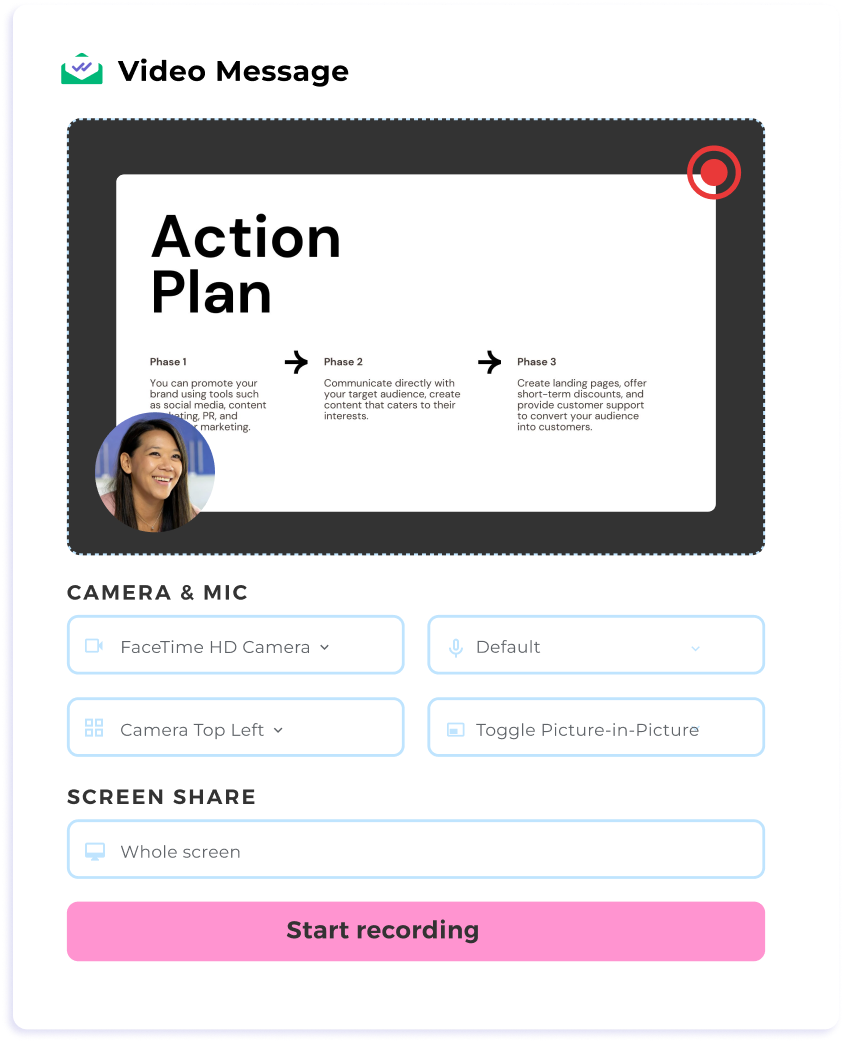
Mailtrack's outreach capabilities are basic but functional. Mass email lets you send up to 10,000 personalized emails per campaign from Gmail, each appearing as an individual message (no BCC). Mail merge pulls unlimited custom fields from Google Sheets. Email templates with one-click insertion save repetitive typing, and templates can be shared with teammates via link. Video messages can be recorded and embedded inline.
Source: Mailsuite
It's all email-only, though. No phone call reminders. No LinkedIn touches. No automated multi-step sequences that adapt based on recipient behavior. The sending cap is 100 emails/month on the free plan, 60,000/month on Advanced.
Yesware was designed for sales teams running structured outreach. Multi-channel campaigns combine automated emails, manual emails, phone call reminders, LinkedIn InMails, and custom tasks into coordinated sequences. Emails are sent from your own inbox, not a third-party sender, which keeps deliverability high. The system automatically removes recipients who reply or book meetings, preventing awkward follow-ups to people who already responded.
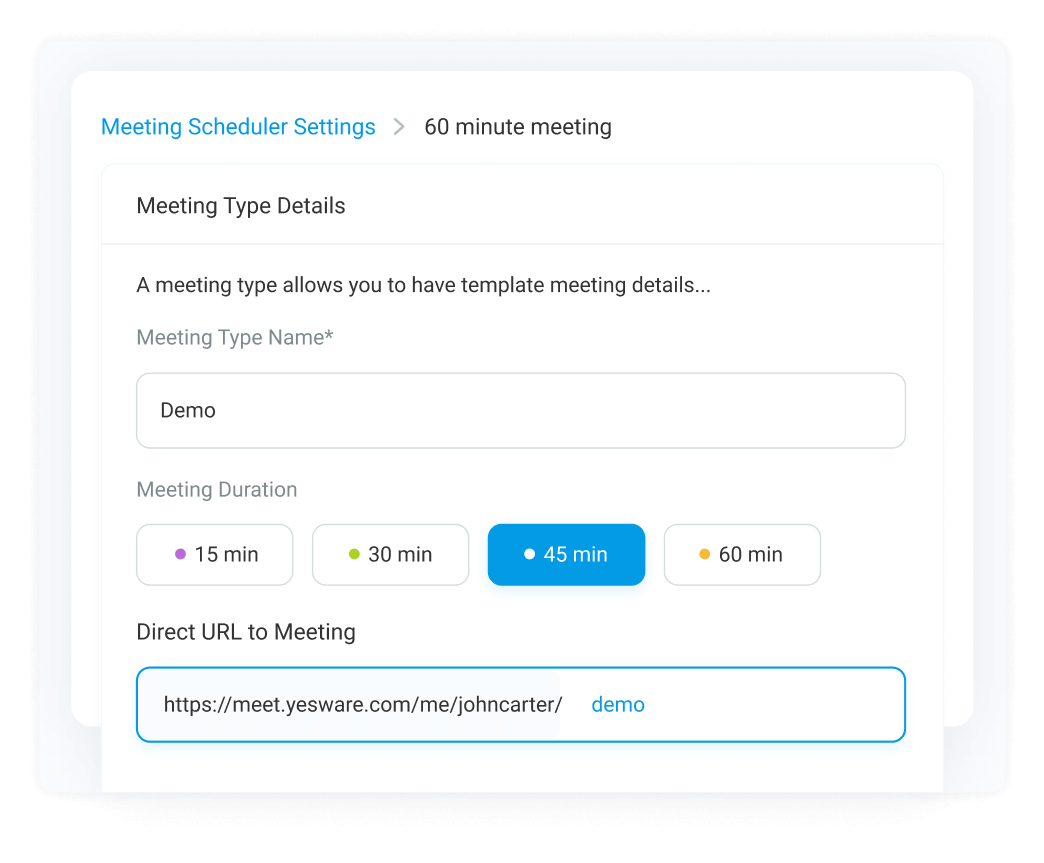
Yesware's Meeting Scheduler lets prospects pick available times directly. Enterprise users get Round Robin functionality that distributes meetings across up to 15 team members. Campaign performance is visible through detailed reporting: open rates, click-throughs, and connection percentages by campaign and by rep.
Source: Yesware
For solo professionals who send a handful of tracked emails a day, Mailtrack's simplicity is an advantage. For sales teams running structured outbound, Yesware's campaign engine is the clear choice.
The intelligence gap neither tool fills
Both Mailtrack and Yesware help you track what happens after you send an email. Neither helps you figure out who to email in the first place, or why.
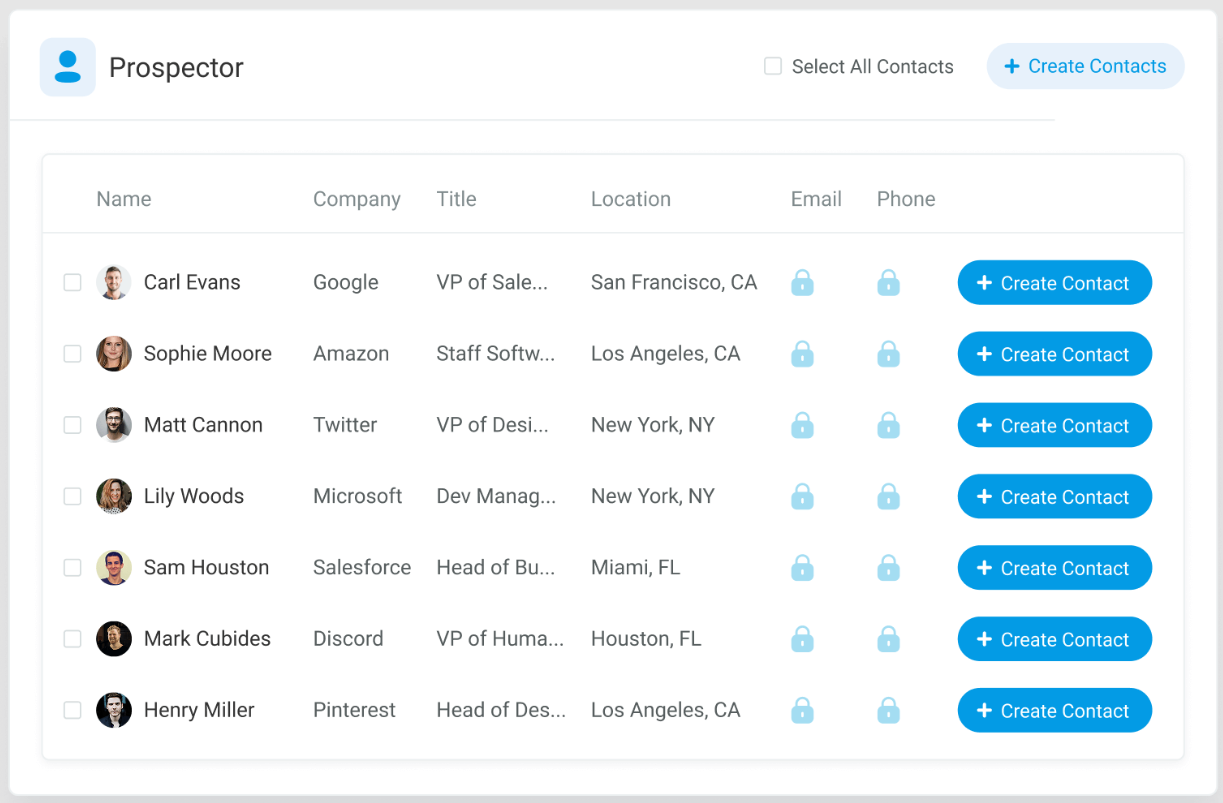
Yesware's Prospector offers access to 100+ million B2B contacts with filters for job title, seniority, company size, and industry. It's a useful add-on for finding prospects. But it's a static contact database, not an intelligence platform. There are no intent signals showing which accounts are researching solutions. No technographic data revealing what tools a company already uses. No org charts mapping the buying committee. No signals that tell you when to reach out, just who exists.
Source: Yesware
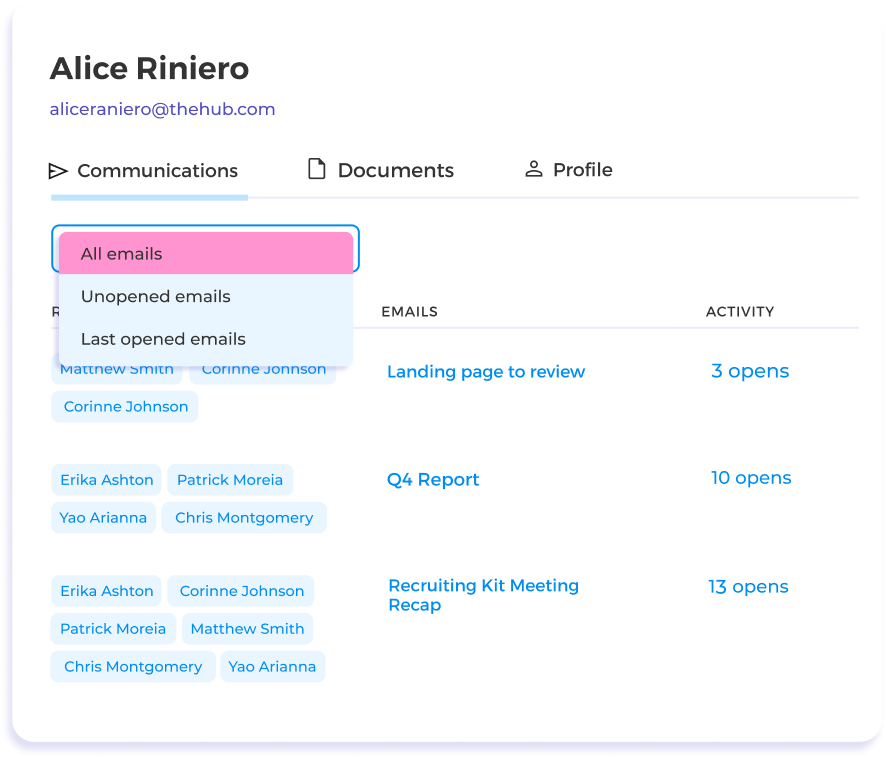
Mailtrack has no prospecting or intelligence features at all. Its CRM for Gmail is a lightweight contact management layer that logs email activity, but it has no pipeline view, no deal stages, and no integration with Salesforce or HubSpot beyond BCC forwarding.
Source: Mailsuite
ZoomInfo operates at a different level. Its data covers 500M contacts across 100M companies, verified by a pipeline that includes 300+ human researchers and achieves up to 95% accuracy on first-party data. In a Fortune 500 competitive RFP analyzing 25 million contacts across vendors, the independent consultant concluded that "no other competitor came even close."
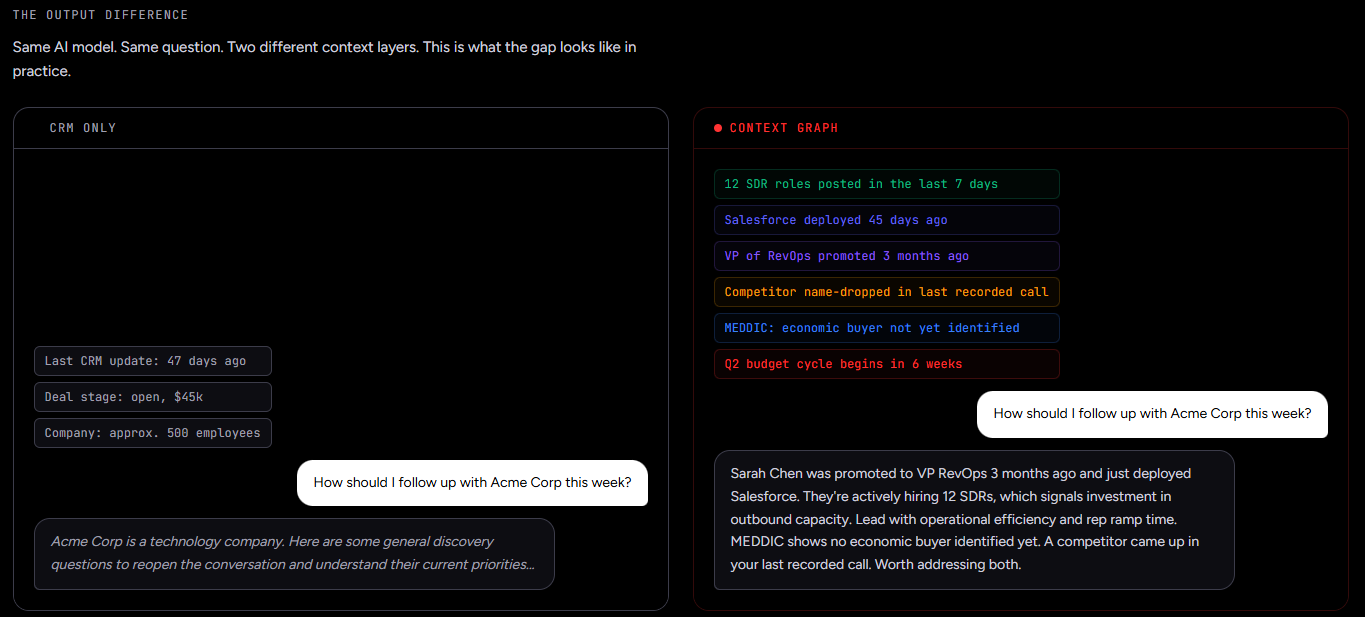
But the data is just the starting point. The GTM Context Graph fuses ZoomInfo's third-party data with a customer's CRM records, conversation transcripts, email interactions, and behavioral signals. It captures not just that a deal moved to Stage 3, but why it moved: the CFO joined the last call and asked about six-month ROI, the champion went quiet for eight days during an internal budget battle. That reasoning flows into every outreach recommendation, every account prioritization, every follow-up draft.
Buyer Intent data tracks signals from 210 million IP-to-Organization pairings and 6 trillion+ new keyword-to-device pairings sourced monthly. Guided Intent, exclusive to ZoomInfo, identifies topics historically correlated with deal success rather than requiring manual topic selection. WebSights resolves anonymous website traffic to companies, including buying team identification.
The difference for a sales rep: instead of sending an email and watching for opens, you walk into every conversation knowing the account is researching your category, the VP of Finance just joined the buying committee, and the company hired three new VPs last quarter. Email tracking becomes a secondary signal inside a much richer intelligence picture.
"That combination of our internal CRM data, external signals, and AI that's given all that context has helped us craft very specific account- and persona-based messages. And people have responded to them right away." (Toby Carrington, CBO, Seismic)
CRM integration and team features
How each tool connects to your CRM reveals who it was built for.
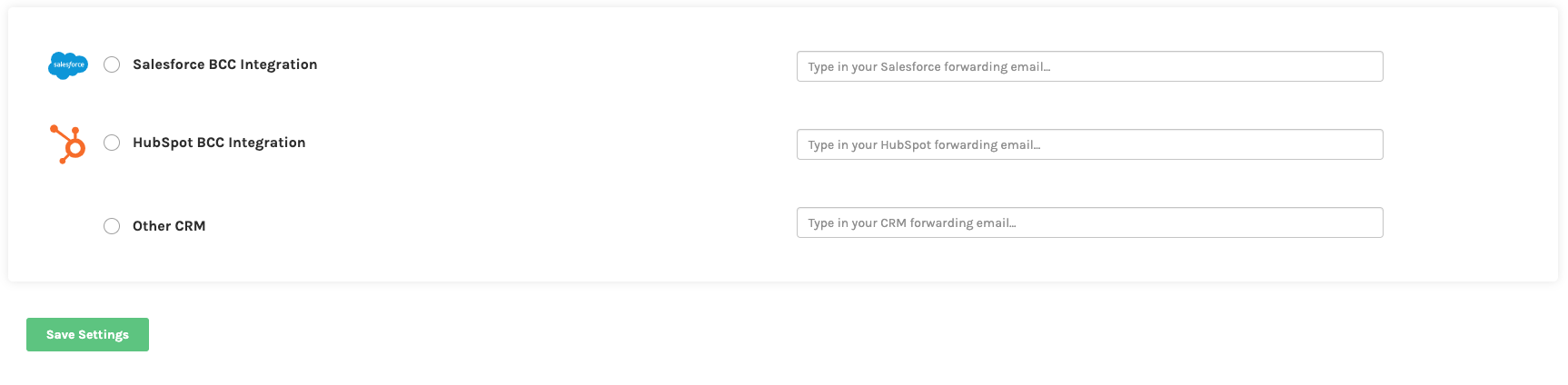
Mailtrack keeps things minimal. The CRM for Gmail auto-captures email activity and organizes it by contact, but there's no pipeline management, no deal stages, and no team dashboards. For teams using an external CRM, the only bridge is a BCC forwarding integration that copies tracked emails into Salesforce or HubSpot at compose time. The Teams plan adds centralized billing and volume discounts but no shared analytics or manager visibility into rep activity. This is a tool built for individuals who happen to work on a team, not for the team itself.
Source: Mailsuite
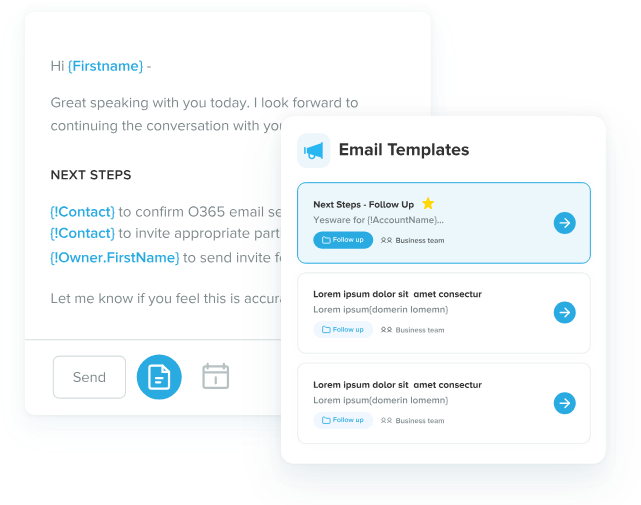
Yesware is stronger on team features. Shared templates and campaigns on Premium plans let teams standardize messaging. Team reporting gives managers visibility into rep activity, email performance, and campaign results. The Salesforce integration on the Enterprise plan ($65-85/user/month) auto-syncs emails, creates tasks, and enables bi-directional activity sync. Fundbox reported 100% adoption of Team Templates and saving 1 hour per day per sales rep on manual CRM entry.
Source: Yesware
The limitation: Yesware's only CRM integration is Salesforce. Teams on HubSpot, Dynamics, or other CRMs get no native sync. And even the Salesforce integration doesn't always work reliably, according to user reviews.
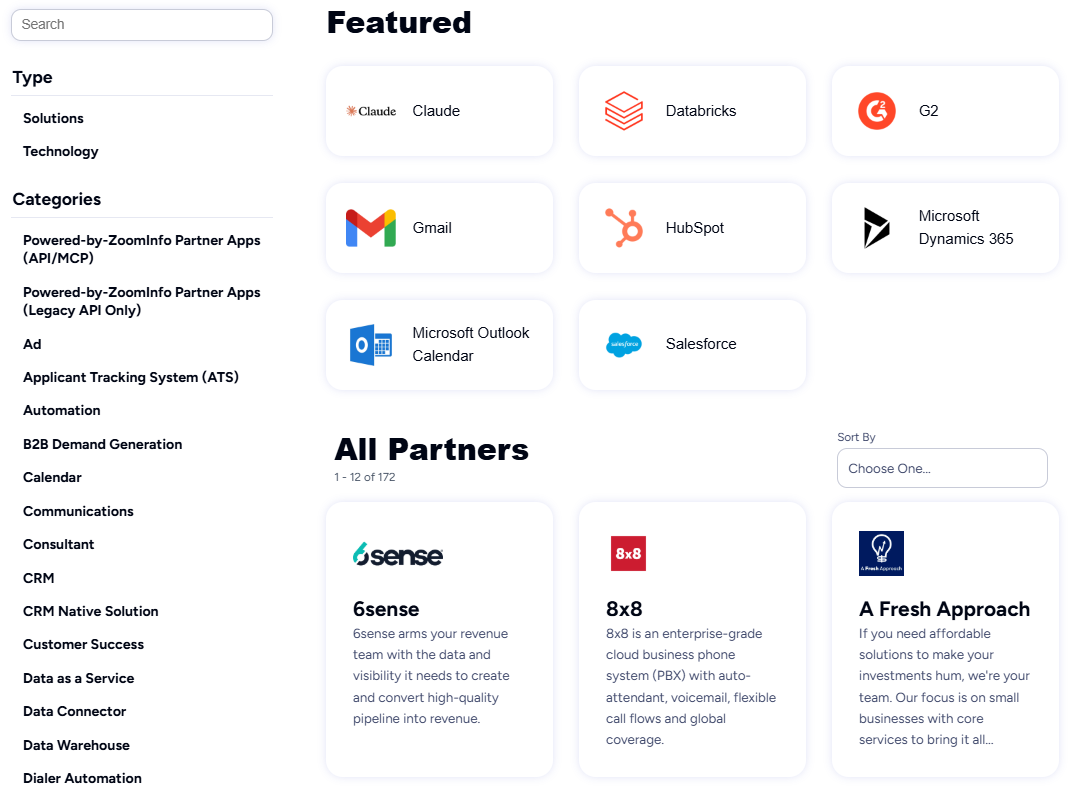
ZoomInfo integrates natively with Salesforce, HubSpot, and Dynamics, plus 120 partner integrations across CRM, marketing automation, sales engagement, and data warehouse categories. The Enterprise API and MCP server expose the same intelligence to any custom tool or AI agent. API access is included in all relevant plans.
Inside GTM Workspace, sellers see their entire book of business in one place, pulling CRM data, ZoomInfo intelligence, conversation history, and market signals together. CRM updates happen without leaving the page. AI agents handle account research, outreach drafting, and signal monitoring. The result: Seismic's sales team attributed 39% of active pipeline to opportunities identified or influenced by ZoomInfo signals, while saving 11.5 hours per week.
"Anything that minimizes our team's need to switch contexts is beneficial. ZoomInfo offers a single view, eliminating the need to navigate between systems." (Ben Perceval, RevOps Manager, Spekit)
Pricing reflects each tool's scope
The pricing structures tell you what each platform is trying to be.
Mailtrack is the most affordable option. The free plan includes unlimited email open tracking with no time limit, though every outgoing email carries a "Sent with Mailsuite" signature. The Advanced plan at €9.99/user/month removes the branding and unlocks unlimited link tracking, document analytics, e-signatures, 60,000 outbound emails/month, and priority support. Team discounts scale from 18% off for 5-9 seats to 35% off for 50+ seats. No annual commitment is required; subscriptions are month-to-month by default.
The limitation is scope: you're paying for email tracking and lightweight outreach, not a sales platform.
Yesware charges more and gives more. The free plan is heavily restricted (5 users, 24-hour tracking window, 10 campaign recipients/month). Paid plans range from $15/user/month (Pro, annual) for unlimited tracking and basic reporting, to $35/user/month (Premium, annual) for unlimited campaigns and team features, to $65/user/month (Enterprise, annual) for Salesforce integration. Users note that Outreach has more automation features but costs 3-4 times more, positioning Yesware as the mid-market choice.
Worth noting: Yesware does not permit mid-term downgrades or seat reductions, and provides no refunds for unused portions of prepaid terms. Prospector credits for the B2B contact database cost extra beyond the base subscription.
ZoomInfo uses custom-quoted, consumption-based pricing with no publicly listed prices. Costs scale with seats, credit volume, features, and contract length. The entry point is higher than either Mailtrack or Yesware, reflecting the platform's scope: B2B data, intent signals, conversation intelligence, AI execution, and multi-channel orchestration.
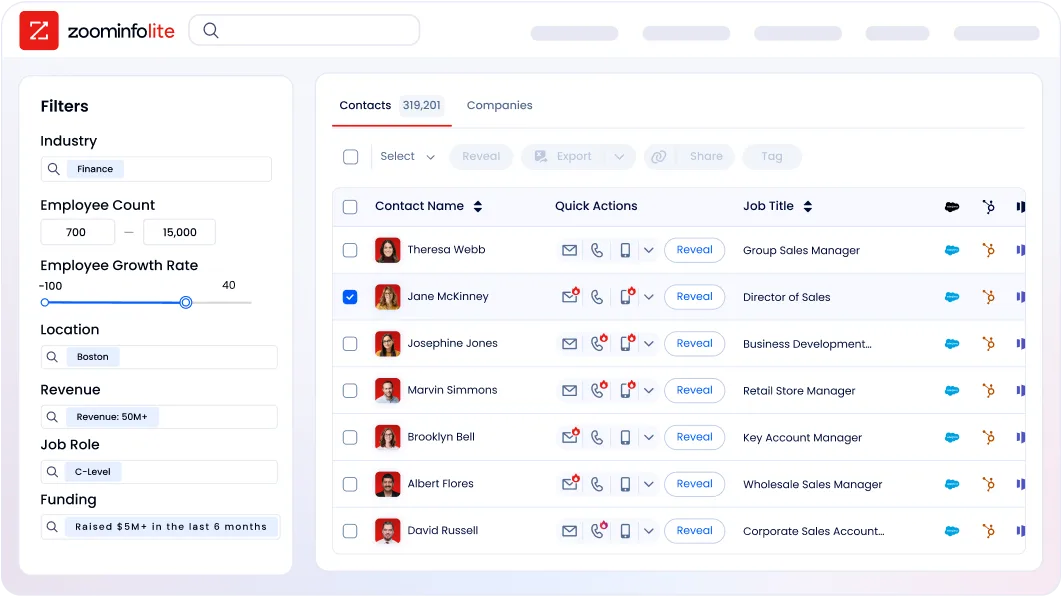
Two free entry points exist: ZoomInfo Lite (permanent free tier with 10 monthly export credits, contact and company search, WebSights Lite, and HubSpot integration) and a 7-day free trial of the full platform. For teams evaluating whether the intelligence justifies the investment, documented outcomes provide context: Snowflake achieved 200% higher conversion rates on accounts scored using ZoomInfo data, and Thomson Reuters increased closed-won deals by 40%.
Security and compliance
All three platforms take security seriously, but the depth of their compliance programs reflects their target markets.
Mailtrack holds an ISO 27001 certification and operates as a Google Verified Partner. Data is stored on AWS infrastructure in Ireland using AES-256 encryption. The company does not store email body content on its servers, only tracking metadata. GDPR compliance tools are built into the product, including consent request management and recipient opt-out handling. For an EU-based company targeting individuals and small teams, this is solid.

Source: Mailsuite
Yesware maintains a SOC 2 Type II report and earned the Skyhigh CloudTrust rating of Enterprise-Ready. The platform passed Salesforce's Security Review and is listed on the AppExchange. Yesware is GDPR and CCPA compliant with data sourced through public records or opt-in partners, and runs quarterly security updates. Like Mailsuite, it does not store permanent copies of email message bodies.
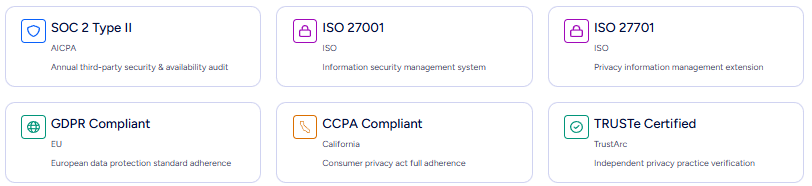
ZoomInfo carries the most thorough compliance stack, reflecting its enterprise customer base: ISO 27001, ISO 27701, SOC 2 Type II, TRUSTe GDPR, and TRUSTe CCPA certifications, all renewed annually. ZoomInfo is a registered data broker in California and Vermont and maintains a dedicated Trust Center. For regulated industries, financial services, and enterprises with strict vendor requirements, this depth matters.
Who each tool is (and isn't) for
Understanding each platform's ideal user makes the choice clearer.
Mailtrack is built for the individual professional who lives in Gmail. Real estate agents tracking listing proposals. Lawyers confirming time-sensitive document delivery. Recruiters monitoring candidate engagement. Freelancers and solopreneurs who need to know their emails were read, without adopting a new platform or changing their workflow. It is not for large enterprise teams, organizations standardized on Outlook, or anyone needing pipeline management and CRM depth.
Yesware is designed for small to mid-sized sales teams that need structured outreach layered on top of their inbox. Account executives running personalized follow-up sequences. Sales managers who want visibility into rep activity and template performance. Teams already on Salesforce who need automatic activity sync. It is not suited for high-volume SDR teams processing hundreds of leads monthly, organizations needing CRM integration beyond Salesforce, or teams requiring large-scale prospecting data.
ZoomInfo serves enterprise and upper mid-market go-to-market teams that need the full picture: data, intelligence, signals, and execution in one platform. Named customers include Adobe, Snowflake, PayPal, Deloitte, and JPMorgan. The platform spans Sales, Marketing, and RevOps, with 35,000+ companies served worldwide. It is not designed for B2C companies or teams with no outbound motion.
Mailtrack vs. Yesware vs. ZoomInfo: Which should you choose?
The right tool depends on where you are in your sales maturity and what problem you're solving.
Choose Mailtrack (Mailsuite) if:
You're an individual professional who works primarily in Gmail
Knowing whether emails were opened and documents were read is your main need
You want the simplest setup with no learning curve
Your budget is under €10/month per user
You don't need CRM integration, prospecting data, or multi-channel campaigns
Choose Yesware if:
You run a sales team that needs structured email campaigns with automated follow-ups
Shared templates, team reporting, and campaign analytics matter to your workflow
Your team uses Salesforce and needs automatic activity sync
You want a meeting scheduler and basic prospecting features alongside tracking
You need both Gmail and Outlook support
Choose ZoomInfo if:
You need to know not just who opened your email, but who to email and why
Buyer intent signals, account prioritization, and deal intelligence would change how your team sells
You want AI-informed outreach backed by B2B data and your own CRM history
Your team spans Sales, Marketing, and RevOps and needs a shared intelligence layer
You're ready to invest in a platform that connects data, signals, and execution
Explore ZoomInfo with a free trial or start with ZoomInfo Lite at no cost.
Email tracking is a valuable signal, but it's one signal. Knowing a prospect opened your email tells you they saw it. Knowing they're researching your category, that their CFO just joined the buying committee, and that accounts with this signal pattern close at 2x the rate? That's the difference between tracking activity and driving revenue.
"ZoomInfo gives us the information we need to execute. We don't have to go through and spend our time digging. It's already there, so we can be three steps ahead." (William Kenimer, VP of Revenue Operations, Vensure)
Mailtrack vs. Yesware vs. ZoomInfo FAQ
What is the core difference between Mailtrack, Yesware, and ZoomInfo?
Mailtrack (Mailsuite) is a Gmail-native email tracking tool that tells you when emails are opened and documents are viewed. Yesware is a sales engagement platform that adds multi-channel campaigns, shared templates, meeting scheduling, and Salesforce integration on top of email tracking. ZoomInfo is a GTM platform that provides B2B data (500M contacts, 100M companies), buyer intent signals, conversation intelligence, and AI execution, going beyond email tracking to power the entire go-to-market motion.
Which platform is cheapest?
Mailsuite is the most affordable, with a permanent free plan for unlimited email open tracking and a paid plan at €9.99/user/month. Yesware's paid plans start at $15/user/month (annual billing) for unlimited tracking and basic reporting, scaling to $65/user/month for Salesforce integration. ZoomInfo uses custom-quoted pricing with no published rates, though it offers a permanent free tier (ZoomInfo Lite) with 10 monthly export credits and a 7-day free trial of the full platform.
Can I use Mailtrack or Yesware with Outlook?
Yesware supports both Gmail and Outlook as equal platforms. Mailsuite is primarily a Chrome extension for Gmail, with an Outlook add-in available as a secondary offering. If your team is standardized on Outlook, Yesware is the stronger choice between the two. ZoomInfo integrates with both email platforms through its CRM and sales tool integrations.
Which platform has the best prospecting capabilities?
ZoomInfo leads by a wide margin, with 500M contacts, 135M+ verified phone numbers, 200M+ verified business email addresses, and 300+ company attributes for targeting. Yesware's Prospector add-on offers access to 100+ million B2B contacts with basic filters, but no intent signals, technographics, or org charts. Mailsuite has no prospecting features.
Do any of these tools provide buyer intent data?
Only ZoomInfo offers buyer intent data, tracking signals from 210 million IP-to-Organization pairings and 6 trillion+ new keyword-to-device pairings sourced monthly. Its Guided Intent feature identifies topics historically correlated with deal success. Neither Mailtrack nor Yesware provides intent signals; they track engagement only after you've sent an email.
How reliable is email open tracking across these platforms?
All pixel-based email tracking has inherent limitations. Corporate firewalls, antivirus programs, and image-blocking settings can produce false opens or suppress real ones. Yesware users report false open tracking as the most common complaint in reviews. Mailsuite acknowledges that institutional email addresses may interfere with tracking accuracy. Neither platform can detect email forwarding. These limitations apply to any email tracker that uses invisible pixels.
Which tool is best for a sales team that already uses Salesforce?
Yesware offers the deepest Salesforce integration among the email-focused tools, with bi-directional activity sync, inbox sidebar, and calendar sync on the Enterprise plan ($65/user/month). ZoomInfo provides native Salesforce integration plus a much broader set of capabilities, including data enrichment, intent signals, and AI account prioritization. Mailsuite only connects to Salesforce through BCC forwarding, which is a workaround rather than a true integration.
Can these platforms work together, or are they mutually exclusive?
Mailtrack and Yesware are direct competitors in email tracking and would conflict if used simultaneously. ZoomInfo, however, complements either tool at the tracking level, though it often replaces the need for a standalone tracker. ZoomInfo's data and intelligence can power outreach executed through other tools via its API and 120+ marketplace integrations, and its GTM Workspace provides its own engagement and outreach capabilities.
More Yesware comparisons and breakdowns:
