
Yesware was one of the first platforms to bring marketing automation into the sales inbox. Founded in 2010, it created the SaaS sales engagement category by letting salespeople track emails, build templates, and run follow-up sequences without leaving Gmail or Outlook. Vendasta acquired Yesware in October 2022, and the platform still serves over 6,000 teams with that inbox-first approach. But as sales organizations now demand deeper intelligence, broader data, and AI that understands deals (not just open rates), the question is whether inbox-level tooling is enough.
To write this Yesware review, we analyzed the platform in detail. We believe it's the right choice if:
You want email tracking, templates, and campaigns that live inside Gmail or Outlook
You need a fast setup with no learning curve for a small sales team
Your primary outreach channel is email and your CRM is Salesforce
You value simplicity and affordability over feature depth
You don't need prospecting data, intent signals, or AI deal intelligence
However, Yesware might not be the best choice if:
You need a B2B data platform with verified direct dials and business emails at scale
You require buyer intent signals to identify in-market accounts before outreach
You want AI that understands deal context, not just open rates
You're managing multi-channel go-to-market motions across sales and marketing
You need CRM integration beyond Salesforce
In that case, consider ZoomInfo: an AI-powered GTM platform that goes beyond inbox-level sales engagement. Built on B2B data covering 500M contacts, 100M companies, 135M+ verified phone numbers, and 200M+ verified business emails, ZoomInfo fuses this data with your CRM records, conversation transcripts, and behavioral signals through its GTM Context Graph to show not just what happened in a deal, but why. That intelligence powers GTM Workspace for sellers, GTM Studio for marketers and RevOps, and APIs and MCP for any tool or AI agent.
We've included a detailed look at ZoomInfo later in this review as the natural next step for teams that have outgrown inbox-level sales engagement. If you're ready for a broader approach, start with ZoomInfo's free trial.
What is Yesware?
Yesware is a sales engagement platform founded in 2010 in Boston by Matthew Bellows, Rajat Bhargava, and Cashman Andrus. The founders wanted to reduce friction in sales communication by letting reps track emails, book meetings, and follow up without leaving the inbox.
The company raised $48 million from investors including Google Ventures, Battery Ventures, and Foundry Group before Vendasta acquired it in October 2022. Today, Yesware reports 1.4 million+ installs across Outlook and Gmail and serves companies including Monday.com, Acquia, and Yelp.
The core promise is simple: sell smarter without leaving your inbox. Yesware offers email tracking, templates, multi-channel campaigns, a meeting scheduler, a B2B prospector tool, and Salesforce integration. With a 60-second install and no technical skills required, it targets sales reps and small-to-mid-sized teams who want lightweight engagement tools rather than full enterprise sales platforms.
Source: Yesware
Yesware Pros & Cons
Pros | Cons |
|---|---|
Fast setup with 60-second install and no learning curve | False open tracking from corporate firewalls and security tools |
Lives inside Gmail and Outlook with native integration | Only integrates with Salesforce for CRM |
Unlimited personal email templates on all plans | Lack of real support for serious problems is the top switching reason |
Multi-channel campaigns with automated follow-up | Can slow down the inbox when sending many emails |
Competitive pricing compared to enterprise alternatives | Not scalable for large sales organizations |
Automatic Salesforce activity sync (Enterprise tier) | Prospector database limited to 100+ million B2B contacts |
No buyer intent data, technographics, or advanced signals |
Yesware Review: How It Works & Key Features
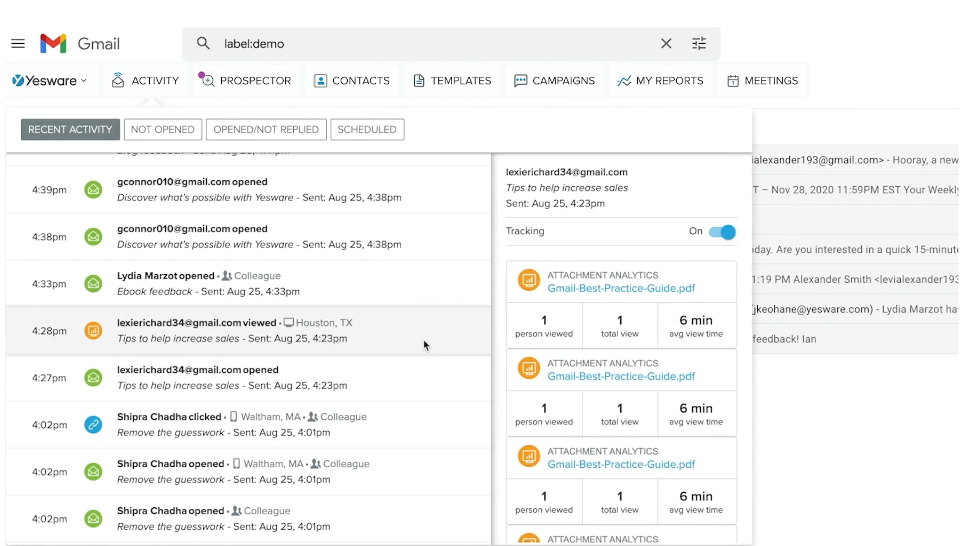
Email Tracking: Yesware shows who opened your emails, when, and on what device.
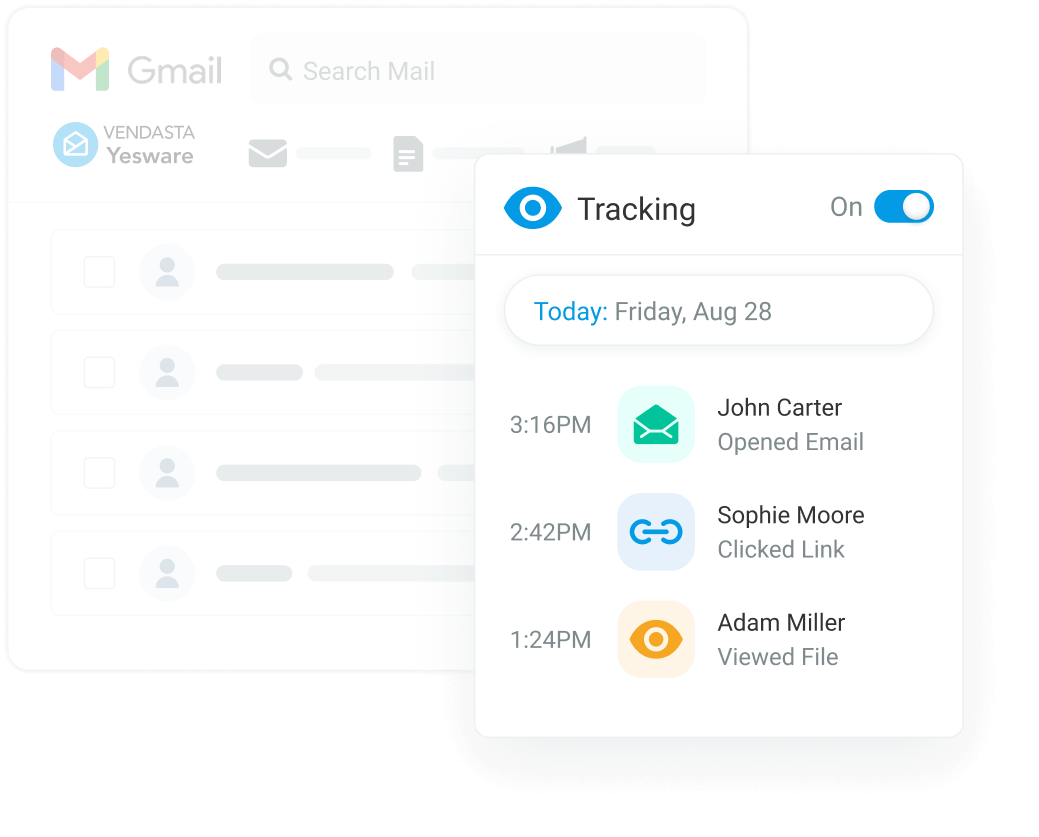
Yesware's email tracking uses an invisible tracking pixel embedded at the end of outgoing messages. When a recipient opens the email, the pixel loads and triggers a notification. Unlike read receipts, Yesware's pixel is invisible to recipients, so they experience the message normally.
Users receive real-time notifications when prospects read emails. The Activity Feed shows the full engagement history with each prospect: opens, link clicks, and attachment views over time. The dashboard provides weekly performance metrics at a glance, including open rates, reply rates, and week-by-week trends.
Source: Yesware
One notable limitation: false open tracking appears in more G2/Capterra reviews than any other complaint. Corporate firewalls, antivirus programs, and email security tools scan incoming emails and trigger the tracking pixel, producing inaccurate data. Teams that rely on open rates to prioritize follow-up waste effort on prospects who never read the email.
The free plan limits tracking to emails sent less than 24 hours ago with a cap of 40 events. Paid plans offer unlimited tracking history.
Multi-Channel Campaigns: Yesware automates multi-touch outreach sequences from the inbox.
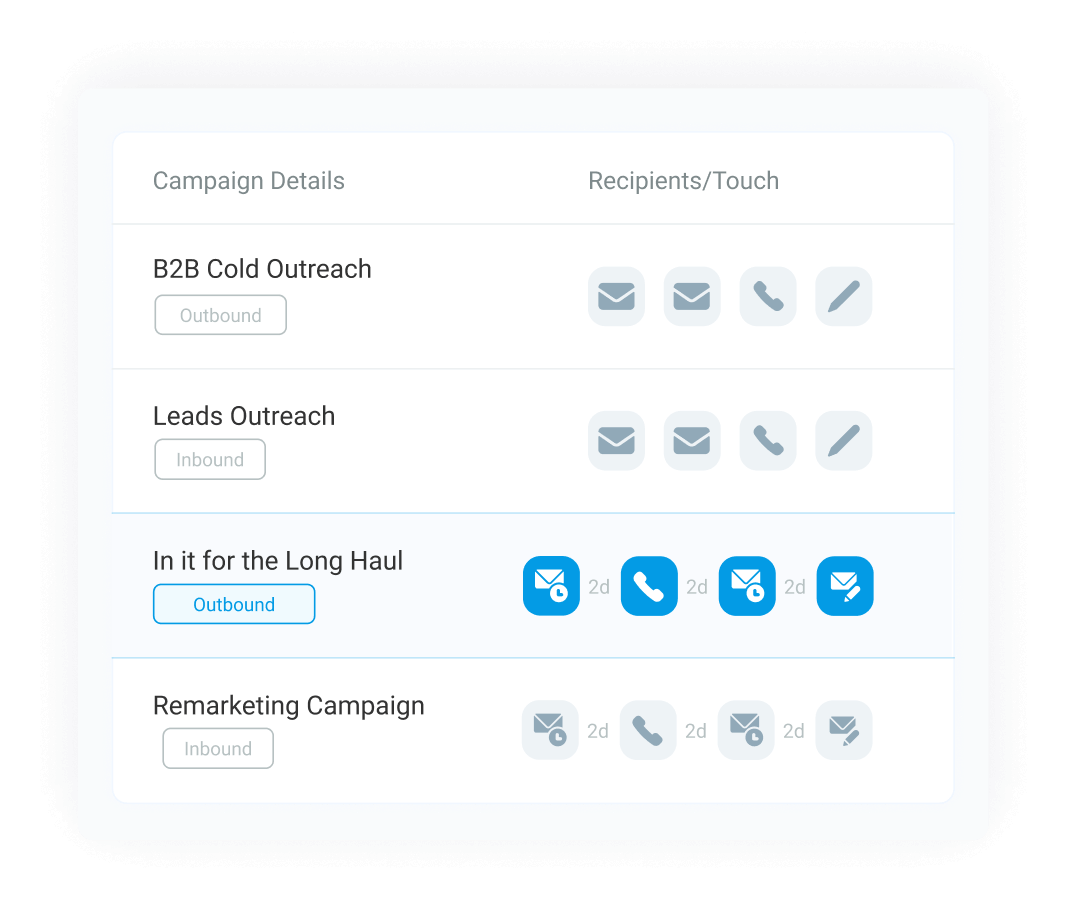
Yesware Campaigns let sales teams build automated outreach sequences combining emails, calls, LinkedIn touches, and custom tasks. Each campaign consists of customizable "touches" scheduled at set intervals. For example: an automated email, then a LinkedIn connection request two days later, then a phone call reminder on day five.
Source: Yesware
A key distinction: Yesware sends emails from your Outlook or Gmail server, not a third-party server. This improves deliverability and makes messages look like one-to-one sales emails rather than mass blasts. The system removes recipients who reply or book meetings to prevent double-touches.
Campaign touches support multiple types: automated emails, manual emails, phone call reminders, LinkedIn InMails, custom tasks, and Sales Navigator connection requests. Merge fields personalize messages using CSV columns, Salesforce fields, or manually entered data. Recipients can be added via CSV upload, manual entry, email thread integration, or Salesforce import (Enterprise only).
Campaign volume depends on tier: the free plan allows 10 campaign recipients per month, Pro allows 20, and Premium and Enterprise offer unlimited recipients.
Email Templates: Reusable messages with performance tracking.
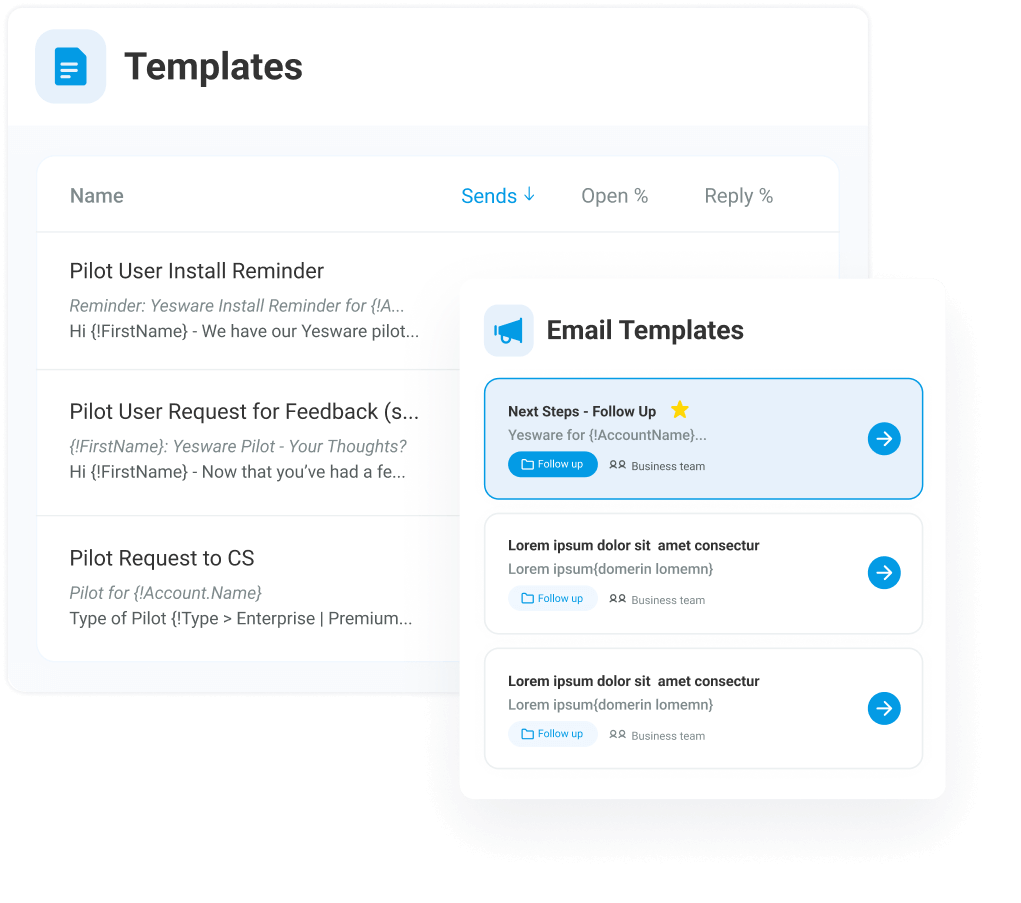
Yesware's Templates feature lets sales teams create and save reusable email messages with rich formatting, images, links, and attachments. Templates support text fields for personalization and dropdown fields with predefined options for consistent messaging. Enterprise users can use Salesforce integration to auto-populate fields with CRM data.
Source: Yesware
On Premium and Enterprise plans, templates can be shared across teams to standardize messaging. Placester's team created 80 templates per rep every month, while Fundbox achieved 100% adoption of Team Templates.
What separates this from basic template tools is the built-in Template Reporting, which tracks which templates generate the highest open and reply rates. This data helps teams identify what works and retire what doesn't.
Meeting Scheduler: Book meetings without email back-and-forth.
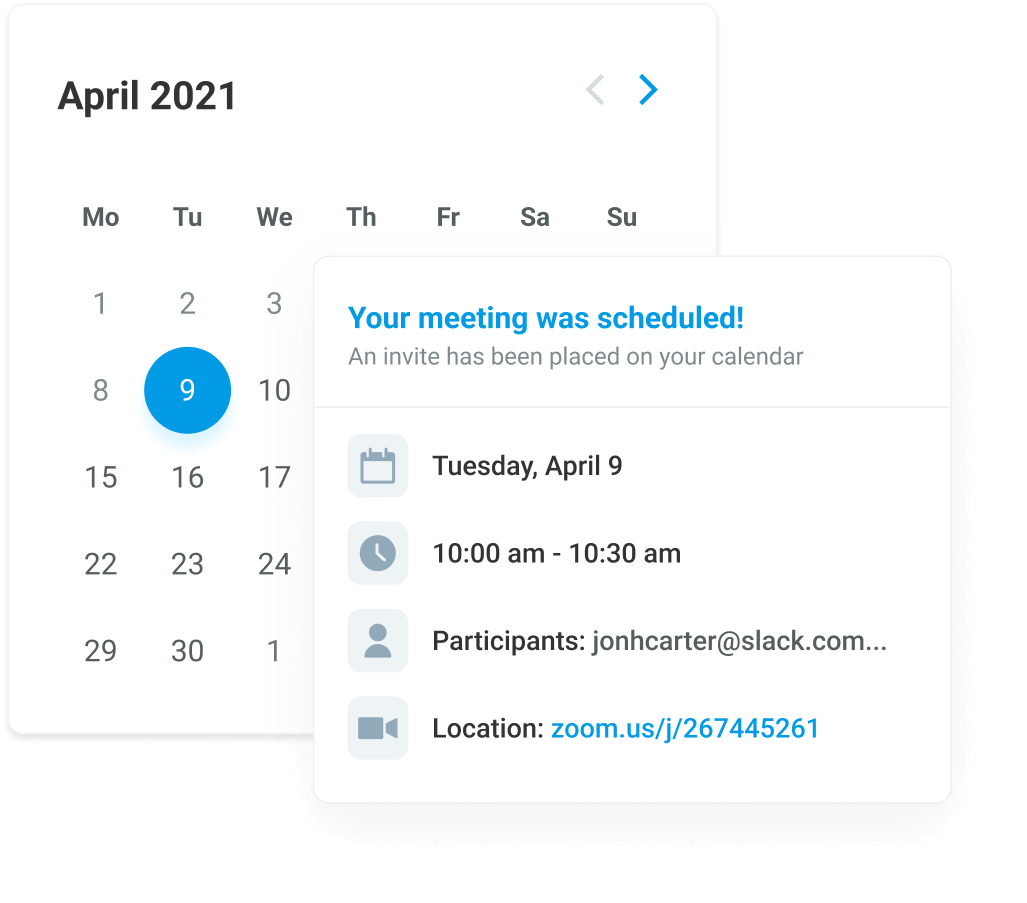
The Meeting Scheduler generates scheduling links that display real-time availability. Recipients pick a time, and the meeting appears on both calendars with automatic confirmation emails. It integrates with Google and Office365 calendars and supports Zoom and Teams for automatic video links.
Source: Yesware
Users can create custom meeting types with specific durations and agendas, configure buffer time between meetings, and set last-minute booking protection. Enterprise users get Round Robin functionality that distributes meetings across up to 15 team members based on availability.
Meeting links can be embedded in email templates and campaigns, making scheduling part of the outreach workflow rather than a separate step.
Prospector: A B2B contact database with search and enrichment.
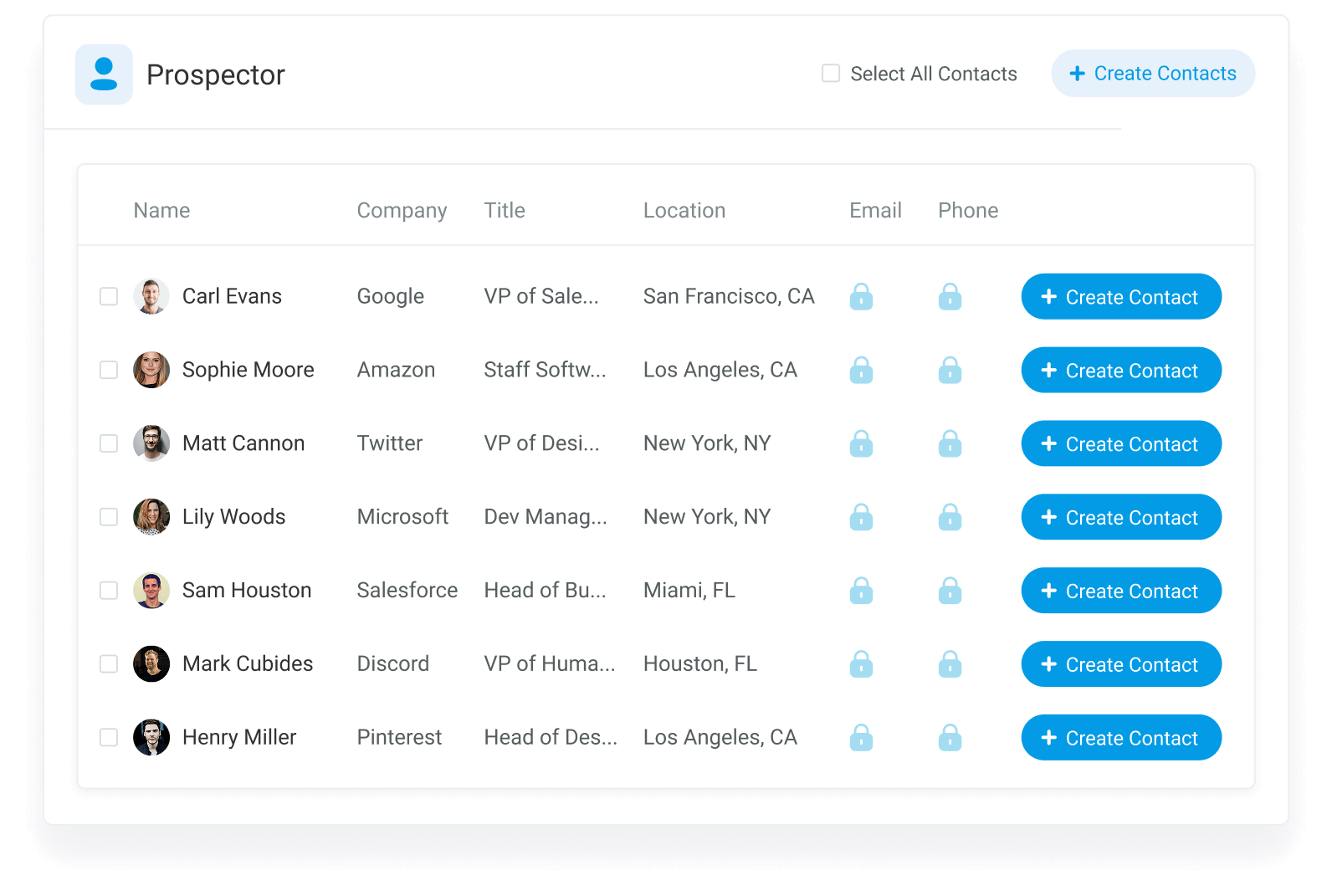
Prospector gives sales teams access to a database of 100+ million B2B contacts. Users search by job title, seniority, location, company name, company size, industry, and company website. Results include verified phone numbers, email addresses, and LinkedIn profiles.
The tool is credit-based: enriching a contact costs 1 account credit. Prospector credits are available as add-ons to existing Yesware plans, though credit pricing is not publicly disclosed.
Source: Yesware
The database provides GDPR and CCPA compliant business profiles, and results feed into Yesware's campaigns and templates.
However, at 100M+ contacts, the database is smaller than dedicated data platforms. It lacks intent signals, technographics, company hierarchies, org charts, and real-time buying indicators. Sales teams get names and emails but no context to know whether those prospects are actually looking to buy.
Pricing: Four tiers from free to $85/seat/month.
Yesware uses a per-seat subscription model with monthly and annual billing:
Free Plan ($0/seat/month):
Email/attachment tracking limited to emails sent within the last 24 hours
10 campaign recipients per month
Meeting scheduler with 2 event types
Limited to 5 users maximum
Pro Plan ($19/seat/month, or $15 annually):
Unlimited email, link, and attachment tracking
20 campaign recipients per month
Personal activity and recipient engagement reports
Premium Plan ($45/seat/month, or $35 annually):
Unlimited campaigns and recipients
Shared templates and campaigns across teams
Team reporting and centralized billing
Enterprise Plan ($85/seat/month, or $65 annually):
Full Salesforce integration (inbox sidebar, email sync, calendar sync, bi-directional activity sync)
Salesforce SSO and trusted IP ranges
RingCentral integration
Annual billing saves 21-24% across paid tiers. All plans include a 14-day free trial with no credit card required.
Important contract details: early cancellations, downgrades, or seat reductions are not permitted during the active subscription term, and no refunds are provided for unused time when canceling.
Where Yesware Falls Short
Yesware does its core job well: it makes inbox-based sales engagement simple. But several limitations surface as teams grow and their needs expand beyond email tracking and templates.
Salesforce-Only CRM Integration: Yesware's only CRM integration is Salesforce, locked behind the Enterprise tier at $65-85/seat/month. Teams using HubSpot, Microsoft Dynamics, Pipedrive, or any other CRM have no native integration option. For a platform built around eliminating manual data entry, this single-CRM limitation excludes a large share of potential users.
Tracking Accuracy Issues: False open tracking is the most cited complaint in user reviews. Corporate firewalls, antivirus software, and email security tools trigger the tracking pixel, producing phantom opens. Inaccurate signals mean wasted effort on cold prospects and missed attention to engaged ones.
Shallow Prospecting Data: The Prospector database covers 100+ million B2B contacts, useful for basic list building. But it lacks buyer intent signals, technographics, company hierarchies, org charts, and real-time buying indicators. Sales teams get names and emails but no context to know whether those prospects are looking to buy.
Scalability Ceiling: Multiple user reviews note that Yesware is not scalable and is less suited for dedicated outbound teams processing hundreds of leads monthly. It can slow down the inbox during high-volume sends. The platform works for individual reps and small teams but hits performance and capability limits as organizations grow.
Support Gaps: The most common reason people leave Yesware is the lack of real support for serious problems. While Yesware advertises response times under 1 hour during business hours, users report that support quality drops for complex issues.
No AI Deal Intelligence: Yesware tells you who opened an email. It doesn't tell you why a deal is stalling, which accounts match your win patterns, or what the buying committee looks like. As sales teams rely more on AI to surface insights and prioritize accounts, Yesware's analytics remain limited to activity metrics (sends, opens, replies) without deal context.
These limitations reflect Yesware's focus on inbox-level simplicity. But they create a gap for teams that need sales engagement tools connected to B2B data, buyer signals, and AI that understands the full go-to-market picture.
Top Yesware Alternative for Growing Sales Teams: ZoomInfo
ZoomInfo addresses Yesware's limitations with an AI-powered GTM platform that connects B2B data, deal intelligence, and multi-channel execution in one system.
Where Yesware gives reps a better inbox, ZoomInfo gives go-to-market teams the data, signals, and AI workflows to find, win, and grow customers.
Comprehensive B2B Data: ZoomInfo operates the largest B2B data platform in the industry.
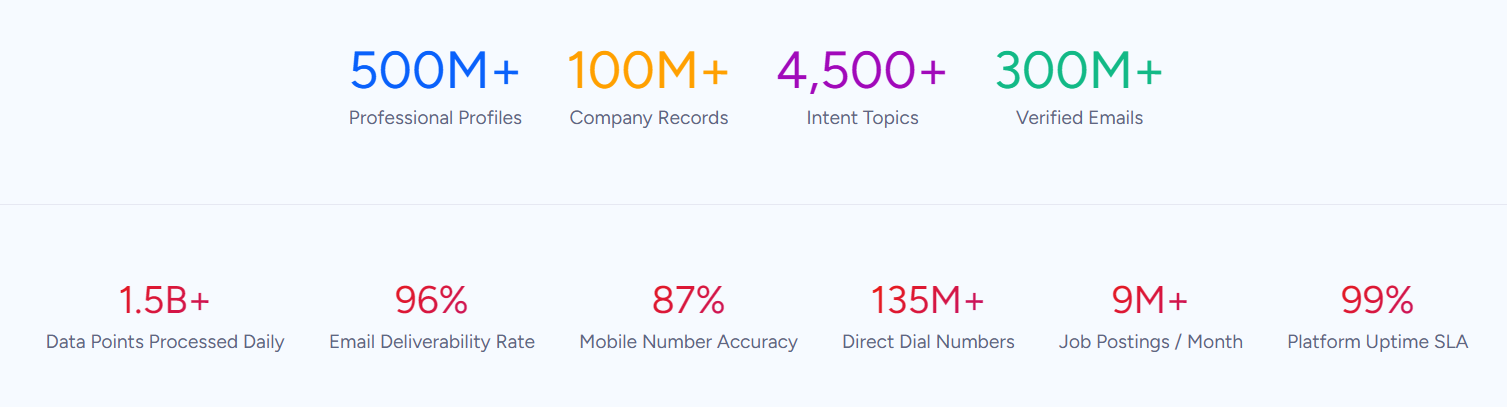
Yesware's Prospector offers 100+ million contacts with basic search filters. ZoomInfo operates at a different scale: 500M contacts, 100M companies, 135M+ verified phone numbers, 120M direct-dial phone numbers, and 200M+ verified business email addresses.
The data spans three dimensions Yesware doesn't cover.
Identity data tells you who buyers are and how to reach them. Company context provides firmographics, org charts, and technographic profiles of 30,000+ technologies across 30+ million companies. Dynamic signals reveal when accounts are in-market, through buyer intent data tracking 210 million IP-to-Organization pairings and website visitor identification that resolves anonymous traffic to companies.
Source: ZoomInfo
This data is verified through a multi-source pipeline backed by 300+ human researchers and achieves up to 95% accuracy on first-party data. In a Fortune 500 competitive RFP analyzing 25 million contacts across vendors, an independent consultant concluded that "no other competitor came even close."
"ZoomInfo gives us the information we need to execute. It's already there, so we can be three steps ahead." (Vensure)
GTM Context Graph: AI that understands why deals move, not just whether emails were opened.
Yesware's analytics track activity: opens, clicks, replies, and template performance.
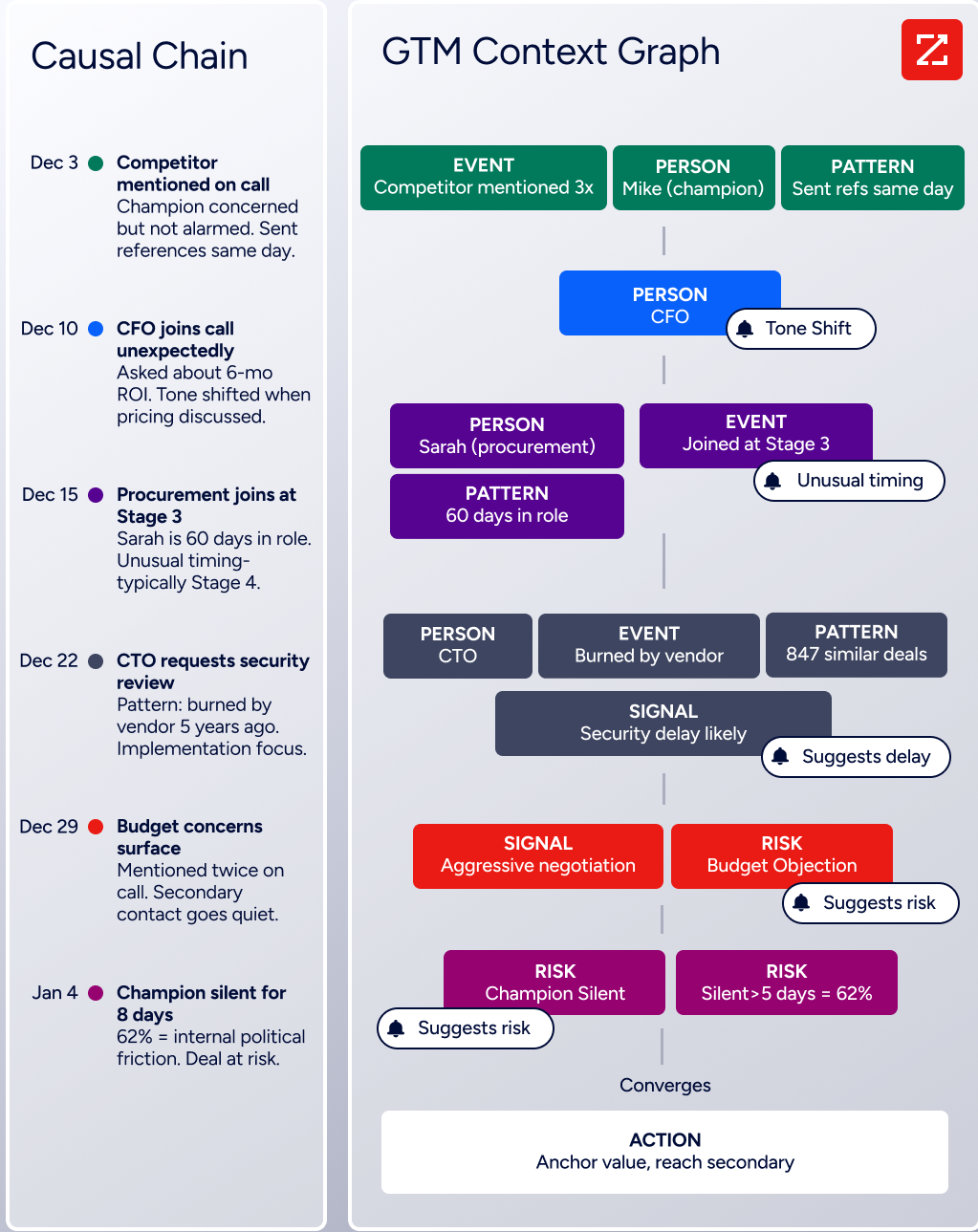
ZoomInfo's GTM Context Graph works at a deeper level, fusing B2B data with a customer's CRM records, conversation transcripts, email interactions, and behavioral signals into an intelligence layer that processes 1.5B+ data points daily.
The difference: a CRM records that a deal moved from Stage 3 to Stage 4. Yesware shows the prospect opened three emails last week. Neither explains why the deal moved.
The GTM Context Graph captures that context. It recognizes that executive sponsorship entering at a specific stage, combined with ROI-focused questions on the last call, matches patterns behind closed-won deals. That reasoning informs every downstream action, from follow-up messaging to account prioritization.
Source: ZoomInfo
This layer exists because ZoomInfo has spent 20 years building B2B data infrastructure and acquired conversation intelligence engines like Chorus for context capture. No single point solution can replicate this because no single point solution has all these layers at scale.
Seismic attributed 39% of active pipeline to opportunities identified or influenced by ZoomInfo signals. "That combination of our internal CRM data, external signals, and AI context has helped us craft very specific account- and persona-based messages." (Seismic)
GTM Workspace: A dedicated selling environment, not just an inbox add-on.
Yesware works as a browser extension layered on Gmail or Outlook. ZoomInfo’s GTM Workspace is a dedicated environment where prioritized accounts, AI-drafted outreach, and deal context converge in one place.
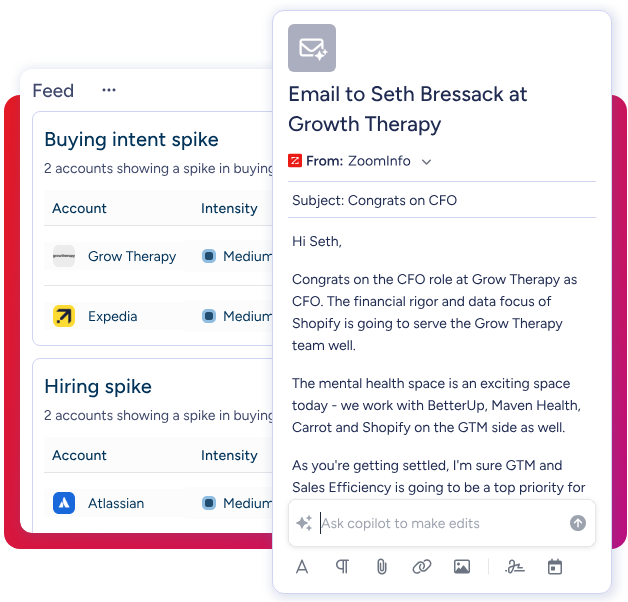
The workspace includes an Action Feed that surfaces in-market buyers matched to target criteria, with pre-drafted actions on every signal (G2 comparisons, funding events, executive hires). The AI Assistant generates account briefs in seconds, pulling CRM history, company news, ZoomInfo signals, and stakeholder context. Views provide filterable interfaces combining CRM data with real-time buying signals.
Source: ZoomInfo
Where Yesware helps reps send better emails, GTM Workspace helps reps run better deals. It addresses the fragmentation problem (the average enterprise uses 23 GTM technologies) by consolidating buyer context and execution into one place. AI agents within Workspace research accounts, generate follow-ups, monitor signals, draft outreach, and update CRM fields.
"Anything that minimizes our team's need to switch contexts is beneficial. ZoomInfo offers a single view, eliminating the need to navigate between systems." (Spekit)
GTM Studio and Universal Access: Intelligence that reaches every team and every tool.
Yesware serves individual sales reps inside their inbox. ZoomInfo delivers intelligence across the entire go-to-market organization through multiple access points.
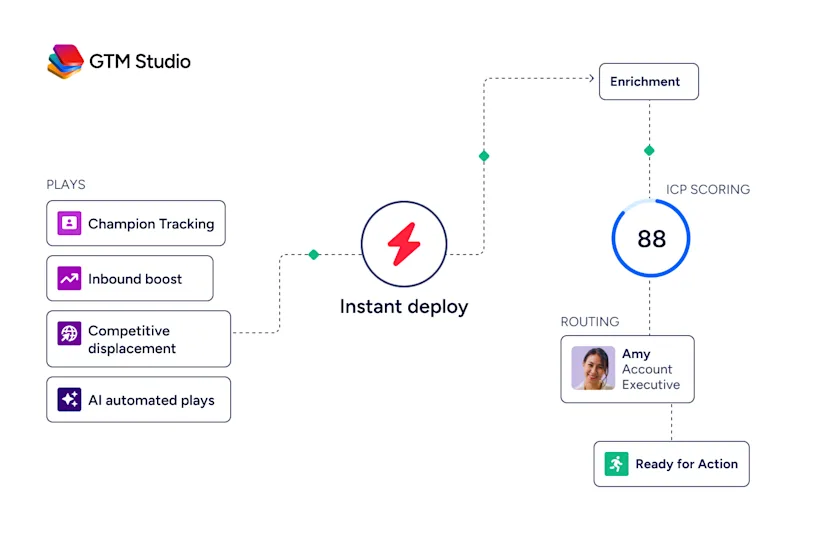
GTM Studio gives marketers, RevOps, and GTM engineers an AI-powered canvas where audience definition, campaign orchestration, and pipeline measurement happen in natural language. Expansion plays that used to take 3 weeks now launch in 30 minutes, without engineering support. Pre-built plays cover inbound acceleration, champion tracking, competitive displacement, and ICP targeting.
Source: ZoomInfo
For teams that build beyond ZoomInfo's own products, APIs and MCP expose the same intelligence to any custom agent, internal tool, or partner platform. API access is included in all relevant plans, and ZoomInfo's MCP server is listed in the Claude directory and supports ChatGPT.
All three access points draw from one GTM Context Graph. A signal one team detects is immediately actionable by every other team, and data quality stays the same regardless of which surface you use.
Pricing: Custom-quoted with a permanent free tier.
ZoomInfo uses a custom-quoted subscription model with no publicly listed prices. Costs depend on users, credit volume, features, and contract length.
Sales plans are organized into three tiers: Professional (contact and company data, Chrome extension, AI email generation), Advanced (adds intent signals, buyer intent clusters, Account Fit Score, automated outreach workflows), and Enterprise (adds real-time intent signals, AI-generated account summaries, advanced workflows, and dedicated support).
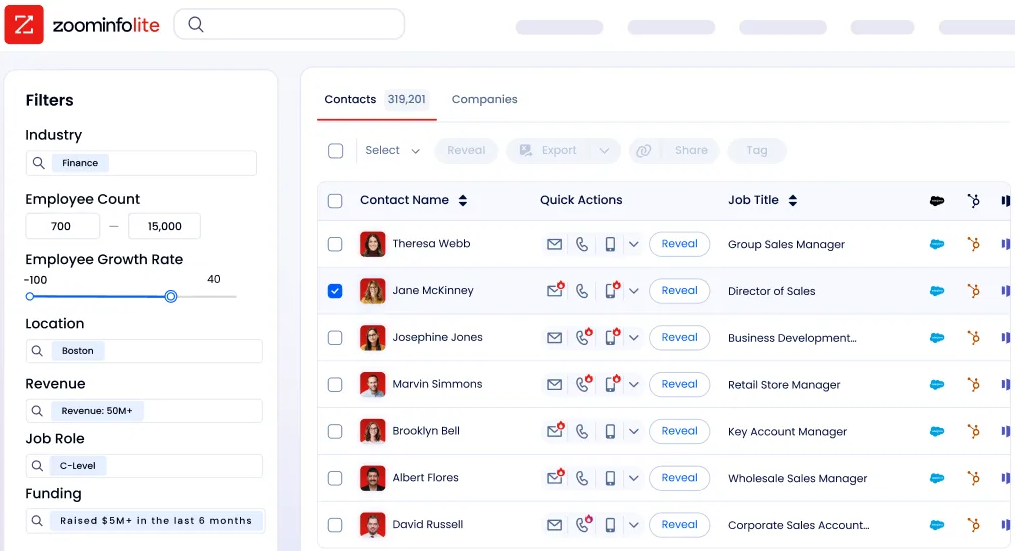
ZoomInfo Lite is a permanent free tier (not a trial) that includes access to 100M+ verified profiles, 10 monthly export credits, the ReachOut Chrome Extension, WebSights Lite (up to 10 website visitor reveals per day), HubSpot integration, and built-in email sending. A 7-day free trial is also available for paid features.
Source: ZoomInfo
Note: ZoomInfo is transitioning toward a consumption-based pricing model.
ZoomInfo costs more than Yesware. The evaluation comes down to whether your team needs inbox-level sales engagement or a full go-to-market intelligence platform.
Yesware or ZoomInfo: Comparison Summary
Yesware | ZoomInfo | |
|---|---|---|
Primary focus | Inbox-based sales engagement | AI-powered GTM platform |
B2B contact database | ||
Verified phone numbers | Available via Prospector add-on | |
Buyer intent data | Not available | 210M IP-to-Org pairings, 6T+ keyword signals monthly |
Technographics | Not available | 30,000+ technologies across 30M+ companies |
Email tracking | Pixel-based open/click/attachment tracking | Available through engagement tools |
Campaign automation | Multi-channel from inbox | Multi-channel via GTM Workspace and GTM Studio |
AI capabilities | Basic AI for content generation | GTM Context Graph with deal intelligence and AI agents |
CRM integration | Salesforce only (Enterprise tier) | |
Conversation intelligence | Not available | Chorus (call recording, analysis, coaching) |
Website visitor identification | Not available | WebSights with contact-level ID |
API and MCP access | APIs and MCP in all relevant plans | |
Free tier | Free plan (5 users max, limited tracking) | ZoomInfo Lite (permanent, 10 exports/month) |
Pricing transparency | Published ($0-$85/seat/month) | Custom-quoted |
Setup complexity | 60-second install | Longer onboarding (broader platform) |
Best for | Individual reps and small teams needing inbox tools | GTM organizations needing data, intelligence, and execution |
Final Verdict
The choice between Yesware and ZoomInfo depends on where your sales organization is today and where it's heading.
Choose Yesware if you need a simple, affordable way to add tracking, templates, and sequencing to your Gmail or Outlook workflow.
It's the right tool for individual reps and small teams whose primary channel is email, whose CRM is Salesforce, and who value fast setup over feature depth. Yesware does what it promises: it makes inbox-based selling more efficient without requiring a large platform investment or behavioral change.
Choose ZoomInfo if your team has outgrown inbox-level tools and needs data, signals, and intelligence to run a full go-to-market operation.
With B2B data covering 500M contacts, a GTM Context Graph that reveals why deals move, and multiple access points (GTM Workspace, GTM Studio, APIs, and MCP), ZoomInfo moves prospecting from list-building to strategic account engagement. It's the natural next step for organizations ready to connect sales, marketing, and operations around shared intelligence.
Get started with ZoomInfo here.
Yesware was built for the era when sales engagement meant tracking opens and automating follow-ups from the inbox. ZoomInfo is built for the era where the entire go-to-market motion (from identifying in-market buyers to understanding deal context to executing across channels) runs on unified data and AI.
Yesware FAQ
Is Yesware free?
Yesware offers a permanent free plan with significant limitations: tracking covers only emails sent within the last 24 hours, campaigns cap at 10 recipients per month, and the plan supports a maximum of 5 users. A 14-day free trial of paid features is also available with no credit card required.
ZoomInfo offers ZoomInfo Lite, a permanent free tier with access to 100M+ verified profiles, 10 monthly export credits, a Chrome extension, website visitor identification, and HubSpot integration.
What CRM does Yesware integrate with?
Yesware integrates only with Salesforce, and that integration is restricted to the Enterprise tier at $65-85 per seat per month. Teams using HubSpot, Microsoft Dynamics, Pipedrive, or any other CRM have no native integration option. For a platform built around eliminating manual data entry, this single-CRM limitation excludes a large share of potential users.
ZoomInfo integrates natively with Salesforce, HubSpot, and Microsoft Dynamics, and offers an app marketplace with 120+ additional integrations.
How accurate is Yesware's email tracking?
Yesware's tracking pixel detects email opens, link clicks, and attachment views in real time.
However, false opens from corporate firewalls, antivirus software, and email security tools are the most cited complaint in user reviews. These tools scan incoming emails and trigger the pixel, producing inflated open rates that can mislead follow-up prioritization.
How much does Yesware cost?
Yesware's paid plans range from $15-19 per seat per month for Pro, $35-45 for Premium, and $65-85 for Enterprise, depending on annual or monthly billing. Annual billing saves 21-24%. The free plan supports up to 5 users with limited features. Prospector credits for the B2B contact database are available as an add-on at undisclosed pricing.
Does Yesware have a B2B contact database?
Yes. Yesware's Prospector provides access to 100+ million B2B contacts, searchable by job title, seniority, location, company name, company size, and industry. Results include verified email addresses, phone numbers, and LinkedIn profiles. The database is smaller than dedicated data platforms and does not include buyer intent signals, technographics, or company hierarchy data.
ZoomInfo's data platform covers 500M contacts, 100M companies, and 135M+ verified phone numbers, with intent data, technographics, and org charts included.
Can Yesware handle large-scale outbound prospecting?
Yesware works well for individual reps and small teams, but user reviews consistently note scalability limitations. The platform can slow down the inbox during high-volume sends and is described as less suited for dedicated SDR teams processing hundreds of leads monthly.
Teams needing high-volume, multi-channel outbound at scale may find the inbox-extension architecture constraining compared to dedicated sales execution platforms.
Does Yesware offer buyer intent data?
No. Yesware tracks email engagement (opens, clicks, replies) but does not identify which companies are researching solutions in your category.
ZoomInfo offers buyer intent data tracking 210 million IP-to-Organization pairings and 6 trillion+ new keyword-to-device pairings sourced monthly, plus Guided Intent that identifies topics historically correlated with deal success.
What happens if I want to cancel my Yesware subscription?
Yesware does not permit early cancellations, downgrades, or seat reductions during the active subscription term. Plans auto-renew by default, and no refunds are provided for the unused remainder of the term. Upgrades can be processed at any time, but any reduction requires waiting until the current term expires.
Researching Yesware? These comparisons and alternatives help you decide:
