
Choosing between Pipedrive vs. Zoho CRM for your sales team often comes down to five questions:
Do you need a focused sales tool, or a platform that covers your entire business?
Is getting your team productive in days more important than customizing every workflow?
Are you primarily managing inbound leads, or do you need to find and reach new prospects?
How important is it that the data inside your CRM is accurate, complete, and current?
Would your team close more deals with a simpler pipeline view, or with deeper automation and AI?
In short, here's what we recommend:
Pipedrive is the CRM built for salespeople who want to sell, not administer software. Its visual pipeline puts every deal on a kanban board where colored cues flag deals going cold, and its activity-based selling approach keeps reps focused on the next call, email, or meeting rather than data entry. 100,000+ companies in 179 countries use it because it works the way salespeople think. The trade-off: Pipedrive stops at sales. You won't find native marketing automation, customer support, or post-sale project management without bolting on other tools.
Zoho CRM gives growing businesses capabilities that rival Salesforce at a fraction of the cost. Its Enterprise edition at $40/user/month includes territory management, AI-powered lead scoring, process enforcement through Blueprint, and customer journey orchestration, all backed by a 50+ app ecosystem covering finance, HR, marketing, and support from a single vendor. 300,000+ businesses worldwide use Zoho CRM. The trade-off: that depth demands patience. Expect to invest real time in setup and configuration before the platform delivers its full value.
Both platforms help you manage deals once they're in your pipeline. But neither answers the questions that determine whether those deals close: Which accounts are researching solutions right now? Who are the real decision-makers? What signals indicate a deal is about to accelerate or stall? That's the intelligence gap that separates busy sales teams from productive ones.
ZoomInfo is a GTM platform that provides the intelligence your CRM can't generate on its own. Built on a B2B data foundation of 500M contacts, 100M companies, 135M+ verified phone numbers, and 200M+ verified business emails, ZoomInfo goes beyond static data.
Its GTM Context Graph, an intelligence layer processing 1.5B+ data points daily, fuses your CRM records, conversation transcripts, and behavioral signals with ZoomInfo's third-party intelligence to reveal which accounts are in-market, who matters in each deal, and why opportunities are moving or stalling. Sellers access this through GTM Workspace, which surfaces prioritized accounts and AI-drafted outreach. Marketers and RevOps use GTM Studio to build audiences and launch plays in natural language. For teams that live inside their CRM, APIs and MCP push the same intelligence directly into Pipedrive, Zoho, or any other tool.
If knowing which accounts to pursue and why sounds like the missing piece, see how ZoomInfo works with a free ZoomInfo Lite account or a 7-day trial.
Pipedrive vs. Zoho CRM vs. ZoomInfo at a glance
Pipedrive | Zoho CRM | ZoomInfo | |
|---|---|---|---|
Core function | Sales pipeline CRM | Full business platform with CRM | B2B data intelligence and GTM execution |
Ease of setup | Fast (hours to days) | Moderate to slow (days to weeks) | Deploys in weeks alongside your CRM |
AI capabilities | Emerging (AI email writer, Sales Assistant) | Mature (Zia: predictive, generative, agentic) | GTM Context Graph with AI agents |
Free plan | No (14-day trial) | Yes (up to 3 users) | Yes (ZoomInfo Lite, permanent) |
Starting price | $14/user/month | $14/user/month | Custom (consumption-based) |
Marketing tools | Add-on (Campaigns) | Native (Cadences, Social CRM, CommandCenter) | Native (GTM Studio, ABM, display ads) |
Contact database | Your data + Prospector (400M+ profiles) | Your data + Zia enrichment | 500M contacts, 200M+ verified emails |
Buyer intent signals | None | None | 210M+ IP-to-Organization pairings |
Integrations | 500+ marketplace apps | 1,100+ marketplace + 55 Zoho apps | 120+ integrations + API/MCP for any tool |
Best for | Small sales teams wanting simplicity | Growing businesses needing breadth | Teams that need better data and buying signals |
Pipedrive trades depth for speed
Pipedrive was founded in 2010 by five salespeople frustrated that CRMs were built for managers to track reps, not for reps to close deals. That founding insight still defines the product.
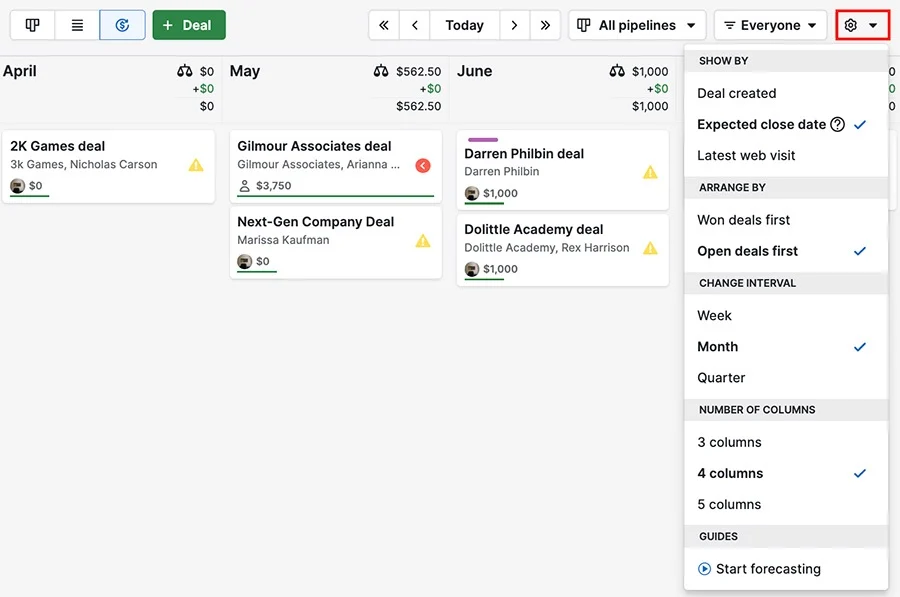
The visual pipeline shows every deal as a card on a kanban board, available in three views: board, list, and forecast. Deal rotting highlights idle deals with colored cues before they go cold. Every call, email, and meeting ties to a specific deal through the activity calendar. A contacts timeline gives a visual history of all communications with any person. A new rep can start using the system productively the same afternoon they sign up.
Source: Pipedrive
Customization stays within intentional limits. You can create multiple pipelines with custom stages, add custom fields (including auto-calculated types), and configure feature modules with a single click. But Pipedrive doesn't try to model complex multi-department processes or enforce step-by-step compliance workflows. It assumes your salespeople know what to do and gives them a clear view of where every deal stands.
Zoho CRM trades speed for depth
Zoho CRM launched in 2005 and has spent two decades building a system that can model nearly any sales process.
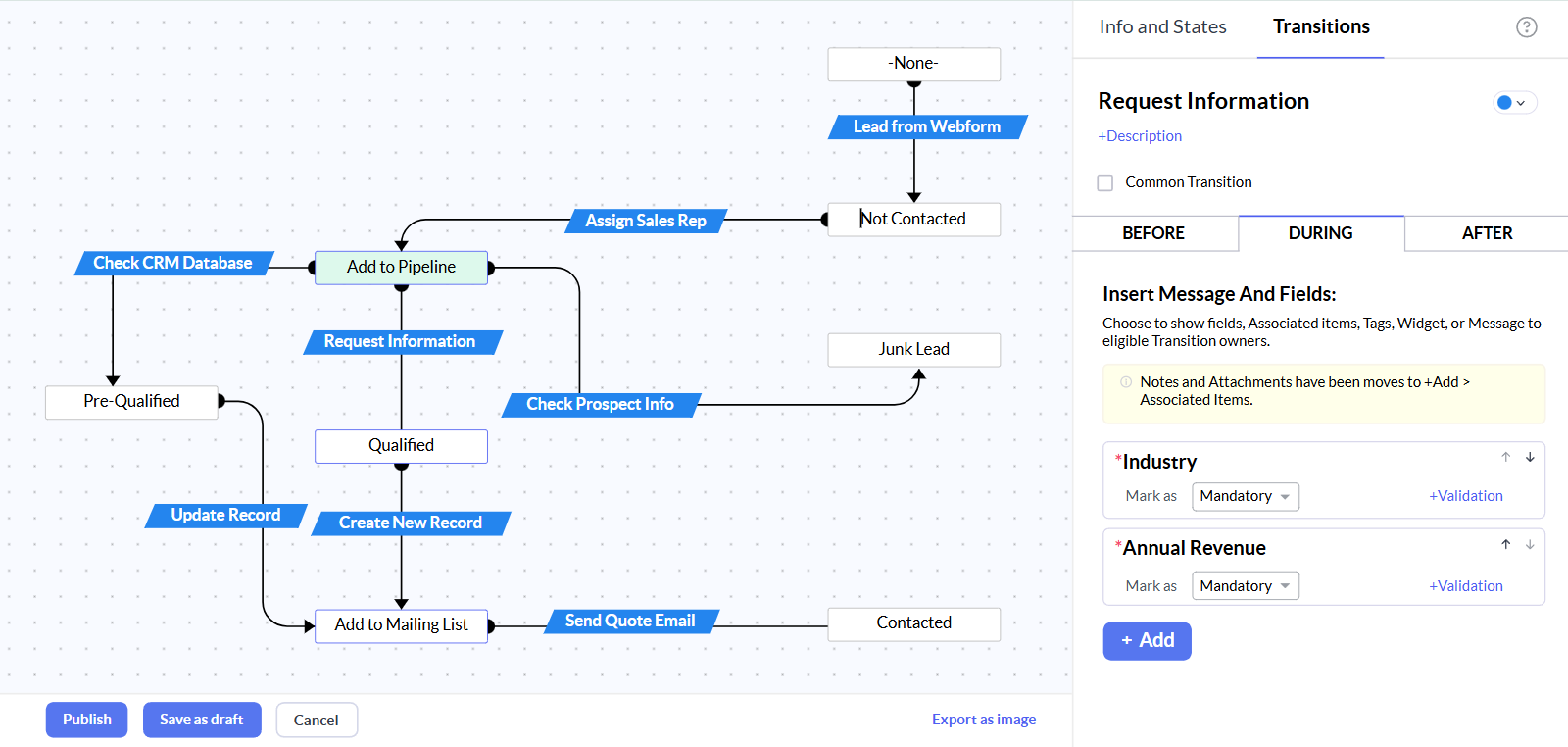
Where Pipedrive's pipeline view is cosmetic (you drag deals between stages freely), Zoho's Blueprint enforces deal progression. Reps cannot advance a record until they complete required actions: logging a call, filling a field, attaching a document. Stagnation alerts and escalations fire when records sit too long at any stage. This isn't a visual aid; it's a process enforcement layer.
Source: Zoho
Beyond Blueprint, Zoho stacks more automation tools. Kiosk Studio lets admins build guided workflows without code. CommandCenter orchestrates customer journeys across departments, with PathFinder showing how customers actually travel through touchpoints. Cadences run multichannel follow-up sequences that branch based on prospect behavior. This layered depth handles complexity Pipedrive's automation can't reach.
The cost of that depth is time. As SoftwareReviews summarizes: "Success requires investing time in setup and configuration rather than expecting immediate out-of-box functionality." A business that needs CRM results next week should start with Pipedrive. A business building a system for the next three years should invest in Zoho.
AI and automation: Zoho leads today, Pipedrive is rebuilding around it
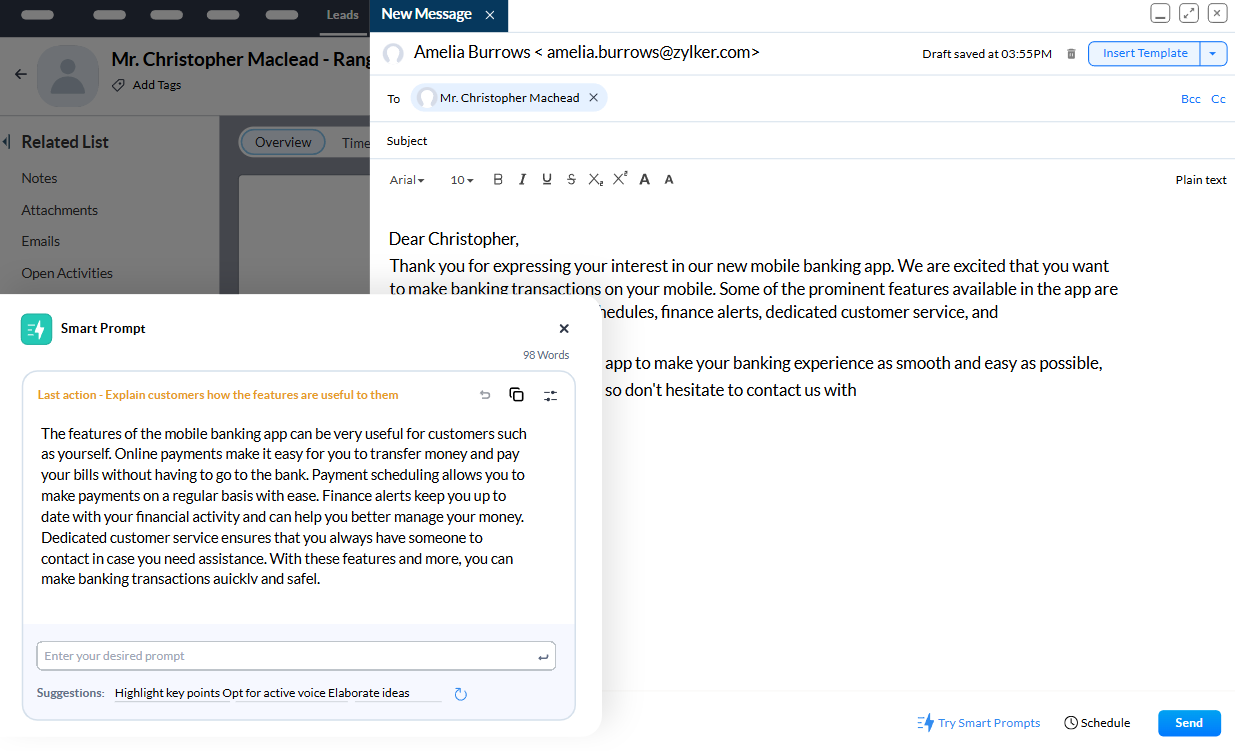
Zoho's Zia AI covers three layers: predictive intelligence (lead scoring, churn prediction, AI forecasting with anomaly detection), generative AI (create modules, workflows, and reports from natural language commands), and agentic AI (autonomous agents that qualify leads, schedule follow-ups, and draft outreach without human intervention). The Zia Agents Store offers 100+ pre-built agents integrated with 60+ applications. Zia runs on proprietary language models built for business use cases, with the option to connect third-party LLMs via the Smart Prompt feature.
Source: Zoho
Zia's communication intelligence stands out. Email sentiment analysis classifies messages by intent, sentiment, and emotion across eight categories. Call transcription extracts sentiment and a one-line summary. Competitor alerts notify reps when leads mention a rival in email. For companies that want AI handling the repetitive and analytical parts of selling, Zoho has more to offer right now.
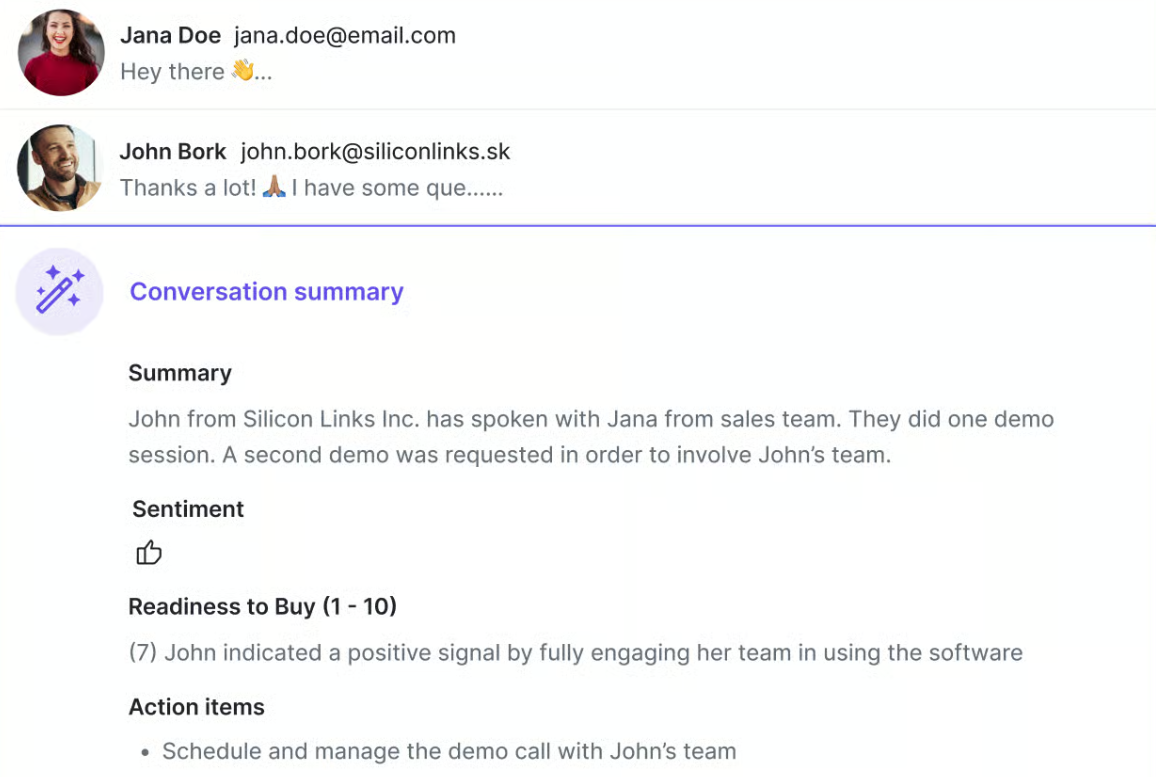
Pipedrive's AI suite is newer but growing fast. The AI Sales Assistant surfaces win probability predictions, deal prioritization, and recommended next steps. An AI email writer generates personalized outreach with configurable tone and length. AI-powered report generation lets managers query CRM data in plain language. A ChatGPT integration (launched December 2025) lets reps query Pipedrive data from ChatGPT. CEO Paulo Cunha has framed the current phase as "Pipedrive 3.0", describing a vision for an AI-native CRM.
Source: Pipedrive
Both platforms automate the mechanical side of selling: sending follow-ups, updating fields, routing leads. But neither generates the intelligence that tells a rep which accounts to pursue in the first place.
The intelligence your CRM can't generate on its own
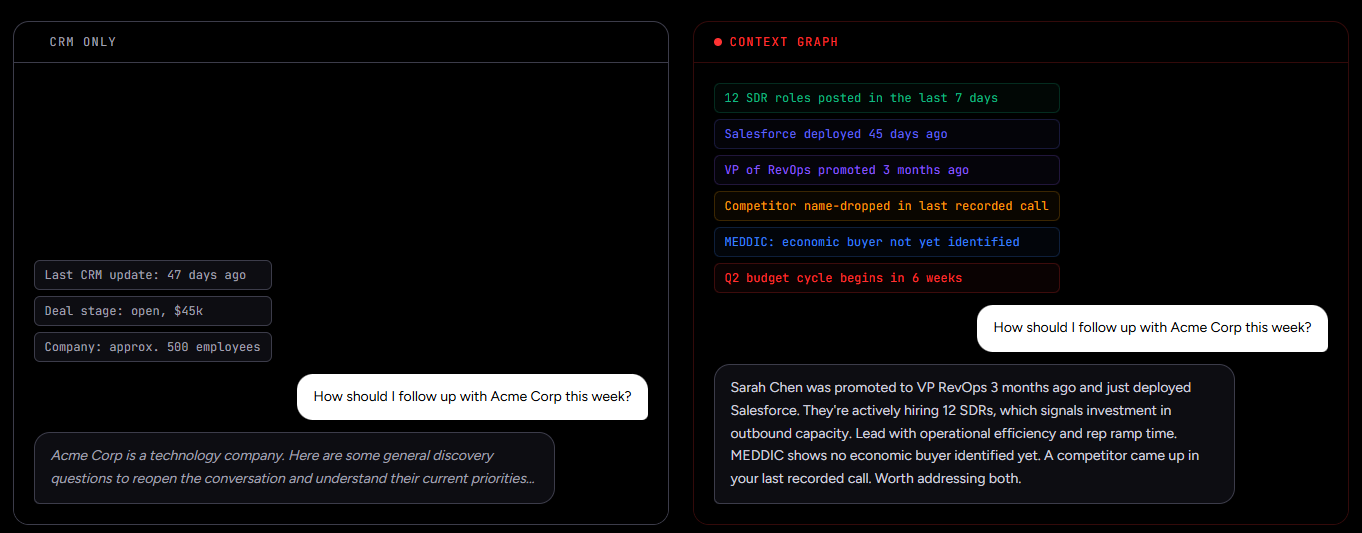
A CRM records what happens. A call was made. An email was sent. A deal moved to Stage 3. It does not capture why the deal moved, whether the account is researching competitors, or which other decision-makers you should be reaching.
This is the gap ZoomInfo fills.
ZoomInfo's B2B data platform spans three dimensions: identity data (500M contacts, 135M+ verified phone numbers, 120M direct dials, and 200M+ verified business emails), company context (100M companies with org charts, technographics tracking 30,000+ technologies, and industry and revenue data), and dynamic signals that reveal when accounts are in-market. This data is verified through a multi-source pipeline backed by 300+ human researchers, reaching up to 95% accuracy on first-party data. In a Fortune 500 competitive RFP analyzing 25 million contacts across vendors, the independent consultant concluded that "no other competitor came even close."
Data at scale is the foundation. The GTM Context Graph is what makes that data useful. It fuses ZoomInfo's third-party intelligence with your CRM records, conversation transcripts, email interactions, and behavioral signals into a single layer that captures not just what happened, but why. The CFO joining a call and asking about six-month ROI. A champion going quiet during an internal budget battle. A spike in research activity around a competitor's product. These signals determine whether a deal closes, and they're invisible inside a standard CRM field.
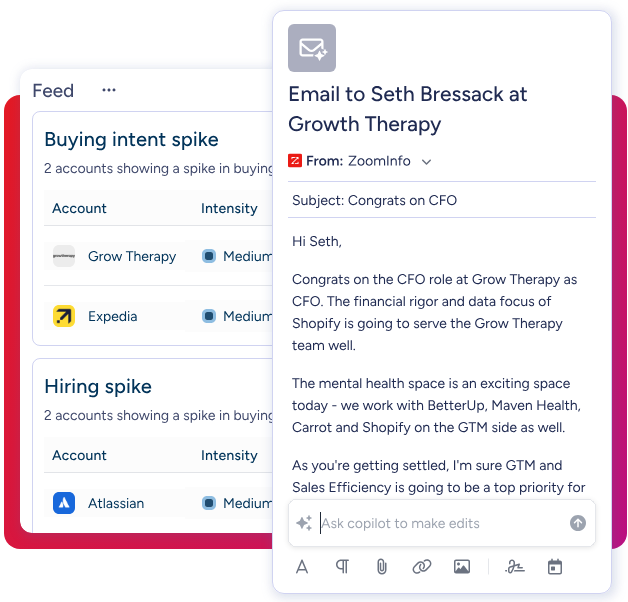
For sellers, this intelligence surfaces through GTM Workspace: a book of business view combining CRM data, ZoomInfo signals, AI-drafted outreach, and recommended next actions in one place. An Action Feed streams in-market buyers matched to your target criteria with pre-drafted actions for every signal (G2 comparisons, funding events, executive hires). For marketers and RevOps, GTM Studio lets you describe audiences in natural language, launch multi-channel plays, and measure pipeline impact. Expansion plays that used to take 3 weeks launch in 30 minutes, without engineering support.
Seismic's sales team attributed 39% of active pipeline to opportunities identified or influenced by ZoomInfo signals, while boosting productivity by 54% and saving 11.5 hours per week per seller. "That combination of our internal CRM data, external signals, and AI that's given all that context has helped us craft very specific account- and persona-based messages. And people have responded to them right away." (Seismic Case Study)
Prospecting: finding the right accounts to work
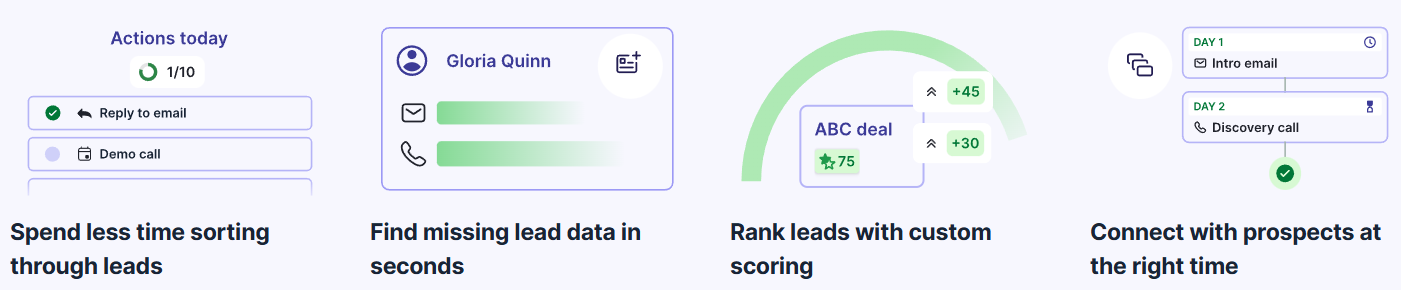
Pipedrive's lead generation centers on two tools. The LeadBooster add-on bundles a chatbot, live chat, web forms, and a Prospector database of over 400 million profiles and 10 million companies, with an AI engine verifying up to 800,000 profiles daily. The newer Pulse toolkit adds data enrichment, custom lead scoring, and automated sequences that pause on engagement signals. Both work inside Pipedrive's ecosystem, giving reps prospecting tools alongside their pipeline.
Source: Pipedrive
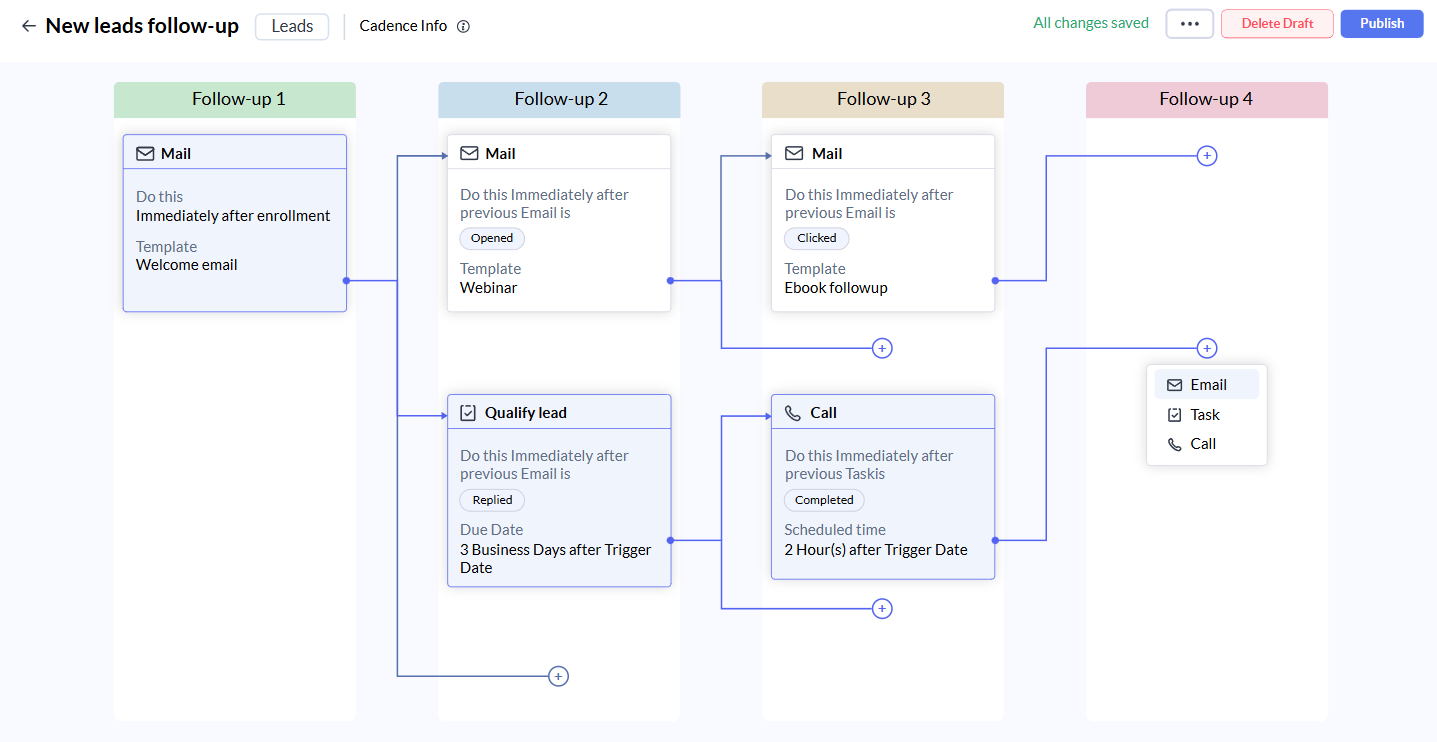
Zoho CRM captures leads from web forms, social media, live chat via SalesIQ, and imports. SalesSignals fires real-time notifications when prospects engage across channels. Zia scores leads by conversion likelihood, and Cadences run multichannel follow-up sequences that adapt based on prospect responses. Zoho's lead generation works well for inbound-driven businesses, though its outbound prospecting data doesn't match a dedicated sales intelligence platform.
Source: Zoho
ZoomInfo operates at a different scale. Buyer Intent data tracks signals from 210 million IP-to-Organization pairings and 6 trillion+ new keyword-to-device pairings sourced monthly. WebSights identifies which companies visit your website and who on the buying team is browsing, with Automatic Traffic Filtering separating real visitors from bots. Guided Intent (exclusive to ZoomInfo) identifies topics historically correlated with your closed deals rather than requiring manual keyword selection. These signals surface accounts ready to buy before they fill out a form.
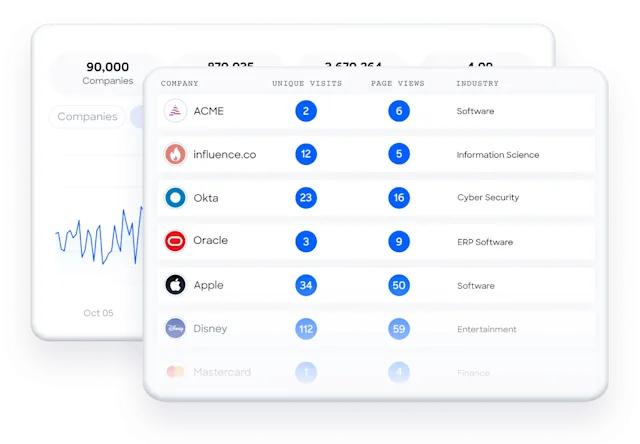
Snowflake feeds over 70 company and technographic data fields from ZoomInfo into their Account Propensity Scoring model. Accounts monitored using ZoomInfo-powered scores showed 90% higher opportunity open rates and 2x higher customer conversion rates. (Snowflake Case Study)
Pricing tells you who each platform is built for
Pipedrive and Zoho CRM share the same entry price, $14/user/month. What you get at each tier diverges from there.
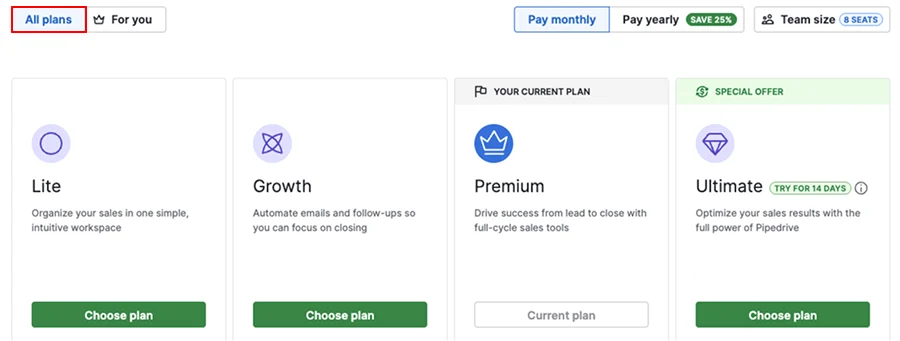
Pipedrive organizes its four tiers (Lite, Growth, Premium, Ultimate) around escalating features and capacity. Lite provides the core pipeline but no email sync or automations. Growth adds email sync, workflow automation with if/else conditions, sequences, and the forecast view. Premium bundles LeadBooster, Projects, and Smart Docs into the subscription (paid add-ons on lower tiers). Ultimate adds contact data enrichment and security features.
Add-ons like Campaigns (email marketing, priced by subscriber count) and Web Visitors (priced by identified organizations) are separate. Pipedrive offers no permanent free plan, just a 14-day free trial with full access and no credit card required. Annual billing saves up to 42%.
Source: Pipedrive
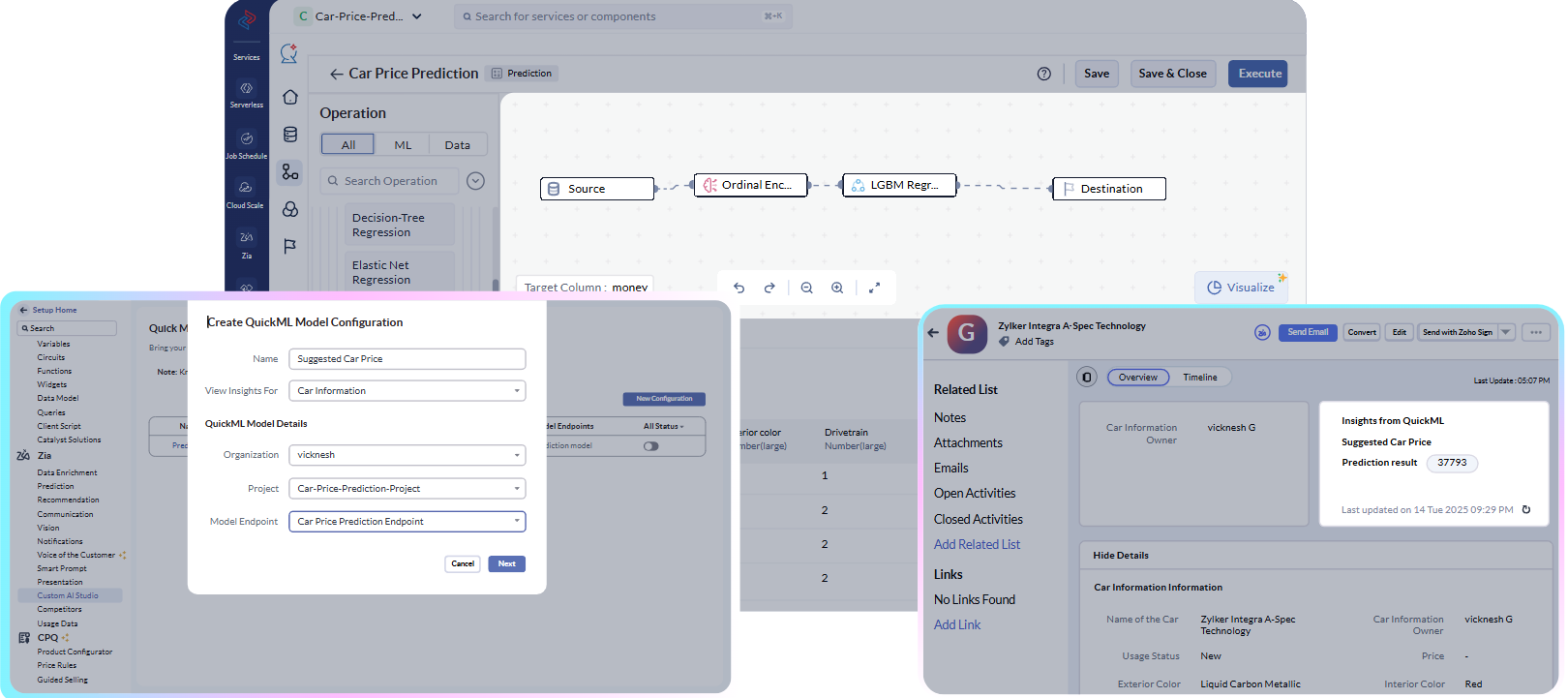
Zoho CRM offers a permanent free plan for up to 3 users, making it the lowest-risk entry point. The Standard tier ($14/user/month) includes custom reports, dashboards, sales forecasting, Cadences, and AI agents. Professional ($23) adds Blueprint process automation, CPQ, and email intelligence. Enterprise ($40) adds Zia AI with predictions and anomaly detection, territory management, journey orchestration, and customer portals. Ultimate ($52) adds custom AI/ML models via QuickML and data preparation tools.
Source: Zoho
The Zoho One bundle (roughly $37/employee/month) delivers the entire 55+ app suite, often making it cheaper than assembling a CRM plus separate tools. A 15-day free trial of the Enterprise plan is available, no credit card required.
ZoomInfo uses consumption-based pricing with no published dollar amounts. Costs scale with user count, monthly credit volume, features, and contract length. ZoomInfo Lite is a permanent free tier with access to the B2B database, 10 monthly export credits, individual and company searches, a Chrome extension, and WebSights Lite (up to 10 website visitor reveals per day). A 7-day free trial of paid plans is also available. ZoomInfo is premium-priced, built for teams where better prospecting data and buying signals translate directly into revenue.
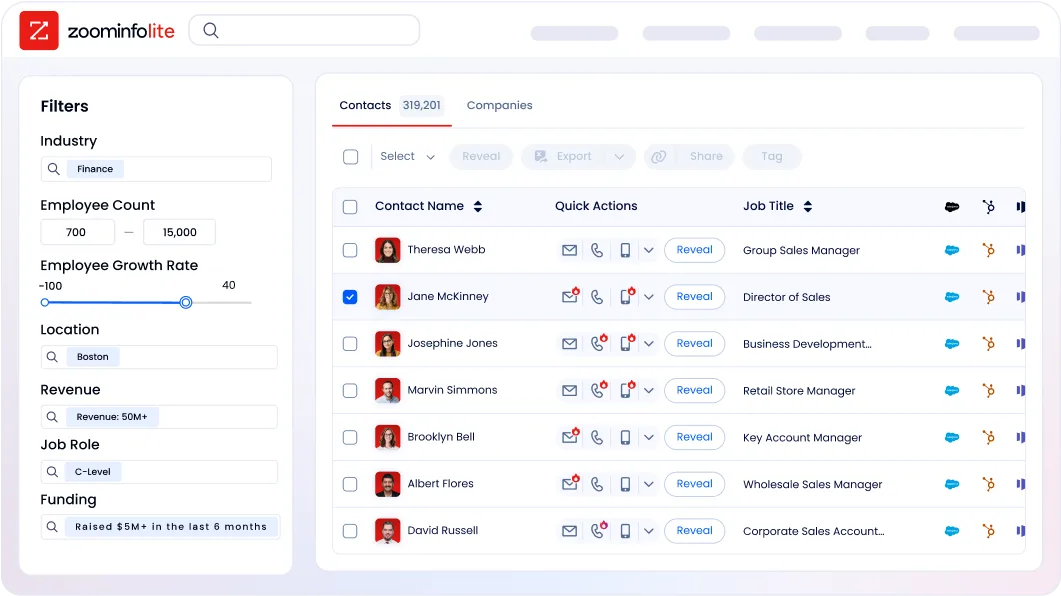
The economic question comes down to bottlenecks. If your team's constraint is organizing existing pipeline, Pipedrive or Zoho CRM at $14-52/user/month addresses it. If your constraint is filling the pipeline with qualified opportunities, ZoomInfo's investment pays for itself in deals you wouldn't have found otherwise.
Ecosystems and integrations shape your growth path
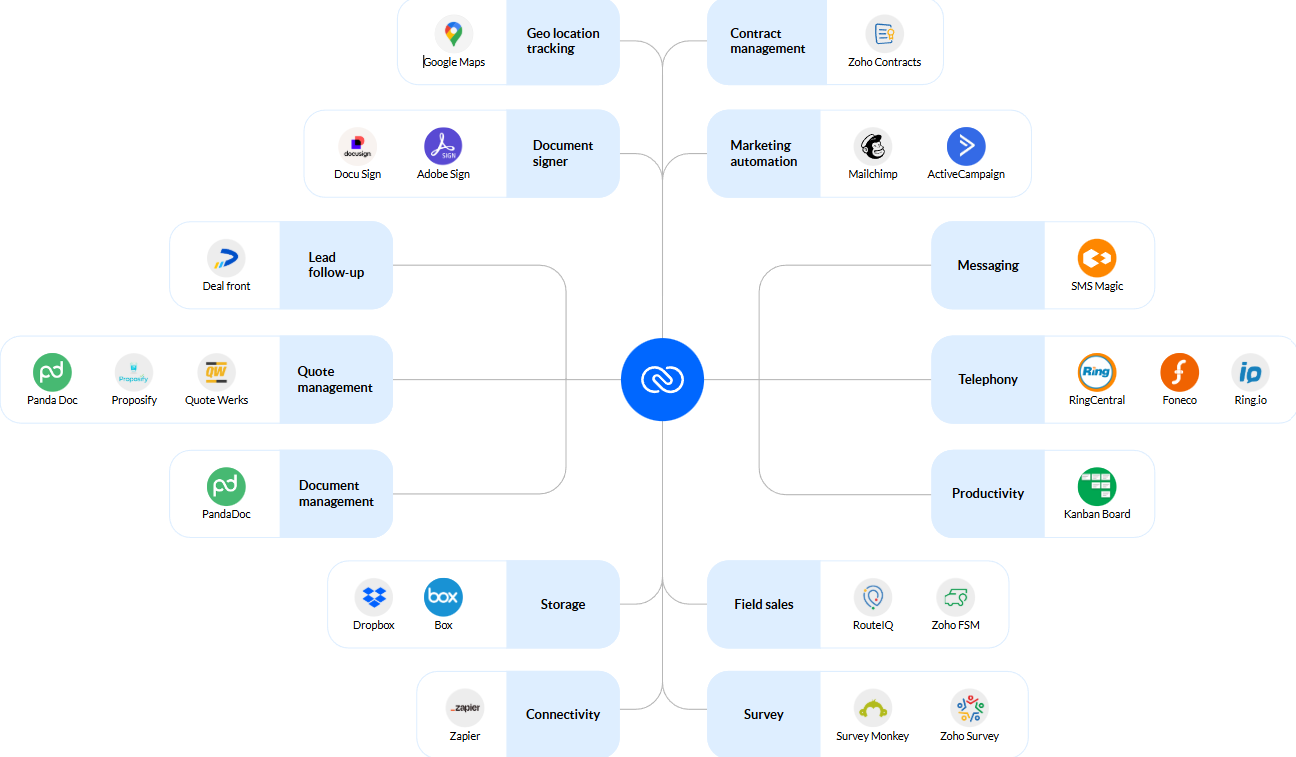
Zoho's single-vendor ecosystem is its structural advantage. 50+ first-party applications share one data layer: Zoho Books for accounting, Zoho Desk for customer support, Zoho Campaigns for email marketing, Zoho Projects for project management, Zoho Analytics for business intelligence. A deal closed in CRM flows into invoicing and support without integration plumbing.
The Zoho Marketplace adds 1,100+ extensions for tools outside the ecosystem. For businesses willing to commit to Zoho, the single-vendor approach eliminates the data sync problems that plague multi-tool stacks.
Source: Zoho
Pipedrive takes the opposite approach: a focused CRM connected to best-of-breed tools through an open marketplace of 500+ integrations. Zapier and Make handle automation. Mailchimp handles email marketing. PandaDoc handles documents. QuickBooks handles invoicing. Pipedrive's free open API (available on all plans) and webhooks give technical teams the flexibility to build custom connections. Companies with at least one Marketplace app installed win 1.5x more deals. The trade-off is integration maintenance: every tool you add is another connection to configure and monitor.
ZoomInfo serves as the intelligence layer powering your stack, regardless of which CRM you choose. API access is included in all relevant plans. The MCP server connects AI models directly to ZoomInfo's data with no custom coding. Whether your CRM is Pipedrive, Zoho, Salesforce, or HubSpot, ZoomInfo's enrichment, intent signals, and buying intelligence flow into it. The same GTM Context Graph powers ZoomInfo's own products and any third-party application, so the intelligence you get never depends on which front-end you use.
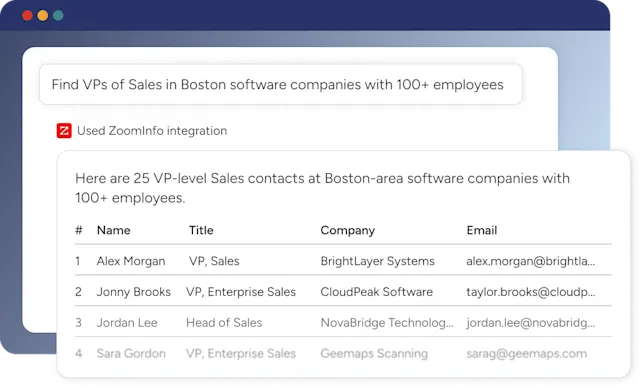
"The plug-and-play aspect of the API means I can integrate it very easily into any process and get information at a moment's notice." Jerry Wilson, Senior Marketing Intelligence Analyst at BDO Canada, which achieved an 87% reduction in time spent updating internal data dashboards. (BDO Canada Case Study)
Pipedrive vs. Zoho CRM vs. ZoomInfo: Which should you choose?
The right choice depends on where your sales process breaks down.
Choose Pipedrive if:
Your team needs a sales CRM they can start using today
Deal visibility and pipeline management are your top priorities
You prefer a focused tool over a full business platform
You have a small to mid-sized sales team that values simplicity
You're comfortable adding integrations for marketing, support, and accounting as needs grow
Choose Zoho CRM if:
You need CRM, marketing, support, and analytics from one vendor
You want customization and process enforcement at a fraction of Salesforce pricing
Your team has the capacity to invest in setup and configuration
You're already using (or open to adopting) other Zoho applications
You need AI-powered automation and predictive analytics at an affordable price
Add ZoomInfo if:
You need to know which accounts are in-market before reaching out
Your CRM data is incomplete, outdated, or missing key decision-makers
You want AI that understands why deals move, not just that they moved
Your team spends too much time researching accounts and not enough time selling
You want the same intelligence layer powering every tool in your GTM stack
See what ZoomInfo reveals about your market with ZoomInfo Lite (free, permanent) or a 7-day free trial.
A CRM organizes your sales process. ZoomInfo fills it with the right opportunities. The strongest sales stacks pair a CRM that fits your workflow (Pipedrive for simplicity, Zoho for depth) with an intelligence layer that identifies which accounts to pursue and why they're worth pursuing now. That combination (a CRM that manages deals and intelligence that generates them) is how revenue teams close the gap between activity and results.
"ZoomInfo's not just a contact data company anymore. They've built a full system of execution. GTM Intelligence works the list, writes the outreach, triggers the play, and helps drive predictable growth." Ian Brodie, CEO and Co-Founder of Levanta. (Levanta Case Study)
Pipedrive vs. Zoho CRM vs. ZoomInfo FAQ
What is the main difference between Pipedrive, Zoho CRM, and ZoomInfo?
Pipedrive is a sales-focused CRM built around visual pipeline management and activity-based selling, designed for small to mid-sized teams that want speed and simplicity. Zoho CRM is a full business platform offering CRM alongside 55+ integrated applications, with customization, AI, and process automation for growing businesses. ZoomInfo is a GTM platform that provides the contacts, company data, intent signals, and contextual intelligence that feed into your CRM, covering 500M contacts and 100M companies with verified direct dials and emails.
Can I use ZoomInfo alongside Pipedrive or Zoho CRM?
Yes. ZoomInfo integrates with both Pipedrive and Zoho CRM through APIs and MCP. ZoomInfo's data and intelligence enrich CRM records, trigger workflows, and surface in-market accounts within whichever CRM you already use. The goal is not to replace your CRM but to power it with better data and buying signals.
Which platform is cheapest to get started with?
Zoho CRM has the most accessible entry point with a permanent free plan for up to 3 users. ZoomInfo offers ZoomInfo Lite as a permanent free tier with 10 monthly export credits and website visitor identification. Pipedrive starts at $14/user/month with a 14-day free trial but no permanent free plan. Both Pipedrive and Zoho CRM start at $14/user/month on their lowest paid tiers. ZoomInfo's paid plans use consumption-based pricing, built for teams where data intelligence drives measurable pipeline impact.
Which CRM has better AI capabilities: Pipedrive or Zoho CRM?
Zoho CRM currently offers more mature AI through its Zia engine, which includes predictive lead scoring, churn prediction, agentic AI agents, call transcription with sentiment analysis, and the ability to create modules, workflows, and reports from natural language commands. Pipedrive's AI features are newer: the AI Sales Assistant provides deal prioritization and win probability predictions, an AI email writer generates outreach, and a ChatGPT integration enables natural language CRM queries. Pipedrive has framed its current roadmap as an AI-native CRM rebuild with significant executive hires from Booking.com and Expedia Group.
Do I need ZoomInfo if I already have a CRM?
A CRM manages existing relationships and deals. It does not tell you which companies are researching solutions, who the key decision-makers are, or what buying signals indicate a deal is likely to close. ZoomInfo provides buyer intent data from 210 million IP-to-Organization pairings, verified contact information across 500 million profiles, and contextual intelligence through its GTM Context Graph. Teams that rely on outbound prospecting, account-based selling, or data-driven pipeline building see the clearest return from adding ZoomInfo alongside their CRM.
Which platform is better for a small sales team of 5-10 people?
For a team that size, Pipedrive is the fastest path to value. Its visual pipeline, low learning curve, and $14/user/month starting price make it easy to adopt without a dedicated admin. Zoho CRM is worth the setup investment if the team also needs marketing automation, customer support tools, or workflow customization from a single vendor. ZoomInfo adds value for this team size when prospecting and lead quality are the bottleneck rather than deal management.
How does Pipedrive's Prospector compare to ZoomInfo's database?
Pipedrive's Prospector (part of the LeadBooster add-on) provides access to over 400 million profiles and 10 million companies, with an AI engine verifying up to 800,000 profiles daily. ZoomInfo's database covers 500 million contacts across 100 million companies, with 135 million verified phone numbers, 120 million direct-dial numbers, and 200 million verified business emails, backed by 300 human researchers and up to 95% first-party data accuracy. ZoomInfo also provides capabilities Pipedrive does not: buyer intent data, technographics tracking 30,000 technologies across 30 million companies, website visitor identification, and the GTM Context Graph that connects signals to deal outcomes.
Is Zoho CRM's ecosystem a real alternative to building a multi-tool stack?
For many growing businesses, yes. Zoho's 55+ applications covering CRM, finance, HR, marketing, project management, and support all share one data layer, eliminating integration maintenance between separate vendors. The Zoho One bundle at roughly $37/employee/month often costs less than assembling a CRM plus standalone tools for email marketing, support, and accounting. The limitation is that some individual Zoho apps may not match the depth of dedicated market leaders in specific categories, and the breadth can feel overwhelming during initial configuration.
See how Pipedrive stacks up against other tools:
