
Treasure Data (now Treasure AI) is one of the most established enterprise Customer Data Platforms. It has unified first-party customer data for over a decade, holds a Leader position in the Gartner Magic Quadrant for CDPs, and runs in 80 Global 2000 companies.
But as your go-to-market strategy evolves, a single CDP may not cover all your data needs. Treasure Data's enterprise-only pricing, 8-to-12-week implementation timelines, SQL-dependent workflows, and B2C marketing focus may not fit every team.
Whether you're looking to:
Activate unified customer data natively within an existing Salesforce ecosystem
Deploy a developer-first CDP with transparent, self-serve pricing
Orchestrate real-time customer data across a vendor-neutral multi-tool stack
Resolve fragmented customer identity for retail and CPG brands at scale
Build warehouse-native CDP infrastructure with an open-source foundation
Run AI-powered decisioning directly on your existing cloud data warehouse
Layer third-party B2B intelligence on top of your customer data for smarter prospecting and pipeline generation
We cover alternatives that address each of these areas.
Some teams will use these platforms alongside Treasure Data. Others will replace it entirely. This isn't about finding a "better" CDP. It's about finding the right fit for your data infrastructure, team, and go-to-market goals.
The Best Treasure Data Alternatives
Best Alternative for B2B Go-to-Market Intelligence and Prospecting We chose ZoomInfo because it fills a gap no CDP addresses: third-party B2B data, intent signals, and AI-driven prospecting. For teams whose go-to-market strategy extends into outbound sales and account-based marketing, ZoomInfo provides the intelligence that CDPs were not built for. |
|---|
Best Alternative for Enterprise Teams Built on the Salesforce Ecosystem We chose Salesforce Data Cloud because it removes the need for a separate CDP vendor for organizations already running Sales Cloud, Service Cloud, and Marketing Cloud, with native Agentforce AI integration and free data ingestion from core Salesforce products. |
Best Alternative for Developer-First CDPs With Transparent Pricing We chose Segment because it offers what Treasure Data cannot: a free tier, publicly listed pricing, same-day implementation, and 750+ integrations that make it the fastest path to a working customer data pipeline for startups and growth-stage teams. |
Best Alternative for Vendor-Neutral Real-Time Data Orchestration We chose Tealium because it combines client-side tag management with a server-side CDP, offers 1,300+ integrations, and enforces consent at the point of data capture, making it a strong fit for multi-vendor enterprise environments. |
Best Alternative for Enterprise Retail and CPG Identity Resolution We chose Amperity because its patented Stitch identity resolution engine can detect and correct over-merged customer profiles (a capability most CDPs lack), making it built for retail and CPG brands with fragmented legacy data. |
Best Alternative for Open-Source Warehouse-Native CDP Infrastructure We chose RudderStack because it offers a functional free tier, open-source self-hostable architecture, Segment API compatibility for easy migration, and a zero-storage design where customer data never resides on the vendor's infrastructure. |
Best Alternative for AI Decisioning on Your Existing Data Cloud We chose GrowthLoop because it runs audience building, journey orchestration, and AI-powered decisioning directly inside BigQuery, Snowflake, or Databricks with no data extraction, giving marketing teams self-service access to warehouse customer data without engineering tickets. |
What is Treasure Data?
Source: Treasure AI
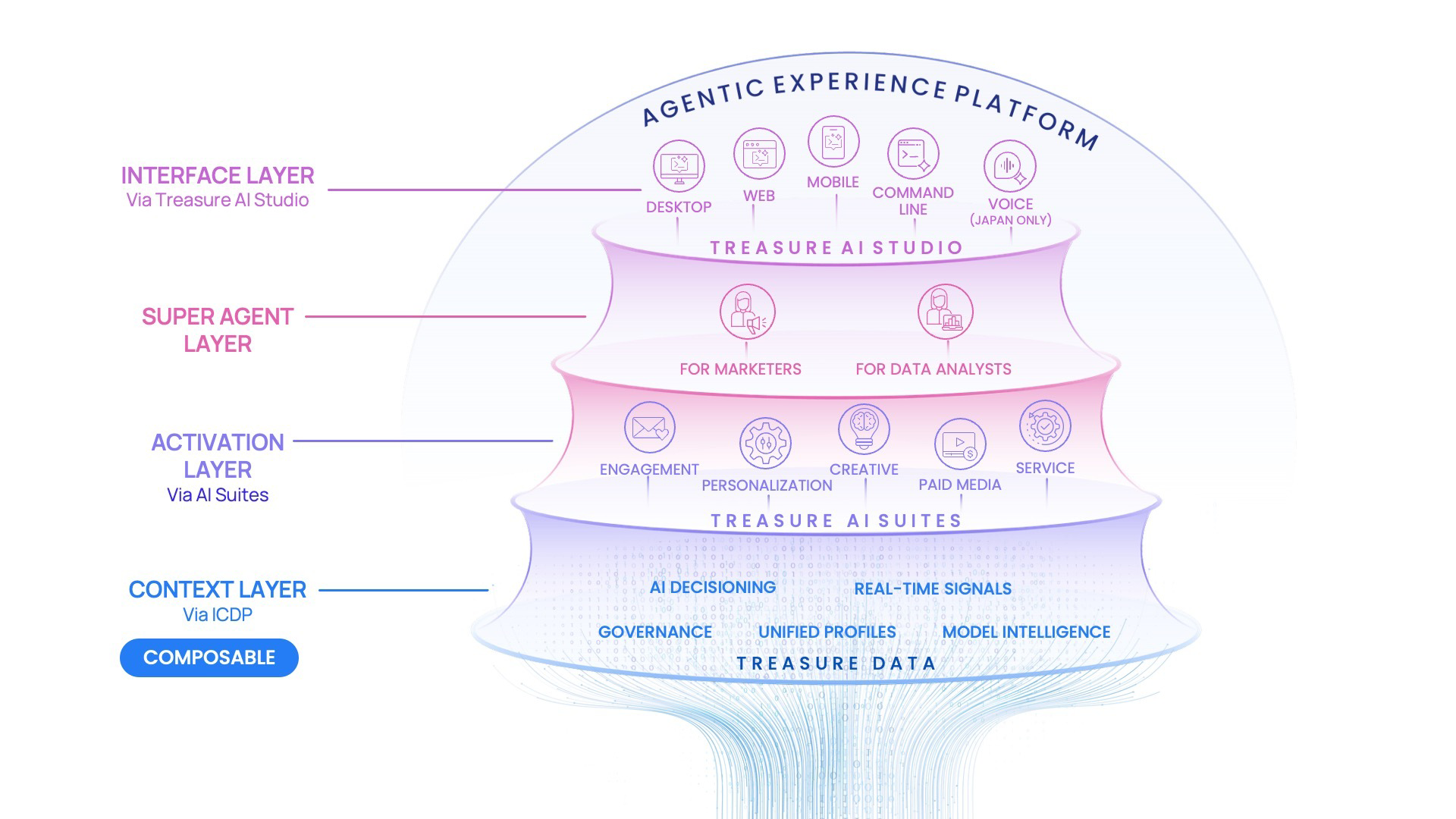
Treasure Data (recently rebranded to Treasure AI) is an enterprise Customer Data Platform that now calls itself an Agentic Experience Platform (AEP). Founded in 2011 in Mountain View, California, the platform centers on the Customer Intelligence Loop: Collect, Unify, Understand, Decide, Engage, with AI agents running the cycle continuously rather than humans clicking through tools weekly.
Its key features include:
Diamond Record identity resolution that uses deterministic, probabilistic, and rule-based matching to create unified customer profiles across channels and devices
Hybrid CDP architecture supporting both fully managed and composable deployment on Snowflake, BigQuery, Databricks, and Redshift, without ETL pipelines or storage duplication
Five AI Suites covering Engagement, Creative, Personalization, Paid Media, and Service for cross-channel marketing activation
Treasure AI Studio, a natural-language workspace that lets marketers build segments, journeys, and reports without SQL
400+ data integrations spanning martech, ad platforms, data warehouses, and analytics tools
Security certifications including SOC 2 Type 2, ISO 27001, ISO 27701, HIPAA, and FISC
When customer data flows in from multiple sources, Diamond Record resolves identities in real time, creating a persistent unified profile that AI agents and marketing teams use to orchestrate personalized campaigns across email, mobile push, paid media, and web. The platform's strength is unifying fragmented B2C customer data at enterprise scale.
But Treasure Data's enterprise-only model comes with trade-offs.
There's no self-serve pricing; all plans require custom enterprise quotes with annual subscriptions. Implementation typically takes 8 to 12 weeks. G2 reviewers note that the platform requires SQL expertise for advanced use cases, pricing can be opaque, and documentation quality is inconsistent. The platform is also rated stronger in B2C than B2B, receiving only a "Strong Performer" designation in Forrester's B2B CDP Wave.
That's why we focused on platforms that address needs where Treasure Data falls short.
Looking for B2B intelligence to power your go-to-market strategy? ZoomInfo combines a large B2B data platform with AI-driven prospecting and the GTM Context Graph. Learn more about ZoomInfo.
How We Curated Our List of Treasure Data Alternatives
After researching Treasure Data and the broader CDP market, we focused on tools that solve specific data infrastructure and go-to-market challenges well. While Treasure Data handles enterprise-scale first-party data unification for B2C marketing, some organizations need specialized capabilities for:
Activating customer data natively within an existing CRM ecosystem without a separate CDP vendor
Deploying a CDP quickly with transparent pricing and self-serve onboarding
Orchestrating data across multi-vendor stacks with real-time consent enforcement
Resolving fragmented customer identity across retail, loyalty, and multi-brand databases
Building warehouse-native data infrastructure without copying data to vendor storage
Running AI-powered marketing decisioning directly on an existing cloud data warehouse
Adding third-party B2B intelligence, intent signals, and prospecting tools that no CDP provides
Each platform on this list leads in one of these areas. You might use them alongside Treasure Data to fill gaps, or choose one as a full replacement.
DISCLAIMER: We aren't covering every customer data platform on the market! Our focus is on highlighting the best alternatives that address some of Treasure Data's limitations for various use cases and business models. |
|---|
1. ZoomInfo: Best Alternative for B2B Go-to-Market Intelligence and Prospecting
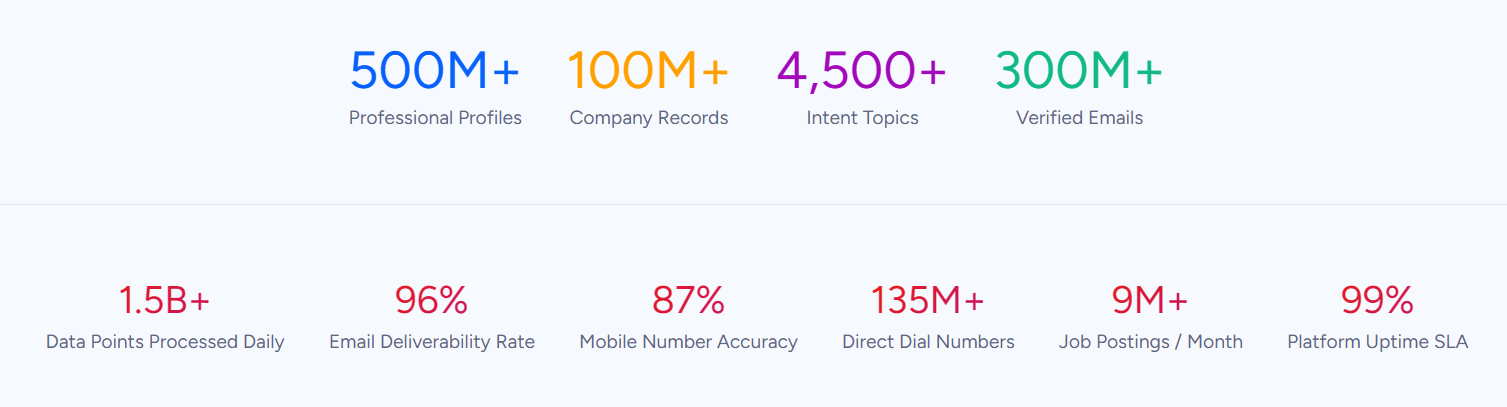
ZoomInfo is an AI GTM platform built on the largest B2B data set in the market: 500M contacts, 100M companies, 135M+ verified phone numbers, and 200M+ verified business email addresses.
Its key features include:
B2B data covering identity, company context (firmographics, technographics, org charts), and buying signals, verified by 300+ human researchers with up to 95% accuracy on first-party data
GTM Context Graph that fuses ZoomInfo's third-party data with your CRM records, conversation intelligence, and behavioral signals into a single graph that captures not just what happened in a deal, but why it happened
Buyer Intent Data tracking signals from 210 million IP-to-Organization pairings and 6 trillion+ keyword-to-device pairings monthly, with Guided Intent that identifies topics historically correlated with deal success
Three access channels through GTM Workspace for sellers, GTM Studio for marketers and RevOps, and APIs and MCP for any AI agent or third-party application
ZoomInfo occupies a different position than Treasure Data in the data stack. Treasure Data is a CDP that unifies your first-party customer data for marketing activation. ZoomInfo is a B2B intelligence platform that provides third-party data, buyer intent signals, and AI-driven prospecting that CDPs were never designed to deliver. For organizations with a B2B go-to-market motion, ZoomInfo adds intelligence that first-party data unification alone cannot produce.
Why Choose ZoomInfo Alongside or Instead of Treasure Data for B2B Intelligence
While Treasure Data unifies first-party customer data for B2C marketing campaigns, ZoomInfo fills a different gap in the go-to-market stack. Here's where ZoomInfo's strengths matter most.
Third-Party B2B Intelligence: Know Your Buyers Before They Know You
CDPs like Treasure Data unify data you already have: website visits, app interactions, purchase history, CRM records. That's essential for engaging existing customers. But for prospecting, pipeline generation, and account-based marketing, you need intelligence about companies and contacts outside your database.
ZoomInfo provides exactly that.
The platform covers 500M contacts across 100M companies, with 120M direct-dial phone numbers and 200M+ verified business emails. This data spans firmographics, technographics (tracking 30,000+ technologies across 200+ categories for 30M+ companies), org charts with decision-maker contacts, and company hierarchies. A Fortune 500 competitive RFP analyzing 25 million contacts across vendors concluded that "no other competitor came even close."
This external intelligence is unavailable in any CDP, including Treasure Data.
Source: ZoomInfo
ZoomInfo in Action: Your marketing team has been running campaigns through Treasure Data's CDP for months, but pipeline growth has plateaued because you're only engaging people who've already interacted with your brand. With ZoomInfo, your team identifies 200 companies actively researching your technology category through Buyer Intent signals, finds the VP-level decision makers at each, and launches personalized outreach with verified direct dials and business emails, all before those prospects ever visit your website.
The GTM Context Graph: AI That Understands Why Deals Move
Treasure Data's AI capabilities (including its Marketing Super Agent and Audience Agent) operate on first-party behavioral data: what customers did on your website, how they responded to campaigns, what they purchased.
ZoomInfo's GTM Context Graph works at a different level: it fuses your CRM data, conversation intelligence from every sales call and email, and ZoomInfo's third-party signals into a single graph that processes 1.5B+ data points daily.
The result is AI that understands context. As ZoomInfo CPO Dominik Facher writes: "The CRM recorded the state change. It has no record of why it happened." The GTM Context Graph captures who champions a deal, who blocks it, what objections came up on the last call, and which signal combinations historically predict closed-won outcomes.
That contextual reasoning powers every downstream action: the follow-up email addresses the CFO's specific concern, the next play targets accounts matching your actual win patterns, and the forecast weights deals by buying evidence rather than stage labels.
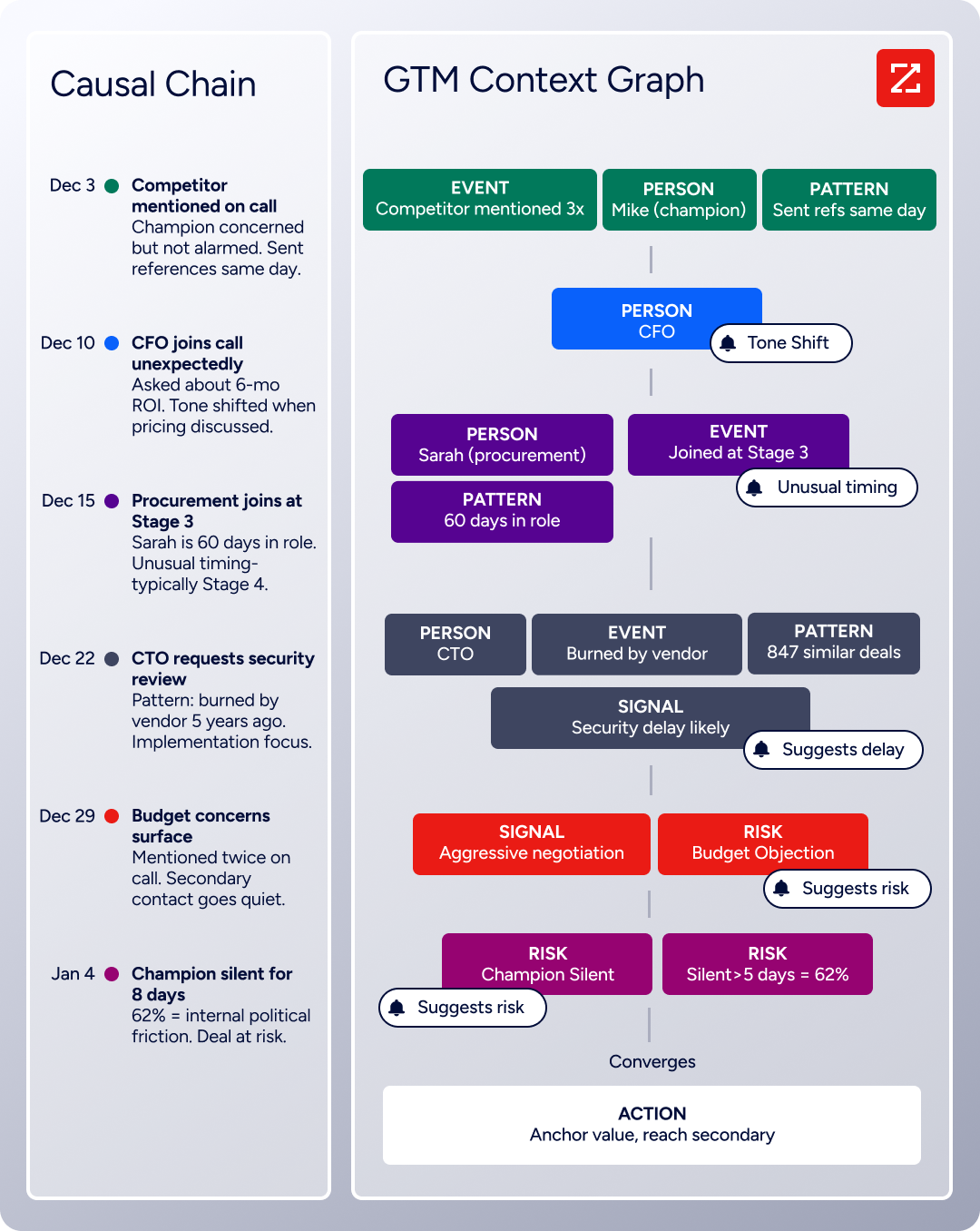
Source: ZoomInfo
ZoomInfo in Action: Your sales team is working on an enterprise deal. The GTM Context Graph surfaces that the CFO joined the last call and asked about six-month ROI (captured by Chorus conversation intelligence), the company just received new funding (third-party signal), and they're hiring three VPs in your target department (hiring signal). ZoomInfo's AI connects these signals to patterns from thousands of similar deals and recommends specific next actions, while GTM Workspace pre-drafts the follow-up email addressing the CFO's exact ROI concern.
Universal Access: Use the Intelligence Everywhere
Treasure Data delivers its capabilities through Treasure AI Studio (a natural-language workspace) and its CDP console. ZoomInfo pushes its intelligence to every surface where go-to-market decisions happen, through three products:
GTM Workspace gives sellers a workspace where prioritized accounts, deal intelligence, and AI-drafted outreach converge. Seismic's sales team boosted productivity by 54% and attributed 39% of active pipeline to ZoomInfo signals.
GTM Studio gives marketers and RevOps teams a natural-language canvas for building audiences, launching GTM plays, and measuring pipeline impact. Expansion plays that used to take 3 weeks now launch in 30 minutes.
APIs and MCP expose the same intelligence to any custom agent, internal tool, or partner platform, including Anthropic Claude and Google. BDO Canada achieved an 87% reduction in time spent on data dashboard updates using the ZoomInfo API.
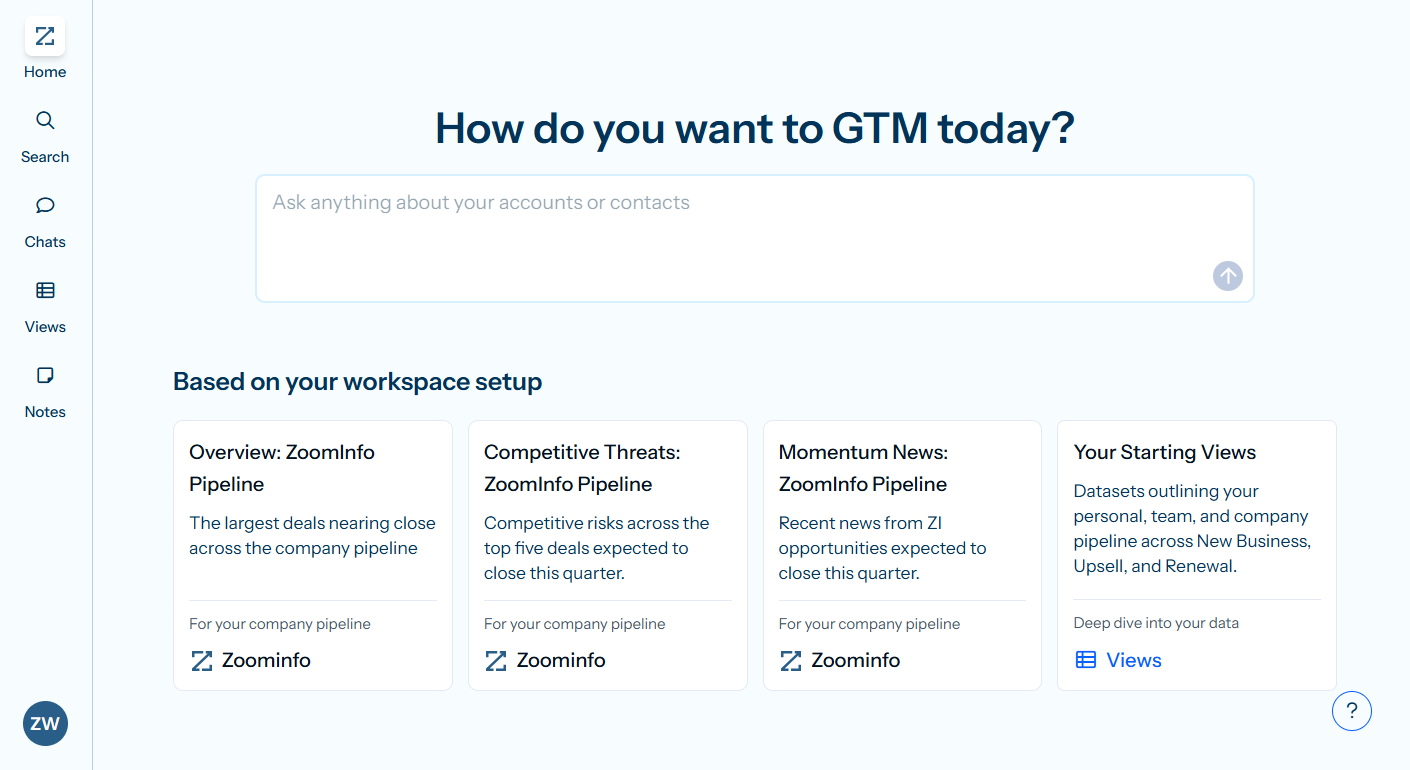
All three products draw from one GTM Context Graph: the same data, the same reasoning, whether you're working in ZoomInfo's native products or your own tools.
"ZoomInfo is our one source of truth for account data, and even more so for contact data. There's no other provider in the market that provides you with that level of detail." (Smartsheet)
NOTE: We looked at other B2B intelligence platforms and found Apollo.io and Cognism frequently mentioned. Apollo.io offers a more affordable entry point with integrated sales engagement features, while Cognism excels in European mobile number coverage. ZoomInfo's data scale (500M contacts, 100M companies), the GTM Context Graph, and access via API and MCP set it apart for enterprise go-to-market teams.
ZoomInfo Pricing
ZoomInfo uses a custom-quoted, consumption-based pricing model with no publicly listed prices. Pricing scales around enterprise license agreements, data access, API consumption, and AI activity.
The platform is organized into three product lines:
Sales plans with Professional, Advanced, and Enterprise tiers, ranging from core contact and company data to AI-driven account prioritization and real-time buyer intent signals
Marketing plans with Marketing Demand, ABM Lite, and ABM Enterprise tiers for audience targeting, display advertising, and full-funnel analytics
Additional products including Chorus (conversation intelligence) and Chat (data-powered website chat), priced separately
ZoomInfo also offers ZoomInfo Lite, a permanent free tier (no credit card, no time limit) that includes access to ZoomInfo's B2B database with 10 monthly export credits, individual and company searches, the ReachOut Chrome Extension, and HubSpot integration. A separate 7-day free trial provides access to core platform features including intent signals and email outreach.
API access is included in all relevant plans.
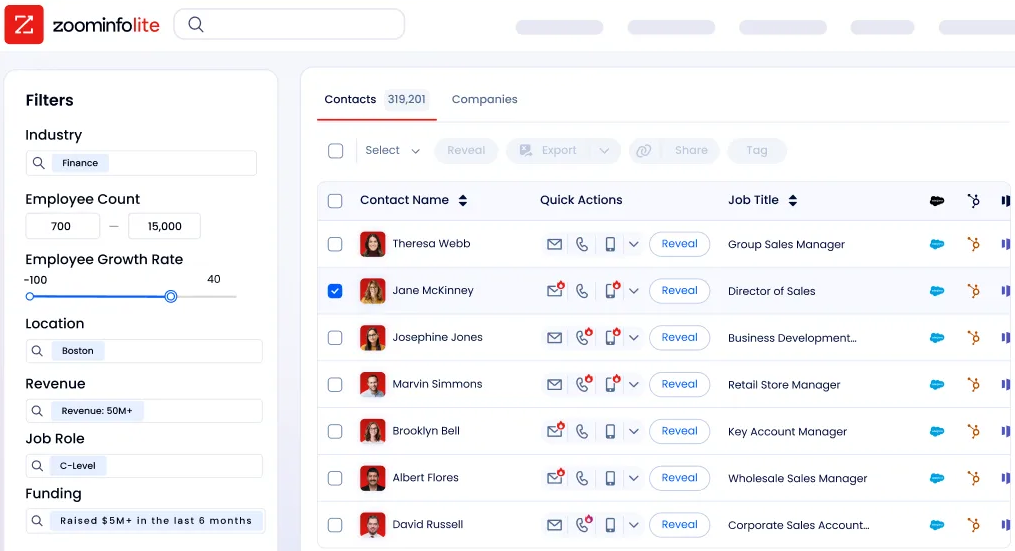
Source: ZoomInfo
Who Should Use ZoomInfo?
Choose ZoomInfo if:
Your go-to-market strategy includes outbound prospecting, account-based marketing, or B2B pipeline generation, and you need verified contact data, buyer intent signals, and AI-driven prospecting that no CDP can provide.
You want to layer third-party B2B intelligence on top of your existing customer data infrastructure (including Treasure Data) to identify in-market accounts, find decision-maker contacts, and launch targeted outreach before prospects engage with your brand.
Your sales, marketing, and RevOps teams need a shared intelligence source that works across CRM, custom tools, and AI agents via API and MCP, rather than being locked inside a single application.
Want to see how ZoomInfo's B2B intelligence can accelerate your pipeline? Start with ZoomInfo Lite for free or request a demo to explore the full platform.
2. Salesforce Data Cloud: Best Alternative for Enterprise Teams Built on the Salesforce Ecosystem
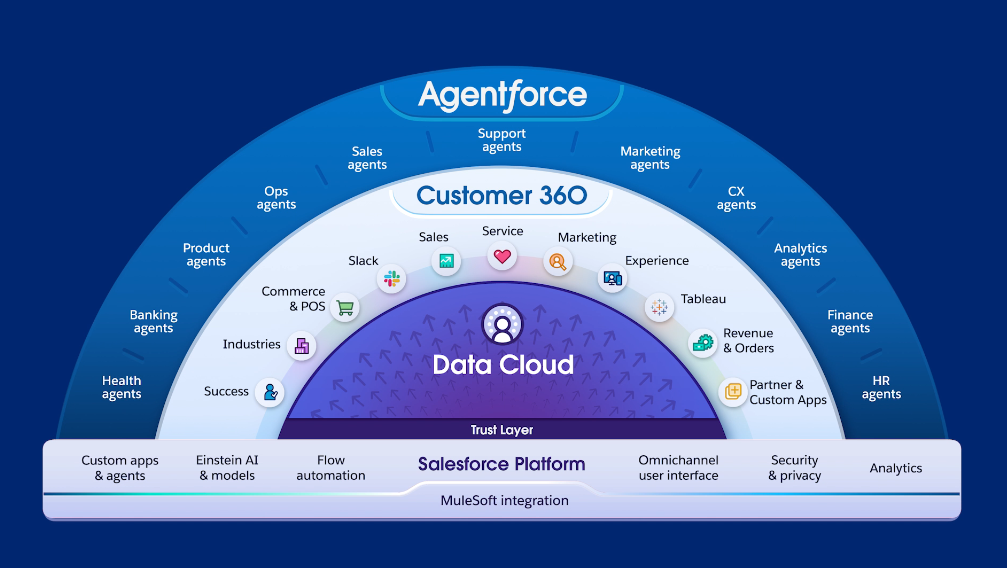
Source: Salesforce
Salesforce Data Cloud (officially rebranded as Data 360) is an enterprise customer data platform that serves as the data infrastructure for the entire Salesforce product family, unifying customer records from Sales Cloud, Service Cloud, Marketing Cloud, Commerce Cloud, and external data sources into a single real-time profile.
Its key capabilities include:
Native Salesforce ecosystem integration with free data ingestion from core Salesforce clouds, no ETL required
Zero-copy data federation with Snowflake, Databricks, Google BigQuery, and Amazon Redshift
Agentforce integration serving as the real-time context layer for Salesforce's autonomous AI agents
Einstein AI models running directly on unified profiles for predictive scoring, recommendations, and next-best-action
Free provisioning with up to 250,000 Flex Credits for existing Enterprise and Unlimited Edition Salesforce customers
For enterprises already running Sales Cloud, Service Cloud, and Marketing Cloud, Data 360 eliminates data fragmentation across those platforms without requiring a separate CDP vendor.
Why Choose Salesforce Data Cloud Over Treasure Data for Enterprise Salesforce Deployments
Salesforce Data Cloud stands out in three areas:
Native Salesforce Ecosystem Integration With No ETL Required
For organizations running Sales Cloud, Service Cloud, Marketing Cloud, and Commerce Cloud, Data 360 ingests that data at no additional cost. Profiles update in real time as Salesforce records change, without scheduling, syncing, or managing connector health.
Treasure Data connects to Salesforce via integrations, meaning Salesforce data must cross API boundaries to reach Treasure Data's identity resolution layer. For enterprises whose primary system of record is Salesforce, Data 360 eliminates an entire category of data pipeline complexity.
Bidirectional Zero-Copy Data Federation at Proven Scale
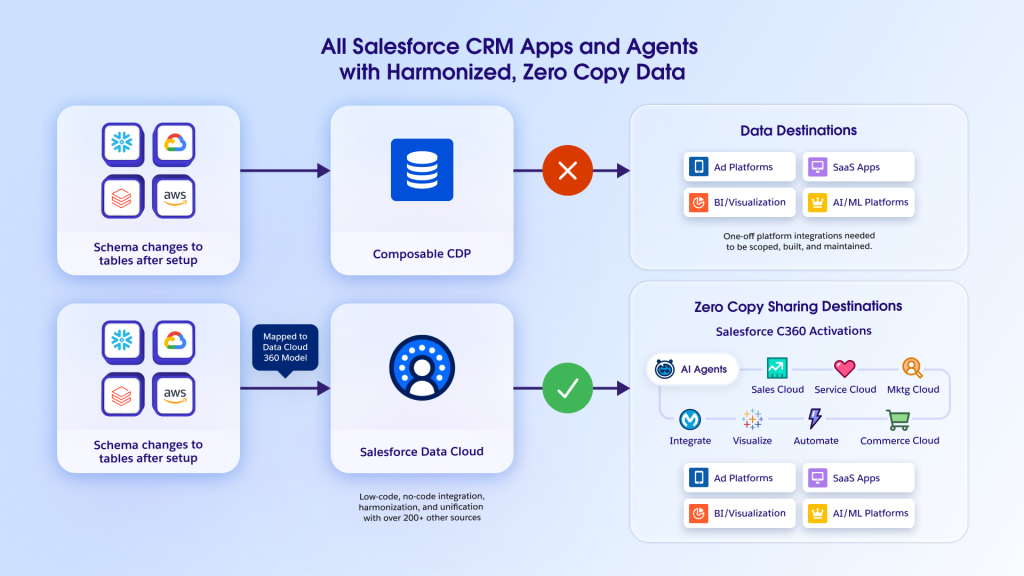
Data 360's Zero Copy architecture is bidirectional: it reads external data from Snowflake, Databricks, and BigQuery in place, and shares enriched outputs (unified profiles, AI-computed scores, segment membership) back to those platforms using native sharing protocols. Zero Copy processed 53 trillion records in FY26, up 310% year-over-year, across more than 25,000 organizations.
Treasure Data offers composable deployment, but its hybrid approach maintains a managed activation layer outside the customer's data catalog.
Source: Salesforce
Agentforce as the Native AI Execution Layer
Data 360 is the sole data provider for Agentforce, Salesforce's autonomous AI agent platform spanning Sales, Service, Marketing, and Commerce Clouds. Every one of Salesforce's top 10 Q4 FY2026 enterprise deals included the full Agentforce and Data 360 suite together. For organizations committed to Agentforce as their AI platform, Data 360 is the only supported path to native real-time data grounding.
NOTE: We also evaluated Adobe Experience Platform in this enterprise CDP category. While Adobe Experience Platform excels at creative activation and is integrated with the Adobe Marketing Cloud stack, Salesforce Data Cloud offers the simplest path for organizations where Salesforce CRM is already the primary system of record. For B2B go-to-market intelligence that complements either platform, ZoomInfo provides the third-party data layer, buyer intent signals, and AI-driven prospecting no CDP delivers natively.
Salesforce Data Cloud Pricing
Salesforce Data Cloud operates on a consumption-based credit model:
Data 360 Provisioning (Free): $0 for existing Enterprise and Unlimited Edition customers with 250,000 Flex Credits and 1 TB storage. A permanent license entitlement, not a time-limited trial.
Data 360 Starter: $60,000/year with 10 million Flex Credits, 5 TB data storage, and 100 internal licensed users.
Flex Credits (Pay-Per-Use): $500 per 100,000 Flex Credits, consumed across query execution, segmentation, activation, and compute.
Profile-Based Pricing: $240 per 1,000 profiles/year (standard) or $420 per 1,000 profiles/year (enterprise).
Note that Gartner's 2026 Magic Quadrant flagged unpredictable credit consumption as a consistent challenge. Organizations moving from Treasure Data's predictable profile-and-behavior unit model should model credit consumption scenarios carefully.
Who Should Use Salesforce Data Cloud?
Choose Salesforce Data Cloud if:
Your organization already runs Sales Cloud, Service Cloud, or Marketing Cloud at enterprise scale and wants to unify those investments into a single customer profile without ETL pipelines or a separate CDP vendor.
You've committed to Agentforce as your AI agent platform (or are evaluating it), as Data 360 is the only supported path to native real-time data grounding for Agentforce agents.
You have an existing Snowflake, Databricks, or BigQuery investment and want bidirectional zero-copy federation that surfaces Salesforce-enriched profiles in your data warehouse without reverse ETL.
3. Segment: Best Alternative for Developer-First CDPs With Transparent Pricing
Source: Twilio
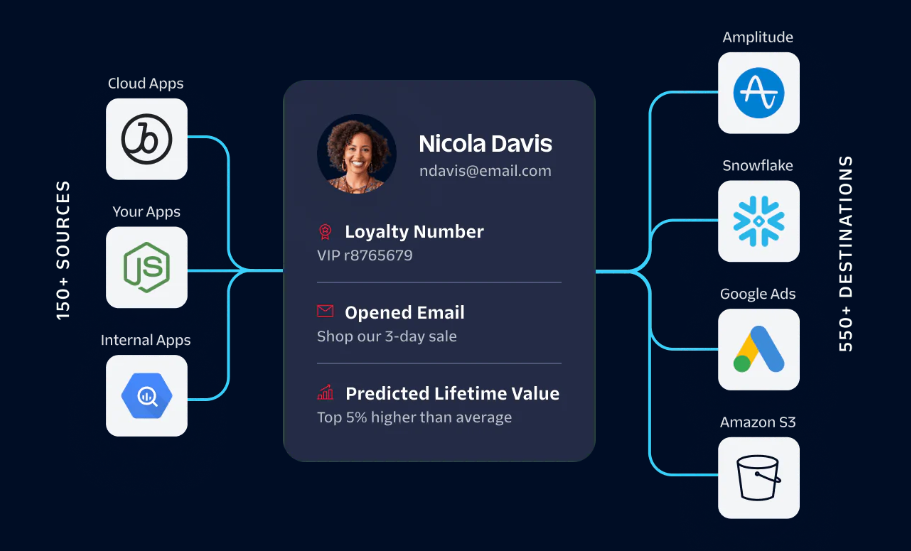
Twilio Segment is a customer data platform built for engineering teams that need a fast, instrumentation-based data pipeline with publicly listed pricing. Where Treasure Data requires multi-week enterprise POCs and custom pricing conversations, Segment offers a working free tier within hours.
Its key capabilities include:
Permanently free plan (1,000 monthly tracked users) and a Team plan starting at $120/month for 10,000 MTUs with published overage rates
750+ pre-built integrations covering analytics, CRM, advertising, data warehouses, and email platforms
Single-API event collection via client-side and server-side SDKs routing data to every connected destination without duplicate instrumentation
Protocols for native data governance that enforces event schemas at the point of collection
Unify for identity resolution that stitches anonymous and known user records across devices
Why Choose Segment Over Treasure Data for Developer-First CDP Deployments
Segment stands out in three areas:
Publicly Listed, Self-Serve Pricing
Treasure Data publishes no pricing, requiring a sales process and custom quote. Segment's pricing page lists every tier, overage rate, and feature inclusion.
The free plan (1,000 MTUs, 2 sources, 1 warehouse destination) is permanently available with no credit card required. The Team plan includes published overage rates: $12 per 1,000 additional MTUs in the 10K-25K band, scaling down to $10 per 1,000 above 100K. Teams can model their CDP cost before talking to sales.
Same-Day Implementation vs. 8-12 Week Enterprise Deployment
Treasure Data's standard deployment takes 8 to 12 weeks. Segment's single-API model lets engineering teams add an Analytics.js snippet, call analytics.track() and analytics.identify(), and have event data flowing to connected destinations in hours. Most teams report getting basic tracking live in under a day. This implementation speed drives Segment's 25,000+ customer base.
750+ Native Connectors and Extensibility
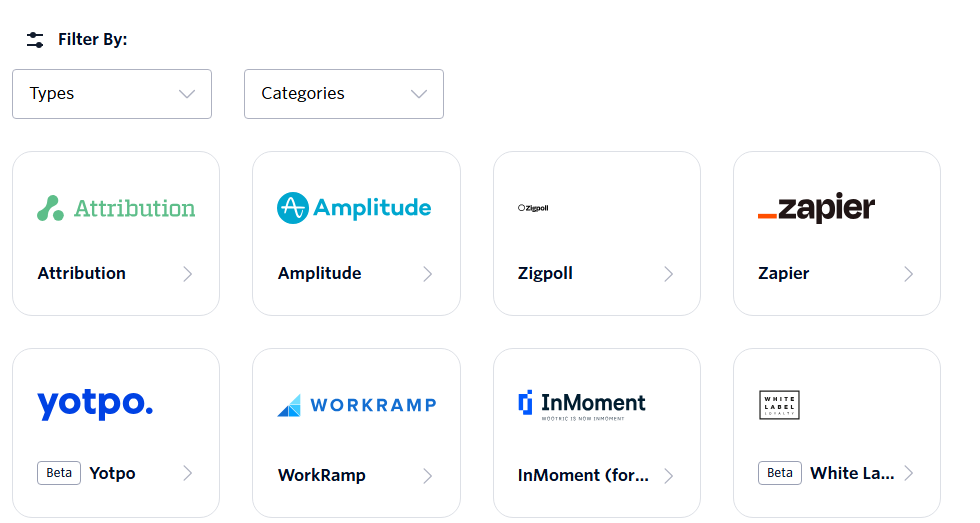
Treasure Data lists 400+ data integrations with 6-8 week custom connector builds for gaps. Segment offers 750+ integrations. Beyond the catalog, Segment's Destination Actions framework gives teams field-level control over how events map to destination actions, and JavaScript-based Functions running on managed Lambda allow extension to any arbitrary endpoint.
Source: Twilio
NOTE: We also evaluated RudderStack for this use case. While RudderStack offers a generous free tier and self-hosted deployment options, Segment offers the broadest native connector catalog, the most accessible managed infrastructure, and wide community adoption. For B2B intelligence that complements Segment's first-party event tracking, ZoomInfo's APIs and MCP can feed third-party contact and company data directly into Segment-connected destinations.
Segment Pricing
Free Plan: $0/month. Up to 1,000 MTUs, 2 sources, 1 warehouse destination, 700+ integrations, 10 seats.
Team Plan: Starting at $120/month. 10,000 MTUs base, unlimited sources, 1 warehouse destination, 14-day free trial available.
Business Plan: Custom pricing. Unlimited sources and warehouse destinations, Protocols data governance, HIPAA eligibility, dedicated Customer Success Manager.
Full CDP (Connections + Unify + Engage): Custom pricing. Adds identity resolution, audience building, journey orchestration, and AI features (Predictions, Recommendations).
Who Should Use Segment?
Choose Segment if:
Your team is technical enough to instrument event tracking through SDKs and wants a working data pipeline in days, not months, without an enterprise implementation contract.
Pricing transparency matters at your current stage; you want to calculate your CDP cost from a public pricing page before engaging sales.
You are a startup or growth-stage company building your first CDP layer and want infrastructure that scales from your first 1,000 users through enterprise audience orchestration on the same platform.
4. Tealium: Best Alternative for Vendor-Neutral Real-Time Data Orchestration
Source: Tealium
Tealium is a Customer Data Orchestration Platform that has combined tag management and real-time CDP capabilities under a single contract since 2013.
Its key capabilities include:
Dual client-side and server-side event collection through iQ Tag Management and EventStream
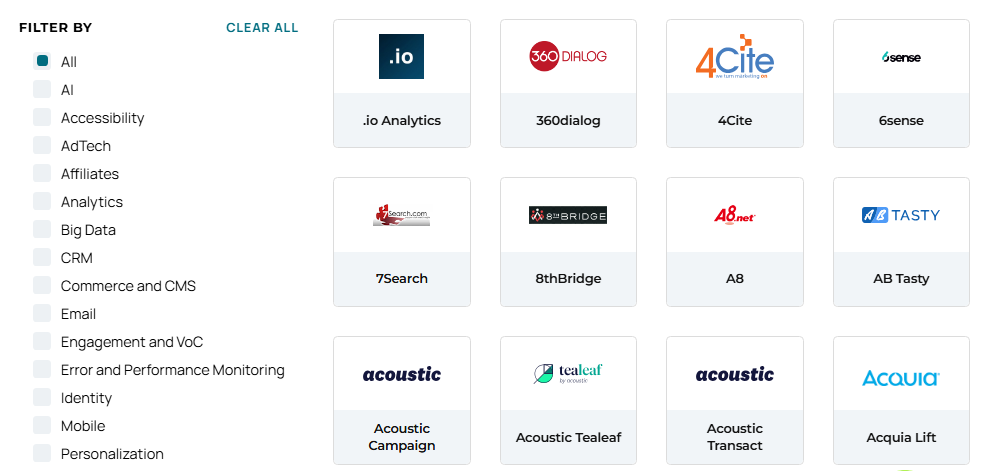
1,300+ pre-built connectors spanning advertising, CRM, analytics, data warehouses, and AI services
Real-time in-session profile updates via AudienceStream with trigger-to-activation latency under 300ms
Built-in Consent Manager enforcing GDPR, CCPA, and HIPAA compliance at the point of data capture
Vendor-agnostic architecture with no tie-in to Google, Adobe, Salesforce, or any single marketing cloud
Why Choose Tealium Over Treasure Data for Vendor-Neutral Real-Time Data Orchestration
Tealium stands out in three areas:
Tag Management and CDP in a Single Contract
Tealium is the only vendor offering both client-side tag management governance and a server-side real-time CDP under one platform. Organizations managing both browser-side event collection (ad tags, analytics pixels, consent banners) and server-side first-party data capture typically run two separate platforms with two contracts and two governance frameworks.
Tealium's iQ Tag Management and EventStream handle both layers, with a universal data layer ensuring events collected client-side feed into the same identity resolution pipeline as server-side events. Treasure Data is a pure CDP without integrated tag management, so customers managing browser-side instrumentation alongside Treasure Data need a separate tool.
The Broadest Connector Ecosystem in the CDP Market
Tealium's 1,300+ pre-built integrations cover advertising platforms, CRMs, marketing automation, data warehouses, AI services (AWS Bedrock, Vertex AI, OpenAI, Pinecone), and legacy enterprise systems. Treasure Data documents 400+ integrations.
The breadth reflects Tealium's founding philosophy of vendor neutrality: the platform treats Google Ads, Adobe Analytics, Salesforce CRM, and Snowflake as equally valid destinations rather than giving preferential routing to one vendor's tools.
Source: Tealium
Consent Enforcement at the Collection Layer
Tealium's Consent Manager enforces consent at the point of tag firing, not as a downstream filter. Tags requiring consent are blocked from loading entirely if the consent signal is absent. Tealium holds HIPAA BAA, SOC 2, and ISO 27701 certifications. The 2025 Gartner Magic Quadrant recognized Tealium as a Leader for the second consecutive year, specifically citing privacy/consent capabilities as a key strength.
NOTE: We also evaluated mParticle and Segment. While mParticle excels at mobile-first event collection and Segment is strong for developer-led event streaming, Tealium offers the broadest connector library and is the only platform combining client-side tag management with server-side CDP capabilities. For B2B intelligence alongside any CDP deployment, ZoomInfo's MCP server can feed buyer intent and contact data into Tealium-connected destinations without custom integration work. For a direct comparison of mParticle and Segment, see our mParticle vs Segment breakdown.
Tealium Pricing
Tealium does not publish pricing on its website. All contracts are negotiated through enterprise sales, with no self-serve tiers or public rate cards. The platform is priced on event volumes, use cases, and modules selected (Data Collection, CDP, Enrichment & Orchestration, Data Cloud Activation, Tealium for AI).
Published support add-ons include Enhanced (2-hour critical response SLA) and Premium (1-hour critical response SLA with a dedicated Technical Account Manager).
Who Should Use Tealium?
Choose Tealium if:
Your team manages both browser-side tag governance and server-side first-party data collection and wants to consolidate both under one platform.
You operate a multi-vendor martech stack and need a neutral data hub that routes events equally without vendor lock-in.
Privacy compliance is a procurement requirement, particularly if you need HIPAA BAA coverage, SOC 2, or ISO 27701 certification with consent enforced at the point of data capture.
5. Amperity: Best Alternative for Enterprise Retail and CPG Identity Resolution

Source: Amperity
Amperity is a Customer Data Cloud that specializes in identity resolution for large consumer brands. Where Treasure Data's Diamond Record unifies data into a managed profile layer for marketing execution, Amperity deploys its patented Stitch ML engine as the identity resolution layer on top of your existing data warehouse.
Its key capabilities include:
Patented Stitch identity resolution combining deterministic, probabilistic, and graph-based matching using up to 45 AI models simultaneously
Three concurrent identity graphs (Growth, Trust, and Opportunity) for flexible accuracy-vs.-reach tradeoffs by use case
Over-merge detection and correction that decomposes incorrectly merged profiles retroactively
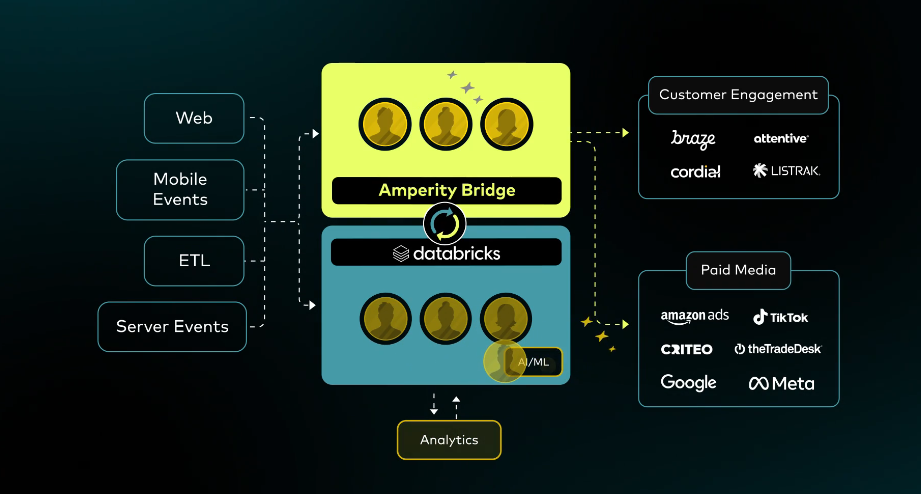
Composable, warehouse-native deployment on Snowflake, BigQuery, and Databricks via Amperity Bridge zero-copy data sharing
Retail-specific analytics including cohort analysis, basket analysis, and CLV-based audience creation built into the platform
Why Choose Amperity Over Treasure Data for Enterprise Retail Identity Resolution
Amperity stands out in three areas:
A Patented Identity Resolution Engine That Corrects Its Own Mistakes
Treasure Data's Diamond Record stitches incoming records against existing profiles as they arrive. Amperity's Stitch engine solves the inverse problem: detecting and correcting records that have been over-merged. Its seven-stage pipeline includes a hierarchical conflict detection step that identifies situations like a married couple with overlapping data incorrectly collapsed into a single profile, then decomposes the cluster rather than compounding the error.
This work appears in academic research published at SIGMOD 2020 and is protected by a portfolio of five patents. The three-graph architecture adds a second layer of differentiation: rather than running a single identity model tuned to one accuracy threshold, Amperity lets brands run different graph outputs for different use cases simultaneously (the Trust Graph for compliance-grade identity, the Growth Graph for paid media lookalike audiences).
Warehouse-Native Composability That Leaves Data Where It Lives
Amperity's Bridge architecture uses Delta Sharing (Databricks) and Secure Data Sharing (Snowflake) for zero-copy integration. Data never enters Amperity-managed storage. The lakehouse remains the system of record at every stage, so existing governance controls (Unity Catalog permissions, column-level security, encryption key management) apply to customer data natively because it never leaves the environment where those controls are configured.
Treasure Data's hybrid approach maintains a managed activation layer outside the customer's data catalog.
Source: Amperity
Retail and CPG Analytics Built In
Treasure Data is a horizontal CDP serving automotive, CPG, entertainment, and more. Amperity concentrates on retail, travel/hospitality, and financial services, with pre-built data models for basket analysis, CLV-tier segmentation, and loyalty gap analysis.
AmpAI predictive models run on the unified identity graph and output structured audience size tiers (top 1%, top 1-5%, and so on) that marketing and CRM teams can use directly without data science intervention. For retail and CPG teams that need these analytics without queuing engineering tickets, Amperity's vertical focus cuts time-to-value compared with configuring a horizontal CDP.
NOTE: We also evaluated ActionIQ (now CDP Agent) and Tealium. While ActionIQ has enterprise audience management capabilities, it lacks Amperity's patented over-merge correction. Tealium excels at real-time digital event collection but its identity resolution for offline and POS data is less mature. For B2B intelligence that helps retail brands identify and engage business customers, ZoomInfo's Enterprise API provides firmographic enrichment that can enhance Amperity's unified profiles with organizational context.
Amperity Pricing
Amperity uses a consumption-based pricing model built around a proprietary unit called "Amps."
Standard Edition: Full platform access including Stitch identity resolution, Customer 360, AmpAI predictive models, and 200+ connectors. 6am-6pm PT weekday support. Up to 10% unused Amps roll over.
Enterprise Edition: Identical platform capabilities with 24/7 support, priority response SLAs, and private training.
No public pricing numbers are disclosed; all pricing requires a sales engagement. Twenty premium advertising connectors (Meta, Google, The Trade Desk, TikTok, and others) carry an additional 25,000 Amps per connector per month. A free Databricks-native CLI called Chuck gives data engineers access to Amperity's identity resolution algorithms before committing to a full contract.
Who Should Use Amperity?
Choose Amperity if:
Your organization is a large retail, travel/hospitality, or CPG brand with customer records fragmented across POS systems, loyalty programs, and multiple acquired databases, and your primary challenge is accurately resolving which records belong to the same person.
Your data teams already manage customer data in Snowflake or Databricks and need identity resolution that operates natively on that infrastructure without a vendor-managed storage layer.
You need retail-specific analytics (CLV segmentation, basket analysis, product affinity modeling) that marketing and CRM teams can use directly without a separate data science function.
6. RudderStack: Best Alternative for Open-Source Warehouse-Native CDP Infrastructure
Source: RudderStack
RudderStack is a customer data infrastructure platform built around one principle: customer data should live in your warehouse, not a vendor's black box.
Its key capabilities include:
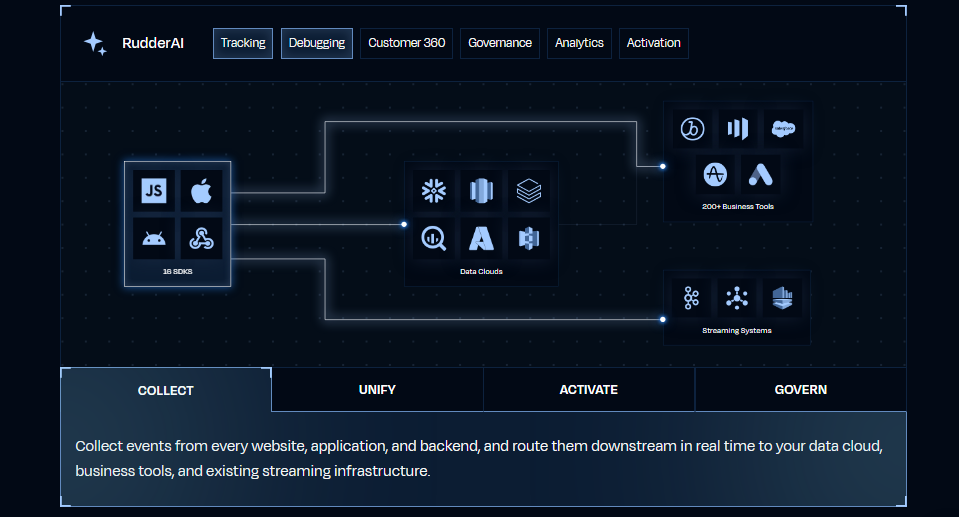
Event Stream with 16+ SDK sources routing to 200+ cloud destinations and warehouse targets
Reverse ETL activating warehouse data to downstream SaaS tools, included in the free tier
Open-source, self-hostable data plane (AGPL-3.0 server, MIT-licensed SDKs) with managed cloud option
Zero-storage architecture where the platform does not store or persist any customer event data
Free forever tier at 250,000 monthly events, not a trial
Segment API compatibility for easy migration without re-instrumentation
Why Choose RudderStack Over Treasure Data for Warehouse-Native CDP Infrastructure
RudderStack stands out in three areas:
A Functional Free Tier
Treasure Data's evaluation path runs through a structured 2-week POC. RudderStack's $0/month permanent plan includes 250,000 monthly events, access to all 200+ cloud destinations, warehouse destinations, and Reverse ETL with up to 10 connections. Data teams can instrument a production application, route events to Snowflake or BigQuery, run transformations, and validate the approach without talking to sales.
Open-Source Architecture With No Vendor Storage
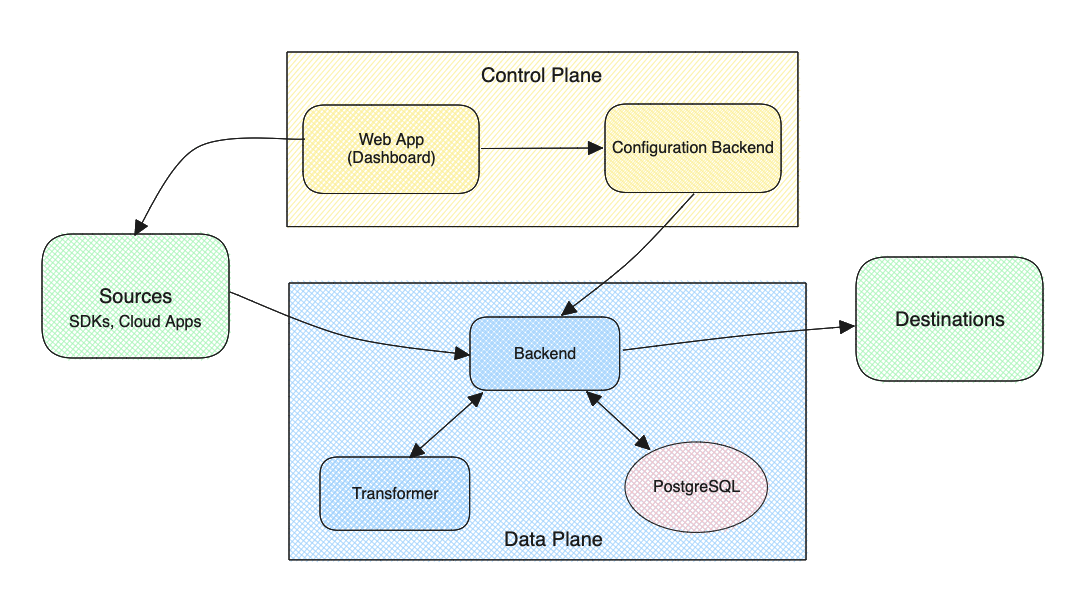
Treasure Data processes customer data on its AWS-hosted infrastructure. RudderStack takes the opposite approach: events flow through the data plane as a pass-through pipeline and land in the customer's own warehouse. Nothing is retained in RudderStack's infrastructure.
The open-source data plane can be self-hosted on Docker or Kubernetes for teams with strict security requirements. RudderStack holds SOC 2 Type 2, HIPAA, and GDPR certifications for the managed cloud option.
Source: RudderStack
Segment API Compatibility for Easy Migration
RudderStack maintains full API compatibility with Twilio Segment's tracking API. Existing Segment instrumentation ports over without changes, anonymousIDs migrate automatically, and warehouse schema continuity is preserved so historical data remains consistent with the new data flowing in. That migration path (low friction, documented cost savings) is something Treasure Data does not offer in the same structured, API-compatible form.
NOTE: We also evaluated Snowplow. While Snowplow offers deep schema control with an open-source event collection layer, its fully self-managed deployment demands significantly more infrastructure overhead. RudderStack offers the most accessible open-source starting point with a functional free tier, Segment API compatibility, and a managed cloud option. For B2B enrichment that complements RudderStack's event pipeline, ZoomInfo data can be pulled via API and pushed into RudderStack-connected warehouse destinations for account-level enrichment.
RudderStack Pricing
Free: $0/month. 250,000 monthly events, 16+ SDK sources, 200+ destinations, Reverse ETL (up to 10 connections), up to 5 JavaScript Transformations.
Starter: $220/month. 1 million monthly events, unlimited tracking plans, email support, 99.95% uptime SLA.
Growth: Custom pricing. Custom event volume, unlimited Transformations and Reverse ETL connections, dedicated support.
Enterprise: Custom pricing. Python Transformations, Profiles & Data Apps (Customer 360 identity resolution), HIPAA compliance, SSO.
Note: RudderStack's Profiles product (warehouse-native Customer 360 identity resolution) is exclusive to the Enterprise tier, so teams needing identity graph construction from day one should factor in Enterprise pricing.
Who Should Use RudderStack?
Choose RudderStack if:
Your team has data engineers who can operate a code-based, API-first platform and wants to avoid the professional services dependency that typically comes with enterprise CDPs.
You already use Snowflake, BigQuery, Redshift, or Databricks and want customer event data to land there natively, not in a proprietary CDP storage layer.
Your organization operates in a regulated industry with strict data residency requirements, and the zero-storage architecture removes a third-party data processor from your compliance surface.
7. GrowthLoop: Best Alternative for AI Decisioning on Your Existing Data Cloud
Source: GrowthLoop
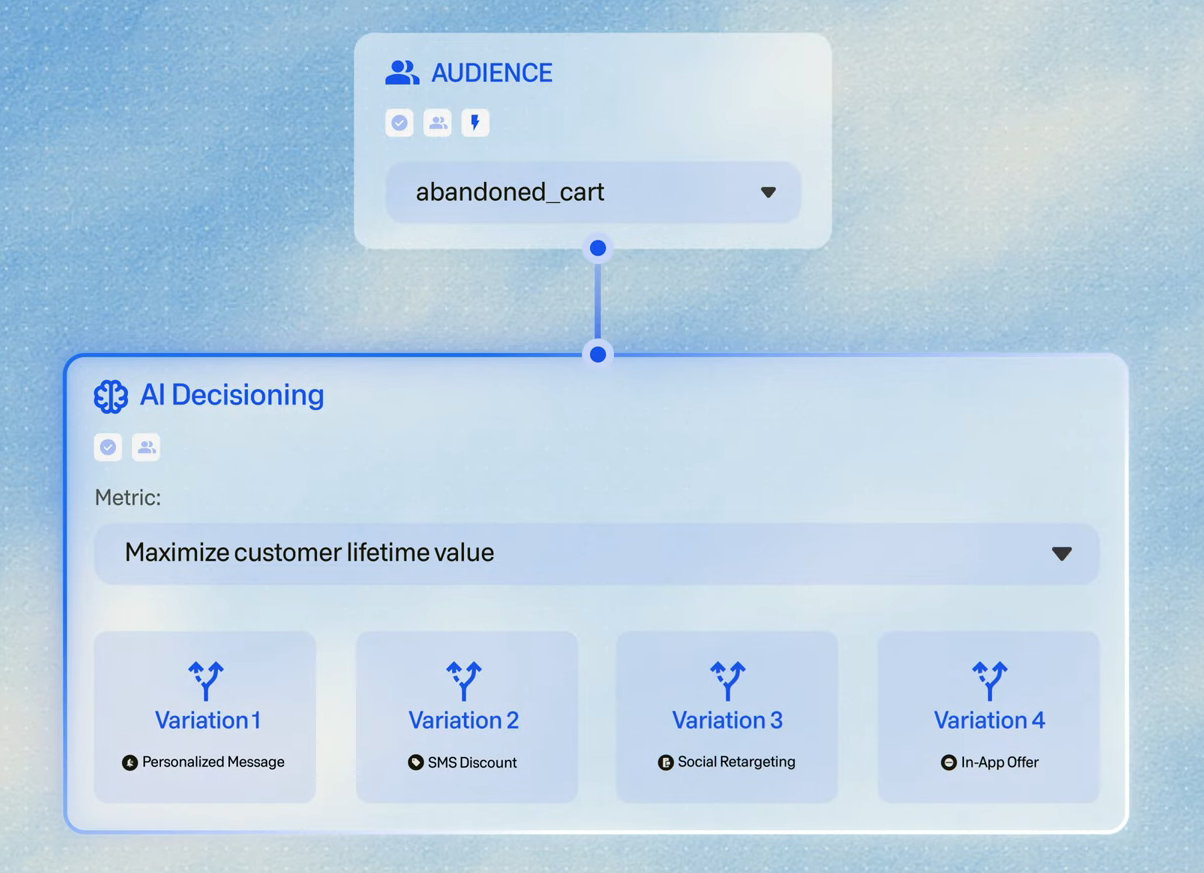
GrowthLoop is a composable CDP that runs natively on a company's existing cloud data warehouse (BigQuery, Snowflake, Databricks, or Redshift), adding AI decisioning and audience activation without data extraction, replication, or proprietary storage.
Its key capabilities include:
Composable AI Decisioning using a Bayesian multi-armed bandit that runs as SQL inside the customer's own warehouse
Native zero-copy warehouse activation where audience building, journey orchestration, and measurement all execute directly on the existing data cloud
Visual no-code audience builder giving non-technical marketing teams self-service access to warehouse customer data
AI agent suite including Audience Agent, Journey Agent, and Insights Agent
50+ destination connectors covering Meta, Google Ads, LinkedIn, TikTok, The Trade Desk, and more
Why Choose GrowthLoop Over Treasure Data for Zero-Copy Warehouse-Native AI Activation
GrowthLoop stands out in three areas:
Composable Architecture Where Data Never Leaves the Warehouse
Treasure Data's Hybrid CDP supports composable mode but creates a real-time cache outside the warehouse for activation. As GrowthLoop's Composable AI Decisioning page states: "Rely on composable decisioning that runs directly inside your data cloud warehouse. No copied data or disparate platforms." Every audience query, decisioning model, and lift measurement executes as SQL inside the customer's warehouse.
GrowthLoop does not maintain its own data store for customer profiles. G2 recognized GrowthLoop with Easiest Setup Enterprise and Most Implementable Enterprise in Winter 2026.
AI Decisioning That Distinguishes Correlation From Causation
Treasure Data's Marketing Super Agent optimizes for behavioral patterns. GrowthLoop's decisioning takes a different approach: controlled holdout experiments that automatically suggest treatment/control splits optimized for statistical significance, combined with a Bayesian multi-armed bandit that rebalances traffic toward winning journey variations in real time.
The Agentic Context Graph accumulates every action-outcome pair across campaigns, so new journeys launch with evidence rather than guesswork. GrowthLoop calls this "compound marketing": each campaign iteration trains the system to improve the next one.
Enterprise-Proven Self-Service Speed
GrowthLoop targets the pain of marketing teams with data in a warehouse but no way to activate it without engineering tickets. The visual no-code audience builder gives non-technical marketers self-service access to warehouse customer data, and GrowthLoop's 50+ destination connectors cover the full paid media activation stack (Meta, Google Ads, LinkedIn, TikTok, The Trade Desk, Amazon Ads, and more).
Treasure Data's Treasure AI Studio went GA only in April 2026; GrowthLoop has solved marketer self-service for years, earning G2's 9.2 ease-of-setup score and 9.5 data modeling score.
NOTE: We also evaluated Lytics and Hightouch. While Lytics excels at AI-driven web personalization for media companies and Hightouch is a strong reverse-ETL tool for syncing warehouse segments to destinations, GrowthLoop offers the most complete composable CDP experience (data to AI decisioning to journey orchestration) for enterprise teams needing measurable paid media ROAS improvement. For B2B account intelligence on top of warehouse-native activation, ZoomInfo's Cloud Partners program delivers B2B data directly into Snowflake, BigQuery, and Databricks, the same warehouses GrowthLoop activates from.
GrowthLoop Pricing
GrowthLoop uses a fully quote-based pricing model. The single scaling axis is customer record volume (not seats or active users), with unlimited users and destinations included.
Basic: Up to 1,000,000 customer records. Full feature access. Email and Slack support.
Growth: Up to 10,000,000 customer records. Same feature access.
Enterprise: 10,000,000+ customer records. Dedicated Solutions Architect, custom measurement setup, dedicated Slack channel.
Note: Customers bear their own cloud compute costs (Snowflake credits, BigQuery bytes processed) directly, which are not included in the GrowthLoop subscription.
Who Should Use GrowthLoop?
Choose GrowthLoop if:
Your team already has BigQuery, Snowflake, Databricks, or Redshift with customer data in it, and the bottleneck is activation speed rather than data collection.
Your marketing team loses days waiting for data engineering to build audience segments and needs self-service access through a no-code visual interface.
You run paid media campaigns and want to measure true incremental lift, not just channel-reported attribution, and use that signal to continuously optimize future campaigns.
The Final Verdict
Treasure Data (now Treasure AI) is a proven enterprise CDP with a decade of experience in first-party customer data unification. But as go-to-market needs evolve, organizations often need specialized tools that go deeper in specific areas. Here are the best alternatives:
ZoomInfo for B2B intelligence, buyer intent signals, and AI-driven prospecting that no CDP provides natively
Salesforce Data Cloud for unifying customer data within an existing Salesforce ecosystem with native Agentforce AI integration
Segment for developer-first CDP deployment with transparent pricing, same-day implementation, and 750+ integrations
Tealium for vendor-neutral real-time data orchestration with integrated tag management and consent enforcement
Amperity for identity resolution with patented over-merge correction for retail and CPG brands
RudderStack for open-source, warehouse-native CDP infrastructure with a functional free tier and zero vendor data storage
GrowthLoop for AI-powered marketing decisioning running directly on your existing cloud data warehouse
You don't have to choose between Treasure Data and these alternatives exclusively. Many organizations layer specialized tools alongside their CDP to build a complete go-to-market stack. Consider your data infrastructure, team capabilities, and growth trajectory when deciding which solution fits.
Want to see how ZoomInfo's B2B intelligence can complement your customer data stack? Start with ZoomInfo Lite for free, or request a demo to explore the full platform.
Treasure Data Alternatives FAQ
Why do businesses look for Treasure Data alternatives?
Treasure Data's most common limitations are its enterprise-only pricing with no published prices, 8-to-12-week implementation timelines, SQL dependency for advanced segmentation and reporting, and a stronger focus on B2C marketing than B2B go-to-market use cases. Organizations may also need specialized capabilities like tag management, developer-first deployment, or third-party B2B intelligence that Treasure Data wasn't designed to provide.
What is the best overall Treasure Data alternative?
There is no single best alternative because Treasure Data covers multiple functions. For B2B intelligence and prospecting, ZoomInfo is the top choice. For Salesforce-native organizations, Salesforce Data Cloud is the simplest option. For developer teams wanting fast, transparent deployment, Segment leads. The right fit depends on your data infrastructure and go-to-market requirements.
Is there a free alternative to Treasure Data?
Yes, several alternatives offer permanent free tiers. RudderStack's free plan includes 250,000 monthly events with full destination access. Segment's free plan supports 1,000 monthly tracked users with 700+ integrations. ZoomInfo Lite provides permanent free access to B2B contact and company data with 10 monthly export credits. Salesforce Data Cloud is provisioned at no cost for existing Enterprise and Unlimited Edition Salesforce customers.
Which Treasure Data alternative is best for retail and e-commerce brands?
Amperity is built for retail and CPG brands, with patented identity resolution that can detect and correct over-merged customer profiles, warehouse-native deployment via zero-copy data sharing, and pre-built retail analytics including basket analysis and CLV segmentation. The platform serves 400+ enterprise brands across retail, travel/hospitality, and financial services.
How does Treasure Data compare to ZoomInfo?
They solve different problems. Treasure Data is a CDP that unifies your first-party customer data (website visits, purchases, app interactions) for B2C marketing activation. ZoomInfo is a B2B intelligence platform that provides third-party data on 500M contacts and 100M companies, buyer intent signals, and AI-driven prospecting tools.
Many organizations use both: a CDP for customer engagement and ZoomInfo for pipeline generation and account intelligence.
Which Treasure Data alternative works best with an existing data warehouse?
GrowthLoop and RudderStack are the strongest warehouse-native options. GrowthLoop runs all audience building, AI decisioning, and journey orchestration directly inside BigQuery, Snowflake, or Databricks as SQL. RudderStack routes event data to your warehouse without storing anything on vendor infrastructure. Amperity's Bridge architecture also offers zero-copy integration with Snowflake and Databricks for identity resolution specifically.
Is it difficult to migrate from Treasure Data to one of these alternatives?
Migration complexity varies. Segment and RudderStack offer the fastest onboarding (hours to days). Salesforce Data Cloud and Amperity require multi-week enterprise implementations. GrowthLoop deploys quickly if you already have a warehouse with customer data.
For organizations not ready for a full migration, ZoomInfo works as a complementary layer alongside Treasure Data, adding B2B intelligence without replacing any existing infrastructure.
Which alternative is best for organizations that need both B2C customer data and B2B sales intelligence?
The most effective approach combines a CDP for first-party customer data with ZoomInfo for third-party B2B intelligence.
ZoomInfo's APIs and MCP expose its data to any tool in your stack, and its Cloud Partners program delivers B2B data directly into Snowflake, BigQuery, and Databricks. Your CDP handles customer engagement while ZoomInfo powers prospecting, intent monitoring, and account-based marketing through the same data infrastructure.
More Treasure Data alternatives and breakdowns:
