
Treasure Data (now Treasure AI) has spent over a decade building one of the most established enterprise customer data platforms on the market. Originally a big-data analytics company, it has evolved into what the company calls an Agentic Experience Platform, designed to let AI agents run marketing operations on top of unified customer data. With 400+ enterprise customers, Leader status in the Gartner Magic Quadrant for CDPs, Forrester Wave for B2C CDPs, and the IDC MarketScape for B2C CDPs, Treasure AI has earned its reputation as a serious platform for large B2C organizations.
To write this Treasure Data review, we analyzed it in depth. We believe it's the right choice if:
You need to unify fragmented customer data from dozens of systems into a single profile
You're a large B2C enterprise with complex, multi-channel customer journeys
You have dedicated data engineering and marketing operations teams
You're investing in first-party data strategies and AI-driven marketing activation
You need enterprise-grade privacy, governance, and compliance infrastructure
However, while Treasure AI excels at unifying and activating B2C customer data, its B2B capabilities consistently rate below its B2C performance. Forrester rated it a Strong Performer (not Leader) in B2B CDPs, and the IDC MarketScape classified it as a Major Player (not Leader) in B2B CDPs. For enterprise organizations that also run B2B go-to-market motions (prospecting, account-based marketing, sales intelligence), that gap matters.
This is where ZoomInfo enters the picture: an AI GTM platform built on a B2B data foundation of 500M contacts, 100M companies, 135M+ verified phone numbers, and 200M+ verified business emails, with a GTM Context Graph intelligence layer that captures not just what happened in a deal, but why. Where Treasure AI handles B2C customer data, ZoomInfo covers the B2B side.
We've included a detailed look at ZoomInfo later in this review as the B2B complement for organizations whose go-to-market strategy spans both consumer and business audiences.
What is Treasure AI?
Treasure AI (formerly Treasure Data) is a customer data platform founded in 2011 in Mountain View, California by Kazuki Ohta, Hironobu Yoshikawa, and Sadayuki Furuhashi. The founding team created Fluentd, an open-source data collection tool that became a Cloud Native Computing Foundation graduated project and gave the company early credibility in the data engineering community.
The company's trajectory has followed the data industry's evolution. From 2011 to 2018, it operated as a big-data analytics platform. In 2018, Arm Ltd. acquired the company for approximately $600 million. When Arm's planned sale to NVIDIA excluded the IoT Services Group in 2021, Treasure Data spun out as an independent SoftBank-owned entity with a $234 million funding round, the largest single funding round a CDP had raised at the time. In April 2026, the company rebranded to Treasure AI and repositioned from a Customer Data Platform to an Agentic Experience Platform.
Today, Treasure AI targets enterprise marketers at large global brands in automotive, CPG, entertainment, financial services, retail, and travel. The company claims to serve 80 Global 2000 companies and reports a 90%+ customer renewal rate. Notable customers include AB InBev, Subaru, Six Flags, Nestle, Sony, Honda, Fujitsu, and Shiseido.
Treasure Data Pros & Cons
Pros | Cons |
|---|---|
Leader status across Gartner, Forrester, and IDC for B2C CDPs | Steep learning curve requiring SQL knowledge for advanced use |
Diamond Record identity resolution with continuous, real-time matching | No public pricing; fully custom enterprise quotes |
Hybrid CDP architecture supporting both complete and composable deployments | Full deployment takes 8 to 12 weeks |
400+ data integrations with custom connector support | No viable path for small or mid-market companies |
Strong APAC and Japanese enterprise market presence | Weaker analyst ratings in B2B CDP evaluations |
Treasure AI Studio enables natural-language interaction (no SQL needed) | Documentation quality and support can be inconsistent |
Enterprise-grade security certifications (SOC 2, ISO 27001, HIPAA) | Legacy interface friction between Audience Studio and core CDP |
Treasure Data Review: How It Works & Key Features
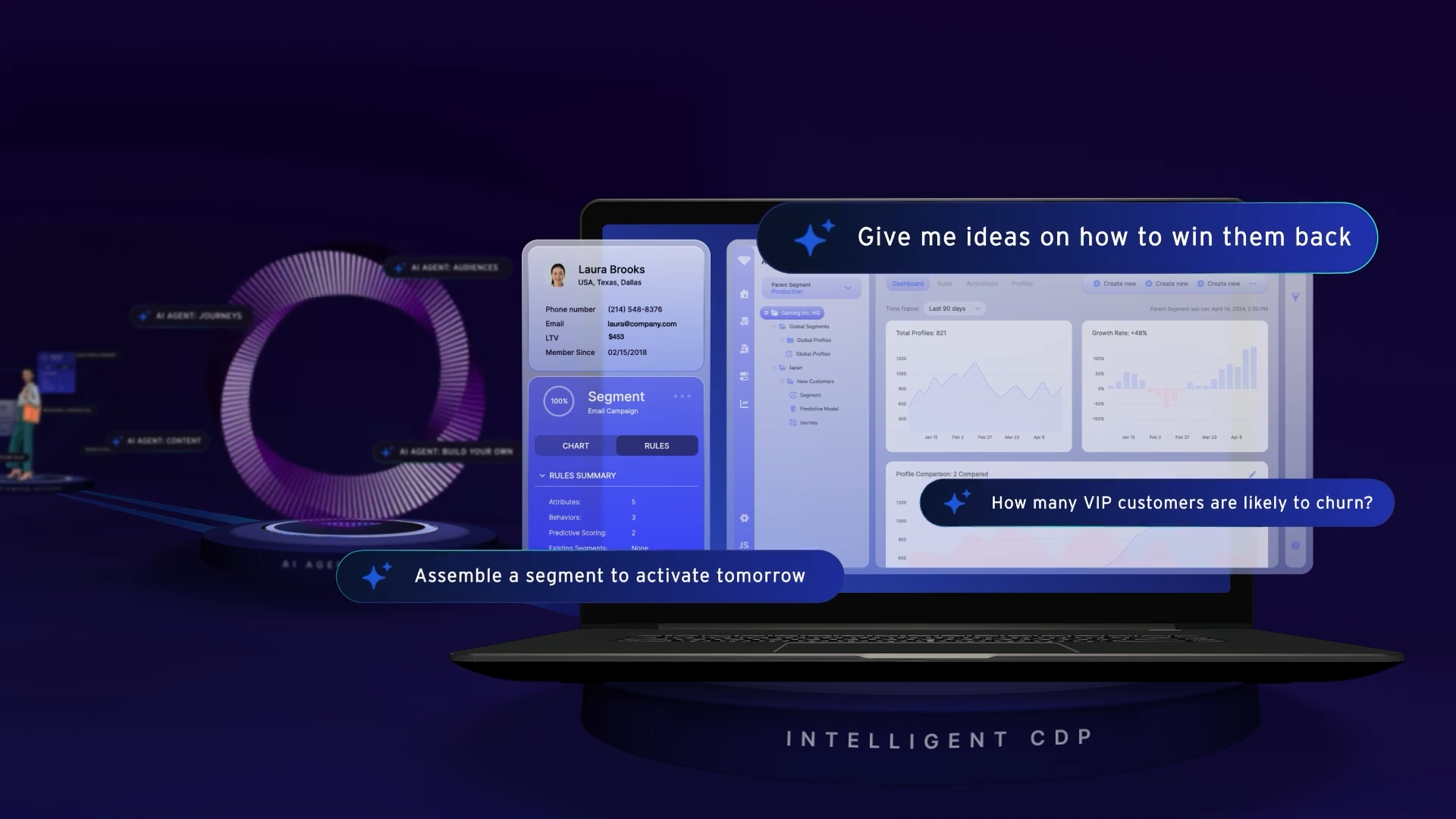
Intelligent CDP and the Diamond Record: Treasure AI's data foundation unifies customer identities across every channel using continuous, multi-method matching.
The Intelligent Customer Data Platform is Treasure AI's core infrastructure layer.
Source: Treasure AI
It ingests customer data from digital and physical touchpoints, resolves identities, and makes unified profiles available for segmentation, activation, and AI-driven decisions.
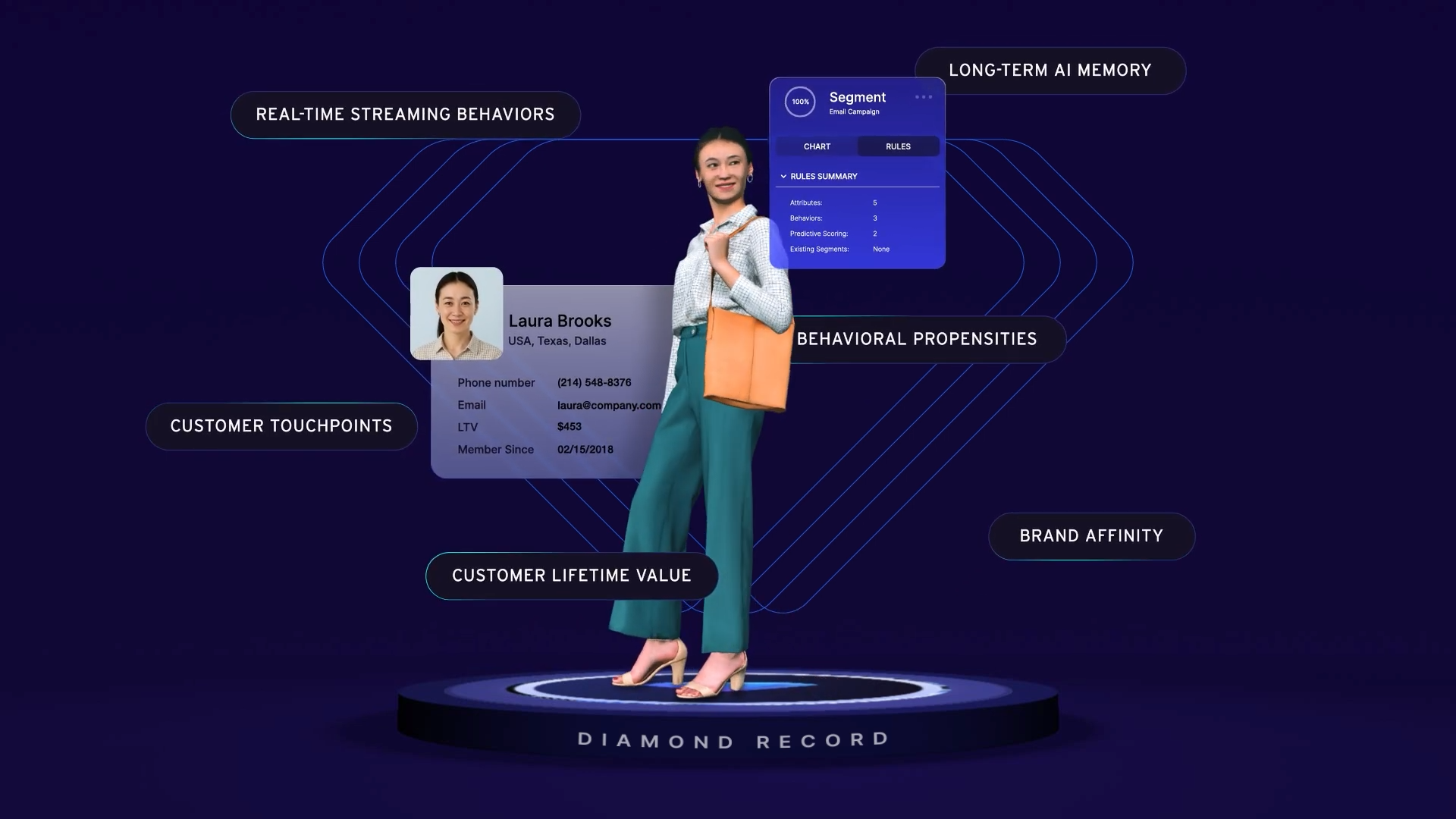
The key differentiator is the Diamond Record, which extends the traditional "golden record" approach to identity resolution.
Source: Treasure AI
Where conventional CDPs rely on batch identity stitching that runs on a schedule, the Diamond Record uses deterministic, probabilistic, and rule-based matching methods that stitch identities continuously as new data arrives.
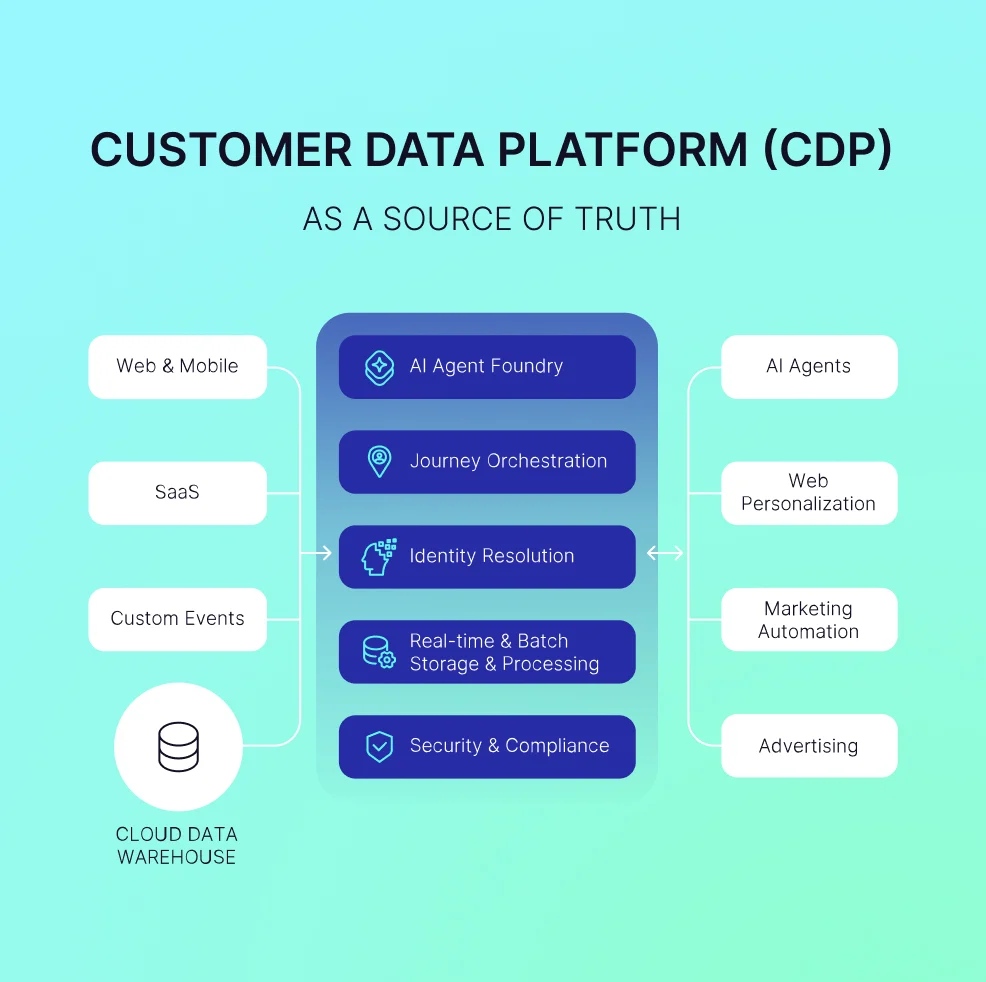
The platform supports a hybrid architecture that lets enterprises choose between a fully managed deployment or a composable mode running on their existing data warehouse (Snowflake, BigQuery, Databricks, or Redshift) using zero-copy, zero-ETL integration.
Source: Treasure AI
Organizations with existing warehouse investments can add Treasure AI's identity resolution and activation without duplicating data or building ETL pipelines.
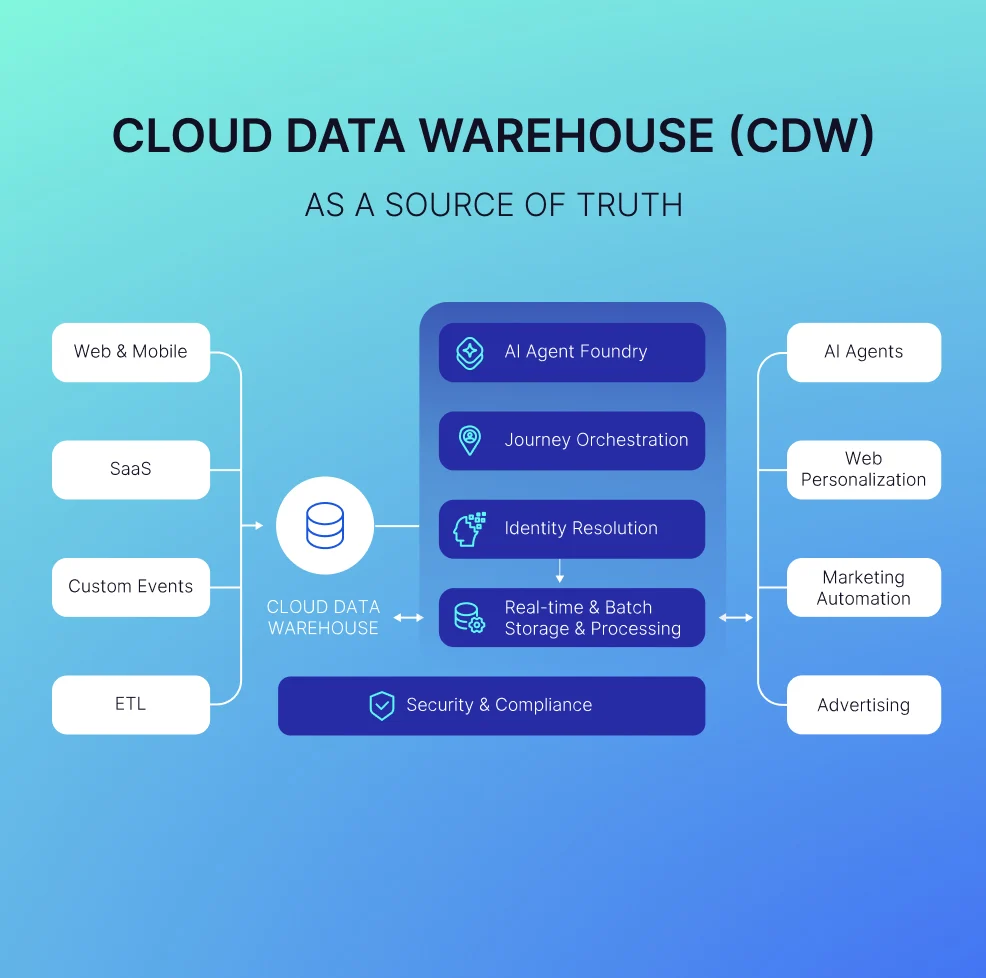
Source: Treasure AI
The CDP processes data in both real-time and batch modes, uses built-in AI to auto-build and optimize segments based on behavioral patterns and intent signals, and supports journey orchestration that adjusts customer journeys based on live feedback loops. Pricing is based on customer profiles and behavioral events, not query volume or compute power, which keeps costs predictable as data scales.
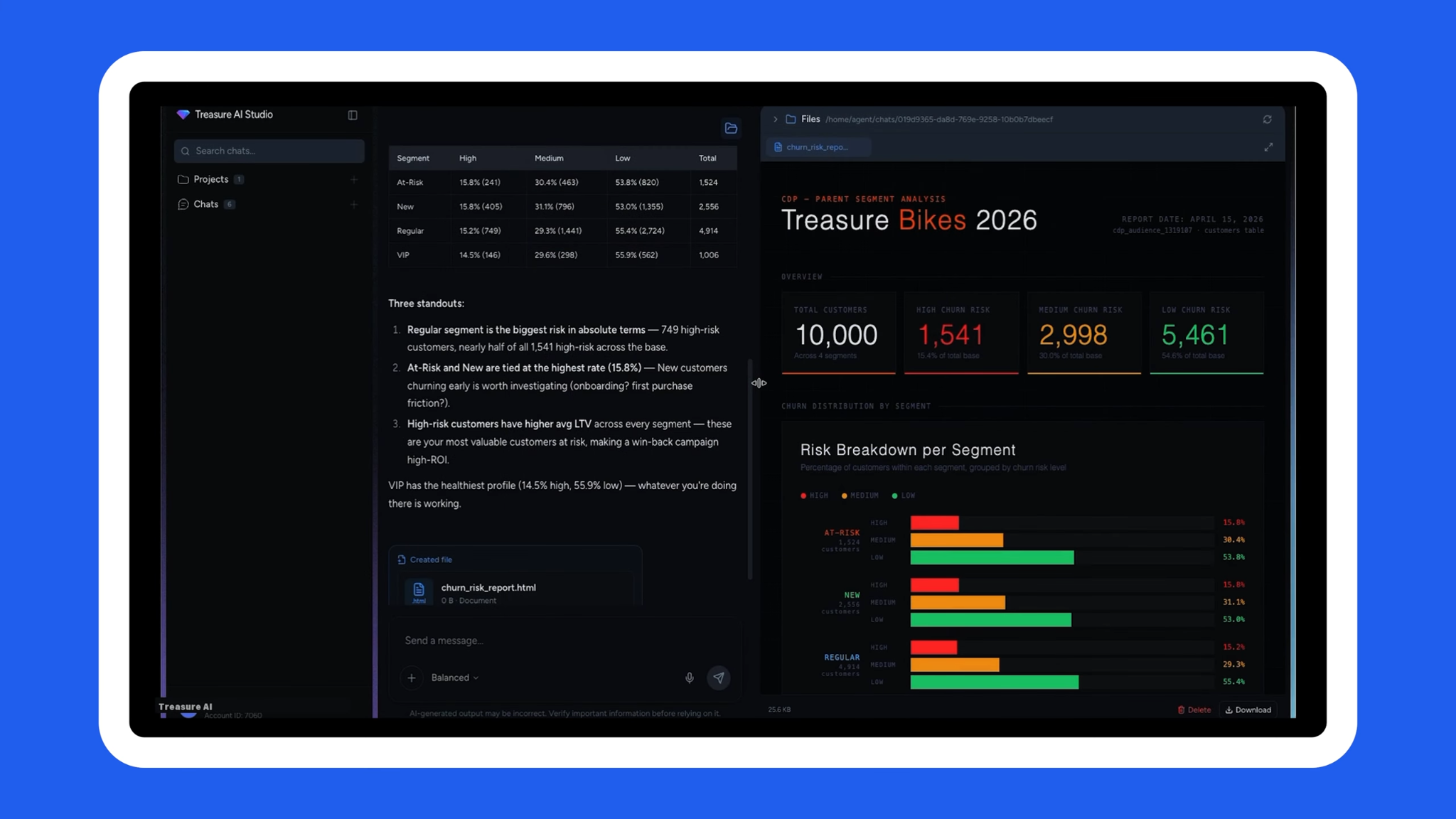
Treasure AI Studio: A conversational AI workspace that lets marketers build segments, journeys, and reports through natural language.
Treasure AI Studio answers a persistent problem: marketers who need data answers have traditionally had to open engineering tickets and wait. Studio, which went GA in April 2026, lets users describe what they want in plain English and get it done in minutes.
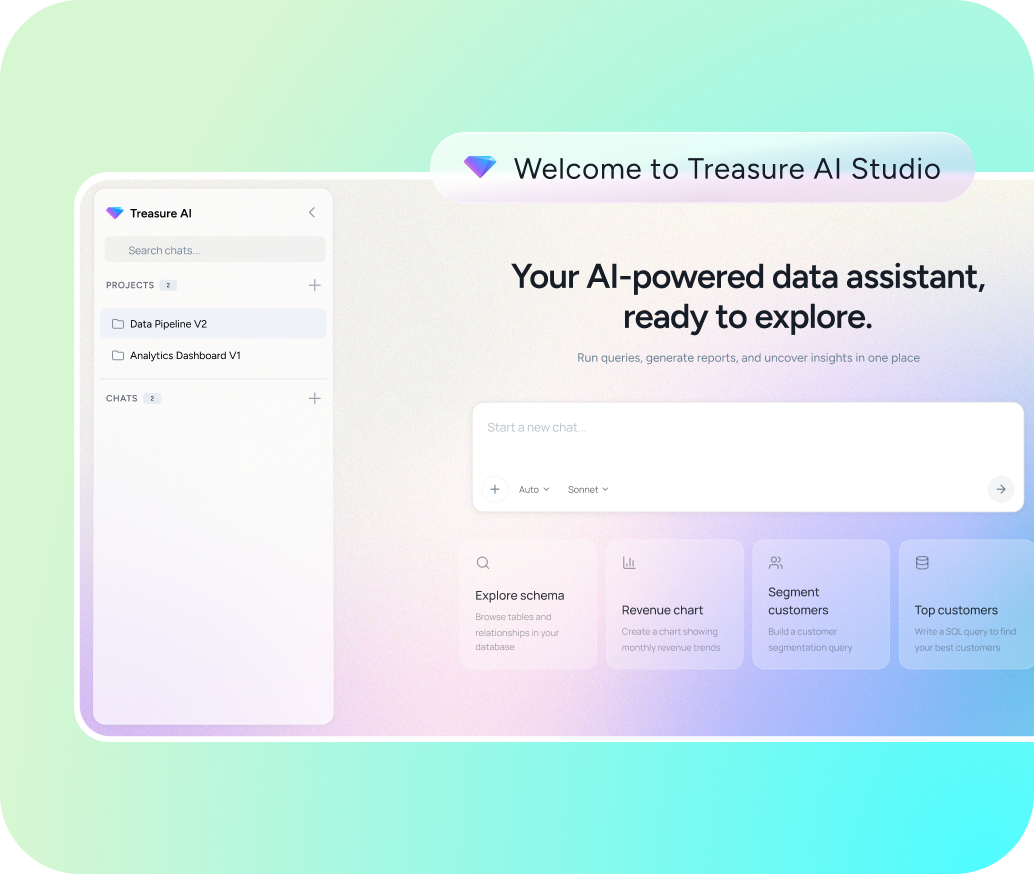
Source: Treasure AI
Users can request audience segments, customer journeys, data queries, and reports through a chat interface.
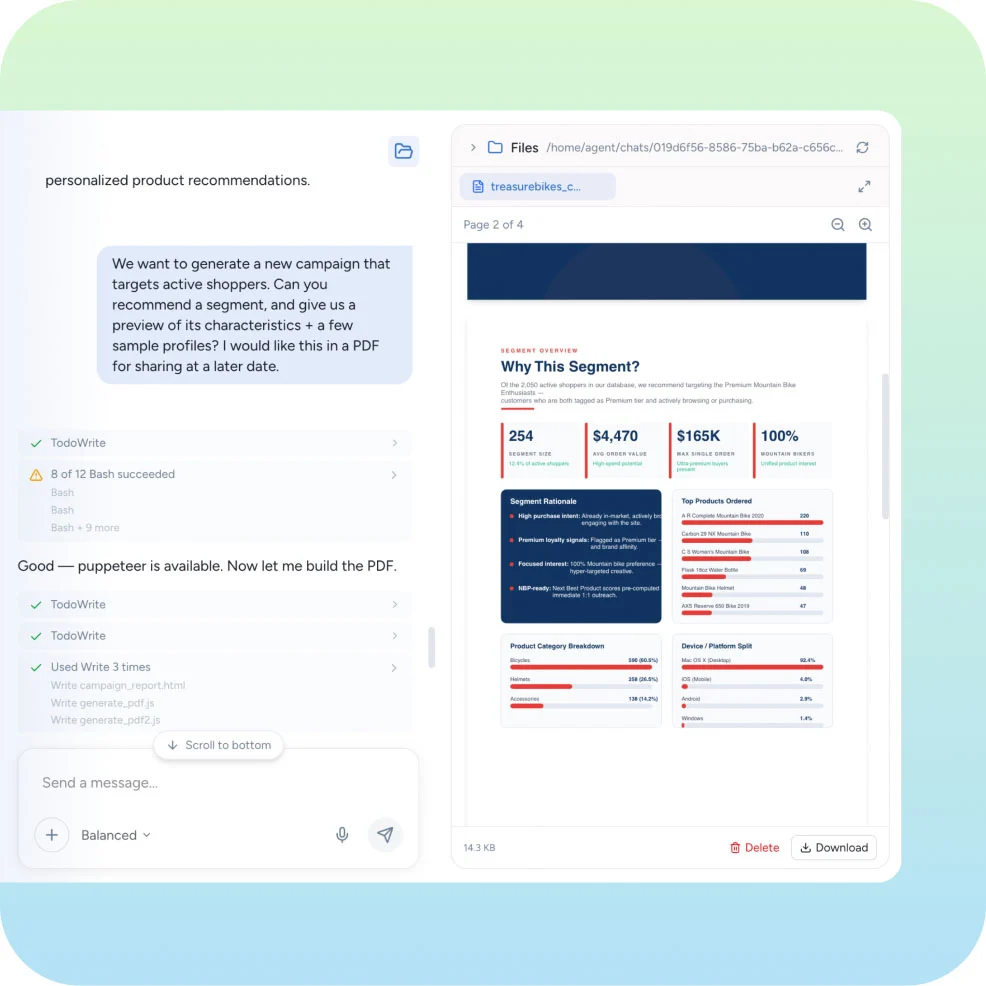
Source: Treasure AI
Studio writes and runs the SQL behind the scenes, streams every tool call as it happens, and surfaces all output for review before execution. Nothing touches the production environment without explicit approval.
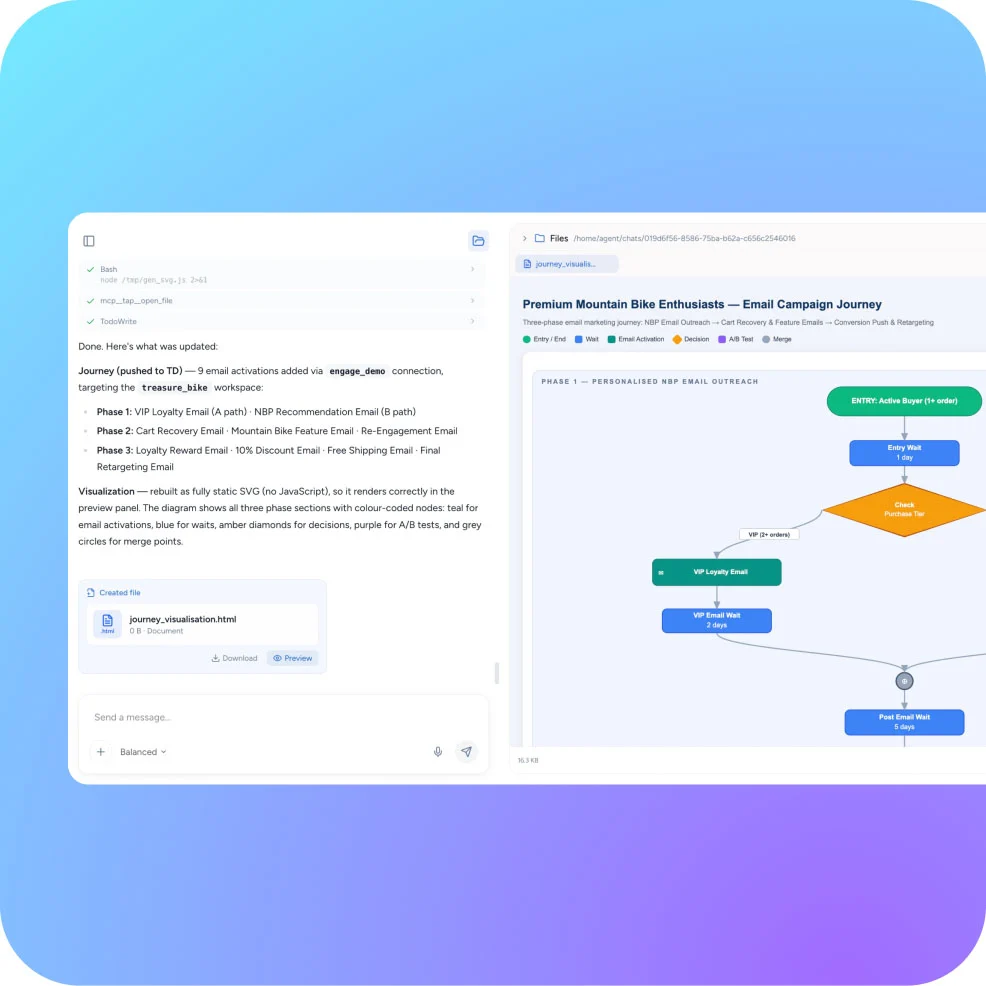
Source: Treasure AI
The workspace maintains in-session memory so users can build on previous questions without re-explaining context. A dual-pane interface shows the conversation on one side and generated files (interactive spreadsheets, charts, SQL code, YAML configurations) on the other. Journey definitions saved with a .journey.yaml extension trigger a Journey Canvas viewer for visual validation before deployment.
Source: Treasure AI
Studio is available on web, macOS desktop, and iOS, with the mobile app supporting voice input.
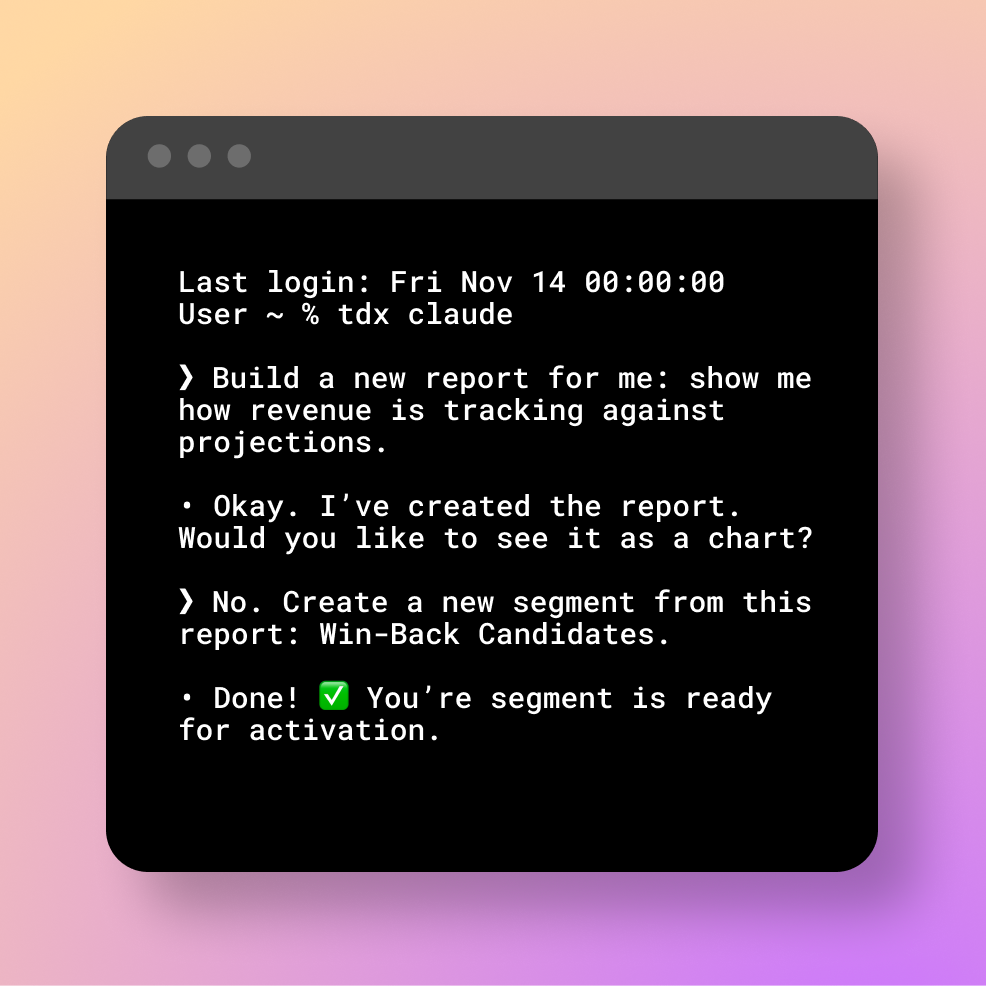
For data engineers, Treasure Code provides a CLI companion that manages segments, workflows, and journeys as version-controlled YAML. Users can organize recurring work inside Projects, named workspaces that pre-load standing context into every new session.
Source: Treasure AI
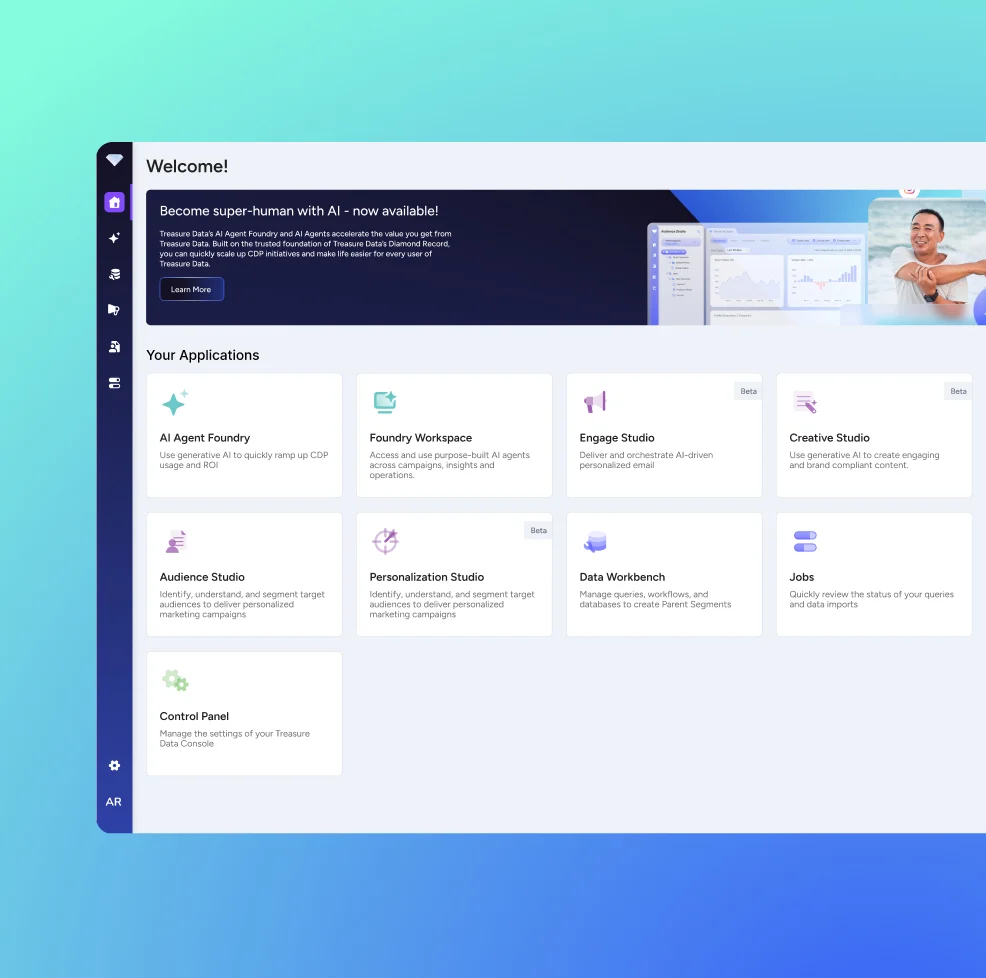
AI Suites: Five activation modules that turn unified customer data into personalized experiences across channels.
Treasure AI Suites sit on top of the Intelligent CDP and handle the execution side of marketing. Rather than requiring separate tools for email, creative production, web personalization, paid media, and customer service, the five suites consolidate these capabilities into one system sharing the same customer data.
Source: Treasure AI
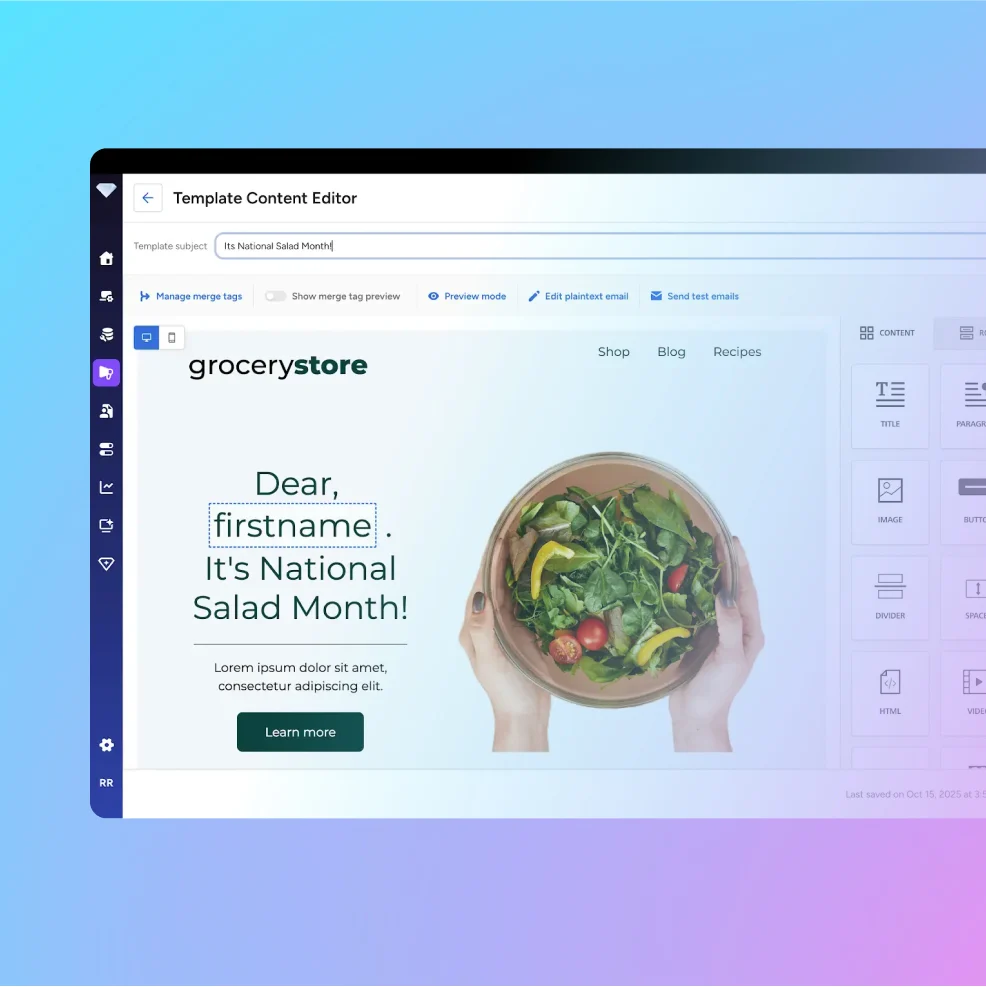
The Engagement AI Suite handles cross-channel journey orchestration across email, mobile push, and (coming soon) SMS and in-app messaging. It includes AI content generation and predictive signals for next-best action, churn risk, product recommendations, and send-time optimization. The platform reportedly reduces email creation workload by about two-thirds.
Source: Treasure AI
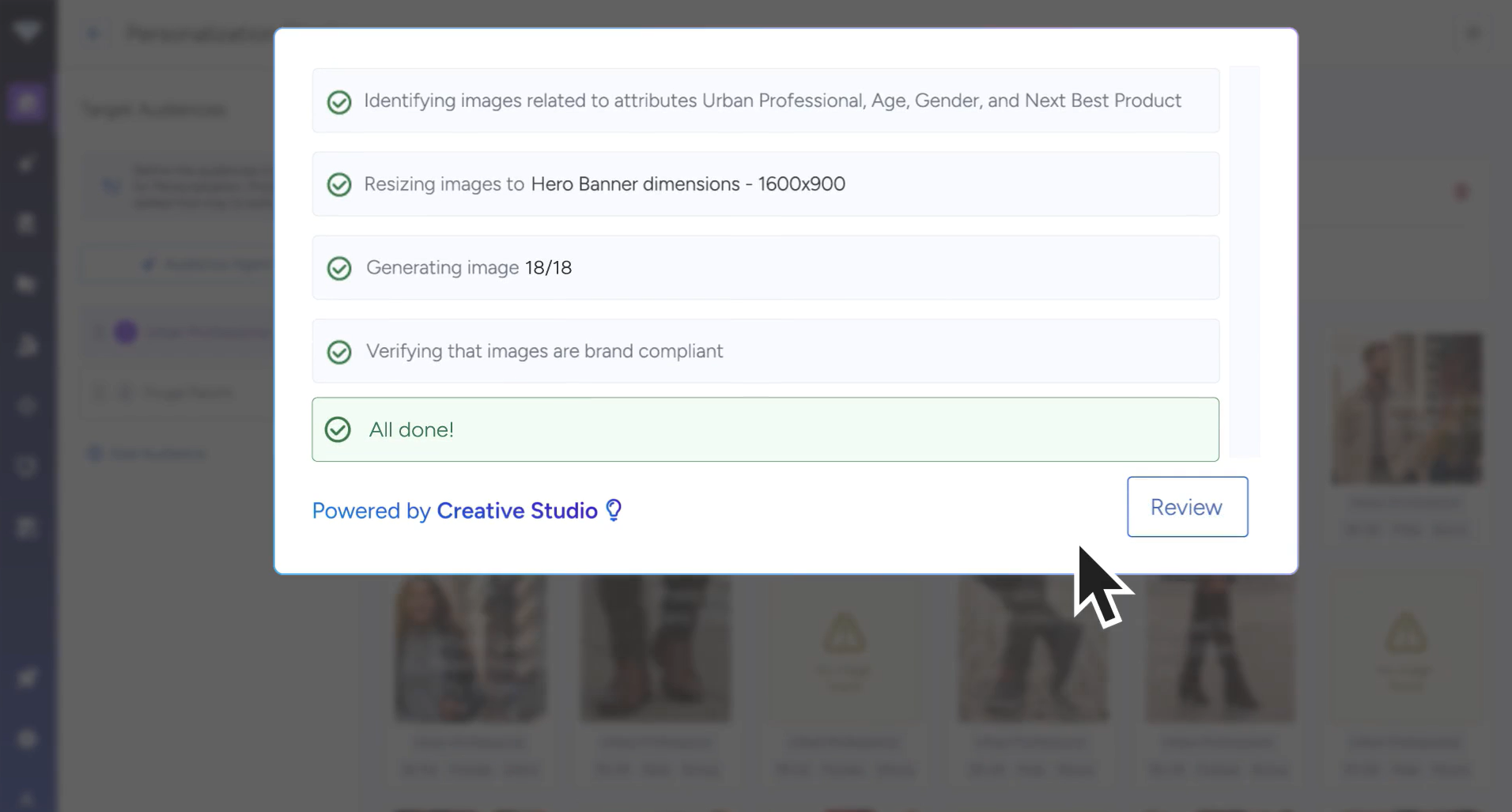
The Creative AI Suite deploys agents for specific tasks: a Brand Guideline Agent that audits copy for compliance, an Email Copy Agent that produces on-brand marketing emails, and Image Generation and Variation Agents that create and adapt visuals within brand guidelines.
Source: Treasure AI
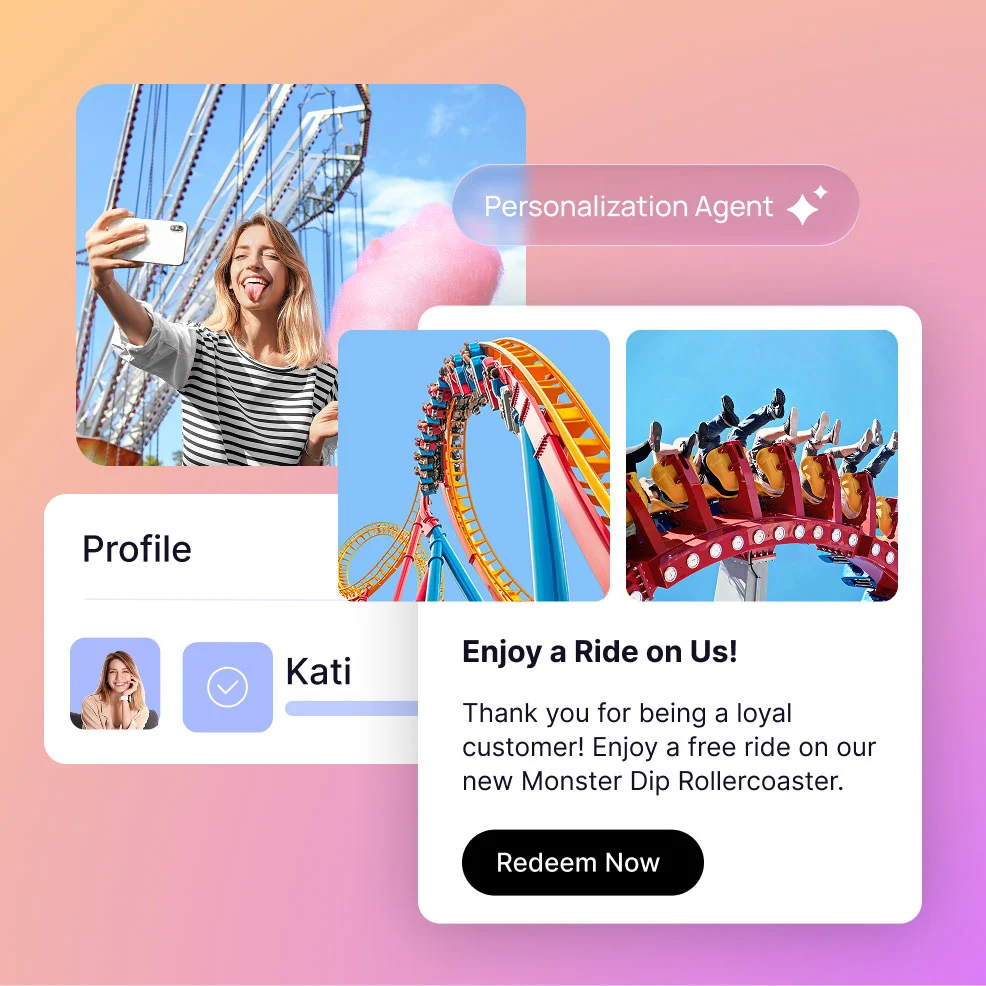
The Personalization AI Suite enables real-time web personalization using a continuous learning loop that adapts decisions based on observed outcomes, replacing periodic A/B test cycles.
Source: Treasure AI
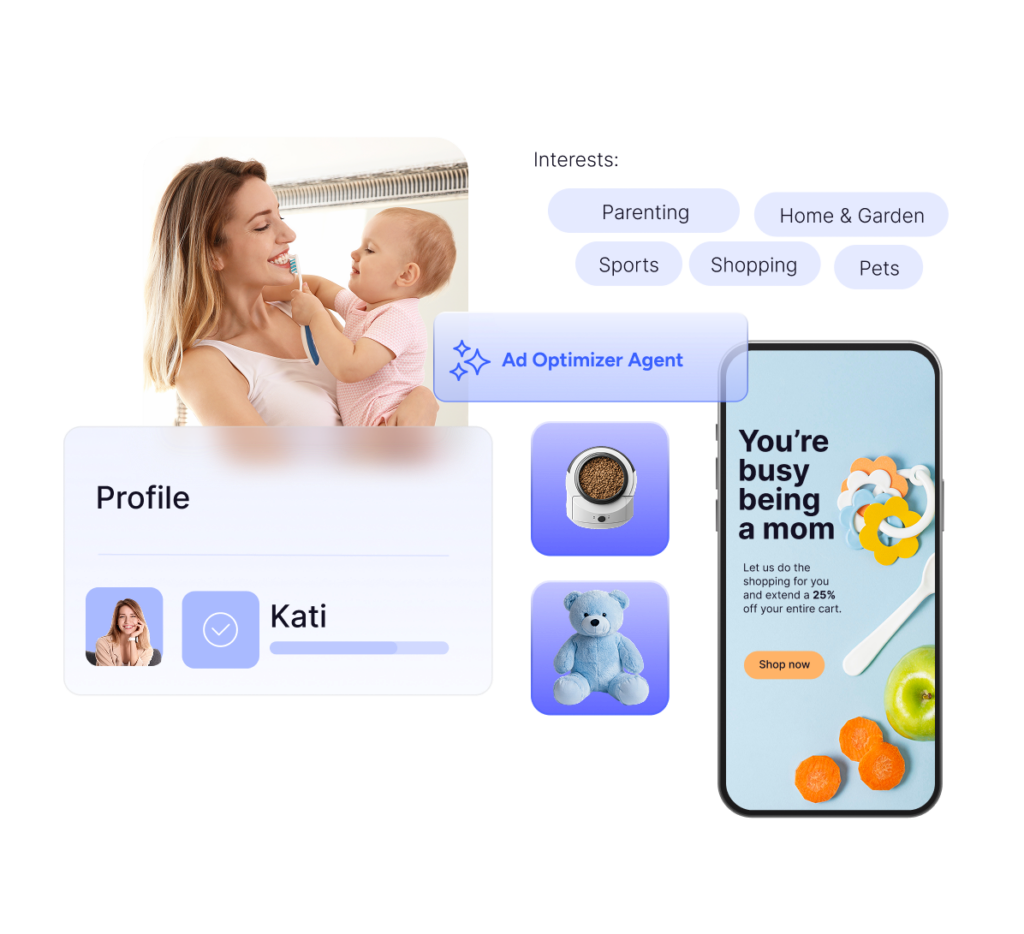
The Paid Media AI Suite connects first-party audience data with walled gardens like Google, Meta, and Amazon through data clean rooms.
Source: Treasure AI
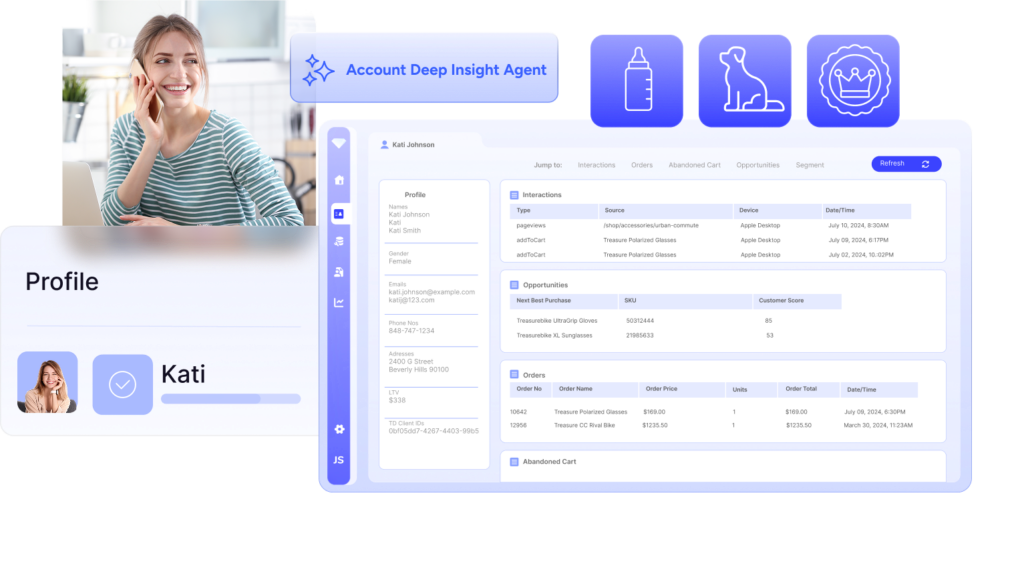
The Service AI Suite provides real-time customer profiles to support reps and field sales professionals, including predictive AI recommendations and self-service chatbots.
Source: Treasure AI
Customers can purchase individual suites rather than the full collection, and a 60-day free trial is available following an onboarding session. The company also offers a Trade-Up Program that gives organizations replacing their existing ESP or CEP up to 24 months free on the Engagement AI Suite.
Pricing: Treasure AI charges based on customer profiles and behavioral events, with no public price list.
Treasure AI uses a profile-and-behavior (P+B) unit pricing model. A P+B unit is consumed at the rate of one unit per 1 million unified customer profiles or per 1 billion behavioral events. Profiles are measured daily, with billing based on the 4th-highest daily total each month (the three peak days are excluded to absorb spikes).
The platform sells three tiers via annual subscription:
Intelligent Customer Data Platform (base tier): Unified data ingestion, segmentation, audience activation, journey orchestration, AI Agent Foundry, up to 2,000 parent segments and 2,000 users per production instance, with security and governance controls
Intelligent CDP + AI Suites: Adds omnichannel activation through all five AI Suites
Treasure AI Studio: Adds the conversational AI workspace and Treasure Code CLI
No public dollar amounts are listed for any tier. All pricing is negotiated through the enterprise sales process. Full deployment typically takes 8 to 12 weeks, though AI features can reportedly shorten time-to-value for specific use cases.
Instead of a self-serve free trial, Treasure AI offers a structured 2-week Proof of Concept at no cost for standard use cases. The POC includes ingestion of up to five data sources, data cleaning and transformation, customer profile unification, and downstream activation. Custom scope beyond standard use cases incurs one-time fees.
If usage exceeds ingest or storage limits, Treasure AI notifies the customer and gives them until end of month to reduce usage. If usage stays above limits, the account is automatically upgraded to the next tier and billed the incremental increase for the remainder of the subscription term.
Where Treasure AI Falls Short
Treasure AI is a strong platform for enterprise B2C data unification and marketing activation, but several limitations follow from its design choices and target market. These are not failures but consequences of building for a specific audience.
Steep learning curve with lingering SQL dependency. Reviewers on G2 and Gartner consistently note that advanced segmentation, transformations, and custom queries require SQL knowledge. Non-technical marketers face real barriers to self-service. Treasure AI Studio aims to solve this, but it only went GA in April 2026. The older Audience Studio interface, which users have criticized for clunky workflows, remains in use alongside the new workspace.
No pricing transparency. No public pricing exists. Prospects cannot assess whether the platform fits their budget before engaging sales. Gartner reviewers have flagged pricing transparency concerns, and G2 users report pricing as a concern, particularly with add-ons and integration requirements. The automatic tier-upgrade mechanism for exceeding usage limits adds further cost unpredictability.
No SMB path. Custom enterprise pricing, a 2-week POC requirement, an 8-to-12-week deployment timeline, and implementation complexity mean Treasure AI has no practical option for small or mid-market companies without dedicated data engineering teams. If your organization lacks marketing ops, data analytics, and IT administration staff to support the platform, it is likely not the right fit.
Documentation gaps and inconsistent support. Users note uneven documentation quality and sometimes delayed technical support. Teams often need professional services or implementation partners to get full value, which increases both cost and time-to-value beyond the base subscription.
Weaker in B2B contexts. Analyst evaluations consistently rate Treasure AI stronger in B2C than B2B. The Forrester Wave placed it as a Strong Performer (not Leader) in B2B CDPs, and the IDC MarketScape classified it as a Major Player (not Leader) in B2B. Organizations with B2B go-to-market motions (sales prospecting, account-based outreach, pipeline management) will find the platform less suited to those workflows.
This last gap matters most for enterprises that operate across both B2C and B2B. Treasure AI can unify consumer data and activate marketing campaigns, but it does not provide B2B contact intelligence, sales prospecting tools, or account-based go-to-market execution. For that, a dedicated B2B platform is needed.
The B2B Go-to-Market Complement to Treasure AI: ZoomInfo
ZoomInfo addresses the B2B gap that Treasure AI's design leaves open. Where Treasure AI unifies consumer data and activates B2C marketing journeys, ZoomInfo is an AI GTM platform built for finding, engaging, and winning business customers. For enterprise organizations that run both B2C and B2B motions, these platforms cover different halves of the go-to-market equation.
Comprehensive B2B Data: ZoomInfo provides the identity, company, and signal data that powers B2B prospecting and account intelligence.
Treasure AI's data foundation is built around consumer profiles: purchase history, browsing behavior, loyalty status, and cross-channel engagement. ZoomInfo's data foundation is built for the business buyer.
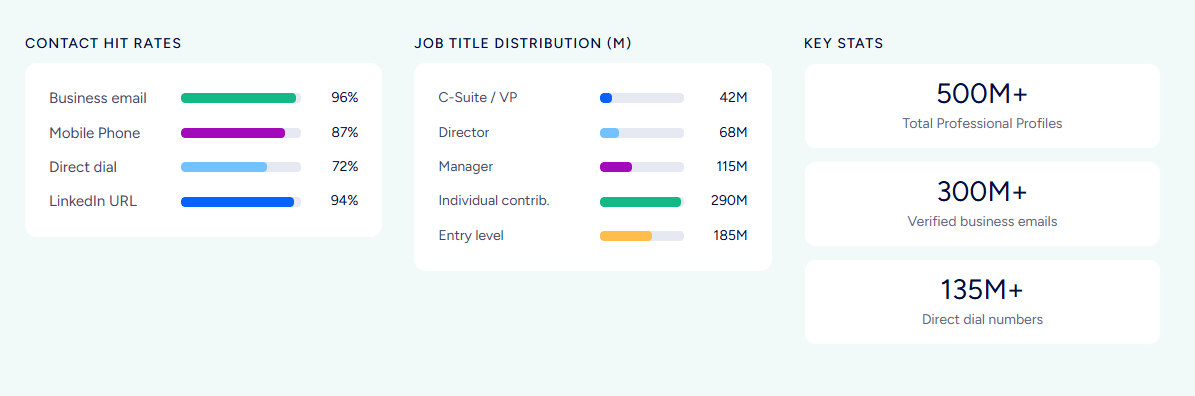
The platform covers 500M contacts, 100M companies, 135M+ verified phone numbers, 120M direct-dial phone numbers, and 200M+ verified business email addresses, verified through a multi-source pipeline backed by 300+ human researchers with up to 95% accuracy on first-party data.
Beyond contact and company records, ZoomInfo tracks signals that reveal when accounts are actively in-market.
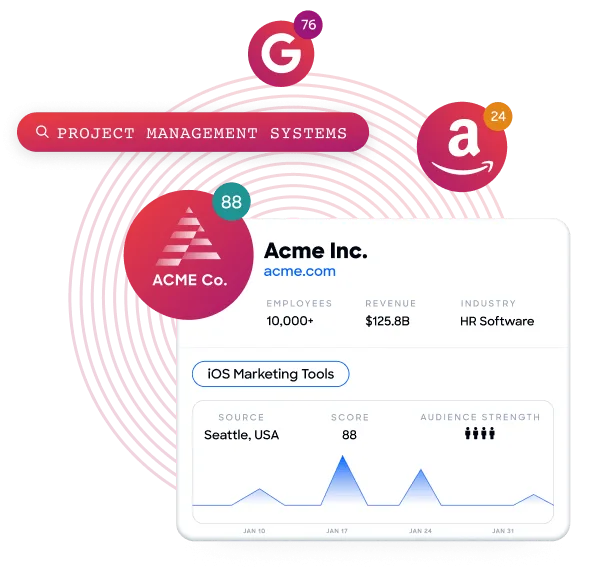
Buyer Intent data draws from 210 million IP-to-Organization pairings and 6 trillion+ new keyword-to-device pairings sourced monthly. Technographic data profiles the tech stacks of 30+ million companies across 30,000+ technologies.
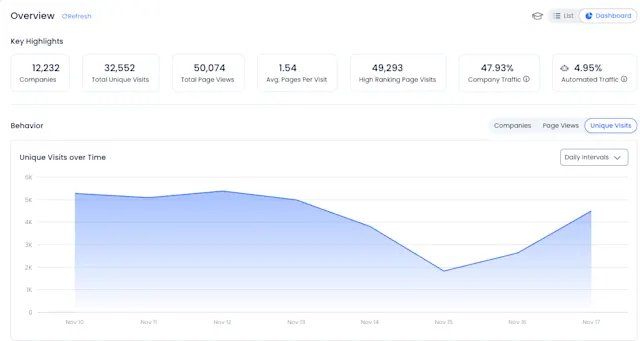
WebSights resolves anonymous website traffic to companies, including buying team identification and direct contact information.
The data quality is externally validated. In a Fortune 500 competitive RFP analyzing 25 million contacts across vendors, the independent consultant concluded that "no other competitor came even close." ZoomInfo has been named a Leader in the Gartner Magic Quadrant for ABM Platforms for two consecutive years and a Leader in the Forrester Wave for Intent Data Providers B2B.
SpringDB saw 2x to 3x increases in campaign conversions, a 300% increase in database usability, and 30-50% uplift in average deal size by using ZoomInfo's enriched data for precise targeting. (SpringDB)
GTM Context Graph: An intelligence layer that captures not just what happened in a deal, but why.
Treasure AI's intelligence layer is built around the Customer Intelligence Loop (Collect, Unify, Understand, Decide, Engage) for consumer marketing. ZoomInfo's intelligence layer, the GTM Context Graph, is built for B2B deal execution.
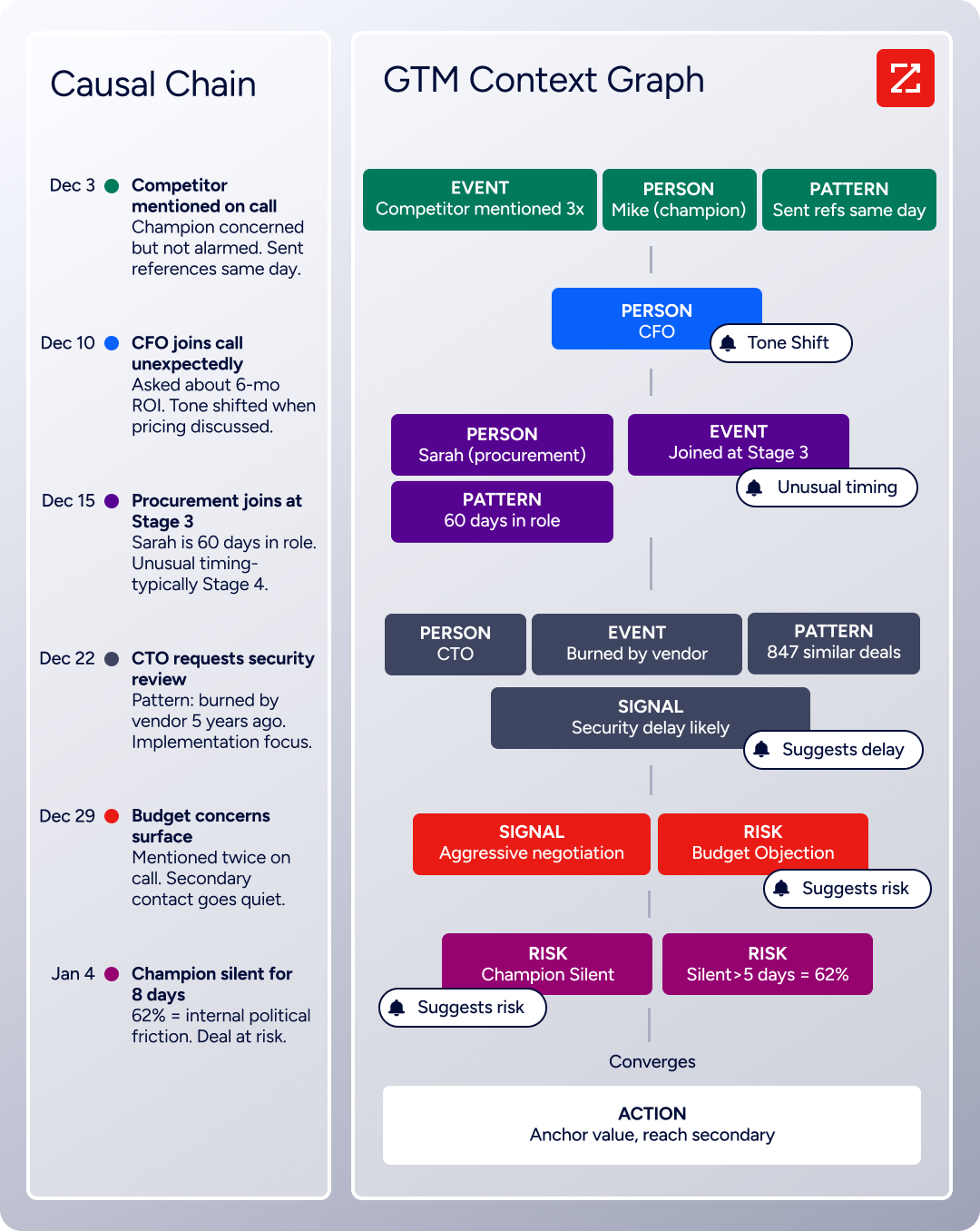
The GTM Context Graph fuses ZoomInfo's B2B data with a customer's CRM records, conversation transcripts from calls and meetings, email interactions, and behavioral signals into a single graph that processes 1.5B+ data points daily. As ZoomInfo's Chief Product Officer Dominik Facher explains: "The CRM recorded the state change. It has no record of why it happened." The GTM Context Graph captures the decision context behind deal movements (executive sponsorship entering at a specific stage, competitive mentions predicting risk, champion silence indicating internal friction) and makes those patterns machine-readable for AI recommendations.
This is a different kind of intelligence than what a B2C CDP provides. Treasure AI tracks consumer behavior to drive marketing personalization. ZoomInfo tracks buying committee dynamics to drive sales execution. For organizations that need both, these intelligence layers are additive.
Seismic attributed 39% of active pipeline to ZoomInfo signals and reported 54% productivity gains: "That combination of our internal CRM data, external signals, and AI that's given all that context has helped us craft very specific account- and persona-based messages." (Seismic)
Universal Access: ZoomInfo delivers its intelligence through native products and open APIs, without lock-in.
Like Treasure AI, ZoomInfo offers multiple ways to access its platform. But where Treasure AI's access points serve marketing teams, ZoomInfo's serve the full B2B go-to-market organization.
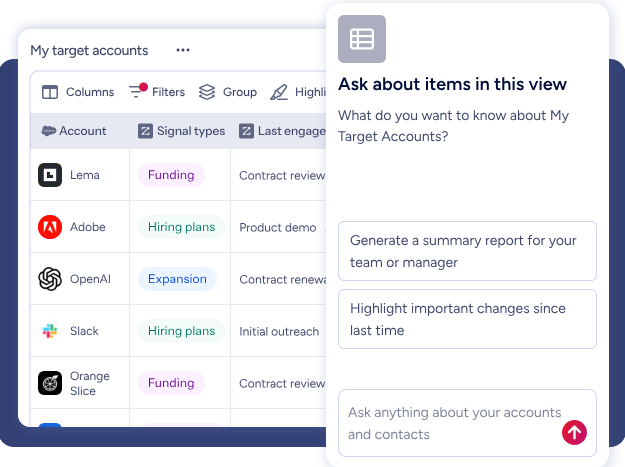
GTM Workspace gives sellers a single interface where prioritized accounts, AI-drafted outreach, and deal execution converge. AI agents handle account research, generate follow-ups, monitor signals, and update CRM fields.
GTM Studio gives marketers, RevOps, and GTM engineers a canvas for designing audiences in natural language, launching multi-channel plays, and measuring pipeline impact without engineering support.
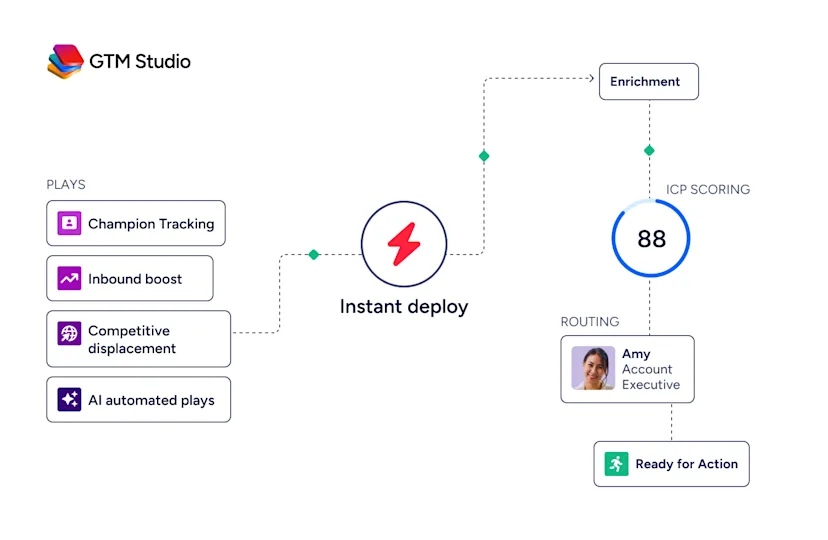
Source: ZoomInfo
For teams that build beyond ZoomInfo's own products, APIs and MCP expose the same intelligence to any custom agent, internal tool, or partner platform.
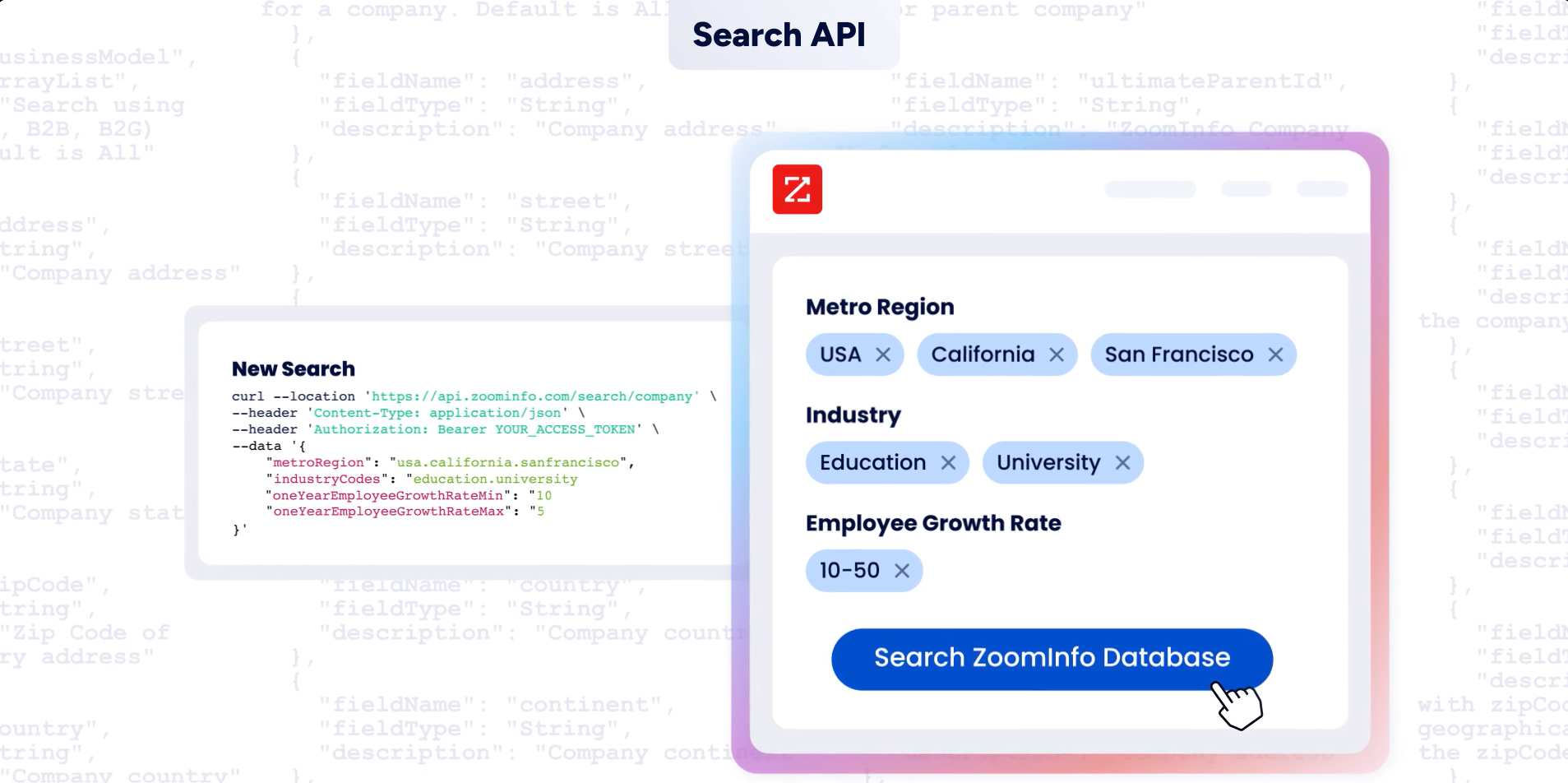
Source: ZoomInfo
API access is included in all relevant plans, and the MCP server is listed in the Claude directory and supports Claude and ChatGPT. All three access methods draw from the same GTM Context Graph.
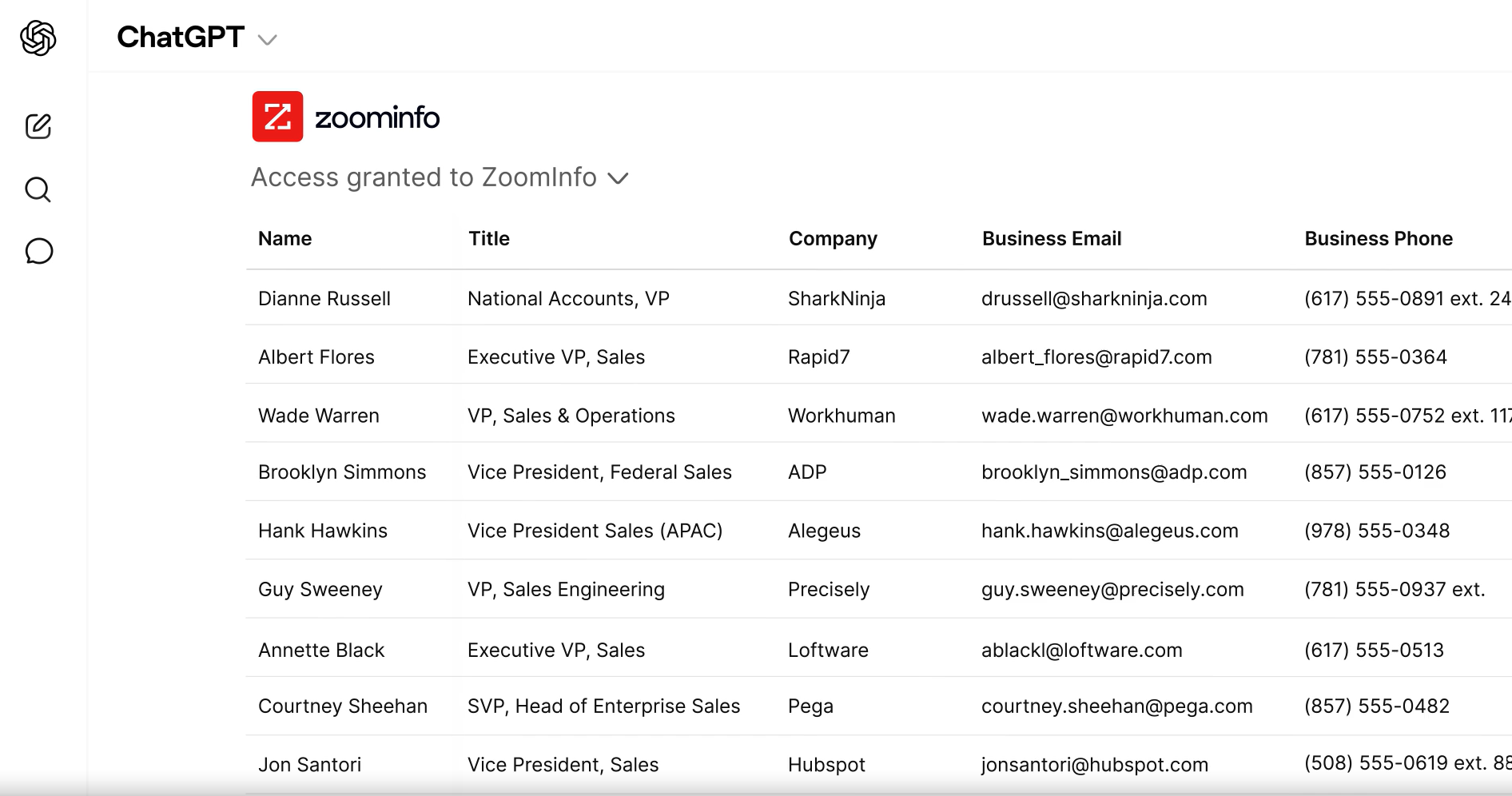
Source: ZoomInfo
ZoomInfo also offers a permanent free tier called ZoomInfo Lite, which provides access to the B2B database with 10 monthly export credits, individual and company searches, the Chrome extension, and HubSpot integration, with no credit card or time limit required.
BDO Canada achieved an 87% reduction in time spent updating their internal data dashboards using ZoomInfo's API. "The plug-and-play aspect of the API means I can integrate it very easily into any process and get information at a moment's notice." (BDO Canada)
Treasure AI and ZoomInfo: Comparison Summary
Aspect | Treasure AI | ZoomInfo |
|---|---|---|
Primary focus | B2C customer data unification and marketing activation | B2B go-to-market intelligence and sales execution |
Core data asset | Unified consumer profiles (Diamond Record) | B2B contact and company database (500M contacts, 100M companies) |
Intelligence layer | Customer Intelligence Loop for marketing journeys | GTM Context Graph for deal execution and pipeline |
Target user | Enterprise marketers, data engineers, marketing ops | Sales, marketing, RevOps, and GTM engineers |
AI capabilities | AI Suites for engagement, creative, personalization, paid media, service | AI agents for prospecting, outreach, deal intelligence, audience orchestration |
Activation channels | Email, push, web personalization, paid media, service | Email, phone, ads, multi-channel plays via GTM Studio |
Analyst recognition (2024) | Leader in B2C CDP (Gartner, Forrester, IDC) | Leader in ABM Platforms (Gartner), Intent Data (Forrester) |
B2B capability | Strong Performer / Major Player (weaker ratings) | Core strength; 500M contacts, intent signals, technographics |
Free access | No free plan; 2-week POC available | ZoomInfo Lite (permanent free tier) + 7-day trial |
Pricing model | No public pricing; custom enterprise quotes | Consumption-based pricing; custom quotes with free entry points |
Best for | Large B2C enterprises unifying consumer data at scale | B2B teams finding, engaging, and winning business customers |
Final Verdict
Treasure AI and ZoomInfo are not competitors. They serve different sides of enterprise go-to-market.
Choose Treasure AI if your primary challenge is unifying fragmented consumer data across dozens of systems and activating personalized B2C marketing at enterprise scale. The platform's decade-long CDP foundation, Diamond Record identity resolution, and hybrid architecture make it a strong choice for large B2C organizations with the data engineering resources to support a complex deployment. Enterprises in automotive, CPG, retail, financial services, and entertainment will find its B2C capabilities well matched to their needs.
Add ZoomInfo if your organization also runs B2B go-to-market motions. Treasure AI does not provide B2B contact intelligence, sales prospecting, or account-based execution. ZoomInfo fills that gap with a large B2B data platform, an intelligence layer that captures why deals move or stall, and access through native products, APIs, and MCP that integrate into any workflow. For enterprises that sell to both consumers and businesses, pairing Treasure AI for B2C with ZoomInfo for B2B covers the full go-to-market spectrum.
Get started with ZoomInfo here.
Treasure Data FAQ
What is the difference between Treasure Data and Treasure AI?
Treasure Data rebranded to Treasure AI in April 2026. The company shifted its positioning from Customer Data Platform to Agentic Experience Platform, reflecting its investment in AI agents that run marketing operations on top of unified customer data. The underlying CDP technology remains the core, but the product now includes Treasure AI Studio (a conversational AI workspace), five AI Suites for channel activation, and an AI Agent Foundry for building custom agents.
How much does Treasure AI cost?
Treasure AI does not publish prices. All pricing is custom-quoted through an enterprise sales process. The pricing model charges based on customer profiles and behavioral events (not query volume or compute power), with three tiers: the base Intelligent CDP, Intelligent CDP plus AI Suites, and Treasure AI Studio. Annual subscriptions are standard. The company offers a free 2-week Proof of Concept for standard use cases, and a 60-day free trial for the AI Suites following an onboarding session.
Does Treasure AI work for small or mid-sized businesses?
No. Treasure AI is designed for enterprise organizations with dedicated data engineering, marketing operations, and IT administration teams. Custom pricing, a 2-week POC requirement, and an 8-to-12-week deployment timeline make it impractical for SMBs. Companies without dedicated data teams should evaluate platforms built for simpler environments.
What industries is Treasure AI best suited for?
Treasure AI is strongest in B2C industries with complex multi-touchpoint customer relationships: automotive, CPG, entertainment and media, financial services, healthcare, retail, technology, and travel. The platform has a notably deep presence in the Japanese enterprise market, with native support for LINE messaging, Yahoo! Japan, and Japan-specific compliance certifications. Notable customers include AB InBev, Subaru, Six Flags, Nestle, Sony, Honda, Fujitsu, and Shiseido.
Does Treasure AI require SQL knowledge?
Advanced segmentation, transformations, and custom queries have historically required SQL expertise, which reviewers on G2 and Gartner consistently identify as a barrier for non-technical marketers. Treasure AI Studio, which went GA in April 2026, addresses this by letting users build segments, journeys, and reports through natural language. However, the older Audience Studio interface remains in use, and organizations should expect a transition period as the newer conversational tools mature.
How does Treasure AI handle data privacy and security?
Treasure AI holds certifications including SOC 2 Type 2, ISO/IEC 27001, ISO/IEC 27701, ISO/IEC 27017, ISO/IEC 27018, HIPAA Type 2, CSA STAR, TRUSTe Responsible AI Certification, and Japan-specific certifications (PrivacyMark, FISC). Data at rest uses at least AES-256 encryption. The platform includes role-based access controls, audit logs, and consent management tools. GDPR and CCPA compliance tooling is built into the data governance layer.
Can Treasure AI handle B2B use cases?
Treasure AI can process B2B data, but analyst evaluations consistently rate it stronger in B2C contexts. Forrester rated it a Strong Performer (not Leader) in B2B CDPs, and the IDC MarketScape classified it as a Major Player (not Leader) in B2B. Organizations with significant B2B go-to-market needs (sales prospecting, account-based marketing, pipeline management) may find the platform less suited to those workflows compared to dedicated B2B platforms like ZoomInfo.
What is the Diamond Record?
The Diamond Record is Treasure AI's approach to identity resolution. It creates a persistent, unified customer profile that connects data from every channel and data source using deterministic, probabilistic, and rule-based matching methods. Unlike traditional "golden record" approaches that rely on batch identity stitching, the Diamond Record updates continuously as new data arrives. The result is a more complete and current customer view that resolves anonymous users, cross-device interactions, and cross-brand relationships into a single identity.
More Treasure Data comparisons and alternatives:
