

Warmy.io has become a popular email deliverability platform that promises to get new or damaged sending domains landing in inboxes instead of spam folders. With a network of over 300,000 active real mailboxes and an AI engine that claims to make 20 million per-mailbox decisions daily, it offers more than simple warm-up automation.
But as email deliverability becomes just one piece of a larger outbound puzzle, the question isn't only whether Warmy works, but whether it's enough.
To write this Warmy review, we analyzed the platform extensively. We believe it's the right choice if:
You need to warm up new domains or mailboxes before launching cold outreach
You want AI-driven warm-up that adjusts automatically without manual tuning
You manage deliverability across multiple email providers (Gmail, Outlook, Yahoo, SendGrid, Amazon SES, and others)
You need inbox placement testing alongside warm-up in a single dashboard
You value fast setup and hands-off operation over granular manual control
However, Warmy might not be the best choice if:
You need full control over warm-up ramp rates and scheduling
You manage 50+ domains and require bulk API-driven automation
You need analytics and reporting beyond what a simplified dashboard provides
You're looking for a platform that also handles finding, verifying, and enriching the contacts you're emailing
Your outreach strategy requires multi-channel orchestration across email, phone, ads, and social
In that last case, consider ZoomInfo: a B2B data and GTM platform that handles the other half of the outbound equation. While Warmy focuses on getting your emails to the inbox, ZoomInfo provides verified B2B contact data (500M contacts, 200M+ verified business emails), buyer intent signals, and AI-powered outreach tools that determine who you're emailing, when to reach them, and what to say. The two platforms address different stages of the same workflow.
For teams running serious outbound programs, deliverability without targeting is as incomplete as targeting without deliverability.
We've included a look at ZoomInfo later in this review as the natural complement for teams that want their outreach infrastructure and intelligence working together. If you're ready to explore what that looks like, start with ZoomInfo's free trial.
What is Warmy?
Warmy.io is a cloud-based email deliverability platform founded in 2020 by Daniel Shnaider, who also co-founded its parent entity, AnyBiz LTD.
The platform grew out of a practical problem: Shnaider's own businesses sent thousands of emails daily and had no effective deliverability tool for multiple languages and industries. What started as an internal solution became a commercial product.
Today, Warmy positions itself as an "Auto All-In-One Tool For Email Deliverability" rather than a simple warm-up tool.
The platform builds and maintains sender reputation by sending AI-personalized emails through a network of real mailboxes, simulating human engagement (opens, replies, spam rescues), and feeding live reputation data back into its algorithms. It claims to serve 35,000+ businesses across 95+ countries and holds a 4.8/5 on G2 across 522+ reviews.
Warmy's core audience includes B2B sales teams warming up domains for cold outreach, marketing agencies managing deliverability for multiple clients, and transactional senders protecting their infrastructure. The platform supports any provider using IMAP/SMTP, from Google Workspace and Microsoft 365 to SendGrid, Amazon SES, Mailgun, and Brevo.
Warmy Pros & Cons
Pros | Cons |
|---|---|
- AI-driven warm-up with per-mailbox optimization | - Pricing is quote-only; no published rates |
- 300,000+ real mailbox network for authentic engagement | - Silent disconnections reported without notification |
- Supports 20+ email providers via IMAP/SMTP | - Dashboard too simple for power users |
- Fast setup (claimed 25 seconds) | - No bulk API for programmatic domain management |
- Native Google Postmaster Tools integration | - Gmail warm-up effectiveness questioned by some users |
- Strong customer support (9.7/10 on G2) | - No refunds; strict cancellation policy |
- B2B and B2C warm-up tracks | - SOC 2 badge displayed but certification not yet obtained |
Warmy Review: How It Works & Key Features
Email Warm-Up: Warmy automates sender reputation building through AI-personalized engagement across a live mailbox network.
Email warm-up is Warmy's core product.
When a domain or mailbox is new (or has been flagged), email providers treat it as a potential spam source. Volume that ramps too quickly signals bulk sending and triggers spam filters. Warmy solves this by gradually building a provable sending history with major providers.
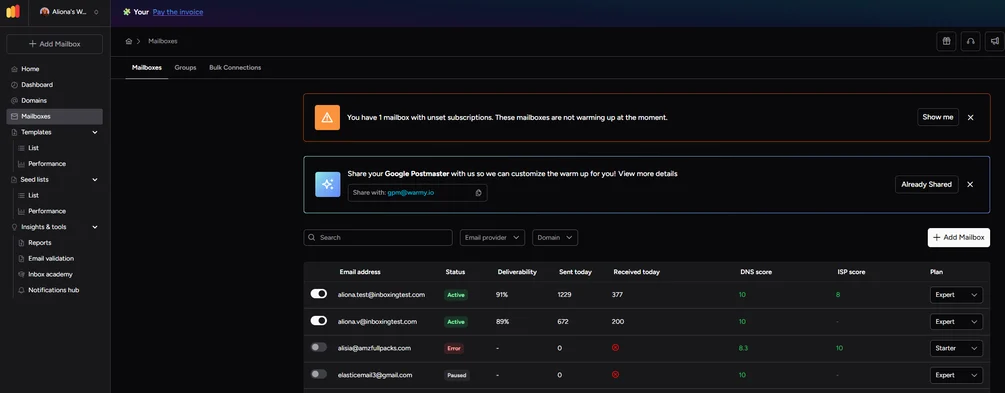
Once a mailbox connects, the platform begins sending personalized warm-up messages to its network of real accounts. These aren't filler messages. Each warm-up email is personalized and topic-specific, and the system simulates human behavior: emails are sent, opened, marked as important, and replied to in threads.
Source: Warmy
Messages that land in spam or Promotions are automatically moved to the inbox. Daily volume increases gradually, and all warm-up messages are auto-archived to keep the user's inbox clean.
Users control the pace through a "temperature" setting: Slow, Medium, or Fast. Slow is recommended for safety; Fast suits urgent timelines but carries reputational risk.
Two features stand out.
Template Warm-Up lets users submit their actual outreach templates, which Warmy incorporates into ~30% of warm-up emails, with support for Spintax for dynamic variation. Your real campaign content builds a favorable history with providers before deployment.
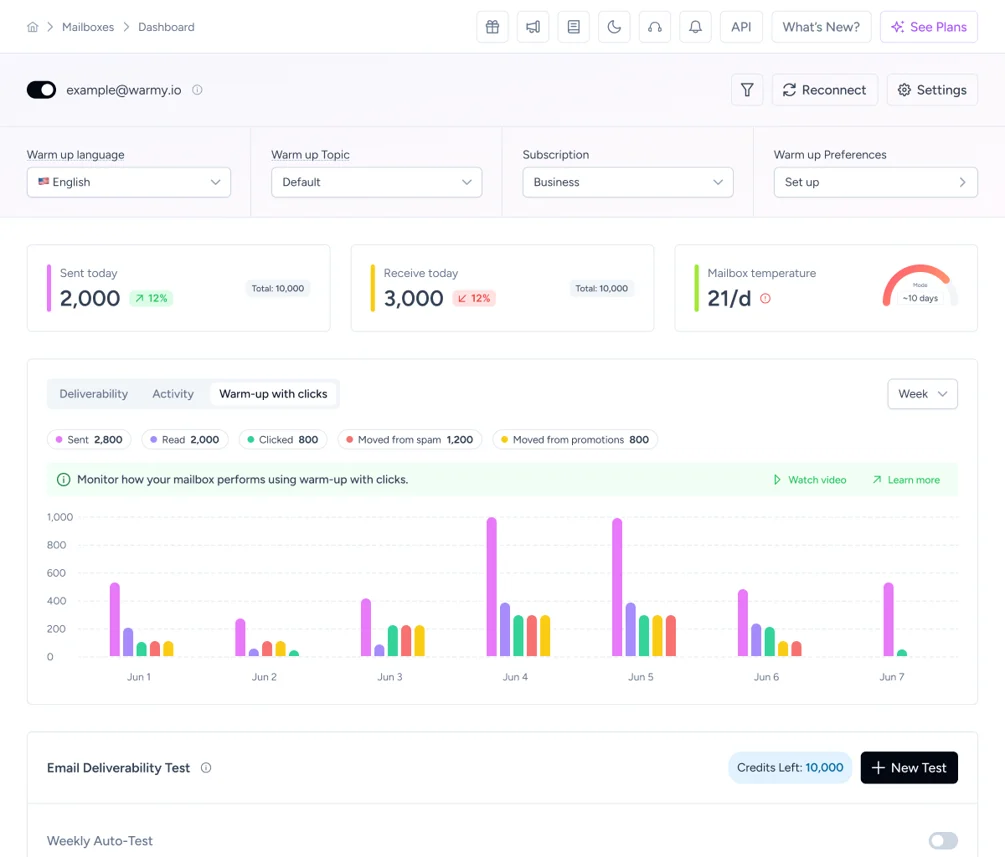
Warm-Up with Clicks (a paid add-on) extends standard warm-up by simulating link clicks inside warm-up emails, addressing AI-based spam filters that weigh engagement beyond opens.
Source: Warmy
The Mailbox Balancing system lets users weight warm-up interactions toward specific providers (Google Workspace and MS365 for B2B, Gmail and Yahoo for B2C). Reputation gets built where it matters for your campaigns.
Email Seed List: Warmy provides real mailbox-based placement testing with active engagement signals.
Warmy's Email Seed List is a curated collection of real, active mailboxes across Gmail, Outlook, Yahoo, G Suite, and MS365 that users send campaigns to before (or alongside) live sends.
Source: Warmy
The purpose: see where your emails actually land before real subscribers are affected.
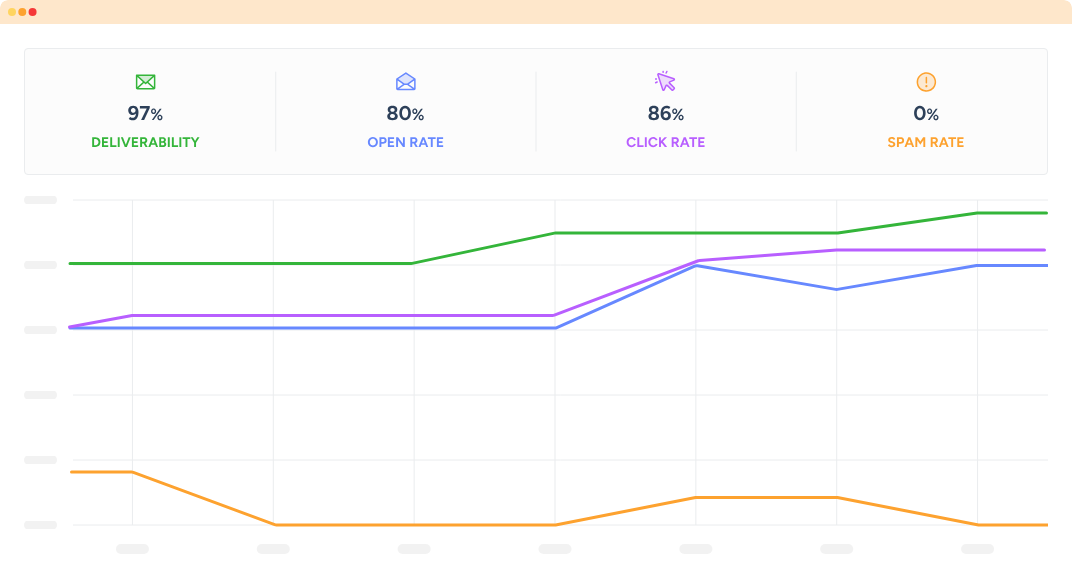
The key difference from passive seed list tools is that Warmy's seed accounts interact with emails. They open and scroll emails, click links at varying intervals, and move spam-routed emails to the inbox and mark them "Important." This generates positive engagement signals that influence ISP classification, not just placement reports.
The seed list comes in three tiers from 500 to 5,000 seeds, covering five provider-specific lists. Lists rotate monthly with a five-day overlap window, keeping the pool current without disrupting in-progress campaigns. Engagement timing is randomized with no fixed patterns to avoid ISP detection.
The Seed List Performance dashboard provides real-time stats on opens, clicks, and spam rescues, filterable by time period, provider, and individual sender.
Deliverability Insights: Warmy consolidates inbox placement, authentication monitoring, and reputation data into a single view.
Deliverability Insights is Warmy's monitoring layer, giving senders real-time visibility into where emails land (inbox, spam, or promotions) and flagging placement issues.
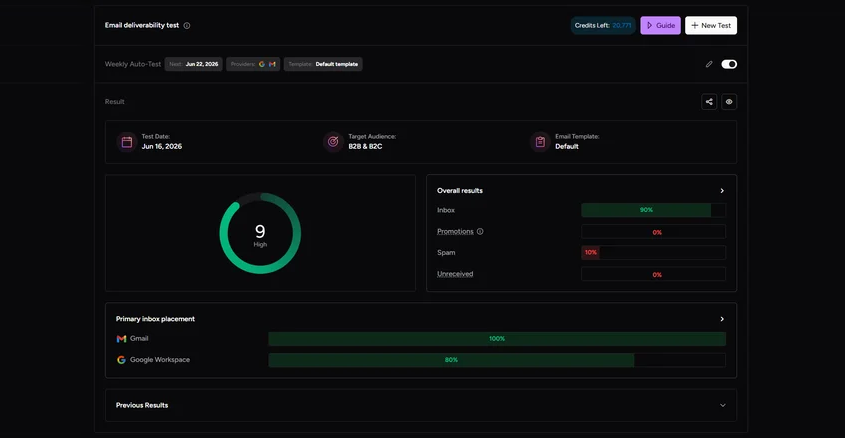
The Inbox Placement Checker sends a personalized test message to real mailboxes outside the warm-up network and reports placement status per provider.
Users select from B2C or B2B providers (Gmail, Outlook, Yahoo, Zoho for B2C; G Suite, MS365, SMTP for B2B) and see inbox, spam, unreceived, or promotions status for each. Warmy can also schedule tests automatically throughout the week across all connected mailboxes.
Source: Warmy
For active campaigns, the Placement Checker integrates into outgoing sends by seeding unique tracking addresses, then monitoring deliverability with up to 7-day windows and up to 50 test emails per provider.
The standout integration is with Google Postmaster Tools, which pulls domain reputation, spam rates, and authentication metrics into the dashboard.
Most monitoring tools just display data. Warmy's GPM integration feeds reputation signals back into warm-up algorithms so the system adjusts automatically when Google's data shows deteriorating domain health. This closed-loop design makes the warm-up process self-correcting.
Additional monitoring includes blacklist checks, SPF/DKIM/DMARC/MX status verification, and a Notification Hub that delivers alerts via email, SMS, and webhooks (Slack and WhatsApp notifications are announced but not yet available).
Adeline AI: Warmy's decision engine processes millions of data points daily to optimize warm-up per mailbox.
Adeline AI is the engine behind Warmy's warm-up operations.
Each connected mailbox produces hundreds of data parameters (sending activity, recipient behavior, spam signals, sender reputation), and Adeline determines the optimal warm-up schedule and daily sending volume for each mailbox. The scale claim: 20 million decisions per day.
What sets Adeline apart from rule-based systems is crowd learning. The engine learns from the entire pool of mailboxes on the Warmy platform, applying patterns discovered across all users automatically. A new mailbox benefits from network-wide insights immediately rather than starting from scratch.
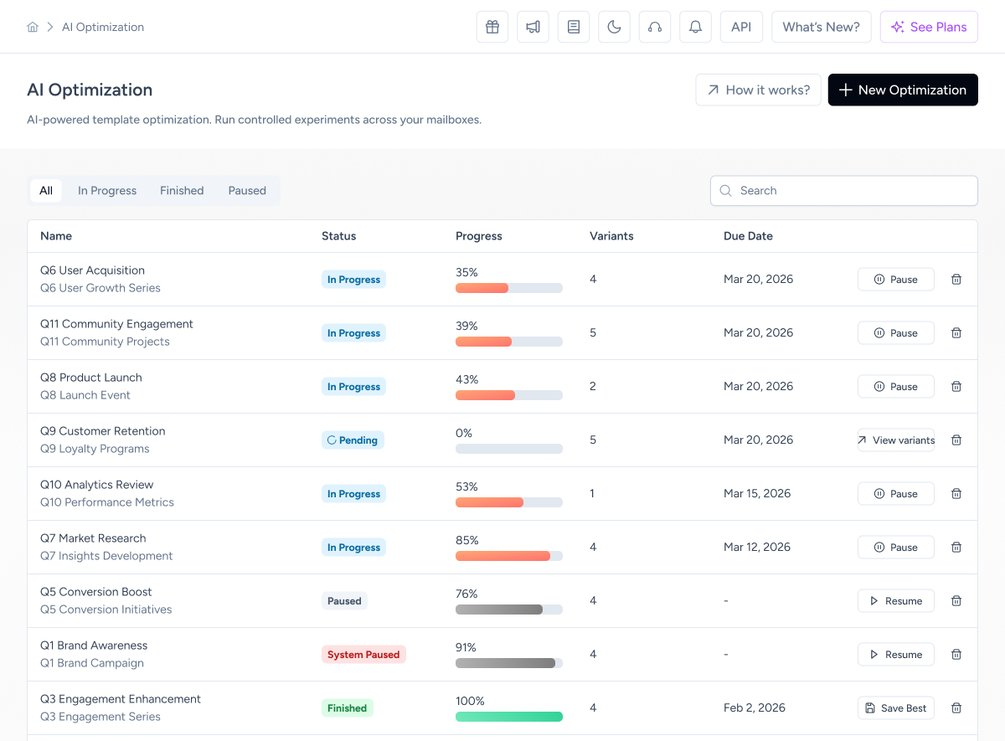
Adeline also powers Templates AI Optimization, which runs structured experiments on template variants inside Warmy's warm-up environment.
Source: Warmy
Two modes are available: Iterative Optimization (tests one version at a time for focused refinement) and Simultaneous Optimization (tests multiple variants in parallel for faster comparison). Tests run inside the warm-up network rather than against live recipients, so poor-performing versions can't damage active outreach. The AI generates new variants on its own, informed by real performance data.
In February 2026, Warmy embedded the Adeline AI Chat assistant inside every account, giving users access to account data and deliverability reports through a conversational interface.
Where Warmy Falls Short
Warmy delivers on its core warm-up promise, but several limitations emerge with sustained use.
These reflect a platform built for accessibility and automated operation rather than power-user control and enterprise infrastructure.
Opaque Pricing: Warmy runs a quote-only pricing model with no published figures. All three plan types (B2B Sender, B2C Sender, Custom) require booking a demo. Warmy's own documentation acknowledges prices fluctuate and recommends a sales call.
For teams evaluating multiple tools, the inability to compare costs without a sales conversation adds friction. The Warm-Up with Clicks feature carries separate pricing on top of the base subscription.
Silent Disconnections: The second most common complaint on G2 (42 mentions): accounts disconnecting silently, sequences stopping, and billing continuing while the service sat idle. For a tool whose value depends on continuous automated operation, silent failures undermine the "set it and forget it" promise.
Dashboard Limitations for Power Users: Warmy's simplified dashboard appeals to beginners, but Capterra reviewers describe it as "too simple" with insufficient analytics. Teams managing large deliverability programs often need deeper data visualization, custom reporting, and exportable historical trends that the current interface doesn't provide.
No Bulk API for Domain Management: Users managing 50+ domains report a critical gap: no API endpoint for programmatic bulk domain enrollment or status management. The product remains UI-centric for domain-level operations, forcing agencies to manage each domain manually.
Gmail Warm-Up Concerns: Multiple Capterra reviewers report that Gmail warm-up doesn't work as effectively as warming for other providers. Given Gmail's dominance in both consumer and SMB email, this is a real concern for teams whose audience primarily uses Gmail.
Compliance Discrepancy: Warmy displays a SOC 2 Type II badge on its homepage and marketing materials. However, the help center article on SOC compliance (updated June 2026) states: "Currently, we do not have SOC compliance, but we are actively working towards obtaining it." This gap matters most for enterprise buyers who require compliance certifications during vendor evaluation.
Strict Cancellation and Refund Terms: Cancellation must be requested through support (live chat, email, or WhatsApp), with no self-serve cancel button. All fees are non-refundable, and cancellation must be submitted at least five business days before the next renewal date. The trial converts automatically to a paid plan unless cancelled before expiration.
These limitations aren't failures. They reflect where Warmy has invested (AI-driven automation, ease of use, broad provider support) and where it hasn't (power-user tooling, pricing transparency, enterprise compliance).
But they reveal a broader gap: Warmy solves the deliverability side of outbound while leaving teams to piece together the rest (finding the right contacts, understanding buyer intent, orchestrating multi-channel outreach) on their own.
The Natural Complement to Warmy: ZoomInfo
Warmy gets your emails to the inbox. But inbox placement only matters if you're emailing the right people, at the right time, with the right message.
That's where ZoomInfo fits.
ZoomInfo is a B2B data and GTM platform built on three pillars: B2B data, an intelligence layer called the GTM Context Graph, and access through native applications and APIs.
Where Warmy operates at the infrastructure layer (sender reputation, inbox placement), ZoomInfo operates at the intelligence and execution layer (who to target, when they're ready to buy, and what to say).
Comprehensive B2B Data: ZoomInfo provides the verified contacts and company intelligence that make deliverability investments worthwhile.
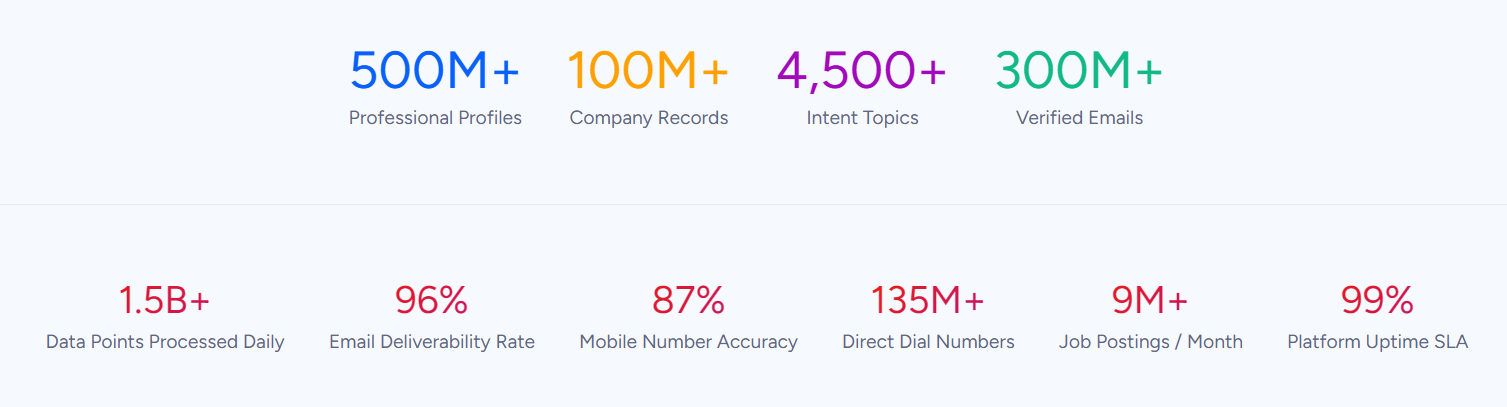
ZoomInfo’s foundation is data: 500M contacts, 100M companies, 135M+ verified phone numbers, and 200M+ verified business email addresses. This data is verified through a multi-source pipeline backed by 300+ human researchers and reaches up to 95% accuracy on first-party data.
For outbound teams, accurate email addresses directly affect deliverability. Sending to stale or incorrect addresses drives up bounce rates, damages sender reputation, and can undo what a warm-up tool has built.
ZoomInfo's verified data reduces that risk at the source. Beyond contacts, the platform provides company attributes, technographics across 30,000+ technologies, org charts, and buyer intent signals that track when companies are actively researching solutions.
The data quality has been externally validated. In a Fortune 500 competitive RFP analyzing 25 million contacts across vendors, the independent consultant concluded that "no other competitor came even close." ZoomInfo has been named a Leader in the Gartner Magic Quadrant for ABM Platforms and a Leader in the Forrester Wave for Intent Data Providers.
Vensure's VP of Revenue Operations: "ZoomInfo gives us the information we need to execute. We don't have to go through and spend our time digging. It's already there, so we can be three steps ahead." (Vensure)
GTM Context Graph: ZoomInfo's intelligence layer captures why deals move, not just that they moved.
Verified data is the foundation. The GTM Context Graph makes it actionable.
Processing 1.5B+ data points daily, it combines ZoomInfo's B2B data with a customer's CRM records, conversation transcripts, email interactions, and behavioral signals into a single intelligence layer.
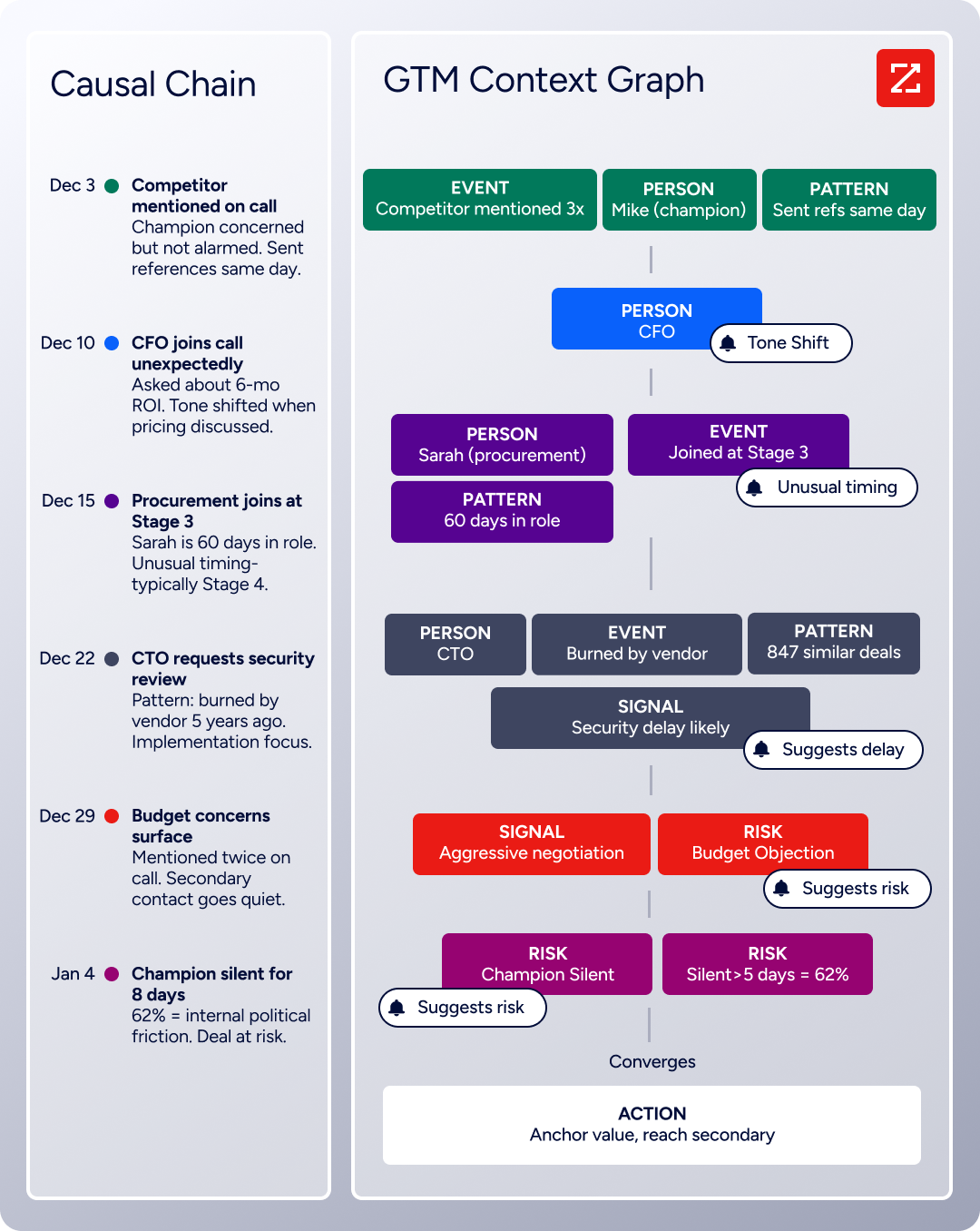
A CRM records that a deal moved stages. The GTM Context Graph captures why: the CFO joined the last call and asked about six-month ROI, the VP went quiet for eight days during an internal budget battle, a competitor came up in three separate conversations.
That reasoning flows into every downstream action, from AI-drafted follow-ups that address the specific concern raised on the last call to plays that target accounts whose signal patterns match your actual wins.
For teams already investing in warm-up infrastructure, this intelligence determines whether that investment produces pipeline or just inbox placement metrics. Knowing your emails reach the inbox matters less if you're emailing the wrong accounts or missing the window when a buyer is actively evaluating.
Seismic attributed 39% of active pipeline to opportunities identified or influenced by ZoomInfo signals. Their Chief Business Officer: "That combination of our internal CRM data, external signals, and AI that's given all that context has helped us craft very specific account- and persona-based messages." (Seismic)
Universal Access: ZoomInfo delivers intelligence through native applications for sellers and marketers, plus APIs and MCP for any tool.
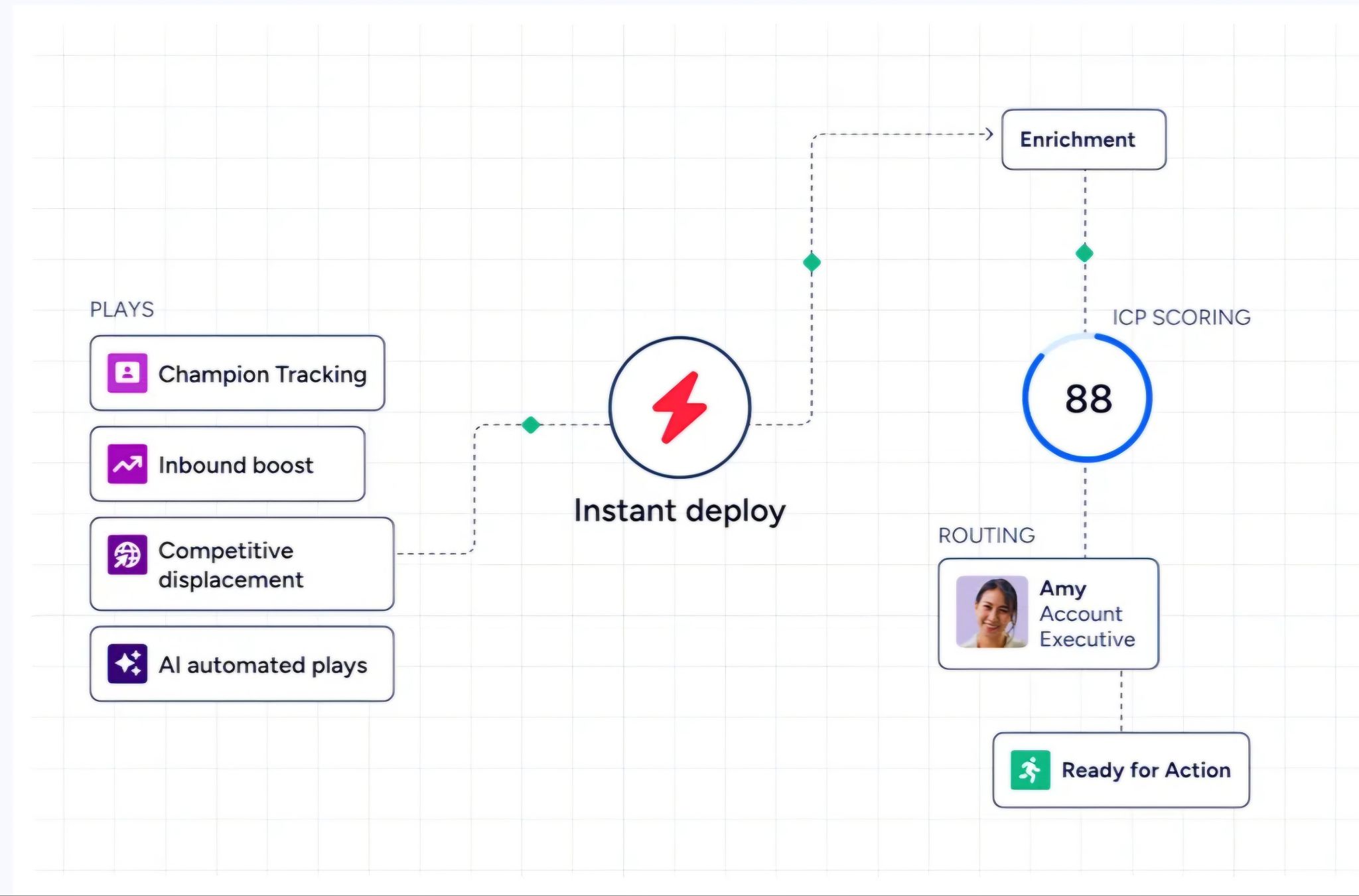
ZoomInfo provides three ways to access its intelligence.
GTM Workspace gives sellers a single interface with prioritized accounts, AI-drafted outreach, and deal execution. GTM Studio gives marketers and RevOps teams a builder for audience definition, campaign orchestration, and pipeline measurement using natural language. And APIs and MCP expose the same intelligence to any custom agent, internal tool, or partner platform.
Source: ZoomInfo
All three draw from one GTM Context Graph. The choice of interface never limits the intelligence available.
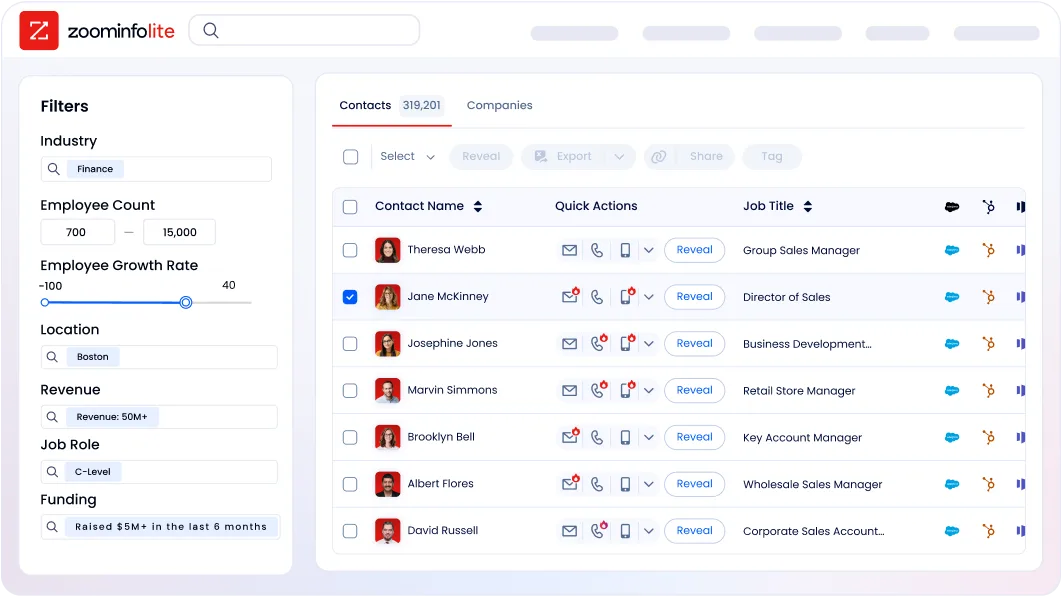
ZoomInfo also provides a permanent free tier. ZoomInfo Lite includes access to the B2B database, 10 monthly export credits, advanced search filters, the Chrome extension, WebSights Lite, and HubSpot integration, with no credit card or time limit.
BDO Canada's Senior Marketing Intelligence Analyst: "The plug-and-play aspect of the API means I can integrate it very easily into any process and get information at a moment's notice," achieving an 87% reduction in time spent on data dashboard updates. (BDO Canada)
Warmy and ZoomInfo: Comparison Summary
Aspect | Warmy | ZoomInfo |
|---|---|---|
Primary Focus | Email deliverability and warm-up | B2B data, intelligence, and GTM execution |
Core Problem Solved | Emails landing in spam instead of inbox | Finding, reaching, and converting the right buyers |
B2B Contact Database | Not included | 500M contacts, 200M+ verified business emails |
Email Warm-Up | Core product with AI optimization | Not included |
Buyer Intent Signals | Not included | Native intent data with Guided Intent |
Inbox Placement Testing | Multi-provider placement checker | Not included |
Multi-Channel Outreach | Email deliverability only | Email, phone, ads, social, direct mail |
AI Capabilities | Warm-up optimization, template testing | Account intelligence, outreach drafting, deal context |
CRM Integration | Not included | Salesforce, HubSpot, Dynamics 365 |
API Access | Available (quote-based) | Included in all relevant plans |
Free Tier | 7-day trial (1 mailbox, no credit card) | ZoomInfo Lite (permanent, no credit card) |
G2 Rating | 4.8/5 (522+ reviews) | Gartner Customers' Choice; 133 G2 No. 1 rankings |
Best For | Teams focused on sending infrastructure | Teams focused on the full outbound motion |
Final Verdict
Warmy and ZoomInfo serve different stages of the same outbound workflow. The choice depends on which problem you need to solve first.
Choose Warmy if your primary challenge is email deliverability. If your emails land in spam, your domains are new or damaged, or you need to maintain sender reputation across dozens of mailboxes, Warmy's AI-driven warm-up and placement testing address that directly.
The platform handles the infrastructure side of outbound with little manual effort, and its broad provider support covers nearly any sending setup. For teams that already have reliable contact data and know who they're targeting, Warmy fills a clear gap.
Choose ZoomInfo if your challenge extends beyond deliverability to the full outbound motion: identifying the right accounts, finding verified contacts, detecting buyer intent, and orchestrating outreach with AI-powered intelligence.
ZoomInfo's GTM Context Graph and 500M-contact database provide the targeting and intelligence that determine whether warm-up investments translate into pipeline. For teams building or scaling an outbound program, ZoomInfo provides the data and execution layer that deliverability tools don't cover.
Get started with ZoomInfo here.
For teams serious about outbound at scale, the two tools complement each other more than they compete. Warmy keeps the sending channel reliable. ZoomInfo ensures you're using that channel to reach the people who matter, when they're most likely to respond.
Warmy FAQ
What is Warmy used for?
Warmy is an email deliverability platform used to warm up new or damaged sending domains before launching outreach campaigns.
It builds sender reputation by sending AI-personalized emails through a network of real mailboxes, simulating human engagement, and rescuing emails from spam folders. It also provides inbox placement testing, authentication monitoring, and seed list tools. It does not provide contact data, CRM functionality, or outreach sequencing.
Does Warmy offer a free trial?
Yes. Warmy offers a 7-day free trial limited to one mailbox and one user, with no credit card required. The trial converts automatically to a paid plan at the then-current rate unless cancelled before expiration. There is no permanent free tier.
ZoomInfo, by comparison, offers both a 7-day free trial and a permanent free tier (ZoomInfo Lite) with access to its B2B database, 10 monthly export credits, and a Chrome extension.
How much does Warmy cost?
Warmy does not publish pricing. All plans (B2B Sender, B2C Sender, and Custom) require booking a demo for a quote. Pricing is volume-based, with discounts available for multiple mailboxes and startups. The Warm-Up with Clicks feature is a paid add-on with separate pricing.
How does Warmy's email warm-up work?
Warmy connects to your mailbox and sends personalized warm-up emails to its network of 300,000+ real mailboxes. The system opens, replies to, and marks these emails as important, gradually building positive engagement signals with email providers.
Volume increases over time based on a temperature setting (Slow, Medium, or Fast), and the Adeline AI engine continuously optimizes the schedule per mailbox. Users can also submit their actual outreach templates for warm-up, building content-level deliverability before campaigns launch.
What email providers does Warmy support?
Warmy supports any provider using IMAP/SMTP, including Gmail, Google Workspace, Outlook, Microsoft 365, Yahoo, Zoho, SendGrid, Amazon SES, Mailgun, iCloud, AOL, GMX, and Brevo. The platform also offers B2B-specific (G Suite, MS365) and B2C-specific (Gmail, Yahoo, Outlook) warm-up tracks with configurable provider weighting.
Is Warmy SOC 2 compliant?
Warmy displays a SOC 2 Type II badge on its homepage and marketing materials. However, the official help center article on SOC compliance (updated June 2026) states that the company does not yet have SOC compliance but is working toward it. Enterprise buyers should verify the current certification status directly with Warmy before making purchasing decisions based on compliance requirements.
Can Warmy replace a B2B data provider or outreach platform?
No. Warmy focuses on email deliverability: warm-up, inbox placement, sender reputation, and authentication monitoring. It does not provide contact databases, email verification, CRM functionality, buyer intent signals, or outreach sequencing.
Teams running outbound programs typically pair Warmy with a platform like ZoomInfo that provides verified B2B contacts, intent data, and AI-powered outreach tools.
Does Warmy have an API?
Warmy offers an API with endpoints for mailbox management, deliverability checking, and seed list operations. Access requires scheduling a call with Warmy's team, and pricing is negotiated separately from standard subscriptions. A Zapier integration and an n8n community node are available for no-code workflows.
However, users managing large numbers of domains report that bulk domain management via API is a gap, with most domain-level operations still requiring the UI.
Related breakdowns to help you choose:
