

Clearout started as an email verification service and has grown into a data quality platform that bundles email validation, email finding, form protection, CRM monitoring, and B2B prospecting under one credit system. For teams whose main concern is cleaning email lists before a campaign send, it offers a low-cost entry point with accuracy guarantees and 24/7 support.
To write this Clearout review, we analyzed it in depth. We believe it's the right choice if:
You need affordable, high-accuracy email verification with a formal deliverability guarantee
You want email finding and verification in one tool so discovered addresses arrive pre-verified
You need real-time form validation to block bad data before it enters your CRM
You value ISO 27001 and SOC 2 Type II compliance at SMB pricing
Your outreach stack runs on HubSpot or Apollo.io and you want native integrations
However, Clearout might not be the best choice if:
You need a B2B contact database, not just verification of data you already have
You require buyer intent signals, technographics, or org charts to prioritize accounts
Your go-to-market strategy demands multi-channel orchestration across sales, marketing, and operations
You need account intelligence that captures why deals move, not just contact validity
You want a platform that connects prospecting, engagement, and CRM enrichment in one system
In this case, you should consider ZoomInfo: an all-in-one GTM platform built on a B2B dataset of 500M contacts, 100M companies, 135M+ verified phone numbers, and 200M+ verified business emails, with buyer intent signals, conversation intelligence, and execution tools that take teams from data discovery through deal close.
We've included a detailed look at ZoomInfo later in this Clearout review because it represents the natural next step for teams that need more than data hygiene. If you're ready to explore a full GTM intelligence platform, you can start with ZoomInfo's free trial here.
What is Clearout?
Clearout is a data verification and prospecting platform founded by Gnanaprakash Rathinam. The company is incorporated as Clearout Inc. in San Francisco, with engineering operations in Bangalore, India. It was built entirely from revenue, with no outside funding, and has grown to serve 80,000+ businesses globally.
The platform started as an email verification service and has expanded into a suite covering the full data quality workflow: clean existing lists, find new verified contacts, and prevent bad data from entering systems at the source.
The current positioning frames Clearout as an "AI-Powered Solution to Discover Ideal Customers," reflecting this shift from list hygiene into prospecting and sales intelligence.
Clearout's core products include an Email Verifier with 20+ validation checks, an Email Finder that pre-verifies addresses at discovery, Form Guard for real-time form validation, Data Pulse for continuous CRM contact monitoring, and a Prospect module for building verified contact lists from LinkedIn and an in-app database. A separate ClearoutPhone product handles phone number validation across 240+ countries.
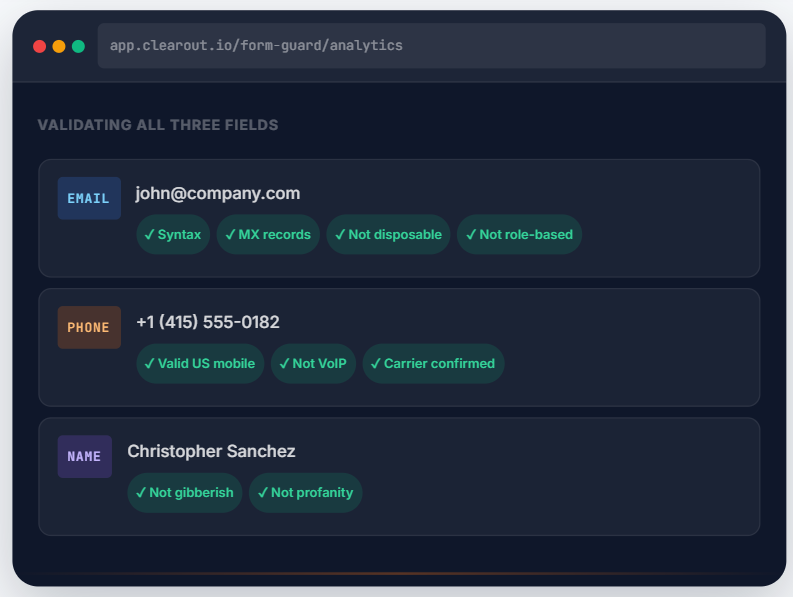
Source: Clearout
The typical Clearout customer is a marketing, sales, or growth team at a small to mid-sized company that needs to verify email lists before sends, block invalid signups at point of capture, or find verified emails for named prospects. G2 data shows 81% of reviewers come from small businesses and 17% from mid-market companies.
Clearout Pros & Cons
Pros | Cons |
|---|---|
- 99% claimed accuracy with a formal 3% bounce-rate guarantee | - Credit system draws the most user complaints (43 G2 mentions) |
- Lowest published price among major competitors ($5/1,000 verifications) | - Bulk verification speed flagged as slow (34 G2 mentions) |
- 24/7 support via chat, email, and phone | - Work email required at signup (Gmail/Yahoo rejected) |
- ISO 27001, SOC 2 Type II, and GDPR certified | - No native Salesforce integration (listed as "Upcoming") |
- Credits never expire on standard purchases | - Independent benchmarks dispute the 99% accuracy claim |
- Pre-verified email finding (no separate verification step) | - No buyer intent data or account intelligence |
- HubSpot Certified App with CRM integration | - 100 free credits is a limited starting point |
Clearout Review: How it Works & Key Features
Email Verifier: Clearout runs 20+ validation checks per address without sending an actual email.
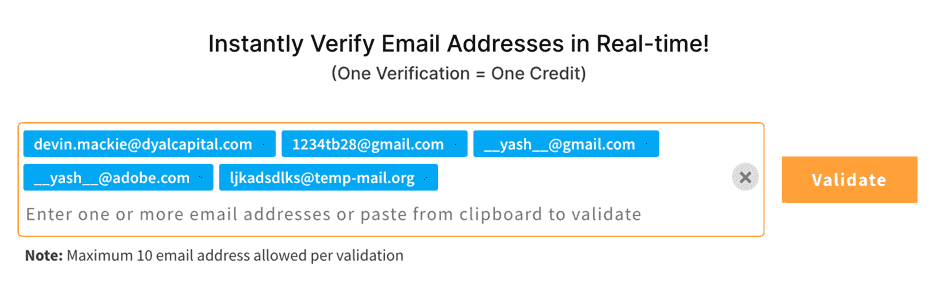
The Email Verifier is Clearout's core product. It confirms whether an email is valid, reachable, and safe to send to by communicating directly with the recipient's mail server via SMTP rather than sending a message.
Source: Clearout
The system runs four verification stages: syntax and format checking against RFC 5322 standards, DNS resolution to confirm valid MX records, SMTP server connectivity to verify mailbox existence, and an AI Verdict layer that scores deliverability using machine learning.
Each address returns with a primary status (Valid, Invalid, Catch All, Unknown), a Safe-to-Send flag (Yes, Risky, No, Unknown), and a detailed reason code. Users can choose between Fastest Turnaround and Highest Accuracy modes depending on whether speed or precision matters more.
Three verification modes are available: Quick Validation for paste-in instant results, Bulk Validation for CSV/XLSX files up to 2GB (processing 10,000 emails in about 3-4 minutes), and a REST API for real-time and bulk verification within custom workflows.
Clearout guarantees a bounce rate of 3% or less on addresses classified as Guaranteed Deliverable, provided the emails are sent within 24 hours of verification and were opt-in acquired. The platform also includes a proprietary anti-greylisting method and claims 96%+ accuracy on Yahoo and AOL addresses, which typically block standard SMTP pinging.
Users can import lists directly from connected services including Mailchimp, ActiveCampaign, Moosend, HubSpot, MailerLite, SendGrid, and Zoho. Credits are not charged for duplicates or Unknown-status results.
Email Finder: Clearout discovers and pre-verifies professional email addresses in a single step.
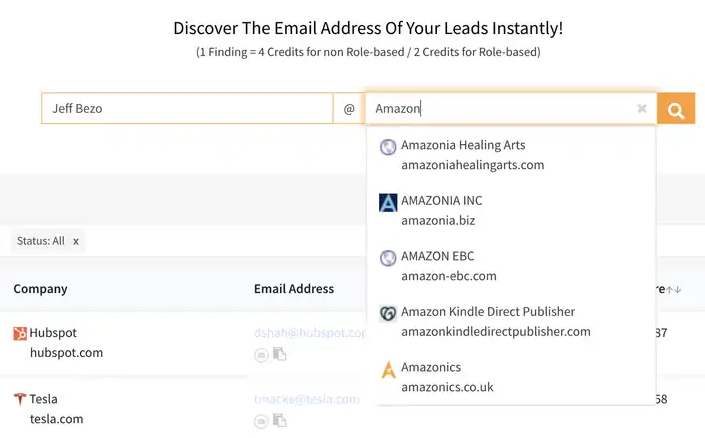
The Email Finder takes a prospect's name and company domain as input and returns a verified business email address. The key distinction from competitors: every discovered email is verified in real time before being returned, eliminating the two-step "find then verify" workflow that most tools require (and bill separately for).
Source: Clearout
The tool uses AI to match company names to correct email domains, discovers probable addresses by analyzing organizational patterns, and assigns a confidence score to each result. Scores of 90+ indicate high accuracy suitable for high-value sequences; 80-90 is moderate, suitable for newsletters; below 80 carries higher risk.
Credits are only charged on successful discovery: 4 credits for a personal email, 2 for a role-based email, and nothing if no email is found. An Autocomplete API resolves company names to correct sending domains with confidence scoring, reducing false positives from domain confusion during bulk enrichment.
The finder is available as a single-lookup Instant Finder, a Bulk Finder for list enrichment via CSV/XLSX, and through Zapier and Make integrations for automated workflows.
Form Guard: Clearout blocks bad data at the point of entry with real-time form validation.
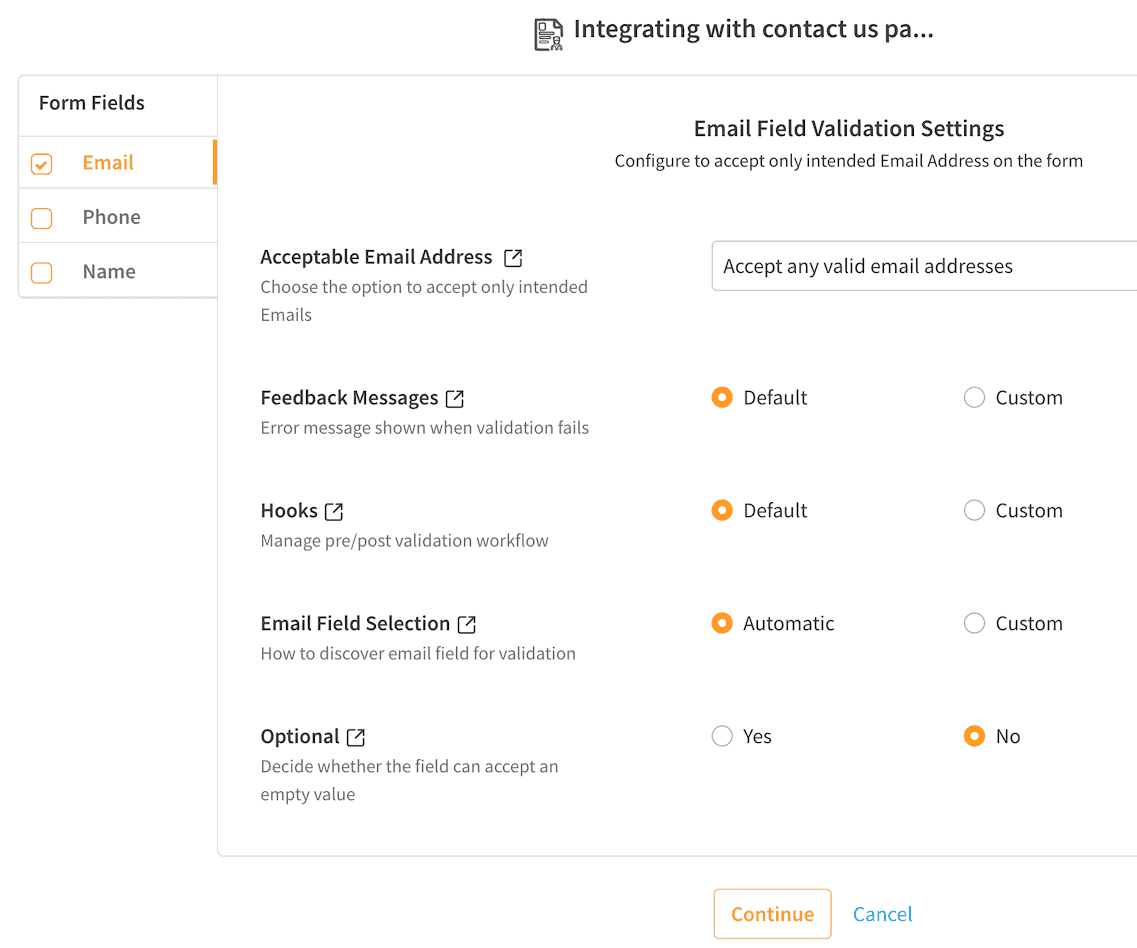
Form Guard sits between a web form and a CRM, validating email, phone, and name fields as visitors fill out forms. Unlike basic HTML5 validation or reCAPTCHA (which stops bots but not real people entering fake data), Form Guard connects directly to mail servers in real time to confirm whether an address is deliverable.
Source: Clearout
Setup requires embedding a single JavaScript snippet. No backend code is needed, and configuration changes apply immediately without re-embedding. Email validation offers configurable acceptance tiers: accept any valid email, accept only business and personal addresses, accept only business email, or accept only Safe To Send addresses.
Phone validation classifies numbers as mobile, landline, VoIP, or toll-free, with a Prefill Dial Code feature that auto-inserts the correct country code based on visitor geolocation. Name validation blocks profanity, gibberish, and bot-submitted strings.
Form Guard also enriches every verified contact with line type, carrier, location, timezone, mail server data, and deliverability insights at the moment of submission. Validation events are logged in real time, including partial form entries from visitors who didn't complete the form.
Data Pulse: Clearout monitors CRM contacts continuously with two-way HubSpot sync.
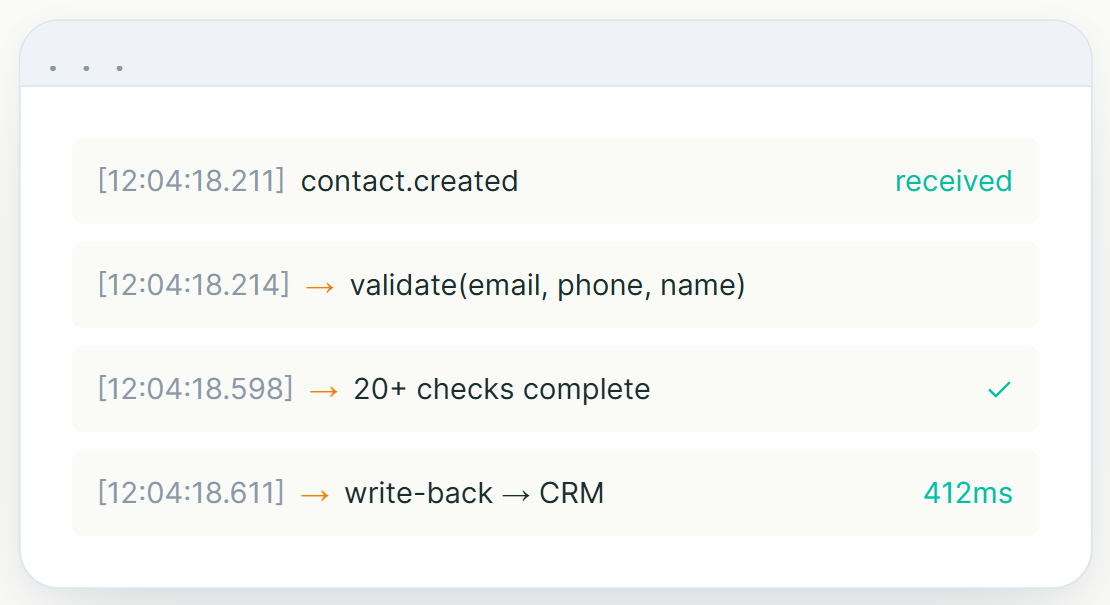
Data Pulse is Clearout's newest product, launched in June 2026. It intercepts contacts the moment they are created in HubSpot, validates email, phone, and name fields in about 412 milliseconds, and writes the cleaned, enriched record back automatically without requiring Zapier, Make, or any middleware.
Source: Clearout
The system listens to HubSpot's contact.created webhook event and runs 20+ validation checks before any rep or marketer acts on the new contact. Phone validation extracts carrier, country, timezone, E164 format, line type, and geographic location across 240+ countries. Administrators configure which output fields get written back to HubSpot to prevent field bloat.
If credits run out, Data Pulse parks the queue, notifies admins, and holds unprocessed contacts. Validation resumes automatically when credits are replenished. Weekly data quality reports are generated every Monday, and an insights engine categorizes findings into Validation, Growth, Actionable, and Educational insights.
The product is currently available only for HubSpot, with Salesforce, Zoho, and others pending.
Prospect: Clearout combines LinkedIn extraction with in-app search for building verified contact lists.
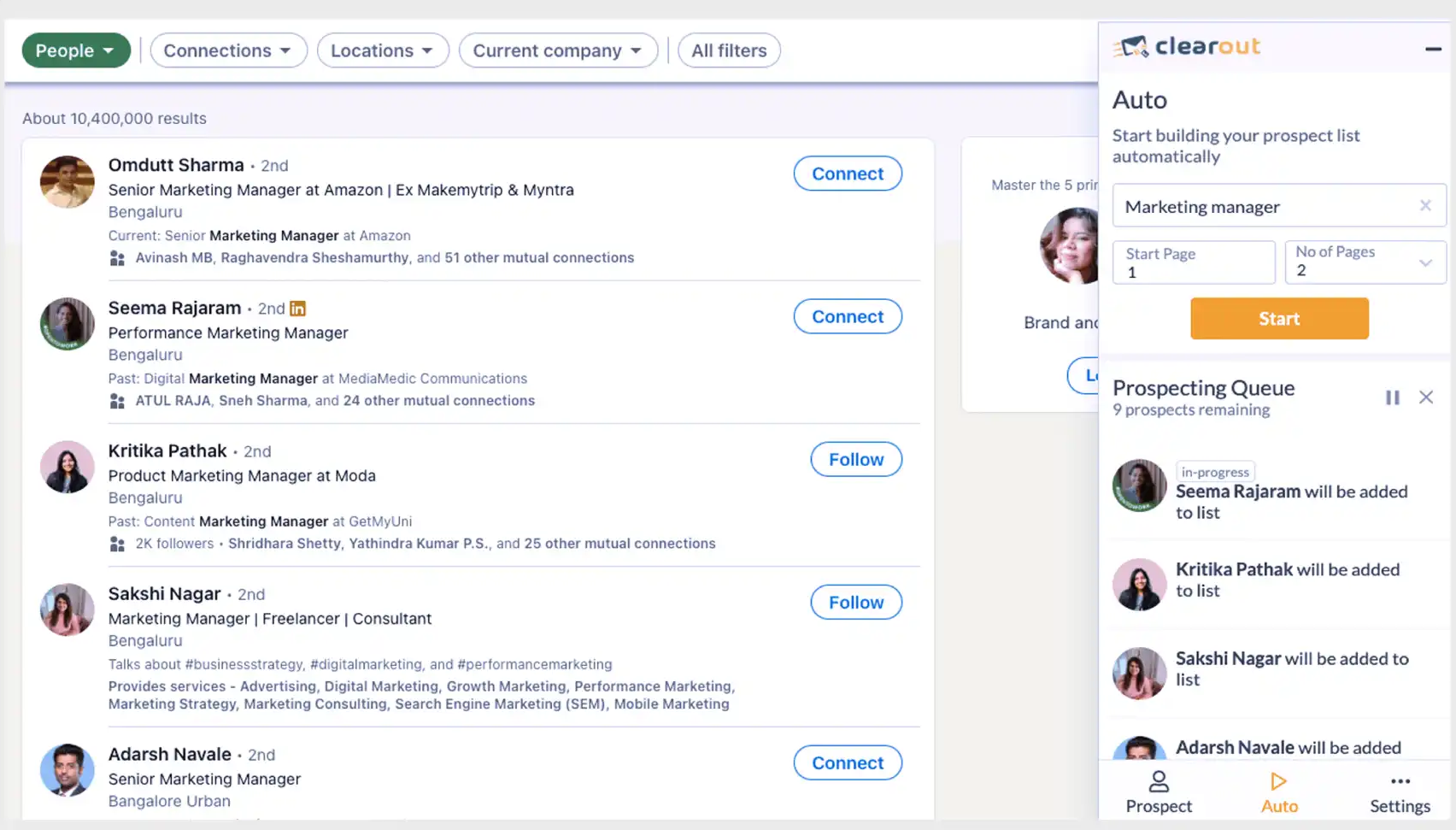
Clearout Prospect consolidates lead list building into a single workflow. It operates through two modes: a Chrome Extension that extracts verified contacts from LinkedIn profiles, searches, and Sales Navigator results, and an in-app Search & Enrich interface with 15+ filters for building lists from Clearout's own contact database.
Source: Clearout
The Chrome Extension supports manual selection of individual profiles or an auto mode that processes multiple pages. Throughput caps at 150 prospects per day on free LinkedIn, 500 on Premium, and 1,000 from Sales Navigator. The extension also works on Wellfound (formerly AngelList), capturing startup funding history, investor details, headcount, and roles.
All discovered contacts arrive pre-verified with 20+ validation checks at 99% claimed accuracy. Credits are consumed only on successful discovery. Both modes feed into the same list management workspace, with export options to CSV, Google Sheets, or connected CRMs and outreach tools.
Pricing Structure: Clearout uses a shared credit system across all products.
Clearout's credit-based pricing model charges credits rather than per-seat fees. All products draw from the same credit pool. Key credit rates:
Email Verifier: 1 credit per valid/invalid/catch-all result (unknown status free)
Email Finder: 4 credits per personal email found (0 if nothing found)
Form Guard: 2 credits per field validated
Data Pulse: 2 credits per contact field validated
Prospect: 4 credits per personal email; 2 per phone number
Clearout's own comparison table lists its price at $5 per 1,000 verifications versus $10 for ZeroBounce, $8 for NeverBounce, and $10 for Kickbox. Credits never expire on standard purchases, and deduplication is free.
Three purchasing modes are available: monthly subscription, annual subscription, and one-time pay-as-you-go (though PAYG is no longer available for new users). An Auto Credit Replenishment feature tops up credits when the balance falls below a configured threshold (minimum 5,000 credits).
New accounts receive 100 free credits with no credit card required, but a work email address is mandatory at registration. Enterprise customers get dedicated account management, Okta SSO, on-premise deployment, and private cloud options.
One pricing limitation: switching plans requires full payment for the new plan with no prorated refunds.
Where Clearout Falls Short
Clearout handles email verification and basic prospecting well, but several limitations surface for teams with broader go-to-market needs. These constraints reflect a platform built around data hygiene rather than full GTM intelligence.
Credit System Friction: This is the most common complaint. G2 aggregated data shows mentions flagging credit limitations.
Credits are consumed on invalid results as well as valid ones (only unknown status is free), which means a dirty list burns through credits on addresses that were never going to work. Higher-credit operations like prospecting (4 credits per email) and Form Guard (2 credits per field) can drain balances fast for high-volume users.
Bulk Processing Speed: G2 mentions flag slow bulk processing. Subscription plans allow up to 3 parallel lists; additional parallel capacity requires a paid add-on. For time-sensitive campaigns, this creates a bottleneck.
No Buyer Intent or Account Intelligence: Clearout tells you whether a contact's email is valid. It cannot tell you whether that contact's company is actively researching solutions like yours, what technologies they use, or how their organization is structured.
There are no intent signals, no technographic data, no org charts, and no account-level intelligence. For teams that need to prioritize who to reach, not just verify how to reach them, this is a fundamental gap.
Accuracy Claims Under Scrutiny: Clearout markets 99% accuracy, but the guarantee applies only to addresses classified as "Guaranteed Deliverable" and sent within 24 hours. Independent benchmarks from competitors have measured overall accuracy substantially lower. The gap between the marketing claim and real-world list accuracy is worth understanding before committing.
Integration Gaps: Some integrations (Drip, Campaign Monitor, Close.io, GetResponse, AWeber) remain in the "Upcoming" column, signaling a known backlog.
No GTM Execution Layer: Clearout can verify data and find contacts, but it provides no tools for engaging those contacts: no sales automation, no email sequences, no ad targeting, no conversation intelligence, no deal tracking. Teams still need separate tools for every step after the data is clean.
These limitations are the natural result of building a focused data quality tool. But they create a clear gap for teams whose challenge isn't just "is this email valid?" but "who should we be talking to, why, and what should we say?"
A Broader Alternative: ZoomInfo
ZoomInfo addresses Clearout's scope limitations by providing complete go-to-market infrastructure: from B2B data through intelligence and multi-channel execution, all in one platform.
The Most Comprehensive B2B Data: ZoomInfo operates the largest verified B2B dataset in the industry.
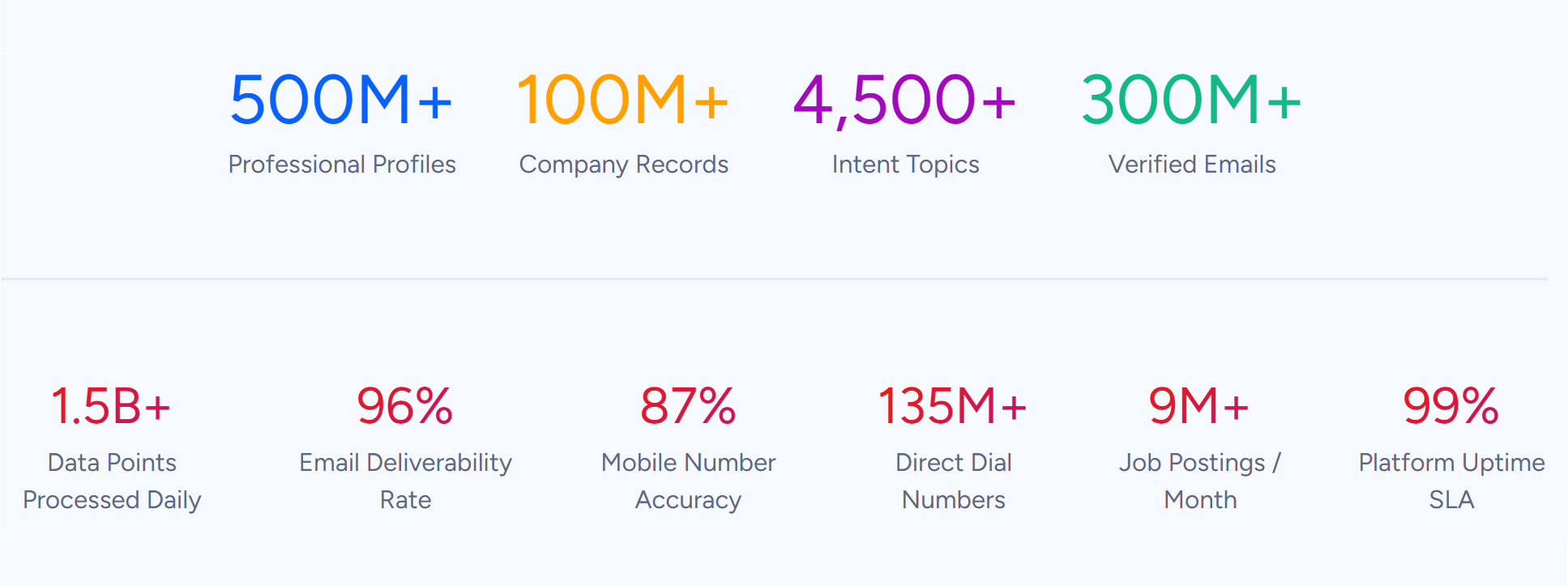
Where Clearout verifies data you already have, ZoomInfo provides the data itself. The platform covers 500M contacts, 100M companies, 135M+ verified phone numbers, 120M direct-dial phone numbers, and 200M+ verified business email addresses.
Source: ZoomInfo
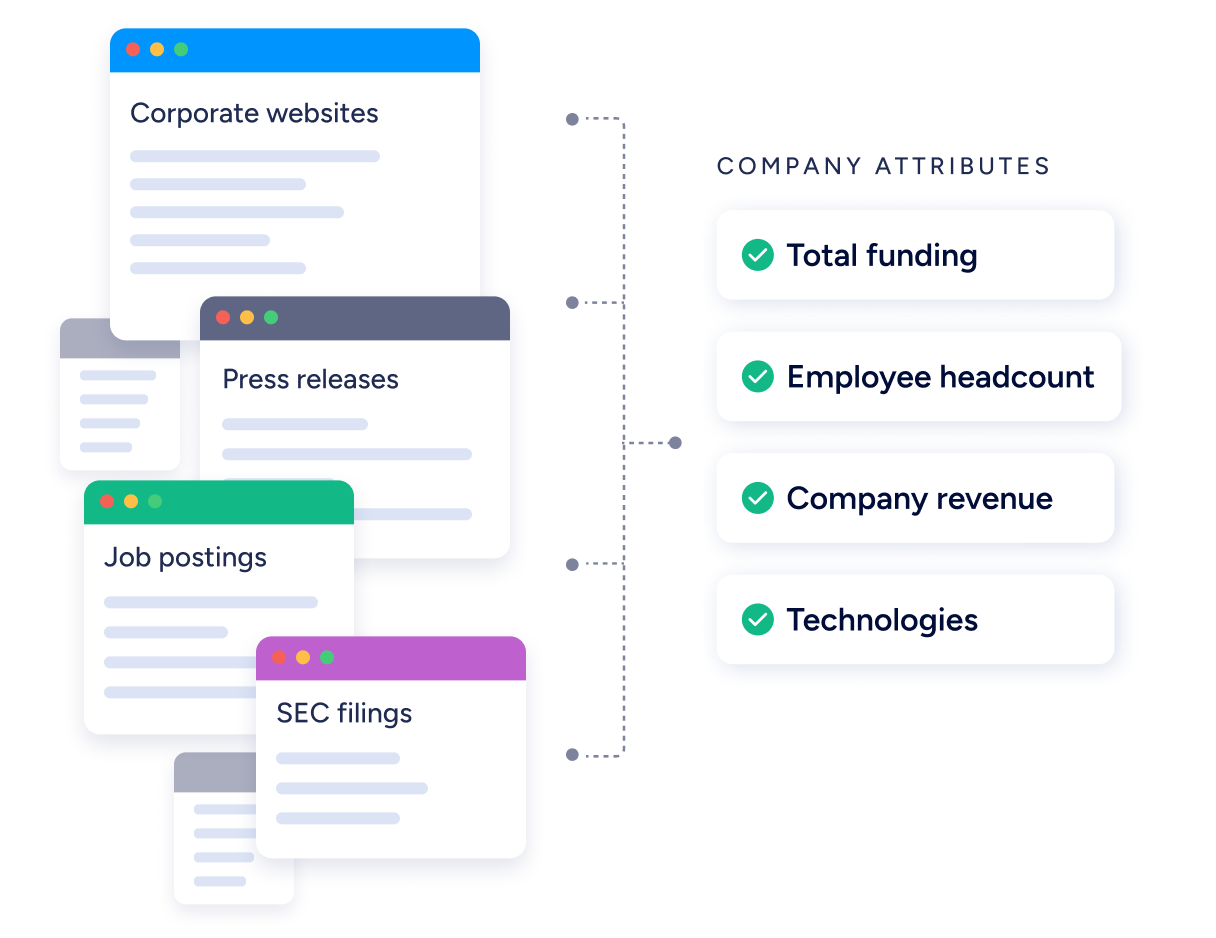
This data spans three dimensions: identity data (who buyers are and how to reach them), company context (org charts, technographics across 30,000+ technologies, industry classifications, and revenue data), and dynamic signals revealing when accounts are actively in-market.
ZoomInfo verifies data through a multi-source pipeline combining automated ML scanning of 28 million site domains daily, third-party partner data covering 95 million businesses, a community of 200,000+ users who share data back, and 300+ human researchers. First-party data reaches up to 95% accuracy.
Source: ZoomInfo
This advantage is externally validated. In a Fortune 500 competitive RFP analyzing 25 million contacts across vendors, the independent consultant concluded that "no other competitor came even close."
ZoomInfo holds 133 No. 1 rankings on G2 across Sales Intelligence, Buyer Intent, Data Quality, and Account Data Management categories, and has been named a Leader in the Gartner Magic Quadrant for ABM Platforms two years running.
"ZoomInfo gives us the information we need to execute. We don't have to spend our time digging. It's already there, so we can be three steps ahead." (Vensure)
GTM Context Graph: ZoomInfo's intelligence layer captures why deals move, not just what happened.
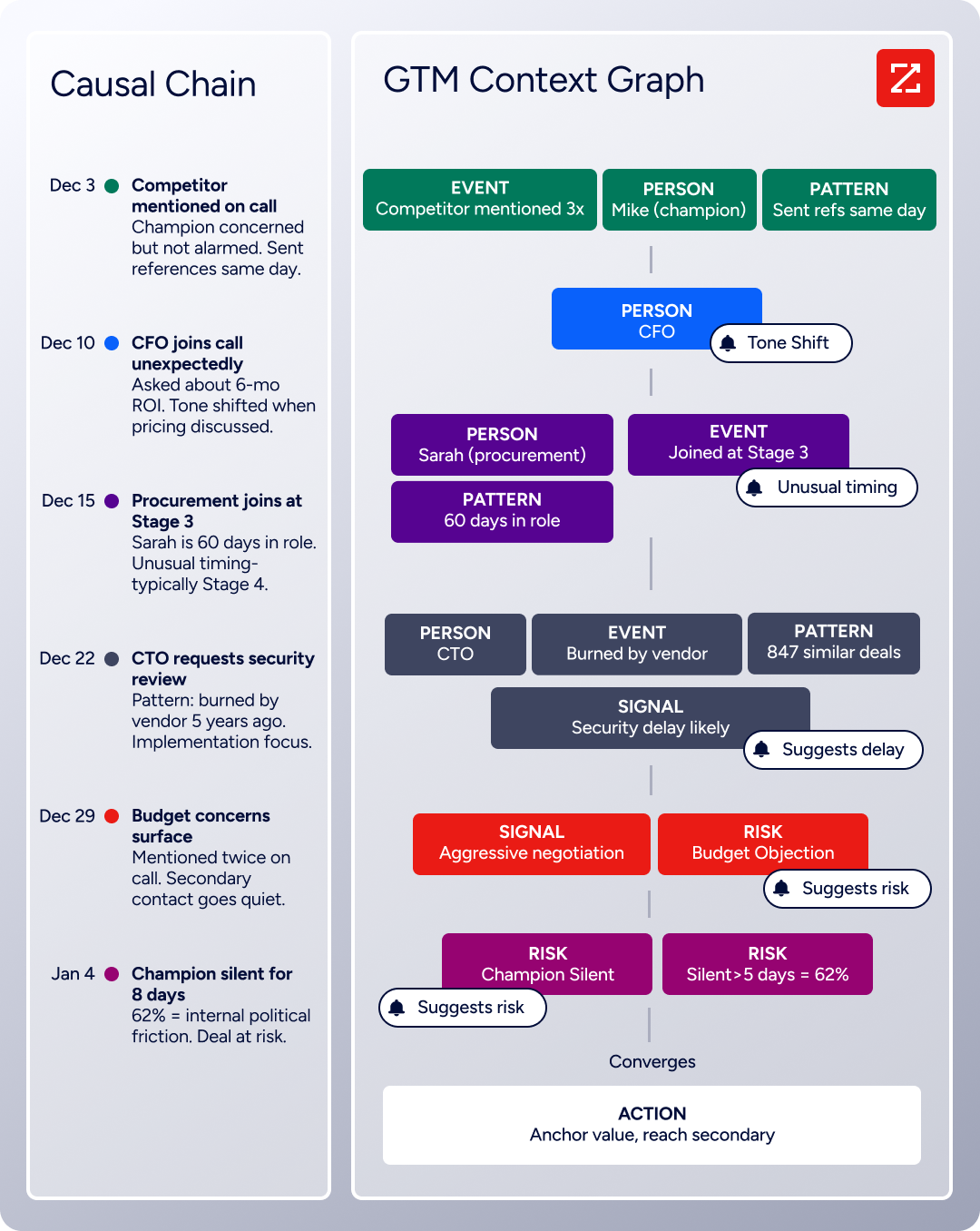
Clearout can tell you whether an email address is deliverable. ZoomInfo's GTM Context Graph, which processes 1.5B + data points daily, tells you why a deal accelerated, why a champion went quiet, and which accounts match your proven win patterns.
Source: ZoomInfo
The GTM Context Graph fuses ZoomInfo's B2B data with a customer's own CRM records, conversation transcripts from calls and meetings, email interactions, and behavioral signals into a single intelligence layer.
A CRM records that a deal moved to Stage 3. Conversation intelligence captures what the VP of Finance said on the last call. Intent data logs a spike in research activity. The GTM Context Graph connects all three to surface the relationships between signals and outcomes.
This intelligence layer exists because of two decades of infrastructure investment. ZoomInfo built the largest B2B data unification platform and acquired the conversation and behavioral intelligence engines (Chorus, Workbounce) that capture context across every buyer interaction. No point solution can replicate it.
"That combination of our internal CRM data, external signals, and AI that's given all that context has helped us craft very specific account- and persona-based messages. And people have responded to them right away." (Seismic)
Universal Access: ZoomInfo's intelligence works in any tool, any workflow, any AI agent.
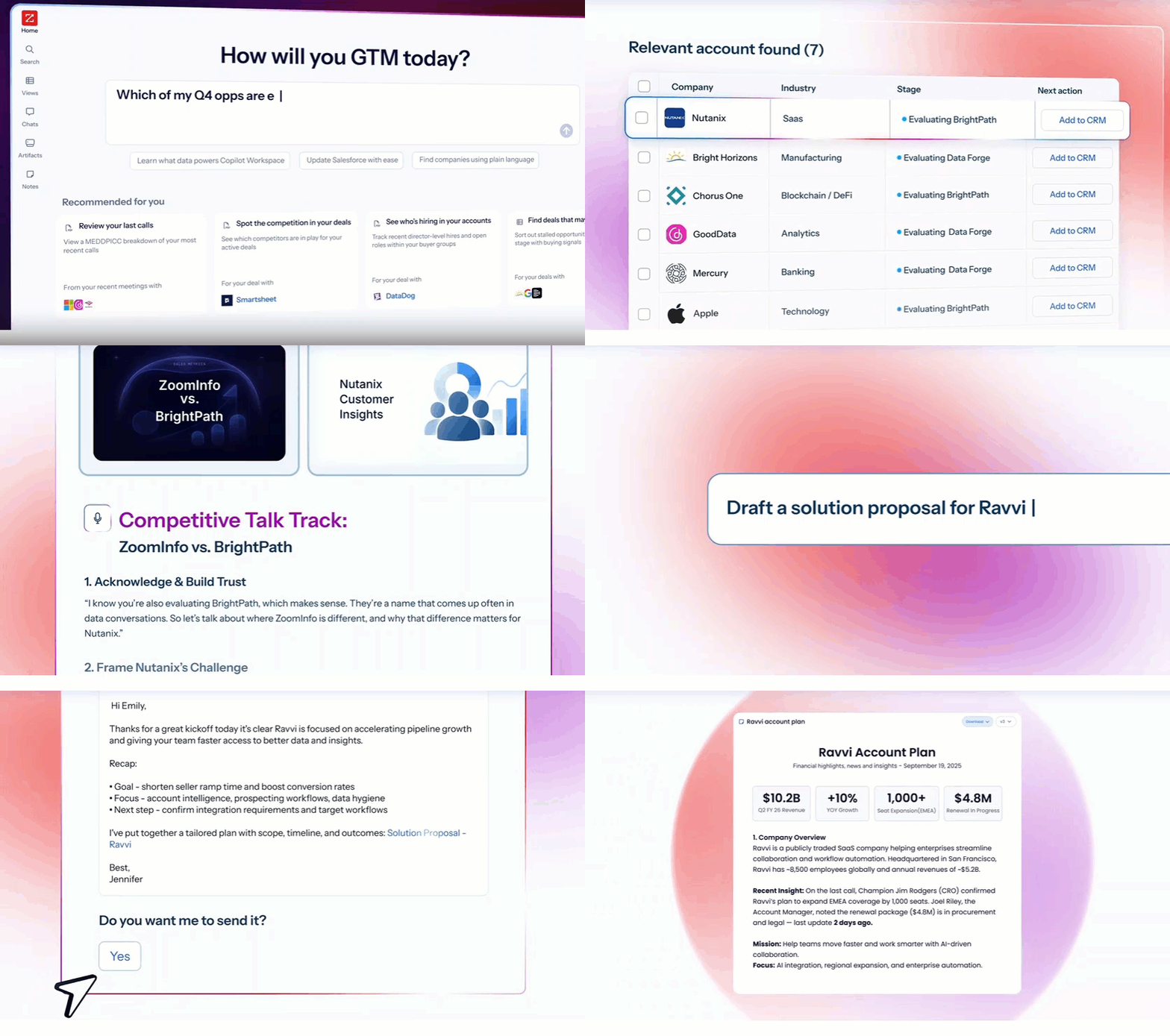
ZoomInfo delivers its intelligence through three channels. GTM Workspace gives sellers a single interface with prioritized accounts, AI-drafted outreach, and deal execution.
Source: ZoomInfo
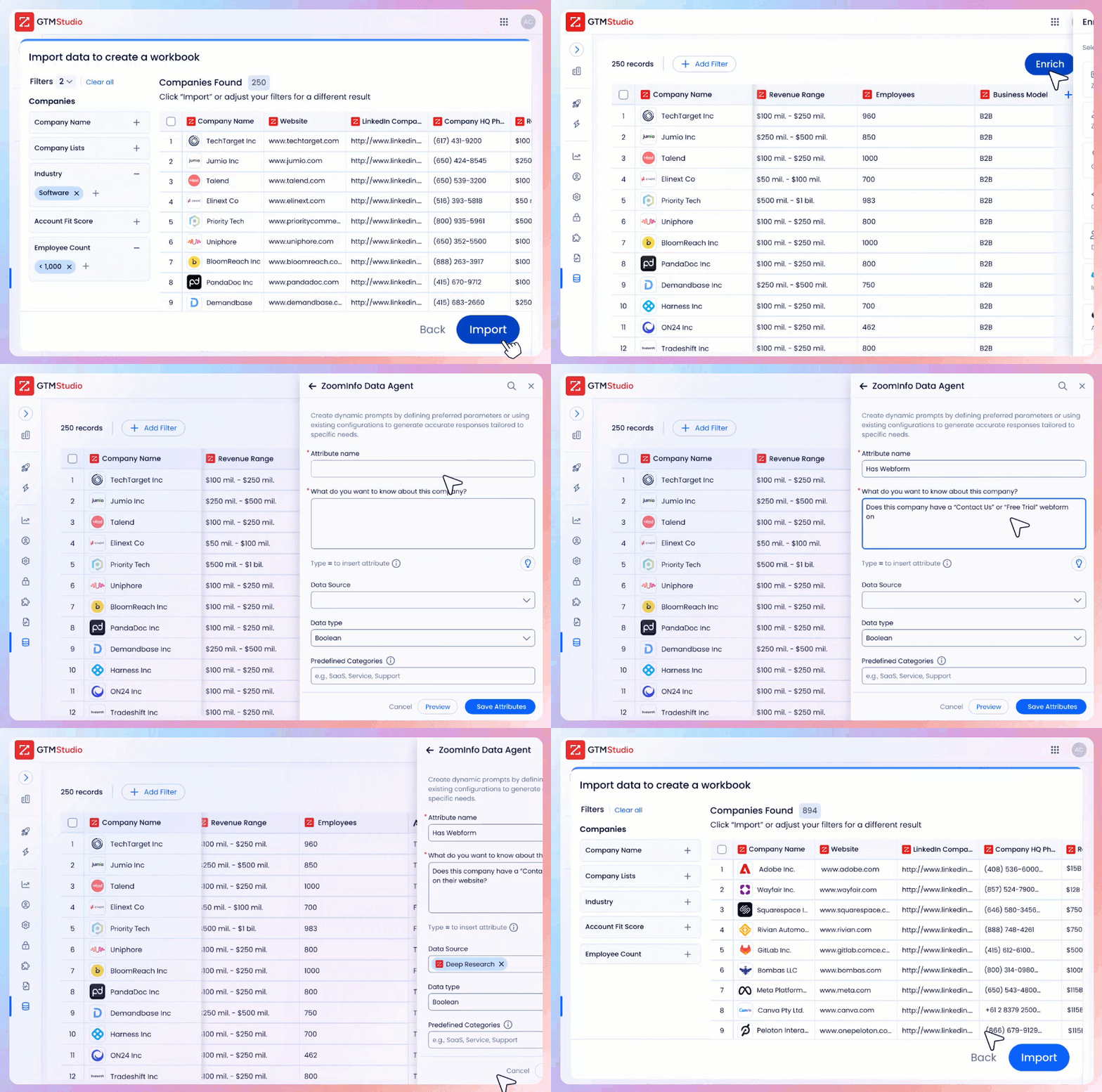
GTM Studio gives marketers and RevOps a canvas for audience definition, campaign orchestration, and pipeline measurement in natural language. And for teams that build beyond ZoomInfo's products, APIs and MCP expose the same intelligence to any custom agent or third-party platform.
Source: ZoomInfo
All three channels draw from one GTM Context Graph: the same data, the same intelligence, the same continuously learning model. The choice of where to work never limits the quality of intelligence available.
Customer results show the impact. Seismic attributed 39% of active pipeline to ZoomInfo signals, with reps 54% more productive. Redwood Logistics achieved a 99% reduction in cost-per-click and a 310% increase in clickthrough rate. Snowflake saw 90% higher opportunity open rates and 2x higher customer conversion on accounts monitored with ZoomInfo-powered scores.
Pricing: ZoomInfo offers consumption-based pricing with a permanent free tier.
ZoomInfo uses consumption-based pricing scaled to usage patterns, users, and feature needs. Paid plans are organized into Sales tiers (Professional, Advanced, Enterprise) and Marketing tiers (Marketing Demand, ABM Lite, ABM Enterprise), with Chorus and Chat available as standalone products.
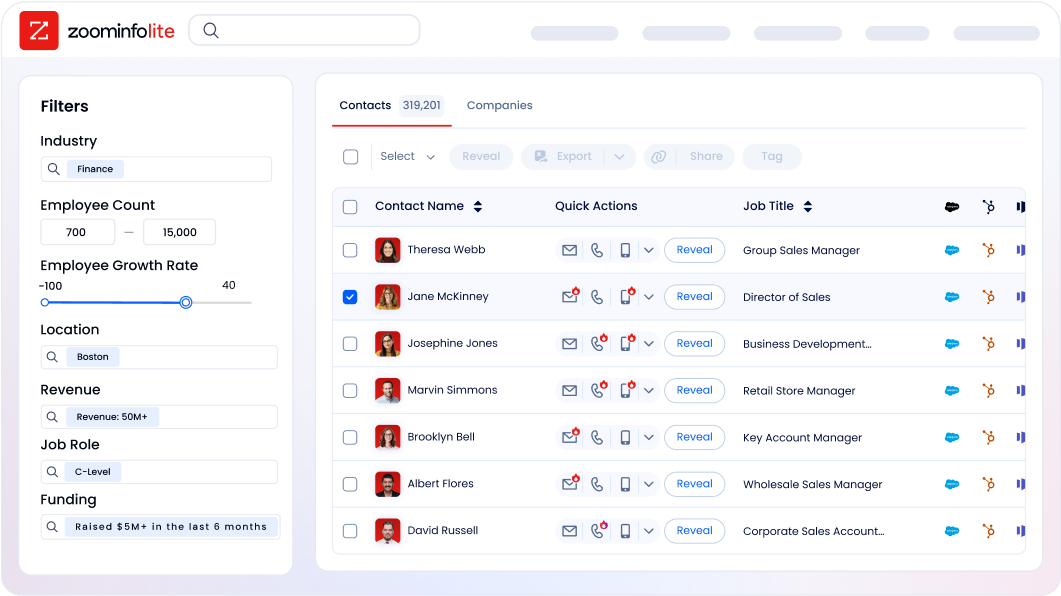
ZoomInfo Lite is a permanent free tier (not a trial) with access to ZoomInfo's B2B database, 10 monthly export credits, individual and company searches, the ReachOut Chrome Extension, and WebSights Lite for up to 10 website visitor reveals per day. A separate 7-day free trial provides access to additional features for evaluation.
Source: ZoomInfo
Clearout or ZoomInfo: Comparison Summary
Clearout | ZoomInfo | |
|---|---|---|
Primary focus | Email verification and data hygiene | All-in-one GTM platform |
Contact database | Find-and-verify on demand; no proprietary database | |
Email verification | 20+ checks, 99% claimed accuracy, 3% bounce guarantee | Built-in verification via NeverBounce acquisition |
Phone data | ClearoutPhone for validation across 240+ countries | |
Buyer intent data | Not available | |
Technographics | Not available | |
AI intelligence | AI Verdict on email deliverability | GTM Context Graph intelligence across deals, signals, and outcomes |
Sales execution | No outreach or engagement tools | GTM Workspace with AI agents, outreach, and CRM sync |
Marketing orchestration | No campaign tools | GTM Studio with multi-channel plays and audience AI |
CRM integrations | HubSpot (certified), Apollo, Zoho; Salesforce pending | Salesforce, HubSpot, Dynamics 365, 120+ marketplace partners |
Form validation | Form Guard (email, phone, name) | FormComplete (reduces forms to one field, auto-appends data) |
Conversation intelligence | Not available | Chorus (call recording, transcription, AI analysis) |
Compliance | ISO 27001, SOC 2 Type II, GDPR | ISO 27001, ISO 27701, SOC 2 Type II, TRUSTe GDPR/CCPA |
Free tier | 100 credits (one-time) | ZoomInfo Lite (permanent, 10 exports/month) + 7-day trial |
Pricing model | Credit-based, from $5/1,000 verifications | Consumption-based, custom-quoted |
Best for | Email list hygiene and data quality | Full go-to-market intelligence and execution |
Final Verdict
The choice between Clearout and ZoomInfo depends on the scope of your go-to-market needs.
Choose Clearout if your primary challenge is email data quality. It verifies existing lists well, finds verified emails for named prospects, and prevents bad data from entering your CRM through forms.
The low price point ($5 per 1,000 verifications), formal deliverability guarantee, and compliance certifications make it a strong fit for teams whose outreach infrastructure is already in place and just needs cleaner data flowing through it. If you know who you want to reach and need to confirm their email works, Clearout does that job efficiently.
Choose ZoomInfo if your challenge extends beyond data hygiene into identifying who to target, understanding when they're ready to buy, and executing across the full go-to-market motion.
With the industry's largest B2B dataset, the GTM Context Graph that captures why deals move and which signals matter, and access through GTM Workspace, GTM Studio, and APIs/MCP, ZoomInfo provides the intelligence and execution infrastructure that turns data into pipeline. For teams ready to move from "is this email valid?" to "which accounts should we pursue, and what should we say?", ZoomInfo connects those answers.
Get started with ZoomInfo here.
Clearout solves the data quality problem well. ZoomInfo solves the go-to-market problem entirely. Your choice depends on which problem defines your current stage.
Clearout FAQ
Is Clearout accurate?
Clearout claims 99% accuracy on its email verification, backed by a formal guarantee that bounce rates will not exceed 3% on addresses classified as Guaranteed Deliverable, provided emails are sent within 24 hours of verification. However, independent benchmarks have measured overall accuracy lower than the marketing figure. The guarantee applies to a specific subset of results, not every address in a list.
ZoomInfo's data reaches up to 95% accuracy on first-party data, verified through a pipeline of automated scanning, third-party data, community input from 200,000+ users, and 300+ human researchers.
Does Clearout have a free plan?
Clearout offers 100 free credits at signup with no credit card required. This is a one-time grant, not a recurring allocation. A work email address is mandatory at registration; Gmail, Yahoo, and other free email providers are rejected.
ZoomInfo offers ZoomInfo Lite, a permanent free tier with 10 monthly export credits, access to the B2B database, search filters, the Chrome extension, and WebSights Lite for website visitor identification.
What integrations does Clearout support?
Clearout integrates natively with HubSpot (as a Certified App), Apollo.io, Zoho CRM, GoHighLevel, Mailchimp, ActiveCampaign, SendGrid, Lemlist, and several form builders. Automation platforms include Zapier, Make, Pabbly, Integrately, and n8n. Salesforce integration is listed as "Upcoming."
ZoomInfo's marketplace lists 120+ integration partners across CRM, marketing automation, sales engagement, data warehouses, and AI platforms, with native connectors for Salesforce, HubSpot, Microsoft Dynamics 365, Snowflake, and others.
How does Clearout's credit system work?
All Clearout products share a single credit pool. Email verification costs 1 credit per result, email finding costs 4 credits per personal email found, Form Guard costs 2 credits per field validated, and Data Pulse costs 2 credits per contact field.
Credits are not charged for unknown status results or duplicate addresses. Standard credits never expire. The most common user complaint on G2 involves credit limitations, with 43 mentions flagging the system as restrictive for high-volume use.
Can Clearout replace a B2B contact database?
No. Clearout verifies and finds email addresses, but it does not maintain a proprietary contact database with company attributes, technographic, or intent data. Its Prospect module includes an in-app search function, but the database scope is not comparable to dedicated B2B intelligence platforms.
ZoomInfo operates a database of 500M contacts and 100M companies with org charts, technographics covering 30,000+ technologies, buyer intent signals, and hiring and funding data.
Does Clearout offer buyer intent data?
No. Clearout focuses on data verification, email finding, and form protection. It does not provide buyer intent signals, technographic data, or any indicator of whether a company is actively researching solutions.
ZoomInfo tracks intent signals from 210 million IP-to-Organization pairings and over 6 trillion keyword-to-device pairings monthly, and offers Guided Intent, which identifies topics historically correlated with deal success.
What is Clearout's Form Guard?
Form Guard is a real-time form validation tool that blocks spam, bots, and invalid contact data at the point of entry. It validates email, phone, and name fields using a single JavaScript snippet embedded in a web page. Unlike reCAPTCHA, which stops bots, Form Guard validates whether the data entered is deliverable by connecting to mail servers in real time. It costs 2 credits per field validated.
ZoomInfo offers FormComplete, which takes a different approach: it reduces forms to a single field and auto-appends the remaining data from ZoomInfo's database. Smartsheet reported a 40%+ increase in form fills and an 84% increase in MQLs using FormComplete.
Does Clearout validate phone numbers?
Yes, through ClearoutPhone, a separate product that validates phone numbers across 240+ countries. It classifies numbers as mobile, landline, VoIP, or toll-free and provides carrier, timezone, and geographic data. Phone validation is also built into Form Guard and Data Pulse.
ZoomInfo takes a different approach by maintaining a database of 135M+ verified phone numbers and 120M direct-dial numbers, providing the numbers themselves rather than just validating numbers you already have.
Researching Clearout? These comparisons and alternatives help you decide:
