

Bouncer has earned a reputation as a reliable email verification tool, especially among European businesses and agencies that need GDPR compliance and accurate deliverability results. The pitch is simple: upload your email list, and Bouncer tells you which addresses are real, which are risky, and which will bounce.
To write this Bouncer review, we analyzed the platform in detail. We believe it's the right choice if:
You need to clean existing email lists before sending campaigns
GDPR compliance and EU-based data hosting are hard requirements
You want a pay-as-you-go model with no subscription commitment for verification
You value a formal accuracy guarantee backed by credit refunds
Your main concern is protecting sender reputation from hard bounces
However, Bouncer might not be the best choice if:
You need to find and verify contacts in the first place, not just clean existing lists
You want buyer intent signals, company intelligence, and contact discovery in one platform
You require verified direct-dial phone numbers alongside email verification
Your team needs AI-powered prospecting and outreach automation
You want a complete go-to-market solution rather than a single-purpose verification tool
In this case, consider ZoomInfo: an AI-powered GTM platform that provides pre-verified contact data at scale (200M+ verified business email addresses and 135M+ verified phone numbers), combined with buyer intent signals, company intelligence, and AI execution tools.
Rather than cleaning emails after the fact, ZoomInfo gives you verified contacts from the start and adds the intelligence to know which ones are worth reaching out to.
We've included a detailed look at ZoomInfo later in this review as the broader alternative for teams that need more than list hygiene. If you're ready to explore a platform that starts with verified data, you can get started with ZoomInfo here.
What is Bouncer?
Bouncer is an email verification SaaS platform founded in 2017 and headquartered in Wroclaw, Poland.
The company uses the tagline "Powerful, Secure and Caring Email Verification," reflecting three priorities: accuracy, EU-hosted GDPR-compliant infrastructure, and responsive human support.
The core product validates email addresses without sending actual emails. Bouncer checks syntax, DNS and MX records, and communicates with recipient mail servers using proprietary algorithms to determine whether an address exists and will accept mail. The platform says it has verified over 4 billion email addresses and prevented more than 500 million bounces.
Beyond bulk verification, Bouncer has expanded into a broader suite: Bouncer Shield for real-time form protection, AutoClean for automated CRM hygiene, a Toxicity Check for flagging spam traps and complainers, a Deliverability Kit for inbox placement testing, Data Enrichment for appending company information, and Email Engagement Insights for assessing inbox activity levels.
Source: Bouncer
The platform targets six buyer segments: SaaS companies, enterprises, agencies, lead generation teams, in-house marketers, and engineers who need API-level integration.
Bouncer Pros & Cons
Pros | Cons |
|---|---|
- Over 99% accuracy with a formal refund guarantee | - Cannot verify Microsoft-hosted emails (Hotmail, Outlook, Live) |
- Credits never expire and no charge for unknowns or duplicates | - Pricing perceived as high for large-volume users |
- Less than 2% "unknown" results | - Only 100 free credits on signup |
- GDPR-compliant with EU-only data hosting | - Limited reporting and analytics |
- 22 native integrations with major ESPs and CRMs | - Small team (~8 named members) may concern enterprise buyers |
- Product suite beyond basic verification | - Occasional API/dashboard result discrepancies reported |
- Responsive human support across all plan tiers | - No contact discovery or prospecting capabilities |
Bouncer Review: How it Works & Key Features
Bulk Email Verification: Bouncer's flagship product validates entire mailing lists without sending a single email.
Bouncer's email verification runs each address through a multi-step process: syntax validation, DNS and MX record checks, and an SMTP server connection using proprietary algorithms built to handle catch-all domains, anti-spam filter-protected addresses, and niche regional providers.
Source: Bouncer
Every verified address returns one of four statuses: deliverable, risky, undeliverable, or unknown, along with a reason code and a deliverability score from 0 to 100. Results also include domain-level data (whether it's catch-all, disposable, or free) and account-level flags (role-based, disabled, or full mailbox).
Two features stand out in the bulk verification flow. First, a free list sampling tool analyzes a random sample of your list at no cost, helping you decide whether full cleaning is worth the credits. Second, a bounce estimate calculates how many addresses in the full list are likely to fail before you commit any credits.
Processing speed reaches 180,000 emails per hour by default, and the platform maintains less than 2% "unknown" results across verifications. When an address looks questionable, Bouncer marks it "unknown" rather than incorrectly flagging a real contact as undeliverable.
The Bouncer Guarantee formalizes this: if an address marked as deliverable hard-bounces within 72 hours for an objective reason, Bouncer refunds the credits.
Email Verification API: Three endpoint modes under one key for developers who need programmatic access.
Bouncer's Email Verification API offers three modes matched to different use cases:
Real-Time (GET /v1.1/email/verify) verifies a single email synchronously, returning the best result within 10 seconds (30 seconds maximum). It suits signup form validation where response time is critical, though it produces roughly 5% more "unknown" results than batch mode due to time constraints. Rate limit: 1,000 requests per minute.
Batch (POST /v1.1/email/verify/batch) handles up to 500,000 emails per batch asynchronously, with callback URL support for webhook notifications when processing completes. Default throughput sits at 100,000–200,000 emails per hour.
Batch Sync (POST /v1.1/email/verify/batch/sync) accepts up to 10,000 emails per request and returns results synchronously. A 24-hour result cache prevents re-verification of the same address within a day, saving credits on repeated submissions.
The API uses a simple x-api-key header for authentication (keys must never be passed in the URL). A sandbox environment provides pre-configured test email addresses for each possible result state, free of charge, so developers can test integrations without burning credits.
Bouncer publishes one official SDK: a Java client library. For other languages, developers build their own client against the REST API.
Bouncer Shield: Real-time form protection that blocks invalid emails before they reach your database.
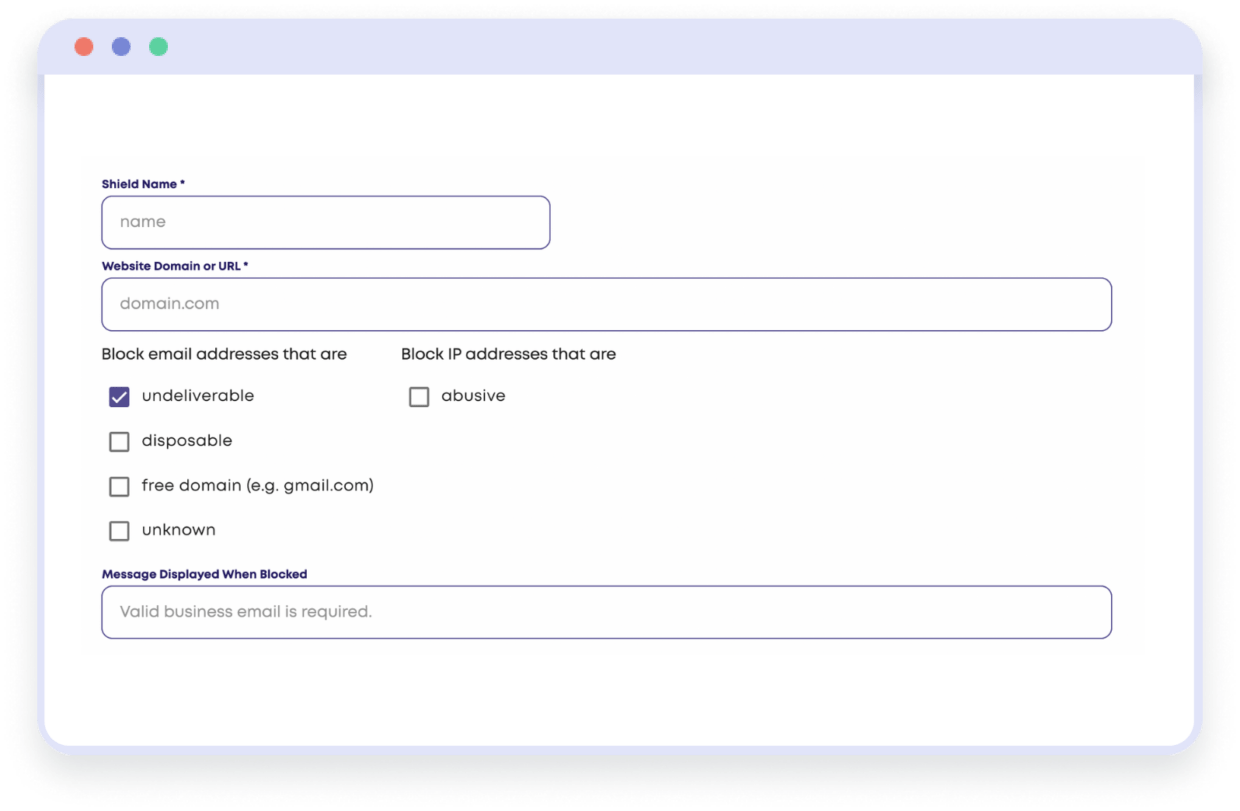
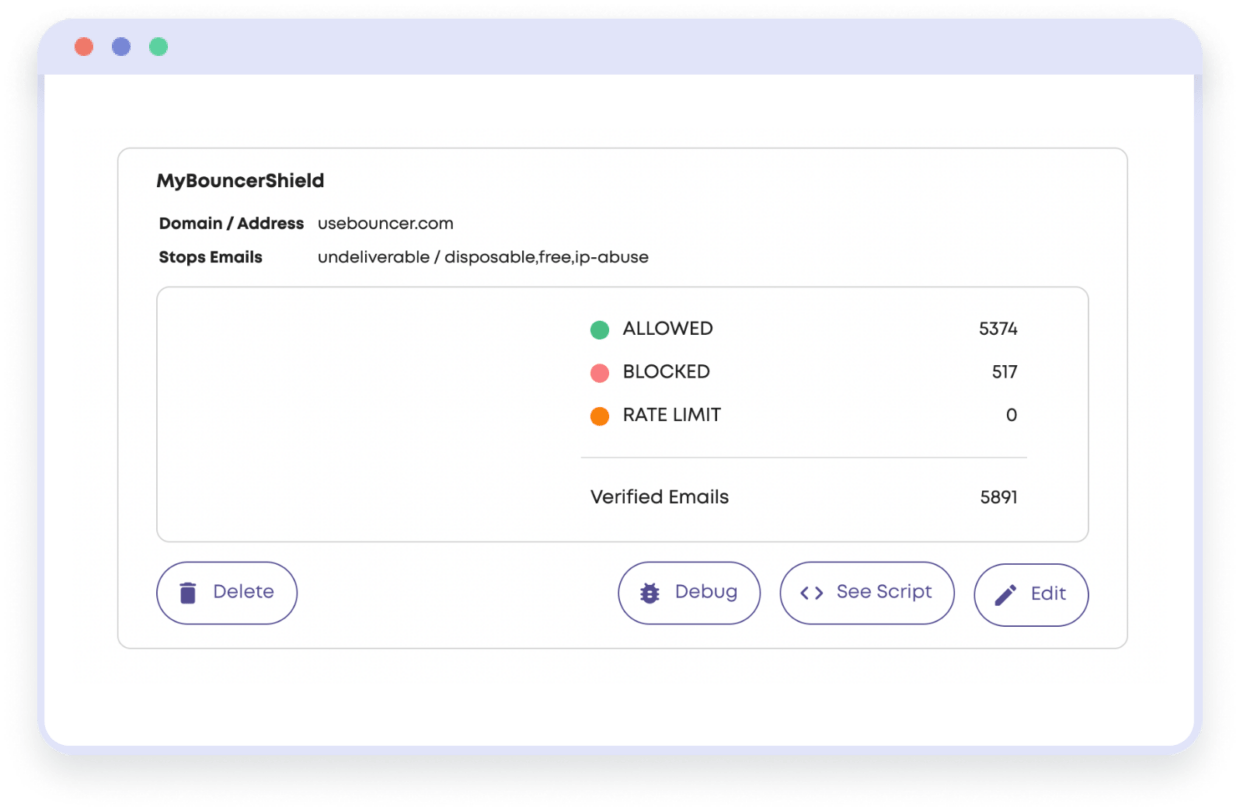
Bouncer Shield intercepts email submissions at the form level and validates them through the same verification engine as the core product.
Source: Bouncer
Unlike the API, Shield requires no backend integration and no developer involvement. Setup takes three steps: configure which email types to block in the dashboard, paste a JavaScript snippet onto your webpage, and Shield runs automatically.
Shield catches typos, blocks disposable email providers, screens for toxicity, and includes built-in IP checks that throttle abusive form submissions. Each Shield instance can be assigned to a separate domain with its own configuration.
Pricing starts at $2/month for 1,000 monthly checks and scales to $1,050/month for 1,000,000 checks. A white-label option removes the "Powered by Bouncer" branding for an additional fee.
Toxicity Check: Identifies deliverable addresses that are still dangerous to send to.
Standard verification confirms whether an address is live. The Toxicity Check goes further, scoring addresses on a 1–5 scale for risk factors that can damage sender reputation without producing a bounce. It flags five categories: widely circulated emails, breached/hacked accounts, known complainers, litigators, and potential spam traps.
Source: Bouncer
The underlying database is described as "BLACKBOX data," the same database used by the biggest Email Service Providers.
Rather than simply flagging suspected spam traps (which the company acknowledges are impossible to identify precisely), Bouncer provides a toxicity score that lets senders make tiered decisions. Addresses scoring 4–5 are candidates for automatic suppression; score 3 warrants manual review.
Deliverability Kit and Additional Tools: Bouncer extends beyond verification into inbox placement and enrichment.
The Deliverability Kit is a separate subscription product (powered by EmailConsul) that solves a different problem: even a clean list won't help if your sending infrastructure is misconfigured.
The Kit combines inbox placement testing (send to seed addresses and see where emails land), authentication verification (SPF, DKIM, DMARC checks), SpamAssassin content scoring, and continuous IP/domain blocklist monitoring. Plans start at $25/month for 250 test emails.
AutoClean connects to HubSpot or Klaviyo (with more CRMs "coming soon") and runs continuous re-verification on a configurable schedule. New contacts are checked hourly, existing contacts are re-verified every X days, and results are written back to the CRM as a "Bouncer Recommends" field with three dispositions: Keep, Suppress, or Quarantine.
Data Enrichment is a free add-on that appends company-level data (company name, country, founding year, industry, LinkedIn URL, and company size) to B2B email addresses during verification. Email Engagement Insights (also free) categorizes contacts by inbox activity level, helping senders spot dormant addresses that are technically deliverable but unlikely to engage.
Source: Bouncer
Pricing: Pay-as-you-go credits that never expire, with no subscription required for core verification.
Bouncer's email verification pricing is credit-based with volume discounts:
Credits | Total Price | Cost per Email |
|---|---|---|
1,000 | $8 | $0.0080 |
5,000 | $35 | $0.0070 |
10,000 | $60 | $0.0060 |
50,000 | $250 | $0.0050 |
100,000 | $400 | $0.0040 |
250,000 | $750 | $0.0030 |
500,000 | $1,250 | $0.0025 |
1,000,000 | $2,000 | $0.0020 |
Three policies set Bouncer apart: credits never expire, duplicate emails within a list are not charged, and "unknown" results are not charged. An auto-refill option handles automatic monthly top-ups.
Signup includes 100 free credits with no credit card required. Bouncer Shield and the Deliverability Kit are priced separately as monthly subscriptions.
Where Bouncer Falls Short
Bouncer delivers strong verification accuracy, but several limitations show a platform built to validate existing data rather than help teams find and reach the right buyers.
Verification Only, No Discovery. Bouncer can tell you whether an email address is valid, but it can't help you find the right people to contact. Teams that need to identify decision-makers, build prospect lists, or discover new accounts must use separate tools for contact and company data, then bring those lists back to Bouncer for cleaning. This adds steps, cost, and time to every outreach effort.
No Phone Number Verification or Access. Email verification is one piece of multi-channel outreach. Bouncer provides no direct-dial phone numbers, no mobile numbers, and no phone verification. Sales teams running call-heavy prospecting need a separate data provider.
Microsoft Email Blind Spot. A reviewer on Capterra notes that Bouncer cannot verify Microsoft-hosted emails (Hotmail, Outlook, Live). This is an industry-wide challenge caused by Microsoft's anti-verification measures, but it creates a real gap for B2C senders or anyone with large consumer email segments.
No Intent or Behavioral Signals. Knowing that an email is deliverable says nothing about whether the person behind it is evaluating solutions. Bouncer provides no buyer intent data, no website visitor identification, and no signals about when accounts are in-market. Teams relying solely on list verification are reaching out blind to the buying stage.
Limited Reporting and Analytics. Capterra reviewers consistently mention that post-verification reporting could be more detailed. Enterprise teams wanting historical trend dashboards or analytics views will find the reporting thin.
Small Team, Enterprise Concerns. The About page lists roughly eight named team members. While this hasn't prevented strong customer satisfaction scores, large enterprise procurement teams may hesitate on vendor stability, particularly when evaluating long-term partnerships.
These limitations reflect Bouncer's deliberate focus on doing email verification well. But for teams whose real challenge isn't cleaning lists but finding the right buyers with verified data, building intelligence around those buyers, and acting on that intelligence, the gap between a verification tool and a go-to-market platform becomes clear.
Top Bouncer Alternative: ZoomInfo
ZoomInfo addresses Bouncer's core limitation by removing the need for post-hoc email verification.
As an AI-powered GTM platform, ZoomInfo provides pre-verified contact data at scale, layered with company intelligence, buyer intent signals, and AI execution tools. Where Bouncer cleans the data you already have, ZoomInfo gives you the right data from the start.
Pre-Verified B2B Data at Scale: ZoomInfo's database removes the need to verify contacts after the fact.
ZoomInfo operates the largest B2B data platform in the industry: 500M contacts, 100M companies, 135M+ verified phone numbers, 120M direct-dial phone numbers, and 200M+ verified business email addresses.
This data flows through a multi-source verification pipeline that combines automated ML scanning of 28 million site domains daily, third-party partner data covering 95 million businesses, a community of 200,000+ ZoomInfo Lite users who share data back, and an in-house Data Training Lab of 300+ human researchers. First-party data reaches up to 95% accuracy.
The difference is structural. Bouncer validates addresses you collected from somewhere else. ZoomInfo provides the contacts, verifies them continuously, and enriches them with 300+ company attributes, org charts, technographics, and firmographics. When a contact changes jobs, the platform detects and updates the record rather than leaving you to discover the bounce.
This data quality isn't self-reported. In a Fortune 500 competitive RFP analyzing 25 million contacts across vendors, the independent consultant concluded that "no other competitor came even close."
"ZoomInfo gives us the information we need to execute. We don't have to go through and spend our time digging. It's already there, so we can be three steps ahead." (Vensure)
Buyer Intent and Signal Intelligence: ZoomInfo reveals which accounts are in-market, not just which emails are deliverable.
Bouncer tells you whether an inbox exists. ZoomInfo tells you whether the person behind it is researching your solution category right now.
ZoomInfo Intent tracks signals from 210 million IP-to-Organization pairings and 6 trillion+ new keyword-to-device pairings sourced monthly. Guided Intent, exclusive to ZoomInfo, identifies topics historically correlated with deal success rather than requiring manual topic selection.
Source: ZoomInfo
These intent signals feed into ZoomInfo's GTM Context Graph, which processes 1.5B+ data points daily by fusing ZoomInfo's third-party data with a customer's CRM records, conversation transcripts, and behavioral signals. The result: an intelligence layer that captures not just what happened in a deal, but why it happened, letting teams prioritize accounts based on buying evidence rather than guesswork.
"That combination of our internal CRM data, external signals, and AI that's given all that context has helped us craft very specific account- and persona-based messages. And people have responded to them right away." (Seismic)
AI-Powered Execution: ZoomInfo turns verified data and intelligence into action through GTM Workspace and GTM Studio.
ZoomInfo delivers its intelligence through multiple access points.
GTM Workspace gives sellers a single view where prioritized accounts, AI-drafted outreach, and deal execution converge. AI agents handle account research, outreach generation, CRM updates, and signal monitoring, all drawing on the GTM Context Graph.
Source: ZoomInfo
GTM Studio gives marketers, RevOps teams, and GTM engineers a builder environment where audience definition, campaign orchestration, and pipeline measurement happen in natural language. Expansion plays that used to take three weeks now launch in 30 minutes.
For teams building their own tools, APIs and MCP expose the same intelligence to any custom agent, internal tool, or partner platform, including Anthropic Claude and ChatGPT.
"Without ZoomInfo, it would be extremely difficult, if not impossible, to achieve our business objectives. Without it, we wouldn't be able to understand the market, have the right contact data, and make meaningful connections." (Smartsheet)
Pricing and Access: ZoomInfo offers a permanent free tier and custom enterprise pricing.
ZoomInfo Lite is a permanent free tier (not a trial) with access to ZoomInfo's B2B database, 10 monthly export credits, individual and company searches, the ReachOut Chrome Extension, WebSights Lite (up to 10 website visitor reveals per day), and a HubSpot integration. No credit card or time limit.
Paid plans use consumption-based pricing with no publicly listed prices. Pricing scales around seats, credit volume, features, and contract length. Sales plans span Professional, Advanced, and Enterprise tiers, each unlocking additional capabilities (intent signals, AI features, advanced integrations). A 7-day free trial of paid features is also available.
Bouncer or ZoomInfo: Comparison Summary
Aspect | Bouncer | ZoomInfo |
|---|---|---|
Primary purpose | Email list verification and hygiene | AI-powered GTM platform |
Target users | Email marketers, agencies, engineers | Sales, marketing, RevOps, GTM engineers |
Email verification | Core product with 99%+ accuracy guarantee | Built into data pipeline; 200M+ pre-verified emails |
Contact discovery | Not available | 500M contacts, 120M direct dials, org charts |
Buyer intent data | Not available | 210M IP-to-Org pairings, Guided Intent |
Phone numbers | Not available | 135M+ verified phone numbers |
Company intelligence | Basic enrichment (6 fields, free) | 300+ company attributes, technographics, firmographics |
AI capabilities | None | GTM Context Graph, AI agents, AI-drafted outreach |
Real-time form protection | Bouncer Shield (from $2/month) | FormComplete (reduces forms, auto-appends data) |
CRM integrations | HubSpot, Klaviyo (AutoClean); 22 native integrations | Salesforce, HubSpot, Dynamics 365; 120+ marketplace integrations |
GDPR compliance | EU-only data hosting (Frankfurt, AWS) | ISO 27001, ISO 27701, SOC 2 Type II, TRUSTe GDPR |
Free tier | 100 credits (one-time) | ZoomInfo Lite (permanent, 10 exports/month) |
Pricing model | Pay-as-you-go credits (from $0.002/email) | Consumption-based, custom-quoted |
Analyst recognition | G2 Momentum Leader | Gartner MQ Leader, Forrester Wave Leader, G2 No. 1 (133 categories) |
Best for | Cleaning existing email lists before campaigns | Finding, verifying, and engaging the right buyers |
Final Verdict
The choice between Bouncer and ZoomInfo depends on where your challenge lies: cleaning data you already have, or getting the right data and intelligence to begin with.
Choose Bouncer if your team already has email lists from other sources and needs a reliable, GDPR-compliant way to validate those addresses before sending. Bouncer's accuracy guarantee, transparent credit pricing, and low "unknown" rate make it a strong choice for marketers and agencies focused on list hygiene.
The platform does one thing well: it tells you which emails are safe to send to, and backs that claim with a refund policy. If your workflow is collect-then-clean, and you don't need contact discovery, phone numbers, or buying signals, Bouncer delivers.
Choose ZoomInfo if your goal goes beyond verifying addresses to finding the right buyers, understanding when they're in-market, and reaching them with the right message at the right time. ZoomInfo provides pre-verified contacts at a scale that makes post-hoc verification less necessary, then layers on the intelligence and execution tools that turn data into pipeline.
For sales teams, marketing operations, and revenue leaders who need a complete go-to-market engine rather than a single-purpose cleaning tool, ZoomInfo provides the data foundation, the intelligence, and the execution tools in one platform.
Get started with ZoomInfo here.
The difference is scope. Bouncer solves a real problem well: bad data in your list damages your sender reputation. ZoomInfo solves the problem upstream: when your contacts are verified at the source and enriched with buying signals, the need to clean lists shrinks, and the intelligence you gain opens possibilities that list verification alone cannot provide.
Bouncer FAQ
How accurate is Bouncer's email verification?
Bouncer claims over 99% accuracy on deliverable classifications and less than 2% of results returned as "unknown." The platform backs this with a formal guarantee: if an address classified as deliverable hard-bounces within 72 hours, Bouncer refunds the credits.
The system is biased against false negatives, preferring to mark uncertain addresses as "unknown" rather than risk marking a real contact as undeliverable.
How much does Bouncer cost?
Bouncer uses pay-as-you-go credits starting at $0.008 per email for 1,000 credits ($8 total), dropping to $0.002 per email at the 1,000,000-credit tier ($2,000 total). Credits never expire, and Bouncer does not charge for duplicates within a list or for "unknown" results. Bouncer Shield and the Deliverability Kit are separate monthly subscriptions.
ZoomInfo uses consumption-based pricing with a permanent free tier (ZoomInfo Lite) and custom-quoted paid plans.
Can Bouncer verify Microsoft email addresses like Hotmail and Outlook?
No. Bouncer cannot verify Microsoft-hosted email addresses (Hotmail, Outlook, Live) because of Microsoft's anti-verification measures. This is an industry-wide limitation, but it creates a real gap for senders with large consumer email segments.
ZoomInfo takes a different approach: rather than verifying addresses after collection, it provides pre-verified business email addresses from its own database of 200M+ verified business emails.
Does Bouncer offer a free plan?
Bouncer offers 100 free credits on signup with no credit card required. This is a one-time allotment rather than a recurring free plan, enough to test the product but not to evaluate performance on meaningful list sizes.
ZoomInfo offers ZoomInfo Lite, a permanent free tier with 10 monthly export credits, access to the B2B database, and basic search and enrichment features.
What integrations does Bouncer support?
Bouncer offers 22 native integrations covering email marketing platforms (Mailchimp, Klaviyo, Brevo, MailerLite, GetResponse, Constant Contact), CRMs (HubSpot, Pipedrive), cold email tools (Woodpecker, LemList, QuickMail), and no-code automation platforms (Make, Pabbly, Integrately). Zapier is not listed.
ZoomInfo's Marketplace includes 120+ integrations across CRM, marketing automation, sales engagement, data warehouses, and AI platforms.
Does Bouncer provide contact data or just verify existing emails?
Bouncer is strictly a verification tool. It validates email addresses you already have but does not help you find new contacts, provide phone numbers, or supply company intelligence beyond six basic enrichment fields (company name, country, industry, founding year, LinkedIn URL, and company size).
ZoomInfo provides contact discovery with 500M contacts, 120M direct-dial phone numbers, org charts, technographics, and firmographics, along with buyer intent signals and AI-powered prospecting tools.
Is Bouncer GDPR compliant?
Yes. Bouncer is headquartered in Poland and stores all data on EU AWS data centers in Frankfurt, Germany. Email addresses are hashed and anonymized in all system layers except the results download step, and data is auto-deleted after 60 days. A Data Processing Agreement (DPA) is available.
ZoomInfo holds ISO 27701 (privacy management), TRUSTe GDPR and CCPA validations, and is a registered data broker in California and Vermont.
What is Bouncer's Toxicity Check?
The Toxicity Check identifies email addresses that are technically deliverable but dangerous to send to. It scores addresses on a 1-5 scale across five risk categories: widely circulated emails, breached accounts, known complainers, litigators, and potential spam traps.
The underlying database is described as the same one used by major Email Service Providers. The toxicity score appears in standard verification results, enabling tiered suppression decisions without a separate workflow.
Researching Bouncer? These comparisons and alternatives help you decide:
